Article

Navigating Environmental Concerns: Assessing the Influence of Renewable Electricity and Eco-Taxation on Environmental Sustainability Using Nonlinear Approaches


by
Alsideek Faraj A. Alfiutouri
and
Muri Wole Adedokun
*
Department of Business Administration, Institute of Graduate Research and Studies, University of Mediterranean Karpasia, Karpasia, TRCN, Mersin 10, Nicosia 99010, Türkiye
*
Author to whom correspondence should be addressed.
Sustainability 2025, 17(23), 10846; https://doi.org/10.3390/su172310846
Submission received: 13 October 2025 / Revised: 21 November 2025 / Accepted: 25 November 2025 / Published: 3 December 2025

Abstract

Concerns about the increasing ecological harm caused by human activities have led to greater recognition of the need to address environmental degradation. Policymakers are implementing actions and strategies to alleviate the detrimental effects of climate-change-driven environmental degradation. One of the policy tools for internalizing the external costs of environmental degradation is eco-taxation, which provides incentives for businesses and individuals to adopt cleaner technologies. Investment in renewable energy has surged in solar and wind due to technological advancements, policy backing, and cost reductions. This study examines the long-term environmental effects of eco-taxation and renewable electricity in France between 1998 and 2020, utilizing a novel Fourier autoregressive distributed lag (NARDL) econometric model. The results indicate that eco-taxation and renewable electricity have nonlinear and asymmetric effects on the environmental sustainability of France. In terms of policy implications, these findings provide policymakers in France with nonlinear and asymmetric insights. The government could optimize eco-taxation design and revenue recycling by integrating its existing green budget approaches with mainstream climate objectives into all government spending and taxation, thereby ensuring policy consistency and preventing environmentally harmful subsidies. Additionally, France could accelerate and diversify renewable deployment by committing to higher renewable generation targets, given the positive nonlinear impact without a rebound effect, or investing in grid flexibility and interconnection through grid modernization, smart grids, and cross-border interconnections.

1. Introduction

Environmental quality encompasses factors such as air and water quality, noise levels, open spaces, the visual impact of biodiversity, and the prospective future effects on nature. Scientists identify three key global challenges: pollution, global warming, and habitat loss. They assert that these problems are closely linked to human activities like pollution, waste disposal, resource extraction, transportation, energy use, and industrial manufacturing. Historically, studies have empirically shown a relationship between economic growth and declining environmental health, as described by the Environmental Kuznets Curve [1]. Economists explain that, in theory, environmental quality declines once the social costs of using natural resources exceed the benefits, based on the Pigouvian framework [2]. Recent research presents evidence that this theory is linked to the growing global warming crisis [3]. Widespread environmental degradation is worsening, resulting in reduced crop yields, increased frequency of extreme weather events, flooding, and health issues. Over the years, understanding and addressing environmental health decline have become top priorities for both policymakers and scientists seeking solutions to these pressing issues.
Governments worldwide have taken decisive policy actions to tackle the worsening environmental problems. They employ measures such as increasing energy efficiency, updating laws, and providing financial support for green energy projects. A widely supported approach among environmental experts is eco-taxation. These taxes are designed to directly influence behaviors that harm the environment and worsen climate change [4,5]. Eco-taxation, also known as environmental taxation or green taxation, is a policy mechanism that promotes environmental sustainability by imposing taxes on activities that harm the environment. Eco-taxation policies apply to emissions from factories, vehicles, household waste, and energy consumption [6]. Eco-taxes aim to internalize the external costs associated with environmental damage. Polluters are held accountable for the financial repercussions of their actions. The strategy aims to provide economic incentives for enterprises and individuals to reduce their environmental impact by adopting cleaner technologies and more sustainable practices. The Organization for Economic Co-operation and Development [7] asserts that eco-taxes can induce behavioral modifications and generate revenue that can be reinvested in environmental conservation and sustainable development efforts.
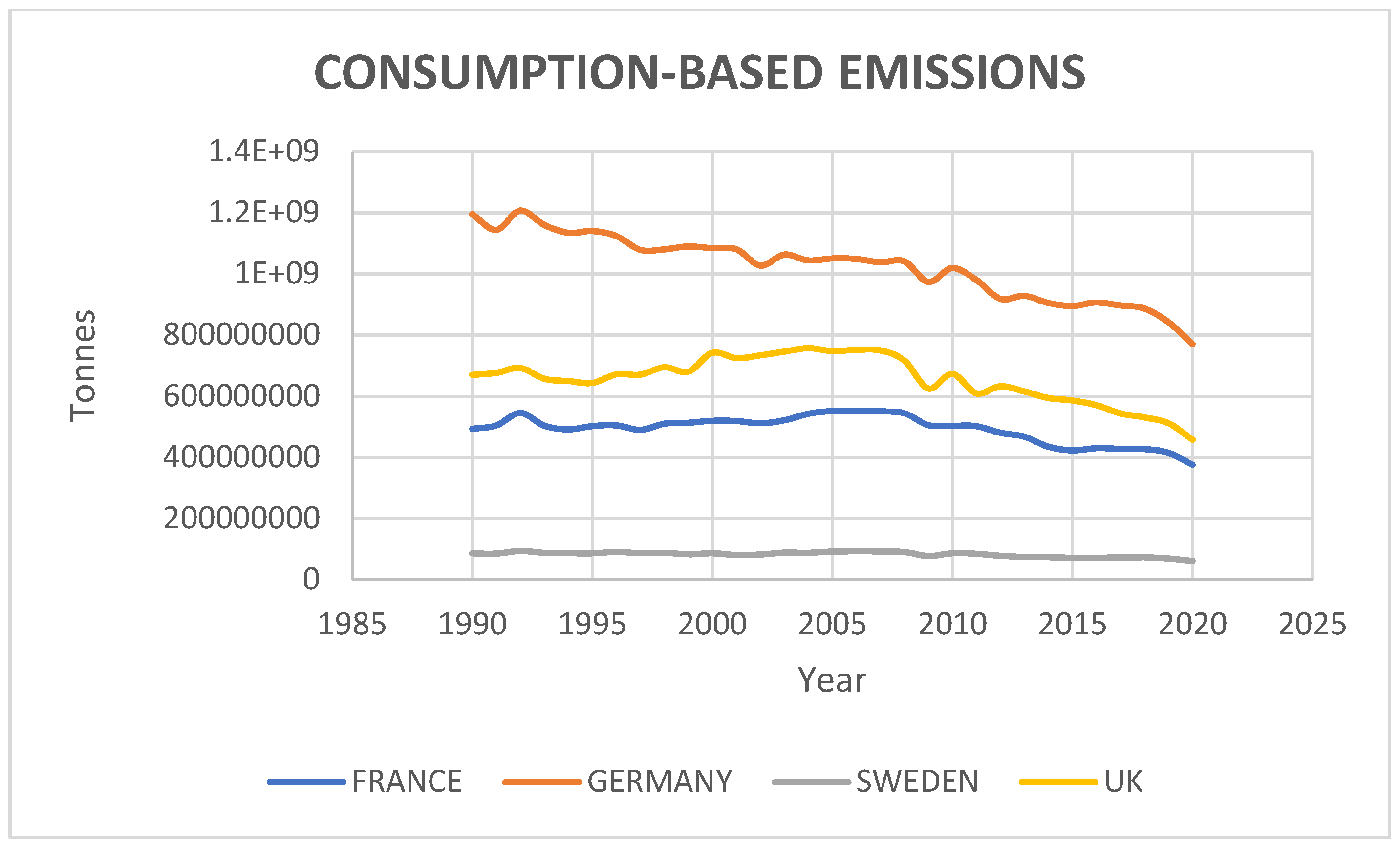
Environmentalists argue that careful consideration of carbon pricing and other eco-friendly policies is crucial to achieving global net-zero emission goals. Other sectors, such as waste management, heating, and transportation, are taxed to reduce carbon emissions, while benefits are offered to green industries. Numerous studies have shown that environmental tariffs aim to reduce fossil fuel use by making these fuels less financially attractive [8,9]. This approach encourages a shift toward cleaner energy sources and reduces overall pollution, including both territorial and consumption-based carbon emissions. Figure 1 and Figure 2 illustrate territorial and consumption-based carbon emissions in selected European economies, including France.
One option to improve environmental quality and support a move to a sustainable economy is renewable electricity. Renewable electricity is generated from renewable sources, such as wind, solar, and hydropower. These sources are known to harm the environment less than fuels such as coal and natural gas [11]. As the world works to reduce carbon emissions, renewable electricity presents a promising approach to combating climate change and achieving net-zero emissions by 2050. The primary objectives of increasing electricity use are clear: to reduce overall emissions, improve air quality, promote digital technology, and develop smart public transportation. Despite its many benefits, some critics argue that renewable electricity costs more upfront to implement. They also point out that wind and solar power are not always reliable since they depend on the weather and the time of day. Storage systems are needed but not always available or affordable. Historically, economies have undergone significant shifts in energy use; however, critics believe the 2050 goal is overly optimistic. They note that in the US, renewable energy use has stayed low since the Paris Agreement. Between 2015 and 2020, fossil fuel use dropped from 81.22% to just 73.08%. Critics argue that only realistic policies, based on broad support, can help the environment reach its 2050 target [12,13,14]
While renewable energy and ecotaxation are individually important, the extent to which they condition or moderate the environmental sustainability of nations remains unclear, especially in advanced economies. To address this gap, the study asks: do renewable energy and ecotaxation exhibit asymmetric long-run effects on France’s environmental quality? Two sub-questions operationalize this inquiry, aligned with our hypotheses: first, do positive and negative shocks in renewable energy use have statistically different long-run effects on environmental sustainability? Second, do positive and negative shocks in ecotaxation have statistically different long-run effects on environmental sustainability?
To answer these questions, France is a credible economy for assessment. As a result of its unique energy history and its complex, often controversial use of environmental policy tools within the highly regulated context of the European Union (EU), France provides an excellent case study. Its extensive use of nuclear power has significantly lowered carbon emissions over recent decades. France has also worked hard to protect natural land and marine environments. The economy has further experienced above-average temperature increases, highlighting its high vulnerability to climate change. As one of the leading EU members, France is subject to ambitious, harmonized EU targets and is committed to achieving carbon neutrality by 2050. To influence consumer behavior in an environmentally friendly manner, the Bonus–Malus System (tax/subsidy system) for new vehicles provides taxes and subsidies for low-emissions vehicles. A controversial eco-tax was imposed on heavy goods vehicles in 2014 to fund public transit, but was abandoned due to massive protests, providing an important insight into the acceptability of environmental policies [15,16]. Using both regulatory and market-based instruments for environmental sustainability, the French experience provides a rich and complex example of the opportunities and trade-offs involved.
Given these, experts say environmental health issues have not been a top policy focus. In recent years, protected species have suffered due to the agricultural sector’s strong political influence. Although France was a key player in the 2015 Paris Agreement negotiations, it is unlikely to achieve the agreement’s net-zero emissions goal by 2050, despite its global commitments. Recent estimates from the Zero Carbon Commission suggest that carbon prices in France could reach 27 billion pounds annually by 2030. France relied heavily on imported electricity in 2022 due to unstable nuclear power output. Although environmental scientists indicate that France has regressed in its net-zero objectives after 2022. The European Commission has criticized France for failing to identify areas at risk of nitrate pollution. Water quality tests reveal ongoing issues, suggesting that water monitoring and controlling standards are not being enforced [13].
Based on these debates, a study on France will clarify the country’s environmental state and contribute to existing research on the topic. Since studies that have examined the impact of eco-taxation and green electrification on environmental quality raise concerns about the validity of such policy instruments [17], this paper aims to validate, invalidate, or ascertain the facts and bring closure to the debates, using new Fourier autoregressive distributed lag econometric methods to analyze the issues. The research draws on the ideas behind Pigouvian taxes and the cap-and-trade system for pollution control. Environmental taxes and instruments have gained greater significance as economic tools for financing and mitigating environmental problems. To fully understand the interactions between the two variables and their impact on environmental sustainability for policy action, the roles of both economic growth and primary energy consumption are controlled.
The paper presents the literature review in the next section, which builds on concepts and sets the assumptions for the analysis. In addition, a literature review is necessary to contextualize the study and establish its scholarly significance by demonstrating how this study contributes to or builds upon the existing knowledge in renewable energy and eco-taxation. The methods and findings of the study follow afterwards. The final section summarizes the research and presents policy implications.

2. Literature Review

2.1. Theoretical Background

Environmental quality refers to the extent to which the environment supports human life and functions as a sink for pollutants in water, air and solids, dissipating harmful substances or absorbing waste. Human activities that reverse these functions pose serious risks to our survival, prompting experts to call for policy measures. Such policies could focus on encouraging economic growth while limiting pollution, which attracts the attention of environmental advocates. Historically, many studies have examined the Environmental Kuznets Curve (EKC). This theory suggests pollution rises with income up to a point, then falls as income increases further. The idea is that this pattern results from changes in the types of goods produced, advances in technology, and greater demand for a cleaner environment as wealth grows [18,19]. Still, most experts agree that the relationship between the environment and the economy is a complex one. It involves factors that both damage and protect environmental quality. Many scientists have sought to understand the factors driving these changes and how to mitigate their harmful effects. This study introduces an econometric model to examine the relationships among various factors and environmental quality. Its main goal is to create a model that explains the connection among economic growth, energy usage, renewable electricity, eco-taxation, and environmental health. To support this goal, the section reviews previous research to gain insights for designing a clear framework. These insights help shape the model and give direction for the upcoming analysis.

2.2. Hypothesis Development

2.2.1. The Eco Tax and Environmental Degradation

An eco-tax is a fee levied on activities that harm the environment. It acts as a tool for policymakers to help protect environmental quality. Ref. [20] found that eco taxation can lower carbon emissions by reducing demand for fossil fuels or encouraging cleaner energy use. Countries around the world implement these taxes to meet goals set by the Kyoto Protocol and the Paris Climate Agreement. The primary objective of eco-taxation is to enhance social welfare [21,22]. Experts argue that environmental harm causes damage to both society and the economy. Because of differences between private costs and social costs, [23] argued that eco-taxation helps balance the extra damage caused by pollution with the costs of mitigation. Critics, however, argue that there is no single global standard for the best energy use, carbon taxes, subsidies, or voluntary efforts. They also note that eco-taxation tends to disproportionately affect poorer households, forcing them to buy cheaper, less energy-efficient appliances [24].
Eco-taxation will significantly influence both the environment and the economy by providing financial incentives to diminish pollution and adopt sustainable practices. Eco-taxes, including carbon taxes and pollution charges, effectively reduce greenhouse gas emissions and other pollutants by increasing the costs associated with environmentally detrimental activities. Ref. [25] demonstrated that nations adopting carbon taxes experienced significant decreases in carbon dioxide emissions while maintaining economic development. Eco-taxes impose financial penalties on users to restrict emissions, thereby directing industries towards cleaner energy sources and technologies, which subsequently improve air and water quality, enhance biodiversity, and promote overall environmental health.
Eco taxation often creates distortions because it relies on a narrow tax base. This results in double taxation, as both intermediate inputs and final products are taxed [26]. Some experts suggest using cap-and-trade systems instead, as they allow markets to set pollution levels and do not directly penalize emissions. These systems set a cap on total pollution and allocate allowances to companies or individuals to pollute [27]. However, critics point out three key drawbacks of cap-and-trade systems compared to carbon taxes. First, fluctuating market prices make it difficult for companies to plan long-term, capital-intensive projects. Second, cap-and-trade systems are complex to run. They require tracking systems, auction processes, and rules to prevent fraud. Lastly, they may work against policy goals if they interfere with corporate operations or cause unintended effects.
Multiple studies have demonstrated that eco-taxation has a positive impact on reducing pollution. Refs. [28,29,30,31] all report similar findings. Ref. [32] found that imposing eco-taxation significantly reduced carbon emissions. Their research also suggests that such taxes encourage growth in renewable energy and help reduce overall energy use. Ref. [33] examined EU policies aimed at reducing carbon emissions and found that eco-taxation is highly effective in cutting emissions across member states. A similar study by [34] examined the impact of eco-taxation on the international competitiveness of European economies. They concluded that these taxes boost economic welfare and improve market health. Some researchers have found that eco-taxation has little impact on reducing carbon emissions. Studies by [31,35,36] support this view. For example, [37] argued that eco-taxation only helps protect the environment if investments are made in energy and environmental technology. Ref. [38] analyzed data from 25 European countries between 1995 and 2005 to examine the long-term impact of eco-taxation on energy use. The findings indicated that these taxes exerted a negligible influence on the energy usage of the countries studied. In consideration of these dynamics, this study posits the following hypothesis:
H1. 
Eco tax has a positive and significant effect on environmental degradation.

2.2.2. Renewable Electricity and Environmental Degradation

Energy serves as the primary form of currency in technology, but its production and use pose serious environmental concerns. These issues include global warming, air pollution, acid rain, ozone layer depletion, forest loss, and radioactive emissions. Experts and policymakers stress the need to address these challenges together to secure humanity’s future. Using energy efficiently and productively can protect the environment. It reduces pollution and cuts carbon dioxide emissions [39,40,41]. Ref. [42] found that economic growth and non-renewable electricity use harm environmental quality, whereas the utilization of renewable energy has a positive influence on the environment in Algeria. Ref. [43] research revealed that the ecological role of renewable energy in ASEAN nations is to fulfill SDGs, including the transition to a low-carbon economy and the mitigation of air pollution. Many scientists believe that shifting energy production from fossil fuels to renewable sources is essential for long-term environmental health [44,45,46]. They support the adoption of renewable technologies that convert natural phenomena into sound energy for the market [47,48]. However, critics point out that progress has been slow. Despite years of optimism from green energy advocates, most electricity and fuel still come from dirty sources, such as natural gas, oil and coal.
Economists and environmental scientists agree that energy use is the leading cause of rising carbon emissions and environmental damage [49,50,51]. These conclusions are derived from testing various hypotheses, including growth, conservation, feedback, and neutrality [52]. Several studies have demonstrated a clear link between economic growth and CO2 emissions, employing various econometric methods [53]. Many researchers argue that investing in renewable energy sources can help countries become energy independent over time [54]. From these insights, this study proposes the following hypothesis:
H2. 
Renewable electricity has a positive and significant relation with environmental degradation.

2.2.3. Relations Between Economic Growth and Environmental Degradation

Concerns about the environmental impact of economic growth have increased significantly over time. Following 1987, research began to link economic trends to environmental damage. During the 1990s, the environmental Kuznets curve (EKC) gained popularity as an explanation for this relationship [55]. The theory proposes a trade-off: as economies grow, their environmental quality can either improve or worsen, depending on the stage of development. It challenges the idea that economic growth always supports environmental sustainability. Evidence supporting this comes from studies like [56], who examined carbon emissions, energy use, and economic growth in BRIC countries between 1971 and 2005, as well as Russia from 1990 to 2005. Ref. [57] reported that a strong link exists between economic development and environmental degradation, with short-term patterns displaying a negative sign in inverted-S and S shapes in the US. Several other studies, such as [58] in Qatar and [59] in Azerbaijan, also confirm the EKC hypothesis for specific periods. Ref. [60] found that the environmental Kuznets curve concept is validated, suggesting that economic growth leads to the adoption of cleaner technologies and practices, thereby reducing environmental degradation in 76 developing countries between 1991 and 2022.
However, some studies have found no clear link. Research by [61,62,63] found no consistent evidence supporting the EKC hypothesis. Based on these reviews, this study proposes the following hypothesis:
H3. 
Economic growth has a positive and significant impact on environmental degradation.

2.2.4. Relations Between Primary Energy Supply and Environmental Degradation

Energy plays a vital role in driving economic growth, supporting society, and improving living standards worldwide. Currently, the ways we produce and use energy are not sustainable if we maintain current technology and overall consumption levels. A significant portion of the energy used for manufacturing and transportation has contributed to increased carbon dioxide emissions. Studies have shown that carbon dioxide (CO2) is the most prevalent greenhouse gas. The primary sources of these gases globally are electricity generation, heating, and transportation [64]. Ref. [65] study reveals that the marginal effects of energy use exacerbate environmental degradation and are contingent upon education. To reduce greenhouse gas emissions, it is crucial to enhance efficiency in energy production, transportation, distribution, and consumption. This study focuses on Primary energy supply to evaluate how renewable electricity and eco-taxation can reduce pollution in France. Primary energy is the energy found in nature before any conversions or processing. It encompasses both non-renewable and renewable sources, including raw fuels and waste. Measuring primary energy use helps assess the total energy consumed by an economy. Hence, we posit that:
H4. 
Primary energy supply has a positive relation with environmental degradation.

2.3. Conceptual Insights

Based on the review, our conceptual framework is rooted in the Double Dividend Hypothesis [66] and aims to bypass or flatten the traditional Environmental Kuznets Curve (EKC) trajectory. It identifies two major pathways to policy insights, (i) ecotaxation and renewable energy path (H1 & H2) respectively; and (ii) economic growth and renewable energy (H3 & H4) consumption pathways, respectively. This means that both renewable electricity and eco-taxation can improve or harm environmental quality, in much the same way as primary (fossil) energy use and economic growth can. The questions are addressed using a nonlinear autoregressive distributed lag (NARDL) model to investigate how renewable electricity and eco-taxation impact the environmental sustainability of France.
Historically, methodological studies have criticized the traditional ARDL Bounds test for failing to account for long-run asymmetric relationships, as well as a lack of endogeneity control, which can lead to sampling bias, reverse causality, and policy blunders (Shin et al., 2014) [67]. The NARDL method has been selected for this study due to its ability to handle heteroscedasticity, serial correlation, and cross-sectional dependence problems, as well as its performance in long-run equilibrium assessments [67]. Moreover, the NARDL approach is applicable regardless of the order in which variables are integrated. It can explain variations in the state of the dependent variable through the unit dynamics of the independent variables [68]. Finally, by investigating the role of these two variables in the resource economy of SSA for achieving self-sufficiency, the study deepens the global understanding of the two factors in policy development and implementation.

3. Methodology

3.1. Data and Source

This study examines the impact of eco-taxation and renewable electricity on environmental damage in France between 1998 and 2020. It uses control variables, including overall economic growth and total energy supply. Data collection focused on several key indicators, including (i) Territorial-based carbon emissions, which serve as a stand-in indicator of the environmental health of France. It was obtained from the World Bank; (ii) Economic growth (controlled variable) [1], measured by gross domestic product (GDP), was sourced from World Bank database; (iii) Renewable electricity [14] data was drawn from International Energy Agency; (iv) Eco tax [31] figures were collected from the European Commission; (v) Total energy supply [69] figures were taken from Our World in Data collections. In general, all data points were chosen based on insights from both theory and previous research, following [70]. All data were transformed into their natural logarithms, allowing for the direct interpretation of coefficients as elasticities, following the methods used by [71]. Table 1 describes the data used and sources for this study.

3.2. Theoretical Motivations

Efficient energy use enhances environmental quality by lowering pollution and reducing carbon dioxide emissions. Reducing CO2 emissions protects nature and the nefarious consequences of global warming. To attain these ecological advantages, energy sources must shift from traditional fossil fuels to renewable energy sources. Concerns about the use of fossil fuels and environmental decline are increasing worldwide. The United Nations is actively promoting a successful transition to alternative energy sources, setting ambitious targets to guide these efforts. Taxing pollution has long been proposed as a key policy tool. Despite ongoing debates, the economist [23] highlighted the difference between the private cost paid by polluters and the actual social cost of pollution.
The author argued that taxing pollution can correct this divergence and promote more efficient market outcomes. To combat climate change and achieve carbon neutrality by 2050, experts emphasize that transitioning to renewable electricity is the most reliable route in achieving net-zero emissions targets. This paper examines the relationships between primary energy use, economic growth, renewable electricity, eco-taxation, and environmental quality. It draws on the Stokey framework, a model that shows how regulations affect pollution and environmental damage [75].
The framework explains how rising fuel consumption, economic growth, and environmental health are linked. It also demonstrates how eco-taxation can mitigate global emissions and encourage innovation in energy utilization. The study is also inspired by the Environmental Kuznets Curve (EKC) theory and the role of technical progress in boosting growth and environmental quality over time. To meet these goals, the paper develops an empirical model on the study of [55] to analyze these relationships.
C O 2 = f G D P ,   P O T ,   R E E ,   T E S
where CO2 is Territorial-based carbon emissions; GDP is gross domestic product; TES is Total energy supply; POT is eco tax, REE is renewable electricity
Next, by logging variables, the model is specified as:
L C O 2 = f ( L G D P t + P O T t + R E E t + L T E S t +   e t )
where LCO2 is logged territorial-based carbon emissions; LGDP logged GDP is gross domestic product; LTES is logged to the total energy supply; POT is eco tax, REE is renewable electricity; f is function; t is time-series data and e is error term.

3.3. Estimation Procedure

3.3.1. BDS Tests

In traditional econometric analysis, structural breaks have often been overlooked. However, experts have found that ignoring these breaks can lead to biased estimates of unit roots [76]. To identify the order of integration in variables, the BDS test is used. This test helps detect hidden nonlinear patterns that may exist in the data. It also reveals potential mistakes in model specification and critical inaccuracies. The BDS model is chosen based on the results of this testing process as
B D S m T ε = T 1 2 C m , T ε C 1 , T ( ε ) m / δ m T ε
where T describes the study sample, ɛ represents the randomly implemented proximate parameter and δ_mT^ (ɛ) stands for the standard deviation of the fluctuating numerator, given the dimension “m”.

3.3.2. ADF Unit Root with Break Point

Following the descriptive statistical analysis, the study assesses the order of integration among the variables employing Augmented Dickey–Fuller (ADF) unit root tests with breakpoints [77]. In econometrics, when variables are integrated at different levels, standard cointegration tests cannot be applied reliably. To address this, the paper employs a new version of the ADF test that accounts for breaks, providing more accurate results regardless of the integration order. The model used to estimate the unit roots with breaks is outlined as follows:
x t = μ + ρ x t 1 + e t
Note: xt refers to variables; μ is a constant; et is the error term. Δxt = μ+ et is the model if different. If Δ = (1 − B), ρ denotes the slope parameter concerning all lagged variables, which becomes 1 when there is a unit root. ADF unit root containing breaks is:
x t = μ + β 1 δ D U t + θ D ( T B ) t + e t
The estimation of the error correction form redefinition, the increment factor, and the ADF with breaks is as follows:
x t = μ + β t + γ 1 s i n 2 π k t N + γ 2 c o s 2 π k t N + ρ 1 x 1 1 + i 1 ρ C i x i 1 + ε
c’ is the parameter slopes of the ADF; p is the lag; k is the Fourier symmetry; TB is the date for structural break; λ refers to the break fraction.

3.3.3. Fourier Autoregressive Distributive Lag (F-ADL) Cointegration Tests

In economic analysis, variables often contain many structural breaks. These breaks can cause models to be mis-specified, leading to incorrect results. The unit root test results support the use of the ADL cointegration test, which accommodates nonlinear breaks. This test models breaks that can be smooth, gradual, and of unknown number by using a Fourier function. It avoids losing power during testing by not relying solely on dummy variables. Instead, it captures the breaks flexibly, increasing the accuracy of the model. The approach helps address the challenges posed by complex data patterns. The model of [78] is designed to adapt to these structural changes effectively as
d t = k = 1 n a k sin 2 π k t T + k = 1 n b k cos 2 π k t T
n’ is the frequency; ‘k’ is the distinct frequencies used, ‘t’ is the trend, π = 3.14, and ‘T’ is the sample size. The model suggests a single frequency value, and the values conforming to the least sum of squared residuals have been endorsed [79].
d t = γ 1 s i n 2 π k t T + γ 2 c o s 2 π k t T

3.3.4. Fourier Nonlinear ARDL Long-Run Equilibrium Estimation

Experts have observed that the conventional ARDL cointegration method is limited in detecting hidden long-term nonlinear relationships among variables (Pesaran et al., 2001) [76]. It often misses complex interactions that change over time. Recently, experts have started using the Fourier nonlinear ARDL estimator. This method better captures long-run equilibrium links, mainly when structural breaks occur in both the timing and structure of the data [79,80].
A key strength of the NARDL approach is its ability to handle issues like heteroscedasticity and serial correlation in time series data. This method is well-regarded because it can be used regardless of whether the variables are at different levels of integration, such as I(0), I(1), or a mix of both. It facilitates a clear understanding of how the dependent variable, Yt, responds to changes in the independent variables, Xit. These responses can be positive or negative, depending on whether the independent variables increase or decrease. The model captures these fluctuations based on the unit changes in the regressors as
Y t = β o + β 1 X t + e t
Y t is the dependent variable; Xt refers to regressors; β1 is the variation of Y t due to unit changes in Xit. The method employs a two-step approach to address structural shifts [81]. The partial sums of X t or partial sums of X-t are restructured for a long-run asymmetric model and expressed as:
Y t =   β o +   β 1 + X t + +   β 1 + X t +   e t
The N-FARDL model is:
L C O 2 t = β 0 + i 1 ρ 1 β 1 L C O 2 t 1 +   +   i 1 ρ 1 β 1 L C O 2 t 1   +   i 1 ρ 1 β 2 L G D P t 1 +   +   i 1 ρ 1 β 2 L G D P t 1 + i 1 ρ 1 β 3 L T E S t 1 +   +   i 1 ρ 1 β 3 L T E S t 1   +   i 1 ρ 1 β 4 P O T t 1 +   +   i 1 ρ 1 β 4 P O T t 1 + i 1 ρ 1 β 5 R E E t 1 +   +   i 1 ρ 1 β 5 R E E t 1 + q L C O 2 t 1 + 1   + L G D P t 1   + 2 L G D P t 1 + 1 + L T E S t 1   + 2 L T E S t 1 + 1 + P O T t 1   + 2 P O T t 1 + 1 + R E E t 1   + 2 R E E t +   e t
Y t = β 0 + i = 1 p β 1   y t 1 + i = 0 q β 2   X t i + + i = 0 q β 3   X t i + i = 0 q β 4   X t i denotes short-term and 〖ρy〗_(t−1) + 1   + 1^+ X_(t−1)^+ + 2 ^- X_(t−1)^-+. Signifies long-term estimates. Also, X_t^+ and X_t^- are fractional sums of POS (+) and NEG (-) alternations in 〖 X〗_t. NARDL frameworks examine the long-term association between 〖X〗^+, 〖^〗X-, and Y (Pesaran et al., 2001) [76]. Long-term asymmetric effects of X_1 on Y are calculated as L_(M1+) = (− 1   + ^+)/ρ and L_(M1-) = (− 1   + ^−)/ρ; Short-term asymmetric effects of X_1 on Y. Rejecting the symmetry confirms the asymmetric effects of X on Y.
Finally, the study utilizes the Fourier–Toda–Yamamoto causality test to corroborate the results of the Fourier ARDL estimations [82].

4. Empirical Outcomes

The study seeks to evaluate the effects of eco-taxation and the use of renewable energy on environmental quality in France. The model also includes variables like economic output and primary energy supply, which serve as controls. These additional factors help isolate the effects of eco taxation and renewable energy efforts on the environment. The data presented in Table 1 provides the relevant details for these variables in Table 2.

4.1. Descriptive Statistics

Based on the summary outcomes shown in Table 2, there were no outliers in the dataset. The analysis also indicates that the variables follow a normal distribution, allowing for further testing. To continue, the study examines whether the variables show linear or nonlinear relationships using the BDS approach.

4.2. The BDS (Nonlinear) Test

It is evident from the BDS estimates (Table 3) that hidden nonlinear patterns exist, since all variables exhibit significant dimensional critical values, which are above their respective BDS estimates

4.3. ADF Unit Root Test with Break Point

According to the results of the ADF Unit Root test with Break Point (Table 4), the interest variables are integrated at order one (i.e., I(1) with breakpoints at 1997Q1, 2018Q4, 1998Q4, and 1998Q1). Historically, 1997Q1/1998Q1/1998Q4 represented periods when the European Union liberalized and adopted a climate policy, marking a critical period for the organization. It was a period of transition between the European Single Market and the European Monetary Union, especially prior to the launch of the Euro in 1999, which led to significant economic restructuring. It was during this period that early discussions regarding CO2 and energy taxation took place, which led to the establishment of energy taxes and a climate policy framework for both the EU and France. Similarly, 2018Q4 historically marked the beginning of the “Yellow Vest” protests in France, which were directly sparked by the proposed increase in the carbon tax on fuel. It was a significant and abrupt structural shift in France’s eco-taxation policy and public acceptance of climate measures that forced the government to freeze the proposed tax hike.

4.4. Fourier ADL Co-Integration Analysis

It is evident from the findings that variables are integrated at first difference. Considering these results, the paper examines the co-integration properties of variables using the Fourier ADL Co-integration estimator (see Table 5). In the case of France, it is possible to measure the impact of POT, LGDP, LTES, and REE on LCO2 by testing for co-integration.

4.5. N—ARDL Bounds and Long Run Test

As shown in Table 6, the F-statistics appear to be higher than the targeted critical values based on the Fourier ARDL Co-integration results (ARDL Bounds test). Based on this result, it can be concluded that the dependent variable and the independent variable have long-term equilibrium relationships.

4.6. Discussion of Findings

According to the results, the long-run nonlinear ARDL estimates reveal that during periods of economic shocks, the variables coefficients exhibit varying levels of statistical significance. From the onset, the N-ARDL long-run co-integration outcomes (Table 7) suggest that for the case of LGDP, both positive and negative nonlinear causal effects on LCO2 exist, given that both positive and negative coefficients are recorded and are significant at −0.484297 and −0.234380, respectively.
First, a 1% increase in LGDP results in a reduction of LCO2 by approximately 48.42% during periods of positive shocks, whereas a 1% decrease in LGDP unexpectedly leads to an increase in LCO2 by 0.23438% in times of adverse shocks, as they follow opposing paths in France, all other things being equal. In contrast to positive shocks in LGDP, negative shocks have a diminished effect on decreasing carbon emissions in France. This result aligns with the hypothesized outcome regarding the effects of LGDP on LCO2 in France. Noteworthy is the fact that the disintegration power of the N-ARDL estimator underscores the need to implement policies aimed at decoupling LGDP from LCO2 in France during shocks.
Recent research by [84] for the UK and [85] for China supports this finding. According to theory, economic expansion increases demand for energy and raw materials for industrial production, which in turn worsens environmental quality. The Environmental Kuznets Curve (EKC) framework makes this assertion. According to the framework, causes of environmental degradation persist throughout the first stage of economic growth until regulations and technological advancements begin to improve the situation. The results suggest that France’s economic growth has reached the EKC peak, marked by technological and innovative improvements, as demonstrated by relatively low CO2 emissions during positive economic shocks.
As a result of the Nonlinear-ARDL long-run cointegration (Table 7), we observe both a positive and a negative nonlinear causal influence on LCO2 for REE, with coefficients of −0.005098 and 9.79 × 10⁻⁵ corresponding with positive and negative shocks. Accordingly, a 1% surge in REE results in a reduction in LCO2 by nearly 0.005098% during periods of positive shock, whereas a 1% decrease in REE during periods of negative shock results in a reduction in LCO2 by approximately 9.79 × 10⁻⁵%. For the case of France, this finding validates the hypothesis established regarding REE’s effects on LCO2. Theoretically, investments in renewable energy sources have reduced carbon emissions. This outcome aligns with the Green Solow Model [86], which posits that technological advancements in pollution abatement can lead to emission reductions, underscoring the critical need to invest in technologies specifically designed to address pollution, as seen in France.
It is worth noting that the small coefficient for REE during positive periods in France suggests that changes in REE have a limited impact on LCO2 over the study period. Since France has heavily invested in nuclear power (which accounts for over 60% of the country’s electricity production), its electricity grid has historically had one of the lowest carbon emissions in Europe. Adding a unit of renewable energy to a country with a high-carbon energy mix (e.g., coal) results in the displacement of a significant amount of CO2, leading to a substantial reduction in the country’s carbon footprint. It should be noted that the addition of new renewable energy generation in France is primarily intended to replace marginal generation from gas or, in some cases, already-clean nuclear power. Due to this, the environmental benefit per unit of RE added is smaller in France than in countries such as Germany or Poland.
Investments in renewable energy are often massive, long-term capital expenditures that are sensitive to macroeconomic cycles (e.g., high interest rates/recessions slow investment). Initially, the high cost may absorb economic resources without generating a strong return on investment (a small coefficient on GDP). In some cases, the incremental deployment of renewable energy may be overshadowed by the effects of other, more significant policies, such as the operation of the nuclear fleet or the structure of eco-taxes on transport fuel. A small coefficient suggests that French consumers and industry are highly inelastic to changes in the share of renewable energy. Price and efficiency are more important factors driving their consumption habits than the source of generation (especially given that the overall supply is already clean).
It is worth-noting that France has demonstrated a commitment to transforming its energy system by focusing on three key areas, curbing fossil fuel consumption by actively working to reduce reliance on traditional fossil fuels; improving energy efficiency by investing in measures to make its energy consumption more efficient through reducing overall demand and by relying on renewable electricity via ensuring significant shift towards generating electricity from renewable sources. It is vital to note that a robust transition to net-zero emissions requires substantial investment in green innovation. The experience of France highlights this: periods with limited or no investment in green energy technologies have been linked to increases in carbon emissions.
Thirdly, the analysis reveals both positive and negative nonlinear causal impacts of LTES on LCO2 with coefficients of 0.882688 and 1.341291, respectively, indicating their magnitudes. Specifically, during positive shock periods, a 1% increase in LTES leads to an approximately 88.26% increase in LCO2. This suggests that during periods of positive LTES shocks, carbon emissions rise significantly. However, during negative shock periods, a “1% decrease in LTES triggers a surprise reduction in LCO2 by 1.34%”—comparatively, negative shock periods for LTES help to reduce carbon emissions in France than positive shock periods. Available records indicate that the recent increase in primary energy use in France, from 5% to 8.66 exajoules in 2023 compared to 2022, represents a notable short-term rise.
However, despite the recent increase, primary energy consumption in France has significantly declined by 2.7 exajoules since 2000, peaking at nearly 11.4 exajoules in 2004. This indicates a general downward trend over the past two decades, explaining the economic slowdown and rising energy costs due to supply bottlenecks, which have resulted in increased coal use in electricity production. Compared to other EU countries, France’s LTES is considered low. The estimates validate the hypothesis about the role of LTES in LCO2 and offer valuable insights into France’s total energy supply, highlighting both a long-term positive decline and recent challenges driven by economic factors and energy costs.
The long-run equilibrium nonlinear-ARDL estimates related to the impact of the Eco Tax (POT) on LCO2 emissions (LCO2) in France find that the impact of POT on LCO2 is nonlinear. These findings validate the stated hypothesis for this assignment on POT for LCO2 in France and align with [20].
This means that positive economic shocks and adverse economic shocks have different effects. The coefficients for POT indicate, for positive economic shocks, the coefficient for POT on LCO2 is −0.043468, implying that a 1% increase in POT leads to approximately a 0.043468% decrease in LCO2. This is a direct, negative relationship, suggesting that a higher eco tax during periods of economic growth helps reduce emissions. However, for adverse economic shocks, the coefficient estimate for POT on LCO2 is 0.064726, implying that a 1% decrease in POT during negative shock periods results in a 0.064726% reduction in LCO2, as they move in the same direction. This means that if POT and LCO2 decrease, they move in the same direction. In simple terms, during economic downturns, a relaxation of the eco tax (a decrease in POT) is associated with lower LCO2 emissions, due to reduced economic activity and thus lower overall energy demand. It is worth noting that the opposite signs indicate asymmetric effects, suggesting that policymakers in France cannot assume a linear response to eco-taxes. When a positive shock occurs, such as a tax hike, its impact is often disproportionately larger than when a negative shock occurs, like a tax cut, which may merely encourage consumption.
Considering the implications of the outcomes for France’s economy, there is a clear theoretical basis and practical application of eco-taxation towards realizing carbon emission reduction targets, specifically in the context of the Kyoto Protocol and the Paris Climate Agreement. The theoretical foundations hinge on the negative externalities of eco taxes, as the consumption or production of pollution-causing goods tends to impose costs on society that are not reflected in the private market price, which does not account for the actual cost of emissions during production or consumption. The outcomes align with Pigouvian Taxes [23], which argue that eco-taxation can equate social marginal damage with private costs, leading to more efficient market outcomes. In essence, France is committed to transforming its energy system through eco-taxation to curb fossil fuel consumption and transition to a net-zero emissions economy.

4.7. Model Stability Test

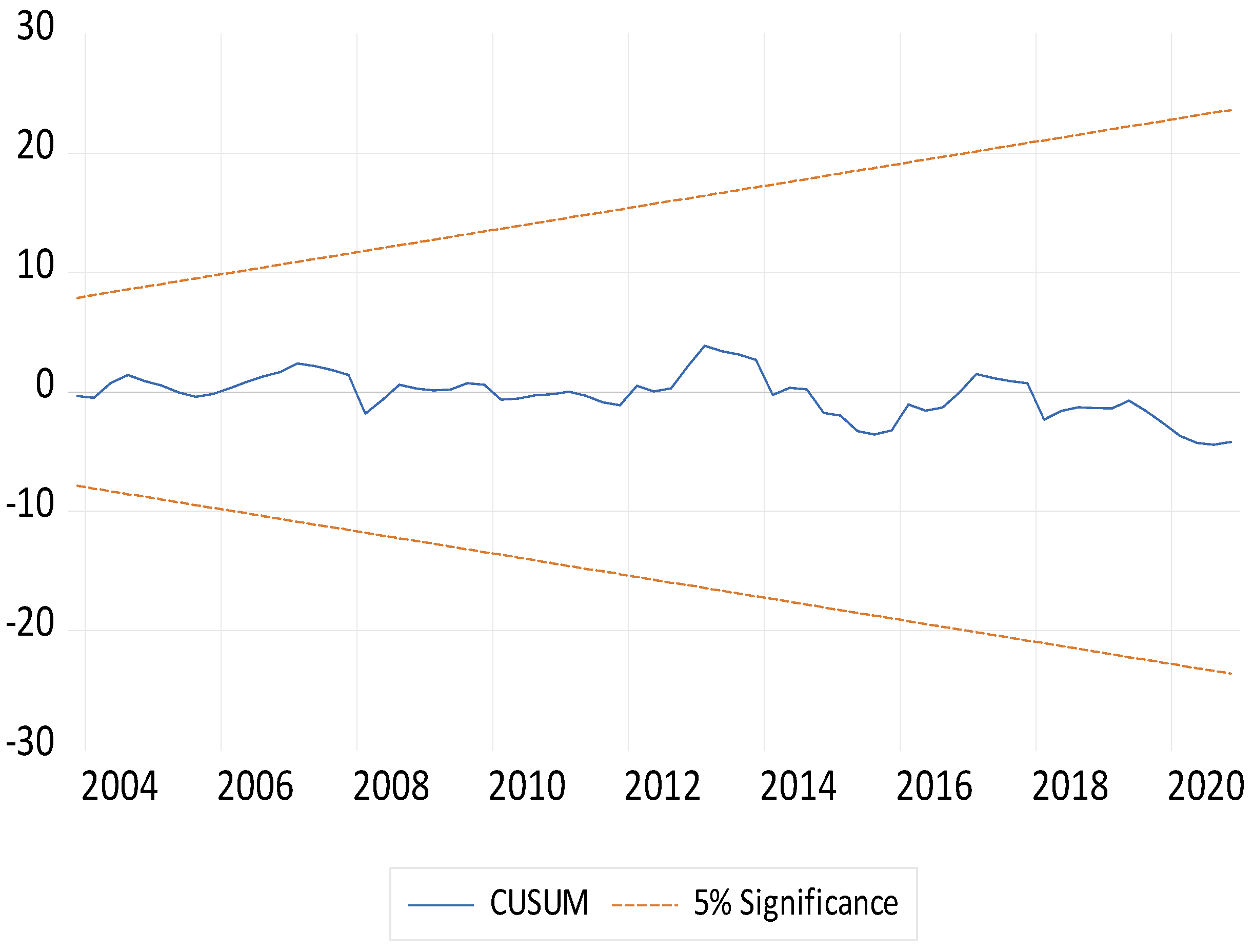
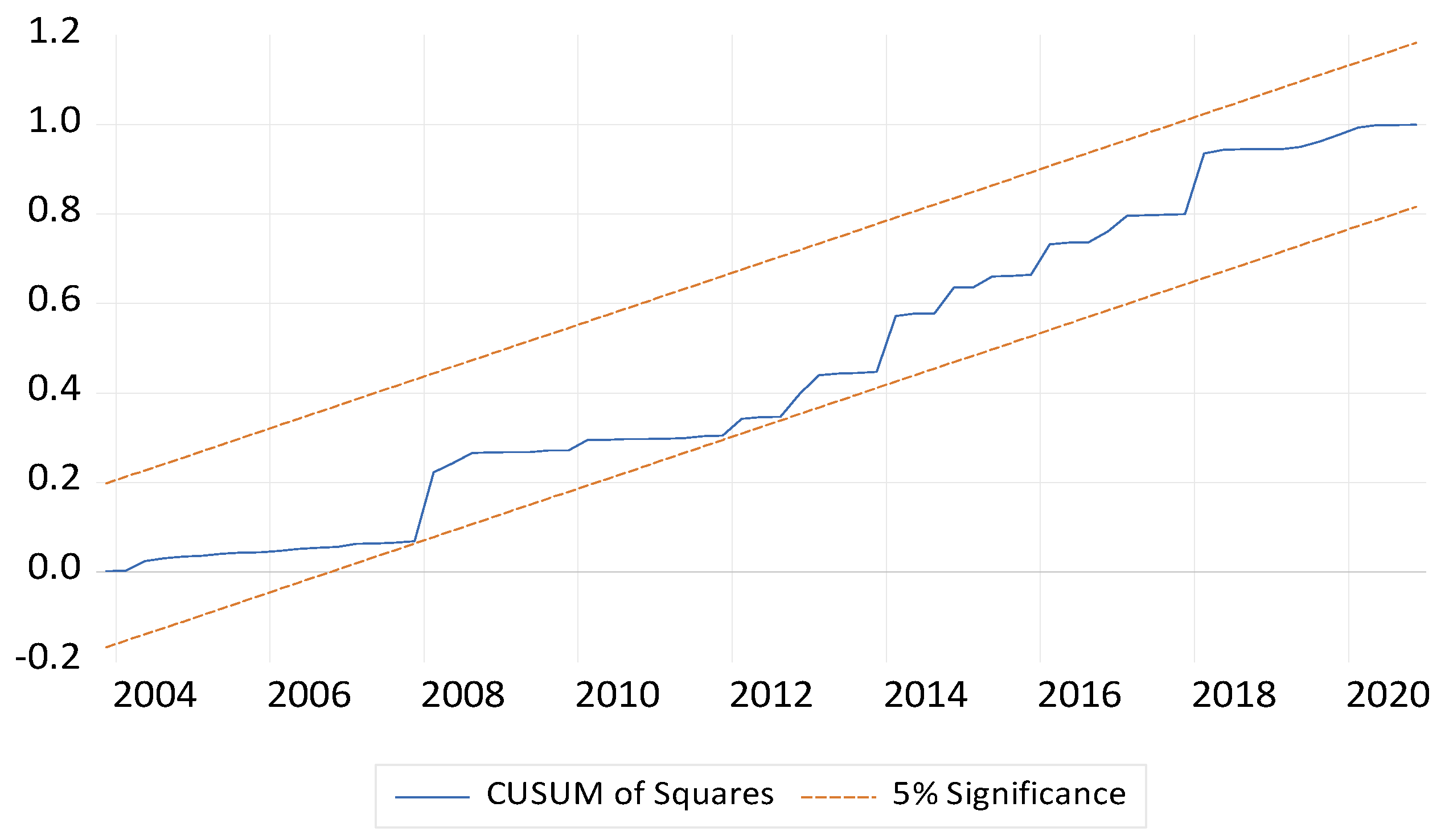
In econometric analysis, model stability is crucial for ensuring that coefficient estimates are reliable and valid, particularly when used to inform policy recommendations, such as those related to LCO2 (carbon dioxide emissions) policies in France. To assess model stability, this paper employed cumulative stability tests, including the Cumulative Sum (CUSUM) test (Figure 3) and the CUSUM of squares test (Figure 4; [87]), which are commonly used to detect structural breaks or changes in model parameters over time. The outcome suggests the model is stable, as shown in Figure 3 and Figure 4, where the cumulative sums of the recursive residuals remain within specified critical bounds.

4.8. Residual Diagnostic Tests

Beyond model stability, it is crucial to verify the absence of violations of classical linear regression assumptions. The paper detects serial correlation (Table 8) using the Breusch-Godfrey Serial Correlation LM Test because its presence can lead to inefficient coefficient estimates. The results indicate that the error terms in the model are not serially correlated over time.
To detect the presence of Heteroskedasticity, the Breusch-Pagan or White test (Table 8) is performed to check if the variance of the error terms is not constant across all levels of the independent variables, thereby avoiding biased standard errors and incorrect inferences. The results indicate no Heteroskedasticity and provide confidence that the estimated coefficients are robust and can be reliably used for informed policy decisions on LCO2 emissions in France.
The Ramsey RESET test (Table 8) was used to verify that the functional form of the regression model is correctly specified. Developed by James B. Ramsey in 1969 [88], the test has been used since then. Specifically, it is designed to detect specification errors in linear regression models. Ramsey reset results indicate that the model does not have any specification errors or omitted-variable biases, and that nonlinear combinations of the explanatory variables help explain the response variable, given its insignificant p-value.

4.9. Causality Test

As the direction of causality between the variables estimated in the NARDL model is unclear, the Fourier-Toda-Yamamoto causality test was applied. In the first instance, it was used by [89] and is a more advanced version of the standard [82]. Fourier Toda-Yamamoto’s key innovation is its ability to account for smooth structural changes and nonlinearities in data through the incorporation of Fourier functions. Hence, it is more robust in situations where traditional linear causality tests might be mis-specified due to the complexity of the time series.
The Fourier Toda Yamamoto causality test (Table 9) indicates that all variables, i.e., LGDP, REE, POT, and LTES, cause LCO2.

5. Conclusions and Implications of the Study

Over the past industrial age, the world has been exposed to high levels of pollution and degradation. In recent years, there has been increased worldwide focus on addressing environmental decline. However, environmental policy has employed various measures to achieve the goals of environmental protection and sustainable development. Despite the multitude of measures available, empirical evidence suggests that renewable energy sources and eco-taxes are the most effective in mitigating all adverse consequences. This study aims to investigate the impact of eco-taxation and renewable electricity on France’s environmental quality. To ensure accurate results, the research takes into account factors such as economic growth and primary energy supply, which are crucial for calculating carbon emissions. The nonlinear ARDL long-term cointegration analysis reveals that eco-taxation is an effective means of reducing carbon emissions from production. It also reveals that increasing renewable electricity can either raise or decrease these emissions. Lastly, the Fourier-Toda-Yamamoto causality test finds that LGDP, REE, POT, and LTES all influence LCO2.

5.1. Theoretical Contributions

We conceptualize a double dividend hypothesis [66] and bypass or flatten the traditional Environmental Kuznets Curve (EKC) trajectory, by identifying two major pathways to policy insights: (i) ecotaxation and renewable energy path; and (ii) economic growth and environmental degradation pathway. By doing so, we explain the effect of ecotaxation and renewable energy consumption.
Moreover, by documenting boom–bust asymmetric long-run effects of ecotaxation and renewable energy consumption, the study explains why linear models yield mixed findings. We foreground NARDL as a viable single-country framework for France, integrating BDS pre-testing, Fourier ADL co-integration analysis, N-ARDL Bounds, and long-run results triangulation. The contribution is to demonstrate how policy-relevant asymmetries (gains vs. losses) can be identified and interpreted within a coherent time-series design, moving beyond symmetric ARDL summaries. By linking asymmetric long-run effects to renewable energy use and ecotaxation, the study proposes a mechanism-informed policy architecture.

5.2. Policy Implications

The results offer nonlinear and asymmetric insights for policymakers in France. Additionally, to achieve the goals of the European Green Deal, the European Union has set bold targets to address climate change and protect the environment. These include cutting greenhouse gas emissions by 55% by 2030 and making Europe a climate-neutral continent by 2050. France can support these efforts by adopting green taxes that align with EU policies, such as the EU Emission Trading System.
Due to differences between countries, France should collaborate with the EU to establish consistent rules for environmentally related taxes that support meeting climate goals. Compared to other EU countries, France has relatively low taxes on the transportation sector. While the country’s feebate system for new vehicles has helped cut emissions, it has also led to some rebounds. France can improve by introducing pollution taxes, such as energy taxes based on the carbon dioxide content of fossil fuels. Historically, France has used taxes on polluting activities, like the TGAP tax introduced in 1999. This tax applies to companies whose activities or products cause pollution.
The energy sector in France accounts for about 11% of the country’s total greenhouse gas emissions. In 2023, the electricity mix consisted of 92% low-carbon sources, comprising 65% nuclear power, 15% solar and wind energy, and 12% hydroelectric power. Significant investments followed poor results in 2022. These investments aimed to reduce the country’s reliance on fossil fuels, which still accounted for half of its primary energy supply. France plans to increase solar capacity from 16 GW to 60 GW by 2030. Wind energy is set to grow from current levels to 35 GW by 2030. Hydroelectricity is expected to increase slightly from 26 GW currently to 29 GW by 2035 [90]. The study suggests that France should adhere to its plan to produce 560 TWh of decarbonized electricity annually, representing a significant increase from the current 463 TWh.

5.3. Limitations of the Study and Future Considerations

The study focuses solely on emissions from production activities in France, limiting comparisons across regions due to time constraints. Future research could examine how these variables affect environmental quality by using several economies to enable better cross-country comparisons. Additionally, the study period ends in 2020, at the time of writing, due to data availability issues, and therefore, could not account for recent dynamics in energy and climate policy alterations in France. Hence, future research should consider assessing these dynamics.

Author Contributions

Conceptualization, A.F.A.A.; writing—original draft preparation, A.F.A.A.; methodology, M.W.A.; writing—review and editing, M.W.A. All authors have read and agreed to the published version of the manuscript.

Funding

This research received no external funding.

Institutional Review Board Statement

Not applicable.

Informed Consent Statement

Not applicable.

Data Availability Statement

The original contributions presented in this study are included in the article. Further inquiries can be directed to the corresponding author.

Conflicts of Interest

The authors declare no conflicts of interest.

References

  1. Alvarado, R.; Toledo, E. Environmental degradation and economic growth: Evidence for a developing country. Environ. Dev. Sustain. 2017, 19, 1205–1218. [Google Scholar] [CrossRef]
  2. McMorran, R.; Nellor, D. Tax Policy and the Environment: Theory and Practice. 1994. Available online: https://ssrn.com/abstract=883847 (accessed on 21 July 2025).
  3. Lin, B.; Jia, Z. The energy, environmental, and economic impacts of carbon tax rate and taxation industry: A CGE-based study in China. Energy 2018, 159, 558–568. [Google Scholar] [CrossRef]
  4. Briguglio, E. The Impact of Taxation on the Ecological Transition. The Case of the So-Called Plastic Tax. 2025. Available online: https://tesidottorato.depositolegale.it/bitstream/20.500.14242/215192/1/Tesi_The%20impact%20of%20taxation%20on%20the%20ecological%20transition.pdf (accessed on 19 July 2025).
  5. Cardenete Flores, M.A.; Lima, M.C.; Sancho, F. Technology Determinants of Carbon Emissions from Demand and Supply Perspectives; BSE, Barcelona School of Economics: Barcelona, Spain, 2024; Available online: https://ddd.uab.cat/record/299347 (accessed on 1 July 2025).
  6. Verma, R. Fiscal Control of Pollution; Springer: Singapore, 2021; Available online: https://link.springer.com/book/10.1007/978-981-16-3037-8 (accessed on 1 July 2025).
  7. OECD Organisation for Economic Co-operation and Development (OECD). Taxing Energy Use 2019: Using Taxes for Climate Action; OECD Publishing: Paris, France, 2020. [Google Scholar]
  8. Nazarkevych, I.; Sych, O. Taxation as a tool of implementation of the EU Green Deal in Ukraine. Reg. Sci. Policy Pract. 2023, 15, 144–161. [Google Scholar] [CrossRef]
  9. Meloche, J.P.; Tremblay-Racicot, F. Eco-Fiscal Tools and Municipal Finance: Current Practices and Opportunities. 2025. Available online: https://hdl.handle.net/1807/145382 (accessed on 25 June 2025).
  10. Our World in Data. 2025. Available online: https://ourworldindata.org/grapher/production-vs-consumption-co2-emissions?tab=table&country=FRA~SWE~DEU~GBR&tableFilter=selection (accessed on 21 June 2025).
  11. Lin, B.; Jia, Z. Is emission trading scheme an opportunity for renewable energy in China? A perspective of ETS revenue redistributions. Appl. Energy 2020, 263, 114605. [Google Scholar] [CrossRef]
  12. Demirbas, A. Global renewable energy projections. Energy Sources Part B 2009, 4, 212–224. [Google Scholar] [CrossRef]
  13. Gielen, D.; Gorini, R.; Wagner, N.; Leme, R.; Gutierrez, L.; Prakash, G.; Asmelash, E.; Janeiro, L.; Gallina, G.; Vale, G.; et al. Global Energy Transformation: A Roadmap to 2050. 2019. Available online: https://www.h2knowledgecentre.com/content/researchpaper1605 (accessed on 13 August 2025).
  14. Moriarty, P.; Honnery, D. Global Renewable Energy Resources and Use in 2050. In Managing Global Warming; Academic Press: Oxford, UK, 2019; pp. 221–235. [Google Scholar] [CrossRef]
  15. Holechek, J.L.; Geli, H.M.E.; Sawalhah, M.N.; Valdez, R. A global assessment: Can renewable energy replace fossil fuels by 2050? Sustainability 2022, 14, 4792. [Google Scholar] [CrossRef]
  16. Lyman, R.; Economist, E. Why renewable energy cannot replace fossil fuels by 2050. Friends Sci. Soc. 2016, 1–44. Available online: https://www.ourenergypolicy.org/wp-content/uploads/2016/06/Renewable-energy-cannot-replace-FF_Lyman1.pdf (accessed on 13 August 2025).
  17. de Azevedo, M.C. Recent Developments in the Environmental Debate Before and After the Kyoto Protocol: A Survey; ISAE, Istituto di Studi e Analisi Economica: Roma, Italy, 2002; Available online: https://lipari.istat.it/digibib/Isae%20Documenti%20Lavoro/wpcagiano25.pdf (accessed on 3 June 2025).
  18. Grossman, G.M.; Krueger, A.B. Environmental Impacts of a North American Free Trade Agreement. 1991. Available online: https://doi.org/10.3386/w3914 (accessed on 26 October 2024). [CrossRef]
  19. Panayotou, T. Demystifying the environmental Kuznets curve: Turning a black box into a policy tool. Environ. Dev. Econ. 1997, 2, 465–484. [Google Scholar] [CrossRef]
  20. Bashir, M.F.; Ma, B.; Bashir, M.A.; Radulescu, M.; Shahzad, U. Investigating the role of environmental taxes and regulations for renewable energy consumption: Evidence from developed economies. Econ. Res. Ekon. Istraživanja 2022, 35, 1262–1284. [Google Scholar] [CrossRef]
  21. Baumol, W.J. On Taxation and the Control of Externalities. Am. Econ. Rev. 1972, 62, 307–322. Available online: http://www.jstor.org/stable/1803378 (accessed on 10 June 2025).
  22. Oates, W.; Baumol, W. The instruments for environmental policy. In Economic Analysis of Environmental Problems; NBER: Cambridge, MA, USA, 1975; pp. 95–132. Available online: http://www.nber.org/chapters/c2834 (accessed on 5 February 2025).
  23. Pigou, A.C. Co-operative Societies and Income Tax. Econ. J. 1920, 30, 156–162. [Google Scholar] [CrossRef]
  24. Yamaguchi, M. Factors that affect innovation, deployment and diffusion of energy-efficient technologies–Case studies of Japan and iron/steel industry. In Proceedings of the In-Session Workshop on Mitigation at SBSTA22 (Subsidiary Body for Scientific and Technological Advice, 22nd Session), Bonn, Germany, 23 May 2005. [Google Scholar]
  25. Andersen, M.S. Carbon taxation and fiscal consolidation: The potential of carbon pricing to reduce Europe’s fiscal deficits. J. Environ. Econ. Manag. 2019, 94, 66–79. [Google Scholar] [CrossRef]
  26. Goulder, L.H. Environmental taxation and the double dividend: A reader’s guide. Int. Tax Public Financ. 1995, 2, 157–183. [Google Scholar] [CrossRef]
  27. Metcalf, G.E. On the economics of a carbon tax for the United States. Brook. Pap. Econ. Act. 2019, 2019, 405–484. [Google Scholar] [CrossRef]
  28. Meng, S.; Siriwardana, M.; McNeill, J. The environmental and economic impact of the carbon tax in Australia. Environ. Resour. Econ. 2013, 54, 313–332. [Google Scholar] [CrossRef]
  29. Jiang, L.; Lin, C.; Lin, P. The determinants of pollution levels: Firm-level evidence from Chinese manufacturing. J. Comp. Econ. 2014, 42, 118–142. [Google Scholar] [CrossRef]
  30. Chen, J.; Cheng, J.; Dai, S. Regional eco-innovation in China: An analysis of eco-innovation levels and influencing factors. J. Clean. Prod. 2017, 153, 1–14. [Google Scholar] [CrossRef]
  31. Akbar, U.S.; Bhutto, N.A.; Rajput, S.K.O. How do carbon emissions and eco taxation affect the equity market performance: An empirical evidence from 28 OECD economies. Environ. Sci. Pollut. Res. 2024, 31, 46312–46324. [Google Scholar] [CrossRef] [PubMed]
  32. Niu, K.; Tian, Z.; Xue, J. Pollutant emission reduction effect through effluent tax, concentration-based effluent standard, or both. Chin. J. Popul. Resour. Environ. 2016, 14, 68–80. [Google Scholar] [CrossRef]
  33. Barker, T.; Junankar, S.; Pollitt, H.; Summerton, P. Carbon leakage from unilateral environmental tax reforms in Europe, 1995–2005. Energy Policy 2007, 35, 6281–6292. [Google Scholar] [CrossRef]
  34. Ekins, P.; Speck, S. Environmental Tax Reform (ETR): A Policy for Green Growth; Oxford University Press: Oxford, UK, 2011. [Google Scholar]
  35. Lin, B.; Li, X. The effect of carbon tax on per capita CO2 emissions. Energy Policy 2011, 39, 5137–5146. [Google Scholar] [CrossRef]
  36. Vera, S.; Sauma, E. Does a carbon tax make sense in countries with still a high potential for energy efficiency? Comparison between the reducing-emissions effects of carbon tax and energy efficiency measures in the Chilean case. Energy 2015, 88, 478–488. [Google Scholar] [CrossRef]
  37. Miceikiene, A.; Čiulevičienė, V.; Rauluskeviciene, J.; Štreimikienė, D. Assessment of the effect of environmental taxes on environmental protection. Ekon. Časopis 2018, 66, 286–308. Available online: https://www.ceeol.com/search/article-detail?id=685072 (accessed on 2 June 2025).
  38. Morley, B. Empirical evidence on the effectiveness of environmental taxes. Appl. Econ. Lett. 2012, 19, 1817–1820. [Google Scholar] [CrossRef]
  39. Krarti, M.; Dubey, K.; Howarth, N. Energy productivity analysis framework for buildings: A case study of the GCC region. Energy 2019, 167, 1251–1265. [Google Scholar] [CrossRef]
  40. Yufenyuy, M.; Pirgalıoğlu, S.; Yenigün, O. The asymmetric effect of biomass energy use on environmental quality: Empirical evidence from the Congo Basin. Environ. Dev. Sustain. 2025, 27, 10241–10274. [Google Scholar] [CrossRef]
  41. Kostakis, I. An empirical investigation of the nexus among renewable energy, financial openness, economic growth, and environmental degradation in selected ASEAN economies. J. Environ. Manag. 2024, 354, 120398. [Google Scholar] [CrossRef]
  42. Doğan, B.; Khalfaoui, R.; Bergougui, B.; Ghosh, S. Unveiling the impact of the digital economy on the interplay of energy transition, environmental transformation, and renewable energy adoption. Res. Int. Bus. Financ. 2025, 76, 102837. [Google Scholar] [CrossRef]
  43. Bélaïd, F.; Youssef, M. Environmental degradation, renewable and non-renewable electricity consumption, and economic growth: Assessing the evidence from Algeria. Energy Policy 2017, 102, 277–287. [Google Scholar] [CrossRef]
  44. Chaudhary, V.; Dubey, H.M.; Pandit, M.; Salkuti, S.R. A chaotic Jaya algorithm for environmental economic dispatch incorporating wind and solar power. AIMS Energy 2024, 12, 1–30. [Google Scholar] [CrossRef]
  45. Ullah, S.; Lin, B. Green energy dynamics: Analyzing the environmental impacts of renewable, hydro, and nuclear energy consumption in Pakistan. Renew. Energy 2024, 232, 121025. [Google Scholar] [CrossRef]
  46. Roussel, Y.; Audi, M. Exploring the Nexus of Economic Expansion, Tourist Inflows, and Environmental Sustainability in Europe. 2024. Available online: https://mpra.ub.uni-muenchen.de/id/eprint/121529 (accessed on 4 March 2025).
  47. Hartley, D. Renewables: A Key Component of our Global Energy Future. In Economics and Politics of Energy; Springer: Boston, MA, USA, 1996; pp. 225–235. [Google Scholar] [CrossRef]
  48. Farhani, S.; Shahbaz, M. What role of renewable and non-renewable electricity consumption and output is needed to initially mitigate CO2 emissions in the MENA region? Renew. Sustain. Energy Rev. 2014, 40, 80–90. [Google Scholar] [CrossRef]
  49. Shahbaz, M.; Solarin, S.A.; Mahmood, H.; Arouri, M. Does financial development reduce CO2 emissions in Malaysian economy? A time series analysis. Econ. Model. 2013, 35, 145–152. [Google Scholar] [CrossRef]
  50. Al-Mulali, U.; Ozturk, I.; Lean, H.H. The influence of economic growth, urbanization, trade openness, financial development, and renewable energy on pollution in Europe. Nat. Hazards 2015, 79, 621–644. [Google Scholar] [CrossRef]
  51. Dogan, E.; Turkekul, B. CO2 emissions, real output, energy consumption, trade, urbanization, and financial development: Testing the EKC hypothesis for the USA. Environ. Sci. Pollut. Res. 2016, 23, 1203–1213. [Google Scholar] [CrossRef]
  52. Menegaki, A.N.; Tugcu, C.T. Rethinking the energy-growth nexus: Proposing an index of sustainable economic welfare for Sub-Saharan Africa. Energy Res. Soc. Sci. 2016, 17, 147–159. [Google Scholar] [CrossRef]
  53. Serener, B.; Kirikkaleli, D.; Addai, K. Patents on environmental technologies, financial development, and environmental degradation in Sweden: Evidence from novel Fourier-based approaches. Sustainability 2022, 15, 302. [Google Scholar] [CrossRef]
  54. Razmjoo, A.A.; Sumper, A.; Davarpanah, A. Development of sustainable energy indexes by the utilization of new indicators: A comparative study. Energy Rep. 2019, 5, 375–383. [Google Scholar] [CrossRef]
  55. Lau, L.S.; Yii, K.J.; Ng, C.F.; Tan, Y.L.; Yiew, T.H. Environmental Kuznets curve (EKC) hypothesis: A bibliometric review of the last three decades. Energy Environ. 2025, 36, 93–131. [Google Scholar] [CrossRef]
  56. Pao, H.T.; Tsai, C.M. CO2 emissions, energy consumption, and economic growth in BRIC countries. Energy Policy 2010, 38, 7850–7860. [Google Scholar] [CrossRef]
  57. Mutascu, M. Beyond the EKC: Economic development and environmental degradation in the US. Ecol. Econ. 2025, 232, 108567. [Google Scholar] [CrossRef]
  58. Mrabet, Z.; Alsamara, M. Testing the Kuznets Curve hypothesis for Qatar: A comparison between carbon dioxide and ecological footprint. Renew. Sustain. Energy Rev. 2017, 70, 1366–1375. [Google Scholar] [CrossRef]
  59. Mikayilov, J.I.; Mukhtarov, S.; Mammadov, J.; Azizov, M. Re-evaluating the environmental impacts of tourism: Does EKC exist? Environ. Sci. Pollut. Res. 2019, 26, 19389–19402. [Google Scholar] [CrossRef] [PubMed]
  60. Hunjra, A.I.; Bouri, E.; Azam, M.; Azam, R.I.; Dai, J. Economic growth and environmental sustainability in developing economies. Res. Int. Bus. Financ. 2024, 70, 102341. [Google Scholar] [CrossRef]
  61. Destek, M.A.; Ulucak, R.; Dogan, E. Analyzing the environmental Kuznets curve for the EU countries: The role of ecological footprint. Environ. Sci. Pollut. Res. 2018, 25, 29387–29396. [Google Scholar] [CrossRef]
  62. Bello, M.O.; Solarin, S.A.; Yen, Y.Y. The impact of electricity consumption on CO2 emission, carbon footprint, water footprint and ecological footprint: The role of hydropower in an emerging economy. J. Environ. Manag. 2018, 219, 218–230. [Google Scholar] [CrossRef]
  63. Solarin, S.A.; Al-Mulali, U.; Ozturk, I. Determinants of pollution and the role of the military sector: Evidence from a maximum likelihood approach with two structural breaks in the USA. Environ. Sci. Pollut. Res. 2018, 25, 30949–30961. [Google Scholar] [CrossRef]
  64. Nicolas, J.P.; David, D. Passenger transport and CO2 emissions: What does the French transport survey tell us? Atmos. Environ. 2009, 43, 1015–1020. [Google Scholar] [CrossRef]
  65. Osuntuyi, B.V.; Lean, H.H. Environmental degradation, economic growth, and energy consumption: The role of education. Sustain. Dev. 2023, 31, 1166–1177. [Google Scholar] [CrossRef]
  66. Degirmenci, T.; Aydin, M. The effects of environmental taxes on environmental pollution and unemployment: A panel co-integration analysis on the validity of double dividend hypothesis for selected African countries. Int. J. Financ. Econ. 2023, 28, 2231–2238. [Google Scholar] [CrossRef]
  67. Shin, Y.; Yu, B.; Greenwood-Nimmo, M. Modelling asymmetric cointegration and dynamic multipliers in a nonlinear ARDL framework. In Festschrift in Honor of Peter Schmidt: Econometric Methods and Applications; Springer: New York, NY, USA, 2014; pp. 281–314. [Google Scholar]
  68. Abegaz, B.E. Asymmetric impact of exchange rate on trade balance in Ethiopia: Evidence from a non-linear autoregressive distributed lag model (NARDL) approach. PLoS ONE 2024, 19, e0311675. [Google Scholar] [CrossRef]
  69. Deka, A.; Ozdeser, H.; Seraj, M. The effect of GDP, renewable energy, and total energy supply on carbon emissions in the EU-27: New evidence from panel GMM. Environ. Sci. Pollut. Res. 2023, 30, 28206–28216. [Google Scholar] [CrossRef] [PubMed]
  70. Saboori, B.; Sulaiman, J.; Mohd, S. Economic growth and CO2 emissions in Malaysia: A cointegration analysis of the environmental Kuznets curve. Energy Policy 2012, 51, 184–191. [Google Scholar] [CrossRef]
  71. Tarazkar, M.H.; Dehbidi, N.K.; Ozturk, I.; Al-Mulali, U. The impact of age structure on carbon emission in the Middle East: The panel autoregressive distributed lag approach. Environ. Sci. Pollut. Res. 2021, 28, 33722–33734. [Google Scholar] [CrossRef]
  72. World Bank. World Development Indicator. 2025. Available online: https://databank.worldbank.org/source/world-development-indicators (accessed on 8 May 2025).
  73. IEA. International Energy Agency (IEA) Data and Statistics. 2024. Available online: https://www.iea.org/data-and-statistics (accessed on 9 May 2025).
  74. Eurostat. European Commission Database. 2025. Available online: https://ec.europa.eu/eurostat/data/database (accessed on 9 May 2025).
  75. Stokey, N.L. Are There Limits to Growth? Int. Econ. Rev. 1998, 39, 1–31. [Google Scholar] [CrossRef]
  76. Pesaran, M.H.; Shin, Y.; Smith, R.J. Bounds testing approaches to the analysis of level relationships. J. Appl. Econom. 2001, 16, 289–326. [Google Scholar] [CrossRef]
  77. Byrne, J.P.; Perman, R. Unit Roots and Structural Breaks: A Survey of the Literature; University of Glasgow: Glasgow, UK, 2006. [Google Scholar]
  78. Ludlow, J.; Enders, W. Estimating non-linear ARMA models using Fourier coefficients. Int. J. Forecast. 2000, 16, 333–347. [Google Scholar] [CrossRef]
  79. McNown, R.; Sam, C.Y.; Goh, S.K. Bootstrapping the autoregressive distributed lag test for cointegration. Appl. Econ. 2018, 50, 1509–1521. [Google Scholar] [CrossRef]
  80. Yilanci, V.; Ozgur, O.; Gorus, M.S. The asymmetric effects of foreign direct investment on clean energy consumption in BRICS countries: A recently introduced hidden cointegration test. J. Clean. Prod. 2019, 237, 117786. [Google Scholar] [CrossRef]
  81. Engle, R.F.; Granger, C.W. Co-integration and error correction: Representation, estimation, and testing. Econom. J. Econom. Soc. 1987, 55, 251–276. [Google Scholar] [CrossRef]
  82. Toda, H.Y.; Yamamoto, T. Statistical inference in vector autoregressions with possibly integrated processes. J. Econom. 1995, 66, 225–250. [Google Scholar] [CrossRef]
  83. Banerjee, P.; Arčabić, V.; Lee, H. Fourier ADL cointegration test to approximate smooth breaks with new evidence from crude oil market. Econ. Model. 2017, 67, 114–124. [Google Scholar] [CrossRef]
  84. Addai, K.; Ozbay, R.D.; Castanho, R.A.; Genc, S.Y.; Couto, G.; Kirikkaleli, D. Energy productivity and environmental degradation in Germany: Evidence from novel Fourier approaches. Sustainability 2022, 14, 16911. [Google Scholar] [CrossRef]
  85. Wan, Y.; Sheng, N. Clarifying the relationship among green investment, clean energy consumption, carbon emissions, and economic growth: A provincial panel analysis of China. Environ. Sci. Pollut. Res. 2022, 29, 9038–9052. [Google Scholar] [CrossRef] [PubMed]
  86. Brock, W.A.; Taylor, M.S. The green Solow model. J. Econ. Growth 2010, 15, 127–153. [Google Scholar] [CrossRef]
  87. Brown, R.L.; Durbin, J.; Evans, J.M. Techniques for testing the constancy of regression relationships over time. J. R. Stat. Soc. Ser. B Stat. Methodol. 1975, 37, 149–163. [Google Scholar] [CrossRef]
  88. Ramsey, J.W. The Interaction of A Heated Air Jet with A Deflecting Flow; University of Minnesota: Minneapolis, MN, USA, 1969. [Google Scholar]
  89. Nazlioglu, S.; Gormus, N.A.; Soytas, U. Oil prices and real estate investment trusts (REITs): Gradual-shift causality and volatility transmission analysis. Energy Econ. 2016, 60, 168–175. [Google Scholar] [CrossRef]
  90. Lardizabal, E. France Defines Its Energy Roadmap Until 2035: Offshore Wind and the Transition to a Decarbonized Mix. 2025. Available online: https://strategicenergy.eu/france-defines-its-energy-roadmap-until-2035-offshore-wind-and-the-transition-to-a-decarbonized-mix/ (accessed on 28 June 2025).
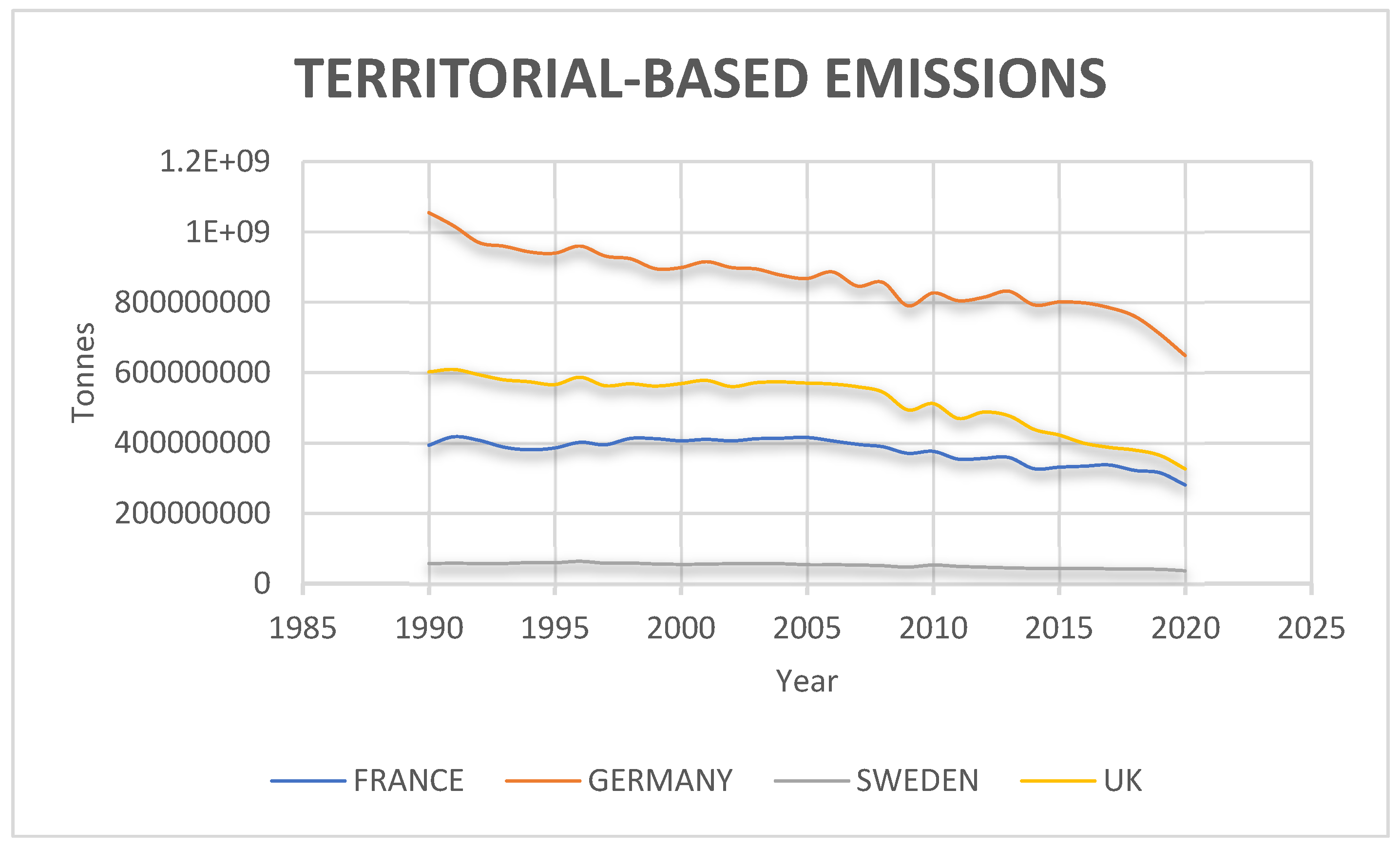
Figure 1. Territorial Emissions Compared [10].
Sustainability 17 10846 g001
Figure 2. Consumption-based emissions compared [10].
Sustainability 17 10846 g002
Figure 3. Cusum.
Figure 3. Cusum.
Sustainability 17 10846 g003
Figure 4. Cusum of Squares.
Sustainability 17 10846 g004
Table 1. Data description.
VariablesAbbreviationMeasurementSources
Carbon dioxide LCO2Tons per year[72]
Economic growthLGDPGDP (constant 2015 USD) Per Capita[72]
Renewable electricity REEMega-Watt-hours[73]
Eco taxPOTTaxes per year[74]
Energy UsedLTESMillion tons of oil equivalent (Mtoe)[72]
Table 2. Descriptive Statistics.
CodeLCO2LGDPREEPOTLTES
Mean2.52799812.3473214.506922.3557693.468990
Median2.54180212.3605613.688282.3525003.471754
Max.2.57364312.4215925.761872.5678133.501445
Min.2.38808512.246839.7646872.1359383.365992
Std. Dev.0.0401370.0474573.2296950.1312720.026311
Skewness−1.036139−0.6494841.0549000.037777−1.084429
Kurtosis3.6666592.4382194.0384331.6928614.724851
Jarque–Bera20.534688.67929323.961597.42872633.27590
Probability0.0000350.0130410.0000060.0243710.000000
Table 3. BDS Test.
Table 3. BDS Test.
VariablesLCO2LGDPREEPOTLTES
DimensionBDS Stat.BDS Stat.BDS Stat.BDS Stat.BDS Stat.
20.176260.207260.168700.180380.17211
30.288200.353350.273440.300160.27826
40.364660.454810.338020.375530.34360
50.418500.524810.377530.418860.38873
60.457170.573680.404860.442650.41943
Table 4. ADF Unit Root Test with Break Point.
VariableADFBreak PointADFBreak Point
AT LEVEL1st DIFF
LCO2−2.7302018Q4−5.261 **1997Q1
LGDP−3.1302010Q2−6.086 ***2018Q4
REE−2.5052011Q2−5.888 ***1998Q4
POT−3.9782005Q1−5.499 **1998Q1
LTES−2.8512018Q4−5.804 ***2017Q1
Note: ** and *** denotes 5% and 10% statistically significant levels, respectively.
Table 5. Fourier ADL Co-integration Test.
ModelTest StatisticsFrequencyMin AIC
LCO2 = f(LGDP, REE, POT, LTES)−5.7070.200−8.081
Note: The decisions are taken based on the critical values of Banerjee et al. (2017) [83].
Table 6. N—ARDL Bounds and Long Run Results.
N-ARDL Bounds Results
F-statistics7.0760
K8
Table 7. N—ARDL Long Run Results.
VariableCoeffStd. Errort-StatsProb.CoeffStd. Errort-StatsProb.
Positive Shock PeriodsNegative Shock Periods
LGDP (+)−0.4842970.215801−2.2441840.0280LGDP (−)−0.2343800.277286−0.8452620.4008
LTES (+)0.8826880.2052844.2998340.0001LTES (−)1.3412910.1974006.7947980.0000
REE (+)−0.0050980.001014−5.0265120.0000REE (−)9.79 × 10−50.0009970.0982160.9220
POT−0.0434680.019489−2.2303300.0289POT0.0647260.0196843.2881840.0016
Table 8. Serial Correlation, Heteroskedasticity Test, and Ramsey RESET Test.
Serial Correlation Approach
F-statistic0.0006Prob.0.979
Heteroskedasticity Test: Breusch-Pagan-Godfrey
F-statistic1.28792Prob. F(28, 70)0.196
Ramsey RESET Test
ValuedfProbability
t-statistic1.301490.690.197
Table 9. Fourier TY Causality Test.
t-Statp-Value
Ho1REE does not cause LCO211.693450.039238
Ho2POT does not cause LCO28.4206430.077329
Ho3LTES does not cause LCO23.13870.678
Ho4LGDP does not cause LCO29.5878720.087791
Disclaimer/Publisher’s Note: The statements, opinions and data contained in all publications are solely those of the individual author(s) and contributor(s) and not of MDPI and/or the editor(s). MDPI and/or the editor(s) disclaim responsibility for any injury to people or property resulting from any ideas, methods, instructions or products referred to in the content.