Article

An Integrated Approach to Air Quality and Waste Management Optimization for Sustainable Islands: A Case Study of Chalki, Southeast Aegean


by
Ioannis Logothetis
1,2,*,
Athanasios Kerchoulas
1,
Dimitrios-Sotirios Kourkoumpas
1,
Adamantios Mitsotakis
1 and
Panagiotis Grammelis
1
1
Centre for Research and Technology Hellas, Chemical Process and Energy Resources Institute, Thermi, 57001 Thessaloniki, Greece
2
Laboratory of Atmospheric Physics, Department of Physics, Faculty of Sciences, Aristotle University of Thessaloniki, 54124 Thessaloniki, Greece
*
Author to whom correspondence should be addressed.
Sustainability 2025, 17(23), 10842; https://doi.org/10.3390/su172310842
Submission received: 30 October 2025 / Revised: 25 November 2025 / Accepted: 28 November 2025 / Published: 3 December 2025

Abstract

Air quality assessment and waste management are key priorities within the Sustainable Development Goals. This study proposes an integrated approach to optimizing waste management and assessing air quality on Chalki Island, located in the Southeastern Aegean region. For analysis, measurements of a mobile air quality system located in the port area were employed to investigate the variability in pollutant concentrations and discomfort conditions. In addition, the ERA5 reanalysis dataset was used to study the impact of climate parameters on air quality. This case study covers the period from February to June 2025. In the context of waste management, a multi-criteria-driven analytical framework was developed to determine the optimal number and configuration of source separation bin arrays tailored to different waste streams at the municipal level. The findings show that anthropogenic activities (i.e., traffic and tourist density) and meteorological parameters significantly affect air pollution. The simultaneous degradation in air quality and discomfort conditions during the high tourist (warm) season increases health risk. In parallel, the deployment of five- and eight-bin source separation arrays was identified as optimal for the off-season and peak tourism season, respectively. This research contributes to a deeper understanding of air pollution variability while additionally guiding sustainable waste management for vulnerable island ecosystems.

1. Introduction

The pursuit of self-sufficiency and sustainable operation in island systems represents a diachronic topic of global significance, primarily due to the inherent complexities of insular environments. These challenges have prompted the development of numerous initiatives dedicated to formulating island-specific sustainability strategies. Within this context, the “NHSOS” project [1] aims to holistically optimize the Greek island of Chalki by addressing a diverse set of interrelated sustainability dimensions. This integrated vision encompasses the implementation of measures that support the island’s transition towards renewable energy integration, environmental performance enhancement, social well-being, and resource use efficiency. Within this broad framework, particular emphasis is placed on air quality and waste management, as they constitute two fundamental components of sustainable insular planning. The “NHSOS” project involves pilot actions that reflect the National and EU priorities of “GR-eco” Islands, “Smart Specialization Strategies” (S3) for regional-based ecosystems, and “Clean Energy for EU Islands” towards the “Green transition” era [2,3,4]. Accordingly, this paper centers on these focal domains, presenting a dual assessment that combines air quality evaluation with the optimized design of the island’s waste management infrastructure.
These thematic priorities are directly aligned with several United Nations Sustainable Development Goals (SDGs) [5] that collectively guide the project’s sustainable design approach. The air quality assessment primarily contributes to SDG 3 (Good Health and Well-being) by addressing pollutant exposure risks and supporting healthier living environments. Complimentary, it directly supports SDG 13 (Climate Action) through the identification of the emission patterns that inform mitigation and adaptation strategies. In parallel, the optimization of the MSW network advances SDG 11 (Sustainable Cities and Communities) by promoting efficient, low-impact waste collection systems, as well as SDG 12 (Responsible Consumption and Production) by fostering circular material management and waste minimization practices. Together, these objectives establish a cohesive sustainable design framework, guiding Chalki’s transformation into a model for sustainable transformation across insular regions.

1.1. Air Quality, Atmospheric Circulation and Health Conditions

Emissions from anthropogenic activities (construction, industry, agriculture, transport sectors, etc.) are some of the most challenging issues in the contemporary era, degrading ambient air quality and affecting human health [6,7]. According to the World Health Organization (WHO), exposure to polluted air conditions poses a health risk, increasing the rate of premature deaths and triggering various diseases [8]. In addition, the Intergovernmental Panel on Climate Change (IPCC) emphasizes that climate change and air pollution show synergic actions that affect the Sustainable Development Goals (SDGs), including health risk and well-being [9,10,11]. Furthermore, air quality degradation causes significant damage to ecosystems globally [8]. There are previous studies that have already shown that an increased concentration of air pollutants is associated with various chronic diseases such as heart, lung, and respiratory diseases; stroke; cognitive issues; and various types of cancer and cardiovascular disorders, increasing the morbidity and mortality rates in the community [12,13,14,15,16]. Transport (vehicle traffic, shipping, and marine sector) and industry are the dominant sectors that degrade air quality, affecting the atmospheric system [17,18]. In the insular areas of the eastern Mediterranean, shipping (arrival, departure, and maneuvering in ports) and tourism activities seem to be fundamental factors that determine the concentration of and variability in pollutants. In particular, the analysis of PM2.5 concentration in the Aegean Islands has shown that each island shows different air pollution patterns that are affected by season and anthropogenic activities [19]. In addition, Logothetis et al. [20,21,22,23] have shown that port activity and shipping in Heraklion and Rhodes city are significant related to the degradation of air quality at the local scale. Vehicle traffic and anthropogenic activities affect the variability in the concentration of pollutants and increase the health risks for the population. The summer season shows degraded ambient air conditions as compared to other seasons. The diurnal variation in air pollution follows the variability in port activities (i.e., passenger density and shipping activity). In general, the concentration of pollutants (such as particulate matter, nitrogen oxides, and sulfate oxides) is increased in port areas compared to other sites [24] due to shipping traffic emissions. These elements emphasize the need for air quality monitoring over port regions in order to promote the mapping and better understanding of pollutant variability over these areas.
The Mediterranean area comprises some of the most climatically vulnerable ecosystems in the world [25,26,27]. These climatic-sensitive areas include urban and island ecosystems that are located at an atmospheric circulation crossroad that is affected by atmospheric circulation and weather systems from the Atlantic, Europe, Africa, and the Middle East [28,29,30]. The Etesian synoptic-driven wind system (annually permanent winds) that blows in the Aegean Sea during the summer period and dust transfer episodes (from lower to higher latitudes) are two of the dominant atmospheric circulation patterns that affect the air quality over the eastern Mediterranean [31,32,33]. Chalki (Halki) is a small island that is located in the southeastern Aegean Sea, over the eastern Mediterranean, with about 500 citizens. Its temperate and mild climate in combination with warm and dry summer conditions, sunny beaches, and rich cultural heritage, as well as traditional gastronomy, convert the region of the South Aegean to a desirable destination for tourists—about 30% of arrivals in Greece [34]. In recent years, there has been a significant increase in tourist arrivals on Chalki’s Island. In addition, the population (locals and visitors) of the Island significantly changes between the summer (high tourist season) and winter (low tourist season) periods. In this context, this work implements a calibrated mobile air quality monitoring system equipped with air quality and meteorological sensors which is located in the port area in order to study the air quality in the port—a high-interest region of Chalki’s city—during the months of 2025 with low and high tourist density (covering the period from February to June 2025). In general, air quality mobile monitoring systems, which are equipped with air quality and meteorological sensors, are an alternative solution to monitor the air quality over areas where there are limitations regarding the use of labor-intensive and expensive air quality systems. The development of new and the incorporated digital innovative technologies in sensors improve the accuracy and efficiency of air quality systems to monitor the air pollution factors over various environments. In addition, the development of sensor networks can acquire high spatiotemporal coverage to sensitive ecosystems. Moreover, the affordability and mobility of these systems provide a valuable solution regarding the investigation of air quality. Despite the limitations of these systems (i.e., their efficiency to capture absolute values and their sensitivity to meteorological conditions such as temperature and humidity), the scientific community consider low-cost sensors (LCS) a viable solution to monitor air quality parameters in areas with special needs, such as high spatial geographical coverage, in combination with the inability to use stable, expensive, and labor-intense systems, etc. [35,36,37,38,39,40,41].
Previous studies have already shown that increased tourist density and anthropogenic activities (i.e., vehicle traffic and shipping) are related to degraded ambient air quality conditions and increased health danger for the population for the city of Chalki and the southeastern Aegean [42,43,44,45,46]. The main objectives of this air quality campaign focus on the investigation of (a) variation in concentrations of basic pollutants over the vulnerable area (regarding the air quality conditions) of the port of Chalki Island and (b) the impact of atmospheric parameters and atmospheric circulation features on local air quality.

1.2. Waste Management

Municipal Solid Waste (MSW) management in island systems requires tailored planning approaches that differ from conventional strategies applied in mainland networks. The distinctive characteristics of Greek islands, such as limited land area, scarce resources, and pronounced seasonal tourism, render the development of operational collection plans particularly complex for public authorities [47]. These constraints also challenge the designated Waste Management Authorities (FODSA) in selecting appropriate treatment and recovery methods for each island. Nevertheless, the need to strengthen preparation for reuse, recycling, and material recovery remains a key priority, in line with the objectives set within the European Waste Framework Directive [48] and the National Waste Management Plan (NWMP) [49]. According to these directives, preparation rates for sustainable waste management must reach 55% w/w by 2025, 60% w/w by 2030, and 65% w/w by 2035. These targets are additionally aligned with those set by the Regional Solid Waste Management Plan (RSWMP) of the South Aegean for the aforementioned milestone years [50].
Waste collection constitutes the initial and one of the most critical functional components of the waste management chain [51]. Inefficiencies in the collection stage can disrupt the flow of waste handling, leading to both operational complications and social discontent [52]. Such challenges are amplified in Small Island Developing States (SIDS), where limited human resources and inadequate infrastructure hinder efficient waste collection and logistics [53]. Despite these limitations, tailored approaches for effective waste collection have been employed on several Greek islands. The implemented techniques aim to strengthen local waste networks and improve the living conditions of permanent and seasonal residents. Notable examples reported by municipal authorities and local sanitation services include the Greek island of Tilos, which has entirely eliminated landfilling through the implementation of a systematic source-separation program [54]. Similarly, in the island of Kythnos, the collection of significant quantities of separated recyclable materials is achieved through an optimized collection plan and the active engagement of local businesses in source sorting practices [55].
An anticipated addition to this group of “green” islands constitutes Chalki. Currently, the island operates exclusively using mixed-waste bins, with daily collection carried out without optimized route planning. Uncompressed mixed waste is transported by ferry to the nearby island of Rhodes. There, it is mechanically separated into standard material categories before recycling or landfilling for the residual non-recyclable fraction. Nonetheless, Chalki is projected to become a national model for holistic sustainable development and energy autonomy, with a key pillar being the creation of a sustainable waste management network. While the Municipality of Chalki has made progress toward this goal, the restructuring of existing waste management infrastructure presents practical challenges that impede the island’s complete transition. Given that Chalki’s current system primarily focuses on collection rather than treatment, integrating source separation at the point of generation represents the most effective strategy. This approach decreases required transport volumes while enabling targeted collection and cost-efficient scheduling [56]. Moreover, it eliminates the need for advanced waste sorting at Rhodes’ facilities, offering both environmental and economic benefits [57]. Even though a residential source-sorting program has been proposed by public authorities, the island’s sharp rise in visitor numbers has significantly increased tourism-related waste. This trend underscores the need for a structured multi-criteria-driven source-separation scheme at the municipal level.
Numerous published works have applied Multi-Criteria Decision Aid (MCDA) methods to support MSW management. According to Achillas et al. [58], the first applications of MCDA in the field of MSW management appeared in 1991. In these early studies, the AHP [59], ELECTRE/TOPSIS [60], and PROMETHEE [61] models were each applied independently to identify optimal locations for MSW transfer and disposal facilities. This trend has continued throughout the years, with most subsequent assessments involving multi-criteria methods for MSW management, primarily applying MCDA for the siting of MSW treatment facilities and the evaluation of management strategies. In the context of small islands, Ramjeawon and Beerachee [62] employed a two-stage AHP multi-criteria methodology to determine the optimal location for a sanitary landfill site in Mauritius, considering twenty-one sub-criteria under three main criteria (environmental, technical, and economic). Similarly, Vego et al. [63] applied the PROMETHEE and GAIA models independently, extending the three aforementioned criteria with a fourth ‘functionality’ criterion to evaluate the most favorable sites for MSW management centers in coastal Croatia. Relevant work also exists for Greek islands, with Skordilis [64] conducting a WBU analysis that incorporates LCA principles, integrating environmental, financial, technological, and social criteria to propose a strategic plan for local solid waste management in the island of Corfu. Overall, while MCDA has been extensively used in facility siting, routing, and broader strategic planning, the optimization of source-separation bin arrays in insular MSW systems remains largely unexplored.
In this regard, the presented study develops an analytical framework to determine the optimal number and composition of source-separation bin arrays at the municipal level. The methodology first introduces a formula for estimating current or projected waste generation followed by an equation to determine the required number of source-separation bins based on prevailing generation trends. A multi-criteria deterministic optimization model is then applied to identify the most effective array configuration, balancing coverage, procurement efficiency, and practical array size. The analysis accounts for Chalki’s seasonal fluctuations in tourist activity, producing two distribution scenarios for both the off-peak and peak season periods. By addressing the research gap in decision-support tools for optimizing source-separation infrastructure in small island systems, this study offers actionable guidance to local authorities and sanitation services in remote regions pursuing efficient waste collection.

2. Materials and Methods

2.1. Air Quality and Bioclimatic Conditions

2.1.1. Measurements and Data on the Concentration of Air Pollutants and Meteorological Factors

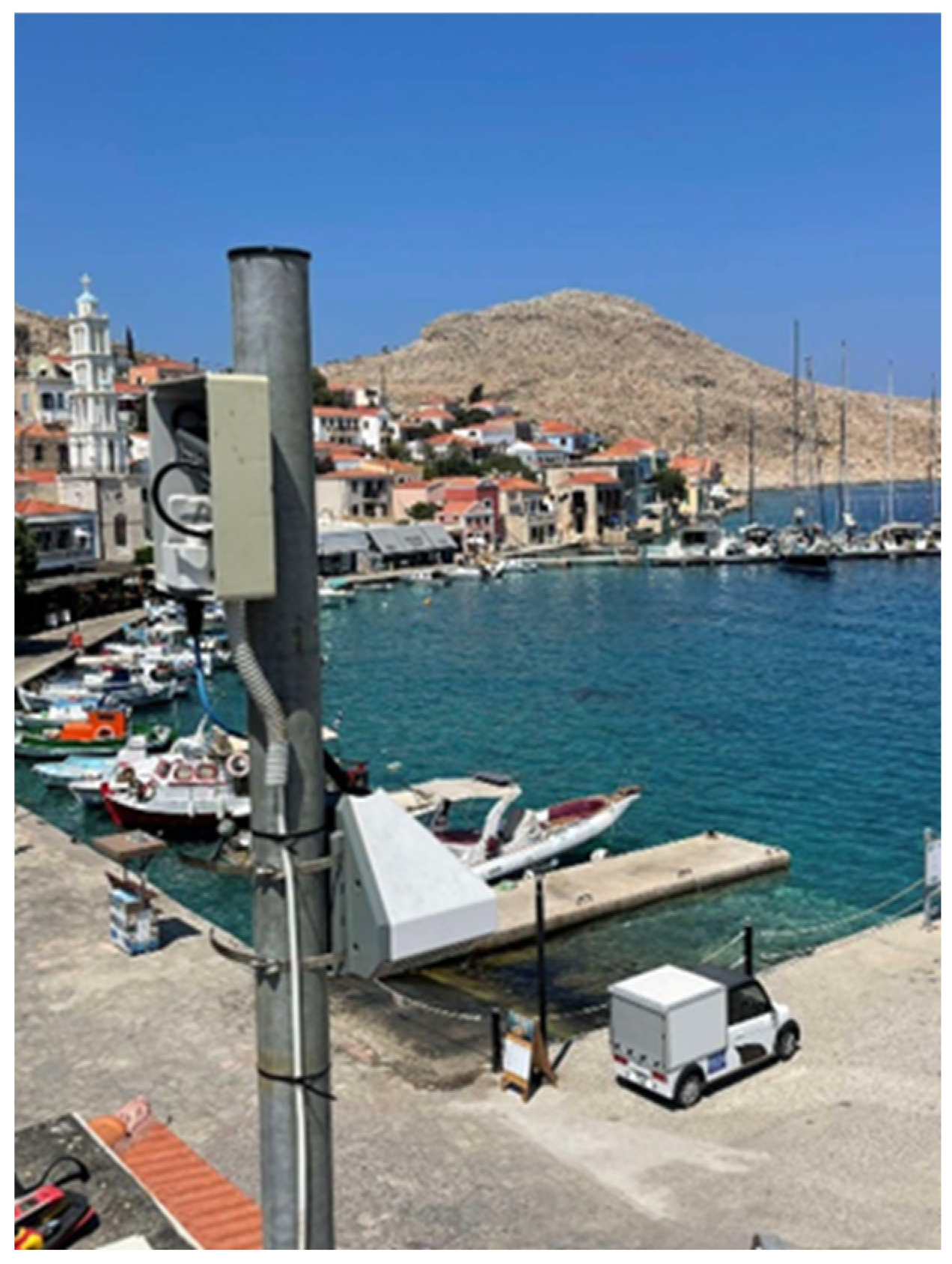
Hourly recordings of pollutant concentrations and meteorological factors from a mobile air quality monitoring system (AQMS) were used to investigate the air quality in Chalki’s port area. In particular, AQMS is equipped with air quality and meteorological sensors that measure particulate matter with diameter equal/less to 2.5 and 10 μm (PM2.5 and PM10; μg/m3), carbon monoxide (CO; ppb), nitrogen dioxide (NO2; ppb), and ozone (O3; ppb), as well as temperature (T; °C), relative humidity (RH; %), and air pressure (Pressure; mbar). The experimental period covers the days from 13 February to 22 June 2025, including a low and high tourist period. The mobile system that employed in the air quality campaign was an AQ-Mesh mobile air quality system (Environmental Instruments Ltd., Coventry, UK) [65]. This system has the ability to be equipped with outdoor air quality and meteorological sensors providing localized, high temporal resolution recordings. In addition, it has already been used in past air quality studies over the southeastern Aegean region (i.e., investigation of Rhodes city air quality) [22,44]. In order to provide representative and reliable results for the air quality of the Chalki’s port area, the location of AQMS was selected taken under consideration the port area characteristics as well as the suggestions of local authorities and port staff. AQ-Mesh is a small-size, low-cost, easy-installation, and accurate monitoring system that can be located in various sites. It is considered a suitable system for ambient air quality measurements in areas with missing labor-intensive instruments. In our analysis, the system is located in the area of the local Post office, near the port dock of Chalki’s city (Figure 1). In this study, the AQMS was equipped with sensors that followed the fully calibrated manufacturer processes. In addition, a primary quality assurance of raw data was performed (outliers have removed from the analysis). Please note that the air quality measurements were implemented in a single point of Chalki’s Port. This campaign provides results for the air quality locally for the port area. The findings cannot be considered as the general ambient air quality conditions for the whole island. In general, the port area of Chalki can be characterized as a high-interest region regarding the air quality for southeastern Aegean variability because it is affected by anthropogenic activities such as vehicle and shipping traffic, as well as tourist density, mainly during the warm (high tourist) season. In addition, climate sensitivity is a crucial factor that affects this area of the Mediterranean.
In order to investigate the impact of meteorological and atmospheric circulation factors on the concentration of air pollutants in Chalki’s port area, hourly data of zonal and meridional wind speed at 10 m ( u 10 and v 10 ; m/s), planetary boundary layer height (PBL; m), precipitation (kg m−2 s−1), and dew point temperature (K) from ERA5 reanalysis dataset were also used [66]. ERA5 is the new-generation (fifth generation) state-of-the-art tool developed in the context of the European Centre for Medium-Range Weather Forecasts (ECMWF) under the Copernicus Climate Change Service (C3S). It provides numerous atmospheric, land, and ocean variables from 1940 until the current period, combining meteorological observations with advanced numerical model tools using assimilation techniques [67]. In addition, it is considered an accurate and reliable dataset with high spatio-temporal resolution (covers the globe on a 31 km grid the atmosphere on 137 levels, up to a height of 80 km [66]), that is widely used for scientific multidisciplinary environmental studies [68,69,70].

2.1.2. Measurements and Data on the Concentration of Air Pollutants and Meteorological Factors

To study the air quality and discomfort human feeling, the Air Quality Health Index (AQHI), Discomfort Index (DI), Humidex (HI), and Apparent Temperature (AT) Indices were calculated. The AQHI [22,71] and DI [72,73] were calculated using measurements from the AQMS. AQHI is an index that provides messages regarding the impact of ambient air pollution (taking under consideration three basic pollutants, namely the concentrations of NO2, O3, and PM2.5) on human health. DI is an index that expresses the effect of air temperature and relative humidity on human thermal comfort. AQHI and DI are calculated using the following Equations (1) and (2):
A i r   Q u a l i t y   H e a l t h   I n d e x   ( A Q H I )   = 10 10.4 × ( 100 × ( e 0.000871 × N O 2 1 + e 0.000537 × O 3 1 + e 0.000487 × P M 2.5 1 ) )
D i s c o m f o r t   I n d e x D I = T a 0.55 × 1 0.01 × R H × ( T a 14.5 )
where
  • T a : The 2 m air temperature (°C);
  • RH: The relative humidity (%);
  • NO2: The concentration of nitrogen dioxide;
  • O3: The concentration of ozone;
  • PM2.5: The concentration of particulate matter with diameter equal/less to 2.5 μm.
To further investigate the discomfort conditions and human sense on Chalki’s area, the HI [74,75,76,77] and AT [78,79] indices are calculated using data from the ERA5 reanalysis dataset. HI is an index that combines the effect of temperature and humidity quantifying the human discomfort feeling, and AT is used to quantify human heat stress, respectively. HI and AT are calculated using the following Equations (3) and (4):
H u m i d e x H I = T a + 0.5555 × 6.112 × e x p 5417.7530 × 1 273.15 1 D P + 273.15 10
A p p a r e n t   t e m p e r a t u r e A T = 2.7 + 1.04 × T a + 2.0 × 0.61078 × exp 17.27 T a T a + 237.3 × R H 0.65 × W S
where
  • DP: The dew point temperature (°C).
The time series of daily mean and diurnal monthly mean variability in the concentration of pollutants and meteorological factors were calculated during period from February to June 2025 to study the daily and hourly mean evolution pollutant concentrations. In addition, the daily mean evolution and diurnal cycle of AQHI and bioclimatic indices (DI, HI, and AT) were calculated to investigate the air quality and human discomfort sense. Generally, previous studies use correlation analysis to investigate the relation among pollutants and meteorological factors [23,80,81]. In this work, Pearson correlation coefficients among the concentration of pollutants, AQHI, bioclimatic indices, meteorological factors, and ventilation coefficient (VC, calculated by multiplying the WS and PBL) were calculated to study the relationship among these factors over the studied area. In general, VC is a simple function of WS and PBL showing the air pollution potential over an area [82]. Increased VC values are associated with a reduced concentration of pollutants due to the combined effect of wind speed and boundary layer height on low tropospheric composition [83]. VC is considered as a simplified parameter that is affected significantly by complex terrain (i.e., complex wind patterns due to coastlines or island regions and impact of topography in the development of PBL). In this work, VC is used as a simple measure for ventilation (dispersion) over the studied region. Regression analysis is usually used to study the relation between atmospheric circulation patterns and atmospheric circulation and air quality indices [30,46,84]. In this work, the regression of WS and VC fields against the AQHI (as a measure to quantity the level for the air quality in Chalki’s port area) were calculated in order to investigate the impact of WS and VC pattern on AQHI variation. For statistical significance, the two-tailed Student’s t-test was used in this work [85].

2.2. Waste Management

2.2.1. Measurements and Data for the Estimation of Annual Waste Generation

Various modeling methods have been developed to forecast MSW generation involving a highly diverse set of prediction factors. According to the review conducted by Kolekar et al. [86], some of the most frequently used independent variables in MSW prediction models include demographic indicators (e.g., population size), socioeconomic parameters (e.g., average income and GDP), and socio-cultural attributes (e.g., age distribution and educational level of the waste-generating population). At the municipal scale, Benítez et al. [87] developed three residential solid waste (RSW) prediction models for specific waste sampling stages within the urban area of Mexicali, each relying on five key independent variables. Similarly, Lebersorger and Beigl [88] applied a multivariate regression approach to analyze waste generation patterns across 542 municipalities in the Province of Styria, Austria, incorporating a diverse set of 116 indicators. More advanced techniques have also been explored, with Abbasi et al. [89] combining a Support Vector Machine (SVM) model with Wavelet Transform (WT) preprocessing to construct a hybrid forecasting tool capable of accurately predicting weekly MSW generation time series for Tehran and Mashhad over a five-year period.
Although multi-variable modeling constitutes a well-established practice for MSW generation forecasting, its application typically requires extensive datasets with robust temporal resolution, which may not be available in smaller settings or less data-rich contexts. In the case of Chalki, available information primarily consists of demographic statistics and aggregated MSW generation figures, along with defined growth trends. Consequently, the present study employs a simplified predictive formula that relies exclusively on demographic and MSW quantity variables, ensuring methodological consistency with data availability while maintaining predictive accuracy.
All data used for estimating Chalki’s current annual waste generation were provided by the island’s municipal authorities, as well as sourced from relevant regional and national databases. Chalki’s permanent population amounts to 478 inhabitants, while in 2019, the island hosted approximately 20,000 visitors. According to the Regional Solid Waste Management Plan (RSWMP) for the South Aegean, the total MSW generated that year was estimated at 303 tons. Of this amount, 91% (276 tons) originated from permanent residents, while the remaining 9% (27 tons) originated from tourism-related activities [50].
In 2023, the number of visitors indicated a significant increase of approximately 525%, reaching 121,000. A similar trend was observed in 2024, with Chalki’s municipal authorities estimating between 120,000 and 130,000 visitors during the high tourist season (from April to October). For the purposes of this study, an average of 125,000 visitors is assumed for 2024. To ensure a balanced value within this reported range and avoid bias toward either the lower or upper bound, an average of 125,000 (±5000) visitors is adopted for the analysis. This margin of error represents the half-width of the confidence interval corresponding to the uncertainty in the provided visitor range. Additionally, a projected annual MSW growth rate of 0.84% is applied, based on data from the Hellenic Statistical Authority (ELSTAT) for the period 2020–2022 [90].
Chalki’s total waste generation in 2024 is disaggregated into two streams: one attributed to permanent residents and the other to seasonal visitors. The projected MSW generation of each contributor category is calculated using the following predictive Formula (5). The total projected MSW quantity is provided by Equation (6).
T W n + i , j = T W n , j × 1 + i × Δ M S W t × N n + i , j N n , j
T W n + i = j T W n + i , j
where
  • TW(n),j: Τhe quantity of generated MSW by waste contributor category during the base year n (ton/year);
  • j: The categorical index denoting societal groups that function as waste generation contributors (e.g., residents, tourists, businesses, etc.);
  • i: The integer number of years between the base year n and the target projection year n + i (dimensionless);
  • ΔMSWt: The total fractional annual increase in waste generation for the examined system (dimensionless);
  • N(n+i),j/N(n),j: The ratio of the population associated with category j in the target year n + i to the corresponding one in the base year n (dimensionless);
  • TW(n+i),j: The quantity of MSW generated by waste contributor category j during the projected year n + i (ton/year);
  • TW(n+i): The total quantity of MSW generated during the projected year n + i (ton/year).

2.2.2. Determination of Source Separation Bin Quantities and Optimal Grouping

The proposed methodology introduces the installation of fixed source-separation-bin arrays across the island’s accessible areas. Each bin category corresponds to a specific material stream, while clear visual cues can ensure proper waste disposal. The number of designated bins is determined by current waste generation trends, enabling dynamic adjustments to factor in seasonal fluctuations. The physical and usable capacities of each bin are assumed equal to account for potential waste protrusion (usable factor φ = 1). The required number of bins for each material category is calculated based on collection intervals, bin volume, waste composition, and material bulk densities, as expressed in Equation (7). The total number of required source-separation bins is provided by Equation (8):
N b k = S F × D W C × T W n + i 1000 × V b × F k ρ k
TNb = k N b k
where
  • Nbk: The integer quantity of waste bins needed to store material stream k between collection intervals. The ceiling function ensures rounding up to account for partial bin needs (dimensionless).
  • SF: A safety factor providing buffer capacity for seasonal fluctuations or unexpected waste generation surges (dimensionless).
  • DWC: The frequency of waste collection (days).
  • Vb: The physical capacity of a single waste bin (m3).
  • ρk: The bulk density of the material stream k after being freely poured in a bin (kg/m3).
  • Fk: The mass fraction of material stream k relative to the total waste mass (dimensionless).
  • TNb: The total integer quantity of waste bins required between collection intervals (dimensionless).
Having estimated the source-separation bin requirements, their optimal grouping is determined using a multi-criteria deterministic optimization model. The proposed tool defines the optimal configuration and number of identical source-separation bin arrays (A) at a municipal scale. The selection of the optimal A is based on three competing criteria.
The first criterion concerns sufficient coverage, achieved by reducing the number of bins comprising each array. Smaller configurations translate to a larger number of arrays, allowing for wider distribution and, subsequently, easier access by residents. This objective is represented by the relative score Scov(A), quantified as
S c o v A = A A m a x a
where
  • Amax: The theoretical maximum number of arrays, which corresponds to one bin dedicated to each waste material category (dimensionless);
  • a ∈ (0, 1): The scaling exponent aiming to prevent benefit overestimation from array number increase (dimensionless).
The second criterion defines a limit to the number of additional bins integrated to compensate for infrastructure gaps. As the methodology employs identical arrays, additional units are required for low-generation waste categories to align their collection infrastructure with that of higher-volume streams. This leads to both additional expenditures as well as potential social discomfort from the over-installation of bins in small scenic settings. Therefore, to prevent excessive procurement, a relative penalty Padd(A) is defined, reflecting additional bin needs. This factor is calculated using the following system of equations:
a k A = N b k A
a A = k a k ( A )
E B A = k ( A × a k A N b k )
P a d d A = E B A T N b
where
  • αk(A): The minimum number of bins for material k, corresponding to A identical arrays (dimensionless);
  • EB(A): The total excess bin requirements estimated by using the summing deficits between scaled demand and estimated thresholds (dimensionless).
Complementary to sufficient coverage, the final objective is designed to discourage excessively large or small arrays. Manageable configurations ensure easier placement in the urban landscape. Moreover, they prevent operational inefficiencies, such as the over-accumulation of bins or impractical under-sizing. To achieve this, the Psize parameter is defined. This factor employs a soft quadratic equation with cap, penalizing deviations from a practical array size. Minor deviations receive moderate penalties, while larger discrepancies are penalized exponentially. The cap restrains the size penalty, preventing it from growing indefinitely and overwhelming other criteria. The parameter is provided be Equation (14), structured as follows:
P s i z e A = min 1 , γ × k a k ( A ) B o B o 2
where
  • γ: The steepness factor which controls how quickly the penalty approaches the cap (dimensionless);
  • Bo: The preferred bin number per array, based on regional practical handling considerations (dimensionless).
The trade-offs between coverage, procurement efficiency, and array size are integrated into the aggregated score:
S c o r e A = w c o v × S c o v A w a d d × P a d d A w s i z e × P s i z e A
where wcov, wadd, and wsize are weight factors for the coverage, procurement, and size criteria, respectively, enabling emphasis on specific priorities, based on the study’s objectives. The weight factors are normalized to sum to 100%. A higher aggregated score reflects a configuration that achieves a balanced equilibrium between the three competing criteria. In this context, a balance signifies a system where additional spatial coverage is gained efficiently, without imposing disproportionate material or logistical burdens. In contrast, negative results signify that penalty terms dominate, indicating that the costs of excess procurement or suboptimal sizing outweigh the spatial coverage benefits.
Additionally, this formulation captures the dynamic correlation between coverage benefits and the opposing procurement and size penalties, which respond in competing ways to variations in the input parameters. For instance, increasing the number of arrays (A) enhances the coverage score, but this effect is progressively moderated by the scaling exponent α, which dampens marginal gains as A grows. Consequently, in systems with higher α values, the contribution of additional arrays to the aggregated score diminishes more rapidly. Simultaneously, larger A values amplify procurement penalties, as aligning low-generation material streams with denser collection networks leads to greater excess bin requirements. This effect becomes distinctively pronounced in systems with unbalanced waste generation profiles, ultimately driving a reduction in the aggregated score. The size penalty functions as a moderating mechanism. When A values result in configurations that diverge significantly from the preferred array size Bo, the aggregated score declines sharply, especially at higher γ values which amplify deviations and impose stricter conformity to the target size.
The relative weight factors determine the extent to which these effects modulate the aggregated score. Emphasizing coverage (wcov) shifts the optimization toward solutions with more arrays, even at the expense of higher procurement or size penalties. In contrast, prioritizing procurement efficiency (wadd) favors configurations that minimize surplus infrastructure, often resulting in fewer arrays. A stronger weighting on array sizing (wsize) narrows the acceptable configuration range by penalizing both undersized and oversized arrays more aggressively. Different combinations of parameter values and weights therefore generate distinct optimization trade-offs. Dense urban systems with balanced waste streams may benefit from configurations that maximize coverage, whereas smaller or more heterogeneous systems may achieve higher aggregated scores through fewer, strategically sized arrays. This flexible interplay between parameters and criteria enables the model to adapt to varying infrastructural, demographic, and operational contexts while maintaining a consistent optimization logic.
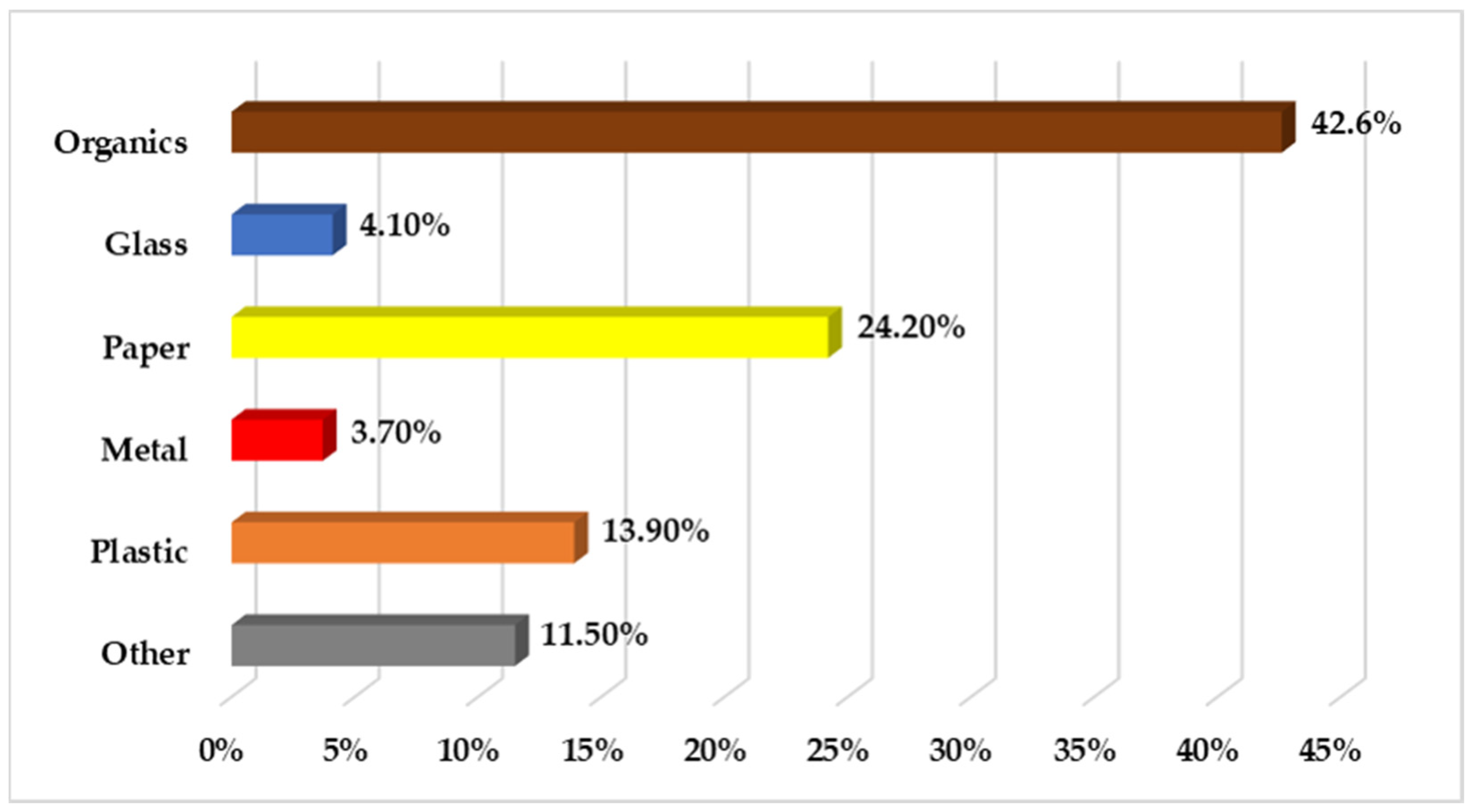
For the case of Chalki, the methodology is applied under two distribution scenarios: one represents the off-season tourist period, considering only permanent residents, while the second additionally accounts for tourist-related waste during the peak season. Consequently, the categorical index j solely encompasses permanent residents and seasonal visitors as waste generation contributors. Identical waste generation habits are assumed for both population categories. Daily waste collection is maintained, with 0.24 m3 source-separation bins selected due to spatial constraints in high-turnover public areas. A SF of 1.2 (20% additional bin capacity) is used to account for peak waste loads. The designated mass fraction composition of waste (Figure 2) is assumed to follow the overall trend of the South Aegean islands, as defined in the corresponding RSWMP. The “Other” category is assumed to represent solely mixed waste. Organic and mixed-waste bins are quantified to establish a sufficiency threshold, as they are excluded from the array optimization analysis. Bulk density values for each material stream are sourced from the Waste & Resources Action Programme (WRAP) database, considering numerous material combinations in both bins and vehicles [91]. The bulk densities selected correspond to small-volume bins in the range of 0.045–0.24 m3. The bulk density of mixed waste derives from its overall composition, weighted by the material-specific bulk densities. The utilized bulk densities are presented in Table 1.
For coverage (Scov), a factor of α = 0.7 is applied, moderately rewarding array proliferation while preventing linear scaling. For the size penalty, a steepness parameter of γ = 0.3 is defined, introducing a moderate penalty slope that only targets impractical extremes. A preferred array size of Bo = 5 is selected, reflecting the spatial constraints of small islands with limited venues or open public spaces.
A standard MCDA approach for MSW management typically involves the application of well-established methods such as the Analytic Hierarchy Process (AHP) or the Technique for Order Preference by Similarity to Ideal Solution (TOPSIS) [92]. However, these methods are most suitable when the evaluation criteria are qualitatively diverse and stakeholder preferences are required to establish weighting schemes. In contrast, the developed framework targets the operational planning layer of waste management, focusing on a limited set of quantifiable operational criteria that can be directly expressed in mathematical form. Instead of using stakeholder-based weighting, a direct deterministic scoring approach with equal weights ( w c o v = w a d d = w s i z e = 0.333 ) is employed. Beyond neutrality, equal weighting ensures that the three criteria operate on a comparable quantitative scale. This ensures that each dimension directly affects the physical planning of bin arrays, thus avoiding the artificial dominance of one criterion over the others. Moreover, given the uncertainty introduced by seasonal tourism, evolving consumption patterns, and demographic variability, equal weights prevent the premature over-prioritization of a single criterion that may shift in relevance under different conditions. The identical-weight scenario establishes a reproducible baseline, serving as a reference point against which alternative weighting schemes can be systematically benchmarked. Nevertheless, the framework remains flexible, allowing for standard MCDA weighting techniques to be applied in cases where stakeholder input is essential.

3. Results and Discussion

3.1. Air Quality, Bioclimatic Conditions, and the Impact of Meteorology on Air Pollution: The Case of Chalki’s Port Area from February to June 2025

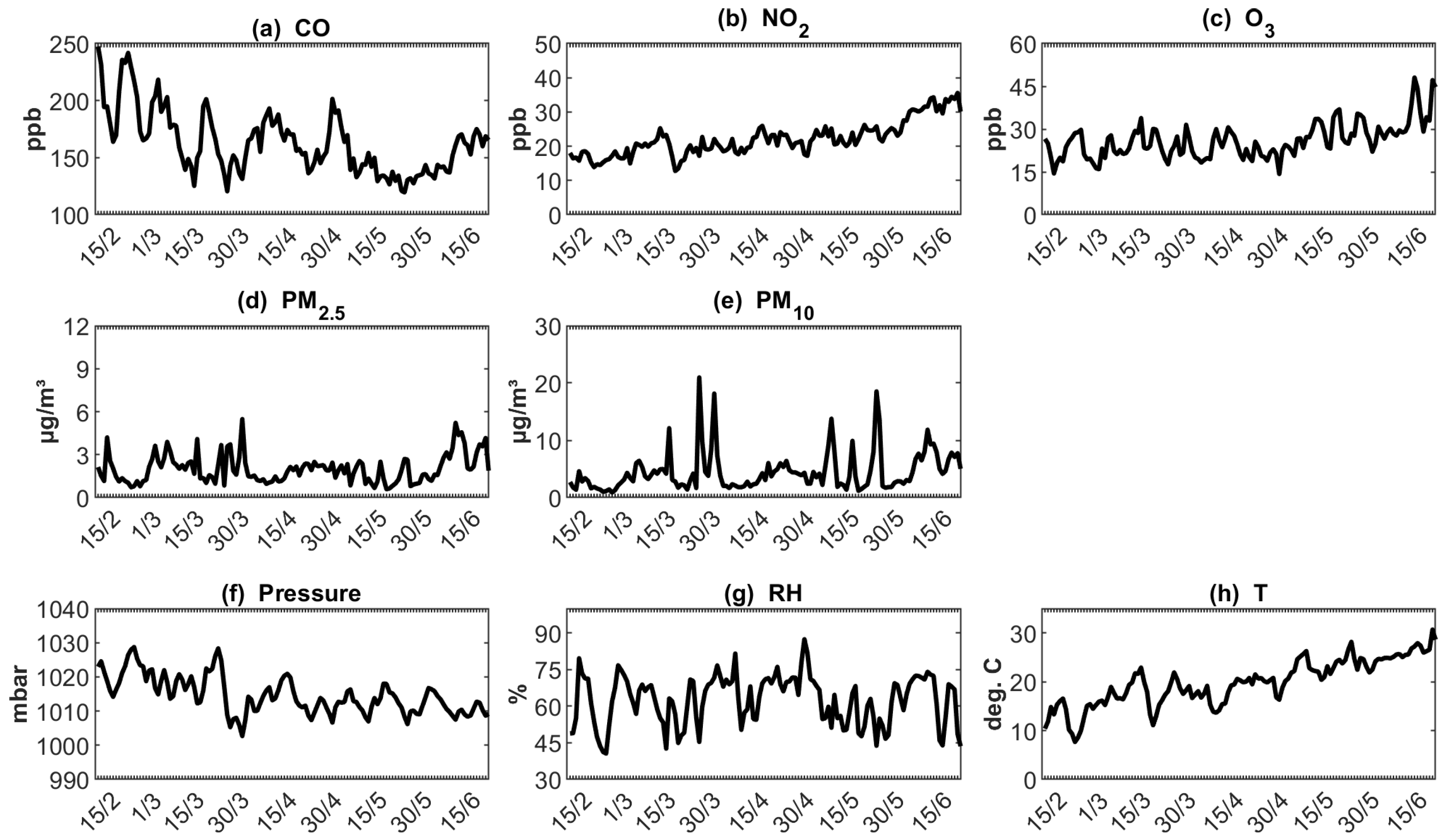
Figure 3 shows the daily mean variability in pollutants and meteorological factors over the port area of Chalki’s Island. The analysis covers the period from 13 February to 22 June 2025, including both the low and high tourist period. The results show that the concentration of key pollutants (CO, NO2, O3, PM2.5, and PM10) do not show values that exceed the thresholds according the EU Directive for air pollution [93]. In particular, CO shows a negative trend during the studied period (Figure 3a), whereas NO2 and O3 present an increase trend during the last studied period (Figure 3b,c), possibly due to increased activities (tourist season peaks) as well as the meteorological conditions. PM2.5 and PM10 concentrations show some peaks that are lower than the daily danger thresholds according the EU Directive for air pollution (Figure 3d,e). The PMs ratio P M 2.5 P M 10 is usually used as a measure for air quality degradation [94]. In general, increased ratio values are associated with the primary and secondary pollutants that are related to anthropogenic activities [95]. Ratio values close to 1 indicate that a high proportion of P M 10 is P M 2.5 , which is more harmful for human health. In our analysis, the calculation of the PMs ratio shows that February and March show the maximum PMs ratio values (about 0.76 and 0.57, respectively). April, May, and June show PMs values that are about 0.5, 0.41, and 0.47, respectively. Bamola et al. [96] have shown that PMs ratio is negatively associated with relative humidity and temperature for a suburban environment. In addition, long-range transportation, local sources, and wind patterns can also affect the variation in PMs ratio [96,97]. For the port area of Chalki, the analysis confirms the results of previous studies showing that warm months present lower PMs ratio values as compared to colder periods, possibly due to changes in climate conditions and local anthropogenic activities. In addition, the atmospheric pressure shows a negative relation to the PMs ratio, possibly due to the impact of large-scale circulation in ambient air quality (summer atmospheric circulation regime over the east Mediterranean). The analysis shows that the daily and hourly mean concentrations of pollutants that were measured from AQMS do not consist of a danger for human health. Regarding meteorological conditions, pressure and temperature show a negative and positive trend, respectively (Figure 3f,h). Corbett et al. [98] have shown that air quality and costal ecosystems are affected by shipping activities. Focusing on southeastern Mediterranean, previous studies have already shown that air quality is significantly affected by transport sector (vehicle and shipping traffic—arrival, departure, and maneuvering) and tourist density [99,100]. For port areas in southern island Greece, the concentration of particulate matters (PMs) and other pollutants such as NOx and SO2 are increased during the tourist high season, as well as over the hours with high port activities (such as increased passenger density and shipping traffic) [23,101]. These results are aligned with the findings of our analysis, indicating that traffic and tourist sectors have an important footprint for the air quality degradation of the port area. In addition, Logothetis et al. [22] have shown that the air pollution conditions in urban and port areas of Rhodes city are degraded during the summer period as compared to the low tourist season (winter period), and the air quality is classified mainly in the “Moderate” class (in terms of the AQI index).
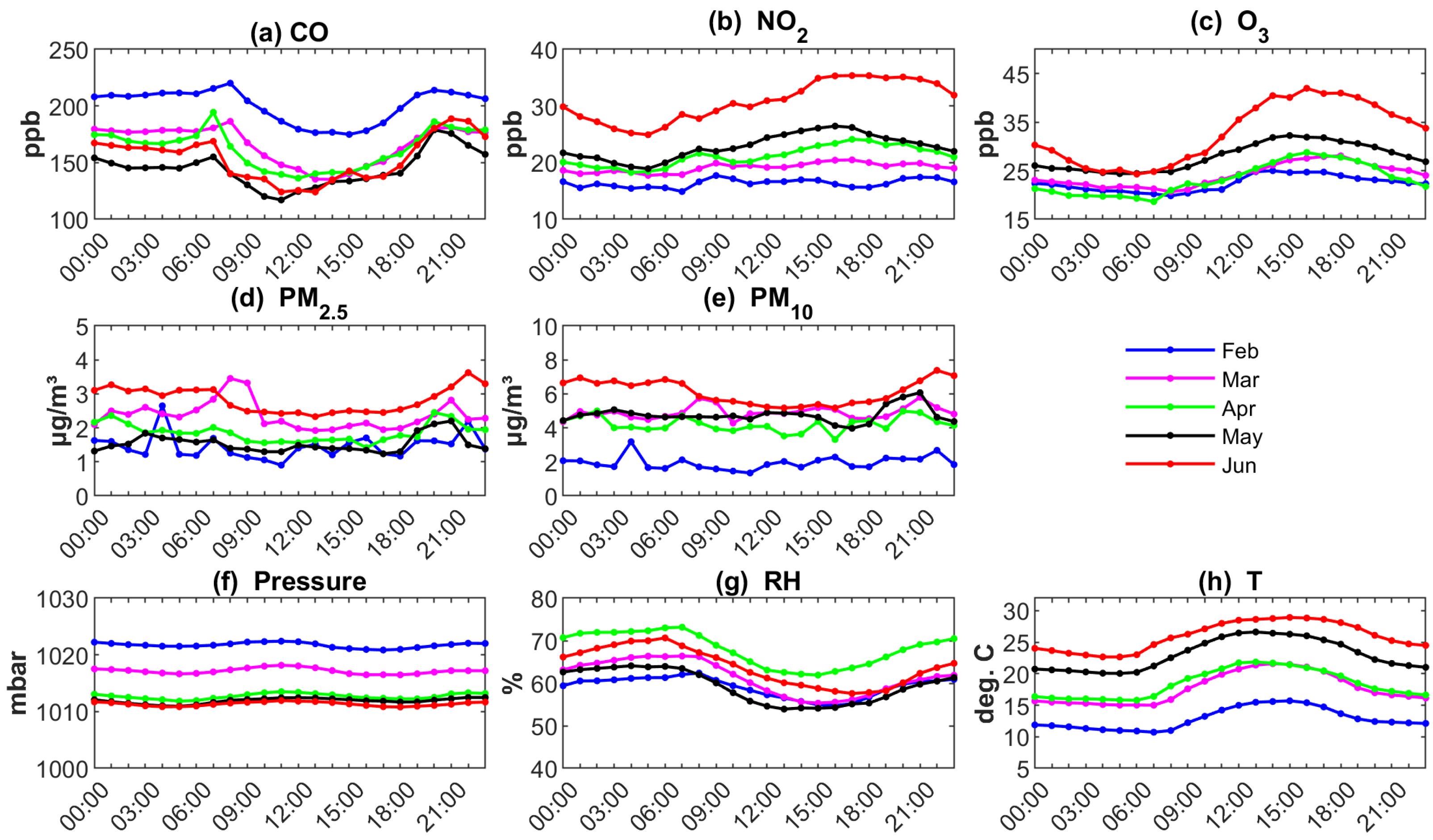
Figure 4 shows the diurnal mean variation for the concentration of pollutants and meteorological factors in Chalki’s port area calculated for each month from February to June 2025. The hourly mean evolution of pollutants show that the warm months (June and May) tend to present an increased concentration of pollutants compared to other months (Figure 4). In particular, NO2 during June shows an increase about 46% compared to February (Figure 4b). Regarding the hourly mean evolution, the concentration of NO2 starts to increase about 6:00 until 15:00 and stay stable until 21:00. The diurnal variation in O3 concentrations follow daily sun activity (Figure 4c) and is possibly significantly affected by atmospheric chemistry (photochemistry [102]). During June, the concentration of O3 increases about 32% compared to February. The maximum change mainly presented over the daytime hours, where the sun activity and traffic peak. The concentration of PM2.5 and PM10 do not show significant variability during the mean day, and the concentration seems to stay in safe limits according to the EU Directive for air pollution (Figure 4d,e). The diurnal variation in CO shows a different hourly mean evolution compared to the other pollutants (Figure 4a). CO shows lower concentrations during the warm period (June and May) compared to February, and shows two peaks: one in the morning and one in the evening hours, respectively. Previous studies have shown that diurnal variation in CO is mainly affected by traffic activities and atmospheric conditions such as wind speed, boundary layer height, thermal inversion, and atmospheric turbulence [23,103,104]. In addition, CO2 measurements over the background station of Finokalia (in Crete Island) show increased CO2 concentrations during winter and decreased concentrations during summer months [105,106]. Regarding the meteorological factors, atmospheric pressures tend to reduce during the warm months (Figure 4f). The establishment of the thermal low, which is extended from the Indian Monsson area through the Middle East to the eastern Mediterranean from the late spring to summer period, is a dominant factor that acts as a driver (in combination with the Balkan high-pressure system) for the summer’s low tropospheric circulation over the Aegean basin [29,30,107,108]. The monthly diurnal mean variation for relative humidity and temperature show a typical pattern for the cold (February) and warm (June) periods over Chalki’s area (Figure 4g,h). These results are consistent with the findings from this analysis showing the impact of atmospheric conditions, traffic profile, and variation, as well as photochemistry, on the air quality of the studied port area.
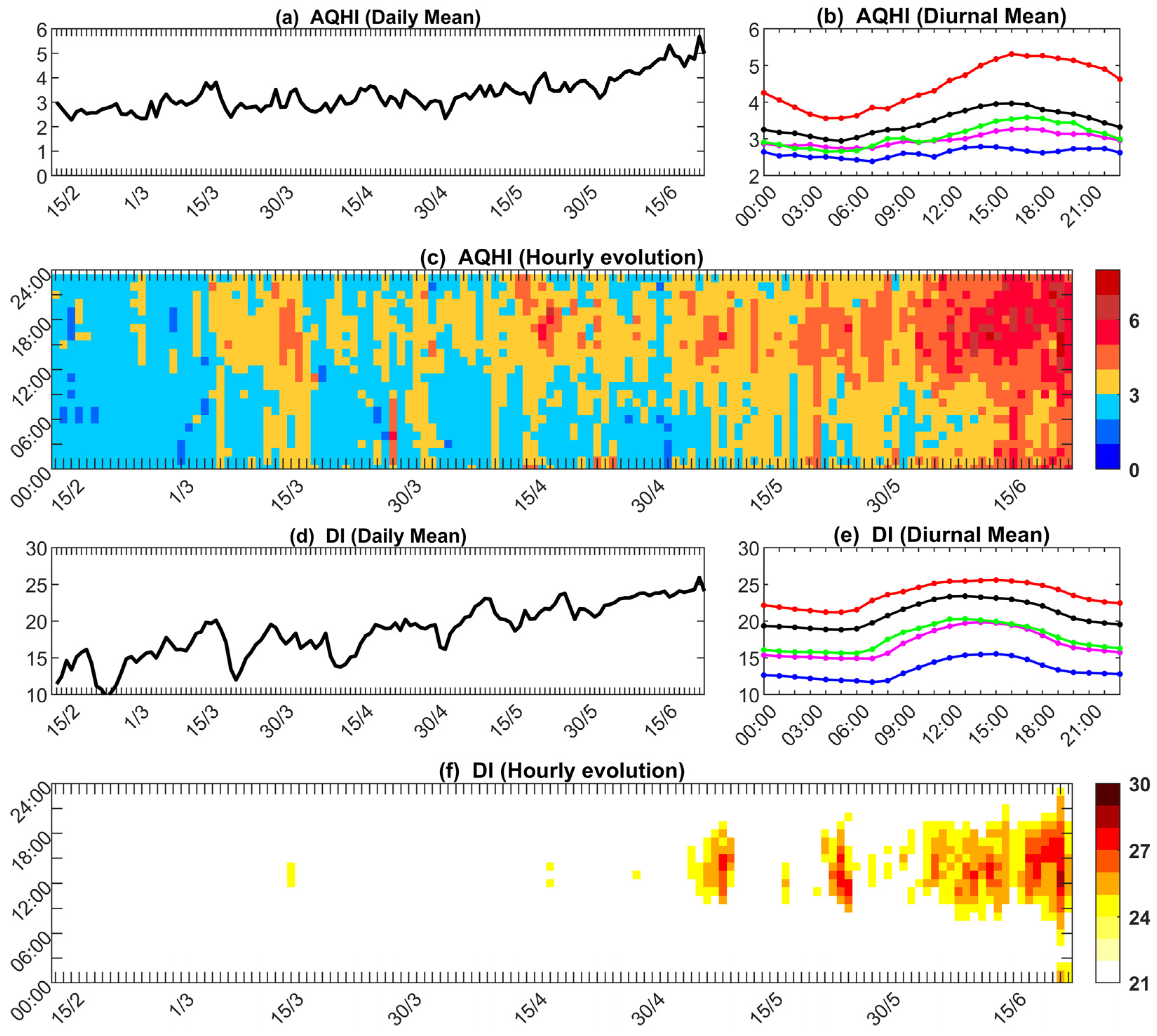
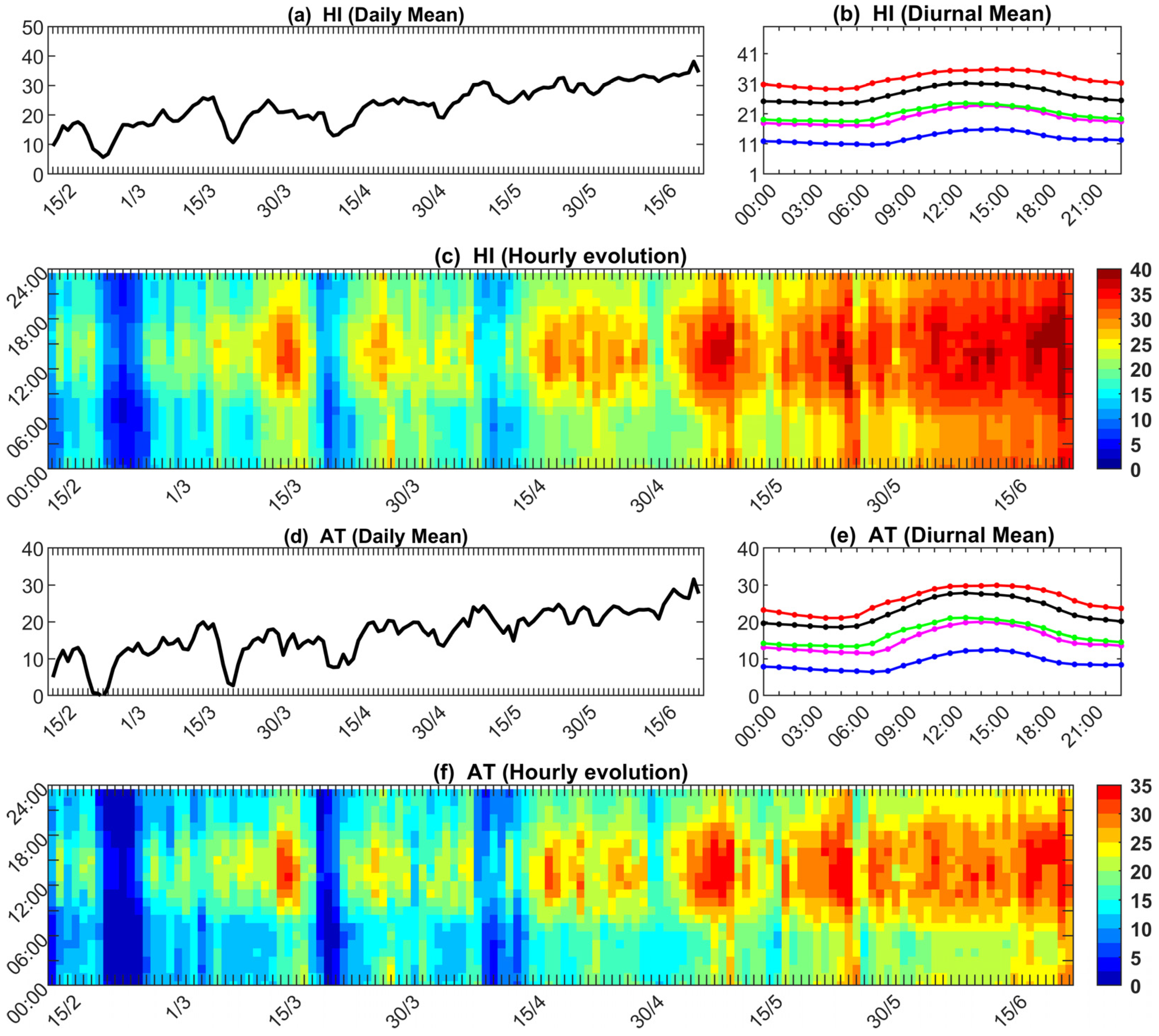
In order to investigate the impact of the ambient air concentration of pollutants and meteorological conditions on human health, the air quality health index (AQHI) and discomfort index (DI) were calculated using recording from the mobile air quality monitoring system. Figure 5 shows the daily diurnal mean and hourly variation in AQHI and DI for each month during the studied period. The findings show that June is the month with the most degraded condition regarding human health risk (in terms of AQHI and DI). The best conditions presented in February, where AQHI values changed between 2 and 3 and DI values were classified in the “No Discomfort” class. For March and April, the AQHI values ranged between 2 and 4 and DI values remained in the “No Discomfort” class (Figure 5b,c,e,f). Focusing on May and June (mainly on June), the conditions seem to be degraded compared to the previous period. Particularly in June, the AQHI and DI increased about 41% and 43% compared to February, respectively. The worst conditions were during the hours that anthropogenic activities peaked, the daily hours between 11:00 and 21:00. The AQHI values varied between 3 and 7, and the DI values show that a part of the population possibly feels discomfort. Focusing on other areas of the southeastern Aegean Sea, Logothetis et al. [23,42] have shown that, in Rhodes city, the AQHI ranges between the “Low” and “Moderate” classes. For the concentration of PM2.5, Fameli et al. [19] have shown that the higher concentrations are mainly affected by local sources as well as the wind speed amplitude. In order to further investigate the impact of meteorological conditions on human sense, the Humidex and Apparent Temperature indices were calculated using data from the ERA5 reanalysis dataset (Figure 6). The findings are in line with the previous analysis showing that human health risk increased during the warm period compared to other months (during the period from February to April 2025). In addition, this analysis shows that reanalysis data can capture and reproduce the general human sense conditions (feeling) in Chalki’s port area compared to DI calculations from sensor measurements.
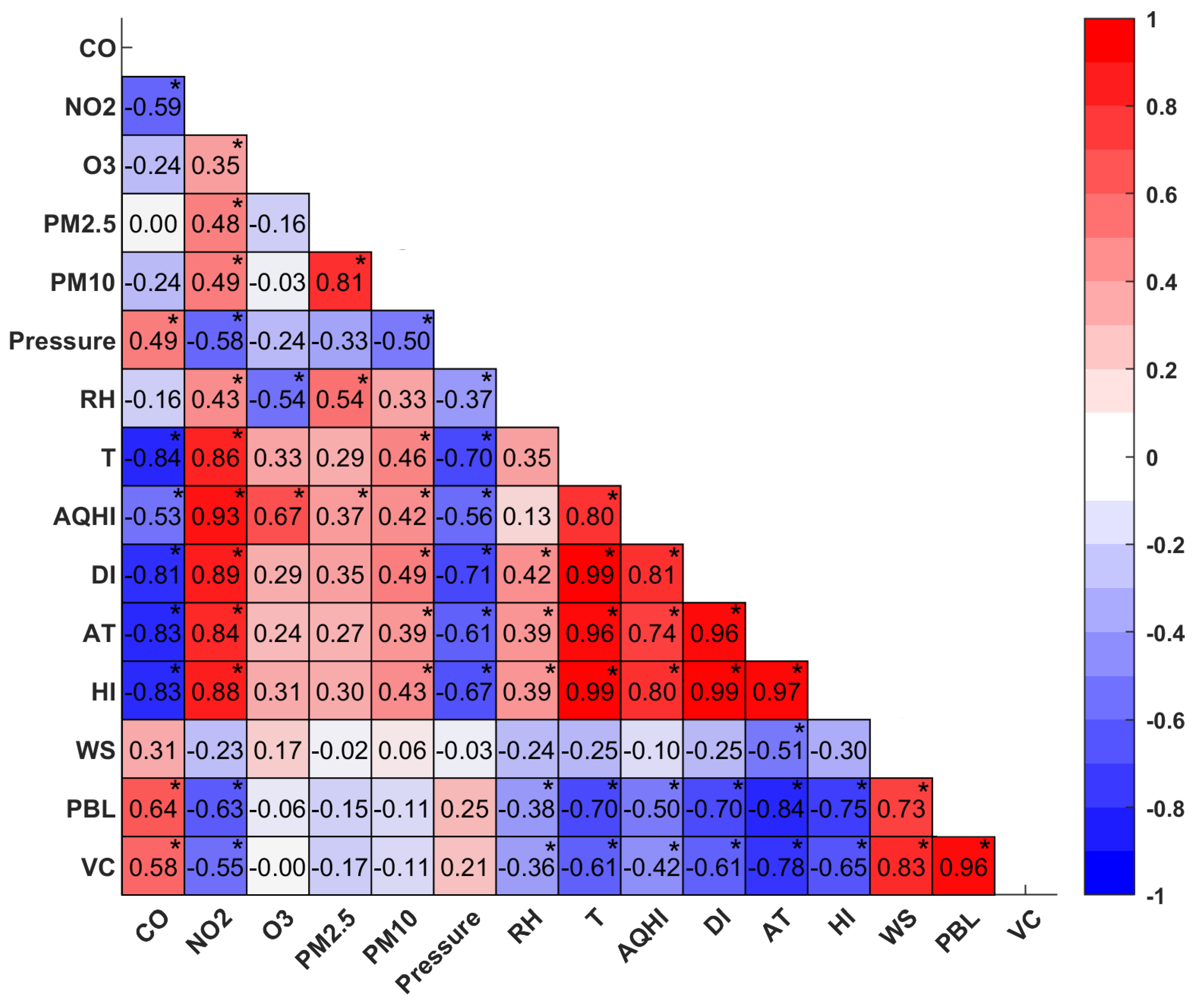
To study the relation among air quality parameters, discomfort indices, and meteorological and atmospheric conditions, the Pearson correlation coefficients among these factors were calculated. The findings are shown in Figure 7. Wind speed (WS) and PBL are, in general, related to improved air quality conditions (low-to-moderate correlation coefficients). Increased WS and PBL tend to improve the air quality, discomfort conditions, and feeling sense for the mean population because they are related to dispersion, increased mixing layer, and ventilation conditions for low troposphere [109,110,111,112,113]. Our analysis shows that WS and PBL are moderate-to-highly negatively correlated with DI, HI, and AT (correlation coefficients are from −0.34 to −0.85). Finally, to study the combined effect of WS and PBL on the concentrations of air pollutants and discomfort conditions, the correlation coefficient between VC and concentration of pollutants, meteorological factors, AQHI, as well as discomfort indices (DI, HI, and AT), are also calculated. Findings show that the increased VC values are associated with improved conditions for both air quality and discomfort. This result is in line with previous studies that show that high VC values are associated with improved air quality conditions due to the dispersion of pollutants [82,83]. The results of our analysis are compatible with previous studies that show that increased VC values are associated with improved air quality conditions due to the dispersion of pollutants [82,83]. According the analysis of Deng at al. [114], ambient air pollutant concentrations are mainly influenced by ground factors, PBL variation, and atmospheric circulation conditions. The results of our analysis also support these findings, showing that meteorological factors (i.e., WS and PBL) and ground factors (i.e., traffic variation and tourist activities) determine the air quality profile and discomfort sense of the population of the port area of Chalki. The positive correlation between AQHI and DI (0.81) indicates a negative synergy for human health. The increased tourist density, in combination with meteorological conditions as well as atmospheric patterns and mechanisms (i.e., photochemistry, air temperature, RH, PBL and VC), consist of the main factors driving this synergy. These results are in line with the analysis of Parliari et al. [115], which shows that degraded air quality and heat conditions (which are related to increased discomfort sense) increase health risk. To sum up, correlation analysis shows that meteorological and atmospheric conditions impact air quality. At this point, it is important to say that this is a complex multi-factor interaction, not a single cause and effect chain (i.e., traffic profile and behavioral features also influence ambient air pollution) [116,117].
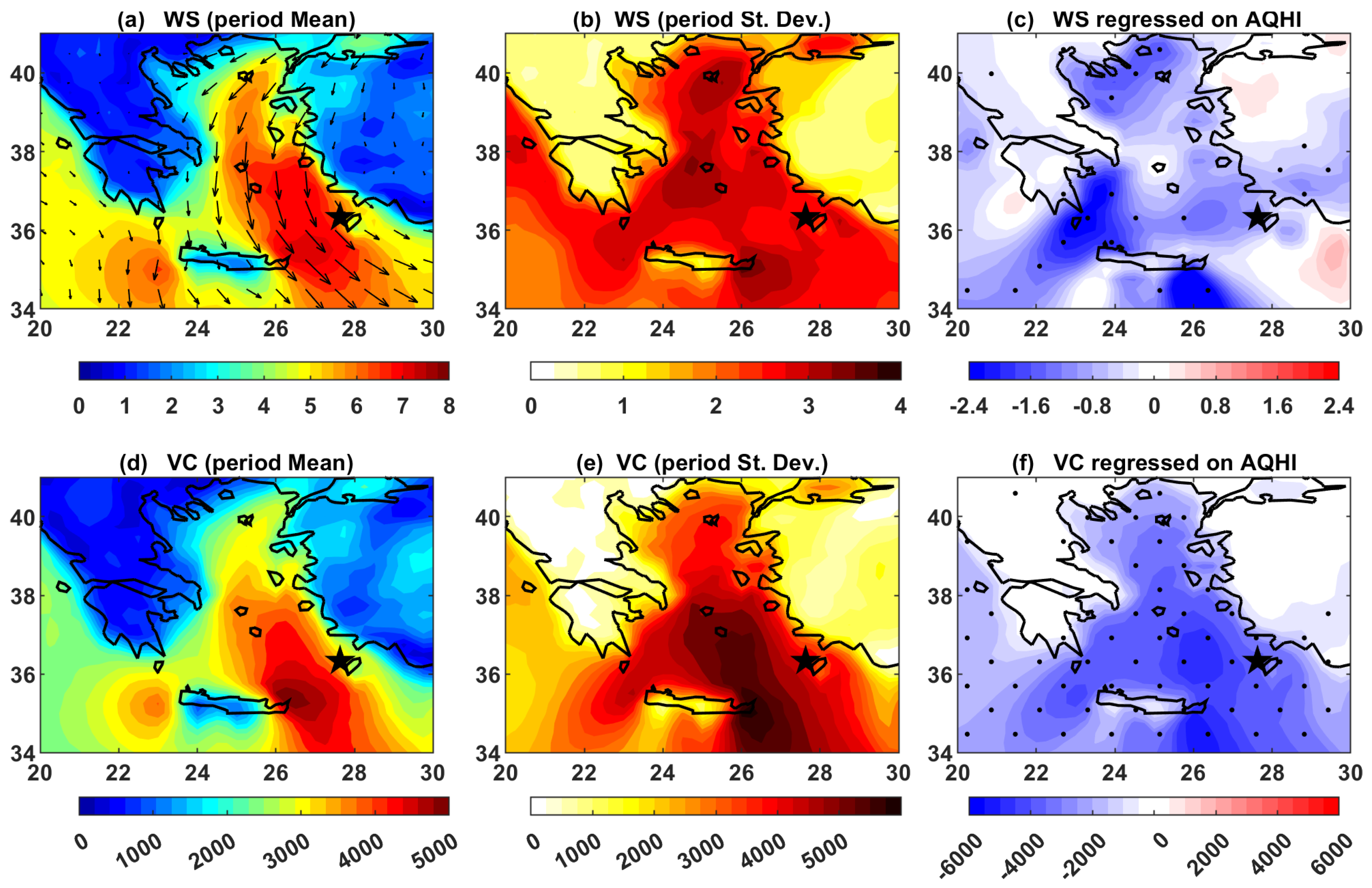
In order to study the impact of WS and VC (as the combined effect of WS and PBL) on air quality conditions in Chalki’s port area, the WS and VC fields, over each grid point in a geographic window of southeastern Mediterranean that includes Aegean Sea, regressed on AQHI (Figure 8). The analysis only considers the no-precipitation days in order to decrease the biases regarding the impact of precipitation in concentration of ambient air pollutants (i.e., wet deposition) [79,118]. Studying the mean WS and VC pattern during no-precipitation days, the maximum mean WS and VC are shown in the areas of the central Aegean (around the region of Naxos Island), southwestern Aegean Sea (western region of Crete Island), and southeastern Aegean (between Crete and Rhodes Islands region) for the period of February–June 2025. The standard deviation of WS and VC are also maximized over these regions. Past studies have shown, using model simulations and observational data, that the most intense mean wind speed (about 7–8 m/s) are presented locally over the central, southeastern, and southwestern Aegean areas in the Aegean basin [84,119,120,121,122]. In our analysis, regression of WS and VC fields against on AQHI shows that there is a relation between WS/VC and air quality conditions (in terms of AQHI) on Chalki’s port area. The impact of WS and VC on the air quality of Chalki’s port area seems to be related with improved ambient air quality conditions (in terms of AQHI) in Chalki’s area (negative values of regression WS and VC fields against the AQHI calculated in Chalki’s port area). The results indicate, in a quantitative way, that the dominant patterns of tropospheric circulation over the Aegean Sea affect (tends to improve) the air quality conditions in Chalki’s area. These findings highlight that, except traffic and anthropogenic activities, the synoptic conditions also significantly affect the variation in air quality over Chalki’s port area.

3.2. Waste Management: Identification of Optimal Source-Separation Bin Arrays

Contributor-specific waste generation results, along with the total annual waste generation for 2024, are presented in the aggregated Table 2.
The results indicate a 53.14% increase in total generated waste compared to 2019. Seasonal residents account for approximately 38% of total generated MSW, reflecting a 29% increase relative to the base year. This surge highlights the significant contribution of tourism-related waste to Chalki’s current waste profile. Based on these estimates, the required number of source-separation bins and their optimal grouping were determined under two distribution scenarios.

3.2.1. Scenario 1: Off-Season

Total and per capita source-separation bin requirements for permanent residents are shown in Table 3.
Overall, the plastic waste stream required the highest quantity of bins due to its notable share in the island’s waste composition and its relatively low bulk density. Conversely, the organic and paper streams, although generated in higher quantities, demonstrated lower bin needs. This is attributed to their relatively higher bulk densities, translating into more efficient storage. The margin of error does not directly influence bin requirement calculations. The multi-criteria optimization model is applied iteratively up to Amax = 15. The three competing criteria and aggregated score for the off-season scenario are calculated for each iteration and are presented in the aggregated Table 4.
The generated results show that the optimal configuration for equal weight factors corresponds to five identical bin arrays (A = 5). This option achieves the highest aggregated score (0.107) among all tested array scenarios. Individual arrays comprise seven source-separation bins, yielding a total of 35 bins (3 bins over the sufficiency threshold). One bin is allocated to each material category with the exemption of plastic and paper, requiring three and two bins per array, respectively. The procurement penalty (Padd = 0.094) remains at a manageable level, reflecting moderate additional bin requirements. Moreover, the size penalty (Psize = 0.048) demonstrates a lower value due to small deviations from the defined Bo. The sum of both penalties is effectively outweighed by a sufficiently high coverage value (Scov = 0.463), entailing balanced trade-offs between criteria.
The second-best option corresponds to ten arrays (A = 10), with a total aggregated score of 0.063. This case benefits from improved bin coverage (Scov = 0.753) compared to the five-array configuration. Expectedly, it completely avoids a size penalty (Psize = 0), since it matches the same number of bins per array as the preferred input. However, this configuration is constrained by a significantly higher procurement penalty (Padd = 0.563), indicating that a substantial number of additional bins are required beyond sufficiency (18 additional bins). This procurement inefficiency ultimately prevents it from outperforming the six-array configuration. Notably, the six-array option demonstrates the third highest score of 0.055. Relative to the optimal configuration, this system exhibits a higher coverage score (Scov = 0.527) and an equivalent size penalty (Psize = 0.017). However, similarly to the ten-array case, its elevated procurement penalty (Padd = 0.313) lower its designated score beneath optimal levels.
Unlike the source-sorting approach implemented for the four primary material categories, mixed waste and organics require a more practical management strategy. In insular systems, the combination of elevated ambient temperatures and diverse organic waste streams often results in pronounced odor emissions from organic waste bins. This can lead to social discomfort and potentially discourage participation in source-sorting practices. Furthermore, bins dedicated to this waste stream demand frequent cleaning, rendering a wide-scale distribution strategy impractical for local sanitation services and exacerbating negative impacts on the surrounding environment. To address these challenges, an aggregated bin strategy is proposed for both organic and mixed waste streams. Based on the pre-calculated capacity requirements, two 1.1 m3 metallic bins will be allocated to each waste stream and positioned at strategic locations. The metallic bins designated for organic waste collection will be further upgraded with dual-entry lids designed to minimize waste exposure during use. This feature effectively reduces unpleasant odors, encouraging greater public participation in source separation practices. The proposed configuration effectively covers the calculated capacity needs for both mixed and organic waste streams, enabling the direct disposal of high-organic-load fractions from restaurants, while facilitating efficient cleaning operations and minimizing social nuisance. To mitigate the potential coverage gaps associated with this aggregated strategy, additional 0.082 m3 bins dedicated to mixed waste will be integrated into each installed source-sorting array.

3.2.2. Scenario 2: Peak Season

In the peak season scenario, bin requirements are jointly driven by waste generated from both permanent residents and seasonal visitors. However, residents produce waste on a continuous annual basis while tourists contribute only during short, concentrated periods. As result, a conventional per capita estimate from static population numbers would misrepresent the actual waste generation dynamics. To address this, the study adopts an equivalent population approach, which annualizes the contribution of seasonal visitors by converting their short-term presence into an average daily load. This enables the combined waste contributions of residents and tourists to be expressed as a single standardized metric over a full year. In turn, it ensures consistency with the aggregated waste generation forecasts and the subsequent bin optimization outputs. The equivalent population Peq(n+i) is defined as
P e q ( n + i ) = N n + i , P R + N n + i , S V × L a v g T e x
where
  • N(n+i),PR: The number of permanent residents in the target year n + i (dimensionless);
  • N(n+i),SV: The number of seasonal visitors in the target year n + i (dimensionless);
  • Lavg: The average length of stay for seasonal visitors in the target year n + i (days);
  • Tex: The length of the examined period, set to 365 days for annualization (days).
As mentioned above, for 2024, the permanent resident population and seasonal visitor influx are estimated at N(n+i),PR = 478 and N(n+i),SV = 125,000, respectively. Local authority data indicate an average visitor stay of Lavg = 5 days. Based on these figures, the population equivalent is calculated at Peq(n+i) = 2190. This harmonized metric allows for the estimation of per capita-equivalent bin requirements that reflect the combined annualized waste load of both waste-contributing categories. Total and per capita-equivalent bin requirements, based on MSW generated from both waste-contributing categories, are shown in Table 5.
In terms of source-separation bin demands, the trend observed in the off-season scenario remained unchanged. This corresponds to the assumed identical waste generation habits between both waste-contributing categories. The per capita-equivalent bin requirement decreased relative to the off-season scenario due to the notable rise in the total waste-contributing population. The Nbk is determined by the total quantity of generated waste rather than by population counts alone. Since seasonal visitors exhibit lower per capita waste generation rates than permanent residents, the increase in the equivalent population does not produce a proportional increase in total waste. Consequently, Nbk adjusts according to the actual waste load, leading to reduced per capita-equivalent values despite the higher aggregated population. For this case, the multi-criteria optimization model is applied iteratively up to Amax = 23. The results for each iteration are presented in aggregated Table 6.
The generated results reveal that accounting for tourist-related waste alters the optimal system configuration to eight identical arrays (A = 8), corresponding to an aggregated score of 0.071. The seven-bin array structure remains unchanged, primarily due to the identical waste generation patterns between permanent residents and seasonal visitors, which limit deviations from the category-specific production trends of the first scenario. Under this configuration, the total number of required source-separation bins increases to 56, exceeding the sufficiency threshold by 10 units. This surge in additional infrastructure directly elevates the procurement penalty to Padd = 0.217. As expected, the size penalty remains constant at Psize = 0.048, since the same array structure is employed. Coverage sufficiency (Scov = 0.477) outweighs both penalty components, resulting in a positive aggregated score for the configuration.
The second-best alternative corresponds to fifteen five-bin arrays (A = 15), achieving an aggregated score of 0.037. This configuration completely avoids size penalties (Psize = 0) and provides substantially higher coverage (Scov = 0.741) compared to the optimal case. However, it entails a significantly higher procurement penalty (Padd = 0.630), driven by the requirement for 29 additional bins, which ultimately undermines its overall performance. The nine-array system yields a slightly lower score of 0.034, with coverage (Scov = 0.519) and size penalties (Psize = 0.048) comparable to the optimal configuration. Nonetheless, the additional bin requirement increases by 70% (17 bins) relative to the model case, raising the procurement penalty to Padd = 0.370 and consequently reducing its reflective final score.
To accommodate for the elevated capacity needs for both mixed and organic waste streams, the number of 1.1 m3 metallic bins will be raised to three per waste category.

3.2.3. Sensitivity Analysis: Alternative Weighting Schemes

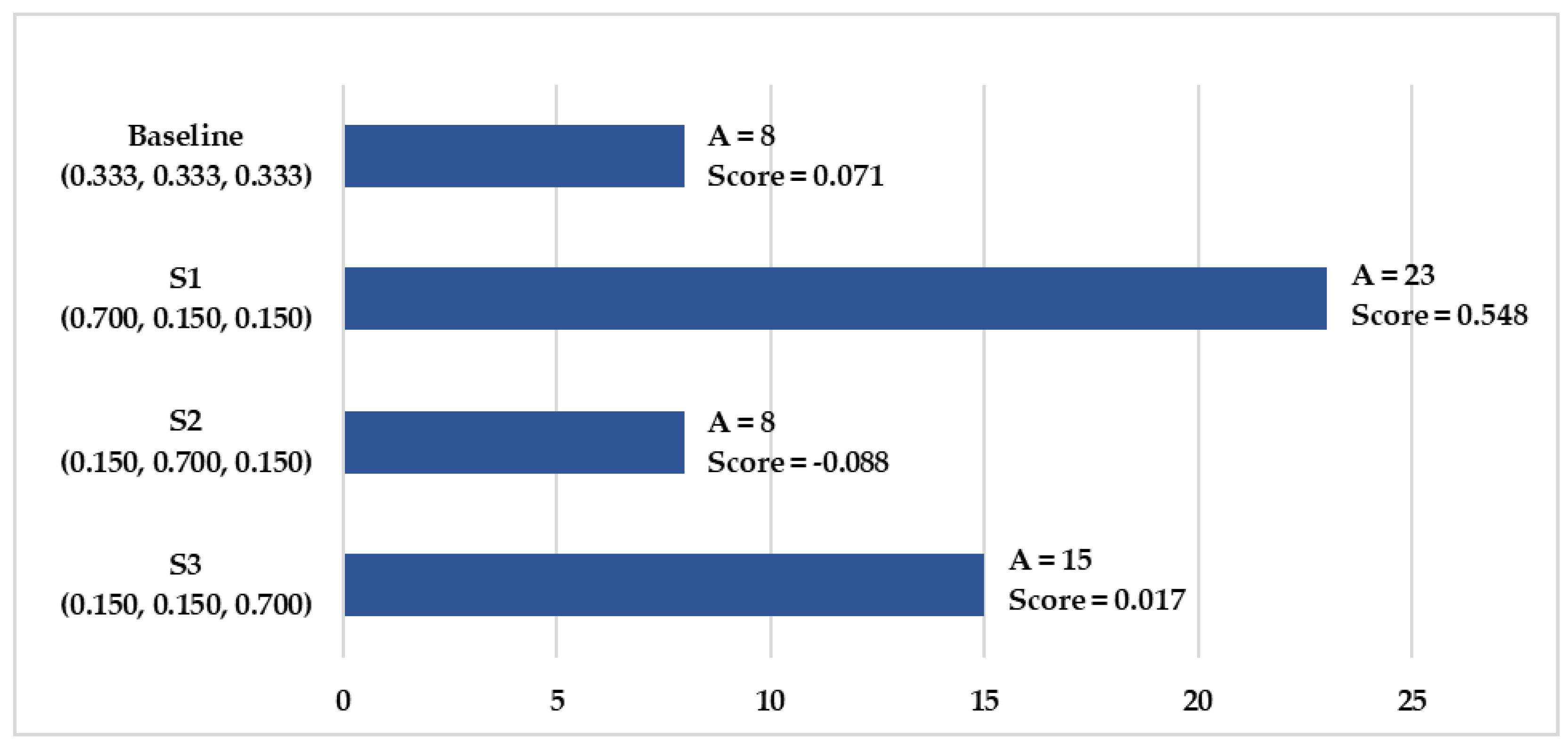
To assess the robustness of the multi-criteria optimization results, a sensitivity analysis of the weight factors wcov, wadd, and wsize is conducted for the peak season bin requirements. Contrary to the neutral equal-weighting baseline, three alternative weighting schemes are defined. Each scheme strongly prioritizes one of the three competing criteria. Accordingly, the analysis considers a coverage-prioritized (S1), a procurement-prioritized (S2), and an array-size-prioritized (S3) scenario, along with the equal weighting scheme as a reference baseline. This design reflects potential decision-making contexts in which a single planning objective is clearly emphasized, while the remaining criteria retain a secondary role. For instance, situations where spatial constraints render array size a primary concern are represented by the array-size-prioritized scenario (elevated wsize). All other variables and modeling assumptions remain identical to the baseline assessment. The defined weighting schemes are presented in Table 7, and their associated aggregated scores and optimal array numbers A are illustrated in Figure 9.
The results indicate notable deviations in the optimal A across the different weighting schemes. Scenario S1, linked to a strong prioritization of coverage, yields an aggregated score of 0.548 and an optimal configuration of 23 identical four-bin arrays (A = 23). Although this result coincides with the theoretical upper bound Amax, it directly aligns with the structure of the score function. In this coverage-prioritized scenario, Scov reaches its maximum value, while Padd assumes an identical value due to this configuration exhibiting fewer additional bin demands compared to the other high-A options. These factors effectively offset each other in the weighted sum. As a result, the aggregated score is determined by the array size penalty, which is minimized (Psize = 0.012) because the number of bins per array (a = 4) closely aligns with the preferred Bo. Thus, when coverage is strongly weighted, the model favors the largest feasible number of arrays that still respects the preferred array size, even at the cost of high additional infrastructure needs.
In the procurement-oriented scenario (S2), where wadd is dominant, the same optimal configuration as the baseline analysis (A = 8) is identified, generating an aggregated score of −0.088. The elevated influence of Padd drives the total score into the negative range. This indicates that the benefits of sufficient coverage are outweighed by the combined penalties, primarily driven by Padd. Nevertheless, A = 8 emerges as the least penalized solution across all criteria, explaining its stability as the optimal configuration under both equal-weighting- and procurement-prioritized schemes.
Finally, S3 corresponds to 15 five-bin arrays (A = 15) and an aggregated score of 0.017. This result reflects the fact that A = 15 constitutes the smallest number of arrays that exactly matches the preferred Bo, thereby minimizing Psize. At lower A values, deviations from Bo become more pronounced and lead to a steeper increase in Psize. In contrast, higher A values and improvements in practical sizing are offset by the growing Padd. Therefore, A = 15 represents the point at which adherence to the preferred Bo balances out the moderate increase in additional bin requirements before further increases in A cause the aggregated score to decline.
These findings indicate that the range of optimal array configurations remains relatively narrow, as a limited number of configurations can credibly balance coverage, procurement, and size practicality. The model thus exhibits stable and logically consistent behavior under moderate variations in weighting priorities, without signs of excessive or non-representative sensitivity.

3.3. Limitations and Prospects for Further Investigations

The results of this study provide significant findings for the air quality as well as the waste management plan of Chalki’s Island. In this section, some of the major limitations of this work are discussed.
Regarding the air quality campaign, the analysis provides the results for a site in the port area. The findings are indicative for the port area, but they cannot be considered generalized and representative of other island’s or city’s areas. The lack of labor-intensive air quality systems or/and a network of LCS cannot provide a complete air quality mapping for the island. The concentration of pollutants has not exceeded the threshold of the EU Directive for ambient air quality, but the increased tourist density could possibly degrade the air quality in the future.
The experimental air quality campaign covers the period from February to June 2025. The peak tourist activity of July and August is not included in our analysis (there is no available data). Future investigations that involve annual recordings of air quality parameters can provide further results and findings with increased statistical robustness.
The complex terrain over the island region of Southeastern Aegean induces limitations. For example, the calculation of VC index is affected significantly by complicated terrain. In addition, the spatial resolution of meteorological data (ERA5 reanalysis dataset) induces a limitation regarding the relation between meteorological factors and AQMS measurements.
The studied air quality period can be considered as a short period in order to investigate the possible interrelation between the two core modules (waste management and air quality) that are studied here. Future works can also cover this lack by accounting for the increased tourist development that it is expected in the future.
Regarding the waste management investigation, the central limitation of the presented analysis lies in its reliance on two necessary and interdependent assumptions. The first concerns the adoption of identical waste-generation habits for residents and tourists, which does not fully reflect actual consumption patterns on the island. Seasonal visitors typically generate larger quantities of lightweight, single-use materials, such as plastic containers, paper packaging, and disposable products. These patterns differ from those of residents, whose waste streams tend to be more diversified and stable throughout the year [123]. As a result, assuming identical waste generation habits may bias bin requirements by undercounting bins for tourism-intensive material streams (e.g., plastics and paper) or overestimating bins for routine household fractions (e.g., organics or mixed packaging). This divergence can influence the optimization outcome. For instance, explicitly modeling tourist-specific consumption would likely increase the required capacity for plastic and paper bins during peak tourist season. This would potentially alter both the number of optimal arrays and their internal bin composition, shifting the focus toward high-turnover bin arrays, rather than the centralized organic waste configuration.
Relating to this, the assumption of a fixed waste composition does not fully capture the expected seasonal variability observed in small touristic islands. During peak tourist months, the composition of MSW generally shifts toward a larger share of short-lived recyclable materials and a reduced proportional share of heavier fractions such as organics and glass [124]. Therefore, applying a standardized composition based on regional averages affects the model’s bin requirement thresholds, which may lead to suboptimal array recommendations under peak tourism conditions.
Notably, bulk density values exhibit substantial variability across regions and seasons due to differences in packaging practices, moisture content, and tourism-driven consumption patterns. In addition, continuous advancements in packaging design (e.g., shift toward lightweight materials or increased use of multi-layer composites) may alter the bulk density of waste materials under free-disposal conditions compared to historical datasets. Consequently, although the WRAP bulk density dataset provides a robust and widely adopted reference, the incorporation of updated or case-specific bulk density measurements is essential for accurately determining bin capacity thresholds.
Although these assumptions introduce uncertainty, they do not compromise the fundamental robustness of the framework. Obtaining continuous, time-disaggregated waste data is not feasible for a small island such as Chalki due to limited monitoring infrastructure and human resources. Under these constraints, applying a unified per capita generation rate and a fixed composition profile remains the most operationally realistic and traceable approach, ensuring that model inputs remain verifiable. Importantly, the developed methodology is inherently adaptable, as it already accommodates differentiated generation rates between contributor categories. As a result, it can easily incorporate updated island-specific data once such information becomes available through the progression of the “NHSOS” project, without demanding additional model modifications. This flexibility ensures that the analysis can be progressively refined as richer local datasets emerge. Furthermore, it facilitates the broader application of the framework to other insular or isolated systems where more granular waste data is accessible.

4. Conclusions

This study was implemented within the framework of the “NHSOS” project, incorporating waste management optimization and air quality investigation actions on the island of Chalki, both aligned to the United Nations Sustainable Development Goals (SDGs). These actions represent key components of holistic sustainability planning, as they address circular resource utilization, environmental impact reduction, and enhancement of residents’ quality of life. Consequently, their effective implementation is essential to ensure environmental efficiency and public health protection, thereby positioning Chalki as a benchmark for sustainability among insular systems.
Regarding the air quality investigation in the port area of Chalki’s Island, a mobile air quality system is employed in order to measure the concentration of basic of pollutant concentrations during a period that covers a low and high tourist season (from 13 February to 22 June 2025). The results show that there are no exceedances of the EU Directive limits for air pollutant concentrations. The variation in the concentration of pollutants in the port area are affected by anthropogenic activities (i.e., shipping, vehicle traffic, and tourist density) and atmospheric circulation factors (i.e., PBL and VC). The calculation of AQHI (that is used as measure to investigate the impact of air quality degradation on human health) and discomfort indices (DI, HI, and AT) show degrade conditions during the high tourist period as compared to the low traffic period (winter and spring months). The synchronous increase in the concentration of pollutants and the degraded bioclimatic conditions mainly during the warm period increase the health risk of pollution. In this context, it is important to consider measures from local authorities (i.e., climate and air quality condition alarms as well as air-conditioned public areas) in order to protect the mean population. Finally, the atmospheric circulation parameters (WS and VC) influence the air quality of Chalki’s port area. In particular, increased WS and VC act as ventilator for the southeastern Aegean, and they related to improved air quality conditions (in terms of AQHI) in Chalki’s port area.
In this study, the investigation of air quality and the impact of atmospheric conditions on the variation in pollutant concentrations provides a methodological framework where the impact of air quality degradation and climate change are combined for a sensitive ecosystem. Chalki shows air quality profile and climate condition features that are common with other vulnerable ecosystems over the Mediterranean. In this context, the results and methodological framework of this study can be applied to other island ecosystems with similar characteristics.
In the context of waste management, a multi-criteria deterministic framework to optimize source-separation bin arrays at the municipal level was developed and adapted to the waste dynamics of the island of Chalki. Foreseen waste quantities for 2024 were estimated using a simplified predictive model based on demographic and MSW generation data. These projections informed the setting of source-separation bin thresholds for all major material streams and supported the optimization of bin array configurations by balancing spatial coverage, procurement efficiency, and array size. The results indicate a rise in tourist-related waste, which accounted for approximately 38% of the island’s total waste output. Despite this increase, material composition remained stable, resulting in consistent qualitative bin needs. Plastics showed the highest bin demand, followed by paper and organics. For the off-season scenario, the optimization model identified five identical bin arrays (A = 5) as the optimal configuration, with an aggregated score of 0.107. Each array consisted of seven source-separation bins, with one bin allocated to each material category with the exception of plastics and paper, which required three and two bins per array, respectively. Under peak season conditions, the optimal configuration shifted to eight identical arrays (A = 8), maintaining the structure of the former scenario, but achieving a slightly lower aggregated score (0.071). A sensitivity analysis using three alternative weighting schemes was conducted to validate the model’s performance under scenarios where specific planning objectives are prioritized.
Beyond its local application for Chalki, the proposed framework holds broader methodological value for insular regions. By integrating waste generation forecasting with multi-criteria bin array optimization, it offers a transparent, quantitative decision support tool capable of guiding municipalities with comparable spatial, operational, and data limitations toward the development of source-separation strategies aligned with circular-economy principles. The framework can inform the design of bin distribution schemes, procurement planning, and infrastructure investments. These elements strengthen compliance with EU and national mandates on resource efficiency, waste reduction, and pollution prevention, as reflected in the relevant SDGs. Future research should integrate seasonal waste composition data and apply standardized MCDA weighting based on stakeholder inputs to assess robustness, reveal parameter dependencies, and enhance model reliability. Additionally, linking this framework with spatial analyses or dynamic models for optimal waste collection frequency could further support the development of adaptive waste collection systems. Integrating cost analysis components into the existing model would also provide added value, enabling municipalities to evaluate the economic implications of alternative array configurations, quantify procurement and operational trade-offs, and prioritize interventions based on economic viability. The tool thus serves as a preliminary methodological baseline for benchmarking and optimizing waste management systems in small-scale or remote municipalities.

Author Contributions

Conceptualization, I.L., D.-S.K., A.M. and P.G.; methodology, I.L., D.-S.K. and A.K.; software, I.L., D.-S.K. and A.K.; validation, I.L., D.-S.K. and A.K.; formal analysis, I.L., D.-S.K. and A.K.; investigation, I.L., D.-S.K. and A.K.; resources, I.L., D.-S.K. and A.K.; data curation, I.L., D.-S.K. and A.K.; writing—original draft preparation, I.L., D.-S.K. and A.K.; writing—review and editing, I.L., D.-S.K., A.K., A.M. and P.G.; visualization, I.L., D.-S.K. and A.K.; supervision, I.L., D.-S.K. and P.G.; project administration, P.G.; funding acquisition, P.G. All authors have read and agreed to the published version of the manuscript.

Funding

“NHSOS” Project (TAEDR-0537029) is implemented in the frame of National Recovery and Resilience Plan “Greece 2.0” and funded by the European Union—NextGenerationEU.

Institutional Review Board Statement

Not applicable.

Informed Consent Statement

Not applicable.

Data Availability Statement

Copernicus Climate Change Service (C3S) (2017): ERA5: Fifth generation of ECMWF atmospheric reanalysis of the global climate. Copernicus Climate Change Service Climate Data Store (CDS). https://cds.climate.copernicus.eu/datasets (accessed on 10 July 2025).

Acknowledgments

The authors would like to acknowledge Copernicus Climate Change Service, who provided the ERA5 climate reanalysis data that were used in this work.

Conflicts of Interest

The authors declare no conflicts of interest.

Abbreviations

The following abbreviations are used in this manuscript:
AHPAnalytic Hierarchy Process
AQHIAir Quality Health Index
AQIAir Quality Index
AQMSAir Quality Monitoring System
ATApparent Temperature
CAQICommon Air Quality Index
C3SCopernicus Climate Change Service
DIDiscomfort Index
ECMWFEuropean Centre for Medium-Range Weather Forecasts
ELECTREELimination Et Choix Traduisant la REalité (Elimination and Choice Expressing Reality)
ELSTATHellenic Statistical Authority
FODSAWaste Management Authorities
GAIAGeometrical Analysis for Interactive Aid
HCIHoliday Climate Index
IPCCIntergovernmental Panel on Climate Change
LCALife Cycle Assessment
LCSLow Cost Sensors
MCDAMulti-Criteria Decision Aid
MSWMunicipal Solid Waste
NWMPNational Waste Management Plan
PBLPlanetary Boundary Layer
PMsParticulate Matters
PROMETHEEPreference Ranking Organization Method for Enrichment Evaluations
RHRelative Humidity
RSWResidential Solid Waste
RSWMPRegional Solid Waste Management Plan
S3Smart Specialization Strategies
SDGsSustainable Development Goals
SIDSSmall Island Developing States
SVMSupport Vector Machine
TOPSISTechnique for Order of Preference by Similarity to Ideal Solution
VCVentilation Coefficient
WBUsWeighted Benefit Utility
WHOWorld Health Organization
WRAPWaste & Resources Action Programme
WSWind Speed
WTWavelet Transform

References

  1. NHSOS Project. Available online: https://www.nhsos-project.gr/ (accessed on 22 October 2025).
  2. European Commission. Clean Energy for EU Islands: What Is the Chalki GR-Eco Islands National Initiative? Available online: https://clean-energy-islands.ec.europa.eu/countries/greece/chalki (accessed on 12 September 2025).
  3. European Commission. Clean Energy for EU Islands: Clean Energy Vision to Clean Energy Action. Available online: https://clean-energy-islands.ec.europa.eu/ (accessed on 24 October 2025).
  4. Tsipouri, L.; Koundouri, P.; Papadaki, L.; Argyrou, M.D.; Tsipouri, L.; Argyrou, M.D.; Koundouri, P. Circular Economy in National Smart Specialisation Strategies: The Case of Greece. In The Ocean of Tomorrow. Environment & Policy; Koundouri, P., Ed.; Springer: Cham, Switzerland, 2021; Volume 57, pp. 199–241. ISBN 978-3-030-56847-4. [Google Scholar]
  5. United Nations. Transforming Our World: The 2030 Agenda for Sustainable Development; United Nations: New York, NY, USA, 2015. [Google Scholar]
  6. Ghorani-Azam, A.; Riahi-Zanjani, B.; Balali-Mood, M. Effects of Air Pollution on Human Health and Practical Measures for Prevention in Iran. J. Res. Med. Sci. 2016, 21, 65. [Google Scholar] [CrossRef]
  7. Manisalidis, I.; Stavropoulou, E.; Stavropoulos, A.; Bezirtzoglou, E. Environmental and Health Impacts of Air Pollution: A Review. Front. Public Health 2020, 8, 505570. [Google Scholar] [CrossRef]
  8. WHO. Air Quality, Energy and Health. Available online: https://www.who.int/teams/environment-climate-change-and-health/air-quality-energy-and-health/health-impacts/exposure-air-pollution (accessed on 24 October 2025).
  9. IPCC. Climate Change 2023: Synthesis Report. Contribution of Working Groups I, II and III to the Sixth Assessment Report of the Intergovernmental Panel on Climate Change; Core Writing Team, Lee, H., Romero, J., Eds.; IPCC: Geneva, Switzerland, 2023. [Google Scholar]
  10. Gomez, J.; Allen, R.J.; Turnock, S.T.; Horowitz, L.W.; Tsigaridis, K.; Bauer, S.E.; Olivié, D.; Thomson, E.S.; Ginoux, P. The Projected Future Degradation in Air Quality Is Caused by More Abundant Natural Aerosols in a Warmer World. Commun. Earth Environ. 2023, 4, 22. [Google Scholar] [CrossRef]
  11. Amann, M.; Kiesewetter, G.; Schöpp, W.; Klimont, Z.; Winiwarter, W.; Cofala, J.; Rafaj, P.; Höglund-Isaksson, L.; Gomez-Sabriana, A.; Heyes, C.; et al. Reducing Global Air Pollution: The Scope for Further Policy Interventions. Philos. Trans. R. Soc. A 2020, 378, 20190331. [Google Scholar] [CrossRef]
  12. Provenzano, S.; Roth, S.; Sager, L. Air Pollution and Respiratory Infectious Diseases. Environ. Resour. Econ. 2024, 87, 1127–1139. [Google Scholar] [CrossRef]
  13. Petropoulou, P.; Artopoulou, I.; Kalemikerakis, I.; Govina, O. Environment and Public Health: Air Pollution and Chronic Diseases. Environ. Sci. Proc. 2023, 26, 118. [Google Scholar] [CrossRef]
  14. Weaver, A.K.; Head, J.R.; Gould, C.F.; Carlton, E.J.; Remais, J.V. Environmental Factors Influencing COVID-19 Incidence and Severity. Annu. Rev. Public Health 2022, 43, 271–291. [Google Scholar] [CrossRef]
  15. Sarmadi, M.; Rahimi, S.; Rezaei, M.; Sanaei, D.; Dianatinasab, M. Air Quality Index Variation before and after the Onset of COVID-19 Pandemic: A Comprehensive Study on 87 Capital, Industrial and Polluted Cities of the World. Environ. Sci. Eur. 2021, 33, 134. [Google Scholar] [CrossRef]
  16. Chakraborty, P.; Jayachandran, S.; Padalkar, P.; Sitlhou, L.; Chakraborty, S.; Kar, R.; Bhaumik, S.; Srivastava, M. Exposure to Nitrogen Dioxide (NO2) from Vehicular Emission Could Increase the COVID-19 Pandemic Fatality in India: A Perspective. Bull. Environ. Contam. Toxicol. 2020, 105, 198–204. [Google Scholar] [CrossRef]
  17. Spyropoulos, G.C.; Nastos, P.T.; Moustris, K.P.; Chalvatzis, K.J. Transportation and Air Quality Perspectives and Projections in a Mediterranean Country, the Case of Greece. Land 2022, 11, 152. [Google Scholar] [CrossRef]
  18. European Environment Agency (EEA). Air Quality in Europe—2020 Report; European Environment Agency: København, Denmark, 2020. [Google Scholar]
  19. Fameli, K.-M.; Kotrikla, A.-M.; Kalkavouras, P.; Polydoropoulou, A. The Influence of Meteorological Parameters on PM2.5 Concentrations on the Aegean Islands. Environ. Sci. Proc. 2023, 26, 125. [Google Scholar] [CrossRef]
  20. Logothetis, I.; Antonopoulou, C.; Zisopoulos, G.; Mitsotakis, A.; Grammelis, P. The Air Quality and Influence of Etesians on Pollution Levels in the City of Rhodes: The Case of July 2022. In Proceedings of the Engineering Proceedings, Online, 1–15 December 2022; Multidisciplinary Digital Publishing Institute: Basel, Switzerland, 2022; Volume 31, p. 14. [Google Scholar]
  21. Logothetis, I.; Antonopoulou, C.; Zisopoulos, G.; Mitsotakis, A.; Grammelis, P. Air Quality and Bioclimatic Conditions in the Touristic City Centre of Rhodes from June to November 2022. In Proceedings of the 8th World Congress on Civil, Structural, and Environmental Engineering (CSEE’23), Lisbon, Portugal, 29–31 March 2023. [Google Scholar]
  22. Logothetis, I.; Antonopoulou, C.; Zisopoulos, G.; Mitsotakis, A.; Grammelis, P. A Case Study of Air Quality and a Health Index over a Port, an Urban and a High-Traffic Location in Rhodes City. Air 2023, 1, 139–158. [Google Scholar] [CrossRef]
  23. Logothetis, I.; Antonopoulou, C.; Sfetsioris, K.; Mitsotakis, A.; Grammelis, P. Comparison Analysis of the Effect of High and Low Port Activity Seasons on Air Quality in the Port of Heraklion. Environ. Sci. Proc. 2021, 8, 3. [Google Scholar] [CrossRef]
  24. Sun, L.; Zhang, J.; Ducruet, C.; Itoh, H.; Liu, X. The Impact of Shipping Activities on Air Quality and Residents’ Health in China’s Port Cities. J. Transp. Geogr. 2025, 123, 104099. [Google Scholar] [CrossRef]
  25. Logothetis, I.; Tourpali, K.; Melas, D. Warming Projections of Eastern Mediterranean in CMIP6 Simulations According to SSP2-4.5 and SSP5-8.5 Scenarios. Environ. Earth Sci. Proc. 2025, 34, 12. [Google Scholar] [CrossRef]
  26. Lazoglou, G.; Papadopoulos-Zachos, A.; Georgiades, P.; Zittis, G.; Velikou, K.; Manios, E.M.; Anagnostopoulou, C. Identification of Climate Change Hotspots in the Mediterranean. Sci. Rep. 2024, 14, 29817. [Google Scholar] [CrossRef]
  27. Giorgi, F. Climate Change Hot-Spots. Geophys. Res. Lett. 2006, 33, 8707. [Google Scholar] [CrossRef]
  28. Tyrlis, E.; Lelieveld, J.; Steil, B. The Summer Circulation over the Eastern Mediterranean and the Middle East: Influence of the South Asian Monsoon. Clim. Dyn. 2013, 40, 1103–1123. [Google Scholar] [CrossRef]
  29. Tyrlis, E.; Lelieveld, J. Climatology and Dynamics of the Summer Etesian Winds over the Eastern Mediterranean. J. Atmos. Sci. 2013, 70, 3374–3396. [Google Scholar] [CrossRef]
  30. Logothetis, I.; Tourpali, K.; Misios, S.; Zanis, P. Etesians and the Summer Circulation over East Mediterranean in Coupled Model Intercomparison Project Phase 5 Simulations: Connections to the Indian Summer Monsoon. Int. J. Climatol. 2020, 40, 1118–1131. [Google Scholar] [CrossRef]
  31. Mitsakou, C.; Kallos, G.; Papantoniou, N.; Spyrou, C.; Solomos, S.; Astitha, M.; Housiadas, C. Saharan Dust Levels in Greece and Received Inhalation Doses. Atmos. Chem. Phys. 2008, 8, 7181–7192. [Google Scholar] [CrossRef]
  32. Rizos, K.; Logothetis, I.; Koukouli, M.E.; Meleti, C.; Melas, D. The Influence of the Summer Tropospheric Circulation on the Observed Ozone Mixing Ratios at a Coastal Site in the Eastern Mediterranean. Atmos. Pollut. Res. 2022, 13, 101381. [Google Scholar] [CrossRef]
  33. Kallos, G.; Astitha, M.; Katsafados, P.; Spyrou, C. Long-Range Transport of Anthropogenically and Naturally Produced Particulate Matter in the Mediterranean and North Atlantic: Current State of Knowledge. J. Appl. Meteorol. Climatol. 2007, 46, 1230–1251. [Google Scholar] [CrossRef]
  34. Vandarakis, D.; Malliouri, D.; Petrakis, S.; Kapsimalis, V.; Moraitis, V.; Hatiris, G.A.; Panagiotopoulos, I. Carrying Capacity and Assessment of the Tourism Sector in the South Aegean Region, Greece. Water 2023, 15, 2616. [Google Scholar] [CrossRef]
  35. Hayward, I.; Martin, N.A.; Ferracci, V.; Kazemimanesh, M.; Kumar, P. Low-Cost Air Quality Sensors: Biases, Corrections and Challenges in Their Comparability. Atmosphere 2024, 15, 1523. [Google Scholar] [CrossRef]
  36. Desouza, P.; Kahn, R.; Stockman, T.; Obermann, W.; Crawford, B.; Wang, A.; Crooks, J.; Li, J.; Kinney, P. Calibrating Networks of Low-Cost Air Quality Sensors. Atmos. Meas. Tech. 2022, 15, 6309–6328. [Google Scholar] [CrossRef]
  37. Liang, L. Calibrating Low-Cost Sensors for Ambient Air Monitoring: Techniques, Trends, and Challenges. Environ. Res. 2021, 197, 111163. [Google Scholar] [CrossRef]
  38. Giordano, M.R.; Malings, C.; Pandis, S.N.; Presto, A.A.; McNeill, V.F.; Westervelt, D.M.; Beekmann, M.; Subramanian, R. From Low-Cost Sensors to High-Quality Data: A Summary of Challenges and Best Practices for Effectively Calibrating Low-Cost Particulate Matter Mass Sensors. J. Aerosol Sci. 2021, 158, 105833. [Google Scholar] [CrossRef]
  39. Samad, A.; Nuñez, D.R.O.; Castillo, G.C.S.; Laquai, B.; Vogt, U. Effect of Relative Humidity and Air Temperature on the Results Obtained from Low-Cost Gas Sensors for Ambient Air Quality Measurements. Sensors 2020, 20, 5175. [Google Scholar] [CrossRef] [PubMed]
  40. Bai, L.; Huang, L.; Wang, Z.; Ying, Q.; Zheng, J.; Shi, X.; Hu, J. Long-Term Field Evaluation of Low-Cost Particulate Matter Sensors in Nanjing. Aerosol Air Qual. Res. 2020, 20, 242–253. [Google Scholar] [CrossRef]
  41. National Collaborating Centre for Environmental Health (NCCEH). Uses and Limitations of Low-Cost Sensors in a Changing Climate. Available online: https://ncceh.ca/resources/blog/uses-and-limitations-low-cost-sensors-changing-climate (accessed on 24 October 2025).
  42. Logothetis, I.; Mitsotakis, A.; Grammelis, P. Air Quality Health Index and Discomfort Conditions in a Heatwave Episode During July 2024 in Rhodes Island. Eng. Proc. 2025, 87, 59. [Google Scholar] [CrossRef]
  43. Logothetis, I.; Giakoumakis, G.; Mitsotakis, A.; Grammelis, P. Air Pollution and the Impact of Meteorological Factors in Air Quality of Chalki Island during a Winter Period of 2023–2024. In Proceedings of the EGU General Assembly 2025, Vienna, Austria, 27 April–2 May 2025. [Google Scholar]
  44. Logothetis, I.; Giakoumakis, G.; Mitsotakis, A.; Grammelis, P. The Air Quality in a Touristic Area of Southeastern Mediterranean: The Case of Chalki Island during a Summer and Autumn Period of 2024. In Proceedings of the 10th World Congress on Civil, Structural, and Environmental Engineering (CSEE 2025), Barcelona, Spain, 10–12 April 2025. [Google Scholar]
  45. Logothetis, I.; Antonopoulou, C.; Zisopoulos, G.; Mitsotakis, A.; Grammelis, P. Changes in Air Quality Health Index in a Coastal City of the Southeastern Aegean Sea between a Summer and Winter Period of 2022. Environ. Sci. Proc. 2023, 27, 13. [Google Scholar] [CrossRef]
  46. Logothetis, I.; Antonopoulou, C.; Zisopoulos, G.; Mitsotakis, A.; Grammelis, P. Air Quality and Climate Comfort INDICES over the Eastern Mediterranean: The Case of Rhodes City during the Summer of 2021. Environ. Sci. Proc. 2022, 19, 1. [Google Scholar] [CrossRef]
  47. Singh, S.J.; Elgie, A.; Noll, D.; Eckelman, M.J. The Challenge of Solid Waste on Small Islands: Proposing a Socio-Metabolic Research (SMR) Framework. Curr. Opin. Environ. Sustain. 2023, 62, 101274. [Google Scholar] [CrossRef]
  48. European Commission. Waste Framework Directive. Available online: https://environment.ec.europa.eu/topics/waste-and-recycling/waste-framework-directive_en#targets (accessed on 15 October 2025).
  49. Hellenic Recycling Organization (EOAN). National Waste Management Plan (NWMP) 2020–2030. Available online: https://www.eoan.gr/εσδα-2020-2030/ (accessed on 15 October 2025). (In Greek).
  50. FODSA of South Aegean. Revision of the Regional Waste Management Plan (RWMP) of South Aegean; FODSA of South Aegean: South Aegean, Greece, 2022. (In Greek) [Google Scholar]
  51. Mohee, R.; Mauthoor, S.; Bundhoo, Z.M.A.; Somaroo, G.; Soobhany, N.; Gunasee, S. Current Status of Solid Waste Management in Small Island Developing States: A Review. Waste Manag. 2015, 43, 539–549. [Google Scholar] [CrossRef]
  52. Diarra, I.; Prasad, S. The Current State of Heavy Metal Pollution in Pacific Island Countries: A Review. Appl. Spectrosc. Rev. 2021, 56, 27–51. [Google Scholar] [CrossRef]
  53. Dhindaw, J. Developing a Framework of Best Practices for Sustainable Solid Waste Management in Small Tourist Islands; University of Cincinnati: Cincinnati, OH, USA, 2004. [Google Scholar]
  54. European Union. Just Go Zero: How the Greek Island of Tilos Became a Certified “Zero Waste” City. European Circular Economy Stakeholder Platform. Available online: https://circulareconomy.europa.eu/platform/en/good-practices/just-go-zero-how-greek-island-tilos-became-certified-zero-waste-city (accessed on 24 October 2025).
  55. DAFNI: Network of Sustainable Greek Islands. “Kythnos Smart Island” Project. Available online: https://dafninetwork.gr/en/portfolio/kythnos-smart-island/ (accessed on 24 October 2025).
  56. Dickella Gamaralalage, P.J.; Ghosh, S.K.; Onogawa, K. Source Separation in Municipal Solid Waste Management: Practical Means to Its Success in Asian Cities. Waste Manag. Res. 2022, 40, 360–370. [Google Scholar] [CrossRef]
  57. Fei, F.; Wen, Z.; Huang, S.; De Clercq, D. Mechanical Biological Treatment of Municipal Solid Waste: Energy Efficiency, Environmental Impact and Economic Feasibility Analysis. J. Clean. Prod. 2018, 178, 731–739. [Google Scholar] [CrossRef]
  58. Achillas, C.; Moussiopoulos, N.; Karagiannidis, A.; Banias, G.; Perkoulidis, G. The Use of Multi-Criteria Decision Analysis to Tackle Waste Management Problems: A Literature Review. Waste Manag. Res. 2013, 31, 115–129. [Google Scholar] [CrossRef] [PubMed]
  59. Erkut, E.; Moran, S.R. Locating Obnoxious Facilities in the Public Sector: An Application of the Analytic Hierarchy Process to Municipal Landfill Siting Decisions. Socioecon. Plann. Sci. 1991, 25, 89–102. [Google Scholar] [CrossRef]
  60. Massam, B.H. The Location of Waste Transfer Stations in Ashdod, Israel, Using a Multi-Criteria Decision Support System. Geoforum 1991, 22, 27–37. [Google Scholar] [CrossRef]
  61. Vuk, D.; Koželj, B.; Mladineo, N. Application of Multicriterional Analysis on the Selection of the Location for Disposal of Communal Waste. Eur. J. Oper. Res. 1991, 55, 211–217. [Google Scholar] [CrossRef]
  62. Ramjeawon, T.; Beerachee, B. Site Selection of Sanitary Landfills on the Small Island of Mauritius Using the Analytical Hierarchy Process Multi-Criteria Method. Waste Manag. Res. 2008, 26, 439–447. [Google Scholar] [CrossRef]
  63. Vego, G.; Kučar-Dragičević, S.; Koprivanac, N. Application of Multi-Criteria Decision-Making on Strategic Municipal Solid Waste Management in Dalmatia, Croatia. Waste Manag. 2008, 28, 2192–2201. [Google Scholar] [CrossRef] [PubMed]
  64. Skordilis, A. Modelling of Integrated Solid Waste Management Systems in an Island. Resour. Conserv. Recycl. 2004, 41, 243–254. [Google Scholar] [CrossRef]
  65. AQ Mesh. Air Quality Monitor That Tracks up to 6 Gases, Particulate Matter, Noise, and Wind—All in One Compact Device. Available online: https://www.aqmesh.com/products/air-quality-monitors/ (accessed on 24 October 2025).
  66. Copernicus Climate Change Service ERA5 Reanalysis Data. Available online: https://www.ecmwf.int/en/forecasts/dataset/ecmwf-reanalysis-v5 (accessed on 10 July 2025).
  67. Hersbach, H.; Bell, B.; Berrisford, P.; Hirahara, S.; Horányi, A.; Muñoz-Sabater, J.; Nicolas, J.; Peubey, C.; Radu, R.; Schepers, D.; et al. The ERA5 Global Reanalysis. Q. J. R. Meteorol. Soc. 2020, 146, 1999–2049. [Google Scholar] [CrossRef]
  68. Varlas, G.; Stefanidis, K.; Papaioannou, G.; Panagopoulos, Y.; Pytharoulis, I.; Katsafados, P.; Papadopoulos, A.; Dimitriou, E. Unravelling Precipitation Trends in Greece since 1950s Using ERA5 Climate Reanalysis Data. Climate 2022, 10, 12. [Google Scholar] [CrossRef]
  69. Omonigbehin, O.; Eresanya, E.O.O.; Tao, A.; Setordjie, V.E.; Daramola, S.; Adebiyi, A. Long-Term Evolution of Significant Wave Height in the Eastern Tropical Atlantic between 1940 and 2022 Using the ERA5 Dataset. J. Mar. Sci. Eng. 2024, 12, 714. [Google Scholar] [CrossRef]
  70. Lombardo, K.; Bitting, M. A Climatology of Convective Precipitation over Europe. Mon. Weather Rev. 2024, 152, 1555–1585. [Google Scholar] [CrossRef]
  71. Yao, J.; Stieb, D.M.; Taylor, E.; Henderson, S.B. Assessment of the Air Quality Health Index (AQHI) and Four Alternate AQHI-Plus Amendments for Wildfire Seasons in British Columbia. Can. J. Public Health 2020, 111, 96–106. [Google Scholar] [CrossRef]
  72. Zauli Sajani, S.; Tibaldi, S.; Scotto, F.; Lauriola, P. Bioclimatic Characterisation of an Urban Area: A Case Study in Bologna (Italy). Int. J. Biometeorol. 2008, 52, 779–785. [Google Scholar] [CrossRef]
  73. Poupkou, A.; Nastos, P.; Melas, D.; Zerefos, C. Climatology of Discomfort Index and Air Quality Index in a Large Urban Mediterranean Agglomeration. Water. Air. Soil Pollut. 2011, 222, 163–183. [Google Scholar] [CrossRef]
  74. Government of Canada. Glossary—Climate—Environment and Climate Change Canada. Available online: https://climate.weather.gc.ca/glossary_e.html#h (accessed on 24 October 2025).
  75. Masterton, J.M.; Richardson, F.A. Humidex: A Method of Quantifying Human Discomfort Due to Excessive Heat and Humidity; Environment Canada, Atmospheric Environment: Downsview, ON, Canada, 1979. [Google Scholar]
  76. Chebana, F.; Martel, B.; Gosselin, P.; Giroux, J.X.; Ouarda, T.B.M.J. A General and Flexible Methodology to Define Thresholds for Heat Health Watch and Warning Systems, Applied to the Province of Québec (Canada). Int. J. Biometeorol. 2013, 57, 631–644. [Google Scholar] [CrossRef] [PubMed]
  77. Zhang, W.; Du, Z.; Zhang, D.; Yu, S.; Huang, Y.; Hao, Y. Assessing the Impact of Humidex on HFMD in Guangdong Province and Its Variability across Social-Economic Status and Age Groups. Sci. Rep. 2016, 6, 18965. [Google Scholar] [CrossRef]
  78. Steadman, R.G. A Universal Scale of Apparent Temperature. J. Appl. Meteorol. Climatol. 1984, 23, 1674–1687. [Google Scholar] [CrossRef]
  79. Wang, J.; Moore, J.C.; Zhao, L. Changes in Apparent Temperature and PM2.5 around the Beijing-Tianjin Megalopolis under Greenhouse Gas and Stratospheric Aerosol Intervention Scenarios. Earth Syst. Dyn. 2023, 14, 989–1013. [Google Scholar] [CrossRef]
  80. Jiang, Y.; Chen, J.; Wu, C.; Lin, X.; Zhou, Q.; Ji, S.; Yang, S.; Zhang, X.; Liu, B. Temporal Cross-Correlations between Air Pollutants and Outpatient Visits for Respiratory and Circulatory System Diseases in Fuzhou, China. BMC Public Health 2020, 20, 1131. [Google Scholar] [CrossRef]
  81. Kirešová, S.; Guzan, M. Determining the Correlation between Particulate Matter PM10 and Meteorological Factors. Eng 2022, 3, 343–363. [Google Scholar] [CrossRef]
  82. Soleimanpour, M.; Alizadeh, O.; Sabetghadam, S. Analysis of Diurnal to Seasonal Variations and Trends in Air Pollution Potential in an Urban Area. Sci. Rep. 2023, 13, 21065. [Google Scholar] [CrossRef] [PubMed]
  83. Sowmya, H.N.; Surendra, B.S.; Arjunasamy, A.; Reshma, E.K.; Bhaskar, M.; Kavitha, K.S.; Shivashankara, G.P.; Ramaraju, H.K. Impact of Meteorological Factors and Ventilation Coefficient on Diurnal and Seasonal Variations of Tropospheric Ozone in Bangalore. Res. Cold Arid Reg. 2025. [Google Scholar] [CrossRef]
  84. Deng, B.; Zhong, Q.; Wang, Q.; Du, J.; Zhang, X. Temporal Variation of 210Pb Concentration in the Urban Aerosols of Shanghai, China. J. Radioanal. Nucl. Chem. 2020, 323, 1135–1143. [Google Scholar] [CrossRef]
  85. Wilks, D.S. Statistical Methods in the Atmospheric Sciences, 4th ed.; Elsevier: Amsterdam, The Netherlands, 2020. [Google Scholar]
  86. Kolekar, K.A.; Hazra, T.; Chakrabarty, S.N. A Review on Prediction of Municipal Solid Waste Generation Models. Procedia Environ. Sci. 2016, 35, 238–244. [Google Scholar] [CrossRef]
  87. Benítez, S.O.; Lozano-Olvera, G.; Morelos, R.A.; Vega, C.A.d. Mathematical Modeling to Predict Residential Solid Waste Generation. Waste Manag. 2008, 28, S7–S13. [Google Scholar] [CrossRef]
  88. Lebersorger, S.; Beigl, P. Municipal Solid Waste Generation in Municipalities: Quantifying Impacts of Household Structure, Commercial Waste and Domestic Fuel. Waste Manag. 2011, 31, 1907–1915. [Google Scholar] [CrossRef]
  89. Abbasi, M.; Abduli, M.A.; Omidvar, B.; Baghvand, A. Results Uncertainty of Support Vector Machine and Hybrid of Wavelet Transform-Support Vector Machine Models for Solid Waste Generation Forecasting. Environ. Prog. Sustain. Energy 2014, 33, 220–228. [Google Scholar] [CrossRef]
  90. Hellenic Statistical Authority (ELSTAT). Solid Waste Statistics 2022; Hellenic Statistical Authority: Athens, Greece, 2024. (In Greek) [Google Scholar]
  91. WRAP. Summary Report—Material Bulk Densities; WRAP: Arlington, VA, USA, 2009. [Google Scholar]
  92. Goulart Coelho, L.M.; Lange, L.C.; Coelho, H.M.G. Multi-Criteria Decision Making to Support Waste Management: A Critical Review of Current Practices and Methods. Waste Manag. Res. 2017, 35, 3–28. [Google Scholar] [CrossRef]
  93. European Union. Directive EU 2024/2881. Available online: https://eur-lex.europa.eu/legal-content/EN/TXT/?uri=OJ:L_202402881 (accessed on 24 October 2025).
  94. Cabello-Torres, R.J.; Carbo-Bustinza, N.; Romero-Cabello, E.A.; Ureta Tolentino, J.M.; Torres Armas, E.A.; Turpo-Chaparro, J.E.; Canas Rodrigues, P.; López-Gonzales, J.L. An Exploratory Analysis of PM2.5/PM10 Ratio during Spring 2016–2018 in Metropolitan Lima. Sci. Rep. 2024, 14, 9285. [Google Scholar] [CrossRef] [PubMed]
  95. Drăgoi, L.; Cazacu, M.-M.; Breabăn, I.-G. Analysis of the PM2.5/PM10 Ratio in Three Urban Areas of Northeastern Romania. Atmosphere 2025, 16, 720. [Google Scholar] [CrossRef]
  96. Bamola, S.; Goswami, G.; Dewan, S.; Goyal, I.; Agarwal, M.; Dhir, A.; Lakhani, A. Characterising Temporal Variability of PM2.5/PM10 Ratio and Its Correlation with Meteorological Variables at a Sub-Urban Site in the Taj City. Urban Clim. 2024, 53, 101763. [Google Scholar] [CrossRef]
  97. Mahapatra, P.S.; Sinha, P.R.; Boopathy, R.; Das, T.; Mohanty, S.; Sahu, S.C.; Gurjar, B.R. Seasonal Progression of Atmospheric Particulate Matter over an Urban Coastal Region in Peninsular India: Role of Local Meteorology and Long-Range Transport. Atmos. Res. 2018, 199, 145–158. [Google Scholar] [CrossRef]
  98. Corbett, J.J.; Wang, C.; Winebrake, J.J.; Green, E. Allocation and Forecasting of Global Ship Emissions; Clean Air Task Force: Boston, MA, USA, 2007; Available online: https://www.researchgate.net/publication/241579973_Allocation_and_Forecasting_of_Global_Ship_Emissions (accessed on 10 October 2025).
  99. Toscano, D. The Impact of Shipping on Air Quality in the Port Cities of the Mediterranean Area: A Review. Atmosphere 2023, 14, 1180. [Google Scholar] [CrossRef]
  100. Progiou, A.G.; Bakeas, E.; Evangelidou, E.; Kontogiorgi, C.; Lagkadinou, E.; Sebos, I. Air Pollutant Emissions from Piraeus Port: External Costs and Air Quality Levels. Transp. Res. Part D Transp. Environ. 2021, 91, 102586. [Google Scholar] [CrossRef]
  101. Doundoulakis, E.; Papaefthimiou, S.; Sitzimis, I. Environmental Impact Assessment of Passenger Ferries and Cruise Vessels: The Case Study of Crete. Eur. Transp. 2022, 87, 2. [Google Scholar] [CrossRef]
  102. Han, S.; Bian, H.; Feng, Y.; Liu, A.; Li, X.; Zeng, F.; Zhang, X. Analysis of the Relationship between O3, NO and NO2 in Tianjin, China. Aerosol Air Qual. Res. 2011, 11, 128–139. [Google Scholar] [CrossRef]
  103. Rozante, J.R.; Rozante, V.; Alvim, D.S.; Manzi, A.O.; Chiquetto, J.B.; D’Amelio, M.T.S.; Moreira, D.S. Variations of Carbon Monoxide Concentrations in the Megacity of São Paulo from 2000 to 2015 in Different Time Scales. Atmosphere 2017, 8, 81. [Google Scholar] [CrossRef]
  104. De Oliveira, A.P.; Machado, A.J.; Escobedo, J.F.; Soares, J. Diurnal Evolution of Solar Radiation at the Surface in the City of São Paulo: Seasonal Variation and Modeling. Theor. Appl. Climatol. 2002, 71, 231–249. [Google Scholar] [CrossRef]
  105. Dimitriou, K.; Bougiatioti, A.; Ramonet, M.; Pierros, F.; Michalopoulos, P.; Liakakou, E.; Solomos, S.; Quehe, P.Y.; Delmotte, M.; Gerasopoulos, E.; et al. Greenhouse Gases (CO2 and CH4) at an Urban Background Site in Athens, Greece: Levels, Sources and Impact of Atmospheric Circulation. Atmos. Environ. 2021, 253, 118372. [Google Scholar] [CrossRef]
  106. Bougiatioti, A.; Gialesakis, N.; Sarafidis, Y.; Gini, M.I.; Mermigkas, M.; Kalkavouras, P.; Mirasgedis, S.; Ramonet, M.; Narbaud, C.; Lopez, M.; et al. Sources and Variability of Greenhouse Gases over Greece. Atmosphere 2024, 15, 1288. [Google Scholar] [CrossRef]
  107. Logothetis, I.; Dafka, S.; Tourpali, K.; Misios, S.; Zanis, P.; Xoplaki, E.; Luterbacher, J.; Papagianoulis, E. The Southeast Asian Monsoon and El Niño–Southern Oscillation Impact on the Summer Atmospheric Circulation of East Mediterranean during 20th Century Based on ERA-20C and CMIP5 Simulations. Int. J. Climatol. 2022, 42, 4893–4908. [Google Scholar] [CrossRef]
  108. Dafka, S.; Xoplaki, E.; Toreti, A.; Zanis, P.; Tyrlis, E.; Zerefos, C.; Luterbacher, J. The Etesians: From Observations to Reanalysis. Clim. Dyn. 2016, 47, 1569–1585. [Google Scholar] [CrossRef]
  109. Logothetis, I.; Antonopoulou, C.; Zisopoulos, G.; Mitsotakis, A.; Grammelis, P. The Impact of Climate Conditions and Traffic Emissions on the Pms Variations in Rhodes City during the Summer of 2021. In Proceedings of the 7th World Congress on Civil, Structural, and Environmental Engineering (CSEE’22), Virtual Conference, 10–12 April 2022. [Google Scholar]
  110. Megaritis, A.G.; Fountoukis, C.; Charalampidis, P.E.; Denier Van Der Gon, H.A.C.; Pilinis, C.; Pandis, S.N. Linking Climate and Air Quality over Europe: Effects of Meteorology on PM2.5concentrations. Atmos. Chem. Phys. 2014, 14, 10283–10298. [Google Scholar] [CrossRef]
  111. Liu, Y.; Zhou, Y.; Lu, J. Exploring the Relationship between Air Pollution and Meteorological Conditions in China under Environmental Governance. Sci. Rep. 2020, 10, 14518. [Google Scholar] [CrossRef]
  112. Emeis, S.; Schäfer, K. Remote Sensing Methods to Investigate Boundary-Layer Structures Relevant to Air Pollution in Cities. Bound. Layer Meteorol. 2006, 121, 377–385. [Google Scholar] [CrossRef]
  113. Su, T.; Li, Z.; Kahn, R. Relationships between the Planetary Boundary Layer Height and Surface Pollutants Derived from Lidar Observations over China: Regional Pattern and Influencing Factors. Atmos. Chem. Phys. 2018, 18, 15921–15935. [Google Scholar] [CrossRef]
  114. Deng, X.; Chen, J.; Dai, R.; Zhai, Z.; He, D.; Zhao, L.; Jin, X.; Zhang, J. The Effects of Planetary Boundary Layer Features on Air Pollution Based on ERA5 Data in East China. Atmosphere 2023, 14, 1273. [Google Scholar] [CrossRef]
  115. Parliari, D.; Economou, T.; Giannaros, C.; Kushta, J.; Melas, D.; Matzarakis, A.; Lelieveld, J. A Comprehensive Approach for Assessing Synergistic Impact of Air Quality and Thermal Conditions on Mortality: The Case of Thessaloniki, Greece. Urban Clim. 2024, 56, 102088. [Google Scholar] [CrossRef]
  116. Rodríguez-Sánchez, J.L.; Santiago, M.G.; Vivanco, B.; Sanchez, E.; Rivas, A.; Martilli, F.; Martín, F. How Do Meteorological Conditions Impact the Effectiveness of Various Traffic Measures on NOx Concentrations in a Real Hot-Spot? Sci. Total Environ. 2024, 954, 176667. [Google Scholar] [CrossRef]
  117. Wu, B.; Zhao, S.; Liu, Y.; Zhang, C. Do Meteorological Variables Impact Air Quality Differently across Urbanization Gradients? A Case Study of Kaohsiung, Taiwan, China. Heliyon 2025, 11, e41694. [Google Scholar] [CrossRef] [PubMed]
  118. Yu, F.; Cui, K.; Sheu, H.L.; Hsieh, Y.K.; Tian, X. Sensitivity Analysis for Dry Deposition and PM2.5-Bound Content of PCDD/Fs in the Ambient Air. Aerosol Air Qual. Res. 2021, 21, 210118. [Google Scholar] [CrossRef]
  119. Arcadio, F.; Logothetis, I.; Tourpali, K.; Melas, D. Projected Changes in Wind Power Potential over a Vulnerable Eastern Mediterranean Area Using EURO-CORDEX RCMs According to Rcp4.5 and Rcp8.5 Scenarios. Eng. Proc. 2025, 87, 18. [Google Scholar] [CrossRef]
  120. Kardakaris, K.; Boufidi, I.; Soukissian, T. Offshore Wind and Wave Energy Complementarity in the Greek Seas Based on ERA5 Data. Atmosphere 2021, 12, 1360. [Google Scholar] [CrossRef]
  121. Soukissian, T.H.; Karathanasi, F.E.; Zaragkas, D.K. Exploiting Offshore Wind and Solar Resources in the Mediterranean Using ERA5 Reanalysis Data. Energy Convers. Manag. 2021, 237, 114092. [Google Scholar] [CrossRef]
  122. Vagenas, C.; Anagnostopoulou, C.; Tolika, K. Climatic Study of the Marine Surface Wind Field over the Greek Seas with the Use of a High Resolution RCM Focusing on Extreme Winds. Climate 2017, 5, 29. [Google Scholar] [CrossRef]
  123. Arbulú, I.; Rey-Maquieira, J.; Sastre, F. The Impact of Tourism and Seasonality on Different Types of Municipal Solid Waste (MSW) Generation: The Case of Ibiza. Heliyon 2024, 10, e33894. [Google Scholar] [CrossRef] [PubMed]
  124. Zeng, Y.; Wang, L.; Zhong, L. The Tourist Plastic Footprint: A New Framework to Identify the Contributions of Tourists to Plastic Pollution. J. Resour. Ecol. 2025, 16, 193–205. [Google Scholar] [CrossRef]
Figure 1. View of the air quality monitoring system that is located in the port area of Chalki’s Island.
Sustainability 17 10842 g001
Figure 2. Mass fraction composition of MSW in Chalki for 2024.
Sustainability 17 10842 g002
Figure 3. Daily mean time series of (ae) concentration of pollutants and (fh) meteorological factors.
Sustainability 17 10842 g003
Figure 4. Diurnal mean variation in (ae) concentration of pollutants and (fh) meteorological factors for each month during the studied period.
Sustainability 17 10842 g004
Figure 5. (a) Daily mean, (b) diurnal mean, and (c) hourly evolution of AQHI over Chalki’s port area. (df) as (ac), but for DI. The red, black, green, magenta, and blue lines show the diurnal mean of June, May, April, March, and February months, respectively (as in Figure 4).
Sustainability 17 10842 g005
Figure 6. (a) Daily mean, (b) diurnal mean, and (c) hourly evolution of HI over Chalki’s port area. (df) as (ac), but for AT. The red, black, green, magenta, and blue lines show the diurnal mean of June, May, April, March, and February months, respectively (as in Figure 4).
Sustainability 17 10842 g006
Figure 7. Pearson correlation coefficients among concentration of pollutants, meteorological factors, AQHI, discomfort indices, and atmospheric circulation factors. The star (*) shows the statistically significant values at 95%.
Sustainability 17 10842 g007
Figure 8. The first line: (a) mean WS and (b) WS standard deviation. (c) Regression map of WS fields against AQHI for the studied period from February to June 2025. The days with precipitation over Chalki’s area are excluded from this analysis. Black dotted areas indicate a 95% confidence level according to a two-tailed Student’s t test. The second line: (df) as (ac), but for VC. The black star shows the region of Chalki Island.
Sustainability 17 10842 g008
Figure 9. Optimal array numbers and aggregated scores for the defined weighting schemes.
Sustainability 17 10842 g009
Table 1. Bulk densities of standard waste material streams.
Material StreamBulk Density (kg/m3)
Plastics40
Metals40
Papers112
Glass276
Organics338
Mixed Waste208
Table 2. Projected municipal solid waste generation per contributor category in Chalki for 2024.
Contributor CategoryPopulation
(N(n+i),j) [persons]
MSW Generation
(TW(n+i),j) [tons/year]
Share of Total MSW [%]Per-Capita MSW Generation [kg/person year]
Permanent Residents47828862.06603
Visitors125,000 (±5000)176 (±7)37.94 (±0.95)1.41
Total MSW Generation (TW(n+i)):464 (±7)
Table 3. Total and per capita required number of bins per material category for the off-season scenario.
Material Stream (k)Required Number of Bins (Nbk)Per Capita Nbk
Plastics150.031
Metals50.010
Papers100.021
Glass20.004
Organics60.013
Mixed Waste30.006
Total Number of Bins:410.086
Total excl. Organics and Mixed Waste (TNb):320.067
Table 4. Iterative results of the multi-criteria optimization model for the off-season scenario.
AaSource-Separation BinsEBTotal BinsScovPaddPsizeScore
PlasticMetalPaperGlass
1321551020320.1500.0001.000−0.283
21783512340.2440.0631.000−0.273
31252414360.3240.1250.588−0.130
41042318400.3960.2500.300−0.051
5731213350.4630.0940.0480.107
67312110420.5270.3130.0480.055
77312117490.5870.5310.0480.002
86212116480.6440.5000.0120.044
96212122540.6990.6880.0120.000
105211118500.7530.5630.0000.063
115211123550.8050.7190.0000.029
125211128600.8550.8750.000−0.007
135211133650.9051.0310.000−0.042
145211138700.9531.1880.000−0.078
154111128601.0000.8750.0120.038
Table 5. Total and per capita-equivalent required number of bins per material category for the peak season scenario.
Material Stream (k)Required Number of Bins (Nbk)Per Capita-Equivalent Nbk
Plastics230.011
Metals60.003
Papers150.007
Glass20.001
Organics90.004
Mixed Waste40.002
Total Number of Bins:590.027
Total excl. Organics and Mixed Waste (TNb):460.021
Table 6. Iterative results of the multi-criteria optimization model for the peak season scenario.
AaSource-Separation BinsEBTotal BinsScovPaddPsizeScore
PlasticMetalPaperGlass
1462361520460.1110.0001.000−0.296
224123812480.1810.0431.000−0.288
31682512480.2400.0431.000−0.268
41362416520.2940.1300.768−0.202
51152319550.3440.1960.432−0.095
6941318540.3900.1740.1920.008
79413117630.4350.3700.192−0.042
87312110560.4770.2170.0480.071
97312117630.5190.3700.0480.034
107312124700.5580.5220.048−0.004
117312131770.5970.6740.048−0.042
126212126720.6340.5650.0120.019
136212132780.6710.6960.012−0.012
146212138840.7060.8260.012−0.044
155211129750.7410.6300.0000.037
165211134800.7760.7390.0000.012
175211139850.8090.8480.000−0.013
185211144900.8420.9570.000−0.038
195211149950.8751.0650.000−0.063
2052111541000.9071.1740.000−0.089
2152111591050.9381.2830.000−0.115
2252111641100.9691.3910.000−0.141
234111146921.0001.0000.012−0.004
Table 7. Defined weighting schemes and corresponding weighting factors for the peak season.
Scenariowcovwaddwsize
Baseline0.3330.3330.333
S10.7000.1500.150
S20.1500.7000.150
S30.1500.1500.700
Disclaimer/Publisher’s Note: The statements, opinions and data contained in all publications are solely those of the individual author(s) and contributor(s) and not of MDPI and/or the editor(s). MDPI and/or the editor(s) disclaim responsibility for any injury to people or property resulting from any ideas, methods, instructions or products referred to in the content.