Improving the Value Realization Level of Eco-Products as a Key Pathway to Achieving Sustainable Ecological Protection and Economic Development in Highly Regulated Rivers


Abstract
1. Introduction
1.1. Theoretical Foundations and Research Gaps
1.1.1. Evolution of Ecosystem Service Valuation and Market-Based Instruments
1.1.2. The Critical Gap: Integrating Value Realization into Sustainability Assessment
2. Materials and Methods
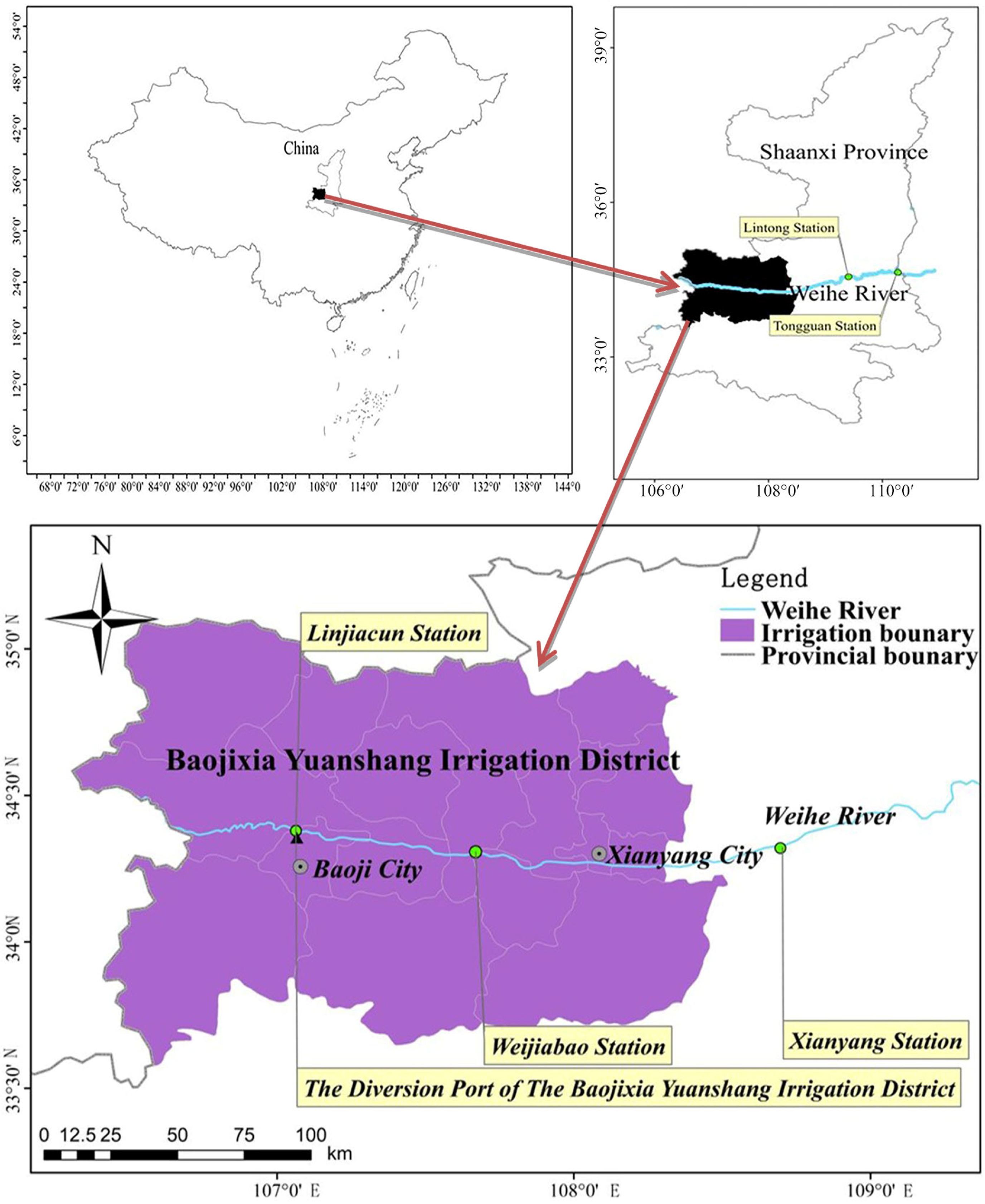
2.1. Study Area

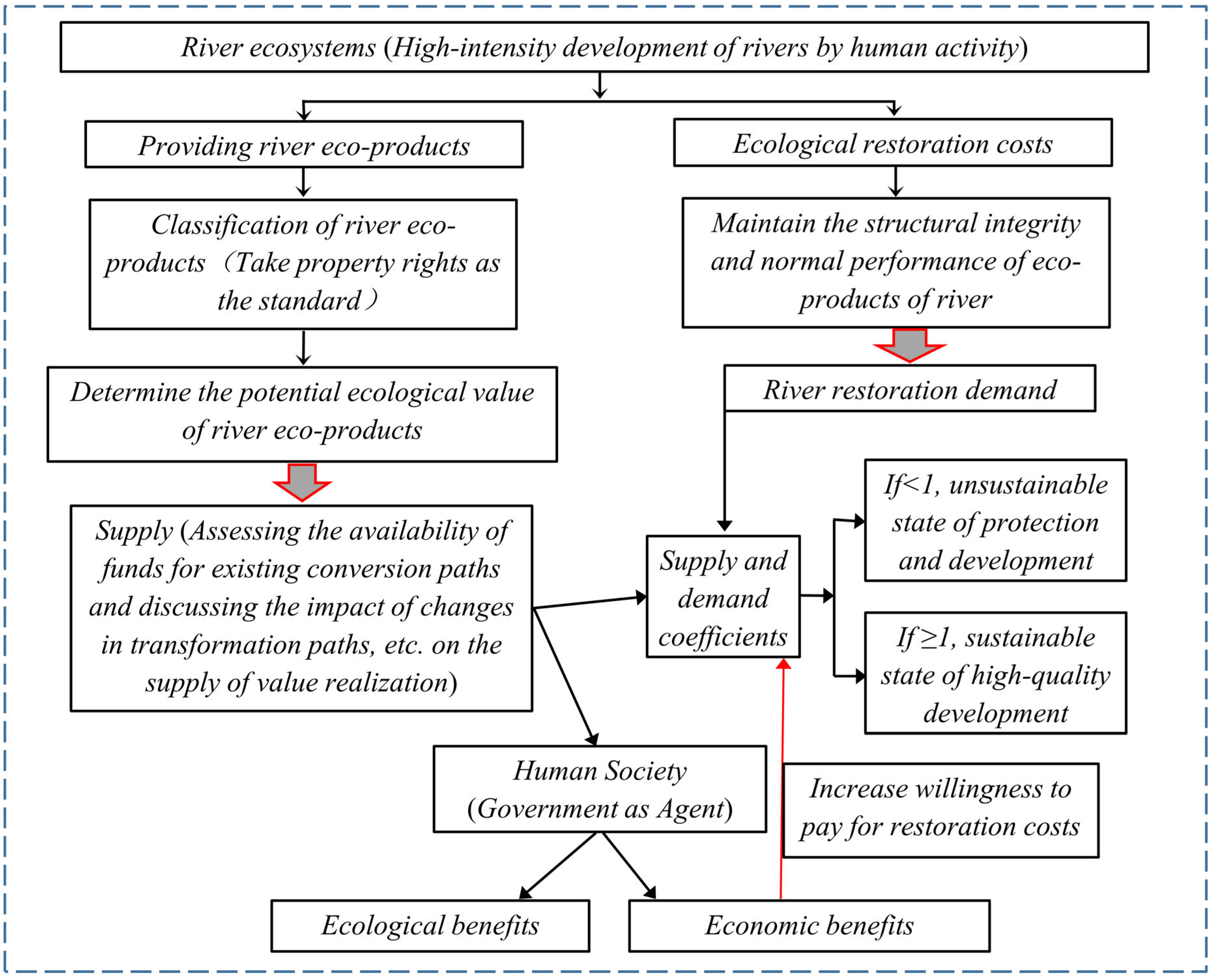
2.2. Methods
Calculation of River Eco-Product Potential Value

| Items | Classification | Basis of Classification | Methods | |
|---|---|---|---|---|
| Provision of aquatic products | Operational | Material object | River eco-products that can be used for market transactions, including physical purchase and spiritual enjoyment. | Market value method [35] |
| Cultural products | ||||
| Leisure tourism | Enjoyment | Achievement reference method [36] | ||
| Hydropower | Quasi operational | River eco-products that can be used for market platform transactions can only be carried out with the authorization of government departments. | Market value method | |
| Production water supply | ||||
| Water purification | Replacement cost method [37] | |||
| Water conservation | Publicity | Property rights are not clear and can not be used for market transactions. They are public eco-products, which usually produce externalities. | Equivalent factor method [38] | |
| Regulate climate | ||||
| Air purification | ||||
| Maintain aquatic biodiversity | ||||
| Soil conservation | ||||
- (1)
- The Realization Amount of Various Public Eco-Product Values
- (2)
- Realization Amount of Quasi Operational and Physical Operational Eco-Products
- (3)
- Realization Amount of the Enjoyment Eco-Product Value
- (4)
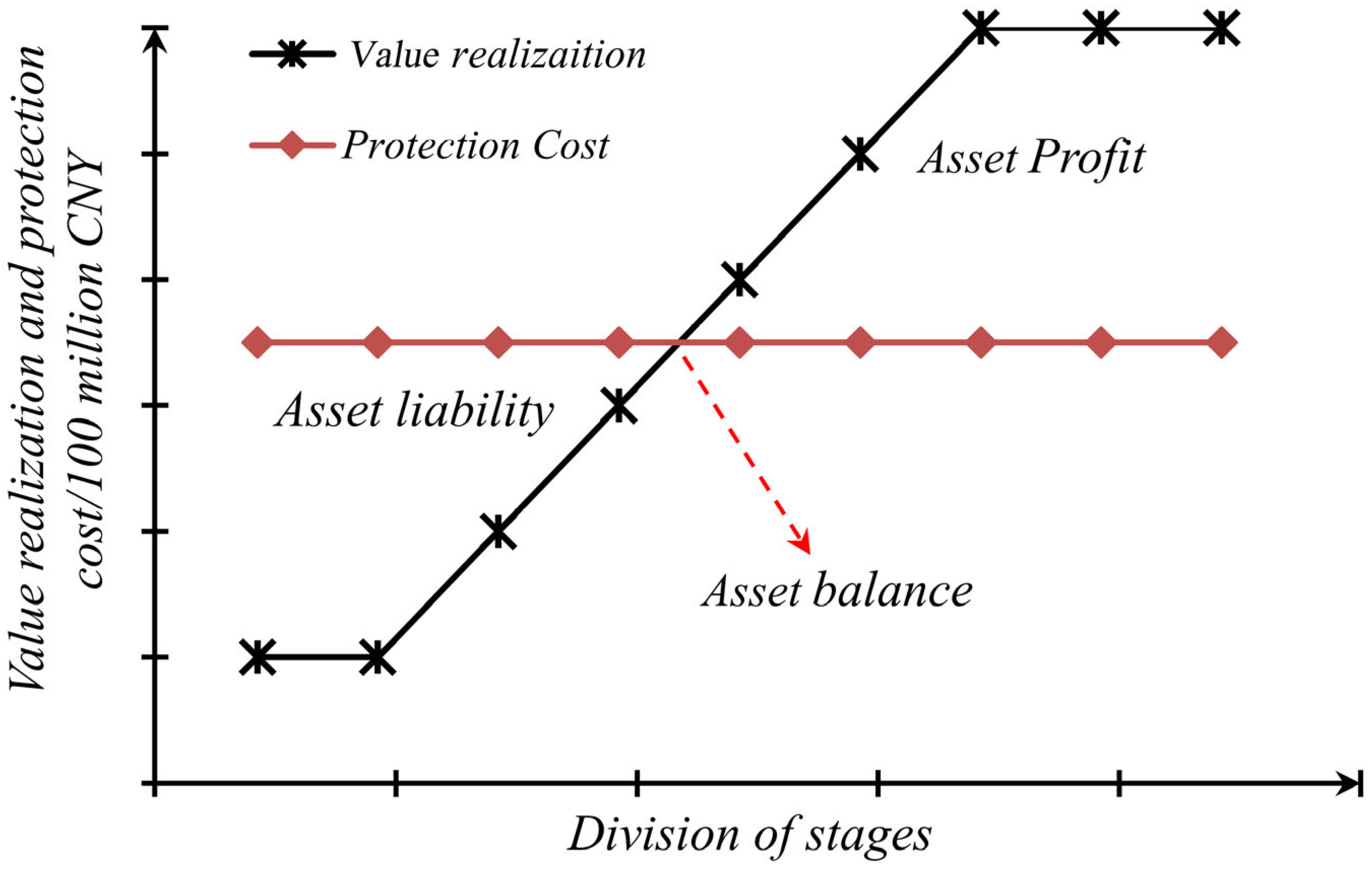
- Value Realization Level and Sustainability
2.3. Data Sources
3. Results
3.1. Potential Economic Value of River Eco-Products
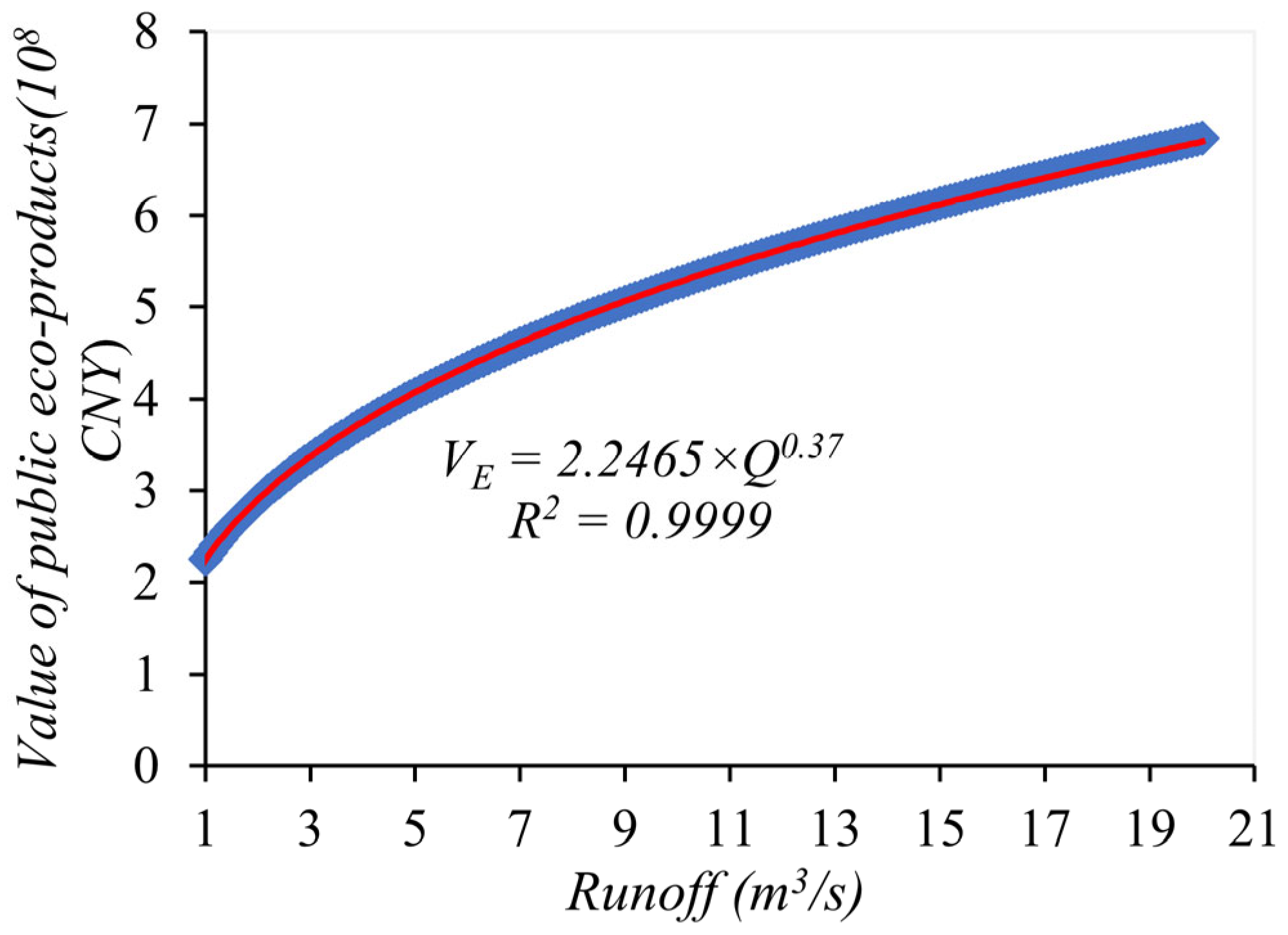
3.1.1. Economic Value of Public Eco-Products of Rivers
3.1.2. Economic Value of Quasi Operational Eco-Products
3.1.3. Economic Value of Operational Eco-Products
3.2. Realization Amount of Various River Eco-Products Under the Current Path
3.2.1. Realization Amount of Public Eco-Product Value
3.2.2. Realization Amount of Quasi Operational and Operational Eco-Product Value
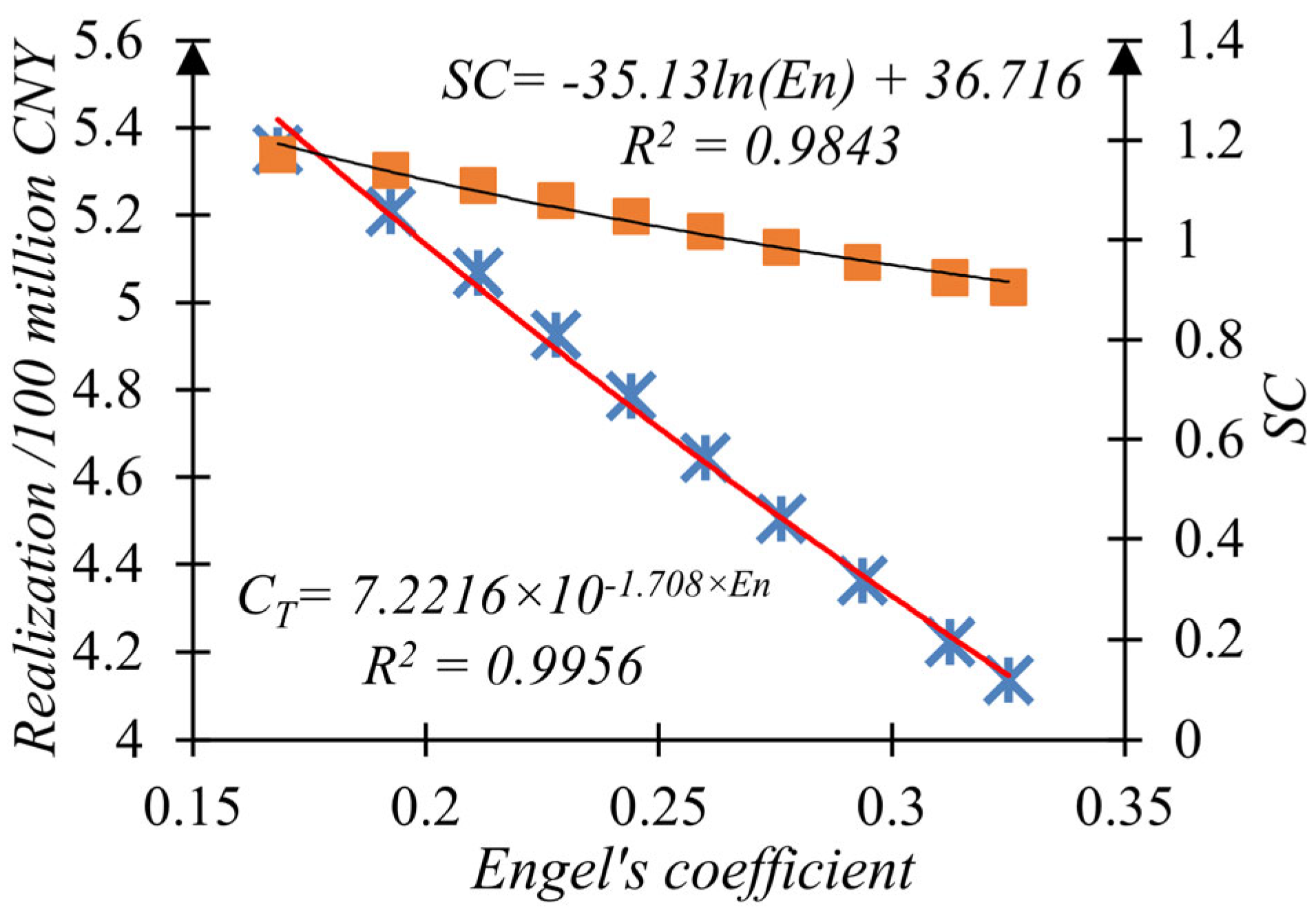
3.3. Total Realization Amount and Sustainability Assessment in the BSWHR
3.4. Realization Amount of Various River Eco-Products Under the Future Protection Compensation Policy
4. Discussion
4.1. A Significant Value Realization Gap Undermines River Sustainability
4.2. Discussion of the Research Methods and Outputs
4.3. Policy Implications for the River Eco-Product Value Transformation Efficiency
- (a)
- Strengthen the Construction of the Socio-Ecological Feedback Mechanism between Ecosystem Services and Human Well-being: To establish a feedback mechanism between eco-products and human well-being, it is crucial to address the current weak public willingness for collaborative governance, which stems from a limited understanding of the value of eco-products. We recommend a shift from generic publicity to targeted interventions. For instance, policymakers should design tailored information programs for different stakeholder groups. Demonstrating to farmers the direct economic losses resulting from water quality degradation due to reduced ecological flows can effectively foster their support for sustainable water allocation policies. The core of this approach is to adopt a data-driven method that quantitatively illustrates the costs of ecological degradation and the benefits of protection, thereby enhancing public understanding and motivation for action.Concurrently, it is essential to create tangible feedback channels that enable communities to perceive the linkages between ecosystem services and their well-being. Practices such as participatory monitoring and community forums can vividly demonstrate how eco-products (e.g., clean water, fisheries, and recreational landscapes) directly contribute to local livelihoods and economic prosperity. Transforming residents from passive information recipients into active governance participants helps cultivate a sense of shared responsibility, which is fundamental for stimulating collective action and enhancing the long-term resilience of the social-ecological system.
- (b)
- Strengthen Institutional Mechanisms for Property Rights and Eco-Product Industrialization: Improving eco-product value realization requires clear property rights and support for the industrial development of river eco-products. At present, the industrialization level of various river eco-products in the BSWHR makes the river ecological protection and green transformation of economy slow. Given that our results demonstrate that well-defined property rights and strategic industrialization are key drivers for enhancing value realization efficiency, it is imperative to develop targeted policies that promote these mechanisms. To this end, policymakers should establish robust institutional frameworks that clarify ownership, usage rights, and benefit-sharing arrangements. Concurrently, policies should promote eco-product industries that effectively translate ecological value into tangible economic opportunities. Practical mechanisms such as co-management agreements, public–private partnerships, and market-based incentives can be leveraged to guide investment and innovation.
- (c)
- Strengthen Integrated Water Governance and Multi-Actor Eco-Compensation Mechanisms: Effective ecological flow management requires coordinated water governance and participation from multiple stakeholders, improving the protection level of e-flow, and establishing the eco-compensation mechanism. At present, the water resources of the BSWHR are mainly used for agricultural irrigation, and there is a lack of high-tech industries with a high water use efficiency, leading to ecological stress. Under the premise of food security, the protection level of the river e-flow should be further improved. Combined with the eco-compensation mechanism, the value realization level of river eco-products will be further improved to promote the coordinated high-quality development of ecological protection and economy.
- (d)
- Strengthen Alignment Mechanisms between Local Actions and Global Sustainability Goals: Linking local eco-product management to global sustainability agendas enhances policy innovation and knowledge exchange. The framework developed in this study integrates eco-product value realization, ecological-flow protection, and the sustainability coefficient, providing a practical tool for river basin management. Mechanisms for cross-scale learning, such as benchmarking against SDG 6 (clean water) and SDG 15 (life on land) or adopting Nature-based Solutions (NbS), can guide local practices while enabling comparisons across regions [6,10]. Institutionalizing these learning processes helps align local decisions with global sustainability standards, fostering strategic and effective eco-product value realization and sustainable development in river basins worldwide.
5. Conclusions and Perspectives
Author Contributions
Funding
Institutional Review Board Statement
Informed Consent Statement
Data Availability Statement
Acknowledgments
Conflicts of Interest
References
- Harvey, J.; Gooseff, M. River Corridor Science: Hydrologic Exchange and Ecological Consequences from Bedforms to Basins. Water Resour. Res. 2015, 51, 6893–6922. [Google Scholar] [CrossRef]
- Pitt, J.; Kendy, E. Shaping the 2014 Colorado River Delta Pulse Flow: Rapid Environmental Flow Design for Ecological Outcomes and Scientific Learning. Ecol. Eng. 2017, 106, 704–714. [Google Scholar] [CrossRef]
- Langan, C.; Farmer, J.; Rivington, M.; Smith, J.U. Tropical Wetland Ecosystem Service Assessments in East Africa; A Review of Approaches and Challenges. Environ. Model. Softw. 2018, 102, 260–273. [Google Scholar] [CrossRef]
- Zhang, P.; Li, K.; Liu, Q.; Liu, R.; Qin, L.; Wang, H.; Zhang, Z.; Wang, K.; Wang, Y.; Liang, R.; et al. Linking Bait and Feeding Opportunities to Fish Foraging Habitat for the Assessment of Environmental Flows and River Restoration. Sci. Total Environ. 2021, 768, 144580. [Google Scholar] [CrossRef]
- IPBES. Global Assessment Report on Biodiversity and Ecosystem Services; Brondizio, E.S., Settele, J., Díaz, S., Ngo, H.T., Eds.; IPBES secretariat: Bonn, Germany, 2019. [Google Scholar]
- Yuan, M.-H.; Lo, S.-L. Ecosystem Services and Sustainable Development: Perspectives from the Food-Energy-Water Nexus. Ecosyst. Serv. 2020, 46, 101217. [Google Scholar] [CrossRef]
- Pires, A.P.F.; Rodriguez Soto, C.; Scarano, F.R. Strategies to Reach Global Sustainability Should Take Better Account of Ecosystem Services. Ecosyst. Serv. 2021, 49, 101292. [Google Scholar] [CrossRef]
- United Nations. United Nations Millennium Declaration; Resolution adopted by the General Assembly, A/RES/55/2; United Nations: New York, NY, USA, 2000; Available online: https://www.un.org/en/development/desa/population/migration/generalassembly/docs/globalcompact/A_RES_55_2.pdf (accessed on 9 November 2025).
- United Nations. Transforming Our World: The 2030 Agenda for Sustainable Development; Resolution adopted by the General Assembly, A/RES/70/1; United Nations: New York, NY, USA, 2015; Available online: https://sdgs.un.org/2030agenda (accessed on 9 November 2025).
- White, C.; Collier, M.J.; Stout, J.C. Using Ecosystem Services to Measure the Degree to Which a Solution Is Nature-Based. Ecosyst. Serv. 2021, 50, 101330. [Google Scholar] [CrossRef]
- Pessina, S. The Link Between Environmental Rights and the Rights of Nature: The Virtues of a Complexity-Based Approach. Jurid. Trib. Rev. Comp. Int. Law 2025, 15, 406–422. [Google Scholar]
- Benra, F.; Brück, M.; Sigman, E.; Pacheco-Romero, M.; Shumi, G.; Abson, D.J.; Frietsch, M.; Fischer, J. National Ecosystem Restoration Pledges Are Mismatched with Social-Ecological Enabling Conditions. Commun. Earth Environ. 2024, 5, 731. [Google Scholar] [CrossRef]
- Salzman, J.; Bennett, G.; Carroll, N.; Goldstein, A.; Jenkins, M. The Global Status and Trends of Payments for Ecosystem Services. Nat. Sustain. 2018, 1, 136–144. [Google Scholar] [CrossRef]
- Cheng, B.; Li, H.; Cheng, W.; Li, J. Fund Allocation Modeling of Compensation Subjects for Various Protection Levels of the Ecological Flow in Rivers under Runoff Variations. J. Environ. Manag. 2024, 370, 122690. [Google Scholar] [CrossRef]
- Cheng, B.; Li, H. Research Progress on River Ecological Products and Mechanism for Realizing Their Market Values. Adv. Water Resour. 2024, 34, 680–688. [Google Scholar] [CrossRef]
- Costanza, R.; d’Arge, R.; de Groot, R.; Farber, S.; Grasso, M.; Hannon, B.; Limburg, K.; Naeem, S.; O’Neill, R.V.; Paruelo, J.; et al. The Value of the World’s Ecosystem Services and Natural Capital. Nature 1997, 387, 253–260. [Google Scholar] [CrossRef]
- Castro, A.J.; Vaughn, C.C.; García-Llorente, M.; Julian, J.P.; Atkinson, C.L. Willingness to Pay for Ecosystem Services among Stakeholder Groups in a South-Central U.S. Watershed with Regional Conflict. J. Water Resour. Plan. Manag. 2016, 142, 05016006. [Google Scholar] [CrossRef]
- Nyongesa, J.M.; Bett, H.K.; Lagat, J.K.; Ayuya, O.I. Estimating Farmers’ Stated Willingness to Accept Pay for Ecosystem Services: Case of Lake Naivasha Watershed Payment for Ecosystem Services Scheme-Kenya. Ecol. Process. 2016, 5, 15. [Google Scholar] [CrossRef]
- Gao, Z.; Wang, X.; Su, J.; Chen, Z.; Zheng, M.; Sun, Y.; Ji, D. Ecological Compensation of Dongjiang River Basin Based on Evaluation of Ecosystem Service Value. J. Ecol. Rural Environ. 2018, 34, 563–570. [Google Scholar] [CrossRef]
- Díaz, S.; Pascual, U.; Stenseke, M.; Martín-López, B.; Watson, R.T.; Molnár, Z.; Hill, R.; Chan, K.M.A.; Baste, I.A.; Brauman, K.A.; et al. Assessing Nature’s Contributions to People. Science 2018, 359, 270–272. [Google Scholar] [CrossRef]
- OECD. Financing Water Supply, Sanitation and Flood Protection: Challenges in EU Member States and Policy Options; OECD Publishing: Paris, France, 2021. [Google Scholar] [CrossRef]
- Mazaheri, M.; Bonnin Roca, J.; Markus, A.; Walrave, B. Market-Based Instruments and Sustainable Innovation: A Systematic Literature Review and Critique. J. Clean. Prod. 2022, 373, 133947. [Google Scholar] [CrossRef]
- Gómez-Baggethun, E.; de Groot, R.; Lomas, P.L.; Montes, C. The History of Ecosystem Services in Economic Theory and Practice: From Early Notions to Markets and Payment Schemes. Ecol. Econ. 2010, 69, 1209–1218. [Google Scholar] [CrossRef]
- Peráček, T.; Kaššaj, M. Legal Easements as Enablers of Sustainable Land Use and Infrastructure Development in Smart Cities. Land 2025, 14, 681. [Google Scholar] [CrossRef]
- Goździewicz-Biechońska, J.; Brzezińska-Rawa, A. Protecting Ecosystem Services of Urban Agriculture against Land-Use Change Using Market-Based Instruments. A Polish perspective. Land Use Policy 2022, 120, 106296. [Google Scholar] [CrossRef]
- Zhang, L.; Yu, H.; Li, D.; Jia, Z.; Wu, F.; Liu, X. Connotation and Value Implementation Mechanism of Ecological Products. Trans. Chin. Soc. Agric. Mach. 2019, 50, 173–183. [Google Scholar] [CrossRef]
- Pan, X.; Xu, L.; Yang, Z.; Yu, B. Payments for Ecosystem Services in China: Policy, Practice, and Progress. J. Clean. Prod. 2017, 158, 200–208. [Google Scholar] [CrossRef]
- Zheng, Y.; Ge, Y.; Jie, Y.; Zhang, H. Analysis Framework of Diversified Watershed Eco-Compensation: A Perspective of Compensation Subject. China Popul. Resour. Environ. 2019, 29, 131–139. [Google Scholar]
- Zhu, J.; Zhang, H.; Hao, H.; Hu, X. Market-Based Watershed Eco-Compensation: A Case Study of Chishui Watershed in Guizhou Province. Environ. Prot. 2018, 46, 26–31. [Google Scholar]
- Yue, S.; Li, H.; Cheng, B. Variation of Economic Value Produced by Environmental Flow in Water-Scarce Basins of Northwest China. J. Water Clim. Change 2020, 12, 955–968. [Google Scholar] [CrossRef]
- Lin, Q.; Li, H. Influence and Guarantee on Ecological Basic Flow of Weihe River from Baojixia Water Diversion. J. Arid Land Resour. Environ. 2010, 24, 114–119. [Google Scholar]
- Cheng, B.; Li, H. Agricultural Economic Losses Caused by Protection of the Ecological Basic Flow of Rivers. J. Hydrol. 2018, 564, 68–75. [Google Scholar] [CrossRef]
- Zhang, W.; Xu, D. Benefits Evaluation of Ecological Restoration Projects Based on Value Realization of Ecological Products. J. Environ. Manag. 2024, 352, 120139. [Google Scholar] [CrossRef]
- Yin, N.; Wang, S.; Liu, Y. Ecosystem Service Value Assessment: Research Progress and Prospects. Chin. J. Ecol. 2021, 40, 233–244. [Google Scholar] [CrossRef]
- Li, L.; Fan, Z.; Xiong, K.; Shen, H.; Guo, Q.; Dan, W.; Li, R. Current Situation and Prospects of the Studies of Ecological Industries and Ecological Products in Eco-Fragile Areas. Environ. Res. 2021, 201, 111613. [Google Scholar] [CrossRef] [PubMed]
- Sun, B.; Cui, L.; Li, W.; Kang, X.; Zhang, M. A Review of Spatial-Scale Transformation in Wetland Ecosystem Service Evaluation. Acta Ecol. Sin. 2018, 38, 2607–2615. [Google Scholar] [CrossRef]
- Li, Z.; Song, R.; Yang, M. Approach to the Environmental Economics Analysis of Benefit from Watershed Management. Sci. Soil Water Conserv. 2003, 1, 56–62. [Google Scholar]
- Xie, G.; Zhang, C.; Zhang, L.; Chen, W.; Li, S. Improvement of the Evaluation Method for Ecosystem Service Value Based on per Unit Area. J. Nat. Resour. 2015, 30, 1243–1254. [Google Scholar] [CrossRef]
- Li, F.; Li, W.; Zhen, L.; Huang, H.; Wei, Y.; Yang, L. Estimating Eco-Compensation Requirements for Forest Ecosystem Conservation—A Case Study of Hainan Island. J. Nat. Resour. 2010, 25, 735–745. [Google Scholar]
- Zhou, C.; Ding, X.; Li, G.; Wang, H. Ecological Compensation Standards in the Water Source Area of the Middle Route Project of the South-North Water Transfer Project. Resour. Sci. 2015, 37, 792–804. [Google Scholar]
- Chen, H.; Sloggy, M.R.; Evans, S. How Land Property Rights Affect the Effectiveness of Payment for Ecosystem Services: A Review. Land Use Policy 2025, 151, 107496. [Google Scholar] [CrossRef]
- Yang, H.; Yang, W.; Zhang, J.; Connor, T.; Liu, J. Revealing Pathways from Payments for Ecosystem Services to Socioeconomic Outcomes. Sci. Adv. 2018, 4, eaao6652. [Google Scholar] [CrossRef]
- Zhou, J.; Tong, Y.; Ding, Q.; Zhang, Y.; Zhang, J.; Yang, W. Economic Evaluation of Ecotourism Service in “One Village Ten Thousand Trees” Area of Kecheng District, Quzhou City Using Travel Cost Method. Acta Ecol. Sin. 2021, 41, 6440–6450. [Google Scholar] [CrossRef]
- Liu, Z.; Lai, Y.; Wang, H.; Cui, Q.; Yao, L. Has the Realization of Ecological Product Value Diminished Carbon Emission Intensity? Evidence from Chinese Counties. Environ. Res. 2025, 285, 122615. [Google Scholar] [CrossRef]
- Zhang, Q.; Li, H.; Gao, Z.; Cheng, B.; Jia, B.; Dang, F. Study on Agricultural Compensation Mechanism Based on River Flow Protection for Basic Ecological Demand in Irrigation District—Baoji Section of the Weihe River as an Example. Agric. Res. Arid Areas 2019, 37, 51–57. [Google Scholar] [CrossRef]
- Bureau of Hydrology, Ministry of Water Resources of the People’s Republic of China. Annual Hydrological Report P. R. China: Volume IV, Hydrological Data of Yellow River Basin, Book 7 (Jing, Luo, Wei Region: Weihe River Basin) (1972–2022); Bureau of Hydrology: Beijing, China, 2022.
- Shaanxi Provincial Bureau of Statistics; Shaanxi Survey Team, National Bureau of Statistics of China. Shanxi Statistical Yearbook (2000–2022); China Statistics Press: Beijing, China, 2022. Available online: https://tjj.shaanxi.gov.cn/tjsj/ndsj/tjnj/ (accessed on 7 November 2025).
- Shaanxi Provincial Department of Water Resources. Water Statistical Yearbook of Shaanxi (2000–2022); Shaanxi Science and Technology Press: Xi’an, China, 2022. Available online: https://slt.shaanxi.gov.cn/zfxxgk/fdzdgknr/tjxx/ (accessed on 7 November 2025).
- Shaanxi Provincial Bureau of Statistics. Shaanxi Regional Statistical Yearbook (2000–2022); China Statistics Press: Beijing, China, 2022.
- Xu, Z.; Wu, W.; Yu, S. Ecological Baseflow: Progress and Challenge. J. Hydroelectr. Eng. 2016, 35, 1–11. Available online: https://d.wanfangdata.com.cn/periodical/slfdxb201604001 (accessed on 7 November 2025).
- Chen, B. Study on water resources protection countermeasures of Shaanxi section of the main stream of Weihe River. Shaanxi Water Conserv. 2014, 50–52. [Google Scholar] [CrossRef]
- Yang, X.; Song, J.; Cheng, D.; Wang, Z.; Liu, C. Estimation of Instream’s Ecosystem Service Value for the Weihe River in Shaanxi Province. Arid Land Geogr. 2014, 37, 958–965. [Google Scholar]
- Gao, Z.; Li, H.; Zhang, Q.; Cheng, B.; Jia, B.; Tian, R. Analysis of Irrigation Benefit of Baoji Gorge Irrigation District Using Ridge Regression of C-D Production Function. Agric. Res. Arid Areas 2018, 36, 33–40. [Google Scholar] [CrossRef]
- Luttik, J. The Value of Trees, Water and Open Space as Reflected by House Prices in the Netherlands. Landsc. Urban Plan. 2000, 48, 161–167. [Google Scholar] [CrossRef]
- Liu, G.; Wang, X.; Gu, J.; Liu, Y.; Zhou, T. Temporal and Spatial Effects of a ‘Shan Shui’ Landscape on Housing Price: A Case Study of Chongqing, China. Habitat Int. 2019, 94, 102068. [Google Scholar] [CrossRef]
- Liu, W. Value Realization Mechanism Optimization and Efficience Evaluation of Aquatic Ecological Products. Environ. Sci. Manag. 2025, 50, 184–188. [Google Scholar]
- Gou, J.; Miao, C.; Ni, J.; Sorooshian, S.; Duan, Q.; Yan, D.; Slater, L.; Xu, Z.; Borthwick, A.G.L.; Su, L.; et al. Warming Climate and Water Withdrawals Threaten River Flow Connectivity in China. Proc. Natl. Acad. Sci. USA 2025, 122, e2421046122. [Google Scholar] [CrossRef]
- Feng, D.; Gleason, C.J. More Flow Upstream and Less Flow Downstream: The Changing Form and Function of Global Rivers. Science 2024, 386, 1305–1311. [Google Scholar] [CrossRef]
- Haase, P.; Bowler, D.E.; Baker, N.J.; Bonada, N.; Domisch, S.; Garcia Marquez, J.R.; Heino, J.; Hering, D.; Jähnig, S.C.; Schmidt-Kloiber, A.; et al. The Recovery of European Freshwater Biodiversity Has Come to a Halt. Nature 2023, 620, 582–588. [Google Scholar] [CrossRef]
- Palmer, M.; Ruhi, A. Linkages between Flow Regime, Biota, and Ecosystem Processes: Implications for River Restoration. Science 2019, 365, eaaw2087. [Google Scholar] [CrossRef]
- Wang, D.; Jia, Y.; Niu, C.; Yan, X.; Hao, C. A Multiple Criteria Decision-Making Approach for Water Allocation of Environmental Flows Considering the Value Trade-Offs—A Case Study of Fen River in China. Sci. Total Environ. 2024, 912, 169588. [Google Scholar] [CrossRef]
- Qureshi, M.E.; Connor, J.; Kirby, M.; Mainuddin, M. Economic Assessment of Acquiring Water for Environmental Flows in the Murray Basin. Aust. J. Agric. Resour. Econ. 2007, 51, 283–303. [Google Scholar] [CrossRef]
- Jones, R.; Crean, J.; Aluwihare, P.; Letcher, R. Economic Cost of Environmental Flows in an Unregulated River System. Aust. J. Agric. Resour. Econ. 2007, 51, 305–321. [Google Scholar] [CrossRef]
- Pang, A.P.; Sun, T. Bayesian Networks for Environmental Flow Decision-Making and an Application in the Yellow River Estuary, China. Hydrol. Earth Syst. Sci. 2014, 18, 1641–1651. [Google Scholar] [CrossRef]


| Items | Data Sources | |
|---|---|---|
| Hydrological and hydraulic data (1972 to 2022) | Hydrological data such as runoff and hydraulic data such as water level, water surface width, velocity, etc. | People’s Republic of China Hydrological Yearbook (Weihe River system) [46] |
| Social data (2000 to 2022) | Grain output, grain market price, agricultural water use, agricultural production input (such as fertilizer, film, energy, manpower, machinery, etc.), gross agricultural output, Engel’s coefficient, etc. | Shaanxi Statistical Yearbook (http://tjj.shaanxi.gov.cn/tjsj/ndsj/tjnj/ accessed on 7 November 2025) [47] Water Statistical Yearbook of Shaanxi (http://slt.shaanxi.gov.cn/zfxxgk/fdzdgknr/tjxx/ accessed on 7 November 2025) [48] Shaanxi Provincial Regional Statistical Yearbook [49] (A paper version that has been publicly released) |
| Ecological flow (e-flow) in rivers | Refs. [32,50] | |
| abandoning the social development cost | Refs. [32,45] | |
| Equivalence factors | Ref. [38] | |
Disclaimer/Publisher’s Note: The statements, opinions and data contained in all publications are solely those of the individual author(s) and contributor(s) and not of MDPI and/or the editor(s). MDPI and/or the editor(s) disclaim responsibility for any injury to people or property resulting from any ideas, methods, instructions or products referred to in the content. |
© 2025 by the authors. Licensee MDPI, Basel, Switzerland. This article is an open access article distributed under the terms and conditions of the Creative Commons Attribution (CC BY) license (https://creativecommons.org/licenses/by/4.0/).
Share and Cite
Cheng, W.; Cheng, B.; Li, H.; Li, Q.; Duan, Q.; Shi, Y. Improving the Value Realization Level of Eco-Products as a Key Pathway to Achieving Sustainable Ecological Protection and Economic Development in Highly Regulated Rivers. Sustainability 2025, 17, 10845. https://doi.org/10.3390/su172310845
Cheng W, Cheng B, Li H, Li Q, Duan Q, Shi Y. Improving the Value Realization Level of Eco-Products as a Key Pathway to Achieving Sustainable Ecological Protection and Economic Development in Highly Regulated Rivers. Sustainability. 2025; 17(23):10845. https://doi.org/10.3390/su172310845
Chicago/Turabian StyleCheng, Wenjuan, Bo Cheng, Huaien Li, Qing Li, Qingzhi Duan, and Yunfu Shi. 2025. "Improving the Value Realization Level of Eco-Products as a Key Pathway to Achieving Sustainable Ecological Protection and Economic Development in Highly Regulated Rivers" Sustainability 17, no. 23: 10845. https://doi.org/10.3390/su172310845
APA StyleCheng, W., Cheng, B., Li, H., Li, Q., Duan, Q., & Shi, Y. (2025). Improving the Value Realization Level of Eco-Products as a Key Pathway to Achieving Sustainable Ecological Protection and Economic Development in Highly Regulated Rivers. Sustainability, 17(23), 10845. https://doi.org/10.3390/su172310845