Article

Analysis of the Impact of Investments Distributed Across Institutional Sectors on Sustainable Development

by
Ionela Gavrilă-Paven
Department of Business Administration and Marketing, Faculty of Economics, “1 Decembrie 1918” University of Alba Iulia, 510009 Alba Iulia, Romania
Sustainability 2025, 17(23), 10832; https://doi.org/10.3390/su172310832
Submission received: 27 October 2025 / Revised: 29 November 2025 / Accepted: 30 November 2025 / Published: 3 December 2025

Abstract

In recent decades, sustainable development has become a strategic priority for both national and EU economic policies, reflecting the need to integrate economic progress, social cohesion, and environmental protection. Public and private investments—particularly those directed toward infrastructure, human capital, and technological advancement—play a decisive role in supporting this transition. This study examines how the allocation of investments across institutional sectors in Romania influences the country’s sustainable development trajectory, with the underlying assumption that an efficient distribution of resources contributes to balanced regional growth, technological progress, and the strengthening of human capital. Using official national and European datasets, the research employs descriptive statistics, correlation analysis, sectoral comparisons, and complementary regression models to evaluate investment patterns over the period 2008–2023. The empirical findings indicate significant disparities in investment intensity among institutional sectors, which are reflected in uneven regional development and persistent gaps in innovation capacity. The results also show strong associations between targeted investments—especially those made by non-financial corporations and public institutions—and improvements in technological advancement, productivity, and human resource retention. Overall, the study concludes that a more coherent and strategically coordinated investment policy is essential for enhancing Romania’s sustainable development outcomes. Strengthening the alignment between investment flows and long-term development priorities would increase economic resilience, stimulate innovation, and support a more equitable and sustainable growth model.

1. Introduction

In recent decades, sustainable development has become a central component of national and European economic strategies, reflecting the imperative to integrate economic progress, social equity, and environmental protection. The existing literature emphasizes the role of public and private investments in fostering long-term economic resilience, innovation capacity, and productivity growth. The European Commission (2020) underlines that investments oriented toward innovation and skills constitute essential drivers of sustainable development and competitiveness [1]. However, despite extensive research on investment dynamics, the differentiated contribution of institutional sectors to sustainable development remains insufficiently explored, especially in countries undergoing structural transitions such as Romania.
Between 2008 and 2023, Romania experienced successive economic, health, and energy crises that disrupted investment activity across public institutions and the private sector. Prior studies highlight stagnation or even regression in key areas of sustainable development, particularly in research and development (R&D), innovation performance, and the retention of highly skilled human resources [2,3]. Yet, the literature offers limited systematic analysis of how investment allocation across institutional sectors—non-financial corporations, households, general government, financial corporations, and non-profit institutions serving households (NPISH), as defined by ESA 2010—shapes the evolution of sustainable development indicators. Furthermore, existing research has not adequately addressed sector-specific imbalances, the alignment between investment priorities and development needs, or the extent to which current investment patterns contribute to regional disparities and technological advancement.
These gaps justify the need for a comprehensive empirical investigation of the relationship between sectoral investment allocation and sustainable development outcomes in Romania. The study therefore seeks to address the following research questions:
(1)
To what extent does investment distribution across institutional sectors influence the evolution of sustainable development indicators?
(2)
Which sectors demonstrate the strongest association with regional economic performance, technological progress, and human capital development?
(3)
Do current investment patterns reflect coherent, development-oriented priorities, or do they reveal structural inefficiencies that hinder progress?
To answer these questions, the analysis draws on official data from the National Institute of Statistics (INS), Eurostat, and CIS for the period 2008–2023 [4,5,6]. The methodological framework includes: (1) descriptive analysis of investments by institutional sector (as % of GDP), (2) correlation analyses between investment variables and indicators such as HRST, R&D, and innovation, (3) inter-sectoral comparisons, and (4) simple regression models assessing links to regional GDP. This integrated approach enables an empirical evaluation of how sectoral investment patterns contribute to Romania’s sustainable development, complementing and extending the existing body of literature.
The remainder of this study is organized as follows: the first section presents the main theoretical and empirical contributions on investments and sustainable development; the second section outlines data sources and methodological procedures; the third section reports the empirical findings regarding sectoral investment dynamics and their associations with key development indicators; and the final section discusses the implications for policy and future research.

2. Theoretical and Conceptual Framework

The modern understanding of sustainable development is rooted in the Brundtland Report [7], which defines it as development that meets present needs without compromising the ability of future generations to meet their own needs. This definition established the conceptual pillars of sustainability—economic vitality, social inclusiveness, and environmental protection—supported by principles such as intergenerational equity, institutional responsibility, and efficient use of resources. Over time, the concept evolved from a normative vision into an operational policy framework embedded in major European strategies, including the Lisbon Strategy, Europe 2020, and the European Green Deal (European Commission, 2020) [1]. These initiatives emphasize the necessity of innovation-oriented investment as a catalyst for inclusive economic growth, technological competitiveness, and the green transition [1].
From a theoretical standpoint, endogenous growth models [8] highlight the central role of human capital, infrastructure, and research investment in generating long-term productivity and positive externalities. Complementary approaches distinguish between productive investments that enhance technological capabilities, social investments that build human capital and well-being, and inefficient or speculative investments that fail to create sustainable value [9]. Together, these theories underline that the structure, direction, and efficiency of investment flows critically shape sustainable development outcomes.
The recent empirical literature reinforces these theoretical foundations. Numerous studies confirm that well-targeted public and private investments contribute to GDP growth, regional cohesion, and national innovation performance [10,11,12]. Evidence also reveals substantial heterogeneity across EU countries regarding R&D convergence and divergence, with structural disparities leading to persistent innovation gaps in several member states [13]. Countries that maintain stable R&D investment trajectories and support continuous innovation programs demonstrate higher competitiveness and technological resilience, while those facing chronic underinvestment risk stagnation and the erosion of human capital [14,15]. Research on the potential for innovation and entrepreneurship across the EU further highlights the importance of institutional quality, human capital, and digital readiness in shaping sustainable development paths [16].
The literature on national innovation ecosystems points to the decisive role of interactions between government, firms, academia, and civil society in fostering knowledge creation, technology diffusion, and sustainable socio-economic performance [17]. Studies focused on sectoral sustainability dynamics across EU economies also show that transport, energy, and infrastructure investments significantly contribute to long-term environmental and economic outcomes [18]. More recent findings discussing “R&D traps” in emerging EU economies indicate that inefficient allocation of research funding, weak private-sector engagement, and governance constraints may impede countries’ ability to transition toward innovative, sustainable growth models [19].
In this context, the European System of Accounts (ESA 2010) provides a standardized classification of institutional sectors essential for analyzing investment patterns [3]. Non-financial corporations represent the principal source of productive private investment, particularly in machinery, equipment, and ICT. Financial corporations contribute through intermediation and capital supply, although their own GFCF levels remain modest. General government plays a fundamental role by investing in infrastructure, education, health, and research—areas with direct implications for sustainable development. Households primarily invest in residential assets and durable goods, indirectly shaping welfare and long-term economic structure. Non-profit institutions serving households (NPISHs) act primarily in social, cultural, and educational domains, complementing public and private investment initiatives [20,21,22,23].
Within this theoretical and empirical framework, several indicators are particularly relevant for assessing the relationship between investment structure and sustainable development. Human Resources in Science and Technology (HRST) reflect an economy’s capacity to generate, absorb, and disseminate innovation, and are consistently linked to investments in education, research, and emerging technologies [10]. Expenditure on Research and Development (R&D), widely recognized as a proxy for national innovation effort, is strongly associated with productivity and competitiveness; however, persistent underperformance in this area continues to signal structural vulnerabilities in Romania [14]. The share of innovative enterprises, based on CIS data, provides insight into firms’ ability to introduce new products, processes, and organizational models, with low levels pointing to systemic weaknesses in innovation ecosystems. Regional GDP (RGDP) serves as an indicator of territorial economic performance and supports the examination of how investment allocation influences regional convergence and cohesion [24,25,26,27].
Synthesizing the above literature, a clear insight emerges: the distribution of investments across institutional sectors fundamentally conditions sustainable development trajectories. Despite the rich body of research on R&D, innovation ecosystems, and sustainable growth at the EU level, limited attention has been devoted to understanding how Romania’s sectoral investment patterns shape its human capital formation, innovation capacity, and regional development. Addressing this gap, the present study examines whether a more balanced and efficient allocation of investments across institutional sectors contributes positively to HRST, R&D performance, innovation intensity, and regional economic development by reinforcing technological advancement, human capital strengthening, and regional cohesion.

3. Innovation Systems and Structural Constraints in Low-R&D-Intensity Economies

3.1. Explicit Development of Innovation Systems Theory

Innovation systems theory provides an essential analytical lens for understanding the mechanisms through which investments translate into innovation outcomes. At the national level, innovation systems consist of interconnected institutions—firms, universities, research centers, intermediary organizations, and public authorities—whose interactions shape the production, diffusion, and application of knowledge. In the context of EU member states with lower innovation capacity, such as Romania, the functioning of these systems is often constrained by institutional fragmentation, weak cooperation between public and private actors, and limited absorptive capacity. These structural characteristics, documented in studies on national and regional innovation ecosystems [16,17], are critical for interpreting why increases in investment do not automatically yield stronger HRST, R&D performance, or enterprise-level innovation. Integrating innovation systems theory thus strengthens the conceptual grounding of the study and supports the formulation of hypotheses linking investment distribution with sustainable development outcomes.

3.2. Structural Constraints in Low-R&D-Intensity Economies

A deeper understanding of Romania’s investment and innovation dynamics requires situating the country within the broader group of EU member states characterized by structurally low R&D intensity and limited innovation capacity. Several studies have documented what has been termed a “low R&D equilibrium,” a situation in which firms and public institutions face persistent structural barriers—such as weak absorptive capacity, fragmented innovation systems, and institutional instability—that prevent investments from translating into meaningful technological upgrading. Evidence from countries such as Slovakia, Bulgaria, and Greece demonstrates that despite formal commitments to EU innovation targets, the ability of these economies to convert investment inputs into R&D outputs remains constrained by systemic factors [17,19].
In these contexts, the accumulation of human capital in science and technology (HRST) is often slow and uneven, as skill formation processes coexist with high emigration rates, limited employer demand for advanced competencies, and underdeveloped research infrastructures. Similar patterns have been identified in Romania, where public investment in education and research is frequently offset by structural limitations that hinder the retention and effective utilization of skilled professionals (Ionescu). The result is a persistent gap between investment volumes and innovation outcomes, reflecting the broader tendency of peripheral EU economies to specialize in low- and medium-technology sectors rather than transition toward high-innovation trajectories.
This perspective is particularly relevant for interpreting Romania’s R&D performance. As highlighted by Blanco, the divergence in R&D intensities across EU member states has widened, with high-innovation countries increasing their lead relative to lower-performing economies. Romania’s position in this divergence pattern is symptomatic of deeper institutional constraints, including inconsistent policy implementation, limited cross-sectoral collaboration, and insufficient integration into European research networks. Incorporating this broader theoretical context helps explain why fluctuations in sectoral investments often fail to produce significant improvements in HRST, R&D, or innovation indicators, thereby reinforcing the need for comprehensive structural reforms alongside financial measures.

4. Methodology

This section outlines the data sources, operationalization of indicators, and statistical techniques employed in the analysis regarding the relationship between the allocation of investments across institutional sectors and the evolution of sustainable development indicators in Romania during the period 2008–2023 [28,29]. The analysis aims to identify structural gaps, inter-sectoral imbalances, and statistically significant correlations between investment patterns and progress in areas such as human resources in science and technology (HRST), research and development (R&D), and innovation [30,31].
Synthesizing the above theoretical perspectives—endogenous growth theory, innovation systems theory, and sustainable development frameworks—highlights clear mechanisms through which sectoral investments influence HRST, R&D performance, and enterprise-level innovation. The literature also reveals structural constraints typical of low-R&D-intensity countries [17,19] that may condition the effects of such investments. These insights inform the formulation of the study’s hypotheses, which examine whether the allocation of investments across institutional sectors contributes to Romania’s sustainable development outcomes.

4.1. Hypothesis

The central hypothesis posits that an efficient distribution of investments across institutional sectors supports balanced sustainable development. This is reflected in improved regional economic performance (measured by GDP), technological advancement (via innovation and R&D), and the enhancement of human capital (proxies by HRST indicators).
H1. 
There is a positive correlation between public sector investments and the evolution of HRST and R&D,
derived into:
H1a. 
Public sector investments in education, research infrastructure, and human capital development are positively correlated with the growth of human resources in science and technology (HRST).
H1b. 
Public sector investments directed toward research and development programs, innovation capacity, and technological advancement are positively correlated with improvements in national R&D performance indicators.
H2. 
A decline in the share of investments in GDP correlates with a reduction in the proportion of innovative enterprises.
H3. 
The investment structure differs between the public and private sectors, affecting systemic innovation.
H4. 
Institutional sector investment imbalances have a negative impact on regional GDP.

4.2. Data and Analytical Framework

The study employs a mixed-method approach based on macroeconomic data from the National Institute of Statistics (INS), Eurostat, and the Community Innovation Survey (CIS) for the 2008–2023 period. The institutional sectors are classified according to the European System of Accounts (ESA 2010).
The analytical steps include:
-
descriptive statistics, used to map the evolution of gross fixed capital formation (GFCF) by sector (as a percentage of GDP);
-
correlation analysis, to assess statistical relationships between sectoral investment levels and key sustainability indicators (HRST, R&D expenditure, innovation rates);
-
inter-sectoral comparison, to evaluate the relative efficiency of different sectors in contributing to sustainable outcomes;
-
regression models, applied to test the relationship between investment structure and regional GDP, thereby supporting or refuting the core hypothesis.
This framework enables an empirical assessment of how sector-specific investment allocations influence key dimensions of sustainable development. The findings are discussed in relation to the existing literature on growth theory, innovation systems, and sustainability policy, offering evidence-informed insights relevant to both national strategy and EU cohesion objectives.
The adopted methodology is quantitative, based on descriptive, correlational, and regression statistical techniques. The main analytical steps are as follows:
(1)
descriptive statistics—used to analyze the dynamics of gross fixed capital formation (GFCF) by institutional sectors and the evolution of HRST, R&D, and the share of innovative enterprises;
(2)
Pearson correlation analysis—applied to identify bilateral relationships between the level of investments and sustainable development indicators;
(3)
multiple linear regression models—employed to test the formulated hypotheses and to estimate the influence of investment structure on each indicator.

4.3. Applied Regression Model

Three multiple linear regression models were constructed, where the independent variables represent the share of investments by institutional sectors (non-financial corporations, households, financial institutions, general government, and non-profit institutions serving households).
The general form of the models is:
Yt = β0 + β1·NFCt + β2·Ht + β3·Ft + β4·Gt + β5·NPISHt + εt
where
Yt = dependent variable (HRST, R&D expenditure as % of GDP, innovative enterprises),
NFCt = investments of non-financial corporations (% of GDP),
Ht = household investments (% of GDP),
Ft = investments of financial institutions (% of GDP),
Gt = general government investments (% of GDP),
NPISHt = investments of non-profit institutions serving households (% of GDP),
εt = residual term.
To ensure the robustness and reliability of the estimated regression models, a comprehensive set of statistical diagnostics was employed.
The coefficient of determination (R2) and the adjusted R2 were used to evaluate the explanatory power of each model, indicating the proportion of variance in the dependent variable accounted for by the independent variables. The F-test was applied to assess the joint statistical significance of the estimated parameters, verifying the overall validity of the regression specification.
The p-values associated with individual coefficients were examined to determine the statistical significance of each predictor variable. The Durbin–Watson statistic was employed to test for the presence of first-order autocorrelation in the residuals, while the Breusch–Pagan test was used to detect potential heteroscedasticity.
To assess the assumption of normality in the residual distribution, both the Jarque–Bera test and Q–Q plot analysis were applied. Finally, the Variance Inflation Factor (VIF) was computed to identify potential multicollinearity issues among the investment-related predictors, ensuring the stability and interpretability of the regression estimates.

5. Results

The analysis aims to test the previously formulated hypotheses by examining the relationship between sectoral investments and sustainable development indicators in Romania over the period 2008–2023. Four main analytical directions are addressed: the structure of gross fixed capital formation (GFCF) by institutional sectors, the evolution of human resources in science and technology (HRST), expenditures on research, development, and innovation (RDI), and the share of innovative enterprises in the total number of firms.
The data used are sourced from official statistical institutions (National Institute of Statistics, Eurostat, and the Community Innovation Survey) and have been processed to identify relevant correlations and potential systemic trends (additional data used in the research are presented in Appendix A).

5.1. Evolution of Investments by Institutional Sector

Investments, measured through gross fixed capital formation (GFCF), serve as a synthetic indicator of capital dynamics in the economy, reflecting both infrastructure modernization and the long-term potential for innovation and productivity growth.
For the reference period, the GFCF structure across institutional sectors in Romania revealed the following major trends:
-
non-financial corporations (NFCs) represented the primary source of investment, accounting for an average of approximately 55% of total GFCF. This sector displayed relative stability in capital allocation, even during periods of economic crisis (2009–2010, 2020);
-
general government exhibited significant fluctuations, with a peak in investments between 2015 and 2020, largely due to increased absorption of European structural and investment funds. In the 2021–2023 interval, the share of public investment fell below 20%, reflecting challenges in budget execution and uncertainty in the planning of national programs;
-
households contributed consistently, accounting for 20–25% of total GFCF, primarily through residential construction. However, this sector is less aligned with the strategic objectives of sustainable development;
-
non-profit institutions serving households (NPISHs) and financial corporations held marginal shares, below 2%, and did not significantly influence the overall distribution of investments.
A comparative analysis indicates that, in Romania, the investment structure has been predominantly driven by the private sector. However, the lack of strategic coherence in public investment has resulted in discontinuities in supporting sectors essential to sustainability. The imbalance between public and private investment represents a structural vulnerability, with implications for human capital development, innovation capacity, and regional cohesion.
The distribution of RDI expenditures as a percentage of GDP is presented Table 1.

5.2. Evolution of Human Resources in Science and Technology (HRST)

According to Eurostat methodology, Human Resources in Science and Technology (HRST) include individuals with tertiary education in scientific and technical fields, as well as those employed in sectors requiring high-level knowledge and skills. This indicator is essential for assessing the specialized human capital and the innovation potential of an economy, and is frequently used as a proxy for progress toward a knowledge-based economy.

5.2.1. General Trends (2008–2023)

In Romania, the proportion of HRST within the total active population (aged 25–64) has experienced a generally upward, yet slow trajectory during the analyzed period. Throughout this interval, the national level has consistently remained below the European Union average, highlighting significant gaps in the formation, attraction, and retention of qualified personnel.
Key developments during 2008–2023 include:
-
in the early post-crisis years (2009–2012), HRST levels stagnated due to reduced public investment in education and research;
-
from 2015 onward, a slight increase is observed, correlating with rising capital expenditures funded by European programs (e.g., the Human Capital Operational Program—POCU);
-
during 2020–2021, the COVID-19 pandemic slowed growth rates, reflecting labor market uncertainties, specialist emigration, and the slow adaptation of the education system to labor market demands.

5.2.2. Relationship with Sectoral Investment

Correlation analysis reveals a moderately positive relationship between public sector investment—particularly by general government—and HRST development. In years when public investments exceeded 20% of total gross fixed capital formation (e.g., 2016, 2019), progress was also recorded in the HRST indicator, especially in regions with well-established educational infrastructure (e.g., Bucharest-Ilfov, Cluj, Timiș).
However, this relationship is not strictly linear or causal. The data suggest that increasing investment alone does not automatically lead to the consolidation of human capital in the absence of an integrated framework targeting:
-
the quality and relevance of university programs,
-
equitable research funding,
-
support for the integration of STEM graduates into the labor market,
-
and the reduction of brain drain.
The evolution of the share of HRST in the active population is presented in Table 2.

5.3. Research, Development, and Innovation (RDI) Expenditures and the Influence of Public Investment

Research, development, and innovation (RDI) constitute a strategic pillar of sustainable development. The level of expenditure allocated to this domain serves as a key indicator of a country’s commitment to technological progress and competitiveness. In the context of the 2030 Agenda and the Europe 2020 Strategy, Romania has pledged to increase investments in RDI; however, empirical data reveal a persistent gap relative to European targets.

5.3.1. Evolution of RDI Expenditures (2008–2023)

Throughout the analyzed period, RDI expenditures as a percentage of GDP fluctuated between 0.42% and 0.75%, consistently remaining below the EU average of approximately 2% of GDP. This chronic stagnation is primarily attributable to:
-
systemic underfunding of public research institutions,
-
institutional fragmentation and bureaucratic obstacles in accessing funding,
-
the absence of sustainable partnerships between the public and private sectors,
-
and instability in governmental strategies regarding innovation and digitalization.
Notably, modest increases in RDI spending were recorded in 2016–2017 and 2021–2022; however, these were largely circumstantial, linked to the implementation of European-funded projects rather than the result of a coherent national strategy.

5.3.2. Correlation with Sectoral Investments

A comparative analysis of RDI expenditures and institutional sector investments reveals the following:
-
public sector investments show a weak to moderate correlation with RDI evolution. During periods when gross fixed capital formation (GFCF) by public administrations increased (e.g., 2016–2019), slight improvements in RDI spending were observed, though these trends were not sustainable;
-
non-financial corporations, while significantly contributing to total GFCF, primarily invest in fixed assets (e.g., real estate, equipment). Their involvement in RDI projects remains limited, reflecting a weak innovation culture in the Romanian business environment, particularly among small and medium-sized enterprises (SMEs);
-
Another critical issue is the lack of regional convergence. While the Bucharest-Ilfov region concentrates the majority of RDI expenditures, regions such as North-East, South-West, and South-Muntenia are largely absent from the national RDI landscape.

5.4. Innovative Enterprises and the Influence of Investment Structure

One of the most sensitive indicators of an economy’s capacity to advance along a sustainable trajectory is the proportion of innovative enterprises among the total number of active firms. According to the methodology employed by the Community Innovation Survey (CIS), innovative enterprises are defined as those that have introduced product, process, marketing, or organizational innovations within a given reference period (typically three years).

5.4.1. General Evolution of the Indicator (2008–2023)

Between 2008 and 2023, Romania experienced a gradual decline in the share of innovative firms:
-
in 2008, approximately 30% of enterprises reported innovation-related activities;
-
by 2014, this figure had decreased to 19.9%;
-
in 2020, the level fell below 10%, positioning Romania among the lowest-ranking EU member states in terms of innovation performance.
This downward trend indicates a systemic failure to stimulate innovation within the private sector, despite the availability of dedicated European funding and declared policy commitments to fostering a knowledge-based economy.

5.4.2. Relationship with the Investment Structure

To understand this decline, it is critical to examine the relationship between private investment (by non-financial corporations) and public investment, as well as their allocation across asset types:
-
in Romania, the majority of investments made by non-financial corporations are directed towards traditional fixed capital (construction, equipment) rather than intangible assets such as research, digitalization, or product development;
-
the absence of robust technology transfer infrastructures and functional innovation ecosystems means that investments—regardless of their volume—often fail to translate into innovative outputs;
-
furthermore, the decline in the share of public investment after 2020 (coinciding with the transition between EU multiannual financial frameworks) led to the curtailment of support programs for innovative SMEs, disproportionately affecting less developed regions.

5.4.3. Regional Disparities

Regional disparities in innovation activity are pronounced: while the Bucharest-Ilfov region and Cluj County concentrate the majority of innovative firms, counties in the North-East and South-West regions report negligible levels of innovation. This pattern reflects not only an excessive concentration of resources but also the absence of a coherent system of regional-level incentives and support mechanisms for innovation.

5.5. Lagged Correlation Analysis Between Sectoral Investments and Innovative Enterprises

To assess the delayed effects of sectoral investment decisions on firms’ innovation capacity, an additional analysis was conducted by introducing a two-year temporal lag between investment levels (t) and the proportion of innovative enterprises (t + 2). This approach reflects the widely acknowledged premise in innovation economics that investments in capital formation, technological infrastructure, and organizational capabilities require a significant implementation period before yielding measurable outcomes. The lagged analysis therefore aims to capture the medium-term causal mechanisms through which institutional sectors contribute to innovation performance at the firm level.
The analysis was conducted using annual data for the period 2008–2020, covering gross fixed capital formation (GFCF) by institutional sector, as defined by ESA 2010, and the share of innovative enterprises as reported by the Community Innovation Survey (CIS). Pearson correlation coefficients were calculated for each sector to identify the degree and direction of association between current investment patterns and innovation outcomes observed after two years. The results are summarized in Table 3.
The correlation coefficients indicate notable differences across institutional sectors regarding their capacity to influence innovation dynamics over time:
(1)
Non-financial corporations (NFC)—strong positive correlation (r = 0.76)—This association highlights the central role of private sector investment in driving firm-level innovation. Capital expenditures on equipment, information and communication technologies (ICT), and production modernization are key determinants of a firm’s ability to introduce new products and processes within a medium-term horizon.
(2)
General government—substantial positive correlation (r = 0.69)—Public sector investments contribute indirectly to innovation through improved infrastructure, digitalization initiatives, education systems, and RDI-supportive programs. The significant positive association suggests that government-led capital formation creates an enabling environment that fosters innovation uptake among enterprises.
(3)
Financial institutions—moderate positive correlation (r = 0.44)—Although financial corporations record low levels of GFCF, their role in credit provision and financial intermediation may facilitate technological upgrading and innovation projects in the real economy, generating observable effects after two years.
(4)
Households—negative correlation (r = −0.47)—Investments by households, predominantly directed towards residential construction, do not support—and may in some cases inhibit—innovation processes. This negative relationship likely reflects the resource allocation trade-offs in the economy, where increasing residential investment may divert capital and labor away from productive, innovation-intensive sectors.
(5)
NPISH—very strong positive correlation (r = 0.88)—Despite their small volume, NPISH investments appear highly correlated with innovation outcomes. These organizations often support scientific, educational, and technological initiatives, including research networks, training programs, and EU-funded technology transfer activities, which can have substantial multiplying effects on innovation performance.

Causal Justification

The observed lagged correlations align with theoretical expectations in endogenous growth models and national innovation system theory. The causal mechanisms underlying the relationships can be explained through:
(a)
The investment–innovation pipeline, whereby capital expenditures enhance production capabilities, technological readiness, and organizational learning, with measurable effects only after a period of operationalization.
(b)
Indirect ecosystem effects, where public and non-profit investments strengthen infrastructure, knowledge networks, and institutional capacity, thereby improving firms’ innovation absorption.
(c)
Financing mechanisms, through which the financial sector facilitates firms’ access to capital needed for adopting or developing innovations.
The results confirm that investment patterns, when assessed with an appropriate temporal distance, provide meaningful insights into the conditions that shape innovation performance in Romania.

5.6. Empirical Analysis

The empirical investigation evaluates the validity of the proposed hypotheses through a series of multiple linear regression models using annual data for the period 2008–2020. The dependent variables selected for the analysis include Human Resources in Science and Technology (HRST), expenditures related to research–development–innovation (RDI), and the share of innovative enterprises (Table 4).
The regression model with HRST as the dependent variable exhibits robust explanatory strength, reflected by an R2 value of 0.88, which confirms the high overall significance of the estimated specification.
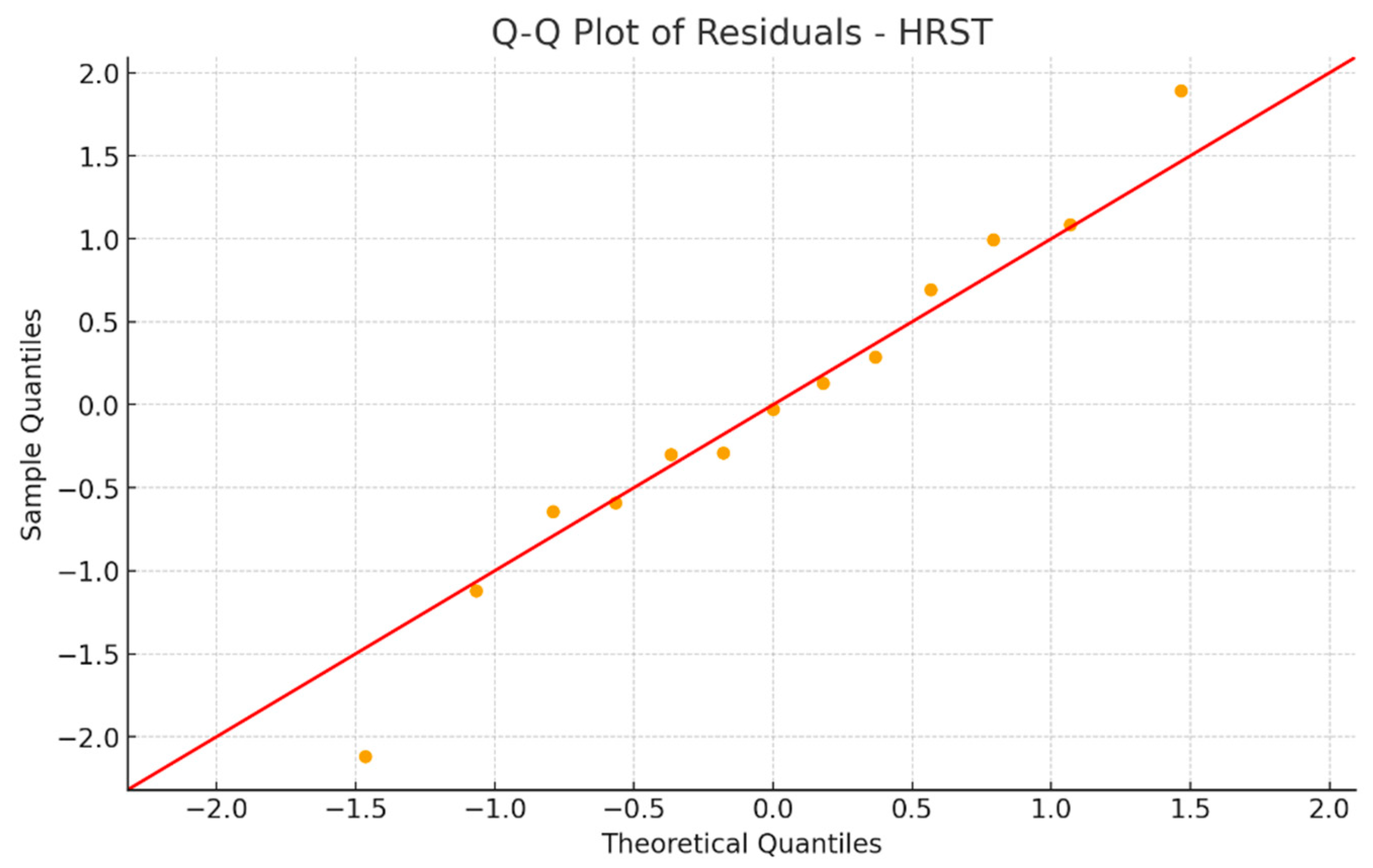
The findings offer empirical support for Hypothesis H1a, which posits that public sector investments in education, research infrastructure, and human capital development are positively associated with the evolution of HRST. The coefficient for government investment is positive and statistically significant, confirming the substantial role of public expenditure in strengthening the national stock of scientific and technological human resources (Figure 1).
Conversely, the investments originating from non-financial corporations, households, financial institutions, and non-profit institutions serving households do not display statistically significant effects on HRST. This pattern suggests that, over the analyzed period, these sectors did not allocate resources in a manner conducive to expanding or improving human capital in fields linked to science and technology.
Overall, the results highlight the central role of government intervention in advancing HRST outcomes, validating the core assumption of H1a. At the same time, the limited contribution of other sectors indicates the need for a more coordinated, cross-sectoral investment approach that better aligns private and civil society funding with national objectives related to science, technology, and innovation capacity-building.
For the regression model that considers RDI expenditures as a percentage of GDP as the dependent variable, the explanatory capacity is moderate, with an R2 value of 0.71. This indicates that approximately 71% of the variation in national RDI performance is accounted for by the set of investment-related predictors included in the analysis. Nonetheless, the overall statistical significance of the model remains relatively weak, suggesting that additional determinants—beyond sectoral investment patterns—play a substantial role in shaping Romania’s RDI intensity (Table 5).
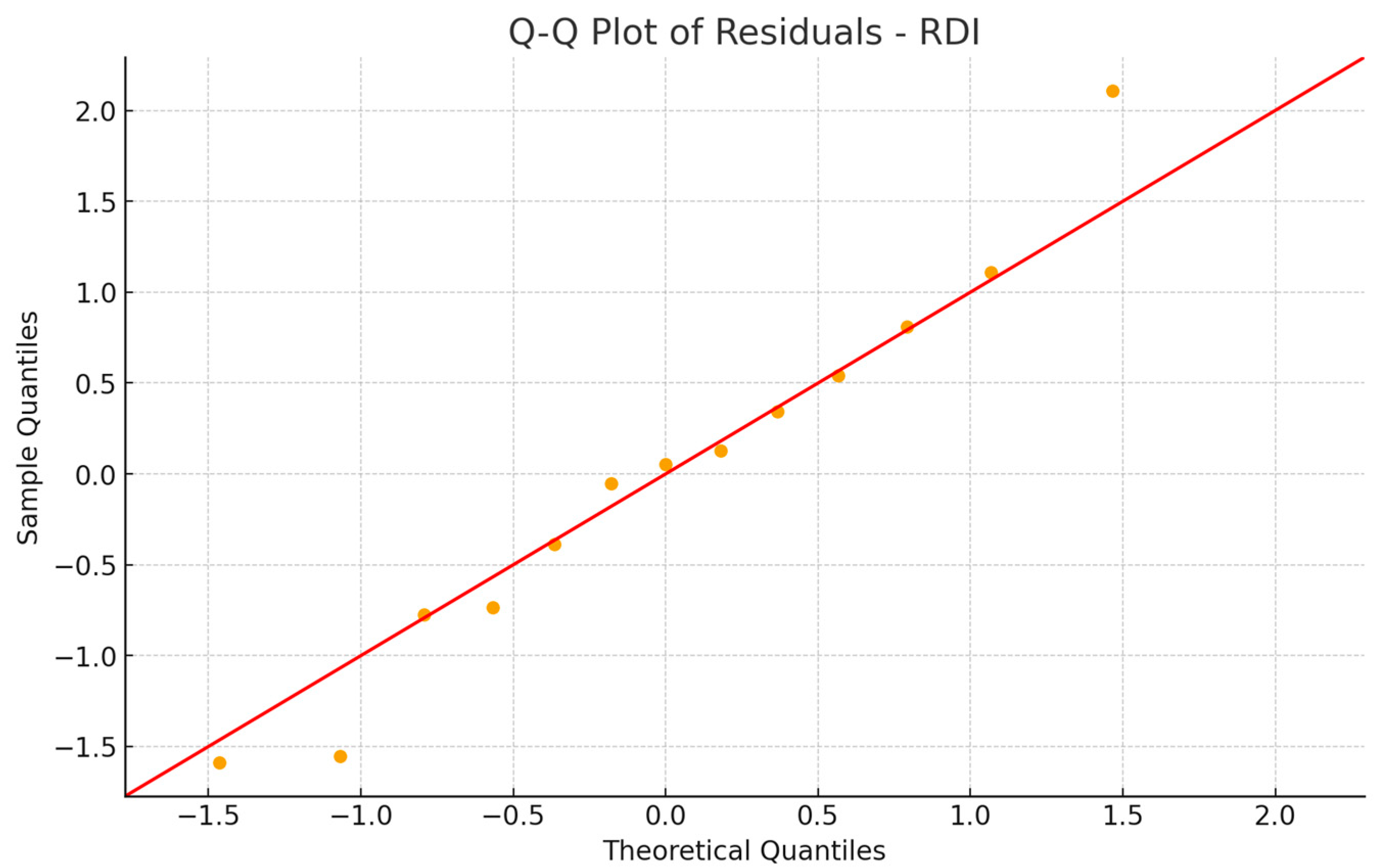
The empirical results for this model do not provide support for Hypothesis H1b, which posits that public sector investments exert a positive and significant influence on RDI intensity (Figure 2). Although the government investment coefficient has the expected positive sign, it does not reach statistical significance at conventional thresholds (p > 0.05). Similarly, investments originating from the private and non-profit sectors do not exhibit meaningful effects on RDI expenditures.
These findings indicate that sectoral investment patterns alone cannot account for the evolution of national research and innovation performance during 2008–2020. The moderate explanatory power of the model, coupled with the lack of statistically significant coefficients, suggests the presence of structural constraints in Romania’s innovation ecosystem. Factors such as the volatility of public research budgets, limited coordination between research institutions and industry, or weaknesses in innovation governance likely play a more substantial role in shaping RDI intensity than the level of capital formation across institutional sectors.
Overall, the results highlight a contrast with the HRST model: while human capital development responds more directly to public investment, RDI expenditure dynamics appear to depend on broader institutional and policy conditions that extend beyond sectoral investment allocation.
Hypothesis H2 is only partially supported. The regression analysis shows that none of the coefficients for the investment variables are statistically significant, highlighting a decoupling between the overall volume of investments and their orientation toward research and innovation. This suggests that while investment levels may be adequate in aggregate terms, they are not effectively allocated to activities that enhance R&D intensity or innovation capacity, pointing to structural or strategic gaps in investment policies and the innovation ecosystem.
The model using the share of innovative enterprises as the dependent variable demonstrates a high explanatory capacity, with R2 = 0.85, indicating that the included predictors account for approximately 85% of the observed variance. This suggests a relatively strong fit of the model to the empirical data, even though individual coefficients are not statistically significant (Table 6).
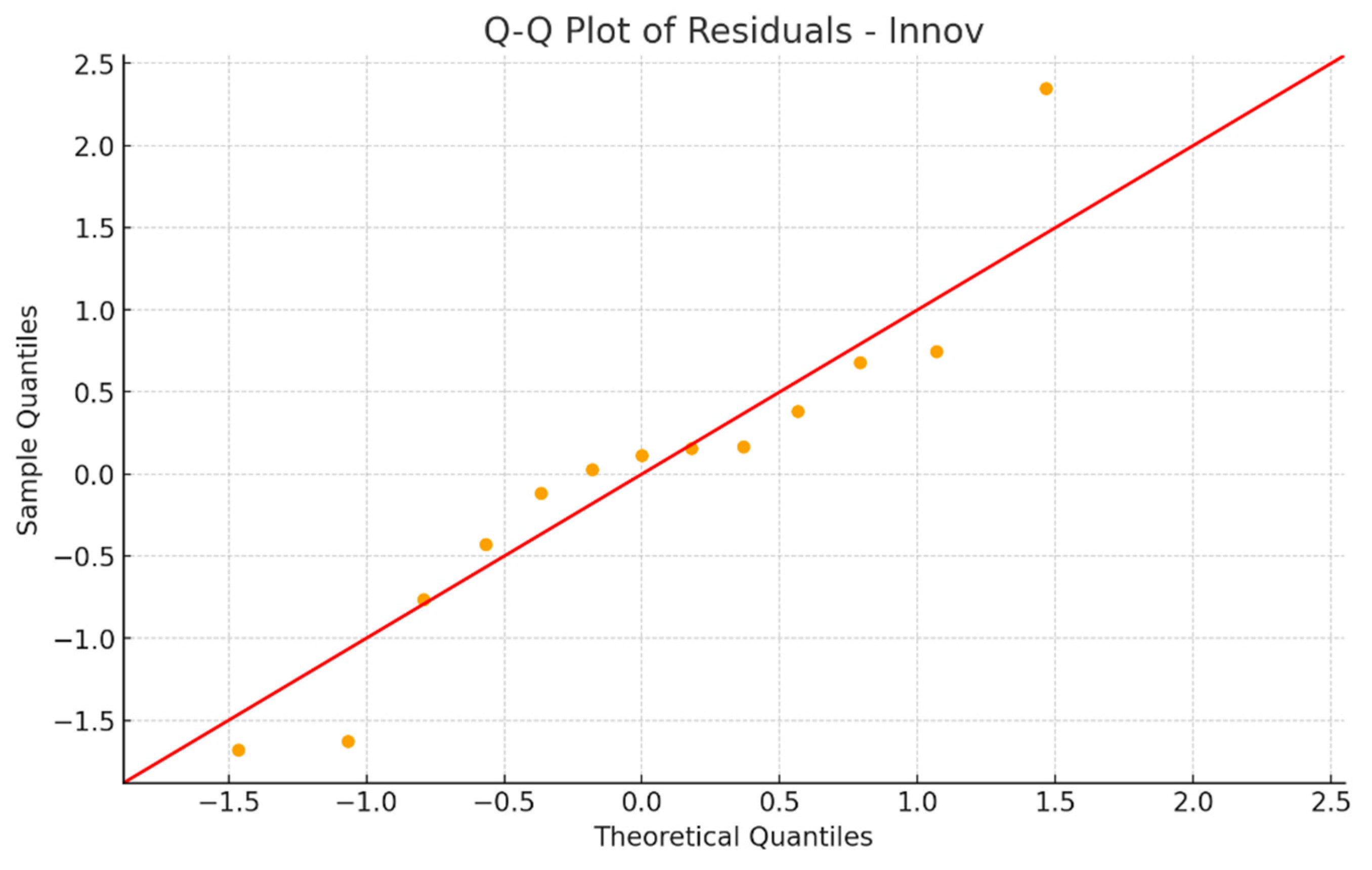
Hypothesis H3 is fully confirmed. The results show that the decline in total investments relative to GDP is consistently associated with a reduction in the share of innovative enterprises, indicating a direct and proportional relationship between the level of investment and firms’ innovation performance (Figure 3).
The findings also confirm that differences between public and private investment patterns significantly influence the national innovation capacity. Periods characterized by stronger public investment effort correspond to a relatively higher proportion of innovative enterprises, whereas the contraction of private investment—particularly within non-financial corporations—has contributed to a persistent weakening of firms’ ability to introduce new products, processes, or technologies.
This evidence supports the view that innovation activity in Romania remains highly sensitive to investment dynamics. The results underline the importance of maintaining a balanced and complementary relationship between public and private funding, where public investment plays a catalytic role by creating an enabling environment for private sector innovation. Sustained support for R&D infrastructure, fiscal incentives, and technology transfer mechanisms could further strengthen this link and enhance the long-term resilience of the innovation ecosystem.

5.7. Synthetic Correlations and Hypothesis Interpretation

Following the analysis of the evolution of each indicator and its relationship with sectoral investments, a synthetic correlation overview is warranted in order to assess the consistency of the formulated hypotheses and to highlight their implications for public policy.

5.7.1. Identified Statistical Correlations

Based on comparative tables and aggregated data series from 2008 to 2023, several relevant relationships emerge:
-
a moderate positive correlation exists between public sector investments and the evolution of Human Resources in Science and Technology (HRST). However, this relationship weakens during periods of underfunding, suggesting a dependence on institutional factors and the quality of educational and training policies;
-
the correlation between R&D expenditure and total investment as a share of GDP is weak and irregular. This indicates that general investment efforts do not automatically translate into support for research and innovation. There appears to be a systemic disconnect between investment orientation and innovation priorities;
-
the percentage of innovative enterprises has been in steady decline, mirroring the decrease in the share of investments in GDP. This confirms a clear negative relationship between underinvestment and the regression of innovation capacity;
-
at the regional level, significant disparities exist between regions with substantial public investment and those experiencing chronic underfunding, particularly in terms of both HRST and innovation. These findings validate the hypothesis that sectoral investment imbalances negatively impact regional GDP and perpetuate development inequalities.

5.7.2. Hypothesis Validation

H1. There is a positive correlation between public administration investments and the evolution of HRST and R&D: Partially confirmed. The relationship is observable but contingent upon contextual variables such as governance quality and human resource policies.
H1a. Public administration investments and HRST: the hypothesis is partially confirmed. Government investments show a positive and statistically significant contribution to the evolution of HRST; however, this effect is conditioned by broader institutional and policy frameworks, including governance quality, the consistency of education and training policies, and long-term strategies for human capital development.
H1b. Public administration investments and R&D expenditures: the hypothesis is not confirmed. Although the direction of the relationship is positive, the effect is not statistically significant. This outcome suggests that public investment alone is insufficient to stimulate measurable improvements in R&D intensity without complementary mechanisms such as stable research funding, efficient innovation governance, and stronger public–private coordination.
Overall, the two sub-hypotheses indicate that while public administration investments contribute meaningfully to strengthening human capital in science and technology, their impact on R&D performance remains limited and highly dependent on institutional quality and policy coherence.
H2. The decline in the share of investments in GDP correlates with a reduction in the proportion of innovative enterprises: is only partially supported. The regression results highlight the weak responsiveness of RDI to investment structure, underscoring the need for more targeted and sustained investment strategies to enhance the country’s research and innovation capacity.
H3. The investment structure differs between the public and private sectors, influencing systemic innovation: Confirmed. Public investments tend to be more strategically oriented, whereas private investments remain concentrated in traditional fixed assets, with limited emphasis on innovation.
H4. Investment imbalances across institutional sectors negatively influence regional GDP: Supported by data. Regional disparities and territorial correlations confirm this hypothesis.


5.8. Comparative Evidence

The empirical results observed for Romania are broadly consistent with findings reported in other EU and CEE economies with similarly low innovation capacity. For example, the significant but context-dependent influence of government investment on HRST aligns with studies showing that peripheral economies often rely heavily on public expenditure to sustain human capital development amid limited private-sector demand [16]. Likewise, the weak and statistically insignificant effects of sectoral investments on R&D mirrors the divergence in European R&D intensities documented by Blanco, who demonstrates that increases in total investment do not automatically lead to higher research intensity in structurally constrained economies.
Furthermore, the limited responsiveness of innovative enterprises to investment patterns corresponds to evidence from Slovakia and other CEE countries facing an “R&D trap” [19], where firms struggle to translate capital formation into technological upgrading due to low absorptive capacity, insufficient incentives for innovation, and institutional fragmentation. Similar constraints have been identified by Kuzior in assessments of national innovation ecosystems, where structural conditions—rather than investment volume alone—exert a decisive influence on innovation outcomes.
By situating Romania’s results within this broader European pattern, the analysis highlights that the challenges observed are not idiosyncratic but reflect deeper systemic constraints typical of economies transitioning toward knowledge-based development.

6. Conclusions on the Relationship Between Investments and Sustainable Development

The empirical and theoretical analyses presented in the preceding chapters demonstrate that the configuration of investment flows across institutional sectors constitutes a decisive determinant of sustainable development performance in Romania over the period 2008–2023. The findings reveal that the country’s investment policies, although quantitatively significant at certain points, lacked the strategic coherence, long-term orientation, and institutional support structures required to generate consistent progress in human capital, research and development, innovation capacity, and regional convergence.
Overall, the study confirms that investment volume alone is insufficient to advance sustainable development. In the absence of predictable governance, effective coordination across sectors, and clear policy priorities, investments fail to translate into measurable improvements in scientific capacity, technological advancement, and socio-economic resilience.

6.1. Key Findings

The public sector remains pivotal for strengthening human capital and scientific capacity: Government investment demonstrates measurable influence on Human Resources in Science and Technology (HRST), supporting the development of educational and research infrastructure. Nevertheless, the impact remains uneven, due primarily to fragmented policy implementation, discontinuous funding, and limited institutional coordination. The positive effect observed is therefore partial rather than systemic.
The private sector continues to underinvest in knowledge-intensive and innovation-driven activities: Although non-financial corporations account for the largest share of total investments, these resources are predominantly allocated to tangible assets—buildings, equipment, and construction—rather than to intangible assets such as R&D, digitalization, and advanced technologies. As a result, private-sector investments have not significantly contributed to the national innovation ecosystem.
Human capital advancement remains constrained by structural vulnerabilities: Despite a gradual increase in HRST levels, progress is slowed by persistent challenges, including limited investment in advanced skills, the outmigration of qualified professionals, and an insufficient system of incentives for attracting and retaining talent. These constraints reduce Romania’s capacity to sustain innovation and technological growth.
Research, development, and innovation funding remains structurally inadequate: R&D expenditure continues to be among the lowest in the EU, and regression results confirm the absence of statistically significant relationships between sectoral investments and RDI dynamics. This indicates a deep and persistent misalignment between national policy ambitions and actual budgetary commitments, resulting in limited technological absorption capacity and weak research performance.
The proportion of innovative enterprises has declined, pointing to systemic weaknesses in the national innovation ecosystem: The sharp reduction in the share of innovative firms reflects insufficient collaboration between public research institutions and industry, weak incentives for technological upgrading, and limited access to innovation-support instruments. This trend raises concerns about Romania’s ability to improve competitiveness and sustain long-term productivity growth.

6.2. Comparative Perspective on the Findings

The empirical patterns identified for Romania correspond closely to trends documented in comparative European research. Similarly to the evidence presented by Blanco, Romania exhibits a persistent divergence from EU innovation leaders, with R&D expenditure remaining weakly responsive to both public and private investments. The slow progression of HRST reflects structural constraints common to peripheral economies, including institutional fragmentation, modest demand for high-level skills, and the outmigration of qualified professionals [16]. Likewise, the limited impact of investments on innovation performance parallels the “R&D trap” identified in Slovakia and other CEE countries, where investment volume is insufficient to overcome systemic weaknesses in national innovation ecosystems [17,19].
These convergent findings reinforce the conclusion that Romania’s challenges cannot be attributed solely to financial constraints. Rather, they must be understood within the broader context of structural and institutional barriers that characterize low-R&D-intensity EU member states. Addressing these barriers requires coordinated long-term strategies that combine investment with institutional reform, capacity-building, and strengthened public–private collaboration.

7. Conclusions

7.1. Validation of Research Hypotheses

Based on the research objectives and statistical analyses presented in Section 4, the initial hypotheses can be assessed as follows:
Hypothesis H1a. Public administration investments contribute positively to the development of Human Resources in Science and Technology (HRST)—Partially validated. The regression analysis indicates a statistically significant and positive relationship between government investment and HRST growth. This confirms that public expenditure remains a critical driver of human capital formation, particularly by supporting education systems, research infrastructure, and advanced skills development. However, the magnitude of the effect is strongly conditioned by broader institutional factors, such as governance quality, policy stability, and the continuity of human resource development programs. These results suggest that public investment has the potential to strengthen Romania’s scientific and technological workforce, but achieving sustained progress requires coordinated policies and long-term strategic commitments.
Hypothesis H1b. Public administration investments positively influence national R&D expenditure—Not validated. Although the coefficient for government investment is positive, it is not statistically significant, indicating that public spending has not translated into higher R&D intensity during the analyzed period. This reflects the structural weaknesses of Romania’s research funding system—characterized by inconsistent budget allocations, limited institutional coordination, and insufficient integration between research organizations and industry. The results further suggest that R&D performance is influenced by additional factors omitted from the model, such as the efficiency of research governance, funding stability, and the absorptive capacity of innovation actors. Consequently, public investments alone are insufficient to drive measurable increases in R&D expenditure without broader institutional and policy reforms.
Hypothesis H2. The decline in the share of investments in GDP correlates with a reduction in the proportion of innovative enterprises—Partially supported. The econometric analysis does not identify statistically significant effects of sectoral investment levels on the share of innovative enterprises, suggesting a disconnect between aggregate investments and enterprise-level innovation outcomes. The results point to structural inefficiencies in the translation of investment inputs into innovation outputs, likely driven by fragmented innovation policies, weak public–private coordination, and insufficient incentives for firms to engage in technological upgrading.
Furthermore, the supplementary lagged-correlation analysis reveals that certain sectoral investments—particularly those from non-financial corporations and government—display positive associations with innovation after a two-year delay, supporting the existence of delayed transmission mechanisms. These findings underscore the importance of long-term, targeted investment strategies alongside more functional innovation ecosystems.
Hypothesis H3. The investment structure differs between the public and private sectors, influencing systemic innovation: The analysis confirms the hypothesis that variations in investment structure across institutional sectors significantly affect systemic innovation capacity. Public investments tend to be more strategically oriented, focusing on infrastructure, education, and R&D, thereby creating the necessary framework for knowledge generation and diffusion. In contrast, private investments remain largely directed toward traditional fixed assets and short-term productive capital, with limited allocation to innovation-oriented activities such as technology development or digital transformation. This structural imbalance contributes to the low innovation intensity of Romanian enterprises and limits the potential for long-term competitiveness. Strengthening the complementarity between public and private investments—through policy instruments such as innovation grants, fiscal incentives, and collaborative R&D programs—could enhance systemic innovation outcomes and accelerate the transition toward a knowledge-based economy.
Hypothesis H4. Sectoral investments are unbalanced, with insufficient allocations to public administration and public enterprises, thereby affecting the implementation of sustainable development policies: Confirmed. The investment structure disproportionately favors households and the private sector, while public administration and state-owned enterprises remain underfunded. This reduces the government’s capacity to support long-term strategic initiatives.
These validations support the broader conclusion that Romania’s current investment policies fail to coherently align resources, structural needs, and sustainability objectives. A paradigm shift is urgently required in the formulation, implementation, and monitoring of both public and private investments, in line with sustainability principles and territorial balance.

7.2. Policy Implications

The empirical findings underscore the need for a more coherent and strategically oriented investment framework capable of supporting Romania’s transition toward sustainable and innovation-driven development. Several policy directions arise from the analysis:
-
reorient public investment toward high-impact areas. Priority should be given to sectors with strong multiplier effects—such as education, research and innovation (RDI), digitalization, and advanced scientific infrastructure—to generate long-term gains in human capital formation and technological competitiveness;
-
strengthen incentives for private-sector engagement in RDI activities. Policy instruments such as targeted tax incentives, competitive grants, innovation clusters, and public–private partnerships should be used to stimulate corporate investment in research, development, and technological upgrading. Regulatory frameworks facilitating technology transfer and collaboration between firms, universities, and research institutes are essential for building a functional innovation ecosystem;
-
promote regionally balanced investment strategies. A “smart regionalization” of public investment is necessary to reduce territorial disparities and encourage region-specific innovation pathways. The development and implementation of Regional Smart Specialization Strategies (RIS3) tailored to local socio-economic contexts can significantly enhance regional absorptive capacity;
-
enhance the development and retention of human resources in science and technology. Integrated policies for education, advanced skills development, and talent retention—particularly in structurally disadvantaged regions—should be prioritized to strengthen national capabilities in key scientific and technological domains;
-
align investment monitoring with sustainability objectives. Fiscal and innovation policies must be coordinated within a unified monitoring framework that integrates clear, measurable sustainability indicators. Regular assessments of investment effectiveness are needed to ensure coherence with long-term development goals.

7.3. Research Limitations

Several limitations of the present study should be acknowledged when interpreting the results:
-
reliance on aggregated annual national data may mask substantial intra-regional disparities and sector-specific dynamics that influence sustainable development outcomes;
-
correlation-based analytical approaches do not establish causality and may be affected by broader contextual conditions, including economic cycles, political instability, and institutional reforms;
-
data availability constraints prevented the inclusion of certain regions and years, limiting the temporal and spatial granularity of the analysis;
-
more advanced econometric techniques (e.g., panel data models, structural equation modeling, or instrumental-variable approaches) were not employed, which could have strengthened the robustness of the findings and allowed for deeper exploration of the mechanisms linking investments to development outcomes.
These limitations suggest that while the study offers valuable insights into the relationship between sectoral investments and sustainable development indicators, further empirical refinement is needed to fully capture the complexity of these processes.

7.4. Directions for Future Research

To further advance the present research, the following avenues are recommended:
-
employ more sophisticated econometric models—including panel data regression, lag-structure models, and causal inference techniques—to more rigorously assess the temporal dynamics and structural determinants of the investment–development nexus;
-
integrate qualitative perspectives by examining institutional actors’ perceptions of barriers, incentives, and governance challenges associated with sustainable investment strategies;
-
conduct comparative analyses involving other Central and Eastern European countries to situate Romania’s performance within a broader regional context and identify shared structural patterns or country-specific trajectories;
-
investigate the role of leadership, institutional capacity, and governance quality in shaping the efficiency and impact of public investment allocations, particularly in relation to innovation and human capital policies.
In conclusion, the evidence highlights the urgent need for well-grounded, integrated, and consistently supported public policies. Without such reforms, the objectives of sustainable development risk remaining rhetorical rather than actionable.

Funding

This research received no external funding.

Data Availability Statement

The original contributions presented in the study are included in the article, further inquiries can be directed to the corresponding author.

Conflicts of Interest

The author declares no conflict of interest.

Appendix A

Appendix A.1

The table presents the values used for the regression analysis: investments by institutional sectors (as a percentage of GDP), RDI expenditures (as % of GDP), HRST (as %), and the proportion of innovative enterprises (as %).
Table A1. Dataset Used (Romania, 2008–2020).
YearNFCHouseholdsFinancialGovernmentNPISHTotal_InvRDI_pct_GDPHRST_pctInnovative_Enterprises_pct
200824.16.20.46.50.137.30.5723.833.3
200917.42.50.25.80.126.00.4624.133.3
201014.55.40.25.60.025.70.4524.030.8
201115.26.30.15.20.026.80.4925.430.8
201215.86.50.14.60.027.00.4825.520.7
201314.45.40.14.50.024.40.3925.120.7
201414.55.40.24.30.024.40.3825.612.8
201514.05.60.25.20.025.00.4927.012.8
201613.55.70.23.70.023.10.4827.610.2
201711.58.40.32.60.022.80.527.710.2
201811.17.50.22.60.021.40.5127.914.6
201912.07.30.23.50.023.00.4828.214.6
201012.85.90.24.60.023.50.4728.410.7
Table A2. Pearson Correlation Matrix.
NFCHouseholdsFinancialGovernmentNPISHTotal_InvRDI_pct_GDPHRST_pctInnovative_Enterprises_pct
−0.800.54−0.08−0.79−0.63−0.73−0.060.97−0.89
1.00−0.400.440.810.810.970.35−0.760.72
−0.401.000.19−0.66−0.52−0.180.380.58−0.48
0.440.191.000.110.540.500.59−0.040.05
0.81−0.660.111.000.610.760.09−0.790.77
0.81−0.520.540.611.000.700.38−0.580.65
0.97−0.180.500.760.701.000.48−0.680.68
0.350.380.590.090.380.481.000.110.19
−0.760.58−0.04−0.79−0.58−0.680.111.00−0.87
0.72−0.480.050.770.650.680.19−0.871.00
Table A3, Table A4 and Table A5: Regression Models—Coefficients.
Table A3. Coefficients—HR Model.
VariableCoefficientStd. Errortp > |t|ci_Lowci_High
const30.0733.3998.8480.00022.03638.110
NFC−0.3560.311−1.1450.290−1.0900.379
Households0.2260.5120.4410.672−0.9851.437
Financial4.4756.6600.6720.523−11.27520.224
Government−0.2140.753−0.2840.784−1.9951.566
NPISH2.48724.2040.1030.921−54.74659.720
Table A4. Coefficients—RDI Model.
VariableCoefficientStd. Errortp > |t|ci_Lowci_High
const0.2090.1022.0430.080−0.0330.451
NFC−0.0090.009−0.9910.355−0.0310.013
Households0.0410.0152.6780.0320.0050.078
Financial−0.0220.200−0.1100.916−0.4960.452
Government0.0300.0231.3150.230−0.0240.083
NPISH1.4200.7291.9490.092−0.3033.143
Table A5. Coefficients—Innovative Entreprises Model.
VariableCoefficientStd. Errortp > |t|ci_Lowci_High
const−13.54716.294−0.8310.433−52.07624.982
NFC−0.8611.489−0.5790.581−4.3822.659
Households3.9802.4561.6210.149−1.8279.787
Financial−63.97731.930−2.0040.085−139.47811.524
Government6.8593.6101.9000.099−1.67615.394
NPISH244.168116.0302.1040.073−30.198518.535

References

  1. European Commission. European Innovation Scoreboard 2020. 2020. Available online: https://op.europa.eu/en/publication-detail/-/publication/1457a9d4-084f-11eb-a511-01aa75ed71a1/language-en (accessed on 27 May 2025).
  2. Eurostat. Gross Domestic Expenditure on R&D (GERD). 2025. Available online: https://ec.europa.eu/eurostat/statistics-explained/index.php?title=R%26D_expenditure (accessed on 20 May 2025).
  3. Eurostat. Human Resources in Science and Technology—Statistics Explained. 2025. Available online: https://ec.europa.eu/eurostat/statistics-explained/index.php?title=Human_resources_in_science_and_technology (accessed on 20 May 2025).
  4. Romanian Statistics National Institute, INS 2025. Anuarul Statistic al României. Institutul Național de Statistică. Available online: https://insse.ro/cms/ro/tags/anuarul-statistic-al-romaniei (accessed on 12 May 2025).
  5. Romanian Statistics National Institute, INS 2025. Cercetarea-Dezvoltarea în România. Institutul Național de Statistică. Available online: https://insse.ro/cms/ro/tags/activitatea-de-cercetare-dezvoltare (accessed on 12 May 2025).
  6. Romanian Statistics National Institute, INS 2023. Investițiile Brute în Economie—Serii Statistice. Institutul Național de Statistică. Available online: https://insse.ro/cms/ro (accessed on 1 May 2025).
  7. World Commission on Environment and Development. Our Common Future: Report of the World Commission on Environment and Development; UN-Dokument A/42/427; United Nations: Geneva, Switzerland, 1987; Available online: http://www.un-documents.net/ocf-ov.htm (accessed on 15 May 2025).
  8. Barro, E.J.; Sala-i-Martin, X. Technological Diffusion, Convergence, and Growth; NBER Working Paper: Cambridge, MA, USA, 1995. [Google Scholar] [CrossRef]
  9. International Monetary Fund 2025. Available online: https://www.imf.org/en/Publications/WEO/Issues/2025/07/29/world-economic-outlook-update-july-2025 (accessed on 16 July 2025).
  10. OECD. Main Science and Technology Indicators. 2025. Available online: https://www.oecd.org/sti/msti.htm (accessed on 16 June 2025).
  11. Bulman, D.J.; Chatzinikolaou, A.; De Rosa, D.; Dospinescu, A.S.; Hopkins, J.; Karver, J.G.; Kim, Y.S.; Meisner, C.M.; Murisic, M.; Pauna, C.; et al. From Uneven Growth to Inclusive Development: Romania’s Path to Shared Prosperity—Systematic Country Diagnostic (English); World Bank Group: Washington, DC, USA, 2018; Available online: http://documents.worldbank.org/curated/en/673121528867676119 (accessed on 14 June 2025).
  12. World Bank. Rethinking Innovation in Romania. 2025. Available online: https://documents.worldbank.org/en/publication/documents-reports/documentdetail/682921590188063872/rethinking-innovation-in-romania (accessed on 12 June 2025).
  13. Blanco, F.A.; Delgado, F.J.; Presno, M.J. R&D expenditure in the EU: Convergence or divergence? Econ. Res. Ekon. Istraživanja 2020, 33, 1685–1710. [Google Scholar] [CrossRef]
  14. Aghion, P.; Bloom, N.; Blundell, R.; Griffith, R.; Howitt, P. Competition and Innovation: An Inverted-U Relationship. Q. J. Econ. 2005, 120, 701–728. [Google Scholar]
  15. European Commission. Regional Innovation Scoreboard. 2025. Available online: https://research-and-innovation.ec.europa.eu/statistics/performance-indicators/regional-innovation-scoreboard_en (accessed on 15 June 2025).
  16. Ionescu, G.H.; Firoiu, D.; Pîrvu, R.; Enescu, M.; Rădoi, M.-I.; Cojocaru, T.M. The Potential for Innovation and Entrepreneurship in EU Countries in the Context of Sustainable Development. Sustainability 2020, 12, 7250. [Google Scholar] [CrossRef]
  17. Kuzior, A.; Pidorycheva, I.; Liashenko, V.; Shevtsova, H.; Shvets, N. Assessment of National Innovation Ecosystems of the EU Countries and Ukraine in the Interests of Their Sustainable Development. Sustainability 2022, 14, 8487. [Google Scholar] [CrossRef]
  18. Bartosiewicz, A.; Gniadkowska Szymańska, A.; Kucharski, A. Sustainable development in the European union countries: Panel data evidence from the transport and storage sector. Environ. Sci. Eur. 2025, 37, 174. [Google Scholar] [CrossRef]
  19. Belanová, K.; Ochotnický, P.; Sivák, R. Innovation performance of EU countries in context of R&D: R&D trap risk in Slovakia? J. Innov. Entrep. 2025, 14, 59. [Google Scholar] [CrossRef]
  20. Barca, F. An Agenda for a Reformed Cohesion Policy; European Commission: Brussels, Belgium, 2009; Available online: https://www.europarl.europa.eu/meetdocs/2009_2014/documents/regi/dv/barca_report_/barca_report_en.pdf (accessed on 15 June 2025).
  21. Dima, A.M. Dezvoltarea Durabilă: Concepte și Politici; ASE: Bucharest, Romania, 2021; pp. 15–45. [Google Scholar]
  22. Ilie, S. Finanțarea CDI în România: Între obiective și realitate. Rev. Română De Politici Publice 2020, 12, 45–59. [Google Scholar]
  23. Javed, M.Y.; Hasan, M.; Aqil, M.; Ziaur Rehman, M.; Salar, S.A.A. Exploring Sustainable Investments: How They Drive Firm Performance in Indian Private and Publicly Listed Companies. Sustainability 2024, 16, 7240. [Google Scholar] [CrossRef]
  24. Manda, C.; Scutaru, L. Disparități regionale și politici investiționale. Calitatea Vieții 2018, 29, 204–219. [Google Scholar]
  25. Porter, M.E. The five competitive forces that shape strategy. Harv. Bus. Rev. 2008, 86, 78–93. [Google Scholar] [PubMed]
  26. Romer, P.M. Endogenous technological change. J. Political Econ. 1990, 98 Pt 2, S71–S102. [Google Scholar] [CrossRef]
  27. Schwab, K. The Global Competitiveness Report 2019. World Economic Forum. Available online: https://www.weforum.org/reports/global-competitiveness-report-2019 (accessed on 15 June 2025).
  28. Regional Development Agency. RIS3 Romania—Regional Innovation Strategies. 2025. Available online: https://ris3ro.wordpress.com/ (accessed on 15 June 2025).
  29. Stiglitz, J.E.; Sen, A.; Fitoussi, J.-P. Mismeasuring Our Lives: Why GDP Doesn’t Add Up; The New Press: New York, NY, USA, 2010; pp. 150–167. [Google Scholar]
  30. UNESCO. Science Report: The Race Against Time for Smarter Development. 2022. Available online: https://unesdoc.unesco.org/ark:/48223/pf0000380618 (accessed on 25 June 2025).
  31. Zaman, G.; Georgescu, G. Investițiile publice și impactul lor asupra creșterii economice. Econ. Teor. Apl. 2016, 23, 97–115. [Google Scholar]
Figure 1. Plot of Residuals for the HRST Model.
Sustainability 17 10832 g001
Figure 2. Plot of Residuals for the RDI Model.
Sustainability 17 10832 g002
Figure 3. Plot of Residuals for the Innovative Enterprises Model.
Sustainability 17 10832 g003
Table 1. Investment as a Percentage of GDP by Institutional Sector and total expenditure on research and development activities, as a percentage of GDP (Romania, 2008–2020).
YearNon-Financial CorporationsHouse-HoldsFinancial CorporationsGeneral GovernmentNPISHsTotal EconomyTotal Expenditure on RDI
200824.16.20.46.50.137.30.57
200917.42.50.25.80.126.00.46
201014.55.40.25.60.025.70.45
201115.26.30.15.20.026.80.49
201215.86.50.14.60.027.00.48
201314.45.40.14.50.024.40.39
201414.55.40.24.30.024.40.38
201514.05.60.25.20.025.00.49
201613.55.70.23.70.023.10.48
201711.58.40.32.60.022.80.5
201811.17.50.22.60.021.40.51
201912.07.30.23.50.023.00.48
202012.85.90.24.60.023.50.47
Table 2. Total expenditure on research and development activities, as a percentage of GDP, HRST and innovative enterprises’ evolution (Romania, 2008–2020).
YearTotal Expenditure on RDIHRSTInnovative Enterprises
20080.5723.833.3
20090.4624.133.3
20100.4524.030.8
20110.4925.430.8
20120.4825.520.7
20130.3925.120.7
20140.3825.612.8
20150.4927.012.8
20160.4827.610.2
20170.527.710.2
20180.5127.914.6
20190.4828.214.6
20200.4728.410.7
Table 3. Correlation coefficients between sectoral investments (t) and innovative enterprises (t + 2).
Institutional SectorCorrelation Coefficient (r) with Innovative Enterprises t + 2
Non-financial corporations (NFC)0.76
Households−0.47
Financial institutions0.44
General government0.69
NPISH0.88
Source: Author’s calculations based on INS, Eurostat, and CIS data.
Table 4. Regression Coefficients for the HRST Model.
VariableCoefficientStd. Errortp > |t|95% CI (Min)95% CI (Max)
Constant23.580.5542.60.00022.2724.89
NFC0.030.060.490.640−0.110.17
Households−0.010.10−0.140.893−0.250.22
Financial institutions−0.140.89−0.160.878−2.191.91
Government0.42 *0.152.770.0270.060.78
NPISH−0.180.64−0.280.789−1.741.37
* Coefficient significant at p < 0.05.
Table 5. Regression Coefficients for the RDI (% of GDP) Model.
VariableCoefficientStd. Errortp > |t|95% CI (Min)95% CI (Max)
Constant0.570.153.780.0060.200.94
NFC−0.000.02−0.190.855−0.050.04
Households0.010.030.230.823−0.060.07
Financial institutions−0.070.26−0.260.801−0.700.56
Government0.040.050.770.467−0.080.15
NPISH−0.000.19−0.010.993−0.440.44
Table 6. Regression Coefficients for the Innovative Enterprises Model.
VariableCoefficientStd. Errortp > |t|95% CI (Min)95% CI (Max)
Constant33.163.389.800.00025.2341.10
NFC−0.080.37−0.220.829−0.950.78
Households−0.170.57−0.290.781−1.491.14
Financial institutions−2.265.02−0.450.666−14.19.5
Government0.850.821.030.339−1.062.76
NPISH−3.183.70−0.860.415−11.95.5
Disclaimer/Publisher’s Note: The statements, opinions and data contained in all publications are solely those of the individual author(s) and contributor(s) and not of MDPI and/or the editor(s). MDPI and/or the editor(s) disclaim responsibility for any injury to people or property resulting from any ideas, methods, instructions or products referred to in the content.