


Utopia or Dystopia? Measuring the Effects of Platform Labour on Workers: A Literature Overview


Abstract
1. Introduction
2. Defining Platform Labour: The Concept and Classification of Platform Labour
3. Method
4. Dual Presentation of the Effects of Platform Labour on Workers: A Thematic Categorisation
4.1. Labour Utopia: Employment Opportunities, Flexible Autonomy and “Be Your Own Boss”
4.1.1. New Employment Opportunities
4.1.2. Flexible and Autonomous Work Experience
4.1.3. Psychological Fulfilment
4.2. Labour Dystopia: Spreading Precarity, Fictitious Freedom and Widening Inequality
4.2.1. The Spread of Precarity
4.2.2. Algorithmic Management and Fictitious Freedom
4.2.3. Replicating and Widening Inequalities
5. Not Absolutely Good or Bad: Examining Subjective Experiences of Workers
5.1. Heterogeneity of Platform Workers
5.2. Subjective Experience of Platform Workers
6. Discussion and Conclusions
Author Contributions
Funding
Institutional Review Board Statement
Informed Consent Statement
Data Availability Statement
Acknowledgments
Conflicts of Interest
References
- Schiller, D. Digital Capitalism: Networking the Global Market System; MIT Press: Cambridge, MA, USA, 2020. [Google Scholar]
- Srnicek, N. Platform Capitalism; Polity Press: Cambridge, UK, 2016. [Google Scholar]
- Langley, P.; Leyshon, A. Platform capitalism: The intermediation and capitalisation of digital economic circulation. Financ. Soc. 2017, 3, 11–31. [Google Scholar] [CrossRef] [Scilit]
- World Employment and Social Outlook: Trends 2021. Available online: https://www.ilo.org/publications/world-employment-and-social-outlook-trends-2021 (accessed on 24 May 2024).
- Schor, J.B.; Attwood-Charles, W.; Cansoy, M.; Ladegaard, I.; Wengronowitz, R. Dependence and precarity in the platform economy. Theory Soc. 2020, 49, 833–861. [Google Scholar] [CrossRef] [Scilit]
- Barnes, S.A.; Green, A.; de Hoyos, M. Crowdsourcing and work: Individual factors and circumstances influencing employability. New Technol. Work. Employ. 2015, 30, 16–31. [Google Scholar] [CrossRef] [Scilit]
- Wood, A.J.; Graham, M.; Lehdonvirta, V.; Hjorth, I. Good Gig, Bad Gig: Autonomy and Algorithmic Control in the Global Gig Economy. Work Employ. Soc. 2019, 33, 56–75. [Google Scholar] [CrossRef] [Scilit] [PubMed]
- Sundararajan, A. The Sharing Economy: The End of Employment and the Rise of Crowd-Based Capitalism; The MIT Press: Cambridge, MA, USA, 2016. [Google Scholar]
- Zhao, E.J. Digital China’s informal circuits: Platforms, labour and governance. China Inf. 2020, 34, 294–295. [Google Scholar] [CrossRef] [Scilit]
- Lima, J. Entrepreneurship, Informality and the Platform Economy. In Platform Labour and Global Logistics: A Research Companion; Routledge: Abingdon, UK, 2022; pp. 230–242. [Google Scholar]
- Deeming, C. Guy Standing (2011), The Precariat: The New Dangerous Class. London: Bloomsbury Academic. £19.99, pp. 198, pbk. J. Soc. Policy 2012, 42, 416–418. [Google Scholar] [CrossRef] [Scilit]
- Schmidt, F. Digital Labour Markets in the Platform Economy: Mapping the Political Challenges of Crowd Workand Gig Work; Division for Economic and Social Policy: Bonn, Germany, 2017. [Google Scholar]
- Kuhn, K.M.; Maleki, A. Micro-entrepreneurs, dependent contractors, and instaserfs: Understanding online labor platform workforces. Acad. Manag. Perspect. 2017, 31, 183–200. [Google Scholar] [CrossRef] [Scilit]
- Delaney Thomas, K. Taxing the gig economy. Univ. Pa. Law Rev. 2018, 166, 1415–1473. [Google Scholar]
- Kalleberg, A.L.; Vallas, S.P. Probing Precarious Work: Theory, Research, and Politics. In Precarious Work; Research in the Sociology of Work; Emerald Publishing Limited: Leeds, UK, 2017; pp. 1–30. [Google Scholar]
- Ravenelle, A.J. Hustle and Gig: Struggling and Surviving in the Sharing Economy, 1st ed.; University of California Press: Oakland, CA, USA, 2019. [Google Scholar]
- Dubal, V. Winning the battle, losing the war? Assessing the impact of misclassification litigation on workers in the GIG economy. Wis. Law Rev. 2017, 2017, 739–802. [Google Scholar]
- Heeks, R.; Gomez-Morantes, J.E.; Graham, M.; Howson, K.; Mungai, P.; Nicholson, B.; Van Belle, J.-P. Digital platforms and institutional voids in developing countries: The case of ride-hailing markets. World Dev. 2021, 145, 105528. [Google Scholar] [CrossRef] [Scilit]
- Eurofound. New Forms of Employment. Available online: https://www.eurofound.europa.eu/en/publications/2015/new-forms-employment (accessed on 21 May 2024).
- van Doorn, N. Platform labor: On the gendered and racialized exploitation of low-income service work in the ‘on-demand’ economy. Inf. Commun. Soc. 2017, 20, 898–914. [Google Scholar] [CrossRef] [Scilit]
- Kushner, S. The freelance translation machine: Algorithmic culture and the invisible industry. New Media Soc. 2013, 15, 1241–1258. [Google Scholar] [CrossRef] [Scilit]
- De Stefano, V. The Rise of the ‘Just-in-Time Workforce’: On-Demand Work, Crowd Work and Labour Protection in the ‘Gig-Economy’. SSRN Electron. J. 2015, 37, 461–471. [Google Scholar] [CrossRef] [Scilit]
- Moore, P. The Quantified Self in Precarity: Work, Technology and What Counts; Routledge: Abingdon, UK, 2017; pp. 1–234. [Google Scholar]
- Rosenblat, A.; Stark, L. Algorithmic Labor and Information Asymmetries: A Case Study of Uber’s Drivers. Int. J. Commun. 2016, 10, 3758–3784. [Google Scholar]
- Stewart, A.; Stanford, J. Regulating work in the gig economy: What are the options? Econ. Labour Relat. Rev. 2017, 28, 420–437. [Google Scholar] [CrossRef] [Scilit]
- Gandini, A. Digital labour: An empty signifier? Media Cult. Soc. 2021, 43, 369–380. [Google Scholar] [CrossRef] [Scilit]
- Graham, M.; Hjorth, I.; Lehdonvirta, V. Digital labour and development: Impacts of global digital labour platforms and the gig economy on worker livelihoods. Transf. Eur. Rev. Labour Res. 2017, 23, 135–162. [Google Scholar] [CrossRef] [Scilit]
- Howcroft, D.; Bergvall-Kåreborn, B. A Typology of Crowdwork Platforms. Work. Employ. Soc. 2018, 33, 21–38. [Google Scholar] [CrossRef] [Scilit]
- Spreitzer, G.M.; Cameron, L.; Garrett, L. Alternative Work Arrangements: Two Images of the New World of Work. Annu. Rev. Organ. Psychol. Organ. Behav. 2017, 4, 473–499. [Google Scholar] [CrossRef] [Scilit]
- Gandini, A. Labour process theory and the gig economy. Hum. Relat. 2018, 72, 1039–1056. [Google Scholar] [CrossRef] [Scilit]
- Kenney, M.; Zysman, J. Chapter 1 Work and Value Creation in the Platform Economy. In Work and Labor in the Digital Age; Research in the Sociology of Work; Emerald Publishing Limited: Leeds, UK, 2019; pp. 13–41. [Google Scholar]
- Jabagi, N.; Croteau, A.-M.; Audebrand, L.; Marsan, J. Gig-workers’ motivation: Thinking beyond carrots and sticks. J. Manag. Psychol. 2019, 34, 192–213. [Google Scholar] [CrossRef] [Scilit]
- Irani, L. Difference and Dependence among Digital Workers: The Case of Amazon Mechanical Turk. South Atl. Q. 2015, 114, 225–234. [Google Scholar] [CrossRef] [Scilit]
- Berger, T.; Chen, C.; Frey, C.B. Drivers of disruption? Estimating the Uber effect. Eur. Econ. Rev. 2018, 110, 197–210. [Google Scholar] [CrossRef] [Scilit]
- Veen, A.; Barratt, T.; Goods, C. Platform-Capital’s ‘App-etite’ for Control: A Labour Process Analysis of Food-Delivery Work in Australia. Work Employ. Soc. 2020, 34, 388–406. [Google Scholar] [CrossRef] [Scilit]
- Page, M.J.; McKenzie, J.E.; Bossuyt, P.M.; Boutron, I.; Hoffmann, T.C.; Mulrow, C.D.; Shamseer, L.; Tetzlaff, J.M.; Akl, E.A.; Brennan, S.E.; et al. The PRISMA 2020 statement: An updated guideline for reporting systematic reviews. Int. J. Surg. 2021, 88, 105906. [Google Scholar] [CrossRef]
- Ravenelle, A.J.; Kowalski, K.C.; Janko, E. The Side Hustle Safety Net: Precarious Workers and Gig Work during COVID-19. Sociol. Perspect. 2021, 64, 898–919. [Google Scholar] [CrossRef] [Scilit]
- Reynolds, J.; Kincaid, R. Gig Work and the Pandemic: Looking for Good Pay from Bad Jobs During the COVID-19 Crisis. Work. Occup. 2023, 50, 60–96. [Google Scholar] [CrossRef] [Scilit]
- Hoang, L.; Blank, G.; Quan-Haase, A. The winners and the losers of the platform economy: Who participates? Inf. Commun. Soc. 2020, 23, 681–700. [Google Scholar] [CrossRef] [Scilit]
- Burtch, G.; Carnahan, S.; Greenwood, B.N. Can You Gig It? An Empirical Examination of the Gig Economy and Entrepreneurial Activity. Manag. Sci. 2018, 64, 5497–5520. [Google Scholar] [CrossRef] [Scilit]
- Peticca-Harris, A.; deGama, N.; Ravishankar, M.N. Postcapitalist precarious work and those in the ‘drivers’ seat: Exploring the motivations and lived experiences of Uber drivers in Canada. Organization 2018, 27, 36–59. [Google Scholar] [CrossRef] [Scilit]
- Alexander, O.; Borland, J.; Charlton, A.; Singh, A. The Labour Market for Uber Drivers in Australia. Aust. Econ. Rev. 2022, 55, 177–194. [Google Scholar] [CrossRef] [Scilit]
- Huang, N.; Burtch, G.; Hong, Y.; Pavlou, P.A. Unemployment and Worker Participation in the Gig Economy: Evidence from an Online Labor Market. Inf. Syst. Res. 2020, 31, 431–448. [Google Scholar] [CrossRef] [Scilit]
- Deng, X.; Joshi, K.D. Why Individuals Participate in Micro-task Crowdsourcing Work Environment: Revealing Crowdworkers’ Perceptions. J. Assoc. Inf. Syst. 2016, 17, 648–673. [Google Scholar] [CrossRef] [Scilit]
- Schor, J.B.; Attwood-Charles, W. The “sharing” economy: Labor, inequality, and social connection on for-profit platforms. Sociol. Compass 2017, 11, e12493. [Google Scholar] [CrossRef] [Scilit]
- Doucette, M.H.; Bradford, W.D. Dual Job Holding and the Gig Economy: Allocation of Effort across Primary and Gig Jobs. South. Econ. J. 2019, 85, 1217–1242. [Google Scholar] [CrossRef] [Scilit]
- Glavin, P. Multiple jobs? The prevalence, intensity and determinants of multiple jobholding in Canada. Econ. Labour Relat. Rev. 2020, 31, 383–402. [Google Scholar] [CrossRef] [Scilit]
- Yao, Y. Uberizing the Legal Profession? Lawyer Autonomy and Status in the Digital Legal Market. Br. J. Ind. Relat. 2019, 58, 483–506. [Google Scholar] [CrossRef] [Scilit]
- Granger, S.; Barker Caza, B.; Ashford, S.J.; Reid, E.M. Adapting to a jolt: A mixed methods study identifying challenges and personal resources impacting professional gig workers’ well-being during COVID-19. J. Vocat. Behav. 2022, 138, 103784. [Google Scholar] [CrossRef] [Scilit]
- Rani, U.; Furrer, M. On-Demand Digital Economy: Can Experience Ensure Work and Income Security for Microtask Workers? Jahrbücher Natl. Und Stat. 2019, 239, 565–597. [Google Scholar] [CrossRef] [Scilit]
- van Doorn, N.; Ferrari, F.; Graham, M. Migration and Migrant Labour in the Gig Economy: An Intervention. Work Employ. Soc. 2023, 37, 1099–1111. [Google Scholar] [CrossRef] [Scilit]
- Fabo, B.; Karanovic, J.; Dukova, K. In search of an adequate European policy response to the platform economy. Transf. Eur. Rev. Labour Res. 2017, 23, 163–175. [Google Scholar] [CrossRef] [Scilit]
- Jarrahi, M.H.; Sutherland, W.; Nelson, S.B.; Sawyer, S. Platformic Management, Boundary Resources for Gig Work, and Worker Autonomy. Comput. Support. Coop. Work 2019, 29, 153–189. [Google Scholar] [CrossRef] [Scilit]
- Anwar, M.A.; Graham, M. Between a rock and a hard place: Freedom, flexibility, precarity and vulnerability in the gig economy in Africa. Compet. Change 2020, 25, 237–258. [Google Scholar] [CrossRef] [Scilit]
- Oyer, P. The gig economy. IZA World Labor 2020, 471. [Google Scholar] [CrossRef] [Scilit]
- Chen, M.K.; Chevalier, J.A.; Rossi, P.E.; Oehlsen, E. The Value of Flexible Work: Evidence from Uber Drivers. J. Political Econ. 2019, 127, 2735–2794. [Google Scholar] [CrossRef] [Scilit]
- Brawley, A.M. The Big, Gig Picture: We Can’t Assume the Same Constructs Matter. Ind. Organ. Psychol. 2017, 10, 687–696. [Google Scholar] [CrossRef] [Scilit]
- Berger, T.; Frey, C.B.; Levin, G.; Danda, S.R. Uber happy? Work and well-being in the ‘Gig Economy’. Econ. Policy 2019, 34, 429–477. [Google Scholar] [CrossRef] [Scilit]
- Lehdonvirta, V. Flexibility in the gig economy: Managing time on three online piecework platforms. New Technol. Work Employ. 2018, 33, 13–29. [Google Scholar] [CrossRef] [Scilit]
- Goods, C.; Veen, A.; Barratt, T. “Is your gig any good?” Analysing job quality in the Australian platform-based food-delivery sector. J. Ind. Relat. 2019, 61, 502–527. [Google Scholar] [CrossRef] [Scilit]
- Hall, J.V.; Krueger, A.B. An Analysis of the Labor Market for Uber’s Driver-Partners in the United States. ILR Rev. 2017, 71, 705–732. [Google Scholar] [CrossRef] [Scilit]
- Duggan, J.; Sherman, U.; Carbery, R.; McDonnell, A. Algorithmic management and app-work in the gig economy: A research agenda for employment relations and HRM. Hum. Resour. Manag. J. 2019, 30, 114–132. [Google Scholar] [CrossRef] [Scilit]
- Hannák, A.; Wagner, C.; Garcia, D.; Mislove, A.; Strohmaier, M.; Wilson, C. Bias in Online Freelance Marketplaces. In Proceedings of the 2017 ACM Conference on Computer Supported Cooperative Work and Social Computing, Portland, OR, USA, 25 February–1 March 2017; pp. 1914–1933. [Google Scholar]
- Milkman, R.; Elliott-Negri, L.; Griesbach, K.; Reich, A. Gender, Class, and the Gig Economy: The Case of Platform-Based Food Delivery. Crit. Sociol. 2020, 47, 357–372. [Google Scholar] [CrossRef] [Scilit]
- Rockmann, K.W.; Ballinger, G.A. Intrinsic motivation and organizational identification among on-demand workers. J. Appl. Psychol. 2017, 102, 1305–1316. [Google Scholar] [CrossRef] [Scilit] [PubMed]
- Makimoto, T.; Manners, D. Digital Nomad; John Wiley & Sons: New York, NY, USA, 1997. [Google Scholar]
- Schor, J.B.; Vallas, S.P. The Sharing Economy: Rhetoric and Reality. Annu. Rev. Sociol. 2021, 47, 369–389. [Google Scholar] [CrossRef] [Scilit]
- Purcell, C.; Brook, P. At Least I’m My Own Boss! Explaining Consent, Coercion and Resistance in Platform Work. Work Employ. Soc. 2022, 36, 391–406. [Google Scholar] [CrossRef] [Scilit]
- Churchill, B.; Craig, L. Gender in the gig economy: Men and women using digital platforms to secure work in Australia. J. Sociol. 2019, 55, 741–761. [Google Scholar] [CrossRef] [Scilit]
- Malin, B.J.; Chandler, C. Free to Work Anxiously: Splintering Precarity Among Drivers for Uber and Lyft. Commun. Cult. Crit. 2017, 10, 382–400. [Google Scholar] [CrossRef] [Scilit]
- Doody, S.; Chen, V.T.; Goldstein, J. Varieties of Entrepreneurial Capitalism: The Culture of Entrepreneurship and Structural Inequalities of Work and Business Creation. Sociol. Compass 2016, 10, 858–876. [Google Scholar] [CrossRef] [Scilit]
- Nemkova, E.; Demirel, P.; Baines, L. In search of meaningful work on digital freelancing platforms: The case of design professionals. New Technol. Work Employ. 2019, 34, 226–243. [Google Scholar] [CrossRef] [Scilit]
- Myhill, K.; Richards, J.; Sang, K. Job quality, fair work and gig work: The lived experience of gig workers. Int. J. Hum. Resour. Manag. 2021, 32, 4110–4135. [Google Scholar] [CrossRef] [Scilit]
- Kalleberg, A.L. Flexible Firms and Labor Market Segmentation. Work Occup. 2003, 30, 154–175. [Google Scholar] [CrossRef] [Scilit]
- Friedman, G. Workers without employers: Shadow corporations and the rise of the gig economy. Rev. Keynes. Econ. 2014, 2, 171–188. [Google Scholar] [CrossRef] [Scilit]
- Ahsan, M. Entrepreneurship and Ethics in the Sharing Economy: A Critical Perspective. J. Bus. Ethics 2018, 161, 19–33. [Google Scholar] [CrossRef] [Scilit]
- Rani, U.; Furrer, M. Digital labour platforms and new forms of flexible work in developing countries: Algorithmic management of work and workers. Compet. Change 2021, 25, 212–236. [Google Scholar] [CrossRef] [Scilit]
- Cherry, M.A.; Aloisi, A. ‘Dependent Contractors’ in the Gig Economy: A Comparative Approach. Am. Univ. Law Rev. 2017, 66, 635–690. [Google Scholar] [CrossRef] [Scilit]
- Kässi, O.; Lehdonvirta, V. Online labour index: Measuring the online gig economy for policy and research. Technol. Forecast. Soc. Change 2018, 137, 241–248. [Google Scholar] [CrossRef] [Scilit]
- Moore, S.; Newsome, K. Paying for Free Delivery: Dependent Self-Employment as a Measure of Precarity in Parcel Delivery. Work Employ. Soc. 2018, 32, 475–492. [Google Scholar] [CrossRef] [Scilit]
- Brawley, A.M.; Pury, C.L.S. Work experiences on MTurk: Job satisfaction, turnover, and information sharing. Comput. Hum. Behav. 2016, 54, 531–546. [Google Scholar] [CrossRef] [Scilit]
- Calo, R.; Rosenblat, A. The Taking Economy: Uber, Information, and Power. SSRN Electron. J. 2017, 117, 1623–1690. [Google Scholar] [CrossRef] [Scilit]
- Chen, J.Y.J. Thrown under the bus and outrunning it! The logic of Didi and taxi drivers’ labour and activism in the on-demand economy. New Media Soc. 2018, 20, 2691–2711. [Google Scholar] [CrossRef] [Scilit]
- Shevchuk, A.; Strebkov, D.; Davis, S.N. The Autonomy Paradox: How Night Work Undermines Subjective Well-Being of Internet-Based Freelancers. ILR Rev. 2018, 72, 75–100. [Google Scholar] [CrossRef] [Scilit]
- Wood, A.J.; Graham, M.; Lehdonvirta, V.; Hjorth, I. Networked but Commodified: The (Dis)Embeddedness of Digital Labour in the Gig Economy. Sociology 2019, 53, 931–950. [Google Scholar] [CrossRef] [Scilit]
- Scully-Russ, E.; Torraco, R. The Changing Nature and Organization of Work: An Integrative Review of the Literature. Hum. Resour. Dev. Rev. 2019, 19, 66–93. [Google Scholar] [CrossRef] [Scilit]
- Sutherland, W.; Jarrahi, M.H.; Dunn, M.; Nelson, S.B. Work Precarity and Gig Literacies in Online Freelancing. Work Employ. Soc. 2019, 34, 457–475. [Google Scholar] [CrossRef] [Scilit]
- Leighton, P. Professional self-employment, new power and the sharing economy: Some cautionary tales from Uber. J. Manag. Organ. 2016, 22, 859–874. [Google Scholar] [CrossRef] [Scilit]
- Vallas, S.; Schor, J.B. What Do Platforms Do? Understanding the Gig Economy. Annu. Rev. Sociol. 2020, 46, 273–294. [Google Scholar] [CrossRef] [Scilit]
- Kuhn, K.M. The Rise of the “Gig Economy” and Implications for Understanding Work and Workers. Ind. Organ. Psychol. 2016, 9, 157–162. [Google Scholar] [CrossRef] [Scilit]
- Kaine, S.; Josserand, E. The organisation and experience of work in the gig economy. J. Ind. Relat. 2019, 61, 479–501. [Google Scholar] [CrossRef] [Scilit]
- Fleming, P. The Human Capital Hoax: Work, Debt and Insecurity in the Era of Uberization. Organ. Stud. 2017, 38, 691–709. [Google Scholar] [CrossRef] [Scilit]
- Ladegaard, I.; Ravenelle, A.J.; Schor, J. ‘God Is Protecting Me … And I Have Mace’: Defensive Labour In Precarious Workplaces. Br. J. Criminol. 2022, 62, 773–789. [Google Scholar] [CrossRef] [Scilit]
- Gregory, K. ‘My Life Is More Valuable Than This’: Understanding Risk among On-Demand Food Couriers in Edinburgh. Work Employ. Soc. 2020, 35, 316–331. [Google Scholar] [CrossRef] [Scilit]
- Tassinari, A.; Maccarrone, V. Riders on the Storm: Workplace Solidarity among Gig Economy Couriers in Italy and the UK. Work Employ. Soc. 2019, 34, 35–54. [Google Scholar] [CrossRef] [Scilit]
- Orr, W.; Henne, K.; Lee, A.; Harb, J.I.; Alphonso, F.C. Necrocapitalism in the Gig Economy: The Case of Platform Food Couriers in Australia. Antipode 2022, 55, 200–221. [Google Scholar] [CrossRef] [Scilit]
- Cameron, L.D.; Thomason, B.; Conzon, V.M. Risky Business: Gig Workers and the Navigation of Ideal Worker Expectations During the COVID-19 Pandemic. J. Appl. Psychol. 2021, 106, 1821–1833. [Google Scholar] [CrossRef] [Scilit]
- Aguilera, A.; Dablanc, L.; Krier, C.; Louvet, N. Platform-based food delivery in Paris before and during the pandemic: Profile, motivations and mobility patterns of couriers. Eur. Transp. Res. Rev. 2022, 14, 45. [Google Scholar] [CrossRef] [Scilit]
- Gregory, K.; Maldonado, M.P. Delivering Edinburgh: Uncovering the digital geography of platform labour in the city. Inf. Commun. Soc. 2020, 23, 1187–1202. [Google Scholar] [CrossRef] [Scilit]
- Mbare, B. Psychosocial work environment and mental wellbeing of food delivery platform workers in Helsinki, Finland: A qualitative study. Int. J. Qual. Stud. Health Well-Being 2023, 18, 2173336. [Google Scholar] [CrossRef] [Scilit]
- Wood, A.J. The Taylor Review: Understanding the gig economy, dependency and the complexities of control. New Technol. Work Employ. 2019, 34, 111–115. [Google Scholar] [CrossRef] [Scilit]
- Ashford, S.J.; Caza, B.B.; Reid, E.M. From surviving to thriving in the gig economy: A research agenda for individuals in the new world of work. Res. Organ. Behav. 2018, 38, 23–41. [Google Scholar] [CrossRef] [Scilit]
- Caza, B.B.; Reid, E.M.; Ashford, S.J.; Granger, S. Working on my own: Measuring the challenges of gig work. Hum. Relat. 2022, 75, 2122–2159. [Google Scholar] [CrossRef] [Scilit]
- Geissinger, A.; Laurell, C.; Öberg, C.; Sandström, C.; Suseno, Y. The sharing economy and the transformation of work: Evidence from Foodora. Pers. Rev. 2021, 51, 584–602. [Google Scholar] [CrossRef] [Scilit]
- Li, Y.; Xu, S.; Yu, Y.; Meadows, R. The well-being of gig workers in the sharing economy during COVID-19. Int. J. Contemp. Hosp. Manag. 2022, 35, 1470–1489. [Google Scholar] [CrossRef] [Scilit]
- Warren, T. Work–life balance and gig work: ‘Where are we now’ and ‘where to next’ with the work–life balance agenda? J. Ind. Relat. 2021, 63, 522–545. [Google Scholar] [CrossRef] [Scilit]
- Wells, K.J.; Attoh, K.; Cullen, D. “Just-in-Place” labor: Driver organizing in the Uber workplace. Environ. Plan. A Econ. Space 2021, 53, 315–331. [Google Scholar] [CrossRef] [Scilit]
- Cameron, L.D.; Rahman, H. Expanding the Locus of Resistance: Understanding the Co-constitution of Control and Resistance in the Gig Economy. Organ. Sci. 2022, 33, 38–58. [Google Scholar] [CrossRef] [Scilit]
- Jago, A.S. ALGORITHMS AND AUTHENTICITY. Acad. Manag. Discov. 2019, 5, 38–56. [Google Scholar] [CrossRef] [Scilit]
- Leicht-Deobald, U.; Busch, T.; Schank, C.; Weibel, A.; Schafheitle, S.; Wildhaber, I.; Kasper, G. The Challenges of Algorithm-Based HR Decision-Making for Personal Integrity. J. Bus. Ethics 2019, 160, 377–392. [Google Scholar] [CrossRef] [Scilit]
- Au-Yeung, T.C.; Qiu, J. Institutions, Occupations and Connectivity: The Embeddedness of Gig Work and Platform-Mediated Labour Market in Hong Kong. Crit. Sociol. 2022, 48, 1169–1187. [Google Scholar] [CrossRef] [Scilit]
- Lee, M.K.; Kusbit, D.; Metsky, E.; Dabbish, L. Working with machines: The impact of algorithmic and data-driven management on human workers. In Proceedings of the 33rd Annual ACM Conference on Human Factors in Computing Systems (CHI ‘15), Seoul, Republic of Korea, 18–23 April 2015; pp. 1603–1612. [Google Scholar]
- Newlands, G. Algorithmic Surveillance in the Gig Economy: The Organization of Work through Lefebvrian Conceived Space. Organ. Stud. 2020, 42, 719–737. [Google Scholar] [CrossRef] [Scilit]
- Fourcade, M.; Healy, K. Seeing like a market. Socio-Econ. Rev. 2016, 15, 9–29. [Google Scholar] [CrossRef] [Scilit]
- Bucher, E.L.; Schou, P.K.; Waldkirch, M. Pacifying the algorithm—Anticipatory compliance in the face of algorithmic management in the gig economy. Organization 2020, 28, 44–67. [Google Scholar] [CrossRef] [Scilit]
- Popan, C. Embodied Precariat and Digital Control in the “Gig Economy”: The Mobile Labor of Food Delivery Workers. J. Urban Technol. 2021, 31, 109–128. [Google Scholar] [CrossRef] [Scilit]
- Walker, M.; Fleming, P.; Berti, M. ‘You can’t pick up a phone and talk to someone’: How algorithms function as biopower in the gig economy. Organization 2021, 28, 26–43. [Google Scholar] [CrossRef] [Scilit]
- Zhu, G.; Huang, J.; Lu, J.; Luo, Y.; Zhu, T. Gig to the left, algorithms to the right: A case study of the dark sides in the gig economy. Technol. Forecast. Soc. Change 2024, 199, 123018. [Google Scholar] [CrossRef] [Scilit]
- Shapiro, A. Between autonomy and control: Strategies of arbitrage in the “on-demand” economy. New Media Soc. 2017, 20, 2954–2971. [Google Scholar] [CrossRef] [Scilit]
- Wu, Q.; Zhang, H.; Li, Z.; Liu, K. Labor control in the gig economy: Evidence from Uber in China. J. Ind. Relat. 2019, 61, 574–596. [Google Scholar] [CrossRef] [Scilit]
- Strebkov, D.; Shevchuk, A.; Lukina, A.; Melianova, E.; Tyulyupo, A. Social Factors of Contractor Selection on Freelance Online Marketplace: Study of Contests Using “Big Data”. J. Econ. Sociol. 2019, 20, 25–65. [Google Scholar] [CrossRef] [Scilit]
- Schörpf, P.; Flecker, J.; Schönauer, A.; Eichmann, H. Triangular love–hate: Management and control in creative crowdworking. New Technol. Work Employ. 2017, 32, 43–58. [Google Scholar] [CrossRef] [Scilit]
- Huang, H. Algorithmic management in food-delivery platform economy in China. New Technol. Work Employ. 2022, 38, 185–205. [Google Scholar] [CrossRef] [Scilit]
- Rahman, H.A. The Invisible Cage: Workers’ Reactivity to Opaque Algorithmic Evaluations. Adm. Sci. Q. 2021, 66, 945–988. [Google Scholar] [CrossRef] [Scilit]
- Wood, A.J.; Lehdonvirta, V. Platforms Disrupting Reputation: Precarity and Recognition Struggles in the Remote Gig Economy. Sociology 2022, 57, 999–1016. [Google Scholar] [CrossRef] [Scilit]
- Shevchuk, A.; Strebkov, D.; Tyulyupo, A. Always on across time zones: Invisible schedules in the online gig economy. New Technol. Work Employ. 2021, 36, 94–113. [Google Scholar] [CrossRef] [Scilit]
- Glavin, P.; Schieman, S.; Bierman, A. From flexibility to unending availability: Platform workers’ experiences of work–family conflict. J. Marriage Fam. 2024, 86, 574–592. [Google Scholar] [CrossRef] [Scilit]
- Jin, T.; Wang, T.; Zhou, S.; Liu, D. Long Working Hours and Job Satisfaction in Platform Employment: An Empirical Study of On-Demand Delivery Couriers in China. Appl. Res. Qual. Life 2024, 19, 1197–1223. [Google Scholar] [CrossRef] [Scilit]
- van Doorn, N.; Chen, J.Y. Odds stacked against workers: Datafied gamification on Chinese and American food delivery platforms. Socio-Econ. Rev. 2021, 19, 1345–1367. [Google Scholar] [CrossRef] [Scilit]
- Vasudevan, K.; Chan, N.K. Gamification and work games: Examining consent and resistance among Uber drivers. New Media Soc. 2022, 24, 866–886. [Google Scholar] [CrossRef] [Scilit]
- Mika, B.; Polkowska, D. The game of Ride-Pass in platform work: Implementation of Burawoy’s concept of workplace games to app-mediated ride-hailing industry in Poland. New Media Soc. 2024, 27, 1811–1828. [Google Scholar] [CrossRef] [Scilit]
- Sun, P.; Yujie Chen, J.; Rani, U. From Flexible Labour to ‘Sticky Labour’: A Tracking Study of Workers in the Food-Delivery Platform Economy of China. Work Employ. Soc. 2021, 37, 412–431. [Google Scholar] [CrossRef] [Scilit]
- Aloisi, A. Commoditized Workers The Rising of On-Demand Work, A Case Study Research on a Set of Online Platforms and Apps. SSRN Electron. J. 2015, 37, 656–690. [Google Scholar] [CrossRef] [Scilit]
- Koivusalo, M.; Svynarenko, A.; Mbare, B.; Perkio, M. Globalization, platform work, and wellbeing-a comparative study of Uber drivers in three cities: London, Helsinki, and St Petersburg. Glob. Health 2024, 20, 18. [Google Scholar] [CrossRef] [Scilit]
- Mazmanian, M.; Orlikowski, W.J.; Yates, J. The Autonomy Paradox: The Implications of Mobile Email Devices for Knowledge Professionals. Organ. Sci. 2013, 24, 1337–1357. [Google Scholar] [CrossRef] [Scilit]
- Putnam, L.L.; Myers, K.K.; Gailliard, B.M. Examining the tensions in workplace flexibility and exploring options for new directions. Hum. Relat. 2013, 67, 413–440. [Google Scholar] [CrossRef] [Scilit]
- Galière, S. When food-delivery platform workers consent to algorithmic management: A Foucauldian perspective. New Technol. Work Employ. 2020, 35, 357–370. [Google Scholar] [CrossRef] [Scilit]
- Gregory, K.; Sadowski, J. Biopolitical platforms: The perverse virtues of digital labour. J. Cult. Econ. 2021, 14, 662–674. [Google Scholar] [CrossRef] [Scilit]
- Ettlinger, N. The governance of crowdsourcing: Rationalities of the new exploitation. Environ. Plan. A Econ. Space 2016, 48, 2162–2180. [Google Scholar] [CrossRef] [Scilit]
- Feng, X.; Cooke, F.L.; Zhao, C. Fragmentation of employment relationships, fragmentation of working time: The nature of work and employment of platform takeaway riders and implications for decent work in China. Asia Pac. J. Hum. Resour. 2024, 62, e12398. [Google Scholar] [CrossRef] [Scilit]
- Shibata, S. Gig Work and the Discourse of Autonomy: Fictitious Freedom in Japan’s Digital Economy. New Political Econ. 2019, 25, 535–551. [Google Scholar] [CrossRef] [Scilit]
- Newlands, G.; Lutz, C. Crowdwork and the mobile underclass: Barriers to participation in India and the United States. New Media Soc. 2020, 23, 1341–1361. [Google Scholar] [CrossRef] [Scilit]
- Shaw, A.; Fiers, F.; Hargittai, E. Participation inequality in the gig economy. Info. Commun. Soc. 2023, 26, 2250–2267. [Google Scholar] [CrossRef] [Scilit]
- Demirel, P.; Nemkova, E.; Taylor, R. Reproducing Global Inequalities in the Online Labour Market: Valuing Capital in the Design Field. Work Employ. Soc. 2020, 35, 914–930. [Google Scholar] [CrossRef] [Scilit]
- Artero, J.; Borra, C.; Gomez-Alvarez, R. Education, inequality and use of digital collaborative platforms: The European case. Econ. Labour Relat. Rev. 2020, 31, 364–382. [Google Scholar] [CrossRef] [Scilit]
- Schor, J.B. Does the sharing economy increase inequality within the eighty percent?: Findings from a qualitative study of platform providers. Camb. J. Reg. Econ. Soc. 2017, 10, 263–279. [Google Scholar] [CrossRef] [Scilit]
- Lutz, C. Digital inequalities in the age of artificial intelligence and big data. Hum. Behav. Emerg. Technol. 2019, 1, 141–148. [Google Scholar] [CrossRef] [Scilit]
- Trittin-Ulbrich, H.; Scherer, A.G.; Munro, I.; Whelan, G. Exploring the dark and unexpected sides of digitalization: Toward a critical agenda. Organization 2021, 28, 8–25. [Google Scholar] [CrossRef] [Scilit]
- Tan, Z.M.; Aggarwal, N.; Cowls, J.; Morley, J.; Taddeo, M.; Floridi, L. The ethical debate about the gig economy: A review and critical analysis. Technol. Soc. 2021, 65, 101594. [Google Scholar] [CrossRef] [Scilit]
- Artificial Intelligence, Platform Work and Gender Equality. Available online: https://eige.europa.eu/publications-resources/publications/artificial-intelligence-platform-work-and-gender-equality-report (accessed on 18 August 2024).
- Gerber, C. Gender and precarity in platform work: Old inequalities in the new world of work. New Technol. Work Employ. 2022, 37, 206–230. [Google Scholar] [CrossRef] [Scilit]
- Zhao, M. “Ready worker two”: Gendered labor regime of platform-based game work in China. New Media Soc. 2024, 27, 3293–3313. [Google Scholar] [CrossRef] [Scilit]
- Bakas, F.; Salman, D. ‘You ensure your own safety’: Gender, fear and tourism labour in the gig economy in Turkiye. Gend. Place Cult. 2024, 31, 1072–1094. [Google Scholar] [CrossRef] [Scilit]
- Cook, C.; Diamond, R.; Hall, J.V.; List, J.A.; Oyer, P. The Gender Earnings Gap in the Gig Economy: Evidence from over a Million Rideshare Drivers. Rev. Econ. Stud. 2021, 88, 2210–2238. [Google Scholar] [CrossRef] [Scilit]
- Greenwood, B.; Adjerid, I.; Angst, C.M.; Meikle, N.L. How Unbecoming of You: Online Experiments Uncovering Gender Biases in Perceptions of Ridesharing Performance. J. Bus. Ethics 2020, 175, 499–518. [Google Scholar] [CrossRef] [Scilit]
- Piasna, A.; Drahokoupil, J. Gender inequalities in the new world of work. Transf. Eur. Rev. Labour Res. 2017, 23, 313–332. [Google Scholar] [CrossRef] [Scilit]
- Leung, L.Y.M. ‘No South Asian Riders, Please’: The Politics of Visibilisation in Platformed Food Delivery Work during the COVID-19 Pandemic in Hong Kong. Crit. Sociol. 2022, 48, 1189–1203. [Google Scholar] [CrossRef] [Scilit]
- Rosenblat, A.; Levy, K.E.C.; Barocas, S.; Hwang, T. Discriminating Tastes: Uber’s Customer Ratings as Vehicles for Workplace Discrimination. Policy Internet 2017, 9, 256–279. [Google Scholar] [CrossRef] [Scilit]
- Mendonça, P.; Kougiannou, N.K.; Clark, I. Informalization in gig food delivery in the UK: The case of hyper-flexible and precarious work. Ind. Relat. A J. Econ. Soc. 2022, 62, 60–77. [Google Scholar] [CrossRef] [Scilit]
- Briziarelli, M. Spatial politics in the digital realm: The logistics/precarity dialectics and Deliveroo’s tertiary space struggles. Cult. Stud. 2018, 33, 823–840. [Google Scholar] [CrossRef] [Scilit]
- Ford, M.; Honan, V. The limits of mutual aid: Emerging forms of collectivity among app-based transport workers in Indonesia. J. Ind. Relat. 2019, 61, 528–548. [Google Scholar] [CrossRef] [Scilit]
- Frey, B. Platform Labor and In/Formality: Organization among Motorcycle Taxi Drivers in Bandung, Indonesia. Anthropol. Work Rev. 2020, 41, 36–49. [Google Scholar] [CrossRef] [Scilit]
- Keith, M.G.; Harms, P.; Tay, L. Mechanical Turk and the gig economy: Exploring differences between gig workers. J. Manag. Psychol. 2019, 34, 286–306. [Google Scholar] [CrossRef] [Scilit]
- James Holtum, P.; Irannezhad, E.; Marston, G.; Mahadevan, R. Business or Pleasure? A Comparison of Migrant and Non-Migrant Uber Drivers in Australia. Work Employ. Soc. 2021, 36, 290–309. [Google Scholar] [CrossRef] [Scilit]
- Lata, L.N.; Burdon, J.; Reddel, T. New tech, old exploitation: Gig economy, algorithmic control and migrant labour. Sociol. Compass 2022, 17, e13028. [Google Scholar] [CrossRef] [Scilit]
- Schaupp, S. Algorithmic Integration and Precarious (Dis)Obedience: On the Co-Constitution of Migration Regime and Workplace Regime in Digitalised Manufacturing and Logistics. Work Employ. Soc. 2021, 36, 310–327. [Google Scholar] [CrossRef] [Scilit]
- Abkhezr, P.; McMahon, M. The intersections of migration, app-based gig work, and career development: Implications for career practice and research. Int. J. Educ. Vocat. Guid. 2022, 24, 39–57. [Google Scholar] [CrossRef] [Scilit]
- Orth, B. Stratified pathways into platform work: Migration trajectories and skills in Berlin’s gig economy. Environ. Plan. A 2024, 56, 476–490. [Google Scholar] [CrossRef] [Scilit]
- Dunn, M. Making gigs work: Digital platforms, job quality and worker motivations. New Technol. Work Employ. 2020, 35, 232–249. [Google Scholar] [CrossRef] [Scilit]
- Fieseler, C.; Bucher, E.; Hoffmann, C.P. Unfairness by Design? The Perceived Fairness of Digital Labor on Crowdworking Platforms. J. Bus. Ethics 2017, 156, 987–1005. [Google Scholar] [CrossRef] [Scilit]
- Švagan, B. Understanding the paradox of high job quality evaluations among platform workers. Humanit. Soc. Sci. Commun. 2023, 10, 977. [Google Scholar] [CrossRef] [Scilit]
- Josserand, E.; Kaine, S. Different directions or the same route? The varied identities of ride-share drivers. J. Ind. Relat. 2019, 61, 549–573. [Google Scholar] [CrossRef] [Scilit]
- Timko, P.; van Melik, R. Being a Deliveroo Rider: Practices of Platform Labor in Nijmegen and Berlin. J. Contemp. Ethnogr. 2021, 50, 497–523. [Google Scholar] [CrossRef] [Scilit]
- Cameron, L.D. The Making of the “Good Bad” Job: How Algorithmic Management Manufactures Consent Through Constant and Confined Choices. Adm. Sci. Q. 2024, 69, 458–514. [Google Scholar] [CrossRef] [Scilit]
- Vieira, T. The Unbearable Precarity of Pursuing Freedom: A Critical Overview of the Spanish sí soy autónomo Movement. Sociol. Res. Online 2021, 28, 244–260. [Google Scholar] [CrossRef] [Scilit]
- Bucher, E.; Fieseler, C. The flow of digital labor. New Media Soc. 2016, 19, 1868–1886. [Google Scholar] [CrossRef] [Scilit]
- Elbanna, A.; Idowu, A. Crowdwork, digital liminality and the enactment of culturally recognised alternatives to Western precarity: Beyond epistemological terra nullius. Eur. J. Inf. Syst. 2021, 31, 128–144. [Google Scholar] [CrossRef] [Scilit]
- Attoh, K.; Wells, K.J.; Cullen, D. The work of waiting: Migrant labour in the fulfillment city. J. Ethn. Migr. Stud. 2024, 50, 3839–3854. [Google Scholar] [CrossRef] [Scilit]
- Goyette, K. Spatio-temporal dynamics of platform labour: Short-term rental cleaning labour intermediaries and student-migrant-workers. J. Ethn. Migr. Stud. 2024, 50, 3786–3804. [Google Scholar] [CrossRef] [Scilit]
- Zhou, L.; Lei, X.; Liu, M.; Huang, X.; Hou, R. Algorithmic Competency of On-Demand Labor Platform Workers: Scale Development, Antecedents, and Consequences. Asia Pac. J. Hum. Resour. 2025, 63. [Google Scholar] [CrossRef] [Scilit]
- Glasner, B. The Minimum Wage, Self-Employment, and the Online Gig Economy. J. Labor Econ. 2023, 25. [Google Scholar] [CrossRef] [Scilit]
- Stanton, C.T.; Thomas, C. Who Benefits from Online Gig Economy Platforms? Am. Econ. Rev. 2025, 115, 1857–1895. [Google Scholar] [CrossRef] [Scilit]
- Masikane, F.; Webster, E. Workers’ power and platform capitalism: The embryo towards an alternative. New Political Econ. 2025, 30, 325–341. [Google Scholar] [CrossRef] [Scilit]
- Matilla-Santander, N.; Lundh, F.; Kvart, S.; Baron, S.L.; Bodin, T.; Gevaert, J.; Hakansta, C.; Hernando, J.C.; Muntaner, C.; Kreshpaj, B. What is known about the health of location-based and online web-based digital labour platform workers? A scoping review of the literature. BMC Public Health 2025, 25, 2635. [Google Scholar] [CrossRef] [Scilit] [PubMed]
- Wang, J.; Choi, S.Y.-p. Gendered labor contentions in the platform economy: Studying food-delivery and house-cleaning workers. Int. J. Comp. Sociol. 2025, 66, 734–750. [Google Scholar] [CrossRef] [Scilit]
- Lei, Y.W. Delivering Solidarity: Platform Architecture and Collective Contention in China’s Platform Economy. Am. Sociol. Rev. 2021, 86, 279–309. [Google Scholar] [CrossRef] [Scilit]
- Sun, P. Your order, their labor: An exploration of algorithms and laboring on food delivery platforms in China. Chin. J. Commun. 2019, 12, 308–323. [Google Scholar] [CrossRef] [Scilit]
- Wood, A.J.; Martindale, N.; Lehdonvirta, V. Dynamics of contention in the gig economy: Rage against the platform, customer or state? New Technol. Work Employ. 2021, 38, 330–350. [Google Scholar] [CrossRef] [Scilit]
- Cunningham-Parmeter, K. From Amazon to Uber: Defining employment in the modern economy. BUL Rev. 2016, 96, 1673–1728. [Google Scholar]
- Todolí-Signes, A. The ‘gig economy’: Employee, self-employed or the need for a special employment regulation? Transf. Eur. Rev. Labour Res. 2017, 23, 193–205. [Google Scholar] [CrossRef] [Scilit]
- Minter, K. Negotiating labour standards in the gig economy: Airtasker and Unions New South Wales. Econ. Labour Relat. Rev. 2017, 28, 438–454. [Google Scholar] [CrossRef] [Scilit]
- Scholz, T.; Siftung, R.L. Platform Cooperativism. Challenging the Corporate Sharing Economy. Available online: https://rosalux.nyc/wp-content/uploads/2020/11/RLS-NYC_platformcoop.pdf (accessed on 17 October 2024).
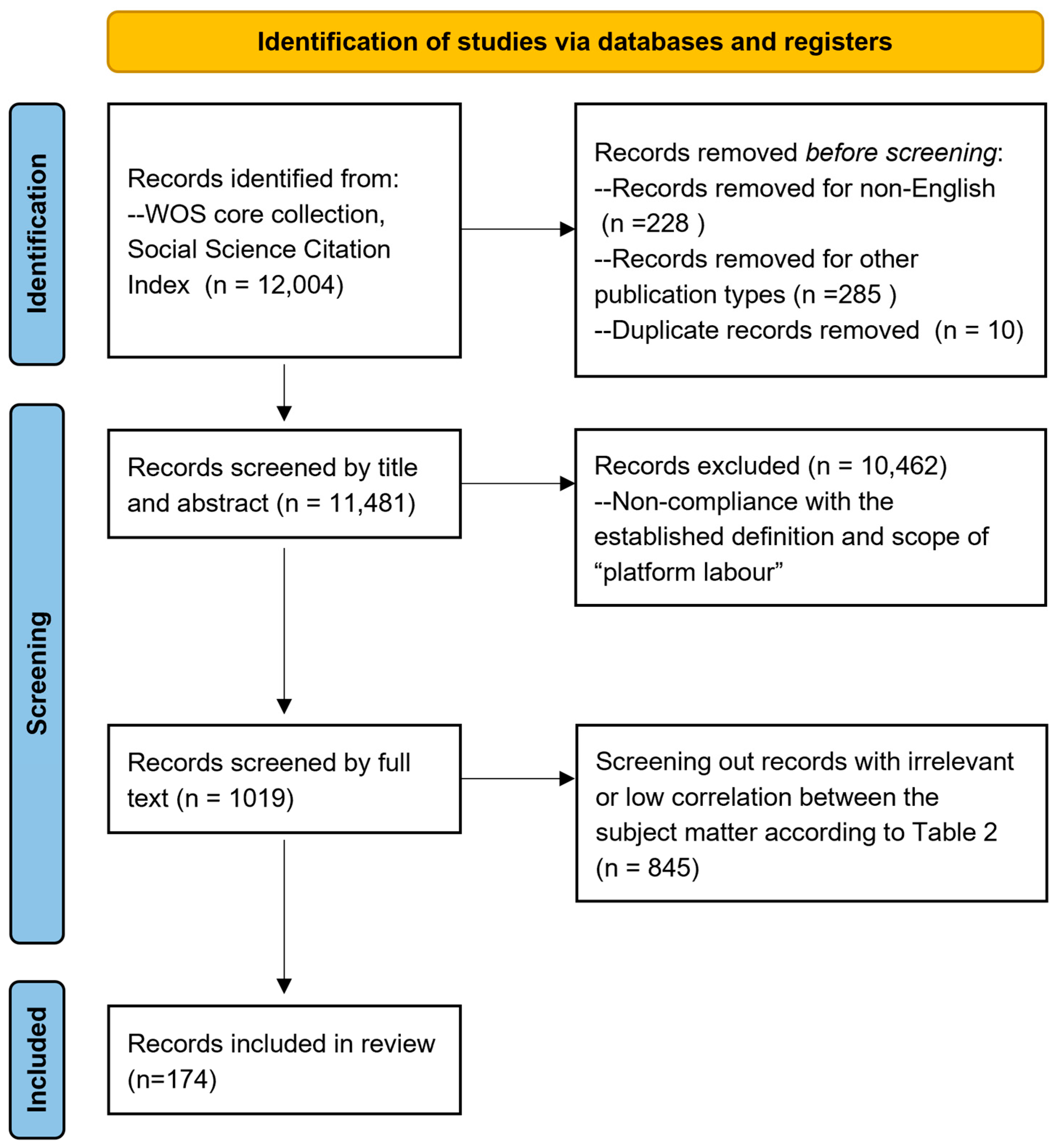

| Category | Specific Standard Requirements |
|---|---|
| Research database | Web of Science Core Collection |
| Citation indexes | Social Science Citation Index (SSCI) |
| Searching period | 1 January 2015 to 1 April 2024 |
| Searching keywords | TS = (“platform labour” OR “platform work” OR “labour platform” OR “gig work” OR “digital labour” OR “crowdwork” OR “on-demand work”) |
| Language | English |
| Document types | Article, Review article |
| Data extraction | Export with full records in plain text format |
| Sample size | 11,491 (Before manual screening) |
| Inclusion Criteria |
|---|
|
|
|
| Overall Dimension | Key Aspect | Core Viewpoints/Impacts | Representative Literature |
|---|---|---|---|
| Labour Utopia | New Employment Opportunities | Inclusivity & Low Barriers: Provides employment channels for the unemployed, disadvantaged groups (e.g., women, persons with disabilities), and workers in developing countries, transcending traditional barriers. | Anwar & Graham, 2021 [54]; Graham et al., 2017 [27]; Hoang et al., 2020 [39]; Rani & Furrer, 2019 [50]; van Doorn et al., 2023 [51] |
| Income Diversification: Offers a flexible way for those with formal jobs to supplement their primary income. | Doucette & Bradford, 2019 [46]; Glavin, 2020 [47]; Ravenelle et al., 2021 [37]; Reynolds & Kincaid, 2023 [38] | ||
| Flexible and Autonomous Work Experience | Sense of Control over Time and Space: Grants workers significant control over working time, location, and tasks, facilitating work–life balance. | Goods et al., 2019 [60]; Hall & Krueger, 2017 [61]; Lehdonvirta, 2018 [59]; Schor et al., 2020 [5] | |
| Positive Subjective Experience & Job Satisfaction: Flexible and autonomous arrangements are proven to enhance job satisfaction and overall well-being, particularly for workers who need to combine paid work with caregiving responsibilities or education. | Berger et al., 2019 [58]; Chen et al., 2019 [56]; Milkman et al., 2020 [64]; Rockmann & Ballinger, 2017 [65]; Wood et al., 2019 [7] | ||
| Psychological Fulfilment | Appeal of Entrepreneurial Narrative: The promise of “being your own boss” is highly attractive, making workers feel freed from traditional work constraints. | Churchill & Craig, 2019 [69]; Malin & Chandler, 2017 [70]; Purcell & Brook, 2022 [68] | |
| Meaning & Emotional Rewards: Some workers derive meaning, enjoyment, and a sense of fulfilment from helping others through their work. | Milkman et al., 2020 [64]; Myhill et al., 2021 [73]; Nemkova et al., 2019 [72] | ||
| Labour Dystopia | The Spread of Precarity | Lack of Institutional Protection: The “independent contractor” status excludes workers from social security and basic labour protections. | Cherry & Aloisi, 2017 [78]; Stewart & Stanford, 2017 [25]; Wood et al., 2019 [85] |
| Risk Shifting & Deteriorating Conditions: Platforms shift market risks and costs (e.g., income volatility, health risks) onto workers, leading to deteriorating conditions and income volatility and increased physical and mental health risks. | Gregory, 2021 [138]; Kalleberg & Vallas, 2017 [15]; Kaine & Josserand, 2019 [91]; Ladegaard et al., 2022 [93]; Orr et al., 2022 [96] | ||
| Algorithmic Management and Fictitious Freedom | Hidden Control & Autonomy Paradox: Algorithms control workers through opaque task allocation and rating systems, creating an autonomy paradox in which apparent flexibility masks intensive managerial control. | Fourcade and Healy, 2016 [114]; Gandini, 2018 [30]; Rosenblat & Stark, 2016 [24]; Shapiro, 2017 [119]; Shibata, 2019 [141] | |
| Coercive “Always-On” Culture: Algorithmic management fosters “always-on” pressure, forcing workers to extend working hours and intensifying work–life conflict. | Glavin et al., 2024 [127]; Shevchuk et al., 2019 [121]; Sun et al., 2021 [132]; Vasudevan & Chan, 2022 [130] | ||
| Replicating and Widening Inequalities | Advantaged Beneficiaries: Platform labour primarily benefits those with prior advantages in income, education, digital skills and access to infrastructure, exacerbating class solidification and digital divides. | Artero et al., 2020 [145]; Lutz, 2019 [147]; Newlands & Lutz, 2020 [142]; Schor, 2017 [146]; Spreitzer et al., 2017 [29] | |
| Systemic Discrimination: Algorithms can encode and amplify societal gender and racial biases, leading to discrimination against women and ethnic minorities in pay, task access, and ratings. | Cook et al., 2021 [154]; Gerber, 2022 [151]; Greenwood et al., 2020 [155]; Tan et al., 2021 [149] | ||
| New Structures of Inequality: Fosters new forms of inequality like the “servant economy” and “reintermediation,” creating multiple layers of exploitation within the platform. | Graham et al., 2017 [27]; Mendonça et al., 2022 [159]; Schor & Attwood-Charles, 2017 [45]; Wood et al., 2019 [85] |
Disclaimer/Publisher’s Note: The statements, opinions and data contained in all publications are solely those of the individual author(s) and contributor(s) and not of MDPI and/or the editor(s). MDPI and/or the editor(s) disclaim responsibility for any injury to people or property resulting from any ideas, methods, instructions or products referred to in the content. |
© 2025 by the authors. Licensee MDPI, Basel, Switzerland. This article is an open access article distributed under the terms and conditions of the Creative Commons Attribution (CC BY) license (https://creativecommons.org/licenses/by/4.0/).
Share and Cite
Zhang, Y.; Liu, C.; Wang, M. Utopia or Dystopia? Measuring the Effects of Platform Labour on Workers: A Literature Overview. Sustainability 2025, 17, 10830. https://doi.org/10.3390/su172310830
Zhang Y, Liu C, Wang M. Utopia or Dystopia? Measuring the Effects of Platform Labour on Workers: A Literature Overview. Sustainability. 2025; 17(23):10830. https://doi.org/10.3390/su172310830
Chicago/Turabian StyleZhang, Yi, Chan Liu, and Maofu Wang. 2025. "Utopia or Dystopia? Measuring the Effects of Platform Labour on Workers: A Literature Overview" Sustainability 17, no. 23: 10830. https://doi.org/10.3390/su172310830
APA StyleZhang, Y., Liu, C., & Wang, M. (2025). Utopia or Dystopia? Measuring the Effects of Platform Labour on Workers: A Literature Overview. Sustainability, 17(23), 10830. https://doi.org/10.3390/su172310830

