


Validity and Reliability of Data Regarding Adult Perceptions About Sustainable Development: The Case of Greek Civil Servants


Abstract
1. Introduction
- (a)
- How valid and reliable are the data collected via the use of the Greek version of the Sustainability Consciousness Questionnaire (SCQ-GR) with regard to the perceptions of Greek civil servants about sustainable development?
- (b)
- What is the effect of gender with regard to the perceptions of Greek civil servants about sustainable development?
2. Background
2.1. Instruments Assessing Perceptions About Sustainable Development
2.2. The Sustainability Consciousness Questionnaire (SCQ)
2.3. Relationships Between Cognitive, Attitudinal and Behavioral Domains of Sustainability Perceptions
2.4. The Effect of Gender on Sustainability Perceptions
3. Methods
3.1. Participants
3.2. Instrument
4. Results
4.1. Exploratory Factor Analysis
- (a)
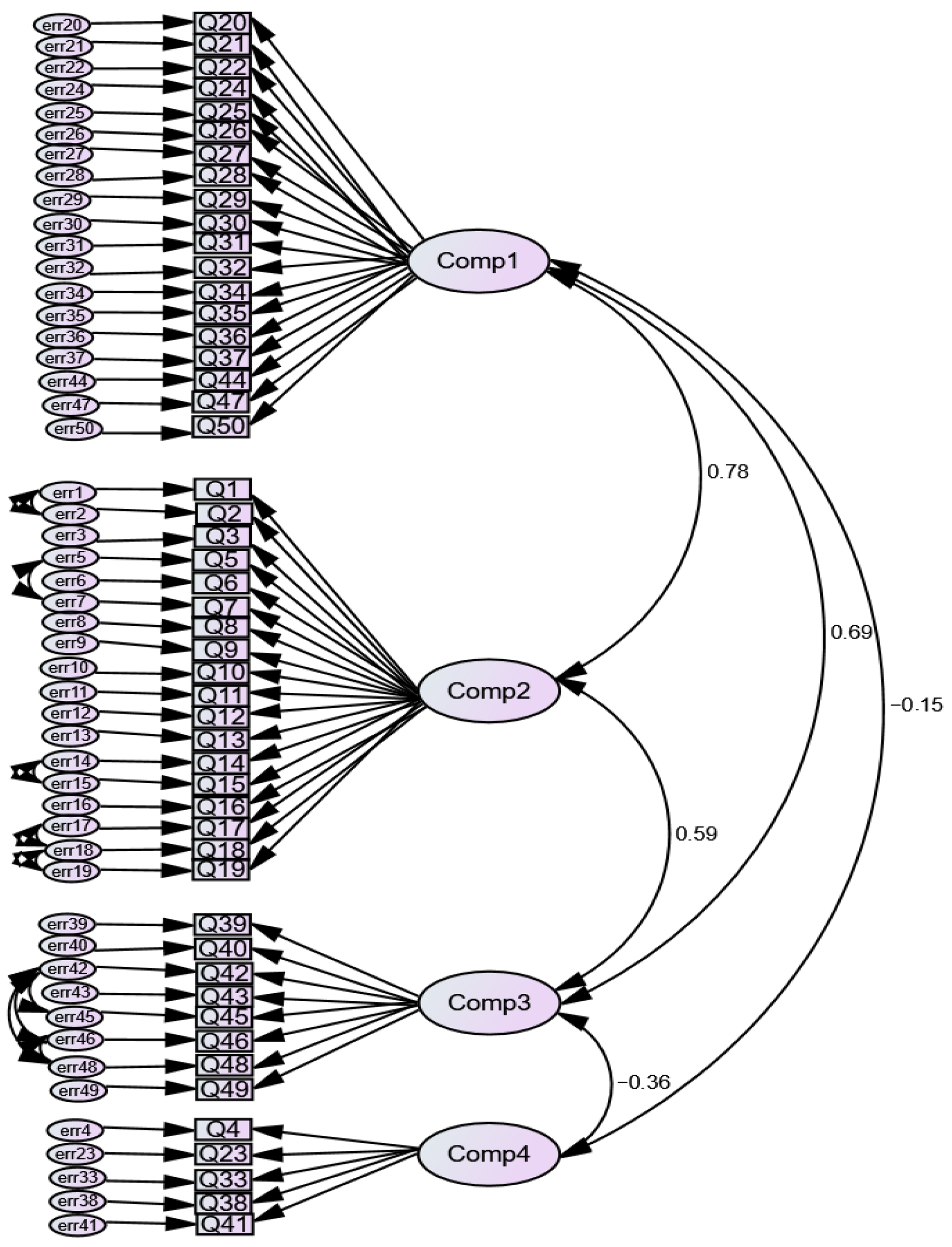
- Component 1: This component has the highest eigenvalue (=25.619) and accounts for 51.24% of the total variance. It is characterized by a Cronbach’s α value equal to 0.976. As seen in Table 1, there exist 24 items in total that load in this component with factor loadings of sizable value (>0.3). Twelve items (namely Q20–Q22 and Q24–Q32) refer to attitudes, and twelve (namely Q34–Q40, Q43–Q45, Q47 and Q50) refer to behavior toward SD (based on the structure of the original instrument SCQ-L). Among the twelve behavior-related items, seven (namely Q34–Q37, Q44, Q47 and Q50) mostly pertain to behaviors with a high level of social acceptance/desirability [e.g., I show the same respect to men and women, boys and girls (Item Q50)] and behavioral choices/habits [e.g., I recycle as much as I can (Item Q36)] and they possess sizable loadings (>0.3) solely in Component 1. From the remaining five behavior-related items, four items—namely Q39, Q40, Q43 and Q45—present sizable loadings also in Component 3. These items are differentiated from the group of seven mentioned above, since they refer to behaviors which provide evidence for active involvement in social [e.g., I do things which help poor people (Item Q39)] or environmental issues [e.g., I pick up rubbish when I see it out in the countryside or in public places (Item Q40)]. This is the main characteristic of the items that comprise Component 3, as it is noted below. Therefore, the content of these four items leads us to assign them to Component 3. Finally, one behavior-related item (Q38—I often make lifestyle choices which are not good for my health) loads also in Component 4, and it does so with a much higher loading value. This item, worded negatively, possesses a common characteristic with the rest of the items comprising Component 4 as it expresses the notion of detachment from the notion of sustainability. The above arguments justify its assignment to Component 4.
- (b)
- Component 2: It presents the second-highest eigenvalue (=4.877) and accounts for 9.75% of the total variance. It is characterized by a Cronbach’s α value equal to 0.971. As seen in Table 1, there exist 19 items in total that load in this component with factor loadings of sizable value (>0.3). All items except one (namely Q4—Preserving nature is not necessary for sustainable development) possess sizable loadings only in this component. With regard to item Q4, we note that—in similarity with the case of item Q38 discussed above—it shares the same characteristics with the group of items comprising Component 4, as it is worded negatively and expresses detachment from the notion of sustainability. Therefore, item Q4 is assigned to Component 4.
- (c)
- Component 3: It has the third highest eigenvalue (=2.809) and accounts for 5.62% of the total variance. It is characterized by a Cronbach’s α value equal to 0.912. Taking into account the argumentation deployed in the above presentation of Component 1, we conclude that it consists of eight items (namely Q39–Q40, Q42–Q43, Q45–Q46 and Q48–Q49) with all referring to behavior and with representation of all three dimensions of SD (“Environment”—3 items, “Society”—2 items and “Economy”—3 items). The items of this component pertain to behaviors that are more closely associated with activism in the socioeconomic or environmental domains [e.g., I pick up rubbish when I see it out in the countryside or in public places (Item Q40), I support an aid organization or environmental group (Item Q48), I often purchase second-hand goods over the internet or in a shop (Item Q42)]. Therefore, it was decided that a suitable title for describing the content of the items comprising this component is “Social and Environmental Activism for SD” (SEA).
- (d)
- Component 4: It possesses the fourth-highest eigenvalue (=1.399) and accounts for 2.80% of the total variance. It is characterized by a Cronbach’s α value equal to 0.833. Taking into account the argumentation deployed in the above presentation of Components 1 and 2, we conclude that it consists of five items (namely Q4, Q23, Q33, Q38 and Q41). They are related to the environmental and social dimensions of SD via four and one items, respectively. All five items are phrased in a negative manner toward SD [e.g., Preserving nature is not necessary for sustainable development (Item Q4), I think that it is OK that each one of us uses as much water as we want (Item Q33) and I don’t think about how my actions may damage the natural environment (Item Q41)] expressing detachment from the notion of sustainability. However, during the setup of the data set, the ratings they received were inverted (i.e., a rating of “1” was converted to “5”). In this way, the scores concerning these items refer to a notion opposite to detachment, and, therefore, it was decided that a suitable title for describing their content is “Attachment to SD” (ASD). This component resembles the notion of environmental concern and, as it will be discussed below (Section 5), it is mostly relevant to the affective dimension of the framework presented by Sánchez and Lafuente [39].
4.2. Confirmatory Factor Analysis
4.3. Measurement Invariance Testing for Gender Comparisons
- Females: CFI = 0.898, TLI = 0.892, RMSEA = 0.063, SRMR = 0.070
- Males: CFI = 0.870, TLI = 0.863, RMSEA = 0.071, SRMR = 0.069
4.4. Greek Civil Servants’ Perceptions About Sustainable Development: Gender Comparisons
5. Discussion
5.1. Validity of SCQ-GR
5.2. Factor Structure of SCQ-GR
5.3. Factor Content of SCQ-GR
5.4. Factor Correlations of SCQ-GR
5.5. Gender Effects
5.6. Implications, Limitations and Future Directions
6. Conclusions
- (a)
- The Greek version of the Sustainability Consciousness Questionnaire (SCQ-GR) comprises 50 items and constitutes an instrument with which valid and reliable data can be obtained in order to probe the perceptions of Greek adults (in-service civil servants) regarding sustainable development. Data validity and reliability were tested via a combination of exploratory and confirmatory factor analyses.
- (b)
- Factor analyses showed that SCQ-GR may be used for the assessment of the following four components of perceptions about sustainable development: (i) attitudes and behaviors regarding sustainable development, (ii) beliefs regarding sustainable development, (iii) social–environmental activism for sustainable development and (iv) attachment to sustainable development. The first three components display significant pairwise positive correlations. The fourth component (attachment to sustainable development) displays no or small negative correlations with the other components.
- (c)
- After ensuring strict measurement invariance, female civil servants were shown to outperform their male colleagues in attitudes and behaviors, beliefs, as well as attachment to sustainable development. In addition, no statistically significant gender differences were observed with regard to social–environmental activism for sustainable development.
Supplementary Materials
Author Contributions
Funding
Institutional Review Board Statement
Informed Consent Statement
Data Availability Statement
Conflicts of Interest
Appendix A

| Item Number in SCQ-GR (Item in Original Instrument) | Component 1 | Component 2 | Component 3 | Component 4 |
|---|---|---|---|---|
| Q32 (A18) | 0.828 | 0.374 | ||
| Q30 (A14) | 0.800 | 0.382 | ||
| Q50 (B17) | 0.796 | 0.384 | ||
| Q27 (A10) | 0.789 | 0.363 | ||
| Q25 (A7) | 0.786 | 0.366 | ||
| Q26 (A8) | 0.785 | |||
| Q37 (B4) | 0.782 | 0.373 | ||
| Q22 (A3) | 0.775 | 0.321 | ||
| Q47 (B14) | 0.773 | 0.331 | ||
| Q28 (A11) | 0.764 | |||
| Q20 (A1) | 0.753 | 0.461 | ||
| Q31 (A16) | 0.753 | 0.304 | ||
| Q24 (A6) | 0.749 | |||
| Q36 (B3) | 0.738 | 0.312 | 0.308 | |
| Q21 (A2) | 0.707 | 0.414 | ||
| Q29 (A13) | 0.697 | 0.348 | ||
| Q45 (B12) | 0.664 | 0.309 | 0.471 | |
| Q34 (B1) | 0.646 | 0.315 | 0.348 | |
| Q44 (B11) | 0.637 | 0.314 | 0.380 | |
| Q35 (B2) | 0.591 | |||
| Q43 (B10) | 0.591 | 0.522 | ||
| Q39 (B6) | 0.563 | 0.321 | 0.400 | |
| Q8 (K9) | 0.342 | 0.806 | ||
| Q9 (K10) | 0.357 | 0.799 | ||
| Q14 (K16) | 0.308 | 0.780 | ||
| Q13 (K15) | 0.389 | 0.777 | ||
| Q10 (K11) | 0.391 | 0.775 | ||
| Q7 (K8) | 0.322 | 0.769 | ||
| Q2 (K2) | 0.307 | 0.767 | ||
| Q11 (K12) | 0.355 | 0.763 | ||
| Q16 (K18) | 0.412 | 0.750 | ||
| Q5 (K5) | 0.323 | 0.750 | ||
| Q15 (K17) | 0.351 | 0.745 | ||
| Q6 (K7) | 0.409 | 0.745 | ||
| Q12 (K14) | 0.402 | 0.741 | ||
| Q17 (K19) | 0.726 | |||
| Q1 (K1) | 0.702 | |||
| Q19 (K21) | 0.696 | |||
| Q3 (K3) | 0.310 | 0.673 | ||
| Q18 (K20) | 0.656 | |||
| Q42 (B9) | 0.720 | −0.416 | ||
| Q46 (B13) | 0.348 | 0.700 | ||
| Q48 (B15) | 0.483 | 0.626 | ||
| Q49 (B16) | 0.486 | 0.320 | 0.529 | |
| Q40 (B7) | 0.481 | 0.491 | ||
| Q41 (B8i) | 0.843 | |||
| Q23 (A5i) | 0.822 | |||
| Q4 (K4i) | 0.390 | 0.721 | ||
| Q38 (B5i) | 0.691 | |||
| Q33 (A19i) | 0.676 |
Appendix B
| Item Number in SCQ-GR | Comp1 | Comp2 | Comp3 | Comp4 |
|---|---|---|---|---|
| Q20 | 0.876 | |||
| Q21 | 0.834 | |||
| Q22 | 0.842 | |||
| Q24 | 0.778 | |||
| Q25 | 0.849 | |||
| Q26 | 0.813 | |||
| Q27 | 0.849 | |||
| Q28 | 0.805 | |||
| Q29 | 0.775 | |||
| Q30 | 0.863 | |||
| Q31 | 0.801 | |||
| Q32 | 0.868 | |||
| Q34 | 0.765 | |||
| Q35 | 0.574 | |||
| Q36 | 0.807 | |||
| Q37 | 0.856 | |||
| Q44 | 0.748 | |||
| Q47 | 0.820 | |||
| Q50 | 0.860 | |||
| Q1 | 0.646 | |||
| Q2 | 0.813 | |||
| Q3 | 0.699 | |||
| Q5 | 0.766 | |||
| Q6 | 0.830 | |||
| Q7 | 0.815 | |||
| Q8 | 0.860 | |||
| Q9 | 0.851 | |||
| Q10 | 0.846 | |||
| Q11 | 0.829 | |||
| Q12 | 0.846 | |||
| Q13 | 0.828 | |||
| Q14 | 0.808 | |||
| Q15 | 0.760 | |||
| Q16 | 0.839 | |||
| Q17 | 0.693 | |||
| Q18 | 0.601 | |||
| Q19 | 0.709 | |||
| Q39 | 0.783 | |||
| Q40 | 0.723 | |||
| Q42 | 0.498 | |||
| Q43 | 0.786 | |||
| Q45 | 0.850 | |||
| Q46 | 0.672 | |||
| Q48 | 0.718 | |||
| Q49 | 0.717 | |||
| Q4 | 0.695 | |||
| Q23 | 0.753 | |||
| Q33 | 0.651 | |||
| Q38 | 0.530 | |||
| Q41 | 0.755 |
Appendix C
| Item Pair | Covariance |
|---|---|
| err1–err2 | 0.349 |
| Err–err7 | 0.254 |
| err14–err15 | 0.239 |
| err17–err18 | 0.351 |
| err18–err19 | 0.418 |
| err42–err46 | 0.330 |
| err42–err48 | 0.242 |
| err42–err45 | −0.093 |
| err46–err48 | 0.228 |
Appendix D
- Greek version of the Sustainability Consciousness Questionnaire (SCQ-GR).
- Note: Each item (Q1-Q50) is accompanied in parentheses by the abbreviated name of the factor (component) in which it was shown to belong in the current work. The abbreviations used for the names of the factors (components) are as follows:
- -
- “AB” for Component 1, which refers to attitudes and behaviors regarding SD;
- -
- “BEL” for Component 2, which refers to beliefs regarding SD;
- -
- “SEA” for Component 3, which refers to social–environmental activism for SD;
- -
- “ASD” for Component 4, which refers to attachment to SD.
- Q1 (BEL). Economic development is necessary for sustainable development.
- Q2 (BEL). Improving people’s chances for a long and healthy life contributes to sustainable development.
- Q3 (BEL). Reducing water consumption is necessary for sustainable development.
- Q4 (ASD). Preserving nature is not necessary for sustainable development.
- Q5 (BEL). A culture where conflicts are resolved peacefully through discussion is necessary for sustainable development.
- Q6 (BEL). Sustainable development demands that we humans reduce all sorts of waste.
- Q7 (BEL). People who exercise their democratic rights are necessary for sustainable development (for example, they vote in elections, involve themselves in social issues, express their opinions).
- Q8 (BEL). Reinforcing girls’ and women’s rights and increasing equality around the world is necessary for sustainable development.
- Q9 (BEL). Respecting human rights is necessary for sustainable development.
- Q10 (BEL). To achieve sustainable development, all the people in the world must have access to good education.
- Q11 (BEL). Sustainable development requires that companies act responsibly towards their employees, customers and suppliers.
- Q12 (BEL). Preserving the variety of living creatures is necessary for sustainable development (preserving biological diversity).
- Q13 (BEL). Having respect for other cultures is necessary for sustainable development.
- Q14 (BEL). Sustainable development requires fair distribution of goods and services among people in the world.
- Q15 (BEL). Wiping out poverty in the world is necessary for sustainable development.
- Q16 (BEL). Sustainable development requires a shift to renewable natural resources.
- Q17 (BEL). Sustainable development demands that people understand how the economy functions.
- Q18 (BEL). For sustainable development, major infectious diseases such as HIV/AIDS and malaria must be stopped.
- Q19 (BEL). For sustainable development, people need to be educated in how to protect themselves against natural disasters.
- Q20 (AB). I think that everyone ought to be given the opportunity to acquire the knowledge, values and skills that are necessary to live sustainably.
- Q21 (AB). I think that we who are living now should make sure that people in the future enjoy the same quality of life as we do today.
- Q22 (AB). I think that companies have a responsibility to reduce the use of packaging and disposable articles.
- Q23 (ASD). I think that using more natural resources than we need does not threaten the health and well-being of people in the future.
- Q24 (AB). I think that we need stricter laws and regulations to protect the environment.
- Q25 (AB). I think it is important to reduce poverty.
- Q26 (AB). I think that companies in rich countries should give employees in poor nations the same conditions as in rich countries.
- Q27 (AB). I think that it is important to take measures against problems which have to do with climate change.
- Q28 (AB). I think that the government should provide financial aid to encourage more people to make the shift to green cars.
- Q29 (AB). I think that the government should make all its decisions on the basis of sustainable development.
- Q30 (AB). I think that it is important that people in society exercise their democratic rights and become involved in important issues.
- Q31 (AB). I think that people who pollute land, air or water should pay for the damage they cause to the environment.
- Q32 (AB). I think that women and men throughout the world must be given the same opportunities for education and employment.
- Q33 (ASD). I think it is OK that each one of us uses as much water as we want.
- Q34 (AB). Where possible, I choose to cycle or walk when I’m going somewhere, instead of traveling by motor vehicle.
- Q35 (AB). I never waste water.
- Q36 (AB). I recycle as much as I can.
- Q37 (AB). When I use a computer or mobile to chat, to text, to play games and so on, I always treat others as respectfully as I would in real life.
- Q38 (ASD). I often make lifestyle choices which are not good for my health.
- Q39 (SEA). I do things which help poor people.
- Q40 (SEA). I pick up rubbish when I see it out in the countryside or in public places.
- Q41 (ASD). I don’t think about how my actions may damage the natural environment.
- Q42 (SEA). I often purchase second-hand goods over the internet or in a shop.
- Q43 (SEA). I always separate food waste before putting out the rubbish when I have the chance.
- Q44 (AB). I avoid buying goods from companies with a bad reputation for looking after their employees and the environment.
- Q45 (SEA). I have changed my personal lifestyle in order to reduce waste (e.g., throwing away less food or not wasting materials).
- Q46 (SEA). I work on different committees (e.g., at my work, in my community, etc.).
- Q47 (AB). I treat everyone with the same respect, even if they have another cultural background than mine.
- Q48 (SEA). I support an aid organization or environmental group.
- Q49 (SEA). I watch news programs or read newspaper articles to do with the economy.
- Q50 (AB). I show the same respect to men and women, boys and girls.
References
- UN. Report of the World Commission on Environment and Development: Our Common Future. 1987. Available online: https://sustainabledevelopment.un.org/content/documents/5987our-common-future.pdf (accessed on 12 September 2025).
- Ruggerio, C.A. Sustainability and sustainable development: A review of principles and definitions. Sci. Total Environ. 2021, 786, 147481. [Google Scholar] [CrossRef]
- Giddings, B.; Hopwood, B.; O’ Brien, G. Environment, economy and society: Fitting them together into sustainable development. Sustain. Dev. 2002, 10, 187–196. [Google Scholar] [CrossRef]
- Lozano, R. Envisioning sustainability three-dimensionally. J. Clean. Prod. 2008, 16, 1838–1846. [Google Scholar] [CrossRef]
- Purvis, B.; Mao, Y.; Robinson, D. Three pillars of sustainability: In search of conceptual origins. Sustain. Sci. 2019, 14, 681–695. [Google Scholar] [CrossRef]
- Robinson, J. Squaring the circle? Some thoughts on the idea of sustainable development. Ecol. Econ. 2004, 48, 369–384. [Google Scholar] [CrossRef]
- Jabareen, Y. A new conceptual framework for sustainable development. Environ. Dev. Sustain. 2008, 10, 179–192. [Google Scholar] [CrossRef]
- Ciegis, R.; Ramanauskiene, J.; Martinkus, B. The concept of sustainable development and its use for sustainability scenarios. Eng. Econ. 2009, 62, 28–37. Available online: https://inzeko.ktu.lt/index.php/EE/article/view/11609 (accessed on 23 September 2025).
- Ben-Eli, M.U. Sustainability: Definition and five core principles, a systems perspective. Sustain. Sci. 2018, 13, 1337–1343. [Google Scholar] [CrossRef]
- McKeown, R. Teaching for a brighter more sustainable future. Kappa Delta Pi Rec. 2013, 49, 12–20. [Google Scholar] [CrossRef]
- Gericke, N.; Boeve-de-Pauw, J.; Berglund, T.; Olsson, D. The Sustainability Consciousness Questionnaire: The theoretical development and empirical validation of an evaluation instrument for stakeholders working with sustainable development. Sustain. Dev. 2019, 27, 35–49. [Google Scholar] [CrossRef]
- Salta, K.; Koulougliotis, D. Assessing motivation to learn chemistry: Adaptation and validation of Science Motivation Questionnaire II with Greek secondary school students. Chem. Educ. Res. Pract. 2015, 16, 237–250. [Google Scholar] [CrossRef]
- UNESCO. Framework for the UNDESD International Implementation Scheme. 2006. Available online: https://unesdoc.unesco.org/ark:/48223/pf0000148650 (accessed on 16 September 2025).
- UNESCO. Shaping the Future We Want. UN Decade of Education for Sustainable Development (2005–2014). Final Report. 2015. Available online: https://unesdoc.unesco.org/ark:/48223/pf0000230171 (accessed on 16 September 2025).
- Tuncer, G. University students’ perception on sustainable development: A case study from Turkey. Int. Res. Geogr. Environ. Educ. 2008, 17, 212–226. [Google Scholar] [CrossRef]
- Biasutti, M.; Frate, S. A validity and reliability study of the Attitudes toward Sustainable Development scale. Environ. Educ. Res. 2017, 23, 214–230. [Google Scholar] [CrossRef]
- Kalsoom, Q.; Khanam, A.; Quraishi, U. Sustainability consciousness of pre-service teachers in Pakistan. Int. J. Sustain. High. Educ. 2017, 18, 1090–1107. [Google Scholar] [CrossRef]
- Al-Naqbi, A.K.; Alshannag, Q. The status of education for sustainable development and sustainability knowledge, attitudes, and behaviors of UAE university students. Int. J. Sustain. High. Educ. 2018, 19, 566–588. [Google Scholar] [CrossRef]
- Kirby, C.K.; Zwickle, A. Sustainability behaviors, attitudes, and knowledge: Comparing university students and the general public. J. Environ. Stud. Sci. 2021, 11, 639–647. [Google Scholar] [CrossRef]
- Radwan, A.F.; Khalil, E.M.A.S. Knowledge, attitude and practice toward sustainability among university students in UAE. Int. J. Sustain. High. Educ. 2021, 22, 964–981. [Google Scholar] [CrossRef]
- Salas-Zapata, W.; Cardona-Arias, J.A. Construction and validation of a knowledge, attitudes and practices scale related to sustainability in university students. J. Appl. Res. High. Educ. 2021, 13, 63–78. [Google Scholar] [CrossRef]
- Tsai, L.T.; Chang, C.C.; Hu, P.H. A scale for assessing student understandings of marine resource conservation and sustainability: Psychometric verification and the latent mean difference between genders. Environ. Educ. Res. 2021, 27, 1329–1342. [Google Scholar] [CrossRef]
- Leiva-Brondo, M.; Lajara-Camilleri, N.; Vidal-Meló, A.; Atarés, A.; Lull, C. Spanish university students’ awareness and perception of sustainable development goals and sustainability literacy. Sustainability 2022, 14, 4552. [Google Scholar] [CrossRef]
- Syed Azhar, S.N.F.; Mohammed Akib, N.A.; Sibly, S.; Mohd, S. Students’ attitude and perception towards sustainability: The case of Universiti Sains Malaysia. Sustainability 2022, 14, 3925. [Google Scholar] [CrossRef]
- Wendlandt Amézaga, T.R.; Camarena, J.L.; Celaya Figueroa, R.; Garduno Realivazquez, K.A. Measuring sustainable development knowledge, attitudes, and behaviors: Evidence from university students in Mexico. Environ. Dev. Sustain. 2022, 24, 765–788. [Google Scholar] [CrossRef]
- Salahange, L.; Sánchez-Martín, J.; Dávila-Acedo, M.A.; Cañada-Cañada, F. A new validated instrument to assess sustainability perception among university students. Discov. Sustain. 2024, 5, 400. [Google Scholar] [CrossRef]
- Michalos, A.C.; Creech, H.; Swayze, N.; Maurine Kahlke, P.; Buckler, C.; Rempel, K. Measuring knowledge, attitudes and behaviours concerning sustainable development among tenth grade students in Manitoba. Soc. Indic. Res. 2012, 106, 213–238. [Google Scholar] [CrossRef]
- Olsson, D.; Gericke, N.; Sass, W.; Boeve-de Pauw, J. Self-perceived action competence for sustainability: The theoretical grounding and empirical validation of a novel research instrument. Environ. Educ. Res. 2020, 26, 742–760. [Google Scholar] [CrossRef]
- Sass, W.; Pauw, J.B.-D.; Maeyer, S.D.; Petegem, P.V. Development and validation of an instrument for measuring action competence in sustainable development within early adolescents: The action competence in sustainable development questionnaire (ACiSD-Q). Environ. Educ. Res. 2021, 27, 1284–1304. [Google Scholar] [CrossRef]
- Chen, C.; An, Q.; Zheng, L.; Guan, C. Sustainability literacy: Assessment of knowingness, attitude and behavior regarding sustainable development among students in China. Sustainability 2022, 14, 4886. [Google Scholar] [CrossRef]
- Loparics, J.; Große, C.S.; Helm, C. German-language adaptation and validation of the self-perceived action competence for sustainability questionnaire (SPACS-Q). Environ. Educ. Res. 2025, in press. [Google Scholar] [CrossRef]
- Čiarnienė, R.; Vienažindienė, M.; Adamonienė, R. Sustainable behaviour: Evidence from Lithuania. Eng. Manag. Prod. Serv. 2020, 12, 80–92. [Google Scholar] [CrossRef]
- De Silva, D.G.; Pownall, R.A.J. Going green: Does it depend on education, gender or income? Appl. Econ. 2014, 46, 573–586. [Google Scholar] [CrossRef]
- Fabio, R.A.; Croce, A.; Calabrese, C. Construction and psychometric properties of the sustainable behavior questionnaire among Italian adults. Sustain. Dev. 2024, 32, 4374–4384. [Google Scholar] [CrossRef]
- Vaikma, H. Unveiling the mindset: Measuring consumer perception towards the dimensions of sustainability. Sustain. Futures 2025, 9, 100616. [Google Scholar] [CrossRef]
- Michalos, A.C.; Kahlke, P.M.; Rempel, K.; Lounatvuori, A.; MacDiarmid, A.; Creech, H.; Buckler, C. Progress in measuring knowledge, attitudes and behaviours concerning sustainable development among tenth grade students in Manitoba. Soc. Indic. Res. 2015, 123, 303–336. [Google Scholar] [CrossRef]
- Zwickle, A.; Jones, K. Sustainability knowledge and attitudes—Assessing latent constructs. In Handbook of Sustainability and Social Science Research; Leal Filho, W., Marans, R., Callawaert, J., Eds.; Springer: Berlin/Heidelberg, Germany, 2018; pp. 435–451. [Google Scholar] [CrossRef]
- Tuncer, G.; Ertepinar, H.; Tekkaya, C.; Sungur, S. Environmental attitudes of young people in Turkey: Effects of school type and gender. Environ. Educ. Res. 2005, 11, 215–233. [Google Scholar] [CrossRef]
- Sánchez, M.J.; Lafuente, R. Definición y medición de la conciencia ambiental. Rev. Int. Sociol. 2010, 68, 731–755. [Google Scholar] [CrossRef]
- Berglund, T.; Gericke, N.; Chang Rundgren, S.N. The implementation of education for sustainable development in Sweden: Investigating the sustainability consciousness among upper secondary students. Res. Sci. Technol. Educ. 2014, 32, 318–339. [Google Scholar] [CrossRef]
- Boeve-de Pauw, J.; Gericke, N.; Olsson, D.; Berglund, T. The effectiveness of education for sustainable development. Sustainability 2015, 7, 15693–15717. [Google Scholar] [CrossRef]
- Berglund, T.; Gericke, N. Separated and integrated perspectives on environmental, economic, and social dimensions–an investigation of student views on sustainable development. Environ. Educ. Res. 2016, 22, 1115–1138. [Google Scholar] [CrossRef]
- Olsson, D.; Gericke, N.; Chang Rundgren, S.N. The effect of implementation of education for sustainable development in Swedish compulsory schools–assessing pupils’ sustainability consciousness. Environ. Educ. Res. 2016, 22, 176–202. [Google Scholar] [CrossRef]
- Olsson, D.; Gericke, N. The adolescent dip in students’ sustainability consciousness—Implications for education for sustainable development. J. Environ. Educ. 2016, 47, 35–51. [Google Scholar] [CrossRef]
- Olsson, D.; Gericke, N.; Boeve-de Pauw, J.; Berglund, T.; Chang, T. Green schools in Taiwan—Effects on student sustainability consciousness. Glob. Environ. Change 2019, 54, 184–194. [Google Scholar] [CrossRef]
- Marcos-Merino, J.M.; Corbacho-Cuello, I.; Hernández-Barco, M. Analysis of sustainability knowingness, attitudes and behavior of a Spanish pre-service primary teachers sample. Sustainability 2020, 12, 7445. [Google Scholar] [CrossRef]
- Boned-Gómez, S.; Giménez-Egido, J.M.; Ferriz-Valero, A.; Baena-Morales, S. A leap toward sustainable consciousness: SCQ-S validation for Spanish adolescents. Sustain. Dev. 2025, 33, 6475–6494. [Google Scholar] [CrossRef]
- Ogishima, H.; Ito, A.; Kajimura, S.; Himichi, T. Validity and reliability of the Japanese version of the sustainability consciousness questionnaire. Front. Psychol. 2023, 14, 1130550. [Google Scholar] [CrossRef] [PubMed]
- Saleem, A.; Aslam, S.; Sang, G.; Dare, P.S.; Zhang, T. Education for sustainable development and sustainability consciousness: Evidence from Malaysian universities. Int. J. Sustain. High. Educ. 2023, 24, 193–211. [Google Scholar] [CrossRef]
- Yoo, S.S.; Kim, G.; La, S.J.; Sung, Y. Exploring sustainability consciousness as a psychological construct with undergraduate students in the Republic of Korea. Int. J. Sustain. High. Educ. 2024, 25, 1610–1625. [Google Scholar] [CrossRef]
- Nousheen, A.; Tabassum, F. Assessing students’ sustainability consciousness in relation to their perceived teaching styles: An exploratory study in Pakistani context. Int. J. Sustain. High. Educ. 2024, 25, 1214–1231. [Google Scholar] [CrossRef]
- Arantes, L.; Sousa, B.B. The Sustainability Consciousness Questionnaire: Validation among Portuguese population. Sustainability 2025, 17, 305. [Google Scholar] [CrossRef]
- Morales-Baños, V.; Borrego-Balsalobre, F.J.; Díaz-Suárez, A.; López-Gullón, J.M. Levels of sustainability awareness in Spanish university students of nautical activities as future managers of sports and active tourism programmes. Sustainability 2023, 15, 2733. [Google Scholar] [CrossRef]
- Berglund, T.; Gericke, N.; Boeve-de Pauw, J.; Olsson, D.; Chang, T. A cross-cultural comparative study of sustainability consciousness between students in Taiwan and Sweden. Environ. Dev. Sustain. 2020, 22, 6287–6313. [Google Scholar] [CrossRef]
- Ovais, D. Students’ sustainability consciousness with the three dimensions of sustainability: Does the locus of control play a role? Reg. Sustain. 2023, 4, 13–27. [Google Scholar] [CrossRef]
- Leal, S.; Nascimento, J.; Piki, A.; Tekerek, A.; Güzel, A.; Loureiro, A.; Gonçalves, C.; Messias, I.; Simons, J.; Teunen, L.; et al. Exploring sustainable development perceptions among higher education students: An empirical study on knowledge, attitudes, and behaviours. Clean. Responsible Consum. 2024, 14, 100223. [Google Scholar] [CrossRef]
- Lestari, H.; Ali, M.; Sopandi, W.; Wulan, A.R.; Rahmawati, I. The Impact of the RADEC Learning model oriented ESD on students’ sustainability consciousness in elementary school. Pegem J. Educ. Instr. 2022, 12, 113–122. [Google Scholar] [CrossRef]
- Gong, Q.; Liu, J.; Chen, X.; He, Y.; Sun, X.; Tan, Z.; Su, X. Assessment of sustainability consciousness among pre-service teachers in China under the “Double Carbon” goal. Int. J. Sustain. High. Educ. 2025, in press. [Google Scholar] [CrossRef]
- Li, H. Sustainability consciousness of pre-service English teachers. Discov. Sustain. 2025, 6, 68. [Google Scholar] [CrossRef]
- Malandrakis, G. The contribution of sustainability education pedagogies to the development of Greek preservice teachers’ sustainability consciousness about social issues in urban environments. Environ. Educ. Res. 2022, 28, 382–404. [Google Scholar] [CrossRef]
- Ebrahim Elshall, S.; Samir Darwish, S.; Mohamed Shokry, W. The effectiveness of educational interventions about sustainability development among nursing students. Egypt. J. Health Care 2022, 13, 294–310. [Google Scholar] [CrossRef]
- Saqib, Z.A.; Zhang, Q.; Ou, J.; Saqib, K.A.; Majeed, S.; Razzaq, A. Education for sustainable development in Pakistani higher education institutions: An exploratory study of students’ and teachers’ perceptions. Int. J. Sustain. High. Educ. 2020, 21, 1249–1267. [Google Scholar] [CrossRef]
- Ariza, M.R.; Boeve-de Pauw, J.; Olsson, D.; Van Petegem, P.; Parra, G.; Gericke, N. Promoting environmental citizenship in education: The potential of the sustainability consciousness questionnaire to measure impact of interventions. Sustainability 2021, 13, 11420. [Google Scholar] [CrossRef]
- Liu, N.; Liu, X. Understanding vocational business students sustainability consciousness. World J. Vocat. Educ. Train. 2021, 3, 9–17. [Google Scholar] [CrossRef]
- Moustafa Saleh, M.S.; Elsabahy, H.E.S. Integrating sustainability development education program in nursing to challenge practice among nursing interns in health care. J. Nurs. Manag. 2022, 30, 4419–4429. [Google Scholar] [CrossRef]
- Mohamed, M.A.E.S.; Ghallab, E.; Hassan, R.A.A.; Amin, S.M. Sustainability consciousness among nursing students in Egypt: A cross-sectional study. BMC Nurs. 2024, 23, 343. [Google Scholar] [CrossRef]
- Vicente-Molina, M.A.; Fernández-Sáinz, A.; Izagirre-Olaizola, J. Environmental knowledge and other variables affecting pro-environmental behaviour: Comparison of university students from emerging and advanced countries. J. Clean. Prod. 2013, 61, 130–138. [Google Scholar] [CrossRef]
- Ajzen, I. The theory of planned behavior. Organ. Behav. Hum. Decis. Process. 1991, 50, 179–211. [Google Scholar] [CrossRef]
- Schwartz, S.H. Normative influences on altruism. Adv. Exp. Soc. Psychol. 1977, 10, 221–279. [Google Scholar] [CrossRef]
- Stern, P.C. New environmental theories: Toward a coherent theory of environmentally significant behavior. J. Soc. Issues 2000, 56, 407–424. [Google Scholar] [CrossRef]
- Cialdini, R.B.; Reno, R.R.; Kallgren, C.A. A focus theory of normative conduct: Recycling the concept of norms to reduce littering in public places. J. Pers. Soc. Psychol. 1990, 58, 1015–1026. [Google Scholar] [CrossRef]
- Kollmuss, A.; Agyeman, J. Mind the gap: Why do people act environmentally and what are the barriers to pro-environmental behavior? Environ. Educ. Res. 2002, 8, 239–260. [Google Scholar] [CrossRef]
- Bamberg, S.; Möser, G. Twenty years after Hines, Hungerford, and Tomera: A new meta-analysis of psycho-social determinants of pro-environmental behaviour. J. Environ. Psychol. 2007, 27, 14–25. [Google Scholar] [CrossRef]
- Gifford, R.; Nilsson, A. Personal and social factors that influence pro-environmental concern and behaviour: A review. Int. J. Psychol. 2014, 49, 141–157. [Google Scholar] [CrossRef]
- Tam, K.P.; Chan, H.W. Environmental concern has a weaker association with pro-environmental behavior in some societies than others: A cross-cultural psychology perspective. J. Environ. Psychol. 2017, 53, 213–223. [Google Scholar] [CrossRef]
- Gifford, R. The dragons of inaction: Psychological barriers that limit climate change mitigation and adaptation. Am. Psychol. 2011, 66, 290–302. [Google Scholar] [CrossRef]
- Heeren, A.J.; Singh, A.S.; Zwickle, A.; Koontz, T.M.; Slagle, K.M.; McCreery, A.C. Is sustainability knowledge half the battle? An examination of sustainability knowledge, attitudes, norms, and efficacy to understand sustainable behaviours. Int. J. Sustain. High. Educ. 2016, 17, 613–632. [Google Scholar] [CrossRef]
- Bussey, K.; Bandura, A. Social cognitive theory of gender development and functioning. In The Psychology of Gender, 2nd ed.; Eagly, A.H., Beall, A.E., Sternberg, R.J., Eds.; Guilford Press: New York, NY, USA, 2004; pp. 92–119. [Google Scholar]
- Pomerantz, E.M.; Ng, F.F.-Y.; Wang, Q. Gender socialization: A parent × child model. In The Psychology of Gender, 2nd ed.; Eagly, A.H., Beall, A.E., Sternberg, R.J., Eds.; Guilford Press: New York, NY, USA, 2004; pp. 120–144. [Google Scholar]
- Zelezny, L.C.; Chua, P.P.; Aldrich, C. New Ways of Thinking about Environmentalism: Elaborating on gender differences in environmentalism. J. Soc. Issues 2000, 56, 443–457. [Google Scholar] [CrossRef]
- Olsson, D.; Gericke, N. The effect of gender on students’ sustainability consciousness: A nationwide Swedish study. J. Environ. Educ. 2017, 48, 357–370. [Google Scholar] [CrossRef]
- Field, A. Discovering Statistics Using IBM SPSS Statistics, 4th ed.; Sage Publications: Thousand Oaks, CA, USA, 2013. [Google Scholar]
- Velicer, W.F.; Eaton, C.A.; Fava, J.L. Construct explication through factor or component analysis: A review and evaluation of alternative procedures for determining the number of factors or components. In Problems and Solutions in Human Assessment: Honoring Douglas N. Jackson at Seventy; Goffin, R.D., Helmes, E., Eds.; Kluwer: Boston, MA, USA, 2000; pp. 41–71. [Google Scholar]
- O’connor, B.P. SPSS and SAS programs for determining the number of components using parallel analysis and Velicer’s MAP test. Behav. Res. Methods Instrum. Comput. 2000, 32, 396–402. [Google Scholar] [CrossRef]
- Pajares, M.F. Teachers’ beliefs and educational research: Cleaning up a messy construct. Rev. Educ. Res. 1992, 62, 307–332. [Google Scholar] [CrossRef]
- Brown, T.A. Confirmatory Factor Analysis for Applied Research; The Guilford Press: New York, NY, USA, 2006. [Google Scholar]
- Byrne, B.M. Structural Equation Modeling with AMOS: Basic Concepts, Applications, and Programming, 3rd ed.; Routledge: New York, NY, USA, 2016. [Google Scholar]
- Hu, L.; Bentler, P.M. Cutoff criteria for fit indexes in covariance structure analysis: Conventional criteria versus new alternatives. Struct. Equ. Model. Multidiscip. J. 1999, 6, 1–55. [Google Scholar] [CrossRef]
- Rocabado, G.A.; Komperda, R.; Lewis, J.E.; Barbera, J. Addressing diversity and inclusion through group comparisons: A primer on measurement invariance testing. Chem. Educ. Res. Pract. 2020, 21, 969–988. [Google Scholar] [CrossRef]
- Widaman, K.F.; Reise, S.P. Exploring the measurement invariance of psychological instruments: Applications in the substance use domain. In The Science of Prevention: Methodological Advances from Alcohol and Substance Abuse Research; Bryant, K.J., Windle, M.E., West, S.G., Eds.; American Psychological Association: Washington, DC, USA, 1997. [Google Scholar]
- Chen, F.F. Sensitivity of goodness of fit indexes to lack of measurement invariance. Struct. Equ. Model. Multidiscip. J. 2007, 14, 464–504. [Google Scholar] [CrossRef]
- Cohen, J. A power primer. Psychol. Bull. 1992, 112, 155–159. [Google Scholar] [CrossRef]
- Diekmann, A.; Preisendörfer, P. Persönliches umweltverhalten: Diskrepanzen zwischen anspruch und wirklichkeit. Koelner Z. Soziologie Sozialpsychologie 1992, 44, 226–251. Available online: https://psycnet.apa.org/record/1993-88835-001 (accessed on 23 September 2025).
- Kormos, C.; Gifford, R. The validity of self-report measures of proenvironmental behavior: A meta-analytic review. J. Environ. Psychol. 2014, 40, 359–371. [Google Scholar] [CrossRef]
- Boeve-de Pauw, J.; Jacobs, K.; Van Petegem, P. Gender differences in environmental values: An issue of measurement? Environ. Behav. 2014, 46, 373–397. [Google Scholar] [CrossRef]
- Cuadrado, E.; Macias-Zambrano, L.; Carpio, A.J.; Tabernero, C. The ABC connectedness to nature scale: Development and validation of a scale with an approach to affective, behavioural, and cognitive aspects. Environ. Educ. Res. 2023, 29, 308–329. [Google Scholar] [CrossRef]
- Van Harskamp, M.; De Maeyer, S.; Sass, W.; Van Petegem, P.; Boeve-de Pauw, J. Measurement invariance of the action competence in sustainable development questionnaire: Can we compare between groups? Environ. Educ. Res. 2025, 31, 498–511. [Google Scholar] [CrossRef]
- Swim, J.K.; Gillis, A.; Hamaty, K.J. Gender bending and gender conformity: The social consequences of engaging in feminine and masculine pro-environmental behaviors. Sex Roles 2020, 82, 363–385. [Google Scholar] [CrossRef]
- Xia, W.; Li, L.M.W. Societal gender role beliefs moderate the pattern of gender differences in public-and private-sphere pro-environmental behaviors. J. Environ. Psychol. 2023, 92, 102158. [Google Scholar] [CrossRef]
- Milfont, T.L. The effects of social desirability on self-reported environmental attitudes and ecological behaviour. Environmentalist 2009, 29, 263–269. [Google Scholar] [CrossRef]
| Item Number in SCQ-GR (Item in Original Instrument) | Component 1 | Component 2 | Component 3 | Component 4 |
|---|---|---|---|---|
| Q32 (A18) | 0.952 | |||
| Q26 (A8) | 0.925 | |||
| Q25 (A7) | 0.887 | |||
| Q30 (A14) | 0.886 | |||
| Q28 (A11) | 0.874 | |||
| Q22 (A3) | 0.870 | |||
| Q50 (B17) | 0.869 | |||
| Q27 (A10) | 0.859 | |||
| Q24 (A6) | 0.843 | |||
| Q31 (A16) | 0.835 | |||
| Q37 (B4) | 0.831 | |||
| Q47 (B14) | 0.819 | |||
| Q20 (A1) | 0.789 | |||
| Q36 (B3) | 0.743 | |||
| Q21 (A2) | 0.726 | |||
| Q29 (A13) | 0.709 | |||
| Q35 (B2) | 0.685 | |||
| Q34 (B1) | 0.592 | |||
| Q45 (B12) | 0.566 | 0.420 | ||
| Q44 (B11) | 0.563 | |||
| Q39 (B6) | 0.447 | 0.337 | ||
| Q8 (K9) | 0.846 | |||
| Q1 (K1) | 0.830 | |||
| Q9 (K10) | 0.828 | |||
| Q2 (K2) | 0.827 | |||
| Q7 (K8) | 0.821 | |||
| Q14 (K16) | 0.821 | |||
| Q17 (K19) | 0.811 | |||
| Q5 (K5) | 0.809 | |||
| Q18 (K20) | 0.795 | |||
| Q19 (K21) | 0.788 | |||
| Q11 (K12) | 0.787 | |||
| Q10 (K11) | 0.782 | |||
| Q13 (K15) | 0.776 | |||
| Q15 (K17) | 0.766 | |||
| Q6 (K7) | 0.739 | |||
| Q16 (K18) | 0.734 | |||
| Q12 (K14) | 0.718 | |||
| Q3 (K3) | 0.696 | |||
| Q42 (B9) | 0.830 | |||
| Q46 (B13) | 0.770 | |||
| Q48 (B15) | 0.656 | |||
| Q49 (B16) | 0.532 | |||
| Q43 (B10) | 0.487 | 0.498 | ||
| Q40 (B7) | 0.351 | 0.466 | ||
| Q41 (B8i) | 0.841 | |||
| Q23 (A5i) | 0.819 | |||
| Q38 (B5i) | −0.357 | 0.731 | ||
| Q4 (K4i) | 0.435 | 0.675 | ||
| Q33 (A19i) | 0.623 |
| Component | 1 | 2 | 3 | 4 |
|---|---|---|---|---|
| 1 | 1.000 | |||
| 2 | 0.695 | 1.000 | ||
| 3 | 0.561 | 0.388 | 1.000 | |
| 4 | −0.072 | 0.068 | −0.328 | 1.000 |
| Testing Level | CFI | RMSEA | SRMR | ΔCFI | ΔRMSEA | ΔSRMR |
|---|---|---|---|---|---|---|
| Model 1 (Configural) | 0.900 | 0.045 | 0.069 | |||
| Model 2 (Metric) | 0.901 | 0.044 | 0.071 | 0.001 | −0.001 | 0.002 |
| Model 3 (Scalar) | 0.900 | 0.044 | 0.074 | −0.001 | 0.000 | 0.003 |
| Model 4 (Residual) | 0.890 | 0.045 | 0.077 | −0.010 | 0.001 | 0.003 |
| Independent Samples t-Test | Mann–Whitney U Test | ||||||
|---|---|---|---|---|---|---|---|
| Female (N = 310) Mean (St.D *) | Male (N = 320) Mean (St.D) | t-Statistic (df) | p-Value | Z-Score | p-Value | Effect Size (Cohen’s d) | |
| Component 1 | 77.5 (22.8) | 72.4 (22.5) | 2.855 (628) | 0.004 | −4.195 | <0.001 | 0.225 |
| Component 2 | 77.6 (23.4) | 72.2 (26.4) | 2.734 (623.285) | 0.006 | −3.079 | 0.002 | 0.216 |
| Component 3 | 64.2 (21.8) | 65.8 (22.2) | −0.859 (628) | 0.391 | −1.167 | 0.243 | - |
| Component 4 | 64.3 (24.0) | 54.4 (27.6) | 4.827 (621.246) | <0.001 | −4.599 | <0.001 | 0.383 |
Disclaimer/Publisher’s Note: The statements, opinions and data contained in all publications are solely those of the individual author(s) and contributor(s) and not of MDPI and/or the editor(s). MDPI and/or the editor(s) disclaim responsibility for any injury to people or property resulting from any ideas, methods, instructions or products referred to in the content. |
© 2025 by the authors. Licensee MDPI, Basel, Switzerland. This article is an open access article distributed under the terms and conditions of the Creative Commons Attribution (CC BY) license (https://creativecommons.org/licenses/by/4.0/).
Share and Cite
Petsimeris, C.; Salta, K.; Koulougliotis, D. Validity and Reliability of Data Regarding Adult Perceptions About Sustainable Development: The Case of Greek Civil Servants. Sustainability 2025, 17, 10829. https://doi.org/10.3390/su172310829
Petsimeris C, Salta K, Koulougliotis D. Validity and Reliability of Data Regarding Adult Perceptions About Sustainable Development: The Case of Greek Civil Servants. Sustainability. 2025; 17(23):10829. https://doi.org/10.3390/su172310829
Chicago/Turabian StylePetsimeris, Christos, Katerina Salta, and Dionysios Koulougliotis. 2025. "Validity and Reliability of Data Regarding Adult Perceptions About Sustainable Development: The Case of Greek Civil Servants" Sustainability 17, no. 23: 10829. https://doi.org/10.3390/su172310829
APA StylePetsimeris, C., Salta, K., & Koulougliotis, D. (2025). Validity and Reliability of Data Regarding Adult Perceptions About Sustainable Development: The Case of Greek Civil Servants. Sustainability, 17(23), 10829. https://doi.org/10.3390/su172310829

