Can Tax Incentives Drive Green Sustainability in China’s Firms? Evidence on the Mediating Role of Innovation Investment



Abstract
1. Introduction
2. Literature Review and Research Hypothesis
2.1. Literature Review
2.2. Research Hypothesis
3. Methodology
3.1. Sample Construction and Variable Definitions
3.2. Baseline Fixed-Effects Model
3.3. Mediation Test: R&D Investment as a Channel
3.4. Endogeneity Test
3.5. Robustness Tests
4. Results
4.1. Enterprise Size
4.2. Ownership Concentration
4.3. Regional Differences
5. Discussion
6. Conclusions
Author Contributions
Funding
Institutional Review Board Statement
Informed Consent Statement
Data Availability Statement
Conflicts of Interest
References
- Halisçelik, E.; Soytas, M.A. Sustainable Development from Millennium 2015 to Sustainable Development Goals 2030. Sustain. Dev. 2019, 27, 545–572. [Google Scholar] [CrossRef]
- Qasim, S.; Qureshi, M.A.; Shaikh, S.N. Green Management and Sustainability in SMEs: A Pathway to a Greener Economy. In Examining Green Human Resources Management and Nascent Entrepreneurship; Tunio, M.N., Qureshi, M.A., Qureshi, J., Eds.; IGI Global Scientific Publishing: Palmdale, PA, USA, 2025; pp. 115–144. [Google Scholar] [CrossRef]
- Bouattour, A.; Gharbi, S.; Kalai, M.; Helali, K. Relationships between green technological innovation, renewable energy, circular economy, and green growth. J. Innov. Knowl. 2025, 10, 100748. [Google Scholar] [CrossRef]
- van den Bergh, J.C.J.M. Environmental and Climate Innovation: Limitations, Policies and Prices. Technol. Forecast. Soc. Change 2013, 80, 11–23. [Google Scholar] [CrossRef]
- Hewitt, D.N.; Roper, S. Exploring Market Failures in Open Innovation. Int. Small Bus. J. 2018, 36, 23–40. [Google Scholar] [CrossRef]
- Zhang, W.; Zhu, B.; Li, Y.; Yan, D. Revisiting the Porter hypothesis: A multi-country meta-analysis of the relationship between environmental regulation and green innovation. Humanit. Soc. Sci. Commun. 2024, 11, 232. [Google Scholar] [CrossRef]
- Cao, Y.; Liu, X. Empirical Study on the Impact of Tax Reduction on the Development of Chinese Green Energy Industry. PLoS ONE 2023, 18, e0294875. [Google Scholar] [CrossRef]
- Boubaker, S.; Cheng, F.; Liao, J.; Yue, S. Environmental Tax Incentives and Corporate Environmental Behaviour: An Unintended Consequence from a Natural Experiment in China. Eur. Financ. Manag. 2024, 30, 800–838. [Google Scholar] [CrossRef]
- Blackman, A.; Li, Z.; Liu, A.A. Efficacy of Command-and-Control and Market-Based Environmental Regulation in Developing Countries. Annu. Rev. Resour. Econ. 2018, 10, 381–404. [Google Scholar] [CrossRef]
- Popp, D. Environmental Policy and Innovation: A Decade of Research. In Working Paper 25631; National Bureau of Economic Research: Cambridge, MA, USA, 2019. [Google Scholar] [CrossRef]
- Liu, H. Constructing and Implementing a Green Taxation System in China under the Dual-Carbon Target. Front. Environ. Sci. 2024, 12, 1392244. [Google Scholar] [CrossRef]
- Ravšelj, D.; Aristovnik, A. The Impact of Private Research and Development Expenditures and Tax Incentives on Sustainable Corporate Growth in Selected OECD Countries. Sustainability 2018, 10, 2304. [Google Scholar] [CrossRef]
- Song, M.; Wang, S.; Zhang, H. Could Environmental Regulation and R&D Tax Incentives Affect Green Product Innovation? J. Clean. Prod. 2020, 258, 120849. [Google Scholar] [CrossRef]
- Ying, W.; Mayburov, I.A. The Impact of VAT Preferential Policies on the Profitability of China’s New Energy Power Generation Industry. Energies 2025, 18, 3614. [Google Scholar] [CrossRef]
- Shahmoradi, B.; Bagheri, A. Unlocking Innovation: The Economic Impact of R&D Tax Credit Policies. J. Tax Reform 2025, 11, 341–357. [Google Scholar] [CrossRef]
- Zheng, Q.; Li, J.; Duan, X. The Impact of Environmental Tax and R&D Tax Incentives on Green Innovation. Sustainability 2023, 15, 7303. [Google Scholar] [CrossRef]
- Bei, N.; Chen, Z.; Li, W. Enterprise Rent-seeking and High-quality Development: A Perspective Based on Institutional Deficiencies. Manag. Decis. Econ. 2024, 45, 5330–5345. [Google Scholar] [CrossRef]
- Wang, Y.; Mayburov, I.A. Scenario-Based Forecasting of the Impact of Tax Incentives on Green R&D in China’s Wind Power Industry in a Complex Network Environment. Sustainability 2025, 17, 1560. [Google Scholar] [CrossRef]
- Chenghao, Y.; Mayburov, I.A.; Hongjie, G. Can Environmental Protection Tax Reform Promote Green Comprehensive Efficiency Productivity? Evidence from China’s Provincial Panel Data. J. Tax Reform 2025, 11, 149–174. [Google Scholar] [CrossRef]
- Anees, A.; Meo, M.S.; Saleem, A. Green finance and sustainability in China: Myth or reality? Sustain. Futures 2025, 10, 101426. [Google Scholar] [CrossRef]
- Saleem, F.; Xu, L. Could Environmental Related Taxes Moderate the Impacts of Digital Transformation and Renewable Energy Consumption on Environmental Degradation in OECD Economies? J. Tax Reform 2025, 11, 532–547. [Google Scholar] [CrossRef]
- Walter, C.E.; Au-Yong-Oliveira, M.; Veloso, C.M.; Polónia, D.F. R&D Tax Incentives and Innovation: Unveiling the Mechanisms behind Innovation Capacity. J. Adv. Manag. Res. 2022, 19, 367–388. [Google Scholar] [CrossRef]
- Wang, H.; Yang, J.; Zhu, N. Does Tax Incentives Matter to Enterprises’ Green Technology Innovation? The Mediating Role on R&D Investment. Sustainability 2024, 16, 5902. [Google Scholar] [CrossRef]
- Wang, Y.; Yu, L. Can the current environmental tax rate promote green technology innovation?—Evidence from China’s resource-based industries. J. Clean. Prod. 2021, 278, 123443. [Google Scholar] [CrossRef]
- Jiang, Z.; Xu, C.; Zhou, J. Government Environmental Protection Subsidies, Environmental Tax Collection, and Green Innovation: Evidence from Listed Enterprises in China. Environ. Sci. Pollut. Res. 2023, 30, 4627–4641. [Google Scholar] [CrossRef]
- Henriques, I.; Sadorsky, P. Environmental Technical and Administrative Innovations in the Canadian Manufacturing Industry. Bus. Strategy Environ. 2007, 16, 119–132. [Google Scholar] [CrossRef]
- Wang, J.; Osei, A.; Agyemang, A.O. Leveraging Green Innovation and Eco-Technology for Sustainable Competitive Advantage: Firm-Level Productivity Analysis in China and the United States. Bus. Strategy Environ. 2025, 34, 7389–7411. [Google Scholar] [CrossRef]
- Kostka, G.; Mol, A.P. Implementation and Participation in China’s Local Environmental Politics: Challenges and Innovations. J. Environ. Policy Plan. 2013, 15, 3–16. [Google Scholar] [CrossRef]
- von Bodman, N. The Impact of Prospectus Language on IPO Underpricing: A Textual Analysis of European IPOs. Jr. Manag. Sci. 2024, 9, 1934–1963. [Google Scholar] [CrossRef]
- Lee, C.-Y.; Wu, H.-L.; Dong, M. What Drives Firms to Explore New Technological Fields? An Investigation on the Technological Entry Effect of CEO Decision Horizon and Board Governance. IEEE Trans. Eng. Manag. 2018, 66, 142–155. [Google Scholar] [CrossRef]
- Tingbani, I.; Salia, S.; Hussain, J.G.; Alhassan, Y. Environmental Tax, SME Financing Constraint, and Innovation: Evidence from OECD Countries. IEEE Trans. Eng. Manag. 2021, 70, 1006–1025. [Google Scholar] [CrossRef]
- Oduro, S.; Maccario, G.; de Nisco, A. Green Innovation: A Multidomain Systematic Review. Eur. J. Innov. Manag. 2022, 25, 567–591. [Google Scholar] [CrossRef]
- Wong, V.; Turner, W.; Stoneman, P. Marketing strategies and market prospects for environmentally-friendly consumer products. Br. J. Manag. 1996, 7, 263–281. [Google Scholar] [CrossRef]
- Chen, Y.; Ma, Y. Does Green Investment Improve Energy Firm Performance? Energy Policy 2021, 153, 112252. [Google Scholar] [CrossRef]
- Price, D.d. The Science/Technology Relationship, the Craft of Experimental Science, and Policy for the Improvement of High Technology Innovation. Res. Policy 1984, 13, 3–20. [Google Scholar] [CrossRef]
- Clarke, A.E.; Shim, J.K.; Mamo, L.; Fosket, J.R.; Fishman, J.R. Biomedicalization: Technoscientific Transformations of Health, Illness, and US Biomedicine. Am. Sociol. Rev. 2003, 68, 161–194. [Google Scholar] [CrossRef]
- Wang, Y.; Mayburov, I.A.; Ye, C. The Impact of Tax Incentives on the Innovative Capacity of Renewable Energy Enterprises in China. J. Tax Reform 2025, 11, 592–611. [Google Scholar] [CrossRef]
- Ma, L.; Xing, X.; Iqbal, N. Multi-Dimensional Competition in Local Governments, Performance Pressures, and Corporate Green Innovation in China. J. Appl. Econ. 2024, 27, 2351267. [Google Scholar] [CrossRef]
- König, M.D.; Spescha, A.; Wörter, M.; Dobbelaere, S. What Makes Firms Stop Doing R&D in Switzerland?—Project Commissioned by SERI. KOF Stud. 2022, 169. [Google Scholar] [CrossRef]
- Liu, Q.; Qiu, L.D.; Wei, X.; Zhan, C. The (dis)connection between R&D and productivity in China: Policy implications of R&D tax credits. J. Comp. Econ. 2024, 52, 297–320. [Google Scholar] [CrossRef]
- Pan, C.; Song, Y.; Huang, Y. Golden Returns from Green Investments: The Impact of Corporate Environmental Behaviour on Product Market Performance. Int. J. Financ. Econ. 2025. [Google Scholar] [CrossRef]
- Zhang, X.; Jiang, Q.; Cifuentes-Faura, J.; Hu, X.; Li, Y. Do Tax Incentives Matter in Promoting Corporate ESG Performance toward Sustainable Development? Bus. Strategy Environ. 2025, 34, 57–69. [Google Scholar] [CrossRef]
- Wu, Q.; Min, S. Sustainable future engine: Exploring the impact of energy saving and emission reduction fiscal policies on green technological innovation quality. J. Environ. Manag. 2025, 395, 128025. [Google Scholar] [CrossRef]
- Chang, K.; Long, Y.; Yang, J.; Zhang, H.; Xue, C.; Liu, J. Effects of subsidy and tax rebate policies on green firm research and development efficiency in China. Energy 2022, 258, 124793. [Google Scholar] [CrossRef]
- Jawadi, F.; Pondie, T.M.; Cheffou, A.I. New challenges for green finance and sustainable industrialization in developing countries: A panel data analysis. Energy Econ. 2025, 142, 108120. [Google Scholar] [CrossRef]
- Midttun, A. Governance and Business Models for Sustainable Capitalism; Taylor & Francis Group: New York, NY, USA, 2022. [Google Scholar] [CrossRef]
- Wang, C.; Chen, P.; Hao, Y.; Dagestani, A.A. Tax incentives and green innovation—the mediating role of financing constraints and the moderating role of subsidies. Front. Environ. Sci. 2022, 10, 1067534. [Google Scholar] [CrossRef]
- Guceri, I.; Liu, L. Effectiveness of Fiscal Incentives for R&D: Quasi-Experimental Evidence. Am. Econ. J. Econ. Policy 2019, 11, 266–291. [Google Scholar] [CrossRef]
- Wang, Y.; Sun, X.; Guo, X. Environmental Regulation and Green Productivity Growth: Empirical Evidence on the Porter Hypothesis from OECD Industrial Sectors. Energy Policy 2019, 132, 611–619. [Google Scholar] [CrossRef]
- Wang, M.; Pang, S.; Hmani, I.; Hmani, I.; Li, C.; He, Z. Towards Sustainable Development: How Does Technological Innovation Drive the Increase in Green Total Factor Productivity? Sustain. Dev. 2021, 29, 217–227. [Google Scholar] [CrossRef]
- Ambec, S.; Cohen, M.A.; Elgie, S.; Lanoie, P. The Porter hypothesis at 20: Can environmental regulation enhance innovation and competitiveness? Rev. Environ. Econ. Policy 2013, 7, 2–22. [Google Scholar] [CrossRef]
- Occhiali, G. Obstacles and appeal of environmental taxation: Insights from sub-Saharan Africa. Environ. Dev. 2024, 51, 101037. [Google Scholar] [CrossRef]
- Liu, T.; Zhang, Y.; Liang, D. Can Ownership Structure Improve Environmental Performance in Chinese Manufacturing Firms? The Moderating Effect of Financial Performance. J. Clean. Prod. 2019, 225, 58–71. [Google Scholar] [CrossRef]
- Jacob, M.; Michaely, R. Taxation and Dividend Policy: The Muting Effect of Agency Issues and Shareholder Conflicts. Rev. Financ. Stud. 2017, 30, 3176–3222. [Google Scholar] [CrossRef]
- Lazonick, W. Innovative Enterprise Solves the Agency Problem: The Theory of the Firm, Financial Flows, and Economic Performance. Institute for New Economic Thinking Working Paper Series. 2017. Available online: https://www.ssrn.com/abstract=3081556 (accessed on 3 November 2025).
- Holmstrom, B. Agency Costs and Innovation. J. Econ. Behav. Organ. 1989, 12, 305–327. [Google Scholar] [CrossRef]
- Bird, R.; Davis-Nozemack, K. Tax Avoidance as a Sustainability Problem. J. Bus. Ethics 2018, 151, 1009–1025. [Google Scholar] [CrossRef]
- Osadchenko, E.A. The Impact of Affordable and Modern Energy Availability on the Economic Growth of Countries Around the World. J. Appl. Econ. Res. 2024, 23, 905–928. [Google Scholar] [CrossRef]
- Bauer, T.; Kourouxous, T.; Krenn, P. Taxation and Agency Conflicts between Firm Owners and Managers: A Review. Bus. Res. 2018, 11, 33–76. [Google Scholar] [CrossRef]
- Agyemang, A.O.; Yusheng, K.; Osei, A. Driving the Sustainability Transition from Policy to Practice: Synergizing Corporate Governance and Technological Innovation to Advance Responsible Consumption and Production. Sustain. Dev. 2025, 33, 6528–6548. [Google Scholar] [CrossRef]
- Wu, L.; Tian, W.; Zhu, Y.; Lyulyov, O.; Pimonenko, T. The Effect of Governance Structure on Green Technology Innovation: Based on the Internal Control Perspective. Bus. Strategy Environ. 2025. [Google Scholar] [CrossRef]
- Liu, F.; Wang, Z. Can Green Credit Interest Subsidy Policy Promote Corporate Green Innovation?—From the Perspective of Fiscal and Financial Policy Coordination. Sustainability 2025, 17, 9750. [Google Scholar] [CrossRef]
- Guzman, J.; Murray, F.; Stern, S.; Williams, H. Accelerating Innovation Ecosystems: The Promise and Challenges of Regional Innovation Engines. Entrep. Innov. Policy Econ. 2024, 3, 9–75. [Google Scholar] [CrossRef]
- Cooke, P. Transition regions: Regional–national eco-innovation systems and strategies. Prog. Plan. 2011, 76, 105–146. [Google Scholar] [CrossRef]
- Ying, W.; Leontyeva, Y.V. The Impact of Tax Incentives on the Financial Performance of Wind Power Generation in China: Short-Term and Long-Term Effects. J. Tax Reform 2024, 10, 459–474. [Google Scholar] [CrossRef]



| Type | Variable (Abbreviation) | Definition/Construction | Measurement/Explanation | Unit |
|---|---|---|---|---|
| Dependent | Green Sustainable Development Performance (GSDP) | Composite index for firm-level green sustainable development performance | PCA on (i) green patent applications and (ii) environmental-disclosure E-score. Inputs are z-standardized; PC1 is used. PC1 variance share = 56.46%. Scores are min–max rescaled to [0, 1] (higher = better) | Index [0–1] |
| Independent | Tax Incentive Gap (TIG) | Statutory CIT 25%—financial-statement–implied effective tax burden | Reported in percentage points (pp). Drop observations with non-positive profit before tax; constrain burdens to [0, 100%] before winsorization. Two-sided winsorization at the 1st/99th percentiles | pp |
| Independent | R&D Super-Deduction Ratio (RDSR) | Policy intensity of R&D super-deduction | Super-deductible R&D amount/R&D expenditure; capped to [0, 2] then winsorized at the 1st/99th percentiles | Ratio |
| R&D Intensity (RD1) | Innovation investment (core mediator) | R&D expenditure/Total assets (ratio) | Ratio | |
| Mediating (core) | GRDI (RD2) | the intensity and green orientation of firms’ R&D activities. | The Green R&D Intensity Index (GRDI) is constructed using two variables: (i) the annual number of green patent applications, and (ii) total R&D expenditure. Both variables are standardized and subjected to principal component analysis (PCA). The first principal component is extracted and rescaled to the [0, 1] range, representing the intensity and green orientation of firms’ R&D activities.” | Index [0–1] |
| Control | Revenue Growth Rate | Growth in operating revenue | ; winsorized at the 1st/99th percentiles | Ratio |
| Tobin’s Q | Market valuation relative to replacement cost | (Market capitalization + Total liabilities)/Total assets | Ratio | |
| Firm Size | Firm scale | ln(Total assets) | Log | |
| Asset Growth Rate | Growth in total assets | winsorized at the 1st/99th percentiles | Ratio | |
| Board Size | Board structure | Number of directors on the board | Count | |
| Firm Age | Operating period since establishment | Years since establishment | Years | |
| Independent Director Ratio | Board independence | Independent directors/Board size; constrained to [0, 1] then winsorized | Ratio [0–1] | |
| Top-1 Shareholder Ownership | Ownership concentration | Largest shareholder ownership; constrained to [0, 1] then winsorized. | Ratio [0–1] | |
| Current Ratio | Short-term liquidity | Current assets/Current liabilities | Ratio |
| Component | Eigenvalue | Difference | Proportion | Cumulative |
|---|---|---|---|---|
| Comp1 | 1.12929 | 0.258586 | 0.5646 | 0.5646 |
| Comp2 | 0.870707 | 0 | 0.4354 | 1 |
| Variable | Comp1 | Comp2 | Unexplained |
|---|---|---|---|
| Z_green patent | 0.7071 | 0.7071 | 0 |
| Z_ E-score | 0.7071 | −0.7071 | 0 |
| Variable | Comp1 | Comp2 |
|---|---|---|
| Z_green patent | 0.7071 | |
| Z_ E-score | 0.7071 | 0.7071 |
| Variable | Obs | Mean | Std. dev | Min | Max |
|---|---|---|---|---|---|
| PC1 | 43,421 | −2.31 | 1.062682 | −3.020555 | 30.26572 |
| Component | Difference | Proportion | Eigenvalue | Cumulative |
|---|---|---|---|---|
| Comp1 | 1.49638 | 0.992763 | 0.7482 | 0.7482 |
| Comp2 | 0.503618 | 0 | 0.2518 | 1.0000 |
| Variable | Comp1 | Comp2 | Unexplained |
|---|---|---|---|
| z_gp | 0.7071 | 0.7071 | 0 |
| z_rdtotal | 0.7071 | −0.7071 | 0 |
| Variable | Comp1 | Comp2 |
|---|---|---|
| z_gp | 0.7071 | |
| z_rdtotal | 0.7071 | −0.7071 |
| Variable | Count | Mean | std | p1 | p25 | Median | p75 | p99 | min | max |
|---|---|---|---|---|---|---|---|---|---|---|
| GSDP | 30,438 | 0.31 | 0.1785 | 0.0011 | 0.1825 | 0.2816 | 0.4145 | 0.8303 | 0.0011 | 0.8305 |
| TIG | 30,438 | 0.0107 | 0.1196 | −0.4776 | −0.0256 | 0.0107 | 0.0713 | 0.2491 | −0.4776 | 0.2491 |
| RDSR | 30,438 | 0.0267 | 0.0404 | 0 | 0 | 0.0077 | 0.04 | 0.2241 | 0 | 0.2241 |
| Revenue Growth Rate | 30,438 | 0.1647 | 0.4297 | −0.5804 | −0.0339 | 0.0975 | 0.2573 | 2.7988 | −0.5804 | 2.8003 |
| Tobin’s Q | 30,438 | 2.0384 | 2.4986 | 0 | 0.6456 | 1.3261 | 2.4478 | 16.5863 | 0 | 16.6151 |
| Firm Size (ln assets) | 30,438 | 22.2335 | 1.4395 | 19.0008 | 21.2666 | 22.1084 | 23.0942 | 26.3667 | 19.0004 | 26.3668 |
| Asset Growth Rate | 30,438 | 0.1875 | 0.4303 | −0.3356 | 0.0021 | 0.0845 | 0.2149 | 2.8984 | −0.3356 | 2.8989 |
| Board Size | 30,438 | 8.2438 | 2.5046 | 0 | 7 | 9 | 9 | 15 | 0 | 15 |
| Operation Period (years) | 30,438 | 18.81 | 6.6868 | 9 | 13 | 17 | 25 | 31 | 9 | 31 |
| Independent Director Ratio | 30,438 | 0.3559 | 0.0969 | 0 | 0.3333 | 0.3333 | 0.4286 | 0.5714 | 0 | 0.5714 |
| Top-1 Shareholder’s Ownership | 30,438 | 0.3255 | 0.1636 | 0 | 0.2087 | 0.3059 | 0.4359 | 0.7482 | 0 | 0.7482 |
| Current Ratio | 30,438 | 2.2997 | 2.4632 | 0.2379 | 1.0763 | 1.5468 | 2.4618 | 16.2882 | 0.2379 | 16.2885 |
| Variables | FE OLS |
|---|---|
| TIG (pp-equivalent ratio) | 0.0043 |
| RDSR (ratio) | 0.1302 *** |
| Revenue Growth (ratio) | −0.0077 *** |
| Tobin’s Q | 0.0018 *** |
| Firm Size (ln assets) | 0.0510 *** |
| Asset Growth Rate | 0.0017 |
| Board Size | −0.0001 |
| Operation Period (years) | 0.0026 *** |
| Independent Director Ratio | 0.0370 |
| Top-1 Shareholder’s Ownership | −0.0045 |
| Current Ratio | 0.0012 ** |
| Firm FE & Year FE | Yes |
| Observations | 30483 |
| # Clusters (firm) | 2241 |
| Within R2 | 0.0545 |
| Variable | VIF | 1/VIF |
|---|---|---|
| Revenue Growth (ratio) | 4.58 | 0.218504 |
| Tobin’s Q | 4.57 | 0.218721 |
| Firm Size (ln assets) | 1.48 | 0.674085 |
| Asset Growth Rate | 1.47 | 0.680102 |
| Board Size | 1.12 | 0.890239 |
| Operation Period (years) | 1.03 | 0.96866 |
| Independent Director Ratio | 1.01 | 0.987606 |
| Top-1 Shareholder’s Ownership | 1 | 0.998803 |
| Current Ratio | 1 | 0.999401 |
| TIG | 1 | 0.999896 |
| Mean VIF | 1.83 |
| Variables | (1) Baseline | SE(1) | (2) +RD1 | SE(2) | (3) +RD2 | SE(3) | (4) +RD1 & RD2 | SE(4) |
|---|---|---|---|---|---|---|---|---|
| TIG | 0.0043 | 0.0064 | 0.0048 | −0.0064 | 0.0050 | −0.0063 | 0.0052 | −0.0063 |
| RDSR | 0.1302 *** | −0.0442 | −0.1904 *** | −0.0610 | −0.0454 | −0.0482 | −0.2242 *** | −0.0609 |
| R&D Intensity (RD1) | 0.9792 *** | −0.139916 | 0.621009 *** | −0.1491 | ||||
| GRDI(RD2) | 0.0042 *** | −0.0001 | 0.0010 *** | −0.0002 | ||||
| Revenue Growth | −0.0077 *** | −0.0015 | −0.0088 *** | −0.0015 | −0.0082 *** | −0.0015 | −0.0089 *** | −0.0015 |
| Tobin’s Q | 0.0018 *** | −0.0006 | 0.0015 ** | −0.0006 | 0.0017 *** | −0.0006 | 0.0015 ** | −0.0006 |
| Firm Size (ln assets) | 0.0510 *** | −0.0026 | 0.0507 *** | −0.0026 | 0.0481 *** | −0.0026 | 0.0484 *** | −0.0026 |
| Asset Growth | 0.001656 | −0.0017 | 0.0025 | −0.0017 | 0.0020 | −0.0017 | 0.0025 | −0.0017 |
| Board Size | −0.0001 | −0.0011 | −0.0001 | −0.0011 | −0.0001 | −0.0011 | 0.0001 | −0.0010 |
| Firm Age (years) | −0.0026 *** | −0.0008 | −0.0024 *** | −0.0008 | −0.0018 ** | −0.0008 | −0.0018 ** | −0.0008 |
| Independent Director Ratio | 0.0369 | −0.0273 | 0.0379 | −0.0274 | 0.0385 | −0.0275 | 0.0389 | −0.0275 |
| Top-1 Shareholder’s Ownership | −0.0045 | −0.0164 | −0.0041 | −0.0162 | −0.0040 | −0.0163 | −0.0038 | −0.0162 |
| Current Ratio | 0.0012 ** | −0.0005 | 0.0014 *** | −0.0005 | 0.0012 ** | −0.0005 | 0.0013 *** | −0.0005 |
| Firm FE & Year FE | Yes | Yes | Yes | Yes | ||||
| SE clustered by | Firm | Firm | Firm | Firm | ||||
| Observations | 30,483 | 30,483 | 30,483 | 30,483 | ||||
| Firms | 2241 | 2241 | 2241 | 2241 | ||||
| Within R2 | 0.0545 | 0.0586 | 0.0624 | 0.0639 |
| Variables | (1) FE OLS | SE(1) | (2) FE-2SLS | SE(2) |
|---|---|---|---|---|
| TIG | −0.0008 | −0.0071 | −0.0454 | −0.0766 |
| RDSR (ratio) | 0.1084 ** | −0.0455 | 0.1204 | −0.0749 |
| Revenue Growth (ratio) | −0.0055 *** | −0.0017 | −0.0060 *** | −0.0019 |
| Tobin’s Q | 0.0017 *** | −0.0007 | 0.0017 *** | −0.0007 |
| Firm Size (ln assets) | 0.0542 *** | −0.0030 | 0.0534 *** | −0.0034 |
| Asset Growth (ratio) | −0.0031 | −0.0020 | −0.0034 * | −0.0020 |
| Board Size | 0.0002 | −0.0012 | 0.0002 | −0.0013 |
| Firm Age (years) | −0.0028 | −0.0025 | −0.0028 | −0.0025 |
| Independent Director Ratio | 0.0432 | −0.0313 | 0.0426 | −0.0315 |
| Top-1 Shareholder’s Ownership | −0.0013 | −0.0181 | −0.0043 | −0.0187 |
| Current Ratio | 0.0010 * | −0.0005 | 0.0010 * | −0.0006 |
| Firm FE & Year FE | Yes | Yes | ||
| SE clustered by | Firm | Firm | ||
| Observations | 25,979 | 25,979 | ||
| Firms | 2240 | 2240 | ||
| Within R2 | 0.0519 | 0.0516 | ||
| First-stage F (excluded)—TIG | 36.04 | |||
| Partial R2—TIG | 0.0132 | |||
| First-stage F (excluded)—RDSR | 697.86 | |||
| Partial R2—RDSR | 0.409 |
| (1) | |
|---|---|
| Variables | GSDP |
| L.GSDP | 0.831 *** |
| (0.0208) | |
| TIG (pp-equivalent ratio) | −4.81 |
| (1.96 × 10⁻⁶) | |
| RDSR (ratio) | 0.000476 ** |
| (0.000191) | |
| Revenue Growth (ratio) | −3.07 *** |
| (5.68 × 10⁻¹⁰) | |
| Tobin’s Q | 9.28 ** |
| (4.40) | |
| Firm Size (ln assets) | 0.0138 *** |
| (0.00130) | |
| Asset Growth (ratio) | 1.45 ** |
| (6.19) | |
| Board Size | 0.000188 |
| (0.000376) | |
| Firm Age (years) | −0.000419 *** |
| (0.000109) | |
| Independent Director Ratio | 4.09 |
| (0.000101) | |
| Top-1Shareholder’s Ownership | −1.04 |
| (3.78) | |
| Current Ratio | −0.000618 *** |
| (0.000160) | |
| 2010bn.year | −0.0179 *** |
| (0.00447) | |
| 2011.year | −0.00677 |
| (0.00460) | |
| 2012.year | −0.000171 |
| (0.00452) | |
| 2013.year | −0.00186 |
| (0.00422) | |
| 2014.year | −0.0111 *** |
| (0.00421) | |
| 2015.year | −0.0189 *** |
| (0.00427) | |
| 2016.year | −0.00529 |
| (0.00439) | |
| 2017.year | 0.000640 |
| (0.00444) | |
| 2018.year | 0.00642 |
| (0.00454) | |
| 2019.year | 0.00572 |
| (0.00417) | |
| 2020.year | 0.00381 |
| (0.00445) | |
| 2022.year | 0.00112 |
| (0.00381) | |
| 2023.year | −0.0117 *** |
| (0.00375) | |
| Constant | −0.238 *** |
| (0.0218) | |
| Observations | 29,415 |
| Number of firm_id | 2241 |
| Test | Statistic | p-Value |
|---|---|---|
| AR(1) | −25.4 | 0 |
| AR(2) | 1.08 | 0.08 |
| Hansen | χ2(12) = 14.2 | 0.29 |
| Number of instrumental variables | 18 | — |
| Variables | Coefficient | Std. Err. |
|---|---|---|
| R1 | ||
| TIG (pp-equivalent ratio) | 0.0043 | −0.0063 |
| RDSR (ratio) | 0.1302 *** | −0.0441 |
| Revenue Growth (ratio) | −0.0077 *** | −0.0015 |
| Tobin’s Q | 0.0018 *** | −0.0006 |
| Firm Size (ln assets) | 0.0510 *** | −0.0026 |
| Asset Growth (ratio) | 0.0016 | −0.0017 |
| Board Size | −0.0001 | −0.0011 |
| Firm Age (years) | −0.0026 *** | −0.0008 |
| Independent Director Ratio | 0.0370 | −0.0273 |
| Top-1 Ownership | −0.0045 | −0.0164 |
| Current Ratio | 0.0012 ** | −0.0005 |
| Within | 0.0545 | |
| Observations | 30,483 | |
| Firms | 2241 | |
| R2 | ||
| TIG (pp-equivalent ratio) | 0.003348 | −0.0069 |
| RDSR (ratio) | 0.1700 *** | −0.0497 |
| Revenue Growth (ratio) | −0.0099 *** | −0.0021 |
| Tobin’s Q | 0.0016 ** | −0.0008 |
| Firm Size (ln assets) | 0.0486 *** | −0.0027 |
| Asset Growth (ratio) | 0.0040 * | −0.0024 |
| Board Size | 0.0003 | −0.0012 |
| Firm Age (years) | −0.0024 *** | −0.0008 |
| Independent Director Ratio | 0.0462 | −0.0289 |
| Top-1 Ownership | −0.0009 | −0.016 |
| Current Ratio | 0.0012 * | −0.0006 |
| Within | 0.0517 | |
| Observations | 30,483 | |
| Firms | 2241 | |
| R3 | ||
| TIG (pp-equivalent ratio) | 0.004097 | −0.0068 |
| RDSR (ratio) | 0.1226 *** | −0.0441 |
| Revenue Growth (ratio) | −0.0083 *** | −0.0016 |
| Tobin’s Q | 0.0019 *** | −0.0006 |
| Firm Size (ln assets) | 0.0497 *** | −0.0026 |
| Asset Growth (ratio) | 0.0026 | −0.0017 |
| Board Size | −0.0003 | −0.0010 |
| Firm Age (years) | −0.0025 *** | −0.0008 |
| Independent Director Ratio | 0.0351 | −0.0274 |
| Top-1 Ownership | −0.0126 | −0.0164 |
| Current Ratio | 0.0013 *** | −0.0004 |
| Within | 0.0539 | |
| Observations | 26,176 | |
| Firms | 2241 | |
| R4 | ||
| L1.TIG | −0.0020 | −0.0064 |
| L1.RDSR | 0.0738 * | −0.0433 |
| Revenue Growth (ratio) | −0.0083 *** | −0.0016 |
| Tobin’s Q | 0.0019 *** | −0.0006 |
| Firm Size (ln assets) | 0.0514 *** | −0.0028 |
| Asset Growth (ratio) | 0.0006 | −0.0018 |
| Board Size | 0.0003 | −0.0011 |
| Firm Age (years) | −0.002176 * | −0.0013 |
| Independent Director Ratio | 0.039839 | −0.0287 |
| Top-1 Ownership | −0.000164 | −0.0168 |
| Current Ratio | 0.001180 ** | −0.0005 |
| Within R2 | 0.0511 | |
| Observations | 29,222 | |
| Firms | 2241 | |
| (R5) Baseline (cluster = year) | ||
| TIG (pp-equivalent ratio) | 0.0043 | −0.0060 |
| RDSR (ratio) | 0.1302 *** | −0.0494 |
| Revenue Growth (ratio) | −0.0077 *** | −0.0022 |
| Tobin’s Q | 0.0018 *** | −0.0005 |
| Firm Size (ln assets) | 0.0510 *** | −0.0035 |
| Asset Growth (ratio) | 0.0016 | −0.0043 |
| Board Size | −0.0001 | −0.0006 |
| Firm Age (years) | −0.0026 *** | −0.0003 |
| Independent Director Ratio | 0.0369 *** | −0.0101 |
| Top-1 Ownership | −0.0045 | −0.0149 |
| Current Ratio | 0.0012 *** | −0.0005 |
| Within R2 | 0.0545 | |
| Observations | 30,483 | |
| Firms | 2241 |
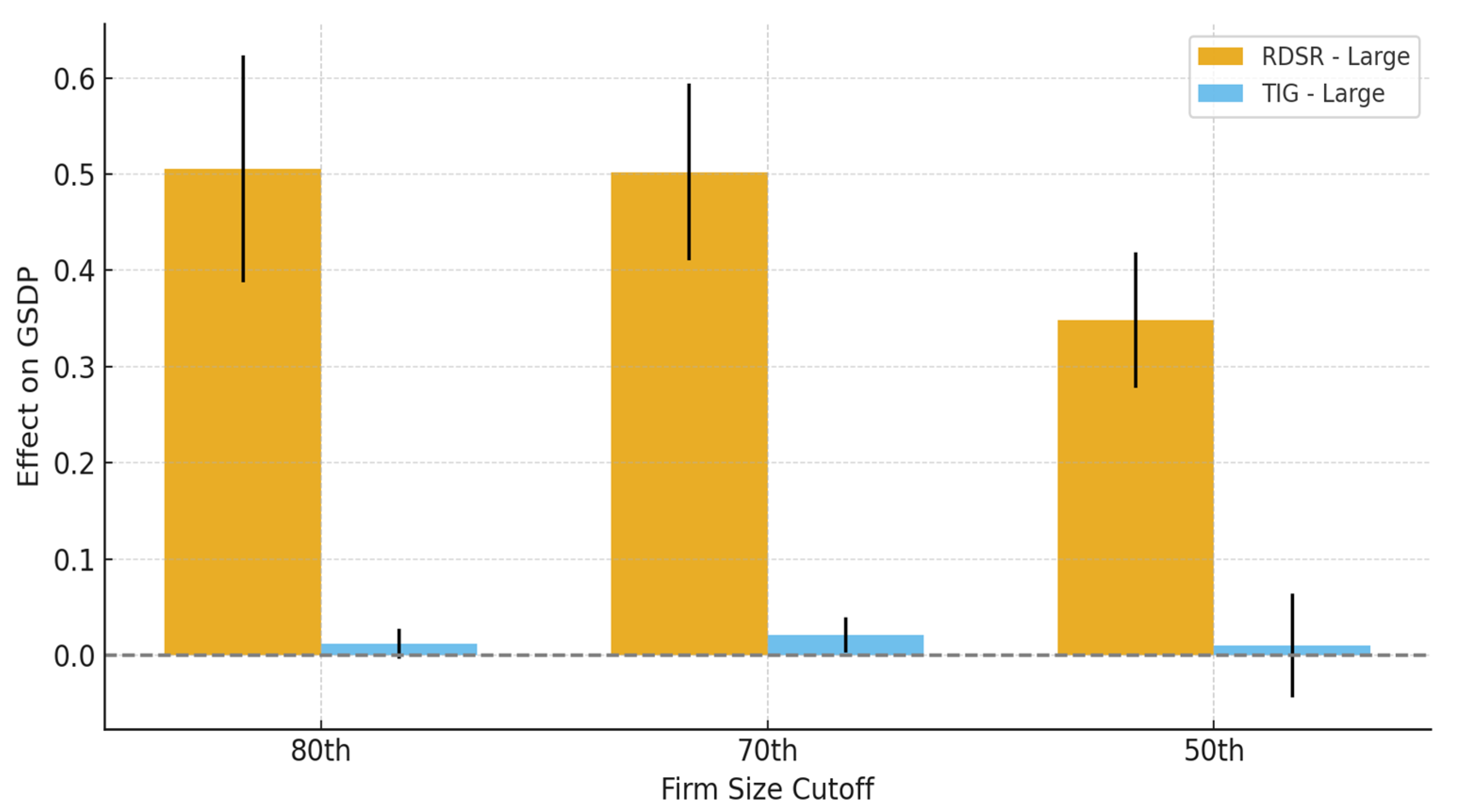
| Main Var | Cutoff | se1 | p1 | se2 | p2 | Large Effect (b1 + b2) | se_Large | p_Large | R2 Within | ||
|---|---|---|---|---|---|---|---|---|---|---|---|
| RDSR | 80 | 0.0827 | 0.0463 | 0.0736 | 0.4227 | 0.1226 | 0.0006 | 0.5055 | 0.1177 | 0.0000 | 0.0554 |
| TIG | 80 | 0.0043 | 0.0070 | 0.5385 | 0.0080 | 0.0172 | 0.6418 | 0.0123 | 0.0156 | 0.4281 | 0.0537 |
| RDSR | 70 | 0.0387 | 0.0479 | 0.4187 | 0.4635 | 0.0985 | 0.0000 | 0.5022 | 0.0916 | 0.0000 | 0.0564 |
| TIG | 70 | 0.0018 | 0.0076 | 0.8110 | 0.0134 | 0.0143 | 0.3495 | 0.0152 | 0.0121 | 0.2083 | 0.0538 |
| RDSR | 50 | −0.0147 | 0.0506 | 0.7716 | 0.3634 | 0.0819 | 0.0000 | 0.3487 | 0.0703 | 0.0000 | 0.0562 |
| TIG | 50 | 0.0075 | 0.0088 | 0.3971 | −0.0029 | 0.0129 | 0.8242 | 0.0046 | 0.0093 | 0.6228 | 0.0537 |
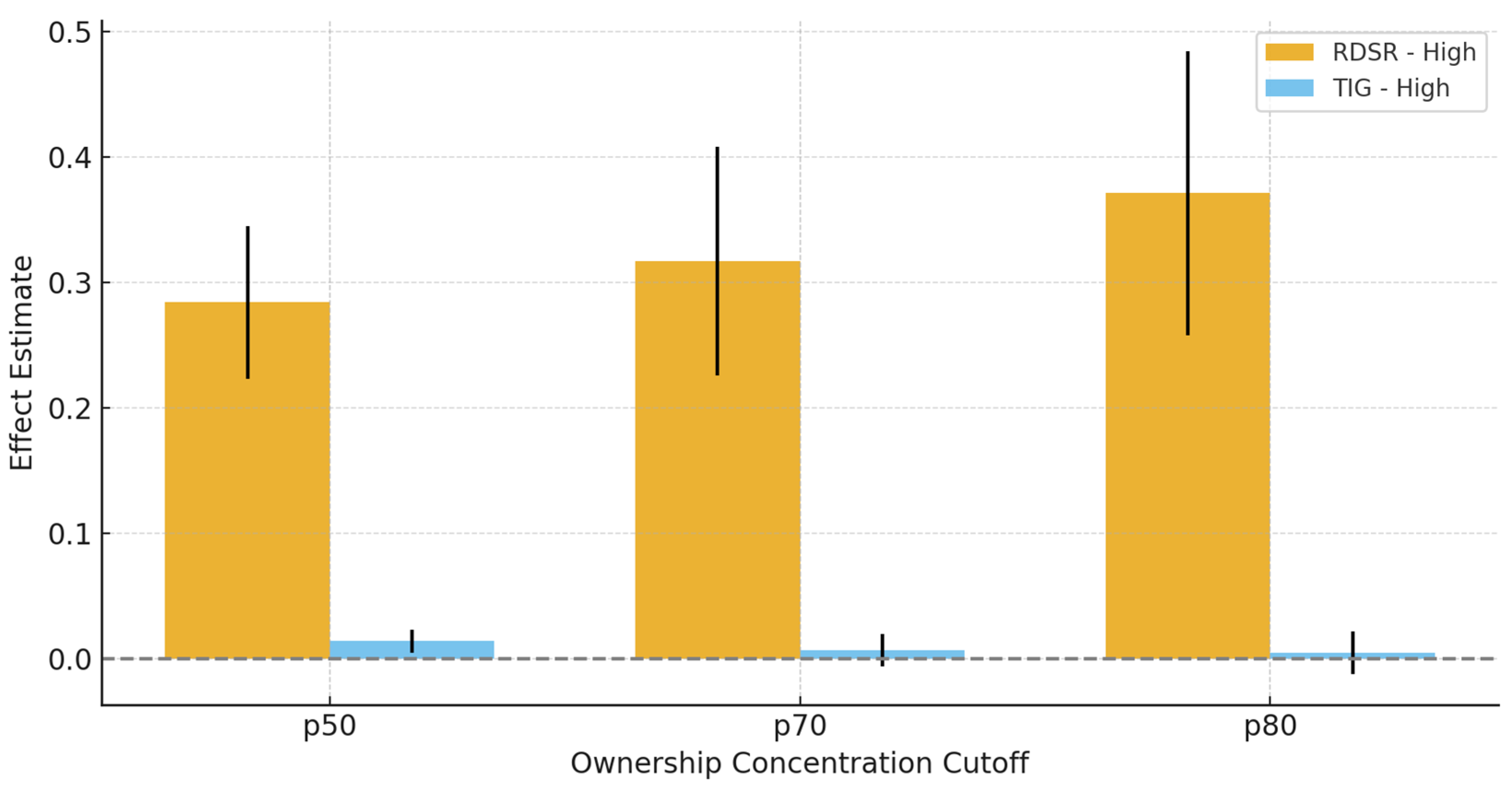
| Cutoff | Low (β1) | Interaction (β2) | High = β1 + β2 | Within R2 |
| p50 (median) | −0.0260 | 0.3110 *** | 0.2840 * | 0.0556 |
| (0.0550) | (0.076) | (0.061) | ||
| p70 | 0.070 | 0.2470 ** | 0.317 * | 0.0549 |
| (0.046) | (0.097) | (0.091) | ||
| p80 | 0.090 * | 0.2810 ** | 0.371 * | |
| (0.046) | (0.118) | (0.113) | 0.0548 | |
| p50 (median) | −0.003 | 0.018 | 0.014 | 0.0538 |
| (0.009) | (0.013) | (0.009) | ||
| p70 | 0.006 | 0.001 | 0.007 | 0.0537 |
| (0.007) | (0.015) | (0.013) | ||
| p80 | 0.006 | −0.001 | 0.005 | 0.0537 |
| (0.007) | (0.018) | (0.017) |
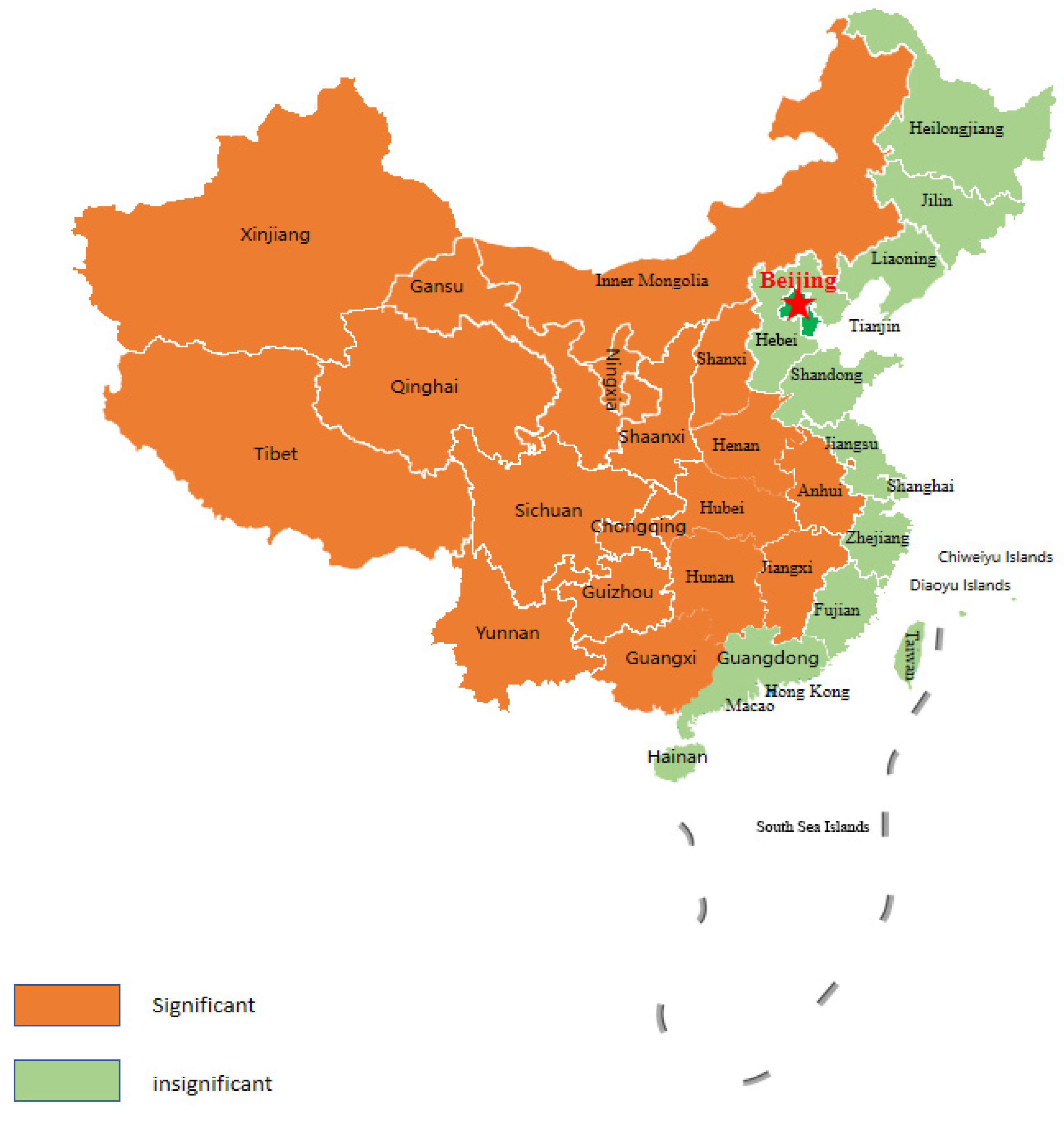
| Variable | |||
|---|---|---|---|
| TIG (Tax Incentive Gap) | −0.0033 (0.0049) | 0.0045 (0.0075) | 0.0029 (0.0083) |
| RDSR (R&D Super-deduction, share) | 0.1168 ** (0.0523) | 0.4386 *** (0.1052) | −0.1052 (0.0996) |
| Revenue Growth rate | −0.0088 *** (0.0020) | −0.0084 *** (0.0032) | −0.0041 (0.0029) |
| Asset Growth rate | 0.0040 * (0.0022) | −0.0009 (0.0038) | −0.0072 ** (0.0035) |
| Tobin’s Q | 0.0022 *** (0.0008) | 0.0003 (0.0014) | 0.0028 ** (0.0012) |
| Firm Size (ln Assets) | 0.0491 *** (0.0034) | 0.0558 *** (0.0061) | 0.0477 *** (0.0052) |
| Board Size | −0.0003 (0.0015) | 0.0020 (0.0019) | −0.0029 (0.0026) |
| Firm Age (years) | −0.0018 * (0.0009) | −0.0021 (0.0022) | −0.0044 (0.0030) |
| Independent Director % | 0.0430 (0.0361) | 0.0672 (0.0530) | −0.0288 (0.0569) |
| Top 1 Shareholder % | −0.0028 (0.0202) | −0.0210 (0.0349) | 0.0361 (0.0395) |
| Current Ratio | 0.0014 ** (0.0006) | 0.0023 * (0.0012) | −0.0011 (0.0010) |
| Firm FE & Year FE | Yes | Yes | Yes |
| Observations | 21,252 | 5676 | 4727 |
| Within R2 | 0.047 | 0.084 | 0.064 |
Disclaimer/Publisher’s Note: The statements, opinions and data contained in all publications are solely those of the individual author(s) and contributor(s) and not of MDPI and/or the editor(s). MDPI and/or the editor(s) disclaim responsibility for any injury to people or property resulting from any ideas, methods, instructions or products referred to in the content. |
© 2025 by the authors. Licensee MDPI, Basel, Switzerland. This article is an open access article distributed under the terms and conditions of the Creative Commons Attribution (CC BY) license (https://creativecommons.org/licenses/by/4.0/).
Share and Cite
Wang, Y.; Mayburov, I.A. Can Tax Incentives Drive Green Sustainability in China’s Firms? Evidence on the Mediating Role of Innovation Investment. Sustainability 2025, 17, 10816. https://doi.org/10.3390/su172310816
Wang Y, Mayburov IA. Can Tax Incentives Drive Green Sustainability in China’s Firms? Evidence on the Mediating Role of Innovation Investment. Sustainability. 2025; 17(23):10816. https://doi.org/10.3390/su172310816
Chicago/Turabian StyleWang, Ying, and Igor A. Mayburov. 2025. "Can Tax Incentives Drive Green Sustainability in China’s Firms? Evidence on the Mediating Role of Innovation Investment" Sustainability 17, no. 23: 10816. https://doi.org/10.3390/su172310816
APA StyleWang, Y., & Mayburov, I. A. (2025). Can Tax Incentives Drive Green Sustainability in China’s Firms? Evidence on the Mediating Role of Innovation Investment. Sustainability, 17(23), 10816. https://doi.org/10.3390/su172310816