Do Suburbs Have Higher Fertility than Central Cities? Diversity of Regional Differences in Population Reproduction Within Metropolitan Areas in Japan

Abstract
1. Introduction
2. Previous Research
2.1. Population Studies in Western Countries
2.2. Population Studies in Japan
3. Materials and Methods
4. Results
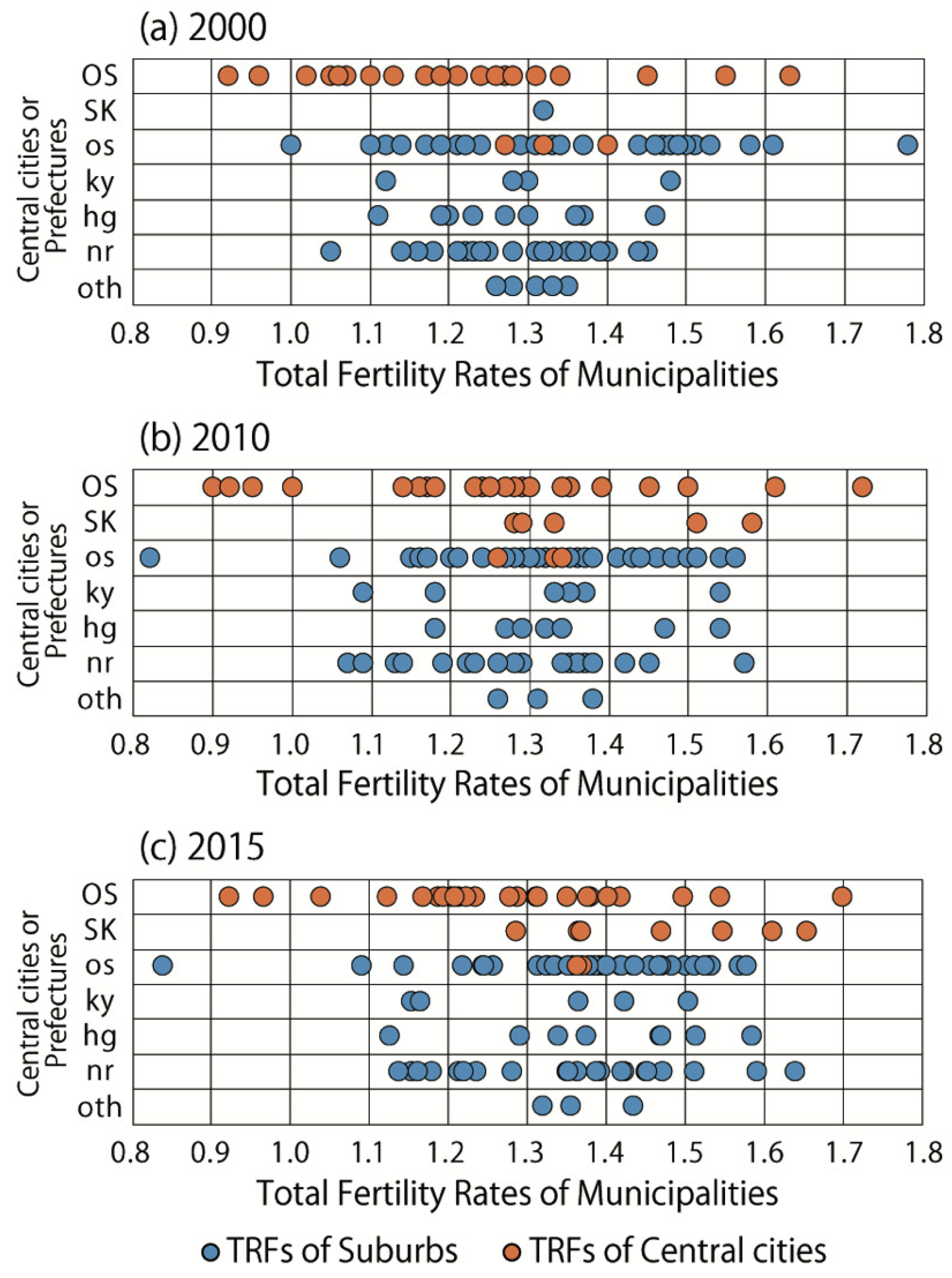
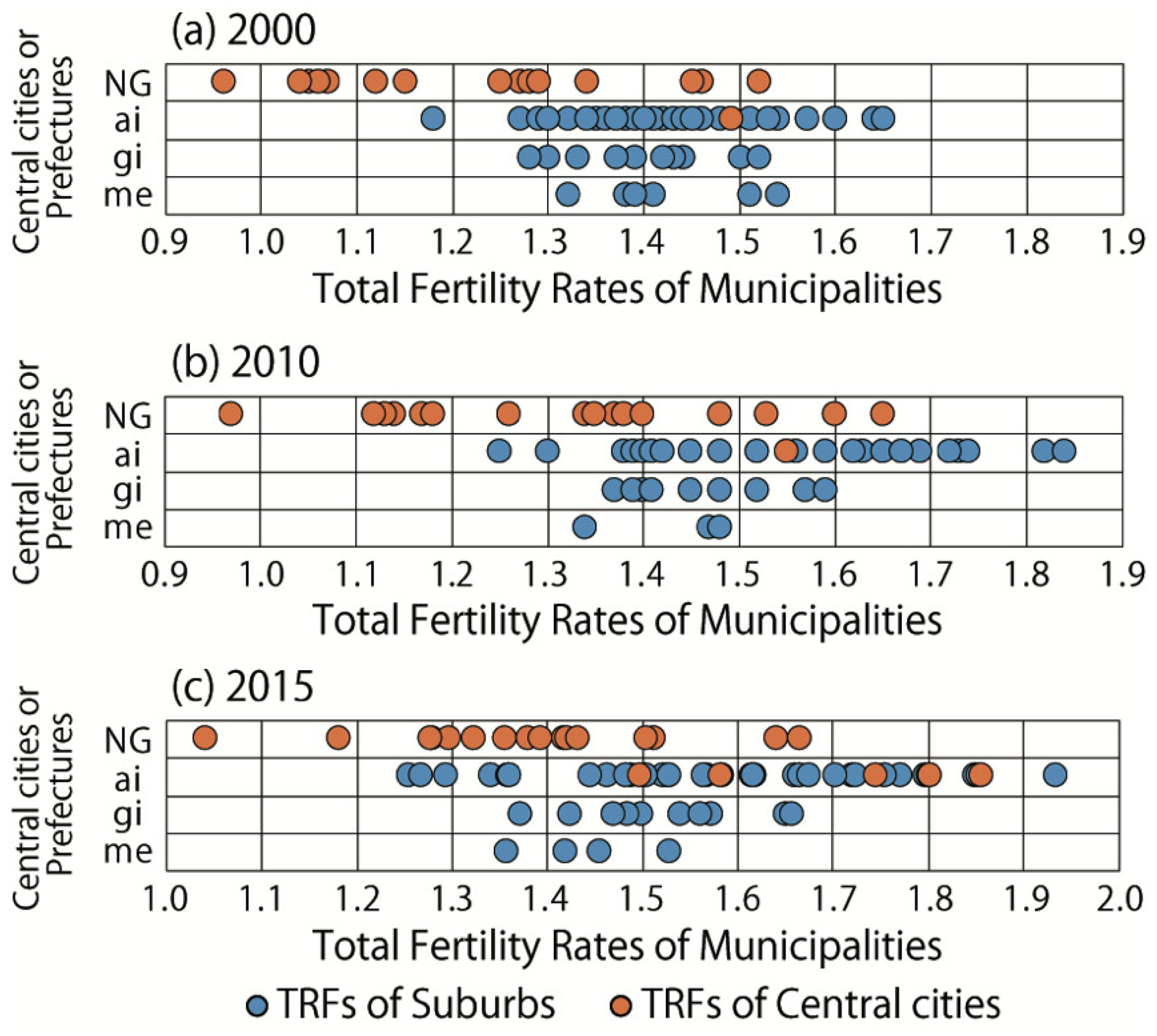
4.1. Major Metropolitan Employment Areas
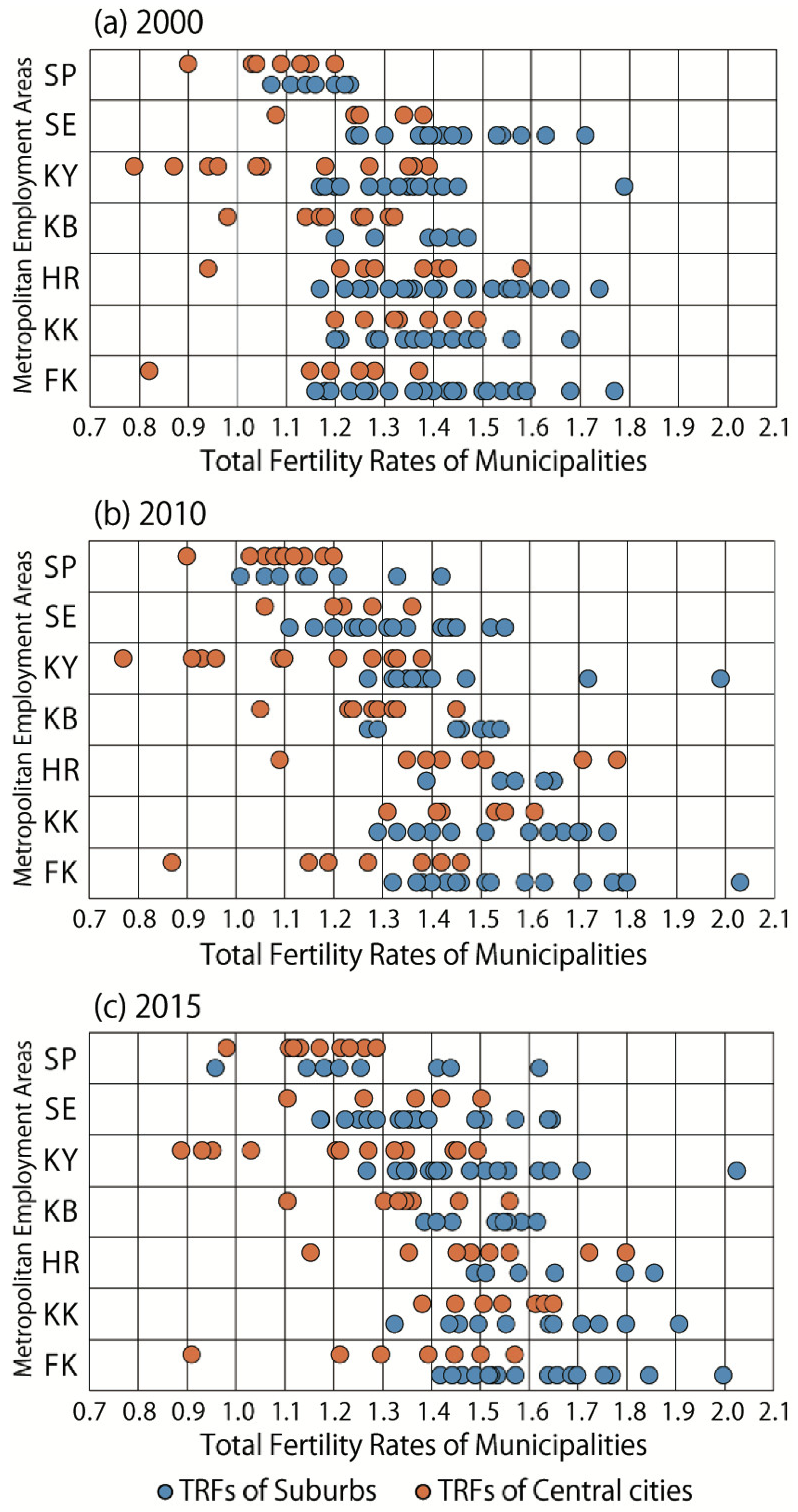
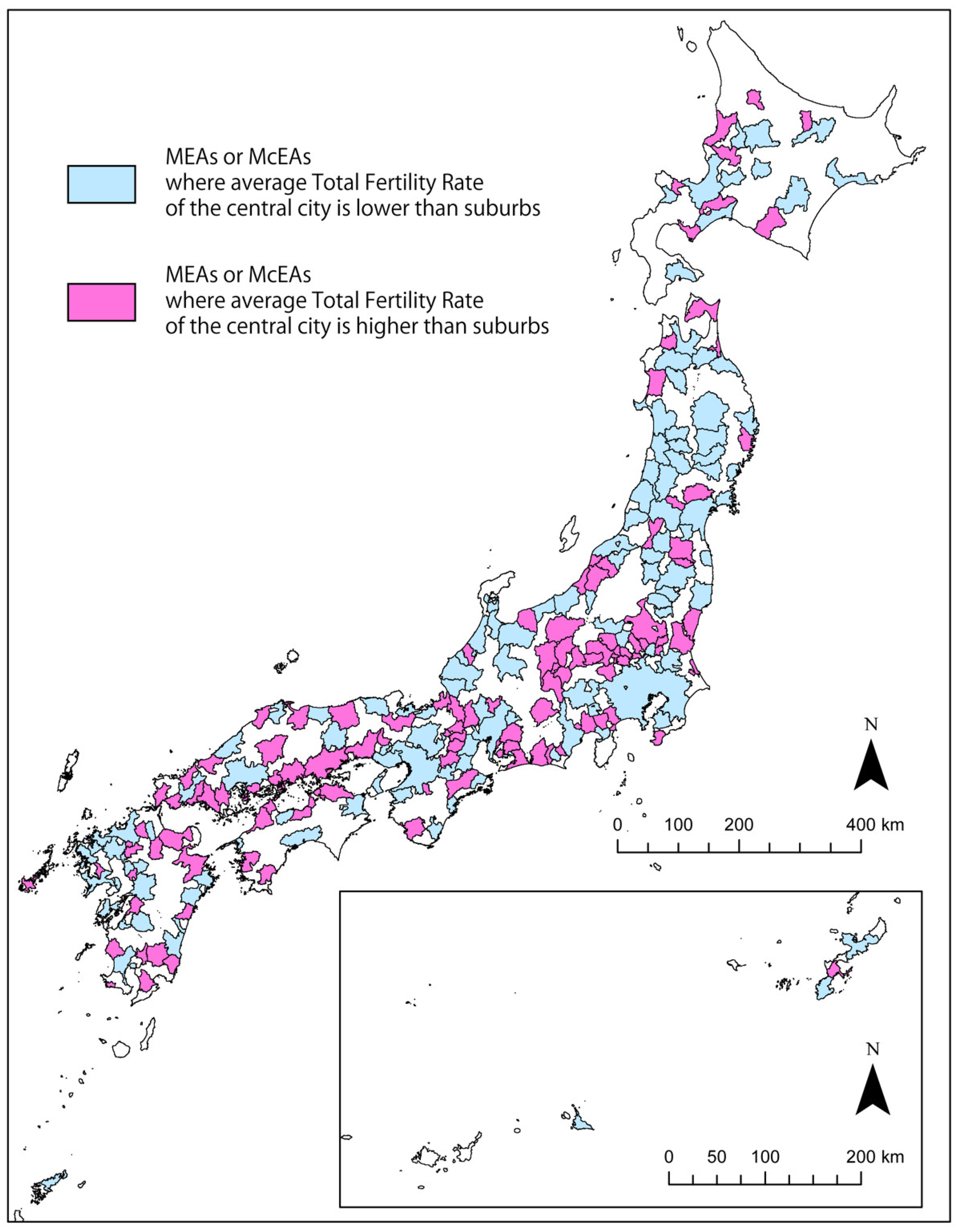
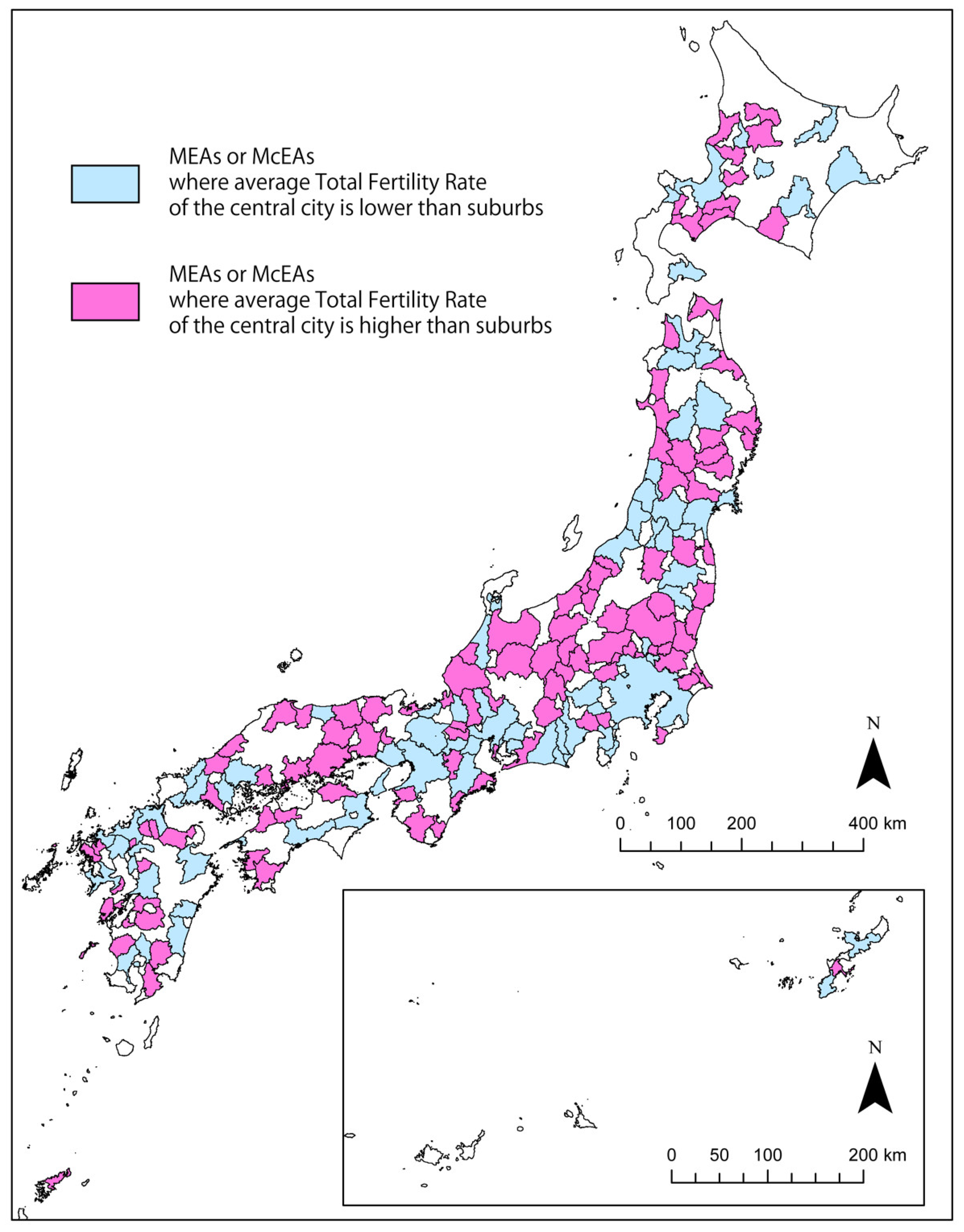
4.2. Other Metropolitan Employment Areas
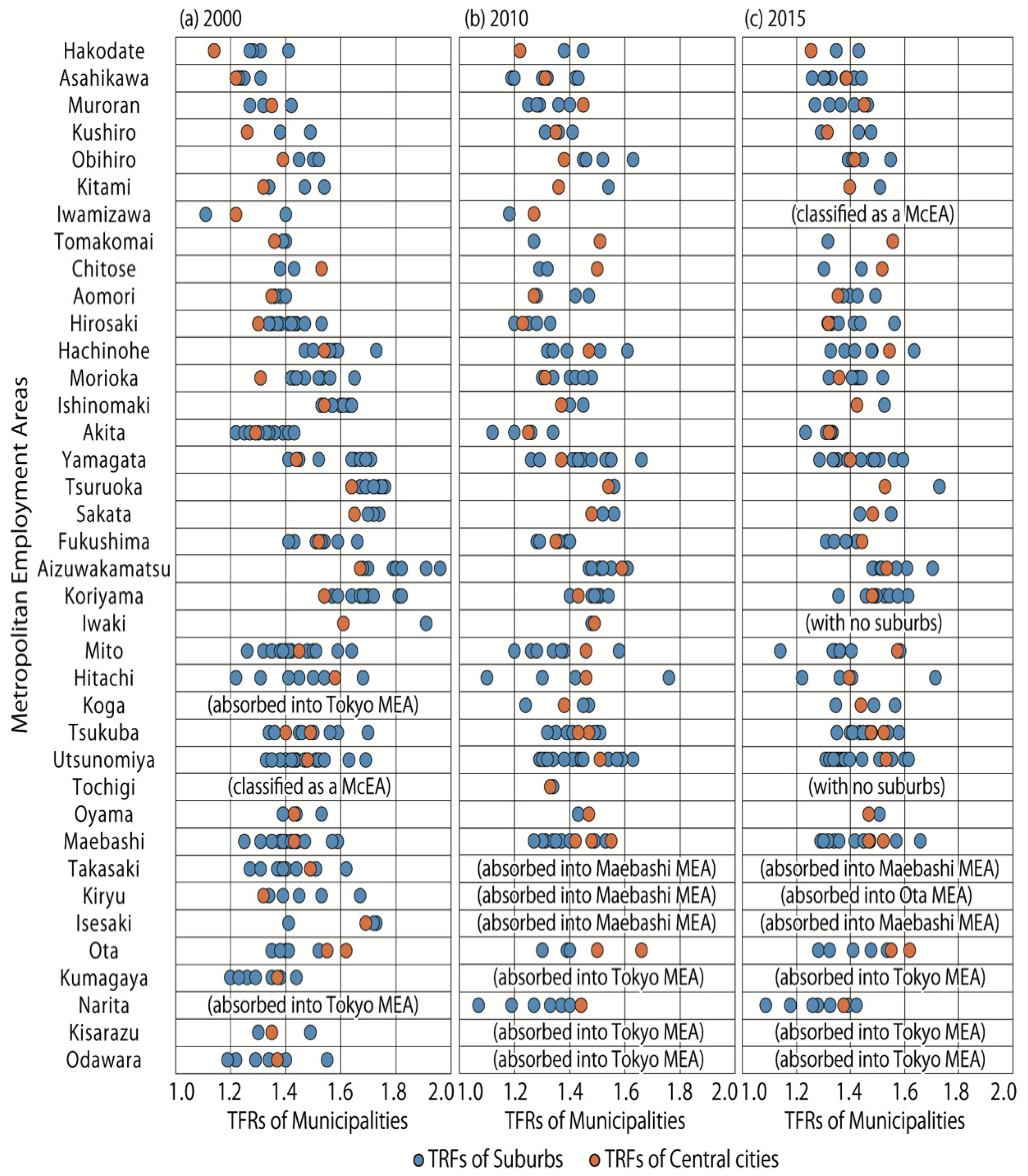
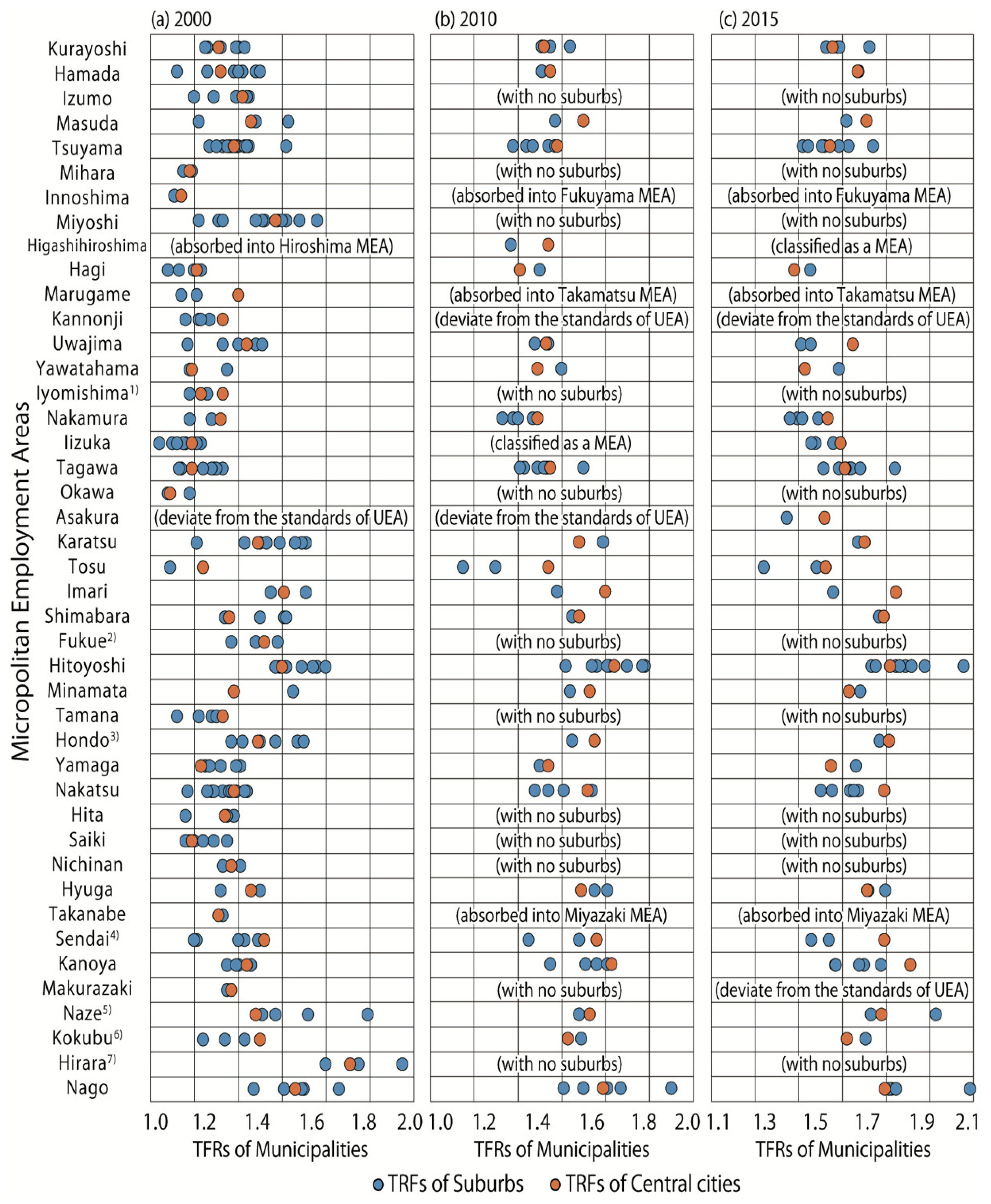
4.3. Micropolitan Employment Areas
5. Discussion
5.1. Do Suburbs Have Higher Fertility than Central Cities?
5.2. Relationship Between Fertility Distribution and the Urban Life Cycle Model
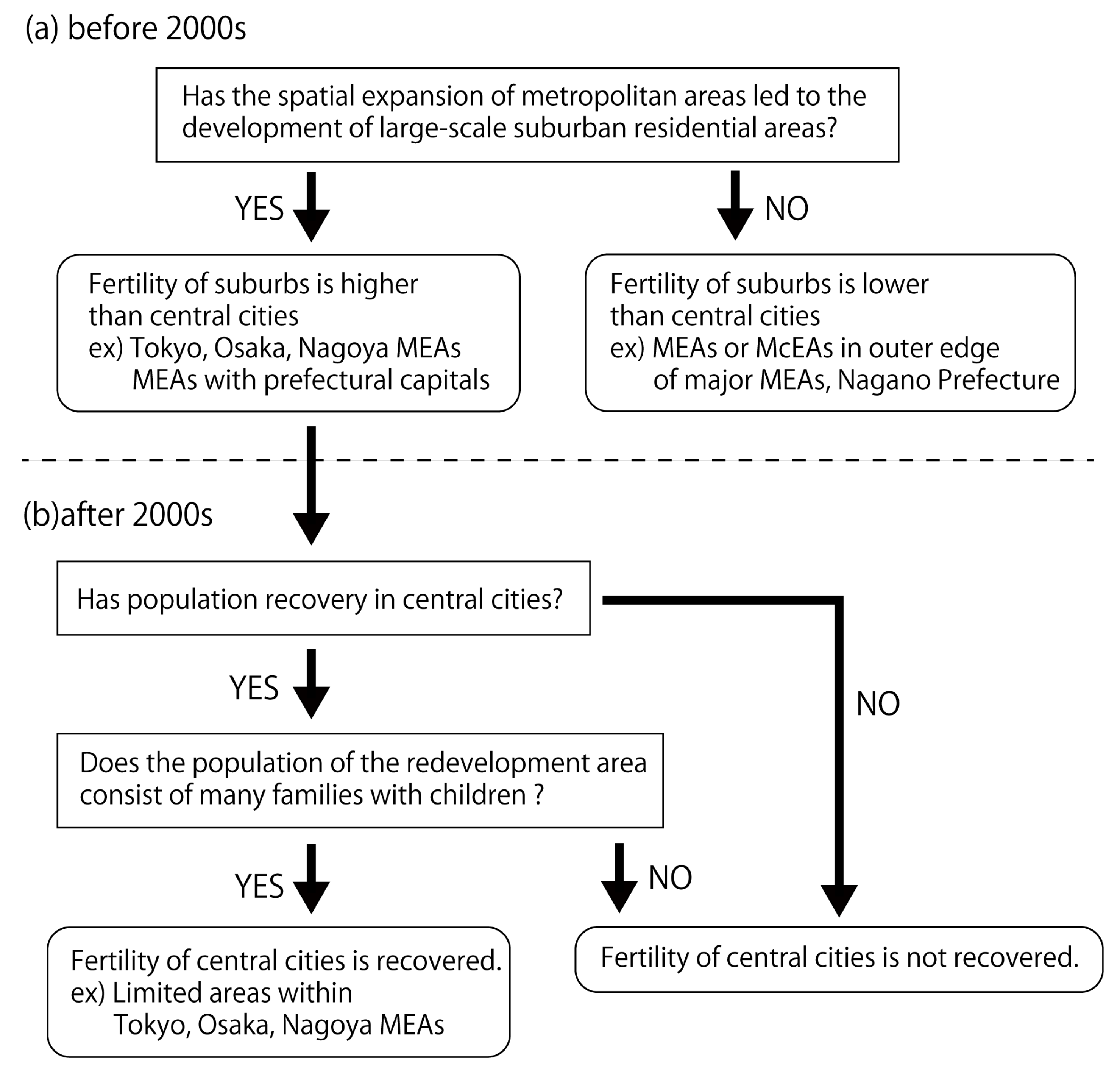
5.3. The Diversification Process of Regional Differences in Fertility Within Japanese Metropolitan Areas
6. Conclusions
Author Contributions
Funding
Institutional Review Board Statement
Informed Consent Statement
Data Availability Statement
Acknowledgments
Conflicts of Interest
References
- Jones, R.S. Addressing Demographic Headwinds in Japan: A Long-Term Perspective; OECD Economics Department Working Papers, No. 1792; OECD Publishing: Paris, France, 2024; Available online: https://www.oecd.org/content/dam/oecd/en/publications/reports/2024/04/addressing-demographic-headwinds-in-japan-a-long-term-perspective_85b9a67f/96648955-en.pdf (accessed on 20 November 2025).
- Maruo, N. The impact of population ageing on the social security expenditure and economic growth in Japan. J. Popul. Stud. 1987, 10, 7–24. [Google Scholar]
- Council on Population Problems. A Shrinking Population Society: Responsibility and Choices for the Future: Debates on Declining Birth Rates and the Report of Council on Population Problems; Gyosei: Tokyo, Japan, 1998. [Google Scholar]
- Katagiri, M. Economic consequences of population aging in Japan: Effects through changes. In Demand Structure; Discussion Paper Series; Bank of Japan Institute for Monetary and Economic Studies: Tokyo, Japan, 2012; Volume 3, Available online: https://www.imes.boj.or.jp/research/papers/english/12-E-03.pdf (accessed on 20 November 2025).
- Kubo, T.; Yui, Y. (Eds.) The Rise in Vacant Housing in Post-Growth Japan: Housing Market, Urban Policy, and Revitalizing Aging Cities; Springer: Singapore, 2020. [Google Scholar]
- Fukuda, S.; Okumura, K. Regional convergence under declining population: The case of Japan. Jpn. World Econ. 2020, 55, 101023. [Google Scholar] [CrossRef]
- Notestein, F.W. Population—The long view. In Food for the World; Schultz, T.W., Ed.; University of Chicago Press: Chicago, IL, USA, 1945; pp. 36–57. [Google Scholar]
- Kuroda, T. Demographic experience of Japan in view of international scene. In Relation to Demographic Transition Theory. J. Popul. Probl. 1968, 106, 53–68. [Google Scholar]
- Moon, H.; Saito, O. The first and second transitions: Japan and South Korea compared. J. Popul. Probl. 2015, 71, 102–121. [Google Scholar]
- Van De Kaa, D.J. Europe’s second demographic transition. Popul. Bull. 1987, 42, n1. [Google Scholar]
- Coleman, D. Immigration and ethnic change in low-fertility countries: A third demographic transition. Popul. Dev. Rev. 2006, 32, 401–446. [Google Scholar] [CrossRef]
- Boyle, P. Population geography: Does geography matter in fertility research? Prog. Hum. Geogr. 2003, 27, 615–626. [Google Scholar] [CrossRef]
- Sharlin, A. Urban-rural differences in fertility in Europe during the demographic transition. In The Decline of Fertility in Europe; Coale, A.J., Watkins, S.C., Eds.; Princeton University Press: Princeton, NJ, USA, 1986; pp. 234–260. ISBN 978-1-4008-8669-2. [Google Scholar]
- Galloway, P.R.; Lee, R.D.; Hammel, E.A. Urban versus Rural: Fertility Decline in the Cities and Rural Districts of Prussia, 1875 to 1910. Eur. J. Popul. 1998, 14, 209–264. [Google Scholar] [CrossRef]
- Klüsener, S.; Dribe, M.; Scalone, F. Spatial and social distance at the onset of the fertility transition: Sweden, 1880–1900. Demography 2019, 56, 169–199. [Google Scholar] [CrossRef]
- Hall, R.; Ogden, P.E.; Hill, C. The pattern and structure of one-person households in England and Wales and France. Int. J. Popul. Geogr. 1997, 3, 161–181. [Google Scholar] [CrossRef]
- Ogden, P.E.; Hall, R. The second demographic transition, new household forms and the urban population of France during the 1990s. Trans. Inst. Br. Geogr. 2004, 29, 88–105. [Google Scholar] [CrossRef]
- Buzar, S.; Ogden, P.E.; Hall, R. Households matter: The quiet demography of urban transformation. Prog. Hum. Geogr. 2005, 29, 413–436. [Google Scholar] [CrossRef]
- Lerch, M. Fertility decline in urban and rural areas of developing countries. Popul. Dev. Rev. 2019, 45, 301–320. [Google Scholar] [CrossRef]
- Yamagami, T. Spatio-temporal structure of population growth in major metropolitan areas in Japan. Geogr. Rev. Jpn. 2003, 76, 187–210. [Google Scholar] [CrossRef][Green Version]
- Yabe, N. Population recovery in inner Tokyo in the late 1990s: A statistical analysis in Minato Ward. Geogr. Rep. Tokyo Metrop. Univ. 2004, 29, 35–43. [Google Scholar]
- Yabe, N. Population recovery in inner Tokyo in the late 1990s: A questionnaire survey in Minato Ward. Jpn. J. Hum. Geogr. 2003, 55, 277–292. [Google Scholar]
- Miyazawa, H.; Abe, T. Recovery and changes in the socioeconomic composition of population in the central area of Tokyo during the period from 1995 to 2000: Analysis of small-area census data. Geogr. Rev. Jpn. 2005, 78, 893–912. [Google Scholar] [CrossRef]
- Koizumi, R.; Nishiyama, H.; Kubo, T.; Kukimoto, M.; Kawaguchi, T. New dimension of housing acquisition in the Tokyo Bay area: Skyscraper condominium residents in Toyosu. Geogr. Rev. Jpn. Ser. A 2011, 84, 592–609. [Google Scholar] [CrossRef]
- Tomita, K. How satisfied do people feel about their new condominiums? The case of the Central District of Osaka city. Stud. Humanit. 2005, 56, 65–89. [Google Scholar]
- Kagawa, T. Supply trends and characteristics of private-sector condominiums in Chuo Ward, Sapporo city, Hokkaido, Japan: A comparative study before and after the bubble economy period. Jpn. J. Hum. Geogr. 2007, 59, 57–72. [Google Scholar] [CrossRef]
- Sakakibara, S.; Matsuoka, K.; Miyazawa, H. Characteristics of condominium residents in the center of Sendai and their residential preferences for city center. Q. J. Geogr. 2003, 55, 87–106. [Google Scholar] [CrossRef][Green Version]
- Hirose, T. Transformation of urban land use and the characteristics of residents through the construction of condominiums—A case of redevelopment in Itsutsu-Bashi district, the old section of Sendai city. Q. J. Geogr. 2000, 52, 118–130. [Google Scholar] [CrossRef]
- Horiuchi, C. The population growth and the supply structure of condominiums in the central area of Kyoto city. Ann. Assoc. Econ. Geogr. 2009, 55, 193–214. [Google Scholar]
- Naganuma, S.; Arai, Y. Characteristics of downtown residents and their reasons for living in a city core: A case study of Fukuoka. J. Geogr. 2010, 119, 794–809. [Google Scholar] [CrossRef][Green Version]
- Kubo, T. Decision-making process on residential choices of condominium residents in the central area of Mito city, Ibaraki Prefecture. Geogr. Rev. Jpn. 2008, 81, 45–59. [Google Scholar] [CrossRef][Green Version]
- Kobayashi, T. Supply trend and residents characteristics of private-sector condominiums in the center of Niigata City. Komazawa J. Geogr. 2011, 47, 83–102. [Google Scholar]
- Otsuka, T. Condominium supply and residential preference in the central urban area of Toyohashi city, a medium-scale city in Japan. Geogr. Rev. Jpn. 2005, 78, 202–227. [Google Scholar] [CrossRef]
- Rodrigo-Comino, J.; Egidi, G.; Sateriano, A.; Poponi, S.; Mosconi, E.M.; Gimenez Morera, A. Suburban fertility and metropolitan cycles: Insights from European cities. Sustainability 2021, 13, 2181. [Google Scholar] [CrossRef]
- Kulu, H. Why do fertility levels vary between urban and rural areas? Reg. Stud. 2013, 47, 895–912. [Google Scholar] [CrossRef]
- Tromans, N.; Natamba, E.; Jefferie, J. Have women born outside the UK driven the rise in UK births since 2001? Popul. Trends 2009, 136, 28–42. [Google Scholar] [CrossRef]
- Mulder, C.H.; Wagner, M. The connections between family formation and first-time home ownership in the context of west Germany and the Netherlands. Eur. J. Popul. 2001, 17, 137–164. [Google Scholar] [CrossRef]
- De Beer, J.; Deerenberg, I. An explanatory model for projecting regional fertility differences in the Netherlands. Popul. Res. Policy Rev. 2007, 26, 511–528. [Google Scholar] [CrossRef]
- Michielin, F. Lowest low fertility in an urban context: The role of migration in Turin, Italy. Popul. Space Place 2004, 10, 331–347. [Google Scholar] [CrossRef]
- Hank, K. Regional fertility differences in Western Germany: An overview of the literature and recent descriptive findings. Int. J. Popul. Geogr. 2001, 7, 243–257. [Google Scholar] [CrossRef]
- Kulu, H. Fertility of internal migrants: Comparison between Austria and Poland. Popul. Space Place 2006, 12, 147–170. [Google Scholar] [CrossRef]
- Kulu, H. Migration and fertility: Competing hypotheses re-examined. Eur. J. Popul. 2005, 21, 51–87. [Google Scholar] [CrossRef]
- Thygesen, L.C.; Knudsen, L.B.; Keiding, N. Modelling regional variation of first-time births in Denmark 1980–1994 by an age-period-cohort model. Dem. Res. 2005, 13, 573–596. [Google Scholar] [CrossRef]
- Kulu, H.; Vikat, A.; Andersson, G. Settlement size and fertility in the Nordic countries. Popul. Stud. 2007, 61, 265–285. [Google Scholar] [CrossRef] [PubMed]
- Gray, E.; Evans, A. Geographic variation in parity progression in Australia. Popul. Space Place 2018, 24, 2080. [Google Scholar] [CrossRef]
- Heaton, T.B.; Lichter, D.T.; Amoateng, A. The timing of family formation: Rural-urban differentials in first intercourse, childbirth, and marriage. Rural Sociol. 1989, 54, 1–16. [Google Scholar]
- Glusker, A.I.; Dobie, S.A.; Madigan, D.; Rosenblatt, R.A.; Larson, E.H. Differences in fertility patterns between urban and rural women in Washington State, 1983–1984 to 1993–1994. Women Health 2000, 31, 55–70. [Google Scholar] [CrossRef]
- Kulu, H.; Boyle, P.J. High fertility in city suburbs: Compositional or contextual effects? Eur. J. Popul. 2009, 25, 157–174. [Google Scholar] [CrossRef]
- Kulu, H.; Boyle, P.J.; Andersson, G. High suburban fertility: Evidence from four northern European countries. Demogr. Res. 2009, 21, 915–944. [Google Scholar] [CrossRef]
- Duncan, O.D.; Reiss, A.J. Social Characteristics of Urban and Rural Communities, 1950; John Wiley & Sons: New York, NY, USA, 1956. [Google Scholar]
- Goldstein, S.; Mayer, K.B. Residence and status differences in fertility. Milbank Meml. Fund Q. 1965, 43, 291–310. [Google Scholar] [CrossRef]
- Kiser, C.V.; Grabill, W.H.; Campbell, A.A. Trends and Variations in Fertility in the United States; Harvard University Press: Cambridge, MA, USA, 1968. [Google Scholar] [CrossRef]
- Freedman, R.; Whelpton, P.K.; Campbell, A.A. Family Planning, Sterility and Population Growth; McGraw-Hill: New York, NY, USA, 1959. [Google Scholar]
- McLaughlin, D.K.; Lichter, D.T.; Johnston, G.M. Some women marry young: Transitions to first marriage in metropolitan and nonmetropolitan areas. J. Marriage Fam. 1993, 55, 827–838. [Google Scholar] [CrossRef]
- Snyder, A.R. The role of contemporary family behaviors in nonmarital conception outcomes of nonmetro women: Comments on Albrecht and Albrecht (2004). Rural Sociol. 2006, 71, 155–163. [Google Scholar] [CrossRef]
- Snyder, A.R.; Brown, S.L.; Condo, E.P. Residential differences in family formation: The significance of cohabitation. Rural Sociol. 2004, 69, 235–260. [Google Scholar] [CrossRef]
- Boyle, P.J.; Graham, E.; Feng, Z. Contextualising Demography: The Significance of Local Clusters of Fertility in Scotland; MPIDR Working Paper WP-2007; Max Planck Institute for Demographic Research: Rostock, Germany, 2007; Volume 036. [Google Scholar]
- Hayami, A. A Demographic Overview of Early Modern Japan Based on Micro-Data: Population, Family Reconstruction, and Households in Suwa gun, Shinano Province. In The Historical Demography of Pre-Modern Japan; University of Tokyo Press: Tokyo, Japan, 2001; pp. 66–119. [Google Scholar]
- Hayami, A. Demographic Aspects of Tokugawa Japan Based on Micro-Data: Nishijo mura, Ampachi gun, Mino Province. In The Historical Demography of Pre-Modern Japan; University of Tokyo Press: Tokyo, Japan, 2001; pp. 120–158. [Google Scholar]
- Hayami, A.; Kurosu, S. Regional diversity in demographic and family patterns in preindustrial Japan. J. Jpn. Stud. 2001, 27, 295–321. [Google Scholar] [CrossRef]
- Kawabe, H. On the regional differences of the fertility in Japan. J. Popul. Probl. 1979, 150, 1–14. [Google Scholar]
- Hama, H. Fertility changes on regional basis and their influences to national fertility. Econ. Pap. (Seijo Univ.) 2003, 160, 1–30. [Google Scholar]
- Iwasawa, M.; Suga, K.; Kamata, K.; Yoda, S.; Kaneko, R. Nuptiality and Marital Fertility Effect on Municipality-level TFR in Japan: An application of log-linear Model. J. Popul. Probl. 2022, 78, 78–105. [Google Scholar]
- Sasai, T. A study on regional differentials in marital fertility. J. Popul. Probl. 2007, 63, 3–23. [Google Scholar]
- Yamauchi, M. Why do married couples in the Tokyo metropolitan area have fewer children than those in the rest of Japan? J. Popul. Probl. 2016, 72, 73–98. [Google Scholar]
- Kamata, K.; Iwasawa, M. Spatial variations in fertility: Geographically weighted regression analyses for town-and-village-level TFR in Japan. J. Popul. Stud. 2009, 45, 1–20. [Google Scholar]
- Yui, Y. Regional differentation on family status in Japan. Bull. Grad. Sch. Educ. Hiroshima Univ. Part II Arts Sci. Educ. 2006, 54, 57–66. [Google Scholar]
- Yamauchi, M. Regional marital fertility in Japan: Analysis of 15 sample surveys from 2000 to 2010. J. Popul. Probl. 2017, 73, 21–40. [Google Scholar]
- Yamauchi, M.; Koike, S.; Kamata, K.; Nakagawa, M. Migration effects on martial fertility in the Tokyo metropolitan area, the non-Tokyo metropolitan area, and Japan. J. Popul. Probl. 2020, 76, 265–283. [Google Scholar]
- Koike, S. On the impact of migration on fertility—Can migration reduce fertility? J. Popul. Probl. 2006, 62, 3–19. [Google Scholar]
- Koike, S. On the relation of migration and fertility behavior—Focusing on the migrants to metropolitan areas before first marriage. J. Popul. Probl. 2009, 65, 3–20. [Google Scholar]
- Koike, S. An examination of the hypotheses on the impact of migration on fertility—From the data of “seventh national survey on migration”. J. Popul. Probl. 2014, 70, 21–43. [Google Scholar]
- Sawada, K. Fertility transition and the birth control methods in Okinawa under U.S. military occupation, 1945–1972. J. Popul. Stud. 2005, 36, 23–40. [Google Scholar]
- Sawada, K. Fertility and family in Okinawa: The politics of reproduction and a marginalized population. Jpn. Sociol. Rev. 2016, 67, 400–414. [Google Scholar] [CrossRef][Green Version]
- Yamauchi, M.; Nishioka, H.; Esaki, Y.; Koike, S.; Suga, K. Contextual effects and fertility differences between Okinawa Prefecture and mainland Japan. Geogr. Rev. Jpn. Ser. A 2020, 93, 85–106. [Google Scholar] [CrossRef]
- Nishioka, H. Effects of the family formation norms on demographic behaviors: Case of Okinawa in Japan. J. Popul. Probl. 1994, 50, 52–60. [Google Scholar]
- Kanemoto, Y.; Tokuoka, K. Proposal for the standards of metropolitan areas of Japan. J. Appl. Reg. Sci. 2002, 7, 1–15. [Google Scholar]
- Kubo, T.; Yui, Y. Diversification of the condominium supply in Central Tokyo: Supply strategies of “compact” condominiums. Geogr. Rev. Jpn. Ser. A 2011, 84, 460–472. [Google Scholar] [CrossRef]



| 2000 | 2010 | 2015 | |
|---|---|---|---|
| Municipalities for which the TFR is calculated | 3356 | 1897 | 1896 |
| Municipalities in Metropolitan Employment Areas (MEAs) | 1573 | 1091 | 1075 |
| Central cities in MEAs | 263 | 288 | 276 |
| Suburbs in MEAs | 1310 | 803 | 799 |
| Municipalities in Micropolitan Employment Areas (McEAs) | 669 | 319 | 332 |
| Central cities in McEAs | 137 | 93 | 96 |
| Suburbs in McEAs | 532 | 226 | 236 |
Disclaimer/Publisher’s Note: The statements, opinions and data contained in all publications are solely those of the individual author(s) and contributor(s) and not of MDPI and/or the editor(s). MDPI and/or the editor(s) disclaim responsibility for any injury to people or property resulting from any ideas, methods, instructions or products referred to in the content. |
© 2025 by the authors. Licensee MDPI, Basel, Switzerland. This article is an open access article distributed under the terms and conditions of the Creative Commons Attribution (CC BY) license (https://creativecommons.org/licenses/by/4.0/).
Share and Cite
Usui, H.; Matsui, K. Do Suburbs Have Higher Fertility than Central Cities? Diversity of Regional Differences in Population Reproduction Within Metropolitan Areas in Japan. Sustainability 2025, 17, 10814. https://doi.org/10.3390/su172310814
Usui H, Matsui K. Do Suburbs Have Higher Fertility than Central Cities? Diversity of Regional Differences in Population Reproduction Within Metropolitan Areas in Japan. Sustainability. 2025; 17(23):10814. https://doi.org/10.3390/su172310814
Chicago/Turabian StyleUsui, Haru, and Keisuke Matsui. 2025. "Do Suburbs Have Higher Fertility than Central Cities? Diversity of Regional Differences in Population Reproduction Within Metropolitan Areas in Japan" Sustainability 17, no. 23: 10814. https://doi.org/10.3390/su172310814
APA StyleUsui, H., & Matsui, K. (2025). Do Suburbs Have Higher Fertility than Central Cities? Diversity of Regional Differences in Population Reproduction Within Metropolitan Areas in Japan. Sustainability, 17(23), 10814. https://doi.org/10.3390/su172310814