Research on the Combined Treatment of Composite Organic-Contaminated Soil Using Diversion-Type Ultra-High-Temperature Pyrolysis and Chemical Oxidation


Abstract
1. Introduction
2. Materials and Methods
2.1. Site Overview
2.1.1. Pollution Identification
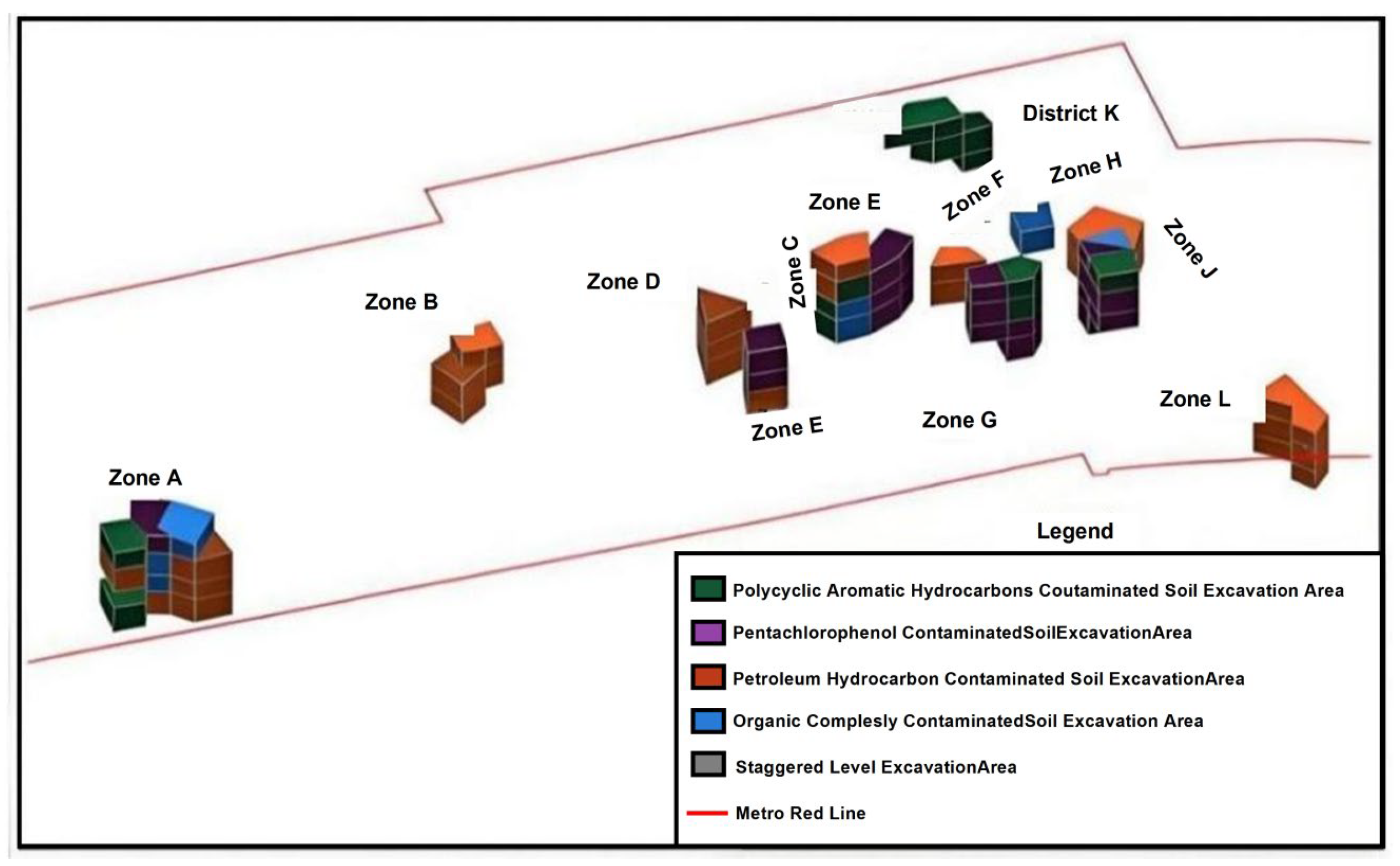
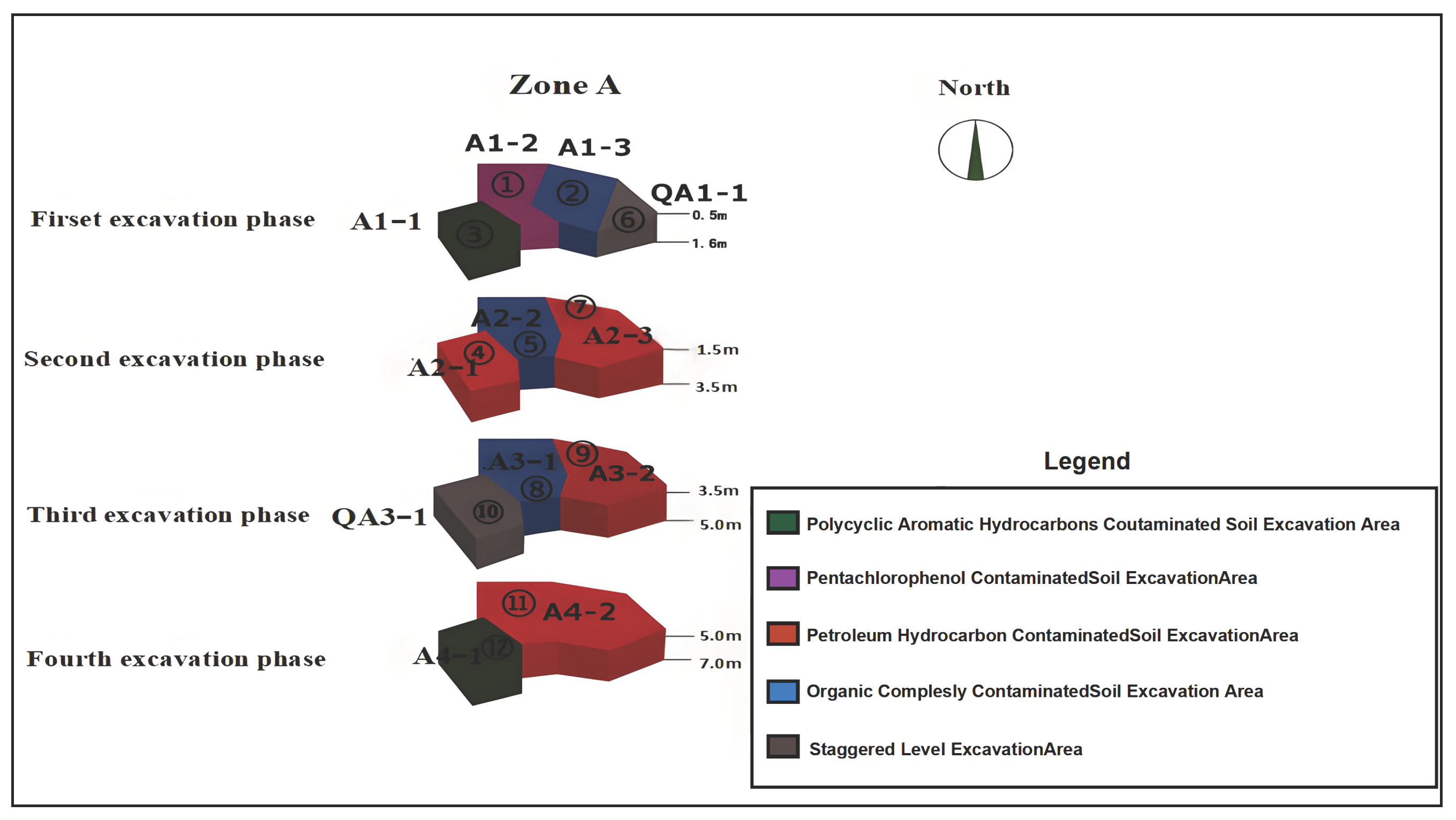
2.1.2. Demarcation of Pollution Remediation Areas
2.2. Determination of Process Parameters and Equipment
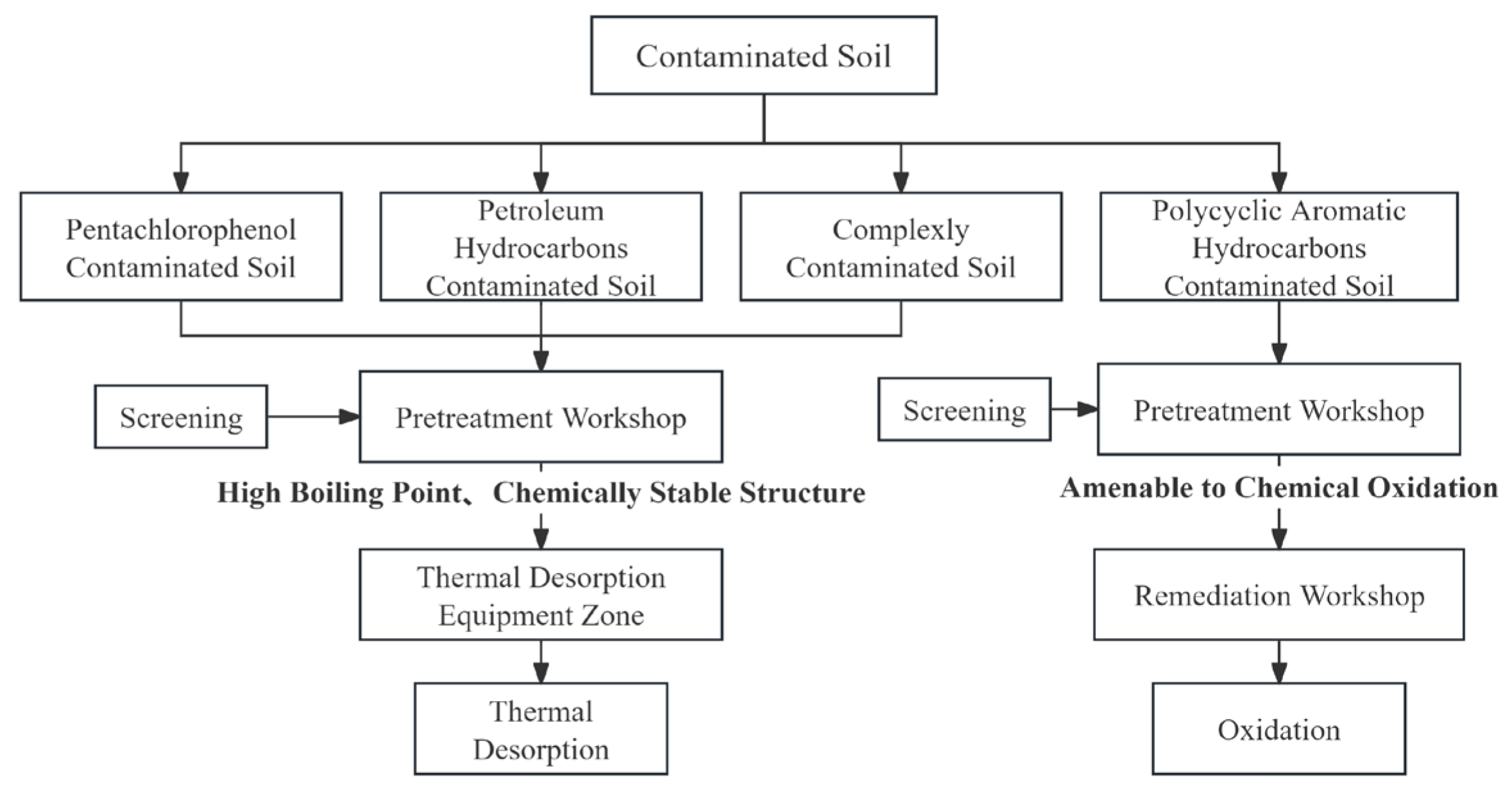
2.2.1. Split-Flow Process
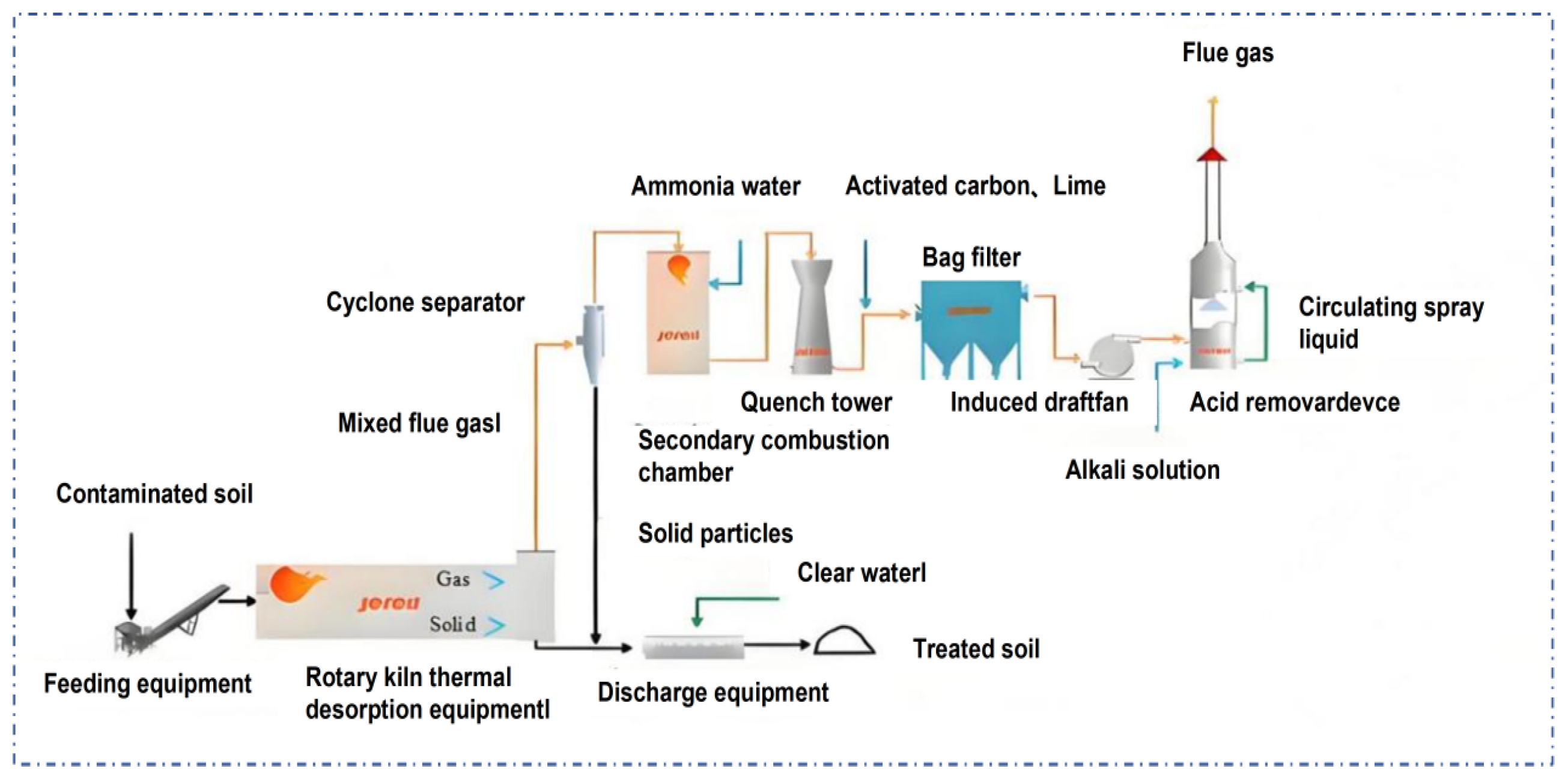
2.2.2. ESTD Process Parameters and Equipment
2.2.3. ISCO Process Parameters and Reagents
2.2.4. Remediation Effect Evaluation Parameters
- (1)
- Removal rate
- (2)
- Compliance rate
- (3)
- Carbon emission accounting method
2.3. Sampling and Testing Methods
2.3.1. Sampling Protocol
2.3.2. Sample Preservation
2.3.3. Detection Methods
3. Results
3.1. Results of Monitoring After Excavation Pit Completion
3.2. Remediation Results of Contaminated Soil
3.2.1. Remediation Effect of Enhanced Thermal Desorption (ESTD)
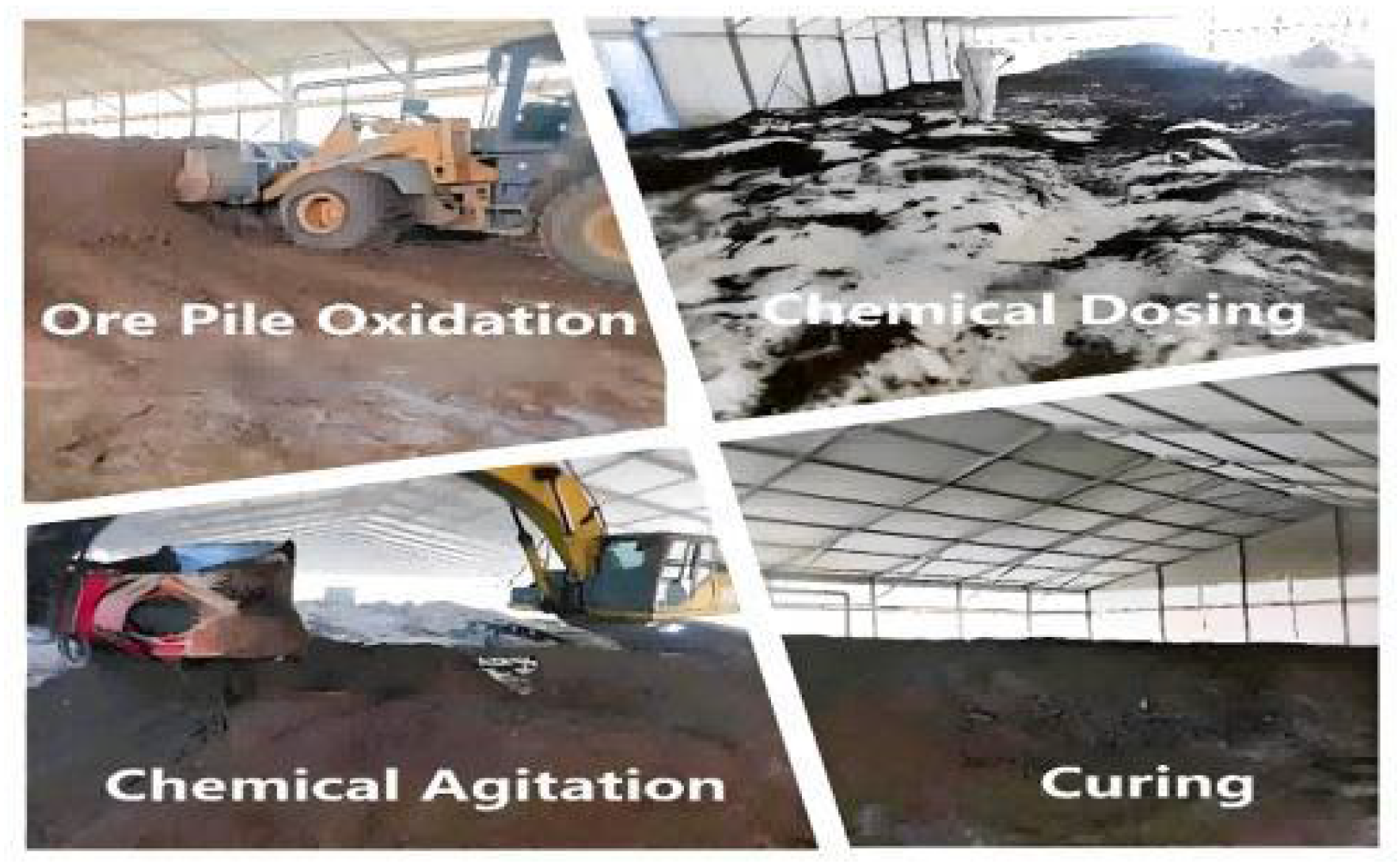
3.2.2. Results of Chemical Oxidation Stage
3.3. Test Results for Secondary Contaminated Areas
4. Discussion
4.1. Removal Efficiency and Contaminant–Technology Matching Patterns
- (1)
- High-Thermal Sensitivity/Oxidizability Group
- (2)
- Refractory Polycyclic Aromatics
- (3)
- Oxidation-Specific Group
SO4•− + OH− → SO42− + •OH
4.2. Time Efficiency: Synergistic Optimization of Microscopic Kinetics and Macroscopic Scheduling
4.2.1. Microscopic Kinetics Analysis
Ea = 200 kJ/mol, R = 8.314 J/(mol·K), T1 = 1173 K (900 °C), and T2 = 1273 K (1000 °C).
k2/k1 = exp[Ea/R × (1/T1 − 1/T2)] = exp[200,000/8.314 × (1/1173 − 1/1273)] ≈ 2.8
Oxidative decomposition of pentachlorophenol (PCP): C6HCl5O + (11/2)O2 + H2O → 6CO2 + 5HCl
Thermal oxidation of anthracene: C14H10 + (33/2)O2 → 14CO2 + 5H2O
4.2.2. Macro Process Scheduling Optimization
4.3. Comprehensive Assessment of Carbon–Energy–Cost Synergies
4.3.1. Synergistic Mechanisms for Energy Efficiency Improvement
4.3.2. Technology–Policy Synergies for Carbon Reduction Pathways
4.3.3. Cost–Benefit Mechanisms for Economies of Scale
5. Conclusions
Engineering Implications and Future Outlook
Author Contributions
Funding
Institutional Review Board Statement
Informed Consent Statement
Data Availability Statement
Conflicts of Interest
Abbreviations
| TD | thermal desorption |
| ESTD | ex situ thermal desorption |
| ISCO | chemical oxidation |
| PS-AOPs | Persulfate advanced oxidation |
| PAHs | polycyclic aromatic hydrocarbons |
| PCP | pentachlorophenols |
| PHC | Petroleum hydrocarbons |
| B[a]P | Benzo[a]pyrene |
| D[ah]A | Dibenzo [ah] anthracene |
| B[a]A | Benzo [a] anthracene |
Appendix A

| Number | Project Location | Technical Route | Scale m3 | Daily Processing Volume m3 d−1 | Energy Consumption kWh m−3 | Unit Cost USD m−3 * |
|---|---|---|---|---|---|---|
| 1 | A pesticide factory in Ningbo | Indirect thermal desorption (gas, 950 °C) | 24,808 | 120 | 763 | 106.31 |
| 2 | Northeast Pharmaceutical Group | Direct + indirect thermal desorption (natural gas, 1000 °C) | 51,078.5 | 240 | 820 | 139.28 |
| 3 | A certain steel plant in Beijing | Reverse burning rotary kiln (1000 °C) | 10,000 | 150 | 900 | 139.28 |
| 4 | Suzhou A Chemical Plant | Resistance heating (ERH, 950 °C) | 272,214 | 300 | 940 | 132.31 |
| 5 | Suzhou B Chemical Plant | Resistance heating (ERH, 950 °C) | 403,097 | 320 | 960 | 135.10 |
| 6 | Nanjing C Chemical Plant | Heat conduction heating (TCH, electric, 900 °C) | 36,767 | 110 | 980 | 137.88 |
| 7 | A chemical site in Guangzhou | Heat conduction heating (TCH, gas, 900 °C) | 24,864 | 130 | 870 | 128.13 |
| 8 | Tianjin D Chemical Plant | Heat conduction heating (TCH, electric, 900 °C) | 29,391 | 100 | 990 | 140.67 |
| 9 | Wuhan E Chemical Factory | Heat conduction heating (TCH, electric, 950 °C) | 66,000 | 140 | 970 | 136.49 |
| 10 | Shanghai F Chemical Plant | Heat conduction heating (TCH, gas, 900 °C) | 300 | 15 | 890 | 129.53 |
| 11 | Anchorage (AK, USA) | Heat conduction heating (TCH, electric, 900 °C) | 1529 | 22 | 464 | 167.13 |
| 12 | A decommissioned solvent plant in Jiangsu | Gas thermal desorption (950 °C, 99.8% removal rate) | 5000 | 50 | 1010 | 153.20 |
| 13 | A pesticide factory in Beijing | Thermal desorption (940 °C) | 3000 | 40 | 1050 | 160.17 |
| 14 | A pesticide factory in Tianjin | Thermal desorption (900 °C, 30 min) | 2000 | 30 | 1100 | 167.13 |
| 15 | Organophosphorus pesticide factory in Sichuan | Thermal desorption (900–950 °C) | 4000 | 45 | 1050 | 154.60 |
| 16 | A coking plant in Anhui Province | Thermal desorption (1000 °C, 30 min) | 56,000 | 200 | 900 | 111.42 |
| 17 | A steel plant in Chongqing | Chemical oxidation + reactor thermal desorption | 3483 | 80 | 1346 | 167.13 |
| 18 | Pringy, France | In situ thermal desorption (electric, 80 °C) | 10,000 | 30 | 4860 | 348.19 |
References
- Ministry of Ecology and Environment of the People’s Republic of China (MEE); Ministry of Natural Resources of the People’s Republic of China (MNR). National Soil Pollution Status Survey Report. 2014. Available online: http://www.mee.gov.cn/ (accessed on 15 June 2025).
- Li, K.; Sun, R.; Guo, G. The Rapid Increase of Urban Contaminated Sites along China’s Urbanization during the Last 30 Years. iScience 2023, 26, 108124. [Google Scholar] [CrossRef]
- Ou, S.P.; Liao, X.L.; Huang, Z.T.; Hu, Y.C.; Cai, Z.; Chen, Z.F. Bioaccessibility and health risk assessment of hydrophobic organic pollutants in soils from four typical industrial contaminated sites in China. Acta Sci. Circumstantiae 2025, 147, 282–293. [Google Scholar] [CrossRef]
- Cao, W.; Geng, S.; Zou, J.; Wang, Y.; Guo, Y.; Zhu, Y.; Dou, J. Post-relocation of Industrial Sites for Decades: Ascertain Sources and Human Risk Assessment of Soil Polycyclic Aromatic Hydrocarbons. Ecotoxicol. Environ. Saf. 2020, 198, 110646. [Google Scholar] [CrossRef]
- Zhao, L.; Lyu, C.; Li, Y. Analysis of Factors Influencing Plant–Microbe Combined Remediation of Soil Contaminated by Polycyclic Aromatic Hydrocarbons. Sustainability 2021, 13, 10695. [Google Scholar] [CrossRef]
- Barati, A.F.; Jamshidi-Zanjani, A.; Saeedi, M. A Comprehensive Review of Soil Remediation Contaminated by Persistent Organic Pollutants Using Electrokinetic: Challenging Enhancement Techniques. Environ. Manag. 2025, 373, 123587. [Google Scholar]
- Li, F.; Zhang, Y.; Wang, S.; Li, G.; Shen, K. Insight into ex-situ thermal desorption of soils contaminated with petroleum via carbon number-based fraction approach. Chem. Eng. J. 2019, 385, 123946. [Google Scholar] [CrossRef]
- Lee, S.H.; Lee, J.H.; Jung, W.C.; Park, M.; Kim, M.S.; Lee, S.J.; Park, H. Changes in Soil Health with Remediation of Petroleum Hydrocarbon Contaminated Soils Using Two Different Remediation Technologies. Sustainability 2020, 12, 10078. [Google Scholar] [CrossRef]
- Chen, B.; Xu, J.; Zhu, L.Z. Controllable Chemical Redox Reactions to Couple Microbial Degradation for Organic Contaminated Sites Remediation: A Review. Environ. Sci. 2024, 139, 428–445. [Google Scholar] [CrossRef]
- Zhang, S.; Zhao, J.; Zhu, L. New Insights into Thermal Desorption Remediation of Pyrene-Contaminated Soil Based on an Optimized Numerical Model. Hazard. Mater. 2024, 461, 132687. [Google Scholar] [CrossRef] [PubMed]
- Gao, Y.F.; Yang, H.; Zhan, X.H.; Zhou, L.X. Scavenging of BHCs and DDTs from Soil by Thermal Desorption and Solvent Washing. Environ. Sci. Pollut. Res. 2013, 20, 1482–1492. [Google Scholar] [CrossRef] [PubMed]
- Jung, J.H.; Khirul, A.; Kang, D.; Jee, H.; Park, C.; Jung, Y.; Song, S.; Yang, E. The Cutting-Edge Solutions for Soil and Sediment Remediation in Shipyard Environments. Processes 2025, 13, 2010. [Google Scholar] [CrossRef]
- Park, M.-O.; Panthi, G.; Park, J.-H.; Bajagain, R.; Lee, K.Y.; Hong, Y. Molecular Weight-Dependent Desorption of Alkanes in Low-Temperature Thermal Treatment of Total Petroleum Hydrocarbon-Contaminated Soils. Water Air Soil Pollut. 2025, 236, 77. [Google Scholar] [CrossRef]
- Li, Y.; Yang, J.; Wei, M.; Song, Y. Process Optimization of Modified Sodium Persulfate for the Remediation of Petroleum Hydrocarbon Contaminated Soil. PLoS ONE 2025, 20, e0331869. [Google Scholar] [CrossRef]
- Dominguez, C.M.; Rodriguez, V.; Montero, E.; Romero, A.; Santos, A. Methanol-Enhanced Degradation of Carbon Tetrachloride by Alkaline Activation of Persulfate: Kinetic Model. Sci. Total Environ. 2019, 666, 631–640. [Google Scholar] [CrossRef]
- Deng, B.; Carter, R.A.; Cheng, Y.; Liu, Y.; Eddy, L.; Wyss, K.M.; Ucak-Astarlioglu, M.G.; Luong, D.X.; Gao, X.; JeBailey, K.; et al. High-Temperature Electrothermal Remediation of Multi-Pollutants in Soil. Nat. Commun. 2023, 14, 6116. [Google Scholar] [CrossRef]
- Zhou, Z.; Liu, X.T.; Sun, K.; Lin, C.Y.; Ma, J.; He, M.C.; Ouyang, W. Persulfate-Based Advanced Oxidation Processes (AOPs) for Organic-Contaminated Soil Remediation: A Review. Chem. Eng. 2019, 372, 836–851. [Google Scholar] [CrossRef]
- Sang, K.; Wu, X.; Li, B.; Ke, C. In-Situ Jet Grouting–Assisted Chemical Oxidation for Remediation of Polycyclic Aromatic Hydrocarbon–Contaminated Sites: An Engineering Practice. Environ. Eng. 2025, 151, 04025058. [Google Scholar] [CrossRef]
- Liu, C.; Xia, W.; Cao, Z.; Dai, J.; Zhou, R.; Li, H.; Xu, J. Bibliometric Analysis and Research Progress on Hydrogen Peroxide and Persulfate Oxidation Processes in the Remediation of Actual Oil-Contaminated Soil. Environ. Sci. Pollut. Res. 2025, 32, 4403–4430. [Google Scholar] [CrossRef] [PubMed]
- Tsitonaki, A.; Petri, B.; Crimi, M.; Mosbæk, H.; Siegrist, R.L.; Bjerg, P.L. In Situ Chemical Oxidation of Contaminated Soil and Groundwater Using Persulfate: A Review. Crit. Rev. Environ. Sci. Technol. 2010, 40, 55–91. [Google Scholar] [CrossRef]
- Sun, H.; Yang, X.R.; Xie, J.Y.; Li, X.Y.; Zhao, Y.S. Remediation of Diesel-Contaminated Aquifers Using Thermal Conductive Heating Coupled with Thermally Activated Persulfate. Water Air Soil Pollut. 2021, 232, 324. [Google Scholar] [CrossRef]
- Mora, V.C.; Rosso, J.A.; Le Roux, G.C.; Martire, D.O.; Gonzalez, M.C. Thermally Activated Peroxydisulfate in the Presence of Additives: A Clean Method for the Degradation of Pollutants. Chemosphere 2009, 75, 1405–1409. [Google Scholar] [CrossRef]
- Liang, C.; Yang, S.; Xing, B.; Li, C.; Yuan, F.; Wang, J.; Dong, W.; Yan, S.; Sun, Z. Review and perspective of sulfate radical-based advanced oxidation processes (SR-AOPs) in the remediation of polycyclic aromatic hydrocarbon (PAHs) contaminated soil. J. Environ. Manag. 2025, 390, 126337. [Google Scholar] [CrossRef]
- Chen, X.; Li, L.; Zhang, Y.; Gu, H. Coupling of Low-Temperature Thermal Desorption and Oxidation for the Remediation of Crude Oil Contaminated Soil. Braz. Chem. Eng. 2025, in press. [CrossRef]
- Li, Y.-T.; Sui, Q.; Li, X.; Wang, Y.-Q.; Liu, X.-Y.; Liu, H.; Du, W.-Y. Enhanced In-Situ Zero-Valent Iron Activated Persulfate Oxidation with Electrokinetics for the Remediation of Petroleum Hydrocarbon Contaminated Soil. Environ. Chem. Eng. 2024, 12, 113781. [Google Scholar] [CrossRef]
- Jiang, D.; Li, T.; Liang, X.; Zhao, X.; Li, S.; Li, Y.; Oh, K.; Liu, H.; Cao, T. Evaluation of Petroleum Hydrocarbon-Contaminated Soil Remediation Technologies and Their Effects on Soybean Growth. Environments 2025, 12, 6. [Google Scholar] [CrossRef]
- GB 36600-2018; Ministry of Ecology and Environment; State Administration for Market Regulation. Soil Environmental Quality—Control of Soil Pollution Risk in Construction Land. China Standards Press: Beijing, China, 2018.
- Zhang, S.; Wang, S.; Zhao, J.; Zhu, L. Predicting Thermal Desorption Efficiency of PAHs in Contaminated Sites Based on an Optimized Machine Learning Approach. Environ. Pollut. 2024, 346, 123667. [Google Scholar] [CrossRef] [PubMed]
- Han, C.; Zhu, X.; Xiong, G.; Gao, J.; Wu, J.; Wang, D.; Wu, J. Quantitative study of in situ chemical oxidation remediation with coupled thermal desorption. Water Res. 2023, 239, 120035. [Google Scholar] [CrossRef]
- Li, Y.T.; Wang, Y.Q.; Du, S.W.Y. Remediation of petroleum hydrocarbon contaminated soils by nZVI coupled with electrokinetic activation of persulfate. J. Clean. Prod. 2024, 459, 142514. [Google Scholar] [CrossRef]
- Xu, J.; Guan, H.; Liu, C.; Zhou, R.; Wang, J.; Zhai, X.; Chen, T.; Wang, M. Research Progress on Remediation of Petroleum Contaminated Soil by Persulfate: Existing Technologies, Degradation Pathway, and Future Direction. Environ. Chem. Eng. 2025, 13, 116540. [Google Scholar] [CrossRef]
- HJ 25.5-2018; Technical Guideline for Verification of Risk Control and Soil Remediation of Contaminated Site. China Environmental Publishing Group: Beijing, China, 2018.
- Zhang, Y.; Chen, H.; Cao, Y.; Liang, X.; Ji, H.; Lin, K.; Yang, Y. An Interpretable Machine Learning Framework for Optimizing Chemical Oxidative Remediation of Organic Pollutants in Soils. Environ. Chem. Eng. 2025, 13, 118564. [Google Scholar] [CrossRef]
- Navarro, A.; Cañadas, I.; Martinez, D.; Rodriguez, J.; Mendoza, J.L. Application of solar thermal desorption to remediation of mercury-contaminated soils. Sol. Energy 2009, 83, 1405–1414. [Google Scholar] [CrossRef]
- Zhang, Y.N.; Deng, X.W.; Yuan, X.Z. Environmental risk assessment of soil and groundwater in a typical petroleum hydrocarbon-contaminated site. J. Green Sci. Technol. 2021, 23, 147–150. [Google Scholar]
- Ding, H.; Wang, D.; Chen, C.; Yang, Y.; Wu, T.; Wang, H.; Xu, H.; Yang, X.; Liu, P. Case analysis of multi-technology combined treatment engineering for typical coking contaminated sites. J. Environ. Eng. Technol. 2023, 13, 1732–1739. [Google Scholar]
- Chen, H.; Cao, Y.; Qin, W.; Lin, K.; Yang, Y.; Liu, C.; Ji, H. Machine Learning Models for Predicting Thermal Desorption Remediation of Soils Contaminated with Polycyclic Aromatic Hydrocarbons. Sci. Total Environ. 2024, 927, 172173. [Google Scholar] [CrossRef] [PubMed]
- Li, Z.; Liang, J.; Li, J.; Ma, X.; Lang, Y.; Li, H.; Qiu, H.; Cao, X.; Zhao, L. Thermal desorption coupled with persulfate oxidation for removing soil organic pollutants: Key role of soil organic matter passivation. J. Hazard. Mater. 2025, 500, 140382. [Google Scholar] [CrossRef] [PubMed]
- Ministry of Ecology and Environment. Catalogue of Remediation Technologies for Contaminated Sites, 2022nd ed.; Ministry of Ecology and Environment: Beijing, China, 2022; p. 41.
- Sheng, W.; Jiao, W.; Li, S.; Yue, Y.; Gu, H.; Zhan, M.; Zhang, B.; Xu, X. Demonstration and effect evaluation of heap-type gas-fired thermal desorption engineering for coking-contaminated sites. Res. Environ. Sci. 2022, 35, 9. [Google Scholar] [CrossRef]
- USEPA. Guidance for Comparing Background and Chemical Concentrations in Soil for CERCLA Sites; EPA 540-R-01-003; USEPA: Washington, DC, USA, 2002.
- HJ 25.6-2018; Technical Guidelines for Site Remediation. China Environmental Press: Beijing, China, 2018.
- Dagaut, P.; Cathonnet, M. The Ignition, Oxidation, and Combustion of Kerosene: A Review of Experimental Kinetic Studies. Prog. Energy Combust. Sci. 2006, 32, 48–92. [Google Scholar] [CrossRef]
- HJ168-2020; Technical Guidelines for Formulating Environmental Monitoring and Analysis Method Standards. China Environmental Publishing Group: Beijing, China, 2020.
- HJ 703-2014; Soil and Sediment-Determination of Phenolic Compounds-Gas Chromatography. China Environmental Science Press: Beijing, China, 2014.
- HJ 834-2017; Soil and Sediment-Determination of Semi-Volatile Organic Compounds-Gas Chromatography/Mass Spectrometry. China Environmental Press: Beijing, China, 2017.
- HJ 1021-2019; Soil and Sediment-Determination of Petroleum Hydrocarbons(C10–C40)-Gas Chromatography. China Environmental Publishing Group: Beijing, China, 2019.
- Tian, H.; Li, C.; Wang, Z.; Zhao, S.; Xu, Y.; Wang, S. Polycyclic Aromatic Hydrocarbons Degradation Mechanisms in Methods Using Activated Persulfate: Radical and Non-Radical Pathways. Chem. Eng. J. 2023, 473, 145319. [Google Scholar] [CrossRef]
- Jadhao, P.; Khare, A.; Patil, M.; Kumar, A.R. Roles of Surfactant, Oxidant and Activator on Enhanced Electrokinetic-Persulfate Technique for the Removal of Hydrophobic Organic Compounds in Soil: A Review. J. Environ. Chem. Eng. 2023, 11, 109525. [Google Scholar] [CrossRef]
- Fan, G.; Cang, L.; Gomes, H.I.; Zhou, D. Electrokinetic Delivery of Persulfate to Remediate PCBs Polluted Soils: Effect of Different Activation Methods. Chemosphere 2016, 144, 138–147. [Google Scholar] [CrossRef] [PubMed]
- Phillips, I.M.; Ghirardi, J.K. Impact of Soil Heterogeneity on Measuring the Attainment of PCB Clean-Up Standards; ASTM International: West Conshohocken, NJ, USA, 2022. [Google Scholar]
- Luo, Y.R. Bond Dissociation Energies of Organic Molecules. In CRC Handbook of Chemistry and Physics, 103rd ed.; CRC Press: Boca Raton, FL, USA, 2022. [Google Scholar]
- Stockholm Convention on Persistent Organic Pollutants (POPs). The 16 New POPs: An Introduction to the Chemicals Added to the Stockholm Convention as Persistent Organic Pollutants by the Conference of the Parties; Stockholm Convention on Persistent Organic Pollutants (POPs): Châtelaine, Switzerland, 2017. [Google Scholar]
- Qi, C.; Liu, X.; Lin, C.; Zhang, X.; Ma, J.; Tan, H.; Ye, W. Degradation of sulfamethoxazole by microwave-activated persulfate: Kinetics, mechanism and acute toxicity. Chem. Eng. J. 2014, 249, 6–14. [Google Scholar] [CrossRef]
- Ding, D.; Song, X.; Wei, C.; LaChance, J. A review on the sustainability of thermal treatment for contaminated soils. Environ. Pollut. 2019, 253, 449–463. [Google Scholar] [CrossRef]
- Yang, Z.Y.; He, Q.J.; Ling, W.T. Effect of roasting heat treatment on the immobilization of zinc and copper in soil. Jiangsu Agric. Sci. 2016, 44, 500–503. [Google Scholar]
- Lominchar, M.A.; Lorenzo, D.; Romero, A.; Santos, A. Remediation of soil contaminated by PAHs and TPH using alkaline activated persulfate enhanced by surfactant addition at flow conditions. J. Chem. Technol. Biot. 2018, 93, 1270–1278. [Google Scholar] [CrossRef]
- Yang, Z.H.; Chen, X.K.; Gan, Z.D.; Wang, Y.Z.; Niu, S.L.; Han, K.H. Research Progress on Thermal Chlorine Removal Technology for Polyvinyl Chloride and Its Mixed Plastics. Plast. Sci. Technol./Suliao Ke-Ji 2024, 52. [Google Scholar] [CrossRef]
- Luo, Y.M.; Zheng, H. China Contaminated Site Remediation Technology Development Report, 2020 ed.; Science Press: Beijing, China, 2021; pp. 87–92. (In Chinese) [Google Scholar]
- Che, M.; Su, H.; Si, H.; Guo, B.; Huang, R.; Zhao, J.; Su, R. Efficient Composite Chlorinated Ethenes Removal Using Gallic Acid to Enhance Fe/Ni Nanoparticles Activated Persulfate. Environ. Sci. Pollut. Res. 2024, 31, 8855–8867. [Google Scholar] [CrossRef] [PubMed]
- Galwey, A.K.; Brown, M.E. Application of the Arrhenius Equation to Solid State Kinetics: Can This Be Justified? Thermochim. Acta 2002, 386, 91–98. [Google Scholar] [CrossRef]
- Liu, Z.; Li, X.; Yu, J.; Shi, H.; Wang, J.; Ma, F.; Gu, Q. Carbon Emissions and Reduction Potential of Ex-Situ Thermal Desorption (ESTD) for Contaminated Sites Based on Actual Projects in China. Clean. Prod. 2025, 507, 145551. [Google Scholar] [CrossRef]
- China Energy News. National Carbon Market Trading Price Remains Stable with an Upward Trend. People’s Daily 2025-01-13. Available online: http://paper.people.com.cn/zgnyb/pc/content/202501/13/content_30052542.html (accessed on 15 June 2025).


| Test Items | PHC | B[a]P | D[ah]A | B[a]A | PCP |
|---|---|---|---|---|---|
| Screening values * | 4500 | 1.5 | 1.5 | 15 | 2.7 |
| Control values * | 9000 | 5.5 | 5.5 | 55 | / |
| Maximum | 7010 | 3.91 | 2.92 | 22.4 | 4.45 |
| Detection rate (%) | 96.8 | 6.5 | 1.1 | 7.7 | 37.1 |
| Maximum content (point-depth) | S14-0.5 | XS09-0.5 m | XS09-0.5 m | XS09-0.5 m | XS26-2.0 |
| Maximum over-limit multiple | 0.56 | 1.61 | 0.95 | 0.49 | 0.65 |
| Category | Environmental Assessment No. | Excavation No. | Pollution Type | Theoretical Volume | Actual Volume | Transport Route | Treatment Measure |
|---|---|---|---|---|---|---|---|
| Polluted soil excavation | A1 | A1-1 | PAHs | 1211.23 | 1209.84 | A foundation pit–pretreatment workshop | Chemical oxidation |
| A2 | A1-2 | PCP | 1255.81 | 2902.97 | A foundation pit–pretreatment workshop | Thermal desorption | |
| A3 | A1-3 | Organic complex pollution | 1578.66 | A foundation pit–pretreatment workshop | |||
| Staggered soil | QA1-1 | — | — | 553.97 | 552.25 | Transported to clean soil temporary storage area | To be tested |
| Total | 4599.67 | 4665.06 | |||||
| Stages | Region | Unit Volume/Area | Main Sample Number | Parallel Sample | Little Calculator |
|---|---|---|---|---|---|
| Clearing effect | Bottom of the pit | ≤40 m × 40 m grid | 61 | 10 | 71 |
| Side wall a | Layering | 200 | 28 | 228 | |
| After repair | Chemical oxidation reactor | ≤500 m3 | 25 | 5 | 30 |
| Thermal desorption reactor | ≤500 m3 | 152 | 20 | 172 | |
| Secondary pollution zone | Grid ≤ 40 m × 40 m | 84 | 12 | 96 | |
| Combined | 548 | 79 | 627 | ||
| Target Substances | Container | Filling Method | Storage Temperature | Shelf Life | Notes |
|---|---|---|---|---|---|
| Petroleum hydrocarbons | 250 mL glass | Headspace minimum | 4 °C | 14 d | — |
| PAHs, pentachlorophenol | 250 mL glass | Headspace minimum | 4 °C | 10 d | — |
| Benzene series (low concentrations) | 40 mL brown | 2 × 40 mL + dry weight | 4 °C | 7 d | Add a stirring bar |
| Benzene series (high concentration) | 40 mL brown | Methanol protection | 4 °C | 14 d | Extract within 7 days |
| Indicators | PHC | PCP | B[a]A | B[a]P | D[ah]A | |||||
|---|---|---|---|---|---|---|---|---|---|---|
| Side Wall | Pit Bottom | Side Wall | Pit Bottom | Side Wall | Pit Bottom | Side Wall | Pit Bottom | Side Wall | Pit Bottom | |
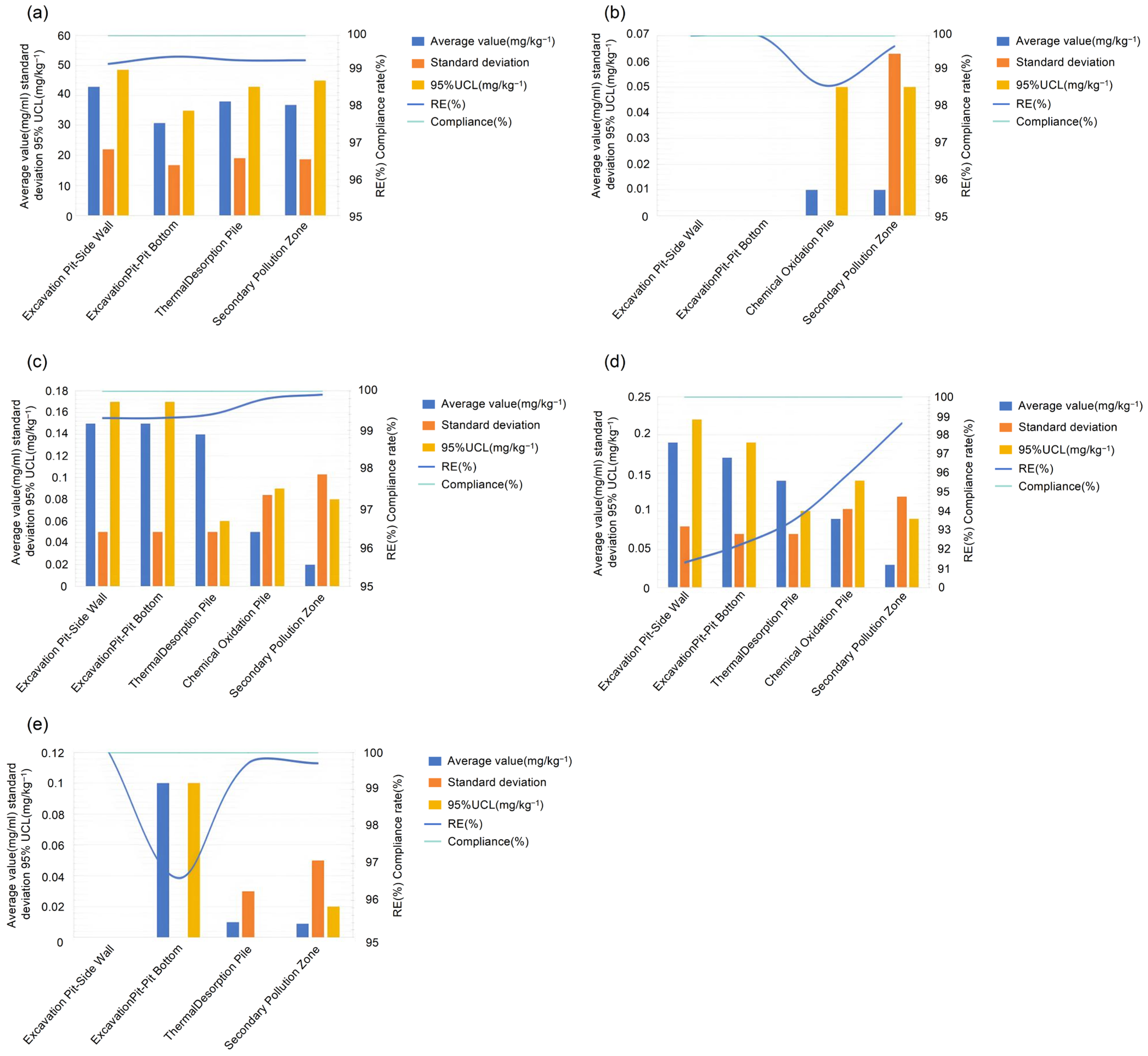
| Average (mg kg−1) | 42.8 | 30.7 | - | - | 0.15 | 0.15 | 0.19 | 0.17 | - | 0.1 |
| Standard deviation | 22.0 | 16.8 | - | - | 0.05 | 0.05 | 0.08 | 0.07 | - | 0.0 |
| 95% UCL | 48.5 | 34.9 | - | - | 0.17 | 0.17 | 0.22 | 0.19 | - | 0.10 |
| Removal rate (%) | 99.2 | 99.4 | 100 | 100 | 99.3 | 99.3 | 91.3 | 92.2 | 100 | 96.6 |
| Compliance rate (%) | 100 | 100 | 100 | 100 | 100 | 100 | 100 | 100 | 100 | 100 |
| Indicators | PHC | PCP | B[a]A | B[a]P | D[ah]A | |||||
|---|---|---|---|---|---|---|---|---|---|---|
| ESTD | SPA | ESTD | SPA | ESTD | SPA | ESTD | SPA | ESTD | SPA | |
| Average (mg kg−1) | 38 | 36.8 | — | 0.01 | 0.14 | 0.02 | 0.14 | 0.03 | 0.01 | <0.01 |
| Standard deviation | 19.1 | 18.7 | — | 0.063 | 0.05 | 0.103 | 0.07 | 0.119 | 0.03 | 0.05 |
| 95% UCL | 42.82 | 44.87 | — | 0.05 | 0.06 | 0.08 | 0.1 | 0.09 | 0.00 | 0.02 |
| Removal rate (%) | 99.3 | 99.3 | — | 99.7 | 99.4 | 99.9 | 93.5 | 98.6 | 99.7 | 99.7 |
| Compliance rate | 100 | 100 | 100 | 100 | ||||||
| Indicators | Average (mg kg−1) | Standard Deviation | 95% UCL | Removal Rate (%) | Compliance Rate (%) |
|---|---|---|---|---|---|
| B[a]A | 0.08 | 0.084 | 0.21 | 99.6 | 100 |
| B[a]P | 0.12 | 0.103 | 0.29 | 94.5 | 100 |
| D[a,h]A | — | — | — | 100 | 100 |
| Benzene and benzene compounds | — | — | — | 100 | 100 |
Disclaimer/Publisher’s Note: The statements, opinions and data contained in all publications are solely those of the individual author(s) and contributor(s) and not of MDPI and/or the editor(s). MDPI and/or the editor(s) disclaim responsibility for any injury to people or property resulting from any ideas, methods, instructions or products referred to in the content. |
© 2025 by the authors. Licensee MDPI, Basel, Switzerland. This article is an open access article distributed under the terms and conditions of the Creative Commons Attribution (CC BY) license (https://creativecommons.org/licenses/by/4.0/).
Share and Cite
Xing, S.; Duan, X.; Feng, M. Research on the Combined Treatment of Composite Organic-Contaminated Soil Using Diversion-Type Ultra-High-Temperature Pyrolysis and Chemical Oxidation. Sustainability 2025, 17, 10807. https://doi.org/10.3390/su172310807
Xing S, Duan X, Feng M. Research on the Combined Treatment of Composite Organic-Contaminated Soil Using Diversion-Type Ultra-High-Temperature Pyrolysis and Chemical Oxidation. Sustainability. 2025; 17(23):10807. https://doi.org/10.3390/su172310807
Chicago/Turabian StyleXing, Shuyuan, Xianglong Duan, and Minquan Feng. 2025. "Research on the Combined Treatment of Composite Organic-Contaminated Soil Using Diversion-Type Ultra-High-Temperature Pyrolysis and Chemical Oxidation" Sustainability 17, no. 23: 10807. https://doi.org/10.3390/su172310807
APA StyleXing, S., Duan, X., & Feng, M. (2025). Research on the Combined Treatment of Composite Organic-Contaminated Soil Using Diversion-Type Ultra-High-Temperature Pyrolysis and Chemical Oxidation. Sustainability, 17(23), 10807. https://doi.org/10.3390/su172310807