Article

Analysis of Specific Habitat Conditions for Fish Bioindicator Species Under Climate Change with Machine Learning—Case of Sutla River


1
Civil Engineering Department, University of Applied Sciences, 10000 Zagreb, Croatia
2
Faculty of Civil Engineering, University of Rijeka, 51000 Rijeka, Croatia
3
Section of Ecology, Elektroprojekt Consulting Engineers, 10000 Zagreb, Croatia
*
Author to whom correspondence should be addressed.
Sustainability 2025, 17(23), 10803; https://doi.org/10.3390/su172310803
Submission received: 17 October 2025 / Revised: 17 November 2025 / Accepted: 27 November 2025 / Published: 2 December 2025
(This article belongs to the Special Issue Sustainable Use of Water Resources in Climate Change Impacts)

Abstract

In studies of potential climate change (CC) impacts on freshwater ecosystems, water temperature is a primary abiotic factor. Still, it is insufficient to describe the specific habitat conditions that have changed for the biological elements of water quality affecting fish. In this study, special attention is focused on the fish bioindicator species, Barbus balcanicus. For two future scenarios of CC impact (RCP4.5 (2020–2050) and RCP8.5 (2070–2100)), in a Sutla River water body case study, fish life stage models are developed based on the fundamental abiotic factors (water flow, depth, velocity, temperature, and dissolved oxygen) to describe the ecological requirements of the selected fish bioindicator species. Two future CC impact scenarios and their results—water flow, dissolved oxygen, and nutrients, prepared by SWAT—have been analysed. To determine the most important abiotic factors, for water temperature, depth, and velocity, models have been developed by the machine learning tool Weka. The modelled biological elements of water quality were combined with previously calculated dissolved oxygen, flow, and E-flow values during dry periods and the spawning period. For both selected CC scenarios, the results indicate that in approximately 60–70% of the life stages of the bioindicator species Barbus balcanicus, the conditions are acceptable.

1. Introduction

Related to the 17 defined United Nations (UN) Sustainable Development Goals (SDGs) for Sustainable Development until 2030, particularly SDG13—Climate Action—the need to analyse the impact of humans and climate change (CC) on water resources, and the future needs of human society regarding water resources, is crucial for defining sustainable integrated water management of the river basin. An imbalance between the environmental and economic objectives of river basin management is the result of intensive soil and water resources use. The solution is presented in sustainable integrated river basin water management, which aims to achieve the environmental objectives of the Water Framework Directive (WFD). This can be reached only if appropriate flow, sediment, and nutrient regimes, along with related river morphology quality, are guaranteed. The WFD is more focused on water quality, and there is no explicit obligation to define E-flow. Most EU countries have prepared and developed procedures for investigating and determining E-flow related to specific climate, hydrographic, and hydrological conditions. The concept of E-flow, its definition, and its practical use are fundamental in achieving water-related UN SDGs, and relate to social perspectives and climate change [1].
In the Republic of Croatia, there is currently no official methodology for defining E-flow. Ćosić-Flajsig et al. [2] introduced an innovative, holistic approach for assessing the E-flow under the present conditions in the case study of the water body downstream of the Vonarje dam in the transboundary Sutla River Basin, shared by Croatia and Slovenia. Research included the analysis and examination of available data to gain new knowledge about the river basin and its water bodies, with the aim of bridging the gap related to monitoring issues. This was done to assess the E-flow, which was determined through flow values and key abiotic indicators for fish bioindicator species.
As reported by the Intergovernmental Panel on Climate Change (IPCC, 2022) [3], CC is expected to alter precipitation patterns, evapotranspiration rates, and the river flow regime. Although E-flow regimes are not specifically documented in the WFD, their principles promote them to achieve good ecological status (GES) in river systems [4]. At first, the WFD did not indicate the CC adaptation measures to be included in River Basin Management Plans (RBMPs), but this phenomenon can be seen as a pressure on the water bodies during the development of the RBMPs [5].
Changes in the water regime have numerous consequences, and related issues of water quantity and water quality (including ecological and chemical water status) can lead to significant socio-economic and environmental problems [6]. Further modifications of natural flow patterns are expected to increase species’ vulnerability to extinction, while the health of the ecosystem and the ecosystem services are threatened, even if ecosystems might somehow adapt to the new conditions. Schneider et al. [7] state that the need for E-flow actions is further increasing under CC, and the diverse effects of CC must be considered. It is imperative to apply adaptive E-flow management and encompass the analysis of specific habitat conditions, such as dissolved oxygen, water temperature, water depth, and water velocity, for bioindicator species to minimise further stress on river ecosystems. Korkmaz et al. [8] investigated the CC impact on habitat suitability for endemic freshwater fish species in the Semi-Arid Central Anatolian Ecoregion in Turkey. They established that the protection of aquatic resources in the region is crucial for the conservation of endemic freshwater fish fauna in Turkey.
In studies of the potential impacts of CC on freshwater ecosystems, it is indicated that water temperature is a critical abiotic factor [2,9]. Although air temperature is the most visible sign of global CC, changes in water temperature can significantly modify the environment, especially the biosphere [9]. In cases where water temperature is not measured, it must be modelled or determined by other means. Stream water temperature can be modelled by linear regression using air temperature as the only input variable. Still, it is insufficient to characterise the specific habitat conditions that have changed for the biological elements of water quality for fish. Special attention should be provided to habitat conditions for bioindicator fish species inhabiting the watercourse. Analysis of the air temperature and stream temperature relationship at a geographically diverse set of streams using linear and nonlinear relationships is given in research by Morrill et al. [10]. The relationship between the daily temperature of river water and air, with the use of the cross-correlation function and Granger causality for the River Noteć and its tributaries (Western Poland), was analysed by Graf [11]. In the research by Rabi et al. [12], the relationship between the daily mean air temperature and the daily water temperature of the River Drava in Croatia was analysed using linear regression, stochastic modelling, nonlinear regression, and multilayer perceptron (MLP) feed-forward neural networks. According to their results, MLP models perform much better among other models, and can be applied for the estimation and prediction of daily mean river temperature. They work on the condition that it is not necessary to determine the nonlinear dependency between input and output parameters.
A study by Ćosić-Flajsig et al. [13] presented an integrated water quality management model to achieve environmental objectives, where future scenarios were modelled with the Soil and Water Assessment Tool (SWAT) based on land use, meteorological and hydrological data, data related to CC, and the implementation of different measures in the Sulta River basin. SWAT was employed to simulate the streamflow Qav. year (m3/s), sediment (t), total nitrogen (TN; kg), and total phosphorus (TP; kg). The baseline period was 2004–2014, while future periods were 2020–2050 and 2070–2100. Leone et al. [14] presented a similar approach, using SWAT+ to simulate daily streamflow for both the baseline period (1980–2010) and the future period (2020–2050), based on observed and modelled climate projections, respectively, as long-term observed streamflow data under natural conditions were not available. They developed a methodology for establishing the E-flow regime of a temporary river (Locone, Italy) under conditions of limited data availability and CC.
When large databases are available (like the ones produced from the SWAT model), the machine learning (ML) methods can be applied to discover complex patterns in the data. ML methods have been successfully applied in a wide range of Water Resource Management (WRM) fields, from streamflow prediction to identifying the movement and changes in pollutants in water resources [15]. In their research, Ozcan et al. [16] used a ML algorithm-based methodology for predicting the habitat suitability for the species Formica rufa (ant group). Through their research, they established that ML techniques are very effective for simulating species habitat appropriateness. Also, ML models have been used for identifying optimal habitats for industrial Suaeda aegyptiaca cultivation in Bushehr Province, India [17].
As mentioned, an innovative holistic model for present E–flow scenario assessment of the water body downstream of the Vonarje dam in the transboundary Sutla River Basin (between Croatia and Slovenia) has been proposed by Ćosić-Flajsig et al. [2]. This paper, as a novelty, presents a continuation of the research and an improvement in the previously developed methodology for the assessment of E-flow and specific habitat conditions for fish bioindicator species (for the present scenario), including CC (through selected future scenarios), with SWAT modelling (based on methodology developed by Ćosić-Flajsig et al. [13]), and with an emphasis on the use of ML methods for habitat suitability analyses for fish bioindicator species, all applied on the Sutla River Basin.
The research aims to present a continuation of the E-flow assessment by including the CC impact for the analysis of specific habitat conditions for fish bioindicator species.

2. Materials and Methods

2.1. Sutla River Basin

The transboundary Sutla River Basin, between Slovenia and Croatia, has an area of 590.6 km2, of which 77% is in Slovenia and 23% is in Croatia (Figure 1). The Sutlansko Lake (Vonarje Reservoir) was constructed in the 1980s by building the Vonarje dam within a natural retention area. The reservoir volume is 12.4 million m3, the surface area is 195 ha, and the length is approximately 6 km. The retention area and the bed of the Sutla River are protected as NATURA 2000 sites. The Vonarje dam was built as a multipurpose hydrotechnical facility, and the biological minimum, which was calculated during the design of the dam, was defined as a flow of 120 L/s [2]. A model for water quality management that supports good water status, particularly downstream of the dam/reservoir, was developed by the authors of this study, based on the information from the Croatian Water monitoring programme [13]. The impact assessment of the application of the basic and supplementary measures in the river basin was modelled by the SWAT. The aim was to assess the impact of current measures on future situations with the inclusion of CC, to create a basis for the analysis and proposal of tailor-made measures.
The knowledge related to the longitudinal profile of the river and the volume of Sutla Lake are preconditions to maintain the ecosystem of the river. E-flow below the dam was evaluated using pressure assessment and hydrological-hydraulic methods, with a calculated value of 0.68 m3/s [2].
On the basis of the research and from the results of the monitoring programme for the following parameters—temperature, salinity, pH, BOD5 (Biochemical Oxygen Demand for 5 days), COD (Chemical Oxygen Demand), ammonium, nitrite, TN, orthophosphate, and TP—the Sutla River belongs to water type 4a, denoting lowland medium-sized rivers, according to the Croatian Regulation on Water Quality Standards [18].

2.2. Biological Indicators

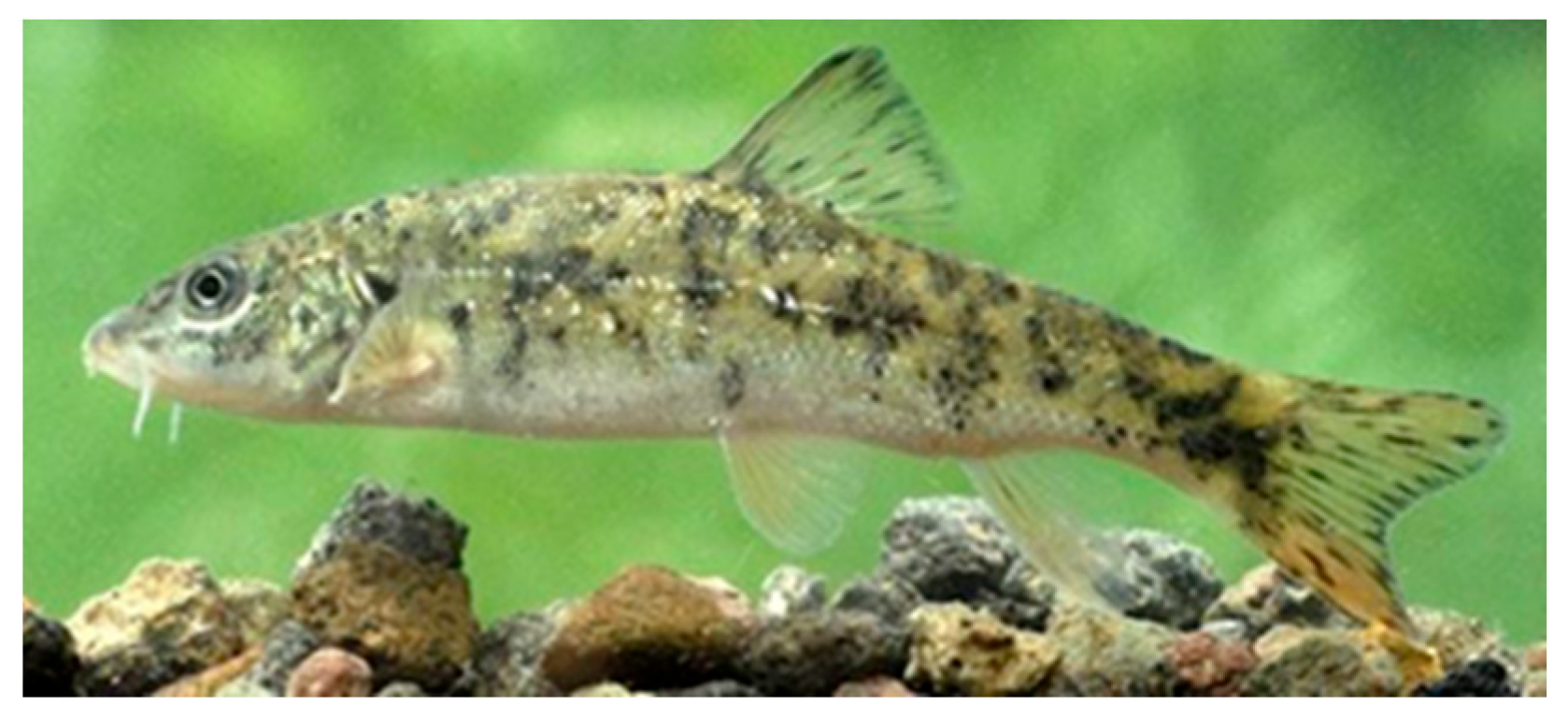
Verification of the E-flow value suitability defined by Ćosić-Flajsig et al. [2], determined by hydrological methods, for developing the necessary spatial and temporal dynamics of key ecological indicators downstream of the dam and at the Zelenjak gauging station cross-section on the Sutla River (Figure 1b), as well as for ensuring the living conditions of characteristic fish species, was based on hydraulic calculations. Special attention is focused on the fish bioindicator, Barbus balcanicus—the brook barbel species inhabiting the watercourse’s middle part (Figure 2).
The selection of the biological indicator fish species (brook barbel) and accompanying fish species downstream of the dam is important because the entire Sutla River is protected as a NATURA 2000 site. The brook barbel is listed as a vulnerable species (VU) in the Red Book of Freshwater Fishes of Croatia [19], while according to the International Union for Conservation of Nature Red List of Threatened Species, also known as the IUCN Red List [20], it is considered a species of least concern (LC), but with an unknown population trend. The most important causes of threat to this species are watercourse pollution, degradation, and the modification of its habitats by anthropogenic activities, especially the damming of rivers and streams, which prevent upstream migrations of brook trout for spawning and reduce their reproductive success. Each watercourse, and each of its sections, is inhabited by certain types of fish due to specific habitat conditions conditioned by the slope of the bottom of the bed, the width of the bed, the velocity, depth, and temperature of the water, and the type of substrate [6].
Barbus balcanicus brook barbel, a type of brook trout, spawns from April to June, and during the spawning period, it is required that the water depth is more than 40 cm, and the water velocity is more than 49 cm/s. The E-flow has been calculated based on the pressure assessment and hydrological-hydraulic methods, and it is 0.68 m3/s. The final E-flow has been increased to 0.98 m3/s [2] to fulfil the requirements of the fish bioindicators (Barbus balcanicus) so the ecosystem can function properly. The E-flow for the present scenario, on the profile downstream of the dam (Figure 1b), has been defined using a holistic approach by integrating morphological and hydrological characteristics with ecological considerations based on the research of the river and the biological communities inhabiting the river. Hydraulic calculations were performed at characteristic cross-sections of watercourses defined by hydrological methods, including water depth, flow velocity, and bed coverage [2]. The fundamental ecological requirements of the selected indicator fish species, brook barbel, i.e., individual stages of their development, are presented in Table 1.
The key abiotic factors important for the life stage spawning of the selected indicator fish species are as follows: a water depth greater than body height (BH, 20–45 cm); a water velocity of 0.35–0.5 m/s; a water temperature of 4–17 (14) °C; and dissolved oxygen above 6 mg/L [2,18,21]. Related to the fulfilment of values of the key abiotic factors, the value of the E-flow that meets the requirements of the fish bioindicator (Barbus balcanicus) is 0.98 m3/s.

2.3. Methodology

Integrated river basin management and good water status can be achieved if appropriate flow, sediment regime, and related river morphology quality are provided.
A holistic model for E-flow assessment for the present scenario was first developed and proposed by Ćosić-Flajsig et al. [2] and then further developed, including CC impact for different scenarios in a subsequent study [22], for the water body downstream of the Vonarje dam of the transboundary Sutla River Basin case study using SWAT modelling. The research aimed to determine the impact of CC on the holistic assessed E-flow by modelling low flows, sediment, TN, and TP under future CC scenarios in the data-limited river basin, using Indicators of Hydrological Alterations (IHAs) and biological indicators for the Sutla River downstream of the Vonarje dam [13].
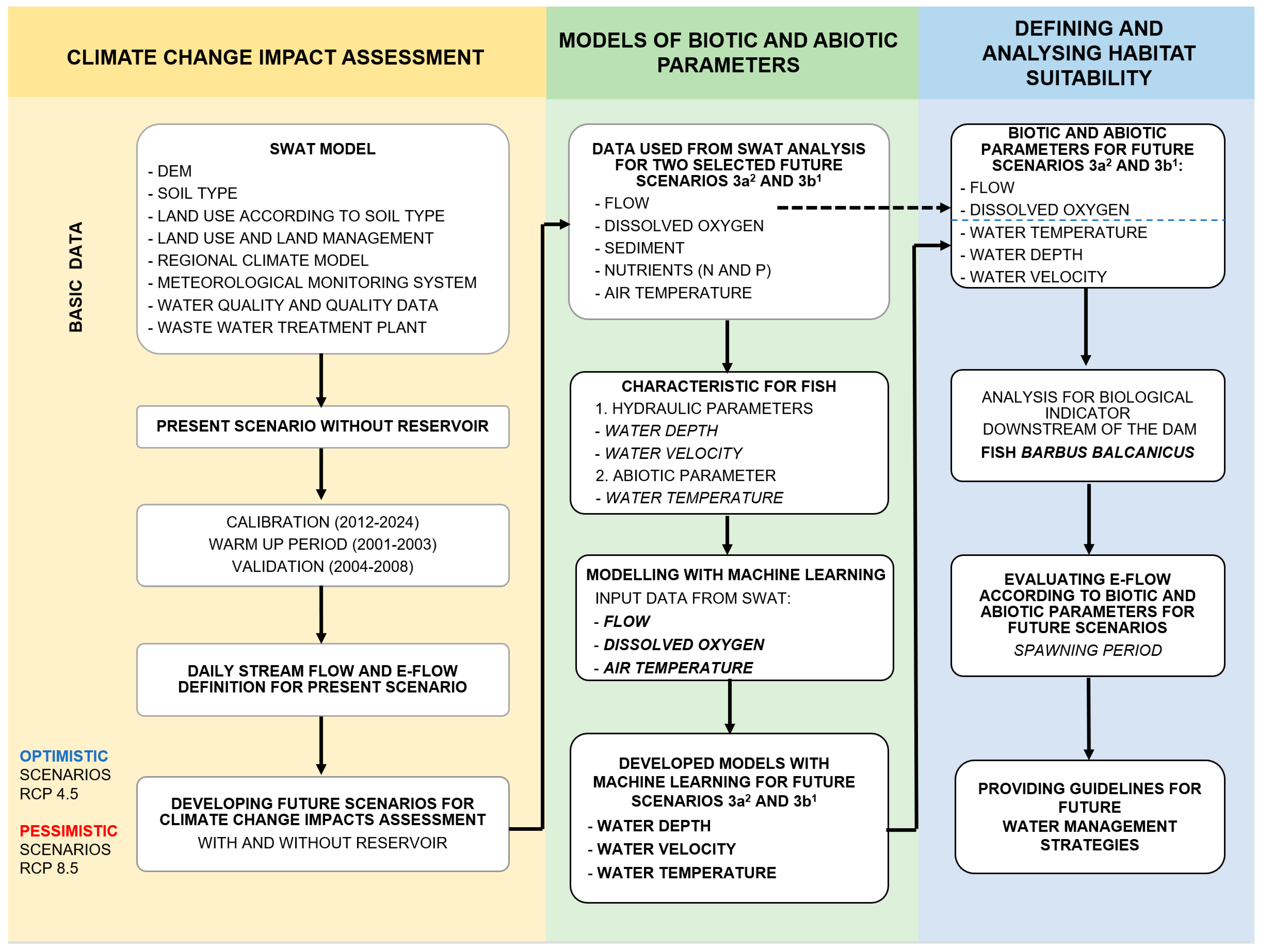
The proposed methodology [22] has been further improved and implemented in this paper. As a novelty, this includes the use of ML methods for habitat suitability analyses for fish bioindicator species, as presented in Figure 3. The methodology is based on analyses of river basin pressures under CC and the occurrence of hydrological extremes, as well as the implementation of a programme of basic and supplementary measures using the SWAT modelling tool (the yellow part of Figure 3 [13]). It also includes the analysis of E-flow and specific habitat conditions for fish bioindicator species, combined with modelling using ML methods (the green and blue parts of Figure 3). All components are applied to the Sutla River case study. Past (scenario 2), present (scenario 1), and future (scenario 3) scenarios were analysed using the SWAT model, which was developed based on land use, climatic and hydrological data, and CC projections. Analyses were conducted with (a) or without (b) the reservoir, and included measures related to municipal wastewater and agriculture [13].
The holistically assessed E-flow for future scenarios at the Sutla River profile, as was the case for the E-flow in the present scenario [2], is proposed by integrating hydrological, morphological, and ecological characteristics, as well as the composition and abundance of biological quality elements. The key steps of the holistic E-flow assessment methodology for future CC impact scenarios are:
  • Analyses of river basin pressures under CC impact by the SWAT model;
  • Programme of basic and supplementary measures;
  • Hydrological analysis and abiotic factors;
  • Biological research.
Biological indicators were used to improve the methodology for both present and future CC impact scenarios, to analyse specific habitat conditions for fish bioindicator species.
Based on CC adaptation strategies for Croatia (until 2070) and Slovenia (until 2050), as well as the results of regional and national models from the Slovenian Environmental Agency (ARSO), future scenarios for the Sutla River Basin were prepared. These include Representative Concentration Pathways (RCPs) of 4.5 as moderately optimistic and 8.5 as pessimistic for the periods 2020 to 2050 and 2070 to 2100, using six dynamically downscaled regional climate models (RCMs): CCLM4 (drivModel: CNRM-CERFACS-CNRM-CM5), CCLM4 (drivModel: MPI-M-MPI-ESM-LR), HIRHAM5, INERIS, RACMO22E, and RCA4. All scenarios were developed at the local river basin level with bias correction (BC) methods using empirical quantile mapping (EQM). RCMs were applied on precipitation, air temperature (maximum and minimum), global solar radiation, relative humidity, and wind speed in order to prevent unrealistic results on the daily level. Results of the SWAT model were verified by calibration and validation for the period (2004–2014), recognised statistical tests, the Nash-Sutcliff coefficient (NSE), and negative percent bias PBIAS by the SWAT CUP tool [13]. The results of the validation are in line with the calibration results. After calibration of the base model for the PRESENT scenario, parameters remained fixed for modelling FUTURE scenarios.
Eight FUTURE scenarios were developed:
  • (a) With reservoir: 3a1, 3a2, 3a3 and 3a4,
  • (b) Without reservoir: 3b1, 3b2, 3b3 and 3b4,
where the superscript denotes the selected RCP and time period as follows 1 RCP4.5 2020–2050; 2 RCP4.5 2070–2100; 3 RCP8.5 2020–2050; and 4 RCP8.5 2070–2100) [13].
The models provided results for the location downstream of Vonarje dam for SUBBASIN 2: Qav,year (m3/s); Qav,month (m3/s); Qav,month (m3/s) for the dry period (April–September); and Qav,month (m3/s) for the wet period (October–March).
Based on the results of analyses of river basin pressures under CC impacts using the SWAT model and the programme of basic and supplementary measures, two future CC scenarios with moderate impacts were selected: FUTURE 3a2 and FUTURE 3b1. The results for the selected two scenarios are presented in Section 3.
Not all 32 indicators of hydrological alterations (IHAS) for future climate impact scenarios, describing magnitude, timing, frequency, duration, rate of change, and periods of the year (dry and wet), were available for the analysis.
CC monitoring stations are limited in representing the basin’s topoclimatic diversity. The closest CC measuring station below the Vonarje dam is measuring station 590, which is located at approximately the same altitude as the analysed water body. For this measuring station, air temperatures were analysed to calculate water temperatures relevant to determining specific habitat conditions for indicator species using machine learning.
For the selected scenarios FUTURE 3a2 and FUTURE 3b1, only dissolved oxygen, Qav,year, and Qav,month have been calculated by the SWAT model.
Four key abiotic factors are important for the selected indicator fish species, the brook barbel, in the spawning life stage: water depth in cm, water velocity in cm/s, water temperature in °C, and dissolved oxygen in mg/L (Table 1). So, the E-flow values must be corrected after determining the deviation of the obtained values from those that ensure the living conditions for the survival of the characteristic indicator species, fish brook barbel, for dry periods, and the spawning period life stage.
To model abiotic factors (that were not available as measured data or data modelled by SWAT), the water depth, water velocity, and water temperature are used for habitat suitability analyses for fish bioindicator species; a model tree method integrated in the ML tool Weka [23] is applied, and this presents a new step and a novelty in the research.
Linear regression, stochastic modelling, nonlinear regression, and neural networks were also considered for modelling abiotic factors [12], but since a large database was produced from SWAT, ML was selected as a tool. ML discovers complex patterns in data and has been successfully applied in a wide range of Water Resource Management fields, from streamflow prediction to identifying the movement and changes in pollutants in water resources [15], and also for predicting the habitat suitability [16].
ML, precisely model trees in this case, uses a regression equation in terminal leaves, that allows them to provide a more precise prediction of the class value. One of the most used algorithms for the induction of model trees is the M5 algorithm, which is based on the top-down induction of decision trees (TDIDT) algorithm [24]. For the analysis conducted in this paper, a modification of the M5 algorithm was used, named M5P, which is implemented in the Weka ML tool [23,24]. After the model tree is built from the learning set of data, it is necessary to assess the quality of the obtained model, i.e., the accuracy of prediction. The quality of the obtained model can be assessed by using the model on a testing set of data and comparing the target’s predicted values with the actual values. Another possibility is applying a cross-validation method, in which the given data set is divided into a selected number of folds (n). Each fold is used for testing, and the remaining (n − 1) folds are used for training the model. The final error is the average error of all the models throughout the procedure [24]. In the conducted analysis, the 10-fold cross-validation method is applied to assess the model quality. To evaluate the model accuracy, the size of the error between the actual and the predicted values can be calculated by various measures: root mean-squared error (RMSE); mean absolute error (MAE); root relative squared error (RRSE); relative absolute error (RAE); and the correlation coefficient (R) [24]. In the conducted analysis, the accuracy of model prediction was assessed using all the above measures. On the basis of the actual data, the selected algorithm, and the proposed parameter settings used to determine the number of rules, Weka yields the model that demonstrates the highest overall performance.
The learning data set for obtaining prediction models was organised so that water depth, water velocity, and water temperature served as target variables. In contrast, the independent variables are month of the year and flow for water depth (WD) and water velocity (WV), while water temperature (WT) used month of the year, dissolved oxygen, air temperature, and flow. The above parameters were mainly used because they were the most suitable for modelling and accessibility, including both observed measurements and data generated by the SWAT model. Based on the procedure outlined above, prediction models for water depth, water velocity, and water temperature were derived and subsequently used for further analysis.
Model trees work well and provide interpretability with single tree and belonging equations that the other models lack. Also, building the model is fast, and in case pruning is applied, then the obtained models can be simple and comprehensible. Regarding this, such models can also be used for management purposes.
All the input ML data sources are presented in Figure 3. The data used for modelling are based on the 20-year continuous data series (monthly measurements) for the water quality and water quantity at the Zelenjak measuring station (Figure 1b). Monthly flow measurements, and the cross-sectional area determined by a topographic survey at the observed gauging station, were used to estimate the flow velocity based on hydrological monitoring data from 2000 to 2022. The flow area for each time step was calculated using an analytical relation between water depth and cross-sectional flow area. The continuity equation was then used to calculate the water velocity. This approach enabled the assessment of water velocity under varying flow and channel morphology conditions during the monitoring period.

3. Results

As the bioindicator for water body E-flow downstream of the Vonarje dam (Subbasin 2) (Figure 1), the fish Barbus balcanicus (brook barbel) was defined (Figure 2). Additionally, the longitudinal continuity of watercourses, except the Vonarje dam, was assessed for the PRESENT scenario and FUTURE scenarios. The reliability and effectiveness of this approach were illustrated by analysing the potential CC impacts on water availability in the Sutla River downstream of the Vonarje dam, using the SWAT model. Results from average annual numerical modelling for PRESENT, PAST, and FUTURE scenarios are presented in Table 2. For the flow of the PAST scenarios, Qav,year, the values are like those of the PRESENT scenario. The Qav,year values for FUTURE scenarios are the lowest for RCP 4.5 (2020–2050), followed by the values for RCP 8.5 (2070–2100). The results of the CC scenarios determined by the SWAT model, as a result of the implemented basic measures, show a potentially significant increase in the flow and the transport of sediment, while this is not the case with nutrients (TN and TP).
It was expected that all values due to CC would be considerably higher, as occurred with the average flow and sediment. However, hotspots in a few subbasins were identified.
Modelling CC impact, with six RCMs, on the river basin quantity (river flow) and quality (sediment, TN, and TP loads), contributed to improving knowledge and understanding. Two future scenarios (FUTURE 3a2 and FUTURE 3b1) have been selected as the average representative values. The selection of the “moderate” (neither optimistic nor pessimistic) FUTURE scenarios has been performed related to the “realistic” values based on the expert assessment and water management relevance (with and/or without reservoir) (Table 3). Analyses of the average minimum and maximum monthly flows, as well as dissolved oxygen (DO) levels downstream of the Vonarje dam for the present and two selected future scenarios, were prepared on the basis of the average monthly flow results from the eight future scenarios, and are presented in Table 3.
The conducted hydrological analyses do not show a significant trend of decreasing average monthly flows, but they do indicate an increasing trend in average minimum flows, with pronounced extremes occurring in both minimum and maximum values. This is particularly important during dry periods (average: 2.36 m3/s, 1.31 m3/s; maximum: 6.97 m3/s, 5.99 m3/s; and minimum: 0.13 m3/s, 0.09 m3/s).
To model abiotic factors that were not available as outputs from the SWAT model for the selected FUTURE scenarios (i.e., water depth, water velocity, and water temperature), the ML approach and Weka tool, described in Section 2.3. were applied to derive the inputs required for the habitat suitability analysis of fish bioindicator species.
The ML method, with model trees, as described, was used on the 20-year continuous data series (monthly measurements) for the water quality and water quantity at Zelenjak measuring station (Figure 1b), and the following models have been developed regarding the PRESENT scenario:
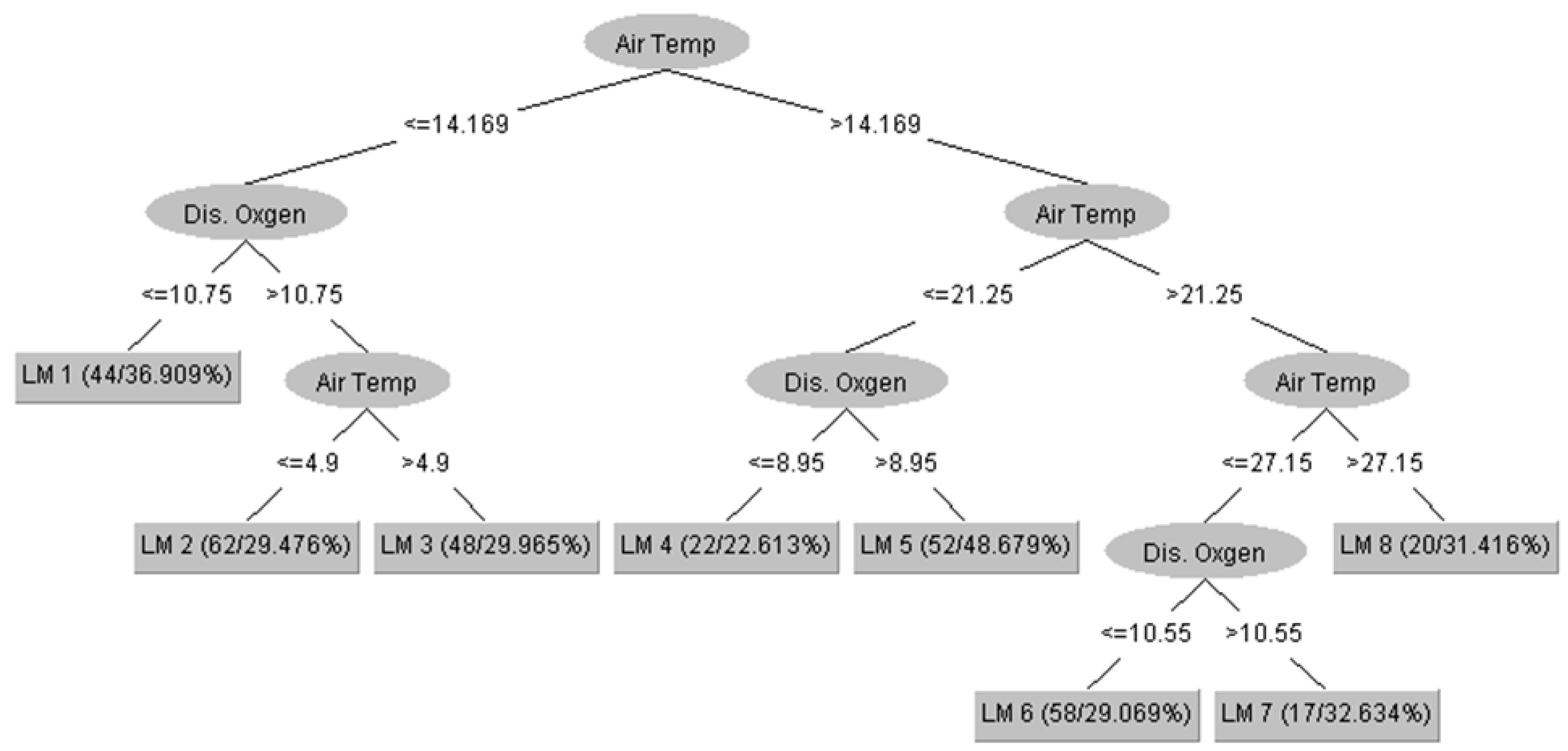
The model for water temperature (WT) is demonstrated in Figure 4, with associated model equations given in Table 4. The independent variables for building the model included month of the year, dissolved oxygen, air temperature, and flow. The WT model has eight leaves, each representing an equation used to predict water temperature.
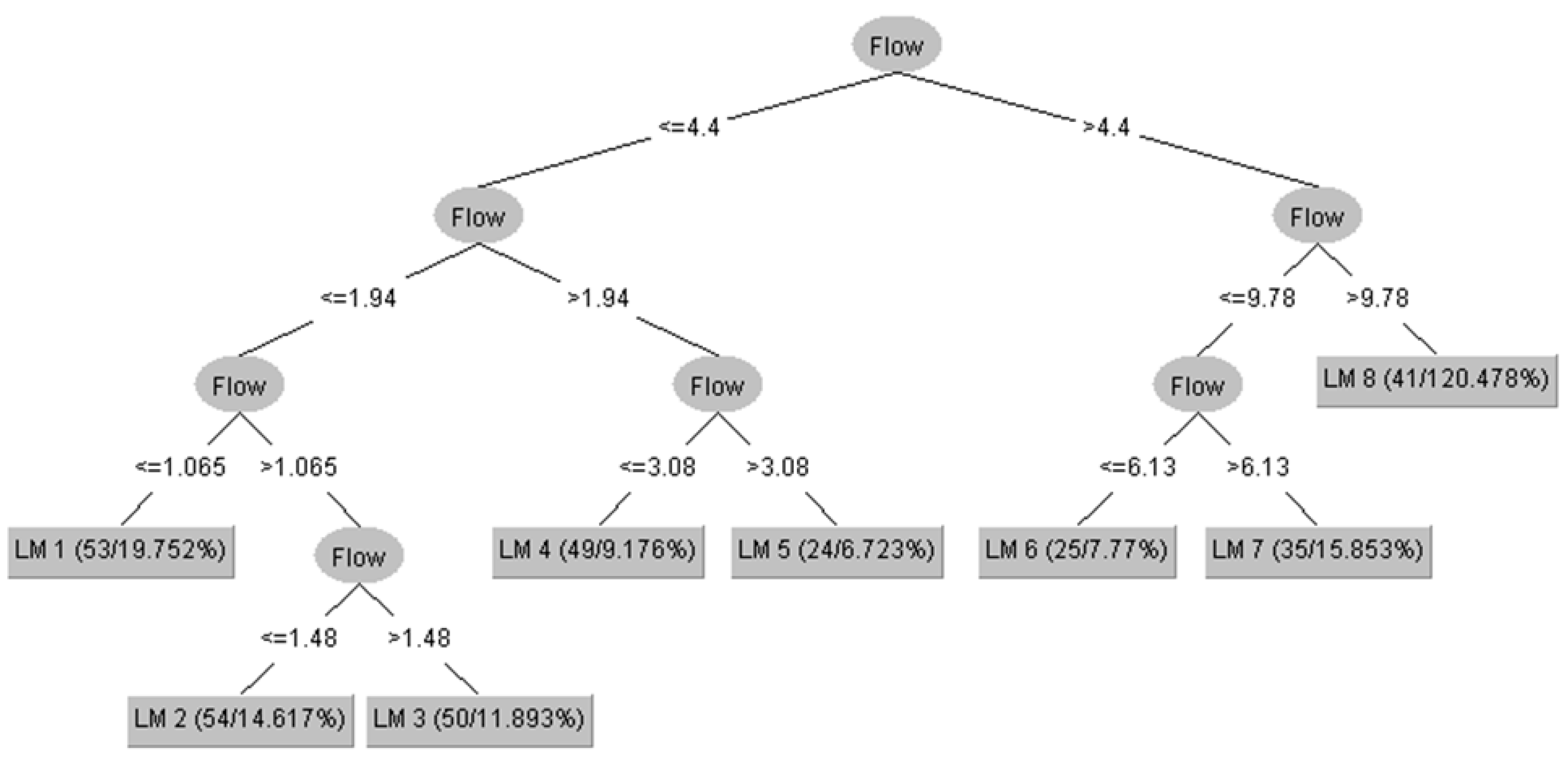
The model of WT (Figure 4, Table 4) has a very high correlation coefficient with a value of 0.95 and can be used for prediction purposes. The other parameters of the model are the MAE of 1.61, RMSE of 2.09, RAE of 27.56%, and RRSE of 31.16%. From the obtained model tree (Figure 4) and related equations (Table 4), it can be established that water temperature mainly depends on parameters such as air temperature and dissolved oxygen, and thus can be used for future scenarios under CC impact based on this model, which is necessary for assessing the E-flow and analysis of specific habitat conditions for fish bioindicator species.
Water depth (WD) is calculated based on the model tree demonstrated in Figure 5 with related model equations in Table 5. The independent variables for building the model comprised month of the year and flow. The model for WD has eight leaves, each representing an equation used for the prediction of WD.
The model for WD (Figure 5, Table 5) has a very high correlation coefficient, too, with a value of 0.96, indicating its suitability for prediction purposes. The other parameters of the model are the MAE of 5.94, RMSE of 11.34, RAE of 21.46%, and RRSE of 27.95%. From the obtained model and related equations, it can be seen that water depth mainly depends on flow, and thus can be used for future scenarios under CC impact based on this model, which is necessary for assessing the E-flow and analysis of specific habitat conditions for fish bioindicator species.
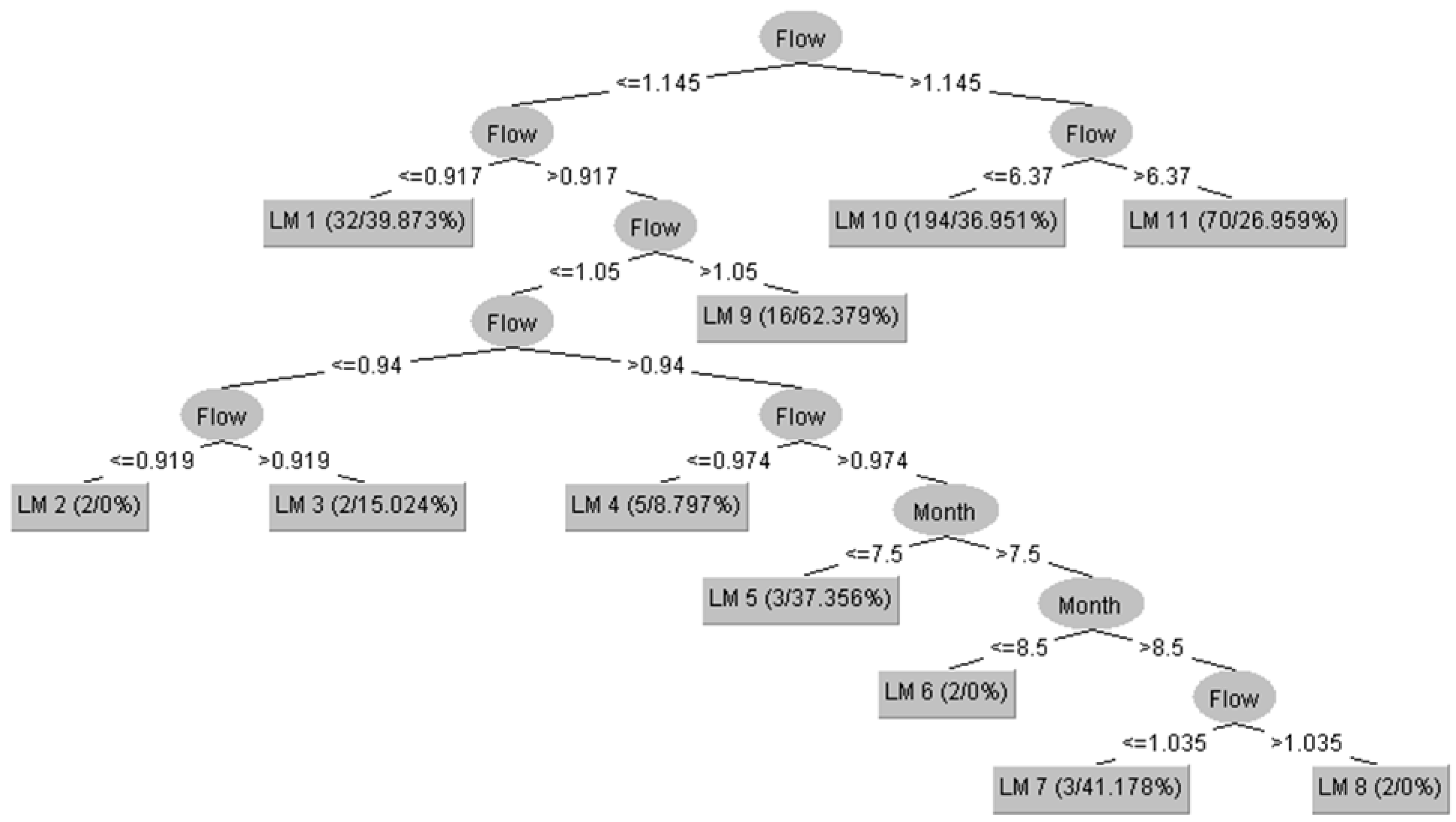
Water velocity (WV) is predicted based on the model tree presented in Figure 6 with related equations given in Table 6. The independent variables for building the model included the month of the year and flow. The obtained model has eleven leaves, each representing an equation used to predict water velocity.
The model for WV (Figure 6, Table 6) has a moderate correlation coefficient with a value of 0.56 and is thus suitable for use in prediction purposes. Other parameters of the model are MAE 0.26, RMSE 0.52, RAE 82.33%, and RRSE 85.87%. From the obtained model tree and related equations (for WV), it can be observed that the water velocity mainly depends on parameters such as month of the year and flow, and thus can also be used for future scenarios under CC impact based on this model, which is necessary for assessing the E-flow values and analysing specific habitat conditions for fish bioindicator species. Although a strong linear correlation between flow and water velocity was observed when analysing each individually, the combined multi-year data set exhibited a lower correlation (R = 0.56). This is attributed to the variation in riverbed geometry, which influences the relationship between water depth and flow across a cross-sectional area as described in Section 2. As mentioned, the water velocity is derived from the continuity equation. Different expressions for A(h) across years lead to divergent velocity values for the same flow rate, thus weakening the overall correlation when all years during the monitoring period are considered together.
The methodology of the defined E-flow for the PRESENT scenario is presented in Section 2 of this paper. The value of the E-flow that meets the requirements of fish bioindicators (Barbus balcanicus), 0.98 m3/s, is an important value for the assessment of the acceptable E-flow values under the impact of climate change.
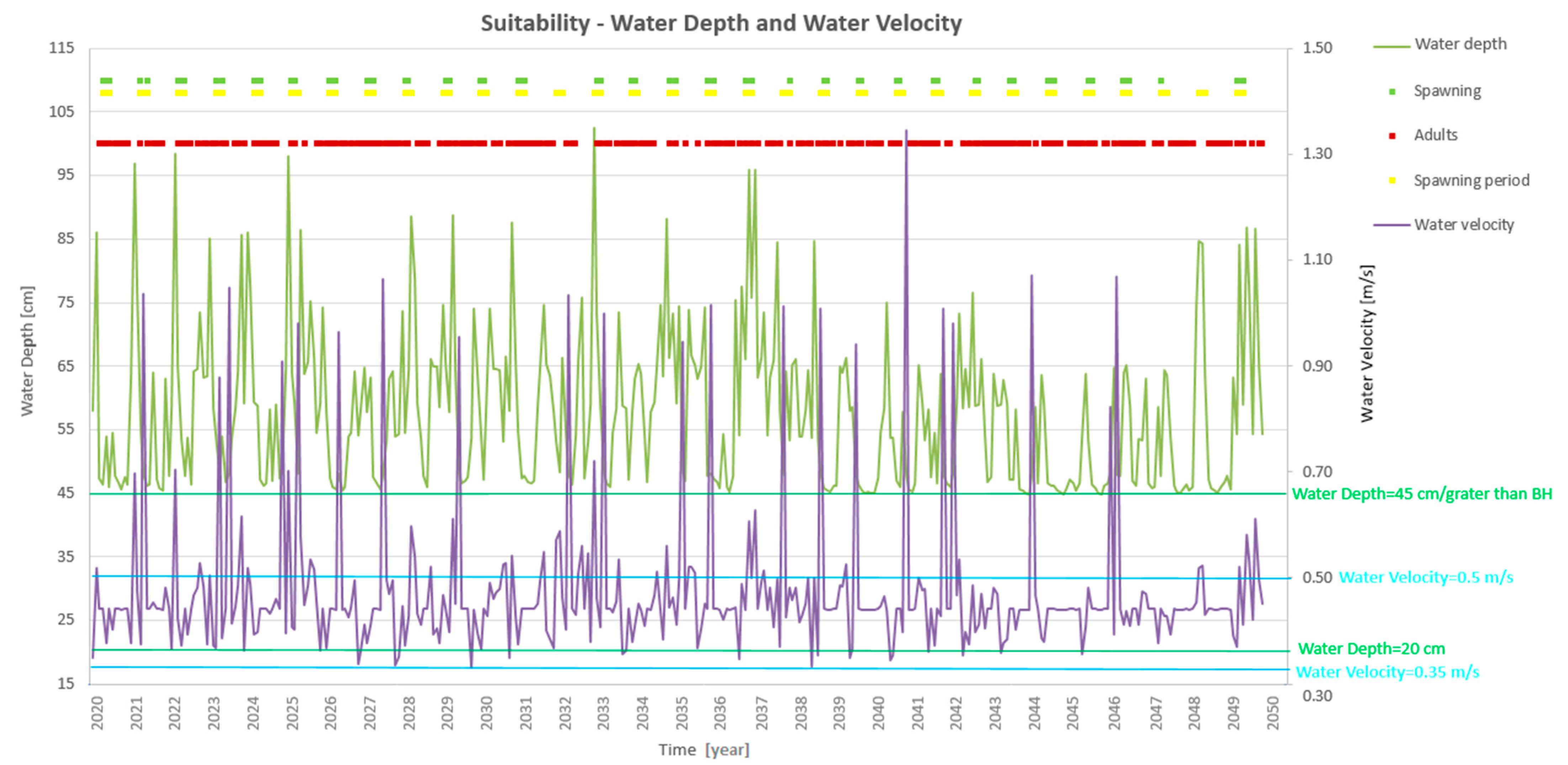
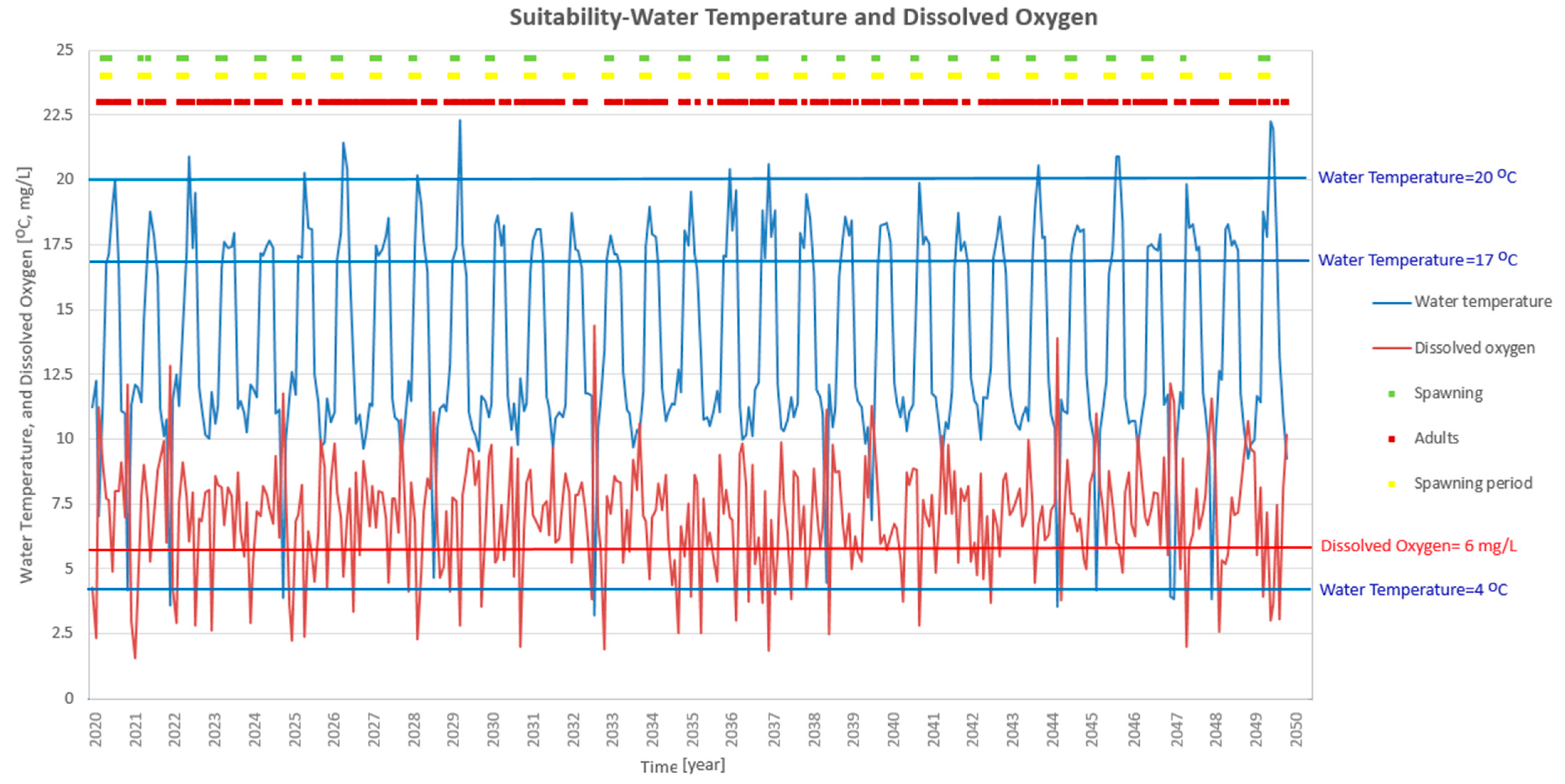
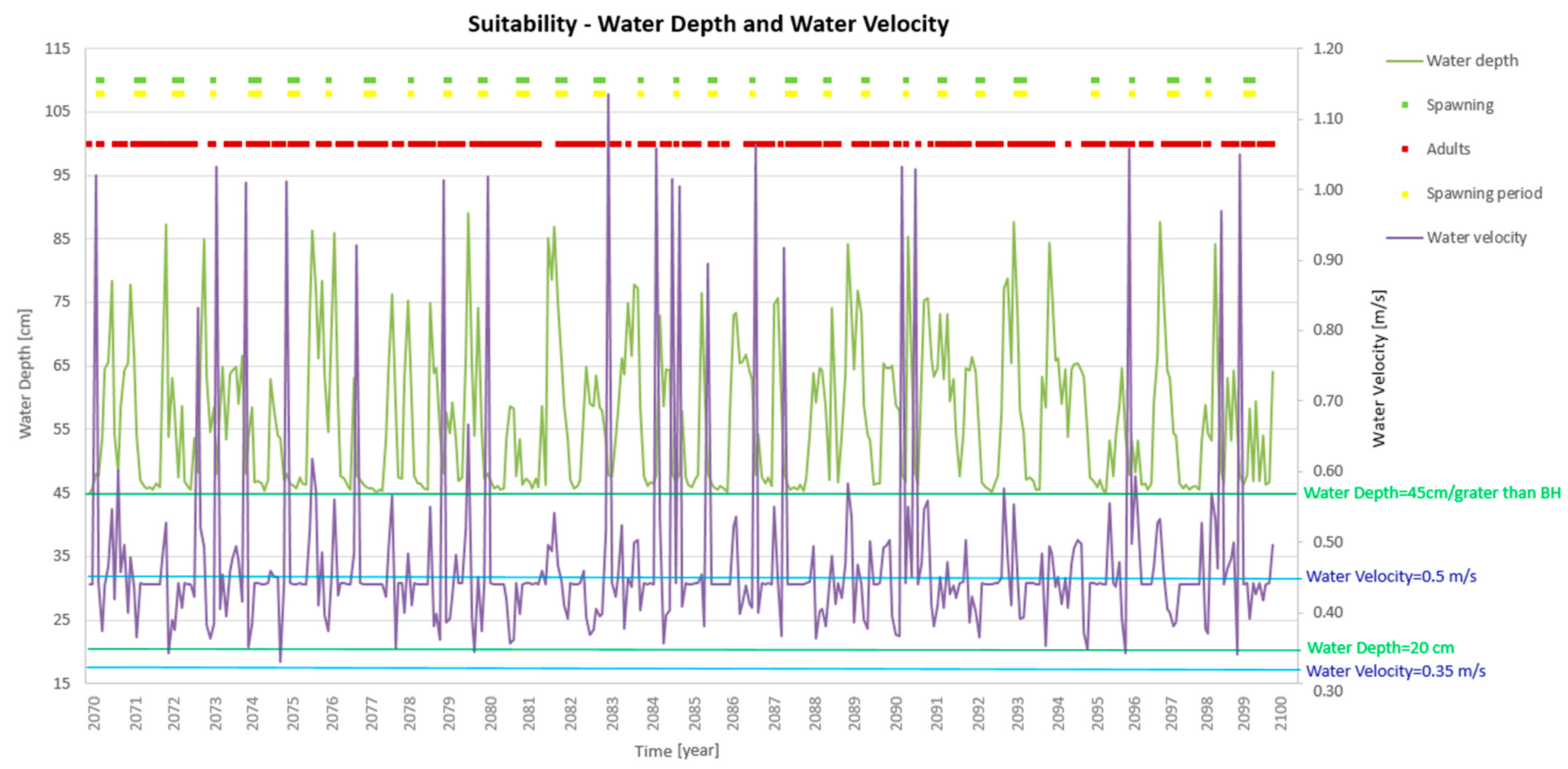
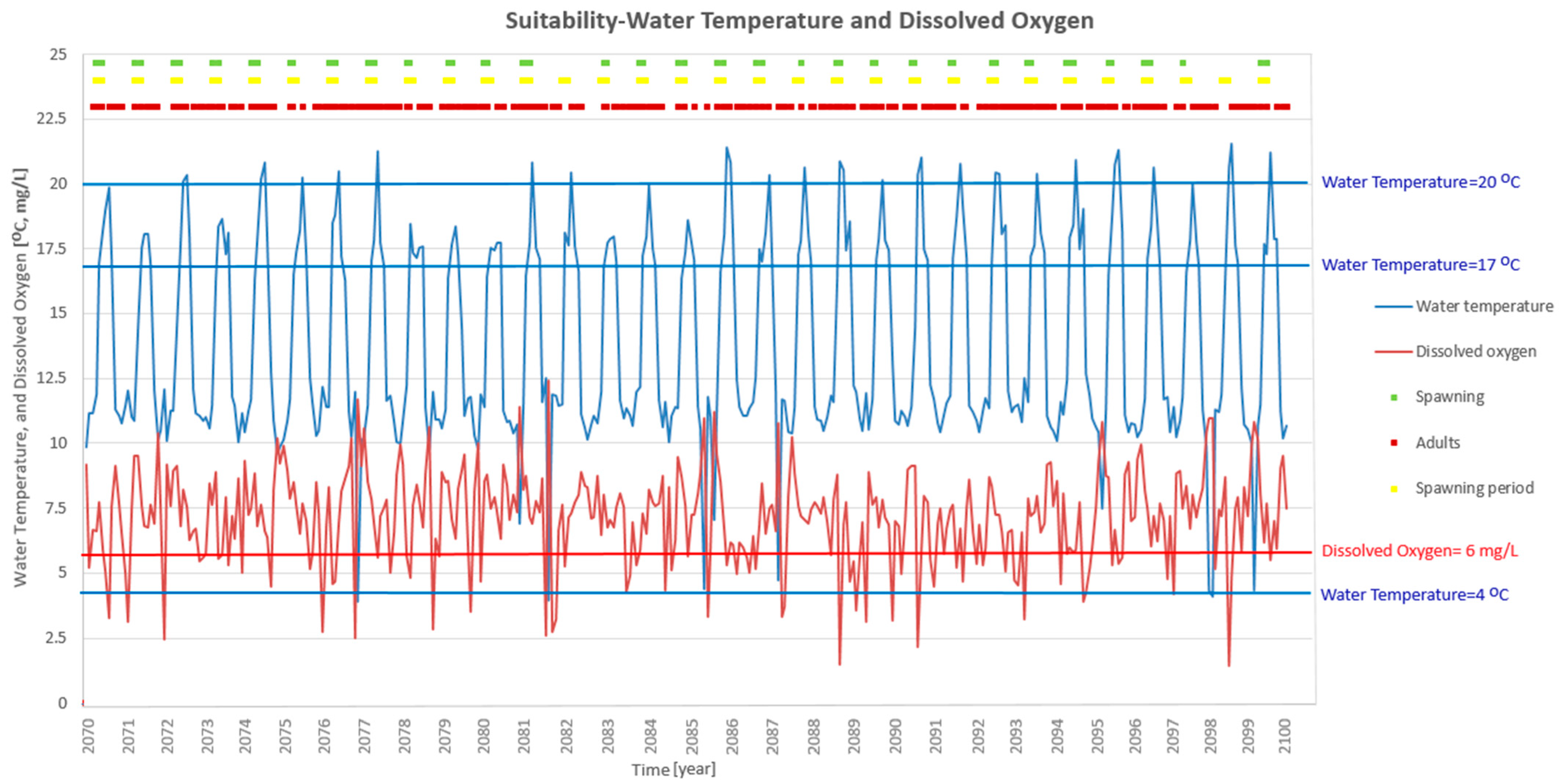
The scenarios selected for further analysis are FUTURE 3a2 (without reservoir, RCP 4.5 2020–2050) and FUTURE 3b1 (with reservoir, RCP 8.5 (2070–2100). The obtained model trees for abiotic parameters (Figure 4, Figure 5 and Figure 6, Table 4, Table 5 and Table 6) were used to define suitability for fish bioindicator species in selected FUTURE scenarios. For the FUTURE 3a2 scenario, the considered variables include water depth and water velocity (Figure 7), and water temperature and dissolved oxygen (Figure 8). The same variables are evaluated for the FUTURE 3b1 scenario, as presented in Figure 9 and Figure 10. Figure 7, Figure 8, Figure 9 and Figure 10 were prepared in accordance with the limit values from Table 1, which relate to key abiotic factors important for fish communities. In Figure 7, Figure 8, Figure 9 and Figure 10, the red dots represent the periods when the conditions for the adult fish category are met. The yellow dots indicate the entire suitable period during which spawning occurs, while the green dots indicate only part of that entire period when the necessary conditions for spawning are met, from April to June. In Figure 7 and Figure 9, light blue and green lines denote limit values for water depth and water velocity, while in Figure 8 and Figure 10, blue and red lines denote limit values for water temperature and dissolved oxygen according to Table 1.
For the FUTURE 3a2 scenario, the parameter values are generally suitable for both “Spawning” and “Adults,” as is also the case for the FUTURE 3b1 scenario. Depending on the change in the cross-section, or the representative part where it was measured during the fry period of the brook barbel, specific habitat conditions are not suitable 30% of the time, while specific habitat conditions are met 70% of the year.
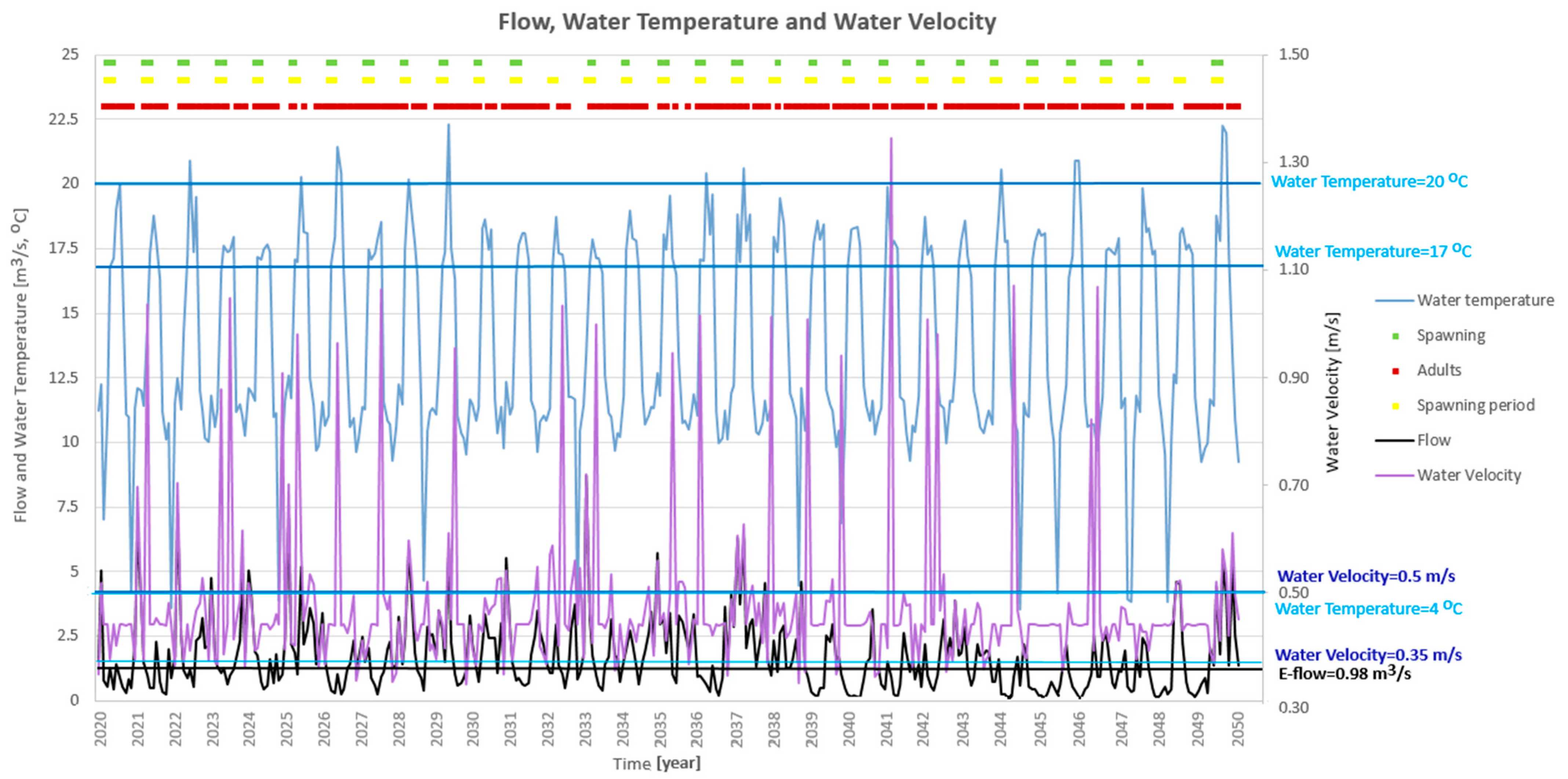
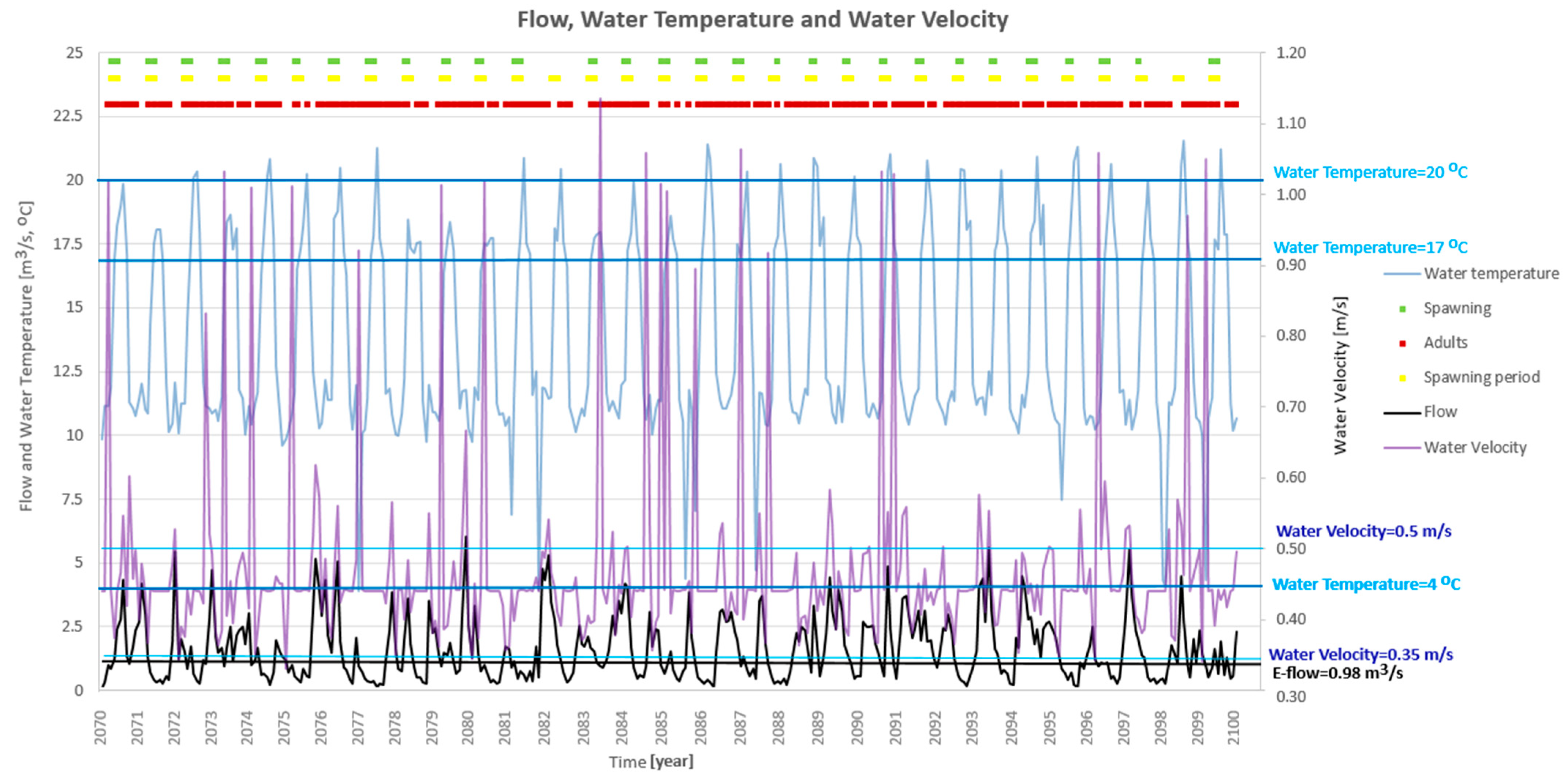
Figure 11 and Figure 12 present the prognostic representative abiotic elements of water quality for surveying fish indicator species. They are used to select appropriate E-flow values during dry periods and the spawning period life stage of the fish Barbus balcanicus of the two selected FUTURE CC scenarios, FUTURE 3a2 and FUTURE 3b1. Given that the indicator fish species is most sensitive during the spawning period, a presentation of key abiotic indicators (flow, water temperature, and water velocity) during the spawning period was created.
Figure 11 presents the most important abiotic indicators (water temperature, water velocity, and flow), for the selected scenario, FUTURE 3a2.
Figure 12 presents the most important abiotic indicators (water temperature, water velocity, and flow), for the selected scenario, FUTURE 3b1.
According to the statistical analysis of data from Figure 11 and Figure 12, it was found that:
  • 64.78% of the flow for the FUTURE 3a2 scenario and 60.48% for the FUTURE 3b1 scenario are higher than the defined E-flow, 0.98 m3/s;
  • 68.8% of spawning conditions were individually met for the indicator species used in defining E-flow and specific habitat conditions for the FUTURE 3a2 scenario;
  • 66.7% of spawning conditions were individually met for the indicator species used in defining E-flow and specific habitat conditions for the FUTURE 3b1 scenario.

4. Discussion

E-flow is administratively determined through flow values, but in addition to flow, it is extremely important to satisfy key abiotic indicators (specific habitat conditions for bioindicator species), especially for future scenarios that must include the climate change impact. Flow and dissolved oxygen data were available for the PRESENT scenario and modelled by SWAT for selected FUTURE scenarios.
The key abiotic indicators for the PRESENT scenario for the fish indicator species Barbus balcanicus are water temperature, water velocity, and water depth. They have been calculated by the Weka ML tool [23,24] using three tree models (a model tree for water temperature (Figure 4 and Table 4), a model tree for water depth (Figure 5 and Table 5), and a model for water velocity (Figure 6 and Table 6)) based on the 20-year continuous data series (monthly measurements) for the water quality and water quantity at Zelenjak measuring station. The models are simple, comprehensible, and also applicable for management purposes. They have a very high correlation coefficient for water temperature and water depth, and a moderate correlation coefficient for water velocity. The calculated water velocities were obtained through the flow and profile geometry, and therefore, a lower correlation coefficient was obtained. In comparisons with existing well-known approaches and methodologies, Morrillet et al. [10], and Graf [11] deal with determining water temperature under the influence of CC, using other models; therefore, it is difficult to make a comparison using ML methods. In the paper by Morrill et al. [10], the correlation between air temperature and stream temperature improved, ranging from 0.72 to 0.93. Efficiency coefficients for the nonlinear regression at 20 of the 22 sites were higher than those for the linear regression. In the paper, Graf [11] has concluded that the results of modelling the relationship between data series with the use of the linear and natural cubic splines models confirmed the presence of a nonlinear relation. There is a statistically significant correlation of random fluctuations for both temperature series on the same days. In all instances, the linear model recreated water temperature variance to a lesser degree (78.65–88.02%) than the natural cubic spline model (84.05–89.83%).
Abiotic factors that are important for fish are dissolved oxygen, water temperature, water velocity, and water depth (Table 1 [18,21]), and this coincides well with the ecological valence of the brook barbel, which mainly lives in the bottom parts of clean and fast-flowing waters, and can inhabit watercourses up to 500 m above sea level. It is suitable for parts of rivers where the temperature of water is between 5 and 25 °C. According to its diet, the Barbus balcanicus (brook barbel) is omnivorous—the young feed on bottom invertebrates and plant material. Spawning lasts from April to June, and individuals migrate to the upstream parts of the watercourse, where the water is clean and rich in oxygen, and the bottom is covered with stones or gravel [21]. All values obtained and shown in Figure 4 coincide with specific habitat conditions that the brook barbel need for spawning. The values (concentrations) shown in the model tree for water temperature indicate values that correspond to very good water status for the HR-R_4A watercourse type [18].
The value of the E-flow that meets the requirements of fish bioindicators (Barbus balcanicus), 0.98 m3/s (Section 2.2), is an important value for the assessment of acceptable E-flows under CC impact. Figure 7, Figure 8, Figure 9 and Figure 10 were prepared in accordance with the limit values from Table 1, which relate to key abiotic factors important for fish communities, and from them, it can be concluded that while the conditions are largely acceptable for the spawning and adult stages of Barbus balcanicus, they are not completely adequate for the fry stage. Due to the strong connection between the biocenotic composition of fish and hydrological conditions, which are the main controlling and limiting factors of specific habitat conditions in watercourses, variations in rivers and their individual sections are caused by water velocity, slope, and bed roughness. Therefore, some variations in individual sections of the watercourses may be caused by morphological changes in the longitudinal and lateral flow that make the habitat conditions insufficient for the survival of the indicator fish species in certain developmental phases, but this does not mean that the habitat conditions do not fully correspond to the indicator fish species.
Figure 11 and Figure 12 present the most important abiotic indicators (water temperature, water velocity, and flow) for the selected FUTURE scenarios. On the basis of the statistical analysis of these data, more than 60.48% of the flow is higher than the defined E-flow of 0.98 m3/s. Furthermore, at least 66.7% of the spawning conditions were individually met for the indicator fish species used in defining the E-flow and specific habitat conditions in the selected FUTURE scenarios with additional measures applied.
Related to adults and fry developmental stages of fish life for Barbus balcanicus, it is important to emphasise some facts. The stated water depths and water velocities are sufficient for the characteristic fish species to inhabit the Sutla River area. It can be assumed that by ensuring the basic ecological conditions for the maintenance of selected fish species, i.e., water depth and velocity, and habitat coverage with water, conditions are also ensured for the development of other indigenous communities of the parent watercourse.
Here, we need to be cautious about the location of hydrological stations, as we do not know how representative they are, nor the representativeness of the stations for sampling biological quality elements, such as fish. Young fish (fry) are always a sensitive stage in the fish life cycle, and they must at least have small areas within the riverbed where water velocities are lower in order to survive and continue their development.
The establishment of the basic living conditions of selected bioindicator fish species should be checked by the defined flow values, which are calculated with hydrological and hydraulic methods. To understand the fundamental relationships between individual hydraulic factors, a hydraulic calculation for stationary, uniform, and conservative flow in a trapezoidal channel, representing a specific section of a watercourse, is sufficient. As shown by the example of the Sutla River, the values of retained inflow determined by hydrological methods are often insufficient for the survival of the selected bioindicator species, as well as for the autochthonous fish communities of the watercourse (Sutla). Therefore, in previous research, based on hydraulic calculations, the value for the defined E-flow was increased to 0.98 m3/s [2].
There are shortcomings/uncertainties of this research related to the monitoring system:
  • All available monitoring data have been checked, and a continuous series of at least 20 years has been used. Existing data, which are requested by WFD, are not fully implemented in the monitoring programme and are insufficient for detailed analysis and modelling of specific habitat conditions for fish bioindicator species, since hydrological monitoring and surface water quality monitoring are not always well coordinated. The assessment of key abiotic factors for fish/specific habitat conditions requires an interdisciplinary approach and investigative monitoring.
  • It is important to emphasise that the profiles for hydrological measurements are not exactly located at the same microlocality as the water quality measuring stations, where samples for monitoring the water state are taken. This may explain why unfavourable hydrological conditions for the stream brook barbel occur even in the current state, or it could be that the profile is not the most representative, while the rest of the riverbed provides favourable hydrological and hydraulic conditions for brook barbel settlement.
  • The Zelenjak monitoring station is the most suitable monitoring station because it is a hydrological and water quality station. Daily flow values were converted into monthly flow values because water quality at the same measuring station is measured once a month. It is also a station with a very long working period, established in mid-1957, and in 1979, the limnigraph was replaced by an automatic measuring station that measures water levels and flows. During this long measurement period, the water quality measuring station was the same on the left bank (the Croatian side of the Sutla River). At the Zelenjak hydrographic measuring station during the analysed period, where both water level and flow are measured, the flow curve was changed 9 times to calibrate the “0” level, the cross-section was recorded 9 times, and the instruments of the automatic water level measuring station were used.
  • Across all scenarios, the limited availability of high-quality data for habitat modelling presents a major challenge in defining E-flow parameters, such as water temperature, water depth, and water velocity.
  • When talking about a small number of brook barbel specimens, it should always be emphasised that along with brook barbel, there are also accompanying species that are characteristic of inhabiting medium-sized streams [21]. For biology, it is important to state that the results of the analysis of the biological elements of water quality are collected once every three years. For a complete and detailed analysis, biological material should be collected for at least one full year (spring, summer, autumn, and winter) and at least seasonally (spring, summer), because in this way, the actual dynamics, composition, and structure of the ichthyofauna would be seen, and it could be known whether all hydrological and hydraulic conditions for brook barbel settlement are met.
  • It is also important to emphasise that the sediment was not analysed in the ML analyses, of course, because there are not enough measurements. Therefore, in future analysis research, this should be considered. During interpretation, we should bear in mind that the results of the analysis would certainly be different if the transport of sediment were also considered; that is, we are missing the sediment part in the future scenarios.
Finally, it is important to emphasise that the following principles for the E-flow, essential for the achievement of water-related UN SDGs, need to be respected:
  • E-flow, and specific habitat conditions for bioindicator species, are the quantity of water that provides for an ecological balance and preserves the natural stability of an aquatic ecosystem.
  • Any water abstraction from any part of a watercourse requires an investigation into the consequences that such activity could cause to an aquatic ecosystem.
  • Special attention should be paid to protecting rare and endangered flora and fauna, which is important for ecological balance, while taking care of flora and fauna as a basic link in the food chain.
  • Regarding the quantity and quality of water, all changes in the watercourse must be analysed to define/check the E-flow and specific habitat conditions for fish bioindicator species.
  • Since every watercourse is specific for its natural characteristics and hydraulic engineering facilities—already built or planned to be built—it is important to have all the related data.

5. Conclusions

This paper presents the methodology for the analysis of specific habitat conditions for fish bioindicator species in rivers under climate change with the application of ML.
Introducing ML in the analysis of specific habitat conditions for fish bioindicator species in rivers, for future climate change scenarios modelled by SWAT, presents a new step and is the novelty of the research in this field. This makes the research valuable and unique, supporting sustainability and achieving water-related UN SDGs.
The methodology presented in this paper has proven to be appropriate for the water body downstream of the Vonarje dam of the Sutla River. The value of E-flow and values of specific habitat conditions for fish bioindicator species and their biological communities have been checked and analysed for future climate change scenarios modelled by SWAT. Four key abiotic factors are important for the selected fish indicator species, Barbus balcanicus, especially during the life stage of spawning: water depth, velocity, temperature, and dissolved oxygen. For the selected FUTURE scenarios, flow and dissolved oxygen have been calculated by the SWAT model, while water depth, water velocity, and water temperature have been modelled by ML. For both selected FUTURE climate change scenarios, the results indicate that the conditions are acceptable for approximately 60–70% of the life stages of the fish bioindicator species Barbus balcanicus, particularly during the dry and spawning periods, with the obligation that additional adaptation measures are implemented.
The shortcomings/uncertainties of this research are related to the lack of an adequate monitoring system. The improved monitoring system should be better suited to apply a holistic approach to the assessment of E-flow and specific habitat conditions for fish bioindicator species and habitat modelling.

Author Contributions

Conceptualization, G.Ć.-F., G.V., I.V. and B.K.; methodology, G.Ć.-F., G.V., I.V. and B.K.; software, G.Ć.-F. and G.V.; validation, G.Ć.-F. and G.V.; formal analysis, G.Ć.-F., G.V., I.V. and B.K.; investigation, G.Ć.-F., G.V., I.V. and B.K.; resources, G.Ć.-F., G.V., I.V. and B.K.; data curation, G.Ć.-F. and G.V.; writing—original draft preparation, G.Ć.-F., G.V., I.V. and B.K.; writing—review and editing, G.Ć.-F., G.V., I.V. and B.K.; visualisation, G.Ć.-F., G.V., I.V. and B.K.; supervision, B.K.; project administration G.Ć.-F.; funding acquisition, B.K. and G.V. All authors have read and agreed to the published version of the manuscript.

Funding

This research is funded by the European Union—NextGenerationEU, through the following University of Rijeka projects: “Water Resources Management & Climate Change Resilience” (uniri-iz-25-27) and “Challenges in Water Resources Management in Times of Climate Change Regarding the Production of Drinking Water” (uniri-iz-25-18).

Institutional Review Board Statement

Not applicable.

Informed Consent Statement

Not applicable.

Data Availability Statement

The data presented in this study are available on request from the corresponding author.

Acknowledgments

Thanks to Glavan Matjaž, from the University of Ljubljana Biotechnical Faculty, Department of Agriculture, Slovenia, for help in interpreting data and results of the SWAT model, which were used for FUTURE CC impact scenarios as input data for ML.

Conflicts of Interest

Author Ivan Vučković works at Elektroprojekt Consulting Engineers Section of Ecology, Croatia. He has NO confict of interest related to the work under consideration.

References

  1. Poff, N.L.R.; Matthews, J.H. Environmental flows in the Anthropocene: Past progress and future prospects. Curr. Opin. Environ. Sustain. 2013, 5, 667–675. [Google Scholar] [CrossRef]
  2. Ćosić-Flajsig, G.; Vučković, I.; Karleuša, B. An Innovative Holistic Approach to an E-flow Assessment Model. Civ. Eng. J. 2020, 6, 2188–2202. [Google Scholar] [CrossRef]
  3. Intergovernmental Panel on Climate Change (IPCC). Climate Change 2022—Impacts, Adaptation and Vulnerability: Working Group II Contribution to the Sixth Assessment Report of the Intergovernmental Panel on Climate Change; Cambridge University Press: Cambridge, UK; New York, NY, USA, 2023; p. 3056. [Google Scholar] [CrossRef]
  4. Acreman, M.C.; Ferguson, A.J.D. Environmental flows and the European Water Framework Directive. Freshw. Biol. 2010, 55, 32–48. [Google Scholar] [CrossRef]
  5. Escribano Francés, G.; Quevaviller, P.; San Martín González, E.; Vargas Amelin, E. Climate change policy and water resources in the EU and Spain. A closer look into the Water Framework Directive. Environ. Sci. Pol. 2017, 69, 1–12. [Google Scholar] [CrossRef]
  6. Cowx, I.G.; Welcomme, L.R. Rehabilitation of Rivers for Fish; Fishing News Books: London, UK, 1998; 260p. [Google Scholar]
  7. Schneider, C.; Laize, C.L.R.; Acreman, M.C.; Flörke, M. How will climate change modify river flow regimes in Europe? Hydrol. Earth Syst. Sci. 2013, 17, 325–339. [Google Scholar] [CrossRef]
  8. Korkmaz, M.; Mangıt, F.; Dumlupınar, İ.; Çolak, M.A.; Akpınar, M.B.; Koru, M.; Pacheco, J.P.; Ramírez-García, A.; Yılmaz, G.; Amorim, C.A.; et al. Effects of Climate Change on the Habitat Suitability and Distribution of Endemic Freshwater Fish Species in Semi-Arid Central Anatolian Ecoregion in Türkiye. Water 2023, 15, 1619. [Google Scholar] [CrossRef]
  9. Gizinska, J.; Sojka, M. How Climate Change Affects River and Lake Water Temperature in Central-West Poland-A Case Study of the Warta River Catchment. Atmosphere 2023, 14, 330. [Google Scholar] [CrossRef]
  10. Morrill, J.C.; Bales, R.C.; Conklin, M.H. Estimating stream temperature from air temperature: Implications for future water quality. J. Environ. Eng. 2005, 131, 139–146. [Google Scholar] [CrossRef]
  11. Graf, R. A multifaceted analysis of the relationship between daily temperature of river water and air. Acta Geophys. 2019, 67, 905–920. [Google Scholar] [CrossRef]
  12. Rabi, A.; Hadzima-Nyarko, M.; Šperac, M. Modelling River temperature from air temperature: Case of the River Drava (Croatia). Hydrol. Sci. J. 2014, 60, 1490–1507. [Google Scholar] [CrossRef]
  13. Ćosić-Flajsig, G.; Karleuša, B.; Glavan, M. Integrated Water Quality Management Model for the Rural Transboundary River Basin—A Case Study of the Sutla/Sotla River. Water 2021, 13, 2569. [Google Scholar] [CrossRef]
  14. Leone, M.; Gentile, F.; Lo Porto, A.; Ricci, G.F.; Schürz, C.; Strauch, M.; Volk, M.; De Girolamo, A.M. Setting an environmental flow regime under climate change in a data-limited Mediterranean basin with temporary river. J. Hydrol. Reg. Stud. 2024, 52, 101698. [Google Scholar] [CrossRef]
  15. Ghobadi, F.; Kang, D. Application of Machine Learning in Water Resources Management: A Systematic Literature Review. Water 2023, 15, 620. [Google Scholar] [CrossRef]
  16. Ozcan, G.E.; Ünel, E.; Sivrikaya, F. A Machine Learning Algorithm-Based Approach (MaxEnt) for Predicting Habitat Suitability of Formica rufa. J. Appl. Entomol. 2025, 149, 558–572. [Google Scholar] [CrossRef]
  17. Edrisnia, S.; Etemadi, M.; Pourghasemi, H.R. Machine learning-driven habitat suitability modeling of Suaeda aegyptiaca for sustainable industrial cultivation in saline regions. Ind. Crops Prod. 2025, 225, 120427. [Google Scholar] [CrossRef]
  18. Croatian Ministry of Health. Regulation on Water Quality Standards. In Official Gazette 2023, 20/23; Croatian Ministry of Health: Zagreb, Croatia, 2023. [Google Scholar]
  19. Mrakovčić, M.; Brigić, A.; Buj, I.; Ćaleta, M.; Mustafić, P.; Zanella, D. Red Book of Freshwater Fish of Croatia; Ministry of Culture, State Institute for Nature Protection, Republic of Croatia: Zagreb, Croatia, 2006. Available online: https://www.haop.hr/sites/default/files/uploads/dokumenti/03_prirodne/crvene_knjige_popisi/Crvena_knjiga_slatkovodnih_riba-web.pdf (accessed on 8 October 2025).
  20. The IUCN Red List. Available online: https://www.iucnredlist.org/ (accessed on 8 October 2025).
  21. Mrakovčić, M. Criteria for determining sustainable flow based on fish communities. In Documentation Elektroprojekt d.d.; Elektroprojekt: Zagreb, Croatia, 2000; p. 41. [Google Scholar]
  22. Ćosić-Flajsig, G.; Karleuša, B.; Vučković, I.; Glavan, M. E-flow Holistic Assessment in Data-limited River Basin under Climate Change Impact. In Proceedings of the WMHE 2024, Štrbské Pleso, High Tatras, Slovakia, 10–14 September 2024. [Google Scholar]
  23. Witten, I.H.; Frank, E. Data Mining: Practical Machine Learning Tools and Techniques, 2nd ed.; Elsevier: Amsterdam, The Netherlands, 2005. [Google Scholar]
  24. Wang, Y.; Witten, I.H. Inducing model trees for continuous classes. In Proceedings of the 9th European Conference on Machine Learning, Prague, Czech Republic, 23–25 April 1997. [Google Scholar]
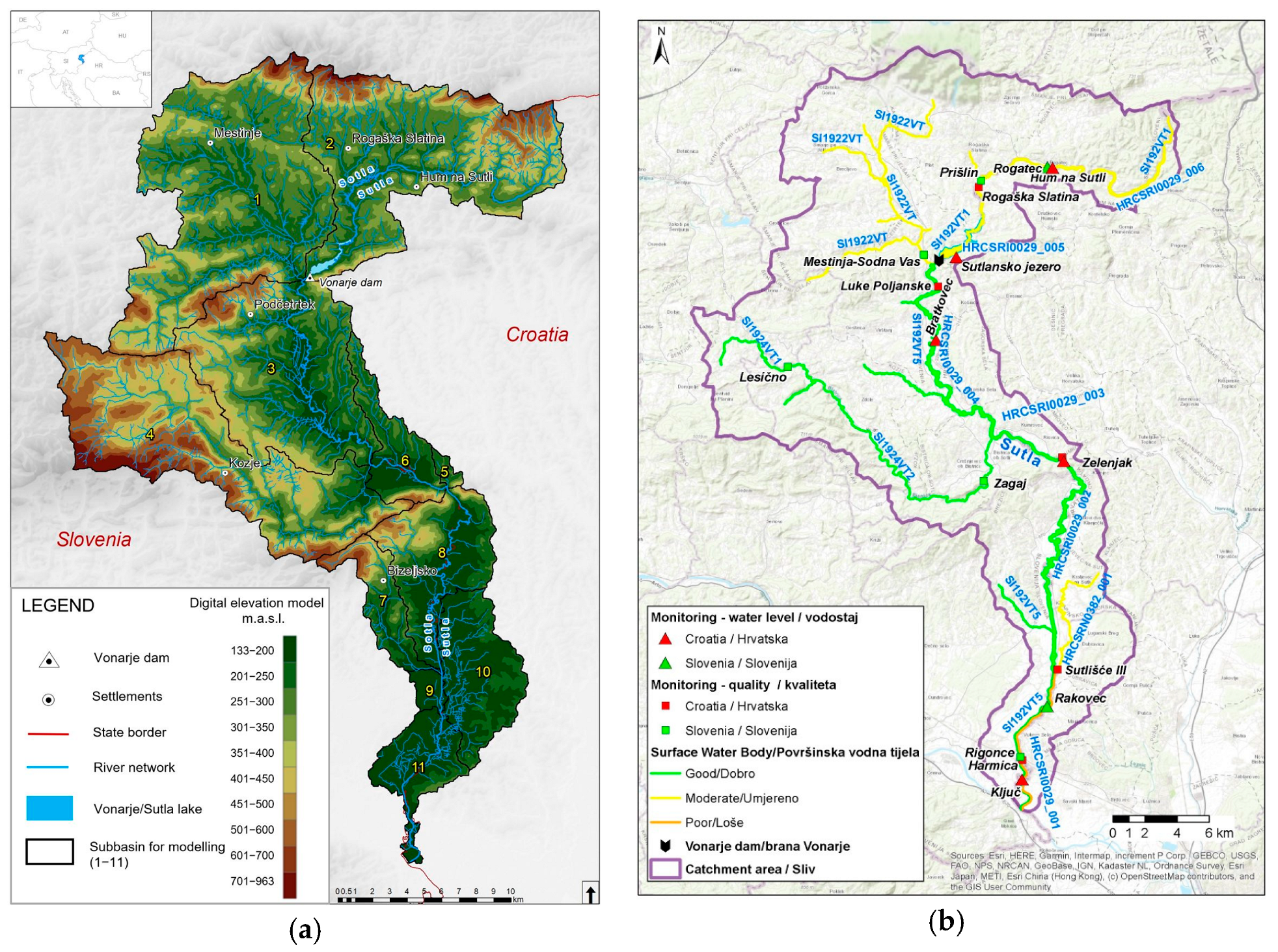
Figure 1. Transboundary Sutla River Basin [13]: (a) Digital elevation model, hydrographic network with lakes, settlements, 11 subbasins, and the Vonarje dam location; (b) Measuring stations on the River Sutla.
Sustainability 17 10803 g001
Figure 2. Barbus balcanicus brook barbel (in Croatian: potočna mrena).
Sustainability 17 10803 g002
Figure 3. Methodology of a holistic approach for the assessment of E-flow for the present scenario and future climate change impact scenarios with the analysis of specific habitat conditions for fish bioindicator species using machine learning modelling.
Sustainability 17 10803 g003
Figure 4. Model tree for water temperature.
Sustainability 17 10803 g004
Figure 5. Model tree for water depth.
Sustainability 17 10803 g005
Figure 6. Model tree for water velocity.
Sustainability 17 10803 g006
Figure 7. Suitability of water depth and water velocity for the FUTURE 3a2 scenario.
Sustainability 17 10803 g007
Figure 8. Suitability of water temperature and dissolved oxygen for the FUTURE 3a2 scenario.
Sustainability 17 10803 g008
Figure 9. Suitability of water depth and water velocity for the FUTURE 3b1 scenario.
Sustainability 17 10803 g009
Figure 10. Suitability of water temperature and dissolved oxygen for the FUTURE 3b1 scenario.
Sustainability 17 10803 g010
Figure 11. Suitability of flow, water temperature, and water velocity for the FUTURE 3a2 scenario.
Sustainability 17 10803 g011
Figure 12. Suitability of flow, water temperature, and water velocity for the FUTURE 3b1 scenario.
Sustainability 17 10803 g012
Table 1. Presentation of the fundamental ecological requirements of the selected indicator species [18,21].
Key Abiotic Factors Important for Fish Communities
Biogeographical AreaLife
Stage
Water Depth
cm
Water Velocity m/sWater
Temperature
°C
Dissolved
Oxygen
mg/L
Barbus
balcanicus
brook barbel
SpawningGreater than body height
20–45
0.35–0.54–17 (14) *Above 6
<FryAbout 300.06–0.2(15) *Above 6
AdultsGreater than body height
20–45
0.35–0.54–20Above 6
* Figures in parenthesis () = optimum value.
Table 2. Average annual modelled results for present, past, and future scenarios downstream of the Vonarje dam.
ScenarioQav,year (m3/s)Sediment (t)TN (t)TP (t)
PRESENT 11.67 (m3/s)2409 (t)298,275 (t)19,957 (t)
PAST 2a2%62%42%59%
PAST 2b0%62%42%39%
FUTURE 3a16% (−9; 17)7% (−15; 18)0% (−10; 7)0% (−5; 4)
FUTURE 3a221% (−4; 49)14% (−18; 44)7% (−17; 26)0% (−9; 7)
FUTURE 3a314% (3; 33)14% (−5; 29)4% (−8; 17)1% (−3; 5)
FUTURE 3a428% (5; 91)20% (−13; 105)8% (−10; 50)0% (−8; 15)
FUTURE 3b14% (−12; 15)10% (−16; 23)2% (−10; 13)0% (−5; 4)
FUTURE 3b218% (−6; 44)14% (−18; 44)7% (−12; 26)0% (−9; 7)
FUTURE 3b311% (1; 30)14% (−5; 29)4% (−8; 17)1% (−3; 5)
FUTURE 3b425% (3; 86)20% (−13; 104)8% (−10; 51)0% (−8; 15)
Note: The average percentage change in values for past and future scenarios (in brackets are the minimum and maximum % change according to the different climate models) are defined in relation to the absolute values of the present scenario.
Table 3. Average monthly numerical modelling results of flow and dissolved oxygen for present and selected future scenarios downstream of the Vonarje dam.
ScenarioQav, month (m3/s)
av. (Min, Max)
Qav, month (m3/s)
Dry Period
(April–September)
av. (Min, Max)
Qav, month (m3/s)
Wet Period
(October–March)
av. (Min, Max)
DOav, month
(mg/L)
av. (Min, Max)
PRESENT 14.88 (0.39; 58.3)4.43 (0.39; 58.3)5.66 (0.69; 58)10.63 (6.1; 17.6)
FUTURE 3a21.68 (0.14;7.27)2.36 (0.13; 6.97)1.94 (0.19; 6.26)7.14 (1.46; 12.43)
FUTURE 3b11.46 (0.08; 7.40)1.31 (0.09; 5.99)1.69 (1.10; 6.00)7.02 (1.55; 14.35)
Table 4. Equations for the water temperature model tree.
Equation No.Equation
LM 1.Water Temp = 0.1322 × Air Temp − 0.3111 × Dis. Oxygen + 12.5546
LM 2.Water Temp = 0.1417 × Air Temp − 0.1885 × Dis. Oxygen + 6.0976
LM 3.Water Temp = 0.1538 × Air Temp − 0.1885 × Dis. Oxygen + 8.11
LM 4.Water Temp = 0.138 × Air Temp − 0.5352 × Dis. Oxygen + 18.8255
LM 5.Water Temp = 0.138 × Air Temp − 0.3897 × Dis. Oxygen + 15.7557
LM 6.Water Temp = 0.1912 × Air Temp − 0.429 × Dis. Oxygen + 19.3492
LM 7.Water Temp = 0.1912 × Air Temp − 0.6061 × Dis. Oxygen + 19.5212
LM 8.Water Temp = 0.303 × Air Temp − 0.4584 × Dis. Oxygen + 17.9846
Table 5. Equations for the water depth model tree.
Equation No.Equation
LM 1.Water Depth = 3.5252 × Flow + 44.5565
LM 2.Water Depth = 3.8616 × Flow + 49.0192
LM 3.Water Depth = 3.9451 × Flow + 51.8193
LM 4.Water Depth = 3.4175 × Flow + 56.2257
LM 5.Water Depth = 4.3769 × Flow + 59.4978
LM 6.Water Depth = 3.0882 × Flow + 70.4646
LM 7.Water Depth = 2.7699 × Flow + 78.3939
LM 8.Water Depth = 1.7687 × Flow + 127.308
Table 6. Equations for the water velocity model tree.
Equation No.Equation
LM 1.Water Velocity = 0.003 × Flow + 0.4397
LM 2.Water Velocity = −24.6558 × Flow + 24.1276
LM 3.Water Velocity = −24.6558 × Flow + 24.0777
LM 4.Water Velocity = −2.2376 × Flow + 3.1806
LM 5.Water Velocity = −2.2376 × Flow + 3.2286
LM 6.Water Velocity = −0.0394 × Month − 2.2376 × Flow + 3.5946
LM 7.Water Velocity = −0.0335 × Month − 2.2376 × Flow + 3.5355
LM 8.Water Velocity = −0.0335 × Month − 2.2376 × Flow + 3.5369
LM 9.Water Velocity = −2.4544 × Flow + 3.1987
LM 10.Water Velocity = 0.0103 × Month + 0.0461 × Flow + 0.2659
LM 11.Water Velocity = 0.0114 × Flow + 0.6208
Disclaimer/Publisher’s Note: The statements, opinions and data contained in all publications are solely those of the individual author(s) and contributor(s) and not of MDPI and/or the editor(s). MDPI and/or the editor(s) disclaim responsibility for any injury to people or property resulting from any ideas, methods, instructions or products referred to in the content.