Article

Declining Crop Yield Sensitivity to Drought and Its Environmental Drivers in the North China Plain


1
Hebei Key Laboratory of Intelligent Water Conservancy, School of Water Conservancy and Hydropower, Hebei University of Engineering, Handan 056038, China
2
School of Earth Science and Engineering, Hebei University of Engineering, Handan 056038, China
3
Lhasa Plateau Ecosystem Research Station, Key Laboratory of Ecosystem Network Observation and Modeling, Institute of Geographic Sciences and Natural Resources Research, Chinese Academy of Sciences, Beijing 100101, China
*
Authors to whom correspondence should be addressed.
Sustainability 2025, 17(23), 10798; https://doi.org/10.3390/su172310798
Submission received: 26 September 2025 / Revised: 3 November 2025 / Accepted: 30 November 2025 / Published: 2 December 2025

Abstract

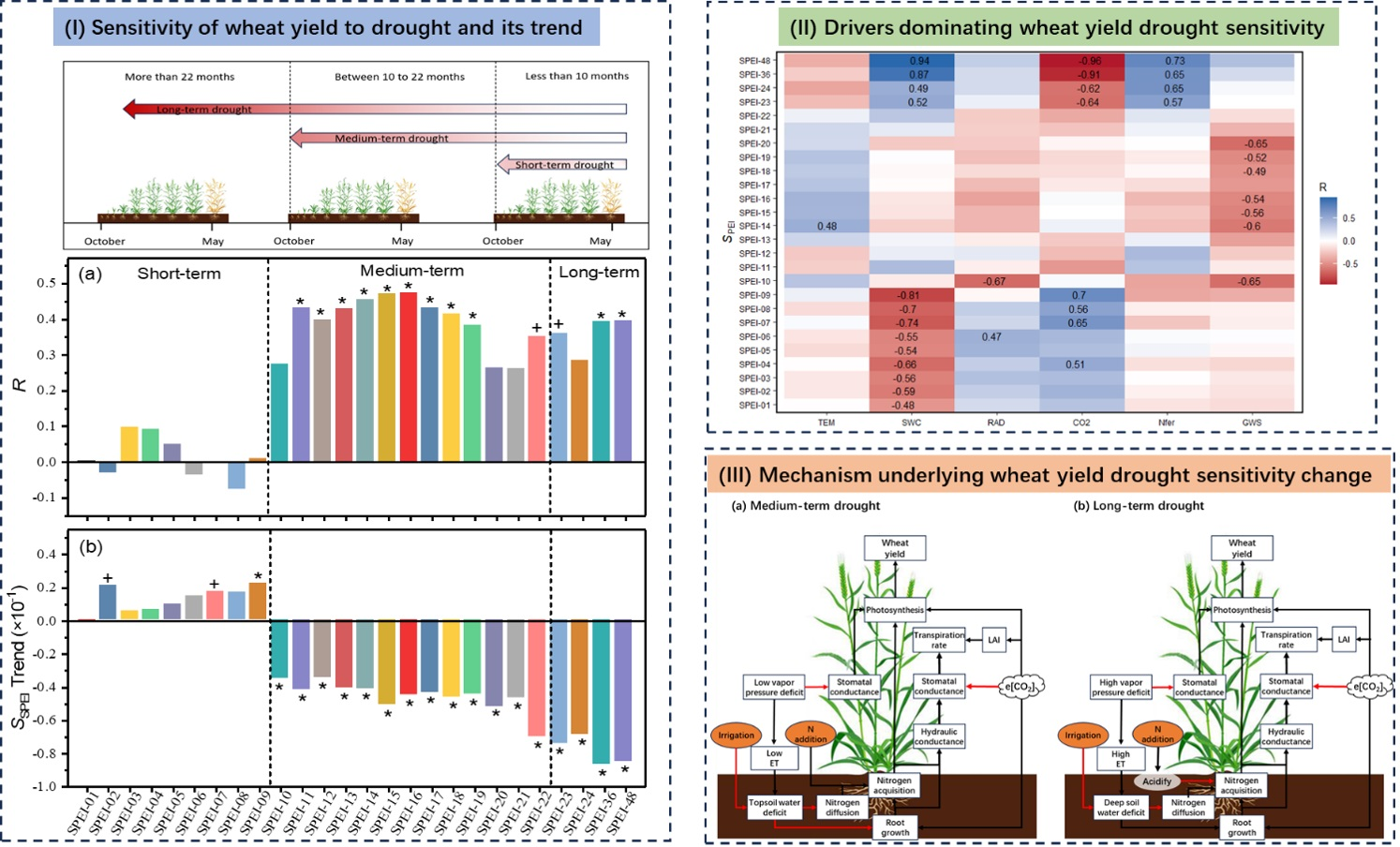
Drought poses a severe threat to global food security and agricultural sustainability. Despite substantial efforts to enhance crop yield tolerance to drought, the effectiveness varies spatiotemporally across different environments and management practices. In this study, we compiled long-term grain yield data alongside multiple environmental indicators, including the multiscalar Standardized Precipitation Evapotranspiration Index (SPEI), climate, soil moisture (SWC), groundwater storage (GWS), nitrogen fertilizer (Nfer), and atmospheric CO2 records. We aim to assess the variability and drivers of grain yield sensitivity to drought across the North China Plain. We found a significantly positive correlation between the interannual variability of wheat yield and SPEI over the 9-month scale, suggesting that wheat yield variations were sensitive to medium-term (>9 month) and long-term (>22 month) drought. Surprisingly, the sensitivity (SSPEI: correlation coefficient between wheat yield variations and SPEI) of wheat yield to medium-term and long-term drought has declined substantially in the past three decades. The effects of SWC, GWS, Nfer, and CO2 on SSPEI varied situationally as the duration of the drought extended. Typically, SWC primarily governed short-term (<10 month) SSPEI, with a relative weight of 38.9 ± 3.2% in explaining SSPEI variability. The decrease in medium-term SSPEI was at the expense of GWS, which contributed a relative weight of 33.7 ± 12.3% in explaining the variations. SWC, CO2, and Nfer jointly dominated long-term SSPEI variations, and the cumulative relative weight as high as 84.0 ± 6.2%. Specifically, Nfer notably enhanced the SSPEI during prolonged drought, and the anticipated enriched CO2-induced “fertilizer effect” and “water-saving effect” in decreasing SSPEI were evident during long-term drought, contrasting with CO2 enrichment-enhanced yield reductions observed in short-term drought. Our findings highlight that prediction-based practices to mitigate drought-induced yield loss and enhance agricultural sustainability, including water conservation and fertilizer addition, may differ radically depending on drought episodes.

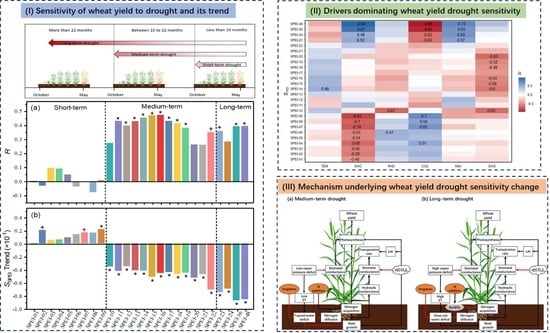
Graphical Abstract

1. Introduction

Over the past half-century, the global climate has undergone significant warming, with an increasing rate in air temperature at nearly 0.2 °C per decade [1]. Observations and projections suggest that warming has intensified and will amplify hydrological cycles and increase the scope and frequency of extreme climate events [2,3,4]. Drought is a prevalent extreme weather that may impose severe water stress on agricultural production and threaten global food security [5,6,7]. There is substantial evidence indicating that the sensitivity of global natural vegetation productivity to drought has increased in recent decades, and drought-induced crop yield reductions are expected to enhance under warming [8,9,10]. Although great efforts in adaptation and management have been dedicated to increasing the tolerance of crop yield to drought, the effectiveness can vary spatially and temporally [11]. Therefore, it is crucial to assess the changes in the sensitivity of grain yield to drought and its environmental and anthropogenic drivers.
The severity of extreme climate events impacting natural or human communities depends on both the variability and magnitude of the events, as well as the vulnerability and exposure of the natural and artificial systems [12,13]. For example, the extent to which drought events significantly affect food production, also known as the sensitivity of food production to drought, depends on factors including drought intensity, extent, and duration. Additionally, it relies on the drought tolerance of crop species and the effectiveness of human activities, such as irrigation and water resource management, which may largely mitigate the adverse impacts of drought-induced water deficits. Globally, it is reported that cereal yield reductions due to drought and extremely high temperatures ranged from 9% to 10%, with production losses 8–11% higher in developing countries compared to developed countries from 1964 to 2007 [13]. Hence, it is essential to analyze the change in the sensitivity of food production to extreme events and its driving factors, which hold important significance for regional food security and efficient water resources management [7,14].
Typically, irrigation is commonly employed to mitigate the impacts of drought and stabilize grain yields. Furthermore, strategies such as breeding drought-resistant varieties, improving farming practices, and building new water conservation infrastructure can alleviate and even reverse the adverse effects of droughts on grain production, thereby decreasing the sensitivity of grain yield to drought [15,16]. Moreover, other environmental factors may also significantly alter the drought sensitivity of grain productivity by affecting plant physiology. For instance, elevated atmospheric CO2 concentration can directly enhance leaf photosynthesis and vegetation productivity, which is known as the CO2 fertilization effect [15,17,18]. Nevertheless, elevated CO2 concentration also reduces stomatal conductance, alleviates water stress, and prevents water loss from soil [19,20]. These processes may jointly increase water-use efficiency and modify the drought sensitivity of vegetation growth. Additionally, fertilizer application also enhances crop photosynthesis and water use efficiency, thereby reducing the productive sensitivity to water conditions [14,21,22]. Changes in environmental factors and advancements in agricultural breeding and management techniques may have significantly altered the sensitivity of grain yield to drought, whereas the variability and underlying mechanisms remain poorly understood.
China, with the world’s largest population, faces enduring challenges in food security, which is crucial for the nation’s economy and the well-being of people. Wheat is an important crop type and raw material among the diverse categories of crops and dietary habits, particularly in northern China. In the year 2023, China’s total wheat planting area was 23.63 million hectares, accounting for 19.9% of the country’s total grain planting area according to the latest statistics from the National Bureau of Statistics. Wheat production was a total of 136.59 million tons, comprising 19.6% of China’s grain production. The North China Plain (NCP), as one of the country’s most important agricultural regions, is characterized by an intensive winter wheat–summer maize double-cropping system that relies heavily on irrigation to ensure stable yields during dry seasons [23]. Generally, winter wheat yield in the NCP contributes approximately 75% of China’s total winter wheat production [24]. However, the region’s strong irrigation dependence has led to severe groundwater overexploitation, making the NCP one of the most depleted aquifers globally [25,26]. Historically, drought, particularly spring drought, has been the predominant natural hazard affecting the stability of wheat production in China [27,28]. For instance, between 1955 and 2018, nearly 22 years out of 60 years can be classified as relatively dry springs in the NCP [29]. To cope with drought while reducing groundwater overexploitation, various strategies have been widely explored in the NCP to sustain stable grain production under limited water availability, including drought-tolerant varieties breeding, optimizing irrigation regimes, adjusting fertilization strategies, and improving crop rotation systems [30,31]. Such efforts may have substantially altered the response of crop yield to drought in recent decades. Specifically, the sensitivity of food production to drought may have evolved due to environmental change and agricultural practices. However, the evolving sensitivity of crop yield to drought and its underlying drivers remains lacking, hindering the development of targeted adaptation strategies in the NCP.
In this study, we retrieve long-term survey-based data on wheat yield and employ the multi-scale Standardized Precipitation Evapotranspiration Index (SPEI), alongside records of climate, soil moisture, groundwater levels, nitrogen fertilization, and atmospheric CO2 concentration. Our objective is to quantify the sensitivity of wheat yield to drought at multiple temporal scales and to assess its evolution and potential environmental drivers.

2. Materials and Methods

2.1. Study Area

Covering an area of over 300,000 square kilometers, the North China Plain (NCP) is the largest alluvial plain in China and one of the most populous plain in the world [32]. The predominant agricultural practice in this region is the winter wheat–summer maize rotation, occupying the largest share of cultivated land. This cropping system is extensively practiced in the central part of the plain, particularly in Hebei, Henan, and Shandong provinces (Figure 1). The NCP experiences a warm and humid climate, characterized by an average annual temperature of approximately 12.2 °C (1961–2005), and annual precipitation ranging from 400 to 800 mm [33,34].

2.2. Data Sources

2.2.1. Wheat Yield Data

The province-scale grain production data for the North China Plain region, encompassing Beijing, Tianjin, Hebei, Henan, and Shandong provinces, were obtained from the “China Statistical Yearbook” published by the National Bureau of Statistics (https://www.stats.gov.cn/sj/ndsj/, accessed on 14 October 2023). For this study, we retrieved the total wheat production (N, ×104 tons) and cultivated area (S, ×103 ha) data for each province or city. Subsequently, we calculated the wheat yield per unit area (U, kg/ha) by dividing the total production by the cultivated area (U = N/S).

2.2.2. Multi-Scale SPEI and Climate Data

The Standardized Precipitation Evapotranspiration Index (SPEI) is widely used in drought-related research [9,35]. The SPEI retains the standardization and multi-scalar nature of the Standardized Precipitation Index (SPI), allowing drought conditions to be analyzed across different temporal scales (e.g., 1–48 months). In this study, we acquired SPEI data at different time scales, including 1–24 months, 36 months, and 48 months. The data were derived from long-term monthly precipitation data provided by the Climatic Research Unit (CRU TS 4.03) and potential evapotranspiration (PET) data estimated using the FAO-56 Penman–Monteith method. SPEI was calculated based on the formula proposed by Vicente-Serrano, Beguería and López-Moreno [35]. And the spatial resolution of the data is 0.5° × 0.5° (https://spei.csic.es/, accessed on 30 May 2024). The study period we selected spans from 1993 to 2020, aligning with the timeframe of wheat production.
Climate and soil moisture data, including monthly mean temperature, average surface shortwave radiation, and soil moisture data at different depths, were obtained from the European Centre for Medium-Range Weather Forecasts (ECMWF) Fifth Generation Reanalysis (ERA5-land) (https://www.ecmwf.int, accessed on 12 March 2024). The monthly gridded data have a spatial resolution of 0.1° × 0.1° and cover the period from 1993 to 2020. We used the boundaries layer of the NCP to mask each variable layer and calculated the mean annual temperature (TEM, K) and land surface shortwave radiation (RAD, J m−2). The soil moisture encompassed four depths (0~7 cm, 7~28 cm, 28~100 cm, and 100~289 cm). The soil water content (SWC, m3 m−3) was calculated based on the four level datasets and converted into equivalent liquid water depth (cm).

2.2.3. Atmospheric CO2 and Nitrogen Fertilizer Application Data

The monthly atmospheric CO2 concentration data used in this study were sourced from the atmospheric in situ observations at the Mauna Loa Observatory in Hawaii, provided by The Scripps CO2 Program from 1958 to the present (https://scrippsco2.ucsd.edu/, accessed on 20 April 2024). Nitrogen fertilizer application data for the NCP were obtained from a recent panel dataset reconstructed based on historical records of nitrogen fertilizer application across China, integrated with an improved agricultural field map [36]. This dataset offers gridded data for China from 1952 to 2018, with a spatial resolution of 5 km × 5 km. For the nitrogen fertilizer application in China, this dataset has been reported to possess higher accuracy compared to the estimation conducted by the Food and Agriculture Organization (FAO) of the United Nations [36].

2.2.4. GRACE-Based Groundwater Storage Data

The Gravity Recovery and Climate Experiment (GRACE) satellite mission, launched in 2002, has revolutionized our ability to measure Earth’s gravity field changes. The GRACE provides global terrestrial water storage anomaly (TWSA), which is widely used in global and regional hydrological research [6,37]. In conjunction with hydrological models, GRACE-based TWSA enables us to quantify the spatiotemporal changes in groundwater storage (GWS) [38]. However, for the prior period before 2002, there is no measures could be used to evaluate the TWSA, as well as the gap period (2017–2018) between the GRACE and GRACE Follow-On (GRACE-FO) missions [39,40]. Several methods (e.g., statistical model and machine learning) have been conducted to reconstruct long-term TWSA based on empirical relationships among the existing TWSA and climatic or hydrological factors. In this study, we obtained a long-term GRACE-like TWSA that was reconstructed by Li, Kusche, Chao, Wang and Loecher [40]. The TWSA was produced by combining machine learning with statistical decomposition techniques for the period 1979–2020 and was in 0.5° resolution over the global land. In addition, the reconstructed TWSA has been evaluated and compared with other source TWSA, and the results showed that it is more accurate than previously published products.
Generally, TWSA is the sum of anomalies in surface water storage (SWSA) and groundwater storage (GWSA). The SWSA can be calculated with the anomalies in soil water storage (SWSA), snow water storage (SNWSA), canopy water (CWSA), and runoff (QsA). These components were achieved from the ERA5-land. To match the TWSA baseline from January 2004 to December 2009, we subtracted the mean of the corresponding period for all variables. And the GWSA can be calculated as the Equation (1):
G W S A = T W S A S W S A S N W S A Q s A C W S A

2.3. Life Cycle-Based Definition of Drought Durations

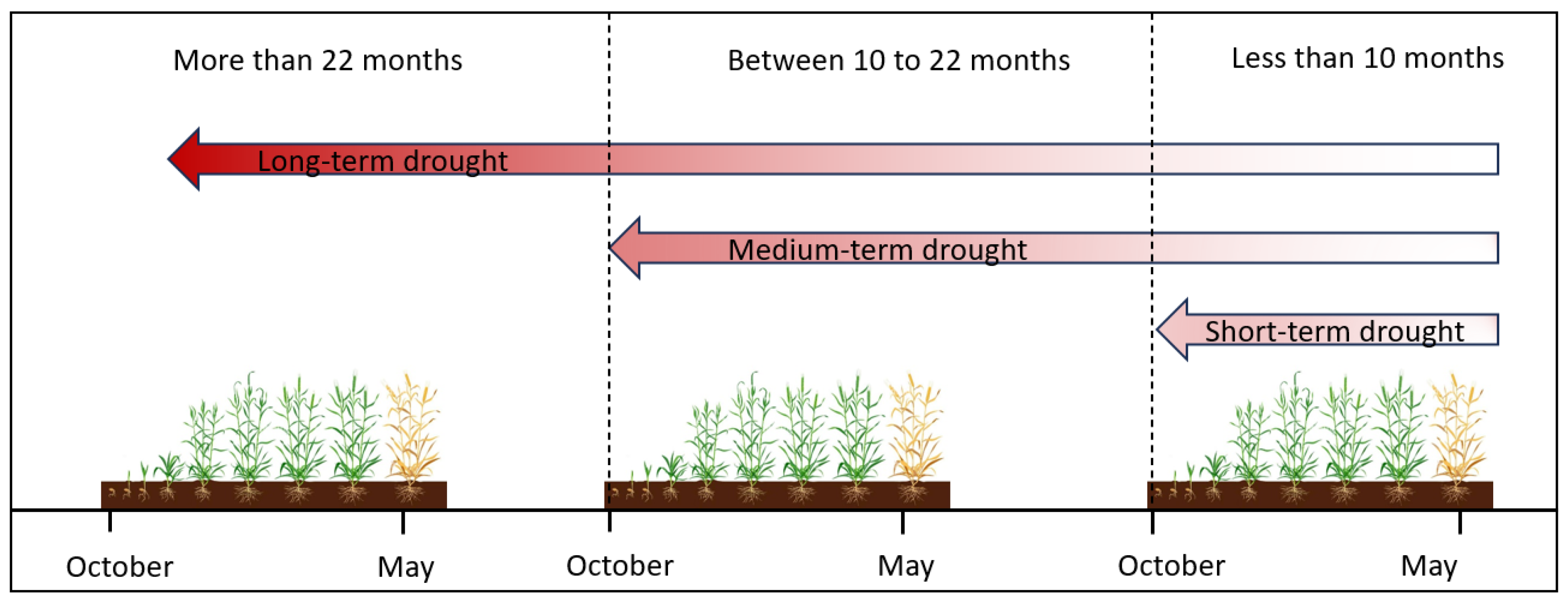
Previously, there has been no unified definition on drought duration to quantify short-term, medium-term, and long-term drought. It ranges widely in previous studies depending on the chosen objectives [41,42]. In this study, we quantified short-term drought using the drought duration within one life history of winter wheat, medium-term drought with a duration longer than one but less than two life history, and long-term drought with a duration longer than two life history, considering that the winter wheat in the NCP is typically sown in late September to early October in the previous year and harvested in late May to early June of the following year. Therefore, three categories of drought duration were defined: short-term drought (less than 10 months), medium-term drought (10–22 months) and long-term drought (more than 22 months). The SPEI for May at different time scales was selected to quantify the duration of drought, and the schematic diagram is below (Figure 2).

2.4. Statistical Methods

The interannual variability (IAV) of wheat yield per unit area (U) was obtained by removing the linear trend. This approach can be achieved using the “detrend” function within the “pracma” package in R (v4.5) software. Changes in cultivated area and total production are more strongly determined by farmland management strategies (partly reflecting the economic and social impacts of drought) rather than direct biophysical drought responses. In contrast, the variability in yield per unit area largely reflects the combined effects of environmental factors and human drought adaptation measures. Therefore, to analyze the response of wheat yield IAV to drought at different time scales, the Pearson correlation coefficient (R) between the IAV of wheat yield per unit area (U) and the SPEI was calculated to indicate the sensitivity of wheat production to drought (SSPEI). A larger R and SSPEI indicate higher sensitivity, while a smaller R and SSPEI mean lower sensitivity. To examine the change of SSPEI over time, a dynamic sensitivity analysis was conducted using a 9-year sliding window. For instance, from 1993 to 1997, sensitivity analysis is applied to obtain S1SPEI, and as S2SPEI for the period 1994–1998. By following this function, a total of 24 windows are chosen, resulting in 24 values of the SSPEI. Based on the SSPEI time series, it is possible to analyze the SSPEI change trend and its environmental drivers.
To unfold the drivers influencing the variations of the SSPEI, the corresponding 9-year sliding window mean method was applied to obtain decadal environmental variable changes, including mean air temperature (TEM), mean land surface radiation (RAD), soil water content (SWC), N fertilizer application (Nfer), atmospheric CO2 concentration (CO2), and groundwater storage (GWS). To eliminate the influence of spurious correlations, the anomalies of each environmental factor were obtained by removing the linear trend when conducting regression analysis between environmental variables and SSPEI. Additionally, to assess the relative importance of each environmental factor on SSPEI, we employed the relative weight method [43]. The method was based on variance decomposition for multiple linear regression models, and the relative importance of each factor can be quantified with a percentage. The sum of the relative weights of all independent variables is 100%, and factor with the highest relative importance value can be defined as the dominant driver among these factors under consideration. This procedure was performed with the “relaimpo” package in R (v4.5) software.

3. Results

3.1. Wheat Yield Anomalies Across the NCP

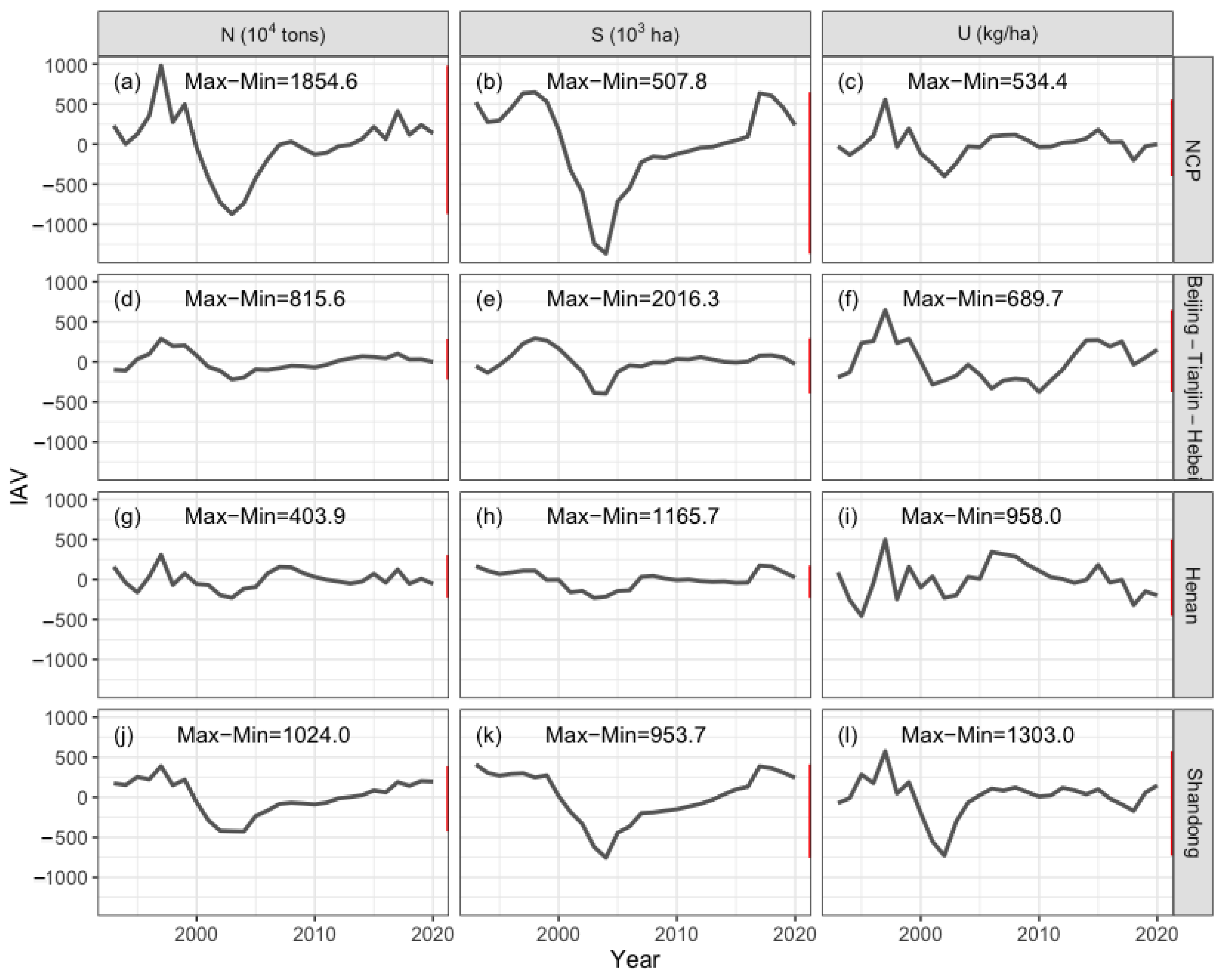
From 1993 to 2020, wheat production (N) in the NCP exhibited a significant increasing trend (p < 0.05), with a linear growth rate of 111.16 × 10⁴ tons per year (Figure S1). The interannual variability (IAV) in N overall the NCP ranged from the minimum of −873.3 × 10⁴ tons in 2003 to a maximum of 981.3 × 10⁴ tons in 1997 (Figure 3a). The ranges of IAV in N for these subregions, including Beijing–Tianjin–Hebei, Henan, and Shandong, were 507.8 × 10⁴, 534.4 × 10⁴, 815.6 × 10⁴ tons, respectively (Figure 3b–d).
At the NCP scale, the cultivated area (S) showed a slight increase trend that did not reach statistical significance level (p > 0.05) (Figure S1). The range of the IAV in S reached 2016.3 × 103 ha, which was the difference between the maximum value of 648.8 × 10⁴ ha in 1998 and the minimum value of −1367.5 × 104 ha in 2004 (Figure 3e). Shandong contributed as much as 57.8% (1165.7 ha) to the IAV range in S for the NCP, followed by 689.7 × 10⁴ ha in Beijing–Tianjin–Hebei and 403.9 × 10⁴ ha in Henan (Figure 3f–h).
The wheat yield per unit area (U) experienced a notably increasing trend in the past three decades (p < 0.05) across the NCP, with a yearly mean linear growth rate of 87.83 kg/ha (Figure S1). The IAV in U was substantially at 958.0 kg/ha, driven by the peak of 557.4 kg/ha in 1997 and a low of value −400.6 kg/ha in 2002 (Figure 3i). Shandong exhibited the highest IAV in U at 1303.0 kg/ha, followed by Beijing–Tianjin–Hebei with 1024.0 kg/ha and Henan with 953.7 kg/ha (Figure 3j–l).

3.2. Multi-Scale SPEI Changes Across the NCP

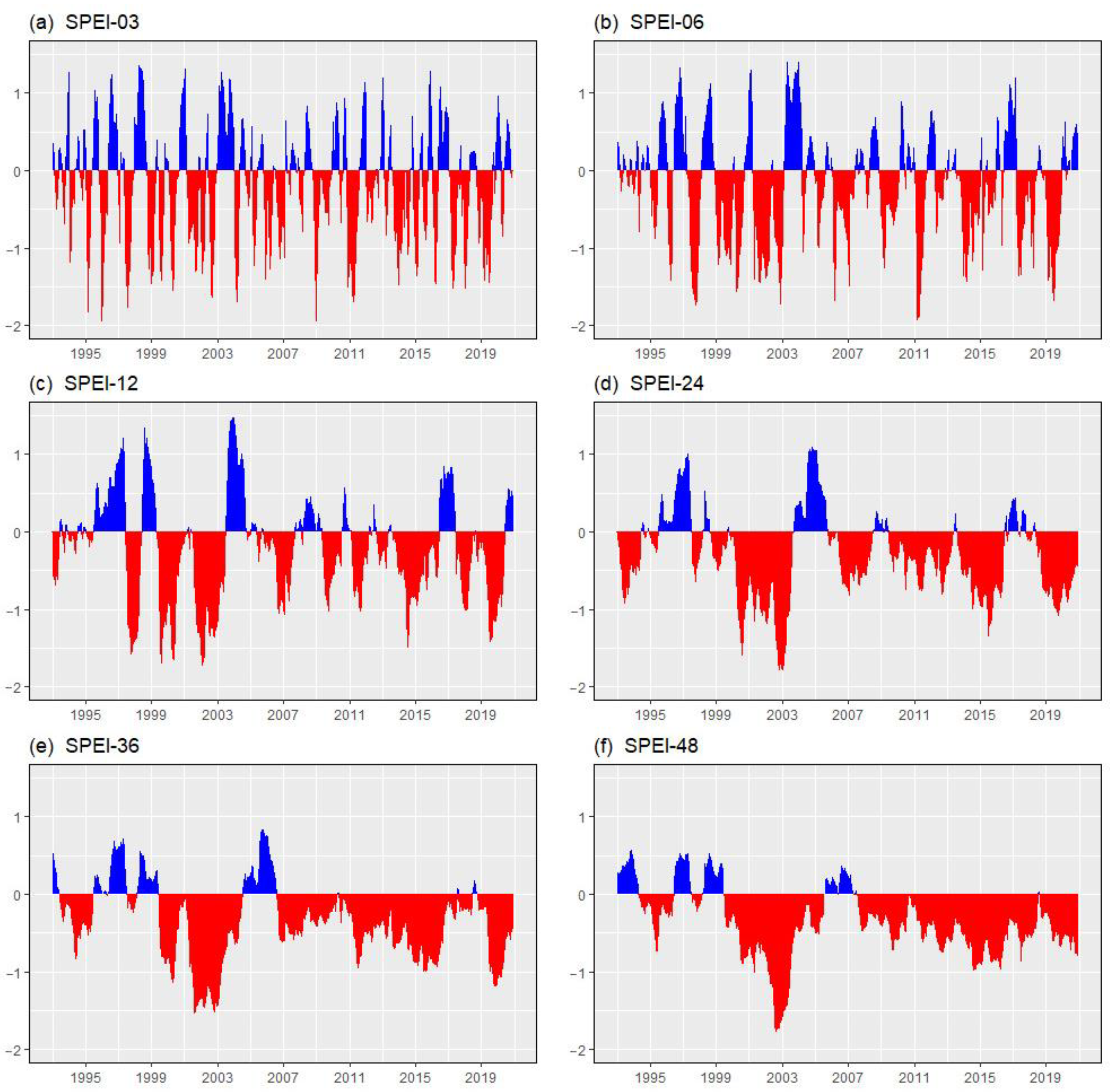
Between 1993 and 2020, the monthly variations of SPEI-03 in the NCP predominantly exhibited seasonal fluctuations between wet and dry periods. Extreme drought events (SPEI ≤ −2.0) occurred on five occasions, specifically in February 1999, April 2000, May 2001, March 2002, and January 2011 (Figure 4a). Severe drought events (−2.0 < SPEI ≤ −1.5) were recorded 15 times, primarily during the winter and spring seasons, with the most prolonged severe drought lasting from March to May 2001 (Figure 4a). At the 6-month scale, extreme droughts occurred twice across the NCP, in February 1999 and April 2011. Severe droughts happened nine times, with the longest-lasting from August to November in 1997 (Figure 4b). For the 12-month scale (SPEI-12), severe droughts occurred four times, specifically in October–November 1997, August 1999, April–June 2000, and January–April 2002 (Figure 4c). At longer scales such as 24-month, 36-month, and 48-month, the time series of SPEI-24, SPEI-36, and SPEI-48 showed consistent patterns. Prolonged and severe drought events occurred from May 2000 to June 2003, peaking in the winter of 2002–2003. From around July 2006 onwards, the NCP experienced an extended period of mild dry conditions with SPEI mostly negative and less than −1.5 (Figure 4d–f).
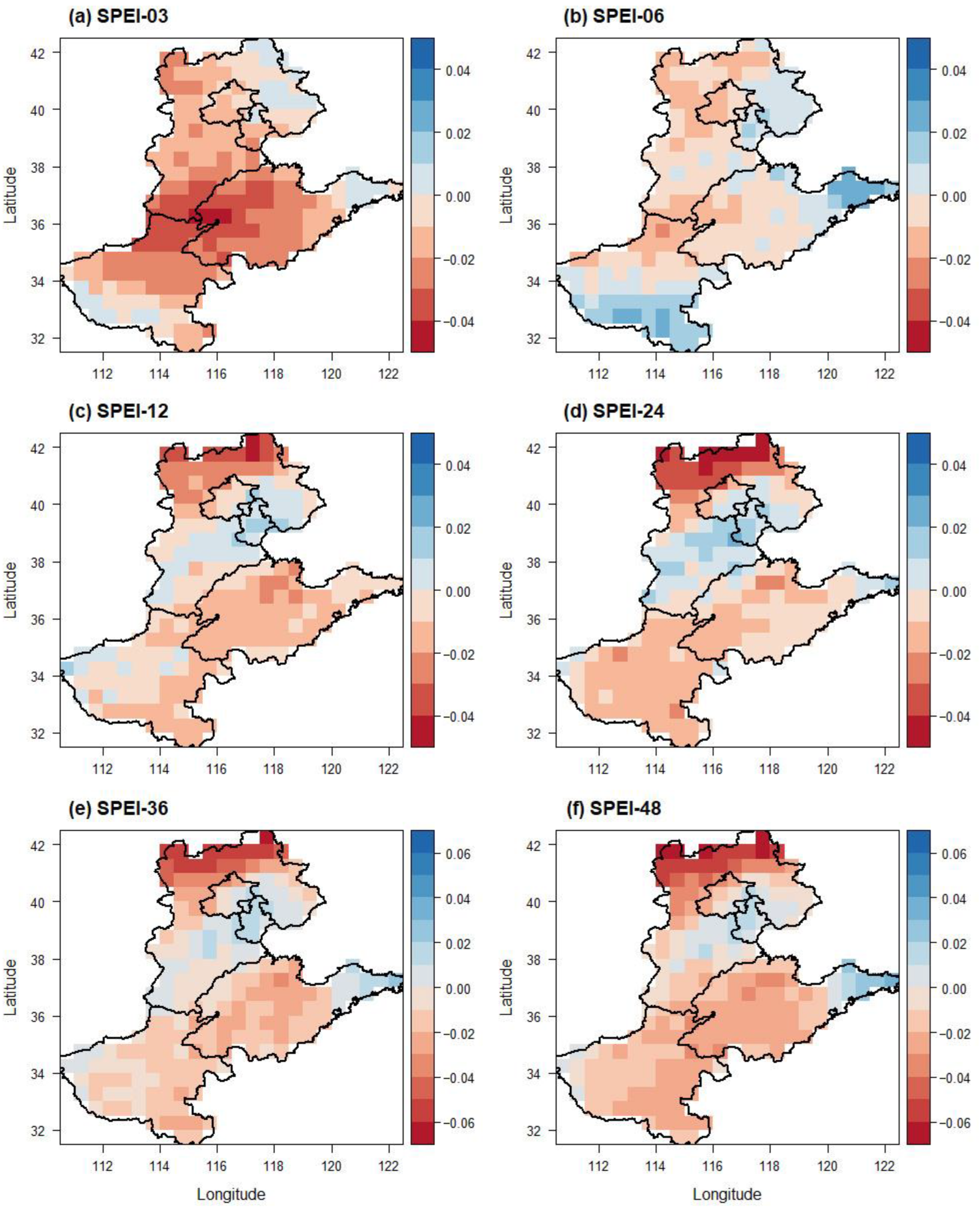
Spatially, 88.3% of the total area across the NCP exhibited a decreasing trend in SPEI-03, with the central region showing a relatively higher rate of decline, indicating an exacerbation of spring drought (Figure 5a). Conversely, only 11.7% of the area showed a positive trend, which primarily concentrated in the southern part of Henan, the northeastern part of Hebei, and parts of the eastern peninsula of Shandong. At the 6-month scale (SPEI-6), 60.7% of the area displayed a decreasing trend, and 39.3% showed an increasing trend (Figure 5b).
The trend observed in SPEI-12, SPEI-24, SPEI-36, and SPEI-48 depicted consistent spatial patterns, with the proportions of areas showing a decreasing trend at 80.4%, 75.7%, 77.1%, and 83.6%, respectively (Figure 5c–f). Specifically, regions with decreasing trends in SPEI were mainly located in the northern areas and along the Henan–Shandong region, suggesting more pronounced aridification trends observed in the northern regions (Figure 5c–f). In contrast, wetting trends were primarily concentrated in the southern part of Hebei extending to the Beijing–Tianjin region (Figure 5c–f).

3.3. Sensitivity of Wheat Yield to Drought and Its Changes

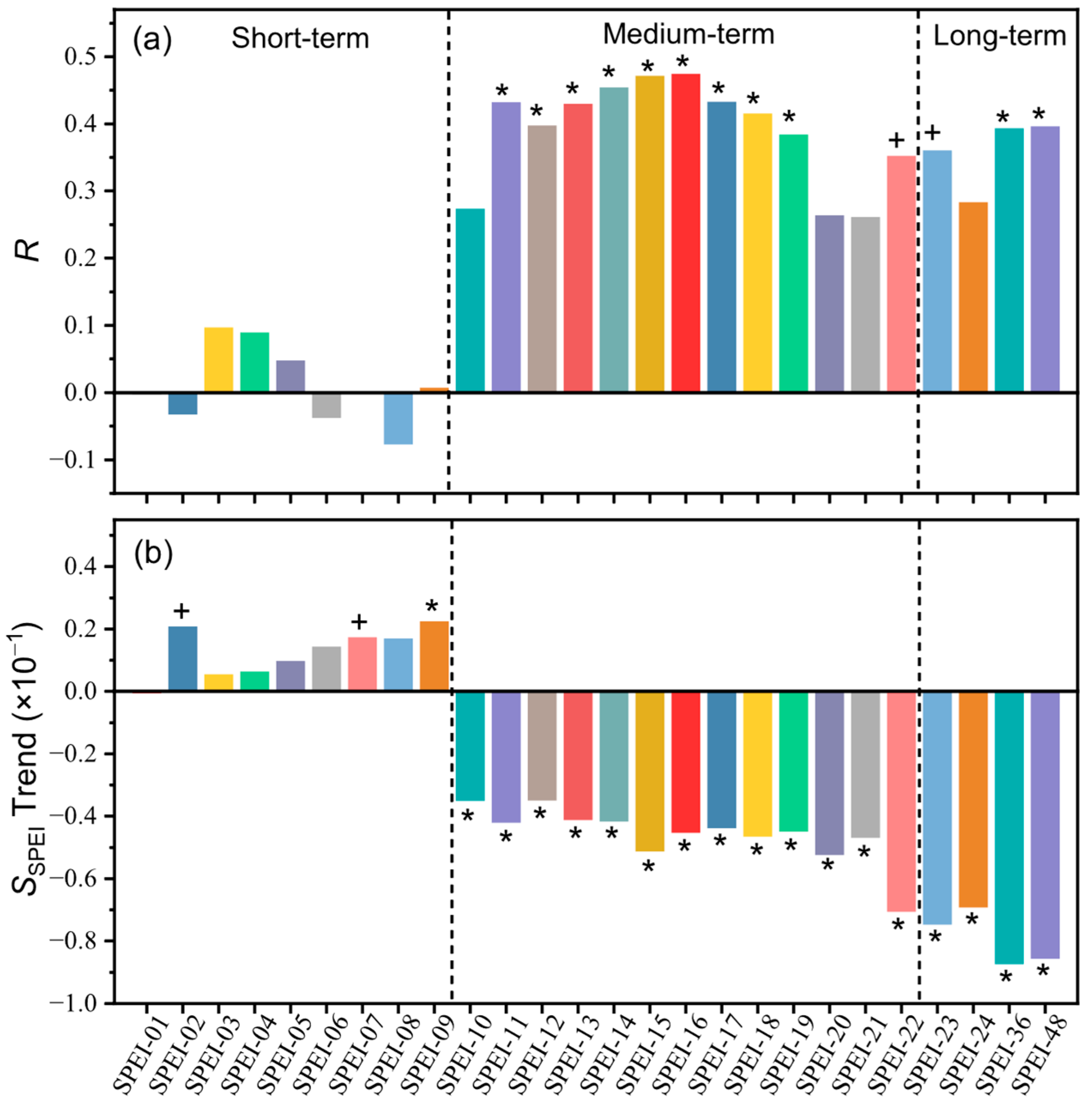
For medium-term and long-term durations, the relationship between wheat yield IAV and SPEI was predominantly statistically significant (p < 0.05), suggesting that wheat yield IAV in the NCP was sensitive to medium-term and long-term drought (Figure 6a and Figure S2), whereas the relationship was indistinct when the SPEI time scale was less than 10 months, indicating that wheat yield IAV was insensitive to short-term drought events (Figure 6a and Figure S2).
We analyzed the change in SSPEI change across different time periods using the 9-year moving window analysis. The results revealed that the SSPEI had substantially declined when the drought duration exceeded 10 months, implying a notable reduction in wheat yield losses due to medium-term and long-term drought (Figure 6b and Figure S3). Conversely, SSPEI depicted an increasing trend when the drought duration was less than 10 months (Figure 6b and Figure S3). This suggested that short-term drought-induced wheat yield reduction has enhanced, although some trends did not achieve the statistical significance.

3.4. Environmental Drivers Regulating Wheat Yield SSPEI

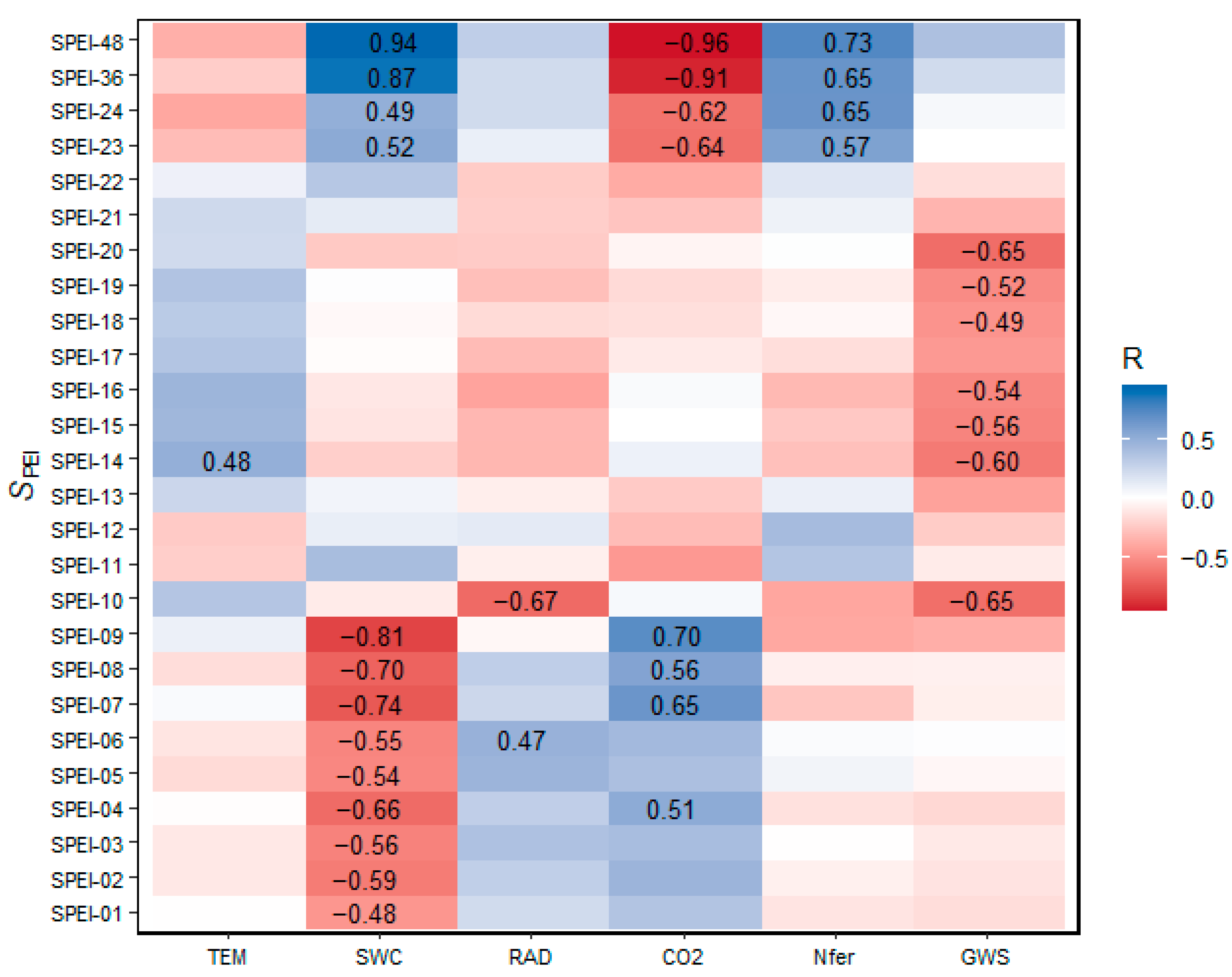
Variations in the environmental factors, including TEM, SWC, RAD, Nfer, CO2, and GWS, exhibited distinct effects on SSPEI across different time scales. For short-term drought durations, the relationship between SWC and SSPEI was significantly negative (p < 0.05), indicating that higher soil moisture substantially mitigated the adverse effects of short-term drought on wheat yield variability (Figure 7). By contrast, the relationship between CO2 and SSPEI under short-term drought was positive, with significant correlations (p < 0.05) observed at the 4-month, 7-month, 8-month, and 9-month scales, suggesting that enriched CO2 enhanced wheat yield losses (Figure 7). Effects from other factors were generally insignificant across most scales for short-term drought events (Figure 7).
GWS showed negative correlations with multi-scale SSPEI under medium-term drought, most of which met the statistical significance level (p < 0.05) (Figure 7). These pronounced negative relationships implied that the declines in medium-term drought-induced reductions in wheat yield were at the cost of groundwater for irrigation. However, other environmental factors rarely showed significant correlations with SSPEI under the medium-term drought events (Figure 7).
During prolonged drought durations, the relationship between SWC and SSPEI was significantly positive (p < 0.05), suggesting that higher soil moisture levels might significantly enhance long-term drought-induced wheat yield losses (Figure 7). Nevertheless, atmospheric CO2 levels significantly and negatively correlated with SSPEI, indicating that elevated atmospheric CO2 concentrations could mitigate the reductions in wheat yield caused by long-term drought (Figure 7). Additionally, positive correlations between Nfer and SSPEI were statistically significant (p < 0.05) under long-term drought, suggesting that increased nitrogen fertilization might intensify SSPEI and contribute to drought-induced wheat yield reductions (Figure 7).
The relationships between TEM/RAD and SSPEI were mostly non-significant across most drought timescales (Figure 7). Although TEM showed a positive correlation with SSPEI at medium-term scales, this relationship reversed to negative under long-term drought conditions (Figure 7). Similarly, RAD exhibited a positive correlation with SSPEI during both short-term and long-term droughts but turned negative at medium-term scales (Figure 7).
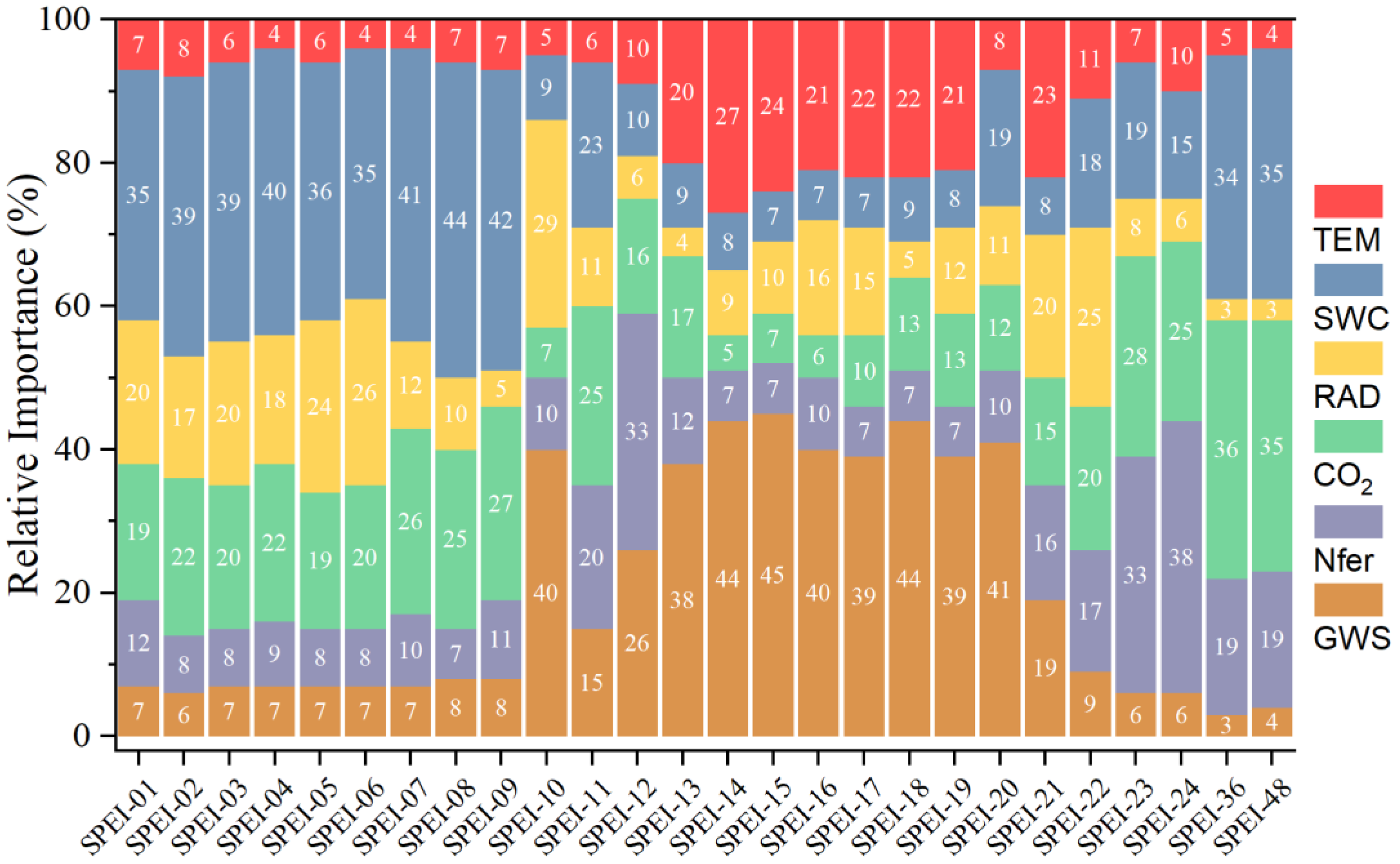
The relative weight analysis was employed to quantitatively assess the influence of various environmental factors on the SSPEI. The results indicated that SWC, with an average relative weight of 38.9 ± 3.2%, dominated SSPEI variations for short-term drought with the SPEI timescale less than 10 months (Figure 8). At the medium-drought scale, GWS emerged as the strongest explanatory variable for SSPEI variations, with a mean relative weight of 33.7 ± 12.3% (Figure 8). During long-term drought periods, SWC, CO2, and Nfer jointly dominated SSPEI variations, and the cumulative relative weight as high as 84.0 ± 6.2% (Figure 8).

4. Discussion

4.1. Declining Sensitivity of Wheat Yield Variations to Drought Overall the NCP

Climate change-induced environmental stress is widely recognized as the primary factor impacting crop photosynthesis and contributing to reductions in food production [44,45,46]. Globally, climate change is estimated to explain approximately one-third of the variability in food production [45]. Among the various stressors, drought is the most frequent and widespread factor affecting crop production [13]. Climate warming is expected to intensify both the frequency and severity of drought events, particularly in the arid and semi-arid regions [47,48]. We analyzed the spatiotemporal changes of multi-scale SPEI and found that the aridity has enhanced at the NCP scale during 1993–2020 (Figure 4). Spatially, there has been an enhancement in spring drought (SPEI-03) across nearly the entire NCP (Figure 5a). By contrast, medium and long-term drought (SPEI-12 to SPEI-48) has intensified in northern Beijing–Tianjin–Hebei, Henan, and Shandong (Figure 5). These results are generally consistent with previous studies [24,29,49].
Correlation coefficients between wheat yield IAV and SPEI are significantly positive when the time scale exceeds 10 months (p < 0.05), while no significance is exhibited at shorter time scales (Figure 6a and Figure S2). The results suggest that wheat yield IAV in the NCP is sensitive to medium-term and long-term drought, but less responsive to short-term droughts. This finding is generally consistent with a previous study conducted in the NCP, which suggests that the impact of drought on wheat in the NCP exhibits a lag period of nearly 11 months [49]. Using a 9-year moving window analysis, we found that the sensitivity of wheat yield IAV (SSPEI) to medium-term and long-term drought exhibits a significant decreasing trend, while the short-term drought sensitivity shows an increasing trend, parts of which meets the significance at p < 0.1 level (Figure 6b and Figure S3). This implies that the reduction in wheat yield losses caused by medium-term and long-term drought has decreased, while the potential losses from short-term droughts may be increasing. Previously, it has also been reported that the correlation coefficients between winter wheat yield and SPEI-03 and SPEI-06 have increased during the 1980s, 1990s, and 2000s, whereas the correlation with SPEI-12 has declined in the NCP [49]. Globally, it has been confirmed that the sensitivity of vegetation productivity to long-term (>12 months) droughts has decreased [50], while constraints from short-term droughts (e.g., SPEI-03) have been increasing under climate warming over the past three decades [9,10,51].

4.2. Environmental Drivers and Mechanisms Underlying the Changes in SSPEI

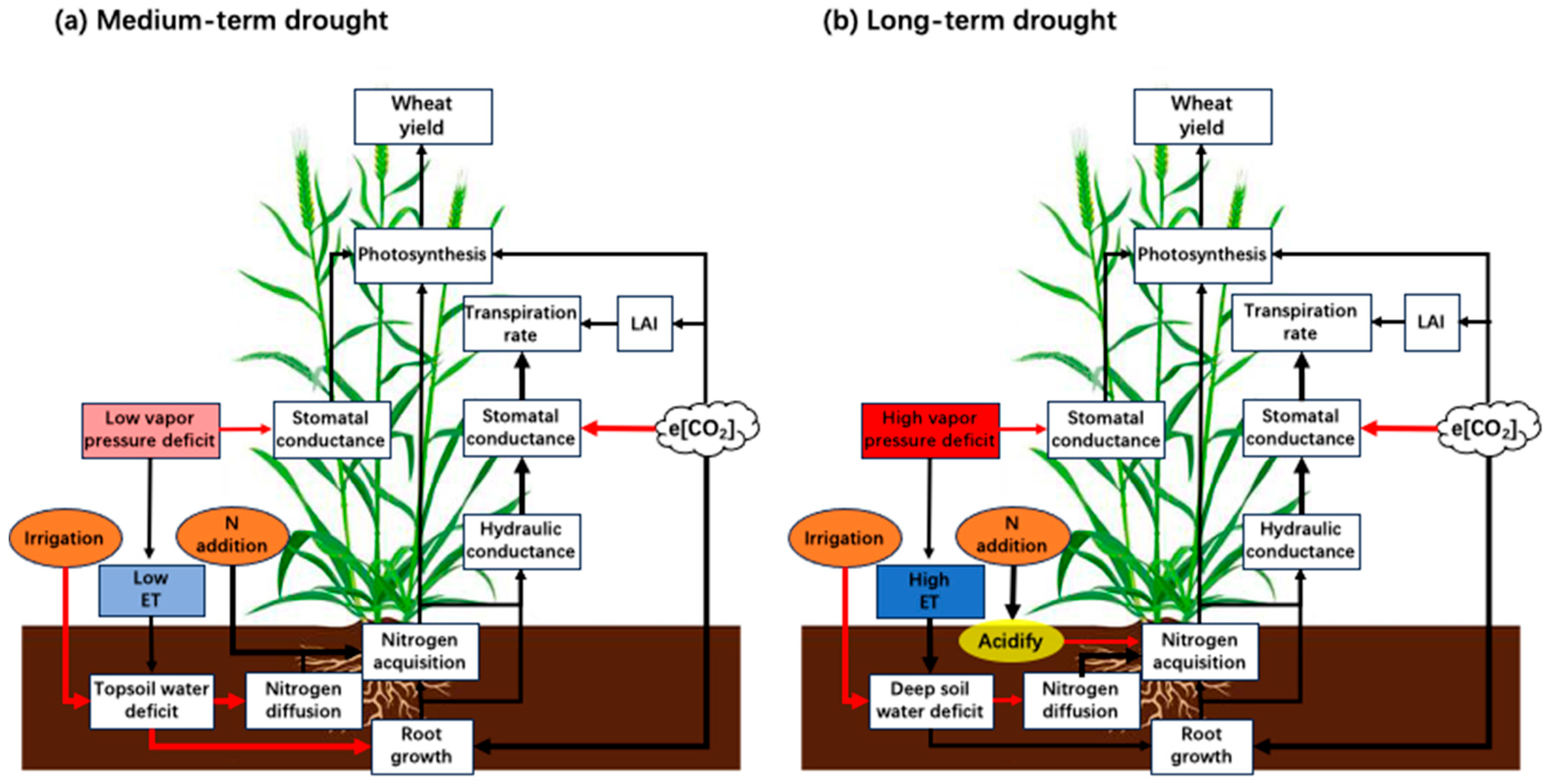
Farmland management and environmental change, which induce adaptions in both the intrinsic physiological efficiency and morphological traits of plants, should be responsible for the SSPEI variability [52]. For example, irrigation, with surface water or groundwater, is a common method to replenish SWC and cope with drought-induced water stress, hence agricultural drought often employs soil moisture deficiency [53]. Additionally, the widespread application of artificial fertilizers, such as nitrogen fertilizer (Nfer), may promote photosynthesis and partially compensate for the negative impacts of drought on crop production [14,22,54]. Furthermore, the elevated atmospheric CO2 concentration is expected to enhance photosynthesis as well as decrease stomatal conductance and transpiration rate, also termed the CO2 fertilization effect and water-saving effect, thus improving water use efficiency (WUE) and alleviating the negative impacts of drought on plant productivity [20,54,55,56]. Morphologically, variations in SWC, atmospheric CO2, and fertilization also trigger alterations in root development, which is an essential trait for acquiring water and nutrients, thereby mitigating drought stress and nutrient limitation [11,54,57,58]. Therefore, in this study, we further analyzed the impacts of these natural and anthropogenic factors, including climatic factors (TEM, RAD), SWC, Nfer, atmospheric CO2, and groundwater exploitation, on variations in wheat yield SSPEI in the NCP (Figure 7 and Figure 8). Based on our results and previous findings, we described the underlying mechanisms of SSPEI variability using the schematic model depicted in Figure 9.

4.2.1. Effects of Soil Moisture and Groundwater on SSPEI

The effects of soil moisture on plant photosynthetic production are complex. Firstly, SWC directly determines the water availability and regulates hydraulic and stomatal conductance, thereby affecting both leaf photosynthesis and transpiration [54,59]. Additionally, soil water deficiency hinders nutrient diffusion from the topsoil surface to the root surface, altering nutrient availability and thus impacting crop yield [60,61]. Furthermore, soil drought also regulates root growth, thereby affecting water and nutrient uptake, which are critical morphological adaptations to drought severity [58,61]. The observed effects of changes in SWC on the SSPEI are influenced by the total impacts of these processes. In this study, we observed that SWC shows a significantly negative correlation with SSPEI (p < 0.05) at time scales shorter than 10 months (short-term drought) (Figure 7). This primarily illustrates that short-term drought does not necessarily lead to soil drought, and replenishing soil water can effectively alleviate the negative effects of short-term drought on wheat yield. It is important to note that the SWC data used in this study was simulated by a large-scale climate model. The SWC variations are close to the changes induced by natural physical processes and are not influenced by the groundwater extraction for irrigation.
However, during long-term drought, when the duration of SPEI exceeds the 23-month scale, SWC exhibits a significantly positive correlation (p < 0.05) with SSPEI, implying that high soil moisture may enhance the yield loss induced by long-term drought (Figure 7). Several reasons can explain this phenomenon. Firstly, under long-term durations, variations in SWC may be insufficient to indicate water availability for winter wheat production. It is commonly known that most of the precipitation in the NCP occurs in summer, while spring precipitation and irrigation are the most critical natural and anthropogenic processes determining water availability and winter wheat productivity in the current year. Therefore, under long-term drought conditions, SWC variability might be significantly influenced by precipitation during the last summer or even the summer before last, rather than the pre-harvest season for wheat. Conversely, a higher SWC may result from more precipitation in summer but drier conditions during the cold seasons. Therefore, these correlations can be significantly negative (Figure 7). Secondly, a relatively high SWC may inhibit the prolonged drought-induced adaptive responses in crops. It is widely reported that long-term environmental stress leads to physiological and morphological adaptations of plants to increase stress tolerance [54,62,63]. For example, physiologically, plants tend to reduce hydraulic conductivity and stomatal conductance to minimize water loss during drought conditions. Plants also morphologically reduce leaf area and promote roots development, particularly the deep roots [11,57] (Figure 9). However, soil with relatively high-water content (though still deficient) may partly constrain the adaptive processes and subsequently enhance SSPEI. Other factors, such as the shortened growing season of crops under prolonged drought may make water supply outside the growing season invalid and the passive effects of increased precipitation during the harvest months may also partly contribute to the indistinct and remarkably positive correlations between SWC and SSPEI (Figure 7 and Figure 8) [15].
Based on the reconstructed GRACE TWSA data, we examined the relationship between GWS and SSPEI anomalies. The results shows that the correlations between GWS and SSPEI anomalies are significantly negative at the medium-term scales (10–20 months), showing that the significant reduction in SSPEI for the medium-term drought is at the expense of groundwater consumption (Figure 7 and Figure 8). Groundwater in the NCP has been widely reported to be overexploited to meet the socioeconomic and irrigation water demand, resulting in the NCP becoming one of the most depleted aquifers in this world [25,26,64]. For the long-term drought, the relationship between GWS and SSPEI is indistinct (Figure 7 and Figure 8). This may be attributed to the limited responsiveness of the current irrigation regime to prolonged drought conditions. In the NCP, standard irrigation practices for winter wheat typically consist of post-sowing irrigation, freeze-protection irrigation, and post-regreening applications, with no supplemental irrigation provided during the winter period. In the case of summer maize, farmers are also reluctant to increase the frequency of irrigation because maize is more tolerant to drought and less economical viable than wheat. This may jointly contribute to the unclear relationship between GWS and SSPEI.

4.2.2. Effects of Atmospheric CO2 on SSPEI

The relationship between CO2 and SSPEI varies situationally under different time scales of drought. Specifically, in short-term droughts lasting less than 10 months, CO2 is positively correlated with SSPEI, suggesting that elevated CO2 may exacerbate the drought-induced yield reductions (Figure 7). Moreover, the correlation is statistically significant (p < 0.05) within the 7- to 9-month time scale (Figure 7). However, during medium-term or long-term drought exceeding 10 months, the relationship shifts from positive to negative and becomes statistically significant since the 23-month (Figure 7), suggesting that elevated CO2 effectively mitigates crop yield losses under prolonged drought conditions. Generally, short-term and medium-term droughts induce topsoil water deficits, whereas current irrigation regimes may effectively alleviate the water stress. In this situation, elevated CO2 and atmospheric water deficit may constrain transpiration rates by decreasing stomatal conductance and minimizing transpirational water loss, thus reducing evaporative cooling and increasing leaf-to-air vapor pressure difference (Figure 9a) [65,66]. By contrast, an increase in leaf area induced by elevated CO2 may partially or fully compensate the reduced stomatal conductance, thus enhancing transpiration and photosynthetic productivity (Figure 9a) [67,68,69,70]. Previous studies have demonstrated that elevated CO2 has a stronger fertilization effect under moderate drought conditions [54,71]. Additionally, topsoil drought and enriched CO2 may inhibit shallow roots growth while promoting deep roots development, thereby intensifying the extraction of deep soil moisture. Failure to replenish deep soil moisture during prolonged drought can exacerbate reductions in productivity [68]. Therefore, the relationship between CO2 and SSPEI is positive but no significance at the 1- to 6-month scale. The correlations become statistically significant (p < 0.05) when the time scale exceeds 6 months but shorter than 10 months (Figure 7), suggesting that the enriched CO2-induced adaptions in traits may amplify the risk of drought-induced yield reduction.
Conversely, prolonged droughts result in significant reductions in deep soil moisture, which has a profoundly adverse impact on vegetation growth [72]. Here, the compound drought in both atmosphere and soil can largely reduce stomatal conductance (Figure 9b). Moreover, the elevated CO2-induced fertilization and water-saving effects may intensify, potentially shifting the CO2-SSPEI relationship from positive to negative (Figure 7) [20,70]. Previously, studies have shown that elevated CO2 has reduced vegetation’s reliance on water, but it has increased the vulnerability of water-abundant areas to drought [73]. Moreover, during prolonged droughts, elevated CO2 is anticipated to stimulate deep root system development, enhancing water and nutrient uptake, and ultimately reducing drought sensitivity [57,62,74].

4.2.3. Effects of Nitrogen Addition on SSPEI

Nitrogen addition, whether sourced from atmospheric nitrogen deposition or artificial fertilizer application, is one of the environmental drivers that can significantly influence plant photosynthesis and carbon accumulation [14,18,21,75]. It is well-established that adequate nitrogen supply can optimize water use efficiency and enhance the fertilization effect of elevated CO2, and thereby increase vegetation productivity [18,22,76]. Generally, in moderate drought conditions, nitrogen addition can increase nitrogen availability and compensate for drought-induced yield reduction when soil moisture deficit is moderate (Figure 9a). However, intensified drought conditions may reduce nutrient diffusion rates and hinder nutrient acquisition due to deep soil deficits. Furthermore, excessive nitrogen addition can lead to soil acidification, potentially damaging roots and reducing the gradient between root and soil water potential, ultimately decreasing water use efficiency and nutrient uptake and enhancing yield loss (Figure 9b) [54,77,78].
In this study, Nfer shows negative correlations with SSPEI up to the 19 months, implying that nitrogen fertilizer application may partially mitigate the sensitivity of wheat yield to drought (Figure 7). It is noteworthy that these correlations did not reach statistical significance level (p > 0.05), possibly due to short-term drought-induced constrains on root growth, which partially offset the compensatory effects of nitrogen addition by reducing nitrogen acquisition capability. However, when the SPEI time scale exceeds 23 months, nitrogen addition shifts the effect on SSPEI from weakly negative to significantly positive correlations (Figure 7), suggesting that increased nitrogen addition markedly enhances the reduction in wheat yield due to drought. Prolonged drought may induce deep soil moisture deficits, thus reducing nitrogen diffusion and effectiveness (Figure 9). Additionally, absorbing high concentrations of nitrogen may increase water consumption, ultimately lowering water use efficiency. This exacerbates the negative effects of drought on grain production. Previous field experiments conducted by Lenka, et al. [79] and Liu, et al. [80] have shown that high nitrogen addition significantly increases soil water consumption. Similarly, another study also suggests that water scarcity and excessive nitrogen addition contribute to low wheat yields in arid regions, and reducing nitrogen addition under limited irrigation conditions can enhance water and nitrogen absorption efficiency in agricultural fields [77]. Therefore, managing nitrogen fertilizer applications based on predictions of drought severity could be an effective strategy to mitigate drought-induced reductions in grain production across various drought time scales.

4.2.4. Effects of Climate Regimes on SSPEI

Drought-induced water stress often compounds with heat stress, making it difficult to fully isolate the respective effects under drought conditions [81,82]. For most SPEI time scales ranging from 10 to 22 months, TEM shows a positive correlation with SSPEI, albeit rarely reaching statistical significance (p > 0.05) (Figure 7). Furthermore, the relative importance analysis also indicates that TEM is the second dominator among the six factors considered (Figure 8). We believe the positive relationship between TEM and SSPEI may be attributed to two main reasons. On one hand, in dry conditions, warming is expected to shorten the growing season length and ultimately reduce wheat yield production [15]. On the other hand, extreme hot events, like heatwaves have been documented to induce photosynthetic stagnation or affect the fertilization effect of elevated CO2, leading to reductions in crop yields [74,81,83]. However, the annual mean temperature alone may not adequately reflect extreme hot events, which could explain the lack of significant relationship between TEM and SSPEI (Figure 7). Precipitation was examined to have strong collinearity with SWC when multiple regression model is applied, so we retained SWC and removed precipitation. RAD can directly affects food production through photosynthesis, and indirectly reduce grain yield by changing water availability (e.g., enhancing evapotranspiration). Across multiple SPEI time scales, insignificant correlation predominates the relationship between RAD and SSPEI, which is possibly the result of the combined effects of RAD. In short-term drought conditions, a high RAD can lead to low water availability when the anthropogenic irrigation is untimely, thus leading a positive correlation between RAD and SSPEI (Figure 7). In the medium-term drought scenarios, irrigation liberates water restriction and a high RAD inducing high photosynthetic capacity, which compensates for the drought-induced yield losses, ultimately leading to the negative correlation between RAD and SSPEI (Figure 7). Under long-term drought, a high RAD may enhance water deficit and leaf area shrinking, which eventually lead to the shift in correlation from negative to positive (Figure 7).

4.3. Limitations and Practical Implications

In this study, we expected to provide valuable insights into the temporal evolution and environmental drivers of wheat yield sensitivity to drought across the NCP. However, there are several limitations that may lead to uncertainty and warrant consideration. First, the spatial resolutions of the datasets used, particularly the long-term gridded SPEI and the province-level grain production records are not fully consistent. Although we have masked the raster data using remote sensing-based crop distribution images, the results may still partly introduce bias in quantifying the relationship between drought indices and yield variability. In addition, on the other hand, uncertainty arises from model-based data, such as the SWC, GWS, and Nfer datasets. Their heterogeneous accuracy among datasets and potential interpolation errors could affect the precision in estimating the relationship between SSPEI variability and environmental factors. Second, we focus primarily on drought impacts and does not explicitly consider concurrent heat stress or compound dry-hot events, which often occurs alongside drought and may amplify or offset the effects of drought on crop yield. The interactions between drought and heat stress, as well as their combined physiological effects on wheat growth and water use efficiency, deserve further investigation. Third, the relationships between drought SSPEI and its drivers such as SWC, GWS, Nfer, and CO2 are inferred from statistical models rather than fully mechanistic process-based simulations. Future studies should integrate crop growth and land surface models with coupled hydrological processes to provide a more mechanistic understanding of their interactions.
From a practical perspective, our findings have important implications for agricultural management and drought adaptation in water-limited regions. The identified timescale-dependent drivers of drought sensitivity indicate that strategies to mitigate drought-induced yield loss should be tailored according to drought duration and intensity. Specifically, groundwater management should prioritize preventing overexploitation during medium-term droughts, while optimizing fertilizer use and promoting soil water conservation are essential during prolonged droughts to sustain yield stability. Moreover, the study highlights that elevated atmospheric CO2 may temporarily buffer long-term drought effects through enhanced water-use efficiency, but its mitigation potential should not be overestimated in the face of worsening water scarcity. Therefore, prediction-based adaptive management integrating drought forecasting, soil moisture monitoring, and resource-efficient irrigation scheduling is crucial for ensuring the long-term sustainability of agricultural production in the NCP and similar semi-arid agricultural systems worldwide.

5. Conclusions

In this study, we investigated the sensitivity of wheat yield anomalies to drought across multiple timescales and analyzed the changes in response to potential environmental drivers in the NCP. Over the past three decades, wheat yield anomalies were predominantly regulated by medium-term and long-term drought (over 10 months). However, the sensitivity of wheat yield to medium-term and long-term drought declined substantially, suggesting that the risk of wheat yield reduction from medium-term and long-term drought is decreasing. Notably, the effects of the SWC, GWS, Nfer, and atmospheric CO2 on drought sensitivity varied situationally with the extension of the time scale. In general, SWC was the dominant factor regulating wheat yield’s short-term drought sensitivity (SSPEI), with a relative weight of 38.9 ± 3.2% in explaining SSPEI variability. While GWS primarily dominated medium-term SSPEI, and contributed a relative weight of 33.7 ± 12.3% in explaining the variations. SWC, CO2, and Nfer jointly dominated long-term SSPEI variations, and the cumulative relative weight as high as 84.0 ± 6.2%. Specifically, the anticipated “fertilizer effect” and “water-saving effect” of enriched CO2 in mitigating drought-induced reductions were observed primarily in long-term drought scenarios, contrasting with CO2 enrichment-enhanced yield reductions during short-term drought. Nfer may partially alleviate yield reductions from short-term and medium-term droughts, but it remarkably enhanced yield loss under long-term drought. Therefore, we hypothesized that the declining in wheat yield sensitivity to medium-term and long-term drought is the result of groundwater exploitation and the CO2 enrichment, respectively. Our findings highlight that farmland management and mitigation strategies to ensure food security and sustainability, such as water resource management and fertilizer application, may need to vary and should be based on projections of regional drought evolution across different time scales.

Supplementary Materials

The following supporting information can be downloaded at: https://www.mdpi.com/article/10.3390/su172310798/s1, Figure S1: Changes in total wheat yield (N, ×104 tons), cultivated area (S, ×103 ha), and yield per unit area (U, kg/ha) in the NCP for the period 1993–2020; Figure S2: Sensitivity of wheat yield to multi-scale SPEI; Figure S3: Changes in SSPEI in the past three decades.

Author Contributions

Conceptualization, Z.X. and Y.Z.; Data curation, Y.C.; Formal analysis, Z.W.; Funding acquisition, Z.W. and Y.Z.; Investigation, F.L.; Methodology, Z.W.; Validation, Y.C.; Visualization, Z.W.; Writing—original draft, Z.W.; Writing—review and editing, Z.W., F.L., B.N. and Y.Z. All authors have read and agreed to the published version of the manuscript.

Funding

This research was jointly funded by the Natural Science Foundation of Hebei Province, grant number C2024402017; the National Natural Science Foundation of China, grant number 32071608; and the Central Guidance on Local Science and Technology Development Funding of Hebei Province, grant number 226Z6401G.

Institutional Review Board Statement

Not applicable.

Informed Consent Statement

Not applicable.

Data Availability Statement

The province-scale grain production data were obtained from the “China Statistical Yearbook” published by the National Bureau of Statistics (https://www.stats.gov.cn/sj/ndsj/, accessed on 14 October 2023). The 1–24-month time-scales of SPEI were obtained from https://spei.csic.es/spei_database (accessed on 30 May 2024). The atmospheric CO2 data is available from Mauna Loa Observatory provided by the Scripps Institution of Oceanography (Scripps CO2 program) (https://www.scrippsco2.ucsd.edu/data/atmospheric_co2/, accessed on 20 April 2024). The reconstructed GRACE-based TWSA data can be obtained from https://datadryad.org/dataset/doi:10.5061/dryad.z612jm6bt (accessed on 25 April 2024). The climate and soil moisture data are available from ERA5-land (https://www.ecmwf.int/, accessed on 12 March 2024).

Conflicts of Interest

The authors declare no conflicts of interest.

Abbreviations

SPEI: Standardized Precipitation Evapotranspiration Index; NCP: North China Plain; SWC: soil moisture content; GWS: groundwater storage; Nfer: nitrogen fertilizer; SSPEI: sensitivity of wheat yield to drought defined as the Pearson correlation coefficient (R) between the wheat yield variations and the corresponding SPEI; TEM: mean annual temperature; RAD: land surface shortwave radiation; CO2: atmospheric carbon dioxide concentration; IAV: interannual variability obtained by removing the linear trend.

References

  1. Samset, B.H.; Zhou, C.; Fuglestvedt, J.S.; Lund, M.T.; Marotzke, J.; Zelinka, M.D. Steady global surface warming from 1973 to 2022 but increased warming rate after 1990. Commun. Earth Environ. 2023, 4, 400. [Google Scholar] [CrossRef]
  2. Donat, M.G.; Lowry, A.L.; Alexander, L.V.; O’Gorman, P.A.; Maher, N. More extreme precipitation in the world’s dry and wet regions. Nat. Clim. Change 2016, 6, 508–513. [Google Scholar] [CrossRef]
  3. Papalexiou, S.M.; Montanari, A. Global and Regional Increase of Precipitation Extremes Under Global Warming. Water Resour. Res. 2019, 55, 4901–4914. [Google Scholar] [CrossRef]
  4. Min, S.K.; Zhang, X.; Zwiers, F.W.; Hegerl, G.C. Human contribution to more-intense precipitation extremes. Nature 2011, 470, 378–381. [Google Scholar] [CrossRef]
  5. Vicente-Serrano, S.M.; Quiring, S.M.; Pena-Gallardo, M.; Yuan, S.; Dominguez-Castro, F. A review of environmental droughts: Increased risk under global warming? Earth-Sci. Rev. 2020, 201, 102953. [Google Scholar] [CrossRef]
  6. Pokhrel, Y.; Felfelani, F.; Satoh, Y.; Boulange, J.; Burek, P.; Gädeke, A.; Gerten, D.; Gosling, S.N.; Grillakis, M.; Gudmundsson, L.; et al. Global terrestrial water storage and drought severity under climate change. Nat. Clim. Change 2021, 11, 226–233. [Google Scholar] [CrossRef]
  7. Santini, M.; Noce, S.; Antonelli, M.; Caporaso, L. Complex drought patterns robustly explain global yield loss for major crops. Sci. Rep. 2022, 12, 5792. [Google Scholar] [CrossRef] [PubMed]
  8. Kim, W.; Iizumi, T.; Nishimori, M. Global Patterns of Crop Production Losses Associated with Droughts from 1983 to 2009. J. Appl. Meteorol. Climatol. 2019, 58, 1233–1244. [Google Scholar] [CrossRef]
  9. Jiao, W.; Wang, L.; Smith, W.K.; Chang, Q.; Wang, H.; D’Odorico, P. Observed increasing water constraint on vegetation growth over the last three decades. Nat. Commun. 2021, 12, 3777. [Google Scholar] [CrossRef]
  10. Wei, X.; He, W.; Zhou, Y.; Cheng, N.; Xiao, J.; Bi, W.; Liu, Y.; Sun, S.; Ju, W. Increased Sensitivity of Global Vegetation Productivity to Drought over the Recent Three Decades. J. Geophys. Res. Atmos. 2023, 128, e2022JD037504. [Google Scholar] [CrossRef]
  11. Vadez, V.; Grondin, A.; Chenu, K.; Henry, A.; Laplaze, L.; Millet, E.J.; Carminati, A. Crop traits and production under drought. Nat. Rev. Earth Environ. 2024, 5, 211–225. [Google Scholar] [CrossRef]
  12. IPCC. Climate Change 2021: The Physical Science Basis. Contribution of Working Group I to the Sixth Assessment Report of the Intergovernmental Panel on Climate Change; Cambridge University Press: Cambridge, UK; New York, NY, USA, 2021. [Google Scholar]
  13. Lesk, C.; Rowhani, P.; Ramankutty, N. Influence of extreme weather disasters on global crop production. Nature 2016, 529, 84–87. [Google Scholar] [CrossRef]
  14. Li, H.L.; Terrer, C.; Berdugo, M.; Maestre, F.T.; Zhu, Z.C.; Peñuelas, J.; Yu, K.L.; Luo, L.; Gong, J.Y.; Ye, J.S. Nitrogen addition delays the emergence of an aridity-induced threshold for plant biomass. Natl. Sci. Rev. 2023, 10, nwad242. [Google Scholar] [CrossRef]
  15. Guo, R.P.; Lin, Z.H.; Mo, X.G.; Yang, C.L. Responses of crop yield and water use efficiency to climate change in the North China Plain. Agric. Water Manag. 2010, 97, 1185–1194. [Google Scholar] [CrossRef]
  16. Zhang, L.; Ma, Q.; Zhao, Y.; Chen, H.; Hu, Y.; Ma, H. China’s strictest water policy: Reversing water use trends and alleviating water stress. J. Environ. Manag. 2023, 345, 118867. [Google Scholar] [CrossRef]
  17. Schimel, D.; Stephens, B.B.; Fisher, J.B. Effect of increasing CO2 on the terrestrial carbon cycle. Proc. Natl. Acad. Sci. USA 2015, 112, 436–441. [Google Scholar] [CrossRef]
  18. Wang, S.; Zhang, Y.; Ju, W.; Chen, J.M.; Ciais, P.; Cescatti, A.; Sardans, J.; Janssens, I.A.; Wu, M.; Berry, J.A.; et al. Recent global decline of CO2 fertilization effects on vegetation photosynthesis. Science 2020, 370, 1295–1330. [Google Scholar] [CrossRef]
  19. Keenan, T.F.; Hollinger, D.Y.; Bohrer, G.; Dragoni, D.; Munger, J.W.; Schmid, H.P.; Richardson, A.D. Increase in forest water-use efficiency as atmospheric carbon dioxide concentrations rise. Nature 2013, 499, 324. [Google Scholar] [CrossRef] [PubMed]
  20. Lian, X.; Piao, S.; Chen, A.; Huntingford, C.; Fu, B.; Li, L.Z.X.; Huang, J.; Sheffield, J.; Berg, A.M.; Keenan, T.F.; et al. Multifaceted characteristics of dryland aridity changes in a warming world. Nat. Rev. Earth Environ. 2021, 2, 232–250. [Google Scholar] [CrossRef]
  21. Sinclair, T.R.; Rufty, T.W. Nitrogen and water resources commonly limit crop yield increases, not necessarily plant genetics. Glob. Food Secur. 2012, 1, 94–98. [Google Scholar] [CrossRef]
  22. Liu, Y.J.; Chen, Q.M.; Tan, Q.H. Responses of wheat yields and water use efficiency to climate change and nitrogen fertilization in the North China plain. Food Secur. 2019, 11, 1231–1242. [Google Scholar] [CrossRef]
  23. Yang, X.; Wang, G.; Chen, Y.; Sui, P.; Pacenka, S.; Steenhuis, T.S.; Siddique, K.H.M. Reduced groundwater use and increased grain production by optimized irrigation scheduling in winter wheat-summer maize double cropping system-A 16-year field study in North China Plain. Field Crops Res. 2022, 275, 108364. [Google Scholar] [CrossRef]
  24. Yu, H.; Zhang, Q.; Sun, P.; Song, C. Impact of Droughts on Winter Wheat Yield in Different Growth Stages during 2001–2016 in Eastern China. Int. J. Disaster Risk Sci. 2018, 9, 376–391. [Google Scholar] [CrossRef]
  25. Gleeson, T.; Wada, Y.; Bierkens, M.F.P.; van Beek, L.P.H. Water balance of global aquifers revealed by groundwater footprint. Nature 2012, 488, 197–200. [Google Scholar] [CrossRef]
  26. Liu, X.; Min, L.; Chang, Y.; Shen, Y.; Wang, Z.; Shen, Y.-J. Identifying hotspots of water table depth change by coupling trend with time stability analysis in the North China Plain. Sci. Total Environ. 2023, 904, 167002. [Google Scholar] [CrossRef] [PubMed]
  27. Zhu, X.; Liu, T.; Xu, K.; Chen, C. The impact of high temperature and drought stress on the yield of major staple crops in northern China. J. Environ. Manag. 2022, 314, 115092. [Google Scholar] [CrossRef]
  28. Shi, J.; Cui, L.; Tian, Z. Spatial and temporal distribution and trend in flood and drought disasters in East China. Environ. Res. 2020, 185, 109406. [Google Scholar] [CrossRef] [PubMed]
  29. Zang, D.; Zheng, Y.; Zhang, G. Characteristics of spring drought in North China over the past 60 years and its relationship with sea surface temperature in the North Atlantic. Trans. Atmos. Sci. 2021, 44, 451–460. [Google Scholar]
  30. Hamani, A.K.M.; Abubakar, S.A.; Si, Z.; Kama, R.; Gao, Y.; Duan, A. Suitable split nitrogen application increases grain yield and photosynthetic capacity in drip-irrigated winter wheat (Triticum aestivum L.) under different water regimes in the North China Plain. Front. Plant Sci. 2023, 13, 1105006. [Google Scholar] [CrossRef] [PubMed]
  31. Liu, Y.; Zhang, J.; Ge, Q. The optimization of wheat yield through adaptive crop management in a changing climate: Evidence from China. J. Sci. Food Agric. 2021, 101, 3644–3653. [Google Scholar] [CrossRef]
  32. Zheng, C.; Liu, J.; Cao, G.; Kendy, E.; Wang, H.; Jia, Y. Can China Cope with Its Water Crisis?—Perspectives from the North China Plain. Ground Water 2010, 48, 350–354. [Google Scholar] [CrossRef]
  33. Tan, F.; Wang, J.; Song, Y. Characteristics of Climate Change in the North China Plain for Recent 45 Years. Meteorol. Mon. 2010, 36, 40–45. [Google Scholar]
  34. Yu, H.; Zhang, Q.; Sun, P.; Song, C. Impacts of drought intensity and drought duration on winter wheat yield in five provinces of North China plain. Acta Geogr. Sin. 2019, 74, 87–102. [Google Scholar]
  35. Vicente-Serrano, S.M.; Beguería, S.; López-Moreno, J.I. A Multiscalar Drought Index Sensitive to Global Warming: The Standardized Precipitation Evapotranspiration Index. J. Clim. 2010, 23, 1696–1718. [Google Scholar] [CrossRef]
  36. Yu, Z.; Liu, J.; Kattel, G. Historical nitrogen fertilizer use in China from 1952 to 2018. Earth Syst. Sci. Data 2022, 14, 5179–5194. [Google Scholar] [CrossRef]
  37. Humphrey, V.; Zscheischler, J.; Ciais, P.; Gudmundsson, L.; Sitch, S.; Seneviratne, S.I. Sensitivity of atmospheric CO2 growth rate to observed changes in terrestrial water storage. Nature 2018, 560, 628–631. [Google Scholar] [CrossRef]
  38. Rateb, A.; Scanlon, B.R.; Pool, D.R.; Sun, A.; Zhang, Z.; Chen, J.; Clark, B.; Faunt, C.C.; Haugh, C.J.; Hill, M.; et al. Comparison of Groundwater Storage Changes from GRACE Satellites with Monitoring and Modeling of Major U.S. Aquifers. Water Resour. Res. 2020, 56, e2020WR027556. [Google Scholar] [CrossRef]
  39. Humphrey, V.; Gudmundsson, L. GRACE-REC: A reconstruction of climate-driven water storage changes over the last century. Earth Syst. Sci. Data 2019, 11, 1153–1170. [Google Scholar] [CrossRef]
  40. Li, F.; Kusche, J.; Chao, N.; Wang, Z.; Loecher, A. Long-Term (1979-Present) Total Water Storage Anomalies over the Global Land Derived by Reconstructing GRACE Data. Geophys. Res. Lett. 2021, 48, e2021GL093492. [Google Scholar] [CrossRef]
  41. Zhang, Y.; Wu, R. Asian meteorological droughts on three time scales and different roles of sea surface temperature and soil moisture. Int. J. Climatol. 2021, 41, 6047–6064. [Google Scholar] [CrossRef]
  42. Gao, J.; Zhang, L.; Tang, Z.; Wu, S.; Battipaglia, G. A synthesis of ecosystem aboveground productivity and its process variables under simulated drought stress. J. Ecol. 2019, 107, 2519–2531. [Google Scholar] [CrossRef]
  43. Groemping, U. Relative importance for linear regression in R: The package relaimpo. J. Stat. Softw. 2006, 17, 1–27. [Google Scholar] [CrossRef]
  44. Ray, D.K.; West, P.C.; Clark, M.; Gerber, J.S.; Prishchepov, A.V.; Chatterjee, S. Climate change has likely already affected global food production. PLoS ONE 2019, 14, e0217148. [Google Scholar] [CrossRef]
  45. Ray, D.K.; Gerber, J.S.; MacDonald, G.K.; West, P.C. Climate variation explains a third of global crop yield variability. Nat. Commun. 2015, 6, 5989. [Google Scholar] [CrossRef] [PubMed]
  46. Lesk, C.; Coffel, E.; Winter, J.; Ray, D.; Zscheischler, J.; Seneviratne, S.I.; Horton, R. Stronger temperature–moisture couplings exacerbate the impact of climate warming on global crop yields. Nat. Food 2021, 2, 683–691. [Google Scholar] [CrossRef]
  47. Huang, J.; Yu, H.; Guan, X.; Wang, G.; Guo, R. Accelerated dryland expansion under climate change. Nat. Clim. Change 2016, 6, 166–171. [Google Scholar] [CrossRef]
  48. Koutroulis, A.G. Dryland changes under different levels of global warming. Sci. Total Environ. 2019, 655, 482–511. [Google Scholar] [CrossRef] [PubMed]
  49. Liu, X.F.; Pan, Y.Z.; Zhu, X.F.; Yang, T.T.; Bai, J.J.; Sun, Z.L. Drought evolution and its impact on the crop yield in the North China Plain. J. Hydrol. 2018, 564, 984–996. [Google Scholar] [CrossRef]
  50. He, B.; Huang, L.; Chen, Z.; Wang, H. Weakening sensitivity of global vegetation to long-term droughts. Sci. China-Earth Sci. 2018, 61, 60–70. [Google Scholar] [CrossRef]
  51. Denissen, J.M.C.; Teuling, A.J.; Pitman, A.J.; Koirala, S.; Migliavacca, M.; Li, W.; Reichstein, M.; Winkler, A.J.; Zhan, C.; Orth, R. Widespread shift from ecosystem energy to water limitation with climate change. Nat. Clim. Change 2022, 12, 677–684. [Google Scholar] [CrossRef]
  52. Wang, X.; Li, L.; Ding, Y.; Xu, J.; Wang, Y.; Zhu, Y.; Wang, X.; Cai, H. Adaptation of winter wheat varieties and irrigation patterns under future climate change conditions in Northern China. Agric. Water Manag. 2021, 243, 106409. [Google Scholar] [CrossRef]
  53. Mishra, A.K.; Singh, V.P. A review of drought concepts. J. Hydrol. 2010, 391, 204–216. [Google Scholar] [CrossRef]
  54. Li, S.; Liu, F. Chapter 2—Crop exposure to drought stress under elevated CO2: Responses in physiological, biochemical, and molecular levels. In Sustainable Crop Productivity and Quality Under Climate Change; Liu, F., Li, X., Hogy, P., Jiang, D., Brestic, M., Liu, B., Eds.; Academic Press: Cambridge, MA, USA, 2022; pp. 21–42. [Google Scholar]
  55. Chen, C.; Riley, W.J.; Prentice, I.C.; Keenan, T.F. CO2 fertilization of terrestrial photosynthesis inferred from site to global scales. Proc. Natl. Acad. Sci. USA 2022, 119, e2115627119. [Google Scholar] [CrossRef]
  56. Song, Y.; Jiao, W.; Wang, J.; Wang, L. Increased Global Vegetation Productivity Despite Rising Atmospheric Dryness over the Last Two Decades. Earths Future 2022, 10, e2021EF002634. [Google Scholar] [CrossRef]
  57. Eziz, A.; Yan, Z.; Tian, D.; Han, W.; Tang, Z.; Fang, J. Drought effect on plant biomass allocation: A meta-analysis. Ecol. Evol. 2017, 7, 11002–11010. [Google Scholar] [CrossRef]
  58. Wang, Y.; Zhang, X.; Chen, J.; Chen, A.; Wang, L.; Guo, X.; Niu, Y.; Liu, S.; Mi, G.; Gao, Q. Reducing basal nitrogen rate to improve maize seedling growth, water and nitrogen use efficiencies under drought stress by optimizing root morphology and distribution. Agric. Water Manag. 2019, 212, 328–337. [Google Scholar] [CrossRef]
  59. Domec, J.C.; Smith, D.D.; McCulloh, K.A. A synthesis of the effects of atmospheric carbon dioxide enrichment on plant hydraulics: Implications for whole-plant water use efficiency and resistance to drought. Plant Cell Environ. 2016, 40, 921–937. [Google Scholar] [CrossRef]
  60. Hu, Y.C.; Schmidhalter, U. Drought and salinity: A comparison of their effects on mineral nutrition of plants. J. Plant Nutr. Soil Sci. 2005, 168, 541–549. [Google Scholar] [CrossRef]
  61. Korres, N.E.; Norsworthy, J.K.; Tehranchian, P.; Gitsopoulos, T.K.; Loka, D.A.; Oosterhuis, D.M.; Gealy, D.R.; Moss, S.R.; Burgos, N.R.; Miller, M.R.; et al. Cultivars to face climate change effects on crops and weeds: A review. Agron. Sustain. Dev. 2016, 36, 12. [Google Scholar] [CrossRef]
  62. Liu, H.; Mi, Z.; Lin, L.; Wang, Y.; Zhang, Z.; Zhang, F.; Wang, H.; Liu, L.; Zhu, B.; Cao, G.; et al. Shifting plant species composition in response to climate change stabilizes grassland primary production. Proc. Natl. Acad. Sci. USA 2018, 115, 4051–4056. [Google Scholar] [CrossRef] [PubMed]
  63. Liu, C.; Sack, L.; Li, Y.; Zhang, J.; Yu, K.; Zhang, Q.; He, N.; Yu, G. Relationships of stomatal morphology to the environment across plant communities. Nat. Commun. 2023, 14, 6629. [Google Scholar] [CrossRef]
  64. Yang, W.; Long, D.; Scanlon, B.R.; Burek, P.; Zhang, C.; Han, Z.; Butler, J.J.; Pan, Y.; Lei, X.; Wada, Y. Human Intervention Will Stabilize Groundwater Storage Across the North China Plain. Water Resour. Res. 2022, 58, e2021WR030884. [Google Scholar] [CrossRef]
  65. Shen, M.; Piao, S.; Jeong, S.J.; Zhou, L.; Zeng, Z.; Ciais, P.; Chen, D.; Huang, M.; Jin, C.S.; Li, L.Z.; et al. Evaporative cooling over the Tibetan Plateau induced by vegetation growth. Proc. Natl. Acad. Sci. USA 2015, 112, 9299–9304. [Google Scholar] [CrossRef] [PubMed]
  66. Ainsworth, E.A.; Rogers, A. The response of photosynthesis and stomatal conductance to rising [CO2]: Mechanisms and environmental interactions. Plant Cell Environ. 2007, 30, 258–270. [Google Scholar] [CrossRef] [PubMed]
  67. Tor-ngern, P.; Oren, R.; Ward, E.J.; Palmroth, S.; McCarthy, H.R.; Domec, J.-C. Increases in atmospheric CO2 have little influence on transpiration of a temperate forest canopy. New Phytol. 2015, 205, 518–525. [Google Scholar] [CrossRef]
  68. Manea, A.; Leishman, M.R. Leaf Area Index Drives Soil Water Availability and Extreme Drought-Related Mortality under Elevated CO2 in a Temperate Grassland Model System. PLoS ONE 2014, 9, e91046. [Google Scholar] [CrossRef]
  69. Jiang, S.Z.; Liang, C.; Cui, N.B.; Zhao, L.; Liu, C.W.; Feng, Y.; Hu, X.T.; Gong, D.Z.; Zou, Q.Y. Water use efficiency and its drivers in four typical agroecosystems based on flux tower measurements. Agric. For. Meteorol. 2020, 295, 108200. [Google Scholar] [CrossRef]
  70. Zhang, Y.; Gentine, P.; Luo, X.; Lian, X.; Liu, Y.; Zhou, S.; Michalak, A.M.; Sun, W.; Fisher, J.B.; Piao, S.; et al. Increasing sensitivity of dryland vegetation greenness to precipitation due to rising atmospheric CO2. Nat. Commun. 2022, 13, 4875. [Google Scholar] [CrossRef]
  71. Liu, S.X.; Mo, X.G.; Lin, Z.H.; Xu, Y.Q.; Ji, J.J.; Wen, G.; Richey, J. Crop yield responses to climate change in the Huang-Huai-Hai Plain of China. Agric. Water Manag. 2010, 97, 1195–1209. [Google Scholar] [CrossRef]
  72. Liu, X.; Sun, G.; Fu, Z.; Ciais, P.; Feng, X.; Li, J.; Fu, B. Compound droughts slow down the greening of the Earth. Glob. Change Biol. 2023, 29, 3072–3084. [Google Scholar] [CrossRef]
  73. Li, D.; An, L.; Zhong, S.; Shen, L.; Wu, S. Declining coupling between vegetation and drought over the past three decades. Glob. Change Biol. 2024, 30, e17141. [Google Scholar] [CrossRef]
  74. Benlloch-Gonzalez, M.; Bochicchio, R.; Berger, J.; Bramley, H.; Palta, J.A. High temperature reduces the positive effect of elevated CO2 on wheat root system growth. Field Crops Res. 2014, 165, 71–79. [Google Scholar] [CrossRef]
  75. Zhang, D.; Yin, W.; Chai, Q.; Fan, Z.; Hu, F.; Zhao, L.; Fan, H.; He, W.; Cao, W. Enhancing crop production and carbon sequestration of wheat in arid areas by green manure with reduced nitrogen fertilizer. J. Environ. Manag. 2024, 365, 121571. [Google Scholar] [CrossRef]
  76. Manderscheid, R.; Dier, M.; Erbs, M.; Sickora, J.; Weigel, H.-J. Nitrogen supply—A determinant in water use efficiency of winter wheat grown under free air CO2 enrichment. Agric. Water Manag. 2018, 210, 70–77. [Google Scholar] [CrossRef]
  77. Tan, Y.; Chai, Q.; Li, G.; Zhao, C.; Yu, A.; Fan, Z.; Yin, W.; Hu, F.; Fan, H.; Wang, Q.; et al. Improving wheat grain yield via promotion of water and nitrogen utilization in arid areas. Sci. Rep. 2021, 11, 13821. [Google Scholar] [CrossRef]
  78. Wang, J.; Sha, Z.; Zhang, J.; Kang, J.; Xu, W.; Goulding, K.; Liu, X. Reactive N emissions from cropland and their mitigation in the North China Plain. Environ. Res. 2022, 214, 114015. [Google Scholar] [CrossRef]
  79. Lenka, S.; Singh, A.K.; Lenka, N.K. Water and nitrogen interaction on soil profile water extraction and ET in maize–wheat cropping system. Agric. Water Manag. 2009, 96, 195–207. [Google Scholar] [CrossRef]
  80. Liu, L.; Hu, C.; Olesen, J.E.; Ju, Z.; Zhang, X. Effect of warming and nitrogen addition on evapotranspiration and water use efficiency in a wheat-soybean/fallow rotation from 2010 to 2014. Clim. Change 2016, 139, 565–578. [Google Scholar] [CrossRef]
  81. AghaKouchak, A.; Chiang, F.; Huning, L.S.; Love, C.A.; Mallakpour, I.; Mazdiyasni, O.; Moftakhari, H.; Papalexiou, S.M.; Ragno, E.; Sadegh, M. Climate Extremes and Compound Hazards in a Warming World. Annu. Rev. Earth Planet. Sci. 2020, 48, 519–548. [Google Scholar] [CrossRef]
  82. Bevacqua, E.; Zappa, G.; Lehner, F.; Zscheischler, J. Precipitation trends determine future occurrences of compound hot–dry events. Nat. Clim. Change 2022, 12, 350–355. [Google Scholar] [CrossRef]
  83. Zscheischler, J.; Mahecha, M.D.; von Buttlar, J.; Harmeling, S.; Jung, M.; Rammig, A.; Randerson, J.T.; Schoelkopf, B.; Seneviratne, S.I.; Tomelleri, E.; et al. A few extreme events dominate global interannual variability in gross primary production. Environ. Res. Lett. 2014, 9, 035001. [Google Scholar] [CrossRef]
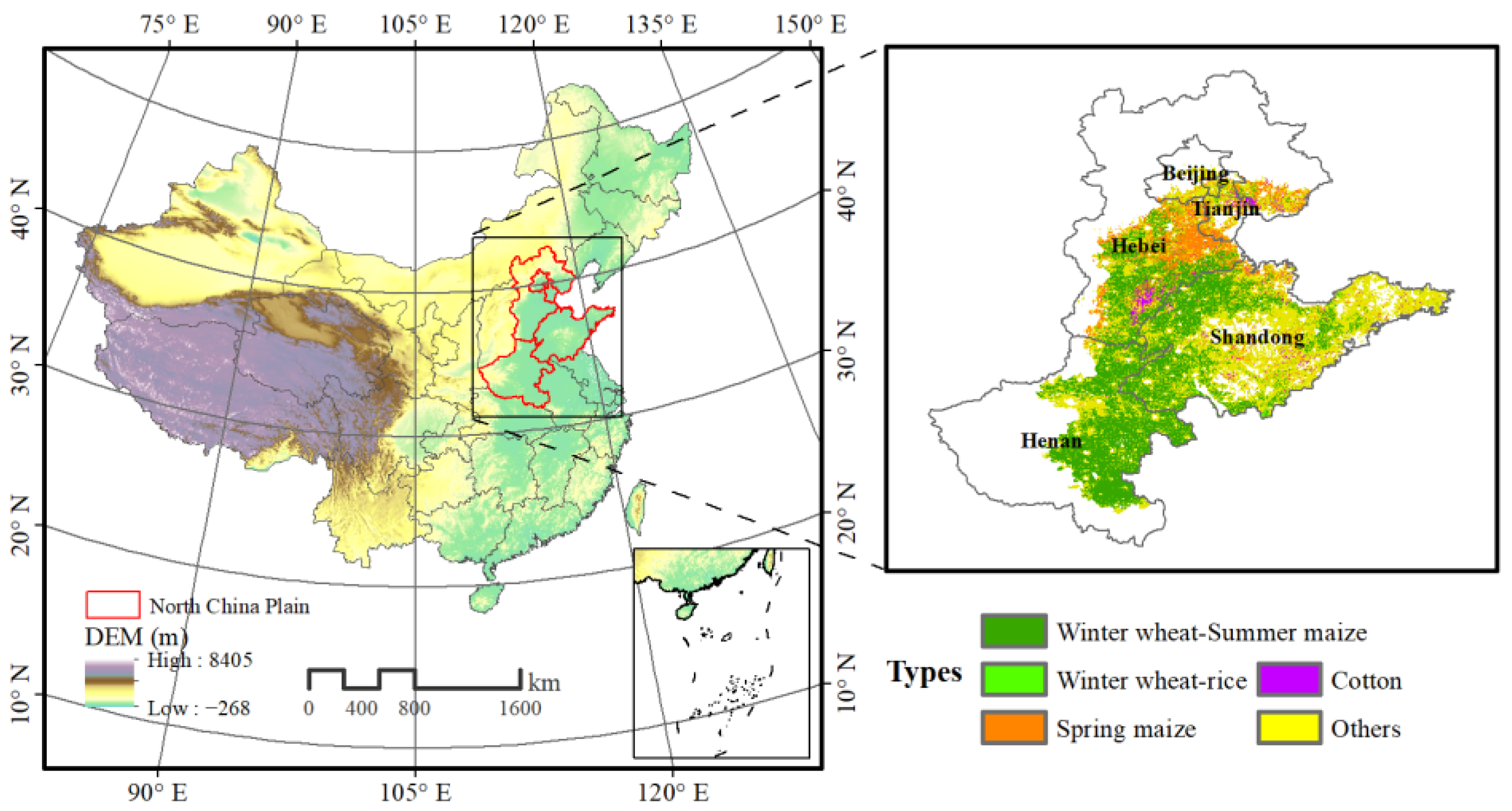
Figure 1. Location (left) and spatial distribution of crop types (right) in the NCP.
Sustainability 17 10798 g001
Figure 2. Schematic diagram of drought durations to quantify short-term, medium-term, and long-term drought.
Sustainability 17 10798 g002
Figure 3. Interannual variability (IAV) of the total wheat yield (N, ×104 tons), cultivated area (S, ×103 ha), and yield per unit area (U, kg/ha) in the NCP. Panels (al) IAV of N, S, and U in NCP, Beijing–Tianjin–Hebei, Hennan, and Shandong from 1993 to 2020, respectively. Red line near right border shows range of IAV, which was also denoted as Max–Min in each subfigure.
Sustainability 17 10798 g003
Figure 4. Muti-scale time series of monthly SPEI in the NCP during 1993–2020. (af) 3-month scale SPEI (SPEI-03), 6-month scale SPEI (SPEI-06), 12-month scale SPEI (SPEI-12), 24-month scale SPEI (SPEI-24), 36-month scale SPEI (SPEI-36), and 48-month scale SPEI (SPEI-48), respectively. Blue fill represents positive SPEI values, and red fill represents negative SPEI values.
Sustainability 17 10798 g004
Figure 5. Spatial patterns of SPEI at different time scales in the NCP. (af) Spatial trend of 3-month scale SPEI (SPEI-03), 6-month scale SPEI (SPEI-06), 12-month scale SPEI (SPEI-12), 24-month scale SPEI (SPEI-24), 36-month scale SPEI (SPEI-36), and 48-month scale SPEI (SPEI-48), respectively.
Sustainability 17 10798 g005
Figure 6. Sensitivity of wheat yield to multi-scale SPEI and its change trend. (a) Sensitivity of wheat yield anomalies to muti-scale SPEI. R is Pearson correlation coefficient. (b) Linear trend of SSPEI (obtained by 9-year moving window). Vertical dotted lines were used to divide different durations. Columns labeled with + and * show significance levels at p < 0.10 and 0.05, respectively.
Sustainability 17 10798 g006
Figure 7. Relationship between muti-scale SSPEI and environmental factors. TEM, SWC, RAD, CO2, Nfer, and GWS showed anomalies of mean temperature, soil water content, surface shortwave radiation, nitrogen fertilization, atmospheric CO2, and groundwater storage, respectively. R denotes Pearson correlation coefficient between SSPEI and environmental factors (with linear trend removed). Inclusion values in figure show that relationship is significant (p < 0.05).
Sustainability 17 10798 g007
Figure 8. Relative importance of each environmental factor on SSPEI variations. TEM, SWC, RAD, CO2, Nfer, and GWS show anomalies of mean temperature, soil water content, surface shortwave radiation, nitrogen fertilization, atmospheric CO2, and groundwater storage, respectively.
Sustainability 17 10798 g008
Figure 9. Schematic model of wheat yield adaptive mechanisms when exposed to medium-term (a) and prolonged drought (b). ET: evapotranspiration; LAI: leaf area index; e[CO2]: enriched CO2. Black and red arrows indicate positive and negative effects, respectively.
Sustainability 17 10798 g009
Disclaimer/Publisher’s Note: The statements, opinions and data contained in all publications are solely those of the individual author(s) and contributor(s) and not of MDPI and/or the editor(s). MDPI and/or the editor(s) disclaim responsibility for any injury to people or property resulting from any ideas, methods, instructions or products referred to in the content.