Article

Binary and Ternary Blends of Construction and Demolition Waste and Marble Powder as Supplementary Cementitious Materials


by
Ana Mafalda Matos
* and
Joana Sousa Coutinho
CONSTRUCT-Labest, Faculty of Engineering, University of Porto, 4200-464 Porto, Portugal
*
Author to whom correspondence should be addressed.
Sustainability 2025, 17(23), 10769; https://doi.org/10.3390/su172310769
Submission received: 9 October 2025 / Revised: 20 November 2025 / Accepted: 24 November 2025 / Published: 1 December 2025

Abstract

Portland cement is widely used in construction, but it contributes significantly to global CO2 emissions. This study evaluates the potential use of construction and demolition waste (CDW) and marble powder (MP) as supplementary cementitious materials, in line with circular economy goals. Both wastes were ground finer than cement and characterised chemically and physically. Binary and ternary blends with 5% and 10% replacement were tested in pastes and mortars for fresh properties, mechanical performance, and durability. Setting time, soundness, and workability remained within standard limits. Compressive strength decreased moderately, with 28-day activity indices between 82 and 88%, confirming the low reactivity of the supplementary cementitious materials. Sorptivity decreased in all mixes, and chloride resistance improved in the 10CDW and 10MP blends. However, the ternary mix showed increased chloride migration. Carbonation depth increased in all mixes, indicating the need for protective measures in carbonation-prone environments. Replacing 10% of cement with CDW or MP can avoid 70–80 kg of CO2 per tonne of binder and reduce landfill waste. These materials can be used as low-carbon fillers in cement-based systems, provided that their durability limitations are considered in design.

1. Introduction

Portland cement manufacturing is recognized as one of the most carbon-intensive industrial activities. The calcination of limestone and subsequent clinkerization release approximately 0.9 t CO2 per tonne of cement, placing the sector among the largest point sources of global anthropogenic emissions. Overall, cement production accounts for 5–8% of total global CO2 emissions, and in 2019 it generated around 2.4 Gt CO2, corresponding to 26% of industrial sector emissions [1]. In addition to greenhouse gas emissions, cement manufacturing requires substantial quantities of raw materials and energy. The construction sector—driven largely by cement and concrete—consumes about 30% of global raw materials and nearly 40% of total energy [2]. Considering that the annual cement output has now surpassed 4 billion tonnes [1], the combination of high material demand with energy-intensive kiln operations and extensive limestone extraction explains why the cement industry remains a major source of CO2 and other pollutants.
Mitigating the environmental impact of cement is thus a critical imperative. International climate accords (e.g., the Paris Agreement) have singled out cement manufacture as a key target for decarbonization [1]. Recent international frameworks—including the IEA/WBCSD Technology Roadmap (2018), the EU Waste Framework Directive, and the UN SDG 13 on Climate Action—have identified multi-scale strategies to reduce the carbon footprint of the sector. These operate at (i) Cement level: clinker substitution, energy efficiency, carbon capture; (ii) Concrete level: material efficiency, supplementary cementitious (SCM) incorporation, circular economy; and (iii) Structural level: design optimisation, extended service life.
Among these, the partial replacement of Portland cement with SCMs—especially those derived from wastes or by-products—is one of the most technically feasible, economically viable, and environmentally impactful pathways [3,4,5]. As illustrated in the current literature, next-generation SCMs combine wide availability with low embodied carbon (about 0.2–0.4 kg CO2/kg) and high durability potential, enabling a circular approach to sustainable construction.
Traditional SCMs like fly ash, slag, and calcined clay can significantly cut CO2 per unit of binder by offsetting clinker content [6]. However, the availability of conventional SCMs is limited and region-dependent. This has encouraged research into non-traditional, waste- or by-product-derived SCMs that can both alleviate disposal problems (landfill) and replace a portion, which, depending on the material, can reach 50% of Portland cement [2]. Several studies have been performed using a wide range of wastes or by-products as SCMs, depending on the local availability, as discussed elsewhere [7,8,9]. In this context, two promising candidates are construction and demolition waste and marble processing waste, which are abundant by-products with potential cementitious value.

1.1. Construction and Demolition Waste as a Supplementary Cementitious Material

CDW is one of the largest waste streams in Europe, generated from demolition activities and construction waste. European policies have spurred its recycling, with recovery rates exceeding the 2020 target of 70%. In 2020, the EU average CDW recovery reached about 89% [10]. CDW encompasses debris generated during the construction, renovation, and demolition of structures, including concrete rubble, masonry and ceramic fragments, wood, metals, glass, etc. In many countries, concrete and masonry (ceramic) materials make up over 80% of CDW by mass [11,12,13].
Common practice is to recycle CDW into road base or as coarse recycled concrete aggregate in new concrete [13,14]. Yet a substantial fine fraction (cement paste dust, crushed brick/ceramic fines) is often produced during CDW recycling and is typically landfilled, leading to environmental issues such as dust pollution, groundwater contamination, and loss of land use [2]. Moreover, using CDW solely as an aggregate substitution yields limited CO2 reduction because the cement content in concrete remains unchanged. Notably, ceramic-rich CDW aggregate has a higher embodied carbon (0.213 kg CO2/kg) than natural aggregates (0.0075 kg CO2/kg). Consequently, aggregate substitution yields only modest environmental benefits compared with partial replacement of Portland cement (0.9 kg CO2/kg) [2]. This insight has prompted researchers to explore the finer fraction of CDW as an SCM, directly substituting part of the cement itself [2]. This “fine fraction” exhibits high porosity and water absorption due to its residual paste content, which negatively affects the performance of fresh and hardened mixes if used directly as fine aggregate [15].
Recent studies have explored the activation and fine grinding of CDW fines for use as a cementitious component. Many studies have shown that certain components of CDW possess latent cementitious or pozzolanic properties when processed to a suitable fineness. In particular, recycled masonry and ceramic wastes (from bricks, tiles, etc.) contain high silica and alumina phases that can react with cement hydration products. For example, Silva et al. [16] found that finely ground residue of masonry (brick waste) exhibits measurable pozzolanic activity, with lime fixation and Strength Activity Index (SAI) values of about 77% at 7 days and 84% at 28 days when used to replace 20–50% of cement. These values meet ASTM C618 criteria, indicating that masonry CDW can be considered a viable pozzolan [16]. Similarly, investigations on recycled ceramic tile waste powder have confirmed its ability to participate in cement hydration. At early ages, ground ceramic waste mainly acts as a filler that improves the particle packing, but over time, a pozzolanic reaction ensues, consuming portlandite (Ca(OH)2) and contributing to strength development [2]. Indeed, concretes with up to 25% cement replaced by ground ceramic CDW have achieved 28-day compressive strengths comparable to conventional concrete, thanks to this combination of filler and pozzolanic effects [2]. These findings dispel the notion that CDW is an inert diluent; instead, when properly milled and (if necessary) treated, CDW fines can actively enhance the cement matrix.
The incorporation of fine CDW as an SCM may improve durability-related properties of cementitious composites. The fine CDW particles (<150 μm) can fill micro-pores in the paste, refining the pore structure and reducing permeability. Cantero et al. studied concrete where 25% of the cement was replaced by ground recycled masonry aggregate (GR-RMA) powder, combined with recycled aggregate, and observed notable durability enhancements. After 28 days, the CDW-blended concretes showed total water absorption values 5–7% lower than the reference (ordinary concrete), and the depth of water penetration under pressure was reduced by a similar margin. These improvements were attributed to the lower connectivity of the pore network in the presence of the ultra-fine CDW particles, which also led to higher electrical resistivity [17]. In fact, all concretes incorporating 25% ground CDW powder (with recycled aggregate) had water absorption below 4.2% and sorptivity under 0.4 mm·min−0.5, indicating very low permeability and excellent resistance to ingress of aggressive agents [17]. Other benefits reported include a reduction in heat of hydration and autogenous shrinkage when cement is partially replaced by CDW fines [16]. The lower heat release is due to lower overall content of clinker phases, which can mitigate thermal cracking in mass concrete, while the reduced shrinkage is linked to the lower water demand and internal curing effect of some porous CDW particles [16]. These characteristics suggest that CDW-derived SCMs can enhance long-term durability and stability, which is crucial for structural concrete performance.
It is noteworthy that the reactivity of CDW powder can vary depending on its source and treatment. Untreated recycled concrete fines (from crushed old concrete) tend to contain mostly hydrated cement phases and calcium carbonates, which by themselves are relatively inert in fresh cement mixtures. Such untreated concrete powder chiefly acts as a filler, diluting the cement and potentially slightly reducing early strength [18]. To unlock greater reactivity, researchers have experimented with activating CDW powders. One approach is carbonation of recycled concrete paste/powder, which can convert calcium hydroxide and C–S–H in the old paste into amorphous silica or silica-gel-like phases [18]. Zając et al. [18] reported that carbonated recycled concrete powder exhibits a rapid pozzolanic reaction in the first days of hydration, attributable to the newly formed silica-rich gel on the particle surfaces [18]. Another approach is thermal treatment: Baggio et al. subjected CDW fines (<150 µm) to calcination at 700–900 °C followed by prolonged milling, and found that the combined thermo-mechanical activation substantially increased the material’s pozzolanicity [19]. The treated CDW powder met chemical requirements for Class N pozzolans (sum of SiO2 + Al2O3 + Fe2O3 > 70%) and achieved a pozzolanic activity index of 97% in standard mortar tests. Compressive strength of mortars was significantly improved by these treatments, indicating that activated CDW powder can almost match the performance of Portland cement in contributing to strength. Such advances, while mostly at the laboratory stage, highlight the tremendous potential of CDW as a supplementary cementitious resource. In summary, the literature demonstrates that, with proper selection and processing, CDW powders (particularly those rich in ceramic/masonry waste or carbonated cement paste) can be employed as effective SCMs, contributing to both improved concrete properties and sustainability through CO2 savings and waste valorisation [19].

1.2. Marble Powder as a Supplementary Cementitious Material

The ornamental stone industry, particularly in the extraction and processing of marble, generates large volumes of waste in the form of powder and slurry from sawing and polishing operations. Marble is a form of metamorphic limestone (calcium carbonate), and when blocks of marble are sawn and polished for use in construction (tiles, slabs, etc.), around 20–30% of the volume ends up as waste in the form of slurry or powder [20]. Improper disposal of fine marble residues leads to a serious environmental impact, including soil and water contamination, dust emission, and land occupation (see Figure 1). According to statistics published in 2020 by countries with an active dimensional stone industry, including China, India, and Turkey (which, together, make up around 60% of the world’s quarry production), as well as Brazil, Iran (5.3%), Italy (3.8%), Spain, Egypt, Portugal and the USA (2–3%), the total amount of material extracted annually from dimensional stone quarries is about 316 Mt (gross quarrying production) [21].
In the context of cementitious systems, marble powder is predominantly a non-pozzolanic (inert) filler because it consists mainly of CaCO3 with minimal silica or alumina content. Unlike fly ash or other SCMs, raw marble powder does not directly contribute to pozzolanic reactions with cement hydration by-products. Its value as an SCM, therefore, lies in its physical effects on the cement paste matrix. The addition of finely ground marble powder (<90 μm, for instance) can improve the packing density of the paste and serve as nucleation sites for the precipitation of C–S–H gel, potentially leading to a denser microstructure [20,22]. It can also react mildly with aluminate phases in cement to form calcium carboaluminate hydrates, which may contribute to matrix cohesion. Extensive research over the last decade has investigated the influence of partial cement replacement with marble powder on concrete and mortar properties. A consistent finding is that small replacement levels (up to about 10% by weight of cement) can be utilised without strength loss, and in many cases can even enhance certain mechanical properties. For example, a recent review compiled data from numerous studies and concluded that the optimal marble powder content is typically in the range of 10–15% [20].
At these levels, the filler effect of marble dust tends to improve the particle grading and internal curing, which can increase early-age strengths. Kabeer et al. (2023) reported a 5–10% increase in 28-day compressive strength when 10% of the cement was replaced by waste marble powder, compared to a control mix [22]. In the same study, 10% MP also improved 7-day strength, indicating a beneficial acceleration of early hydration [22]. However, beyond an optimum threshold (roughly 15% replacement), the dilution of cement becomes pronounced, leading to a reduction in strength-gain capacity [20]. Many researchers observe a clear drop-off in compressive strength when marble powder content is increased from 15% to 20% or higher [20]. For instance, replacing 20% of cement with marble dust has been reported to reduce 28-day strength by about 10–15%, and higher replacements (30–40%) can cause even more drastic strength losses [23]. These results underscore that while marble powder can serve as a partial cement replacement, its optimal usage is limited to relatively low proportions (commonly 5–15%).
In terms of durability and other properties, the inclusion of marble powder has nuanced effects. Moderate marble powder substitutions tend to decrease the porosity of the hardened cement paste by filling voids, which can enhance durability. Notably, concrete mixtures with about 10% marble powder have shown reduced permeability to fluids and aggressive ions [22]. In a recent study, adding 10% WMP led to an approximately 20% improvement in chloride ion penetration resistance (as measured by charge passed) compared to plain concrete. This implies a denser pore structure that slows down chloride ingress, beneficial for reinforced concrete longevity. Another investigation found that when marble dust was used to replace 10% of cement, the water absorption of the concrete dropped to the lowest among the tested mixes, even lower than the plain reference concrete. The sample with 10% cement replacement had the lowest 7-day water absorption rate, indicating superior impermeability, whereas higher marble dust contents or using the dust as sand replacement resulted in higher absorption [24]. Scanning electron microscopy (SEM) images in such studies reveal a more compact microstructure at the optimal marble powder content (e.g., 10%), with fewer voids and a well-distributed cementitious matrix [23]. On the other hand, excessive marble powder can adversely affect durability. When 20–30% of cement is replaced, the lack of sufficient clinker hydration products may lead to higher capillary porosity, as unreacted marble particles simply occupy space without binding [23]. Researchers have observed that concrete mixes with overly high marble powder show increased chloride permeability and may require additional water or admixtures to maintain workability [23]. Therefore, just as with mechanical performance, an optimal range exists for durability benefits. A comprehensive review concluded that approximately 10–15% marble powder substitution optimises both strength and durability, whereas beyond this range, properties start to degrade appreciably [22]. It is also worth mentioning that marble powder can be successfully combined with other SCMs in blended cement systems. For example, incorporating marble powder alongside silica fume (microsilica) or fly ash has yielded synergistic improvements in durability, as the chemically active SCMs compensate for marble’s lower reactivity while marble powder enhances packing. Kabeer et al. noted that a ternary blend of cement with 10% WMP and a portion of silica fume achieved lower chloride diffusion and a denser microstructure than using silica fume alone [23]. Such hybrid approaches highlight that waste marble powder can be part of multi-component cement replacement strategies, contributing to sustainability and performance when used judiciously.

2. Research Significance and Objectives

Given the urgent need to reduce Portland cement consumption and the promising findings from previous studies on construction and demolition waste (CDW) and marble powder (MP), this work investigates the feasibility of incorporating these two waste-derived powders as supplementary cementitious materials in cement-based materials.
The experimental programme was designed to examine the influence of these materials at two levels of cementitious matrices: paste, which consists of cement and waste powder and provides insight into hydration kinetics and the fundamental pozzolanic or filler behaviour, and mortar, which includes sand and represents a more realistic composite for assessing mechanical properties and durability. The primary objectives of this investigation are to quantify the impact of replacing 5% and 10% of cement with CDW and MPs on setting times and hydration of cement pastes, to measure the effect of these substitutions on the compressive strength of mortars at 7, 28, and 84 days, and to evaluate durability-related parameters including water absorption, and resistance to aggressive agents such as carbontation or chloride penetration. As such, this research extends beyond evaluating mechanical performance by incorporating durability assessments, which are critical to ensuring that sustainability benefits are not offset by premature deterioration or reduced service life.
The replacement levels selected in this study are intentionally low (5 and 10% cement replacement by mass), reflecting values that the construction industry can adopt without substantial changes to existing mix designs or performance classifications. Such an approach offers a practical solution to reduce clinker consumption and related CO2 emissions, which are estimated at approximately 808 kg CO2 per tonne of Portland cement, according to the verified Environmental Product Declaration for CEM I 42.5R produced by Secil (2025) [25]. At a 10% replacement level, this corresponds to ~81 kg CO2 avoided per tonne of cement. Accounting for the relatively small emissions associated with grinding CDW and MP (estimated at 10–20 kg CO2/t), the net reduction is approximately 60–70 kg CO2 per tonne of binder. Even small reductions in cement content, when multiplied across the vast scale of global concrete production, can generate substantial environmental benefits and contribute to waste valorisation.

3. Materials and Methods

To assess the feasibility of incorporating construction and demolition waste (CDW) and marble powder (MP) as SCMs, the study was conducted in the following main stages: waste source identification and collection, laboratory processing and preparation, and physical–chemical characterisation followed by performance testing.
In the first stage, technical visits were carried out to industrial facilities that generate the targeted waste streams. CDW samples were obtained from a recycling plant in Figueira da Foz, specialising in processing construction and demolition residues, while MP samples were collected from a marble processing company in Borba, Portugal. At each facility, representative waste fractions were selected for laboratory evaluation. CDW was sampled from the fine fraction (<10 mm) resulting from crushing and separation processes, whereas MP was taken from the slurry produced during marble cutting and polishing, subsequently dewatered on site.
In the second stage, both waste materials underwent treatment in the laboratory to ensure their suitability for use as SCMs. Once in a form adequate for integration into cementitious matrices, the processed powders were characterised to establish their physical and chemical properties. Chemical composition was determined by X-ray fluorescence (XRF), specific density by Le Chatelier’s method, and Blaine fineness according to EN 196-6. Particle size distribution was measured using laser diffraction. These preliminary tests were conducted to ensure that the waste powders met basic criteria for partial cement replacement.
Following the characterisation stage, cement paste mixtures were prepared to investigate the fundamental effects of CDW and MP on hydration and setting behaviour. For each waste type, two replacement levels of Portland cement were adopted—5% and 10% by mass—along with a control mixture without waste addition. The initial and final setting times were determined following EN 196-3, and soundness tests were performed to verify the volumetric stability of the blended pastes.
Subsequently, mortar specimens were produced using the same substitution ratios to assess performance at a practical scale. Tests on fresh mortar included flow table measurements to evaluate workability. Hardened mortar was analysed through a mechanical strength and durability performance. Mechanical strength was determined by flexural and compressive strength tests at 7, 28, and 84 days of curing, in accordance with EN 196-1. Durability assessment involved water absorption by capillarity and exposure tests to simulate aggressive environments, including chloride and CO2 ingress..
Together, these procedures provide a holistic understanding of the effect of CDW and MPs on the fresh and hardened properties of cementitious systems and their potential to enhance sustainability without compromising engineering performance.

3.1. Wastes Laboratory Treatment

3.1.1. Waste Marble

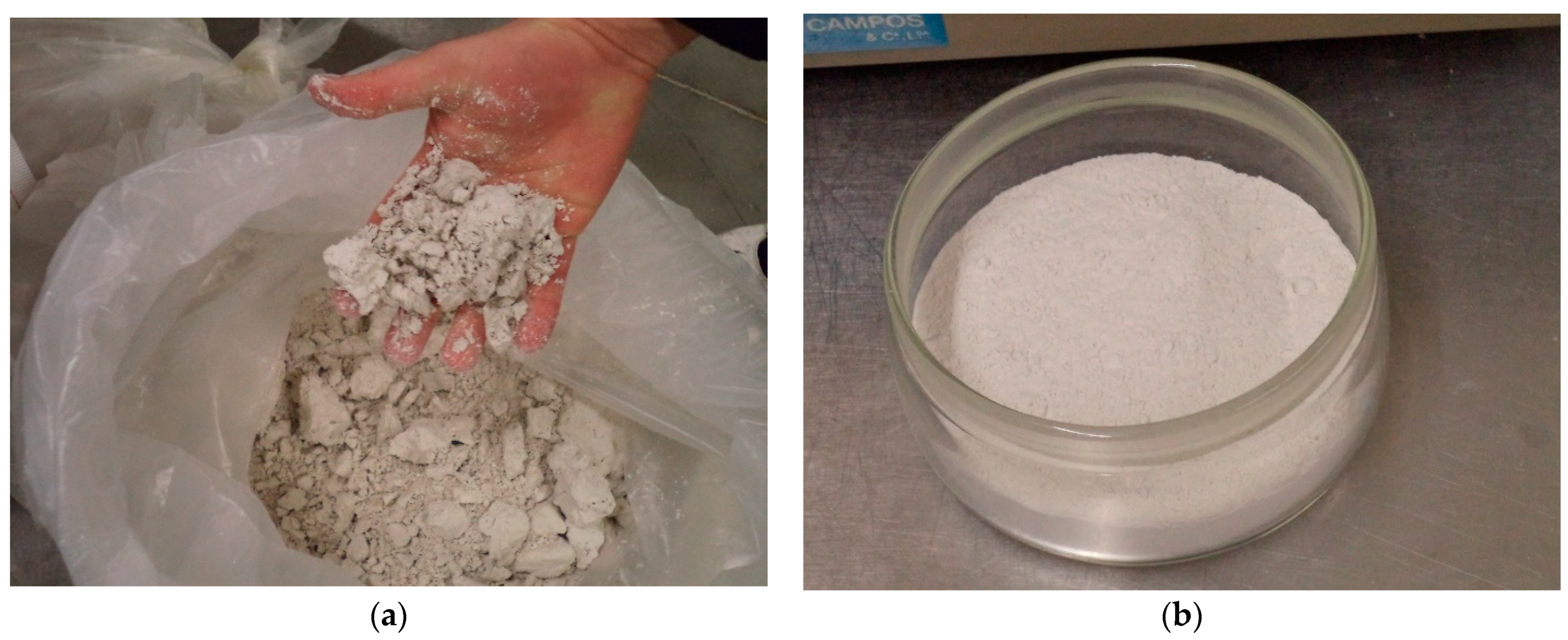
The marble waste used in this study was supplied by a company located in Borba, Portugal. In brief, the marble blocks are cut using water-jet systems, and the resulting dust mixes with water to form a slurry, which represents a significant environmental concern. This slurry is partially dewatered in a filter press to reduce its water content. After this treatment, the material consists of approximately 80% fine solid particles and 20% water by mass, as illustrated in Figure 2a. The marble dust sample was oven-dried at 105 °C until constant mass was achieved. Following drying, the material was disaggregated and sieved through a 4 mm mesh, and the fraction passing the sieve was collected.
Based on previous experience, it was considered necessary to achieve a fineness comparable to or finer than that of Portland cement to ensure the suitability of marble waste for partial cement replacement. Therefore, the material was further processed by grinding in a RETSCH PM100 planetary ball mill using 1 mm zirconia balls. The grinding procedure was performed at a rotational speed of 400 rpm for 8 min to obtain a fine powder suitable for incorporation into cementitious systems, see Figure 2b.

3.1.2. Construction and Demolition Wastes

The construction and demolition waste (CDW) used in this study was supplied by a recycling company located in Figueira da Foz, Portugal, which provides integrated solutions for the management of waste generated by the construction sector. Upon arrival at the facility, the CDW undergoes a systematic processing sequence designed to recover aggregates of different sizes while removing contaminants. Initially, there is a pre-selection phase in which clean concrete pieces, free of soil or organic matter, are directed to a crusher to produce recycled aggregate of the desired dimensions. Materials that do not meet these initial quality criteria follow a more rigorous treatment process, beginning with particle size separation into two fractions: 0–30 mm and >30 mm. Subsequent mechanical sorting removes impurities such as metals, plastics, and wood; when necessary, manual sorting is carried out to eliminate residual contaminants. After these steps, the material is further crushed and screened to produce fine (0–10 mm), medium (10–30 mm), and coarse (30–80 mm and >80 mm) aggregates. Despite these efforts, not all material processed meets market standards, and unsuitable fractions are ultimately sent to landfill.
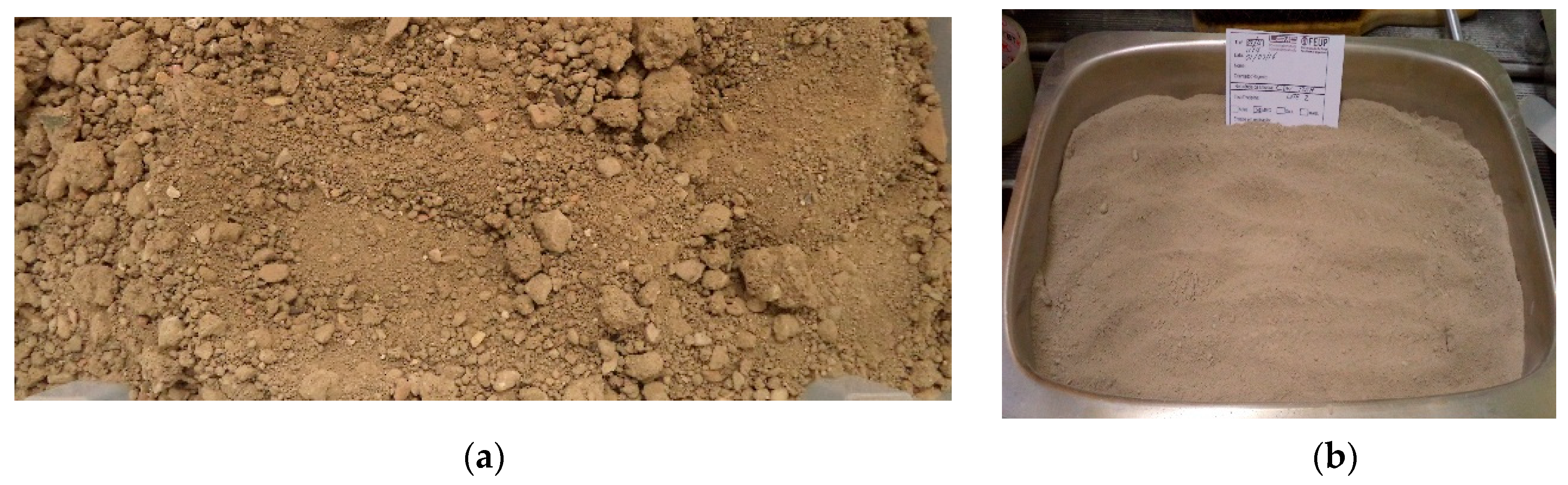
For this experimental study, a representative sample of the finest fraction (0–10 mm) generated during the recycling process was collected, as illustrated in Figure 3a. This fine CDW material is generally considered a low-value by-product because of its high water absorption and the potential presence of residual contaminants, both of which limit its direct application in concrete production. Consequently, innovative uses for this material are essential to enhance its sustainability potential.
To enable its use as a partial cement replacement, the CDW sample required further size reduction to achieve a fineness comparable to or smaller than that of Portland cement. For this purpose, the material was processed using a laboratory ball mill. A batch of 1150.1 g of CDW and 1628.6 g of metallic grinding balls was loaded into the rotating drum of the mill. The grinding process was carried out continuously for a total duration of 120 h, with interruptions every 24 h to detach adhered material from the inner surfaces of the drum and ensure uniform milling. This extended grinding operation produced a fine CDW powder suitable for incorporation into cementitious systems, see Figure 3b.

3.2. Tests on Pastes and Mortars

3.2.1. Setting Time and Soundness of Pastes

All mixtures were prepared using ordinary Portland cement CEM I 42.5 R as the primary binder, partially replaced by either construction and demolition waste (CDW) powder or marble powder (MP) at two substitution levels: 5% and 10% by mass of cement. Paste mixture proportions are presented in Table 1, and samples were produced according to NP EN 196-1. The initial and final setting times of cement pastes were determined using the Vicat apparatus following EN 196-3. The Vicat needle penetration method was employed to record the time at which the paste reached initial and final set under controlled laboratory conditions of 20 ± 2 °C and relative humidity above 90%.
Soundness was evaluated on the same paste formulations to verify their volumetric stability and ensure that partial replacement with waste powders did not introduce excessive expansion. The Le Chatelier test, as prescribed by EN 196-3, was performed on specimens subjected to accelerated hydration in boiling water after initial setting. The difference between the indicator points before and after the treatment was measured, and the expansion values were compared against the limits specified by the standard (≤10 mm) to confirm compliance. These tests provided an essential baseline for assessing whether the inclusion of CDW or MP fine powders affected setting behaviour and dimensional stability relative to ordinary Portland cement pastes.

3.2.2. Mortar Specimens Manufacturing

All mixtures were prepared using ordinary Portland cement CEM I 42.5 R as the primary binder, partially replaced by either construction and demolition waste (CDW) powder or marble powder (MP) at two substitution levels: 5% and 10% by mass of cement. A reference mix without any replacement served as the control, see Table 2.
The water-to-binder ratio (w/b) was fixed at 0.50 for all pastes and mortars to ensure comparability among mixtures. For mortar specimens, a cementitious material-to-sand ratio of 1:3 by mass was adopted, using standard graded siliceous sand in compliance with EN 196-1 specifications. Mixing was carried out according to the procedure described in EN 196-1.
Immediately after mixing, the fresh mortar was tested for workability using the flow table method (described in Section 3.2.3). Fresh mortar was then cast into prismatic moulds measuring 40 × 40 × 160 mm for subsequent mechanical strength testing (Section 3.2.4). All specimens were compacted on a vibration table to eliminate entrapped air and covered with a plastic sheet to prevent moisture loss during the initial setting period.
After 24 h, the specimens were demoulded and cured in lime-saturated water at 20 ± 2 °C until the designated testing ages. Mechanical tests were performed at 7, 28, and 84 days, while durability-related tests were carried out on separate specimens after 28 days of curing. The preparation of specimens for durability assessment followed the relevant procedures described in the respective standards and is briefly detailed in Section 3.2.5.

3.2.3. Workability

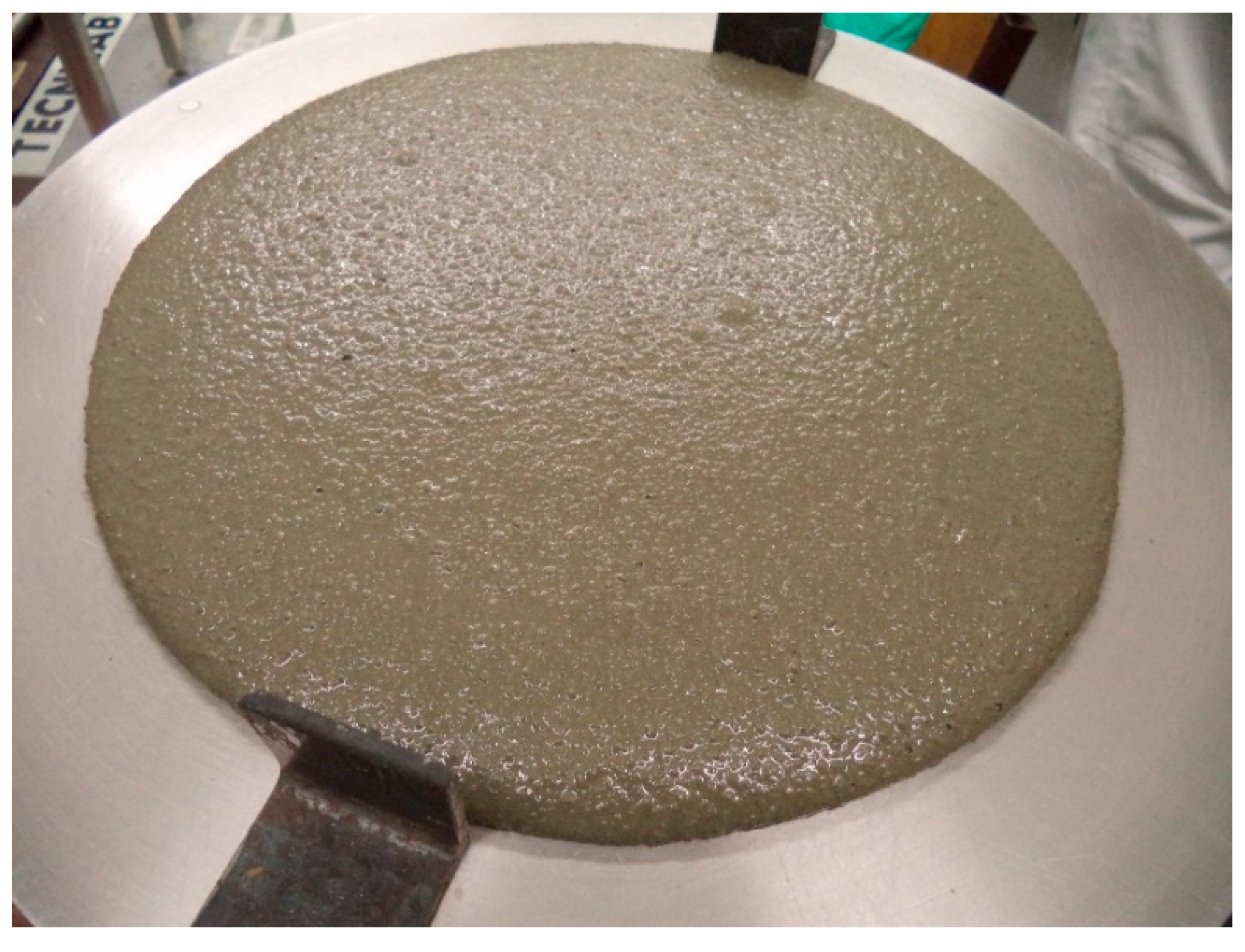
Workability was measured through the spread diameter for each mortar, according to NP EN 1015-3, firstly for CTL mortar in order to establish a standard value, see Figure 4. The use of superplasticisers was not necessary because the spread diameters for waste-containing mortars fell inside the reference band of the CTL spread ± 10 mm, previously defined.

3.2.4. Mechanical Strength

Prismatic specimens (40 × 40 × 160 mm3) were produced to assess three-point flexure and compressive strengths according to NP EN 196-1. As mentioned in Section 3.2, specimens were water cured in a curing chamber (under controlled temperature 20 ± 2 °C and HR > 95%) and removed to perform the mechanical test at established ages: 7, 28 and 84 days. The Flexure test was performed at a rate of loading of (50 ± 10) N/s, and the compressive test at 2400 ± 200 N/s.

3.2.5. Durability Indicators

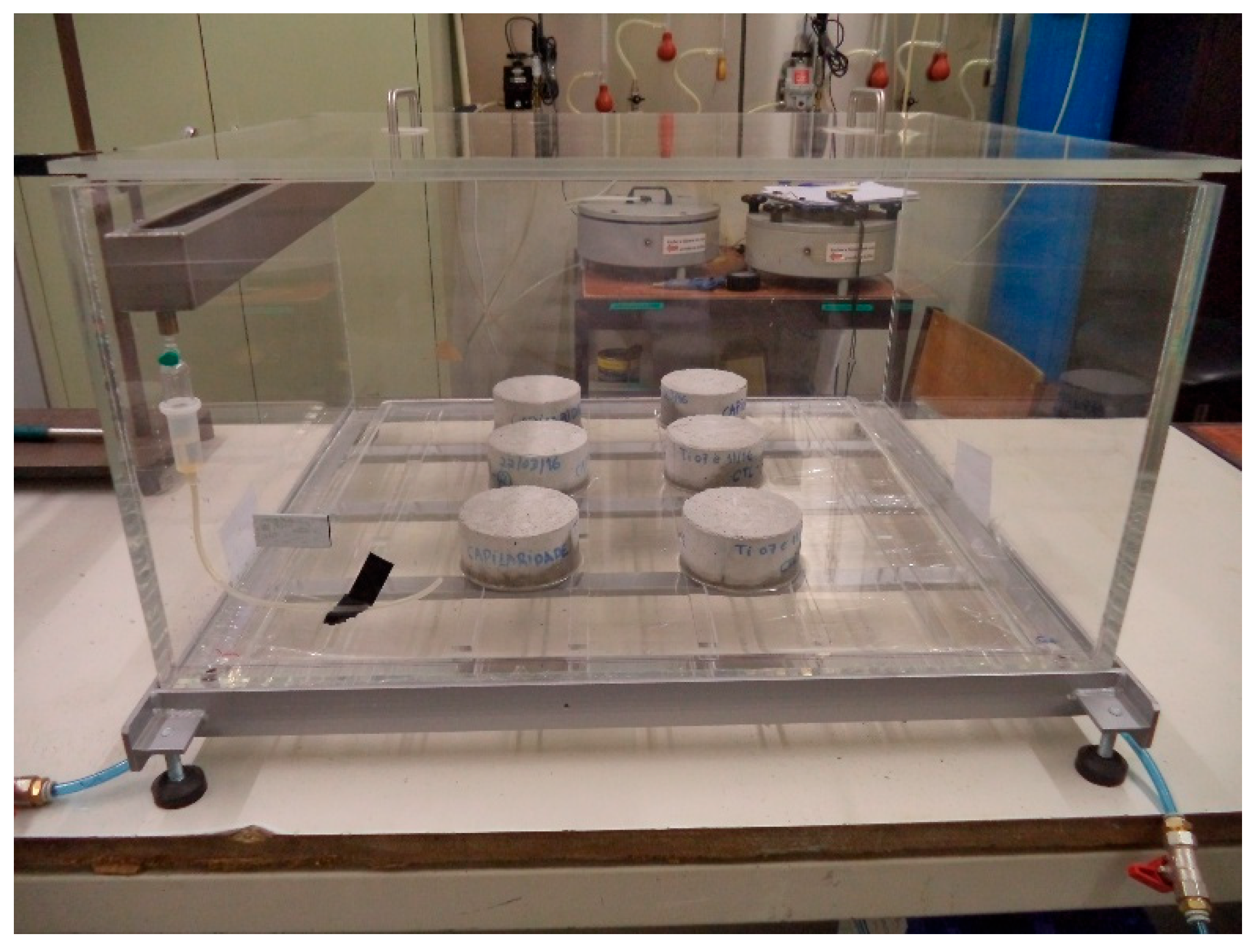
To evaluate water absorption by capillarity of mortar, the test performed was based on the RILEM TC 116-PCD recommendation. Cylindrical specimens with 100 mm diameter and 50 mm height were produced and cured for 4 weeks in the curing chamber and then placed in an oven at 40 °C for 2 h to attain constant mass. Afterwards, they were weighed and introduced into a shallow water bath with the moulded face in contact with a constant water depth of 3 ± 1 mm. For the next 24 h, the specimens remained in the water bath and were weighed at previously stipulated time intervals, see Figure 5. Results were plotted as capillary absorption curves through the relation between the variation in the mass of each test specimen per unit area versus the square root of time. As these curves are almost linear in the first 4.5 h of the test, linear equations were obtained by regression where, in accordance with Equation (1), the slope S is the Sorptivity (S, expressed in mg/(mm2·min0.5)) for each test specimen, A represents the water absorption per unit area (mg/mm2), A0 is the water initially absorbed by the pores in contact with water (mg/mm2) and t corresponds to the time passed since the initial moment (min).
A = A 0 + S × t 0.5
The procedure described in the Portuguese standard E-463 allowed for evaluating the resistance to accelerated penetration of chlorides, consisting of subjecting the test specimens to an electrical potential to force chloride ions into the mortar. At the end of this phase, the test specimens were split into two parts and pulverised with a silver nitrate solution. This led to a visible white precipitate of silver chloride, making it easier to measure the penetration depth of the chlorides. After reading these depths, the non-stationary-state chloride migration coefficient (Dns, expressed as ×10−12 m2/s) was determined using Equation (2), where U is the absolute value of the applied voltage (V), T is the mean value of the initial and final temperatures in the anode solution (°C), L is the thickness of the specimen (mm), Xd is the mean value of the penetration depth (mm) and t corresponds to the test duration (h).
D ns = 0.0239 273 + T L U 2 t × X d 0.0238 273 + T L X d U 2
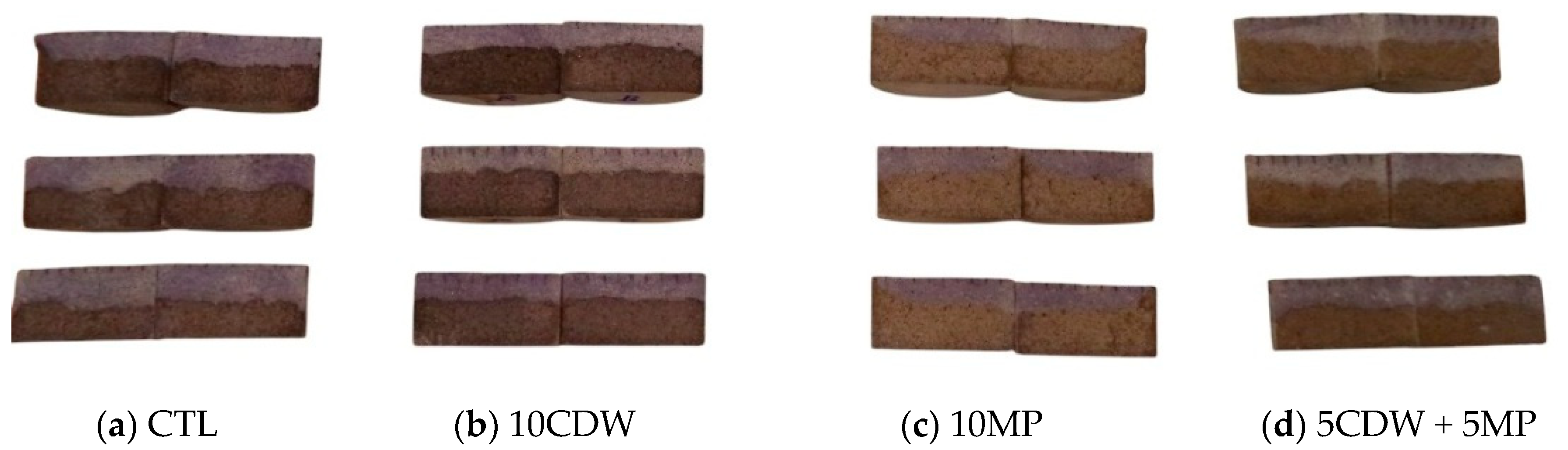
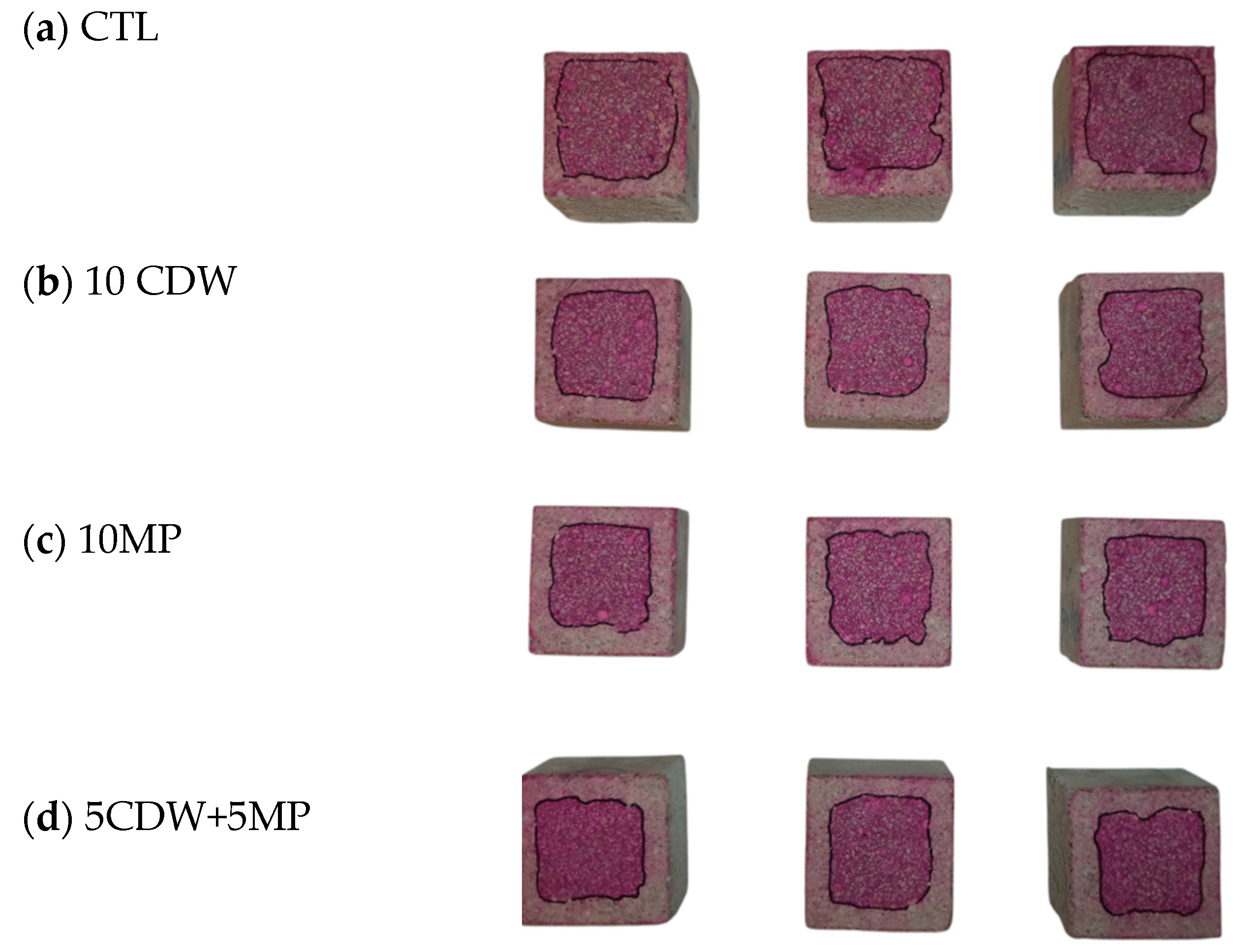
Carbonation resistance was evaluated on three replicate mortar prisms 40 × 40 × 160 mm3 for each mortar of Table 2, following the RILEM CPC-18 methodology. Specimens underwent 14 days of wet curing, followed by 14 days in a controlled environment (20 ± 2 °C; 50 ± 3% RH), and were subsequently exposed to an accelerated carbonation chamber (5 ± 0.1% CO2; 60 ± 5% RH; 23 ± 2 °C). At each test age, 5 weeks after CO2 exposure, approximately 1 cm thick slice was removed from each specimen, and the freshly fractured surfaces were sprayed with a 1% phenolphthalein solution. Carbonation depth was determined as the distance from the surface to the boundary where the phenolphthalein indicator remained colourless.

4. Results and Discussion

4.1. Raw Materials Properties

The results in Table 3 show distinct differences between Portland cement (CEM I 42.5 R), construction and demolition waste (CDW) powder, and marble powder (MP) in terms of density, fineness, and chemical composition, which directly influence their behaviour as SCMs.
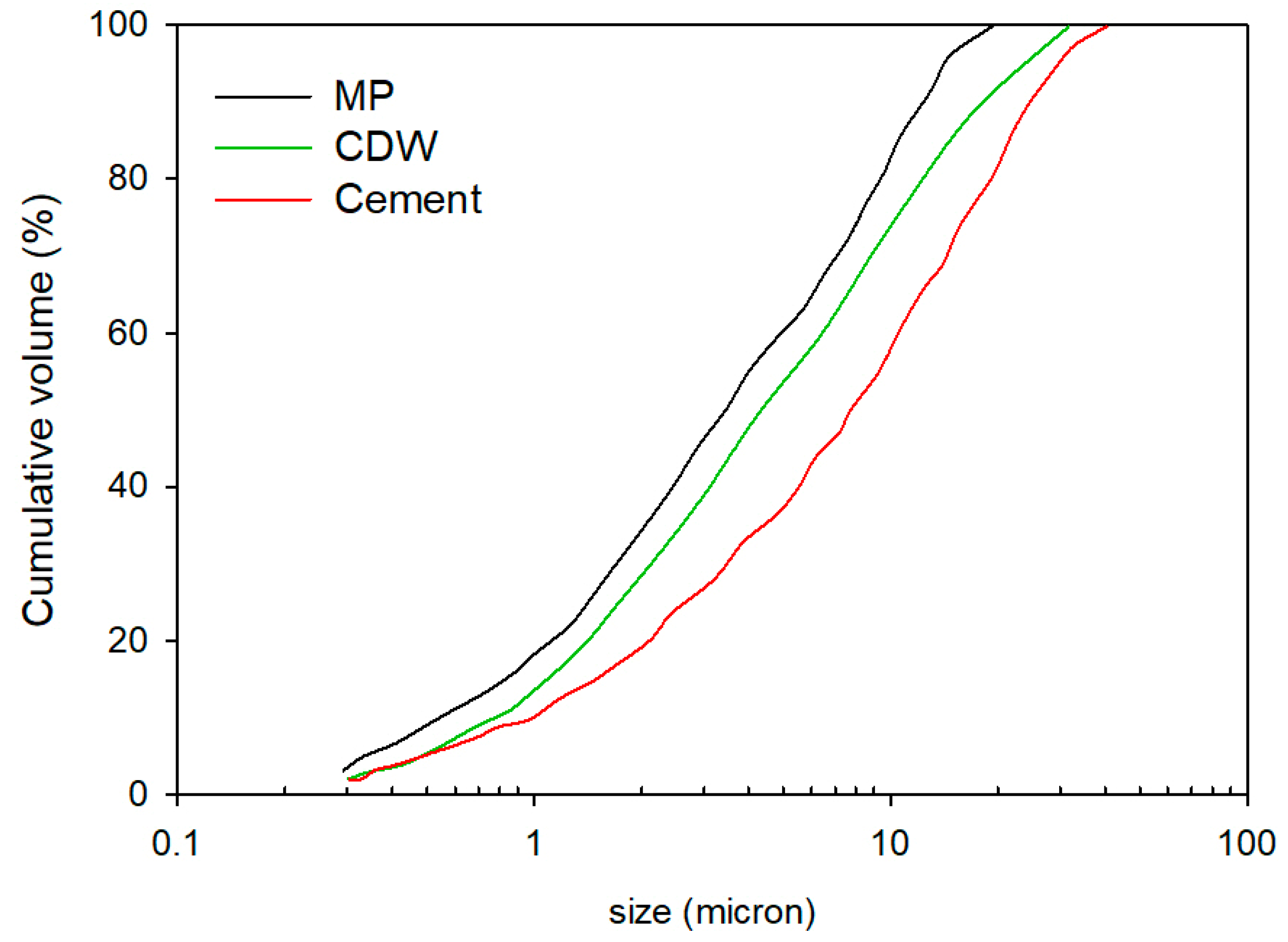
Physical properties reveal that the specific gravity of cement (3080 kg/m3) is higher than that of MP (2710 kg/m3) and CDW (2620 kg/m3). The reduced density of CDW reflects its porous nature and high silica content. Blaine fineness values for CDW (8439 cm2/g) and MP (9631 cm2/g) are approximately double that of cement (4246 cm2/g). Figure 6 presents the particle size distribution (PSD) of cement, CDW, and MP, showing that both wastes are finer than cement, consistent with the Blaine values. Notably, MP contains a larger fraction of ultrafine particles (below 10 μm), suggesting a potential filler effect that could enhance packing density and accelerate early hydration by providing additional nucleation sites.
Chemical composition shows that CDW is silica-rich (SiO2 = 72.27%), which is characteristic of masonry and ceramic waste and indicates potential pozzolanic reactivity if properly activated. MP, on the other hand, is predominantly calcareous (CaO = 53.93%) with very low SiO2 content (1.51%), confirming its role as an inert filler rather than a reactive SCM. The high loss on ignition (LOI) of MP (43.12%) is consistent with its high CaCO3 content, which decomposes upon heating. Cement displays the expected high CaO content (63.75%) and moderate silica (19.16%), balanced with alumina and ferric oxides that contribute to clinker phases.
CDW’s moderate Al2O3 (5.10%) and Fe2O3 (3.25%) contents may enable secondary hydration reactions with calcium hydroxide from cement. Alkali contents (Na2O + K2O) are slightly higher in CDW compared to cement, which could influence alkali–silica reaction risk if reactive aggregates are present. Sulphate content is markedly higher in cement (3.26%) due to gypsum addition for setting control, whereas CDW and MP contain negligible SO3. Chloride levels in all materials are well below the corrosion risk threshold.
The oxide composition and physical properties of CDW and MP were compared against the requirements for supplementary cementitious materials (SCMs) and fillers as defined in relevant standards.
For CDW powder, the combined content of SiO2, Al2O3, and Fe2O3 is 80.62%, exceeding the 70% minimum threshold specified in ASTM C618 for Class N natural pozzolans, in EN 450-1 for fly ash and NP 4220 for pozzolans in general. This suggests strong potential for pozzolanic activity, consistent with previous findings on finely ground masonry/ceramic-rich CDW. However, the loss on ignition (LOI) of 8.17% exceeds the typical limits (≤6% in ASTM C618; ≤5–7% in EN 450-1), indicating the need for pre-treatment or quality control to meet standard requirements. Sulphate (SO3) and chloride contents are well below maximum allowable limits (SO3 ≤ 4%, Cl ≤ 0.1%), complying with durability-related specifications.
In contrast, marble powder (MP) is chemically dominated by CaO (53.93%, equivalent to about 96% CaCO3), with very low SiO2, Al2O3, and Fe2O3 contents (combined is 2.21%), far below pozzolanic thresholds. Therefore, it cannot be classified as a pozzolan under ASTM C618 or EN 450-1. Instead, it falls under the EN 197-1 classification of limestone filler, which requires ≥75% CaCO3, ≤4% MgCO3, and total organic carbon (TOC) ≤0.20%. The measured MgO content (0.65%) is well within limits, and the high LOI (43.12%) is consistent with its carbonate nature. According to EN 197-1, limestone fillers can be used in composite cements (e.g., CEM II/A-L with 6–20% filler, CEM II/B-L with 21–35%) as inert additions that improve packing density and particle size distribution, thereby influencing rheology and early-age hydration kinetics. The high Blaine fineness of MP (9631 cm2/g) further supports its role as a performance-enhancing filler.

4.2. Paste Level

Table 4 presents the results of setting times of paste samples with mix proportions of Table 1. As can be seen, all pastes with SCM presented smaller setting times. Paste with 100% cement (CTL in Table 4), with an initial set after 157 min, was followed by 10CDW, 5CDW + 5MP and 10MP, in decreasing order. As discussed in the Introduction section, studies have reported mixed effects of marble powder (MP) on the setting time of cementitious pastes. Several works have observed that high dosages of waste marble powder tend to prolong both initial and final setting times [26]. For example, replacing cement with a large fraction of marble dust (e.g., 50%) significantly delayed the Vicat setting times in reference [27]. This retarding effect is often attributed to dilution of the clinker content and the very fine particles of MP, increasing the paste viscosity [26]. In contrast, other researchers have found that moderate amounts of finely ground marble (typically ≤10–15%) can accelerate early setting. The calcium carbonate (CaCO3) in marble powder acts as a nucleation site for C–S–H, speeding up initial hydration of C3S [28]. Dhoka et al. (2013) reported that CaCO3 from marble waste accelerates early cement hydration (preventing the AFt-to-AFm phase change) and even forms carboaluminate phases, thereby shortening the time to initial set [28]. Ashish (2018) likewise noted that partial substitution of cement with MP led to earlier initial and final set compared to a control, when MP was used at an optimal about 10% level [29].
Construction and demolition waste (CDW) fines or recycled concrete powder (RCP) show a similar influence. At low replacement levels (up to about 10% by mass of cement), most studies report little to no delay in setting; in fact, some note a slight acceleration of the initial set. Li et al. (2023) found that replacing 30% of cement with recycled concrete powder decreased the initial setting time of paste appreciably [30]. Chen et al.’s study on cement pastes with 0–40% RCP show that introducing 10% RCP shortened the initial setting time (while the final set remained virtually unchanged) [31]. This acceleration at low levels is explained by the filler effect and the presence of nucleation sites or residual Ca(OH)2 in the recycled powder, which can stimulate early hydration [30]. However, at higher CDW contents (>15–20%), researchers consistently observe delayed setting. Beyond a 10% RCP replacement, both initial and final setting times tend to increase markedly [31]. Ohemeng et al. (2021) reported that pastes with very high cement replacement (40–75% waste concrete fines) experienced pronounced setting time delays, owing to the reduced clinker fraction and slower pozzolanic reaction of the waste material [32]. Similarly, Zito et al. noted that concrete with 25% ground ceramic CDW had an initial set about 85 min later than plain Portland cement (PC) concrete [2].
Another key aspect is how MP and CDW affect the water demand (standard consistency) and workability of pastes. The standard consistency of cement paste is the water content needed to reach a fixed paste fluidity (Vicat penetration ~6 mm). Literature shows that marble powder can influence this parameter, again with somewhat differing observations. Some studies report that adding marble powder (especially as an additional filler) will increase the water required for standard consistency [26]. Marble dust particles are very fine and somewhat hygroscopic; the enlarged specific surface area increases water demand to achieve comparable lubrication/workability. Recent studies and reviews report higher mixing-water demand in mixes containing marble powder [33,34,35]. This aligns with the idea that marble’s fine particles can absorb or hold water, reducing free water for flow. Indeed, Mashaly et al. [36] observed that incorporating marble sludge powder increased the normal consistency water demand of cement pastes, presumably due to its high fineness. On the other hand, several recent studies note the opposite when marble powder replaces a portion of cement. In those cases, the total cementitious solids volume remains similar, and the MP’s smooth, inert particles can improve the mix’s packing and flow. Ashish et al. [29] found that the water required for standard consistency decreased slightly as the marble powder replacement level increased (up to 20%). Similarly, Aliabdo et al. [37] reported that cement pastes with marble dust needed marginally less water to reach a given consistency than pure PC paste, likely because the marble acted as a lubricant filler. Consistent with this, a study by Alemu et al. (2025) on combined marble + glass powder noted that partial cement replacement by these wastes improved mortar flow (workability), even though the powders were finer than cement [38]. The non-absorptive, smooth surface of marble particles was cited for enhancing paste fluidity and reducing water demand.
Recycled CDW fines generally have a higher water demand than cement, because they often contain porous hydrated phases. Fine recycled concrete powder can be relatively porous and irregular, retaining water and thus requiring more mixing water for equivalent flow [31]. Many authors have documented that replacing cement or sand with fine CDW increases the water-to-binder ratio to maintain constant workability. For example, a review by Braga et al. [39] noted a 20–34% rise in water demand when using fine recycled aggregates in masonry mortar. Li et al. (2020) observed that as RCP content increased from 10% to 30%, the fluidity of the paste decreased significantly, indicating insufficient water and the need for superplasticiser or extra water to compensate [31]. They attributed this to the RCP’s high surface area and micro-porosity, which increased the water demand of the mix due to strong water absorption. Interestingly, that same study found that blending in some fly ash (FA) or silica fume (SF) alongside RCP could counteract the loss of flow—the fly ash’s “ball-bearing” effect improved workability and even restored flow to near-control levels. This shows that the workability impact of CDW fines can be mitigated by mix design. In general, however, pure CDW powder tends to reduce paste consistency (stiffen the mix) unless water is increased. This is why many standards caution that recycled fine aggregates may require higher water/cement ratios.
In the current research experiments, all modified pastes showed equal or lower water demand compared to the control, which aligns with the favourable scenario described above for small replacements. The standard consistency of the 10% MP paste was essentially the same as the plain cement paste (both around the normal range, with no extra water needed), and the 10% CDW paste also had a similar consistency. Notably, the combined 5% + 5% paste exhibited a slightly lower penetration (4 mm vs. ~8 mm for others) under the same water content, indicating it was a bit stiffer; however, this still fell within the standard consistency criteria (a Vicat penetration of 4–8 mm is acceptable) and suggests only a minor adjustment in water would be needed. Overall, the fact that none of the waste-containing pastes required more water to reach standard consistency is an encouraging result. It corroborates literature where low-level cement replacements (5–10%) with finely ground, non-absorptive wastes did not compromise workability.

4.3. Mortar Level

4.3.1. Fresh State

The average slump values recorded for the mortars mixes were 217.3 mm (CTL), 216.9 mm (10CDW), 217.7 mm (10MP), and 214.8 mm (5CDW + 5MP), as presented in Table 5. In practical terms, all tested concretes maintained high workability without the use of superplasticiser, demonstrating that 10% cement replacement with CDW, MP, or their combination is fully compatible with the fresh property expectations of both SCM standards (EN 450-1, ASTM C618) and filler standards (EN 197-1, EN 933-10), and may not require significant adjustments to industrial batching or casting procedures.

4.3.2. Mechanical Properties

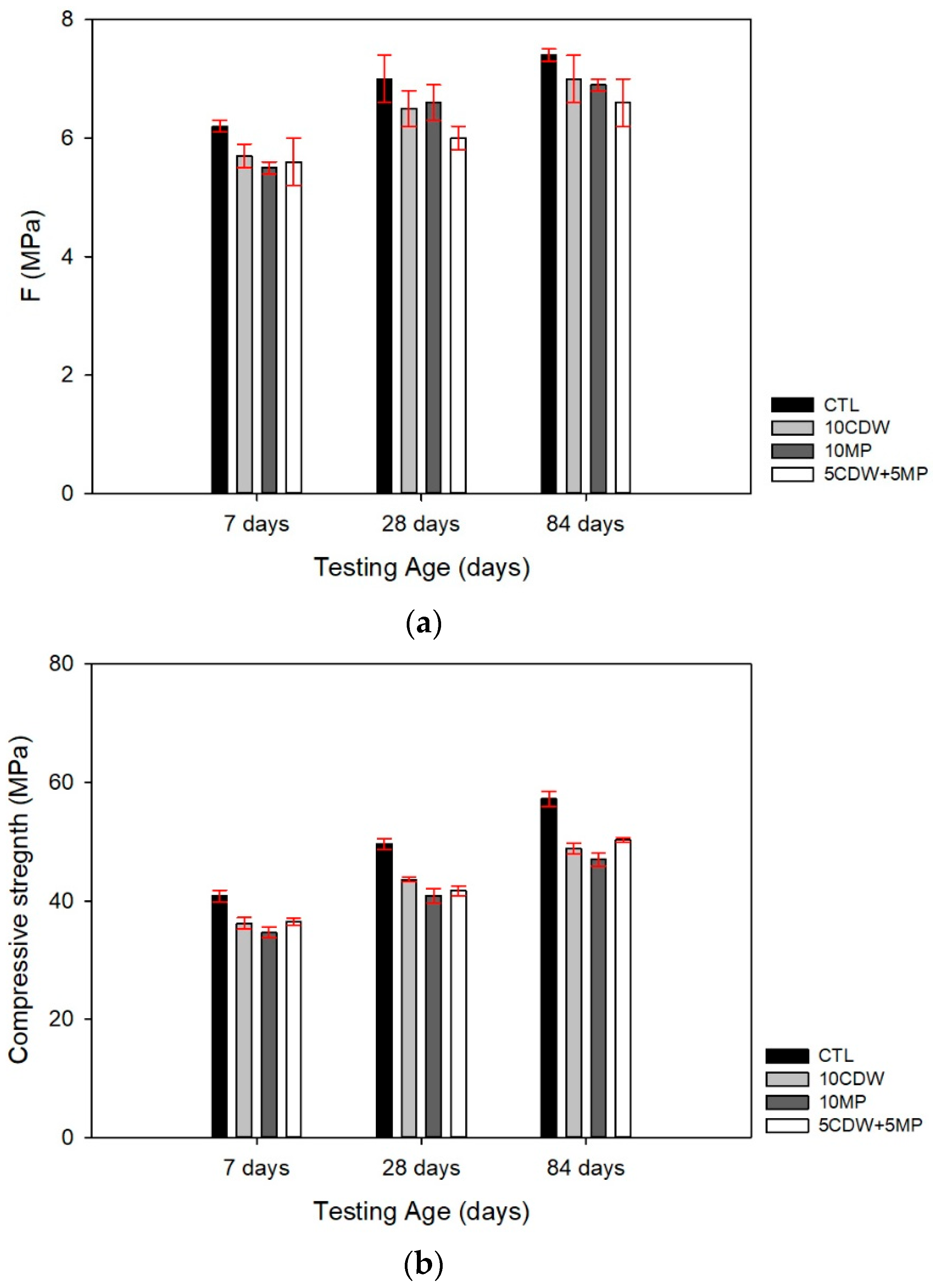
Figure 7a shows that all waste-containing mortars exhibited slightly lower flexural strength than the control (CTL) at early ages, but the gap narrowed over time. At 28 days, CTL reached about 7.0 MPa, while 10CDW and 10MP attained 6.5–6.6 MPa (93–94% of CTL), and 5CDW + 5MP attained about 6.0 MPa (86%). This modest early-age penalty is typical of fillers with limited reactivity, as also reported for CDW fines and marble powder in other studies [40,41].
Figure 7b presents compressive strength development up to 84 days. All mixtures exhibited continuous strength development; however, the CDW- and MP-modified mortars remained below the CTL at all ages. At 28 days, the CTL registered 49.6 MPa, whereas 10CDW, 5CDW + 5MP and 10MP reached 43.6, 41.7 and 40.9 MPa, respectively. Thus, CDW powder contributed slightly more than MP at equal replacement levels. This is consistent with the presence of minor reactive phases in CDW (hydrated cement residues, ceramics), whereas MP is essentially inert CaCO3, acting mainly through packing and nucleation effects [41,42].
At 28 days, the activity indices were 88% (10CDW), 84% (5CDW + 5MP), and 82% (10MP). None reached the 90% threshold defined by NP 4220 for pozzolanic classification. This indicates that both powders acted primarily as fillers, not as active SCMs. Comparable indices have been reported for untreated CDW fines (about 80–85% at 10–20% replacement) [4] and for marble dust at 10% substitution [40]. Only after thermal or carbonation activation have CDW powders achieved indices approaching 95–97% [43].
The observed strength reductions (≤18% at 28 days) align with prior studies reporting that 5–10% cement replacement by CDW or marble powder maintains compressive strength within 10–20% of reference values [44,45]. Rocha and Coutinho [44] found that a 5% CDW powder replacement caused negligible strength loss, while 10% substitution led to a slight reduction but remained acceptable for non-structural mortars. Similarly, Ma et al. [1] observed only an approximately 4% decrease at 56 days with 10% recycled powder. In contrast, higher marble powder contents consistently reduce strength due to pure dilution, although some studies report slight improvements at 5–10% when fineness and mix design are favourable [40].
Overall, CDW powder outperformed marble powder in mechanical contribution at 10% replacement, likely due to residual reactivity. However, neither material qualified as a pozzolan, confirming their role as fillers. The mechanical performance remained within acceptable limits (82–88% of CTL strength), supporting their feasibility for low-level cement substitution where sustainability benefits—reduced clinker use and waste valorisation—outweigh modest strength penalties.

4.3.3. Durability Indicators

The non-steady-state chloride migration coefficients ranged from 12.8 × 10⁻¹² m2/s (10CDW) to 15.1 × 10⁻¹² m2/s (5CDW + 5MP), compared with 14.2 × 10⁻¹² m2/s for the control mix (CTL), as presented in Table 6 and Figure 8 (chloride penetration depth results). All mortars achieved chloride penetration values consistent with the low range for XS/XD exposure classes, as reported in EN 12390-18 and NT Build 492.
The lower Dns values for 10CDW (≈−10% relative to CTL) and 10MP (≈−8%) suggest an improvement in resistance to chloride ingress. This trend agrees with Cantero et al. [17], who reported similar reductions due to a combination of filler densification and secondary CSH formation from ceramic-rich CDW, and with Kabeer et al. [22], who found that 10% marble powder reduced chloride permeability by up to 20% through the filler effect and nucleation of hydration products. Such benefits are well documented for low-level (<15%) replacements with finely ground CDW [2] or limestone-type fillers [22,46].
By contrast, the 5CDW + 5MP blend recorded a slightly higher Dns than CTL (+6%). This indicates that combining two low-reactivity fillers does not automatically yield cumulative benefits. Elgalhud et al. [42] highlighted that limestone addition can modify pore connectivity, and recent work by Tokareva et al. [43] on demolition fines also showed that non-optimised blends may sustain percolation pathways for chloride ingress. As such, the combination of CDW and MP, despite both being fine powders, may lead to non-optimal particle packing.
Sorptivity results corroborated these findings, as can be seen in Table 7. All waste-containing mixes exhibited lower sorptivity than CTL (0.0753 mg/mm2·min0·5), with 10CDW (0.0705) and 10MP (0.0740) showing modest reductions, and 5CDW + 5MP achieving the largest drop (0.0588; −22% relative to CTL). Reduced sorptivity is typically attributed to near-surface pore refinement and reduced capillary connectivity, as observed by Chen et al. [47] for ceramic waste powders and Aliabdo et al. [40] for marble dust. Interestingly, the ternary mix showed the lowest sorptivity but the highest chloride migration, underscoring that the two parameters probe different aspects of the pore network. Sorptivity reflects near-surface densification, while chloride migration is governed by through-thickness pore connectivity.
Accelerated carbonation testing results, presented in Table 8, as well as in Figure 9, revealed depths of 3.80 mm (CTL), 5.40 mm (10CDW), 5.80 mm (10MP), and 5.90 mm (5CDW + 5MP) after 5 weeks of exposure to 5% CO2 at 60% RH. This represents an increase of 42–55% compared with CTL. Such behaviour is consistent with the well-documented tendency of low-reactivity fillers to accelerate carbonation due to clinker dilution and reduced portlandite buffering capacity [48]. In CDW, the effect is exacerbated because most potentially reactive phases are already hydrated, limiting additional Ca(OH)2 supply [43]. Zito et al. [2] observed similar increases (30–60%) in carbonation coefficients for ceramic-rich CDW powders at higher replacement levels (20–25%), reinforcing that the trend is robust even at 10% substitution.
For marble powder, two mechanisms explain the accelerated carbonation: (i) dilution of clinker phases reduces alkalinity and Ca(OH)2 reserves; (ii) finely divided calcite particles act as preferential nucleation sites for carbonation reactions without contributing to long-term alkalinity.
The ternary mix did not mitigate the carbonation increase observed in the single SCMs. While the combination of fillers improved sorptivity, this densification was insufficient to hinder gaseous CO2 ingress, which is more dependent on alkaline protection than on pore refinement. This confirms that improvements in liquid transport resistance (sorptivity, chloride ingress) do not necessarily translate into improved carbonation resistance.
From a design perspective, the observed increases in carbonation depth suggest that mortars with 10% CDW or MP (alone or in combination) should be used cautiously in environments corresponding to EN 206 classes XC3–XC4. Mitigation measures will be necessary, such as increased cover depth, lower water/binder ratios, or the incorporation of reactive SCMs (e.g., fly ash, slag, calcined clay) to restore alkalinity and carbonation resistance.

5. Conclusions

This study assessed the impact of partially replacing cement with construction and demolition waste (CDW) and marble powder (MP) at 10% by mass, used individually and in a 5CDW + 5MP blend. Fresh properties were unaffected or slightly improved, notably with MP, which increased workability without requiring admixtures.
Mechanical strength decreased moderately, especially at early ages, with 28-day compressive strength activity indices between 82 and 88%, confirming the low reactivity of the waste-derived potential SCM. Durability results were varied: sorptivity decreased in all mixes—most notably in the ternary blend—while chloride ingress resistance improved only with CDW and MP used separately. The ternary mix, by contrast, showed increased chloride permeability, probably due to suboptimal particle packing and lack of chemical synergy. Carbonation resistance declined significantly across all blends (42–55% higher depths than control), indicating the need for mitigation strategies in reinforced applications.
From an environmental standpoint, replacing 10% of cement with CDW or MP can avoid ~70–80 kg of CO2 per tonne of cement and diverts inert waste from landfills, supporting circular economy goals. However, the ternary blend did not offer additive benefits and underperformed in critical durability aspects.
The main limitations of this study include the absence of microstructural analysis (XRD, SEM), and the narrow substitution range explored. These findings nonetheless provide a sound basis for further optimisation of CDW and MP as cementitious fillers.
Future work should address these limitations, explore activation strategies to enhance CDW reactivity, and test higher substitution levels under varied exposure conditions to define the application boundaries of these materials in real-world cement systems.

Author Contributions

Conceptualisation, A.M.M. and J.S.C.; methodology, A.M.M. and J.S.C.; software, A.M.M. and J.S.C.; validation, A.M.M. and J.S.C.; formal analysis, A.M.M. and J.S.C.; investigation, A.M.M. and J.S.C.; resources, A.M.M. and J.S.C.; data curation, A.M.M. and J.S.C.; writing—original draft preparation, A.M.M. and J.S.C.; writing—review and editing A.M.M. and J.S.C.; visualisation, A.M.M. and J.S.C.; supervision, A.M.M. and J.S.C.; project administration, A.M.M. and JSC.; funding acquisition, A.M.M. and J.S.C. All authors have read and agreed to the published version of the manuscript.

Funding

This work was financially supported by Funding-UID/04708 of the CONSTRUCT-Instituto de I&D em Estruturas e Construções-funded by Fundação para a Ciência e a Tecnologia, I.P./MCTES through the national funds; and by FCT-Fundação para a Ciência e a Tecnologia through the individual Scientific Employment Stimulus 2021.01765.CEECIND.

Institutional Review Board Statement

Not applicable.

Informed Consent Statement

Not applicable.

Data Availability Statement

The original contributions presented in this study are included in the article material. Further inquiries can be directed to the corresponding authors.

Acknowledgments

The authors acknowledge that a preliminary version of part of the experimental programme was previously explored in the MSc thesis of Silva (2016), under the supervision of Joana Sousa Coutinho at the Faculty of Engineering of the University of Porto [49]. In the present article, all tests were updated and reinterpreted, and the analyses, discussion and conclusions are entirely new and solely the responsibility of the authors. Collaboration and materials supply by Secil, Sika, Demolição SA and CEVALOR are gratefully acknowledged.

Conflicts of Interest

Collaboration and materials supply by Secil, Sika, Demolição SA and CEVALOR, which fall under the category of materials-related funding. The author declares that there are no other conflicts of interest.

Abbreviations

CDWConstruction and Demolition waste
hhours
HRRelative Humidity (%)
LFLimestone filler
LOILoss on ignition (%)
MPWaste marble powder
PCPortland cement
SAIStrength activity index (%)
SCMsSupplementary cementitious materials
w/cwater to cement weight ratio
w/bwater to binder weight ratio

References

  1. Ige, O.E.; Von Kallon, D.V.; Desai, D. Carbon emissions mitigation methods for cement industry using a systems dynamics model. Clean Technol. Environ. Policy 2024, 26, 579–597. [Google Scholar] [CrossRef]
  2. Zito, S.V.; Irassar, E.F.; Rahhal, V.F. Recycled Construction and Demolition Waste as Supplementary Cementing Materials in Eco-Friendly Concrete. Recycling 2023, 8, 54. [Google Scholar] [CrossRef]
  3. Favier, A.; Scrivener, K.; Habert, G. Decarbonizing the cement and concrete sector: Integration of the full value chain to reach net zero emissions in Europe. IOP Conf. Ser. Earth Environ. Sci. 2019, 225, 012009. [Google Scholar] [CrossRef]
  4. Ripley, K.M.; Saadi, F.H.; Burke, Z.L.H. Cost-motivated pathways towards near-term decarbonization of the cement industry. RSC Sustain. 2024, 3, 255–263. [Google Scholar] [CrossRef]
  5. European Commission. Deep Decarbonisation of Industry: The Cement Sector Cement Sector Overview; European Commission: Brussels, Belgium, 2021. [Google Scholar]
  6. Khaiyum, M.Z.; Sarker, S.; Kabir, G. Evaluation of Carbon Emission Factors in the Cement Industry: An Emerging Economy, Context. Sustainability 2023, 15, 15407. [Google Scholar] [CrossRef]
  7. Waste and Supplementary Cementitious Materials in Concrete. ScienceDirect. Rafat Siddique. 2018. Available online: https://www.sciencedirect.com/book/9780081021569/waste-and-supplementary-cementitious-materials-in-concrete (accessed on 23 June 2025).

  8. Miller, S.A.; Habert, G.; Myers, R.J.; Harvey, J.T. Achieving net zero greenhouse gas emissions in the cement industry via value chain mitigation strategies. One Earth 2021, 4, 1398–1411. [Google Scholar] [CrossRef]
  9. Schmidt, W.; Alexander, M.; John, V. Education for sustainable use of cement-based materials. Cem. Concr. Res. 2018, 114, 103–114. [Google Scholar] [CrossRef]
  10. Caro, D.; Lodato, C.; Damgaard, A.; Cristóbal, J.; Foster, G.; Flachenecker, F.; Tonini, D. Environmental and socio-economic effects of construction and demolition waste recycling in the European Union. Sci. Total Environ. 2024, 908, 168295. [Google Scholar] [CrossRef]
  11. Joseph, H.S.; Pachiappan, T.; Avudaiappan, S.; Maureira-Carsalade, N.; Roco-Videla, Á.; Guindos, P.; Parra, P.F. A Comprehensive Review on Recycling of Construction Demolition Waste in Concrete. Sustainability 2023, 15, 4932. [Google Scholar] [CrossRef]
  12. Construction and Demolition Waste. European Commission. Available online: https://environment.ec.europa.eu/topics/waste-and-recycling/construction-and-demolition-waste_en (accessed on 23 June 2025).
  13. de Andrade Salgado, F.; de Andrade Silva, F. Recycled aggregates from construction and demolition waste towards an application on structural concrete: A review. J. Build. Eng. 2022, 52, 104452. [Google Scholar] [CrossRef]
  14. Reis, G.S.D.; Quattrone, M.; Ambrós, W.M.; Cazacliu, B.G.; Hoffmann Sampaio, C. Current Applications of Recycled Aggregates from Construction and Demolition: A Review. Materials 2021, 14, 1700. [Google Scholar] [CrossRef] [PubMed]
  15. Soultana, A.; Galetakis, M.; Vasiliou, A.; Komnitsas, K.; Vamvuka, D. Utilization of Upgraded Recycled Concrete Aggregates and Recycled Concrete Fines in Cement Mortars. Recent Prog. Mater. 2021, 3, 3. [Google Scholar] [CrossRef]
  16. Silva, Y.F.; Lange, D.A.; Delvasto, S. Effects of the incorporation of residue of masonry on the properties of cementitious mortars. Rev. Construcción 2020, 19, 407–421. [Google Scholar] [CrossRef]
  17. Cantero, B.; del Bosque, I.F.S.; de Rojas, M.I.S.; Matías, A.; Medina, C. Durability of concretes bearing construction and demolition waste as cement and coarse aggregate substitutes. Cem. Concr. Compos. 2022, 134, 104722. [Google Scholar] [CrossRef]
  18. Zajac, M.; Skocek, J.; Gołek, Ł.; Deja, J. Supplementary cementitious materials based on recycled concrete paste. J. Clean. Prod. 2023, 387, 135743. [Google Scholar] [CrossRef]
  19. Baggio, T.F.; Possan, E.; de Oliveira Andrade, J.J. Physical-chemical characterization of construction and demolition waste powder with thermomechanical activation for use as supplementary cementitious material. Constr. Build. Mater. 2024, 437, 136907. [Google Scholar] [CrossRef]
  20. Abbas, M.M.; Muntean, R. Marble Powder as a Sustainable Cement Replacement: A Review of Mechanical Properties. Sustainability 2025, 17, 736. [Google Scholar] [CrossRef]
  21. Tazzini, A.; Gambino, F.; Casale, M.; Dino, G.A. Managing Marble Quarry Waste: Opportunities and Challenges for Circular Economy Implementation. Sustainability 2024, 16, 3056. [Google Scholar] [CrossRef]
  22. Prakash, B.; Saravanan, T.J.; Kabeer, K.I.S.A.; Bisht, K. Exploring the potential of waste marble powder as a sustainable substitute to cement in cement-based composites: A review. Constr. Build. Mater. 2023, 401, 132887. [Google Scholar] [CrossRef]
  23. Khan, K.; Ahmad, W.; Amin, M.N.; Ahmad, A.; Nazar, S.; Alabdullah, A.A.; Abu Arab, A.M. Exploring the Use of Waste Marble Powder in Concrete and Predicting Its Strength with Different Advanced Algorithms. Materials 2022, 15, 4108. [Google Scholar] [CrossRef]
  24. Ali, S.; Ahmad, S.; Ullah, I. Utilization of waste marble dust as cement and sand replacement in concrete. Discov. Civ. Eng. 2024, 1, 15. [Google Scholar] [CrossRef]
  25. Secil—Companhia Geral de Cal e Cimento. Environmental Product Declaration: CEM I 42.5R Portland Cement. EPD Norway, NEPD-10063-2. 2025. Available online: https://www.secil.pt (accessed on 10 November 2025).
  26. Nadu, T. Study on the Properties of Concrete Incorporated With Various Mineral Admixtures-Limestone Powder and Marble Powder (Review Paper). Int. J. Innov. Res. Sci. Eng. Technol. 2015, 1, 3297. [Google Scholar] [CrossRef]
  27. Singh, M.; Aggarwal, N.; Rashid, S.; Srivastava, A.; Khapre, R. Marble Dust as a Sustainable Cementitious Material: Investigating the Synergistic Effects of Curing Conditions. SSRN 2024. [Google Scholar] [CrossRef]
  28. Zhang, J.; Cai, D.; Wang, T.; Hu, Q.; Li, K. Experimental analysis on the effects of artificial marble waste powder on concrete performance. Ann. Chim. Sci. Mater. 2018, 42, 347–362. [Google Scholar] [CrossRef]
  29. Ashish, D.K. Feasibility of waste marble powder in concrete as partial substitution of cement and sand amalgam for sustainable growth. J. Build. Eng. 2018, 15, 236–242. [Google Scholar] [CrossRef]
  30. Li, J.; Zhan, B.; Gao, P.; Hu, L.; Qiao, M.; Sha, H.; Yu, Q. Effects of recycled concrete powders on the rheology, setting and early age strength of cement paste. Constr. Build. Mater. 2023, 401, 132899. [Google Scholar] [CrossRef]
  31. Chen, X.; Li, Y.; Bai, H.; Ma, L. Utilization of Recycled Concrete Powder in Cement Composite: Strength, Microstructure and Hydration Characteristics. J. Renew. Mater. 2021, 9, 2189–2208. [Google Scholar] [CrossRef]
  32. Grigorjev, V.; Azenha, M.; De Belie, N. Second Life for Recycled Concrete and Other Construction and Demolition Waste in Mortars for Masonry: Full Scope of Material Properties, Performance, and Environmental Aspects. Materials 2024, 17, 5118. [Google Scholar] [CrossRef]
  33. Shawki, M.A.; Elnemr, A.; Koenke, C.; Thomas, C. Rheological properties of high-performance SCC using recycled marble powder. Innov. Infrastruct. Solut. 2024, 9, 176. [Google Scholar] [CrossRef]
  34. Oza, R.B.; Kangda, M.Z.; Agrawal, M.R.; Vakharia, P.R.; Solanki, D.S.M. Marble dust as a binding material in concrete: A review. Mater. Today Proc. 2022, 60, 421–430. [Google Scholar] [CrossRef]
  35. Matos, A.M. Waste marble valorisation in 3D cementitious materials printing. In WASTES: Solutions, Treatments and Opportunities IV, Proceedings of the 6th International Conference, Coimbra, Portugal, 6–8 September 2023; Taylor & Francis: London, UK, 2023. [Google Scholar] [CrossRef]
  36. Mashaly, A.O.; El-Kaliouby, B.A.; Shalaby, B.N.; El-Gohary, A.M.; Rashwan, M.A. Effects of marble sludge incorporation on the properties of cement composites and concrete paving blocks. J. Clean. Prod. 2016, 112, 731–741. [Google Scholar] [CrossRef]
  37. Ashish, D.K. Concrete made with waste marble powder and supplementary cementitious material for sustainable development. J. Clean. Prod. 2019, 211, 716–729. [Google Scholar] [CrossRef]
  38. Alemu, M.Y.; Yehualaw, M.D.; Nebiyu, W.M.; Nebebe, M.D.; Taffese, W.Z. Marble and Glass Waste Powder in Cement Mortar. Appl. Sci. 2025, 15, 3930. [Google Scholar] [CrossRef]
  39. Jesus, S.; Pederneiras, C.M.; Farinha, C.B.; de Brito, J.; Veiga, R. Reduction of the Cement Content by Incorporation of Fine Recycled Aggregates from Construction and Demolition Waste in Rendering Mortars. Infrastructures 2021, 6, 11. [Google Scholar] [CrossRef]
  40. Aliabdo, A.A.; Elmoaty, A.E.M.A.; Auda, E.M. Re-use of waste marble dust in the production of cement and concrete. Constr. Build. Mater. 2014, 50, 28–41. [Google Scholar] [CrossRef]
  41. Ma, Z.; Li, W.; Wu, H.; Cao, C. Chloride permeability of concrete mixed with activity recycled powder obtained from C&D waste. Constr. Build. Mater. 2019, 199, 652–663. [Google Scholar] [CrossRef]
  42. Elgalhud, A.A.; Dhir, R.K.; Ghataora, G. Limestone addition effects on concrete porosity. Cem. Concr. Compos. 2016, 72, 222–234. [Google Scholar] [CrossRef]
  43. Tokareva, A.; Kaassamani, S.; Waldmann, D. Fine demolition wastes as Supplementary cementitious materials for CO2 reduced cement production. Constr. Build. Mater. 2023, 392, 131991. [Google Scholar] [CrossRef]
  44. Rocha, S.; Sousa-Coutinho, J. Construction and demolition waste as partial cement replacement. Adv. Cem. Res. 2019, 31, 411–422. [Google Scholar] [CrossRef]
  45. Yang, Y.; Kang, Z.; Zhan, B.; Gao, P.; Yu, Q.; Wang, J.; Zhao, W.; Zhang, Y.; Bi, W.; Yang, C.; et al. Short Review on the Application of Recycled Powder in Cement-Based Materials: Preparation, Performance and Activity Excitation. Buildings 2022, 12, 1568. [Google Scholar] [CrossRef]
  46. Khyaliya, R.K.; Kabeer, K.I.S.A.; Vyas, A.K. Evaluation of strength and durability of lean mortar mixes containing marble waste. Constr. Build. Mater. 2017, 147, 598–607. [Google Scholar] [CrossRef]
  47. Chen, X.; Zhang, D.; Cheng, S.; Xu, X.; Zhao, C.; Wang, X.; Wu, Q.; Bai, X. Sustainable reuse of ceramic waste powder as a supplementary cementitious material in recycled aggregate concrete: Mechanical properties, durability and microstructure assessment. J. Build. Eng. 2022, 52, 104418. [Google Scholar] [CrossRef]
  48. Elgalhud, A.A.; Dhir, R.K.; Ghataora, G.S. Carbonation resistance of concrete: Limestone addition effect. Mag. Concr. Res. 2017, 69, 84–106. [Google Scholar] [CrossRef]
  49. da Silva, A.F.C. Resíduos de Mármore e Resíduos de Construção e Demolição no Cimento, FEUP. 2016. Available online: https://repositorio-aberto.up.pt/handle/10216/83983 (accessed on 9 October 2025).
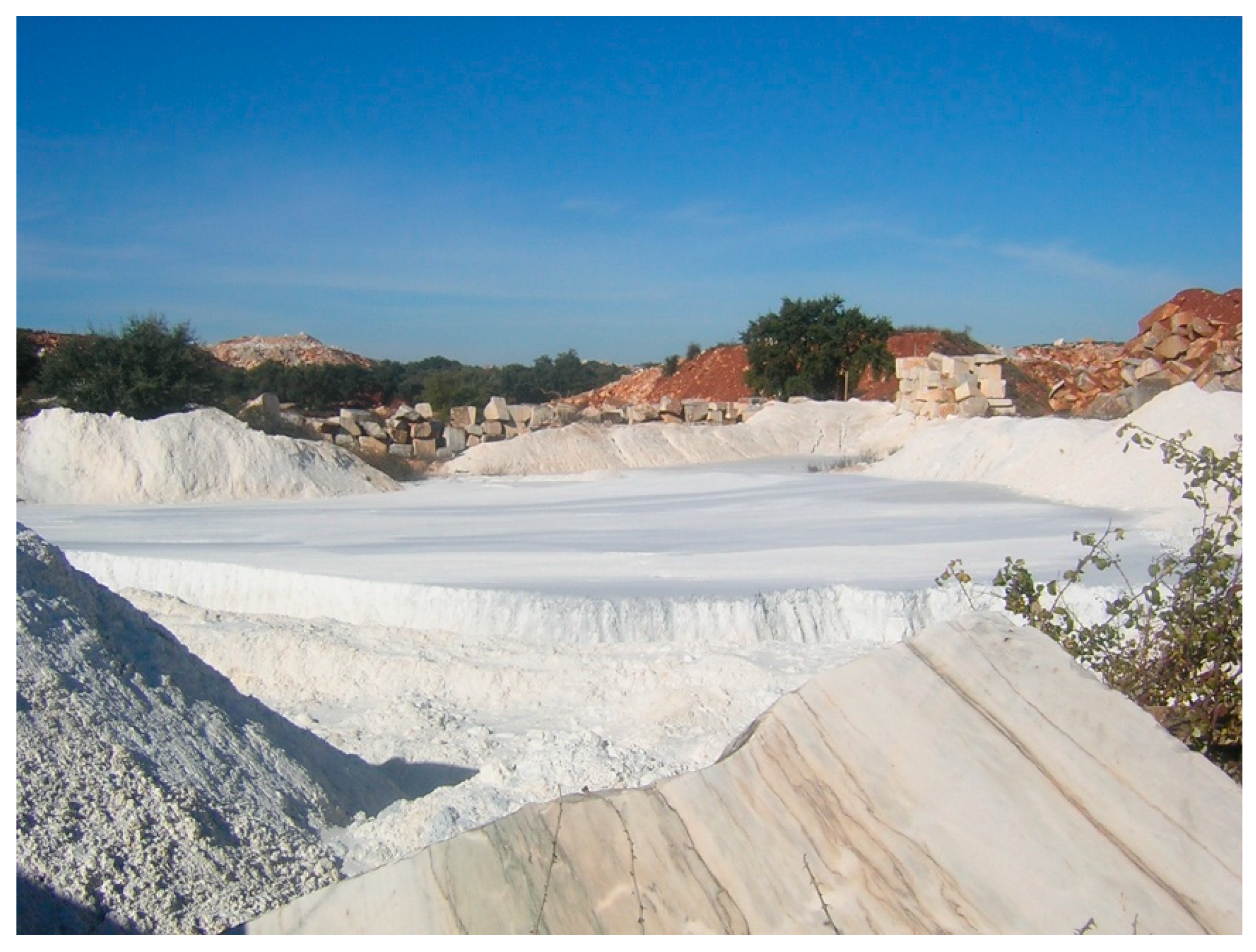
Figure 1. Marble waste dust accumulation in Portugal (south region).
Sustainability 17 10769 g001
Figure 2. (a) Waste marble dust; (b) waste marble powder (MP), after desaggregation and grinding.
Sustainability 17 10769 g002
Figure 3. CDW used in the current work: (a) finest fraction (0–10 mm), (b) treated CDW used in this research.
Sustainability 17 10769 g003
Figure 4. Slump diameter measurement of a fresh mortar.
Sustainability 17 10769 g004
Figure 5. Capillary water absorption test.
Sustainability 17 10769 g005
Figure 6. Particle size distribution of MP, CDW and cement.
Sustainability 17 10769 g006
Figure 7. Mechanical strength results: (a) Flexure; (b) Compression.
Sustainability 17 10769 g007
Figure 8. Chloride penetration depth results.
Sustainability 17 10769 g008
Figure 9. Carbonation depth areas.
Sustainability 17 10769 g009
Table 1. Pastes mixture proportions.
Constituent Materials/Pastes IDCTL10CDW10MP5CDW + 5MP
Water (g)142142142142
Cement (g)500450450450
CDW (g)-50-25
MP (g)--5025
Table 2. Mortar mixtures proportions.
Constituent MaterialsCTL10CDW10MP5CDW + 5MP
Water (g)225225225225
Cement (g)450405405405
Sand (g)1350135013501350
CDW (g)-45-22.5
MP (g)--4522.5
Table 3. Main oxide composition, LOI and density of cement, CDW and MP.
CEM I 42.5 RCDWMP
Specific gravity (kg/m3)308026202710
Blaine fineness (cm2/g)424684399631
Main Oxide composition (%)CEM I 42.5 RCDWMP
LOI2.278.1743.12
SiO219.1672.271.51
Al2O34.455.10.53
Fe2O33.53.250.17
CaO63.758.2753.93
MgO1.870.280.65
Na2O0.220.31<0.20
K2O0.91.840.1
SO33.260.31<0.1
Cl0.05<0.02<0.02
Table 4. Pastes results summary.
Paste
Identification
Standard
Consistency (mm)
Initial Setting Time
(mm)
Final Setting Time
(mm)
CTL8157227
10CDW8155224
10MP8137197
5CDW + 5MP4150229
Table 5. Mortars’ workability results summary.
Mortar IdentificationAverage Workability (mm)
CTL217.3
10CDW216.9
10MP217.7
5CDW + 5MP214.8
Table 6. Chloride penetration test results.
Mortar IdentificationDns (×10−12 m2/s)
CTL14.2 ± 1.8
10CDW12.8 ± 0.6
10MP13.0 ± 0.9
5CDW + 5MP15.1 ± 0.4
Table 7. Sorptivity results.
Mortar IdentificationSorptivity (mg/(mm2·min0.5))
CTL0.0753 ± 0.003
10CDW0.0705 ± 0.005
10MP0.0740 ± 0.003
5CDW + 5MP0.0588 ± 0.007
Table 8. Average carbonation depth results.
Mortar IdentificationAverage Carbonation Depth (mm)
CTL3.80
10CDW5.40
10MP5.80
5CDW + 5MP5.90
Disclaimer/Publisher’s Note: The statements, opinions and data contained in all publications are solely those of the individual author(s) and contributor(s) and not of MDPI and/or the editor(s). MDPI and/or the editor(s) disclaim responsibility for any injury to people or property resulting from any ideas, methods, instructions or products referred to in the content.