Evaluating the Efficiency of Public Spending on Tourism as a Driver of Institutional Sustainability: Evidence from Southern Italy’s Municipalities




Abstract
1. Introduction
- SDG 11—Sustainable Cities and Communities: targeted investments can foster responsible travel behaviour and reduce pressure on host communities [27];
- SDG 12—Responsible Consumption and Production: tourism communication can promote sustainable practices, enhance local culture, and encourage the use of endogenous resources [28].
2. Materials and Methods
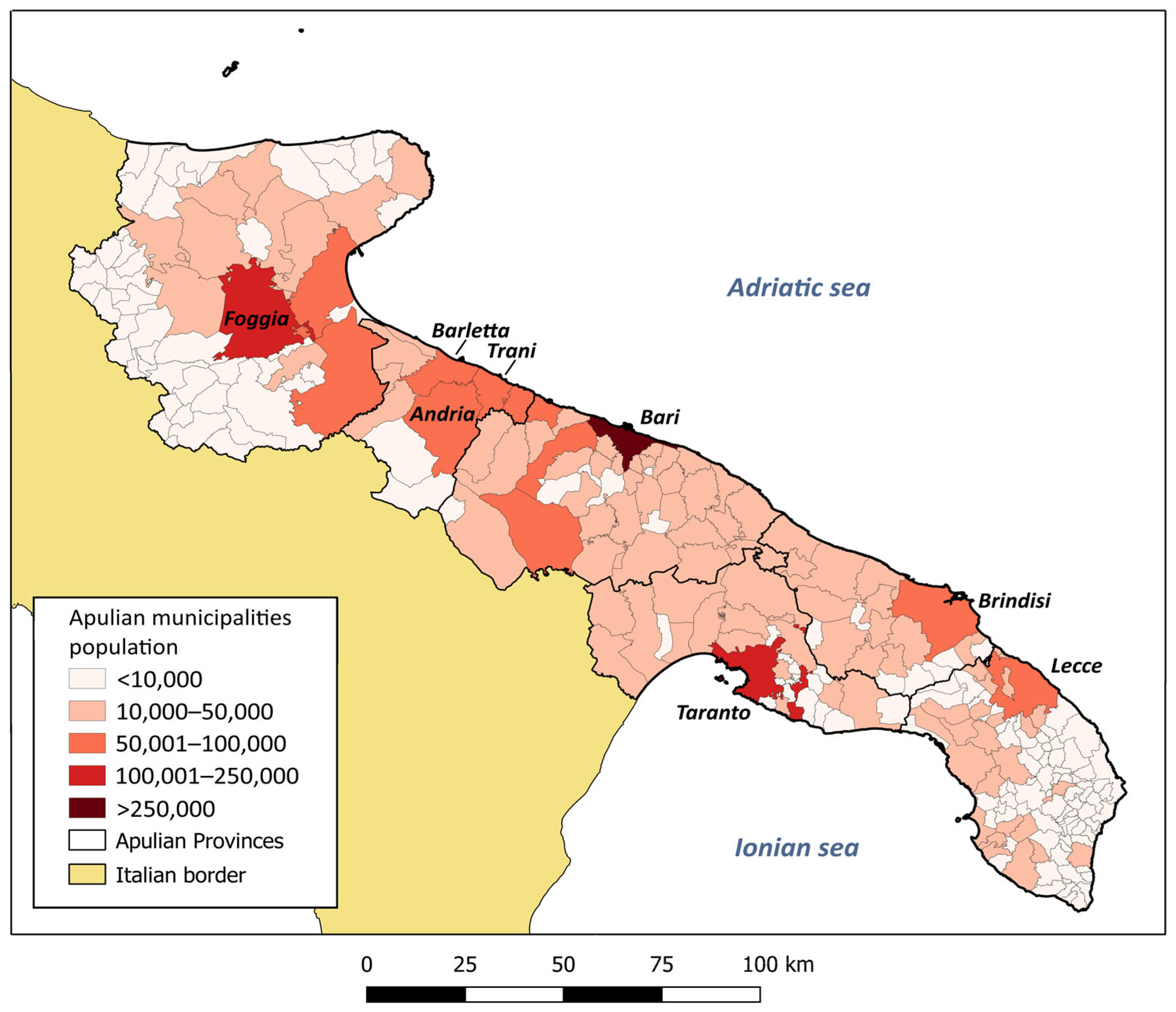
2.1. The Apulia Region: A Southern Italian Tourism Hub
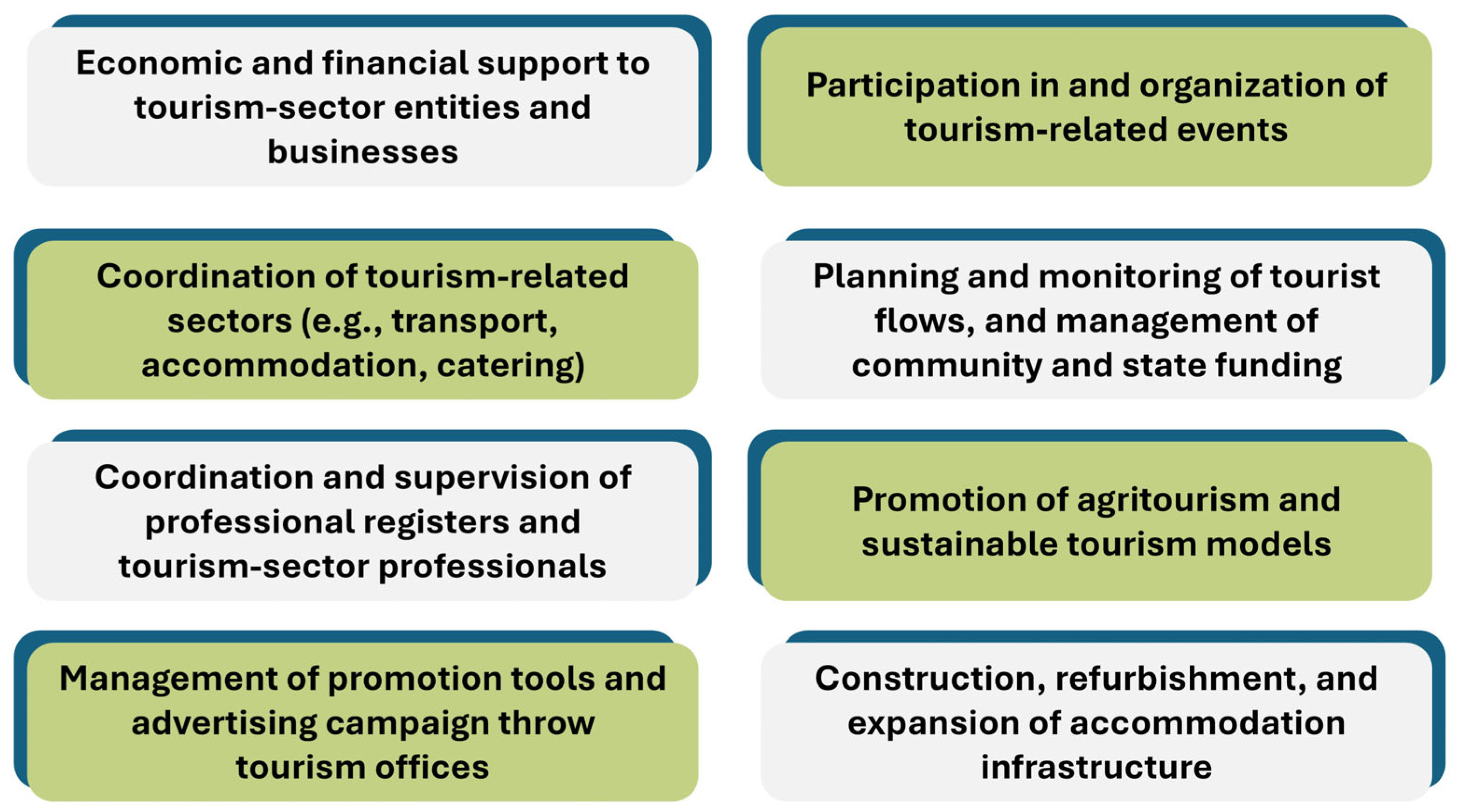
- Basic tourism services—information, hospitality, entertainment, and visitors’ assistance activities, with a particular focus on the “Tourist Information Offices”, which serve as essential contact points for tourists;
- Local tourism promotion initiatives—projects and campaigns implemented by municipalities to enhance and strengthen the image of local tourism products.
2.2. Methodological Framework
2.3. The Stochastic Frontier Analysis (SFA)
2.4. Regression of Structural and Territorial Factors
- Simple indicators (SI): these are direct, elementary measures of municipal characteristics (e.g., number of beds per 1000 inhabitants, distance to the nearest UNESCO site).
- Composite indicators (CI): these aggregate several simple indicators representing the same conceptual dimension (e.g., economic level, naturalness of the territory), to capture multidimensional phenomena and enhance interpretability.

| Composite Indicator (CI) | Simple Components | Unit of Measure | Reference Year and Data Source |
|---|---|---|---|
| CI1—Composite indicator of economic development | Average employment rate—Positive polarity | % | Mean (2019–2021–2022)—ISTAT [73] |
| Value added of local production units—Positive polarity | € | Mean (2019–2021–2022)—IPRES Puglia [74] | |
| Number of local business units per capita—Positive polarity | No. | Mean (2019–2021–2022)—IPRES Puglia [74] | |
| Average taxable income per capita—Positive polarity | € | Mean (2019–2021–2022)—ISTAT [73] | |
| CI2—Composite indicator of accessibility | Minimum average travel time to the nearest long-distance railway station—Negative polarity | Minutes | 2022—ISTAT [75] |
| Minimum average travel time to the nearest airport—Negative polarity | Minutes | 2022—ISTAT [75] | |
| Minimum average travel time to the nearest passenger port—Negative polarity | Minutes | 2022—ISTAT [75] | |
| Minimum average travel time to the nearest motorway exit—Negative polarity | Minutes | 2022—ISTAT [75] | |
| CI3—Composite indicator of natural value | Share of municipal area covered by natural land—Positive polarity | % | 2018—Corine Land Cover [76] |
| Share of municipal area under environmental protection—Positive polarity | % | 2015—SIT Puglia [60] | |
| CI4—Composite indicator of coastal tourist and environmental quality | Share of coastline in natural condition—Positive polarity | % | 2020—ISPRA GeoDB2020 [77] |
| Total beach surface area—Positive polarity | hectares | 2020—ISPRA GeoDB2020 [77] | |
| Number of years with “Blue Flag” beach certification in the last three years—Positive polarity | No. | 2024—www.bandierablu.org [78] | |
| Density of beach establishments per km of sandy coastline—Positive polarity | No. | 2024—Puglia DMS [50] | |
| Presence of a Marine Protected Area adjacent to the coast—Positive polarity | Yes/No | 2024—SIT Puglia [60] | |
| Presence of a Coastal Protected Natural Area—Positive polarity | Yes/No | 2024—SIT Puglia [60] | |
| Presence of tourist marinas or docking facilities—Positive polarity | Yes/No | 2024—Puglia DMS [50] | |
| CI5—Composite indicator of average cultural production | Number of cultural events organized by the municipality | No. | Mean (2022–2023)—Puglia DMS [50] |
| Number of cultural events lasting two or more consecutive days | No. | Mean (2022–2023)—Puglia DMS [50] |
3. Results
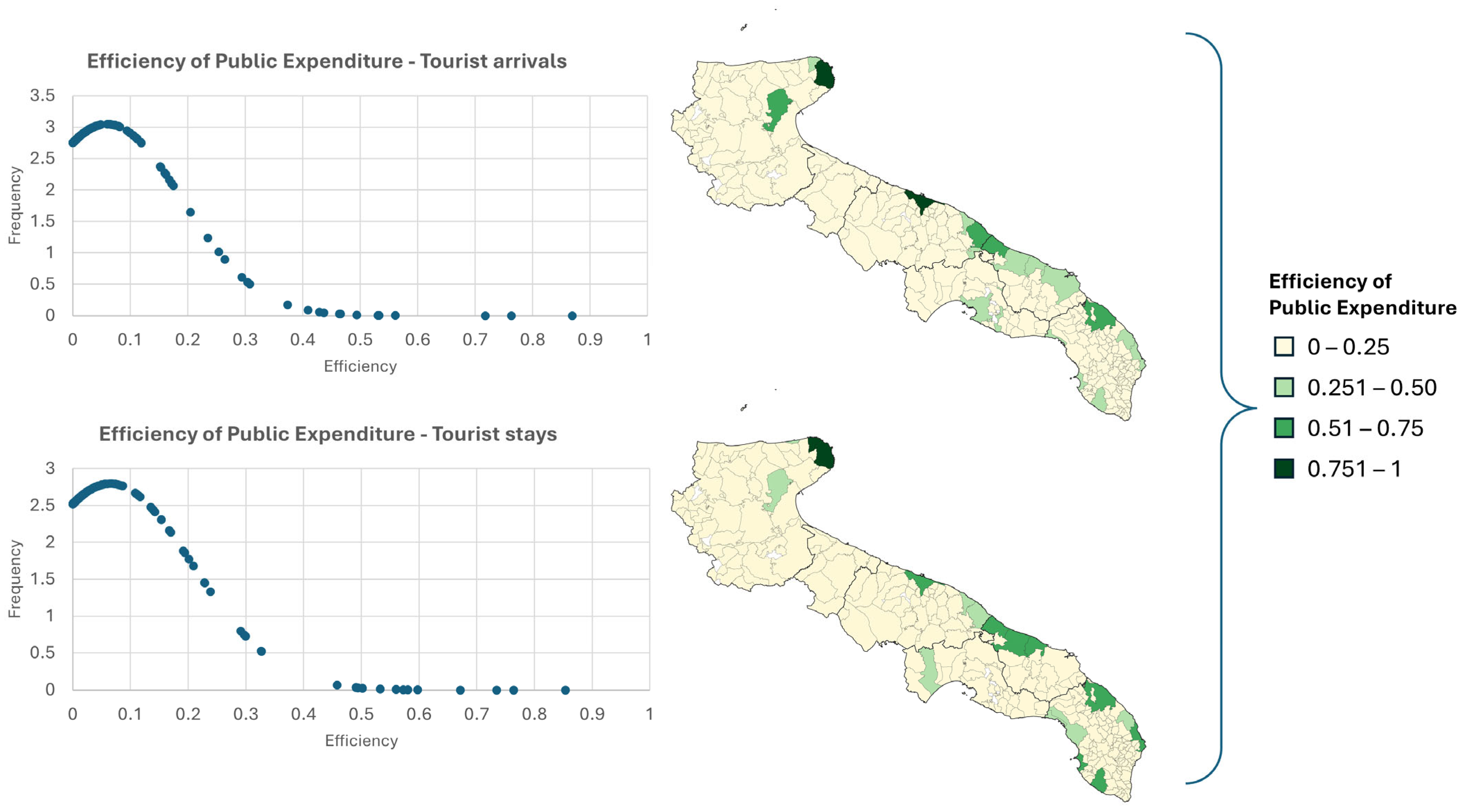
3.1. Efficiency of Public Spending for Tourist Arrivals and Overnight Stays
3.2. Distribution of Municipal Efficiency Levels
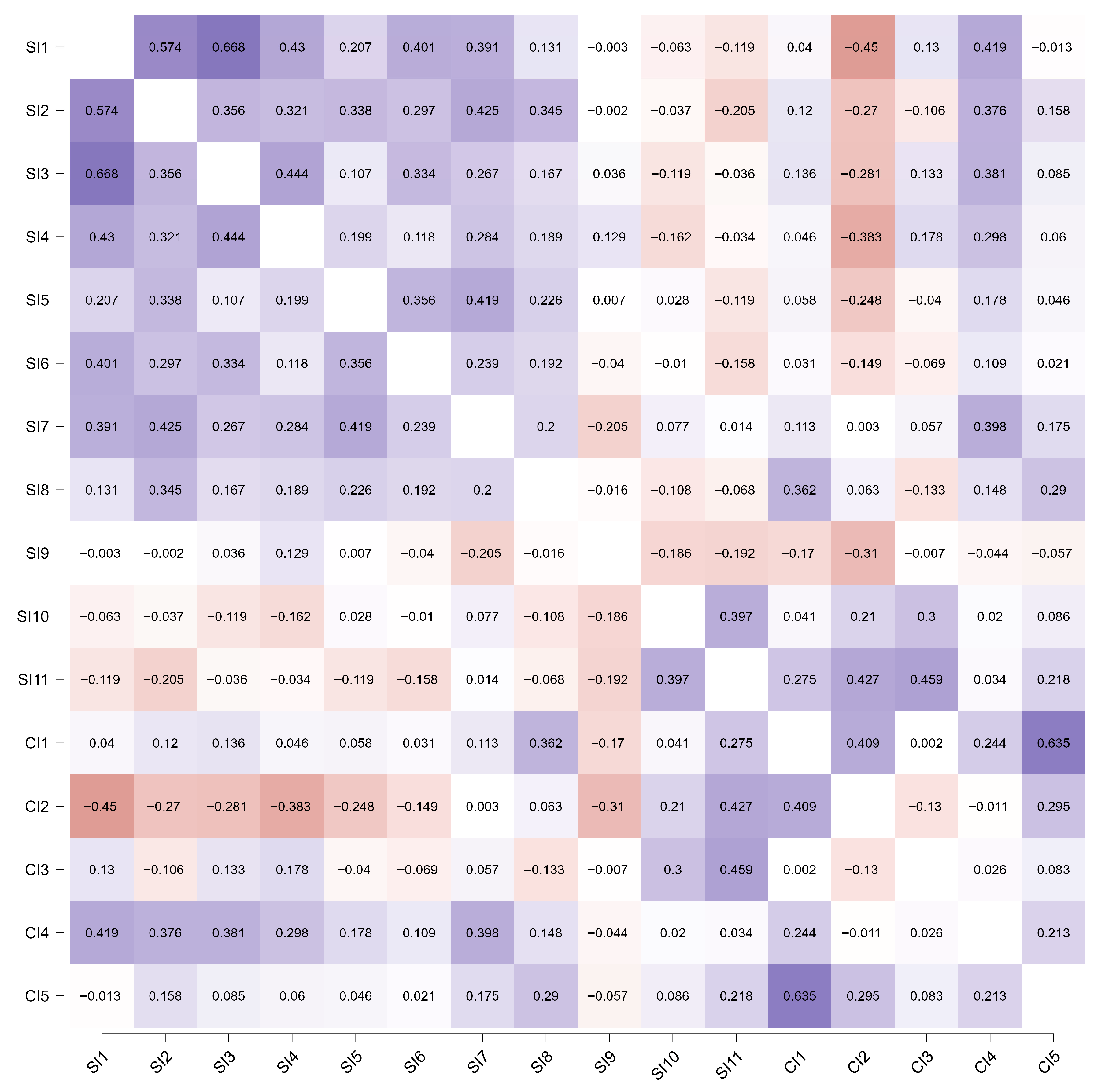
3.3. Drivers of Public Spending Efficiency
- the number of beds per 1000 inhabitants (SI1) and density of accommodation facilities per 10 km2 (SI2) (r = 0.574);
- the number of beds per 1000 inhabitants (SI1) and the number of tourism services per 1000 inhabitants (SI3) (r = 0.668);
- the composite economic development index (CI1) and average cultural production index (CI5) (r = 0.635).
3.3.1. Multiple Regression Results—Efficiency and Tourist Arrivals
- average cultural production (CI5): it is the strongest predictor (β = 0.497), confirming the strategic role of cultural and creative activities, especially longer events, in attracting visitors;
- accommodation density (SI1): it is positively associated with the capacity to attract tourists (β = 0.397), indicating that a higher number of available beds improves the conversion of public spending into tourism flows;
- coastal quality and natural value indicators (CI4, CI3): they both show positive and significant effects (β = 0.155 and β = 0.112, respectively), highlighting the contribution of environmental and landscape assets to efficiency;
- economic development level (CI1): it shows a positive effect (β = 0.106), suggesting that stronger local economies manage public resources more effectively;
- agritourism and camping facilities (SI6): it shows a less but significant positive effect (β = 0.082), underlining their complementary role in the regional tourism system;
| Model | R2 | Adjusted R2 | RMSE | AIC | BIC | ||
| M7 | 0.698 | 0.690 | 0.073 | −582.967 | −551.383 | ||
| Coefficients | |||||||
| (Intercept) | Std. Error | Standardized (β) | t | p | 2.5% CI | 97.5% CI | VIF |
| CI5 | 0.003 | 0.497 | 10.655 | <0.001 | 0.028 | 0.041 | 1.727 |
| SI1 | <0.001 | 0.397 | 8.939 | <0.001 | <0.001 | <0.001 | 1.562 |
| CI4 | <0.001 | 0.155 | 3.793 | <0.001 | 0.002 | 0.005 | 1.326 |
| CI3 | 0.063 | 0.112 | 2.665 | 0.008 | 0.044 | 0.294 | 1.393 |
| CI1 | 0.009 | 0.106 | 2.211 | 0.028 | 0.002 | 0.039 | 1.835 |
| SI6 | 0.003 | 0.082 | 2.076 | 0.039 | <0.001 | 0.011 | 1.232 |
3.3.2. Multiple Regression Results—Efficiency and Tourist Overnight Stays
- Accommodation density (SI1): it is the strongest coefficient (β = 0.633), confirming that the availability of lodging capacity is the most important condition for maximizing the impact of public tourism spending on stays;
- Average cultural production (CI5): it is significantly positive (β = 0.406), suggesting that a rich cultural offering, especially multi-day events, enhances tourists’ length of stay;
- Coastal quality (CI4) and natural value (CI3): both positive and significant (β = 0.180 and β = 0.122, respectively), showing that the combination of coastal and environmental resources increases spending efficiency;
- Accessibility (CI2): it shows positive effect (β = 0.114), indicating that better connectivity supports longer tourist stays;
- Agritourism and camping facilities (SI6): show positive effect (β = 0.074), highlighting their role in promoting a more locally rooted tourism model;
- Cycling and pedestrian paths (SI4): it is the only with negative coefficient (β = −0.090), possibly reflecting niche tourism specialization less connected to traditional accommodation-based tourism.
| Model | R2 | Adjusted R2 | RMSE | AIC | BIC | ||
| M7 | 0.725 | 0.717 | 0.076 | −562.855 | −531.271 | ||
| Coefficients | |||||||
| (Intercept) | Std. Error | Standardized (β) | t | p | 2.5% CI | 97.5% CI | VIF |
| SI1 | <0.001 | 0.633 | 13.367 | <0.001 | <0.001 | 0.512 | 1.952 |
| CI5 | 0.003 | 0.406 | 10.953 | <0.001 | 0.025 | 0.838 | 1.193 |
| CI4 | <0.001 | 0.180 | 4.518 | <0.001 | 0.002 | 0.725 | 1.379 |
| CI3 | 0.058 | 0.122 | 3.463 | <0.001 | 0.087 | 0.933 | 1.072 |
| CI2 | 0.334 | 0.114 | 2.675 | 0.008 | 0.236 | 0.630 | 1.586 |
| SI4 | 0.001 | −0.090 | −2.235 | 0.026 | −0.006 | 0.715 | 1.398 |
| SI6 | 0.003 | 0.074 | 1.972 | 0.050 | <0.001 | 0.814 | 1.228 |
3.3.3. Comparing the Two Regression Analyses: Complementary Insights into Efficiency
4. Discussion
4.1. Technical Efficiency and Marginal Returns of Public Tourism Spending
4.2. How Local Factors Shape the Efficiency of Public Tourism Spending
4.3. Implications for Sustainability and Local Policies
4.4. Methodological and Empirical Limitations
5. Conclusions and Future Research Directions
Supplementary Materials
Author Contributions
Funding
Institutional Review Board Statement
Informed Consent Statement
Data Availability Statement
Conflicts of Interest
References
- Schubert, S.F.; Brida, J.G.; Risso, W.A. The Impacts of International Tourism Demand on Economic Growth of Small Economies Dependent on Tourism. Tour. Manag. 2011, 32, 377–385. [Google Scholar] [CrossRef]
- Tyrrell, T.J.; Johnston, R.J. The Economic Impacts of Tourism: A Special Issue. J. Travel Res. 2006, 45, 3–7. [Google Scholar] [CrossRef]
- Torre, A.; Scarborough, H. Reconsidering the Estimation of the Economic Impact of Cultural Tourism. Tour. Manag. 2017, 59, 621–629. [Google Scholar] [CrossRef]
- Antolini, F. Transport and Tourism, an Inseparable Alliance: The Importance of the Transport Sector. Qual. Quant. 2023, 57, 465–480. [Google Scholar] [CrossRef]
- Thommandru, A.; Espinoza-Maguiña, M.; Ramirez-Asis, E.; Ray, S.; Naved, M.; Guzman-Avalos, M. Role of Tourism and Hospitality Business in Economic Development. Mater. Today Proc. 2023, 80, 2901–2904. [Google Scholar] [CrossRef]
- Butler, R. Tourism Destination Development: The Tourism Area Life Cycle Model. Tour. Geogr. 2024, 27, 599–607. [Google Scholar] [CrossRef]
- Angelkova, T.; Koteski, C.; Jakovlev, Z.; Mitrevska, E. Sustainability and Competitiveness of Tourism. Procedia Soc. Behav. Sci. 2012, 44, 221–227. [Google Scholar] [CrossRef]
- Guo, Y.; Jiang, J.; Li, S. A Sustainable Tourism Policy Research Review. Sustainability 2019, 11, 3187. [Google Scholar] [CrossRef]
- Higham, J.; Miller, G. Transforming Societies and Transforming Tourism: Sustainable Tourism in Times of Change. J. Sustain. Tour. 2018, 26, 1–8. [Google Scholar] [CrossRef]
- Roblek, V.; Drpić, D.; Meško, M.; Milojica, V. Evolution of Sustainable Tourism Concepts. Sustainability 2021, 13, 12829. [Google Scholar] [CrossRef]
- Hall, C.M. Policy Learning and Policy Failure in Sustainable Tourism Governance: From First- and Second-Order to Third-Order Change? J. Sustain. Tour. 2011, 19, 649–671. [Google Scholar] [CrossRef]
- Aall, C. Sustainable Tourism in Practice: Promoting or Perverting the Quest for a Sustainable Development? Sustainability 2014, 6, 2562–2583. [Google Scholar] [CrossRef]
- Milano, C.; Novelli, M.; Cheer, J.M. Overtourism and Tourismphobia: A Journey Through Four Decades of Tourism Development, Planning and Local Concerns. Tour. Plan. Dev. 2019, 16, 353–357. [Google Scholar] [CrossRef]
- Jenkins, J.M.; Hall, C.M.; Mkono, M. Tourism and Public Policy. In The Wiley Blackwell Companion to Tourism; Lew, A.A., Hall, C.M., Williams, A.M., Eds.; John Wiley and Sons: Hoboken, NJ, USA, 2014; pp. 542–555. ISBN 978-1-118-47448-8. [Google Scholar]
- Aguinis, H.; Kraus, S.; Poček, J.; Meyer, N.; Jensen, S.H. The Why, How, and What of Public Policy Implications of Tourism and Hospitality Research. Tour. Manag. 2023, 97, 104720. [Google Scholar] [CrossRef]
- Fayos-Solá, E. Tourism Policy: A Midsummer Night’s Dream? Tour. Manag. 1996, 17, 405–412. [Google Scholar] [CrossRef]
- Dwyer, L.; Forsyth, P. The Case for Tourism Promotion: An Economic Analysis. Tour. Rev. 1992, 47, 16–26. [Google Scholar] [CrossRef]
- Govers, R.; Go, F.M.; Kumar, K. Promoting Tourism Destination Image. J. Travel Res. 2007, 46, 15–23. [Google Scholar] [CrossRef]
- Pan, X.; Rasouli, S.; Timmermans, H. Investigating Tourist Destination Choice: Effect of Destination Image from Social Network Members. Tour. Manag. 2021, 83, 104217. [Google Scholar] [CrossRef]
- Smeral, E. Aspects to Justify Public Tourism Promotion: An Economic Perspective. Tour. Rev. 2006, 61, 6–14. [Google Scholar] [CrossRef]
- Walsh, P.P.; Banerjee, A.; Murphy, E. The UN 2030 Agenda for Sustainable Development. In Partnerships and the Sustainable Development Goals; Murphy, E., Banerjee, A., Walsh, P.P., Eds.; Sustainable Development Goals Series; Springer International Publishing: Cham, Switzerland, 2022; pp. 1–12. ISBN 978-3-031-07460-8. [Google Scholar]
- Rasoolimanesh, S.M.; Ramakrishna, S.; Hall, C.M.; Esfandiar, K.; Seyfi, S. A Systematic Scoping Review of Sustainable Tourism Indicators in Relation to the Sustainable Development Goals. J. Sustain. Tour. 2023, 31, 1497–1517. [Google Scholar] [CrossRef]
- Alonso-Muñoz, S.; Torrejón-Ramos, M.; Medina-Salgado, M.-S.; González-Sánchez, R. Sustainability as a Building Block for Tourism—Future Research: Tourism Agenda 2030. Tour. Rev. 2023, 78, 461–474. [Google Scholar] [CrossRef]
- Mason, P.; Augustyn, M.; Seakhoa-King, A. Tourism Destination Quality and the UN Sustainable Development Goals: Tourism Agenda 2030. Tour. Rev. 2023, 78, 443–460. [Google Scholar] [CrossRef]
- Ammirato, S.; Felicetti, A.M.; Raso, C.; Pansera, B.A.; Violi, A. Agritourism and Sustainability: What We Can Learn from a Systematic Literature Review. Sustainability 2020, 12, 9575. [Google Scholar] [CrossRef]
- Hutárová, D.; Kozelová, I.; Špulerová, J. Tourism Development Options in Marginal and Less-Favored Regions: A Case Study of Slovakia’s Gemer Region. Land 2021, 10, 229. [Google Scholar] [CrossRef]
- Paskaleva-Shapira, K.A. New Paradigms in City Tourism Management: Redefining Destination Promotion. J. Travel Res. 2007, 46, 108–114. [Google Scholar] [CrossRef]
- Devkota, N.; Gajdka, K.; Siwakoti, R.; Klimova, M.; Dhakal, K. Promoting Sustainable Tourist Behavior through Promotional Marketing. J. Tour. Serv. 2023, 14, 219–241. [Google Scholar] [CrossRef]
- Deskins, J.; Seevers, M.T. Are State Expenditures to Promote Tourism Effective? J. Travel Res. 2011, 50, 154–170. [Google Scholar] [CrossRef]
- Corne, A. Benchmarking and Tourism Efficiency in France. Tour. Manag. 2015, 51, 91–95. [Google Scholar] [CrossRef]
- Cellini, R.; Torrisi, G. Regional Public Spending for Tourism in Italy: An Empirical Analysis. Tour. Econ. 2013, 19, 1361–1384. [Google Scholar] [CrossRef]
- Koop, G.; Osiewalski, J.; Steel, M.F.J. The Components of Output Growth: A Stochastic Frontier Analysis. Oxf. Bull. Econ. Stat. 1999, 61, 455–487. [Google Scholar] [CrossRef]
- Quercia, P.; Potito, S. Evoluzione Del Turismo in Puglia Nell’ambito Delle Politiche di Sviluppo Regionale. Reg. Econ. 2023, 7, 14–24. [Google Scholar]
- Parete, G.; Bruno, M.F.; Calabrese, P.; Carlucci, R.; Chiarulli, M.; D’Onghia, G.; Fiore, A.; Fratino, U.; Longo, C.; Longo, F.; et al. Climate Impacts and Adaptation Strategies for Coastal Erosion, Aquaculture, and Tourism along the Adriatic Side of Apulia Region. Front. Clim. 2024, 6, 1378253. [Google Scholar] [CrossRef]
- Colaizzo, R.; Letta, M.; Montalbano, P. L’efficacia delle politiche di valorizzazione culturale in Puglia. Analisi fattuale e controfattuale sull’attrazione turistica. Econ. Della Cult. 2018, 4, 491–508. [Google Scholar] [CrossRef]
- Regione Puglia Piano Strategico del Turismo 2016–2025—Puglia365. Regione Puglia. 2016. Available online: https://partecipazione.regione.puglia.it/uploads/decidim/attachment/file/2860/Piano-Strategico-del-Turismo-Puglia365_2016_2025.pdf (accessed on 1 June 2025).
- Decreto Legislativo 23 Maggio 2011, n. 79. Codice Della Normativa Statale in Tema di Ordinamento e Mercato del Turismo. 2011. Available online: https://www.mimit.gov.it/images/stories/documenti/dlgs23maggio2011turismo_multiproprieta.pdf (accessed on 28 August 2025).
- Decreto Legislativo 21 Maggio 2018, n. 62. Attuazione Della Direttiva (UE) 2015/2302 del Parlamento Europeo e del Consiglio, del 25 Novembre 2015, Relativa ai Pacchetti Turistici e ai Servizi Turistici Collegati. 2018. Available online: https://www.astrid-online.it/static/upload/decr/decreto-legislativo-21-maggio-2018--n.pdf (accessed on 28 August 2025).
- MEF—Ministero Dell’economia e Delle Finanze. Glossario Missioni e Programmi Fino al 2024. 2024. Available online: https://www.rgs.mef.gov.it/VERSIONE-I/e_government/amministrazioni_pubbliche/arconet/index.html (accessed on 28 August 2025).
- Barrios Cobos, S.; Schächter, A. The Quality of Public Finances and Economic Growth; European Commission, Ed.; European Commission: Brussels, Belgium, 2008; ISBN 978-92-79-08262-7. [Google Scholar]
- Legge 31 Dicembre 2009, n. 196. Legge di Contabilità e Finanza Pubblica. 2009. Available online: https://www.normattiva.it/uri-res/N2Ls?urn:nir:stato:legge:2009;196 (accessed on 28 August 2025).
- Antolini, F. Italy Evaluating Public Expenditures on Tourism: The Utility of the Italian Public Accounting Reforms. Natl. Account. Rev. 2021, 3, 179–203. [Google Scholar] [CrossRef]
- Antonelli, M.A.; De Bonis, V. The Efficiency of Social Public Expenditure in European Countries: A Two-Stage Analysis. Appl. Econ. 2019, 51, 47–60. [Google Scholar] [CrossRef]
- Agasisti, T.; Porcelli, F. Local Governments’ Efficiency and Its Heterogeneity—Empirical Evidence from a Stochastic Frontier Analysis of Italian Municipalities 2010–2018. Appl. Econ. 2023, 55, 2902–2927. [Google Scholar] [CrossRef]
- Saji, D.R.; Madheswaran, S. Public Expenditure Efficiency on Health in Indian States: Generalised Stochastic Frontier Approach. J. Asia Pac. Econ. 2025, 1–24. [Google Scholar] [CrossRef]
- Liu, Y.; Myers, R. Model Selection in Stochastic Frontier Analysis with an Application to Maize Production in Kenya. J. Product. Anal. 2009, 31, 33–46. [Google Scholar] [CrossRef]
- Afonso, A.; Kazemi, M. Assessing Public Spending Efficiency in 20 OECD Countries. In Inequality and Finance in Macrodynamics; Bökemeier, B., Greiner, A., Eds.; Dynamic Modeling and Econometrics in Economics and Finance; Springer International Publishing: Cham, Switzerland, 2017; Volume 23, pp. 7–42. ISBN 978-3-319-54689-6. [Google Scholar]
- Aigner, D.; Lovell, C.A.K.; Schmidt, P. Formulation and Estimation of Stochastic Frontier Production Function Models. J. Econom. 1977, 6, 21–37. [Google Scholar] [CrossRef]
- Arpaia, A.; Turrini, A. Government Expenditure and Economic Growth in the EU: Long-Run Tendencies and Short-Term Adjustment. SSRN Electron. J. 2007. [Google Scholar] [CrossRef]
- Il Turismo in Puglia—Osservatorio. Digital Management System. Available online: https://osservatorio.dms.puglia.it/knowage-vue/document-composite/Homepage_public (accessed on 6 June 2025).
- Goldberger, A.S. The Interpretation and Estimation of Cobb-Douglas Functions. Econometrica 1968, 36, 464. [Google Scholar] [CrossRef]
- Lee, Y.H.; Schmidt, P. A Production Frontier Model with Flexible Temporal Variation in Technical Efficiency. In The Measurement of Productive Efficiency: Techniques and Applications; Oxford University Press: Oxford, UK, 1993; pp. 237–255. [Google Scholar]
- Umar, H.S.; Girei, A.A.; Yakubu, D. Comparison of Cobb-Douglas and Translog Frontier Models in the Analysis of Technical Efficiency in Dry-Season Tomato Production. Agrosearch 2017, 17, 67. [Google Scholar] [CrossRef]
- Hou, Z.; Ramalho, J.J.S.; Roseta-Palma, C. Dealing with Endogeneity in Stochastic Frontier Models: A Comparative Assessment of Estimators. Energy Econ. 2025, 151, 108922. [Google Scholar] [CrossRef]
- Coelli, T.; Henningsen, A. Package “Frontier”, Version 1.1-8 2025. Available online: https://cran.r-project.org/web/packages/frontier/frontier.pdf (accessed on 19 November 2025).
- Johnsson, T. A Procedure for Stepwise Regression Analysis. Stat. Pap. 1992, 33, 21–29. [Google Scholar] [CrossRef]
- Goss-Sampson, M.A. Statistical Analysis in JASP. A Guide for Students. 2025. Available online: https://jasp-stats.org/wp-content/uploads/2025/07/Statistical-Analysis-in-JASP-A-guide-for-students-2025.pdf (accessed on 1 September 2025).
- Anselin, L. An Introduction to Spatial Data Science with GeoDa: Volume 1: Exploring Spatial Data, 1st ed.; CRC Press: Boca Raton, FL, USA, 2024; ISBN 978-1-032-22918-8. [Google Scholar]
- Anselin, L. Introduction to Spatial Data Science with Geoda: Volume 2: Clustering Spatial Data; Chapman & Hall CRC: Boca Raton, FL, USA, 2024; ISBN 978-1-040-02873-5. [Google Scholar]
- S.I.T. Puglia. Available online: https://pugliacon.regione.puglia.it/web/sit-puglia-sit/pptr-piano-paesaggistico-territoriale-regionale (accessed on 6 June 2025).
- Geositi Della Puglia. Available online: https://geositipuglia.uniba.it/geoportal/download.php (accessed on 6 June 2025).
- Federazione Speleologica Pugliese—Catasto Puglia. Available online: https://fspuglia.it/catasto/catasto-puglia/31 (accessed on 6 June 2025).
- CARTApulia—La Carta Dei Beni Culturali Pugliesi. Available online: https://www.cartapulia.it/ (accessed on 16 June 2025).
- MASAF—Ministero Dell’agricoltura, Della Sovranità Alimentare e Delle Foreste. Elenco Delle Denominazioni Italiane, Iscritte nel Registro Delle Denominazioni di Origine Protette, Delle Indicazioni Geografiche Protette e Delle Specialità Tradizionali Garantite; MASAF: Rome, Italy, 2024. [Google Scholar]
- MASAF—Ministero Dell’agricoltura, Della Sovranità Alimentare e Delle Foreste. Elenco Alfabetico dei vini DOP Italiani; MASAF: Rome, Italiy, 2024. [Google Scholar]
- MASAF—Ministero Dell’agricoltura, Della Sovranità Alimentare e Delle Foreste. Elenco Alfabetico vini IGP; MASAF: Rome, Italy, 2024. [Google Scholar]
- Fondazione Slow Food per La Biodiversità Onlus. Available online: https://www.fondazioneslowfood.com/it/ (accessed on 30 June 2025).
- Nardo, M.; Saisana, M.; Saltelli, A.; Tarantola, S. Tools for Composite Indicators Building; European Commission, Directorate-General, Joint Reseasrch Centre: Brussels, Belgium, 2005; JRC31473. [Google Scholar]
- Mazziotta, M.; Pareto, A. Synthesis of Indicators: The Composite Indicators Approach. In Complexity in Society: From Indicators Construction to Their Synthesis; Maggino, F., Ed.; Social Indicators Research Series; Springer International Publishing: Cham, Switzerland, 2017; Volume 70, pp. 159–191. ISBN 978-3-319-60593-7. [Google Scholar]
- Available online: https://www.viaggiareinpuglia.it/it/homepage (accessed on 3 June 2025).
- Bergantino, A.S.; Buonarota, M.; Buongiorno, A.; Intini, M. Regional Multimodal Accessibility: Policies and Strategies for Sustainable Tourism Destinations in Coastal Areas. Res. Transp. Bus. Manag. 2023, 48, 100872. [Google Scholar] [CrossRef]
- Alcalá-Ordóñez, A.; Segarra, V. Tourism and Economic Development: A Literature Review to Highlight Main Empirical Findings. Tour. Econ. 2023, 31, 76–103. [Google Scholar] [CrossRef]
- Istat—A Misura di Comune. Available online: https://www.istat.it/statistica-sperimentale/aggiornamento-degli-indicatori-del-sistema-informativo-a-misura-di-comune/ (accessed on 14 July 2025).
- Fondazione Istituto Pugliese di Ricerche Economiche e Sociali Risultati Economici Imprese 2017_2022. Available online: https://dati.puglia.it/ckan/dataset/risultati-economici-delle-unita-locali-di-imprese-in-puglia (accessed on 28 August 2025).
- L’accessibilità dei Comuni Alle Principali Infrastrutture di Trasporto. Available online: https://www.istat.it/comunicato-stampa/laccessibilita-dei-comuni-alle-principali-infrastrutture-di-trasporto/ (accessed on 14 July 2025).
- CORINE Land Cover 2018. Available online: https://land.copernicus.eu/en/products/corine-land-cover/clc2018 (accessed on 6 June 2025).
- ISPRA Portale Delle Coste. Available online: https://sinacloud.isprambiente.it/portal/apps/sites/#/coste (accessed on 23 June 2025).
- Programma Bandiera Blu. Available online: https://www.bandierablu.org/common/index.asp (accessed on 30 June 2025).
- Tufănoiu, I.; Toma, C. The Role of Public Administration Expenditures in Tourism Development—A Comparative Analysis of Two Valuable Geoheritage Areas. Eur. J. Sustain. Dev. 2024, 13, 525. [Google Scholar] [CrossRef]
- Caldas, P.; Dollery, B.; Marques, R.C. Measuring What Matters in Local Government: A Municipality Sustainability Index. Policy Stud. 2022, 43, 738–758. [Google Scholar] [CrossRef]
- Gaspar, V.; Amaglobeli, D.; Garcia-Escribano, M.; Prady, D.; Soto, M. Fiscal Policy and Development: Human, Social, and Physical Investments for the SDGs. Staff Discuss. Notes 2019, 19, 1. [Google Scholar] [CrossRef]
- Cristóbal, J.; Ehrenstein, M.; Domínguez-Ramos, A.; Galán-Martín, Á.; Pozo, C.; Margallo, M.; Aldaco, R.; Jiménez, L.; Irabien, Á.; Guillén-Gosálbez, G. Unraveling the Links between Public Spending and Sustainable Development Goals: Insights from Data Envelopment Analysis. Sci. Total Environ. 2021, 786, 147459. [Google Scholar] [CrossRef]
- OpenBDAP—Banca Dati Amministrazioni Pubbliche 2023 Rendiconto SDB Spese Riepilogo Missioni Puglia. Available online: https://openbdap.rgs.mef.gov.it/ (accessed on 26 May 2025).
- Moreno-Enguix, M.D.R.; Lorente Bayona, L.V. Factors Affecting Public Expenditure Efficiency in Developed Countries. Polit. Policy 2017, 45, 105–143. [Google Scholar] [CrossRef]
- Mirea, C.-N.; Nistoreanu, P. Existing accommodation capacity, factor of influence on tourist arrivals. Case study: Calarasi county, Romania. Tour. South. East. Eur. 2021, 6, 467–478. [Google Scholar] [CrossRef]
- Sharpley, R. The Influence of the Accommodation Sector on Tourism Development: Lessons from Cyprus. Int. J. Hosp. Manag. 2000, 19, 275–293. [Google Scholar] [CrossRef]
- Fernández Gallardo, J.A.; Caridad, Y.; Ocerín, J.M.; Genoveva Millán Vázquez De La Torre, M. Evaluation of the Reception Capacity of a Certain Area Regarding Tourist Housing, Addressing Sustainable-Tourism Criteria. Sustainability 2019, 11, 6422. [Google Scholar] [CrossRef]
- Sarantakou, E.; Terkenli, T.S. Non-Institutionalized Forms of Tourism Accommodation and Overtourism Impacts on the Landscape: The Case of Santorini, Greece*. Tour. Plan. Dev. 2019, 16, 411–433. [Google Scholar] [CrossRef]
- McKercher, B.; Mei, W.S.; Tse, T.S.M. Are Short Duration Cultural Festivals Tourist Attractions? J. Sustain. Tour. 2006, 14, 55–66. [Google Scholar] [CrossRef]
- Zhang, J.; Yu, Z.; Miao, C.; Li, Y.; Qiao, S. Cultural Tourism Weakens Seasonality: Empirical Analysis of Chinese Tourism Cities. Land 2022, 11, 308. [Google Scholar] [CrossRef]
- Chen, X.; Bao, K.; Gao, C.; Wen, Y.; Zhang, T. Towards Corporate Sustainability: Can the Cultural and Tourism Consumption Promotion Policy Enhance Corporate ESG Performance? Sustainability 2025, 17, 8402. [Google Scholar] [CrossRef]
- Felsenstein, D.; Fleischer, A. Local Festivals and Tourism Promotion: The Role of Public Assistance and Visitor Expenditure. J. Travel Res. 2003, 41, 385–392. [Google Scholar] [CrossRef]
- Gallegati, S.; Masiá, P.; Fanelli, E.; Danovaro, R. The Impact of Natural Capital Loss on Blue-Tourism Economy: The Red Sea Case Study. Mar. Policy 2025, 172, 106507. [Google Scholar] [CrossRef]
- McKenna, J.; Williams, A.T.; Cooper, J.A.G. Blue Flag or Red Herring: Do Beach Awards Encourage the Public to Visit Beaches? Tour. Manag. 2011, 32, 576–588. [Google Scholar] [CrossRef]
- Mooser, A.; Anfuso, G.; Pranzini, E.; Rizzo, A.; Aucelli, P.P.C. Beach Scenic Quality versus Beach Concessions: Case Studies from Southern Italy. Land 2023, 12, 319. [Google Scholar] [CrossRef]
- Castellana, F.; Zupo, R.; Corbo, F.; Crupi, P.; Catino, F.; Petrosillo, A.M.; Giannico, O.V.; Sardone, R.; Clodoveo, M.L. Exploring Apulia’s Regional Tourism Attractiveness through the Lens of Sustainability: A Machine Learning Approach and Counterfactual Explainability Process. Sustainability 2024, 16, 6287. [Google Scholar] [CrossRef]
- Buongiorno, A.; Intini, M. Sustainable Tourism and Mobility Development in Natural Protected Areas: Evidence from Apulia. Land Use Policy 2021, 101, 105220. [Google Scholar] [CrossRef]
- Gaffar, V.; Tjahjono, B.; Abdullah, T.; Sukmayadi, V. Like, Tag and Share: Bolstering Social Media Marketing to Improve Intention to Visit a Nature-Based Tourism Destination. Tour. Rev. 2022, 77, 451–470. [Google Scholar] [CrossRef]
- Ait-Yahia Ghidouche, K.; Nechoud, L.; Ghidouche, F. Achieving Sustainable Development Goals through Agritourism in Algeria. Worldw. Hosp. Tour. Themes 2021, 13, 63–80. [Google Scholar] [CrossRef]
- Morgese, F.; Giuffrida, N.; Ottomanelli, M. Analysis of Bike-Friendly Services for Sustainable and Resilient Tourism: The Case of Apulia Region. Transp. Res. Procedia 2025, 90, 27–34. [Google Scholar] [CrossRef]
- Wolf, I.D.; Hagenloh, G.; Croft, D.B. Visitor Monitoring along Roads and Hiking Trails: How to Determine Usage Levels in Tourist Sites. Tour. Manag. 2012, 33, 16–28. [Google Scholar] [CrossRef]
- Yang, Y.; Wong, K.K.F. A Spatial Econometric Approach to Model Spillover Effects in Tourism Flows. J. Travel Res. 2012, 51, 768–778. [Google Scholar] [CrossRef]
- Hall, C.M. Constructing Sustainable Tourism Development: The 2030 Agenda and the Managerial Ecology of Sustainable Tourism. J. Sustain. Tour. 2019, 27, 1044–1060. [Google Scholar] [CrossRef]
- Seraphin, H.; Gowreesunkar, V.G.B. Tourism: How to Achieve the Sustainable Development Goals? Worldw. Hosp. Tour. Themes 2021, 13, 3–8. [Google Scholar] [CrossRef]
- Matos, S.; Jorge, S.; Moura, E.S.P. Measuring Local Public Expenditure Effectiveness Using Sustainable Development Goals. Int. J. Public Sect. Manag. 2023, 36, 440–462. [Google Scholar] [CrossRef]
- Almstedt, Å.; Lundmark, L.; Pettersson, Ö. Public Spending on Rural Tourism in Sweden. Fenn. Int. J. Geogr. 2016, 194, 18–31. [Google Scholar] [CrossRef] [PubMed]
- Lemos Baptista, J.M.; Pocinho, M.; Nechita, F. Tourism and Public Policy. Ser. V Econ. Sci. 2019, 12, 77–86. [Google Scholar] [CrossRef]
- Torres-Delgado, A.; López Palomeque, F.; Elorrieta Sanz, B.; Font Urgell, X. Monitoring Sustainable Management in Local Tourist Destinations: Performance, Drivers and Barriers. J. Sustain. Tour. 2023, 31, 1672–1693. [Google Scholar] [CrossRef]
- Wang, Y.; Zhang, H.; Gao, W.; Yang, C. COVID-19-Related Government Interventions and Travel and Leisure Stock. J. Hosp. Tour. Manag. 2021, 49, 189–194. [Google Scholar] [CrossRef]
- Perchinunno, P.; L’Abbate, S.; Massari, A.; Antonucci, L. Statistical Indicators for the Identification of Sustainable Territories and Environmental Tourism. Qual. Quant. 2025. [Google Scholar] [CrossRef]
- Pugliapromozione L’impatto Economico del Turismo in Puglia: I Primi Trend Del 2024. 2025. Available online: https://aret.regione.puglia.it/dati-e-ricerche/rapporti-e-statistiche/dettaglio/-/asset_publisher/c2UOAprz5aIk/content/id/4682302/impatto-economico-del-turismo-in-puglia-il-trend-degli-otto-mesi-2024 (accessed on 28 August 2025).


| Simple Indicator (SI) | Description | Unit of Measure | Reference Year and Data Source |
|---|---|---|---|
| SI1—Accommodation density per 1000 residents | Number of accommodation beds per 1000 residents | No. | Mean (2021–2024)—Puglia DMS [50] |
| SI2—Density of accommodation facilities per 10 km2 | Number of accommodation facilities per 10 km2 | No. | Mean (2021–2024)—Puglia DMS [50] |
| SI3—Tourism-related services per 1000 residents | Average number of tourism-related services per 1000 residents (excluding accommodations) | No. | 2023—Puglia DMS [50] |
| SI4—Length of pedestrian and cycling routes per 10 km2 | Total length of pedestrian trails, hiking paths, and cycle routes per 10 km2 | No. | 2024—SIT Puglia and Web research [60] |
| SI5—Geosites and hiking destinations within 15 km of the urban centre | Number of geological sites (e.g., caves, dolines) and excursion destinations within 15 km of the municipal centre | No. | 2024—“Geositi della Puglia” Project; Federation of Apulian Speleology and Puglia DMS [50,61,62] |
| SI6—Agritourism facilities and campsites per 10 km2 | Number of agritourism facilities and campsites per 10 km2 | No. | 2024—Puglia DMS [50] |
| SI7—Distance from the nearest coastal area | Rank of travel time to the nearest coastal zone | Ranking 1–4 (from longest to shortest distance) | 2024—Google Maps |
| SI8—Density of architectural heritage sites per 10 km2 | Number of architectural heritage sites in good condition per 10 km2 | No. | 2024—“CartApulia” Project [63] |
| SI9—Museums and archeological parks per 1000 residents | Number of archeological parks and museums per 1000 residents | No. | 2024—Puglia DMS and Google Maps [50] |
| SI10—Certified agri-food products | Number of certified PDO/PGI/TSG products and Slow Food Presidia produced in the municipality | No. | 2024—MASAF [64,65,66,67] |
| SI11—Distance from the nearest UNESCO site | Rank of travel time to the nearest UNESCO site | Ranking 1–5 (from longest to shortest distance) | 2024—Google Maps |
| χ2 = 30.243 (p < 0.001) | |||||
| Log Likelihood = −1422.021 | |||||
| AIC = 2856.042 | BIC = 2885.412 | ||||
| ln_Tourist_Arrivals | Coefficient | Std. Error | 2.5% CI | 97.5% CI | p > |z| |
| Intercept | 11.747 | 0.341 | 11.079 | 12.416 | <0.001 |
| β—ln_Public_Expenditure | 0.080 | 0.015 | 0.051 | 0.109 | <0.001 |
| β—Residual | −0.045 | 0.012 | −0.067 | −0.021 | <0.001 |
| μ | 4.507 | 0.420 | 5.592 | 9.310 | <0.001 |
| σ2 | 7.451 | 0.948 | 0.936 | 0.962 | <0.001 |
| γ | 0.949 | 0.007 | 3.682 | 5.332 | <0.001 |
| σu2 | 7.070 | ||||
| σv2 | 0.381 | ||||
| χ2 = 30.457 (p < 0.001) | |||||
| Log Likelihood = −1547.682 | |||||
| AIC = 3107.364 | BIC = 3136.734 | ||||
| ln_Tourist_Stays | Coefficient | Std. Error | 2.5% CI | 97.5% CI | p > |z| |
| Intercept | 12.835 | 0.307 | 12.232 | 13.436 | <0.001 |
| β—ln_Public_Expenditure | 0.090 | 0.016 | 0.059 | 0.123 | <0.001 |
| β—Residual | −0.054 | 0.014 | −0.081 | −0.027 | <0.001 |
| μ | 4.374 | 0.438 | 6.355 | 11.635 | <0.001 |
| σ2 | 8.995 | 1.346 | 0.927 | 0.959 | <0.001 |
| γ | 0.944 | 0.008 | 3.515 | 5.233 | <0.001 |
| σu2 | 8.491 | ||||
| σv2 | 0.504 | ||||
Disclaimer/Publisher’s Note: The statements, opinions and data contained in all publications are solely those of the individual author(s) and contributor(s) and not of MDPI and/or the editor(s). MDPI and/or the editor(s) disclaim responsibility for any injury to people or property resulting from any ideas, methods, instructions or products referred to in the content. |
© 2025 by the authors. Licensee MDPI, Basel, Switzerland. This article is an open access article distributed under the terms and conditions of the Creative Commons Attribution (CC BY) license (https://creativecommons.org/licenses/by/4.0/).
Share and Cite
Parete, G.; Ottomano Palmisano, G.; De Boni, A.; Roma, R.; Acciani, C. Evaluating the Efficiency of Public Spending on Tourism as a Driver of Institutional Sustainability: Evidence from Southern Italy’s Municipalities. Sustainability 2025, 17, 10768. https://doi.org/10.3390/su172310768
Parete G, Ottomano Palmisano G, De Boni A, Roma R, Acciani C. Evaluating the Efficiency of Public Spending on Tourism as a Driver of Institutional Sustainability: Evidence from Southern Italy’s Municipalities. Sustainability. 2025; 17(23):10768. https://doi.org/10.3390/su172310768
Chicago/Turabian StyleParete, Giuseppe, Giovanni Ottomano Palmisano, Annalisa De Boni, Rocco Roma, and Claudio Acciani. 2025. "Evaluating the Efficiency of Public Spending on Tourism as a Driver of Institutional Sustainability: Evidence from Southern Italy’s Municipalities" Sustainability 17, no. 23: 10768. https://doi.org/10.3390/su172310768
APA StyleParete, G., Ottomano Palmisano, G., De Boni, A., Roma, R., & Acciani, C. (2025). Evaluating the Efficiency of Public Spending on Tourism as a Driver of Institutional Sustainability: Evidence from Southern Italy’s Municipalities. Sustainability, 17(23), 10768. https://doi.org/10.3390/su172310768