Effect of Metakaolin and Biochar Addition on the Performance of 3D Concrete Printing: A Meta-Analysis Approach

 ,
,  , and
, and 
Abstract
1. Introduction
2. Methodology
2.1. Search Strategy and Data Extraction
2.2. Data Synthesis and Meta-Analytical Model
3. Results
3.1. Effect of Biochar and Metakaolin on the Mechanical Properties of 3DCP

| Geographic Region | Experimental Setup | Outcomes | Impact on Compressive Strength | Impact on Flexural Strength | Ref |
|---|---|---|---|---|---|
| Italy | 1–7% BC in cement paste/mortar | ↑ CS and FS at 7 and 28 days | CS ↑ 23% (7 d), ↑ 13% (28 d) | FS ↑ 63% (7 d), ↑ 29% (28 d) | [33] |
| Italy | 5–23% BC, high S/C ratio. | Optimal 5–11% BC ↑ CS, FS and printability. | CS ↑ by 17% (28 d), | FS ↑ by 15% (28 d), | [34] |
| Brazil | PC replaced by 30% MK | 30% of MK ↑ extrusion, buildability, and stability. | >8 MPa. (28 d) | Slightly ↑ FS (28 d) | [35] |
| Italy | 5–23% BC in mortar | ↑ Stability, ↓ CO2 emissions (43%). | 75 MPa (28 d) | 15 MPa (28 d) | [15] |
| France | MK+ GP + xanthan gum | ↑ Viscosity and printability | ↑ CS with fillers. | Stable FS | [36] |
| Malaysia | 10–40% RHB + cement | 20% RHB replacement optimised CS and CO2 uptake. | 20% BC ↑ CS (28 d) | ↑ FS with ↑ CO2 uptake | [16] |
| Australia | 1–3% BC + 20% FA | 3% BC ↑ CS and ↓ shrinkage by 30–60% | 3% BC ↑ CS by 24% (7 d) and 21% (28 d) | 1% BC ↑ FS by 17% and 3% BC ↑ FS by 7% (28 d) | [26] |
| Pakistan/Saudi Arabia | 1–5% BC in OPC | 2% BC ↓ porosity and ↑ hydration. | CS ↑18% (28 d) | Slightly ↑ FS (28 d) | [37] |
| Hong Kong/USA/Italy | OPC + SCMs + 5% BC + fibres | ↑ CS, ↓ CO2 impact, and ↑ economic value. | 5% BC ↑ CS by 17% | 5% BC ↑ FS | [38] |
| China | 1–3% BC in concrete | 1–3% BC ↓ Carbonation and ↑ CS | 1–3% BC ↑ CS by 15–18% | FS ↑ slightly at 1–3% BC, ↓ at higher dosages | [25] |
| China | BC + cement | BC addition ↑ CS and ↑ durability | 2–5% BC ↑ CS and microstructural compactness | BC slightly ↑ FS | [27] |
| Brazil | MK + industrial residues | MK addition ↑ CS (up to 90 MPa), ↓ cost (16%) | MK ↑ CS (7, 28 d) | Comparable FS. | [39] |
| Korea | BC +cement + aggregate | BC↑ mechanical performance and sustainability. | 2–5% BC ↑ CS by 10–40% | 30% BC ↑ FS by 20% | [20] |
| Italy | 2–5% BC in PLC 2–5% BC | 2% BC 2% BC ↑ durability and ↓ absorption while 5% BC ↓ CS | 2% BC ↑ CS by 3% (28 d), 7% (1 y), 9% (2 y) | 2% BC ↑ FS by 9% (2 y) | [40] |
| Colombia | 0–20% in OPC. | 10% BC ↑ printability | 10% BC maintain CS | 10% BC maintain FS | [41] |
| South Korea | 2–5% BC in cement | BC addition ↑ Sequestration and ↑ CS (30%) | ACC ↑ CS by 30% (28 d) | ↑ FS with pore uniformity. | [13] |
| China | MK/FA+ sodium silicate solution | Increased MK ↑ viscosity and ↓ CS | Max CS of 25.2 MPa achieved, ↑ MK ↓ CS due to high viscosity | ↑ MK ↓ FS | [42] |
3.2. Meta-Analysis of Mechanical Properties
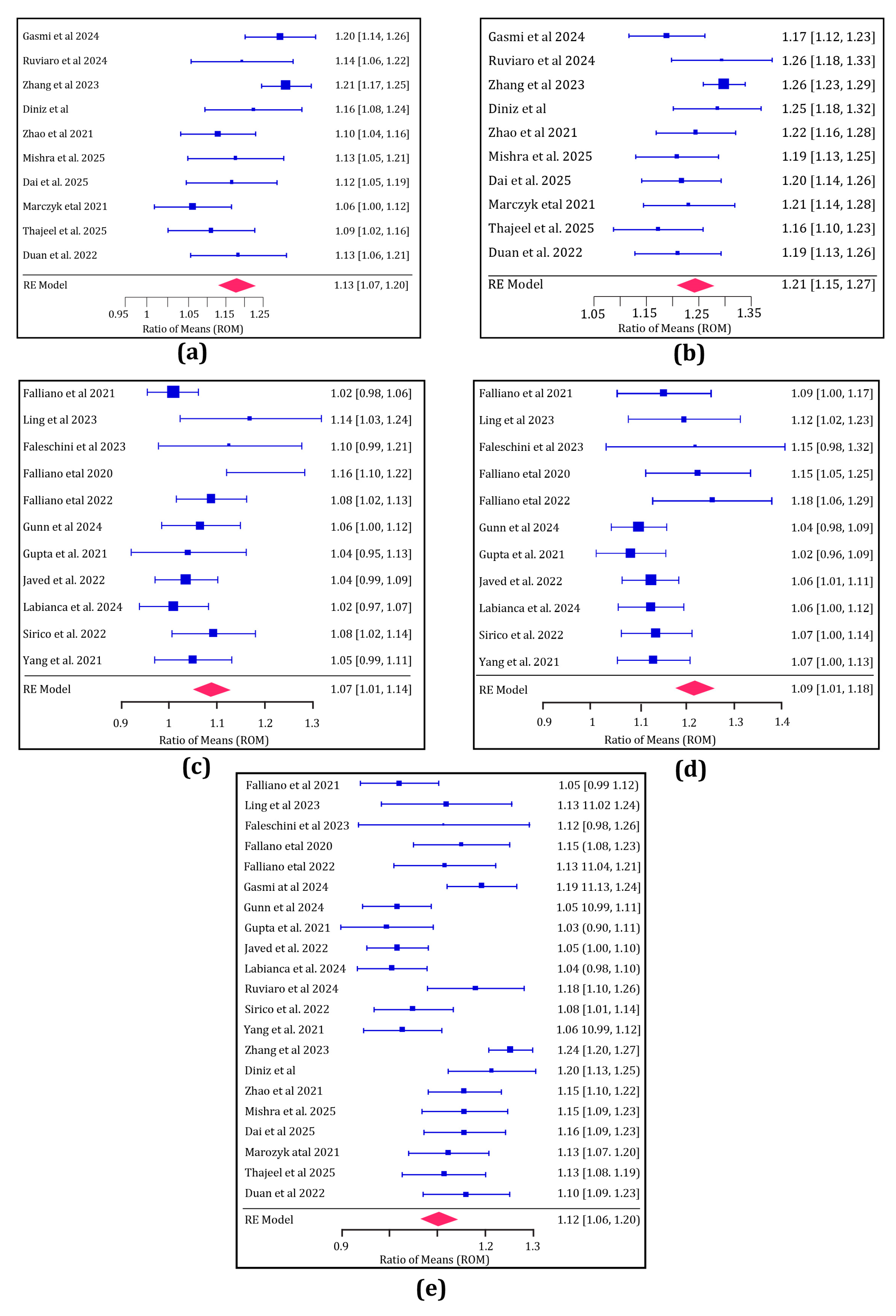
| Author | Ref | Material | ROM | 95% CI Low | 95% CI High | |||||
|---|---|---|---|---|---|---|---|---|---|---|
| Falliano et al. | [43] | BC | 74.5 | 73.2 | 7.28 | 0.53 | 1.019 | 0.0195 | 0.98 | 1.06 |
| Ling et al. | [25] | BC | 47.7 | 42.0 | 7.84 | 6.25 | 1.135 | 0.0483 | 1.03 | 1.25 |
| Faleschini et al. | [34] | BC | 11.0 | 10.0 | 0.49 | 0.36 | 1.104 | 0.0504 | 1.00 | 1.22 |
| Falliano et al. | [14] | BC | 71.8 | 62.0 | 5.15 | 4.00 | 1.159 | 0.0261 | 1.10 | 1.22 |
| Falliano et al. | [15] | BC | 70.0 | 65.0 | 5.15 | 4.00 | 1.077 | 0.0258 | 1.02 | 1.13 |
| Gasmi et al. | [36] | MK | 74.0 | 63.0 | 4.41 | 4.00 | 1.175 | 0.0246 | 1.12 | 1.23 |
| Gunn et al. | [16] | BC | 53.0 | 50.0 | 3.42 | 3.24 | 1.060 | 0.0290 | 1.00 | 1.12 |
| Gupta et al. | [26] | BC | 50.0 | 48.0 | 6.76 | 6.25 | 1.042 | 0.0425 | 0.96 | 1.13 |
| Javed et al. | [37] | BC | 54.0 | 52.0 | 2.25 | 2.25 | 1.038 | 0.0231 | 0.99 | 1.09 |
| Labianca et al. | [38] | BC | 52.0 | 51.0 | 2.89 | 2.56 | 1.020 | 0.0262 | 0.97 | 1.07 |
| Ruviaro et al. | [39] | MK | 86.8 | 70.0 | 9.00 | 7.84 | 1.240 | 0.0306 | 1.17 | 1.32 |
| Sirico et al. | [40] | BC | 54.0 | 50.0 | 3.81 | 3.24 | 1.080 | 0.0295 | 1.02 | 1.14 |
| Yang et al. | [13] | BC | 57.7 | 55.0 | 4.21 | 3.61 | 1.050 | 0.0286 | 0.99 | 1.11 |
| Zhang et al. | [42] | MK | 92.0 | 73.0 | 1.69 | 1.44 | 1.260 | 0.0125 | 1.23 | 1.29 |
| Diniz et al. | [35] | MK | 70.0 | 56.0 | 4.41 | 4.00 | 1.250 | 0.0269 | 1.19 | 1.32 |
| Zhao et al. | [44] | MK | 67.0 | 55.0 | 3.61 | 3.24 | 1.218 | 0.0250 | 1.16 | 1.28 |
| Mishra et al. | [30] | MK | 69.0 | 58.0 | 4.41 | 4.00 | 1.190 | 0.0266 | 1.13 | 1.25 |
| Dai et al. | [31] | MK | 73.0 | 61.0 | 4.41 | 4.00 | 1.197 | 0.0252 | 1.14 | 1.26 |
| Marcyzyk et al. | [45] | MK | 64.0 | 53.0 | 4.41 | 4.00 | 1.208 | 0.0289 | 1.14 | 1.28 |
| Thajeel et al. | [32] | MK | 61.6 | 53.0 | 4.41 | 4.00 | 1.162 | 0.0294 | 1.10 | 1.23 |
| Duan et al. | [10] | MK | 66.7 | 56.0 | 4.41 | 4.00 | 1.191 | 0.0275 | 1.13 | 1.26 |
| Author | Ref | Material | ROM | 95% CI Low | 95% CI High | |||||
|---|---|---|---|---|---|---|---|---|---|---|
| Falliano et al. | [43] | BC | 8.69 | 8.00 | 0.20 | 0.16 | 1.09 | 0.042 | 1.00 | 1.17 |
| Ling et al. | [25] | BC | 6.74 | 6.00 | 0.16 | 0.12 | 1.12 | 0.048 | 1.02 | 1.23 |
| Faleschini et al. | [34] | BC | 1.26 | 1.10 | 0.01 | 0.01 | 1.15 | 0.076 | 0.99 | 1.33 |
| Falliano et al. | [14] | BC | 10.35 | 9.00 | 0.29 | 0.25 | 1.15 | 0.044 | 1.05 | 1.25 |
| Falliano et al. | [15] | BC | 9.42 | 8.00 | 0.29 | 0.25 | 1.18 | 0.049 | 1.07 | 1.30 |
| Gasmi et al. | [36] | MK | 12.00 | 10.00 | 0.12 | 0.09 | 1.20 | 0.024 | 1.14 | 1.26 |
| Gunn et al. | [16] | BC | 8.30 | 8.00 | 0.07 | 0.06 | 1.04 | 0.026 | 0.99 | 1.09 |
| Gupta et al. | [26] | BC | 8.90 | 8.70 | 0.13 | 0.12 | 1.02 | 0.033 | 0.96 | 1.09 |
| Javed et al. | [37] | BC | 7.21 | 6.80 | 0.05 | 0.05 | 1.06 | 0.026 | 1.01 | 1.12 |
| Labianca et al. | [38] | BC | 7.00 | 6.60 | 0.07 | 0.06 | 1.06 | 0.030 | 1.00 | 1.12 |
| Ruviaro et al. | [39] | MK | 22.56 | 18.75 | 1.67 | 1.44 | 1.14 | 0.037 | 1.06 | 1.22 |
| Sirico et al. | [40] | BC | 6.96 | 6.50 | 0.08 | 0.06 | 1.07 | 0.032 | 1.01 | 1.14 |
| Yang et al. | [13] | BC | 7.46 | 7.00 | 0.09 | 0.08 | 1.07 | 0.033 | 1.00 | 1.14 |
| Zhang et al. | [42] | MK | 9.80 | 8.10 | 0.04 | 0.03 | 1.21 | 0.017 | 1.17 | 1.25 |
| Diniz et al. | [35] | MK | 8.10 | 7.00 | 0.12 | 0.09 | 1.16 | 0.035 | 1.08 | 1.24 |
| Zhao et al. | [44] | MK | 8.80 | 8.00 | 0.09 | 0.08 | 1.10 | 0.028 | 1.04 | 1.16 |
| Mishra et al. | [30] | MK | 7.90 | 7.00 | 0.12 | 0.09 | 1.13 | 0.035 | 1.05 | 1.21 |
| Dai et al. | [31] | MK | 8.30 | 7.40 | 0.12 | 0.09 | 1.12 | 0.033 | 1.05 | 1.20 |
| Marcyzyk et al. | [45] | MK | 9.00 | 8.50 | 0.12 | 0.09 | 1.06 | 0.030 | 1.00 | 1.12 |
| Thajeel et al. | [32] | MK | 8.34 | 7.66 | 0.12 | 0.09 | 1.09 | 0.033 | 1.02 | 1.16 |
| Duan et al. | [10] | MK | 7.93 | 7.00 | 0.12 | 0.09 | 1.13 | 0.035 | 1.06 | 1.21 |
3.3. Meta-Analysis Regression for Mechanical Properties
3.4. Printability and Dimensional Stability
3.5. Environmental Sustainability
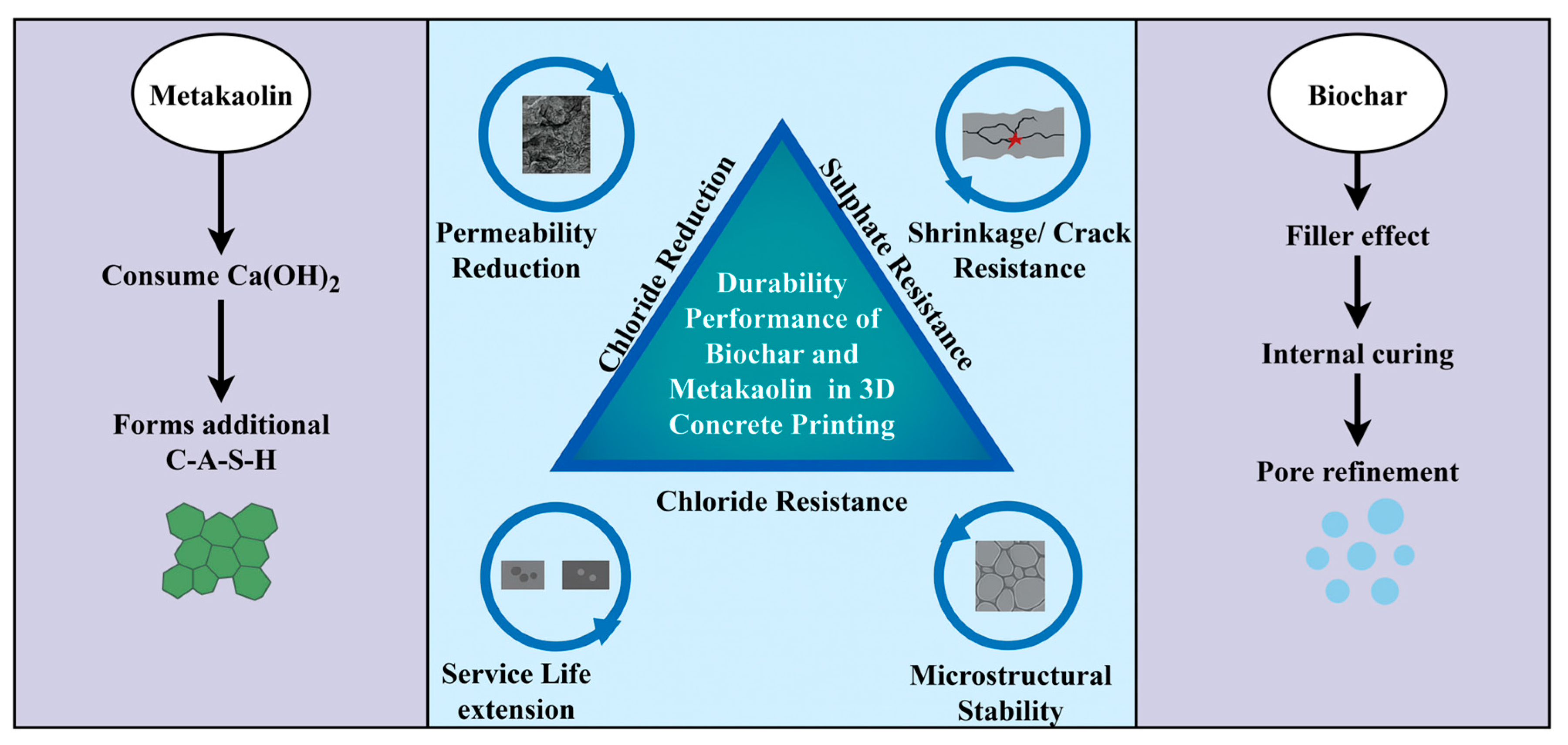
3.6. Durability Effects of Metakaolin and Biochar on 3DCP
3.7. Viability Analysis
4. Statistical Validation and Robustness of Meta-Analytical Results
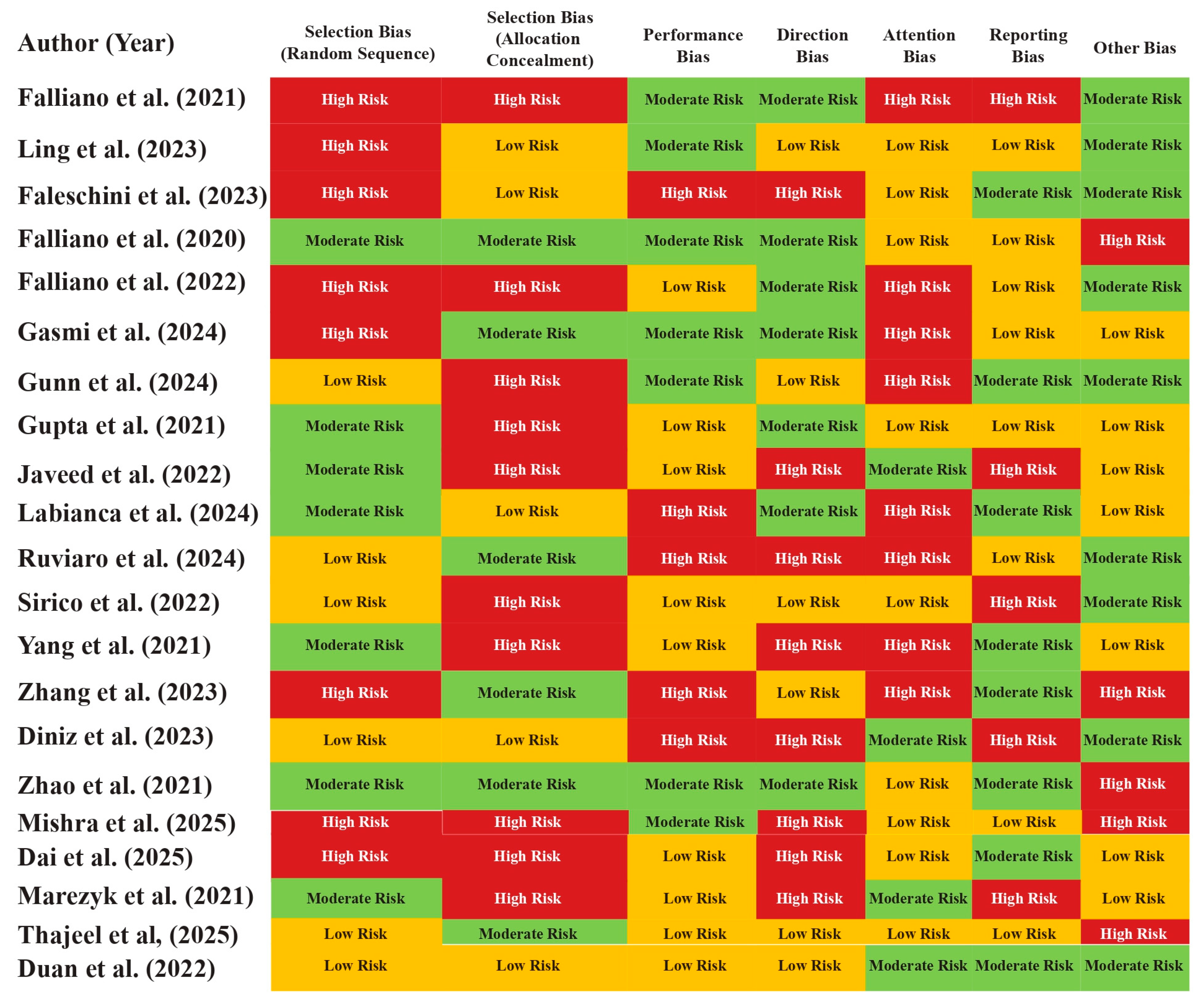
4.1. Risk of Bias Assessment
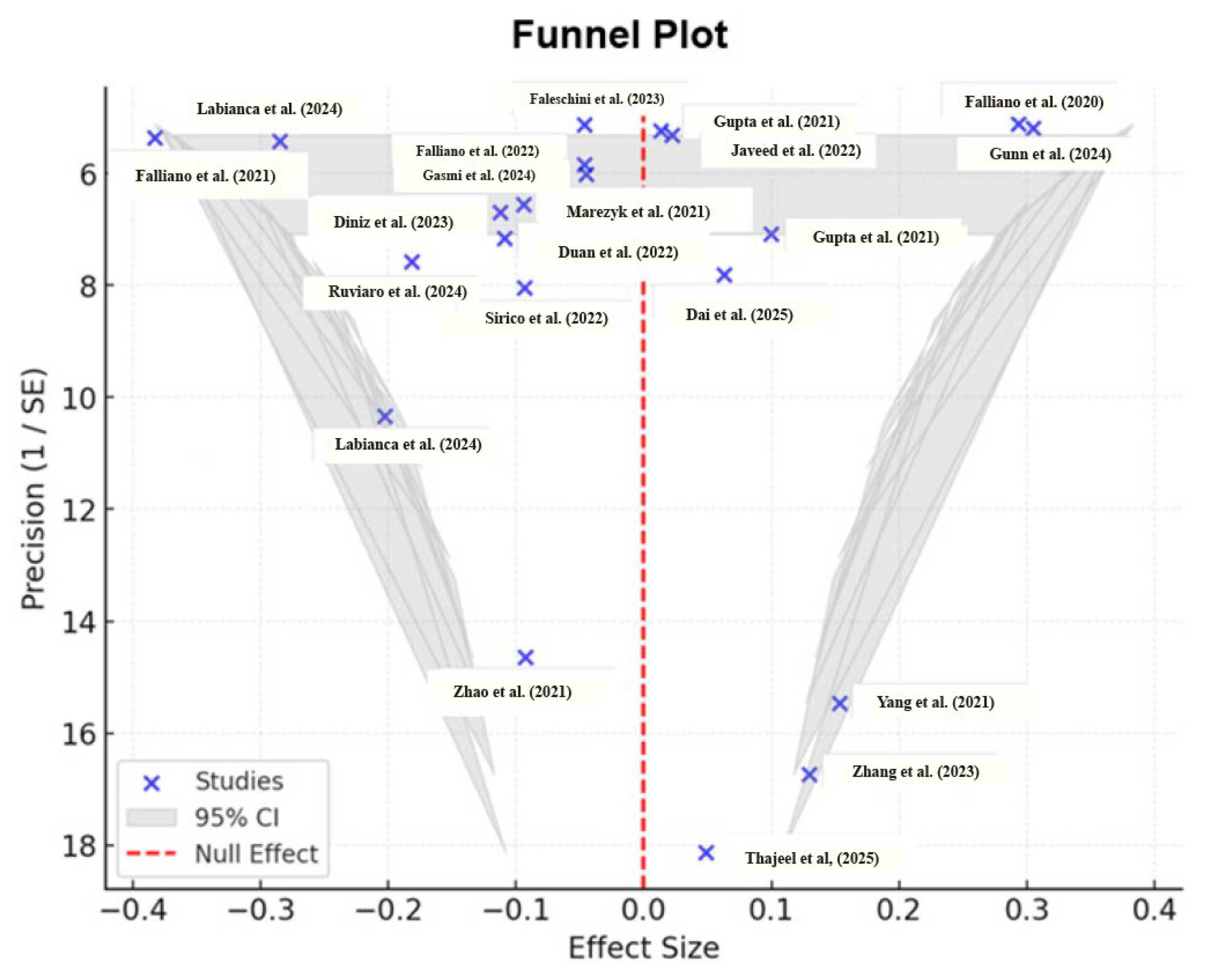
4.2. Publication Bias and Heterogeneity Analysis
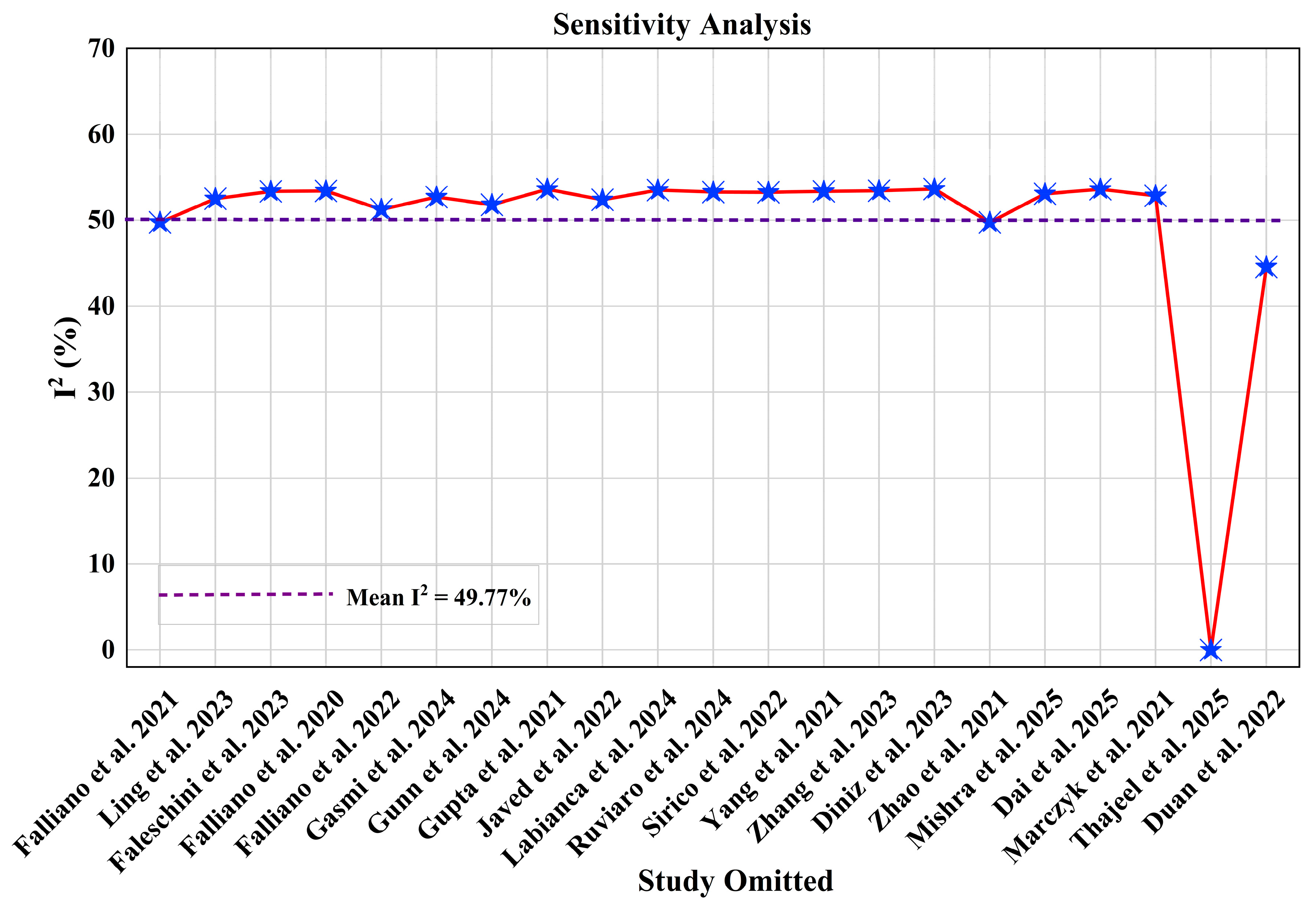
4.3. Sensitivity Analysis
5. Discussion
6. Practical Implication
7. Conclusions
- The overall meta-analysis revealed statistically significant improvements in mechanical performance, with a pooled ratio of means (ROM) of 1.12 (95% CI: 1.10–1.15), indicating consistent gains in CS and FS and supported by low-to-moderate heterogeneity (I2 = 48.86%).
- Biochar incorporation significantly enhanced mechanical performance, with pooled ROM values of 1.07 (95% CI: 1.01–1.14) for CS and 1.09 (95% CI: 1.01–1.18) for FS—representing 7% and 9% improvements over unmodified mixes, respectively.
- Metakaolin exhibited a stronger influence, yielding a 21% increase in CS (ROM = 1.21, 95% CI: 1.15–1.27) and a 13.4% improvement in FS (ROM = 1.13, 95% CI: 1.07–1.20), confirming its effectiveness as a high-performance SCM for 3DCP.
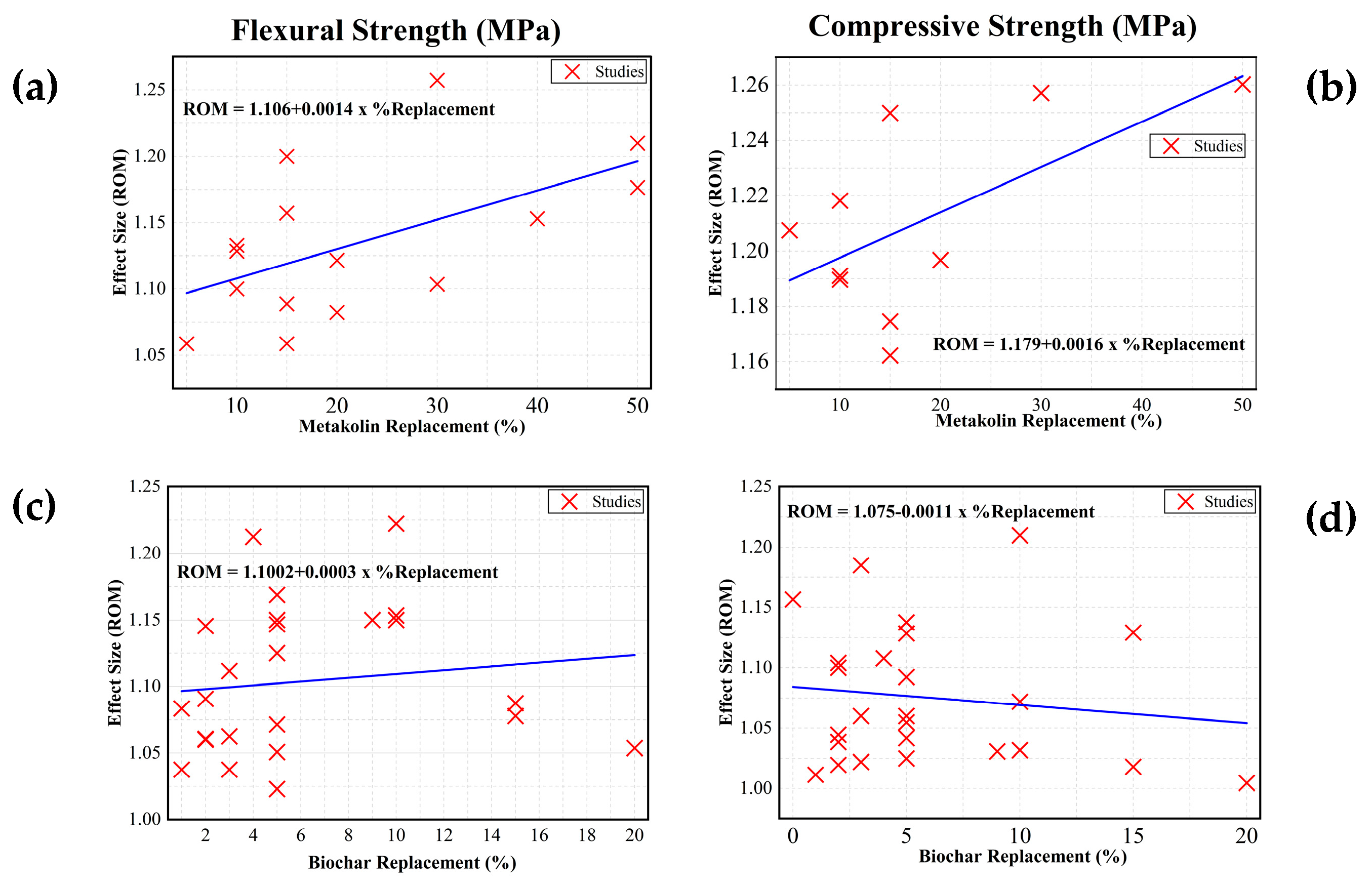
- Optimal MK dosages were identified as 15–20% for CS and 10–15% for FS, reflecting enhanced pozzolanic reactivity, pore-structure refinement, and interfacial bonding.
- Optimal BC dosages were found to be 3–5% for CS and 2–5% for FS. These levels support pore refinement and carbon-sequestration benefits, while higher dosages tend to reduce workability and increase porosity, leading to inconsistent or adverse performance outcomes.
- Environmental benefits were evident for both additives: BC-enabled mixes achieved CO2-emission reductions of up to 43%, while MK reduced clinker consumption and supported low-carbon construction through more efficient binder chemistry.
- Statistical validation procedures—including the symmetrical funnel plot and non-significant Egger test—confirmed the absence of notable publication bias, reinforcing the robustness and reliability of the meta-analytical findings.
- Both MK and BC are confirmed as eco-efficient modifiers that enhance structural, durability, and environmental performance in 3DCP, offering complementary routes toward sustainable, low-carbon digital construction.
8. Limitations and Future Recommendations
- Establish standardised testing and printing protocols (e.g., nozzle geometry, layer height, deposition rate, curing conditions) to improve reproducibility and enable meaningful comparison across studies.
- Conduct long-term durability assessments under realistic exposure conditions (freeze–thaw, chloride ingress, carbonation, sulphate attack) to evaluate service life performance.
- Design controlled factorial studies to investigate synergistic effects of combined MK and BC incorporation on mechanical, rheological, and durability properties.
- Undertake cradle-to-grave LCAs incorporating transport, printing-energy demand, operational behaviour, and end-of-life processes to provide comprehensive sustainability benchmarks.
- Broaden comparative analyses to include other eco-efficient additives and alternative binders (e.g., LC3, geopolymers, fly ash, recycled powders) to contextualise MK and BC performance.
- Advance rheological optimisation studies to establish robust correlations between fresh-state properties (yield stress, open time, buildability) and hardened-state performance in 3DCP.
- Investigate scalability challenges, including pumpability, extrusion stability, and structural build-up, to support industrial-scale implementation.
- Assess economic feasibility and cost–benefit trade-offs, particularly balancing emissions reductions with potential increases in processing or material costs.
- Develop hybrid composites incorporating multiple eco-efficient modifiers to enhance strength, buildability, and sustainability simultaneously.
- Expand multi-performance optimisation frameworks integrating mechanical, rheological, durability, and environmental criteria to guide holistic mix design for 3DCP.
Supplementary Materials
Author Contributions
Funding
Institutional Review Board statement
Informed Consent Statement
Data Availability Statement
Conflicts of Interest
Abbreviations
| 3DCP | 3D concrete printing |
| CO2 | Carbon Dioxide |
| CS | Compressive Strength |
| BC | Biochar |
| FA | Fly Ash |
| 3DP | 3D Printing |
| ROM | Ratio of Means |
| ACC | Accelerated Carbonation Curing |
| LCA | Life Cycle Assessment |
| RHB | Rice Husk Biochar |
| SC | Standard Curing |
| GP | Geopolymer |
| ↑ | Improved/Increased |
| SE | Standard Error |
| OPC | Ordinary Portland Cement |
| SCMs | Supplementary Cementitious Materials |
| FS | Flexural Strength |
| MK | Metakaolin |
| PC | Portland Cement |
| LC3 | Limestone Calcined Clay Cement |
| CI | Confidence Intervals |
| PVA | Polyvinyl Alcohol |
| SF | Silica Fume |
| CC | Carbonation Curing |
| PLC | Portland Limestone Cement |
| S/C | Sand/Cement Ratio |
| ↓ | Decreased |
References
- Hossain, M.A.; Zhumabekova, A.; Paul, S.C.; Kim, J.R. A review of 3D printing in construction and its impact on the labor market. Sustainability 2020, 12, 8492. [Google Scholar] [CrossRef]
- Xiao, J.; Ji, G.; Zhang, Y.; Ma, G.; Mechtcherine, V.; Pan, J.; Wang, L.; Ding, T.; Duan, Z.; Du, S. Large-scale 3D printing concrete technology: Current status and future opportunities. Cem. Concr. Compos. 2021, 122, 104115. [Google Scholar] [CrossRef]
- De Schutter, G.; Lesage, K.; Mechtcherine, V.; Nerella, V.N.; Habert, G.; Agusti-Juan, I. Vision of 3D printing with concrete—Technical, economic and environmental potentials. Cem. Concr. Res. 2018, 112, 25–36. [Google Scholar] [CrossRef]
- Miller, S.A.; Horvath, A.; Monteiro, P.J.M. Readily implementable techniques can cut annual CO2 emissions from the production of concrete by over 20%. Environ. Res. Lett. 2016, 11, 074029. [Google Scholar] [CrossRef]
- Tabassum, T.; Mir, A.A. A review of 3d printing technology-the future of sustainable construction. Mater. Today Proc. 2023, 93, 408–414. [Google Scholar] [CrossRef]
- Murtaza, G.; Baldinelli, G. Revolutionizing Architecture: 3D Printing in Large Construction Industry and Strategic Innovations for Enhanced Performance. Appl. Res. 2025, 4, e70033. [Google Scholar] [CrossRef]
- Andrew, R.M. Global CO2 emissions from cement production. Earth Syst. Sci. Data 2018, 10, 195–217. [Google Scholar] [CrossRef]
- Sbahieh, S.; McKay, G.; Nurdiawati, A.; Al-Ghamdi, S.G. The sustainability of partial and total replacement of Ordinary Portland Cement: A deep dive into different concrete mixtures through life cycle assessment. J. Build. Eng. 2025, 108, 112830. [Google Scholar] [CrossRef]
- Scrivener, K.L.; John, V.M.; Gartner, E.M. Eco-efficient cements: Potential economically viable solutions for a low-CO2 cement-based materials industry. Cem. Concr. Res. 2018, 114, 2–26. [Google Scholar] [CrossRef]
- Duan, Z.; Li, L.; Yao, Q.; Zou, S.; Singh, A.; Yang, H. Effect of metakaolin on the fresh and hardened properties of 3D printed cementitious composite. Constr. Build. Mater. 2022, 350, 128808. [Google Scholar] [CrossRef]
- Khan, N.M.; Ma, L.; Inqiad, W.B.; Khan, M.S.; Iqbal, I.; Emad, M.Z.; Alarifi, S.S. Interpretable machine learning approaches to assess the compressive strength of metakaolin blended sustainable cement mortar. Sci. Rep. 2025, 15, 19414. [Google Scholar] [CrossRef]
- Sadrolodabaee, P.; Adu-Amankwah, S.; Nowakowski, D.J.; Mehravar, M.; Rahman, M. Long-Term Properties of Ternary Cementitious Grout Systems Incorporating Wood-Based Biochar and Fly Ash. RILEM Bookseries 2025, 61, 404–413. [Google Scholar] [CrossRef]
- Yang, X.; Wang, X.Y. Strength and durability improvements of biochar-blended mortar or paste using accelerated carbonation curing. J. CO2 Util. 2021, 54, 101766. [Google Scholar] [CrossRef]
- Falliano, D.; De Domenico, D.; Quattrocchi, S.; Cosenza, P.; Ricciardi, G.; Restuccia, L.; Ferro, G.A. Mechanical properties and carbon footprint of 3D-printable cement mortars with biochar additions. MATEC Web Conf. 2020, 323, 01017. [Google Scholar] [CrossRef]
- Falliano, D.; Restuccia, L.; Ferro, G.A. Biochar addition for 3DCP: A preliminary study. Procedia Struct. Integr. 2022, 41, 699–703. [Google Scholar] [CrossRef]
- Gunn, P.F.E.; Onn, C.C.; Mo, K.H.; Lee, H.V. Enhancing carbon sequestration in cement mortar using high volume local rice husk biochar coupled with carbonation curing. Case Stud. Constr. Mater. 2024, 21, e03591. [Google Scholar] [CrossRef]
- Hassan, A.; Alomayri, T.; Noaman, M.F.; Zhang, C. 3D Printed Concrete for Sustainable Construction: A Review of Mechanical Properties and Environmental Impact; Springer: Berlin/Heidelberg, Germany, 2025; Volume 32. [Google Scholar] [CrossRef]
- Barve, P.; Bahrami, A.; Shah, S. Geopolymer 3D printing: A comprehensive review on rheological and structural performance assessment, printing process parameters, and microstructure. Front. Mater. 2023, 10, 1241869. [Google Scholar] [CrossRef]
- Tarhan, Y.; Tarhan, İ.H.; Şahin, R. Comprehensive Review of Binder Matrices in 3D Printing Construction: Rheological Perspectives. Buildings 2025, 15, 75. [Google Scholar] [CrossRef]
- Senadheera, S.S.; Gupta, S.; Kua, H.W.; Hou, D.; Kim, S.; Tsang, D.C.; Ok, Y.S. Application of biochar in concrete—A review. Cem. Concr. Compos. 2023, 143, 105204. [Google Scholar] [CrossRef]
- Akinyemi, B.A.; Adesina, A. Recent advancements in the use of biochar for cementitious applications: A review. J. Build. Eng. 2020, 32, 101705. [Google Scholar] [CrossRef]
- Field, A.P.; Gillett, R. How to do a meta-analysis. Br. J. Math. Stat. Psychol. 2010, 63, 665–694. [Google Scholar] [CrossRef]
- Martín-Martín, A.; Orduna-Malea, E.; Thelwall, M.; López-Cózar, E.D. Google Scholar, Web of Science, and Scopus: A systematic comparison of citations in 252 subject categories. J. Informetr. 2018, 12, 1160–1177. [Google Scholar] [CrossRef]
- Page, M.J.; McKenzie, J.E.; Bossuyt, P.M.; Boutron, I.; Hoffmann, T.C.; Mulrow, C.D.; Shamseer, L.; Tetzlaff, J.M.; Akl, E.A.; Brennan, S.E.; et al. The PRISMA 2020 statement: An updated guideline for reporting systematic reviews. BMJ 2021, 372, n71. [Google Scholar] [CrossRef] [PubMed]
- Ling, Y.; Wu, X.; Tan, K.; Zou, Z. Effect of Biochar Dosage and Fineness on the Mechanical Properties and Durability of Concrete. Materials 2023, 16, 2809. [Google Scholar] [CrossRef] [PubMed]
- Gupta, S.; Kashani, A.; Mahmood, A.H.; Han, T. Carbon sequestration in cementitious composites using biochar and fly ash—Effect on mechanical and durability properties. Constr. Build. Mater. 2021, 291, 123363. [Google Scholar] [CrossRef]
- Zhang, J.; Zhang, C.; Zhang, Y.; Li, M.; Zhu, X.; Xia, Y.; Wang, L.; Tsang, D.C. Designing printable cement composites with porous biochar using an extended water film thickness theory. J. Build. Eng. 2025, 113, 114181. [Google Scholar] [CrossRef]
- Qing, L.; Zhang, H.; Zhang, Z. Effect of biochar on compressive strength and fracture performance of concrete. J. Build. Eng. 2023, 78, 107587. [Google Scholar] [CrossRef]
- Sirico, A.; Bernardi, P.; Sciancalepore, C.; Vecchi, F.; Malcevschi, A.; Belletti, B.; Milanese, D. Biochar from wood waste as additive for structural concrete. Constr. Build. Mater. 2021, 303, 124500. [Google Scholar] [CrossRef]
- Mishra, S.K.; Upadhyay, B.; Das, B.B. Exploring the role of metakaolin in binary and ternary blended 3D printable mortars: Deep insights into printability. Int. J. Constr. Manag. 2025, 1–19. [Google Scholar] [CrossRef]
- Dai, X.; Tao, Y.; Zhang, Y.; Ding, L.; Van Tittelboom, K.; De Schutter, G. Development of 3D printable alkali-activated slag-metakaolin concrete. Constr. Build. Mater. 2024, 444, 137775. [Google Scholar] [CrossRef]
- Thajeel, M.M.; Kopecskó, K.; Balázs, G.L. Enhancing printability of 3D printed concrete by using metakaolin and silica fume. Struct. Concr. 2025, early view, 1–17. [Google Scholar] [CrossRef]
- Pardey, J.F.C. Rheological and Mechanical Properties of Cementitious Materials with the Addition of Biochar: A Strategy to Obtain 3D Printability. Master’s Thesis, Politecnico di Torino, Turin, Italy, 2021. [Google Scholar]
- Faleschini, F.; Trento, D.; Masoomi, M.; Pellegrino, C.; Zanini, M.A. Sustainable mixes for 3D printing of earth-based constructions. Constr. Build. Mater. 2023, 398, 132496. [Google Scholar] [CrossRef]
- Diniz, H.A.A.; Martinelli, A.E.; Cabral, K.C.; da Silva Ferreira, R.L.; da Silva, I.F.D. Synergistic effects of the use of metakaolin, sand and water on the properties of cementitious composites for 3D printing. Constr. Build. Mater. 2023, 366, 130277. [Google Scholar] [CrossRef]
- Gasmi, A.; Pélegris, C.; Davidovits, R.; Guessasma, M.; Tortajada, H.; Jean, F. Advanced Refinement of Geopolymer Composites for Enhanced 3D Printing via In-Depth Rheological Insights. Ceramics 2024, 7, 1316–1339. [Google Scholar] [CrossRef]
- Javed, M.H.; Sikandar, M.A.; Ahmad, W.; Bashir, M.T.; Alrowais, R.; Wadud, M.B. Effect of various biochars on physical, mechanical, and microstructural characteristics of cement pastes and mortars. J. Build. Eng. 2022, 57, 104850. [Google Scholar] [CrossRef]
- Labianca, C.; Zhu, X.; Ferrara, C.; Zhang, Y.; De Feo, G.; Hsu, S.C.; Tsang, D.C. A holistic framework of biochar-augmented cementitious products and general applications: Technical, environmental, and economic evaluation. Environ. Res. 2024, 245, 118026. [Google Scholar] [CrossRef]
- Ruviaro, A.S.; Silvestro, L.; Santana, H.A.; Araújo, A.; Pelisser, F. Ternary sustainable geopolymer matrices containing metakaolin, water treatment sludge, and porcelain tile polishing residue. Constr. Build. Mater. 2024, 440, 137412. [Google Scholar] [CrossRef]
- Sirico, A.; Belletti, B.; Bernardi, P.; Malcevschi, A.; Pagliari, F.; Fornoni, P.; Moretti, E. Effects of biochar addition on long-term behavior of concrete. Theor. Appl. Fract. Mech. 2022, 122, 103626. [Google Scholar] [CrossRef]
- Vergara, L.A.; Perez, J.F.; Colorado, H.A. 3D printing of ordinary Portland cement with waste wood derived biochar obtained from gasification. Case Stud. Constr. Mater. 2023, 18, e02117. [Google Scholar] [CrossRef]
- Zhang, X.; Zhang, X.; Li, X.; Ma, M.; Zhang, Z.; Ji, X. Slurry rheological behaviors and effects on the pore evolution of fly ash/metakaolin-based geopolymer foams in chemical foaming system with high foam content. Constr. Build. Mater. 2023, 379, 131259. [Google Scholar] [CrossRef]
- Falliano, D.; De Domenico, D.; Cosenza, P.; Ricciardi, G.; Restuccia, L.; Ferro, G.A. Green High-Performance Mortars for 3D Printing Applications. Lect. Notes Civ. Eng. 2021, 351, 441–450. [Google Scholar] [CrossRef]
- Zhao, Z.; Chen, M.; Zhong, X.; Huang, Y.; Yang, L.; Zhao, P.; Wang, S.; Lu, L.; Cheng, X. Effects of bentonite, diatomite and metakaolin on the rheological behavior of 3D printed magnesium potassium phosphate cement composites. Addit. Manuf. 2021, 46, 102184. [Google Scholar] [CrossRef]
- Marczyk, J.; Ziejewska, C.; Gądek, S.; Korniejenko, K.; Łach, M.; Góra, M.; Kurek, I.; Doğan-Sağlamtimur, N.; Hebda, M.; Szechyńska-Hebda, M. Hybrid materials based on fly ash, metakaolin, and cement for 3d printing. Materials 2021, 14, 6874. [Google Scholar] [CrossRef] [PubMed]
- Pan, Y.; Zhang, Y.; Zhang, D.; Song, Y. 3D printing in construction: State of the art and applications. Int. J. Adv. Manuf. Technol. 2021, 115, 1329–1348. [Google Scholar] [CrossRef]
- Wang, L.; Nerella, V.N.; Li, D.; Zhang, Y.; Ma, B.; Ivaniuk, E.; Zhang, J.; Zhu, X.; Yan, J.; Mechtcherine, V.; et al. Biochar-augmented climate-positive 3D printable concrete. Commun. Mater. 2024, 5, 257. [Google Scholar] [CrossRef]
- Inqiad, W.B.; Javed, M.F.; Alsekait, D.M.; Khan, N.M.; Khan, M.; Aslam, F.; Elminaam, D.S.A. Soft-computing models for predicting plastic viscosity and interface yield stress of fresh concrete. Sci. Rep. 2025, 15, 10740. [Google Scholar] [CrossRef]
- Lin, A.; Tan, Y.K.; Wang, C.H.; Kua, H.W.; Taylor, H. Utilization of waste materials in a novel mortar–polymer laminar composite to be applied in construction 3D-printing. Compos. Struct. 2020, 253, 112764. [Google Scholar] [CrossRef]
- Ibrahim, K.A.; van Zijl, G.P.A.G.; Babafemi, A.J. Influence of limestone calcined clay cement on properties of 3D printed concrete for sustainable construction. J. Build. Eng. 2023, 69, 106186. [Google Scholar] [CrossRef]
- Jaji, M.B.; van Zijl, G.P.A.G.; Babafemi, A.J. Durability and pore structure of metakaolin-based 3D printed geopolymer concrete. Constr. Build. Mater. 2024, 422, 135847. [Google Scholar] [CrossRef]
- Wang, T.; Tang, Y.; Qin, S.; Li, G.; Wu, H.; Leung, C.K.Y. Sustainable and mechanical properties of Engineered Cementitious Composites with biochar: Integrating micro- and macro-mechanical insight. Cem. Concr. Compos. 2025, 155, 105813. [Google Scholar] [CrossRef]
- Ghazouani, N.; Selmi, A.; El Ouni, M.H.; Raza, A. Advancing carbon sequestration in engineered cementitious composites: Incorporating slag and pyrolysis-enhanced biochar for net-zero emissions. J. Build. Eng. 2025, 108, 112876. [Google Scholar] [CrossRef]
- Wu, M.; Wei, K.; Jiang, J.; Xu, B.B.; Ge, S. Advancing green sustainability: A comprehensive review of biomass briquette integration for coal-based energy frameworks. Int. J. Coal Sci. Technol. 2025, 12, 44. [Google Scholar] [CrossRef]
- El Inaty, F.; Baz, B.; Aouad, G. Long-term durability assessment of 3D printed concrete. J. Adhes. Sci. Technol. 2023, 37, 1921–1936. [Google Scholar] [CrossRef]
- Wu, F.; Zhang, Q.; Dong, S.; Cai, Y.; Yang, S.; Xu, F.; Luo, P.; Jiang, J. Biochar modification enhances mechanical and durability properties of cement-based materials. Sci. Rep. 2025, 15, 22174. [Google Scholar] [CrossRef] [PubMed]
- Ali, A.; Zhang, Z.; Azarijafari, H.; Shi, X. Biochar-amended high-strength engineered cementitious composites. Cem. Concr. Compos. 2025, 164, 106219. [Google Scholar] [CrossRef]
- Zhang, Y.; Zhang, Y.; Yang, L.; Liu, G.; Chen, Y. Hardened properties and durability of large-scale 3D printed cement-based materials. Mater. Struct. 2021, 54, 45. [Google Scholar] [CrossRef]
- Bekaert, M.; Van Tittelboom, K. The Effect of Curing Conditions on the Service Life of 3D Printed Concrete Formwork. Materials 2023, 16, 6972. [Google Scholar] [CrossRef] [PubMed]
- Bradshaw, J.; Si, W.; Khan, M. Emerging Insights into the Durability of 3D-Printed Concrete: Recent Advances in Mix Design Parameters and Testing. Designs 2025, 9, 85. [Google Scholar] [CrossRef]
- Salari, M.; Akhoundi, B. Environmental Assessment of 3D Printed Concrete: Potentials and Challenges, Perspectives, and Opportunities (2013–2023). J. Rehabil. Civ. Eng. 2026, 14, 41. [Google Scholar]
- Federowicz, K.; Cendrowski, K.; Sikora, P. Low-carbon cementitious composite incorporated with biochar and recycled fines suitable for 3D printing applications: Hydration, shrinkage and early-age performance. Frat. Integrita Strutt. 2025, 19, 91–107. [Google Scholar] [CrossRef]
- Kapoor, R.T.; Ahmad, P.; Rafatullah, M. Insights into Biochar Applications: A Sustainable Strategy toward Carbon Neutrality and Circular Economy. In Catalytic Applications of Biochar for Environmental Remediation: Sustainable Strategies Towards a Circular Economy; ACS Publications: Washington, DC, USA, 2024; Volume 2. [Google Scholar] [CrossRef]
- Muthukrishnan, S.; Kua, H.W.; Na Yu, L.; Chung, J.K.H. Fresh Properties of Cementitious Materials Containing Rice Husk Ash for Construction 3D Printing. J. Mater. Civ. Eng. 2020, 32, 04020195. [Google Scholar] [CrossRef]
- Zaid, O.; El Oun, M.H. Advancements in 3D printing of cementitious materials: A review of mineral additives, properties, and systematic developments. Constr. Build. Mater. 2024, 427, 136254. [Google Scholar] [CrossRef]
- Restuccia, L.; Ferro, G.A.; Suarez-Riera, D.; Sirico, A.; Bernardi, P.; Belletti, B.; Malcevschi, A. Mechanical characterization of different biochar-based cement composites. Procedia Struct. Integr. 2020, 25, 226–233. [Google Scholar] [CrossRef]
- Raza, M.H.; Besklubova, S.; Zhong, R.Y. Economic analysis of offsite and onsite 3D construction printing techniques for low-rise buildings: A comparative value stream assessment. Addit. Manuf. 2024, 89, 104292. [Google Scholar] [CrossRef]
- Markin, V.; Krause, M.; Otto, J.; Schröfl, C.; Mechtcherine, V. 3D-printing with foam concrete: From material design and testing to application and sustainability. J. Build. Eng. 2021, 43, 102870. [Google Scholar] [CrossRef]
- Besklubova, S.; Tan, B.Q.; Zhong, R.Y.; Spicek, N. Logistic cost analysis for 3D printing construction projects using a multi-stage network-based approach. Autom. Constr. 2023, 151, 104863. [Google Scholar] [CrossRef]
- Munir, Q.; Kärki, T. Cost Analysis of Various Factors for Geopolymer 3D Printing of Construction Products in Factories and on Construction Sites. Recycling 2021, 6, 60. [Google Scholar] [CrossRef]
- Allouzi, R.; Al-Azhari, W.; Allouzi, R. Conventional Construction and 3D Printing: A Comparison Study on Material Cost in Jordan. J. Eng. 2020, 2020, 1–14. [Google Scholar] [CrossRef]
- Yang, H.; Chung, J.K.H.; Chen, Y.; Li, Y. The cost calculation method of construction 3D printing aligned with internet of things. EURASIP J. Wirel. Commun. Netw. 2018, 2018, 147. [Google Scholar] [CrossRef]
- Weng, Y.; Li, M.; Ruan, S.; Wong, T.N.; Tan, M.J.; Yeong, K.L.O.; Qian, S. Comparative economic, environmental and productivity assessment of a concrete bathroom unit fabricated through 3D printing and a precast approach. J. Clean. Prod. 2020, 261, 121245. [Google Scholar] [CrossRef]
- Aghimien, D.; Aigbavboa, C.; Aghimien, L.; Thwala, W.D.; Ndlovu, L. Making a case for 3D printing for housing delivery in South Africa. Int. J. Hous. Mark. Anal. 2020, 13, 565–581. [Google Scholar] [CrossRef]
- Koroteev, D.D.; Huang, J.; Koreneva, A.I. Cost analysis of the combined application of 3D-printing and BIM technologies in the construction industry. AIP Conf. Proc. 2022, 2559, 040012. [Google Scholar] [CrossRef]
- Han, Y.; Yang, Z.; Ding, T.; Xiao, J. Environmental and economic assessment on 3D printed buildings with recycled concrete. J. Clean. Prod. 2021, 278, 123884. [Google Scholar] [CrossRef]
- Abdalla, H.; Fattah, K.P.; Abdallah, M.; Tamimi, A.K. Environmental Footprint and Economics of a Full-Scale 3D-Printed House. Sustainability 2021, 13, 11978. [Google Scholar] [CrossRef]


| Ref | Material Type | Proportion | Rheological | Printability | Dimensional Stability | Optimal Conditions |
|---|---|---|---|---|---|---|
| [47] | BC | 2% | ↑ Build-up rate (22%) and thixotropy | ↑ pumpability, extrudability, and buildability | ↑ structural stability over time | 2% BC optimal for thixotropy and buildability |
| [15] | BC | - | - | ↑ dimensional stability with zero slump in extrusion | Zero slump after extrusion | - |
| [14] | BC | - | ↑ Rheology and internal curing | ↑ dimensional stability and cement hydration | ↑ fresh state stability | - |
| [49] | BC + Polymer | - | ↑ cohesion and densification | ↑ ductility and post-cracking integrity | ↑ matrix densification and stability | - |
| [31] | MK | 10–20% | ↑ particle packing, yield stress, and viscosity | ↑ early-age buildability and shape retention | ↓ deformation and ↑interlayer adhesion | 10% MK optimal for balancing strength and printability |
| [10] | MK | 10% | ↑ yield stress, dynamic viscosity | Printable layers ↑ from 17 to 23 | ↑ green strength and stiffness | 10% MK optimal for increased printable layers |
| [32] | MK + SF | (10% MK + 5% SF) | ↑ cohesion and particle packing | ↑ shape retention S1 = 0.99 with 72 printable layers | ↑ shape retention and layer stacking | MK10SF5 (10% MK + 5% SF) ↑printability and strength |
| [30] | MK | Up to 20% | Slight ↑ in yield stress | ↓ plastic cracking at 10% MK | ↓ dimensional stability at high dosages | 10% replacement is ideal while 20% leads to plastic cracking |
| [45] | MK | 10% | ↑ static yield stress and structural build-up | ↑ buildability in alkali-activated slag systems | ↑ shape retention | 10% MK optimal in alkali-activated slag matrices |
| [35] | MK | Up to 30% | ↑ viscosity and consistency | stable layers, ↑ printability | ↑ layer consistency and printability | Up to 30% MK maintains printability without compromise |
| [44] | MK + Diatomite + Bentonite | - | ↑ thixotropy | ↓ deformation rate to 3.45% | ↓ deformation, ↑ buildability | - |
| Author | Material | Curing Process | Rheology and Printing Parameter | Sustainability Benefits | Key Finding |
|---|---|---|---|---|---|
| [33] | BC | — | ↑ rheology and extrusion | sequestering carbon and reducing cement | 1–5% BC ↑ strength and rheology |
| [30] | MK | — | ↑ shape retention and thixotropy | ↓ CO2 and minimising resource depletion | MK use with OPC and GGBS ↑ printability |
| [61] | BC | — | ↑ viscosity and consistency | Enables carbon sequestration, supports an 8.3% ↓ in carbon and ↓ cement usage. | ↑ mechanical performance |
| [49] | BC | — | ↑ viscosity and yield stress | Biomass reuse | Ductility ↓, mitigated with polymer reinforcement |
| [62] | BC | — | ↑ buildability and reduces fluidity | ↓ carbon footprint | 10% BC ↑ green strength, but increases shrinkage |
| [14] | BC | CC | ↑ extrusion stability | Utilises waste-derived biochar and ↓ CO2 emissions | 5–23% BC ↑ strength |
| [63] | BC | — | ↑ printability | Supports circular economy and sustainability goals | ↑ shrinkage, hydration, and |
| [31] | MK | SC | ↑ yield stress and pumpability | ↓ energy demand | 10% MK ↑ buildability, while 20% reduces strength and refining the microstructure |
| [45] | MK | SC | ↑ buildability | Promotes the circular economy and ↓ the environmental waste | MK-fly ash-cement blends improve strength and control setting times |
| [32] | MK | SC | ↑ shape retention, green strength, durability | ↓ CO2 footprint and supports resource efficiency | 10–15% replacement of cement with MK enhances strength and hydration |
| [10] | MK | SC | ↑ yield stress and buildability, ↓ shrinkage | ↓ PC usage and minimising resource depletion | 5–10% MK ↑ yield stress, printability (17→23 layers), and early strength |
| [35] | MK | — | ↑ shape retention and extrusion | Lowers the environmental impact | Up to 30% MK ↑ flow, CS, and buildability |
| [44] | MK | SC | Moderate ↑ in viscosity | ↓ carbon emission and increasing resource efficiency | 3% MK ↑ stability and ↓ deformation |
| [57] | BC | ACC | ↑ rheology and extrusion | sequestering carbon and reducing cement | 1–5% BC ↑ strength and rheology |
Disclaimer/Publisher’s Note: The statements, opinions and data contained in all publications are solely those of the individual author(s) and contributor(s) and not of MDPI and/or the editor(s). MDPI and/or the editor(s) disclaim responsibility for any injury to people or property resulting from any ideas, methods, instructions or products referred to in the content. |
© 2025 by the authors. Licensee MDPI, Basel, Switzerland. This article is an open access article distributed under the terms and conditions of the Creative Commons Attribution (CC BY) license (https://creativecommons.org/licenses/by/4.0/).
Share and Cite
Iqbal, I.; Kasim, T.; Inqiad, W.B.; Besklubova, S.; Sadrolodabaee, P.; Nowakowski, D.J.; Rahman, M. Effect of Metakaolin and Biochar Addition on the Performance of 3D Concrete Printing: A Meta-Analysis Approach. Sustainability 2025, 17, 10725. https://doi.org/10.3390/su172310725
Iqbal I, Kasim T, Inqiad WB, Besklubova S, Sadrolodabaee P, Nowakowski DJ, Rahman M. Effect of Metakaolin and Biochar Addition on the Performance of 3D Concrete Printing: A Meta-Analysis Approach. Sustainability. 2025; 17(23):10725. https://doi.org/10.3390/su172310725
Chicago/Turabian StyleIqbal, Imtiaz, Tala Kasim, Waleed Bin Inqiad, Svetlana Besklubova, Payam Sadrolodabaee, Daniel Jozef Nowakowski, and Mujib Rahman. 2025. "Effect of Metakaolin and Biochar Addition on the Performance of 3D Concrete Printing: A Meta-Analysis Approach" Sustainability 17, no. 23: 10725. https://doi.org/10.3390/su172310725
APA StyleIqbal, I., Kasim, T., Inqiad, W. B., Besklubova, S., Sadrolodabaee, P., Nowakowski, D. J., & Rahman, M. (2025). Effect of Metakaolin and Biochar Addition on the Performance of 3D Concrete Printing: A Meta-Analysis Approach. Sustainability, 17(23), 10725. https://doi.org/10.3390/su172310725