2.1. Institutional Background
With the acceleration of industrialization and the sustained development of the global economy, the complexity and severity of environmental issues are continuously increasing. The growing prominence of problems such as air pollution, soil contamination, and the loss of biodiversity not only inflicts irreversible damage on natural ecosystems but also directly threatens human health and quality of life [
13,
14,
15]. In this context, enterprises as major contributors to these issues, have become a primary focus of regulatory efforts. China has repeatedly enacted relevant environmental protection laws to regulate corporate behavior. However, in practice, law enforcement officers face difficulties in applying these laws during the specific implementation of environmental legislation [
14,
15]. Firstly, the jurisdictional approach to environmental cases differs from traditional cases, as they cannot be simply categorized into criminal, civil, and administrative cases and assigned to corresponding personnel for trial. Secondly, the trial process of environmental cases often involves multidisciplinary expertise, but traditional legal practitioners, mostly with a liberal arts background, lack the professional competence required for handling environmental cases. This deficiency makes it challenging for them to grasp the appropriate application of laws during trials, leading to misjudgments and lenient sentences in environmental cases. Therefore, the phenomena of “non-compliance with laws despite their existence” and “difficulty in holding violators accountable” in China’s environmental judicial system require further resolution, and the effectiveness of environmental judicial functions needs further development.
Given the dilemmas in environmental legal systems, the environmental court system emerged as a crucial legal force in regulating the efficiency of regional environmental law enforcement. With its specialized review process and efficient judgment efficiency, environmental courts have significantly enhanced the enforcement capacity of environmental justice, playing a pivotal role in advancing the establishment of an ecological legal system. Specifically, the enforcement advantages of environmental courts are as follows, primarily manifested in higher professionalism, efficient trials, clear jurisdiction, and stringent penalties.
(1) The establishment of environmental courts enhances the professionalism of the trial process for environmental litigation cases. Traditionally, Chinese legal practitioners, mostly with a liberal arts background, lack sufficient knowledge in environmental science, leading to potential misjudgments during trials due to professional limitations. The establishment of environmental courts has prompted courts to prioritize environmental backgrounds when recruiting practitioners and strengthen environmental professional knowledge training for existing practitioners, thereby enhancing the professionalism of court trials for environmental litigation cases. For instance, the Liaoning Provincial High People’s Court specifically selected talents capable of handling environmental cases when establishing its environmental court and established a corresponding environmental talent team to adequately prepare for enhancing environmental law enforcement capabilities.
(2) The establishment of environmental courts facilitates efficient trials of environmental litigation cases. Unlike the separate trial approach for administrative, criminal, and civil cases, environmental courts have institutionally clarified the consolidated trial of environmental litigation cases, pioneering the “three-in-one” and “two-in-one” centralized trial models (i.e., unifying environmental-related administrative, criminal, and civil cases for centralized adjudication by professional trial institutions), thereby significantly improving the trial efficiency of environmental litigation cases. For example, at the end of 2023, the Datong Environmental Court implemented a “two-in-one” centralized trial model for a case involving “the use of prohibited fishing nets during the fishing ban period” within its jurisdiction, with a collegiate panel composed of judges from both civil and criminal departments swiftly conducting the trial and sentencing the involved individuals. Additionally, environmental courts can promptly halt environmental violations, integrating the trial and enforcement of environmental litigation cases. For instance, at the end of 2022, the Beijing Environmental Court accepted a lawsuit filed by the Miyun District Tax Bureau against a local enterprise for discharging sewage and immediately ordered the enterprise to cease pollution and imposed a fine upon accepting the case.
(3) The establishment of environmental courts enhances the clarity of territorial jurisdiction for environmental cases. Some environmental resource cases may possess cross-regional characteristics, leading to ambiguous territorial jurisdiction and affecting law enforcement. The establishment of environmental courts aids in centralized jurisdiction and governance of cases, resolving issues of mutual shirking of responsibility and lack of recourse in pollution cases spanning administrative boundaries. For example, Hunan Province has clearly delineated environmental resource cases based on watersheds and ecological functional zones, effectively addressing cross-administrative boundary challenges in water pollution control within the province.
(4) Environmental courts can impose stricter penalties on polluting enterprises. Environmental courts have formally enhanced the stringency of penalties for polluting behaviors, imposing higher pollution costs on enterprises through the implementation of a “daily penalty” system. For severely polluting enterprises, environmental courts may even mandate a cessation of operations or relocation outside the region to strictly curb environmental pollution. For instance, Wynca, a top 500 manufacturing enterprise in China and a large listed company, was ordered by the Dongying Environmental Court to suspend operations and rectify, and fined RMB 22.74 million for directly discharging wastewater into watersheds and illegally dumping it in Shandong and Jiangsu provinces.
2.2. Literature Review of Enterprise Supply Chain Financing
In the globally uncertain business landscape, robust and resilient supply chain management has become a critical pillar of corporate core competitiveness, offering significant value in enhancing enterprises’ dynamic capabilities [
16,
17,
18,
19]. Supply chain financing, as a critical financing source for enterprises, demonstrates differential access structurally influenced by ownership nature and asset scale. Research indicates state-owned enterprises and large enterprises exhibit significant advantages in supply chain financing due to institutional privileges and asset collateral capacity, whereas private enterprises and small–medium enterprises face dual constraints of restricted financing channels and high costs [
20,
21]. This disparity originates from state-owned enterprises’ stronger risk resilience and reputational capital, enabling them to maintain stable supply chain credit relationships amid market volatility [
10,
22]. Notably, asset structure mismatch may further deteriorate financing conditions, forming a vicious cycle hindering high-quality enterprise development [
23].
Information transparency theory offers new perspectives for addressing supply chain financing. Enterprises can effectively reduce information asymmetry through optimizing annual report readability and enhancing disclosure frequency and quality, thereby improving supply chain financing conditions [
24]. External information intermediaries such as analyst coverage also strengthen stakeholder recognition and trust, creating a virtuous financing cycle [
9,
25]. Notably, emerging technologies like blockchain are proven to enhance transparency and reshape supply chain operations, albeit they may introduce new market dynamics [
18]. Corporate governance research reveals that controlling shareholders’ expropriation of minority interests undermines investor confidence and worsens overall financing environments [
26,
27].
From an upper echelon theory perspective, executive characteristics profoundly impact supply chain financing. Risk-tolerant executives tend to explore diversified financing channels, while broad decision-making horizons indirectly enhance financing capacity through improved governance [
28,
29,
30]. Executive professional reputation and social capital prove equally vital, where favorable reputation signals positive attributes, while social networks based on alumni or regional ties serve as supply chain funding channels [
11,
31]. Institutional economics research further indicates that regional cultures such as merchant associations and Confucianism subtly influence supply chain financing environments by shaping business ethics and trust mechanisms [
11,
32,
33].
Simultaneously, the external policy environment, such as low-carbon regulations, critically shapes supply chain strategies and their financial stability by balancing environmental goals with economic pressures [
17].
Overall, existing research predominantly explores antecedents of enterprise supply chain financing from institutional arrangements, information environments, corporate governance, and cultural perspectives, yet rarely examines differentiated impacts through the lens of strengthened environmental law enforcement capability.
2.3. Research Hypothesis
Enterprises failing to effectively implement environmental measures or neglecting regulatory requirements face not only substantial fines but also significant brand reputation damage. This dual risk compels enterprises to accelerate green transformation through adopting advanced environmental technologies, optimizing production processes, and reducing pollutant emissions, thereby gradually aligning with sustainable development models under legal and market pressures [
34]. In this process, environmental courts function as catalysts compelling enterprises to fundamentally reevaluate and adjust production models to meet increasingly stringent legal requirements and evolving societal expectations [
35].
Per information asymmetry theory, financiers often lack comprehensive understanding of enterprises’ actual conditions [
36]. For polluting enterprises specifically, uncertainties regarding environmental compliance and governance levels typically lead suppliers, customers, and other stakeholders to adopt conservative risk assessments. Consequently, supply chain financing costs increase while accessibility decreases. However, as polluting enterprises enhance environmental governance and information transparency, they effectively reduce information asymmetry and improve supply chain credibility [
12]. Signaling theory and stakeholder theory further suggest that proactive green governance behaviors signal positive attributes to stakeholders and respond to their expectations, thereby strengthening trust and support [
35]. Although environmental risk exposure constrains value creation capacity for polluting enterprises [
37], proactive environmental responsibility may constitute a strategic investment that reduces future risks and enhances long-term performance [
38,
39]. Furthermore, constrained by social norms, stakeholders with socially responsible investment principles may prefer providing funding to enterprises demonstrating active green governance, even accepting potential short-term financial trade-offs. Based on this analysis, we propose:
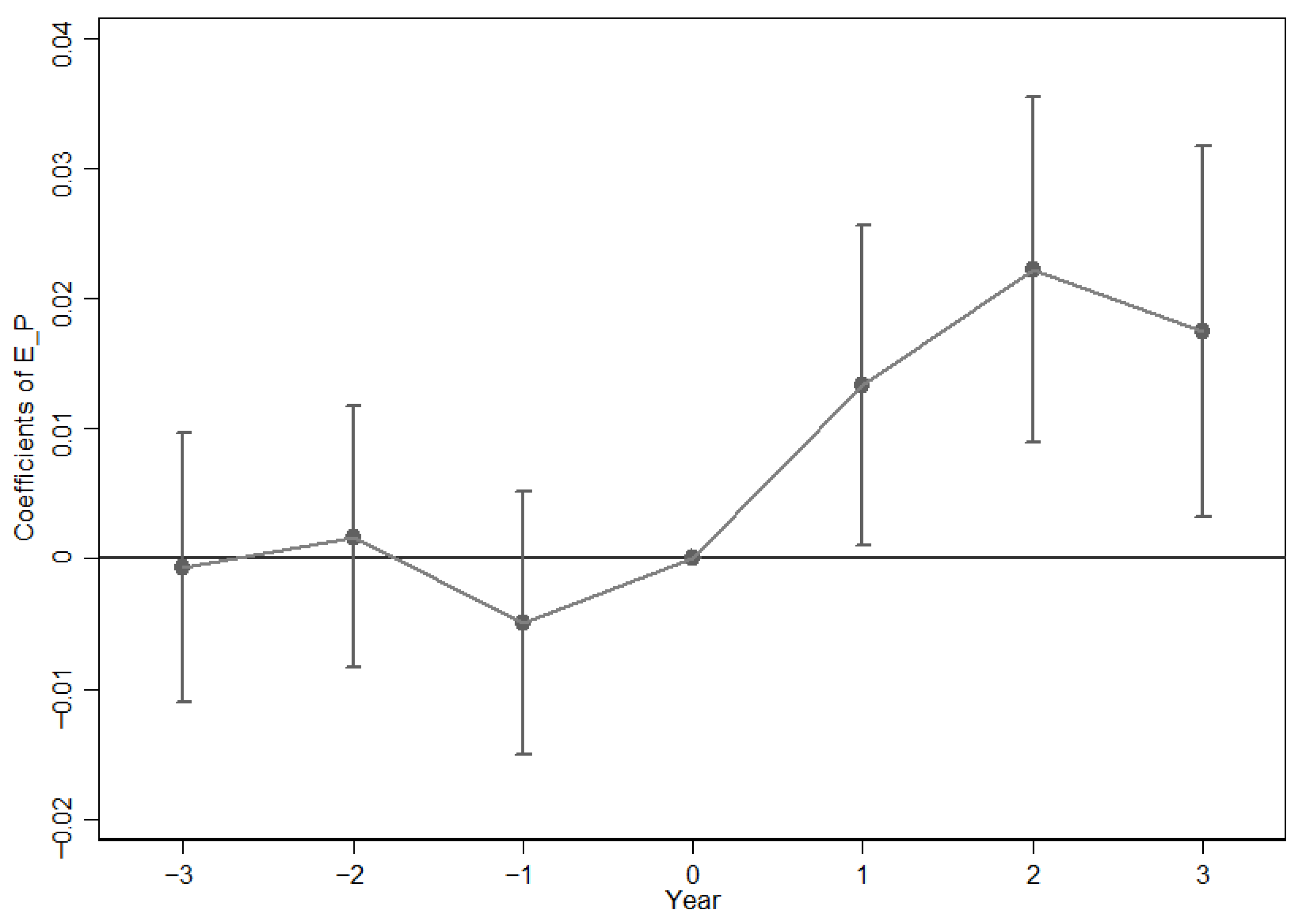
Hypothesis 1a: The establishment of regional environmental courts improves supply chain financing for polluting enterprises.
Given that polluting enterprises may face significant uncertainties under stricter environmental regulations, stakeholders such as suppliers and customers may make negative judgments based on projected environmental risks and performance during the process of polluting enterprises seeking supply chain financing. For instance, they may anticipate a decline in the future operating performance and poor environmental performance of pollution-intensive enterprises, leading to an inability to repay debts and pay interest on time [
40]. Consequently, stakeholders like suppliers and customers may impose more stringent requirements on pollution-intensive enterprises in terms of fund delivery, accounts receivable recovery, and other aspects, ultimately exacerbating the supply chain financing situation of polluting enterprises [
41,
42,
43]. Moreover, if pollution-intensive enterprises cease relevant pollution emission behaviors in their production processes to avoid environmental penalties, it may lead to a halt in their own operational and production activities, placing them in a disadvantageous position of contract default. They may even face major financial crises such as a broken capital chain and bankruptcy, adversely affecting their supply chain financing. Based on this, we propose the following competitive hypothesis.
Hypothesis 1b: The establishment of regional environmental courts inhibits supply chain financing for polluting enterprises.
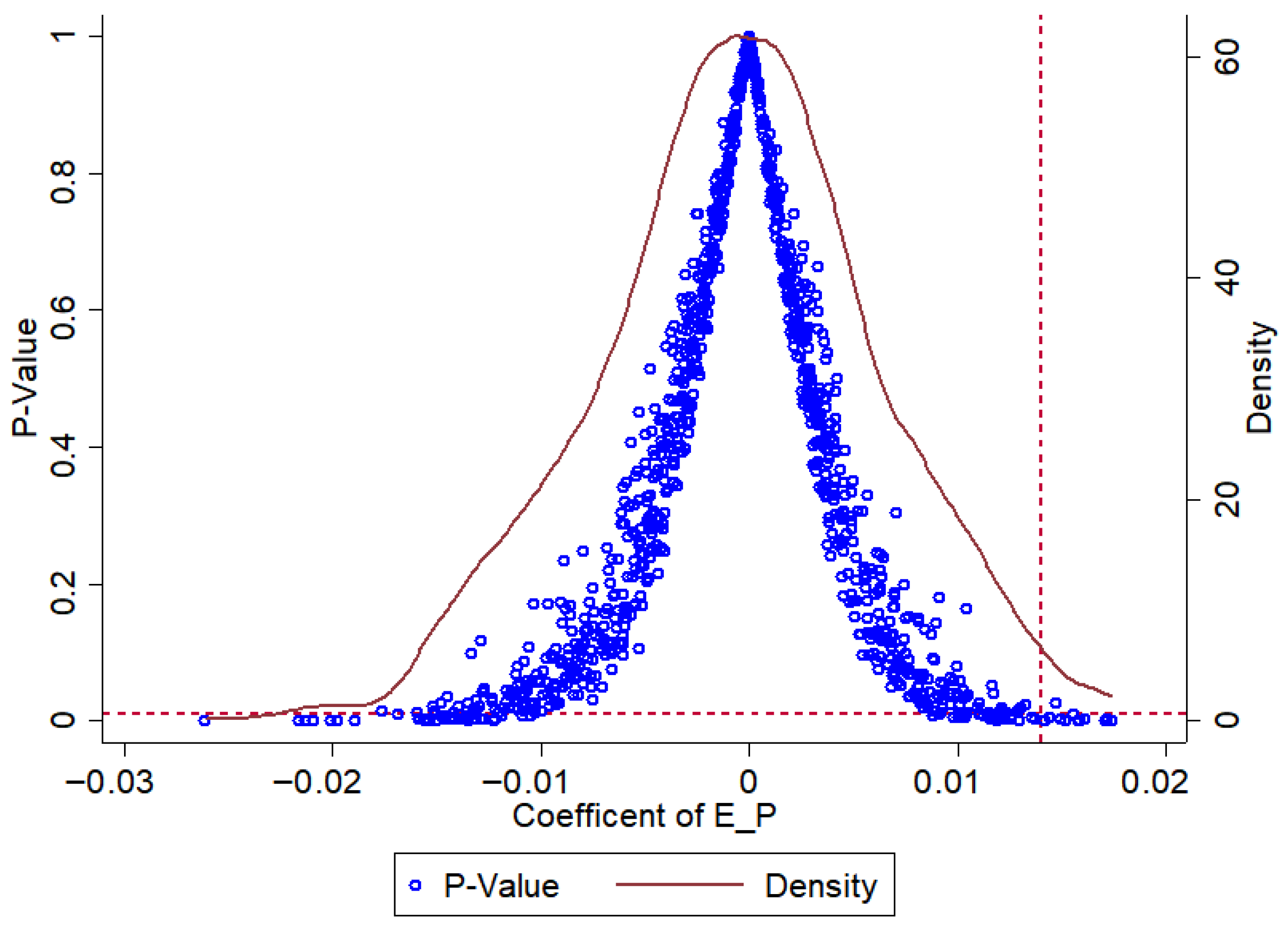
Therefore, empirical testing is needed to verify the relationship between environmental courts and supply chain financing of polluting enterprises.