

Article

Green Fund Shareholding and Corporate Carbon Performance: An Empirical Analysis Based on Chinese A-Share Listed Companies

School of Economic and Management, University of Science and Technology Beijing, Beijing 100083, China
*
Author to whom correspondence should be addressed.
Sustainability 2025, 17(23), 10722; https://doi.org/10.3390/su172310722
Submission received: 24 October 2025 / Revised: 21 November 2025 / Accepted: 28 November 2025 / Published: 30 November 2025

Abstract

Against the global low-carbon transition, China, as one of the world’s major carbon emitters, relies on green finance to drive corporate carbon reduction. However, existing research has paid limited attention to green funds, an important component of China’s green finance system, leaving their role in shaping corporate carbon performance understudied. This study addresses this gap by exploring how green fund shareholding affects corporate carbon performance. Using data of Chinese A-share listed companies from 2008 to 2022, this work employed baseline regression, robustness checks, mediation analysis, and heterogeneity tests. Key findings include: green fund shareholding is associated with significant improvements in corporate carbon performance; green technology innovation plays a partial mediating role in this relationship; external supervision positively moderates the link between green fund shareholding and corporate carbon performance; and the positive effect tends to be more pronounced for firms with higher green fund ownership and net value ratios. This study helps fill the gap of ignoring investor heterogeneity in prior related research. It also suggests that regulators could optimize information disclosure and supervision for green funds, while enterprises may strengthen collaboration with green funds, providing support for China’s green finance development and corporate low-carbon transition.

1. Introduction

Against the backdrop of global climate change, achieving carbon peaking and carbon neutrality has become a global consensus. The IPCC emphasizes that curbing corporate carbon emissions is a core pathway to mitigating global warming, as enterprises, major greenhouse gas emitters, are pivotal to the low-carbon economic transition. This global agenda takes on unique significance in China: as the world’s largest developing economy and an important actor in global climate governance, China has explicitly committed to reaching a carbon peak by 2030 and carbon neutrality by 2060. For Chinese A-share listed companies, improving carbon performance is no longer merely a compliance requirement for meeting national environmental regulations but also a strategic imperative to enhance long-term competitiveness [1]. What distinguishes the Chinese context further is its rapidly expanding yet policy-driven green financial system: unlike mature markets where green funds emerge from market demand, China’s green funds are strongly guided by state policies and interact with a unique mix of state-owned enterprises and private firms. This distinct institutional setting raises critical questions: Do green funds in China effectively improve corporate carbon performance? If so, through what mechanisms, and under what external conditions, is this effect strengthened?
With the global rise of ESG investment, green funds have emerged as a critical force shaping corporate environmental behavior. Unlike traditional institutional investors that prioritize short-term financial returns, green funds integrate environmental sustainability into their core investment criteria. They not only allocate capital to low-carbon firms but also actively engage with investees to push for carbon reduction [2]. Prior studies suggest two potential channels for this influence: “voice governance”, where green funds use shareholder rights to urge enterprises to optimize carbon management systems [3]; “signal transmission”, where green fund shareholding enhances a firm’s environmental reputation, thereby incentivizing further investment in low-carbon technologies to maintain this signal. However, existing literature on institutional investors and corporate carbon performance remains fragmented and controversial. On one hand, some studies argue that most institutional investors are short-term oriented and lack motivation to push for long-term, costly carbon reduction [4]; on the other hand, research on long-term institutional investors shows they can improve corporate environmental performance through active governance [5,6]. A critical gap in this literature is that most studies focus on general institutional investors, with limited empirical evidence on green funds, especially in China’s policy-driven green finance context.
To fill these gaps, this study constructs an analytical framework based on three core theories. Institutional investor activism theory explains why green funds have the motivation and capacity to intervene in corporate carbon management; principal-agent theory clarifies how green funds alleviate shareholder-management conflicts over carbon reduction; and stakeholder theory contextualizes how green funds transmit external low-carbon demands. Using a sample of Chinese A-share listed companies from 2008 to 2022, preliminary empirical results indicate that green fund shareholding has a significant positive impact on corporate carbon performance; green fund shareholding promotes firms’ investment in low-carbon patents and technologies, which in turn improves carbon performance; both environmental news coverage and regional environmental penalties significantly strengthen the positive effect of green fund on corporate carbon performance.
This study makes three distinct contributions. First, it enriches the literature on institutional investor governance and corporate environmental behavior by focusing on green funds as a specific, ESG-oriented investor type, moving beyond the broad category of institutional investors to provide targeted insights into how ESG investment drives corporate low-carbon transition. Second, it fills the gap in cross-country evidence by validating the governance effect of green funds in China’s unique policy-driven context. This is particularly valuable given that most existing studies are based on mature markets, and China’s green financial system and corporate ownership structure may generate distinct mechanisms. Third, by integrating mediating and moderating analyses, this study opens the “black box” of green funds’ impact on carbon performance, providing a more nuanced understanding of how and when green funds work.
From a practical and policy perspective, this study’s findings have clear implications. For policymakers, they support the expansion of green fund markets and the improvement of supporting policies to leverage green capital for “double carbon” goals. For listed companies, they highlight the value of attracting green fund investment, not only for accessing green capital but also for driving internal carbon management improvements. For green fund managers, they validate the environmental governance value of active engagement, providing a basis for optimizing investment and governance strategies.

2. Literature Review

2.1. Corporate Carbon Performance: Connotation and Influencing Factors

Corporate carbon performance denotes the efficacy of enterprises in managing carbon emissions, optimizing low-carbon operational procedures, and fulfilling emission reduction objectives [7]. It is often assessed through metrics including carbon emission intensity and carbon abatement efficiency [8]. As a pivotal dimension of corporate environmental performance, it has evolved into a crucial metric to assess firms’ contribution to the global “carbon peaking and carbon neutrality” agenda. Owing to its vital role in shaping corporate sustainable development strategies and supporting the realization of global climate ambitions, the determinants of firm carbon performance have been extensively probed in prior academic literature, with researchers delving into a multitude of influencing factors from diverse perspectives.
From the perspective of external drivers, government environmental policies are recognized as a direct force shaping corporate carbon performance [9]. Mandatory policies such as carbon emission trading schemes (ETS) force high-emission enterprises to reduce emissions through technological upgrading, while incentive policies such as green subsidies can lower the cost of enterprises’ low-carbon investments [10,11]. However, the effectiveness of policy-driven carbon reduction varies across regions and industries. For example, enterprises in regions with lax policy enforcement often exhibit “symbolic carbon reduction” rather than substantive improvements [12]. From the perspective of internal drivers, corporate governance mechanisms (e.g., independent director systems [13], environmental management committees [14]) and technological capabilities (e.g., renewable energy adoption [15]) play critical roles. Enterprises with sound environmental governance structures are more likely to integrate low-carbon concepts into operational decisions [16], while advanced low-carbon technologies directly improve carbon emission efficiency [17].
Notably, the academic focus on drivers of corporate carbon performance has gradually shifted from traditional lenses—such as external policy constraints and internal management practices—to the role of capital market participants, particularly institutional investors. This shift underscores a growing recognition that financial market forces can act as critical complements to policy tools, facilitating enterprises’ long-term low-carbon transitions [18].
Yet, while the literature on institutional investors and corporate carbon performance has grown mature, it harbors a critical omission: it largely treats institutional investors as a homogeneous group, failing to disaggregate subsets with distinct investment mandates and objectives. Most existing studies, for instance, center on general institutional investors (e.g., conventional mutual funds, pension funds) and overlook “green funds”—a specialized subset explicitly anchored in ESG (Environmental, Social, Governance) principles, where environmental outcomes serve as a non-negotiable investment criterion rather than an optional add-on.
This failure to isolate green funds as a unique category has distorted prior findings: it conflates the heterogeneous effects of different institutional investors, leading to ambiguous, even conflicting, conclusions about their role in carbon governance. For example, conclusions often mix the short-term profit orientations of general funds with the long-term environmental commitments of green funds, obscuring the latter’s potential to drive carbon performance improvements. Consequently, the literature offers limited insights into how specialized green capital shapes corporate carbon behavior—a gap that not only undermines a nuanced understanding of institutional investors’ governance roles but also lacks relevance to policy-driven green finance contexts like China’s A-share market.

2.2. Institutional Investors’ Shareholding and Corporate Carbon Performance

The linkage between institutional investor ownership and firm-level carbon performance has been a subject of prolonged debate in academia, giving rise to two conflicting perspectives. The “active governance hypothesis” posits that institutional investors, particularly those with a long-term investment horizon, possess the incentive and capability to engage in corporate governance practices [19]. They can leverage shareholder rights such as submitting shareholder proposals, casting votes on environmental resolutions to encourage firms to enhance carbon management [20], and their shareholding can send positive signals to bolster firms’ environmental reputation, which in turn boosts market valuation [21]. Behind this mechanism, the professional expertise and capital influence of institutional investors empower them to effectively drive corporate environmental initiatives. For instance, Ren et al. discovered that institutional investors with a robust ESG focus markedly lowered the carbon emission intensity of Chinese listed firms by advocating for the implementation of environmental management systems [6]. This empirical finding highlights the proactive role that institutional investors can play in advancing corporate carbon performance.
In contrast, the “short-term profit hypothesis” posits that institutional investors prioritize short-term financial returns over long-term environmental benefits. Carbon reduction investments (e.g., green technology R&D, carbon capture equipment) often require high upfront costs and have long payback periods [22], which may reduce short-term earnings. Thus, institutional investors may pressure enterprises to cut low-carbon investments to meet quarterly profit targets [23]. For example, Liu et al. revealed that in companies with a higher proportion of institutional ownership, the short-term profit orientation of institutional investors partially undermines the execution of ESG policy goals, thereby weakening the mitigating impact of ESG enhancement on carbon emissions [4]. This finding underscores how institutional investors’ short-sightedness can hinder corporate efforts in carbon emission reduction.
The crux of this controversy stems from the heterogeneity across institutional investors: various categories of institutional investors have distinct investment objectives and time horizons, resulting in divergent impacts on corporate carbon performance [24]. Green funds, as a specialized subset of ESG-oriented investors, are fundamentally distinct from conventional institutional investors: they embed environmental factors into investment decision-making criteria (e.g., screening out high-carbon enterprises) and view corporate low-carbon development as a pivotal driver of long-term investment value [18]. However, existing empirical research on the interplay between green funds and corporate carbon performance remains limited. Most studies either classify green funds merely as a component of “ESG institutional investors” without meticulous differentiation [25,26] or concentrate on developed markets like the U.S. and Europe [27], overlooking the unique institutional context of China, where green finance is heavily policy-driven and the A-share market is characterized by a significant presence of state-owned enterprises and industries with high carbon emissions. This context-driven research gap thus underscores an urgent necessity to investigate the linkage between green fund ownership and corporate carbon performance within the Chinese context.
It is critical to address the core source of the existing divergence: the failure to account for investor heterogeneity. As noted earlier, institutional investors are not a homogeneous group, and their varying objectives (long-term value vs. short-term returns) directly shape their influence on corporate carbon strategies. This oversight explains why prior studies have reached conflicting conclusions regarding institutional investors’ role in carbon governance. Building on this insight, we posit that green funds, unlike general institutional investors, align more closely with the “active governance hypothesis”. Their explicit ESG mandates inherently prioritize long-term environmental value alongside financial returns, eliminating the short-term profit pressure that often undermines other institutional investors’ engagement in carbon reduction. This unique characteristic of green funds justifies our focus on them, as it allows us to empirically test a more targeted and theoretically consistent relationship between institutional shareholding and corporate carbon performance, one that addresses the heterogeneity gap in existing research and responds to the urgent need for evidence from China’s context.

3. Research Hypothesis

To theoretically clarify the impact of green fund shareholding on corporate carbon performance, this study selects three core theories, institutional investor activism theory, principal–agent theory, and stakeholder theory, to construct the analytical framework. These theories mutually complement each other, explaining “why green funds can influence corporate carbon performance” and “how this influence is realized” from the perspectives of investor behavior, internal governance, and stakeholder interaction.
Institutional investor activism theory challenges the traditional perception of institutional investors as “passive traders,” stressing that those with large shareholdings, professional capabilities, and low marginal supervision costs tend to adopt active intervention to shape corporate decision-making [28]. As goal-oriented institutional investors centered on “environmental sustainability” [29], green funds anchor their investment logic in the belief that corporate low-carbon transformation drives long-term value creation—this gives them strong motivation to boost corporate carbon performance [30]. For Chinese A-share listed companies, green fund shareholding translates to two core intervention behaviors supporting this motivation: First, the “voice mechanism”, where green funds use their shareholding rights to participate in board meetings, submit proposals, or engage management directly, urging the formulation of carbon reduction targets, increased low-carbon technology investment, and improved carbon management systems [3]. Second, the “exit threat”, where their professional information advantages allow rapid shareholding adjustments based on corporate carbon performance; the risk of large-scale stock sales exerts market pressure, forcing management to prioritize carbon emission reduction to avoid stock price volatility and financing challenges [31].
Principal–agent theory identifies the separation of ownership and management rights in modern enterprises as the root of interest conflicts between shareholders and management [32]. This conflict is particularly acute for carbon performance. Carbon reduction requires substantial upfront investment with long payback periods, which may undermine short-term financial performance and further harm management’s personal interests. Consequently, management tends to prioritize short-term gains and neglect long-term carbon management [33]. As “active principals”, green funds alleviate this conflict through two core channels directly supporting improved corporate carbon performance: First, concentrated shareholding enhances their supervision capacity, enabling them to monitor management’s carbon reduction investment decisions and prevent the sacrifice of long-term environmental interests for short-term profits [3]. Second, they promote the optimization of corporate incentive mechanisms by proposing to integrate carbon performance indicators into management’s evaluation and remuneration systems. This aligns management’s personal interests with the enterprise’s long-term low-carbon goals, motivating proactive resource allocation for better carbon performance [34].
Stakeholder theory posits that enterprises must respond to the demands of multiple stakeholders to achieve sustainable development, beyond their sole responsibilities to shareholders. Green funds, as special stakeholders integrating “capital attributes” and “environmental attributes”, exert direct influence on corporate carbon performance through their dual role in this framework. First, in their role as capital stakeholders, green funds provide enterprises with scarce green capital, which is critical for low-carbon transformation. Amid China’s booming green finance, enterprises seek continuous green capital support; to maintain this cooperation, they have strong incentives to meet green funds’ carbon performance demands. Second, as representatives of environmental stakeholders, green funds transmit the low-carbon demands of the government, environmental organizations, and the public to enterprises. Responding to these demands allows enterprises to enhance environmental reputation, gain external stakeholder recognition, and avoid risks such as policy penalties, consumer boycotts, or ESG rating downgrades, all of which drive enterprises to improve carbon performance [26].
Based on the above theoretical deduction, this study proposes the core research hypothesis:
Hypothesis 1.
Green fund shareholding has a significantly positive impact on corporate carbon performance.

4. Research Design

4.1. Sample Selection and Data Sources

This study selects Chinese A-share listed companies in Shanghai and Shenzhen from 2008 to 2022 as the initial research sample. To ensure data validity and reliability, the following detailed screening procedures are implemented: First, samples from the financial industry, classified under the “J” code in the 2012 Edition of the China Securities Regulatory Commission (CSRC) Industry Classification, are excluded. Their non-physical operational models and unique carbon emission traits render their carbon performance non-comparable to that of non-financial firms. Second, companies labeled “ST” or “PT” in their stock codes are removed. Given their abnormal financial conditions, such firms may obscure the causal relationship between green fund shareholding and corporate carbon performance. Third, samples with missing variables are excluded to avoid estimation bias arising from incomplete observations. Fourth, single-year observations (samples with only one year of data) are eliminated, as panel data analysis requires multi-period data to capture dynamic relationships. Finally, continuous variables are winsorized at the 1% and 99% quantiles to mitigate the influence of extreme values. After these steps, the final sample comprises 2382 unique firms and 22,286 firm-year observations. All data used in this study are retrieved from the China Stock Market & Accounting Research (CSMAR) Database.

4.2. Variable Definition

4.2.1. Explained Variable

The explained variable in this work is corporate carbon performance (CP). Existing literature measures corporate carbon performance primarily through three proxies: absolute carbon emissions, carbon intensity, and carbon efficiency [35]. However, absolute carbon emissions are highly sensitive to firm size, limiting cross-firm comparability. While carbon intensity incorporates output factors, it only reflects relative emission scales and fails to fully capture the synergistic economic and environmental effects of low-carbon development. To address these limitations, this study uses the ratio of operating revenue to carbon emissions as the proxy for CP. This indicator directly reflects a firm’s capacity to create value while reducing emissions by measuring operating revenue generated per unit of carbon emissions, aligning with the “low consumption and high output” connotation of green development. The calculation formula is:
C P i , t = O R i , t / C E i , t
where C P i , t denotes the carbon performance of firm i in year t ; O R i , t is the operating revenue of firm i in year t ; and C E i , t represents the carbon emissions of firm i in year t .
C E i , t is estimated based on industry-level carbon emissions, following the method:
C E i , t = O C i , t / O C j , t × C E j , t
where O C i , t is the operating cost of firm i in year t ; O C j , t is the total operating cost of industry j (to which firm i belongs) in year t ; and C E j , t is the total carbon emissions of industry j in year t .

4.2.2. Explanatory Variable

The independent variable in this research is green fund shareholding (GF), operationalized as the count of green funds that hold shares in a listed company within a specific year. Original data regarding fund shareholdings are obtained from the China Stock Market & Accounting Research (CSMAR) Database. Specifically, we integrate information by matching the “Fund Entity Information Table” and “Stock Investment Details Table” within the Fund Market Series, thereby deriving the roster of funds that invest in each listed company. In line with the methodology of Jiang et al. [36], we manually classify green funds by scrutinizing their “investment objectives” and “investment scopes” for keywords related to the environment. These keywords encompass “environmental protection”, “ecology”, “green”, “new energy development”, “clean energy”, “low-carbon”, “sustainable”, and “energy conservation”. A fund is categorized as “green” if it includes any of these environmental keywords. Subsequently, GF is computed as the total number of these identified green funds that hold shares in firm i during year t , which reflects the degree of green fund engagement in the enterprise. To ensure the accuracy of this identification process, we cross-checked the fund documents and investment mandates multiple times, minimizing the risk of misclassification.

4.2.3. Control Variable

To mitigate the impact of other factors on corporate carbon performance and ensure the robustness of empirical results, this study incorporates a set of control variables based on existing literature [37]. Firm size (Size) is controlled because larger enterprises typically have more resources for carbon management but may also face higher emission pressures due to scale effects. Asset-liability ratio (Lev) is included as high leverage may constrain firms’ investment capacity in low-carbon initiatives. Firm age (Age) is considered since mature enterprises might have more established environmental management systems, while younger firms may adopt innovative low-carbon practices more flexibly. Return on assets (ROA) is controlled to reflect profitability, as firms with stronger financial performance may allocate more funds to carbon reduction. Industry competition (HHI) is included because competitive pressures can drive firms to improve carbon performance to gain competitive advantages. Ownership concentration (Owner) is controlled, as major shareholders may influence strategic decisions related to carbon management. The proportion of independent directors (Indep) is considered since independent directors often play a supervisory role in promoting environmental responsibility. Management shareholding (Mshare) is included because managerial ownership can align its interests with long-term firm value, including carbon performance. The symbols and measurement methods of the above variables in this study are presented in Table 1.

4.3. Model Setting

To empirically test the impact of green fund shareholding on corporate carbon performance (i.e., Hypothesis 1), this study constructs the following benchmark regression model:
C P i , t = α 0 + α 1 G F i , t + γ C o n t r o l s i , t + u i + v t + ε i , t
In Model (3), C P i , t denotes the carbon performance of firm i in year t ; G F i , t represents the number of green funds holding shares in firm i in year t , which is the core explanatory variable; C o n t r o l s i , t is the set of control variables as defined in Section 4.2.3; α 0 is the constant term; α 1 is the coefficient to be estimated, reflecting the marginal effect of green fund shareholding on corporate carbon performance; γ is the coefficient vector of control variables. To mitigate the interference of omitted variables, u i controls for firm-fixed effects, and v t controls for year-fixed effects. ε i , t is the random disturbance term. A significantly positive α 1 would support Hypothesis 1.

5. Empirical Results

5.1. Descriptive Statistics

Table 2 reports the detailed descriptive statistics for all variables in this study, covering a total of 22,286 firm-year observations from Chinese A-share listed companies. With respect to the dependent variable, corporate carbon performance has a mean of 64.014 and a standard deviation of 99.260, which signals considerable heterogeneity in carbon performance across the sampled firms. The median of CP is 14.453, lower than its mean, and it has a skewness of 1.845 and a kurtosis of 5.502. These figures jointly suggest a right-skewed distribution, which is in line with the existence of firms with high carbon efficiency in the sample. As for the core explanatory variable, green fund shareholding, it has a mean of 1.018 and a median of 0, implying that most firms have little to no green fund ownership. Meanwhile, the maximum value of GF is 19, reflecting that some firms have attracted substantial green fund involvement. Additionally, the high skewness (4.056) and kurtosis (24.180) of GF confirm its right-skewed distribution, a feature that is typical of institutional shareholding datasets.

5.2. Correlation Analysis

Table 3 reports the Pearson correlation coefficients among variables, aiming to preliminarily examine their relationships and detect potential multicollinearity.
The core explanatory variable, green fund shareholding, exhibits a significantly positive correlation with corporate carbon performance at the 1% significance level, with a correlation coefficient of 0.116. This preliminary finding is in line with Hypothesis H1, implying that increased participation of green funds may be linked to superior carbon performance.
Regarding the control variables, firm size (Size) demonstrates a notably positive correlation with GF (0.355 **) and a moderately positive correlation with CP (0.028). This indicates that larger firms tend to attract greater involvement from green funds and exhibit marginally better carbon performance. Return on assets (ROA) is positively associated with both GF (0.238 ***) and CP (0.037 ***), revealing that firms with higher profitability are more prone to securing green fund investments and accomplishing better carbon performance. The asset-liability ratio (Lev) presents a negative correlation with both CP (−0.058 ***) and ROA (−0.407 ***), which is consistent with the notion that high financial leverage might impede a firm’s capacity for low-carbon investments.
Table 4 presents the variance inflation factors (VIF) to examine the issue of multicollinearity in the research model. All the included variables exhibit VIF values lower than 2, with a range from 1.010 to 1.640, which is considerably below the commonly accepted threshold of 10. This result suggests that there is no serious multicollinearity problem, thus guaranteeing the validity and reliability of the subsequent regression analyses.

5.3. Baseline Regression Analysis

To ascertain the most suitable model between the fixed effects (FE) and random effects (RE) specifications, we perform the Hausman test. The test statistic (chi2) is 502.16, and the corresponding Prob > chi2 is 0.000, which leads to the rejection of the null hypothesis. As a consequence, we employ the fixed effects model for all subsequent analytical procedures.
Table 5 reports the outcomes of baseline regressions that investigate the influence of green fund shareholding on corporate carbon performance. Model (1) incorporates only GF and fixed effects, and it reveals that GF is significantly and positively associated with CP at the 1% significance level (coefficient = 1.308, t = 6.791). This finding preliminarily suggests that green fund shareholding exerts a promotional effect on carbon performance. Model (2) further incorporates all control variables, and GF continues to exert a significantly positive impact on CP at the 1% level (coefficient = 0.784, t = 4.018), thereby validating the robustness of this relationship.
Both models control for time and individual fixed effects, with R-squared of 0.783 and 0.788, indicating a good fit. Overall, results support Hypothesis 1: green fund shareholding significantly improves corporate carbon performance.
Table 5 also presents the estimation results of control variables. Size shows a significantly positive coefficient, indicating larger firms possess more resources to optimize carbon efficiency, thus improving CP. Lev is positively significant, likely because high-leverage firms face stricter creditor oversight, forcing them to prioritize carbon management to mitigate operational risks. Age has a significantly negative coefficient, as older firms may lag in updating low-carbon technologies, hindering CP improvement. ROA is positively significant, reflecting profitable firms’ stronger capacity to invest in carbon reduction initiatives. HHI and owner both exhibit significantly negative coefficients; higher market monopoly reduces competitive pressure for emission reduction, while excessive equity concentration may lead major shareholders to prioritize short-term gains over long-term carbon efforts. Mshare is negatively significant, possibly due to executives focusing on short-term stock performance, as carbon reduction increases short-term costs. Indep is insignificant, which may stem from insufficient independence of independent directors in Chinese A-share firms or their greater focus on financial performance rather than carbon oversight. This insignificance highlights that China’s independent director system still needs to integrate environmental governance expertise and strengthen independence to play a meaningful role in promoting corporate carbon performance.

5.4. Robustness Test

5.4.1. Omitted Variable Bias

To mitigate concerns about omitted variable bias, this section introduces potential confounding variables that may affect both green fund shareholding and corporate carbon performance, re-estimating the model.
Table 6 reports results after including Meb (number of managers with environmental backgrounds), ESG (Wind ESG score), Gfin (green finance development index), and Pres (carbon peak pressure). In Model (1) with Meb, GF remains significantly positive (0.826 ***, t = 4.131). Model (2) adds ESG, and GF’s coefficient (0.756 ***) stays significant. Model (3) incorporates Gfin, with GF still positive and significant (0.800 ***). Model (4) includes Pres, showing GF’s significance (0.785 ***). Model (5) adds all variables simultaneously, and GF remains significantly positive (0.845 ***).
These results confirm that the positive impact of green fund shareholding on corporate carbon performance is robust to the inclusion of potential omitted variables, alleviating bias concerns.

5.4.2. Bidirectional Causality

To address potential bidirectional causality between green fund shareholding and corporate carbon performance, we employ the instrumental variable (IV) method and lagged explanatory variable approach.
For IV analysis, we use the average green fund shareholding of other firms in the same industry-region (IV_GF) as an instrument. The under-identification test (LM statistic = 91.695, p = 0.000) rejects under-identification, and the weak identification test (Cragg-Donald Wald F = 81.389) confirms no weak instrument issue. In Table 7, Model (2) shows that GF positively impacts CP (12.253 ***, t = 4.045), consistent with baseline results.
For lagged variables, Model (3) (GF lagged by one period) and Model (4) (GF lagged by two periods) both report significantly positive GF coefficients (1.240 ***, 1.537 ***), indicating the positive effect persists when accounting for temporal lag.
These results collectively alleviate endogeneity concerns from bidirectional causality, reinforcing that green fund shareholding robustly promotes corporate carbon performance.

5.4.3. Sample Self-Selection

To tackle the potential sample self-selection bias, which may stem from green funds’ inherent preference for firms with intrinsically better carbon performance, this section utilizes entropy balancing (EB) and propensity score matching (PSM) to mitigate such selection effects.
Table 8 presents the results after balancing the observable characteristics between firms with and without green fund shareholding. Model (1) adopts entropy balancing, revealing that green fund shareholding remains significantly and positively associated with corporate carbon performance at the 1% significance level (coefficient = 0.839, t = 5.301). Model (3) employs PSM, and GF still demonstrates a significant positive impact on CP at the 5% level (coefficient = 0.519, t = 2.181). These results confirm that the positive influence of green fund shareholding on CP is robust against sample self-selection bias, thereby strengthening the causal inference.

5.4.4. Excluding Policy Shocks

To further rule out the potential interference of external policy shocks on the core empirical relationship between green fund shareholding and corporate carbon performance, this work conducts robustness tests by partitioning the full sample based on four typical environmental and carbon policies in China, with the results reported in Table 9. The rationale for this design lies in that China’s proactive promotion of carbon neutrality
First, regarding the Carbon Peaking Action Plan, Columns (1) and (2) of Table 9 present the regression results for the pre-policy period (year < 2021) and post-policy period (year ≥ 2021), respectively. In Column (1), the coefficient of GF is 0.839 and significant at the 1% level, while in Column (2), the coefficient of GF increases to 1.797 and remains significant at the 1% level. This indicates that, regardless of whether the Carbon Peaking Action Plan is implemented, green fund shareholding consistently promotes corporate carbon performance.
Second, considering the heterogeneity of local environmental enforcement (measured by whether the city where a firm is located has implemented an environmental court pilot), Columns (3) and (4) partition the sample into non-pilot cities and pilot cities. The coefficient of GF in Column (3) (non-pilot cities) is 0.860, and in Column (4) (pilot cities), it is 0.747. Both coefficients are significantly positive, suggesting that the promoting effect of GF on CP is not limited to regions with strengthened environmental policy stringency.
Third, for the low-carbon city pilot policy, Columns (5) and (6) separate firms in non-pilot cities and pilot cities. In Column (5) (non-pilot cities), the coefficient of GF is 0.881 and significant at the 1% level. In Column (6) (pilot cities), although the coefficient of GF decreases to 0.516, it remains significant at the 10% level. This result shows that even in regions without the policy support of low-carbon city pilots, green fund shareholding still exerts a stable positive impact on CP, and the weakening of the coefficient in pilot cities may be due to the overlapping effects of local low-carbon policies and green fund supervision—yet the core relationship is not overturned by this policy shock.
Finally, regarding the key pollution supervision policy, Columns (7) and (8) distinguish non-key supervised firms and key supervised firms. The coefficient of GF in Column (7) (non-key supervised firms) is 0.999, and in Column (8) (key supervised firms), it is 0.699. Both coefficients are highly significant and positive, indicating that the role of green funds in improving CP is not restricted to firms under strict pollution supervision.
Overall, across all sub-sample regressions excluding different policy shocks, the coefficient of GF remains significantly positive at least at the 10% statistical level. This confirms that the positive promoting effect of green fund shareholding on corporate carbon performance is not driven by external policy factors such as the Carbon Peaking Action Plan, environmental court pilots, low-carbon city pilots, or key pollution supervision, thereby further verifying the robustness and reliability of the core research conclusion.

5.4.5. Other Robustness Tests

This work further verifies the robustness of results through additional methods, including alternative variable measurement, adjusted estimation models, sample exclusion, and policy interference checks.
Model (1) replaces the explanatory variable (GF) with the natural logarithm of “total green funds plus 1” to address potential scale effects. The coefficient of GF remains significantly positive at the 1% level (2.146 ***, t = 3.006), consistent with baseline findings.
Model (2) employs panel Tobit estimation to account for potential truncation in carbon performance data. GF still exhibits a significant positive impact on CP (0.873 ***, t = 4.950), confirming robustness across estimation methods.
Model (3) excludes samples from 2020 to 2021 to mitigate interference from special events (e.g., the COVID-19 pandemic). The coefficient of GF remains significantly positive (0.717 ***, t = 3.508), indicating results are not driven by these years.
Collectively, these tests confirm that green fund shareholding’s positive effect on corporate carbon performance is robust (Table 10).
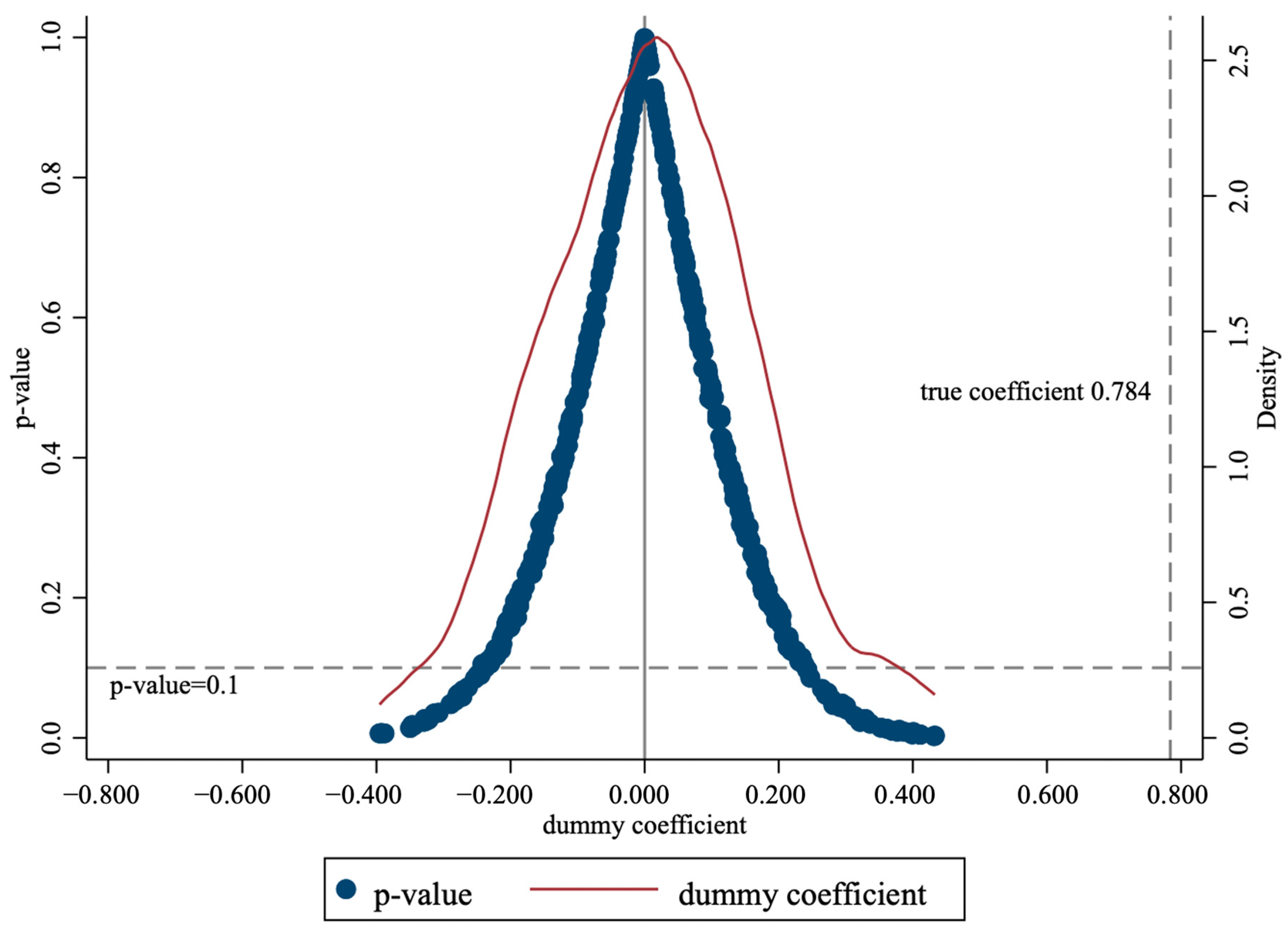
To rule out the likelihood that the detected impact of green fund shareholding on corporate carbon performance is attributable to unobserved stochastic factors, this work performs a placebo test. Specifically, we randomly reshuffle the assignment of GF across firms to generate dummy coefficients and repeatedly estimate the baseline model for 500 iterations.
As illustrated in Figure 1, the distribution of these dummy coefficients clusters tightly around 0, whereas the actual coefficient of GF (0.784) departs significantly from this central tendency. Furthermore, most p-values of the dummy coefficients are above the 0.1 threshold and thus lack statistical significance. These findings suggest that the positive effect of GF on CP is not a consequence of random variability, thus further solidifying the causal robustness of our key research finding.

5.5. Further Analysis

5.5.1. The Mediating Effect of Green Technology Innovation

Green technology innovation is expected to play a mediating role in the relationship between green fund shareholding and corporate carbon performance. Green funds, as investors with environmental preferences, may drive firms to enhance green technology innovation through two channels: on the one hand, they can provide capital support to encourage firms to increase investment in green technologies (e.g., R&D for low-carbon processes [38]); on the other hand, they may exert supervisory pressure to promote firms to improve green patent output (e.g., inventions related to emission reduction [39]). These green technology innovations can directly improve the efficiency of carbon resource utilization, thereby enhancing corporate carbon performance.
To examine whether green technology innovation plays a mediator role in the relationship between green fund shareholding and corporate carbon performance, we use a three-step mediation test. Two proxies for green technology innovation are adopted: green technology investment (GT1, measured by investment amount) and green patent applications (GT2, measured by the number of applications).
Step 1: Model (1) confirms the total effect—GF significantly and positively affects CP (0.784 ***, t = 4.018), consistent with baseline results.
Step 2: Models (2) and (4) test the impact of GF on mediators. Model (2) shows that GF positively correlates with GT1 (0.290 *, t = 1.870), indicating that green fund shareholding promotes green technology investment. Model (4) reports a significant positive effect of GF on GT2 (0.149 ***, t = 9.831), suggesting that GF also stimulates green patent applications.
Step 3: Models (3) and (5) include both GF and mediators. Model (3) adds GT1, where GT1 itself positively affects CP (0.047 ***, t = 5.268), and the coefficient of GF decreases from 0.784 *** to 0.770 ***, confirming partial mediation through GT1. Model (5) adds GT2, which significantly improves CP (1.185 ***, t = 13.023), while GF’s coefficient drops to 0.607 ***, indicating that GT2 also plays a partial mediating role.
These results suggest green fund shareholding enhances corporate carbon performance partially by promoting green technology innovation, both through increasing investment in green technologies and boosting green patent output (Table 11).

5.5.2. The Moderating Effect of External Supervision

Subsequently, in further analysis, this study investigates the moderating function of external supervision mechanisms, particularly green media attention and government environmental regulation, in the link between green fund shareholding and corporate carbon performance. It is hypothesized that external supervision is likely to enhance the influence of green fund shareholding on carbon performance: green media attention can magnify public scrutiny, thereby pressuring firms to proactively meet the demands of green investors [40]. Meanwhile, stricter government environmental regulation can intensify the supervisory binding effect of green funds, with both factors jointly facilitating the adoption of low-carbon initiatives [41].
Table 12 reports the findings. Model (1) investigates the moderating effect of green media attention (GM, operationalized as the quantity of environmental news coverage associated with listed companies). The coefficient of the interaction term GF*GM is significantly positive at the 1% significance level (0.131 ***, t = 5.927), suggesting that green media attention magnifies the positive influence of GF on corporate carbon performance. In detail, greater media attention reinforces the function of green funds in facilitating corporate carbon performance improvement, which is consistent with the notion that media oversight amplifies external pressures that drive firms toward low-carbon practices.
Model (2) assesses the moderating role of government environmental regulation (ER, operationalized as provincial environmental penalty cases scaled by 1000). The interaction term GF*ER is significantly positive at the 1% significance level (0.352 ***, t = 4.927), indicating that more stringent government environmental regulation also amplifies the positive impact of GF on corporate carbon performance (CP). This suggests that robust regulatory constraints complement the influence of green funds, incentivizing firms to enhance their carbon performance in a more efficacious manner.
Across both models, the main effect of GF stays significantly positive, and control variables exhibit consistent significance patterns that align with the baseline results. Collectively, these findings validate that external supervision mechanisms, including green media attention and government environmental regulation, exert a positive moderating function, fortifying the facilitative effect of green fund shareholding on corporate carbon performance.

5.5.3. Heterogeneity Analysis

This section explores heterogeneity in the impact of green fund shareholding on corporate carbon performance based on two dimensions: green fund ownership ratio and green fund net value ratio, grouped by industry-year medians (Table 13).
First, regarding green fund ownership ratio: Model (1) uses samples where the ratio is below the industry-year median, showing GF has an insignificant effect on CP (1.752, t = 0.891). Model (2) focuses on samples above the median, and GF significantly and positively affects CP (0.622 **, t = 2.378). This indicates that the promotion effect of green fund shareholding on CP is only significant when green funds hold a relatively high proportion of shares, possibly because higher ownership strengthens green funds’ ability to participate in corporate governance and push for low-carbon practices.
Second, concerning the green fund net value ratio, Model (3) includes samples below the industry-year median, with GF exerting an insignificant impact on CP (1.471, t = 0.659). Model (4) uses samples above the median, where GF significantly improves CP (0.666 **, t = 2.500). This suggests that green funds with higher net value ratios are more effective in promoting corporate carbon performance, likely due to stronger capital strength and longer-term investment horizons, enabling more sustained support for low-carbon initiatives.
Overall, the positive effect of green fund shareholding on corporate carbon performance exhibits heterogeneity, being more pronounced when green funds have higher ownership ratios or net value ratios.
Most control variables (Lev, HHI, Owner, Indep) show minor differences in coefficients and significance across groups. Notable differences emerge in four variables: Size: Coefficients are larger in high-ratio groups than in low-ratio groups. This is because green funds with higher ownership/net value strengthen resource integration for large firms, amplifying the positive effect of firm size on carbon performance. Age: It is insignificant in low-ratio groups but significantly negative in high-ratio groups. Stricter low-carbon oversight from high-ratio green funds exacerbates the constraint of outdated technologies in older firms, making Age’s negative impact prominent. ROA: It is significantly positive in low-ratio groups but insignificant in high-ratio groups. High-ratio green funds provide sufficient capital for low-carbon initiatives, reducing the reliance of CP on firm profitability. Mshare: It is significantly negative in Models (1)–(3) but insignificant in Model (4), as high-net-value green funds’ strong supervision mitigates executives’ short-term profit-driven harm to CP. The inconsistency of Mshare’s significance across models further confirms that equity-based incentives alone may not be sufficient to drive carbon performance. General profit-sharing via shareholding aligns executives’ interests with traditional financial goals but fails to account for the long-term, cost-intensive nature of carbon improvement; without explicit, targeted incentives, management shareholding cannot bridge the gap between executives’ short-term incentives and corporate low-carbon objectives.

6. Discussion and Conclusions

6.1. Discussion

This work empirically investigates the influence of green fund shareholding on corporate carbon performance by leveraging 22,286 firm-year observations of Chinese A-share listed enterprises, generating robust insights that enhance the comprehension of green finance and corporate sustainability.
First, the baseline regression analysis verifies a significantly positive association between GF and CP, strongly corroborating Hypothesis H1. This aligns with the expectation that green funds, as pro-environmental institutional investors, drive firms toward low-carbon practices. The result supplements the literature on green finance by providing evidence from the Chinese context, where institutional investors’ environmental governance roles remain under-explored. Unlike general institutional ownership, green funds’ dual focus on financial returns and environmental benefits motivates them to push for carbon performance improvements, addressing the “green paradox” in corporate investment.
Second, the mediating effect analysis reveals that green technology innovation (both investment and patent output) partially transmits the positive impact of GF on CP. This indicates green funds act through two channels: providing capital for green R&D and exerting supervisory pressure to enhance patent output, which directly boosts carbon efficiency. This finding supports resource dependence theory, as green funds supply critical financial and governance resources for firms’ low-carbon transitions.
Third, external supervision (green media attention and government environmental regulation) positively moderates the GF-CP relationship. Higher media scrutiny amplifies public pressure, while stricter environmental regulation strengthens institutional constraints, jointly reinforcing green funds’ governance effects. This highlights the importance of institutional complementarity in promoting corporate sustainability, echoing the institutional theory perspective.
Fourth, heterogeneity analysis shows the GF-CP effect is significant only when green funds hold higher ownership or net value ratios. This suggests sufficient ownership enables green funds to participate in corporate governance effectively, while higher net value ratios reflect stronger capital strength and long-term investment horizons, supporting sustained low-carbon initiatives.
Building on the robust empirical evidence that green fund shareholding exerts a positive influence on corporate carbon performance through distinct mechanisms and contextual contingencies, this work makes three noteworthy contributions to the scholarship on green finance and corporate sustainability.
First, it augments green finance research by providing empirical insights from the Chinese unique institutional setting, confirming that green funds—distinct from general institutional investors—substantially improve CP. This tackles the underexplored environmental governance function of institutional investors in emerging markets and alleviates the “green paradox” in corporate investment practices.
Second, it elucidates the mediating role of green technology innovation (encompassing investment and patent output), demonstrating that green funds operate via capital provision for green R&D initiatives and supervisory impetus for patent advancement. This validates resource dependence theory and bridges the gap in comprehending the transmission pathways between green institutional ownership and low-carbon organizational behavior.
Third, it pinpoints crucial boundary conditions: external oversight (including media attention and environmental regulation) strengthens the GF-CP association (thereby supporting institutional theory), while GF’s ownership proportion and net value ratios dictate the significance of the effect. These findings delineate the scenarios where green funds are most impactful, enhancing practical implications for both policymakers and corporate stakeholders.

6.2. Conclusions

Leveraging 22,286 firm-year observations of Chinese A-share listed enterprises, this work empirically examines the influence of green fund shareholding on corporate carbon performance. Baseline regression outcomes confirm that GF significantly enhances CP, and this conclusion is robust when addressing omitted variable bias, bidirectional causality, sample self-selection, and other endogeneity issues through a series of rigorous tests. Mechanism exploration uncovers that green technology innovation (encompassing green technology investment and green patent filings) exerts a partial mediating effect. Additionally, external supervisory mechanisms—specifically green media attention and government environmental regulation—positively moderate the GF-CP association. Heterogeneity investigation demonstrates that the positive impact of GF is more salient for firms with higher green fund ownership proportions or net value ratios. Overall, this study validates that green funds effectively facilitate corporate low-carbon development, furnishing empirical evidence for harnessing institutional investors to advance environmental sustainability.

6.3. Policy Implications

This study’s findings offer targeted, actionable policy implications for advancing corporate low-carbon development via green funds—with explicit alignment with China’s “Dual Carbon” goals (carbon peaking by 2030 and carbon neutrality by 2060).
First, for regulators: To effectively amplify green funds’ role in driving corporate carbon reduction, policymakers should implement three concrete measures. Lower the entry barriers for dedicated green funds: Simplify registration procedures for funds that allocate over 60% of assets to low-carbon sectors to reduce market access costs and expand the pool of qualified green funds. Establish a “Green Fund Label” with strict criteria: Define measurable standards for the label, including a minimum 50% share of investments in low-carbon enterprises, quarterly disclosure of portfolio firms’ carbon emissions, and adherence to national ESG investment guidelines. This label will help investors distinguish genuine green funds from “greenwashed” ones, fostering market trust. Retain and refine differentiated incentives: Offer preferential tax policies for green funds holding ≥5% stakes in low-carbon enterprises, and establish a risk compensation mechanism. These measures respond to our empirical finding that high-ownership and high-net-value green funds exert a more pronounced positive impact on corporate carbon performance (CP).
Second, for stock exchanges and listed companies: Stock exchanges should mandate enhanced shareholder disclosure: Require listed firms to publicly report their top 10 shareholders, with explicit notation of whether these shareholders have formal ESG mandates. This transparency will increase market oversight of green fund participation and pressure firms to prioritize carbon reduction. For listed companies, given the critical role of green funds in improving CP, firms should proactively engage with qualified green funds as strategic long-term partners—for example, inviting green fund representatives to join environmental governance committees or holding quarterly dialogues on carbon reduction targets. This collaboration leverages green funds’ expertise in sustainable development to accelerate firms’ low-carbon transition.
Third, to reinforce mediating and moderating channels: Strengthen green technology innovation support. Provide targeted R&D subsidies for firms receiving green fund investments, and streamline green patent application processes. This addresses our finding that green technology investment and patents partially mediate the impact of GF on CP. Optimize external supervision. Build a national green media information platform to amplify public scrutiny of listed firms’ carbon performance. These steps leverage the moderating role of green media attention and government regulation to strengthen green funds’ promotional effect on CP.
Finally, our results highlight a critical strategic link. Cultivating a robust cohort of domestic green funds is not merely a financial market development goal, but a key lever for achieving China’s 2030/2060 Dual Carbon targets. By enhancing green funds’ participation and influence in corporate governance, policymakers can align micro-level firm behavior with national macro-environmental strategies, driving widespread and sustainable corporate carbon reduction.

Author Contributions

Conceptualization, Q.C. and H.W.; methodology, Q.C. and H.W.; software, and H.W.; validation, Q.C. and H.W.; formal analysis, Q.C. and H.W.; investigation, Q.C.; resources, Q.C. and H.W.; data curation, Q.C. and H.W.; writing—original draft preparation, Q.C. and H.W.; writing—review and editing, Q.C. and H.W.; visualization, Q.C. and H.W.; supervision, Q.C. and H.W.; project administration, Q.C. and H.W.; funding acquisition, Q.C. All authors have read and agreed to the published version of the manuscript.

Funding

This research received no external funding.

Institutional Review Board Statement

Not applicable.

Informed Consent Statement

Not applicable.

Data Availability Statement

The datasets generated and analyzed during the current study are available from the corresponding author on reasonable request.

Conflicts of Interest

The authors declare no conflicts of interest.

References

  1. Zhang, H.W. Effect of low carbon economy on enterprise competitiveness: A multiple mediation model. Appl. Ecol. Environ. Res. 2019, 4, 8793–8803. [Google Scholar] [CrossRef]
  2. Wang, F.J.; Zhou, X.M.; Gan, T. Can green funds improve corporate environmental, social, and governance performance? Evidence from Chinese-listed companies. PLoS ONE 2024, 19, e0301395. [Google Scholar] [CrossRef] [PubMed]
  3. Chen, L.; Johari, J.B.; Said, R.M. Do green funds contribute to corporate environmental performance? Empirical evidence from China. Transform. Bus. Econ. 2024, 23, 259–280. [Google Scholar]
  4. Liu, Z.Y.; Yang, B.G.; Andreosso-O’callaghan, B.; Zhang, X.A. Does corporate ESG performance influence carbon emissions? Sustainability 2025, 17, 7575. [Google Scholar] [CrossRef]
  5. Safiullah, M.; Alam, M.S.; Islam, M.S. Do all institutional investors care about corporate carbon emissions? Energy Econ. 2022, 115, 106376. [Google Scholar] [CrossRef]
  6. Ren, X.Z.; Dong, Y.Z.; Guo, J.M.; Liu, Y.D. Institutional ownership and corporate greenhouse gas emissions: The evidence from China. Pac.-Basin Financ. J. 2023, 82, 102135. [Google Scholar] [CrossRef]
  7. Haque, F. The effects of board characteristics and sustainable compensation policy on carbon performance of UK firms. Br. Account. Rev. 2017, 49, 347–364. [Google Scholar] [CrossRef]
  8. Hoffmann, V.H.; Busch, T. Corporate carbon performance indicators: Carbon intensity, dependency, exposure and risk. J. Ind. Ecol. 2008, 12, 505–520. [Google Scholar] [CrossRef]
  9. Pan, J.Y.; Du, L.Z.; Wu, H.T.; Liu, X.Q. Does environmental law enforcement supervision improve corporate carbon reduction performance? Evidence from environmental protection interview. Energy Econ. 2024, 132, 107441. [Google Scholar] [CrossRef]
  10. Li, N.; Zhang, H.L.; Xie, X. Does market-based environmental regulatory policy improve corporate environmental performance? Evidence from carbon emission trading in China. Sustainability 2025, 17, 623. [Google Scholar] [CrossRef]
  11. Zhang, X.F.; Fan, D.C. Research on the synergistic emission reduction effect of carbon emission trading and green financial policy. J. Environ. Manag. 2024, 367, 121924. [Google Scholar] [CrossRef]
  12. Firsova, A.; Strezov, V.; Taplin, R. After 20 years of creating Australian climate policy: Was the proposed carbon pollution reduction scheme a change in direction? Aust. J. Environ. Manag. 2012, 19, 21–34. [Google Scholar] [CrossRef]
  13. Chen, Z.; Chen, H.; Wang, L.; Guo, W. Factors of enterprise carbon performance: An empirical study of public shipping company in coastal regions of China. J. Coast. Res. 2020, 107, 268–272. [Google Scholar] [CrossRef]
  14. Dixon-Fowler, H.R.; Ellstrand, A.E.; Johnson, J.L. The Role of Board Environmental Committees in Corporate Environmental Performance. J. Bus. Ethics 2017, 140, 423–438. [Google Scholar] [CrossRef]
  15. Yuan, Y.; Cai, F.; Yang, L.L. Renewable Energy Investment under Carbon Emission Regulations. Sustainability 2020, 12, 6879. [Google Scholar] [CrossRef]
  16. Bui, B.; Houqe, M.N.; Zaman, M. Climate governance effects on carbon disclosure and performance. Br. Account. Rev. 2020, 52, 100880. [Google Scholar] [CrossRef]
  17. Miao, C.L.; Chen, Z.Y.; Zhang, A.X. Green technology innovation and carbon emission efficiency: The moderating role of environmental uncertainty. Sci. Total Environ. 2024, 938, 173551. [Google Scholar] [CrossRef] [PubMed]
  18. Liu, M.T.; Fang, X.B. How does green investor entry affect corporate carbon performance? Evidence from China. Renew. Energy 2025, 244, 122748. [Google Scholar] [CrossRef]
  19. Kordsachia, O.; Focke, M.; Velte, P. Do sustainable institutional investors contribute to firms’ environmental performance? Empirical evidence from Europe. Rev. Manag. Sci. 2022, 16, 1409–1436. [Google Scholar] [CrossRef]
  20. Khanchel, I.; Lassoued, N.; Khiari, C.; Khan, S.A. Carbon efficiency and green bonds: The institutional investors’ green touch. Res. Int. Bus. Financ. 2025, 77, 102943. [Google Scholar] [CrossRef]
  21. Kim, E.H.; Lyon, T. When does institutional investor activism increase shareholder value?: The Carbon Disclosure Project. B.E. J. Econ. Anal. Policy 2011, 11, 50. [Google Scholar] [CrossRef]
  22. Zhao, L.H.; Cao, R.H.; Wang, Y.J. Solar energy investment, technological innovation and carbon emission reduction: Evidence from China. Front. Energy Res. 2023, 10, 1104071. [Google Scholar] [CrossRef]
  23. Florackis, C.; Muktadir-Al-Mukit, D.; Sainani, S.; Zhang, Z.Y. Stock market reaction to mandatory carbon disclosure announcements: The role of institutional investors. J. Int. Financ. Mark. Inst. Money 2025, 99, 102113. [Google Scholar] [CrossRef]
  24. Wang, Y.Z.; Lin, Y.J.; Fu, X.Q.; Chen, S.H. Institutional ownership heterogeneity and ESG performance: Evidence from China. Financ. Res. Lett. 2023, 51, 103448. [Google Scholar] [CrossRef]
  25. Feng, J.Y.; Yuan, Y. Green investors and corporate ESG performance: Evidence from China. Financ. Res. Lett. 2024, 60, 104892. [Google Scholar] [CrossRef]
  26. Zhang, Y.M.; Xiong, X.; Gao, Y. Green fund investors and ESG performance: Evidence from China. Pac.-Basin Financ. J. 2024, 88, 102546. [Google Scholar] [CrossRef]
  27. Silva, F.; Cortez, M.C. The performance of US and European green funds in different market conditions. J. Clean. Prod. 2016, 135, 558–566. [Google Scholar] [CrossRef]
  28. McCahery, J.A.; Sautner, Z.; Starks, L.T. Behind the scenes: The corporate governance preferences of institutional investors. J. Financ. 2016, 71, 2905–2932. [Google Scholar] [CrossRef]
  29. Dyck, A.; Lins, K.V.; Roth, L.; Wagner, H.F. Do institutional investors drive corporate social responsibility? International evidence. J. Financ. Econ. 2019, 131, 693–714. [Google Scholar] [CrossRef]
  30. Jin, J.Y.; Han, L.Y. Assessment of Chinese green funds: Performance and industry allocation. J. Clean. Prod. 2018, 171, 1084–1093. [Google Scholar] [CrossRef]
  31. Li, J.; Zhang, Y.Z.; Zhang, Y.J.; Xiong, X. Institutional investor networks and earnings management: The role of the exit threat. Econ. Model. 2024, 141, 106903. [Google Scholar] [CrossRef]
  32. Jensen, M.C.; Meckling, W.H. Theory of the firm: Managerial behavior, agency costs and ownership structure. J. Financ. Econ. 1976, 3, 305–360. [Google Scholar] [CrossRef]
  33. Xie, X.J.; Gong, Y.K.; Cheng, L. Managerial myopia and carbon emission: Evidence from China. Pac.-Basin Financ. J. 2025, 90, 102614. [Google Scholar] [CrossRef]
  34. Scholtens, B. The sustainability of green funds. Nat. Resour. Forum 2011, 35, 223–232. [Google Scholar] [CrossRef]
  35. Perera, K.; Kuruppuarachchi, D.; Kumarasinghe, S.; Suleman, M.T. The impact of carbon disclosure and carbon emissions intensity on firms’ idiosyncratic volatility. Energy Econ. 2023, 128, 107053. [Google Scholar] [CrossRef]
  36. Jiang, G.S.; Lu, J.C.; Li, W.A. Does green investor play a role? Empirical research from corporate participation in green governance. J. Financ. Res. 2021, 5, 117–134. [Google Scholar]
  37. Meng, B.; Zang, Q.; Li, G.R. Study on the impact of corporate social responsibility on carbon performance in the background of carbon peaking and carbon neutrality. Bus. Ethics Environ. Responsib. 2024, 33, 416–430. [Google Scholar] [CrossRef]
  38. Lv, Q.; Li, X.C.; Sun, Y.C.; Han, Y. Institutional investors’ green activism and corporate green innovation: Based on the behindscene communications. Emerg. Mark. Financ. Trade 2024, 60, 3284–3307. [Google Scholar] [CrossRef]
  39. Tang, H.; Tong, M.H.; Chen, Y.R. Green investor behavior and corporate green innovation: Evidence from Chinese listed companies. J. Environ. Manag. 2024, 366, 121691. [Google Scholar] [CrossRef]
  40. Jie, G.; Lv, J.H. Media attention, green technology innovation and industrial enterprises’ sustainable development: The moderating effect of environmental regulation. Econ. Anal. Policy 2023, 79, 873–889. [Google Scholar] [CrossRef]
  41. Zheng, L.; Omori, A.; Cao, J.; Guo, X.M. Environmental regulation and corporate environmental performance: Evidence from Chinese carbon emission trading pilot. Sustainability 2023, 15, 8518. [Google Scholar] [CrossRef]
Figure 1. Placebo Test.
Sustainability 17 10722 g001
Table 1. Variable Definition.
TypeSymbolMeasurement
Dependent variableCPThe ratio of the enterprise’s operating revenue to its carbon emissions
Explained variableGFThe total number of green funds holding shares in the firm
Control variableSizeThe natural logarithm of the total assets
LevThe ratio of total liabilities to total assets
AgeThe enterprise’s establishment duration
ROAThe ratio of the net profit to the total assets
HHISquare the market share of each enterprise in the industry, and then sum up all the squared results.
OwnerThe shareholding ratio of the largest shareholder
IndepThe ratio of the number of independent directors to the size of the board of directors
MshareThe ratio of the number of shares held by directors, supervisors, and senior executives to the total number of shares
Table 2. Descriptive statistics.
VariableObsMeanSdMinp50MaxSkewnessKurtosis
CP22,28664.01499.2600.09714.453426.3481.8455.502
GF22,2861.0182.3680.0000.00019.0004.05624.180
Size22,28622.2201.26519.83922.05126.0220.6873.313
Lev22,28642.68219.4805.51242.28888.9550.1462.296
Age22,28618.9695.9446.00019.00034.0000.1672.655
ROA22,2863.8136.128−21.7343.72020.070−0.9376.939
HHI22,28611.6259.5801.9388.71455.6042.0558.314
Owner22,28635.01114.7879.08333.02674.6580.4842.654
Indep22,28637.3265.28531.25033.33057.1401.3724.771
Mshare22,28611.72719.1810.0000.16469.6831.5604.155
Table 3. Pearson correlation coefficient.
VariableCPGFSizeLevAgeROAHHIOwnerIndepMshare
CP1
GF0.116 ***1
Size0.028 ***0.355 ***1
Lev−0.058 ***0.036 ***0.435 ***1
Age0.157 ***0.050 ***0.202 ***0.097 ***1
ROA0.037 ***0.238 ***0.037 ***−0.407 ***−0.077 ***1
HHI−0.057 ***0.0080.064 ***0.034 ***0.008−0.022 ***1
Owner−0.085 ***0.017 ***0.159 ***−0.007−0.157 ***0.151 ***0.079 ***1
Indep0.063 ***0.027 ***−0.002−0.028 ***0.016 **−0.015 **0.0030.044 ***1
Mshare0.109 ***−0.013 *−0.274 ***−0.295 ***−0.182 ***0.171 ***−0.026 ***−0.039 ***0.072 ***1
Note: *** p < 0.01, ** p < 0.05, * p < 0.1.
Table 4. Variance inflation factor.
VariableSizeLevROAGFMshareAgeOwnerIndepHHI
VIF1.6401.6201.3901.2301.1701.1101.1101.0101.010
1/VIF0.6090.6170.7210.8150.8540.9000.9040.9880.990
Table 5. Baseline regression.
Variable(1)(2)
CPCP
GF1.308 ***0.784 ***
(6.791)(4.018)
Size 9.961 ***
(10.908)
Lev 0.299 ***
(7.963)
Age −2.723 **
(−2.561)
ROA 0.258 ***
(3.255)
HHI −0.618 ***
(−8.515)
Owner −0.643 ***
(−11.494)
Indep −0.020
(−0.200)
Mshare −0.220 ***
(−4.621)
Cons62.683 ***−87.185 ***
(164.016)(−3.052)
Time FEyesyes
Individual FEyesyes
Observations22,28622,286
R−squared0.7830.788
Note: *** p < 0.01, ** p < 0.05, t-values are in parentheses.
Table 6. Robustness tests for omitted variables.
Variable(1)(2)(3)(4)(5)
CPCPCPCPCP
GF0.826 ***0.756 ***0.800 ***0.785 ***0.845 ***
(4.131)(3.528)(4.105)(4.025)(3.853)
Size9.946 ***9.640 ***10.077 ***9.945 ***9.613 ***
(10.618)(9.767)(11.049)(10.890)(9.486)
Lev0.296 ***0.328 ***0.291 ***0.297 ***0.313 ***
(7.744)(8.190)(7.744)(7.907)(7.663)
Age−2.677 **−3.119 ***−2.406 **−2.706 **−2.748 **
(−2.485)(−2.728)(−2.265)(−2.545)(−2.368)
ROA0.191 **0.257 ***0.270 ***0.254 ***0.188 **
(2.333)(3.064)(3.399)(3.202)(2.166)
HHI−0.533 ***−0.723 ***−0.611 ***−0.620 ***−0.620 ***
(−7.134)(−9.201)(−8.437)(−8.547)(−7.650)
Owner−0.652 ***−0.678 ***−0.632 ***−0.642 ***−0.677 ***
(−11.412)(−11.440)(−11.311)(−11.476)(−11.165)
Indep−0.050−0.081−0.023−0.022−0.116
(−0.486)(−0.762)(−0.228)(−0.215)(−1.070)
Mshare−0.227 ***−0.261 ***−0.210 ***−0.218 ***−0.261 ***
(−4.650)(−5.209)(−4.425)(−4.597)(−5.049)
Meb−0.225 −0.163
(−0.642) (−0.443)
ESG 0.414 *** 0.399 ***
(4.249) (4.035)
Gfin 1.780 *** 1.620 ***
(7.543) (6.206)
Pres 4.061 **26.688 **
(1.989)(2.430)
Cons−88.267 ***−95.597 ***−161.640 ***−87.208 ***−162.908 ***
(−3.043)(−3.054)(−5.355)(−3.053)(−4.854)
Time FEyesyesyesyesyes
Individual FEyesyesyesyesyes
Observations21,56920,78022,28622,28620,064
R−squared0.7850.7950.7890.7880.792
Note: *** p < 0.01, ** p < 0.05, t-values are in parentheses.
Table 7. Robustness tests for bidirectional causality.
VariableIVLagged
(1)(2)(3)(4)
GFCPCPCP
GF 12.253 ***1.240 ***1.537 ***
(4.045)(5.806)(6.593)
IV_GF0.121 ***
(9.022)
Size0.785 ***1.8909.243 ***9.209 ***
(21.202)(0.727)(8.857)(7.855)
Lev−0.0010.291 ***0.343 ***0.336 ***
(−0.333)(6.861)(8.151)(7.212)
Age0.091 **−2.440 **−1.336−0.677
(2.248)(−2.146)(−1.051)(−0.448)
ROA0.047 ***−0.225−0.052−0.085
(14.764)(−1.311)(−0.552)(−0.787)
HHI−0.002−0.978 ***0.170 **0.263 ***
(−0.709)(−10.210)(2.047)(2.898)
Owner−0.013 ***−0.545 ***−0.684 ***−0.625 ***
(−5.768)(−7.279)(−10.936)(−8.964)
Indep0.002−0.027−0.074−0.095
(0.421)(−0.238)(−0.674)(−0.788)
Mshare0.005 **−0.227 ***−0.223 ***−0.266 ***
(2.568)(−4.291)(−4.232)(−4.563)
Cons−18.025 ***83.371−101.154 ***−110.874 ***
(−16.032)(1.331)(−3.051)(−2.926)
Time FEyesyesyesyes
Individual FEyesyesyesyes
LM statistic91.695 ***
F statistic81.389
Observations18,87618,87619,18916,466
R−squared0.5120.8020.8030.819
Note: *** p < 0.01, ** p < 0.05, t-values are in parentheses.
Table 8. Robustness tests for sample self-selection.
Variable(1)(2)
CPCP
GF0.839 ***0.519 **
(5.301)(2.181)
Size12.272 ***8.706 ***
(11.942)(6.674)
Lev0.386 ***0.376 ***
(9.074)(7.143)
Age−5.504 ***−5.681 ***
(−4.490)(−3.791)
ROA0.1340.334 ***
(1.405)(2.634)
HHI−0.517 ***−0.458 ***
(−6.787)(−4.639)
Owner−0.564 ***−0.638 ***
(−9.735)(−8.580)
Indep−0.098−0.066
(−0.951)(−0.492)
Mshare−0.182 ***−0.298 ***
(−3.356)(−4.569)
Cons−95.674 ***−6.283
(−2.880)(−0.154)
Time FEyesyes
Individual FEyesyes
Observations22,28613,941
R−squared0.8170.807
Note: *** p < 0.01, ** p < 0.05, t-values are in parentheses.
Table 9. Robustness tests for excluding policy shocks.
Variable(1)(2)(3)(4)(5)(6)(7)(8)
CPCPCPCPCPCPCPCP
GF0.839 ***1.797 ***0.860 ***0.747 **0.881 ***0.516 *0.999 ***0.699 ***
(3.801)(4.064)(3.271)(2.574)(3.311)(1.839)(4.061)(3.040)
Size9.592 ***13.412 **12.028 ***6.774 ***12.498 ***6.821 ***10.403 ***3.931 **
(9.493)(2.367)(10.859)(3.254)(10.256)(5.017)(9.583)(2.219)
Lev0.302 ***0.1630.232 ***0.403 ***0.140 ***0.458 ***0.234 ***0.109 *
(7.427)(1.052)(5.034)(5.223)(2.811)(8.195)(5.418)(1.666)
Age−1.13611.403 **−1.793−3.573−4.800 ***−0.909−1.828−2.971
(−0.838)(2.087)(−1.146)(−1.459)(−3.237)(−0.609)(−1.365)(−1.562)
ROA0.0890.705 ***0.1350.858 ***0.0040.597 ***0.537 ***0.447 ***
(1.034)(3.594)(1.364)(6.073)(0.041)(5.001)(5.849)(4.030)
HHI−0.249 ***−3.076 ***−0.478 ***−0.704 ***−0.470 ***−0.712 ***−0.468 ***−0.447 ***
(−3.109)(−15.151)(−5.471)(−4.889)(−5.020)(−6.384)(−5.726)(−3.716)
Owner−0.584 ***0.272−0.548 ***−0.243 *−0.520 ***−0.746 ***−0.696 ***−0.297 ***
(−9.552)(0.940)(−8.070)(−1.793)(−7.351)(−8.479)(−10.360)(−3.041)
Indep−0.0770.251−0.071−0.110−0.1310.1520.020−0.008
(−0.709)(0.908)(−0.566)(−0.582)(−0.987)(1.016)(0.170)(−0.056)
Mshare−0.214 ***0.002−0.323 ***−0.092−0.046−0.442 ***−0.222 ***0.106
(−4.066)(0.010)(−5.194)(−0.884)(−0.757)(−6.091)(−4.119)(1.036)
Cons−124.116 ***−452.142 **−163.754 ***16.886−111.530 ***−48.034−112.495 ***45.336
(−3.714)(−2.555)(−4.370)(0.252)(−2.876)(−1.157)(−3.323)(0.797)
Time FEYesyesyesyesyesyesyesyes
Individual FEyesyesyesyesyesyesyesyes
Observations18,172392812,285685910,62611,64716,3035741
R−squared0.7580.9740.7780.8980.7840.7940.8090.932
Note: *** p < 0.01, ** p < 0.05, * p < 0.1, t-values are in parentheses.
Table 10. Other robustness tests.
Variable(1)(2)(3)
CPCPCP
GF2.146 ***0.873 ***0.717 ***
(3.006)(4.950)(3.508)
Size10.101 ***1.208 **9.829 ***
(11.051)(2.039)(10.591)
Lev0.298 ***0.129 ***0.271 ***
(7.945)(4.228)(7.106)
Age−2.683 **−0.770 ***−2.378 **
(−2.524)(−5.516)(−2.197)
ROA0.260 ***0.325 ***0.218 ***
(3.258)(4.505)(2.663)
HHI−0.618 ***−0.698 ***−0.669 ***
(−8.514)(−8.849)(−8.995)
Owner−0.646 ***−0.284 ***−0.604 ***
(−11.538)(−7.406)(−10.593)
Indep−0.0170.104−0.026
(−0.171)(1.235)(−0.256)
Mshare−0.218 ***0.031−0.207 ***
(−4.585)(1.027)(−4.245)
Cons−91.122 ***−31.266 **−95.092 ***
(−3.191)(−2.141)(−3.296)
Time FEyesyesyes
Individual FEyesyesyes
/sigma_u 29.454 ***
(43.891)
/sigma_e 46.579 ***
(195.424)
Observations22,28622,28620,429
R−squared0.7880.776
Note: *** p < 0.01, ** p < 0.05, t-values are in parentheses.
Table 11. The mediating effect of green technology innovation.
Variable(1)(2)(3)(4)(5)
CPGT1CPGT2CP
GF0.784 ***0.290 *0.770 ***0.149 ***0.607 ***
(4.018)(1.870)(3.951)(9.831)(3.120)
GT1 0.047 ***
(5.268)
GT2 1.185 ***
(13.023)
Size9.961 ***1.476 **9.892 ***0.0279.930 ***
(10.908)(2.030)(10.838)(0.376)(10.919)
Lev0.299 ***−0.0280.300 ***−0.0040.303 ***
(7.963)(−0.939)(8.003)(−1.252)(8.112)
Age−2.723 **0.156−2.730 **0.124−2.869 ***
(−2.561)(0.185)(−2.570)(1.501)(−2.710)
ROA0.258 ***0.0040.258 ***−0.0070.267 ***
(3.255)(0.068)(3.254)(−1.205)(3.380)
HHI−0.618 ***−0.052−0.615 ***−0.012 **−0.603 ***
(−8.515)(−0.900)(−8.487)(−2.195)(−8.347)
Owner−0.643 ***−0.092 **−0.639 ***0.008 *−0.652 ***
(−11.494)(−2.058)(−11.423)(1.749)(−11.703)
Indep−0.0200.228 ***−0.0310.013 *−0.036
(−0.200)(2.837)(−0.307)(1.665)(−0.355)
Mshare−0.220 ***0.139 ***−0.226 ***0.007 *−0.228 ***
(−4.621)(3.670)(−4.760)(1.903)(−4.816)
Cons−87.185 ***−36.658−85.466 ***−2.413−84.325 ***
(−3.052)(−1.612)(−2.994)(−1.089)(−2.964)
Time FEyesyesyesyesyes
Individual FEyesyesyesyesyes
Observations22,28622,28622,28622,28622,286
R−squared0.7880.3210.7890.6650.790
Note: *** p < 0.01, ** p < 0.05, * p < 0.1, t-values are in parentheses.
Table 12. The moderating effect of external supervision.
Variable(1)(2)
CPCP
GF0.512 **0.472 **
(2.545)(2.273)
GF * GM0.131 ***
(5.927)
GM−1.044 ***
(−5.204)
GF * ER 0.352 ***
(4.927)
ER 1.755 ***
(6.816)
Size10.134 ***9.661 ***
(11.079)(10.600)
Lev0.298 ***0.298 ***
(7.943)(7.958)
Age−2.738 ***−1.877 *
(−2.578)(−1.763)
ROA0.264 ***0.278 ***
(3.325)(3.509)
HHI−0.612 ***−0.620 ***
(−8.436)(−8.563)
Owner−0.647 ***−0.637 ***
(−11.571)(−11.415)
Indep−0.009−0.008
(−0.088)(−0.076)
Mshare−0.216 ***−0.197 ***
(−4.554)(−4.145)
Cons−90.351 ***−98.762 ***
(−3.162)(−3.457)
Time FEyesyes
Individual FEyesyes
Observations22,28622,286
R−squared0.7890.789
Note: *** p < 0.01, ** p < 0.05, * p < 0.1, t-values are in parentheses.
Table 13. Heterogeneity analysis based on differences in green fund ownership.
Variable(1)(2)(3)(4)
CPCPCPCP
GF1.7520.622 **1.4710.666 **
(0.891)(2.378)(0.659)(2.500)
Size7.330 ***10.554 ***7.180 ***11.272 ***
(6.715)(4.944)(6.594)(5.243)
Lev0.341 ***0.362 ***0.344 ***0.328 ***
(7.940)(4.096)(8.026)(3.662)
Age−1.728−5.119 *−1.666−6.086 **
(−1.456)(−1.906)(−1.423)(−2.135)
ROA0.275 ***0.0040.292 ***−0.012
(3.089)(0.019)(3.279)(−0.060)
HHI−0.488 ***−0.719 ***−0.526 ***−0.710 ***
(−5.796)(−4.477)(−6.206)(−4.456)
Owner−0.634 ***−0.689 ***−0.642 ***−0.748 ***
(−9.586)(−5.357)(−9.702)(−5.738)
Indep−0.0670.053−0.0830.054
(−0.577)(0.247)(−0.708)(0.247)
Mshare−0.191 ***−0.261 **−0.202 ***−0.173
(−3.613)(−2.042)(−3.850)(−1.318)
Cons−53.213−50.984−48.786−48.725
(−1.611)(−0.722)(−1.489)(−0.668)
Time FEyesyesyesyes
Individual FEyesyesyesyes
Observations14,987659315,2116436
R−squared0.7920.8400.7960.832
Note: *** p < 0.01, ** p < 0.05, * p < 0.1, t-values are in parentheses.
Disclaimer/Publisher’s Note: The statements, opinions and data contained in all publications are solely those of the individual author(s) and contributor(s) and not of MDPI and/or the editor(s). MDPI and/or the editor(s) disclaim responsibility for any injury to people or property resulting from any ideas, methods, instructions or products referred to in the content.