Ecological Security Assessment Based on Sensitivity, Connectivity, and Ecosystem Service Value and Pattern Construction: A Case Study of Chengmai County, China

Abstract
1. Introduction
2. Materials and Methods
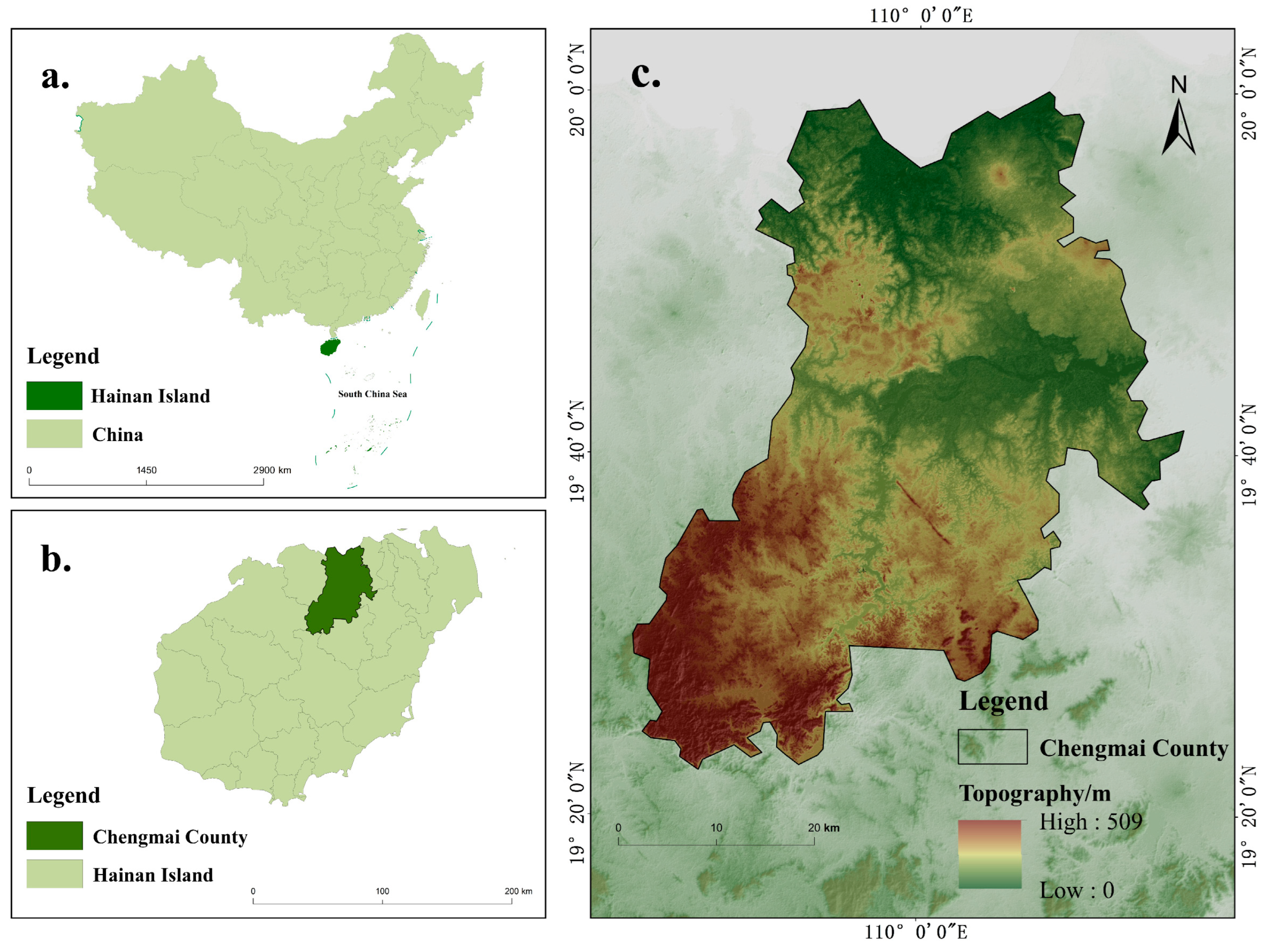
2.1. Study Area
2.2. Data Source
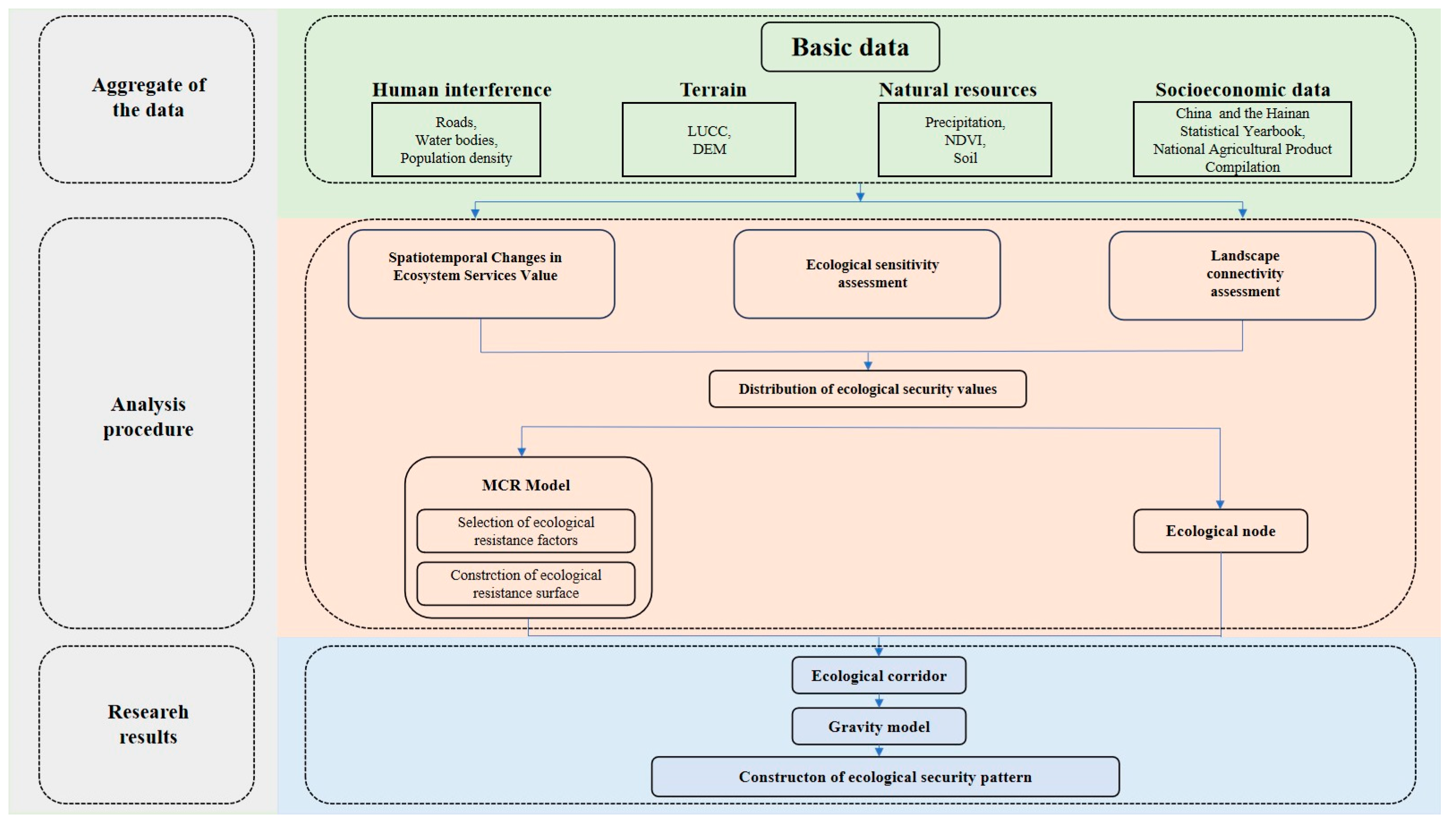
2.3. Methods
2.3.1. Land Use Data Preprocessing
2.3.2. Ecosystem Sensitivity Assessment
2.3.3. Ecosystem Service Value Assessment
- (1)
- Ecosystem Service Value Assessment
- (2)
- Ecosystem Service Change Index (ESCI)
2.3.4. Landscape Connectivity Assessment
2.3.5. Ecological Security Pattern Construction
- (1)
- Resistance Surface Construction
- (2)
- Potential Corridor Extraction
- (3)
- Significant Corridor Identification
3. Results
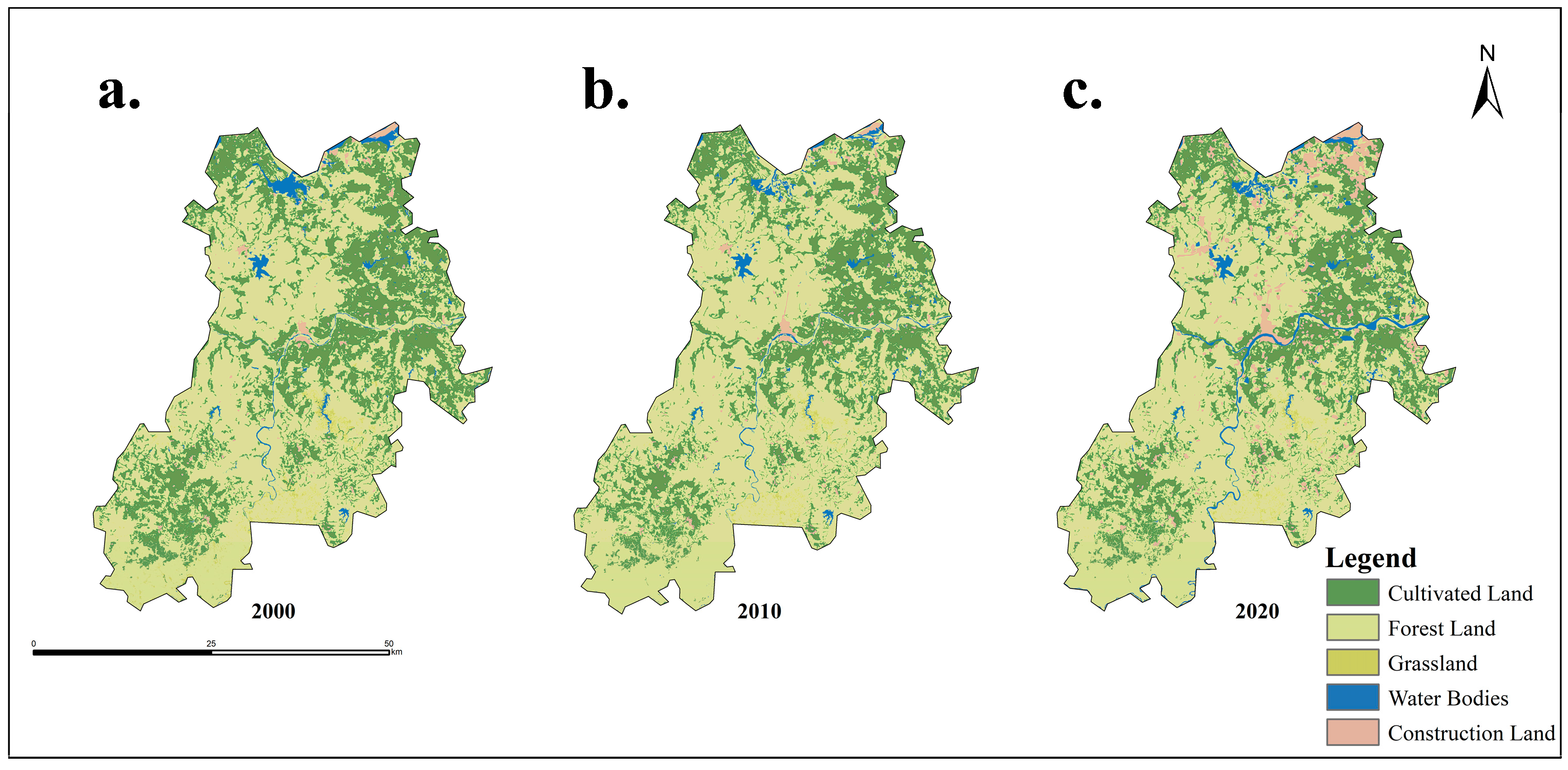
3.1. Land Use Analysis
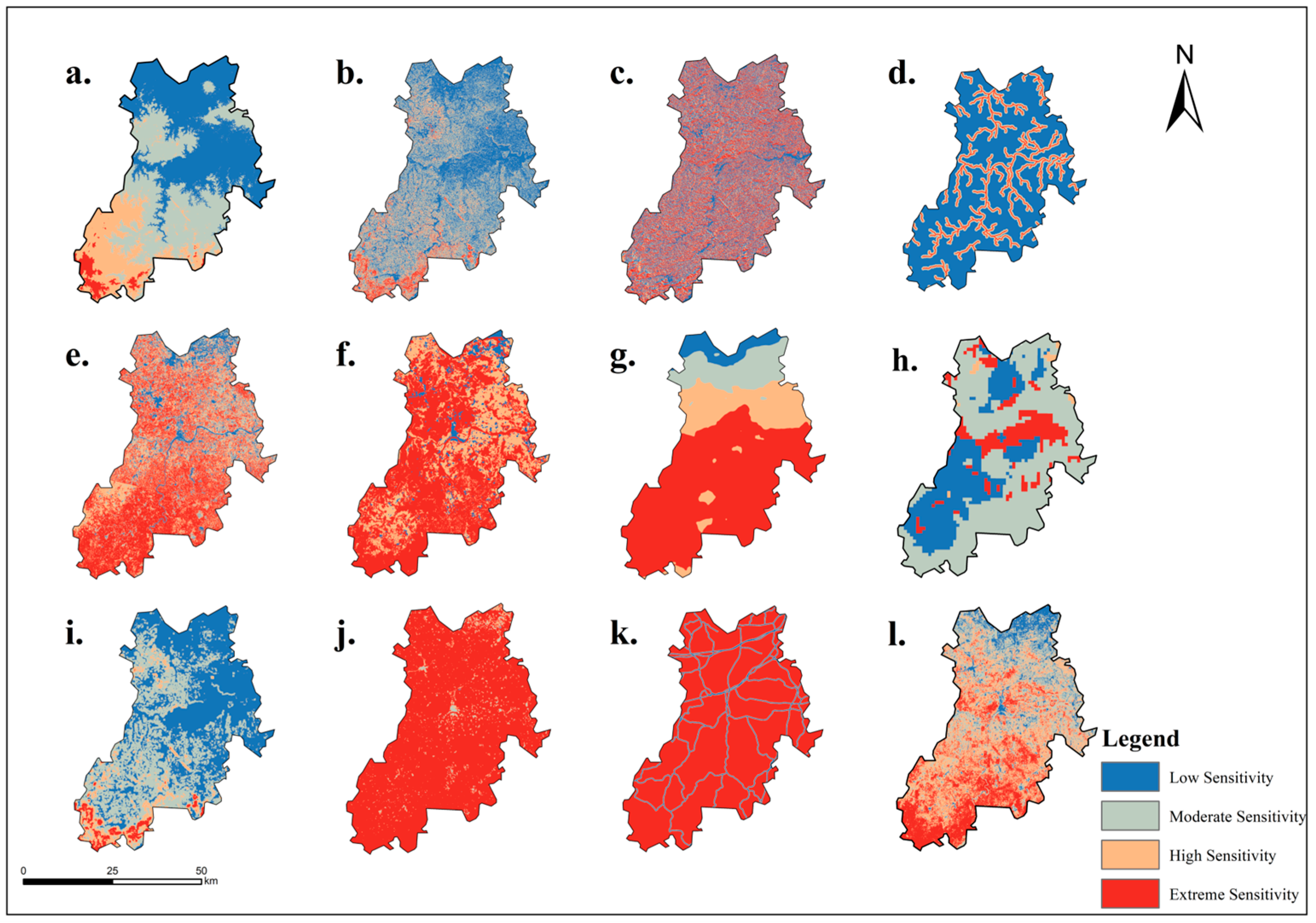
3.2. Ecological Sensitivity
3.3. Spatiotemporal Distribution of Ecosystem Service Value
3.3.1. Ecosystem Service Value Changes
3.3.2. Spatial Distribution of Ecosystem Service Change Index
3.4. Landscape Connectivity Assessment
3.4.1. MSPA Analysis
3.4.2. Landscape Connectivity Analysis
3.5. Ecological Security Pattern Construction
3.5.1. Resistance Surface
3.5.2. Source Distribution
3.5.3. Corridor Extraction
4. Discussion
4.1. The Necessity of Research
4.2. Ecological Security Pattern and Optimization Recommendations
4.3. Innovativeness and Rationality
4.4. Limitations and Prospects
5. Conclusions
- (1)
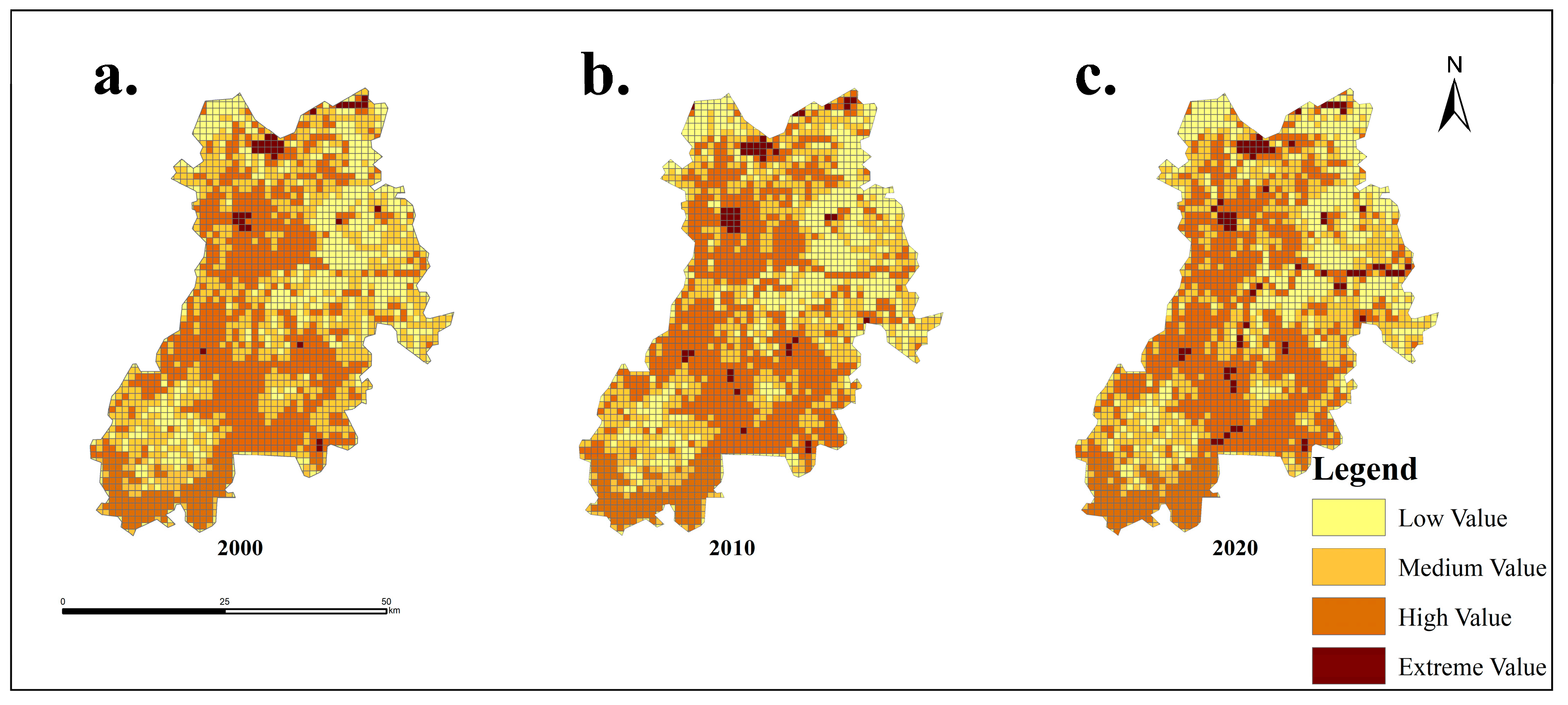
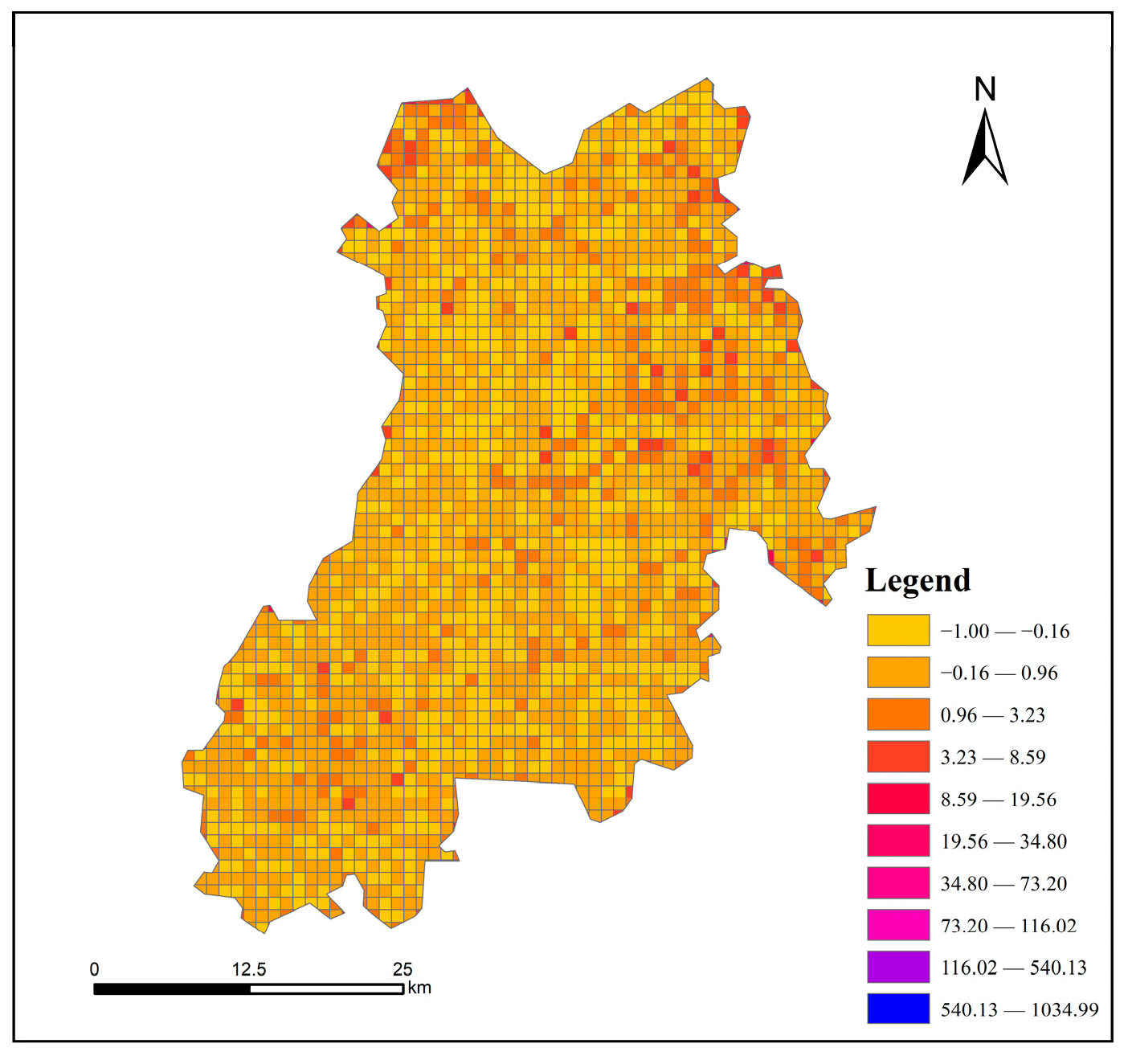
- Rapid expansion of construction land was observed, particularly after 2010, with an overall increase of 289.81%. Ecological sensitivity exhibited a spatial pattern of “high in the south, low in the north,” indicating that southern regions are more vulnerable to environmental changes. ESV displayed significant spatial differentiation, with higher values in the central–southern region and lower values in the northeast, showing an overall increase of 424 million Chinese Yuan.
- (2)
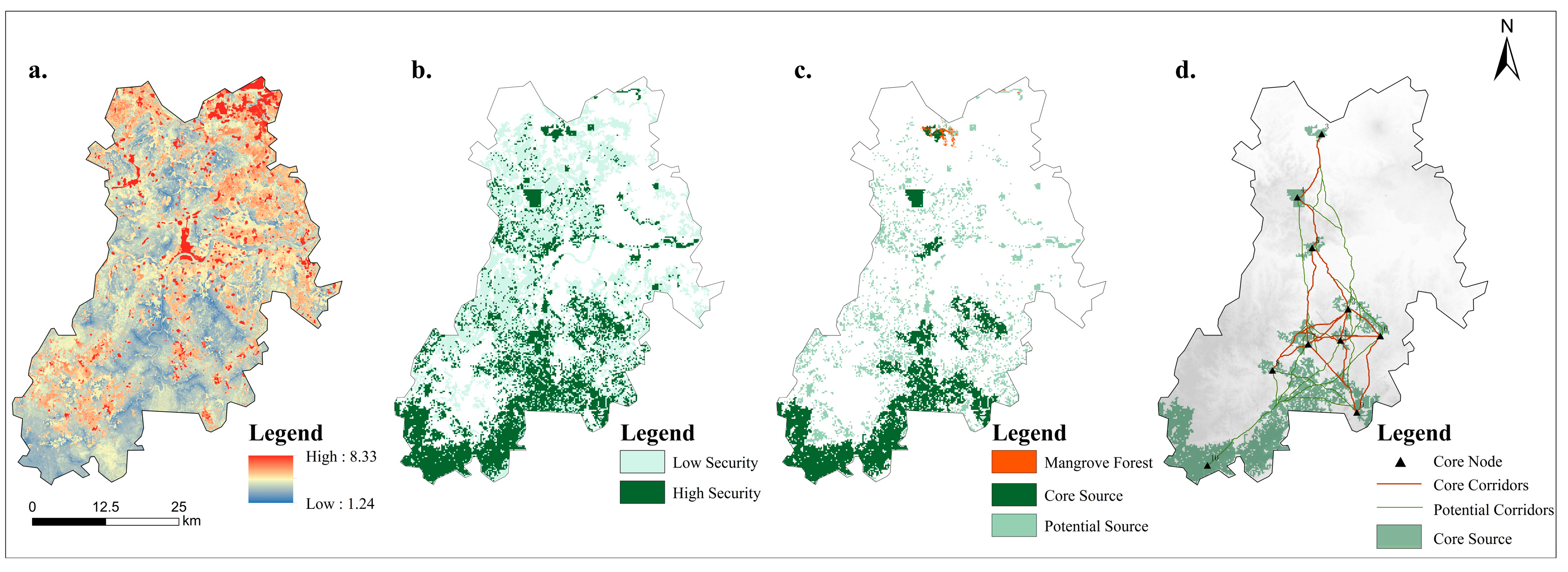
- The overall ecological security status was relatively favorable. Potential ecological sources covering 437.27 km2 were identified, showing a high degree of overlap with ecological protection red lines and nature reserves. A total of 10 ecological nodes and 45 ecological corridors were extracted, with a cumulative length of 1186.91 km. Among these, 16 core corridors, totaling 193.12 km, were prioritized for conservation due to their ecological significance.
- (3)
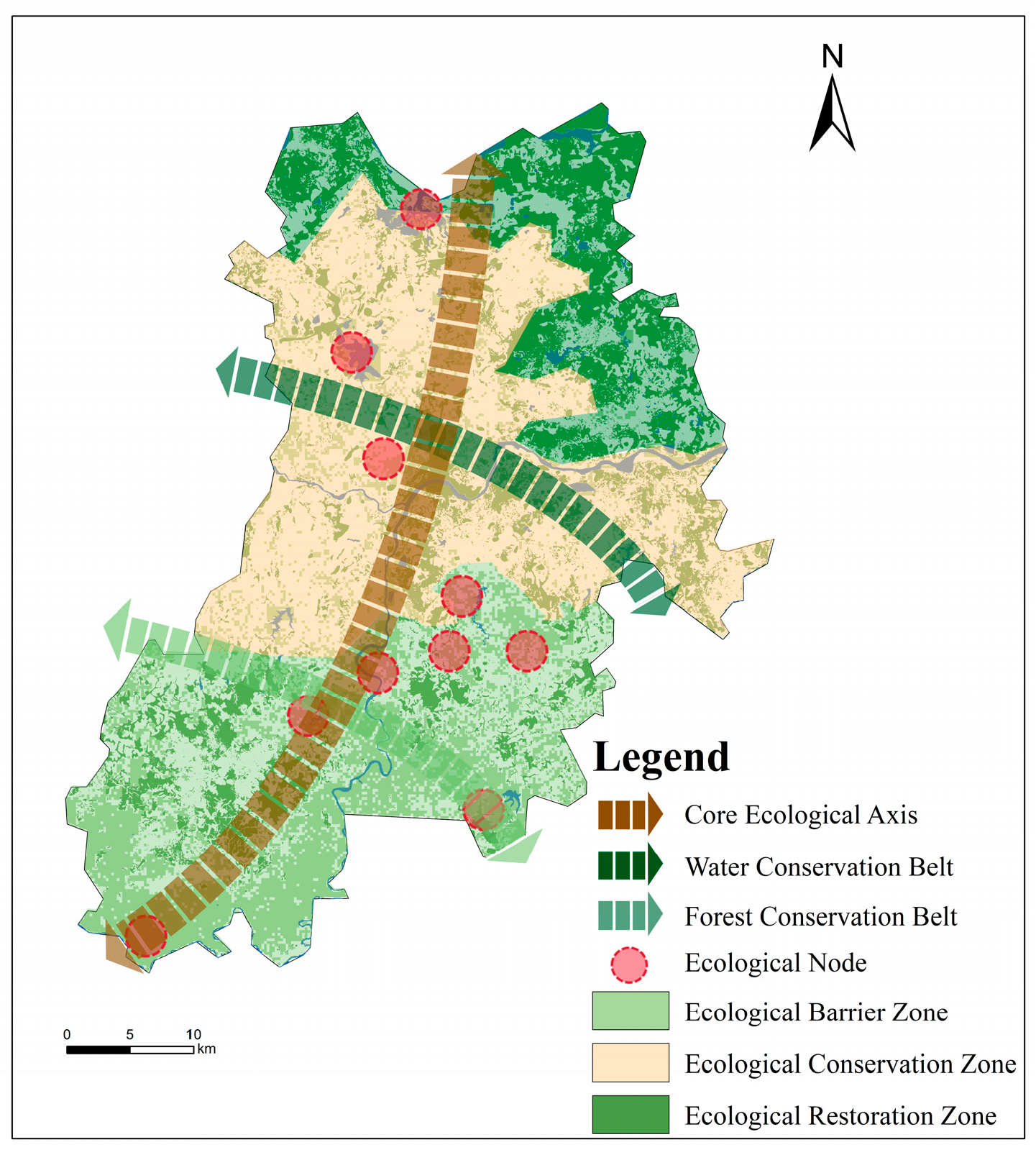
- An integrated ESP described as “one axis, two belts, and three zones” was established. This pattern provides a practical framework for guiding ecological conservation and regional development planning. Furthermore, the ecological security assessment framework developed in this study offers a novel and transferable approach for ESP research in small-scale coastal areas undergoing development.
Author Contributions
Funding
Institutional Review Board Statement
Informed Consent Statement
Data Availability Statement
Acknowledgments
Conflicts of Interest
Abbreviations
| ESV | Ecosystem Service Value |
| ESP | Directory of open access journals |
| MCR | Minimum Cumulative Resistance |
| MSPA | Morphological Spatial Pattern Analysis |
| DEM | Digital Elevation Model |
| NDVI | Normalized Difference Vegetation Index |
| HWSD | Harmonised World Soil Database |
| AHP | Analytic Hierarchy Process |
References
- Bunting, P.; Hilarides, L.; Rosenqvist, A.; Lucas, R.M.; Kuto, E.; Gueye, Y.; Ndiaye, L. Global mangrove watch: Monthly alerts of mangrove loss for africa. Remote Sens. 2023, 15, 2050. [Google Scholar] [CrossRef] [Scilit]
- Goto, G.M.; Goñi, C.S.; Braun, R.; Cifuentes-Jara, M.; Friess, D.A.; Howard, J.; Klinger, D.H.; Teav, S.; Worthington, T.A.; Busch, J. Implementation costs of restoring global mangrove forests. One Earth 2025, 8, 101342. [Google Scholar] [CrossRef] [Scilit]
- Mohan, M.; Selvam, P.P.; Ewane, E.B.; Moussa, L.G.; Asbridge, E.F.; Trevathan-Tackett, S.M.; Macreadie, P.I.; Watt, M.S.; Gillis, L.G.; Cabada-Blanco, F.; et al. Eco-friendly structures for sustainable mangrove restoration. Sci. Total Environ. 2025, 978, 179393. [Google Scholar] [CrossRef] [Scilit] [PubMed]
- Obonaga, L.D.; Ortiz, A.; Wilke, T.; Riascos, J.M. Plastic litter is rapidly bioeroded in mangrove forests. Mar. Environ. Res. 2025, 207, 107027. [Google Scholar] [CrossRef] [Scilit]
- Ram, M.; Sheaves, M.; Waltham, N.J. Restoring mangrove biodiversity: Can restored mangroves support fish assemblages comparable to natural mangroves over time? Restor. Ecol. 2025, 33, e70012. [Google Scholar] [CrossRef] [Scilit]
- Frosi, L.; Arcioni, M.; Macamo, C.; Attorre, F.; Nicosia, E.; Americo, M.; Timba, I.L.; Ramoni-Perazzi, P. Temporal trends, geographic scope, and research gaps in Mozambican mangrove studies. Reg. Stud. Mar. Sci. 2025, 90, 104422. [Google Scholar] [CrossRef] [Scilit]
- Beltrao, M.G.; Goncalves, C.F.; Brancalion, P.H.S.; Carmignotto, A.P.; Silveira, L.F.; Galetti, P.M., Jr.; Galetti, M. Priority areas and implementation of ecological corridor through forest restoration to safeguard biodiversity. Sci. Rep. 2024, 14, 30837. [Google Scholar] [CrossRef] [Scilit]
- Dewa, D.D.; Buchori, I.; Sejati, A.W.; Liu, Y. Integrating Google Earth Engine and regional ecological corridor modeling for remote sensing-based urban heat island mitigation in Java, Indonesia. Remote Sens. Appl. Soc. Environ. 2025, 38, 101573. [Google Scholar] [CrossRef] [Scilit]
- Mardeni, V.D.N.; Dias, H.M.; Santos, A.R.D.; Santos, D.M.C.; Moreira, T.R.; Carvalho, R.D.C.F.; Santos, E.C.D.; Pautz, C.; Zandonadi, C.U. Delimitation of Ecological Corridor Using Technological Tools. Sustainability 2023, 15, 13696. [Google Scholar] [CrossRef] [Scilit]
- Feng, Y.; Ping, L.; Wu, H.; Yao, J. Evaluation of the impact of climate change on the ecological resistance and ecological corridors based on set pair analysis theory. Ecol. Indic. 2024, 163, 112050. [Google Scholar] [CrossRef] [Scilit]
- Salviano, I.R.; Gardon, F.R.; dos Santos, R.F. Ecological corridors and landscape planning: A model to select priority areas for connectivity maintenance. Landsc. Ecol. 2021, 36, 3311–3328. [Google Scholar] [CrossRef] [Scilit]
- Pelorosso, R.; Noce, S.; De Notaris, C.; Gobattoni, F.; Apollonio, C.; Petroselli, A.; Recanatesi, F.; Ripa, M.N. The nexus between connectivity, climate, and land use: A scenario assessment of bio-energy landscape connectivity in central Italy. J. Environ. Manag. 2025, 376, 124521. [Google Scholar] [CrossRef] [Scilit]
- Naidoo, R.; Aylward, C.; Elliott, W.; Keeley, A.; Kinnaird, M.; Knight, M.; Papp, C.-R.; Thapa, K.; Antelo, R. From science to impact: Conserving ecological connectivity in large conservation landscapes. Proc. Natl. Acad. Sci. USA 2025, 122, e2410937122. [Google Scholar] [CrossRef] [Scilit] [PubMed]
- Montano, L.; Harrison, A.; Henderson, B.; Coleman, M.A.; Raoult, V.; Taylor, M.D.; Gaston, T.; Dwyer, P.G.; Costanza, R.; Dansie, A.; et al. The value of Australian aquatic ecosystem services. Ecosyst. Serv. 2025, 76, 101786. [Google Scholar] [CrossRef] [Scilit]
- Abulaiti, H.; Liu, Y. Ecological sensitivity assessment and driving force analysis of the Tarim river basin. Sci. Rep. 2025, 15, 34630. [Google Scholar] [CrossRef] [Scilit]
- Yang, X.; Liu, W.; Li, S.; Ma, Z.; Chen, C.; Gu, W.; Qu, M.; Zhang, C.; Tao, J.; Ding, Z.; et al. Restoration of urban waterbird diversity: A case study of the construction of a waterbird ecological corridor in the Guangdong-Hong Kong-Macao Greater Bay Area, Southern China. Glob. Ecol. Conserv. 2022, 39, e02277. [Google Scholar] [CrossRef] [Scilit]
- Justeau-Allaire, D.; Ibanez, T.; Vieilledent, G.; Lorca, X.; Birnbaum, P. Refining intra-patch connectivity measures in landscape fragmentation and connectivity indices. Landsc. Ecol. 2024, 39, 24. [Google Scholar] [CrossRef] [Scilit]
- Morin, E.; Razafimbelo, N.T.; Yengué, J.-L.; Guinard, Y.; Grandjean, F.; Bech, N. Are human-induced changes good or bad to dynamic landscape connectivity? J. Environ. Manag. 2024, 352, 120009. [Google Scholar] [CrossRef] [Scilit] [PubMed]
- Nolander, C.; Lundmark, R. A review of forest ecosystem services and their spatial value characteristics. Forests 2024, 15, 919. [Google Scholar] [CrossRef] [Scilit]
- Birhane, E.; Negash, E.; Getachew, T.; Gebrewahed, H.; Gidey, E.; Gebremedhin, M.A.; Mhangara, P. Changes in total and per-capital ecosystem service value in response to land-use land-cover dynamics in north-central Ethiopia. Sci. Rep. 2024, 14, 6540. [Google Scholar] [CrossRef] [Scilit]
- Brander, L.M.; de Groot, R.; Schägner, J.P.; Guisado-Goñi, V.; van’t Hoff, V.; Solomonides, S.; McVittie, A.; Eppink, F.; Sposato, M.; Do, L.; et al. Economic values for ecosystem services: A global synthesis and way forward. Ecosyst. Serv. 2024, 66, 101606. [Google Scholar] [CrossRef] [Scilit]
- Raj, A.; Sharma, L.K. Spatial E-PSR modelling for ecological sensitivity assessment for arid rangeland resilience and management. Ecol. Model. 2023, 478, 110283. [Google Scholar] [CrossRef] [Scilit]
- Khan, R.; Saxena, A.; Shukla, S.; Goel, P.; Bhattacharya, P.; Li, P.; Ali, E.F.; Shaheen, S.M. Appraisal of water quality and ecological sensitivity with reference to riverfront development along the River Gomti, India. Appl. Water Sci. 2022, 12, 13. [Google Scholar] [CrossRef] [Scilit]
- de Morais, M.; Abdo, M.S.A.; dos Santos, C.; Sander, N.L.; da Silva Nunes, J.R.; Lázaro, W.L.; da Silva, C.J. Long-term analysis of aquatic macrophyte diversity and structure in the Paraguay river ecological corridor, Brazilian Pantanal wetland. Aquat. Bot. 2022, 178, 103500. [Google Scholar] [CrossRef] [Scilit]
- De Feudis, C.; Torretta, E.; Orioli, V.; Tirozzi, P.; Bani, L.; Meriggi, A.; Dondina, O. Dispersal and settlement dynamics of wolves in a lowland ecological corridor in northern Italy: Effects of resource availability and human disturbance. Biol. Conserv. 2025, 302, 110936. [Google Scholar] [CrossRef] [Scilit]
- Gao, J.; Du, F.; Zuo, L.; Jiang, Y. Integrating ecosystem services and rocky desertification into identification of karst ecological security pattern. Landsc. Ecol. 2021, 36, 2113–2133. [Google Scholar] [CrossRef] [Scilit]
- Liu, H.; Wang, Z.; Zhang, L.; Tang, F.; Wang, G.; Li, M. Construction of an ecological security network in the Fenhe River Basin and its temporal and spatial evolution characteristics. J. Clean. Prod. 2023, 417, 137961. [Google Scholar] [CrossRef] [Scilit]
- Xu, D.; Guo, X.; Watanabe, T.; Liang, K.; Kou, J.; Jiang, X. Ecological security pattern construction in rural settlements based on importance and vulnerability of ecosystem services: A case study of the southeast region of Chongqing, China. Sustainability 2023, 15, 7477. [Google Scholar] [CrossRef] [Scilit]
- Wei, W.; Zhang, Y.; Wei, X.; Xie, B.; Ma, Z.; Liu, C.; Yu, L.; Zhou, J.; Shi, W.; Liu, T.; et al. Construction and optimization of ecological security patterns based on ecosystem service function and ecosystem sensitivity in the important ecological functional area—A case study in the Yellow River Basin. Ecol. Eng. 2025, 215, 107609. [Google Scholar] [CrossRef] [Scilit]
- Xu, H.; Zhang, Z.; Yu, X.; Li, T.; Chen, Z. The construction of an ecological security pattern based on the comprehensive evaluation of the importance of ecosystem service and ecological sensitivity: A case of Yangxin County, Hubei province. Front. Environ. Sci. 2023, 11, 1154166. [Google Scholar] [CrossRef] [Scilit]
- Nie, H.; Zhao, Y.; Zhu, J.; Ning, A.; Zheng, W. Ecological security pattern construction in typical oasis area based on ant colony optimization: A case study in Yili River Valley, China. Ecol. Indic. 2024, 169, 112770. [Google Scholar] [CrossRef] [Scilit]
- Chen, J.; Wang, S.; Zou, Y. Construction of an ecological security pattern based on ecosystem sensitivity and the importance of ecological services: A case study of the Guanzhong Plain urban agglomeration, China. Ecol. Indic. 2022, 136, 108688. [Google Scholar] [CrossRef] [Scilit]
- Meng, H.; Gong, Z.; Qian, C.; Zhao, X.; Liu, Q.; Bu, X.; Shen, C. Deciphering the spatial code: Identification and optimization of ecological security pattern—A case study of Jiangsu province, China. Land 2025, 14, 1928. [Google Scholar] [CrossRef] [Scilit]
- Ran, Y.; Lei, D.; Li, J.; Gao, L.; Mo, J.; Liu, X. Identification of crucial areas of territorial ecological restoration based on ecological security pattern: A case study of the central Yunnan urban agglomeration, China. Ecol. Indic. 2022, 143, 109318. [Google Scholar] [CrossRef] [Scilit]
- Tong, H.-l.; Shi, P.-j. Using ecosystem service supply and ecosystem sensitivity to identify landscape ecology security patterns in the Lanzhou-Xining urban agglomeration, China. J. Mt. Sci. 2020, 17, 2758–2773. [Google Scholar] [CrossRef] [Scilit]
- Horváth, G.F.; Mánfai, K.; Horváth, A. Relationship between landscape structure and the diet of common barn-owl (tyto alba) at different distances from the Drava River ecological corridor. Ornis Hung. 2023, 31, 88–110. [Google Scholar] [CrossRef] [Scilit]
- Zheng, Y.; Tang, P.; Dong, L.; Yao, Z.; Guo, J. Evaluation of ecological carrying capacity and construction of ecological security pattern in West Liaohe River Basin of China. Front. Ecol. Evol. 2024, 12, 1335671. [Google Scholar] [CrossRef] [Scilit]
- Niu, X.; Zhang, J.; Wang, S.; Zong, L.; Zhou, M.; Zhang, M. Identification of priority areas for ecological restoration based on ecological security patterns and ecological risks: A case study of the Hefei Metropolitan Area. Ecol. Indic. 2025, 175, 113590. [Google Scholar] [CrossRef] [Scilit]
- Wang, X.; Qiu, X.; Wang, Z.; Feng, C.; Fan, Z.; He, W. Construction of a social ecological security pattern based on the supply and demand of ecosystem services. J. Nat. Conserv. 2025, 86, 126962. [Google Scholar] [CrossRef] [Scilit]
- Li, W.; Liu, Y.; Lin, Q.; Wu, X.; Hao, J.; Zhou, Z.; Zhang, X. Identification of ecological security pattern in the Qinghai-Tibet Plateau. Ecol. Indic. 2025, 170, 113057. [Google Scholar] [CrossRef] [Scilit]
- Li, L.; Tang, H.; Lei, J.; Song, X. Spatial autocorrelation in land use type and ecosystem service value in Hainan Tropical Rain Forest National Park. Ecol. Indic. 2022, 137, 108727. [Google Scholar] [CrossRef] [Scilit]
- García-Ontiyuelo, M.; Acuña-Alonso, C.; Vasilakos, C.; Álvarez, X. Strategies for detecting land-use change on the River Tea SCI ecological corridor via satellite images. Sci. Total Environ. 2024, 957, 177507. [Google Scholar] [CrossRef] [Scilit]
- Lei, J.; Chen, Z.; Chen, X.; Li, Y.; Wu, T. Spatio-temporal changes of land use and ecosystem services value in Hainan Island from 1980 to 2018. Acta Ecol. Sin. 2020, 40, 4760–4773. [Google Scholar]
- Manolaki, P.; Zotos, S.; Vogiatzakis, I.N. An integrated ecological and cultural framework for landscape sensitivity assessment in Cyprus. Land Use Policy 2020, 92, 104336. [Google Scholar] [CrossRef] [Scilit]
- Duan, Y.; Zhang, L.; Fan, X.; Hou, Q.; Hou, X. Smart city oriented ecological sensitivity assessment and service value computing based on intelligent sensing data processing. Comput. Commun. 2020, 160, 263–273. [Google Scholar] [CrossRef] [Scilit]
- Jin, X.; Wei, L.; Wang, Y.; Lu, Y. Construction of ecological security pattern based on the importance of ecosystem service functions and ecological sensitivity assessment: A case study in Fengxian county of Jiangsu province, China. Environ. Dev. Sustain. 2021, 23, 563–590. [Google Scholar] [CrossRef] [Scilit]
- Ying, B.; Liu, T.; Ke, L.; Xiong, K.; Li, S.; Sun, R.; Zhu, F. Identifying the landscape security pattern in karst rocky desertification area based on ecosystem services and ecological sensitivity: A case study of Guanling county, Guizhou province. Forests 2023, 14, 613. [Google Scholar] [CrossRef] [Scilit]
- Liang, Y.-X.; Wu, D.-F.; Wu, Z.-J.; Xu, Y.; Zhu, Z.-W.; Zhang, Y.-C.; Zhu, H. Construction of ecological corridors in karst areas based on ecological sensitivity and ecological service value. Land 2023, 12, 1177. [Google Scholar] [CrossRef] [Scilit]
- Wei, L.; Li, M.; Ma, Y.; Wang, Y.; Wu, G.; Liu, T.; Gong, W.; Mao, M.; Zhao, Y.; Wei, Y.; et al. Construction of an ecological security pattern for the national park of Hainan tropical rainforest on the basis of the importance of the function and sensitivity of its ecosystem services. Land 2024, 13, 1618. [Google Scholar] [CrossRef] [Scilit]
- Xie, G.; Zhang, C.; Zhang, L.; Chen, W.; Li, S. Improvement of the evaluation method for ecosystem service value based on per unit area. J. Nat. Resour. 2015, 30, 1243–1254. (In Chinese) [Google Scholar] [CrossRef]
- Qin, J.-Z.; Dai, J.-P.; Li, S.-H.; Zhang, J.-Z.; Peng, J.-S. Construction of ecological network in Qujing city based on MSPA and MCR models. Sci. Rep. 2024, 14, 9800. [Google Scholar] [CrossRef] [Scilit]
- Wang, F.; Yuan, X.; Zhou, L.; Zhang, M. Integrating ecosystem services and landscape connectivity to construct and optimize ecological security patterns: A case study in the central urban area Chongqing municipality, China. Environ. Sci. Pollut. Res. 2022, 29, 43138–43154. [Google Scholar] [CrossRef] [Scilit] [PubMed]
- Wei, Q.; Halike, A.; Yao, K.; Chen, L.; Balati, M. Construction and optimization of ecological security pattern in Ebinur Lake Basin based on MSPA-MCR models. Ecol. Indic. 2022, 138, 108857. [Google Scholar] [CrossRef] [Scilit]
- Qian, W.; Zhao, Y.; Li, X. Construction of ecological security pattern in coastal urban areas: A case study in Qingdao, China. Ecol. Indic. 2023, 154, 110754. [Google Scholar] [CrossRef] [Scilit]
- Zhang, F.; Jia, Y.; Liu, X.; Li, T.; Gao, Q. Application of MSPA-MCR models to construct ecological security pattern in the basin: A case study of Dawen River basin. Ecol. Indic. 2024, 160, 111887. [Google Scholar] [CrossRef] [Scilit]
- Ye, H.; Yang, Z.; Xu, X. Ecological corridors analysis based on mspa and mcr model—A case study of the tomur world natural heritage region. Sustainability 2020, 12, 959. [Google Scholar] [CrossRef] [Scilit]
- Zhang, S.; Zhang, Y.; Xiong, K.; Yu, Y.; He, C.; Zhang, S.; Wang, Z. Construction of forest ecological security patterns based on MSPA model and circuit theory in the Desertification Control forests in South China Karst. npj Herit. Sci. 2025, 13, 432. [Google Scholar] [CrossRef] [Scilit]
- Yuan, M.; Xian, Q.; Huang, Q.; Yang, C.; Shu, J.; Yao, C.; Pan, H. Research on ecological security pattern based on the paradigm of “portray-assessment-construction-validation”—Minjiang River Basin as an example. J. Environ. Manag. 2025, 394, 127553. [Google Scholar] [CrossRef] [Scilit]
- Kong, F.; Duan, S.; Xu, C. The construction of ecological security pattern based on ecosystem services and ecological sensitivity: A case study of the Qiantang River Basin. Acta Ecol. Sin. 2024, 44, 11359–11374. [Google Scholar]
- Li, Y.; Liu, W.; Feng, Q.; Zhu, M.; Yang, L.; Zhang, J.; Yin, X. The role of land use change in affecting ecosystem services and the ecological security pattern of the Hexi Regions, Northwest China. Sci. Total Environ. 2023, 855, 158940. [Google Scholar] [CrossRef] [Scilit]
- Berhanu, Y.; Dalle, G.; Sintayehu, D.W.; Kelboro, G.; Nigussie, A. Land use/land cover dynamics driven changes in woody species diversity and ecosystem services value in tropical rainforest frontier: A 20-year history. Heliyon 2023, 9, e13711. [Google Scholar] [CrossRef] [Scilit] [PubMed]
- Heddam, S.; Zhang, Z.; Ge, H.; Li, X.; Huang, X.; Ma, S.; Bai, Q. Spatiotemporal patterns and prediction of landscape ecological security in Xishuangbanna from 1996–2030. PLoS ONE 2023, 18, e0292875. [Google Scholar] [CrossRef] [Scilit]
- Zhou, G.; Huan, Y.; Wang, L.; Zhang, R.; Liang, T.; Han, X.; Feng, Z. Constructing a multi-leveled ecological security pattern for improving ecosystem connectivity in the Asian water Tower region. Ecol. Indic. 2023, 154, 110597. [Google Scholar] [CrossRef] [Scilit]
- Jin, B.; Geng, J.; Ding, Z.; Guo, L.; Rui, Q.; Wu, J.; Peng, S.; Jin, R.; Fu, X.; Pan, H.; et al. Construction and optimization of ecological corridors in coastal cities based on the perspective of “structure-function”. Sci. Rep. 2024, 14, 27945. [Google Scholar] [CrossRef] [Scilit]
- Dai, L.; Liu, Y.; Luo, X. Integrating the MCR and DOI models to construct an ecological security network for the urban agglomeration around Poyang Lake, China. Sci. Total Environ. 2021, 754, 141868. [Google Scholar] [CrossRef] [Scilit]
- Dong, Z.; Liu, H.; Liu, H.; Chen, Y.; Fu, X.; Zhang, Y.; Xia, J.; Zhang, Z.; Chen, Q. Analysis of habitat quality changes in mountainous areas using the plus model and construction of a dynamic restoration framework for ecological security patterns: A case study of golog tibetan autonomous prefecture, Qinghai province, China. Land 2025, 14, 1509. [Google Scholar] [CrossRef] [Scilit]
- Huang, M.; Gong, D.; Zhang, L.; Lin, H.; Chen, Y.; Zhu, D.; Xiao, C.; Altan, O. Spatiotemporal dynamics and forecasting of ecological security pattern under the consideration of protecting habitat: A case study of the Poyang Lake ecoregion. Int. J. Digit. Earth 2024, 17, 2376277. [Google Scholar] [CrossRef] [Scilit]



| Type | Resolution (m) | Source | Year |
|---|---|---|---|
| Land-Use Data | 30 | National Catalogue Service For Geographic Information (https://www.webmap.cn/ (accessed on 16 June 2025)) | 2000, 2010, 2020 |
| DEM | 30 | Geospatial Data Cloud (http://www.gscloud.cn/ (accessed on 17 June 2025)) | 2020 |
| Soil | 1000 | Soil Dataset (v2.0) from the World Soil Database (HWSD) of the Cold and Arid Regions Scientific Data Centre | 2023 |
| Precipitation | 1000 | Geospatial Data Cloud (http://www.gscloud.cn/ (accessed on 1 June 2025)) | 2022 |
| Population density data | 90 | (https://landscan.ornl.gov/ (accessed on 3 June 2025)) | 2022 |
| NDVI | 1000 | Geospatial Data Cloud (http://www.Gscloud.cn (accessed on 1 June 2025)) | 2021 |
| Road and water data body buffer data | - | National Catalogue Service For Geographic Information (https://www.webmap.cn/ (accessed on 20 July 2025)) | 2021 |
| Socioeconomic data | - | The Hainan Statistical Yearbook, China Statistical Yearbook, and National Agricultural Product Compilation. | 2000–2020 |
| Evaluation Factors | Low Sensitivity | Moderate Sensitivity | High Sensitivity | Extreme Sensitivity | |
|---|---|---|---|---|---|
| Soil Erosion | Rainfall Erosivity/(MJ·mm/hm2·h) | <14,074.39 | [14,074.39, 14,696.10) | [14,696.10, 15,202.60) | ≥15,202.60 |
| Soil Erodibility/ [t·hm2·h/ (hm2·MJ·mm2)] | <0.010 | [0.010, 0.014) | [0.014, 0.018) | ≥0.018 | |
| Topographic Roughness/m | <26 | [26, 53) | [53, 105) | [105, 272] | |
| Human Disturbance | Population Density | ≥240 | [50, 240) | [14, 50) | <14 |
| Road Buffer Zone/m | <100 | [100, 150) | [150, 200) | ≥200 | |
| Habitat Quality | Land Use Type | Construction Land | Unutilized Land | Cultivated Land, Grassland | Forest Land, Water Bodies |
| Elevation/m | [0, 62) | [62, 117) | [117, 213) | ≥213 | |
| Slope/(°) | [0, 4) | [4, 9) | [9, 17) | ≥17 | |
| Aspect | Flat terrain, due north, northwest | Northeast, Due West | East | South, Southeast, Southwest | |
| Water Body Buffer Zone/m | Buffer distance > 500 | Buffer distance 200–500 | Buffer distance 50–200 | Buffer distance < 50 | |
| NDVI | [0, 0.23) | [0.23, 0.51) | [0.51, 0.74) | [0.74, 1] | |
| Ecosystem Service | Secondary Type | Cultivated Land | Forest Land | Grassland | Water Bodies | Construction Land | Unutilized Land |
|---|---|---|---|---|---|---|---|
| Provisioning Services | Food Production | 3169.77 | 800.14 | 892.46 | 2031.12 | 0 | 30.77 |
| Raw Material Production | 892.46 | 1846.47 | 1323.3 | 1138.66 | 0 | 92.32 | |
| Water Supply | −2800.48 | 954.01 | 738.59 | 16,741.33 | 0 | 61.55 | |
| Regulating Services | Gas Regulation | 2523.51 | 6093.35 | 4646.95 | 4123.78 | 0 | 307.75 |
| Climate Regulation | 1323.3 | 18,218.5 | 12,309.8 | 9078.48 | 0 | 276.97 | |
| Purification of the Environment | 369.29 | 5323.99 | 4062.23 | 14,094.72 | 0 | 892.46 | |
| Hydrological Regulation | 3477.52 | 11,909.73 | 9016.93 | 194,617.94 | 0 | 584.72 | |
| Supporting Services | Soil Conservation | 2061.89 | 7416.65 | 5662.51 | 4985.47 | 0 | 369.29 |
| Nutrient Cycling Maintenance | 430.84 | 553.94 | 430.84 | 400.07 | 0 | 30.77 | |
| Biodiversity | 492.39 | 6739.62 | 5139.34 | 16,033.51 | 0 | 338.52 | |
| Cultural Services | Aesthetic Landscape | 215.42 | 2954.35 | 2277.31 | 10,186.36 | 0 | 153.87 |
| Resistance Type | Resistance Value | Weight | ||||
|---|---|---|---|---|---|---|
| 1 | 3 | 5 | 7 | 9 | ||
| Land Use Type | Forest land, Water bodies | Grassland | Cultivated land | Unutilized land | Construction land | 0.43 |
| Elevation/m | <47 | 47–87 | 87–135 | 135–227 | >227 | 0.06 |
| Slope/° | <3 | 3–7 | 7–12 | 12–20 | >20 | 0.11 |
| NDVI | >0.45 | 0.36–0.45 | 0.24–0.36 | 0.08–0.24 | 0–0.08 | 0.17 |
| Distance from Road/m | >5867 | 3224–5867 | 1881–3224 | 850–1881 | <850 | 0.12 |
| Distance from Water Dodies/m | <50 | 50–200 | 200–500 | 500–800 | >800 | 0.11 |
| Weight Type | DEM | Slope Gradient | Slope Aspect | Water Body Buffer Zone | NDVI | Land Use Type | Rainfall Erosive Power | Soil Erodibility | Terrain Undulation | Population Density | Road Buffer Zone |
|---|---|---|---|---|---|---|---|---|---|---|---|
| wAi | 0.06 | 0.07 | 0.05 | 0.09 | 0.22 | 0.08 | 0.08 | 0.12 | 0.08 | 0.10 | 0.05 |
| wBi | 0.09 | 0.09 | 0.09 | 0.09 | 0.09 | 0.09 | 0.08 | 0.08 | 0.09 | 0.12 | 0.08 |
| wi | 0.06 | 0.07 | 0.05 | 0.09 | 0.22 | 0.08 | 0.07 | 0.11 | 0.08 | 0.13 | 0.04 |
| Land Use Type | Cultivated Land | Forest Land | Grassland | Water Bodies | Construction Land | Unutilized Land | |
|---|---|---|---|---|---|---|---|
| 2000 | Area (km2) | 710.06 | 1252.50 | 24.39 | 45.14 | 29.45 | 0.00 |
| Proportion/% | 34.44 | 60.76 | 1.18 | 2.19 | 1.43 | 0.00 | |
| 2010 | Area (km2) | 618.05 | 1356.40 | 12.15 | 40.07 | 34.85 | 0.00 |
| Proportion/% | 29.98 | 65.80 | 0.59 | 1.94 | 1.69 | 0.00 | |
| 2020 | Area (km2) | 595.88 | 1276.52 | 12.07 | 62.32 | 114.81 | 0.00 |
| Proportion/% | 28.90 | 61.92 | 0.59 | 3.02 | 5.57 | 0.00 | |
| Area Change (2000–2020)/km2 | −114.18 | 24.02 | −12.32 | 17.18 | 85.36 | 0.00 | |
| Area Change Rate (2000–2020)/% | −16.08 | 1.92 | −50.51 | 38.05 | 289.81 | 0.00 | |
| Evaluation Factors | Area\km2 | ||||
|---|---|---|---|---|---|
| Low Sensitivity | Moderate Sensitivity | High Sensitivity | Extreme Sensitivity | ||
| Habitat Quality | Elevation | 871.15 | 763.54 | 366.25 | 60.65 |
| Aspect | 647.74 | 468.68 | 233.31 | 703.79 | |
| Slope | 1002.08 | 685.56 | 284.55 | 81.34 | |
| Land Use Type | 114.81 | 0.00 | 607.95 | 1338.83 | |
| Water Body Buffer Zone | 1488.02 | 216.41 | 232.35 | 124.75 | |
| Human Disturbance | Population Density | 0.35 | 32.35 | 71.75 | 1956.66 |
| Road Buffer Zone | 125.62 | 59.67 | 57.83 | 1818.42 | |
| Soil Erosion | Soil Erodibility | 579.83 | 1191.25 | 19.23 | 264.99 |
| Rainfall Erosivity | 114.77 | 259.97 | 384.70 | 1302.10 | |
| NDVI | 214.60 | 288.04 | 638.19 | 920.55 | |
| Topographic Roughness | 1091.90 | 829.13 | 160.38 | 59.48 | |
| Comprehensive Evaluation Index | Area\km2 | Proportion/% | |
|---|---|---|---|
| Low Sensitivity | 1.12–2.18 | 206.08 | 10.06 |
| Moderate Sensitivity | 2.18–2.61 | 539.87 | 26.34 |
| High Sensitivity | 2.61–2.96 | 791.69 | 38.63 |
| Extreme Sensitivity | 2.96–3.73 | 511.81 | 24.97 |
| Land Use Type | Cultivated Land | Forest Land | Grassland | Water Bodies | Construction Land | Unutilized Land | Total | |
|---|---|---|---|---|---|---|---|---|
| 2000 | Area (km2) | 8.63 | 78.67 | 1.13 | 12.34 | 0.00 | 0.00 | 100.78 |
| Proportion/% | 8.56 | 78.06 | 1.13 | 12.25 | 0.00 | 0.00 | 100.00 | |
| 2010 | Area (km2) | 7.51 | 85.20 | 0.56 | 10.96 | 0.00 | 0.00 | 104.23 |
| Proportion/% | 7.21 | 81.74 | 0.54 | 10.51 | 0.00 | 0.00 | 100.00 | |
| 2020 | Area (km2) | 7.24 | 80.18 | 0.56 | 17.04 | 0.00 | 0.00 | 105.02 |
| Proportion/% | 6.90 | 76.34 | 0.53 | 16.22 | 0.00 | 0.00 | 100.00 | |
| ESV Changes (2000–2020) | −1.39 | 1.51 | −0.57 | 4.70 | 0.00 | 0.00 | 4.24 | |
| ESV Change Rate (2000–2020)/% | −16.08 | 1.92 | −50.51 | 38.05 | 0.00 | 0.00 | 4.21 | |
| Value Level | Low Value | Medium Value | High Value | Extreme Value | Total | |
|---|---|---|---|---|---|---|
| 2000 | Area (km2) | 535.88 | 684.52 | 808.52 | 32.67 | 2061.59 |
| Proportion/% | 25.99 | 33.20 | 39.22 | 1.58 | 100.00 | |
| 2010 | Area (km2) | 469.90 | 634.37 | 913.30 | 44.00 | 2061.57 |
| Proportion/% | 22.79 | 30.77 | 44.30 | 2.13 | 100.00 | |
| 2020 | Area (km2) | 448.74 | 623.21 | 919.97 | 69.66 | 2061.58 |
| Proportion/% | 21.77 | 30.23 | 44.62 | 3.38 | 100.00 | |
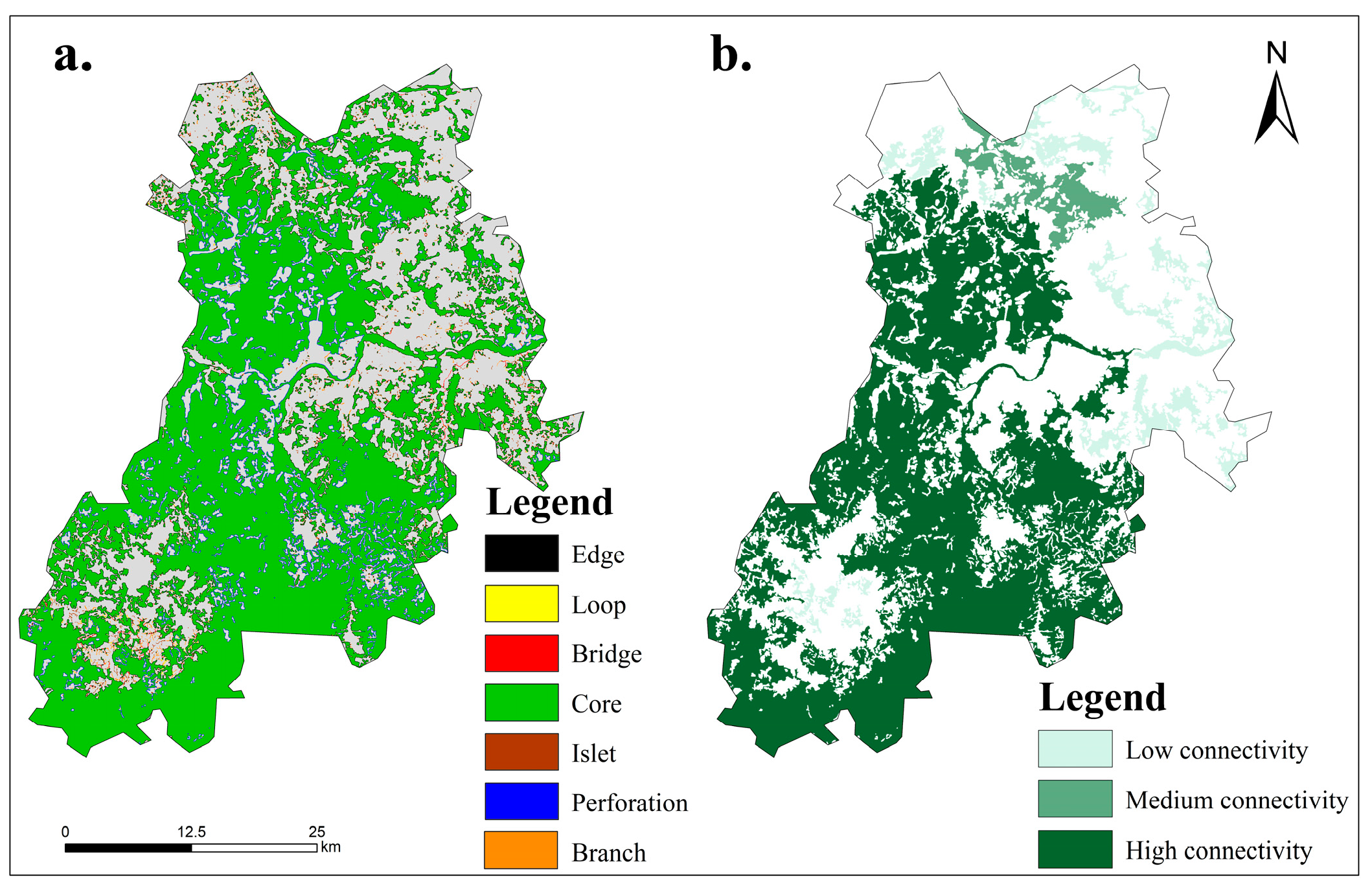
| Type | Edge | Branch | Islet | Core | Loop | Perforation | Bridge | Total |
|---|---|---|---|---|---|---|---|---|
| Area/km2 | 103.89 | 17.17 | 3.77 | 1150.33 | 5.74 | 59.51 | 6.01 | 1346.41 |
| Area of foreground/% | 7.72 | 1.28 | 0.28 | 85.44 | 0.43 | 4.42 | 0.45 | 100 |
| Proportion of total area/% | 5.04 | 0.83 | 0.18 | 55.8 | 0.28 | 2.89 | 0.29 | 65.31 |
| Type | High Connectivity | Medium Connectivity | Low Connectivity | Total |
|---|---|---|---|---|
| Area/km2 | 917.32 | 53.74 | 119.26 | 1090.32 |
| Core area coverage/% | 84.13 | 4.93 | 10.94 | 100 |
| Node | 1 | 2 | 3 | 4 | 5 | 6 | 7 | 8 | 9 | 10 |
|---|---|---|---|---|---|---|---|---|---|---|
| 1 | 0 | 3373.98 * | 67.16 | 104.78 | 345.54 | 2913.64 * | 3514.74 * | 593.30 * | 471.46 * | 122.87 |
| 2 | 0 | 100.34 | 163.70 | 646.55 * | 3019.94 * | 1490.31 * | 435.35 * | 310.72 | 103.28 | |
| 3 | 0 | 479.44 * | 275.74 | 89.31 | 103.87 | 63.53 | 36.78 | 31.47 | ||
| 4 | 0 | 901.69 * | 131.41 | 179.06 | 99.23 | 51.25 | 40.30 | |||
| 5 | 0 | 403.74 | 694.78 * | 303.91 | 124.63 | 84.56 | ||||
| 6 | 0 | 1065.36 * | 344.60 | 522.79 * | 120.23 | |||||
| 7 | 0 | 2558.81 * | 526.64 * | 230.75 | ||||||
| 8 | 0 | 352.69 | 276.32 | |||||||
| 9 | 0 | 125.39 | ||||||||
| 10 | 0 |
Disclaimer/Publisher’s Note: The statements, opinions and data contained in all publications are solely those of the individual author(s) and contributor(s) and not of MDPI and/or the editor(s). MDPI and/or the editor(s) disclaim responsibility for any injury to people or property resulting from any ideas, methods, instructions or products referred to in the content. |
© 2025 by the authors. Licensee MDPI, Basel, Switzerland. This article is an open access article distributed under the terms and conditions of the Creative Commons Attribution (CC BY) license (https://creativecommons.org/licenses/by/4.0/).
Share and Cite
Zhao, Y.; Feng, Y.; Liu, Q.; Mo, Y.; Zhuo, S.; Zhou, P. Ecological Security Assessment Based on Sensitivity, Connectivity, and Ecosystem Service Value and Pattern Construction: A Case Study of Chengmai County, China. Sustainability 2025, 17, 10724. https://doi.org/10.3390/su172310724
Zhao Y, Feng Y, Liu Q, Mo Y, Zhuo S, Zhou P. Ecological Security Assessment Based on Sensitivity, Connectivity, and Ecosystem Service Value and Pattern Construction: A Case Study of Chengmai County, China. Sustainability. 2025; 17(23):10724. https://doi.org/10.3390/su172310724
Chicago/Turabian StyleZhao, Yaoyao, Yuan Feng, Qing Liu, Yixian Mo, Shuhai Zhuo, and Peng Zhou. 2025. "Ecological Security Assessment Based on Sensitivity, Connectivity, and Ecosystem Service Value and Pattern Construction: A Case Study of Chengmai County, China" Sustainability 17, no. 23: 10724. https://doi.org/10.3390/su172310724
APA StyleZhao, Y., Feng, Y., Liu, Q., Mo, Y., Zhuo, S., & Zhou, P. (2025). Ecological Security Assessment Based on Sensitivity, Connectivity, and Ecosystem Service Value and Pattern Construction: A Case Study of Chengmai County, China. Sustainability, 17(23), 10724. https://doi.org/10.3390/su172310724