


Abstract
The disparity in labour productivity between agriculture and non-agricultural sectors is a widespread and persistent phenomenon, and its effects are detrimental to all three pillars of sustainable development. Efforts to reduce this disparity require the establishment of a benchmark. Therefore, the paper proposes a new measure of the economic dimension of sustainable development—the unproductive employment rate (UER)—which could be included in Sustainable Development Goal 8 (SDG 8). ‘Decent work and economic growth’, under target 8.5 ‘Full and productive employment and decent work with equal pay’, as SDG indicator 8.5.3. Based on cross-sectoral differences in labour productivity, this indicator measures the percentage of employment in agriculture that would need to be transferred out of the agricultural sector to achieve a balance between value added per employee in agriculture and value added per employee in the industrial and service sectors. The examples presented use World Bank data from 1995 and 2019 and show that higher levels of development and prosperity help to reduce the share of employment in agriculture and lower the UER indicator. A widening labour productivity gap has been observed between rich, developed groups of countries and groups of poor and least developed countries.
1. Introduction
Sustainable economic development is one of the three pillars of sustainable development, alongside the social and environmental pillars [1,2,3,4,5,6]. One of its elements is labour productivity, which is important for the pace of economic development, competitiveness, employees’ incomes and quality of life, and for the pursuit of sustainable agricultural production methods and minimising the negative impact of agriculture on the natural environment. Low labour productivity is detrimental in all these areas, and increasing it is beneficial for those involved in economic and social life. Greater added value generated by employees means more financial resources for businesses, the public finance sector, and also for employees and their households [7].
According to the three-sector theory, the national economy can be divided into the agricultural, industrial, and service sectors. With economic development and progress, the importance of agriculture and its share in gross value added (GVA) are declining, first in favour of industry and then services [8,9,10,11,12,13]. Even with a fairly rapid decline in the share of agriculture in the employment structure, the different rates of change in the share of individual sectors in the GVA structure mean that inter-sectoral differences in labour productivity measured by GVA per employee are widening over time to the detriment of the weakest sector, i.e., agriculture (Figure 1). As a result, the income disparity between the agricultural population and the non-agricultural population is also increasing [7,14,15].
Figure 1.
Share of economic sectors in the structure of employment and total gross value added (GVA) worldwide in 1995–2019. Source: Own study based on World Bank data [16].
Long-term differences in labour productivity between economic sectors result, among other things, in the need to burden more productive sectors with the costs of mitigating the effects of this disparity, as part of the redistributive function of the public finance sector. Transfers of public funds to sectors with low labour productivity are costly, but usually necessary in connection with the economic, social, and environmental policies pursued by states [17]. Therefore, it can be simplified that low labour productivity has similar economic and social consequences as professional deactivation or unemployment. The added value that is not generated as a result is lost, as in the case of unemployment or economic inactivity, and the negative consequences of income disparity and financial scarcity weigh more heavily on more productive sectors through the mechanism of redistribution, which further slows down their development. This combination of factors hinders sustainable economic development [18]. In social terms, unproductive work perpetuates areas of exclusion, hinders access to education and healthcare, and slows down the process of improving the well-being of the rural population [19,20]. Unproductive employment in agriculture perpetuates social and occupational patterns, which can lead to inherited poverty and social exclusion [21,22,23]. This also has negative psychological consequences. For example, Butterworth et al. [24] indicate that the mental health of unemployed people was comparable to or better than that of people working in occupations with the lowest psychosocial quality. Low productivity also discourages the use of sustainable agricultural production methods and, given the institutional requirements regarding environmental impact and ensuring food safety and high quality, makes farms even in rich countries dependent on financial transfers from public budgets [7,25].
There is broad consensus on the crucial role of agricultural productivity growth in alleviating poverty and improving food security through increased factor productivity [26]. Increasing the productivity of agricultural inputs can be an effective way to increase the overall supply of food, including nutritious food, by lowering food prices and increasing incomes, especially for poorer farmers and smallholder producers [27]. This is particularly important in low-income countries and in view of the growing global population. Increasing the productivity of agricultural inputs has the greatest impact on poverty reduction of any sector, as two-thirds of people living in extreme poverty depend on agriculture for their livelihoods [28]. Improving agricultural efficiency, particularly total factor productivity, offers the opportunity to simultaneously reduce environmental pressures and increase farmers’ incomes by reducing input requirements [29].
It is therefore understandable how important it is to strive for the most productive use of labour resources. Assuming that labour in agriculture is less productive than labour in industry and services in most countries, this requires an assessment of the inter-sectoral disparity in labour productivity and the scale of ‘unproductive’ employment in agriculture. This, in turn, provides a reference point for planning measures to stimulate economic development and demand for labour outside agriculture, as well as guidance for shaping agricultural, social, and education policies [17].
An indicator is needed to show the scale of employment reduction in agriculture necessary to achieve unit labour productivity equal to that of more productive non-agricultural sectors. This is important information which, when taken into account alongside the technology-driven demand for labour in agriculture, provides a basis for setting a long-term employment target in this sector. Given the adverse effects of cross-sectoral labour productivity disparities, such an indicator could also be a measure of sustainable development in the economic pillar.
The paper presents a proposal for a new indicator of the economic dimension of sustainable development—the unproductive employment rate (UER)—which could be incorporated into Sustainable Development Goal 8 (SDG 8), ‘Decent work and economic growth’. It describes the purpose and methodology of calculating the UER and provides illustrative results. These results are presented for groups of countries classified by the World Bank according to region, income level, and demographic dividend group.
The contribution of the article stems primarily from the presentation of a calculation method and examples of the application of a universal and easy-to-use indicator that can provide valuable information for sustainable development planning, SDG evaluation, further research, and economic, agricultural, and social policy. Currently, SDG indicators facilitate the planning of economic, environmental, and social policy objectives and methods, but they do not focus on cross-sectoral disparities in labour productivity and do not measure the scale of desired changes in employment and labour input.
2. Background
2.1. Unproductive Labour and Surplus Employment
According to Adam Smith [30], labour, alongside land and capital, is one of the three basic factors of production. Smith placed labour at the centre of the production process, emphasising that the wealth of a nation depends on the amount of productive labour and the productivity of that labour. For labour to make economic sense, it must therefore be productive, i.e., contribute to the creation of added value, otherwise it is unproductive. According to Karl Marx [31], unproductive labour is labour that does not transform capital into more capital, is not employed by capital for profit, and may create use value but not exchange value in the capitalist sense (i.e., it does not create additional profit that can be exchanged for goods or services). Such labour may be necessary from a technical or social point of view, but from an economic perspective it is superfluous and represents a waste of labour resources [32]. Such unproductive surplus not only fails to contribute to the increase in wealth, but is also a source of burden for those who work productively. Therefore, from an economic policy perspective, the amount of unproductive employment can be equated with surplus employment or redundant employment, with the proviso that such work may be necessary from a technological or social interest perspective. Freeing the labour force from unproductive employment and using it productively is one of the most important issues to be considered in the process of formulating objectives and seeking economic policy tools.
2.2. The Issue of Low Labour Productivity in Agriculture
Unproductive employment can occur in any type of work and in any sector of the economy, but the problem is particularly acute in agriculture. This causes a disparity in value added per worker in agriculture compared to non-agricultural sectors and hinders the pursuit of economic and social, and indirectly also environmental, sustainability in agriculture and rural areas. Depending on the agricultural model and the level of development and wealth of the country, this phenomenon takes different forms and the problem of agricultural income disparity resulting from different levels of productivity is addressed in different ways. Taking into account the natural character of agricultural production, the need to fulfil the food supply function, and environmental protection [33,34,35], many countries decide to transfer part of the value added generated outside agriculture to this sector [7]. However, although necessary and justified, this is also costly and places a burden on more productive sectors of the economy. If, however, the economy is too weak to allow for such intervention, agriculture becomes a breeding ground for poverty and, in the absence of funds for development, also for technological and organisational backwardness. In such a situation, the population’s connection to agriculture stems from a lack of alternatives and is a means of biological survival at a level often lower than the economic minimum for existence. However, even in richer and more developed countries, unproductive (surplus) employment in agriculture is not beneficial. The redistribution of money from more productive sectors to agriculture helps these countries to reduce income disparities and achieve social and environmental sustainable development goals. At the same time, however, such intervention can reduce development opportunities for the economy as a whole. This is because the funds transferred to agriculture reduce the opportunities for investment in more productive sectors. In the long term, this reduces the overall value added generated in the national economy, limits tax revenues to public budgets, and increases pressure to increase debt. As a result, it becomes more difficult to achieve economic and social development and implement environmental protection measures [36,37,38,39]. Therefore, efforts to optimise the sectoral allocation of labour resources in the economy are not only consistent with sustainable development goals, but also necessary to make such development possible in the long term.
2.3. Optimal Level and Unproductive Employment in Agriculture
According to the three-sector theory and empirical experience [8,9,10,11,12,40,41,42], agriculture is the least productive sector in almost all countries of the world. This results in a labour productivity disparity between agriculture and industry and services. This issue can be considered from an economic, social, environmental, cultural, or political perspective. The economic perspective is related to the desire to reduce income disparities in agriculture by maximising labour productivity or subsidising agriculture. In order to achieve higher labour productivity, assuming for simplicity that the efficiency of capital and land is relatively constant (or increasing very slowly), employment in this sector should be reduced to the minimum level achievable under the given technological, natural, and legal conditions [7]. Of course, there are also many countries where agricultural efficiency and productivity can increase, as can the value added generated in agriculture, as the production potential of this sector is in many cases not fully exploited [43,44,45,46,47,48]. However, even in these countries, the productivity of non-agricultural sectors tends to grow faster, which in the long term increases inter-sectoral differences in labour productivity.
Unproductive employment in agriculture may result from historical legacies, cultural traditions, economic and political shocks, or simply from a lack of other employment alternatives that match the characteristics of the labour resources associated with farms [49]. Agriculture can also act as a buffer that absorbs unused labour in the economy, protecting people from becoming unemployed or economically inactive, or simply providing those working in it with access to food necessary for biological survival. In poorer countries, agriculture is usually associated with a less skilled workforce, whose structural characteristics, such as education, professional experience, distance from economic centres, and lack of money for economic migration, do not allow them to compete effectively with city dwellers for jobs outside agriculture. It is therefore easy to see that the processes of transforming the sectoral structure of employment should be long-term and must coexist with economic development, the development of transport infrastructure, cultural changes, and education [50,51,52,53,54,55,56].
Agriculture is a sector in which low labour productivity is often accompanied by seasonal or long-term labour shortages [57]. This is because low labour productivity stems from the natural, technological, and organisational specificities of this sector and from restrictions on its impact on the natural environment. From an economic point of view, unproductive employment is also surplus employment. However, this does not automatically mean that there is surplus employment in the technological sense. There are therefore two issues to be addressed: increasing labour productivity in agriculture and ensuring the availability of sufficient labour to carry out production. In the short term, the solution may be to hire seasonal employees or to combine part-time employment in agriculture with work outside agriculture. In the long term, it is also necessary to transform agriculture itself, to modernise it, including the use of the latest production technologies, such as high-performance machines, including autonomous ones, replacing human labour. Alternatively, especially given limited investment opportunities, farmers may decide to use the services of specialised entities which have the appropriate knowledge and technical equipment [17]. By making fuller use of the potential of machinery and reducing labour input, the services of such an entity can be profitable for the farm [13]. Long-term productivity disparities may also increase farmers’ willingness to give up production and sell their farms to stronger and more modern entities, which is beneficial from an economic point of view, but may entail social and political risks [58,59].
Unproductive employment is ‘unnecessary’ on farms and can therefore be considered surplus employment, the release of which from the agricultural sector and transfer to more productive work outside agriculture will be beneficial from an economic and social point of view. Understanding the concept of unproductive, surplus employment in agriculture therefore requires two points of view to be taken into account. The first takes into account the actual situation, and in this sense, surplus employment in agriculture can be ‘current’, i.e., determined in relation to existing agricultural production conditions (the spatial structure of farms, the level of production and mechanisation, the development of the agricultural service sector, the state of rural infrastructure, etc.). On the other hand, surplus employment can be ‘potential’, the release of which from agriculture is economically desirable but does not take into account the actual demand for labour. As it is usually greater than the ‘actual’ surplus, its release from agriculture depends on a change in production conditions towards a lower demand for labour [49,60]. Regardless of technological conditions, with relatively constant GVA generated in agriculture and limited possibilities for its increase, it is advantageous to achieve it with the lowest possible labour input [17].
In the transformation of the sectoral structure of employment, the allocation of the labour force released from agriculture is also important. The call for a reduction in agricultural employment is justified only if employees released from this sector take up more productive jobs in industry or services [7], because the professional deactivation of the agricultural population does not benefit the economy and may become a source of negative social phenomena. Alternatively, it is possible to allocate the released surplus labour force abroad and, in the long term, also to take advantage of demographic trends that reduce the labour force competing for jobs in the economy. However, the latter only works in richer and more developed countries, while countries in the most difficult situation are usually characterised by high demographic pressure on the labour market [57].
Another important issue is the importance of the level of employment in agriculture for the sustainability of agricultural production in the natural and environmental pillar. Industrial agriculture, whose main objective is to maximise production and profits, is often considered environmentally and socially unsustainable, even though it generates relatively high added value from an economic point of view and employs relatively few employees. At the other end of the spectrum is extensive agriculture, which is based on traditional production methods and involves significant labour resources. This type of agriculture cannot be considered sustainable either [61]. Between these two models lies agriculture that strives for Pareto efficiency, represented, for example, by the ‘European model of agriculture’ [62,63,64]. The functioning and choice of each of these models is determined by many economic and non-economic factors; therefore, the desired direction of structural changes and the target level of employment in agriculture should take into account all the pillars of sustainable development and the specific characteristics of the country and region in which it is to take place.
Reducing employment in agriculture cannot be the sole objective of agricultural transformation. It is part of the effort to make optimal use of labour resources in the economy by optimising their sectoral allocation. It is equally important to preserve the nutritional, environmental, and social functions of agriculture as integral elements of sustainable development. Given the specific nature of agricultural production, its importance for food production, and the requirements placed on agriculture resulting from the performance of non-productive functions, it must be recognised that the supply of added value to agriculture from non-agricultural sectors cannot be ignored [17]. However, in the long term, efforts should be made to reduce the differences between the added value per employee in agriculture and outside agriculture, with the smallest possible share of financial transfers generated outside agriculture. It is important to maintain a balance of objectives in all three pillars of sustainability. The experience of developing countries shows that neglecting any aspect of sustainable development in the long term slows down development and leads to social, nutritional, economic, and environmental problems [65]. For development to be sustainable, work must regain its economic and social value, while labour resources should be deployed as efficiently as possible. Productivity is essential, and the outcomes of work should strengthen the wealth of employees’ households and support sustainable development across local, regional, national, and global levels.
2.4. Sustainable Development Goals and Their Indicators
The proposal to introduce a new Sustainable Development Goal (SDG) indicator is consistent with Goal 8, which reads, ‘Promote sustained, inclusive and sustainable economic growth, full and productive employment and decent work for all,’ and point 8.5, ‘By 2030, achieve full and productive employment and decent work for all women and men, including for young people and persons with disabilities, and equal pay for work of equal value’, contained in the ‘Global indicator framework for Sustainable Development Goals and targets of the 2030 Agenda for Sustainable Development (SDG Indicators)’ of the United Nations. The global indicator framework was adopted by the General Assembly on 6 July 2017 and is contained in the Resolution on Work of the Statistical Commission pertaining to the 2030 Agenda for Sustainable Development (A/RES/71/313), Annex. In accordance with the resolution, the indicator framework is refined annually and has been comprehensively reviewed by the Statistical Commission at its fifty-first session in 2020 and fifty-sixth session in 2025. The global indicator framework is complemented by regional and national indicators developed by Member States [66,67].
The catalogue and structure of sustainability indicators have evolved with the development of the theoretical background concerning sustainable development and the changing needs of academic research, as well as economic, social, and environmental practice. The catalogue of indicators adopted in Agenda 2030 intended to monitor progress towards the Sustainable Development Goals is now widely applied. Monitoring takes place at three levels: global—coordinated by the UN Statistical Commission; world regions—led by regional UN agencies; and national—for which national statistical offices are responsible. At the national level, instead of global indicators, countries can use their own sets of indicators to monitor those areas and issues that are most important to a given country. Sustainability indicators are grouped into 17 thematic areas [67]:
- Goal 1—No poverty (sdg_01);
- Goal 2—Zero hunger (sdg_02);
- Goal 3—Good health and well-being (sdg_03);
- Goal 4—Quality education (sdg_04);
- Goal 5—Gender equality (sdg_05);
- Goal 6—Clean water and sanitation (sdg_06);
- Goal 7—Affordable and clean energy (sdg_07);
- Goal 8—Decent work and economic growth (sdg_08);
- Goal 9—Industry, innovation, and infrastructure (sdg_09);
- Goal 10—Reduced inequalities (sdg_10);
- Goal 11—Sustainable cities and communities (sdg_11);
- Goal 12—Responsible consumption and production (sdg_12);
- Goal 13—Climate action (sdg_13);
- Goal 14—Life below water (sdg_14);
- Goal 15—Life on land (sdg_15);
- Goal 16—Peace, justice, and strong institutions (sdg_16);
- Goal 17—Partnerships for the goals (sdg_17).
Goal 8—Decent work and economic growth (sdg_08) includes the objectives and indicators presented in Table 1.
Table 1.
Targets and indicators under Goal 8: Decent work and economic growth (sdg_08).
These indicators facilitate the planning of economic, environmental, and social policy objectives and methods, but they do not focus on cross-sectoral disparities in labour productivity and do not measure the scale of desired changes in employment and labour input. This gap can be filled by the proposed unproductive employment rate (UER), included in target 8.5 ‘Full employment and decent work with equal pay’ as SDG indicator number 8.5.3.
3. Materials and Methods
3.1. Construction of the Indicator
The unproductive employment rate is based on the assumption that ‘unproductive’ employment in agriculture is equal to the number of employees (or the amount of labour input) in this sector that would have to be released from it in order for the gross value added per employee to be the same in agriculture and outside it [17]. The indicator uses information on inter-sectoral labour productivity disparities. The UER does not take into account the actual, technology-driven demand for labour or its seasonal variability. It is therefore used to estimate the ‘potential’ rather than the ‘actual’ employment surplus. A simplifying assumption is made that the total GVA in agriculture remains, especially in the short term, insensitive to changes in the level of employment in this sector. This assumption applies to a short period and is necessary for estimating the proposed UER. However, reducing employment in agriculture is justified only to the extent necessary from the point of view of production technology. A greater reduction requires a decrease in the demand for labour through technological and organisational progress. Therefore, the UER does not directly specify the necessary reduction in agricultural employment, but is only a reference point. In practice, in order to determine the desired and achievable scale of employment reduction in agriculture, it is necessary to take into account at least the technologically determined demand for labour in agriculture and its seasonal fluctuations, as well as the production targets set.
In line with the above assumption, ‘optimal’ employment in agriculture can be defined as a situation where the labour productivity per employee or per unit of labour input (full-time or hour worked) is the same in agriculture and in non-agricultural sectors. The level of ‘optimal’ employment is therefore expressed as the ratio of total GVA generated in agriculture to the GVA per employee or unit of labour input outside agriculture:
where
OEa—optimal employment in agriculture;
GVAa—GVA in the agricultural sector;
- and
GVAisp—GVA per employee in industry and services on average:
where
GVAi—GVA in the industry;
GVAs—GVA in services;
Eis—total employment in industry and services.
Low labour productivity in agriculture compared to non-agricultural sectors is characteristic of economies, while productivity differences between the industrial and service sectors are not clear-cut. Therefore, the proposed indicator treats these sectors together as more productive. GVAisp is the most universal value for assessing cross-sectoral labour productivity disparities in the economy from the point of view of potential surplus employment in agriculture.
The target share of agriculture in the employment structure can be determined as follows:
where
OEra—optimal employment rate in agriculture (%, share of the total number of employees in the economy);
Etotal—total number of employees in the economy.
The number of employees who would have to leave agriculture is calculated by subtracting the optimal employment level in agriculture (OEa) from the actual employment in agriculture (Ea), so that the value added per employee in this sector equals that outside agriculture:
where
Ea—actual employment in agriculture;
UEa—‘unproductive’ employment in agriculture.
The share of ‘unproductive’ employment UER in agriculture can be calculated as
Equations (6) and (7) show how to calculate UER without first searching for UEa:
or equivalently
On the other hand, knowing the UER, it is easy to determine the number of ‘unproductive’ employees in agriculture, i.e., unproductive employment in agriculture (UEa) and the target optimal employment in agriculture (OEa):
and
Due to the structure of the indicator, its value is influenced by the level of employment in economic sectors and the GVA generated in those sectors. Therefore, changes in the UER result from different rates of change in employment and value added in the sectors of the area under review, and the UER may increase even in the event of a significant reduction in employment in agriculture if GVA outside agriculture increases sufficiently quickly.
The proposed sustainable development indicator can be useful for assessing the situation in individual countries, in their groups, and for international comparisons, while UEa and OEa are useful for planning economic, agricultural, and social policies in individual countries or their smaller groups. ‘Employment’ can be expressed as the total number of employees or as labour input expressed in terms of the number of full-time employees or the number of hours worked. According to the assumption that employees released from agriculture must find employment in industry or services, unproductive employment in agriculture in the short term also means the number of jobs that should be created outside agriculture, subject to changes in the size of the labour force in the economy due to demographic factors and migration.
3.2. Limitations and Comments on the Interpretation of the UER
This study concerns the equalisation of labour productivity between sectors by releasing surplus employment from the least productive, agriculture, to more productive non-agricultural sectors. It is assumed that total GVA in the sectors does not change in the short term. The UER indicator shows the percentage share of ‘unproductive’ employment in the number of people employed in agriculture (Ea). Excess employment can also be expressed as the number of people who would have to leave agriculture or the amount of labour input (surplus employment in agriculture) that would have to be released from agriculture in order for the GVA per employee or unit of labour input in agriculture to be equal to the GVA per employee or unit of labour input outside agriculture (UEa). In turn, optimal employment/labour input (OEa) expresses the number of persons or units of labour input that should remain in agriculture for this condition to be met. Thus, the desired scale (UER) or size (UEa) of the change in employment/labour input in agriculture is sought. The study therefore concerns changes in the allocation of employment or labour input, while labour productivity is the starting point for estimating the scale of these changes. This is a snapshot, as the release of surpluses from agriculture causes a change in UER, even with unchanged total GVA values in the sectors of the economy. In the longer term, aggregate GVA may also change, but this is not a simple cause-and-effect relationship, and changes in GVA result from the interaction of many variables.
The correct selection of data is important for calculating the UER. Depending on which data collection we use, there are two main limitations:
The first is the possible underestimation or overestimation of labour input. If we use data on the number of employees. Employees, especially on small farms, may devote less time to work than those working outside agriculture, particularly on small, low-commodity or non-commodity farms, which are most affected by surplus labour. This is difficult to estimate because, in the absence of time pressure, work may be performed more slowly, also by subsidising the lack of modern technology or inefficient work organisation with their own labour. On the other hand, during busy periods, farm workers may work longer than the full-time equivalent. From this point of view, it seems more appropriate to measure labour input in Annual Work Units (AWU) [69] or hours spent working in and outside agriculture. These data are also not perfect, mainly due to the methodology of estimating labour input which in many cases does not take into account the smallest, non-commercial farms.
When using employment data, it is also necessary to take into account the dual or multiple occupations of farmers. The possibility of resolving this issue depends on the quality of the data and will be greater at the national level than for international comparisons. Properly constructed agricultural censuses and other surveys, such as the Labour Force Survey (LFS), which includes questions about main and additional jobs and time spent on paid work, are helpful, but they do not cover the entire working population [70]. The imperfection of data in this area makes it necessary to take into account estimated adjustments to the initial number of people employed in individual sectors, while also taking into account the grey economy in agriculture (i.e., unregistered seasonal work during harvests, neighbourly services provided free of charge on a reciprocal basis) and outside agriculture. A good, though not perfect, approximation of the actual situation is the identification of persons employed in agriculture on the basis of their main place of employment, as used in LFS surveys [49].
The second limitation is the inconsistent measurement of GVA in agriculture. Many countries have a developed agricultural policy, which includes subsidies for agriculture. The method and level of subsidies vary between countries and different parts of the world, and depending on the model adopted, part of the subsidy is included in GVA and part is not. For example, according to the Farm Accountancy Data Network (FADN) methodology, the supplementary area payment is included in GVA, while the remaining part of farm subsidies is not included in GVA [69]. Therefore, in order to achieve international comparability, especially between countries with significantly different agricultural policy models, data on subsidy amounts can be included in the analysis. However, while it is relatively easy to compare subsidies that are included directly in GVA, it is difficult to precisely determine from GVA the subsidies that are hidden in various ways in the prices obtained for agricultural production. Therefore, alternatively, it can be considered that we agree by convention to a certain level of subsidies included in GVA, which distorts the results (but even then it is worth knowing at least the approximate share of subsidies in GVA). It may be justified by a general consensus that agriculture should be treated as a sector that needs to be subsidised due to its specific nature, strategic food supply function, and non-productive functions. Moreover, non-agricultural sectors also benefit from various forms of public financial transfers. Therefore, both approaches may be correct, provided that the results are described and interpreted taking into account the imperfections of the data. Therefore, depending on the purpose of the analysis and the availability of information, we have a choice: to ‘clean’ GVA of subsidies as far as possible, or to accept GVA data ‘as is’ (which inevitably also means recognising agricultural subsidies at the calculated optimal level of employment OEa).
The interpretation of the calculation results is based on the assumption that low employment productivity reduces the level of wealth at the household, sector, and national economy levels. This has many negative consequences for achieving the economic, social, and environmental objectives of sustainable development. It is therefore beneficial to strive to reduce employment in agriculture in favour of more productive non-agricultural sectors, in line with the UER. The closer to OEa, the lower the burden on more productive sectors of the costs of reducing agricultural income disparities. Thanks to higher GVA per employee in agriculture, achieved by freeing up ‘unproductive’ employment from agriculture, the standard of living and quality of life of agricultural households and workers who have taken up employment outside agriculture is improving. In addition, it allows for income to be earned outside agriculture, even when non-agricultural employment is combined with work on farms. Non-agricultural work helps to improve professional qualifications and is a vehicle for the transfer of knowledge, social skills, customs, worldviews, and cultural norms. This promotes equal opportunities for rural populations vis-à-vis urban residents in many professional and social areas and makes rural development more inclusive. In terms of the environmental dimension of sustainable development, the beneficial impact of reducing unproductive employment stems from the larger pool of financial resources available for environmental purposes in public budgets and on farms, as well as from greater awareness among farmers, which promotes production in line with environmental requirements.
When discussing the practical implications of the UER, it should first be recognised that the process of seeking the optimal level of employment in agriculture involves striving for a balance between economic, social, and environmental objectives. Agricultural productivity, even in the case of an intensive industrial model, is growing more slowly than industry and services, and this is even more true in an extensive or sustainability agricultural model. The increasing productivity gap between sectors over time indicates that the values obtained only ‘set the path’, i.e., show the desired direction of change. However, UER is not a strict target, as changes in employment and GVA in the sectors make UER a dynamic indicator that constantly changes in value. It is therefore necessary to seek the scale of the desired change in agricultural employment rather than its exact value.
In this dynamic process, the components of the UER, i.e., the level of employment and GVA, are important. The specific nature of agriculture suggests that, on an aggregate scale, there is no real possibility of increasing GVA per capita by extending working hours, even if this may be the case in individual cases. With high employment in the agricultural sector, there are two possibilities: high labour input with labour-intensive production methods, or low and unevenly distributed labour input throughout the year. In both cases, achieving GVA per capita similar to that achieved by industrial or service workers is only possible in certain specialised types of agricultural production. Therefore, the way to improve productivity per employee is to make better use of working time through more productive, less labour-intensive production technologies, which will make some of the farm’s employees redundant from the point of view of technological labour demand. In this situation, there is a ‘current’ surplus of employment, and the gap in labour productivity in agriculture can be reduced by cutting employment in agriculture without harming agricultural production. For this to happen, there must be a sufficiently absorbent and structurally matched non-agricultural demand for labour. This leads to the conclusion that the first necessary condition for reducing unproductive employment in agriculture is to reduce the demand for labour at the assumed level of production. This is facilitated by technological and organisational progress, as well as the optimisation of the use of means of production and the concentration of land use [71].
Reducing employment in agriculture cannot consist in pushing the workforce out of agriculture, but should rather exist thanks to its attraction by non-agricultural sectors. In turn, this attraction is possible primarily thanks to employment-oriented economic growth [56]. Therefore, growth in GVA outside agriculture will outpace the demand for additional labour, and this labour absorbed from agriculture will contribute to further growth in GVA in industry and services. In this situation, the reduction in agricultural employment, which contributes to a decrease in UER, simultaneously contributes to an increase in UER in the following period. This creates a dynamic equilibrium, a kind of race between the components that determine changes in UER.
The matter is further complicated by the fact that the existence of unproductive employment in agriculture is most often structural in nature [7]. The difficulties associated with this are, on the one hand, technological and organisational in nature, related to the actual demand for labour in agriculture, regardless of its productivity in economic terms. In order for it to be possible at all, reducing employment in this sector must be preceded by the modernisation of farms and the optimisation of production processes so that economically inefficient labour surpluses are also technologically unnecessary, without harming the volume and quality of agricultural production. On the other hand, the characteristics of the labour force do not always match the needs of the non-agricultural labour market. This applies to qualifications, distance from non-agricultural jobs, alternative costs of taking up employment outside agriculture, and even cultural and mental differences. Legal regulations and other institutional factors (e.g., excessive agricultural subsidies, perpetuating over-employment on farms) may also be an obstacle. However, in the long term, when the economy is doing well and non-agricultural jobs are being created, actual unemployment usually goes down, and structural unemployment follows actual unemployment. This is because the scale and significance of qualitative mismatches between labour supply and demand decrease over time [72,73]. Therefore, the dominant structural nature of excessive employment (hidden unemployment) in agriculture does not preclude the possibility of improving the situation thanks to a good economic situation, provided that economic growth is sustainable and linked to job creation, and that the impact of agricultural policy instruments perpetuating excessive employment (especially transfers to agriculture, which act as unemployment benefits, i.e., discourage job seekers) is not too strong.
Labour demand varies seasonally in agriculture and beyond. However, taking seasonality into account when calculating the UER requires detailed data on seasonal changes in employment and seasonal changes in value added in sectors. This may be justified for individual countries, but at the level of international comparisons the indicator then loses its universal character. Even when seasonal data are taken into account at the sector level, this will always be an approximation, as even within sectors, labour demand varies throughout the year. Therefore, in addition to striving to reduce the technological demand for labour in agriculture, stimulating demand for labour outside agriculture and taking measures to mitigate qualitative mismatches between labour market supply and demand, it is necessary to promote the combination of farm work with non-agricultural employment. This path of change allows for fairly flexible adjustment of labour input on farms to current needs and helps to optimise the use of working time, i.e., to reduce labour input even without reducing nominal employment in agriculture. Combining farm work with non-agricultural employment makes it possible to earn additional income from non-agricultural work, which has a positive impact on the financial situation of agricultural households, increases the professional competences and human capital of the agricultural population, and contributes to the achievement of social goals of sustainability.
3.3. Data Collection Used in the Presented Application Examples
The calculations presented in the article were based on World Bank data [16]. These data allow for comparisons between countries around the world, but they also have certain limitations. Firstly, available employment data sufficient to perform the calculations cover the period since 1995. Secondly, their credibility is limited, particularly in countries where the informal sector is a significant part of the economy. Thirdly, the period covered by the study had to be closed in 2019 because the World Bank stopped publishing data on the number of people employed in the economy and limited the information published to the presentation of the sectoral structure of employment.
The labour force comprises persons aged 15 and older who perform labour to produce goods and services during a specified period. It includes people who are currently employed and those who are unemployed but seeking work, as well as first-time job-seekers. Nevertheless, not everyone who works is taken into account. Unpaid employees, family employees, and students are often omitted, and some countries do not regard members of the armed forces as the labour force. Labour force size tends to vary during the year as seasonal employees enter and leave. The data published by the World Bank covers the overall level of employment in each national economy and the shares of sectors in the employment structure. That is why before calculating the unproductive employment rate (UER), one must first estimate the amount of employment in each sector, which should be expressed in absolute numbers. Information on GVA also comes from the World Bank’s database, which reports volumes in GVA sectors as a percentage of each country’s GDP. Similarly as in the case of employment, the first step is to estimate GVA in each country’s sectors, expressed in absolute numbers. Despite this, the World Bank’s data are quite reliable, readily available, and thus can be used for calculating UER. For smaller geographic areas, however, it may be better to use national statistical service databases or regional databases (e.g., EUROSTAT).
The examples presented use data concerning the Gross Domestic Product (GDP) at the purchaser’s prices, which is the sum of gross value added by all resident producers in the economy plus any product taxes and minus any subsidies not included in the value of the products. It is calculated without making deductions for the depreciation of fabricated assets or for the depletion and degradation of natural resources. Data are expressed in current US dollars. Dollar figures for GDP are converted from domestic currencies using single-year official exchange rates. For a few countries where the official exchange rate does not reflect the rate effectively applied to actual foreign exchange transactions, an alternative conversion factor is used [16].
Different sectors of the economy are defined as follows (the origin of value added is determined by the International Standard Industrial Classification (ISIC), revision 3 or 4):
Agriculture corresponds to ISIC divisions 1–5 and includes forestry, hunting, and fishing, as well as cultivation of crops and livestock production.
Industry corresponds to ISIC divisions 10–45 and includes manufacturing (ISIC divisions 15–37). It comprises value added in mining, manufacturing (also reported as a separate subgroup), construction, electricity, water, and gas.
Services correspond to ISIC divisions 50–99 and they include value added in wholesale and retail trade (including hotels and restaurants), transport, and government, financial, professional, and personal services such as education, health care, and real estate services. Also included are imputed bank service charges, import duties, and any statistical discrepancies noted by national compilers, as well as discrepancies arising from rescaling.
Employment is defined as persons of working age who were engaged in any activity to produce goods or provide services for pay or profit, whether at work during the reference period or not at work due to temporary absence from a job or to working-time arrangements.
4. Results and Discussion
The examples presented show the relationship between location in groups of countries with different geographical positions and levels of development, different incomes and demographic dividends, and the share of agriculture in the employment structure and UER values. This is one of many possible applications of UER, which can be analysed separately or in conjunction with other quantitative and qualitative variables, the selection of which is limited only by the purpose of the research and the availability of data.
Figure 2 shows the share of agriculture in the employment structure and UER values for selected regions identified according to the World Bank classification [16] in 1995 and 2019. In all regions studied, with the exception of North America, the intragroup UER was higher than 60%. The worst situation in this respect was in East Asia and the Pacific and Sub-Saharan Africa. Europe and Central Asia, South Asia, and the Middle East and North Africa were in the middle. Slightly lower values were recorded in Latin America and the Caribbean. In North America, on the other hand, UER values were slightly above 20% in 1995 and slightly above 30% in 2019. It can be seen that, except for North America, high UER values occur despite different shares of employment in agriculture in different regions. For example, in 1995, South Asia and Europe and Central Asia had similar UERs, despite very clear differences in the share of employment in agriculture. This is due to the reference of GVA and employment in agriculture to GVA per employee in industry and services within a given group, which does not reflect differences in absolute values, but is valid from the point of view of assessing the disparity in employment levels between sectors in economies at different levels of development.
Figure 2.
Share of agriculture in employment and unproductive employment rate (UER) in selected regions identified according to the World Bank classification in 1995 and 2019. Source: Own study based on World Bank data [16].
The analysis of changes in the share of employment in agriculture and UER in the years under review (Figure 2) is also interesting. While the share of employment in agriculture decreased in all regions, UER did not decrease but increased significantly in North America. This points to the importance of the level of development and the model of agriculture, as well as the dependence on market variables and the development of non-agricultural sectors [74,75,76,77,78]. Agriculture in less developed regions can adjust employment levels more quickly due to the low benefits of employment in this sector and the resulting motivation of agricultural employees to take up employment outside agriculture. At the same time, due to low labour productivity, the release of some employees from agriculture does not have a significant impact on the economic performance of farms in these regions. It is therefore possible, especially in the initial period, to catch up quite quickly, provided that the non-agricultural labour market is sufficiently absorbent.
At the other end of the spectrum is large-scale agriculture in North America, where low employment levels have already been achieved and a significant labour shortage may emerge. In this case, the impact of agricultural employment on UER changes is likely to be small, with GVA in agriculture and beyond being decisive. As we approach very high levels of productivity and exhaust the possibilities for increasing it in agriculture, the relationship between increasing levels of development and decreasing UER weakens. During the years studied, labour productivity increased in North America both within and outside agriculture, but labour productivity in agriculture increased to a lesser extent (by 87.1% compared to 1995) than in the industrial and service sectors, where it increased by 102.9% (Appendix A, Table A3). Therefore, despite productivity growth and a reduction in agricultural employment from 2.0% to 1.4%, the UER increased from 19.9% to 31.2% (Appendix A, Table A1 and Table A2). Agricultural labour productivity and UER are also influenced by institutional factors, environmental regulations, input prices, and agricultural product prices, as well as changes in labour productivity outside agriculture. Therefore, a reliable analysis should be based on a good understanding of the specific characteristics of a given area and should also take qualitative variables into account.
Figure 3 shows the share of agriculture in the employment structure and the UER values for groups distinguished by income in 1995 and 2019. There is a noticeable correlation between income level and share of agricultural employment, as described in the literature [79,80,81,82]. Due to differences in labour productivity outside agriculture, the relationship between income and UER is not clearly visible except when comparing the high-income group with the other groups. Only when agriculture is highly developed, as is the case in rich countries, and employment in this sector is low, are UER values significantly lower. However, as the example of North America shows (Figure 2), this pattern loses its strength when labour productivity is very high and employment in agriculture is low. The relatively small differences in the other groups apart from the high-income group are probably due to the mutual cancellation of the impact of the volume of employment in agriculture and its productivity. High employment in agriculture increases UER, but relatively low GVA in industry and services may reduce it.
Figure 3.
Share of agriculture in employment and unproductive employment rate (UER) in groups of countries distinguished by income level in 1995 and 2019. Source: Own study based on World Bank data [16].
The share of employment in agriculture decreased in all groups during the period under review, which is consistent with the three-sector theory [83]. However, not all groups experienced UER changes as pronounced as the change in the share of employment in agriculture, and these changes did not always follow the same direction. From the point of view of the situation within a given group, even an increase in UER over a relatively short period of time does not necessarily mean adverse changes in the economy as a whole, as this indicator also refers to productivity outside agriculture, which usually grows faster than in agriculture [17]. On the other hand, an increase in the UER may also result from a decrease in GVA in agriculture, for example due to natural disasters, climate change, or lower sales prices for agricultural products. The interpretation of the UER therefore requires knowledge of the specific characteristics of the country or group under study and consideration of other variables, primarily changes in GVA and labour productivity in individual sectors of the economy.
It is also interesting to compare the situation in groups of countries at various stages of the demographic dividend (Figure 4). At a higher stage of the demographic dividend, lower fertility, better education, and a declining influx of new employees into the labour market contribute to lower employment in agriculture and then force higher productivity of the declining labour force in all sectors of the economy [84,85,86,87]. In groups at a lower stage of the demographic dividend, the relative surplus of labour reduces the price of labour and discourages the search for production methods that require less labour. In addition, the inflow of labour into the labour market is often too high for the economy to absorb, resulting in overt or hidden unemployment. In a situation of high labour surpluses in the economy and low utilisation of total labour resources, it is particularly difficult to reduce inefficient employment surpluses in agriculture. As expected, with the increase in the demographic dividend, the share of agriculture in the employment structure is observed to be decreasing.
Figure 4.
Share of agriculture in employment and unproductive employment rate (UER) in groups of countries at various stages of the demographic dividend in 1995 and 2019. Source: Own study based on World Bank data [16].
The pre-demographic dividend, early-demographic dividend, and late-demographic dividend groups were characterised by UER values close to 80%, with some improvement in the situation observed in the years under review, especially in the early-demographic dividend. UER values were, like the share of agriculture in the employment structure, lowest in the post-demographic dividend group. In the other groups, the UER was significantly higher, and the differences between these groups were relatively small. The decline in UER during the period under review can be assessed positively, with the value of this indicator decreasing most in the post-demographic dividend, where the situation was best, and not changing significantly in the pre-demographic dividend. This points to the unfavourable phenomenon of a widening development gap between the most and least developed groups.
Sustainable growth in agricultural productivity supports and is itself supported by environmental, social, and economic sustainability, for example through improved ecosystem services, a better educated and healthier workforce, and stable markets and communities. Further progress in understanding agricultural productivity growth in sustainability and its drivers remains critical to eradicating widespread extreme poverty, improving human well-being, addressing new environmental challenges, and ensuring food and nutrition security. Harnessing the potential of productivity growth to achieve social, environmental, and economic sustainability goals requires a holistic assessment of the intended and unintended effects of productivity growth, as well as a systematic approach to managing trade-offs and protecting social and environmental well-being [26].
The examples presented show that the productivity gap between agriculture and non-agricultural sectors exists even in rich and highly developed groups. Therefore, it is not appropriate to understand the UER solely as a postulate for reducing employment in agriculture. It is a point of reference, an indication of direction and a measure of distance from the goal, which is only an artefact of the desired state similar to concepts used in economics such as ‘full employment’. The goal is to optimise the use of labour by allocating it in the best possible way across economic sectors, while maintaining production capacities that are important for food security. The path to this goal, which changes over time, leads through technological progress in agriculture, the creation of jobs outside agriculture, and education, which is a vehicle for progress and reduces mismatches between supply and demand in the non-agricultural labour market in line with the environmental and social goals of sustainable development [7].
5. Conclusions
The paper proposes a new indicator, the unproductive employment rate (UER), which shows the share of ‘unproductive’ employment in the least productive sector of the economy, namely agriculture. Given the importance of the optimal use of labour resources for sustainable development, the proposed unproductive employment rate (UER) could be included in Sustainable Development Goal 8 (SDG 8): ‘Decent work and economic growth’. The usefulness of the UER as an indicator of sustainable development stems from its universality, which allows for comparisons between economic sectors, countries, and groups of countries, and its ease of calculation, which means it can be widely used and applied in development policy planning. Comparisons of the UER between countries and regions should take into account the relative nature of the indicator resulting from the use of the gross domestic value added in non-agricultural sectors for calculations. In this way, the UER takes into account the specific characteristics of the economies of the countries or regions under review, adjusting the expected level of change in agricultural employment to cross-sectoral differences in labour productivity at national or regional level. This should be taken into account when comparing UER between countries and regions, but at the same time, it is precisely this reference to the internal situation that makes the indicator a useful tool for measuring sustainability.
The indicator is based on the assumption that ‘unproductive’ employment in agriculture is equal to the number of employees (or the amount of labour input) in this sector that would have to be released from it in order for the gross value added per employee to be the same in agriculture and outside it. The indicator is economic in nature and does not take into account the actual, technology-driven demand for labour or its seasonal variability. It is therefore used to estimate ‘potential’ rather than ‘actual’ surplus employment. A simplifying assumption is made that total GVA in agriculture remains relatively constant regardless of changes in employment.
The examples presented show the relationship between location in groups of countries with different geographical positions and levels of development, different incomes and demographic dividends, and the share of agriculture in the employment structure and UER values. Higher levels of development and wealth help to reduce the share of employment in agriculture and decrease the UER. However, the UER declines more slowly than the share of agriculture in the employment structure, as labour productivity outside agriculture increases over time. Only in conditions of high income and in the post-demographic dividend group did the UER decrease significantly during the period under review. On the other hand, the UER increased in North America, which has the lowest share of employment in agriculture among the regions studied, despite a decline in this share during the years under review. This shows that the relationship between the level of development and the reduction in UER loses its strength when labour productivity is very high and employment in agriculture is low. These relationships result from the different rates of development of economic sectors in the individual countries forming the groups studied and the impact of market-related variables, such as production costs and sales prices of agricultural products.
The practical recommendations are as follows. Basing estimates on the level of employment and GVA in economic sectors within the countries or groups surveyed allows for comparison between them, taking into account their internal socio-economic specificities. This is the right approach because it takes into account, above all, the productivity of the economies of individual countries or regions. However, this approach requires the results obtained to be treated as an approximation of the expected state rather than a strictly defined target. This is due to the following reasons. Firstly, labour input is best measured in full-time equivalents, which is not always possible—just as employment and GVA data in individual countries are not always comparable. Especially in less developed countries, part of the employment and value added is not visible in the statistics and is located in the informal, grey economy. Different countries may use different definitions and criteria, especially when calculating the volume of employment in agriculture. Secondly, labour demand in agriculture varies seasonally, with periods of surplus labour alternating with periods of labour shortages. Thirdly, the value of the indicator is also influenced by market variables and the pace of development of economic sectors, which shape the added value generated in them. Therefore, in addition to the UER value, the analysis of the results should also take into account the economic, social, natural, and political specificities of the area under study.
The inclusion of the proposed unproductive employment rate in the SDG catalogue requires the development of common classification rules in the countries covered by the monitoring, as well as cooperation between the statistical offices of the countries concerned.
The UER can be used separately or, as in the example presented, in conjunction with other variables, the selection of which is limited only by the purpose of the research and the availability of data. The following areas in particular require further research. Firstly, the methodology for data collection should be developed so that it is as similar as possible between countries. Secondly, it is worth examining changes in the UER related to seasonal fluctuations in labour demand in agriculture. A separate issue is to consider the possibility of incorporating the UER into models explaining economic growth and other models that help to understand the mechanisms of macro- and microeconomic interactions on cross-sectoral labour productivity disparities.
The UER serves as a reference point rather than a goal in itself. From a practical perspective, once the UER is known, reducing employment in agriculture is justified until it reaches the level required to sustain agricultural production under the given technological conditions. Further reduction requires the transformation of agriculture and the absorption of surplus employment by non-agricultural sectors. In particular, it is necessary to clarify the desired directions of agricultural transformation so that the optimisation of employment and the increase in labour productivity proceed as smoothly as possible, in line with the social and environmental objectives of sustainable agriculture.
Funding
The publication was financed by the Polish Minister of Science and Higher Education as part of the Strategy of the Poznan University of Life Sciences for 2024–2026 in the field of improving scientific research and development work in priority research areas.
Institutional Review Board Statement
Not applicable.
Informed Consent Statement
Not applicable.
Data Availability Statement
The original data presented in the study are openly available in The World Bank Data Catalogue. Available online: https://datacatalog.worldbank.org (accessed on 29 August 2025).
Conflicts of Interest
The author declare no conflicts of interest. The funders had no role in the design of the study; in the collection, analyses, or interpretation of data; in the writing of the manuscript; or in the decision to publish the results.
Abbreviations
The following abbreviations are used in this manuscript:
| Ea | Actual employment in agriculture |
| Ear | Actual share of agriculture in total employment |
| Eis | Total employment in industry and services |
| Etotal | Total number of employees in the economy |
| GVA | Gross value added |
| GVAa | GVA in the agricultural sector |
| GVAi | GVA in the industry |
| GVAisp | GVA per employee in industry and services on average |
| GVAs | GVA in services |
| OEa | Optimal employment in agriculture |
| OEra | Optimal employment rate in agriculture (share of the total number of employees in the economy) |
| SDG | Sustainable Development Goal |
| UEa | Unproductive employment in agriculture |
| UER | Unproductive employment rate |
Appendix A
Table A1.
Values of the variables under study in 1995 and method of calculation.
Table A2.
Values of the variables under study in 2019 and method of calculation.
Table A3.
Changes in the values of the variables under study in 1995–2019 (1995 = 100%).
References
- Simonis, U.E. Beyond Growth: Elements of Sustainable Development; Edition Sigma: Berlin, Germany, 1960. [Google Scholar]
- Czyżewski, B. Produktywność zasobów w rolnictwie w Polsce wobec paradygmatu zrównoważonego rozwoju (Resource Productivity in Polish Agriculture: Towards the Paradigm of Sustainable). Stud. Ekon. 2012, 2, 165–188. [Google Scholar]
- Uziak, J.; Lorencowicz, E. Sustainable Agriculture–Developing Countries Perspective. In IX International Scientific Symposium “Farm Machinery and Processes Management in Sustainable Agriculture”; University of Life Sciences: Lublin, Poland, 2017. [Google Scholar] [CrossRef] [Scilit]
- Czyżewski, B.; Kłodowska, M.; Matuszczak, A.; Matuszewska, A.; Śmidoda, D. Social Sustainability in Agricultural Farms with Selected Types of Production in European Union Countries. Ann. Pol. Assoc. Agric. Agribus. Econ. 2018, 20, 35–40. [Google Scholar] [CrossRef] [Scilit]
- Zinina, O.V.; Olentsova, J.A. Elements of Sustainable Development of Agricultural Enterprises. IOP Conf. Ser. Earth Environ. Sci. 2020, 421, 022003. [Google Scholar] [CrossRef] [Scilit]
- United Nations. The 17 Goals. 2025. Available online: https://sdgs.un.org/goals (accessed on 22 August 2024).
- Kołodziejczak, W. Employment and Gross Value Added in Agriculture Versus Other Sectors of the European Union Economy. Sustainability 2020, 12, 5518. [Google Scholar] [CrossRef] [Scilit]
- List, F. The National System of Political Economy; Longmans, Green Co.: London, UK, 1909. [Google Scholar]
- Fisher, A.G.B. Production, Primary, Secondary and Tertiary. Econ. Rec. 1939, 15, 24–38. [Google Scholar] [CrossRef] [Scilit]
- Fourastié, J. Die Grosse Hoffnung des Zwanzigsten Jahrhunderts (The Great Hope of the 20th Century); Bund-Verlag: Köln-Deutz, Germany, 1954. [Google Scholar]
- Clark, C. The Conditions of Economic Progress; MacMillan, St. Martin’s Press: London, UK; New York, NY, USA, 1957. [Google Scholar]
- Drejerska, N. Przemiany Sektorowej Struktury Zatrudnienia Ludności Wiejskiej (Changes in the Sectoral Employment Structure of the Rural Population); Wydawnictwo SGGW: Warszawa, Poland, 2018; p. 184. [Google Scholar]
- Kołodziejczak, M. Zmieniająca Się Natura Usług. Studium Usług Produkcyjnych w Rolnictwie Krajów Unii Europejskiej (The Changing Nature of Services. A Case Study of Production Services in Agriculture in EU Member Countries); Wydawnictwo Uniwersytetu Przyrodniczego w Poznaniu: Kraków, Poznań, 2019; p. 200. [Google Scholar]
- Andersson, M.P.; Palacio, A. Structural Change and Income Inequality—Agricultural Development and inter-sectoral Dualism in the Developing World, 1960–2010. OASIS 2015, 23, 99–122. [Google Scholar] [CrossRef] [Scilit]
- Katsushi, S.I.; Bilal, M. Asia’s Rural-Urban Disparity in the Context of Growing Inequality; 27 IFAD Research Series; IFAD: Rome, Italy, 2018. [Google Scholar]
- The World Bank. Data Catalog. Available online: https://datacatalog.worldbank.org (accessed on 29 August 2025).
- Kolodziejczak, W. Labour Productivity and Employment in Agriculture in the European Union. Eur. Res. Stud. J. 2025, XXVIII, 991–1009. [Google Scholar] [CrossRef] [Scilit]
- United Nations. The Sustainable Development Goals Report 2025. 2025. Available online: https://unstats.un.org/sdgs/report/2025/The-Sustainable-Development-Goals-Report-2025.pdf (accessed on 29 August 2025).
- European Commission. Poverty and Social Exclusion in Rural Areas: Final Report. DG Employment, Social Affairs and Equal Opportunities. 2008. Available online: https://ec.europa.eu/social/BlobServlet?docId=2085&langId=en&utm_source (accessed on 29 August 2025).
- International Labour Organization (ILO). Decent Work Deficits Among Rural Workers. 2022. Available online: www.ilo.org/sites/default/files/wcmsp5/groups/public/%40ed_dialogue/%40actrav/documents/publication/wcms_850582.pdf (accessed on 20 August 2025).
- White, B. Agriculture and the Generation Problem; Agrarian Change and Peasant Studies Series the Open Access ICAS Small eBook Book Series; Practical Action Publishing: Rugby, UK, 2020; Available online: https://pure.eur.nl/ws/portalfiles/portal/56253917/Agriculture_and_the_Generation_Problem.pdf (accessed on 20 November 2025).
- Wu, X.; Qi, X.; Yang, S.; Ye, C.; Sun, B. Research on the Intergenerational Transmission of Poverty in Rural China Based on Sustainable Livelihood Analysis Framework: A Case Study of Six Poverty-Stricken Counties. Sustainability 2019, 11, 2341. [Google Scholar] [CrossRef] [Scilit]
- Eichsteller, M.; Njagi, T.; Nyukuri, N. The role of agriculture in poverty escapes in Kenya–Developing a capabilities approach in the context of climate change. World Dev. 2022, 149, 105705. [Google Scholar] [CrossRef] [Scilit]
- Butterworth, P.; Leach, L.S.; Strazdins, L.; Olesen, S.C.; Rodgers, B.; Broom, D.H. The psychosocial quality of work determines whether employment has benefits for mental health: Results from a longitudinal national household panel survey. BMJ J. Occup. Environ. Med. 2011, 68, 11. [Google Scholar] [CrossRef] [Scilit]
- Leng, Y.; Liu, X.; Wang, X. Environmental regulation and high-quality agricultural development. PLoS ONE 2023, 18, e0285687. [Google Scholar] [CrossRef] [Scilit] [PubMed]
- USDA. Sustainable Agricultural Productivity Growth: What, Why and How. 2025. Available online: https://www.usda.gov/about-usda/general-information/staff-offices/office-chief-economist/sustainability/sustainable-productivity-growth-coalition/sustainable-agricultural-productivity-growth-what-why-and-how (accessed on 4 October 2025).
- FAO; IFAD; UNICEF; WFP; WHO. The State of Food Security and Nutrition in the World. Transforming Food Systems for Affordable Healthy Diets. 2020. Available online: https://openknowledge.fao.org/server/api/core/bitstreams/9a0fca06-5c5b-4bd5-89eb-5dbec0f27274/content (accessed on 4 October 2025).
- Fuglie, K.; Gautam, M.; Goyal, A.; Maloney, W.F. Harvesting Prosperity: Technology and Productivity Growth in Agriculture. World Bank Group, 2020. Available online: https://openknowledge.worldbank.org/server/api/core/bitstreams/750a202b-825d-5c26-94c3-2d04aa170973/content (accessed on 4 October 2025).
- Valin, H.; Hertel, T.; Bodirsky, B.L.; Hasegawa, T.; Stehfest, E. Achieving Zero Hunger by 2030 A Review of Quantitative Assessments of Synergies and Tradeoffs Amongst the UN Sustainable Development Goals. United Nations Food Systems Summit 26 May 2021. Available online: https://sc-fss2021.org/wp-content/uploads/2021/06/SDG2_Synergies_and_tradeoffs.pdf (accessed on 4 October 2025).
- Smith, A. An Inquiry into the Nature and Causes of the Wealth of Nations, Introduction to Book IV; Metalibri: Amsterdam, The Netherland; Lausanne, Switzerland; Melbourne, Australia; Milan, Italy; New York, NY, USA; Sao Paulo, Brasil, 2007; Available online: https://www.ibiblio.org/ml/libri/s/SmithA_WealthNations_p.pdf (accessed on 20 November 2025).
- Marx, K. Capital Volume 1; Penguin Classics: London, UK, 1982; Available online: https://www.surplusvalue.org.au/Marxism/Capital%20-%20Vol.%201%20Penguin.pdf (accessed on 22 November 2025).
- Marx, K. Theories of Surplus-Value, Part I, Chapter IV: Productive and Unproductive Labour. 1863. Available online: https://www.marxists.org/archive/marx/works/1863/theories-surplus-value/ch04.htm (accessed on 22 November 2025).
- Martínez-Castillo, R. Sustainable Agricultural Production Systems. Tecnol. Marcha 2016, 29 (Suppl. S1), 70–85. [Google Scholar] [CrossRef] [Scilit]
- FAO. Productivity and Efficiency Measurement in Agriculture. Literature Review and Gaps Analysis. 2017. Available online: http://www.fao.org/3/ca6428en/ca6428en.pdf (accessed on 5 August 2025).
- Jialing, Y.; Jian, W. The Sustainability of Agricultural Development in China: The Agriculture–Environment Nexus. Sustainability 2018, 10, 1776. [Google Scholar] [CrossRef] [Scilit]
- Bartelsman, E.; Haltiwanger, J.; Scarpetta, S. Cross-Country Differences in Productivity: The Role of Allocation and Selection. Am. Econ. Rev. 2013, 103, 305–334. [Google Scholar] [CrossRef] [Scilit]
- Apap, W.; Gravino, D. A Sectoral Approach to Okun’s Law. Appl. Econ. Lett. 2017, 24, 319–324. [Google Scholar] [CrossRef] [Scilit]
- Farole, T.; Ferro, E.; Gutierrez, V.M. Job Creation in the Private Sector; Jobs Working Paper; The World Bank Group: Washington, DC, USA, 2017. [Google Scholar]
- Goto, E.; Bürgi, C. Sectoral Okun’s Law and Cross-Country Cyclical Differences; RPF Working Paper No. 2019-002; The George Washington University, The Center for Economic Research: Washington, DC, USA, 2019. [Google Scholar]
- Baumol, W.J. Macroeconomics of Unbalanced Growth: The Anatomy of Urban Crisis. Am. Econ. Rev. 1967, 57, 415–426. [Google Scholar]
- Ngai, L.R.; Pissarides, C.A. Structural Change in a Multisector Model of Growth. Am. Econ. Rev. 2007, 97, 429–443. [Google Scholar] [CrossRef] [Scilit]
- Foster, A.D.; Rosenzweig, M.R. Economic Development and the Decline of Agricultural Employment. In Handbook of Development Economics; Schulz, T.P., Strauss, J.A., Eds.; Elsevier: Amsterdam, The Netherlands, 2008; pp. 3051–3083. [Google Scholar]
- Bhatia, S.S. Spatial Variations, Changes and Trends in Agricultural Efficiency in Uttar Pradesh, 1953–1963. Indian J. Agric. Econ. 1967, XXII, 66–80. [Google Scholar]
- Poczta, W.; Kołodziejczak, M. Potencjał Produkcyjny Rolnictwa Polskiego i Efektywność Gospodarowania w Aspekcie Integracji z Unią Europejską (The Production Potential of Polish Agriculture and Management Efficiency in Terms of Integration with the European Union); Akademia Rolnicza w Poznaniu: Poznań, Poland, 2004. [Google Scholar]
- Baležentis, T.; Tianxiang, L.; Xueli, C. Has Agricultural Labor Restructuring Improved Agricultural Labor Productivity in China? A Decomposition Approach. Socio-Econ. Plan. Sci. 2021, 76, 100967. [Google Scholar] [CrossRef] [Scilit]
- Chen, C.; Restuccia, D.; Santaeulàlia-Llopi, R. The Effects of Land Markets on Resource Allocation and Agricultural Productivity; Barcelona GSE Working Paper Series; Working Paper No 1011; GSE: Columbia, MD, USA, 2021. [Google Scholar]
- Liu, Z.; Liu, Y.; Wang, J. A Global Analysis of Agricultural Productivity and Water Resource Consumption Changes over Cropland Expansion Regions. Agric. Ecosyst. Environ. 2021, 321, 107630. [Google Scholar] [CrossRef] [Scilit]
- Zepeda, L. Agricultural Investment, Production Capacity and Productivity. Available online: http://www.fao.org/3/x9447e/x9447e03.htm. (accessed on 16 August 2025).
- Kołodziejczak, W.; Wysocki, F. Determinanty aktywności ekonomicznej ludności wiejskiej w Polsce (Determinants of Economic Activity of the Rural Population in Poland); Wydawnictwo Uniwersytetu Przyrodniczego w Poznaniu: Poznań, Poland, 2015. [Google Scholar]
- Heyneman, S.P. Improving the Quality of Education in Developing Countries. Financ. Dev. 1983, 20, 18–21. [Google Scholar]
- Griffith, A.D. Education and Agricultural Development in the Caribbean: The Case of Barbados. Int. J. Educ. Dev. 1995, 15, 175–191. [Google Scholar] [CrossRef] [Scilit]
- Porceddu, E.; Rabbinge, R. Role of research and education in the development of agriculture in Europe. Dev. Crop Sci. 1997, 25, 3–15. [Google Scholar] [CrossRef] [Scilit]
- Gasperini, L. From Agriculture Education for Rural Development and Food Security: All for Education and Food for All. In Proceedings of the 5th European Conference on Higher Agricultural Education, Plymouth, UK, 10–13 September 2000. [Google Scholar]
- Stark, F.; Alexandre, R.; Diman, C.; Alexandre, G.; Diman, J.L.; Archimede, H. A participatory approach in agricultural development: A Case Study of a Research-Education-Development Project to Optimise Mixed Farming Systems in Guadeloupe (FWI). Adv. Anim. Biosci. 2010, 1, 507–508. [Google Scholar]
- Kai, A.S. Rural Education As Rural Development: Understanding the Rural School–Community Well-Being Linkage in a 21st-Century Policy Context. Peabody J. Educ. 2016, 91, 137–154. [Google Scholar]
- Moulton, J. Improving Education in Rural Areas: Guidance for Rural Development Specialists; The World Bank: Washington, DC, USA, 2001; Available online: https://policytoolbox.iiep.unesco.org/library/45954DFT (accessed on 10 November 2025).
- Christiansen, L.; Rutledge, Z.; Taylor, J.E. Viewpoint: The future of work in agri-food. Food Policy 2021, 99, 101963. [Google Scholar] [CrossRef] [Scilit]
- Czyżewski, A.; Guth, M.; Matuszczak, A.; Majchrzak, A.; Brelik, A.; Stepien, S. Socio-Economic Determinants of Small Family Farms’ Resilience in Selected Central and Eastern European Countries. Sustainability 2020, 12, 10362. [Google Scholar] [CrossRef] [Scilit]
- Collier, P.; Dercon, S.; Gollin, D.; Zeitlin, A. Agricultural productivity and structural transformation: Evidence and questions for African development. J. Int. Trade Econ. Dev. 2023, 32, 943–963. [Google Scholar] [CrossRef] [Scilit]
- Frenkel, I. Ludność, Zatrudnienie i Bezrobocie na Wsi. Dekada Przemian; IRWiR PAN: Warszawa, Poland, 2003. [Google Scholar]
- Sadowski, A. Zrównoważony Rozwój Gospodarstw Rolnych z Uwzględnieniem Wpływu Wspólnej Polityki Rolnej Unii Europejskiej; Wydawnictwo Uniwersytetu Przyrodniczego w Poznaniu: Poznań, Poland, 2012. [Google Scholar]
- Cardwell, M. The European Model of Agriculture; Oxford University Press: Oxford, UK, 2004. [Google Scholar]
- Vincent, K.; Cardwell, M. The European Model of Agriculture. by Michael Cardwell. Review by: Keith Vincent 2005. Mod. Law Rev. 2005, 68, 1041–1044. [Google Scholar] [CrossRef] [Scilit]
- Kowalczyk, S.; Sobiecki, R. European Model of Agriculture in Relation to Global Challenges 2014. Zagadnienia Ekonomiki Rolnej 2011, 4, 35–58. [Google Scholar]
- Kołodziejczak, W. Reduction of Employment as the Way to Balance Production Processes in the Polish Agriculture. In Agrarian Perspectives XXVII Food Safety-Food Security. Proceedings of the 27th International Scientific Conference, Prague, Czech Republic, 19–20 September 2018; Tomšík, K., Ed.; Czech University of Life Sciences Prague, Faculty of Economics and Management: Prague, Czech Republic, 2018; pp. 128–135. [Google Scholar]
- United Nations. A/RES/71/313. 2017. Available online: https://undocs.org/A/RES/71/313 (accessed on 5 August 2021).
- Department of Economic and Social Affairs, Statistics Division. SDG Indicators. Global Indicator Framework for the Sustainable Development Goals and Targets of the 2030 Agenda for Sustainable Development. United Nations, 2017. Available online: https://unstats.un.org/sdgs/indicators/indicators-list/ (accessed on 6 August 2021).
- Our World in Data. Sustainable Development Goal 8. Promote Sustained, Inclusive and Sustainable Economic Growth, Full and Productive Employment and Decent Work for All. 2023. Available online: https://ourworldindata.org/sdgs/economic-growth (accessed on 20 August 2025).
- FADN (Committee for the Farm Accountancy Data Network). Typology Handbook. European Commission, July 2020. Available online: https://fadn.pl/wp-content/uploads/2021/11/Typology_Handbook_RICC1500rev5_202012.pdf (accessed on 22 November 2025).
- GUS. Rocznik Statystyczny Rolnictwa 2023; Główny Urząd Statystyczny (GUS): Warszawa, Poland, 2023. [Google Scholar]
- Cervantes-Godoy, D.; OECD. Aligning Agricultural and Rural Development Policies in the Context of Structural Change. OECD Food, Agriculture and Fisheries Paper; October 2022, 187. Available online: https://www.oecd.org/content/dam/oecd/en/publications/reports/2022/10/aligning-agricultural-and-rural-development-policies-in-the-context-of-structural-change_3b594208/1499398c-en.pdf (accessed on 22 November 2025).
- Socha, M.; Sztanderska, U. Strukturalne Podstawy Bezrobocia w Polsce; Wyd. Naukowe PWN: Warszawa, Poland, 2002. [Google Scholar]
- Kołodziejczak, W.; Wysocki, F. Identyfikacja charakteru bezrobocia w Polsce w latach 2006–2009 (The Nature of Unemployment in Poland in 2006–2009). Gospod. Nar. 2013, 9, 29–52. [Google Scholar] [CrossRef] [Scilit]
- Ugur, M.; Mitra, A. Technology Adoption and Employment in Less Developed Countries: A Mixed-Method Systematic Review. World Dev. 2017, 96, 1–18. [Google Scholar] [CrossRef] [Scilit]
- Zhang, J.; Zhang, P.; Lu, S.; Wu, G. Exploring the Impact of Rural Labor Mobility on Cultivated Land Green Utilization Efficiency: Case Study of the Karst Region of Southwest China. Agriculture 2025, 15, 226. [Google Scholar] [CrossRef] [Scilit]
- Du, Y.; Zhao, Z.; Liu, S.; Li, Z. The Impact of Agricultural Labor Migration on the Urban–Rural Dual Economic Structure: The Case of Liaoning Province, China. Land 2023, 12, 622. [Google Scholar] [CrossRef] [Scilit]
- Ahmad, M.I.; Oxley, L.; Ma, H. What Makes Farmers Exit Farming: A Case Study of Sindh Province, Pakistan. Sustainability 2020, 12, 3160. [Google Scholar] [CrossRef] [Scilit]
- Hou, Y.; Ji, X.; Chen, J.; Zhang, H. The Impact of Off-Farm Employment on Farmland Production Efficiency: An Empirical Study Based in Jiangsu Province, China. Processes 2023, 11, 219. [Google Scholar] [CrossRef] [Scilit]
- Anderson, K.; Ponnusamy, S. Structural transformation away from agriculture in growing open economies. Agric. Econ. J. IAAE 2023, 54, 62–76. [Google Scholar] [CrossRef] [Scilit]
- Felipe, J.; Dacuycuy, C.; Lanzafame, M. The Declining Share of Agricultural Employment in the People’s Republic of China: How Fast? ADB Economics Working Paper Series No. 419; Asian Development Bank (ADB): Manila, Philippines, 2014; p. 24. [Google Scholar]
- FAO. Chapter 5 Income Protection for Farmers. Available online: https://www.fao.org/4/w7440e/w7440e06.htm (accessed on 4 October 2025).
- Caldarola, B.; Mazzilli, D.; Patelli, A.; Sbardella, A. Structural Change, Employment, and Inequality in Europe: An Economic Complexity Approach. arXiv 2024, arXiv:2410.07906. [Google Scholar] [CrossRef] [Scilit]
- Kołodziejczak, M. The Use of Agricultural Services in European Union Regions Differing in Selected Agricultural Characteristics. Agriculture 2024, 14, 2346. [Google Scholar] [CrossRef] [Scilit]
- Popović, V. The impact of the age structure of active population on agricultural activity rate: The case study of the Timok Krajina region. East. Eur. Countrys. 2023, 28, 81–98. [Google Scholar] [CrossRef] [Scilit]
- Makhlouf, Y.; Lalley, C. Education Expansion, Income Inequality and Structural Transformation: Evidence From OECD Countries. Soc. Indic. Res. 2023, 169, 255–281. [Google Scholar] [CrossRef] [Scilit]
- Kotschy, R.; Suarez Urtaza, P.S.; Sunde, U. The demographic dividend is more than an education dividend. Proc. Natl. Acad. Sci. USA 2020, 117, 25982–25984. [Google Scholar] [CrossRef] [Scilit] [PubMed]
- Shen, D.; Liang, H.; Shi, W. Rural Population Aging, Capital Deepening, and Agricultural Labor Productivity. Sustainability 2023, 15, 8331. [Google Scholar] [CrossRef] [Scilit]
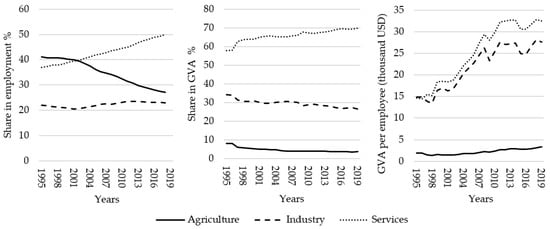
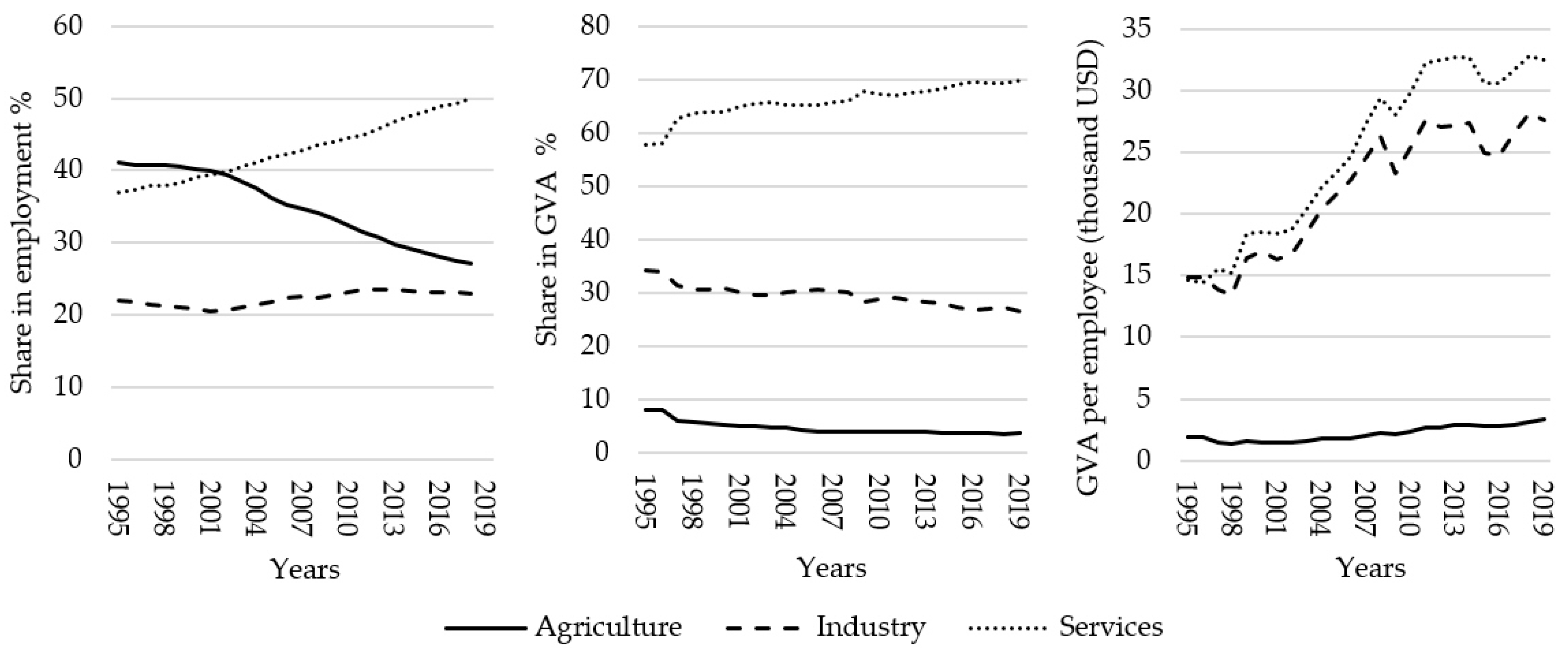
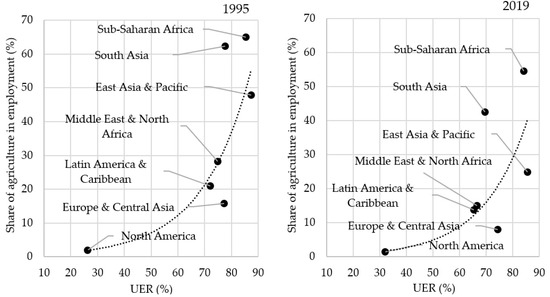
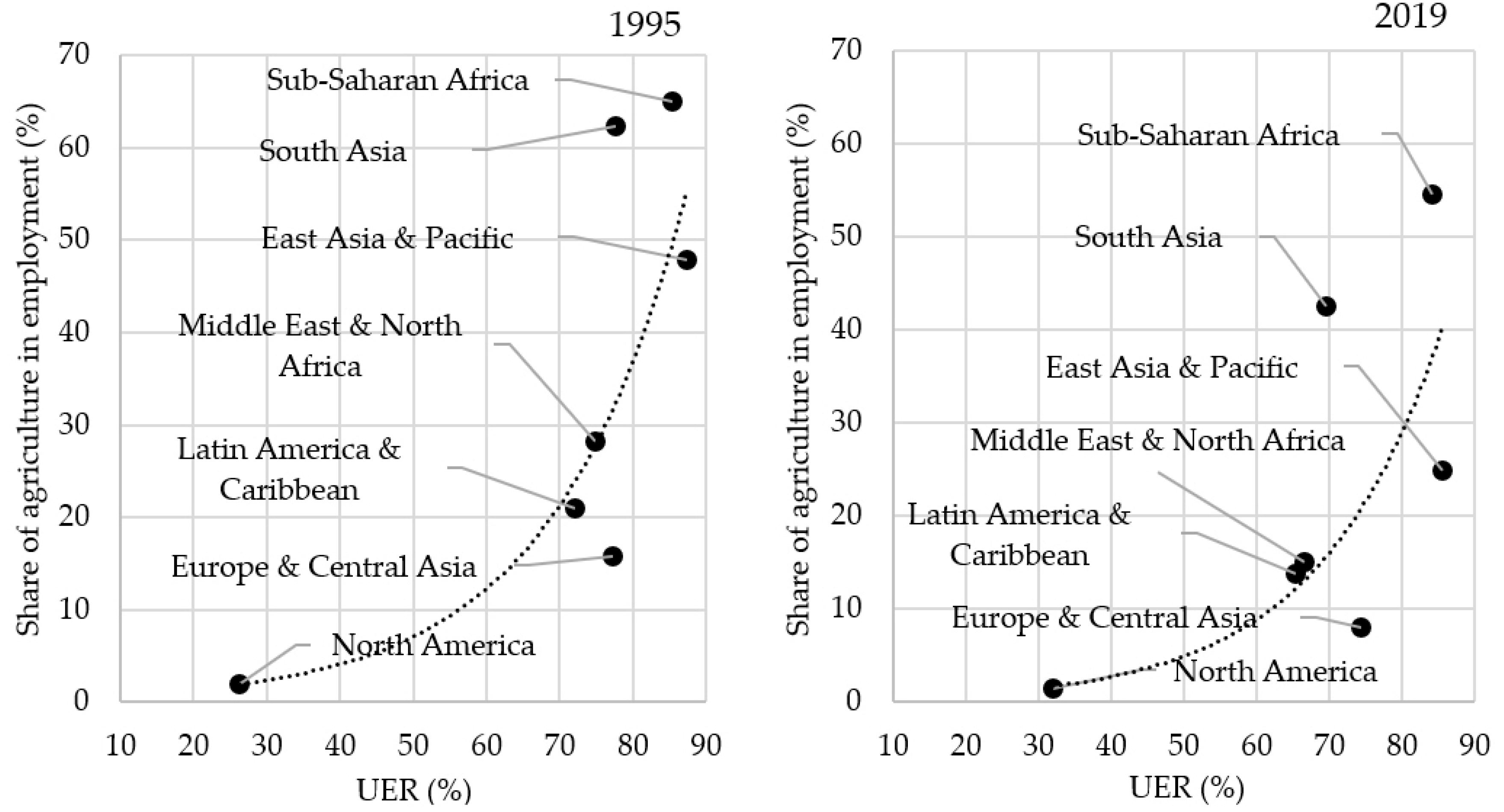
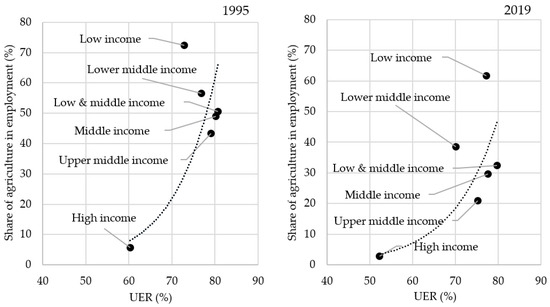
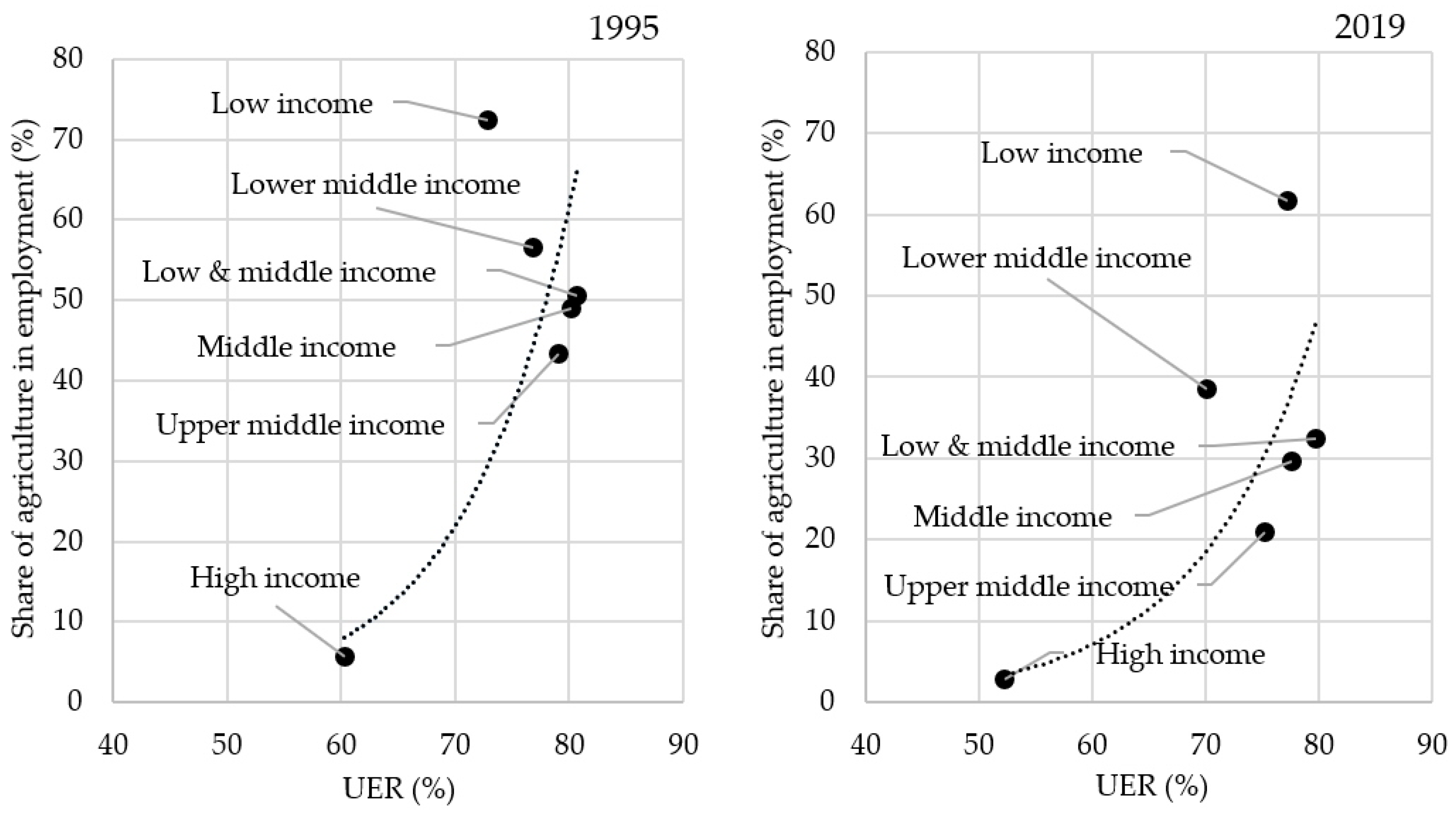
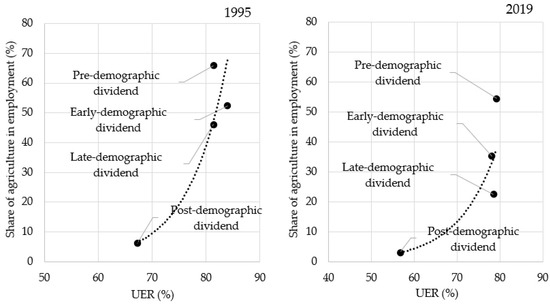
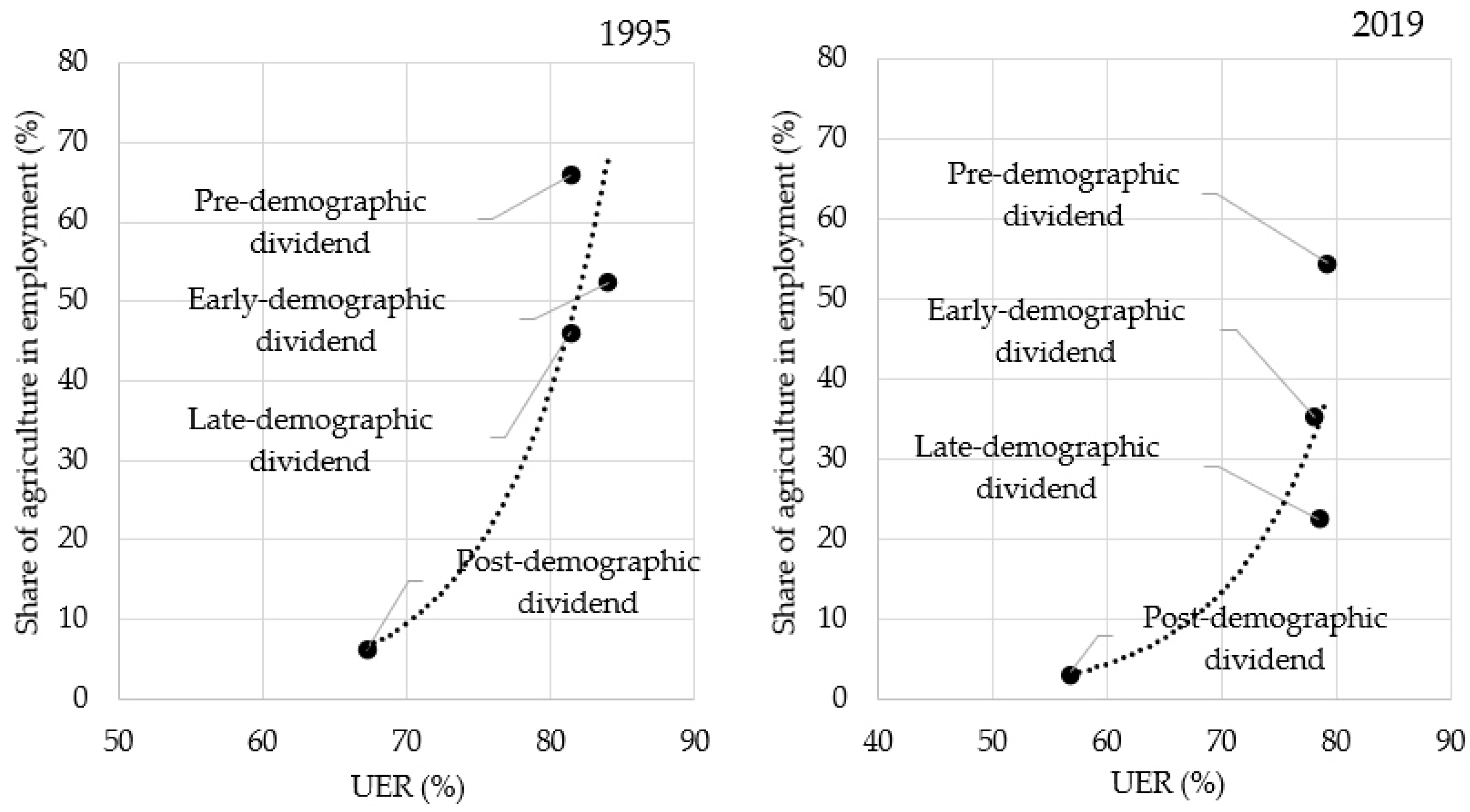

Disclaimer/Publisher’s Note: The statements, opinions and data contained in all publications are solely those of the individual author(s) and contributor(s) and not of MDPI and/or the editor(s). MDPI and/or the editor(s) disclaim responsibility for any injury to people or property resulting from any ideas, methods, instructions or products referred to in the content. |
© 2025 by the author. Licensee MDPI, Basel, Switzerland. This article is an open access article distributed under the terms and conditions of the Creative Commons Attribution (CC BY) license (https://creativecommons.org/licenses/by/4.0/).