You are currently viewing a new version of our website. To view the old version click .
Sustainability
  • Article
  • Open Access

28 November 2025

How Does Digital Economy Drive High-Quality Agricultural Development?—Based on a Dynamic QCA and NCA Combined Approach


and
College of Mechanical and Electrical Engineering, Henan Agricultural University, 63 Nongye Road, Jinshui District, Zhengzhou 450002, China
*
Author to whom correspondence should be addressed.

Abstract

This research explores the digital economy’s impact on high-quality agricultural development, with a particular focus on its effect on Agricultural Green Total Factor Productivity (AGTFP). By integrating Dynamic Qualitative Comparative Analysis (QCA) and Necessary Condition Analysis (NCA) on data spanning from 2011 to 2023 across 31 Chinese provinces, the study produces the following results: (1) No single element of the digital economy alone is indispensable for enhancing AGTFP. Instead, its driving force stems from the synergistic interactions among multiple elements. Configuration analysis identifies four effective pathways to boost AGTFP: the financial–government dual-driver model, the infrastructure–government dual-driver model, the financial–resource dual-driver model and the industry-led driver model. (2) Regional disparities exist in the approaches to achieving high-quality agricultural development. The eastern region prioritizes the integration of finance and policy, while the central and western regions emphasize the synergy between infrastructure and government initiatives. (3) The identified pathways demonstrate temporal stability, with digital finance pathways exhibiting particularly high consistency over the study period, maintaining a temporal stability exceeding 0.85 in most years. This study combines the TOE framework with configuration analysis to enrich the theoretical framework of agricultural digitalization, revealing key pathways through which the digital economy can propel green agriculture development and offers empirical evidence to inform tailored digital agriculture policies.

1. Introduction

As the world grapples with mounting food security concerns, escalating climate challenges, and shifting global trade flows, the digital economy has emerged as a central force driving transformation and high-quality development in the global agricultural system. In this context, China recognizes the digital economy as a key driver of agricultural and rural modernization, as well as high-quality agricultural advancement []. The report of the 20th National Congress of the Communist Party of China explicitly advocated for accelerating the construction of a “Digital China”, promoting the deep integration of the digital and real economy, and empowering traditional industries through digitalization and intelligent transformation. The 2023 Overall Layout Plan for Building Digital China elevated the goal of constructing a “green and intelligent digital ecological civilization” to a national strategic priority, emphasizing the deep integration of the digital and green economy, which provides policy guidance and institutional support for leveraging digitization to drive high-quality agricultural development. In agriculture, the digital economy offers opportunities not only for the intelligent upgrading of production modes but also for systematic changes in resource allocation mechanisms, organizational structures, and ecological governance systems []. From a theoretical standpoint, high-quality agricultural development aims to decouple economic growth from resource consumption and environmental degradation. Agricultural Green Total Factor Productivity (AGTFP) serves as a methodology to evaluate agricultural efficiency and sustainability by incorporating resource consumption and environmental pollution as undesirable outputs into traditional efficiency and productivity assessments []. Consequently, AGTFP is regarded as a critical indicator of high-quality agricultural development, with improvements reflecting enhanced production efficiency and coordinated advancements in resource conservation and environmental protection []. However, there is a notable imbalance between the level of digital economy development and the progress of high-quality agriculture across different regions in China, which constrains the capacity for high-quality agricultural advancement in two ways. Firstly, it risks exacerbating the regional “digital divide”, thereby undermining the overall effectiveness of digital empowerment for agricultural green transformation. Secondly, it leads to development trajectories that are not tailored to specific regional contexts [,,]. Thus, it is essential to elucidate how the digital economy impacts AGTFP, considering the varying combinations and synergies of key factors, and incorporating representative regional development paths to bridge the gaps between implementation and national strategic objectives.
Scholarly research on the relationship between the digital economy and high-quality agricultural development has produced rich, multi-dimensional evidence. At the macro level, studies have focused on the overall impact of the digital economy on agricultural productivity and the transition to green agricultural production []. For example, Hong et al. (2023) [] found that the digital economy has a positive impact on the development of green agriculture, and there are spatial spillover effects among regions. Ma et al. (2025) [] utilized provincial panel data to establish evidence for the claim that the digital economy has profound benefits for agricultural productivity because it enhances resource allocation efficiency and facilitates the dissemination of technological innovation. Cai and Wang (2025) [] found that the digital economy indirectly promotes high-quality agricultural development through the mediating role of green agriculture. Ma et al. (2024) [] similarly demonstrated that the development of the digital economy significantly reduces agricultural carbon emission intensity—thereby promoting green transformation. Building on this line of research, Sun et al. (2024) []., Ye (2025) [], Zhang and Zhang (2024) [], and Liang and Qiao (2025) [] extend the analysis to the broader notion of high-quality agricultural development and find that the digital economy improves agricultural quality, efficiency, and greenness, while exhibiting threshold effects, spatial spillovers and regional disparities. At the meso-level, research has examined the digitalization of industrial chains and the impacts of industrial clustering [,,]. Many scholars have examined how digital technologies are transforming key stages of agricultural production, distribution, and marketing. Xu et al. (2024) [] indicated that digital integration of agricultural value chains effectively reduces transaction costs and improves coordination efficiency. Teng et al. (2024) [] employed a simulation model to investigate the digital transformation process, finding that different types of industrial clusters should pursue tailored digital transformation paths to achieve optimal performance. Similarly, Li et al. (2024) [] demonstrated that digital industrial clusters promote structural upgrading of regional agricultural industries through knowledge spillovers and innovation network effects. At the micro level, research has examined the mechanisms of individual factors such as digital infrastructure, digital finance, and smallholder adoption of digital technologies [,,,]. Zhang et al. (2025) [] provide that broadband expansion helps smallholder farmers adopt new agricultural technologies and enhance productivity, while Guo et al. (2024) [] showed that digital inclusive finance alleviates credit constraints and considerably improves green productivity of new agricultural entities. Similarly, Fu and Guo (2025) [] found that digital inclusive finance promotes agricultural modernization by facilitating urban–rural integration and improving informatization levels. Xiao et al. (2023) [] further confirm that digital inclusive finance enhances agricultural total factor productivity at the provincial level.
Overall, despite considerable progress, current research has three main limitations. First, analytical perspectives remain fragmented: most studies examine individual factors in isolation and overlook the interactions and synergies among technological, organizational, and environmental factors. Secondly, most existing analyses are static and do not fully capture how the digital economy continuously drives the dynamic process of agricultural transformation. Third, traditional econometric methods struggle to capture complex multi-factor interactions and to examine how different regions may follow distinct pathways to achieve similar development outcomes.
Together, these limitations constitute a major research gap: the absence of a comprehensive, dynamic, and configurational framework that can untangle the causal complexity of how the digital economy, via the interplay of its various components, drives AGTFP. To address this gap, this paper poses the following central research question: How do the synergistic configurations of digital economy elements across technological, organizational, and environmental dimensions dynamically drive high-quality agricultural development in China? The central question is further specified into three sub-questions: RQ1: What configurations of digital economy conditions are sufficient to drive high AGTFP? RQ2: How do these sufficient configurations evolve over time? RQ3: What are the differentiated driving paths across China’s major regions? The main purpose of this research is to systematically identify, compare, and track these configurational pathways, so as to offer a detailed and evidence-based view on how the digital economy shapes sustainable agricultural change.
The contributions of this study are threefold. (1) Theoretical contribution: Drawing on the Technology–Organization–Environment (TOE) framework, this research systematically integrates the technological, organizational, and environmental dimensions to provide a holistic analytical perspective on the multiple and complex mechanisms of agricultural green development. (2) Methodological contribution: By combining Necessary Condition Analysis (NCA) with dynamic QCA, this study uncovers synergistic mechanisms and the evolutionary trajectory of the digital economy’s influence on AGTFP. (3) Empirical contribution: Empirically, the study identifies several factor configurations that enhance AGTFP or find the empirical evidence that high-quality agricultural development is achieved from diverse, context-specific pathways. The remainder of the article is structured as follows: Section 2 develops a theoretical model based on the TOE framework, analyzes the interactions within this framework, and proposes the research hypotheses. Section 3 details the research design, including the integrated use of NCA and dynamic QCA and the data sources. Section 4 presents the data analysis and empirical results. Section 5 discusses the research findings, addresses the hypotheses, explores the theoretical and practical implications, and suggests directions for future research.

2. Theoretical Model Construction

2.1. Theoretical Logic and Interaction Mechanisms Within the TOE Framework

The TOE framework serves as a systematic theoretical lens for studying the complex mechanisms through which the digital economy influences high-quality agricultural development. The framework was initially proposed by DePietro et al. (1990) [] to study the adoption and implementation of technological innovations in organizations. The TOE framework posits that technology is only effective if it can be effectively adopted, used, and utilized, which relies on a joint consideration of the characteristics of the technology itself, organizational characteristics, and the technology’s context or environment. As research into the TOE framework and technology adoption evolved, Zhu et al. (2006) [] extended the framework into the digital transformation space, demonstrating its theoretical value in understanding the complexity of technology adoption into organizations. In studies of the digitalization of agriculture, the practical application of the TOE framework has been widely demonstrated, integrating the full chain of influencing factors, from the micro-level technological application context to the meso-level organizational capability context, and the macro-level policy environment context. Recent empirical studies have further enriched the application of the TOE framework. For example, Zhao et al. (2024) [] demonstrated that the synergy of the three dimensions explained the outcome of the digital economy better than solely relying on each dimension. Gao et al. (2023) [] stated that there were significant resource allocation strategies across agricultural entities at different operational scales. Nagy et al. (2025) [] pointed out that the TOE framework has a direct positive relationship with the performance of agricultural SMEs. Collectively, these studies validate the TOE framework’s explanatory power in the agricultural domain and deepen understanding of how the digital economy influences high-quality agricultural development, thereby providing a theoretical lens for this study.
A crucial aspect of the digital economy is its technological dimension. The technological dimension in this study comprises two primary elements: digital infrastructure and digital technology talent. Together, these elements collectively form the material and intellectual foundations of the digital economy []. As outlined in the 14th Five-Year Plan for National Agricultural and Rural Informatization by the Ministry of Agriculture and Rural Affairs, a key national initiative is to establish an integrated “sky-space-ground” agricultural observation network, aiming to facilitate the digital transformation of agricultural production. Evidence suggests that digital infrastructure enables real-time monitoring of farm environments and the collection of threshold-specific data for farm management decisions, thereby laying the foundation for the deployment of green technologies such as water-saving irrigation []. In a related vein, the priorities for digital rural development in 2023 emphasize the adoption of a “digital rural talent reform program” to address the demand for skilled human resources in rural agricultural production. Similarly, research indicates that digital technology workers not only maintain and operate smart agricultural equipment but also contribute to data analytics and decision optimization, thereby enhancing AGTFP [,].
The organizational dimension provides vital resource support for the digital economy, encompassing two components: digital resource investment and digital government construction. With respect to digital resource investment, sustained financial and equipment expenditures form the material foundation for high-quality agricultural development. The extent of investment is directly associated with the extent of exploitation and adoption of technology [,]. Case studies show that for leading agricultural enterprises, organizational structure reorganization and management innovation are the keys to achieving digital transformation. These investments not only expand the application scope of intelligent devices but also promote the systematic accumulation and intelligent analysis of agricultural data through the synergy of technology and organization. This process can optimize production decisions, reduce the use of chemical fertilizers and pesticides, and ultimately enhance AGTFP []. In terms of digital government construction, the government plays a crucial role in creating an institutional environment conducive to the high-quality development of agriculture [,]. Specifically, digital government promotes the development of green agriculture through two major paths: First, the construction of agricultural data and digital public service infrastructural sharing reduces the cost of information and transaction costs of agricultural producers []. Secondly, through the construction of digital regulations, the government monitors the environmental impacts of agricultural production through precise monitoring of individuals and executes institutional protection for green and sustainable practices [].
The environmental dimension represents the external ecological basis of the digital economy, which consists of two main elements: the promotion of digital finance and the development of the digital industry. For digital finance, digital inclusive finance mitigates the financing constraints faced by agricultural producers through big data-driven risk control and online credit services []. In particular, credit evaluation models that rely on digital technologies are more accurately able to assess agricultural operational risks, providing financing to sectors traditionally eschewed by financial institutions [,]. Digital finance also leads to green agricultural transformation by providing new insurance products and service models that provide risk coverage and financial security []. The development of the digital industry relates to the regional level of digital industrialization and directly affects the accessibility and multiplicity of technological resources for digital economy. Regions with highly developed digital industries can provide agricultural sectors with more advanced digital solutions and professional technical service teams. The spillover effects of technology do not end with access to hardware but also with the introduction of modern management concepts and innovative thinking []. Also, the expansion of the digital industry has led to the development of specialized digital service companies dedicated to serving agriculture. These companies provide customized high-quality development solutions for agriculture, significantly reducing the technological and financial risks associated with digital agricultural transformation, decreasing implementation costs while increasing technological transformation efficiency for agricultural producers [].
Thus, this research establishes an analytical framework to explore how the digital economy drives high-quality agricultural development. This study adopts the TOE framework with six antecedent conditions—Digital Infrastructure (DI), Digital Technology Talent (DTT), Digital Resource Investment (DRI), Digital Government Development (DGD), Digital Finance Development (DFD), and Digital Industry Development (DID), which correspond to the technological, organizational, and environmental dimensions.

2.2. Interdimensional Linkages Within the TOE Framework

The TOE framework’s three dimensions do not operate in isolation; instead, they form a dynamic, interdependent system. Our theoretical model posits that the technological dimension serves as the foundational enabler, providing the digital “tools” for transformation []. However, the effective deployment and utilization of these tools are mediated by the organizational dimension, which encompasses the strategic allocation of resources and the establishment of supportive governance structures. Ultimately, the efficacy of technology and organization is realized and amplified within the broader environmental dimension, which comprises the market (digital finance) and industrial ecosystems []. This logic yields a coherent causal chain: advanced digital technology (T), when supported by adequate organizational investment and governance (O), fosters a more mature and conducive digital economic environment (E), which, in turn, feeds back to enhance technological adoption and organizational efficiency, collectively driving AGTFP.
Specifically, the transmission mechanism can be delineated as follows:
(1)
From Technology to Organization (T → O): Robust digital infrastructure (T) generates vast amounts of agricultural data []. To harness this data, organizations must invest in digital resources (O), such as data analytics platforms and skilled personnel (a subset of DTT), and develop digital government systems (O) to manage and regulate data flows. Thus, technology necessitates organizational adaptation and investment.
(2)
From Organization to Environment (O → E): Organizational investments in digital resources (O) and effective digital governance (O) create a stable and predictable market environment, which attracts and spurs the growth of digital finance (E) and the digital industry (E) []. For instance, clear government data standards (O) can incentivize fintech companies to devise tailored agricultural credit products (E).
(3)
Direct and Feedback Effects: While the T → O → E chain is central, direct effects (e.g., technology directly reducing transaction costs in the environment) and feedback effects are also recognized []. Our configurational approach is well suited to capture these complex, non-linear interdependencies.
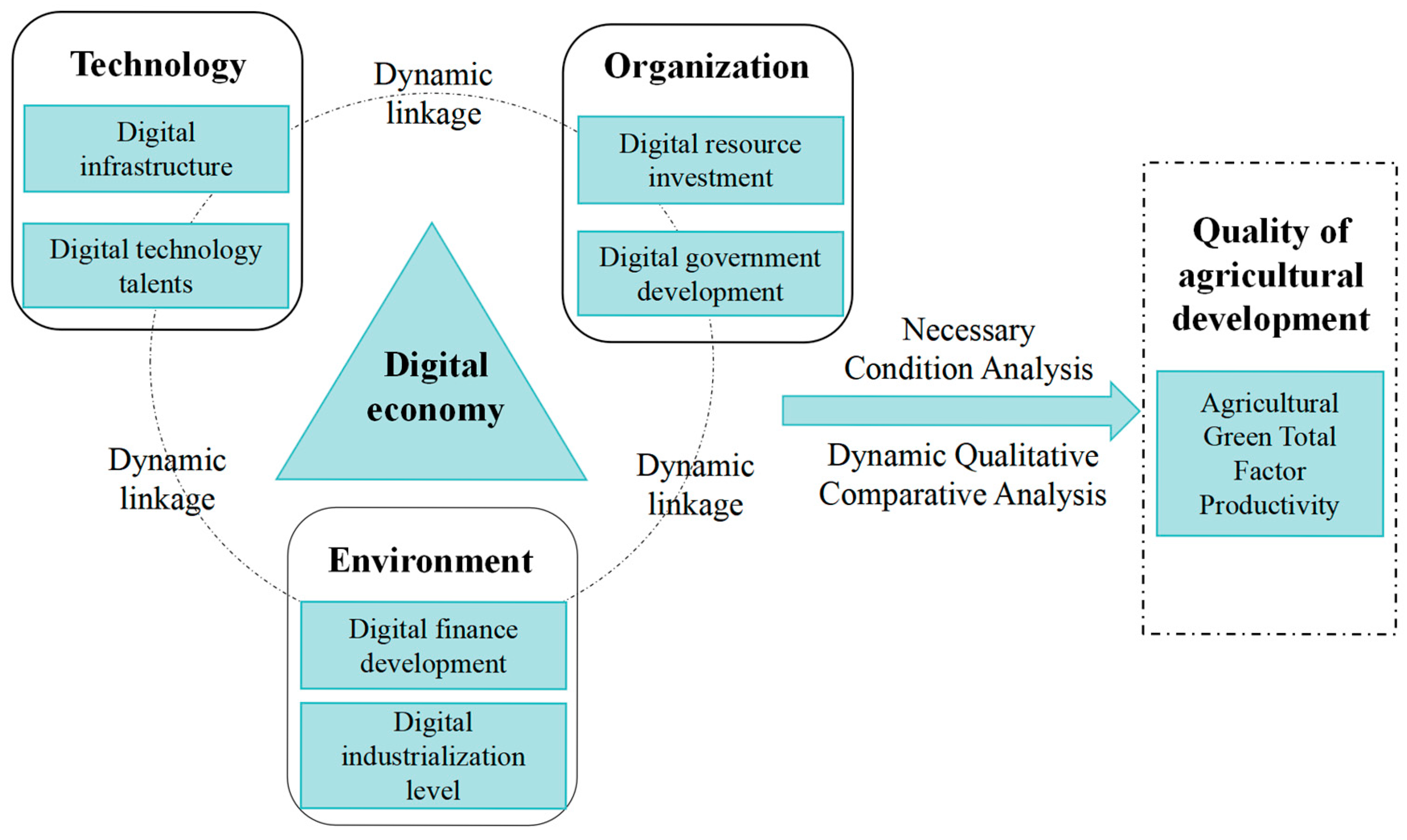
Thus, grounded in the TOE framework and the interdimensional linkages discussed, this research offers a holistic analytical lens to explore how the digital economy fosters high-quality agricultural development. The overall framework, illustrating these causal relationships, is depicted in Figure 1.
Figure 1. Theoretical framework of the digital economy driving high-quality agricultural development. Source: Author’s elaboration based on the TOE framework.
Building on the TOE framework and the interdimensional linkages discussed above, this study proposes the following core research hypotheses:
H1: 
Multiple distinct configurations of digital economy conditions will be sufficient to achieve high AGTFP.
H2: 
The core configurations driving high AGTFP exhibit significant temporal stability over the study period.
H3: 
The prevalence and composition of these effective configurations systematically vary across China’s eastern, central, western, and northeastern regions.
The three dimensions of the TOE framework are interdependent rather than independent. Our theoretical model suggests that the technological aspect acts as the enabler, providing the digital “tools” for transformation []. However, the effective application and utilization of these tools are facilitated by the organizational dimension, which encompasses resource allocation strategies and supportive governance structures. Ultimately, it is the effectiveness of both technology and organization that is realized and magnified within the broader environmental context, encompassing market forces (such as digital finance) and industrial ecosystems []. This forms a complete cause-and-effect chain: Advanced digital technology (T), when supported by sufficient organizational investment and governance (O), creates a more favorable digital economy environment (E), which then helps improve technological adoption and organizational efficiency, collectively boosting AGTFP.

3. Research Design

3.1. Research Method

3.1.1. NCA and Dynamic QCA Method

This paper adopts an integrated model combining Necessary Condition Analysis (NCA) and Dynamic Qualitative Comparative Analysis (QCA) as a systematic approach to unravel the layered mechanisms underlying high-quality agricultural development. This integration is strategically designed to exploit the distinct yet complementary strengths of both methods in analyzing causal complexity []. The QCA approach, grounded in set theory and Boolean algebra, is particularly well suited to this study. It identifies multiple concurrent configurations of antecedent conditions that are sufficient for an outcome, thereby addressing causal asymmetry and equifinality in medium-sized samples []. However, because high-quality agricultural development is a dynamic and cumulative process, conventional static QCA is insufficient to capture its evolutionary nature. The dynamic QCA framework addresses this limitation by revealing how the causal configurations leading to high AGTFP evolve and stabilize over time []. While QCA can also test for necessary conditions, its thresholds are typically strict. NCA complements this by offering a more precise measure to determine the degree of necessity of individual conditions and quantify the required levels (bottlenecks) for an outcome to occur. The conceptual synergy is evident: NCA focuses on identifying “must-have” necessary conditions, while dynamic QCA emphasizes “can-lead-to” sufficient configurations and their temporal dynamics. Building on this complementarity, our analytical approach is deliberately sequential and addresses two key methodological considerations:
(1)
Sequential Integration: First, we use NCA to rigorously test whether any single digital economy element is an indispensable (necessary) condition for high AGTFP. A finding of “no single necessary condition” validates the core QCA premise of causal complexity and equifinality, justifying the subsequent search for multiple sufficient configurations. Then, dynamic QCA is applied to uncover these distinct, viable pathways and to track their evolution from 2011 to 2023.
(2)
Interpreting Seemingly Contradictory Results: It is crucial to anticipate and explain the potential for seemingly contradictory results between the two methods, as they test different types of causal relationships. For example, a condition may be identified by QCA as a core component of one or several sufficient configurations without being a necessary condition for the entire sample when tested by NCA. This is not a methodological inconsistency but a substantive finding that underscores causal complexity. For instance, if digital finance is identified as a core condition in several pathways by QCA but not as a necessary condition by NCA, it should be interpreted as being a critical enabler in specific contexts, but not a universal “show-stopper”. Our integrated framework is uniquely positioned to capture and make sense of this nuance.
In summary, explicitly comparing the two methods enables a more comprehensive understanding of the mechanisms driving high-quality agricultural development, through the dual lenses of necessity versus sufficiency and static versus dynamic change.

3.1.2. SBM-GML Model

In this research, AGTFP is quantified by considering both the Slack-Based Measure (SBM) of efficiency model and the Global Malmquist–Luenberger (GML) index. The SBM efficiency model addresses two important methodological issues. First, it accounts for the efficiency of production processes when undesirable outputs are present. Second, it allows for the results to be comparable across time []. Assume that n decision-making units (DMUs) are included in the sample. For each DMU, the input vector in period t is denoted as x R + m , the desirable output as y R + s , and the undesirable output as b R + q . Based on undesirable outputs, the SBM efficiency model is specified as follows:
min ρ = 1 1 m i = 1 m s i x i 1 + 1 s + q r = 1 s s r + y r + j = 1 q s j b b j
In this model, the variables s i , s r + , and s j b indicate slack variables associated with inputs, desirable outputs, and undesirable outputs, respectively. The symbol ρ denotes the overall efficiency score of the decision-making unit. A lower score indicates that the decision-making unit is closer to the production frontier, reflecting a higher level of green efficiency. On this basis, the Malmquist–Luenberger index is employed to study the dynamic change in Green Total Factor Productivity. The Malmquist–Luenberger index is given as follows:
G M L t , t + 1 = 1 2 D t x t , y t , b t + D t x t + 1 , y t + 1 , b t + 1 × 1 2 D t + 1 x t , y t , b t D t + 1 x t + 1 , y t + 1 , b t + 1 1
An index value of GM L t , t + 1 > 1 is indicative of an improvement in green total factor productivity, whereas a value below 1 implies a decline in it.

3.2. Data Sources

3.2.1. Outcome Variable

In this study, agricultural development quality is employed as the outcome variable, with AGTFP serving as the measurement indicator to operationalize it, following the general approach proposed by Zhou et al. (2023) []. AGTFP is computed using the User-Oriented SBM-Global Malmquist (SBM–GML) model, which mitigates measurement biases inherent in traditional radial productivity models. This model incorporates undesirable outputs into the efficiency evaluation system, thereby improving the accuracy of the results and their comparability over time []. Based on previous research, data availability, and the characteristics of agricultural production, an input–output indicator system has been constructed, which specifically includes the following input indicators: (1) the number of agricultural laborers (10,000 persons), (2) total sown crop area (thousand hectares), (3) total agricultural machinery power (kW), (4) fertilizer consumption (tons), (5) pesticide consumption (tons), (6) agricultural plastic film consumption (tons), and (7) effectively irrigated area (thousand hectares). These indicators comprehensively capture the major factors of agricultural production: labor, land, capital, and technology. The desirable output is defined as the gross value of agricultural output, whereas the undesirable output is defined as total agricultural carbon emissions, which are calculated using the coefficient method. Therefore, the input–output indicator framework is designed to capture the essential relationship between agricultural economic growth and its associated costs in terms of output, resources, and the environment.

3.2.2. Condition Variables

Utilizing the TOE framework, a configurational analytical framework has been established in this study, encompassing six element conditions. Theoretical analysis suggests that digital infrastructure, digital technology talent, digital resource input, digital government development, digital financial development, and digital industry development are intricately interrelated. These factors have direct pathways to AGTFP and also act synergistically through three levels: technological empowerment, organizational support, and environmental facilitation. These pathways could be constructed and unified to promote sustainable agricultural development. In this study, the multidimensional coupling of these factors serves as a systematic analytical approach to explore the pathways related to AGTFP. Among these various factors, four composite variables representing (i) digital infrastructure, (ii) digital industry development, (iii) digital resource input, and (iv) digital government development have been quantified based on the entropy-weight method to create unified composite indices. The specific measurement indicators, data sources, and calculation methods can be observed in Table 1.
Table 1. Description of indicators for antecedent conditions.

3.2.3. Data Calibration

For fuzzy-set qualitative comparative analysis (fsQCA) to be carried out, the raw data is required to be converted into fuzzy-set membership scores within the range of 0 to 1. In this study, the direct calibration method is applied, with calibration anchors being set based on both theoretical knowledge and the empirical distribution of the sample data. In line with widely accepted academic norms, the upper quartile (75%), median (50%), and lower quartile (25%) of each variable are designated as the thresholds for full membership, crossover point, and full non-membership, respectively []. The choice of these quantiles as calibration anchors adheres to established practices in fsQCA research for medium-N samples [,]. This method takes advantage of the empirical distribution of the data to establish meaningful thresholds, ensuring that the calibration is not only rooted in the sample’s characteristics but also maintains theoretical pertinence. The specific calibration anchor values for each variable are presented in Table 2 on the following page.
Table 2. Variable calibration and descriptive statistics.

4. Data Analysis and Empirical Results

4.1. Necessary Condition Analysis

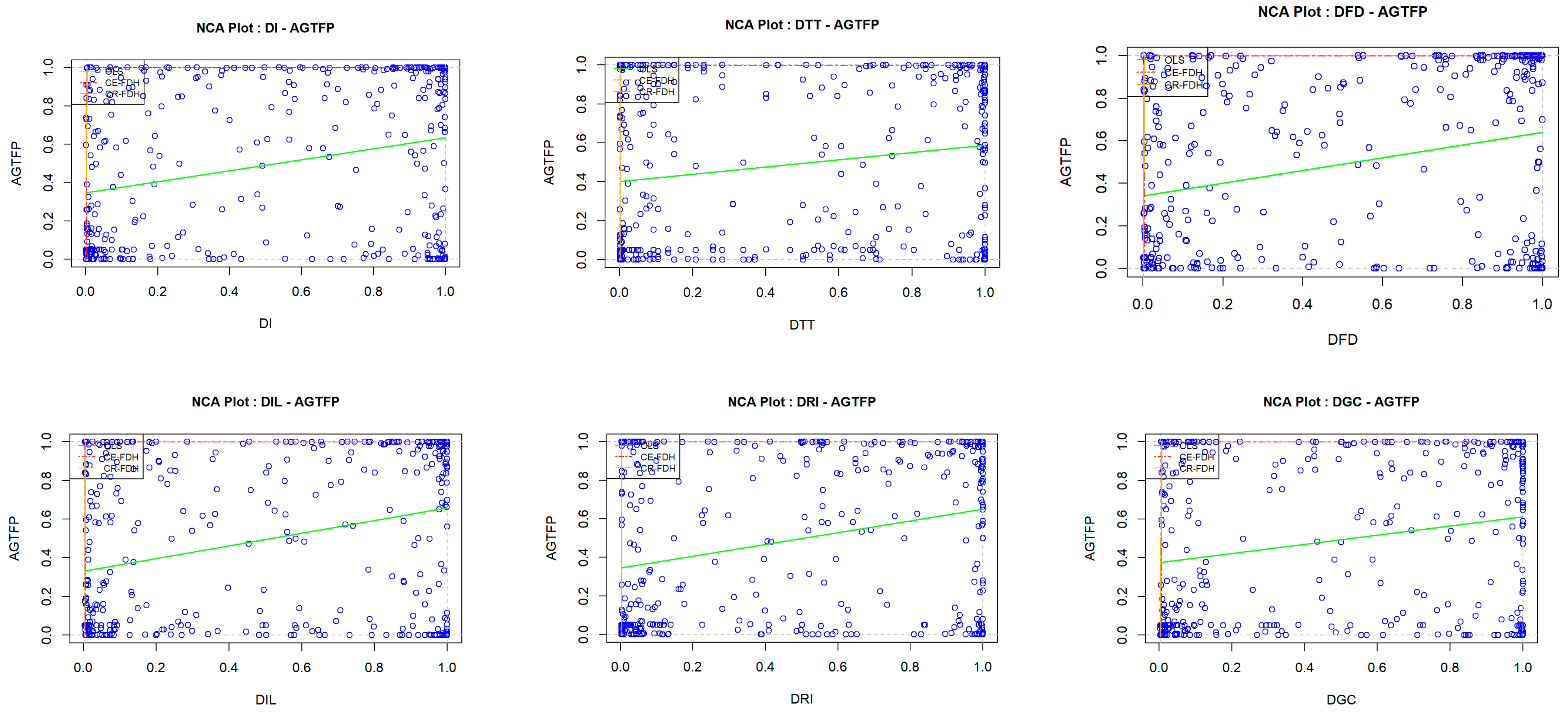
NCA is designed to identify antecedent conditions that are indispensable for an outcome—conditions that must be present whenever the outcome occurs. To enhance the robustness of the findings, we employ both NCA and QCA. First, with the NCA method, two estimation techniques—ceiling regression (CR) and ceiling envelopment (CE)—were implemented to compute the effect size (d) and significance level (p-value) for each condition. As indicated in Table 3, all effect sizes fall below the threshold of 0.1, indicating that none of the variables were necessary for achieving higher levels of AGTFP. These results are further corroborated by the NCA scatterplot (Figure 2), which reveals significant dispersion below the ceiling line, with no observable “corner-shaped” concentration or clear bounding constraint area. The scatterplot demonstrates that no single condition needs to reach a sufficient level to attain high AGTFP. Second, the bottleneck levels reported in Table 4 show that all conditions are non-necessary (NN) at low outcome levels (e.g., Y ≤ 20). As outcome levels rise, conditions start to exhibit bottleneck levels. For example, when Y = 100, the bottleneck levels for DI, DFD, DID, and DGD are 0.4, 0.2, 0.2, and 0.4, respectively, while DTT and DRI remain at 0. These findings illustrate that although some conditions must reach a moderate level to achieve high AGTFP, overall threshold levels remain low.
Table 3. Results of necessary condition analysis.
Figure 2. NCA Scatterplot. Source: Authors’ calculation and creation using R version 4.3.2.
Table 4. Bottleneck level analysis.

4.2. Analysis of Single-Condition Necessity

Additionally, QCA is employed in this study to assess the necessity of each individual condition. As shown in Table 5, the consistency levels of all individual conditional variables are well below the threshold of 0.9, indicating that no single antecedent condition is necessary for the outcome. This finding aligns with those from the NCA. Overall, both the quantitative NCA and qualitative QCA perspectives indicate that antecedent conditions influence the outcome through configurational combinations rather than through any isolated condition. This logic underpins the study’s objective of exploring multiple concurrent causal pathways in the subsequent analyses. After conducting an inter-temporal analysis for configurations with an adjusted inter-group consistency distance exceeding 0.2, the analysis examined whether any combination of causal conditions might constitute a necessary condition. As shown in Table 6, for most years, the inter-group consistency values for Cases 1–7 remain below the 0.9 threshold. Although in 2023, Cases 1–4 exhibit inter-group consistency above 0.9, their coverage values were all below 0.1. The extremely low coverage suggests that these causal relationships occur only sporadically in a small number of cases and thus lack generalizability. Taken together, the results indicate that none of the antecedent conditions in this study—whether associated with high or low AGTFP—can be regarded as a single necessary condition on its own.
Table 5. Necessity test of single conditions.
Table 6. Causal combinations with inter-group consistency adjustment distance greater than 0.2.

4.3. Analysis of Sufficiency for Condition Configurations

Building on the necessity analysis, R version 4.3.2 is employed in this study to conduct condition configuration analysis, with the objective of uncovering the interactions among multiple antecedent conditions that drive both high and low levels of AGTFP. Given that this study is based on a medium-sized sample, a case frequency threshold of 1 is established, along with an original consistency threshold of 0.8 and a PRI consistency threshold of 0.6 []. Based on the software output, we obtain complex, parsimonious, and intermediate solutions. Core and peripheral conditions are identified based on established academic conventions: core conditions, which appear in both the simplified and intermediate solutions, indicate a strong causal relationship with the outcome, while peripheral conditions, which appear only in the intermediate solution, suggest a weaker causal relationship []. The intermediate solution is used as the basis for analysis, with the simplified solution serving to identify core conditions. This process enables the systematic identification of multiple, concurrent causal pathways leading to the outcome. The analysis results are presented in Table 7, which lists the configurations for both high and low AGTFP. By utilizing a combination of condition variables, five configuration types are identified: the financial–government dual-driver, the infrastructure–government dual-driver, the financial–resource dual-driver, the industry-led driver, and the talent-island trap.
Table 7. Configural analysis results of high and low AGTFP.

4.3.1. Summary of Results Analysis

(1)
Configuration Analysis of High-Quality Agricultural Development
According to Table 7, the overall solution consistency for high AGTFP is 0.843, which exceeds the conventional threshold of 0.75 and indicates that the identified combinations of conditions explain high AGTFP effectively. The overall coverage rate of 0.424 and the PRI consistency of 0.645 both meet the standard requirements of the QCA method. Further examination of the inter-group and intra-group consistency adjustment distances for each pathway reveals that most values are within 0.3, suggesting that different combinations of preconditions can effectively drive the formation of high AGTFP.
The Financial–Government dual-driver pathway consists of two configurations, H1a and H1b. In configuration H1a, a high level of digital financial development, a high level of digital government development, a low level of digital infrastructure, and low level of digital technology talent are all identified as core conditions. A high level of digital industry development serves as a supporting condition in this configuration. Together, these conditions generate a highly enhancing effect on AGTFP. Jiangxi Province is a representative case for this pathway, where the high-quality development of agriculture clearly manifests as a government-driven process. The provincial government has institutionalized the strategic priority of green ecological agriculture through top-level documents, such as the “No. 1 Document”, and clarified the direction for allocating financial resources to areas of green transformation. For instance, Yichun City supported low-carbon oil tea garden projects by promoting a full-chain mechanism that provided 140 million RMB in loans. Additionally, Jizhou District financed the agricultural low-carbon transition of agricultural enterprises through the “Agricultural Low-Carbon Loan” program at an interest rate of 2.05%. This example illustrates the successful coupling of policy-driven (government) direction and market-driven finance. The second configuration, H1b, shares the same core conditions as H1a, except that in H1b, a high level of digital resource input is used as a supporting condition instead of digital industry development. The consistency of H1b is 0.895, with a coverage of 0.287, both of which confirm the robustness and explanatory power of the Financial–Government dual-driver pathway.
The Infrastructure–Government dual-driver pathway indicates that the effective interaction between digital infrastructure and government governance can promote AGTFP even when support from digital finance is weak. This pathway is represented by a pair of highly similar configurations, H2a and H2b, each of which has high digital infrastructure, high governmental governance, and low digital financial development as core conditions. They differ in that H2a includes low digital industry development as a supporting condition, while H2b has low digital resource input. An exemplary illustration of the H2a pathway is provided by Hebei Province. The province has actively promoted the development of the national integrated computing power network with a hub node in the Beijing–Tianjin–Hebei region and the construction of the Zhangjiakou Data Center Cluster to foster the synergistic development of data centers and renewable energy. On the policy side, the provincial government released the “Action Plan for Accelerating the Construction of Digital Hebei (2023–2027),” which identifies specific goals and tasks related to the development of digital infrastructure. The plan aims to promote the deep integration of digital technology with the real economy by implementing six special actions and 20 key projects.
In the financial–resource dual-driver pathway (H3), digital finance is highly developed, and digital resource input is strong. High intensity is further bolstered by robust development within the digital industry pathway, indicating the presence of solid industry infrastructure, while digital infrastructure and digital government development are relatively underdeveloped. The underlying logic of this configuration type lies in financial capital’s ability to identify viable investment opportunities necessary for agricultural green transformation, steering towards digitized solutions to enhance resource allocation and efficiency in agricultural production. Guizhou Province serves as an illustrative case, demonstrating how growth and intensity in digital financial development occur as a primary driving force. Within Guizhou, financial institutions have actively developed online methods to improve financial product delivery, exemplified by the “Qian Nong e-Loan”, which employs big data risk control mechanisms to enhance credit accessibility for farmers and agricultural enterprises. As a second driver, Guizhou Province has introduced green financial products tailored to green/organic industries such as tea and medicinal herbs, all aimed at ensuring the effective allocation of certified funds for green and organic agricultural production.
The industry-led driver pathway, represented by configuration H4, showcases an agricultural green transformation that relies on industrial upgrading rather than technology and capital-intensive high-quality agricultural development pathways. This pathway is propelled by high levels of digital industry development and leverages mechanisms such as large-scale production, specialization of business entities, and industry chain integration to effectively offset disadvantages in digital technology development (including brand development, financial investment, infrastructure, and government governance). The “Luochuan Apple” industry in Shaanxi Province has been established as a representative example of this pathway. By creating a highly organized industry model and implementing unified green production standards, the industry has effectively promoted agricultural green development with improved efficiency through industrial upgrading.
(2)
Configuration Analysis of Low-Quality Agricultural Development
The Talent Island Trap configuration (NH1) is characterized by a structural mismatch between the supply of digital technology talent and the demands of industrial development. This configuration is defined by an overabundance of digital technology talent alongside a deficit in supporting industrial infrastructure, investment resources, and compatible financing instruments. Consequently, the skills of digital technology talent are not adequately leveraged as an effective driver for the high-quality development of agriculture. The Xizang Autonomous Region is a typical representative of this configuration. Although a significant number of digital technology talents have been introduced through aid policies to Xizang, the region’s relatively monolithic agricultural industrial structure, limited application scenarios for digital technology, and insufficient investment in digital resources have resulted in difficulties in effectively matching talent with industrial demands. This disconnection between talent and industry prevents digital technology talent from fully realizing its potential in enhancing AGTFP. Similarly, the Ningxia Hui Autonomous Region also exhibits distinct manifestations of this problem. Despite possessing a certain reserve of digital talent, the region faces significant obstacles in applying digital technology to agricultural production because of contextual factors such as incomplete digital infrastructure coverage and limited digital financial services. Furthermore, the local digital industry development level is inadequate, failing to provide the necessary technical support and service infrastructure for the high-quality development of agriculture. This ultimately results in digital technology talents being trapped in a predicament of “having talents but no platforms”. This phenomenon of talent silos underscores the limitations of simply introducing digital technology talents. To fully unleash the potential of such talents, it is imperative to simultaneously promote the construction of the industrial environment, improve digital infrastructure, strengthen financial service support, and build an ecosystem conducive to the effective application of digital technology talents.

4.3.2. Inter-Group Consistency Analysis

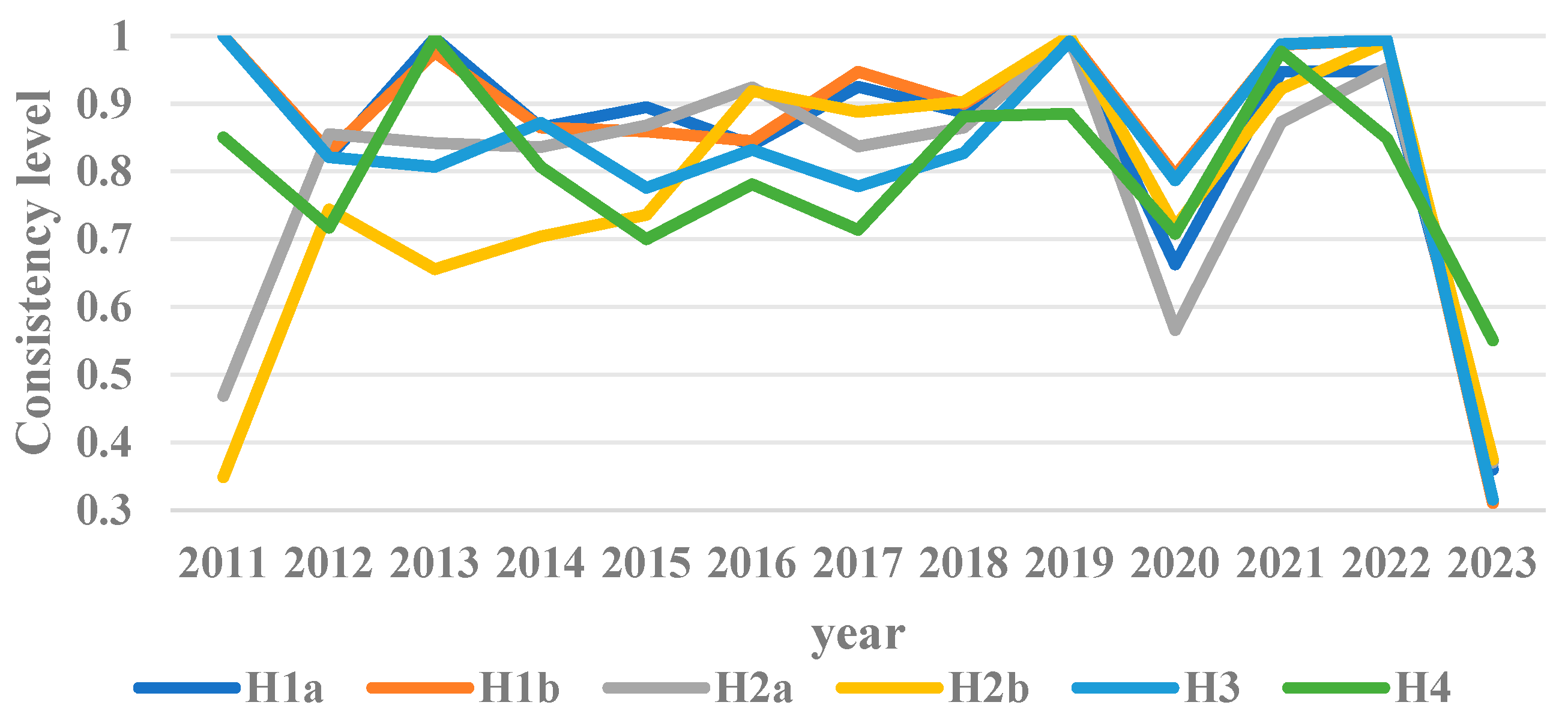
This section goes beyond assessing path stability by conducting a time-series analysis of inter-group consistency to reveal the intrinsic dynamics underlying the evolution of configurational paths from 2011 to 2023. The analysis shows that the trajectories of these paths are not random; instead, they are closely linked to the phased implementation of China’s national digital and agricultural strategies, as illustrated in Figure 3.
Figure 3. Trend of inter-group consistency changes in high-quality agricultural development. Source: Authors’ calculation and creation based on dynamic QCA results.
Two distinct evolutionary patterns are identified. First, digital finance-driven pathways (H1b, H3) exhibit high and sustained consistency in the early stages of the period. A significant surge in their consistency after 2014–2015 was observed, coinciding with the national execution of the “Broadband China” strategy and the “Internet Plus” action plan. These initiatives facilitated the rapid expansion of internet access and spurred the growth of digital financial services, thereby lowering barriers for financial capital to enter the agricultural sector and solidifying its role in green transformation.
Second, the infrastructure–government pathway (H2b) is characterized by a delayed yet ascending pattern. While its consistency remains moderate in the initial years, a marked and steady increase begins around 2018. This trajectory corresponds to the introduction of the “Digital Village Development Strategy Outline” and the subsequent “14th Five-Year Plan for National Informatization”, which accorded unprecedented national priority to rural digital infrastructure. The observed time lag underscores a fundamental characteristic: the synergistic effects of large-scale infrastructure and government governance require a longer gestation period to materialize compared to the more flexible integration of financial capital.
A slight decline in consistency across several paths around 2021–2023 can be attributed to exogenous shocks, particularly disruptions to supply chains and economic activity caused by the global pandemic. This suggests that the driving mechanisms of the digital economy remain vulnerable to major external systemic shocks.
In conclusion, this dynamic analysis shows that the efficacy of different driving paths is jointly shaped by the evolving national policy landscape. The findings therefore go beyond merely stating that paths are stable by explaining why and how their significance shifts in response to key governmental actions, thereby providing a deeper, policy-aware understanding of the digital economy’s evolving impact on green agricultural development.

4.3.3. Regional Differences Analysis of High-Quality Agricultural Development Pathways

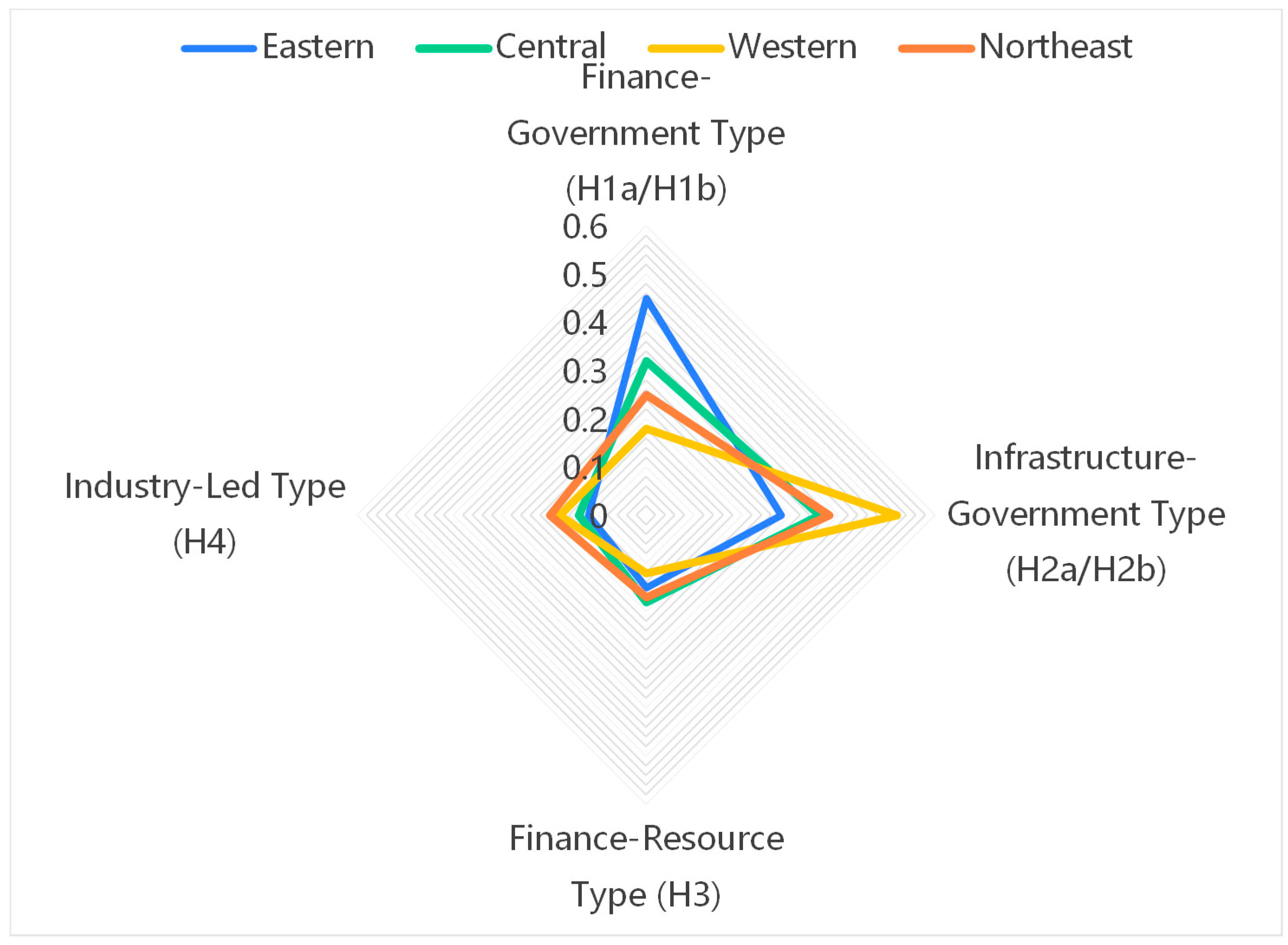
To gain deeper insight into the spatial distribution patterns and regional suitability of driving pathways, this study extends the configuration analysis by calculating the average coverage of each driving pathway across four major regions of China: Eastern, Central, Western, and Northeastern. The findings, as presented in Figure 4, reveal substantial regional disparities in the pathways to high-quality agricultural development. First, the Eastern region is a clear leader in the Financial–Government dual-driver pathway, with a coverage rate of 0.45, highlighting the synergistic benefits derived from its well-developed financial markets and efficient government governance. Second, in the Western region, the Infrastructure–Government dual-driver pathway dominates, with a coverage rate of 0.52, reflecting the strong government-led initiatives to develop digital infrastructure, reduce regional gaps, and enhance overall performance. Both the Central and Northeastern regions exhibit relatively high coverage in the Infrastructure–Government pathway. However, the Northeastern region stands out with its unique performance in the industry-led pathway, boasting a coverage rate of 0.20, highlighting the supporting role played by its traditional industrial base in fostering high-quality agricultural development. This spatial pattern indicates that the High-quality development of agriculture in China is marked by evident path dependence and regional adaptability. Consequently, policy design must fully account for the comparative advantages and resource endowments of each region and implement differentiated, targeted promotion strategies to maximize policy effectiveness.
Figure 4. Radar chart of regional adaptability for different high-quality agricultural development pathways. Source: Authors’ calculation and creation based on QCA coverage analysis.

4.4. Robustness Test

To assess the reliability of the research conclusions, this study adopted the robustness test method proposed by Du et al. (2022) []. Specifically, the case frequency threshold was elevated from 1 to 2, and the PRI consistency threshold was increased from 0.60 to 0.65. Following re-conducting the configuration analysis, two robust configurations, S1 and S2, were identified, as presented in Table 8. Their core condition structures are highly consistent with the original high AGTFP configuration: S1 was aligned with the Financial–Resource dual-driver type, while S2 corresponded to the Infrastructure–Government dual-driver type. Under the adjusted parameters, these two configurations maintained a high level of consistency, with an overall consistency score of 0.871 and an overall coverage of 0.36. This demonstrates that the original configuration structure retains its explanatory power under different threshold settings, confirming the good robustness of the research findings.
Table 8. Results of robustness test.

5. Discussion and Implications

5.1. Research Conclusion

This study examines how the digital economy drives high-quality agricultural development by systematically identifying multiple pathways and dynamic mechanisms for enhancing AGTFP through the interaction of technological, organizational, and environmental factors. Based on panel data from 31 Chinese provinces spanning from 2011 to 2023, and employing dynamic QCA and NCA methods, the study reveals that no single necessary condition can independently lead to high AGTFP. Instead, the analysis identifies multiple equivalent configurations, including financial–government dual-drive, infrastructure–government dual-drive, financial–resource dual-drive, and industry-led drive, as well as the talent island trap associated with low-quality development.
In the necessity analysis, NCA was used to test each antecedent condition. The effect sizes of all conditions were below the 0.1 threshold, indicating that no single condition is essential for enhancing high AGTFP. Specifically, none of the conditions—DI, DTT, DFD, DID, DRI, and DGD—was found to be individually necessary. This result underscores the collaborative role of multiple factors in high-quality agricultural development, indicating that these factors function complementarily rather than in isolation.
To assess sufficiency, QCA was used to examine how conditions combine to produce high AGTFP. The analysis revealed multiple pathways created by synergies between conditions, rather than relying on a single condition. For instance, some pathways were formed as sufficient conditions generated by the combination of conditions, such as the financial–resource dual-drive model, which describes the synergy between digital finance and resource investment, particularly in areas with low levels of digital industry. Additionally, the configuration analysis identified a “talent island trap” pathway for low AGTFP. This pathway illustrates an imbalance between the supply of digital technology talent and the demand from supporting industries and investment, where abundant talent cannot be transformed into a driving force for high-quality agricultural development. This finding confirms Hypothesis 1 (H1).
Consistency analyses showed that each driving path remained highly stable over time, which confirms Hypothesis 2 (H2). For example, pathways based on digital finance awareness, including financial–government dual-drive and financial–resource dual-drive, maintained high stability over several years, reflecting the enduring nature of financial capital in high-quality agricultural development. By contrast, infrastructure-driven pathways, such as the infrastructure–government dual-drive, initially less stable but eventually became more stable, indicating the long-term durability associated with infrastructure construction.
Furthermore, the findings validate Hypothesis 3 (H3) regarding regional heterogeneity. The analysis reveals systematic spatial differences in the prevalence of effective pathways: the financial–government model prevails in the eastern region, whereas the infrastructure–government model is key in the central and western regions. This geographical pattern confirms that the effectiveness of digital economy allocation depends on region-specific conditions, including local resource endowments and development priorities.
The findings of this study are consistent with those of Zhang et al. (2025) [] and Ma et al. (2025) [] on the link between the digital economy and agricultural development, particularly the interplay between digital finance and government actions. Notably, Zhang et al. (2025) [] advocate for the importance of a digital government infrastructure in enhancing agricultural management efficiency and improving resource allocation, while Ma et al. (2025) [] suggest that digital finance can improve agricultural productivity and facilitate high-quality agricultural development through improved fund allocation. However, this study differs from some literature in certain details. Unlike the “single factor influence model” proposed by Luo et al. (2022) [] and Qin et al. (2025) [], this study emphasizes that high-quality agricultural development is not driven by a single factor but by a path composed of multiple conditions, with substitution and complementarity relationships among these paths.
Notably, these findings affirm the value of applying the TOE framework in researching high-quality agricultural development and underscore the central role of multi-factor synergies in agricultural green transformation. New perspectives are disclosed for exploring regional differentiated development mechanisms, providing practical implications for local governments to develop differentiated and precise rural digital development strategies.

5.2. Theoretical Significance

This study makes several salient theoretical contributions to the literature on the digital economy and agricultural development. First, the application of the TOE framework is extended by being systematically integrated with configurational theory (QCA). Causal chains (T→O→E) among its dimensions are explicitly modeled, providing a more dynamic and interconnected analytical lens through which digital transformation in agriculture can be understood. Second, it offers a methodological contribution by demonstrating the value of integrating NCA and dynamic QCA. The limitations of static, correlation-based methods are overcome, enabling the uncovering of complex, evolving, and equifinal causal pathways. Third, a dynamic view of configurations is contributed, demonstrating that path effectiveness and persistence are time-sensitive and policy-contingent, which qualifies cross-sectional inferences. Our findings robustly substantiate that multifactor synergy is identified as the core mechanism driving AGTFP, thereby establishing a more nuanced and complex theoretical proposition regarding the nature of digital-enabled agricultural green transformation.

5.3. Practical Significance

For policymakers in China and other developing countries, it is crucial to devise policies that effectively leverage the digital economy to drive high-quality agricultural development, while taking into account country-specific conditions such as economic development levels, digital infrastructure disparities, resource endowments, farmers’ digital literacy, and uneven regional development.
(1)
Differentiated Regional Strategies Based on Path Characteristics
Policies supporting high-quality agricultural development should be tailored to regional driving modes. Drawing on the configuration evidence in Section 4.3.1, we translate case-backed insights into region-specific policy recommendations aligned with identified pathways. In the eastern region, dominated by a financial–government dual-driver model (exemplified by Jiangxi, H1a), policy should strengthen the coordination between financial capital and policy guidance. As analyzed in Section 4.3.1, the provincial government legitimized green agriculture through top-level policies and targeted financial programs like the “Agricultural Low-Carbon Loan” program. Thus, governments should expand green financial products (green loans, bonds) and offer tax incentives and subsidies to direct capital towards certified green projects, fostering both digital agriculture and green transformation. In the western and central regions, where an infrastructure–government dual-driver pathway prevails (Hebei, H2a), the state’s role as a primary investor is underscored by initiatives like national computing power hubs and the “Digital Hebei” Action Plan; consequently, policies should prioritize digital infrastructure (e.g., IoT, smart agricultural machinery) while enhancing data governance and public administration efficiency to create a hardware–software synergy. In the northeast, where an industry-led path is prominent (Shaanxi, H4), the success of the “Luochuan Apple” brand demonstrates how industrial upgrading and branding can offset weaker digital capabilities; therefore, policies should encourage enterprise–tech partnerships for digital processing and marketing and provide technical support and training to boost firms’ digital capabilities. These actionable strategies, grounded in empirical evidence, show how configuration-specific insights can be translated into coherent, region-tailored policies.
(2)
Differentiated Evaluation Mechanisms Based on Path Characteristics
To facilitate agricultural green transformation, evaluation mechanisms should be tailored to each pathway’s unique dimensions. For financial–government dual-drive regions, assessments should focus on the ratio of green loans and the efficiency of policy coordination, evaluating whether financial support is effectively mobilized for agricultural green initiatives and how well policies coordinate and allocate resources to benefit green agricultural development. For infrastructure–government dual-drive regions, assessments should highlight the coverage and utilization efficiency of digital infrastructure, examining the breadth and depth of infrastructure construction and the extent and actual use of key infrastructures like the Internet of Things (IoT) and smart agricultural equipment. For industry-led regions, assessments should evaluate the degree of digitalization in the industrial chain and the resulting green benefits, including the depth of digital agriculture applications in traditional agriculture and the efficacy of these transformations. For reliable assessment, establishing a digital agriculture policy lab is preferable, using digital twins to simulate diverse policy combinations across multiple scenarios, enabling policies to adapt to conditions and optimize dynamically; thus achieving “monitoring-evaluation-feedback-optimization” dynamic governance.
(3)
Differentiated Talent Development Mechanisms
Establishing specialized talent development mechanisms is vital for promoting high-quality agricultural development. In finance–government dual-drive areas, the objective is to cultivate composite talents skilled in both digital finance and policy design. These individuals must master digital finance technologies and understand policy design and execution to bridge government entities and financial institutions, fostering innovation and execution of green financial products and policies. In infrastructure–government dual-drive regions, talent development should focus on cultivating individuals trained in the operation and management of digital infrastructure projects. These individuals must possess knowledge of modern digital infrastructure construction and management to plan and execute agricultural digital transformation projects efficiently. In industry-driven regions, talent development must focus on cultivating individuals capable of digitally integrating the agricultural industry chain, responding to key factors for positive industry outcomes, and applying digital technology to enhance traditional processes innovatively, supporting productive outcomes for the entire industry. Finally, to ensure talent alignment with regional developmental needs, a path-talent matching mechanism should be established. This regional-focused mechanism provides a framework for designing talent development strategies specific to dominant development paths and industry needs, ensuring a targeted and functional workforce to support high-quality agricultural development.

5.4. Limitations and Prospects

While this study has achieved some progress in integrating methodologies and identifying development paths, it still faces certain limitations. First, the research focuses on analyzing the AGTFP levels across 31 provinces in China yet falls short in exploring county- or enterprise-level scenarios. The coverage of cases is limited. Future studies should incorporate micro-level data, encompassing counties or enterprises, while still considering the unique practices and impacts of high-quality development across diverse regions and agricultural scales. These case studies will offer deeper insights into the actual transformation processes and elucidate the influence of regional disparities on agricultural digitalization. By doing so, this research will be more applicable and richer in terms of findings.
Additionally, the research does not include cross-national comparisons with other countries where digital economies are rapidly growing. Future research could broaden its horizon by including emerging digital economies such as Brazil, South Africa, and South Korea for cross-national analyses, which would facilitate the exploration of commonalities and differences in promoting green innovation and high-quality development, thereby providing additional international experiences and lessons for policy development in China and other developing countries.
Finally, the research examines AGTFP in an aggregated manner, potentially overlooking variations among agricultural sub-sectors. For example, there are significant differences in production methods, resource inputs, and technological requirements between crop production and animal husbandry. Future research could further disaggregate AGTFP by analyzing the high-quality development and green innovation paths of different sub-sectors, respectively, enabling tailored policy responses for various agricultural industries.

Author Contributions

Conceptualization, Z.L. and B.L.; Methodology, Z.L. and B.L.; Investigation, Z.L.; Data curation, Z.L.; Formal analysis, Z.L.; Visualization, Z.L.; Writing—original draft preparation, Z.L.; Writing—review and editing, B.L.; Supervision, B.L.; Project administration, B.L.; Funding acquisition, B.L. All authors have read and agreed to the published version of the manuscript.

Funding

This work was supported by Major Project of Fundamental Research in Philosophy and Social Sciences for Higher Education Institutions in Henan Province (2024-JCZD-21).

Institutional Review Board Statement

Not applicable.

Data Availability Statement

The datasets analyzed in this study were obtained from (i) the National Bureau of Statistics of China (NBS) (https://www.stats.gov.cn, accessed on 25 August 2025), (ii) the Ministry of Industry and Information Technology of China (MIIT) (https://www.miit.gov.cn, accessed on 25 August 2025), and (iii) the Peking University Digital Finance Research Center (https://idf.pku.edu.cn/, accessed on 25 August 2025). Some data providers may require institutional subscriptions or licenses.

Acknowledgments

The author, Zihang Liu, would like to express sincere gratitude to Bingjun Li for his continuous guidance, valuable suggestions, and encouragement throughout this work.

Conflicts of Interest

The authors declare no conflicts of interest.

References

  1. Liang, J.; Qiao, C. Digital economy and high-quality agricultural development: Mechanisms of technological innovation and spatial spillover effects. Sustainability 2025, 17, 3639. [Google Scholar] [CrossRef]
  2. Wang, J.; Dong, Y.; Wang, H. Research on the impact and mechanism of digital economy on China’s food production capacity. Sci. Rep. 2024, 14, 27292. [Google Scholar] [CrossRef]
  3. Ma, G.; Dai, X.; Luo, Y. The effect of farmland transfer on agricultural green total factor productivity: Evidence from rural China. Int. J. Environ. Res. Public Health 2023, 20, 2130. [Google Scholar] [CrossRef]
  4. Lu, S.; Zhuang, J.; Sun, Z.; Huang, M. How can rural digitalization improve agricultural green total factor productivity: Empirical evidence from counties in China. Heliyon 2024, 10, e35296. [Google Scholar] [CrossRef]
  5. Zhou, L.; Zhang, S.; Zhou, C.; Yuan, S.; Jiang, H.; Wang, Y. The impact of the digital economy on high-quality agricultural development—Based on the regulatory effects of financial development. PLoS ONE 2024, 19, e0293538. [Google Scholar] [CrossRef]
  6. Zhang, G.; Zhang, C.; Liu, T. How does the digital economy impact the high-quality development of agriculture? An empirical test based on the spatial Durbin model. Digit. Econ. Sustain. Dev. 2025, 3, 18. [Google Scholar] [CrossRef]
  7. Tu, Z.; Kong, J.; Sun, L.; Liu, B. Can the digital economy reduce the rural-urban income gap? Sustainability 2024, 16, 938. [Google Scholar] [CrossRef]
  8. Hong, M.; Tian, M.; Wang, J. The impact of digital economy on green development of agriculture and its spatial spillover effect. China Agric. Econ. Rev. 2023, 15, 708–726. [Google Scholar] [CrossRef]
  9. Ma, G.; Qin, R.; Lei, S.; Tang, Y. Influence of data elements on China’s agricultural green total factor productivity. Sci. Rep. 2025, 15, 31358. [Google Scholar] [CrossRef]
  10. Cai, Y.; Wang, L. Impact of Digital Economy on Agricultural Green Total Factor Productivity: Evidence from the Quasi-Natural Experiment of the “Broadband China” Strategy. Front. Sustain. Food Syst. 2025, 9, 1607567. [Google Scholar] [CrossRef]
  11. Ma, M.; Li, J.; Song, J.; Chen, X. Digital agriculture’s impact on carbon dioxide emissions varies with the economic development of Chinese provinces. Commun. Earth Environ. 2024, 5, 621. [Google Scholar] [CrossRef]
  12. Sun, G.; Fang, J.; Li, J.; Wang, X. Research on the Impact of the Integration of Digital Economy and Real Economy on Enterprise Green Innovation. Technol. Forecast. Soc. Change 2024, 200, 123097. [Google Scholar] [CrossRef]
  13. Ye, L. Digital economy and high-quality agricultural development. Int. Rev. Econ. Financ. 2025, 99, 104028. [Google Scholar] [CrossRef]
  14. Zhang, J.; Zhang, W. The impact mechanism of digital rural construction on land use efficiency: Evidence from 255 cities in China. Sustainability 2024, 17, 45. [Google Scholar] [CrossRef]
  15. Han, J.; Wei, W.; Ge, W.; Liu, S.; Chou, Y. Digital Technology and Agricultural Production Agglomeration: Mechanisms, Spatial Spillovers, and Heterogeneous Effects in China. Sustainability 2025, 17, 4387. [Google Scholar] [CrossRef]
  16. Ning, L.; Yao, D. The impact of digital transformation on supply chain capabilities and supply chain competitive performance. Sustainability 2023, 15, 10107. [Google Scholar] [CrossRef]
  17. Xu, J.; Wan, J.; Dai, Z. How does digital technology application empower specialty agricultural farmers? Evidence from Chinese litchi farmers. Front. Sustain. Food Syst. 2024, 8, 1444192. [Google Scholar] [CrossRef]
  18. Teng, Y.; Zheng, J.; Li, Y.; Wu, D. Optimizing digital transformation paths for industrial clusters: Insights from a simulation. Technol. Forecast. Soc. Change 2024, 200, 123170. [Google Scholar] [CrossRef]
  19. Li, Z.; Zhou, Q.; Wang, K. The impact of the digital economy on industrial structure upgrading in resource-based cities: Evidence from China. PLoS ONE 2024, 19, e0298694. [Google Scholar] [CrossRef]
  20. Guo, J.; Chen, L.; Kang, X. Digital inclusive finance and agricultural green development in China: A panel analysis (2013–2022). Financ. Res. Lett. 2024, 69, 106173. [Google Scholar] [CrossRef]
  21. Jiang, Y. Digital finance and agricultural green total factor productivity: Evidence from China. Struct. Change Econ. Dyn. 2024, 76, 214–229. [Google Scholar]
  22. Jin, S.; Zhong, Z. Impact of digital inclusive finance on agricultural total factor productivity in Zhejiang Province from the perspective of integrated development of rural industries. PLoS ONE 2024, 19, e0298034. [Google Scholar] [CrossRef] [PubMed]
  23. Mhlanga, D.; Ndhlovu, E. Digital Technology Adoption in the Agriculture Sector: Challenges and Complexities in Africa. Hum. Behav. Emerg. Technol. 2023, 2023, 6951879. [Google Scholar] [CrossRef]
  24. Zhang, J.; Zhang, L.; Zhang, K.; Deng, X. Can internet use promote farmers’ diversity in green production technology adoption? Empirical evidence from rural China. Humanit. Soc. Sci. Commun. 2025, 12, 485. [Google Scholar] [CrossRef]
  25. Fu, X.; Guo, C. Digital Inclusive Finance and the Construction of Agricultural Modernization. Int. Rev. Econ. Financ. 2025, 102, 104332. [Google Scholar] [CrossRef]
  26. Xiao, Q.; Wang, Y.; Liao, H.; Han, G.; Liu, Y. The impact of digital inclusive finance on agricultural green total factor productivity: A study based on China’s provinces. Sustainability 2023, 15, 1192. [Google Scholar] [CrossRef]
  27. DePietro, R.; Wiarda, E.; Fleischer, M. The context for change: Organization, technology and environment. Process. Technol. Innov. 1990, 199, 151–175. [Google Scholar]
  28. Zhu, K.; Dong, S.; Xu, S.X.; Kraemer, K.L. Innovation diffusion in global contexts: Determinants of post-adoption digital transformation of European companies. Eur. J. Inf. Syst. 2006, 15, 601–616. [Google Scholar] [CrossRef]
  29. Zhao, X.; Chen, Q.A.; Zhang, H.; Chen, P.; Chen, S. A study on the influencing factors of corporate digital transformation: Empirical evidence from Chinese listed companies. Sci. Rep. 2024, 14, 6243. [Google Scholar] [CrossRef]
  30. Gao, Y.; Wang, S.P.; Han, Z.M. Agricultural digitalization and the development of new-type agricultural management entities. J. Zhongnan Univ. Econ. Law 2023, 5, 108–121. [Google Scholar]
  31. Nagy, A.; Tumiwa, J.; Arie, F.; László, E.; Alsoud, A.R.; Al-Dalahmeh, M. A meta-analysis of the impact of TOE adoption on smart agriculture SMEs performance. PLoS ONE 2025, 20, e0310105. [Google Scholar] [CrossRef]
  32. Ouyang, R.; Jing, W.; Liu, Z.; Tang, A. Development of China’s Digital Economy: Path, Advantages and Problems. J. Internet Digit. Econ. 2024, 4, 141–160. [Google Scholar] [CrossRef]
  33. Wang, P.Y.; Xu, Q. Design of an intelligent greenhouse water-saving irrigation control system. Mod. Agric. Equip. 2022, 43, 4. [Google Scholar]
  34. Luo, Q.F.; Zhao, Q.F.; Zhang, L.X. The theoretical framework, efficiency-enhancing mechanism and realization path of digital technology empowering high-quality agricultural development. Contemp. Econ. Manag. 2022, 44, 49–56. [Google Scholar]
  35. Daum, T. Digitalization and skills in agriculture. Outlook Agric. 2025, 54, 171–181. [Google Scholar] [CrossRef]
  36. Zhang, Y.; Ma, L.; Wei, F. Digital Infrastructure and Agricultural Global Value Chain Participation: Impacts on Export Value-Added. Agriculture 2025, 15, 1588. [Google Scholar] [CrossRef]
  37. Li, J.; Lou, W. Digital Government Construction and Provincial Green Innovation Efficiency: Empirical Analysis Based on Institutional Environment in China. Sustainability 2024, 16, 10030. [Google Scholar] [CrossRef]
  38. Wang, S.; Yang, Y.; Yin, H.; Zhao, J.; Wang, T.; Yang, X.; Ren, J.; Yin, C. Towards digital transformation of agriculture for sustainable development in China: Experience and lessons learned. Sustainability 2025, 17, 3756. [Google Scholar] [CrossRef]
  39. Liao, F.; Zheng, Y.; Yang, D. Digital transformation in rural governance: Unraveling the micro-mechanisms and the role of government subsidies. Humanit. Soc. Sci. Commun. 2025, 12, 1423. [Google Scholar] [CrossRef]
  40. Zheng, Y.; Liao, F.; Tian, M. Examining the Factors Influencing the Digital Transformation of New Agricultural Operating Entities: Insights from Zhejiang, China. Humanit. Soc. Sci. Commun. 2025, 12, 608. [Google Scholar] [CrossRef]
  41. Zou, X.; Min, J.; Meng, S.; Dai, W.; Li, X. Can digital governance stimulate green development? Evidence from the program of “pilot cities regarding information for public well-being” in China. Front. Public Health 2025, 12, 1463532. [Google Scholar] [CrossRef] [PubMed]
  42. Finger, R. Digital innovations for sustainable and resilient agricultural systems. Eur. Rev. Agric. Econ. 2023, 50, 1277–1309. [Google Scholar] [CrossRef]
  43. Hong, X.; Chen, Q.; Wang, N. The impact of digital inclusive finance on the agricultural factor mismatch of agriculture-related enterprises. Financ. Res. Lett. 2024, 59, 104774. [Google Scholar] [CrossRef]
  44. Zhang, C.; Li, Y. Digital Inclusive Finance Harvest: Cultivating Creditworthiness for Small Agricultural Businesses. Pac. Basin Financ. J. 2025, 91, 102731. [Google Scholar] [CrossRef]
  45. Carter, M.R. Can digitally-enabled financial instruments secure an inclusive agricultural transformation? Agric. Econ. 2022, 53, 953–967. [Google Scholar] [CrossRef]
  46. Choruma, D.J.; Dirwai, T.L.; Mutenje, M.J.; Mustafa, M.; Chimonyo, V.G.P.; Jacobs-Mata, I.; Mabhaudhi, T. Digitalisation in agriculture: A scoping review of technologies in practice, challenges, and opportunities for smallholder farmers in sub-saharan africa. J. Agric. Food Res. 2024, 18, 101286. [Google Scholar] [CrossRef]
  47. Sauvagerd, M.; Mayer, M.; Hartmann, M. Digital platforms in the agricultural sector. Big Data Soc. 2024, 2024, 1–16. [Google Scholar]
  48. Liao, S.; Deng, X.; Lu, H.; Niu, L. Configurational Pathways to Breakthrough Innovation in the Digital Age: Evidence from Niche Leaders. Systems 2024, 12, 542. [Google Scholar] [CrossRef]
  49. Nguyen, T.H.; Le, X.C.; Vu, T.H.L. An Extended Technology-Organization-Environment (TOE) Framework for Online Retailing Utilization in Digital Transformation: Empirical Evidence from Vietnam. J. Open Innov. Technol. Mark. Complex. 2022, 8, 200. [Google Scholar] [CrossRef]
  50. Xiong, C.; Wang, Y.; Wu, Z.; Liu, F. What drives the development of digital rural life in China? Heliyon 2024, 10, e39511. [Google Scholar] [CrossRef]
  51. Bindeeba, D.S.; Tukamushaba, E.K.; Bakashaba, R. How digital capabilities and credit access influence green innovation performance in small and medium enterprises in resource constrained settings. Discov. Sustain. 2025, 6, 955. [Google Scholar] [CrossRef]
  52. Faiz, F.; Le, V.; Masli, E.K. Determinants of digital technology adoption in innovative SMEs. J. Innov. Knowl. 2024, 9, 100610. [Google Scholar] [CrossRef]
  53. Dul, J. Identifying single necessary conditions with NCA and fsQCA. J. Bus. Res. 2016, 69, 1516–1523. [Google Scholar] [CrossRef]
  54. Ragin, C.C. Fuzzy-Set Social Science; University of Chicago Press: Chicago, IL, USA, 2000. [Google Scholar]
  55. Verweij, S.; Vis, B. Three strategies to track configurations over time with Qualitative Comparative Analysis. Eur. Political Sci. Rev. 2021, 13, 95–111. [Google Scholar] [CrossRef]
  56. Zhang, X.; Li, R.; Zhang, J. Understanding the green total factor productivity of manufacturing industry in China: Analysis based on the super-SBM model with undesirable outputs. Sustainability 2022, 14, 9310. [Google Scholar] [CrossRef]
  57. Zhou, Z.; Duan, J.; Geng, S.; Li, R. Spatial network and driving factors of agricultural green total factor productivity in China. Energies 2023, 16, 5380. [Google Scholar] [CrossRef]
  58. Zhou, M.; Wang, L.; Guojia, H. Measurement and temporal–spatial comparison of the integration of the digital economy and the real economy in the context of new quality productivity: Based on the patent co-classification method. J. Quant. Tech. Econ. 2024, 41, 5–27. [Google Scholar]
  59. Zhang, Y.; Ji, M.; Zheng, X. Digital economy, agricultural technology innovation, and agricultural green total factor productivity. Sage Open 2023, 13, 21582440231194388. [Google Scholar] [CrossRef]
  60. Ehlers, M.H.; Huber, R.; Finger, R. Agricultural policy in the era of digitalisation. Food Policy 2021, 100, 102019. [Google Scholar] [CrossRef]
  61. Chen, Z.W.; Tang, C. Impact of digital economy development on agricultural carbon emissions and its temporal and spatial effects. Sci. Tochnol. Manag. Res. 2023, 43, 137–146. [Google Scholar]
  62. Su, J.; Su, K.; Wang, S. Evaluation of digital economy development level based on multi-attribute decision theory. PLoS ONE 2022, 17, e0270859. [Google Scholar] [CrossRef]
  63. Fainshmidt, S.; Witt, M.A.; Aguilera, R.V.; Verbeke, A. The contributions of qualitative comparative analysis (QCA) to international business research. J. Int. Bus. Stud. 2020, 51, 455–466. [Google Scholar] [CrossRef]
  64. Ragin, C.C. Redesigning Social Inquiry: Fuzzy Sets and Beyond; University of Chicago Press: Chicago, IL, USA, 2008. [Google Scholar]
  65. Parente, T.C.; Federo, R. Qualitative comparative analysis: Justifying a neo-configurational approach in management research. RAUSP Manag. J. 2019, 54, 399–412. [Google Scholar] [CrossRef]
  66. Fiss, P.C. Building better causal theories: A fuzzy set approach to typologies in organization research. Acad. Manag. J. 2011, 54, 393–420. [Google Scholar] [CrossRef]
  67. Du, Y.Z.; Liu, Q.C.; Chen, K.W.; Xiao, R.Q.; Li, S.S. Robustness test of business environment configurations for high total factor productivity: A fuzzy-set qualitative comparative analysis approach. Manag. World 2022, 9. [Google Scholar]
  68. Luo, Y.; Mensah, C.N.; Lu, Z.; Wu, C. Environmental regulation and green total factor productivity in China: A perspective of Porter’s and Compliance Hypothesis. Ecol. Indic. 2022, 145, 109744. [Google Scholar] [CrossRef]
  69. Qin, L.; Liu, S.; Xie, F. Green Finance and Green Total Factor Productivity: Impact Mechanisms, Threshold Characteristics, and Spatial Effects. SAGE Open 2025, 15, 21582440251345879. [Google Scholar] [CrossRef]
Disclaimer/Publisher’s Note: The statements, opinions and data contained in all publications are solely those of the individual author(s) and contributor(s) and not of MDPI and/or the editor(s). MDPI and/or the editor(s) disclaim responsibility for any injury to people or property resulting from any ideas, methods, instructions or products referred to in the content.

Article Metrics

Citations

Article Access Statistics

Multiple requests from the same IP address are counted as one view.