Article

Impacts of the Construction of New Energy Demonstration Cities on Energy Utilization Efficiency—Evidence from Chinese Cities

Management College, Beijing Union University, Beijing 100101, China
*
Author to whom correspondence should be addressed.
Sustainability 2025, 17(23), 10677; https://doi.org/10.3390/su172310677
Submission received: 15 October 2025 / Revised: 11 November 2025 / Accepted: 21 November 2025 / Published: 28 November 2025
(This article belongs to the Special Issue Transitioning to Sustainable Energy: Opportunities and Challenges)

Abstract

Cities are at the core of resource consumption and carbon emissions, and against a backdrop of increasingly severe global climate change and resource constraints, they have become crucial in achieving an ecological civilization through sustainable development models. Using data from 293 prefecture-level cities in China from 2006 to 2023 as a research sample, this study empirically examines the impacts of new energy demonstration city construction on energy utilization efficiency, with the aim of providing insights to guide urban sustainable development. Our findings are as follows: firstly, the construction of new energy demonstration cities can effectively enhance energy utilization efficiency. Secondly, digital economy policies and environmental regulations can positively moderate the impact of new energy demonstration city construction on energy utilization efficiency. Thirdly, the construction of new energy demonstration cities can significantly improve energy utilization efficiency through technological innovation and industrial optimization.

1. Introduction

In the context of increasingly severe global climate change and resource constraints, promoting green and low-carbon transformation and achieving sustainable development have become shared challenges and strategic goals for countries around the world. Improving energy utilization efficiency is key to achieving the coordinated development of energy conservation, emission reduction, and economic growth. As core population, industry, and economic hubs, cities are major energy consumers and sources of carbon emissions, and their development models directly affect the progress of global ecological civilization construction. As the world’s largest energy consumer, China ascribes particular importance to exploring urban low-carbon transformation paths under the larger blueprint of the “dual carbon” goals (carbon peaking and carbon neutrality). To identify effective policy tools, the Chinese government released a list of new energy demonstration cities in 2014, aiming to promote the large-scale application and industrialization of new energy technologies such as solar, wind, and biomass energy in cities through financial subsidies, technical support, and policy guidance. This initiative is intended to optimize the energy structure and explore sustainable urban development paradigms, and it represents an important practice in advancing the green transformation of the energy system. Therefore, it is of great importance to explore the impact of the new energy demonstration city pilot policy on urban energy utilization efficiency.
With the implementation of various new energy and low-carbon city pilot policies, evaluating their policy effects has become an academic hotspot. Yi Shanyu and Yin Yuanyuan (2022) [1], using panel data from 267 prefecture-level cities from 2005 to 2019, found that the new energy demonstration city policy can effectively attract the inflow of foreign direct investment (FDI) in China. Yan Jiang et al. (2024) [2], focusing on the perspective of green innovation, found that the “campus to VAT” policy significantly improved cities’ green innovation capabilities. Peng Wang and Donghai Li (2025) [3] used panel data from 286 prefecture-level cities from 2007 to 2021 to evaluate the impact of the “campus to VAT” policy on green total-factor productivity and found that policy effects varied across regions and urban levels. Feng Yuan and Nie Changfei (2022) [4], focusing on the perspective of pollutant emission intensity control, found that China’s new energy demonstration city construction pilot policy had a significant negative impact on environmental pollution, especially in central and western cities and cities with low economic development levels. Huang Manyu and Yang Lu (2025) [5] tested the carbon emission reduction effect of energy transition policies using the difference-in-differences (DID) model and also found that the new energy demonstration city policy played a significant role in carbon emission reduction. Mo Li et al. (2025) [6] constructed a multi-dimensional evaluation system for urban ecosystem resilience and found that energy structure transformation significantly enhanced urban ecosystem resilience. Yang Ma (2025) [7], using panel data from 217 prefecture-level cities from 2012 to 2021, found that the new energy demonstration city policy significantly promoted green growth in pilot cities.
Scholars have also extensively discussed the driving factors behind energy utilization efficiency. Yarong Shi and Bo Yang (2024) [8] used panel data from 279 prefecture-level cities from 2011 to 2021 and adopted mediating and moderating models to verify the synergistic impact of digital finance and green finance on energy efficiency. Li Shanshan and Ma Yanqin (2024) [9], explored carbon trading policies and found that they significantly improved urban single-factor energy productivity and total-factor energy efficiency and that their effect became more significant over time. Han Xue et al. (2024) [10], focusing on digital innovation, found that the establishment of national big data comprehensive pilot zones played an important role in promoting sustainable energy practices and contributed to the global pursuit of harmony between humans and nature. Song Yijia et al. (2025) [11] analyzed the mechanisms through which digital enterprises improved energy utilization efficiency based on both intra-enterprise and inter-enterprise effects and explored the formation mechanisms behind the advantages of ultra-large-scale markets. Zhuoya Ren (2025) [12], from the perspective of green finance reform, used the DID model to evaluate the impact of green finance reform and innovation pilot zones on urban green total-factor energy efficiency.
Based on existing research, this study uses data from 293 prefecture-level cities in China from 2006 to 2023 as the research sample to empirically examine the impact of new energy demonstration city construction on energy utilization efficiency. Compared with existing studies, the innovative elements of this study are as follows: firstly, we chose an innovative research perspective. Most existing studies explore the impact of a single policy on energy efficiency, while this study systematically verifies the positive strengthening effects of digital economy policies and environmental regulations on the relationship between new energy demonstration city construction and energy utilization efficiency. It clarifies the synergistic effects of policy tools and economic forms, providing a new perspective for understanding how multiple factors can jointly enhance the effects of new energy policies. Secondly, our research methods are innovative. Most existing studies analyze independent samples of individual cities, ignoring geographical interconnections. This study adopts spatial econometric analysis methods to empirically test and confirm the significant spatial spillover effects of the policy, providing a solid empirical basis for cross-administrative regional cooperation in energy and environmental governance.

2. Research Hypothesis

The theory of technological innovation states that economic development stems from “creative destruction”—the subversion of old technologies and systems by new technologies and business models [13]. New energy demonstration cities can be seen as large-scale innovation testbeds and technology incubators, providing valuable application scenarios and testing platforms for a series of energy technologies that are still in the pre-commercialization stage. By concentrating resources on building public R&D platforms and implementing major demonstration projects, they not only reduce the technological innovation risks and costs of individual enterprises but also promote the rapid flow and iteration of knowledge and technology among the “government–industry–university–research–application” system. This systematic promotion transforms technological innovation related to energy efficiency improvement from isolated and occasional events into continuous and organized systematic activities, thereby significantly penetrating and reshaping the urban energy utilization model and fundamentally improving energy utilization efficiency. At the same time, the energy sector has typical negative externalities; for example, the environmental pollution and climate change costs caused by the consumption of traditional fossil energy are not included in the market pricing system, leading to excessive energy consumption and inefficient utilization. New energy technologies, due to their positive environmental externalities, raise the dilemma of high costs and low market acceptance (market failure) in the early stages of development. The new energy demonstration city policy is a major government intervention designed to correct this dual externality by building a policy-driven “social–technical testbed”. Furthermore, from the perspective of the agglomeration effect in spatial economics, the demonstration city policy guides the agglomeration of capital, talents, and technology in the new energy, energy conservation, and environmental protection industries [14]. This geographical concentration not only generates economies of scale but also enables the development of specialized energy service companies through industrial linkages. These companies provide enterprises with professional energy efficiency diagnosis and improvement solutions through business models such as energy performance contracting (EPC), transforming energy efficiency improvement from a technical issue into a market-oriented service. This greatly promotes the introduction and popularization of advanced technologies and management models across industries, thereby improving energy utilization efficiency. In summary, as policy-driven socio-technical testbeds, new energy demonstration cities have systematically improved energy use efficiency by rectifying externalities, stimulating agglomeration effects, and accelerating technological iteration. Based on the above analysis, Hypothesis 1 is proposed:
Hypothesis 1.
The construction of new energy demonstration cities can effectively enhance energy utilization efficiency.
From the perspective of information asymmetry and decision-making optimization, a core dilemma faced by traditional energy systems is information opacity and fragmented decision-making [15]. Data on energy production, transmission, distribution, and consumption are scattered and lagging, leading to low accuracy in supply–demand matching and high redundancy in system operations. The big data, Internet of Things (IoT), and cloud computing technologies promoted in digital economy policies provide key tools for solving this dilemma. When these digital technologies are deeply integrated into the physical infrastructure of new energy demonstration cities, they can collect, transmit, and process massive real-time energy information flows [16]. This makes the previous “black-box” energy system highly transparent and visible, significantly reducing information search and coordination costs in energy scheduling, trading, and management. Secondly, digital economy policies have led to the emergence of digital energy platforms. These platforms can break the former pattern of vertical monopoly and long chains in the energy industry, connecting tens of thousands of producers and consumers to form a new energy ecosystem with “source–grid–load–storage” interactions [17]. Within the framework of demonstration cities, these platforms can easily incorporate decentralized distributed photovoltaics, user-side energy storage, electric vehicles, and other flexible resources and increase users’ willingness to participate in system regulation through market-oriented price signals. This platform-based ecological synergy achieves system synergy benefits far exceeding the simple sum of individual entities, expanding the breadth and depth of the resources that new energy demonstration cities can mobilize, thereby amplifying their potential to improve energy efficiency. In summary, digital economy policies have significantly reduced information and coordination costs by enabling transparency and platformization in the energy system while stimulating systemic synergy effects, thereby amplifying the potential for energy efficiency improvements in new energy demonstration cities. Based on the above analysis, Hypothesis 2 is proposed:
Hypothesis 2.
Digital economy policies can positively moderate the impact of new energy demonstration city construction on energy utilization efficiency.
From the perspective of institutional complementarity, the effectiveness of any core policy depends on the coordination and support of other supporting systems [18]. The new energy demonstration city policy mainly focuses on “establishing new systems”, i.e., cultivating and developing new energy industries and infrastructure, while environmental regulation policies focus on “abolishing old systems”, i.e., restricting and phasing out outdated technologies with a lower production capacity. The two are highly complementary in function. A lax environmental regulation attitude leads to an insufficient “abolition of old systems”: high-energy-consuming enterprises can still operate with low environmental costs, which weakens their demand for the new energy and energy efficiency technologies provided by demonstration cities and may even lead to “adverse selection” (the elimination of good enterprises by bad ones) [19]. In contrast, a strict and effectively enforced environmental regulation system can form a “push–pull combination” policy package with the demonstration city policy: environmental regulations “push” enterprises away from high-carbon paths, while demonstration cities “pull” enterprises in by providing feasible low-carbon transformation solutions. This synergistic resonance between systems creates an optimal policy environment for improving energy utilization efficiency. Additionally, environmental regulations help establish strong societal values of resource conservation and environmental friendliness. They make energy utilization efficiency not just a corporate social responsibility or moral choice but a core factor in enterprises gaining competitive advantages in the market or even obtaining production permits. This fair, competitive environment shaped by regulations ensures that all enterprises can compete in terms of energy and environmental performance, allowing businesses in demonstration cities that take the lead in adopting high-efficiency and clean technologies to obtain real market returns [20]. This reward mechanism will encourage more enterprises to take part, forming a virtuous cycle of “compliance–innovation–profit–re-innovation”, thereby greatly strengthening the positive spillover effect of the demonstration city policy. In summary, stringent environmental regulations and new energy demonstration city policies lead to an institutional synergy of “subverting old ways and establishing new ones”, creating a joint force combining push and pull that can effectively enhance the effect of energy efficiency improvements. Based on the above analysis, Hypothesis 3 is proposed:
Hypothesis 3.
Environmental regulations can positively moderate the impact of new energy demonstration city construction on energy utilization efficiency.
The new energy demonstration city policy adjusts the price and demand signals for technological innovation by defining clear development goals for clean energy and investing policy resources. It increases the implicit costs of high-carbon technologies while reducing the relative prices of low-carbon and high-efficiency technologies [21]. This non-market signal guides enterprises and scientific research institutions to concentrate R&D resources on new energy, energy conservation, energy management systems, and related fields such as materials science and information technology, directly driving the rapid growth of green technology patents. Meanwhile, as policy-designated units, demonstration cities promote exchanges and cooperation among various regional stakeholders by establishing public R&D platforms, organizing industry–university–research cooperation, and hosting industry technology forums. This reduces the transaction costs of technological innovation, accelerates knowledge accumulation and circulation, improves the innovation output efficiency of R&D investment, and drives cutting-edge, high-efficiency energy technologies from the laboratory to engineering demonstration, ultimately translating into observable improvements in energy use efficiency. In summary, the new energy demonstration city policy accelerates green technological innovation and transformation by guiding the agglomeration of R&D resources and promoting knowledge synergy, thereby driving improvements in energy use efficiency. Based on the above analysis, Hypothesis 4 is proposed:
Hypothesis 4.
The construction of new energy demonstration cities can effectively improve energy utilization efficiency through technological innovation.
From the perspective of industrial structural transformation, the policy shows a strong intention to foster industry. On the supply side, local governments vigorously encourage investment around the demonstration goals and prioritize the manufacture of new energy equipment and the development of new energy services and related information technology industries. As these emerging green industries expand in scale, their share in the regional total economic output continues to rise, driving significant improvements in regional energy economic efficiency [22]. On the demand side, on the one hand, the vigorous development of the new energy industry generates strong intermediate demand for upstream producer services such as raw materials, high-end equipment manufacturing, and R&D design, driving the upgrading of related industries toward greener and more innovative approaches. On the other hand, the movement of the urban energy infrastructure toward greater cleanliness and intelligence leads to new requirements regarding energy inputs for all downstream industries. High-energy-consuming enterprises must undergo technological transformation to sustain operations in this environment; otherwise, they will face the risk of rising costs or market elimination. In addition, the policy has systematically reduced the barriers and costs that prevent enterprises from entering the green industry, increased the opportunity cost of adhering to traditional high-energy-consuming paths, and promoted the transfer of economic resources from high-energy-consuming sectors to low-energy-consuming ones. This has led to a decline in the energy consumption elasticity coefficient of the entire economic system, achieving a fundamental long-term improvement in energy use efficiency [23]. In summary, the new energy demonstration city policy drives industrial optimization, fosters emerging industries on the supply side, and forms a pull and reverse-impact mechanism on the demand side, all of which promote long-term improvements in energy efficiency. Based on the above analysis, Hypothesis 5 is proposed:
Hypothesis 5.
The construction of new energy demonstration cities can effectively improve energy utilization efficiency through industrial optimization.
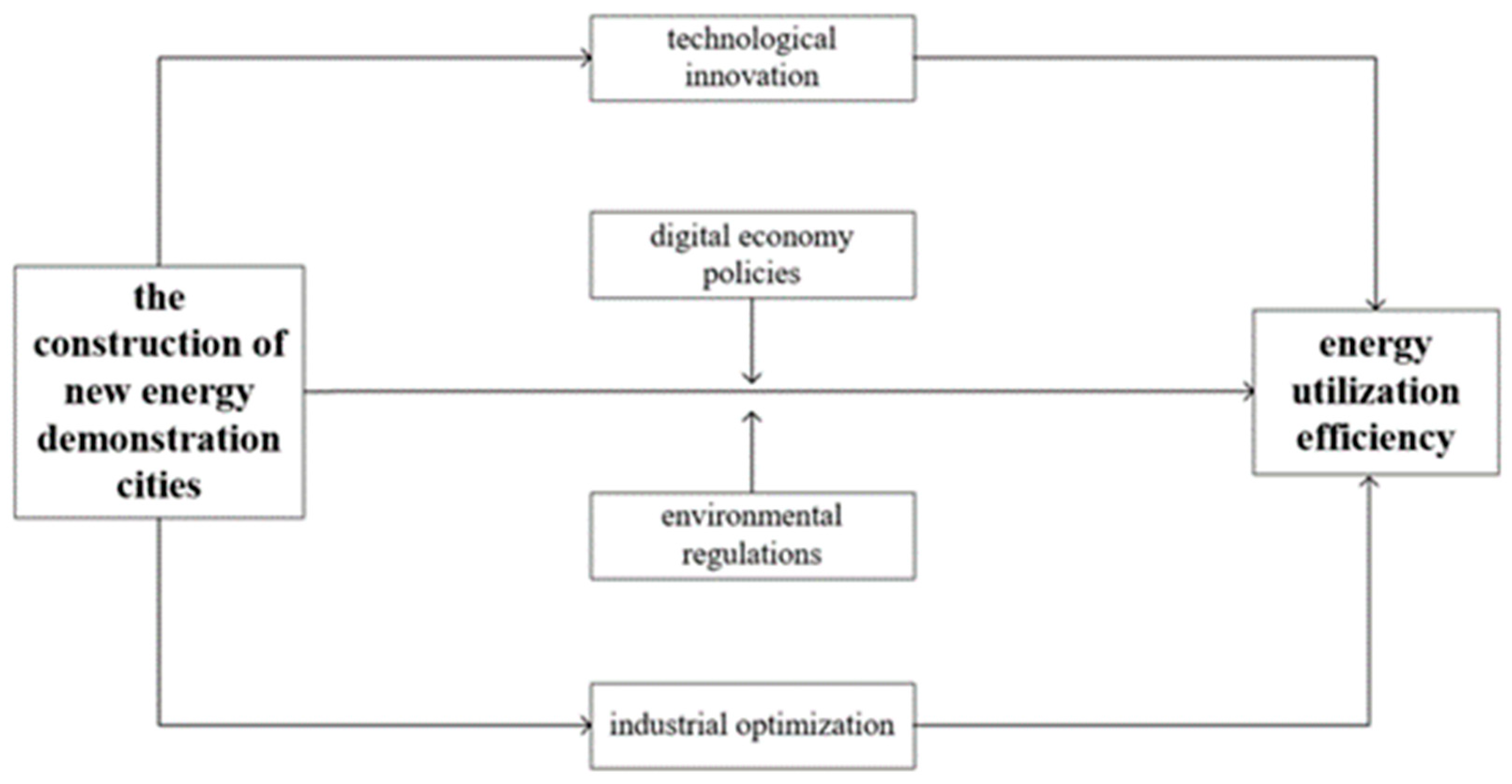
The hypothetical mechanism of the paper is shown in Figure 1.

3. Research Design

3.1. Data Selection

In this paper, we use data from 293 prefecture-level cities in China from 2006 to 2023 as the research sample. The time window fully covers the policy cycle for new energy demonstration cities (the first batch of pilot cities was approved in 2010), with balanced sample sizes before and after the policy implementation, which meets the requirements of the difference-in-differences (DID) model for pre- and post-policy observation periods. Data for each variable and its measurement indicators mainly come from the Wind database, the National Bureau of Statistics website, provincial and municipal Bureau of Statistics websites, the “China Statistical Yearbook”, the “China City Statistical Yearbook”, and the “Government Work Reports” of various provinces, cities, and autonomous regions. In addition, data with missing or abnormal values for key variables are excluded.

3.2. Variable Definitions

Energy use efficiency is a core indicator for measuring energy consumption levels and the degree of effective utilization. Currently, the green transformation of the economy, the adjustment of urban energy structures, and the achievement of carbon sink goals require the metric of energy use efficiency to not only reflect energy consumption itself but also take into account the mutual substitution between production factors and structural changes in the production process. Therefore, referring to the research of Li Rongjie et al. (2022) [24], Wang Jing et al. (2023) [25], and Jiang Xinyu (2025) [26], an indicator system for green total-factor energy efficiency including undesirable outputs is constructed (details in Table 1), and the super-efficiency SBM model is used for calculation to more accurately reflect the energy utilization effect against a background of new energy demonstration city construction. The SBM model can incorporate undesirable outputs and address input–output slack issues. It aligns with the measurement needs for green total-factor energy efficiency, accurately reflects the energy utilization effect against a background of new energy demonstration city construction, and adapts to the considerations of factor substitution and changes in production structure.
To accurately identify the net effect of the new energy demonstration city pilot policy, in this paper, we adopt the classic variable design of the difference-in-differences (DID) model and define the core explanatory variables in two dimensions: whether it is a new energy demonstration city pilot (Treat) and the number of years that it has been one (Post). If the city is a new energy demonstration city pilot, Treat is assigned a value of 1; otherwise, it is assigned a value of 0. For years before the city became a new energy demonstration city pilot, Post is assigned a value of 0; for the year that it became a pilot and subsequent years, Post is assigned a value of 1. The interaction term of the two (Treat × Post) serves as the core policy effect coefficient focused on in this paper, directly reflecting the degree of impact of the construction of new energy demonstration cities on energy use efficiency.
The moderating variables are digital economy policy and environmental regulation. The policy effects of new energy demonstration cities are not isolated but are instead constrained and supported by the external policy environment. Therefore, in this paper, we select two types of key policy variables as moderating factors to analyze their strengthening or weakening effects on the core effect. Digital Economy Policy (Dep), referring to the research of Jin Canyang (2022) [27], Tao Changqi (2022), etc. [28], is measured based on the government work reports of each city, using Python 3.9.0 to calculate the frequency of 60 digital economy-related words; specifically, it is measured based on the proportion of digital economy policy-related word frequency to the total word frequency of the government work report. Environmental Regulation (Er), referring to the practices of Deng Huihui (2019) [29], Chen Shiyi (2021) [30], and Yin Lihui (2021) [31], uses Python to perform word segmentation processing on government work reports and counts 15 keywords related to environmental regulation in each city’s government work report (environmental protection, pollution, etc.); specifically, it is measured as the percentage of frequency of environmental regulation-related words of the total frequency of words in the government work report.
The mediating variables are technological innovation and industrial optimization. To reveal the internal transmission mechanism through which new energy demonstration cities affect energy use efficiency, this paper sets two types of core mediating variables, corresponding to the two key paths of technological progress and structural upgrading. Technological Innovation (Gti) is measured as the total number of green patent grants per 10,000 people in each city; Industrial Optimization (Iso) is measured as the ratio of the added value of the tertiary industry to the added value of the secondary industry.
Regarding the control variables, drawing on existing research and considering that the heterogeneity in economic foundation, resource endowments, and other aspects among Chinese cities may interfere with the identification of the core causal relationship, control variables are selected from six dimensions to exclude irrelevant interferences: the Economic Development Level (Gdp), Population Density (Pop), Infrastructure Level (Inf), Investment Intensity (Inv), Level of Openness (Open), and Urbanization Rate (Urb). The definitions and measurements of each variable are shown in Table 1.

3.3. Model Building

To test Hypothesis 1, this paper uses the difference-in-differences (DID) method to isolate the policy treatment effect, treating the construction of demonstration cities as a quasi-natural experiment. The rationale for adopting the difference-in-differences (DID) method lies primarily in its alignment with the design logic of a quasi-natural experiment: the grouping of pilot cities (treatment group) and non-pilot cities (control group) is close to random, which can reduce selection bias. Simultaneously, two-way controls for regional fixed effects and time fixed effects are applied to avoid the impact of omitted variables at the city and time levels on research accuracy. The specific model is designed as follows:
E u e i , t = β 0 + β 1 T r e a t i , t P o s t i , t + β 2 X i , t + C i t y i + Y e a r t + E i , t
where subscripts i and t represent the city and year, respectively. E u e i , t is the energy utilization efficiency of city i in year t. X i , t represents the control variables; C i t y i is the city fixed effect; Y e a r t is the year fixed effect; β 0 is the intercept term; and E i , t is the random error term.
To test Hypotheses 2 and 3, we further constructed the following model to empirically test the moderating effects of digital economy policy and environmental regulation. Y i , t is the moderating variable, including digital economy policy D e p i , t and environmental regulation E r i , t .
E u e i , t = φ 0 + φ 1 T r e a t i , t P o s t i , t + φ 2 Y i , t T r e a t i , t P o s t i , t + φ 3 X i , t + C i t y i + Y e a r t + E i , t
To test Hypotheses 4 and 5, we further constructed the following model to empirically test the mechanisms through which new energy demonstration city construction affects energy utilization efficiency. M i , t is the mediating variable, including technological innovation G t i i , t and industrial optimization I s o i , t .
M i , t = α 0 + α 1 T r e a t i , t P o s t i , t + α 2 X i , t + C i t y i + Y e a r t + E i , t
E u e i , t = σ 0 + σ 1 T r e a t i , t P o s t i , t + σ 2 M i , t + σ 3 X i , t + C i t y i + Y e a r t + E i , t

4. Empirical Analysis

4.1. Descriptive Statistics

Table 2 reports the descriptive statistics for all variables. It can be seen that the mean of Energy Utilization Efficiency (Eue) is 0.327, indicating that the energy utilization efficiency of Chinese cities is at a relatively low level; the maximum value of Eue is 1.193, the minimum is 0.098, and the standard deviation is 0.139, indicating significant differences in energy utilization efficiency among Chinese cities. Therefore, an in-depth exploration of the impact of new energy demonstration city construction on energy utilization efficiency is of great significance. The mean value for whether it is an NEDC pilot (Treat) is 0.219, indicating that the current number of new energy demonstration cities is relatively small. The mean for the moderating variable Digital Economy Policy (Dep) is 0.109, with a minimum of 0 and a maximum of 1.692, and the mean value for Environmental Regulation (Er) is 0.772, with a minimum of 0 and a maximum of 2.609; it can be seen that there are significant differences in digital economy policies and environmental regulations among Chinese cities, making it necessary to further analyze the moderating role of digital economy policies and environmental regulations in the correlation between new energy demonstration city construction and energy utilization efficiency. Additionally, it can be observed that the control variables exhibit good dispersion, indicating that the selection of control variables is reasonable, which is beneficial for subsequent regression analysis.
Cities with high and low energy utilization efficiency may differ significantly in many aspects. To more clearly describe the differences between these two types of cities, grouping is performed based on the means of energy utilization efficiency, and T-tests are conducted on the inter-group differences. Table 3 reports the results of the univariate analysis. It can be seen that when the energy utilization efficiency is low, the mean vale for whether it is an NEDC pilot (Treat) is 0.216, and the mean before/after NEDC pilot value (Post) is 0.094. When energy utilization efficiency is high, the mean of Treat is 0.222 and the mean of Post is 0.163; the inter-group difference for Treat is not significant, while the inter-group difference for Post is significant at the 1% level. This preliminary finding suggests that after the new energy demonstration city pilot, energy utilization efficiency is significantly improved.

4.2. Benchmark Test

Table 4 shows the regression results for the impact of new energy demonstration city construction on energy use efficiency. From column (1), it can be observed that the correlation coefficient between Eue and Treat×Post is 0.024, which is statistically significant at the 1% level. This indicates a significant positive correlation between the construction of new energy demonstration cities and energy use efficiency, meaning that the initiative significantly promotes higher energy use efficiency. Once a city begins work on the construction on a new energy demonstration city, its energy utilization efficiency will increase by an average of 0.024 units. Thus, Hypothesis 1 is validated. Meanwhile, we find that the correlation coefficient between Eue and Gdp is positive and statistically significant at the 1% level, suggesting a significant positive relationship between the level of economic development and energy use efficiency. In other words, higher levels of economic development are associated with higher energy use efficiency. This may be because regions with more advanced economies possess stronger capital accumulation, greater fiscal capacity, and more dynamic financial markets. These conditions provide indispensable groundwork for technological innovation, directly enabling the development of more efficient energy conversion and utilization technologies and energy management techniques. In contrast, the correlation coefficients between Eue and Inf, as well as Urb, are negative and statistically significant at the 1% level. This implies significant negative correlations between infrastructure development, urbanization rates, and energy use efficiency. Specifically, lower levels of infrastructure and urbanization are associated with higher energy use efficiency. A possible explanation is that infrastructure itself is a major consumer of energy. The construction and operation of expressways, high-speed railways, data centers, and similar projects require substantial and continuous energy inputs. During periods of rapid urbanization and infrastructure expansion, the growth rate of total energy consumption often far exceeds that of GDP, leading to a temporary decline in macro-level energy use efficiency. This apparent “inefficiency” can be viewed as “transition pains” associated with the economy’s structural shift toward a more advanced form. This does not suggest that backwardness itself breeds efficiency; rather, it reflects the transitional costs incurred during structural transformation.
From column (2), it can be observed that after introducing the interaction term between the independent variable and the digital economy, the correlation coefficient between Eue and Treat×Post×Dep is 0.070, which is statistically significant at the 1% level. This indicates that digital economy policies can positively moderate the impact of new energy demonstration city construction on energy use efficiency, thus confirming Hypothesis 2. From column (3), it can be found that after introducing the interaction term between the independent variable and environmental regulation, the correlation coefficient between Eue and Treat×Post×Er is 0.029, which is statistically significant at the 5% level. This suggests that environmental regulation can positively moderate the impact of new energy demonstration city construction on energy use efficiency, thereby confirming Hypothesis 3. Additionally, it can be observed that the level of economic development remains significantly positively correlated with energy use efficiency, while infrastructure level and urbanization rate remain significantly negatively correlated with energy use efficiency.

4.3. Mechanism Test

Table 5 reports the test results for the impact mechanisms of new energy demonstration city construction in energy use efficiency. From column (1), it can be observed that the correlation coefficient between Gti and Treat×Post is 0.073, which is statistically significant at the 1% level, indicating that the construction of new energy demonstration cities promotes technological innovation. From column (2), it can be seen that the correlation coefficient between Eue and Gti is 0.140, statistically significant at the 1% level, while the correlation coefficient between Eue and Treat×Post is 0.014, significant at the 5% level. This suggests that technological innovation plays a partial mediating role in the impact of new energy demonstration city construction on energy use efficiency, thus confirming Hypothesis 4. From column (3), it can be observed that the correlation coefficient between Iso and Treat×Post is 0.221, which is statistically significant at the 1% level, indicating that the construction of new energy demonstration cities facilitates industrial optimization. From column (4), it can be seen that the correlation coefficient between Eue and Iso is 0.036, statistically significant at the 1% level, while the correlation coefficient between Eue and Treat×Post is 0.016, also significant at the 1% level. This indicates that industrial optimization plays a partial mediating role in the impact of new energy demonstration city construction on energy use efficiency, thereby confirming Hypothesis 5.

4.4. Robust Test

4.4.1. Shortening the Time Window

In July 2012, China’s National Energy Administration issued the Notice on the Application for New Energy Demonstration Cities and Industrial Parks, emphasizing the comprehensive implementation of the Scientific Outlook on Development. This Notice was designed to optimize the energy structure and establish a modern energy utilization system, actively promote the application of various new energy technologies in urban power supply, heating, cooling, and building energy efficiency, and enhance sustainable urban development capacity. It also set a clear target of establishing 100 new energy demonstration cities by 2015, officially launching the application process for such cities. To mitigate the potential interference of this policy announcement in the regression results, we narrowed the time window by excluding samples from 2012 and earlier, retaining only data from 2013 to 2023 for re-estimation. Table 6 reports the regression results for the impact of new energy demonstration city construction on energy use efficiency after narrowing the time window. As shown, the correlation coefficient between Eue and Treat×Post is 0.017, statistically significant at the 1% level, indicating that the construction of new energy demonstration cities significantly promotes energy use efficiency. Thus, Hypothesis 1 is again supported. The correlation coefficient between Eue and Treat×Post×Dep is 0.021, significant at the 5% level, suggesting that digital economy policies positively moderate the impact of new energy demonstration city construction on energy use efficiency, which again confirms Hypothesis 2. Meanwhile, the correlation coefficient between Eue and Treat×Post×Er is 0.011, significant at the 10% level, indicating that environmental regulation positively moderates the impact of new energy demonstration city construction on energy use efficiency, thereby providing further support for Hypothesis 3.

4.4.2. Replacing the Method for the Explained Variable

To address potential biases in the regression results arising from different measurement approaches, we further replaced the measurement method for the explained variable by calculating energy use efficiency using the super-efficiency CCR model. Table 7 shows the impact of new energy demonstration city construction on energy use efficiency after substituting the measurement method for the explained variable. As shown, the correlation coefficient between Eue and Treat×Post is 0.030, which is statistically significant at the 1% level, indicating that the construction of new energy demonstration cities significantly promotes energy use efficiency. Thus, Hypothesis 1 is again confirmed. The correlation coefficient between Eue and Treat×Post×Dep is 0.074, significant at the 1% level, suggesting that digital economy policies positively moderate the impact of new energy demonstration city construction on energy use efficiency, which again validates Hypothesis 2. Meanwhile, the correlation coefficient between Eue and Treat×Post×Er is 0.023, significant at the 5% level, demonstrating that environmental regulation positively moderates the impact of new energy demonstration city construction on energy use efficiency, thereby providing further support for Hypothesis 3.

4.4.3. PSM-DID

To further address the self-selection bias in policy effect research, in this study, we employed the nearest neighbor matching (k = 1) method of propensity score matching (PSM) to match demonstration cities with non-demonstration cities that shared similar attributes. A set of control variables was used as matching characteristics for the sample cities, with the matched control group outcomes serving as counterfactual results for the treatment group. After completing the matching, this study re-estimated the impact of demonstration city construction on energy use efficiency based on the new sample data. Table 8 shows the results of the PSM-DID test. The regression results remain consistent with the previous findings, confirming the robustness of the research conclusions.

4.5. Heterogeneity Analysis

4.5.1. Regional Heterogeneity

Regional heterogeneity reflects the macro external environment and economic development stage in which a city is situated, which determines the starting point, constraints, and objectives of policy implementation. Considering the heterogeneity across city regions, we further performed regressions by grouping Chinese cities according to their regions: the eastern, central, western, and northeastern regions. Table 9 shows the regression results after accounting for regional heterogeneity. As shown, in the eastern region, the correlation coefficient between Eue and Treat×Post is 0.057, statistically significant at the 1% level. In the central region, the correlation coefficient is 0.024, significant at the 10% level. In the western and northeastern regions, the coefficients are 0.005 and 0.014, respectively, and are not statistically significant at the 10% level. These results indicate that the construction of new energy demonstration cities has the most pronounced promoting effect on energy use efficiency in the eastern region, followed by the central region, while its impact on the western and northeastern regions is not significant. This discrepancy may be attributed to the strong economic and fiscal foundation of the eastern region, which enables the provision of ample supporting funds, subsidies, and tax incentives. Furthermore, this region benefits from advanced technological and talent advantages, leading the way in technology selection, operation, and maintenance, thereby ensuring the efficient and stable operation of projects. Consequently, the construction of new energy demonstration cities significantly enhances its energy use efficiency. The central region has certain potential but faces structural contradictions. For instance, areas such as Shanxi and Anhui, traditionally reliant on coal, exhibit strong path dependency, requiring new energy development to contend with entrenched traditional energy interests. Additionally, the central region’s financial capacity and reserves of scientific and technological talent are inferior to those of the eastern region, potentially resulting in shortcomings in project financing costs and technological advancement. Although the western region is exceptionally rich in new energy resources, its local economy is relatively small, with a weaker industrial base and a limited energy demand market. The northeastern region, meanwhile, grapples with the decline of traditional heavy industries, population outflows, and sluggish economic growth, leading to slow or even shrinking growth in energy demand. Both regions face high institutional costs and poor flexibility in energy system transformation, which explains why the construction of new energy demonstration cities does not significantly enhance their energy use efficiency.

4.5.2. Resource Endowment Heterogeneity

Heterogeneity in resource endowment reflects the inherent natural capital of a city, which directly determines the technological pathways, costs, and feasibility of new energy development. Considering the heterogeneity in urban resource endowments, we further performed regressions by grouping all cities into resource-based cities and non-resource-based cities. Table 10 shows the regression results after accounting for resource endowment heterogeneity. As shown, in resource-based cities, the correlation coefficient between Eue and Treat×Post is 0.022, statistically significant at the 1% level. In non-resource-based cities, the correlation coefficient is 0.030, also significant at the 1% level. These results indicate that the promoting effect of new energy demonstration city construction on energy use efficiency is more pronounced in non-resource-based cities. This discrepancy may be attributed to the fact that the economic lifelines, fiscal revenue, and employment in resource-based cities heavily rely on traditional resource industries. Transitioning to new energy would shake their economic foundation, leading to strong resistance from those with vested interests and lacking intrinsic motivation for transformation. On the other hand, due to a long-term dependence on resource extraction, resource-based cities lack professional talent and research institutions in the field of new energy, resulting in insufficient momentum for endogenous transformation. In contrast, non-resource-based cities generally exhibit more diversified industrial structures, higher public demand for environmental quality, and more diverse industries and talent pools. Particularly in non-resource-based cities along the eastern coast, it is easier to attract and cultivate high-tech talent, providing intellectual support for research, application, and energy efficiency management in new energy technologies.

5. Further Analysis

Considering the regional disparities among Chinese cities, the construction of new energy demonstration cities may exhibit spatial correlation. Therefore, in this paper, we further analyze the spatial impact effects of new energy demonstration city construction on energy use efficiency.

5.1. Testing for the Existence of Spatial Effects

Firstly, the Moran’s I index is used to measure the spatial correlation in new energy demonstration city construction. The results are shown in Table 11. It can be seen that during the period 2006~2023, the Moran’s I index for new energy demonstration city construction is significantly positive, indicating that during this stage, new energy demonstration city construction showed a significant spatial positive correlation trend of “high–high aggregation, low–low aggregation”.

5.2. Model Specification for Spatial Effects

Next, a spatial regression model is constructed to empirically test the spatial impact effects of new energy demonstration city construction on energy utilization efficiency. Firstly, model selection tests are conducted. Table 12 shows the model test results. It can be seen that both the LR test and the Wald test significantly reject the null hypothesis that the Spatial Durbin Model (SDM) can be simplified to the SAR model and the SEM model, indicating that the SDM has better adaptability.
Based on the model test results, a Spatial Durbin Model is constructed to empirically test the spatial impact of new energy demonstration city construction on energy utilization efficiency. The model is set as follows:
E u e i , t = η 0 + η 1 j = 1 293 ω i j E u e i , t + η 2 T r e a t i , t P o s t i , t + η 3 j = 1 293 ω i j T r e a t i , t P o s t i , t + η 4 X i , t + C i t y i + Y e a r t + E i , t
where ω i j is the spatial weight matrix. In this paper, we select the geographical adjacency matrix for testing and use the geographical distance matrix for robustness testing; j = 1 293 ω i j E u e i , t is the spatial lag term for energy utilization efficiency, and j = 1 293 ω i j T r e a t i , t P o s t i , t is the spatial lag term for new energy demonstration city construction. C i t y i and Y e a r t represent regional fixed effects and time fixed effects, respectively; ε i t is the error term, and η 0 is the intercept term. We focus on the coefficient η 3 of ω i j T r e a t i , t P o s t i , t . If η 3 is significant, this indicates that new energy demonstration city construction has a significant spatial impact effect on energy utilization efficiency.

5.3. Analysis of the Regression Results for Spatial Effects

Table 13 presents the test results for the spatial impact effects of new energy demonstration city construction on energy use efficiency. Column (1) shows the empirical results obtained using the spatial adjacency matrix, while column (2) presents those obtained using the spatial distance matrix.
From column (1), it can be observed that the correlation coefficient between Eue and Treat×Post is 0.024, statistically significant at the 1% level, once again confirming that the construction of new energy demonstration cities significantly promotes energy use efficiency. Meanwhile, the correlation coefficient between Eue and W×Treat×Post is 0.026, significant at the 5% level, indicating a significant positive spatial correlation between new energy demonstration city construction and energy use efficiency. That is to say, the construction of new energy demonstration cities in neighboring areas significantly enhances local energy use efficiency. This phenomenon may be attributed to the following mechanisms. Firstly, technological spillovers and learning effects occur between neighboring cities. The professional technical talents and management personnel cultivated during the construction of demonstration cities may move to work or provide consulting services in surrounding areas. Simultaneously, demonstration cities can drive the formation of new energy-related industrial chains in adjacent regions, and the planning and construction of large-scale new energy infrastructure often cover multiple areas. On the other hand, policy imitation and competition effects occur among neighboring cities. When a city observes that neighboring demonstration cities are gaining central financial subsidies, policy support, and economic growth through new energy development, it tends to imitate them and introduce similar supportive policies. Additionally, the success of nearby demonstration cities places pressure on local governments, prompting them to take measures to catch up and avoid falling behind in regional competition. As seen in column (2), after replacing the spatial weight matrix with the spatial distance matrix, the regression results remain consistent with those in column (1), demonstrating the robustness of the findings.

6. Conclusions and Recommendations

6.1. Conclusions

Using data from 293 prefecture-level cities in China from 2006 to 2023 as the research sample, in this study, we empirically examined the impact of new energy demonstration city construction on energy utilization efficiency. The main research conclusions are as follows: First, the construction of new energy demonstration cities can effectively enhance energy use efficiency. Second, digital economy policies and environmental regulation positively moderate the impact of new energy demonstration city construction on energy use efficiency. Third, new energy demonstration city construction can effectively improve energy use efficiency through technological innovation and industrial optimization. Heterogeneity analysis reveals that the promoting effect of new energy demonstration city construction on energy use efficiency is most pronounced in the eastern region, followed by the central region, while its impact on the western and northeastern regions is not significant. Additionally, the promoting effect is more evident in non-resource-based cities than in resource-based cities. Further analysis indicates a significant positive spatial correlation between new energy demonstration city construction and energy use efficiency, suggesting that the construction of such cities in neighboring areas significantly enhances local energy use efficiency.

6.2. Recommendations

Based on these research conclusions, the following policy implications are proposed: firstly, the demonstration policy should be further developed and promoted to leverage its leading and driving role. Based on the success of existing demonstration cities, more cities should be included in the project, selectively and in batches, and different access standards and support policies should be designed for the currently underserved western and northeastern regions. Secondly, policy coordination should be enhanced to achieve a “policy mix” effect and promote the integration of new energy into the digital economy. The government should take the lead in building urban energy data platforms, promoting data sharing, and incentivizing energy efficiency improvements and, at the same time, leverage the forcing and guiding role of environmental regulations, reasonably set and strictly enforce carbon emission and pollutant emission standards, and create stable market demand for new energy technologies. Thirdly, targeted support and guidance should be provided for key technological innovations and the strategic adjustment of industrial structures. Fiscal R&D investment should focus on breakthroughs and industrialization in core technologies, encourage “industry–university–research–application” cooperation, and accelerate the commercialization of technological achievement; simultaneously, fiscal, tax, and financial measures should be employed to guide traditional high-energy-consuming industries toward green and intelligent transformation. Finally, administrative barriers should be broken down and a new pattern of regional coordinated development created. Policies should reach beyond the scope of individual cities to plan and construct regional green coordinated development belts in a coordinated manner, with the establishment of experience exchange and compensation mechanisms between regions, allowing advanced regions to jointly build industrial parks in less developed regions and directly introducing advanced management models, technologies, and capital to maximize knowledge spillover effects.
Although this study provides useful empirical evidence to guide our understanding of the impact of new energy demonstration city construction on energy use efficiency, it still has certain limitations that highlight key future research directions. The sample in this study only extends up to 2023, meaning that the long-term dynamic effects of the new energy demonstration city policy may not yet be fully captured. At the same time, the research is primarily based on prefecture-level city data and does not explore the district, county, or enterprise levels, which may mask uneven development within cities. Future studies could employ data with longer time spans to assess the long-term effects and sustainability of the policy and utilize micro-level data from enterprises and households, or integrate new data sources, such as remote sensing and big data, to verify the micro-level effects and spatial heterogeneity of the policy at a more granular scale.


Author Contributions

Conceptualization, Z.D. and P.J.; methodology, Z.D. and P.J.; software, Z.D. and T.W.; validation, Z.D. and P.J.; formal analysis, Z.D. and T.W.; investigation, Z.D. and T.W.; resources, Z.D. and P.J.; data curation, Z.D.; writing—original draft preparation, Z.D. and P.J.; writing—review and editing, Z.D. and T.W.; visualization, Z.D. and P.J.; supervision, Z.D. and P.J.; project administration, P.J.; funding acquisition, P.J. All authors have read and agreed to the published version of the manuscript.

Funding

This work was supported by the National Social Science Fund of China (Grand No: 25BGL240).

Institutional Review Board Statement

Not applicable.

Informed Consent Statement

Not applicable.

Data Availability Statement

The original contributions presented in this study are included in the article. Further inquiries can be directed to the corresponding author.

Conflicts of Interest

The authors declare no conflicts of interest.

References

  1. Yi, S.Y.; Yin, Y.Y. The impact of new energy demonstration city policy on foreign direct investment in China during the green transition. Macroecon. Res. 2022, 11, 147–163+175. [Google Scholar]
  2. Jiang, Y.; Fan, M.; Fan, Y. Does energy transition policy enhance urban green innovation capabilities? a quasi-natural experiment based on China’s new energy demonstration city policy. Front. Environ. Sci. 2024, 12, 1377274. [Google Scholar] [CrossRef]
  3. Wang, P.; Li, D. New energy demonstration cities policy and urban green transformation. Financ. Res. Lett. 2025, 79, 107261. [Google Scholar] [CrossRef]
  4. Yuan, F.; Nie, C. Re-examining the effect of China’s new-energy demonstration cities construction policy on environmental pollution: A perspective of pollutant emission intensity control. J. Environ. Plan. Manag. 2022, 12, 2333–2361. [Google Scholar]
  5. Huang, M.Y.; Yang, L. An empirical test of the carbon emission reduction effects of the new energy demonstration city policy. Stat. Decis. 2025, 41, 54–59. [Google Scholar]
  6. Li, M.; Yang, M.; Xia, N.; Cai, S.; Tian, Y.; Li, C. Forging resilient urban ecosystems: The role of energy structure transformation under China’s new energy demonstration city pilot policy. Systems 2025, 8, 709. [Google Scholar] [CrossRef]
  7. Ma, Y. The impact of the new energy demonstration city policy on green growth in pilot cities: Evidence from a quasi-experiment in Chinese prefecture-level cities. J. Innov. Dev. 2025, 3, 84–98. [Google Scholar] [CrossRef]
  8. Shi, Y.; Yang, B. How digital finance and green finance can synergize to improve urban energy use efficiency? New evidence from China. Energy Strategy Rev. 2024, 55, 101553. [Google Scholar] [CrossRef]
  9. Li, S.S.; Ma, Y.Q. The impact of carbon trading policy on urban energy use efficiency and its mechanisms. J. Ind. Technol. Econ. 2024, 43, 90–99. [Google Scholar]
  10. Xue, H.; Cai, M.; Liu, B.; Di, K.; Hu, J. Sustainable development through digital innovation: Unveiling the impact of big data comprehensive experimental zones on energy utilization efficiency. Sustain. Dev. 2024, 1, 177–189. [Google Scholar] [CrossRef]
  11. Song, Y.J.; Chen, X.D.; Li, X.T.; Chen, J.Q. Digital enterprise empowerment, ultra-large market advantages, and enterprise energy use efficiency. China Ind. Econ. 2025, 6, 121–139. [Google Scholar]
  12. Ren, Z.; Bo, Y.; Lei, Y. Green financial policy, environmental regulation, and energy use efficiency. Financ. Res. Lett. 2025, 74, 106711. [Google Scholar] [CrossRef]
  13. Schumpeter, J.A. Capitalism, Socialism, and Democracy. Am. Econ. Rev. 1942, 3, 594. [Google Scholar]
  14. Ma, Y.; Wan, S.; Zhou, Y. Bridging energy gaps in urbanizing economies: Evidence from China’s new energy demonstration city policy on multidimensional energy poverty. Energy Econ. 2025, 149, 108767. [Google Scholar] [CrossRef]
  15. Healy, P.M.; Palepu, K.G. Information asymmetry, corporate disclosure, and the capital markets: A review of the empirical disclosure literature. J. Account. Econ. 2001, 31, 405–440. [Google Scholar] [CrossRef]
  16. Wu, T.; Du, J. Digital economy policy, supply chain finance, and enterprise innovation resilience: A quasi-natural experiment based on pilot innovative industry clusters. Financ. Res. Lett. 2025, 85, 108161. [Google Scholar] [CrossRef]
  17. Yang, X.; Hunjra, A.I.; Grebinevych, O.; Roubaud, D.; Zhao, S. Roads to sustainable development: Pioneering industrial green transformation through digital economy policy. J. Environ. Manag. 2025, 387, 125721. [Google Scholar] [CrossRef] [PubMed]
  18. Nahee, K.; Jeremy, M. Institutional complementarity between corporate governance and Corporate Social Responsibility: A comparative institutional analysis of three capitalisms. Socio-Econ. Rev. 2012, 10, 85–108. [Google Scholar]
  19. Fan, R.; Su, S. Comparison of industrial structure optimization paths under environmental regulation: Efficiency improvement or structure improvement? Int. Rev. Econ. Financ. 2025, 102, 104297. [Google Scholar] [CrossRef]
  20. Li, D.; Zhang, Z.; Xu, R. The impact of environmental regulation on green image management of supply chain: Evidence from China. Financ. Res. Lett. 2025, 74, 106723. [Google Scholar] [CrossRef]
  21. Guo, B.; Feng, Y.; Lin, J.; Wang, X. New energy demonstration city and urban pollutant emissions: An analysis based on a spatial difference-in-differences mode. Int. Rev. Econ. Financ. 2024, 91, 287–298. [Google Scholar] [CrossRef]
  22. Hameed, J.; Huo, C.; Albasher, G.; Naeem, M.A. Revisiting the nexus between financialization and natural Resource efficiency through the lens of financial development and green industrial optimization. J. Clean. Prod. 2024, 468, 143066. [Google Scholar] [CrossRef]
  23. Li, Z.; Tang, X.; Xu, Z.; Mi, F. How does the new energy demonstration city pilot affect corporate green M&A: Evidence of A-share listed companies in China. Financ. Res. Lett. 2025, 85, 107909. [Google Scholar]
  24. Li, R.J.; Li, N.; Yan, X. The impact mechanism of electricity market integration on regional green economic efficiency. Resour. Sci. 2022, 44, 523–535. [Google Scholar] [CrossRef]
  25. Wang, J.; Pan, H.Y.; Zi, S.R.; He, Z.C. The spatial spillover effects of cultural industry agglomeration on green economic efficiency. Sci. Decis. Mak. 2023, 8, 53–68. [Google Scholar]
  26. Jiang, X.Y. The impact of sustainable development policies in resource-based cities on energy use efficiency. Sci. Technol. Ind. 2025, 25, 254–258. [Google Scholar]
  27. Jin, C.Y.; Xu, A.T.; Qiu, K.Y. Measurement of the development level of China’s provincial digital economy and its spatial correlation. Stat. Inf. Forum 2022, 37, 11–21. [Google Scholar]
  28. Tao, C.Q.; Ding, Y. How does the digital economy policy affect manufacturing enterprise innovation?—A perspective based on appropriate supply. Contemp. Financ. Econ. 2022, 3, 16–27. [Google Scholar]
  29. Deng, H.H.; Yang, L.X. Haze control, local competition, and industrial green transformation. China Ind. Econ. 2019, 10, 118–136. [Google Scholar]
  30. Chen, S.Y.; Zhang, J.P.; Liu, Z.L. Environmental regulation, financing constraints, and corporate pollution abatement: Evidence from the adjustment of pollution fee standards. J. Financ. Res. 2021, 9, 51–71. [Google Scholar]
  31. Yin, L.H.; Wu, C.Q. Environmental regulation and the ecological efficiency of pollution-intensive industries in the Yangtze River Economic Belt. China Soft Sci. 2021, 8, 181–192. [Google Scholar]
Figure 1. Hypothetical mechanism.
Sustainability 17 10677 g001
Table 1. Variable definition and interpretation.
VariablesNameSymbolDefinition or MeasurementData Source
Explained variableEnergy Utilization EfficiencyEueCalculated using the Super-Efficiency SBM modelThe Wind database
Explanatory variableNew Energy Demonstration City PilotTreatAssigned a value of 1 if the city is a new energy demonstration city pilot; otherwise, 0The National Bureau of Statistics website, provincial and municipal Bureau of Statistics websites
Pre/Post-Pilot ImplementationPostAssigned a value of 0 for years before becoming a pilot; assigned a value of 1 for the pilot year and subsequent years
Moderating VariableDigital Economy PolicyDepPercentage of digital economy policy-related word frequency in the total word count of the Government Work Report (%)The “Government Work Reports”
Environmental RegulationErPercentage of environmental regulation-related word frequency in the total word count of the Government Work Report (%)
Mediating VariableTechnological InnovationGtiTotal number of green patent grants per 10,000 people in each cityThe Wind database, the “China Statistical Yearbook”, the “China City Statistical Yearbook”
Industrial OptimizationIsoRatio of the value added to the tertiary industry to the value added to the secondary industry
Control VariableEconomic Development LevelGdpNatural logarithm of Gross Domestic ProductThe Wind database, the “China City Statistical Yearbook”
Population DensityPopRatio of year-end permanent resident population to city area
Infrastructure LevelInfMeasured by per capita road area
Investment IntensityInvNatural logarithm of completed investment in fixed assets
Level of OpennessOpenNatural logarithm of Foreign Direct Investment
Urbanization RateUrbProportion of urban population to total population
Table 2. Summary statistics.
VariableObsMeanMedianStd. DevMin
Eue50220.3270.1390.0981.193
Treat50220.2190.41301
Post50220.1210.32701
Dep50220.1090.13101.692
Er50220.7720.29002.609
Gti50220.5230.940010.023
Iso50221.0540.5980.0945.690
Gdp50224.9091.0381.6478.460
Pop50223.8492.6920.24820.093
Inf502217.2917.8460.39061.408
Inv502210.5941.756013.153
Open50225.6243.606015.376
Urb50220.5400.1660.1151
Table 3. Univariate analysis (grouped by mean energy efficiency).
VariablesLow Energy Utilization EfficiencyHigh Energy Utilization EfficiencyT-Test
ObsMeanStd. DevObsMeanStd. Dev
Treat30230.2160.41219990.2220.416−0.006
Post30230.0940.29219990.1630. 369−0.068 ***
Dep30230.0830.11819990.1480.140−0.066 ***
Er30230.7610.29619990.7890.279−0.028 ***
Gti30230.2860.44319990.8811.308−0.594 ***
Iso30230.9810.54219991.1640.659−0.183 ***
Gdp30234.5350.88319995.4750.998−0.939 ***
Pop30234.0042.88319993.6162.3550.388 ***
Inf302315.9487.387199919.3228.080−3.374 ***
Inv302310.4531.738199910.8081.762−0.355 ***
Open30235.9463.38919995.1383.8630.808 ***
Urb30230.5060.16219990.5910.159−0.085 ***
Note: ***: significance at the 1% levels; the same is true below.
Table 4. Benchmark test.
Eue
(1)(2)(3)
Treat×Post0.024 ***0.0100.018 *
(4.21)(1.38)(1.85)
Treat×Post×Dep 0.070 ***
(2.84)
Treat×Post×Er 0.029 **
(2.13)
Gdp0.029 ***0.027 ***0.029 ***
(3.81)(3.60)(3.76)
Pop0.0000.0000.000
(0.87)(1.03)(0.79)
Inf−0.001 ***−0.001 ***−0.001 ***
(−4.66)(−4.49)(−4.63)
Inv−0.004−0.004−0.004
(−1.59)(−1.63)(−1.50)
Open0.0010.0010.001
(0.88)(0.93)(0.88)
Urb−0.068 ***−0.067 ***−0.067 ***
(−2.68)(−2.65)(−2.63)
_Cons0.186 ***0.189 ***0.185 ***
(4.88)(4.95)(4.85)
Year and CityYesYesYes
N502250225022
R20.6710.6700.670
Note: the numbers in brackets are “t” of the estimated coefficients. *, **, ***: significance at the 10%, 5% and 1% levels, respectively. The same is true below.
Table 5. Mechanism test.
GtiEueIsoEue
(1)(2)(3)(4)
Treat×Post0.073 ***0.014 **0.221 ***0.016 ***
(6.65)(2.48)(6.10)(2.87)
Gti 0.140 ***
(19.46)
Iso 0.036 ***
(16.25)
Gdp0.133 ***0.0100.408 ***0.014 *
(8.97)(1.41)(8.42)(1.91)
Pop0.000 ***−0.0000.000 ***0.000
(3.40)(−0.06)(3.75)(0.00)
Inf−0.007 ***−0.001 *−0.021 ***−0.001 **
(−11.19)(−1.65)(−10.54)(−2.27)
Inv−0.027 ***−0.000−0.085 ***−0.001
(−5.57)(−0.07)(−5.45)(−0.34)
Open−0.0020.001−0.016 ***0.001 *
(−1.21)(1.25)(−3.83)(1.80)
Urb−0.490 ***0.001−1.578 ***−0.011
(−9.93)(0.03)(−9.76)(−0.44)
_Cons0.178 **0.162 ***0.559 **0.166 ***
(2.39)(4.40)(2.29)(4.47)
Year and CityYesYesYesYes
N5022502250225022
R20.6410.6940.7060.687
Note: the numbers in brackets are “t” of the estimated coefficients. *, **, ***: significance at the 10%, 5% and 1% levels, respectively.
Table 6. Robustness test: shortening the time window.
Eue
(1)(2)(3)
Treat×Post0.017 ***0.0080.013 *
(3.08)(0.87)(1.76)
Treat×Post×Dep 0.021 **
(2.23)
Treat×Post×Er 0.011 *
(1.86)
_Cons0.180 ***0.181 ***0.180 ***
(4.82)(4.84)(4.80)
Control variablesControlControlControl
N448244824482
R20.6770.6760.677
Note: the numbers in brackets are “t” of the estimated coefficients. *, **, ***: significance at the 10%, 5% and 1% levels, respectively.
Table 7. Robustness test: replacing the method for the explained variable.
Ccr
(1)(2)(3)
Treat×Post0.030 ***0.0150.021 *
(4.14)(1.64)(1.73)
Treat×Post×Dep 0.074 ***
(3.26)
Treat×Post×Er 0.023 **
(2.40)
_Cons0.333 ***0.336 ***0.333 ***
(6.93)(6.98)(6.91)
Control variablesControlControlControl
N502250225022
R20.6630.6620.663
Note: the numbers in brackets are “t” of the estimated coefficients. *, **, ***: significance at the 10%, 5% and 1% levels, respectively.
Table 8. Robustness test: PSM-DID.
Eue
(1)(2)(3)
Treat×Post0.330 ***0.352 ***0.367 ***
(4.27)(4.76)(4.95)
Treat×Post×Dep 0.061 *
(1.83)
Treat×Post×Er 0.081 *
(1.94)
_Cons0.0040.011−0.002
(0.02)(0.05)(−0.01)
Control variablesControlControlControl
N273027302730
R20.7560.7570.756
Note: the numbers in brackets are “t” of the estimated coefficients. *, ***: significance at the 10% and 1% levels, respectively.
Table 9. Regional heterogeneity.
Eue
EasternCentralWesternNortheastern
(1) (2) (3) (4)
Treat×Post0.057 ***0.024 *0.0050.014
(4.89)(1.67)(0.61)(1.07)
_Cons−0.158−0.110−0.478 ***−0.795 ***
(−0.91)(−0.96)(−5.68)(−6.11)
Control variablesControlControlControlControl
N154814221476576
R20.6280.6710.7270.715
Note: the numbers in brackets are “t” of the estimated coefficients. *, ***: significance at the 10% and 1% levels, respectively.
Table 10. Resource endowment heterogeneity.
Eue
Resource-Based CitiesNon-Resource-Based Cities
(1)(2)
Treat×Post0.022 ***0.030 ***
(3.06)(3.73)
_Cons0.131 ***0.152 ***
(2.98)(3.31)
Control variablesControlControl
N20163006
R20.6830.655
Note: the numbers in brackets are “t” of the estimated coefficients. ***: significance at the 1% levels.
Table 11. Moran’s I index for new energy demonstration city construction.
YearMoran’s IYearMoran’s IYearMoran’s I
20060.181 ***20120.120 ***20180.162 ***
(4.877)(3.320)(4.409)
20070.156 ***20130.095 ***20190.208 ***
(4.204)(2.678)(5.631)
20080.168 ***20140.103 ***20200.181 ***
(4.554)(2.887)(4.914)
20090.121 ***20150.144 ***20210.138 ***
(3.361)(3.971)(3.757)
20100.151 ***20160.127 ***20220.143 ***
(4.212)(3.499)(3.973)
20110.205 ***20170.178 ***20230.138 ***
(5.594)(4.898)(3.757)
Note: the values in parentheses are the corresponding z-statistics. The numbers in brackets are “t” of the estimated coefficients. ***: significance at the 1% levels.
Table 12. LR and Wald tests for model selection.
TestStatisticp-Value
LR testLR test (SAR)13.470.062
LR test (SEM)15.400.031
Wald testWald test (SAR)13.500.061
Wald test (SEM)15.380.031
Table 13. The spatial impact of new energy demonstration city construction on energy use efficiency.
Eue
Spatial Contiguity MatrixGeographical Distance Matrix
(1)(2)
Treat×Post0.024 ***0.022 ***
(4.29)(3.87)
Gdp0.030 ***0.026 ***
(4.10)(3.49)
Pop0.0010.001
(0.71)(0.78)
Inf−0.001 ***−0.002 ***
(−4.79)(−4.98)
Inv−0.004 *−0.003
(−1.74)(−1.35)
Open0.0000.001
(0.54)(0.81)
Urb−0.065 ***−0.073 ***
(−2.66)(−2.92)
W×Treat×Post0.026 **0.028 **
(2.38)(2.29)
W×Gdp1.015 **1.136 **
(2.09)(2.33)
W×Pop−0.0010.044
(−0.35)(0.84)
W×Inf−0.001−0.021
(−0.99)(−1.32)
W×Inv0.003−0.076
(0.63)(−0.67)
W×Open−0.002−0.009
(−1.61)(−0.13)
W×Urb−0.074−0.789
(−1.47)(−0.50)
ρ0.069 ***0.057 **
(3.35)(2.37)
_Cons0.006 ***0.006 ***
(50.06)(50.03)
N50225022
R20.1390.127
Note: the numbers in brackets are “t” of the estimated coefficients. *, **, ***: significance at the 10%, 5% and 1% levels, respectively.
Disclaimer/Publisher’s Note: The statements, opinions and data contained in all publications are solely those of the individual author(s) and contributor(s) and not of MDPI and/or the editor(s). MDPI and/or the editor(s) disclaim responsibility for any injury to people or property resulting from any ideas, methods, instructions or products referred to in the content.