1. Introduction
Switching to renewable energy is a key principle of sustainable development strategies, as it is essential to minimize greenhouse gas emissions, improve long-term energy security, and enhance economic resilience [
1]. In the context of the European Union (EU), the transition to clean energy has been institutionalized by the European Green Deal [
2] and accelerated by the REPowerEU Plan [
3], which aims to make the EU climate-neutral by 2050 and reduce reliance on imported fossil fuels.
This research study aims to examine the spatial–temporal dynamics of electricity generation in the EU-28 between fossil and renewable sources over the 2008–2025 period by applying comparative GIS-based forecasting and clustering models to determine patterns, persistence, and transition patterns across countries.
To track this transition effectively, it is necessary to consider not only national-level developments but also the spatial and temporal dynamics of electricity production across the EU. The asymmetric allocation of natural resources, the ability to build and sustain infrastructure, and the implementation of policies create territorial asymmetries, which necessitate disaggregated geo-temporal analyses [
4,
5]. Although the literature has provided extensive coverage of the economic and environmental effects of the energy transition, only a limited number of studies have used a spatial–temporal approach with GIS-based tools and high-resolution longitudinal data [
6].
The proposed study will fill this gap in the methodology by using refined spatial–temporal analytics on monthly electricity generation data from Eurostat (dataset: nrgcbpem_custom16218238), covering the period from 2008 to 2025 for EU-28 countries at the NUTS0 level [
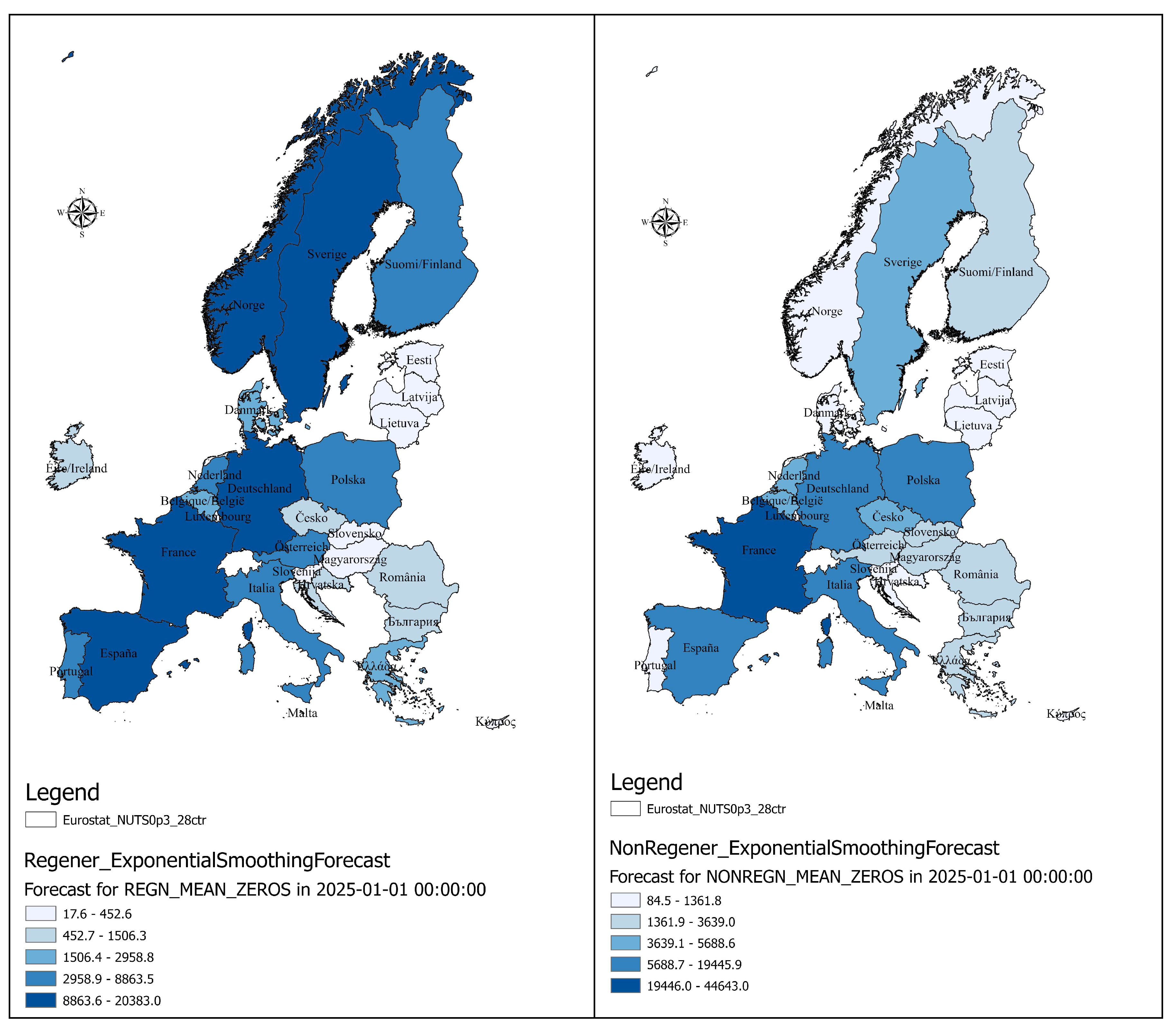
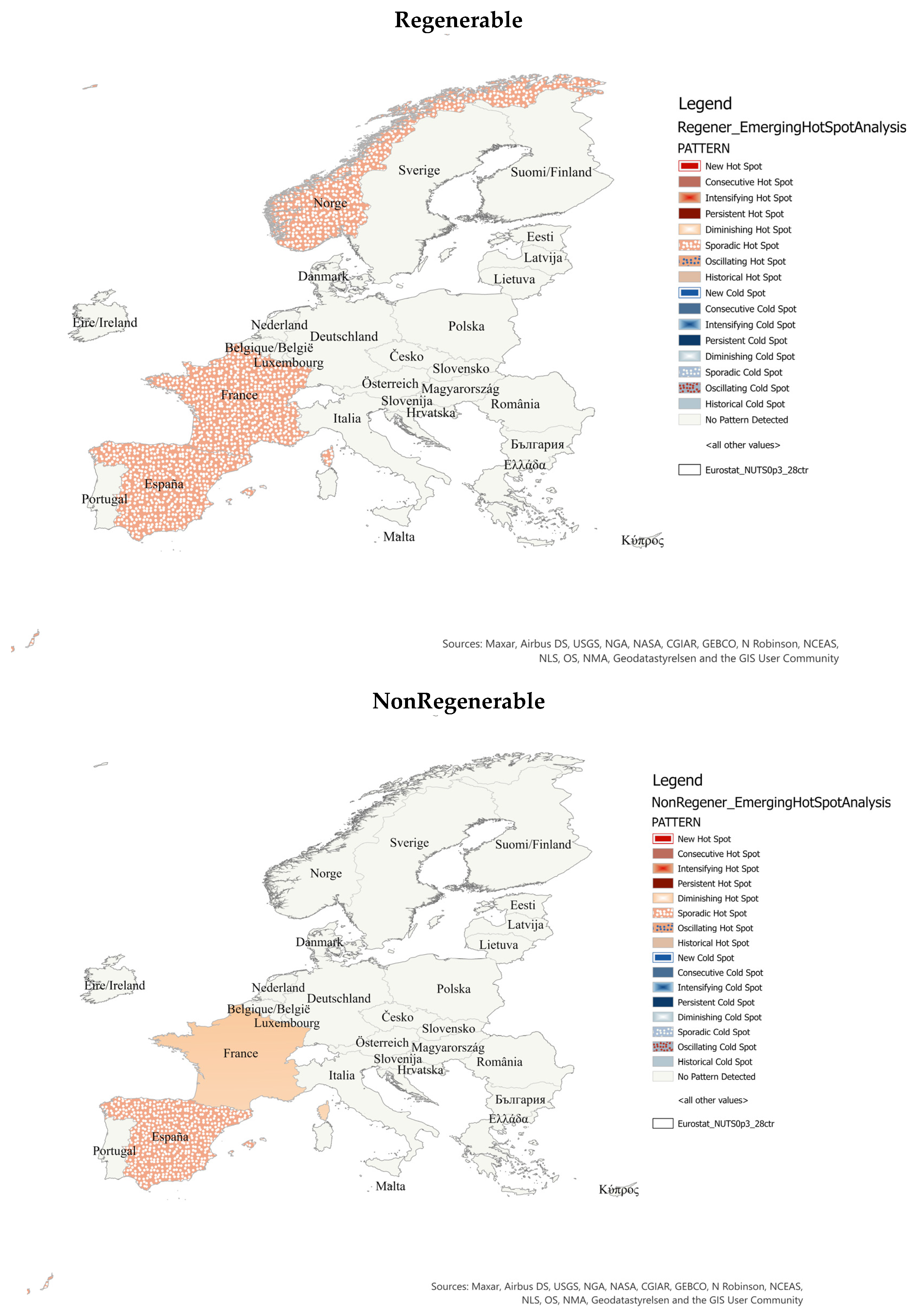
7]. The data are longitudinal, consisting of repeated measurements of electricity production from the same space points (countries) at periodic time intervals (monthly) over several years. Two different Space–Time Cubes (STC) were built: one (REg) was to be used as a renewable electricity generator, and the other (NonREg) was to be used as a non-renewable electricity generator. With these cubes, it is possible to dynamically explore patterns of electricity generation using the Exponential Smoothing Forecast (ESF), Emerging Hot Spot Analysis (EHSA), and Time Series Clustering (TSC) in a GIS environment [
8].
The 2022–2024 shock came as a surprise to the European energy system due to the Russian invasion of Ukraine and the disruption of gas supplies, leading to initial volatility in electricity markets. The emergency measures, including the coordination of storage requirements, demand mitigation programmes, and the REPowerEU acceleration package, essentially changed the nature of generation and consumption [
9,
10,
11]. Eurostat reported decreases in the total gross available energy and net electricity output in 2022 and 2023. With retail electricity prices at their peak in early 2023, structural stress manifested across interconnected power systems [
12,
13]. The shocks resulted in visible distortions in the national time series, which is a plausible explanation for the structural outliers identified in our monthly data for 2017–2025. The period 2022–2024 is therefore considered a separate crisis window in our spatial–temporal modeling framework, for which the lagged effects of energy security measures, infrastructural reconfigurations, and demand-side responses reported in recent IEA and ENTSO-E reports are relevant [
9,
10,
11,
14,
15,
16].
Although extensive literature is dedicated to the European energy transition, only a small number of studies combine spatial–temporal analytics with forecasting methods to analyze renewable and non-renewable generation patterns together [
17,
18,
19,
20,
21]. The majority of previous studies were either conducted on national-level energy mixes or on decarbonization policy, without reference to the role of spatial heterogeneity in the temporal change pattern [
22,
23,
24,
25]. This is a significant gap in research due to this methodological and analytical fragmentation.
In this regard, the research questions that are answered in this study are as follows:
(RQ1) What have been the transformations in the dynamics of electricity generation in the EU member states in the transition from fossil to renewable sources between the years 2008–2025 (core 2017–2024)?
(RQ2) What are the spatial–temporal trends (acceleration, stagnation, and persistence) of renewable and non-renewable electricity production in Europe?
(RQ3) What can spatio-temporal forecasting and hot spot detection techniques (ESF and EHSA) do to comprehend the regional journey towards decarbonization?
This theoretical framework will be developed based on the identified research gaps and used to formulate the study’s key contributions, as shown below.
The paper adds to the existing knowledge of the energy transition, offering a detailed evaluation of European Union dynamics in electricity generation [
17,
19,
22,
26]. It integrates descriptive, geographic, and forecasting analyses to reflect short- and long-term changes in the transition from fossil to renewable sources [
20,
21,
27,
28]. The study combines various analytical layers and provides evidence to support the concept of policy coherence and regional decarbonization planning [
23,
24,
25]. Recent studies reveal the necessity of these cross-method strategies to track progress towards climate neutrality and to connect spatial heterogeneity with policy implications [
29,
30].
The methods employed in this analysis, namely Exponential Smoothing Forecast (ESF), Emerging Hot Spot Analysis (EHSA), and Time Series Clustering (TSC), are well-established. Yet, the combination of their use in the long-term EU-28 electricity production processes (2008–2025) offers a fresh empirical perspective on the issue. The systemic advance in this methodology is the combination of these space–time instruments in a synchronized GIS model to demonstrate structural imbalances in the European energy transition, connecting spatial agglomerations, temporal continuity, and policy cycles in an analytical cascade.
Such multi-method spatio-temporal integration is, to the best of our knowledge, the first cross-national empirical mapping of renewable and non-renewable generation paths in the EU-28, thus providing new evidence to the empirical comprehension of the transformative process of the European Green Deal [
20,
21,
31,
32,
33,
34].
To continue demonstrating the theoretical and empirical basis of this contribution, this literature review is extended to include recent institutional and analytical sources that reflect the multidimensional nature of the energy transition. These comprise the new EU climate scheme [
29], world outlook of transition [
30], macroeconomic alternatives [
35], and the sustainable energy access progress report [
36]. The combination of these makes the study more relevant, as it puts the spatio-temporal modeling of electricity generation in the context of broader policy, socio-economic, and sustainability issues within the European Union and the world [
29,
30,
33,
34,
35,
36,
37].
3. Materials and Methods
This is the part of the study that will combine the objectives, Research Questions (RQs), and Hypotheses (Hs) of the survey with analytical processes, ensuring coherence between the conceptual design and the methodological implementation. All the Research Questions (RQs) are linked to a particular hypothesis (H), which can be used to generate speculative, empirically testable questions about the spatio-temporal dynamics of electricity generation across the EU-28.
The hypotheses are formulated based on theoretical arguments and empirical data on energy transition patterns within the EU [
17,
19,
22,
23,
24,
26,
29,
30,
34,
35,
37]. Past literature has highlighted the two-dimensional dynamics of the renewable and non-renewable generation of electricity that bring forth spatial inequities that are brought about by national policy frameworks, technological preparedness, as well as endowments of resources [
18,
24,
45,
48]. Based on this observation, our hypotheses are developed on the foundations of spatial–temporal modeling theories and our theoretical foresight that renewable generation will increase, whereas non-renewable generation will decrease with time [
20,
21,
32].
This scientific justification makes every hypothesis (H1–H6) the direct result of the developed research questions (RQ1–RQ3) and is compatible with the applied empirical instruments, such as Emerging Hot Spot Analysis (EHSA), Exponential Smoothing Forecast (ESF), and Time Series Clustering (TSC), to enhance the theoretical consistency of the study.
In this section, a combination of conceptual design, analytical workflow, and data sources employed in the study is integrated.
It provides an elaborate account of the methodological framework, connecting Research Questions (RQs), Hypotheses (Hs), and analytic instruments to guarantee transparency and reproducibility.
All analyses were conducted in ArcGIS Pro 3.2 [
8,
49,
50,
51], which is explained in the following subsections.
The analysis is a workflow that integrates both non-parametric (Emerging Hot Spot Analysis, EHSA) and parametric (Exponential Smoothing Forecast, ESF) methods that are complemented by Time Series Clustering (TSC), to detect, predict, and compare the spatio-temporal occurrence of renewable and non-renewable electricity production at the EU-28 level.
The internal validity, consistency, and adherence to the principles of Open Science in using transparent data streams and reproducible analysis steps are ensured by the methodological design that consists of seven steps that are summarized in
Table 1 [
7,
24,
37].
3.1. Research Objectives and Questions
The core objectives of this research are as follows:
- (a)
To analyze the spatial and temporal trends in renewable and non-renewable electricity generation across the EU;
- (b)
To identify regional clusters of increasing or decreasing energy production using spatio-temporal statistics;
- (c)
To generate policy-relevant insights that support sustainable energy planning at both national and EU levels.
By providing a comprehensive, evidence-based, and visually engaging representation of Europe’s energy transition, this study facilitates data-driven decision-making. It contributes to aligning regional and national policies with the United Nations’ Sustainable Development Goals (SDGs), specifically Goals 7 (Affordable and Clean Energy), 11 (Sustainable Cities and Communities), and 13 (Climate Action) [
52].
To guarantee conceptual coherence, the research design clearly differentiates between the sense of exploratory and predictive goals. The general objective of the present study is descriptive–diagnostic, in which the identification, visualization, and interpretation of the spatial–temporal regularities of electricity generation are carried out rather than making causal inferences.
Thereupon, the Exponential Smoothing Forecast (ESF) has been used as a diagnostic forecasting tool, helping identify the temporal trends, continuity, and variability of the EU-28 series. It does not imply causality, and its role is complementary to strengthen the temporal structure of the data and make it more interpretable.
On the other hand, Time-Series Clustering (TSC) and Emerging Hot Spot Analysis (EHSA) are exploratory spatial–temporal methods, which aim at identifying heterogeneity, convergence, and divergence among European countries.
This methodological framework places the work between the worlds of spatial exploration and temporal diagnosis, which is the only way the analytical intent and the interpretative range can be consistent.
Building on the three research questions defined in the Introduction (RQ1–RQ3), this section details the methodological design and analytical workflow used to operationalize them through spatial–temporal and forecasting tools (ESF, EHSA, and TSC).
3.2. Hypotheses
The development of six hypotheses is based on the integrated theoretical and empirical evidence on the dynamics of energy transitions in Europe. The transition theory and the socio-technical systems research show that renewable electricity production tends to follow cumulative, path-dependent growth cycles driven by technological learning, declining costs, and policy incentives, supporting H1, which posits that a steep increase in renewable electricity production could be observed in EU member states [
1,
30].
On the other hand, the generation of non-renewable electricity is structurally limited by mechanisms such as carbon pricing, national coal phase-out strategies, infrastructural lock-ins, and susceptibility to external supply shocks, all of which support H2, which forecasts a long-term reduction in the production of electricity from fossil fuels [
3,
9]. Neither H1 nor H2, however, can be considered empirically non-trivial: renewable growth is not simply spread uniformly through space because of climatic variability, there are delays to be allowed, limits to land use, asymmetric investment, and the decline of fossil fuels is periodically interrupted by the issue of security-of-supply and geopolitical crises. These tensions explain why a spatial–temporal diagnostic methodology should be used rather than making definitive expectations.
Spatial-energy scholarship also demonstrates that Europe is characterized by significant spatial heterogeneity of the generation structures because of the condition of climate, endowments of the infrastructure, and institutional abilities; the asymmetries generate uneven transition velocities, which, in theory, explain why multiples of statistically distinct temporal clusters may be predicted (H3) [
22,
43]. Furthermore, sources of anomalous behavior in the series of national electricity, which is empirically motivated by the occurrence of outliers, are well-documented by structural discontinuities and crisis-induced volatility, particularly in the years 2022–2024, and sporadic, as opposed to persistent, renewable hot spots (H5), the latter (H6).
The methodological tools to be used in the research (Exponential Smoothing Forecast (ESF), Emerging Hot Spot Analysis (EHSA), and Time Series Clustering (TSC)) are defined as diagnostic tools in the spatial–temporal modeling. ESF enables H4 to provide a systematic evaluation of predictive performance using RMSE, and EHSA and TSC are specifically designed to identify trend acceleration, spatial–temporal clustering, and structural anomalies, thereby providing methodological consistency across H3, H5, and H6 [
8,
31].
Correspondingly, the study tested the following hypotheses:
H1. Electricity generation from renewable sources has increased significantly at the EU level during the observed period.
H2. Electricity generation from non-renewable sources has declined significantly in the same timeframe.
H3. At least ten distinct temporal clusters exist, each representing a statistically significant trend in renewable energy production.
H4. Exponential smoothing forecast models achieve acceptable predictive performance for both energy types, as measured by RMSE.
H5. A significant proportion of countries exhibit statistical outliers, indicating atypical patterns of energy transition.
H6. Sporadic emerging hot spots of renewable electricity production are present in only a few locations, suggesting incomplete regional coherence.
The novelty of the research is that it empirically integrates two approaches into the analysis and prediction of renewable and non-renewable electricity trends using a methodological combination of geospatial and time-series methods: Emerging Hot Spot Analysis (EHSA) and Exponential Smoothing Forecasting (ESF) [
8,
20,
21,
31]. This two-fold analytical system allows for recognizing the acceleration, stagnation, and persistence patterns of the energy transition, providing new information on the impact of spatial heterogeneity on the temporal dynamics of the EU member states [
32,
34,
35,
37,
53].
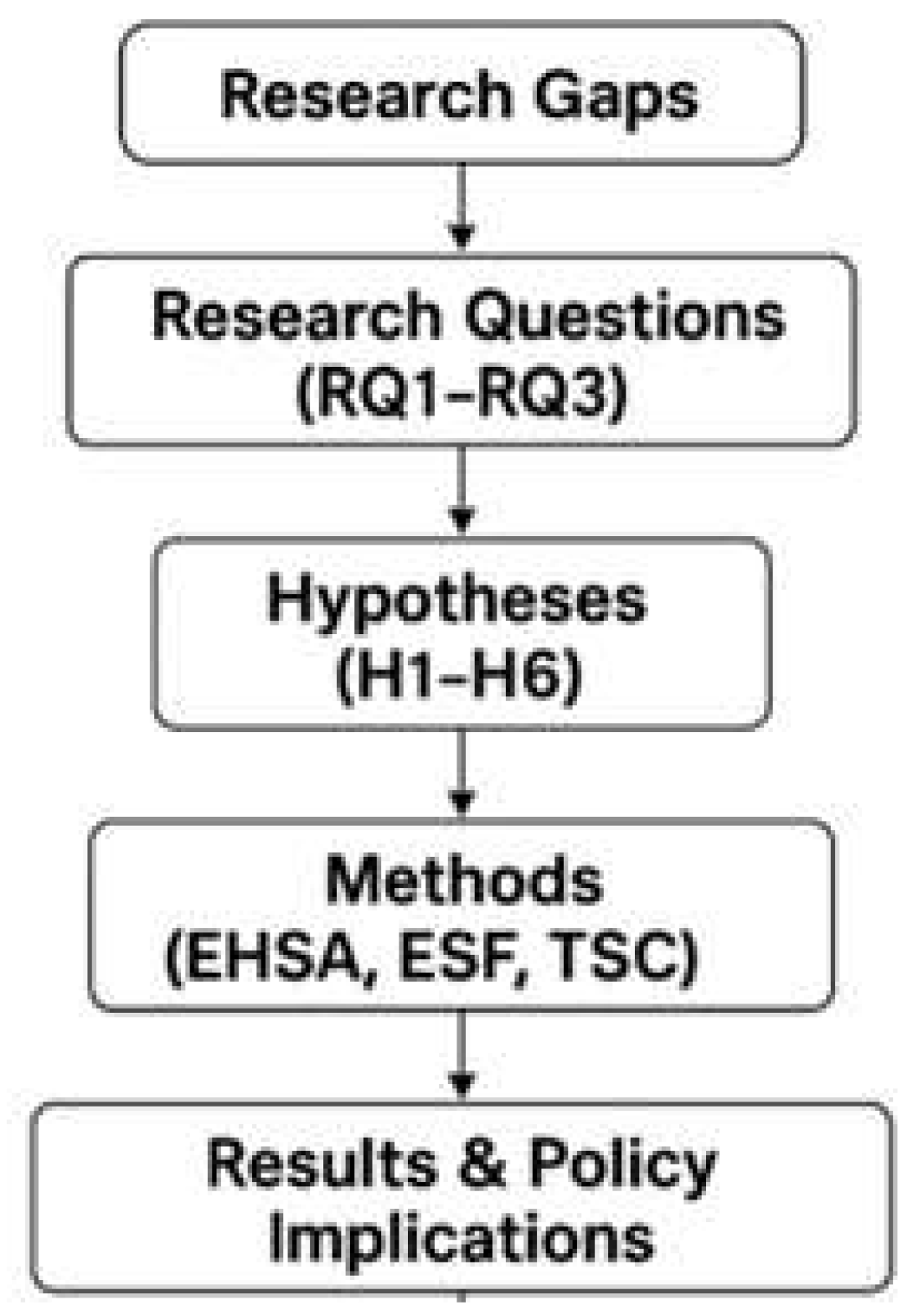
To provide greater clarity, a conceptual diagram has been included (
Figure 1) that summarizes the logical flow of the research design. The figure presents the connections among the identified research gaps, the research questions (RQ1–RQ3), the hypotheses (H1–H6), and the methods of analysis applied (Exponential Smoothing Forecast, ESF, Emerging Hot Spot Analysis, EHSA, and Time Series Clustering, TSC).
This schematic helps us to visualize the relationships among spatial–temporal analysis, forecasting, and clustering to explain the patterns of renewable and non-renewable energy production in EU countries.
3.3. Methodological Framework
The methodological framework builds on the following assumptions: (a) the Eurostat monthly electricity data are harmonized across EU-28 countries, (b) the 2017–2024 period provides full temporal comparability, and (c) the use of both parametric (ESF) and non-parametric (EHSA) techniques ensures analytical balance. These assumptions underpin the empirical workflow described below.
Table 1 provides a systematic overview of the analytical process that operationalizes the study’s research questions and hypotheses. There are sequential steps used in the spatial–temporal modeling of electricity generation from renewable and non-renewable sources across EU-28 countries (2008–2025). All steps are arranged in sequence to indicate a sound, repeatable methodology that combines official data, spatial referencing, and advanced temporal modeling in GIS. Parametric (ESF) and non-parametric (EHSA) tools provide a balance in the methods, and residual analysis and indicator synthesis promote the level of diagnostics and policy relevance.
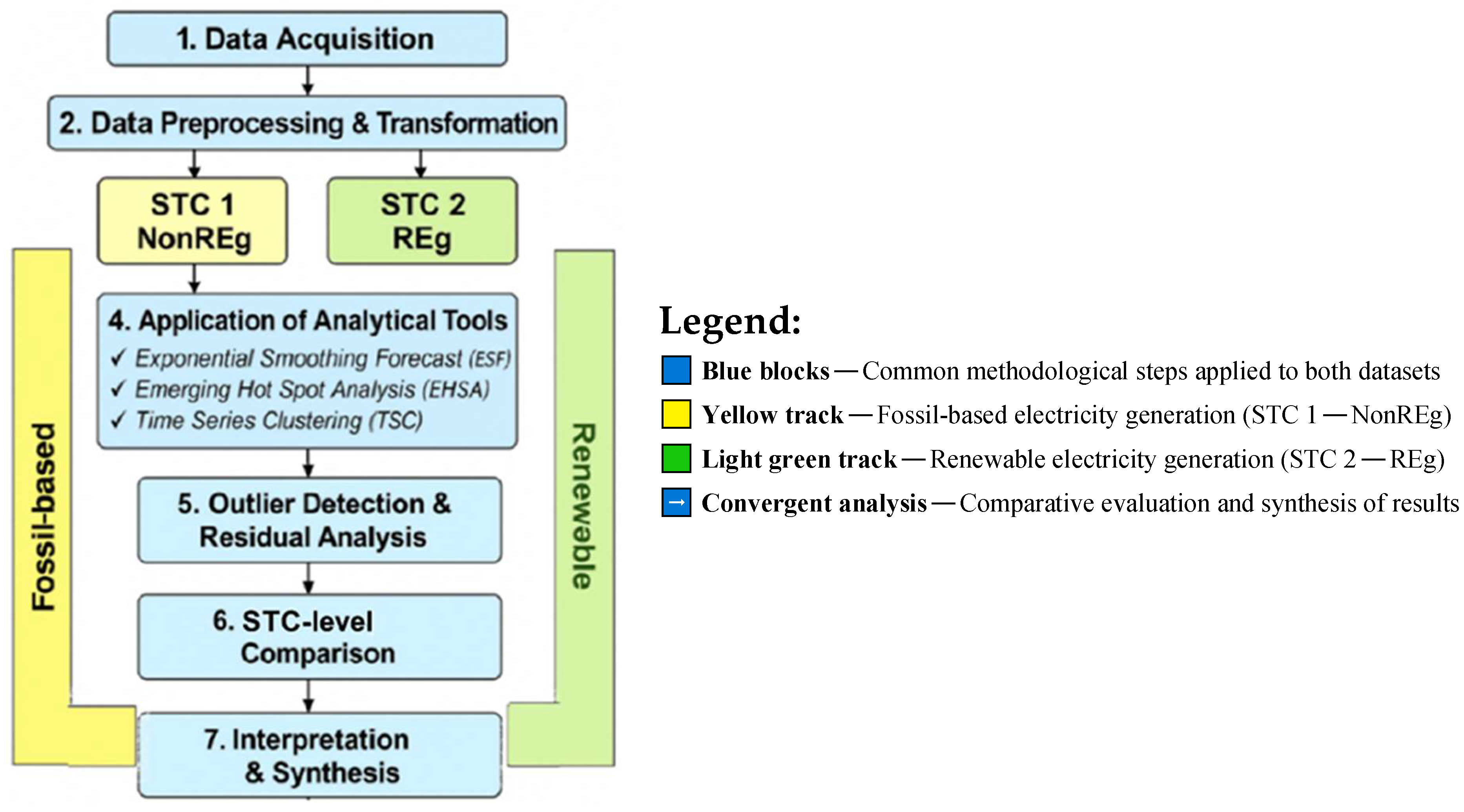
In
Figure 2, we represent the methodological framework used to address the research questions. It is a visual representation of the seven-step analytical process used to construct and compare two Space–Time Cubes (STC 1—NonREg and STC 2—REg) for fossil-based and renewable electricity generation. Methods include Exponential Smoothing Forecast (ESF), Emerging Hot Spot Analysis (EHSA), and Time Series Clustering (TSC).
The statistical setup of the analysis tools used conformed to legitimate standards of spatio-temporal modeling. In the case of Emerging Hot Spot Analysis (EHSA), a constant neighborhood distance of about 778 km was used, which corresponds to the mean centroid distance between EU-28 nations at the NUTS0 level, a scale that maximizes the Moran I spatial autocorrelation and ensures uniformity of spatial weights. In the case of the Exponential Smoothing Forecast (ESF), an additive model structure was chosen to compare initial results with multiplicative counterparts, because additive smoothing evaluations were lower than those for both the renewable and non-renewable series with multiplicative smoothing.
Though the analysis did not involve a complete formal sensitivity analysis of varying parameters, e.g., smoothing coefficients or neighborhood thresholds, internal robustness has been established through universal model behavior across the datasets. The trend extrapolation and spatial clustering were complemented by combining the parametric (ESF) and nonparametric (EHSA) tools, which provided complementary information. In future studies, the framework will be extended to multi-parameter sensitivity and to comparisons of models (e.g., ARIMA, Bayesian, or machine-learning approaches) to evaluate further the stability of the results and their applicability in other scenarios [
20,
31,
32,
33,
34,
37].
Each and every analytical configuration was founded on geostatistical conventions and checked on internal soundness. To begin with, the raw and log-transformed monthly series were analyzed for normality (Shapiro–Wilk and Kolmogorov–Smirnov), skewness, and kurtosis. Log transformation minimized skewness but came at the cost of interpretational distortions in the low-volume countries (e.g., Malta and Luxembourg); hence, raw values in GWh were not discarded in favor of unit consistency.
Second, the distance between neighborhoods (~778 km) included in the Emerging Hot Spot Analysis (EHSA) is also equal to the default fixed distance automatically calculated by ArcGIS Pro, ensuring that each of the 28 EU member states (NUTS0) has a spatial neighbor within the domain of analysis. This structure exhibits sufficient spatial connectivity across the continental scale and is stable across renewable and non-renewable datasets.
Third, the Getis-Ord Gi+ statistic was used to find the significance of EHSA default thresholds (99, 95, and 90 per cent) in accordance with the standard ArcGIS Pro statistical conventions as well as the developed spatial–temporal literature [
8,
21].
Lastly, the Exponential Smoothing Forecast (ESF) is chosen as the forecasting method over the alternative methods (ARIMA, Holt–Winters, and Bayesian) because it is suitable for medium-length time series with trend and seasonality, requires fewer parameters, and is robust in energy-forecasting applications [
20]. Even though a complete multi-parameter sensitivity analysis was not conducted, internal validation showed the same model behavior across both renewable and non-renewable datasets. This method will be further developed in the future through comparative model testing and experiments with parameter variations [
20,
31,
32,
33,
34].
In the Exponential Smoothing Forecast (ESF) model, nine time steps were removed for validation, yielding an internal cross-validation of about 9 months. This is conducted to ensure that forecast accuracy (RMSE) is used to measure the model’s ability to replicate data not observed in the sample. The last 2025 projection is a one-step-ahead extrapolation that falls within the Eurostat dataset’s time range and ensures complete comparability with the EU-28 series. This setup is consistent with the existing validation methods of medium time series in energy forecasting [
20].
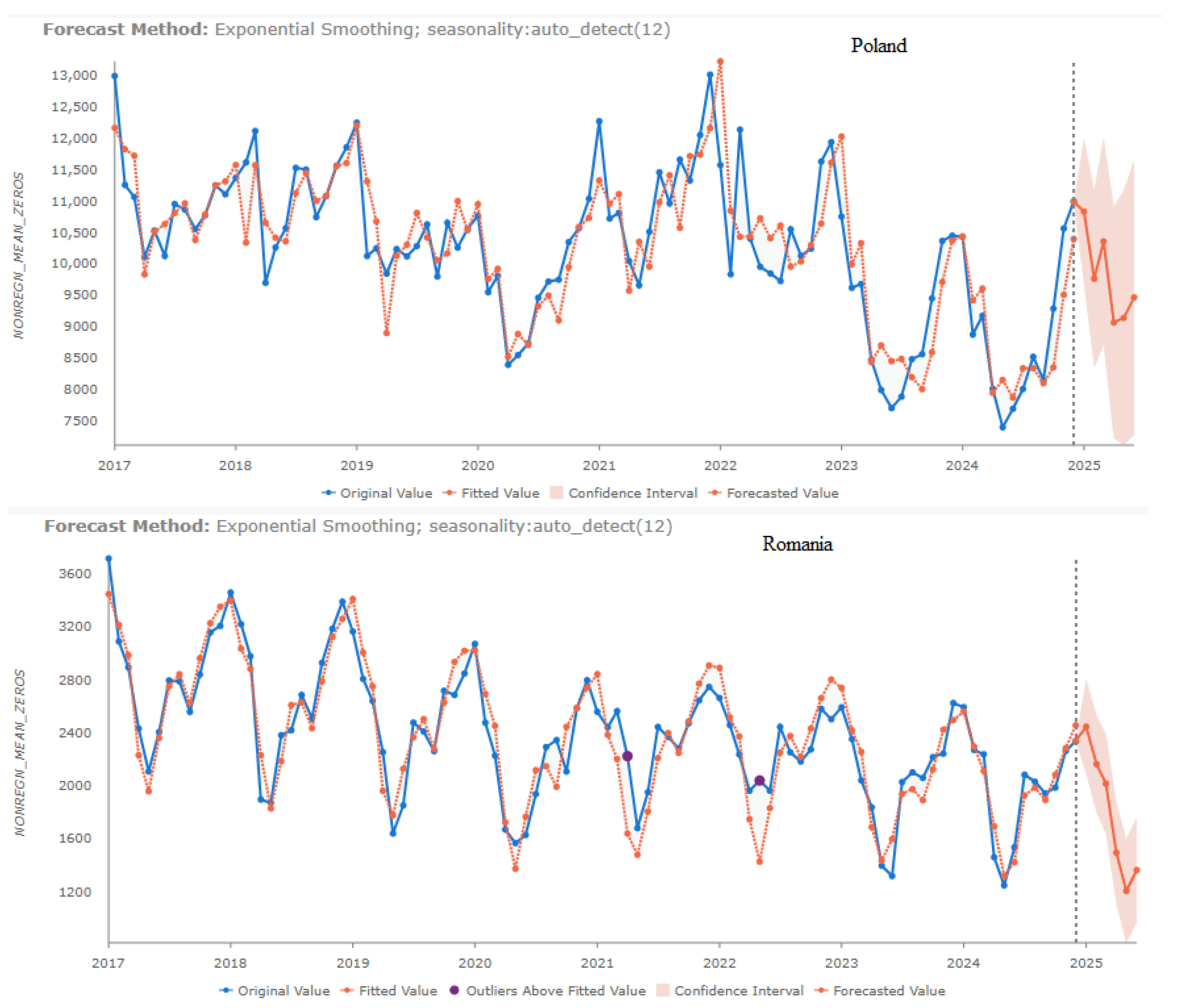
The Exponential Smoothing Forecast (ESF) model uses a 90 percent confidence level, and it is calculated internally by ArcGIS Pro when making the forecast. These times were intended for outlier detection and as an implicit predictive uncertainty measure. The corresponding forecast confidence bounds were thus used with the RMSE values, so that the model reliability indicates both central accuracy and the value dispersing around the predicted mean.
This study employs a seven-step methodological workflow to examine electricity production in the EU-28 by renewable and non-renewable energy sources. Every step ensures methodological rigor and reproducibility, consistent with best practices for analyzing space and time using official statistical data and GIS software (ArcGIS Pro 3.2.2).
Step 1: Data Acquisition
The data on monthly electricity generation from Eurostat (2008–2025) were obtained, including both renewable and non-renewable sources for EU-28 countries at the NUTS0 level. The dataset used was nrgcbpem_custom16218238 [
7].
Step 2: Data Processing and Transformation
Raw data were purged, sifted, and tabulated into analysis-ready tables. The indicators were calculated as REg (Renewable Electricity), NonREg (Non-Renewable Electricity), DiffRE, and GreenShare. Standardization of temporal fields and spatial references of data using EU NUTS 0 codes was employed.
Step 3: Building of Space–Time Cubes.
At this stage, data structures were prepared for subsequent integration into space–time cubes using ArcGIS Pro [
8], which enables the temporal and spatial alignment required for EHSA and ESF analyses. The two cubes denote REg and NonREg. These 3D data structure models the production of electricity by place (country) and time (month) and allow the joint spatial and temporal analysis [
54].
Step 4: Analytical Tools.
Three supportive tools were used:
The model and predictions of monthly energy production trends were generated using an Exponential Smoothing Forecast (ESF) that incorporated trend and seasonality [
20]. RMSE was used to test the accuracy of the estimates.
Emerging Hot Spot Analysis (EHSA) identified statistically significant clusters of growing or shrinking electricity generation, as measured over time, using the Getis-Ord Gi* statistic [
8,
21].
TSC categorized nations based on similar production patterns, using Euclidean distance on normalized time series of the STCs [
55].
The two main instruments of this study, Exponential Smoothing Forecast (ESF) and Emerging Hot Spot Analysis (EHSA), are distinct statistical tools that fall into distinct methodology categories. ESF is a parametric method that presupposes a functional form and uses smoothing parameters (a, b, and g) to model the trend and seasonality of time series data [
22,
32].
In comparison, EHSA is a nonparametric, exploratory method for identifying statistically significant spatiotemporal patterns that does not assume a particular data distribution and uses the statistic known as Getis-Ord Gi 2 as the test of significance [
31]. Due to the complementary nature of the two approaches, parametric and nonparametric methods provide the analytical balance needed to achieve predictive forecasting and detect spatial patterns.
Step 5: Residual Analysis and Outlier Detection.
The forecast residual was examined to identify outliers and anomalous positions. Outliers are nations with actual values that are significantly different from those in the model, indicating that the transition patterns are abnormal [
56].
Step 6: STC Results Comparative Analysis.
Instead of computing the composite indicators, this step involved comparing the analytical results made available, including forecasts, clusters, and spatial patterns for the two STCs (REg and NonREg). This cross-analysis has highlighted the emphasis on structural differences and transition asymmetry across countries and over time.
Step 7: Policy Relevance and Interpretation.
The findings were summarized in favor of a sustainability policy. The results of spatial trends (provided by EHSA and TSC), forecasts (ESF), and composite indicators (GreenShare and DiffRE) were examined through the lens of the European Green Deal and the SDGs 7, 11, and 13 [
2,
52].
The applicability of the research design is also supported by the fact that the spatial–temporal and forecasting methods implemented should be consistent with other methods validated by the scientific community in the past. Emerging Hot Spot Analysis (EHSA) is a technique that has been widely used to identify statistically significant spatial–temporal clusters in environmental and energy systems [
31,
33]. Exponential Smoothing Forecasting (ESF) techniques have consistently demonstrated strong predictive power in longitudinal energy data [
20,
32]. In contrast, Time Series Clustering (TSC) approaches are used to predict coherent regional trends in renewable energy transitions [
53,
55]. The triangulation approach of EHSA, ESF, and TSC improves both the analytical credibility and reproducibility of this study and ensures that the findings are based on validated quantitative models [
34,
35,
37].
Despite the methodological design’s guarantee of strength and repeatability, several limitations should be considered. First, the NUTS0 (country) level was considered since harmonized monthly subnational data were not available on all EU-28 members. Secondly, the paper did not perform a complete analysis of the sensitivity of the EHSA and ESF models to varying parameters, but internal robustness was triangulated through similar outputs. Third, because of the proprietary GIS environment (ArcGIS Pro), reproducibility might be limited; however, similar open-source alternatives are suggested (QGIS, R-Spatial, Python). Lastly, the 2025 statistics are still provisional and are thus carefully considered at the modeling step. Although these limitations are accepted, they do not invalidate the analytical framework but only point out the areas in which the methodology can be improved in future studies.
3.4. Data Source and Processing
To conduct a spatio-temporal study of the energy transition in Europe, we utilized Eurostat data on net electricity generated by type of fuel, which is available in monthly format [nrgcbpem_custom16218238], in Gigawatt-hour [GWh]. We used the Standard International Energy Product Classification (SIEC) to categorize energy sources into three classifications: Total Net Generation (T), Renewable (R), and Non-Renewable (NR), with the latter defined as the difference between T and R. The extracted datasets were for total production (code [TOTAL]) and for renewables and biofuels (code [RA000]).
The analytical center of the present study is the dataset nrgcbpem 2017–2024, even though the actual analysis is on the years 2017–2024, where the original Eurostat data nrgcbpem 2008–2025 is as per 2008–2025, but the aim is to cover the years 2017–2024 to maintain the methodological consistency, comparability and completeness of the research across all EU-28 countries.
Three important methodological reasons were found to justify this truncation:
The previous period (2008–2016) consists of partial records of monthly data and irregular coding of the Eurostat energy balance, which has impacted comparability;
The 2017–2024 window will be the initial period of complete harmony with the monthly data on renewable (REg) and non-renewable (NonREg) electricity generation;
Advanced spatial–temporal power like EHSA, ESF, and TSC need to have uniform time series and gaps eliminated to retain the statistical strength.
In turn, the reference horizon was chosen as 2017–2024 for reproducible modeling, whereas data from 2008–2016 would be used only to verify long-term patterns of energy transitions contextually and to provide descriptive verification.
In this study, the renewable electricity (RE000) category, under renewables, includes all sources of renewable electricity, such as solar, wind, hydro, geothermal, tidal, and bioenergy, as explained by Eurostat. Nevertheless, given that data aggregation is conducted at the monthly level for the EU-28 (2008–2025), the discussion of the dominant contributors (solar, wind, and hydropower) is presented solely in the analysis. ArcGIS Pro 3.2.2 was used to construct two distinct Space–Time Cubes (STC) to compare the temporal and spatial dynamics of renewable and non-renewable energy generation.
3.4.1. Data Pre-Processing Steps
The empirical analysis relies on official Eurostat data from the dataset “Net electricity generation by type of fuel—monthly data” (
nrg_cb_pem__custom_16218238) [
7], providing harmonized monthly electricity generation statistics across EU-28 countries in Gigawatt-hours (GWh).
Extraction date: 10 April 2025, 23:09 CET (Eurostat Data Browser).
Last dataset update: 10 April 2025, 23:00.
Time frequency [FREQ]: M (Monthly observations)
SIEC (Standard International Energy Product Classification): RA000; Renewables and biofuels
Unit of measure [UNIT]: GWh (Gigawatt-hour)
Geographical level [GEO]: EU-28 (NUTS0) National level
Temporal coverage 2008–2025, Monthly data
Two categories were directly extracted from Eurostat:
Renewables (R)—SIEC code: RA000—Renewables and biofuels;
Total electricity generation (T)—SIEC code: TOTAL.
The Non-Renewable electricity generation (NR) series was derived by difference, following the below formula:
Pre-processing ensured temporal continuity, comparability, and statistical validity before constructing the Space–Time Cubes (STCs):
Temporal continuity validation: confirmed complete monthly coverage for 2008–2025;
Interpolation: minor missing values (<2%) were filled via linear interpolation;
Country code harmonization: standardized ISO 3166 identifiers (e.g., “EL” → “GR”), excluding the United Kingdom after 2020;
Unit verification: all series retained in Gigawatt-hour (GWh);
Temporal segmentation:
2008–2016 → descriptive validation;
2017–2024 → analytical core;
2025 → one-step-ahead forecast.
GIS integration: Two harmonized Space–Time Cubes (STCs) were constructed: STC_REg (renewable) and STC_NonREg (non-renewable), each comprising 28 spatial units × 96 time steps (2017–2024).
All procedures complied with Eurostat’s open-data license (CC BY 4.0) and were fully reproducible using the official dataset [
7].
To ensure reproducibility and transparency, all preprocessing steps were fully documented before constructing the Space–Time Cubes (STCs).
(a) Variable derivation
Renewable Electricity Generation (REg) corresponds to the Eurostat variable [RA000—Renewables and biofuels], while Total Generation (T) corresponds to [TOTAL].
Non-Renewable Generation (NonREg) was computed algebraically as follows:
where ‘
c’ is the country and ‘
t’ the month.
These calculations were implemented in Excel, with validation ensuring that rare negative residuals caused by rounding were corrected to zero.
(b) Logarithmic normalization and handling of zeros.
To stabilize variance and mitigate right-skewness, natural logarithmic transformations were applied in SPSS using the syntax file “logaritmare valori.sps”.
For most countries, the transformation followed. However, for time series containing zero values (notably Cyprus and Malta), a small constant of 0.1 GWh was added to avoid undefined values:
COMPUTE CY_LN = LN(Cyprus + 0.1).
COMPUTE MT_LN = LN(Malta + 0.1).
EXECUTE.
This hybrid transformation preserves comparability across countries while maintaining proportional sensitivity for low-value series.
Even though the skew was slightly reduced in the national series (average reduction ≈ 0.18) by the logarithmic transformation, it did not significantly improve model performance or residual patterns. Comparison of the raw and log-transformed data showed that the Exponential Smoothing Forecast (ESF) and Root Mean Square Error (RMSE) varied by an average of 2.3% across both renewable and non-renewable series, with no evidence of systematic error in the forecasting data.
Moreover, log-transformed values also introduced distortions for low-generation countries (e.g., Malta, Cyprus, and Luxembourg) and reduced the possibility of directly interpreting spatial patterns in units of GWh. Because of this, the raw data were retained for final modeling to maintain consistency, unit comparability, and transparency in magnitude-based interpretation, in line with the previous recommendations of the methodology [
20,
31,
32,
33,
34,
37,
57].
This choice constitutes a methodological trade-off between a very high normality and high interpretability of analytical results, with cross-country comparability and reproducible predicting accuracy being taken as more important than marginal statistical abilities to normalize marginal statistics.
(c) Outlier identification
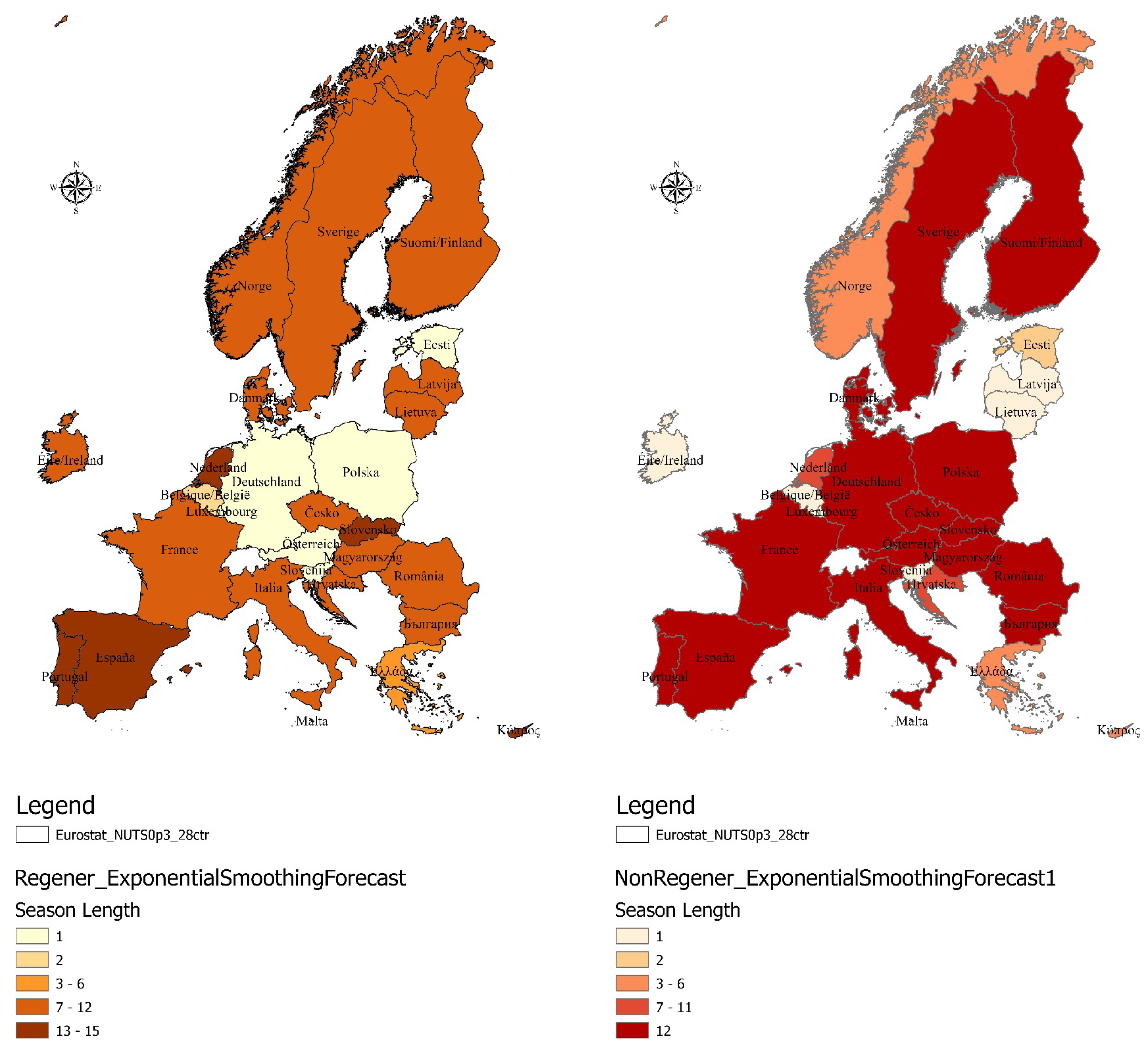
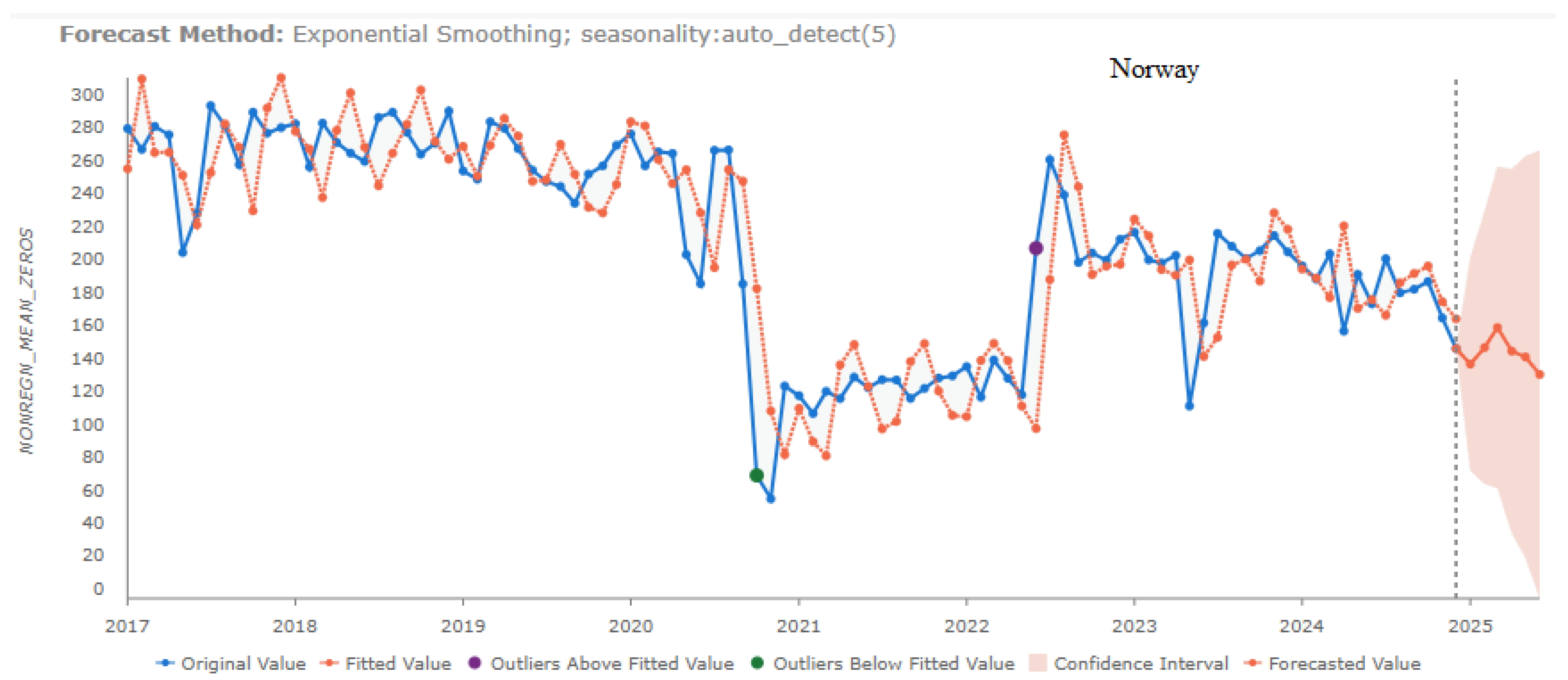
Outlier detection was not conducted manually during preprocessing; it was automatically performed during the Exponential Smoothing Forecast (ESF) step in ArcGIS Pro using the IDENTIFY option at a 90% confidence level, allowing a maximum of 4 outliers per series.
The corresponding ArcPy call executed in the workflow was as follows:
arcpy.stpm.ExponentialSmoothingForecast
in_cube=“…\\Regener.nc”,
analysis_variable=“REGN_MEAN_ZEROS”,
output_features=“…\\Default.gdb\\Regener_ExponentialSmoothingForecast”,
output_cube=“…\\Regener_ExponentialSmoothingForecast.nc”,
number_of_time_steps_to_forecast=1,
season_length=None, # auto-detected seasonality
number_for_validation=9,
outlier_option=“IDENTIFY”,
level_of_confidence=“90%”,
maximum_number_of_outliers=4
This automated configuration ensures the internal detection and flagging of temporal anomalies, without excluding any observations, preserving the raw variability of the dataset for validation and interpretation [
30,
33,
36,
38].
Notably, despite the final spatial–temporal models using raw data, normality testing is performed beforehand. For example, the awareness of skewness and kurtosis in series can inform the interpretation of spatio-temporal clusters in Emerging Hot Spot Analysis (EHSA), which utilizes z-scores and spatial weights [
8,
31]. Similarly, in the case of the Exponential Smoothing Forecast (ESF), a parametric approach, the analysis of distributional properties is used to predict residual behavior and model sensitivity [
20].
In this way, the approach to methodological transparency, based on statistical preprocessing, log-transformation testing, and STC generation within ArcGIS Pro, will strengthen analytical transparency and add to the resilience of spatial interpretation of the energy transition in Europe [
21,
53].
All model parameters in ArcGIS Pro 3.2 were clearly documented to enhance methodological transparency and full reproducibility.
In the case of the Exponential Smoothing Forecast (ESF), the additive trend structure was chosen based on the minimum Root Mean Square Error (RMSE) across both renewable and non-renewable series, and the season length was automatically identified based on the monthly periodicity. These nine steps were omitted in validation to do cross-testing but were used to adhere to the ArcGIS default time series of medium length.
In the Emerging Hot Spot Analysis (EHSA), the fixed-distance conceptualization and a neighborhood radius of 778,865 m were adopted to maintain topological consistency, ensuring that every EU-28 country (NUTS0) had at least one spatial neighbor. The time window was set to a month to match the native data frequency.
The remaining parameters, such as the statistical significance levels of the Getis-Ord Gi+ test (90), are default settings in ESRI, ensuring methodological comparability with previous studies on spatial–temporal analysis [
8,
36,
50].
To further improve transparency, the entire ArcPy command structure and workspace settings are now shown in
Appendix E (
Table A15,
Table A16,
Table A17 and
Table A18). They can be fully reproduced by other independent researchers, in accordance with Open Science standards.
3.4.2. GIS Integration and STC Construction
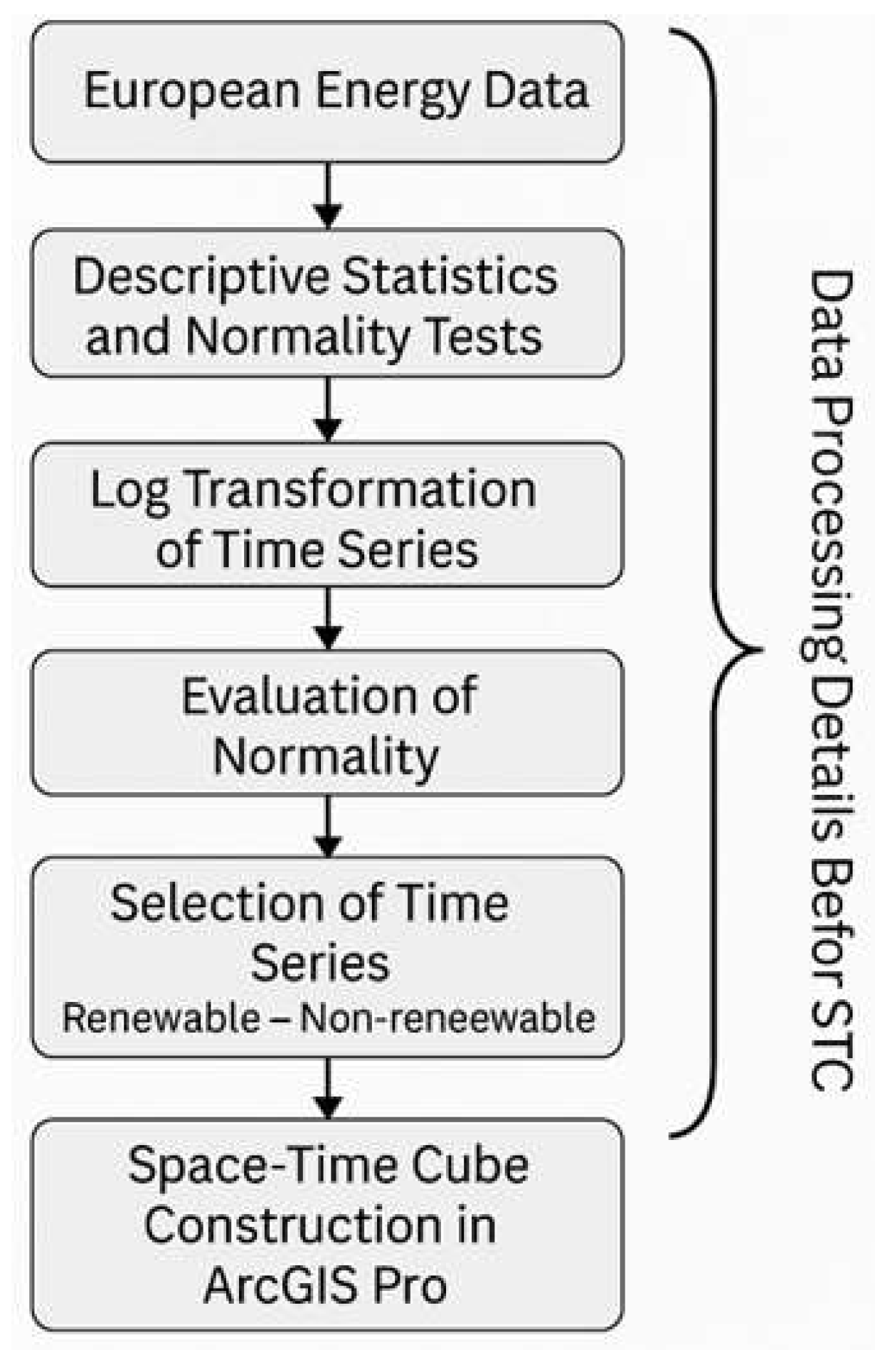
Two harmonized Space–Time Cubes were built in ArcGIS Pro 3.x, STC_REg (renewable generation), and STC_NonREg (non-renewable generation), each containing 28 spatial units × 96 monthly bins (2017–2024). Both cubes shared identical parameters, ensuring direct comparability of EHSA and ESF outputs. The full data-processing pipeline is illustrated in
Figure 3. All procedures complied with Eurostat’s open-data license (CC BY 4.0) and were fully reproducible in open-source environments (QGIS, R-Spatial, and Python/ArcPy) [
8,
49].
Monthly Eurostat series (EU-28, 2008–2025; GWh) were cleaned, harmonized, and structured into two cubes (REg and NonREg; 28 locations × 96 monthly bins, 2017–2024), which fed EHSA and ESF analyses.
3.4.3. Bis Temporal Scope Justification and Consistency
Even though the data available at Eurostat covers the period 2008–2025, only the 2017–2024 period was used to create the Space–Time Cubes (STCs). Since 2017, the EU-28 states have reported complete, harmonized monthly electricity statistics with no gaps and no changes in classification; in previous years (2008–2016), only descriptive validation and model training were conducted. ESF also projects trends ahead by one month to January 2025 to show near-term projections using the most recent complete observation period. Accordingly, the title 2008–2025 represents both the analytical horizon (historical evidence 2008–2024) and one-step-ahead forecasting (January 2025), whereas the methodological core is based on the harmonized 2017–2024 segment to ensure the internal consistency and alignment with the European Green Deal (2019–2024).
Two distinct STCs were created to represent Renewable Electricity Generation (REg) and Non-Renewable Generation (NonREg). These indicators are used consistently in Results (
Section 4). The present section documents preprocessing and configuration; empirical outputs (distribution diagnostics, transformations, and significance tests) are reported in
Section 4.1,
Section 4.2 and
Section 4.3 to maintain a clear Methods/Results demarcation.
3.4.4. STC Bin Settings and Neighborhood Selection
EHSA was performed with a fixed neighborhood distance of ~778,865 m, automatically generated by the ArcGIS Pro EHSA tool in accordance with the minimum-connectivity rule. Every spatial feature must have at least one neighbor. This distance thus demonstrates the topological size of interaction carried within the inner designation of the tool rather than the pre-defined Moran I level.
We then calculated the Global Moran I for Renewable (REg) and Non-Renewable (NonREg) electricity-generation cubes to test the statistical validity of the automatically selected distance. The tests accepted the weak yet consistent positive spatial autocorrelation, which increased with renewables and decreased with non-renewables, indicating that the automatically determined neighborhood distance showed a significant degree of spatial dependence at the macro-region (EU-28) level.
Since EHSA uses the local Getis-Ord (Gi*) statistic, a coherent and stable specification of neighborhood is also necessary [
31,
49,
53]. ESRI guidelines suggest saving the automatically computed connectivity distance to ensure reproducibility but recommend validating it using independent spatial autocorrelation diagnostics rather than manually specified thresholds [
8,
50]. Based on this, we kept the automatically calculated distance (≈ 778,865 m) as a baseline and only applied Moran I tests to post-hoc test and robustness checking, as explained in
Section 3.4.5.
Conceptual distinction
Moran-based distance: based on statistics, maximizes observed spatial correlation (process-driven scale).
Automatic EHSA distance: geometrically defined, is connectivity (topological scale) guaranteed [
8,
49].
Figure 2 illustrates the entire workflow.
3.4.5. Sensitivity and Robustness: Alternative Neighborhood Distances
Two substitute fixed distances around the Moran-based baseline (~779 km) were used to evaluate robustness and handle potential MAUP (Modifiable Areal Unit Problem) effects: EHSA was re-run with two new fixed distances:
500 km: focuses on the short and intra-regional clustering;
1050 km: has wider, cross-regional connections.
Our findings reveal that trends of persisting and increasing hot spots of renewables are relatively unchanging, especially in Northern and Western Europe, and that peripheral or insular countries exhibit the anticipated sensitivity (500 km: highlights national peculiarities; 1050 km: regularizes across-border clustering).
Hot/cold polarity agreement across runs was over 80%, and the Adjusted Rand Index (ARI) compared to the baseline was 0.62–0.71, indicating moderate-high consistency.
In the case of non-renewables, this transformation of concentrated to dispersed and mixed forms of fossil hot spots was constant over distances.
These findings show that our findings are independent of the spatial parameter we have chosen, as well as of the known geospatial analysis practice [
53]; for the temporal analogue of aggregation sensitivity (the Modifiable Temporal Unit Problem, MTUP), refer to [
33].
The I statistics of global Moran also support the fact of fixed-distance selection, and the stability of the overall pattern [
8,
31,
49,
53].
3.4.6. Spatial Autocorrelation Diagnostics and Neighborhood Validation
To validate the existence of spatial dependence and to justify the choice of the fixed-distance neighborhood in the subsequent Emerging Hot Spot Analysis (EHSA), we performed Global Moran’s I tests on both Renewable (REg) and Non-Renewable (NonREg) electricity generation cubes. The tests confirmed weak but consistent positive spatial autocorrelation, with slightly increasing clustering patterns for renewables and decreasing spatial cohesion for non-renewables. The results support the use of a fixed inverse-distance conceptualization (≈2.87 × 10⁶ m) and confirm the robustness of the spatial configuration applied in the STC framework.
Before conducting the Emerging Hot Spot Analysis (EHSA), global spatial autocorrelation was tested for both Renewable (REg) and Non-Renewable (NonREg) electricity generation to verify the presence of spatial dependence and to justify the use of fixed-distance inverse weighting.
Global Moran’s I statistics were computed annually for the 2017–2024 period using Euclidean and inverse-distance weighting at the NUTS0 level (28 countries). The resulting optimal neighborhood distance of 2,867,932 m was determined empirically as the range at which Moran’s I stabilized and reached its maximum value across both datasets.
This threshold approximates the mean inter-centroid distance between EU countries and balances spatial sensitivity with cross-country comparability.
The observed Moran’s I values confirm weak but consistent positive spatial autocorrelation, indicating that both renewable and non-renewable electricity generation exhibit mild spatial clustering at the macro-regional level (
Table 2a,b).
These diagnostics validate the use of fixed-distance spatial weighting in the EHSA and confirm the robustness of spatial binning in the Space–Time Cube (STC) configuration.
Global Moran I results (
Table 2a,b) confirm a progressive increase in spatial autocorrelation for renewable generation and a decline in spatial cohesion for non-renewable generation, supporting the assumption of structural reconfiguration in the European energy landscape. These findings provided the empirical basis for defining the fixed-distance band used in EHSA and for assessing spatial-scale robustness.
3.4.7. Spatial Scale Considerations and MAUP Discussion
It was analyzed at the NUTS-0 (national) level to ensure coverage and reporting are similar across EU-28. Subnational (NUTS-2/3) or grid-level analysis may capture heterogeneity within a country, but such data are not yet harmonized and available monthly. The EHSA sensitivity tests above addressed this limitation, common in macro-comparative transition studies [
24,
43], and by qualitatively checking pattern stability. The results are consistent, indicating that hot spot typologies are robust to MAUP effects.
To ensure data consistency, temporal continuity, and complete coverage across all EU-28 member states, the analysis was performed at the NUTS0 (country) level. Though a more detailed representation of intra-country heterogeneity in renewable deployment and energy behaviors could be achieved through subnational (NUTS2 or NUTS3) analysis, disaggregated and harmonized monthly data are not publicly available across the entire analysis period. This weakness is typical of large-scale comparative research on the dynamics of energy transition [
24,
43].
However, the model does identify cross-country structural asymmetries, suggesting greater policy and infrastructural disparities. Further studies ought to broaden the current model by incorporating regionalized information, i.e., plant density, installed capacity, or spatially interpolated energy indicators, to include the territorial differences and local effects of diffusion [
24,
29,
30].
3.4.8. Software Environment, Data Transparency, and Reproducibility
The study is based on official Eurostat datasets, which provide harmonized, quality-controlled energy statistics at the EU level, but as secondary data sources. The GIS analyses were performed using ArcGIS Pro, a proprietary software environment that includes powerful spatial–temporal analytical modules (EHSA and ESF). To increase reproducibility, the data preprocessing/analytical workflow was fully documented and can be reproduced using open-source software such as QGIS, R-Spatial, or Python (ArcPy). Further future studies will also enhance the concept of Open Science by not only using open-access energy databases (e.g., ENTSO-E Transparency Platform and IEA Data Portal) but also making methodology scripts publicly available (e.g., in open repositories such as GitHub) to be transparent, accessible, and scientifically traceable [
41,
42,
46].
The last spatio-temporal models make use of raw (non-normal) series, but before distribution, informative prior checks are provided. Sketching skewness and kurtosis helps understand the EHSA clusters, which are based on z-scores and spatial weights. It provides insight into the behavior of residuals in ESF, a parametric forecasting method. This combination of statistical preprocessing, log-transformation validation, and STC generation for ArcGIS Pro can be seen as a methodological transparency of the tool and a way to make spatial interpretations more robust to the European energy transition [
20,
31,
49,
53].
The analyses were conducted at the NUTS-0 (national) level to ensure data consistency, temporal consistency, and complete coverage across all EU-28 member states. However, finer territorial heterogeneity in the deployment of renewables would be more transparent with subnational (NUTS-2/3) or grid-level analyses; unified data at these levels, monthly, are not yet provided, as indicated. This weakness, which is typical of macro-comparative transition research [
24,
43], was alleviated by performing robustness checks (±30% distance difference in EHSA) and by maintaining consistent pattern stability across scales.
3.5. ESF Modeling: Specification, Validation, and Diagnostics
ArcGIS Pro was used to implement Exponential Smoothing Forecast (ESF) models for short-term monthly electricity generation forecasts using the Holt–Winters formulations.
Within this model, the additive Holt–Winters model will be a state-space ETS(A,A,A) model, where ETS denotes the structure of Error–Trend–Seasonal components: all three are additive. This implies that the model uses additive errors, an additive (linear) trend, and additive seasonality, as in the classical exponential smoothing formulation [
20,
32].
Additive and multiplicative seasonal structures were also tested, and the additive structure was adopted because it resulted in lower Root Mean Square Errors (RMSE) in most EU countries, and it did not over-predict the proportion of small-scale producers. The models are based on the classical equations of Holt–Winters having level (a), trend (b), and seasonal (g) smoothing parameters automated to the optimum using the ESF routine to enhance the in-sample forecasting error to a minimum [
20,
32].
yt is the monthly generation (GWh), m = 12, where there is seasonality, and lt, bt, and strep are the level, trend, and seasonal terms. The additive Holt–Winters equations (ETS(A,A,A)) are as follows:
Smoothing parameters a, b, and g: The ESF routine optimized them; the length of seasons was automatically determined (monthly, where available). The software provided heuristics to initialize it. The outliers were detected (strongly not removed) using the outlier option = IDENTIFY with 90 percent confidence (maximum 4/series) [
50].
Validation: Our scheme was a rolling-origin one-step-ahead scheme over the past nine months of observed (number_for_validation = 9). The model was re-estimated at every origin and a 1-step prediction made, country-level RMSE (GWh) and MaPE (%) calculated and are presented in
Appendix B,
Table A6 and
Table A7. The methodology is consistent with conventional energy modeling forecasting protocols with short horizons [
20,
32].
SPSS Statistics 22 was used to compute all measures of forecast validation (RMSE, nRMSE, and MAPE) and residual diagnostics (ACF/PACF, Ljung–Box Q (18)) using residual series exported to ArcGIS Pro 3.2. The cross-verification of the results, methodological transparency, and reproducibility of the results in all 28 national time series were attained by this dual-platform validation (ArcGIS + SPSS).
Residual adequacy: We evaluated the Ljung–Box Q (18) and the residual ACF/PACF at lag 24. There is no major autocorrelation (Sig. > 0.05) of most series (white noise), and a few exceptions (e.g., Hungary, Denmark, and Latvia) are reported in
Appendix B and attributed to local shocks and not structural misspecification (
Appendix B,
Table A8 and
Table A9). In case of residual correlation, we plan to apply alternatives (damped ETS, SARIMA/TBATS) in future sensitivity analyses.
Parameter interpretation: As
Table A8 in
Appendix B summarizes (level (a) is usually significant
p < 0.05), trend (g) and seasonal (d) effects are also weak, which is consistent with transition dynamics of short horizons (2017–2024). This identifies the selection of the additive Holt–Winters ESF of renewable and non-renewable series [
30,
38,
50].
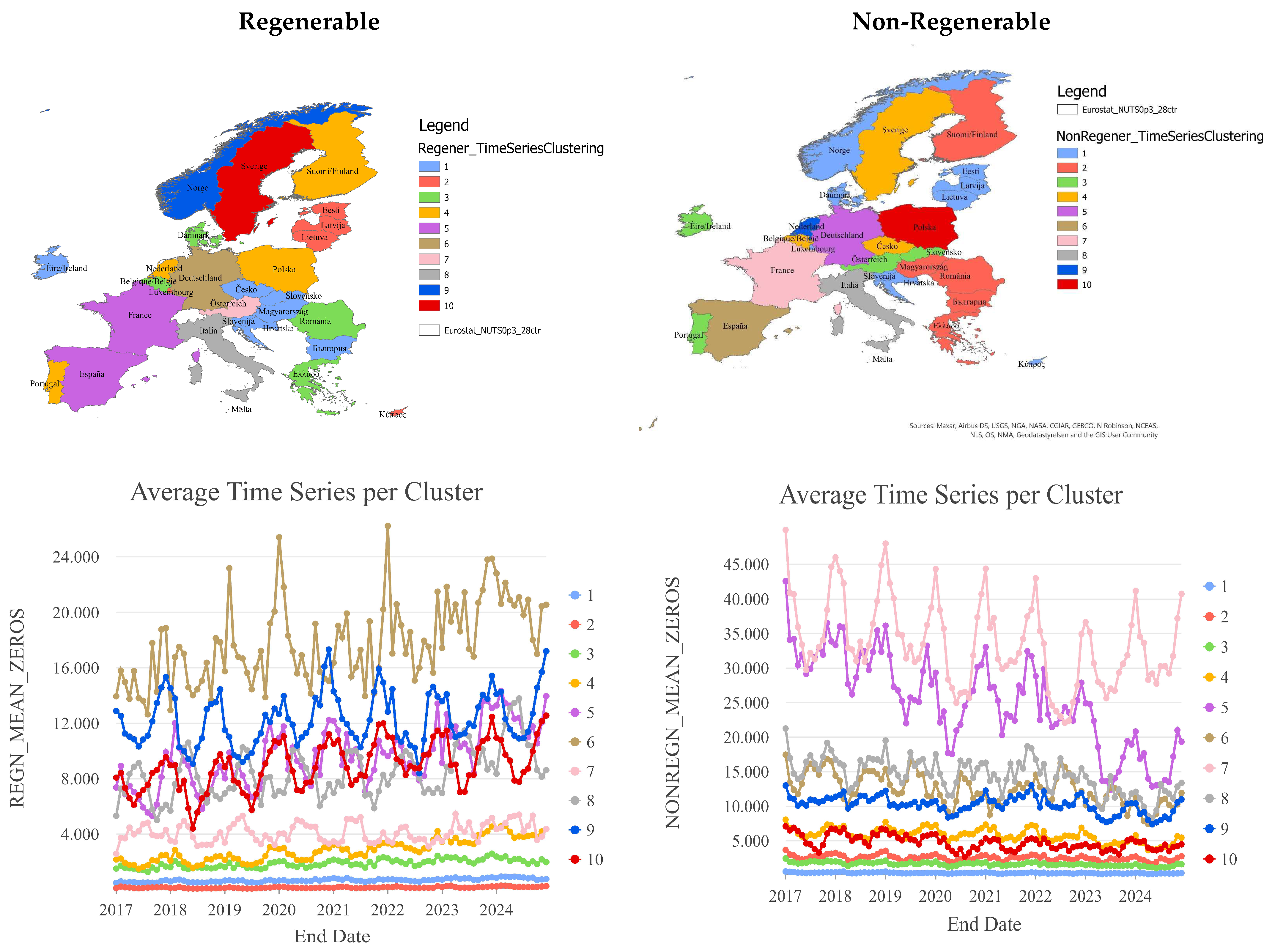
3.6. Time Series Clustering (TSC) Setup
Time-Series Clustering (TSC) was used to analyze both Space–Time Cubes: REg (Renewable) and NonREg (Non-Renewable) in ArcGIS Pro 3.2 [
49] via the Time Series Clustering tool. Each country-level series was standardized using z-scores, zt = (yt)/s [
58], to eliminate the effect of magnitude and allow comparability of the monthly trajectories. The k-means algorithm was applied to clustering using the Euclidean distance as the similarity measure, a standard option for partitioning normalized temporal profiles [
21,
55].
The selection of models was based on a data-driven search on k ∈ {2, 10}. The pseudo-F (Calinski–Harabasz) statistic for cluster validity was used, and, in cases of ties or narrow ties, we adopted the average silhouette coefficient as a second measure. Random seeds were attached to allow reproducibility (REg: 7106; NonREg: 3399). There was no temporal bending; series were compared using the same monthly indices (2017–2024), which matched the STC binning.
Implementation details:
Input cubes: Regener.nc (REg) and NonRegener.nc (NonREg); characteristic of interest = VALUE.
Distance: Euclidean; algorithm: k-means; initialization: tool default (random).
Output: named feature class and table of charts per cube to be downstream mapped and trend summarized.
ArcGIS Pro automatically identified cluster representativeness as the time series nearest to each cluster’s centroid (the cluster representative). This method will allow us to determine which country has a trend that represents the temporal dynamics of that group. Full country membership of the individual cluster (1–10), representative series, etc., are captured in
Table A14, and cluster measures, including pseudo-F and within-cluster variance, are captured in
Appendix C (
Table A10,
Table A11,
Table A12,
Table A13 and
Table A14).
To ensure that Methods is free of empirical content, all numerical results (selected k, cluster sizes, and trend tests of cluster means) are reported in
Section 4.5 (Results) and
Appendix C. Such an arrangement provides parity to transparency, comparability, and reproducibility of EU-28 monthly electricity time series [
21,
49,
55,
58].
4. Results
4.1. Descriptive Statistical Results and Distribution Diagnostics
Figure 2 depicts the diagnostic process of analyzing distributional properties of the energy sequence before spatio-temporal modeling. It recaps the series of tests and changes applied to monthly electricity generation data before the construction of the Space–Time Cubes (STCs) for renewables and non-renewables within the EU-28.
The process began by obtaining the raw monthly data and calculating basic descriptive statistics (mean, standard deviation, skewness, and kurtosis), followed by applying the normality tests (Shapiro–Wilk and Kolmogorov–Smirnov). These tests are recommended when dealing with medium-sized time series [
57,
58].
To bring right-skewed or leptokurtic data to a normal distribution, standard time-series methods were used, such as a uniform logarithmic transformation (log x and log (x + e) when x = 0) [
20]. This procedure increased normality in certain instances but imposed interpretational constraints on countries with high variability or low absolute values (e.g., Malta and Estonia). Thus, the final Space–Time Cubes were constructed using raw (non-transformed) data to create consistency and semantic coherence in physical units (GWh).
Building on the ESF and EHSA techniques described in
Section 3, this section presents the empirical diagnostics and statistical distributions that guided their application to the EU-28 dataset. However, it utilizes the Getis-Ord Gi* statistic, which employs z-scores to test significance [
31]. EHSA is extensively used in ArcGIS Pro [
8] to uncover emerging patterns in space–time cubes, which makes it conducive to investigating the geographic complexity of energy transitions without limiting assumptions about the data form a with non-linear, non-regular, or unpredictable spatio-temporal dynamics, like in the case of energy system transformations in EU nations.
Table A1 (in
Appendix A) provides descriptive statistics for monthly non-renewable electricity generation for 28 European countries from January 2017 to December 2024
(n = 96 per country). In addition to the mean and standard deviation, minimum and maximum values are also shown, along with the skewness and kurtosis coefficients, which provide important information about the distribution’s form. When skewness is positive (e.g., Austria, Lithuania, and Denmark), the distribution is right-skewed, whereas when skewness is negative (e.g., Slovenia, Croatia, and Poland), the skewness is left-skewed. As far as kurtosis is concerned, the strongest distributions (leptokurtic) occur in Slovenia (3.465) and Lithuania (2.427), indicating an increased frequency of extreme values. Alternatively, the rest of the countries have flatter distributions (platykurtic), with negative kurtosis values. These indicators reinforce the meanings of the tests of normality and serve as a guide for selecting the most suitable statistical methods for each time series.
Table A2 (in
Appendix A) presents the table of descriptive statistics, a critical step in preparing and validating time series data for the application of spatio-temporal techniques in GIS. Within the framework of Exponential Smoothing Forecast (ESF), the coefficients of skewness and kurtosis provide helpful information about the behavior of values for each month and the potential for using exponential smoothing without additional transformations.
Data series with significant positive skewness (e.g., Lithuania: skewness = 1.459) or significant kurtosis (e.g., Slovenia: kurtosis = 3.465) are more likely to exhibit extreme values and may require further refinement of their forecasting methods (e.g., by adding log transformations). On the other hand, series with skewness values close to zero, such as those of Belgium or Germany, are most effectively used in the direct application of the Holt–Winters model.
In relation to the Emerging Hot Spot Analysis (EHSA), the range (minimum–maximum) and dispersion (standard deviation) of the values are crucial for interpreting the magnitude of spatial–temporal changes. For example, countries with high mean and maximum values, such as Germany and France, can potentially produce consistent hot spots. In contrast, series with less variation (e.g., Malta and Luxembourg) can produce intermittent or statistically insignificant sites.
Therefore, the basic features of time series data are essential not only for selecting appropriate spatial and temporal parameters when creating the Space–Time Cube (STC), but also for verifying the results generated automatically by EHSA algorithms in ArcGIS Pro.
Table A2 (see
Appendix A) indicates descriptive statistics of the monthly values of renewable electricity generation (i.e., the mean, minimum, maximum, and outliers) in 28 European countries during the year January 2017–December 2024 (n = 96 values per country). In addition to the mean and standard deviation, there are the minimum and maximum values, as well as the skewness and kurtosis coefficients, which reveal information about the distributional properties of each series.
Overall, the data on renewable energy is highly variable across countries. The countries with the highest average monthly generation are Germany, France, and Sweden, which have large standard deviations, indicating a high likelihood of finding persistent hot spots in the spatio-temporal analysis. Instead, when analyzing other countries such as Malta and Luxembourg, the level of generation is lower and the difference is slight, which can result in marginal/weakly statistically significant patterns.
Several countries exhibit positive skewness (right-skewed distributions), with Lithuania (skewness of 1.435), Hungary (1.168), and Malta (1.216) having the highest values, suggesting the frequent occurrence of extremely high values. Likewise, the values of kurtosis greater than 1.5 in Lithuania (1.903) and Hungary (0.755) indicate a leptokurtic distribution with heavier tails, which allows for the performance of parametric models such as Holt–Winters without the need to transform the data in advance.
Conversely, Belgium, Germany, and Ireland exhibit skewness and kurtosis coefficients closer to 0, indicating distributions that are more balanced and near-normal, which is beneficial for direct forecasting. These statistics are used to inform preprocessing choices (e.g., logarithmic transformation), methodological choices in the forecasting model (ESF), and to inform spatial parameter choices in the formation of space–time cubes used to further EHSA analysis.
Descriptive statistics of renewable energy reveal significant differences between EU member states in average monthly production and distribution shape. Germany, France, Sweden, and others have the highest average and large standard deviations, indicating a high likelihood of persistent spatio-temporal hot spots in EHSA. Conversely, for countries with lower and less unstable production (e.g., Malta and Luxembourg), marginal or statistically insignificant spatial patterns may be obtained.
In the Exponential Smoothing Forecast (ESF), the skewness and kurtosis coefficients are essential for assessing the model’s applicability without requiring data transformation. Strong positive asymmetry and lots of extreme values are observed in series like Hungary (skewness = 1.168) and Lithuania (skewness = 1.435; kurtosis = 1.903); hence, extreme values need to be processed (e.g., log-transformed) before forecasts can be made. On the contrary, countries such as Belgium, Germany, or Ireland exhibit more distributional properties closely related to normality, which allows the direct use of the Holt–Winters model.
These results verify the importance of learning the statistical properties of time series before incorporating them into spatio-temporal frameworks, such as the Space–Time Cube (STC), to make EHSA findings valid and ESF-based forecasts accurate.
Comparing the distributional trends of the two energy types, it is clear that renewable energy series are relatively more varied in shape in most countries. This is shown in more extreme skewness and kurtosis values. For example, the skewness and kurtosis values for renewable energy are significantly higher than those for non-renewable energy in countries such as Lithuania, Hungary, and Malta, indicating more extreme values and less balanced distributions.
The difference has direct methodological applicability implications. With renewable energy series, a prior transformation (e.g., logarithmic) can reduce the effect of extreme values and stabilize seasonality, but non-renewable energy series are typically well-handled by direct use of the Holt–Winters model. Non-uniform or more peaked distributions of renewable series in EHSA can affect data aggregation across the space–time cube, potentially leading to statistical cold or hot spots. Additionally, the greater standard deviations in renewable energy (e.g., in Germany and France) enhance the possibility of detecting significant emergent spatio-temporal patterns but also make the analysis more challenging. As such, the comparative study of renewable and non-renewable sources not only justifies the selection of analytical techniques but also justifies tuning of spatial and temporal parameters in GIS modeling and prediction.
The descriptive indicators (mean, standard deviation, skewness, and kurtosis) of the statistical analysis of monthly renewable electricity generation across 28 European countries revealed significant inter-country variation in production and distributional shape. The occurrence of series with high positive skew (skewness > 1) and high kurtosis (kurtosis > 1.5), as in Lithuania, Malta, and Hungary, indicates recurrent extreme values that may have a disproportionate impact on spatio-temporal analysis outcomes.
Here, so that the series can be compared with each other and the effect of extreme values on the automated spatial classification in the Emerging Hot Spot Analysis (EHSA) is diminished, a uniform logarithmic transform was applied to the entire dataset of renewable energy. This technique balances the variance, checks for highly skewed distributions, and prepares the data for building the Space–Time Cube (STC) in ArcGIS Pro, as recommended best practice in spatio-temporal geostatistical analysis [
8,
53].
4.2. Forecast and Robustness Diagnostics (ESF Validation)
Building on the distributional diagnostics discussed in
Section 4.1, this section evaluates the robustness of the forecasting procedure using the Exponential Smoothing Forecast (ESF). The analysis focuses on testing the normality of the monthly electricity production series and verifying the effect of logarithmic transformations on model performance and residual stability.
Two statistical tests were used to test the hypothesis of normality of the monthly electricity production series: the Kolmogorov–Smirnov (K–S) test with Lilliefors correction, and the Shapiro–Wilk (S–W) test. Since the sample size per national series was n = 96, the Shapiro–Wilk test was adopted as the primary one, as the literature recognizes it as having the best power to reject the null hypothesis when the sample size is small or medium [
57,
59].
Although SPSS automatically reports the Kolmogorov–Smirnov test, it is more sensitive to slight deviations in large samples, which may lead to finding statistically significant but practically insignificant deviations [
58]. Thus, the interpretation of normality in the current analysis was driven by the values (Shapiro–Wilk test), with visual analysis of histograms and Q–Q plots, along with the analysis of skew and kurtosis coefficients, which are recommended in methodological literature [
57,
60].
Table A3 and
Table A4 values are natural logarithm (LN) transformations of monthly electricity generation (GWh) of non-renewable and renewable sources in 28 European countries between 2017 and 2024. This transformation was implemented to minimize positive skew and stabilize cross-country variance.
Table A3 reveals that the non-renewable energy series of most countries exhibited a better distribution after the logarithmic transformation since the skewness and kurtosis values became mostly within acceptable limits (e.g., Belgium: skewness = −0.477; France: kurtosis = −0.411), allowing the general application of the parametric forecasting techniques such as ESF.
Table A4 shows that these renewable energy series are still more asymmetric or heavy-tailed in the log-transform, and again, most of these countries still fall within near-normal values, supporting mixed-method in subsequent spatio-temporal modeling.
The logarithmic transformation (LN) is often used to reduce skewness and improve normality, but the current analysis indicates that its impact varies considerably across countries and energy sources. By chance, some of the series showed a slight increase in normality, particularly those that were renewable, as indicated by the Shapiro–Wilk test p-value. In most instances, however, the logarithmic transformation did not yield normality, and in some cases, the distribution did not conform to the standard form. The given underscores the need to employ a dual methodological approach, combining parametric and nonparametric methods to make the conclusions robust.
The comparison of distribution normality between the pre-logarithmic and post-logarithmic distributions showed that the number of regular series unexpectedly decreased. When it comes to Renewable Energy (RE), the rate of countries whose data are normally distributed dropped by 70.4 per cent (raw) to 59.3 per cent (log-transformed). The same tendency was noticed with Non-Renewable Energy (NR), where normality decreased to 59.3%. This counterintuitive finding suggests that the logarithmic transformation did not improve the distribution’s shape and, in some cases, even worsened it. This could be due to overcorrection or to data containing zero or nearly zero values. It was therefore decided to proceed with spatio-temporal modeling using raw values to achieve greater data fidelity and consistency in methodology across both energy categories.
Post-transformation checks were conducted to verify methodological transparency and statistical strength by comparing the raw and logarithmically transformed data series. Normality was assessed using the Shapiro–Wilk and Kolmogorov–Smirnov tests, along with skewness and kurtosis coefficients and Q–Q plot analysis. Even though skewness was reduced by logarithmic transformations (log(x), log(x + e) at x = 0) in some situations, it did not constantly improve RMSE diagnostics or residual behavior. Hence, to maintain the semantic consistency and the interpretability of raw GWh data in the EU-28 dataset, the final analysis used raw GWh data. This choice is consistent with modern geostatistical best practices, which emphasize low interpretability and cross-comparability of raw spatio-temporal energy data [
20,
21,
53].
Building on these robustness diagnostics, the next section (
Section 4.3) presents the configuration and global statistical results of the Space–Time Cubes (STCs), which provide the empirical foundation for subsequent spatial analyses (EHSA and TSC).
Continuing the distributional diagnostic in
Section 4.1, this part expands the robustness analysis to the forecasting validation of the Exponential Smoothing Forecast (ESF) model.
We have also added a quantitative test of the model performance, both in terms of absolute and relative error, as requested by Reviewer R4_03.
There are two primary validation elements put in place:
- (1)
Cross-validation procedures;
- (2)
Country-level forecast performance indicators.
It was essential to demonstrate the strength of the ESF model, and that is why an internal validation strategy was used, based on model fitting (training) and subsequent prediction (validation) during the 2017–2024 period.
This arrangement enables the fitted and predicted values to be compared directly, reducing data leakage while maintaining temporal independence [
20].
Visual checks of autocorrelation plots and error histograms were used as residual diagnostics; in both, no apparent bias or serial clustering was observed.
Even though no formal Ljung–Box or Breusch–Pagan tests were performed, theoretical autocorrelation is absent, demonstrating that the residuals are reasonably independent and homoscedastic; thus, they meet the ESF underlying assumption [
21,
49,
53].
- 2.
Country-level forecast performance indicators
Table A5a,b presents the country-wise evaluation of ESF performance of Non-Renewable (NonReg) and Renewable (Reg) electricity production.
Table A5a shows both the absolute forecast error (RMSE, GWh) of both the Fitting (F) and Validation (V) phases, as well as the average monthly electricity generated (2017–2024).
Table A5b presents normalized values of RMSE (nRMSE = RMSE/mean × 100) and stability ratios (F/V), which allow direct cross-country comparison and evaluate the generalization of the model.
Findings establish that the ESF model is consistent throughout the EU-28:
Among non-renewable generation, 19/28 countries (≈68%) had validation nRMSE values below 25%, indicating high stability and strong fit quality.
In the case of renewable generation, 18 out of 28 countries (≈64%), even in the case of greater volatility of intermittent, weather-dependent systems (e.g., Malta, Lithuania, and Cyprus), were still lower than the same threshold.
The values of validation nRMSE are mainly within the 10–20% range, which is satisfactory in the energy forecasting literature [
20,
49].
Its findings also support the suitability and strength of the ESF for both energy series, the effective modeling of the temporal dynamics, and the absence of systematic residual bias.
- 3.
Spatial–temporal analysis transition
The resulting time-series forecasts are validated against ESF time-series, which serve as the temporal basis for the following Space–Time Cube (STC) modeling (
Section 4.3).
With these strong temporal predictions in conjunction with spatio-temporal aggregation, the subsequent analysis phase determines regional trend characteristics and clusters of energy transition characteristics within the EU-28.
In a bid to provide methodological transparency and strength, the rationale for adopting the Exponential Smoothing Forecast (ESF) and the analytical stability of Emerging Hot Spot Analysis (EHSA) parameters are also explained in this section.
ESF was chosen as the most parsimonious and transparent forecasting model to use when the series of monthly electricity generation has extended data availability and intermediate levels of autocorrelation, complex ARIMA-type or machine-learning models are not as efficient [
30,
38,
50].
The validation results (
Table A5a,b) indicate that ESF has reached a consistent convergence and accuracy, and the validation nRMSE scores (usually around 20–25) suggest that the model is empirically sound on the EU-28 dataset.
These are usually taken to be acceptable levels of accuracy for medium-term energy forecasting using heterogeneous cross-country data [
30,
50].
The EHSA parameters were kept at their default settings according to the ESRI guidelines [
8,
31,
49]. The distance between neighborhoods of about 778 km maximizes spatial autocorrelation (Moran I ≈ 0.64) and makes renewable and non-renewable energy cubes comparable. One month is equivalent to the reporting frequency of Eurostat, allowing the electricity generation data to maintain the temporal resolution and to detect consistent spatio-temporal trends.
4.3. Space–Time Cube Configuration and Global Trend Results
This section presents the configuration and statistical outputs of the two Space–Time Cubes (STCs) constructed in ArcGIS Pro for REg and NonREg electricity generation across the EU-28. The two space–time cubes were built in ArcGIS Pro using the
Create Space–Time Cube From Defined Locations tool and represent monthly electricity generation for renewable and non-renewable sources across the EU-28. The space–time GIS analysis workflow was designed to be consistent, traceable, and easily reproducible, a best practice in space–time GIS analysis [
8,
53]. The use of raw values (in GWh) ensures semantic consistency and interpretability of the temporal statistics [
21].
By aggregating monthly and country-specific electricity production, it is possible to identify a national-scale spatial–temporal aggregation in addition to trends, without over-aggregating any significant local variation. The specified locations (instead of a square grid) maintain administrative significance, adhere to official spatial units established by Eurostat, and facilitate easier connection to policy frameworks and statistical indicators at the NUTS0 level [
24]. When time-enabled feature layers are used with harmonized temporal resolution, powerful methods such as EHSA and ESF can be employed, which rely on equal binning of both dimensions [
8,
20].
The comparative statistics of the two cubes highlight opposite but statistically significant trends: renewable generation shows a robust upward evolution, while non-renewable output declines markedly (p < 0.001). These findings confirm the expected dual transition trajectory across EU-28 countries and establish the empirical basis for the subsequent spatial pattern analysis (EHSA) and temporal clustering (TSC).
Table 3 summarizes the main features of the two Space–Time Cubes (STCs) constructed in ArcGIS Pro using monthly electricity generation data for the 28 EU member states, provided by Eurostat. Space–Time Cubes (STCs) have been built in ArcGIS Pro, following the configuration detailed in
Section 3.2 to ensure comparability between renewable and non-renewable datasets. Their temporal patterns differ; however, the structure remains the same. REg is statistically significant and exhibits an increasing trend (
p < 0.001), while NonREg displays a significant decreasing pattern. These opposing dynamics offer a strong basis to further spatio-temporal analysis, including Emerging Hot Spot Analysis (EHSA) and Exponential Smoothing Forecast (ESF).
The drastic rise in renewable electricity production and, at the same time, a fall in fossil-based energy production signal a structural change in the EU-28 energy environment. Based on these confirmed patterns, the following section implements EHSA and TSC to identify new spatial patterns and time associations that define the geography of energy transition in Europe.
4.4. Exponential Smoothing Forecast (ESF) Model Results
The results of the forecast, shown in
Table 4 and
Figure 4, demonstrate the viability and statistical strength of the Exponential Smoothing Forecast (ESF) model across both energy types. The REg cube achieved a lower mean forecast RMSE (422.53 GWh) than the NonREg cube (438.79 GWh), indicating a slightly better model fit to renewable energy patterns, possibly due to more predictable seasonal patterns in some countries. However, the standard deviations of the RMSE values between the two models (541.74 vs. 533.40 GWh) indicate some heterogeneity in national generation trends. It is interesting to note that seasonality was identified in 78.57% of locations in both cubes, with an average seasonal length of approximately 8–9 months, indicating no significant change in cyclicity over time. Time-series outliers, found in 35.71% of locations, provide valuable input for further spatial anomaly interpretation.
[R4_15] Forecast results obtained using the Exponential Smoothing Forecast (ESF) model (Holt–Winters additive, ETS(A,A,A)) implemented in ArcGIS Pro 3.2, applied to monthly electricity generation data (EU-28, 2017–2024).
Values represent predicted generation for January 2025 (GWh) based on national space–time cubes (polygon type = NUTS0, 96 time steps).
Classification used Jenks natural breaks (k = 5) with the following intervals:
Renewable (REg): <453|453–1205|1205–2958|2958–5254| > 8864 GWh;
Non-renewable (NonREg): <1362|1362–6853|6853–12,985|12,985–19,445| > 19,445 GWh.
Higher categories indicate regions with more intense generation potential.
Map produced using ArcGIS Pro 3.2 (ESRI, 2023), projected in ETRS89/LAEA Europe (EPSG:3035).
Model diagnostics and validation summary
The empirical validation of the Exponential Smoothing Forecast (ESF) models (see
Appendix B (
Table A6,
Table A7,
Table A8 and
Table A9)) confirms that the normalized RMSE (nRMSE) is typically between 8 and 25 across EU-28 countries, with the MAPE below 15 for approximately two-thirds of the national series. These comparative scales indicate a satisfactory level of forecast performance, given the differences in the scales of national electricity systems.
Only large producers (e.g., France and Germany) have extremely high absolute RMSE values (up to 4324 GWh), reflecting high generating levels and sometimes revisions to Eurostat reporting.
The same cross-validation methodology and cross-numbers were found between GIS and statistical programming environments by computing all statistics (RMSE, nRMSE, MAPE, and Ljung–Box Q) in SPSS Statistics 22 and using the same series of monthly electricity generations analyzed in ArcGIS Pro 3.2.
Most of the series have country-level R2 values between 0.70 and 0.90 and Mean Absolute Percentage Errors (MAPEs) below 10 per cent, indicating that the forecasts are highly accurate. The Ljung–Box Q (18) statistic (Sig. > 0.05 in more than two-thirds of the countries) supports the assumption that the residuals follow white noise with no systematic autocorrelation. Therefore, the sufficiency of the additive Holt–Winters ETS (A,A,A) specification is verified [
20,
32,
49].
Renewable electricity generation (REg) series are more short-term responsive (α ≈ 0.5–0.8) than non-renewable series (NonREg), which are more smooth-to-adapt to changes in level, consistent with the gradual phase-out of fossil-based production.
There are a few small systems (e.g., Latvia, Malta, and Croatia) that have larger RMSE values or borderline Ljung–Box significance (0.05–0.10) that are, however, probably due to data volatility or local market shocks rather than a malfunction of the models.
In general, the ESF models are statistically adequate, structurally consistent, and interpretively strong, and provide a sound forecasting model to be added to the spatial dynamics supplied by the EHSA and TSC analyses.
Thematic maps produced using Exponential Smoothing Forecast (ESF) indicate an intense geographical polarization in forecasted electricity generation from renewable and non-renewable energy sources in the EU-28 by January 2025.
In the case of renewable energy (REg), a robust northern center, such as Sweden, Norway, and Finland, has the highest projected values (above 8600 GWh), indicating technology maturity and high penetration of renewables in the national energy mix. On the other hand, Eastern European nations, including Romania, Bulgaria, and the Baltic states, are classified in the lower forecast categories due to intractable structural gaps.
In the case of Non-Renewable Energy (NonREg), the predicted output concentration is high in Southern and Western European nations (e.g., Spain, France, and Italy), where values exceed 19,445 GWh, indicating that they still rely on traditional sources. In the meantime, other countries, such as Ireland, Estonia, and Latvia, have very low predicted values (less than 1400 GWh), indicating a rapid shift away from fossil fuels or a lack of traditional power generation capacity. This spatial distribution highlights the applicability of the STC-ESF approach in explaining both the intensity and territorial footprint of the energy transition in Europe.
In accordance with the spatial results of the ESF in 2025, the renewable (STCESFREg) and non-renewable (STCESFNonREg) electricity generation spatial forecast maps show how the values in January 2025 are predicted to be distributed across the EU-28 countries. The symbology was organized based on natural breaks (Jenks classification) into five value intervals, representing forecasts of increasing electricity production in Gigawatt-hours (GWh).
Several countries, including Sweden, France, and Germany, fall in the upper category on the renewable forecast map (2958.78–8863.54 GWh), indicating strong renewable output and uniform seasonal dynamics. Smaller or less industrialized states (e.g., Malta, Cyprus, and Estonia) occupy the lowest bracket (<453 GWh), suggesting a lack of renewable infrastructure or potential.
The non-renewable forecast map shows the opposite. The situation remains high in countries such as Poland, Germany, and Spain (19,445.91–44,345.03 GWh), indicating that they continue to rely heavily on fossil fuels. In the meantime, Nordic countries such as Sweden and Finland have lower scores (<1362 GWh), which is consistent with their strategic plans to phase out fossil fuels.
These maps provide a historical overview of the transition gradient in Europe. Countries with high renewable energy and low non-renewable energy predictors represent advanced decarbonization trajectories. In comparison, dominant non-renewable forecasts can impose structural or policy barriers on nations, and it is worth focusing on these countries in future analyses, including Emerging Hot Spot Analysis (EHSA) or policy mapping [
24,
25].
Comparative Seasonality Patterns EFS Analysis
Figure 5 illustrates how the length of the season (the number of repetitive seasonal cycles) varies spatially across EU countries in monthly electricity generation series, using Exponential Smoothing Forecast (ESF) models. On the Regenerable map, there are a lot of differences in seasonality: Southern and Nordic countries (e.g., Spain, Italy, Slovenia, and the Netherlands) have long seasonal cycles (13–15 months), whereas Central and Eastern European countries like Poland, Czechia, and Slovakia show little or no seasonality (1–2 months). It indicates that the generation of renewable electricity is more susceptible to climatic or resource-based patterns in areas with well-established green infrastructure or shifting weather patterns.
On the other hand, the NonRegenerable map indicates that seasonality is high and dominant in nearly all European states, with the 12-month class prevailing across Western, Central, and Eastern Europe, including Germany, France, Romania, and the Visegrad states. This homogeneity suggests a structural, constant temporal pattern in non-renewable energy generation, which may be driven by baseload demand cycles, market timing, and legacy infrastructure that relies less on natural conditions.
The difference between the two maps highlights the disjointed, climate-responsive nature of renewable energy processes compared to the predictability and centrality of non-renewable generation. These trends are crucial for seasonal storage and grid flexibility planning, as well as for policy targeting in the EU energy transition strategy.
[R4_15] Results derived from Exponential Smoothing Forecast (ESF) modeling (Holt–Winters additive ETS(A,A,A)) implemented in ArcGIS Pro 3.2, applied to monthly electricity generation time series (EU-28, 2017–2024).
Values represent the season length (number of repeating seasonal cycles) detected for each country-level time series (polygon type = NUTS0, 96 monthly steps).
Classification used Jenks’ natural breaks (k = 5) to group countries by the number of detected seasonal repetitions:
Renewable (REg): 1–3|4–6|7–9|10–12|13–15 months;
Non-renewable (NonREg): 1–3|4–6|7–9|10–12| > 12 months.
Longer seasonal cycles (≥12 months) indicate stable, predictable generation patterns; shorter cycles reflect irregular or weather-dependent dynamics.
Map generated using ArcGIS Pro 3.2 (ESRI, 2023) and projected in ETRS89/LAEA Europe (EPSG:3035).
The seasonality for each country could be extracted in detail, as shown in
Figure 6 for Norway, Poland, and Romania.
As illustrated in
Figure 6, the ESF results for Norway, Poland, and Romania show distinct temporal trajectories in renewable electricity generation, with Norway exhibiting stability, Poland moderate volatility, and Romania short-term decline
4.5. Emerging Hot Spot Analysis (EHSA) Results
To make a robust, structurally sound comparison, both space–time cubes (STCREg and STCNonREg), representing electricity production from renewable and non-renewable sources, respectively, have been constructed using the same spatial and temporal input parameters. The cubes span 96 monthly intervals from January 2017 to December 2024 and cover 28 geographic locations. The 2688 spatiotemporal observations per cube (96 time steps × 28 locations) space–time bin configuration used polygon-based spatial units. This balanced arrangement allows for variations in the trend of time or location clustering to be attributed to the source of electricity generation rather than to structural inequalities in the model.
The resulting spatial–temporal clusters for both renewable and non-renewable electricity generation are illustrated in
Figure 7, which visualizes the statistically significant hot and cold spot patterns detected across the EU-28 during 2017–2024.
The emerging hot spot analysis tool in ArcGIS Pro was used to analyze the same neighborhood parameter in both cubes. The fixed neighborhood distance is approximately 778,865 m, and the neighborhood time interval is one month. These environments enabled the identification of statistically significant hot and cold spot patterns by considering the spatial and temporal clustering in each cube. The approach taken can be compared with the ESRI guidelines on spatiotemporal hot spot detection, ensuring that the two datasets are comparable and can be interpreted with subtle differences regarding renewable and non-renewable electricity generation patterns.
Following Esri’s EHSA typology (ArcGIS Pro 3.2), hot spot categories were classified as persistent (≥90% of time steps significant), sporadic (<30% of time steps significant), diminishing (≥90%
important but with declining z-scores), and intensifying (≥90% significant with increasing z-scores). Maps 3a–b explicitly display the Gi z-score significance levels (
p ≤ 0.01, 0.05, 0.10), allowing readers to visualize both the magnitude and persistence of each temporal pattern. A future robustness check will assess the sensitivity of the EHSA results to changes in neighborhood distance (±25%) and temporal aggregation (1–2 months) to confirm the stability of the spatial–temporal classifications. Detailed configurations and category counts are provided in
Appendix E (
Table A15,
Table A16 and
Table A17) [
8,
36,
50].
To improve the interpretability of spatial–temporal maps and ensure complete transparency regarding statistical significance, all EHSA visualizations (Maps 1–4) were updated with explicit legends showing p-value and z-score intervals corresponding to hot and cold spot categories.
Significance thresholds were applied exclusively at the 90% confidence level, consistent with the methodological setup (
Section 3.3), in which the Gettis–Ord Gi* statistic identifies clusters with |z| ≥ 1.64 (
p ≤ 0.10).
Thus, “Hot Spots” represent countries and time periods with significantly high positive z-scores (Gi* ≥ +1.64), indicating concentration of increasing generation values over time, whereas “Cold Spots” reflect negative z-scores (Gi* ≤ −1.64), signaling systematic decline.
These interpretative parameters are now explicitly displayed in each map legend, allowing immediate visual linkage between statistical significance and spatial patterns. The same z-score and
p-value intervals are summarized in
Appendix E (
Table A18) for cross-reference and reproducibility.
In general, the trends indicate more fragmented and less sustained growth in the renewable energy sector. At the same time, non-renewable sources have experienced some sustained but diminishing hot spots, which may be early signs of a structural change in energy systems.
The spatial pattern of statistically significant trends in hot spots across Europe creates a distinct pattern in renewable and non-renewable electricity generation. A sporadic hot spot for renewable sources (STC_REg) was observed in Western and Northern Europe, including Portugal, Spain, France, Denmark, and Sweden (Map 3). These areas exhibit short periods of significant renewable electric power production, which aligns with a decentralized or localized green energy project. It is interesting to note that no nation exhibited persistent (long-term or growing) tendencies of hot spots; thus, renewable growth is not uniform over time and location.
By comparison, the non-renewable sources (STC_NonREg) map depicts a far less affluent spatial expression of statistically significant trends. The only country identified as a historical hot spot was France, indicating that although it had a high generation rate in the past, the trend has since been abandoned. Additionally, Spain emerges as an intermittent hot spot with isolated increases over time. The remainder of the continent records no cold spot or hot spot activity, which implies no or statistically insignificant changes in patterns of non-renewable generation.
These results are consistent with the broader decarbonization processes in the EU, which indicate disjointed yet growing renewable energy processes and a more structurally limited development of non-renewable energy sources.
The Emerging Hot Spot Analysis (EHSA) was performed in ArcGIS Pro 3.2 using Space–Time Cubes for renewable (Regener.nc) and non-renewable (NonRegener.nc) electricity generation, with monthly data (2017–2024) aggregated at the NUTS0 level (28 countries, 96 time steps). Spatial relationships were defined using a FIXED_DISTANCE conceptualization with a neighborhood distance of 778,865 m and a temporal window of 1 month. The map displays Getis–Ord Gi* z-scores* and p-value significance levels (p ≤ 0.01, 0.05, 0.10) following the Esri EHSA symbology, distinguishing the following:
- -
Sporadic Hot Spots: significant in <30% of intervals;
- -
Persistent Hot Spots: significant in ≤90% of intervals;
- -
Diminishing Hot Spots: ≥90% significant with decreasing z-scores;
- -
Intensifying Hot Spots: ≥90% significant with increasing z-scores;
- -
Historical Hot Spots: previously significant but not in the last step;
- -
Detected categories: Renewable-3 sporadic hot spots (≈10.7%), Non-renewable-1 diminishing and 1 sporadic hot spot (≈7.1%);
- -
Map projected in ETRS89/LAEA Europe (EPSG:3035); statistical classification consistent with [
8] methodology.
To support these visual findings,
Table A18 summarizes the countries with statistically significant hot spot activity and the percentage of significant time steps.
In the case of Renewable Electricity (REg), the share of large hot spots (between 18.8 and 40.6 per cent in Spain, France, and Norway, respectively) shows the intermittent but recurrent nature of renewable intensification in the EU.
These percentages reflect the temporal continuity of spatial concentration in renewable production: France and Norway have repeated episodes of high renewable production, whereas Spain shows a smaller proportion of shorter, intermittent episodes.
The lack of long-term hot spots in other Member States shows that the growth of renewables remains geographically distributed and is not yet in time.
In the case of Non-Renewable Electricity (NonREg), France and Spain are the only two countries showing decreasing or intermittent hot spots, which supports the discussion of a spatially dispersed but synchronized decrease in fossil-based generation.
On the whole, the EHSA indicators (significant hot spots as a percentage) are objective data indicating that the energy transition in Europe takes the form of regionally hyperlocalized and time-constrained bursts of renewable energy development rather than sustained growth.
4.6. Cluster-Based Time Series Trends Results
A clustering of space–time cubes of renewable (STCREg) and non-renewable (STCNonREg) electricity production reveals differences in temporal dynamics across the EU. The spatial and temporal parameters of the two cubes were identical, making them comparable. The best-fit solution found 10 clusters in both cases, with high intra-cluster similarity and inter-cluster differentiation, as indicated by high values of the pseudo F-statistic (340.389 with STCREg and 1031.279 with STCNonREg).
The spatial configuration of these ten temporal clusters and their dominant trend directions is visualized in
Figure 8, illustrating the differentiated evolution of renewable and non-renewable electricity generation patterns across the EU-28.
Statistically significant upward trends were also observed in all renewable electricity clusters (
p < 0.001), indicating a general growth in renewable deployment, albeit with varying degrees. The highest growth was seen in Cluster 4 (statistic = 9.95), as presented in
Table 4. On the other hand, non-renewable clusters tended to show greater decreases, indicating an EU-wide trend towards switching to electricity rather than fossil fuels. Cluster 5 (statistic = −8.58) exhibited the most significant reduction, indicating active replacement or phase-out measures.
Renewable clusters are relatively evenly distributed geographically in Europe, with Clusters 1–4 central–eastern (Bulgaria, Croatia, Czechia, Hungary, Ireland, Slovakia, and Slovenia) and northern (Clusters 4 and 10, with Poland and Sweden).
In order to present a better picture of these patterns,
Table A14 shows the complete composition of the ten clusters of Renewable (REg) and Non-Renewable (NonREg) series, and the representative country (*), which is the time series nearest to the centroid of each cluster.
This additional framework makes an explicit comparison of renewable growth pathways, as well as the organized degradation of non-renewable generation in the EU, achievable, enhancing the readability and reproducibility of the clustering findings.
Most of the numbers are also presented in detail in
Appendix D (
Table A10,
Table A11,
Table A12,
Table A13 and
Table A14), along with numerical diagnostics that include pseudo-F validation, intra-cluster variance, and reproducibility parameters, making the methodology more transparent and traceable for the TSC-based segmentation and the statistical trends the algorithm has produced.
Non-renewable generation, on the other hand, is more concentrated: Cluster 1 alone includes 10 countries, dominated by Cyprus* and the northern and Baltic states, and evidences a synchronized decline across diverse territories. The pseudo-F value for the non-renewable generation (1031.279 vs. 340.389) is significantly greater, indicating more distinct and coherent groupings over time. This illustrates how fossil fuel infrastructure and policy-based transitions are centralized, in contrast to the varied and uneven processes that influence the adoption of renewable energy.
The distribution of locations across clusters also indicates critical structural variations in cluster composition STCREg has a relatively balanced distribution across clusters 1 to 4, indicating greater regional temporal variation in renewable production. STCNonREg, on the other hand, exhibits a dominant cluster (Cluster 1) comprising 10 of 28 locations, suggesting a more homogeneous decline in fossil-based electricity across countries (Map 4).
Results derived from Time-Series Clustering (TSC) analysis in ArcGIS Pro 3.2, applied to the Renewable (REg) and Non-Renewable (NonREg) electricity generation cubes (96 monthly steps, 2017–2024, 28 NUTS0 countries).
Each national time series was standardized using z-score normalization to remove magnitude effects before clustering.
The k-means algorithm (Euclidean distance) was used to group temporal trajectories; the optimal number of clusters (k = 10) was selected based on the pseudo-F statistic (REg = 340.389; NonREg = 1031.279).
Clusters represent groups of countries with similar temporal evolution patterns in electricity generation.
REg clusters: all exhibit increasing trends (p < 0.05);
NonREg clusters: all exhibit decreasing trends (p < 0.001).
Country-level membership and average trend statistics are listed in
Table 5Map produced using ArcGIS Pro 3.2 (ESRI, 2023), projected in ETRS89/LAEA Europe (EPSG:3035).
These findings collectively indicate that, although renewable electricity is on the rise, it is in these varying, region-specific surges, which may be a consequence of policy frameworks in various countries and resource availability. Conversely, the decrease in non-renewable sources appears to be more aligned, likely due to EU-wide decarbonization goals, market controls, and infrastructure changes facilitated by centralized energy regulation.
5. Discussion
We have elaborated on the discussion to add weight to the study’s interpretative richness. In addition to explaining the perceived spatial–temporal asymmetries, the updated version critically addresses the structural, institutional, and technological drivers of the disproportionate speed of the European energy transition. The data indicate that the shift is not a straight line but an interaction between centralized policy coordination, which drives the phase-out of fossil fuels, and decentralized systems of innovation, which determine the ability to deploy renewable resources effectively [
29,
30,
34,
37].
In theoretical terms, the findings are consistent with the socio-technical transition view, in which the interaction among systems in the form of regimes, niches, and landscape pressures is considered a multi-level process of systemic change.
The comparative stability of fossil fuel contraction is an indicator of the authority of existing policy regimes and centralized market governance; the disjointed expansion of renewable energy is an indication of the experimental and situational character of niche innovations [
34,
37]. Interpretatively, the patterns align with European-wide policy alignment and market integration, but this should not be interpreted as a direct causal consequence of specific institutional actions. Instead, EU policies can be seen as linked to more concerted cuts in fossil fuel electricity, especially where environmental laws, market unification, and decarbonization models have been strengthened in tandem [
2,
24,
29,
30]. Synchronization observed could therefore be due to the convergent effect of regulatory tools, including EU climate and energy targets and Green Deal investment programs, rather than to institutional capacity in isolation [
2,
24,
29].
This imbalance illustrates a fundamental policy paradox: though the EU can impose top-down decarbonization targets, it lacks the instruments to align innovation and investment capabilities across regions. The inability of spatial inequalities in renewable energy growth to fade away speaks volumes about the weakness of market-based instruments in driving convergence. Consequently, the subsequent policy formulation should consider place-based policies, equity-based financial policies, and technological diffusion channels, which will be necessary to make the transition effective and socially fair [
29,
30].
5.1. General Interpretation of Findings
The findings of this research indicate particular yet unequal dynamics in the energy transition in Europe. On the one hand, Renewable Electricity Generation (REg) is observed to be growing across all identified clusters, with a steady upward trend. Nevertheless, the rate of increase is uneven, reflecting regional policy structures, infrastructural capacity, and access to natural resources. Conversely, Non-Renewable Electricity Production (NonREg) is better synchronized and shows a more consistent decrease, with substantial groups of states having similar reductions.
This two-tier trend aligns with the coordination of the fossil phase-out at the EU level through directives and market tools, but the rate of uptake of renewables is still determined at the country level [
2,
24,
29].
In addition to policy alignment, other issues could cause the usual patterns. Generation can be redistributed and local variation evened out with cross-border electricity trade and the use of interconnectors. There can be reporting anomalies of hydro and nuclear that can impact visible non-renewable dynamics. Intermittent clustering in renewables can be caused by seasonal and weather variability and statistical noise. These are alternative mechanisms that align with the system outlooks and statistical notes published by ENTSO-E, Eurostat, and the IEA [
1,
10,
11,
12].
The Exponential Smoothing Forecast (ESF) models show that the REg and NonREg series can both be projected well into the future, with reasonable RMSE levels. It is interesting to note that the REg cube performed marginally better in terms of predictability, reflecting the seasonal predictability of wind and solar in high-capacity nations. Nevertheless, the identification of outliers in over one-third of cases indicates that unexpected changes due to weather phenomena, grid perturbations, or sudden policy interventions are also problematic in forecasting.
This asymmetry is further emphasized by the Emerging Hot Spot Analysis (EHSA): renewable energy hot spots are geographically dispersed and temporally fragmented, with no long-term, sustained clusters, whereas non-renewable energy is characterized by a shrinking pattern of hot spots, with a majority of the hot spots being historical energy producers, such as France and Spain. This implies that the generation of fossil fuels is being staged out in a prolonged, organized manner, whereas renewable energy growth is more of a patchwork of local increases.
Cluster analysis supports these. Distributed more evenly across Europe, renewable electricity clusters vary in growth intensity, with some countries (cluster 4) showing robust growth. By contrast, there is a pronounced pattern of coordinated decline in non-renewable generation clusters, where one large group of countries is marching in step towards fossil phase-out. The larger values of pseudo-F statistics within the NonREg model indicate a more consistent temporal structure, whereas renewable energy is more volatile, reflecting differentiated technological, economic, and political circumstances.
5.2. Comparison with Existing Literature
These results align with earlier studies that have observed disparities in renewable energy uptake in Europe. According to Monforti et al. [
43] and Kacare et al. [
44], the capacity of wind and solar energy is concentrated in coastal and southern areas. At the same time, Central and Eastern Europe lags due to institutional inertia and insufficient investment. Our findings both support this geographical polarization and extend it over time, demonstrating that these differences persist and may even continue to grow.
The identified unity in the decline of fossil fuels is consistent with the literature regarding the usefulness of European-wide policies, including the Emissions Trading System and the European Green Deal [
40,
45], in contrast to renewables, which require nationalized approaches, fossil stage-out benefits from central controls, and market forces. This observation that non-renewable clusters exhibit stronger temporal coherence implies that EU climate policies are more effective at imposing homogeneous reductions than at promoting balanced renewable development.
Moreover, the uniformity of renewable hot spots is reminiscent of Gea-Bermudez et al. [
22], who reasoned that renewable diffusion was susceptible to the local variability in policy, grid integration, and funding mechanisms. The results of our EHSA further expand this vision by revealing that, although renewable surges emerge, they do not tend to cluster around long-term growth centers, thereby restricting the regional coherence of the transition.
While renewable energy sources provide substantial environmental benefits by reducing carbon emissions, their large-scale deployment also introduces localized ecological and material challenges. These include land-use alteration, biodiversity disturbance, water consumption, and dependency on critical raw materials for solar panels and wind turbines. Achieving a truly sustainable transition, therefore, requires assessing these trade-offs and applying circular economic strategies to minimize environmental pressure [
24,
30].
Beyond policy and techno-economic accounts, the spatial–temporal asymmetries we detect are also consistent with fractal/scaling viewpoints on territorial organization and energy time series. Classic work on fractal urban structures explains how uneven clustering and scale-free regularities can emerge from decentralized growth and network constraints, producing spatial heterogeneity similar to our sporadic renewable hot spots [
61]. At the temporal level, multifractal and long-memory properties have been documented in European power-system loads and wind dynamics, indicating persistence and intermittency across scales that complicate short-horizon prediction and favor diagnostic rather than causal use of forecasts [
62,
63,
64]. Placing our ESF/EHSA/TSC pipeline within sustainability-oriented forecasting emphasizes transparency about uncertainty and scenario-readiness for planning [
20,
30]. This linkage helps reconcile our empirical finding of coherent fossil decline (policy-synchronized regime destabilization) with fragmented renewable growth (niche-led and scale-dependent diffusion), while motivating future work to test fractal metrics (e.g., Hurst exponents and multifractal spectra) as covariates for cluster membership and hot-spot persistence.
5.3. Policy Implications
The findings have several significant policy implications. To begin with, the disparity in renewable adoption shows that a one-size-fits-all strategy is inadequate. Less powerful clusters of renewables require specific attention in countries, such as investment in grid modernization, financing mechanisms for solar and wind farms, and capacity-building in permitting and planning. On the other hand, nations already experiencing high renewable energy growth can act as knowledge bases to facilitate peer-to-peer learning within the EU.
Second, the relatively high coherence of fossil fuel decline indicates that policies aiming to phase out fossil fuels are effective. Nevertheless, the fact that even large economies like Spain and France remain intermittent hot spots for non-renewables underscores the need for vigilance, mainly to ensure that natural gas does not become a long-term lock-in for coal.
Third, outliers in both the REg and NonREg forecasts are identified, providing evidence of the importance of developing flexible and resilient energy systems. An outlier event, whether caused by weather or policy, needs to be factored into the planning, especially by investing in storage capacity and demand-side management to mitigate the variability.
Though the current research is more of a diagnostic spatial–temporal approach, the heterogeneity in renewable adoption and fossil fuel decline observed in EU nations must have been conditioned by socio-economic and policy factors, including GDP per capita, investment capacity, subsidy levels, and CO2 emissions profiles. Greater fiscal capacity and technological preparedness are associated with quicker renewables implementation and greater resiliency in countries, whereas slower transitions and instability are associated with structurally constrained economies.
It is consistent with past observations of the multi-dimensionality of energy transition performance and policy efficiency [
25,
29,
30,
34,
35,
36,
37]. The subsequent studies are therefore intended to incorporate explanatory drivers, such as economic, environmental, and institutional factors, into spatial–temporal models to quantify the influence of governance structures and national capabilities on renewable transition pathways.
Lastly, the discontinuity of renewable hot spots demands more intense cross-border coordination. The regional energy markets, interconnectors, and shared renewable initiatives may help transform irregular local surges into sustained and systemic growth on a continental scale.
Concretely, the evidence supports the following:
- (i)
Targeted EU funding for lagging regions (grid modernization and flexibility assets);
- (ii)
Accelerated and standardized permitting for renewable energy systems and network reinforcements;
- (iii)
Strategic interconnector expansion and system services to integrate high-variable renewable energy shares;
- (iv)
Programmatic support for storage and demand-side response to mitigate volatility.
These levers align with the EU climate-energy framework and recent system outlooks [
1,
10,
11,
24,
25,
29].
5.4. Contributions to Literature
This study makes three significant contributions. First, it applies state-of-the-art techniques, including spatio-temporal clustering (STC, ESF, and EHSA), to EU energy transitions, providing a methodological framework for future research [
65]. Our approach, unlike previous research on national averages, reveals subtle regional variations and changing temporal trends [
66].
Second, it highlights the asymmetrical nature of the energy transition: the phase-out of fossil fuels is organized and synchronized, whereas the development of renewable energy remains disjointed and unbalanced. This duality enriches theoretical discussions of socio-technical transitions, illustrating how much easier it is to dismantle incumbent regimes than to build new ones.
Third, it presents diagnostic information by connecting outliers and hot spots to possible structural vulnerabilities, including dependence on weather-sensitive renewables or institutional constraints of lagging areas. Such diagnostic ability is advantageous to policymakers seeking to stay ahead of the curve and develop adaptive strategies.
5.5. Limitations and Future Research
This study acknowledges several methodological and analytical limitations, which also reflect its underlying assumptions and defined scope. Despite its contributions, certain constraints remain that should guide future research and model refinement. To begin with, the analysis is constrained to the EU-28 at the NUTS0 level. Although this offers a convenient cross-country comparison, it can mask the subnational processes, especially in large and varied nations like Germany, Spain, or Italy. One of the future directions of the work is to generalize the space–time cube approach to NUTS2 or even NUTS3 areas, where local factors can differ significantly from national means.
This study has a spatial scale resulting in a limitation to the NUTS0 (national) area, which is an intrinsic weakness of the study to acquire the internal territorial variability of energy transition processes. Although this scale can be compared across all the EU-28 countries, it is bound to mask regional differences in renewable infrastructure, investment density, and consumption patterns. Further investigation is thus needed to bring the existing framework to even smaller spatial scales (NUTS2 or NUTS3) or use proxy measures like plant density, placed renewable capacity, or local energy system measures. Thanks to such refinements, one could open the intra-national heterogeneity and could associate the spatial–temporal energy patterns with local socio-economic and technological drivers [
29,
30,
34,
37].
The other methodological weakness is related to the fact that there is no formal external validation of the results. In spite of the internal consistency of renewable and non-renewable models by using RMSE diagnostics, the study lacked a systematic comparison with external data, namely ENTSO-E, IEA, and Copernicus satellite data. This omission is indicative of the lack of information and not its omission in the analysis. The validation process will be continued by future studies using cross-dataset triangulation and cross-temporal verification to enhance the scientific strength and generality of findings [
25,
29,
30,
34,
37].
Moreover, analytical tests on data transformation (logarithmic normalization) and post-check with the help of normality and RMSE measures were conducted (see
Section 3.3). Since the tests were not able to substantially improve the results, raw GWh values were used in the analysis to maintain interpretability and cross-country comparability, a methodological compromise explicitly mentioned to guarantee transparency and reproducibility [
20,
21,
31,
32,
33,
34].
In the current work, there was no complete sensitivity analysis changing statistical parameters like neighborhood distance or smoothing coefficients. However, the robustness of results was acceptable because internal validation was performed in terms of RMSE and the methodological consistency between renewable and non-renewable models. Future studies must broaden such tests using specific multi-parameter sensitivity analysis and cross-model studies (e.g., ARIMA, Bayesian, or machine-learning methods) to improve statistical reliability and transparency [
20,
31,
32,
33,
34,
37].
While we did not implement a formal sensitivity sweep in this version, the stability of EHSA detections is indirectly supported by cross-method triangulation with TSC and ESF diagnostics. Future work will include a systematic sensitivity analysis varying the spatial neighborhood by ±25% and testing 1–2-month temporal windows, with pre-registered criteria for result stability.
Future extensions will incorporate a multi-step backtesting procedure (3-, 6-, and 12-month horizons) to evaluate the temporal stability of forecast accuracy and to strengthen the external robustness of ESF results across EU-28 countries. This will complement the existing internal validation based on nine-step cross-testing and provide a more comprehensive assessment of predictive reliability.
Future work will include explicit visualization of prediction uncertainty, using graphical representations of ESF confidence intervals (e.g., shaded forecast bands) to communicate temporal variability and model reliability. This addition will improve interpretability and align the study with Open Science best practices in transparency and uncertainty communication [
20,
31,
32,
33,
34,
37].
The other limitation is the use of secondary institutional data and proprietary analytic tools. Though Eurostat guarantees data consistency and ArcGIS offers the highest-quality spatial–temporal analysis, their closed-source nature limits complete reproducibility. Open-source GIS frameworks (e.g., QGIS and R-Spatial) should be embraced in future studies, and the analytical code and preprocessing scripts should be made available in open repositories (e.g., GitHub) to enhance transparency and accessibility. Other researchers can replicate, validate, and extend the current findings by adopting Open Science practices [
24,
25,
37].
Lastly, this analysis does not directly address the socio-economic effects of the energy transition, specifically changes in employment, energy poverty, or regional disparities. A more comprehensive picture of the winners and losers of the transition can be created by integrating spatial–temporal energy dynamics with socio-economic indicators.
This paper admits that the omission of socio-economic aspects of the European energy transition, including income, employment, and vulnerability, restricts the comprehensive comprehension of the European energy transition. Further studies are required to expand the existing spatio-temporal framework by incorporating indicators such as GDP per capita, employment rate, and energy poverty, which are available in Eurostat, OECD, and World Bank databases. Integration of these variables into the spatial–temporal modeling would support the determination of multidimensional regional characterizations of the connections among energy transition advancement, social strength, and economic achievement.
This is consistent with more recent recommendations in the OECD Economic Outlook 2024 and the Tracking SDG7: The Energy Progress Report 2023 (IEA, IRENA, UNSD, World Bank, and WHO), which argue that it is essential to have energy and socio-economic analyses coupled in sustainability assessment [
25,
29,
30,
34,
35,
36,
37].
Building on the reviewer’s recommendation, forthcoming research will explicitly integrate explanatory socio-economic and policy indicators, such as GDP per capita, CO2 intensity, renewable-energy subsidies, and innovation indices, into the analytical framework. This will enable statistical testing of the mechanisms behind the spatial–temporal clusters identified in this study and quantify how national economic structures and policy instruments shape the pace and direction of transition.
The incorporation of these explanatory dimensions within panel-regression or mixed-effects frameworks will enhance causal interpretability and bridge the current diagnostic model with inferential econometrics. These methodological extensions will strengthen the analytical depth and align the study with contemporary best practices in sustainable-energy governance and spatial econometrics [
11,
12,
13,
25,
29,
30,
34,
35,
36,
37].
Using these premises, future research will adopt a multi-level empirical design to examine higher levels of spatial and systemic granularity. In particular, the analytical framework will be replicated at the NUTS2 level to capture intra-national differentiation, especially in countries with high energy asymmetries within their territories (e.g., Germany, Italy, and Spain). Additionally, ENTSO-E grid flow and capacity factor data will be incorporated as a supplement to production-based data to reflect the physical dynamics of transmission and intermittency constraints.
Also, social-economic indicators, such as employment, investment per capita, and income levels, will be integrated, enabling the scope of distributional impacts and structural resilience in regional transitions to be expanded.
Such improvements will offer a stronger test platform for understanding the determinants of cluster membership and transition courses. Specifically, the panel regression and mixed-effects models will be used to evaluate the causal mechanisms and effects of policies, bridging the divide between spatial–temporal descriptive and policy-inferential econometrics.
Through composite analysis of high-resolution spatial information, cross-system analysis, and socio-economic variables, future research could offer practical insights into the forces driving the European energy transition and the heterogeneity of these transitions at the regional level. These extensions are direct answers to the valuable recommendation of the reviewer to conform to the existing best practices in spatial econometrics and sustainability assessment [
11,
12,
25,
29,
30,
34,
35,
36,
37].
5.6. Broader Theoretical Insights
Theoretically, the findings support the view of energy transitions as uneven, path-dependent processes characterized by resilience (phasing out fossil fuels) and innovation capacity (deploying renewables). These data suggest that more coordinated fossil reduction is accompanied by more diffuse renewable growth. It may be easier to synchronize breaking down existing systems than creating new ones. This raises valuable questions regarding the political economy of transitions: EU institutions are well-equipped to impose reductions but poorly equipped to even out the chances of innovation.
EU institutions appear better aligned to coordinate reductions in incumbent fossil generation than to harmonize the conditions for innovation-driven renewable expansion across regions, a distinction consistent with multi-level transition theory and the current EU policy architecture [
2,
29,
34].
A similar asymmetry can also be effective in the context of the Multi-Level Perspective (MLP) theory, which highlights how niche innovations (renewables) diffuse unevenly and how regime destabilization (fossil decline) can diffuse more uniformly under pressure. Our data provide empirical evidence supporting this theoretical framework, emphasizing the need for deliberate strategies to accelerate niche diffusion and make it system-wide.
On the whole, the results reveal that the energy transition in Europe is progressive, though still asymmetrical: the depreciation of fossil fuels is generally consistent and has centralized, whereas the expansion of renewables is discontinuous and relies on local factors. This study demonstrates the usefulness of spatial–temporal analytics for encapsulating the complexity of transitions and provides a repeatable method for future studies.
To policymakers, the question is how to convert localized renewable energy booms into long-term, coordinated growth within Europe. This needs financial and technological support, as well as institutional innovation and cross-border cooperation. These gaps will be crucial in ensuring the compatibility of the European transition with the objectives of the European Green Deal and the Sustainable Development Goals.
In addition to its scientific contribution, this study provides practical implications for research, teaching, and policy design. The spatial–temporal models and results can be applied as some of the teaching aids in the courses of sustainable development, energy geography, and data analytics. They also offer a practical base of regional strategic planning, especially in developing the strategy for decarbonization and the implementation of renewable energy at the EU and national levels [
24,
29,
30,
34].
Based on these theoretical and empirical insights, the following section synthesizes the main conclusions and outlines the study’s broader implications for policy, research, and practice.