

A Role for Artificial Intelligence (AI) in Qualitative Research? An Exploratory Analysis Examining New York City Residents’ Perceptions on Climate Change

 , , , and
Abstract
1. Introduction
1.1. The Importance of Qualitative Research on Climate Change Perceptions
1.2. Societal and Environmental Impacts of AI
1.3. Leveraging Artificial Intelligence (AI) for Qualitative Research
1.4. Integrating Artificial Intelligence to Qualitative Data Analysis on Climate Change Perceptions
2. Methods
2.1. Positionality Statement
2.2. StreetTalk Data Collection
2.3. StreetTalk Data Analysis Control Trial
2.3.1. Testing AI- Versus Human-Generated Qualitative Analysis
2.3.2. Thematic Analysis Scoring
3. Results
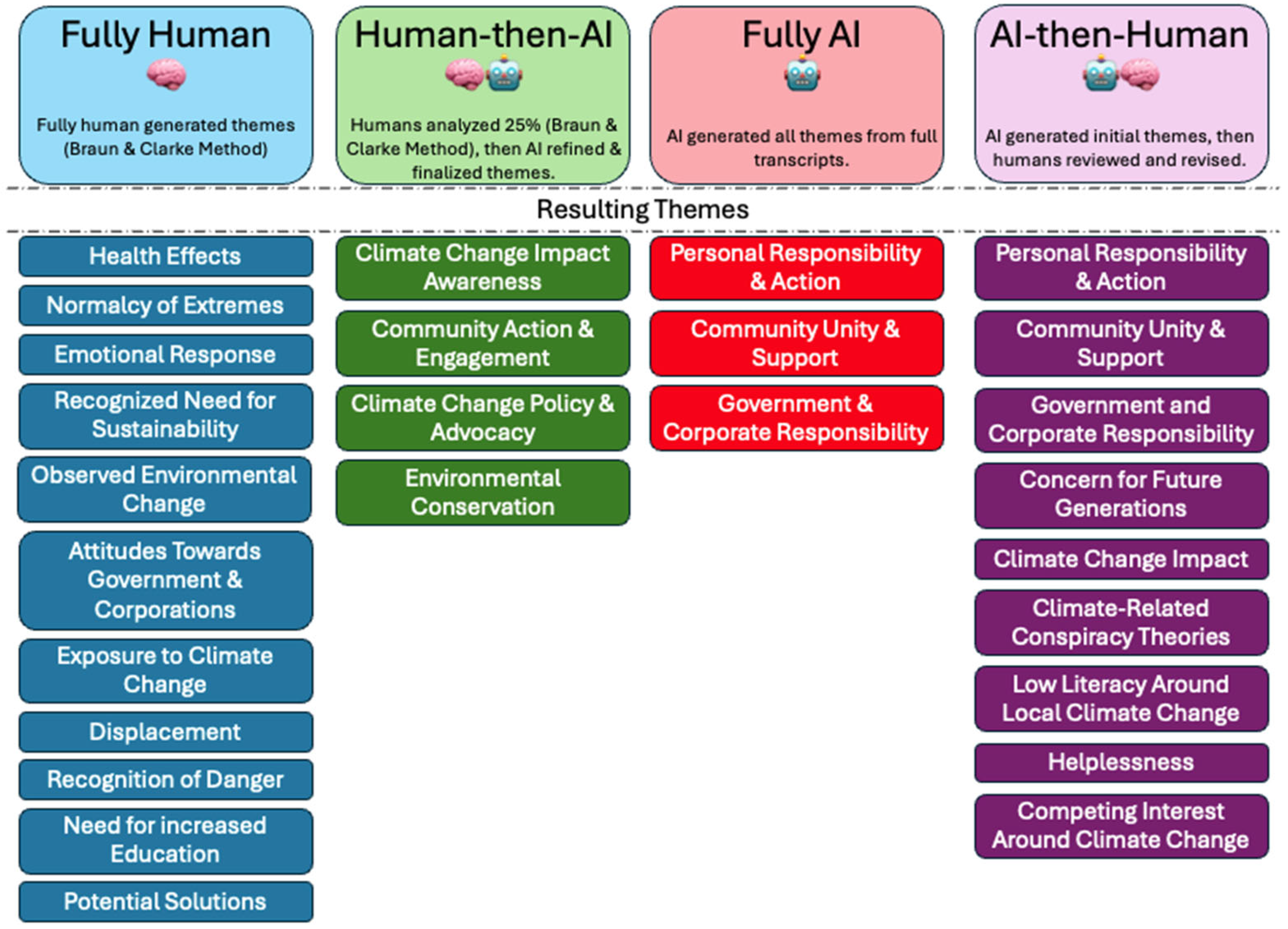
3.1. Thematic Analysis Results by Group
3.1.1. Fully Human-Generated Thematic Analysis
3.1.2. Human-Then-AI-Generated Thematic Analysis
3.1.3. Fully AI-Generated Thematic Analysis
3.1.4. AI-Then-Human-Generated Thematic Analysis
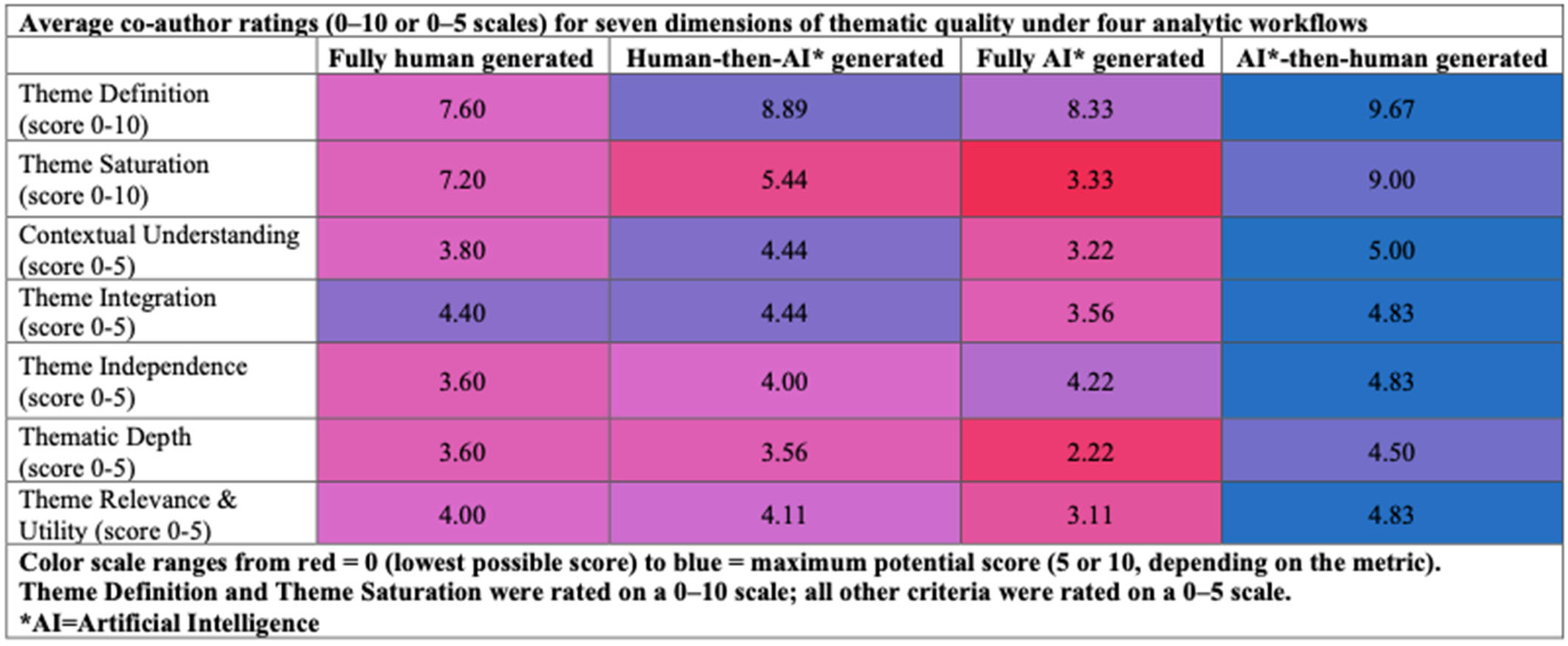
3.2. Thematic Analysis Grading
4. Discussion
4.1. NYC Residents’ Perception of Climate Change Thematic Findings
4.1.1. Personal Responsibility and Action
4.1.2. Community Unity and Support
4.1.3. Government and Corporate Responsibility
4.1.4. Concern for Future Generations
4.1.5. Climate Change Impacts
4.1.6. Climate-Related Conspiracy Theories and Low Literacy Around Local Climate Change
4.1.7. Hopelessness
4.1.8. Competing Interests Surrounding Climate Change
4.2. The Utility of AI in Qualitative Data Analysis
4.3. Strengths, Limitations, and Next Steps
5. Conclusions
Supplementary Materials
Author Contributions
Funding
Institutional Review Board Statement
Informed Consent Statement
Data Availability Statement
Conflicts of Interest
References
- Handmer, J.; Honda, Y.; Kundzewicz, Z.W.; Arnell, N.; Benito, G.; Hatfield, J.; Mohamed, I.F.; Peduzzi, P.; Wu, S.; Sherstyukov, B. Changes in impacts of climate extremes: Human systems and ecosystems. In Managing the Risks of Extreme Events and Disasters to Advance Climate Change Adaptation Special Report of the Intergovernmental Panel on Climate Change; Cambridge University Press: Cambridge, UK, 2012; pp. 231–290. [Google Scholar]
- Turner, M.G.; Calder, W.J.; Cumming, G.S.; Hughes, T.P.; Jentsch, A.; LaDeau, S.L.; Lenton, T.M.; Shuman, B.N.; Turetsky, M.R.; Ratajczak, Z. Climate change, ecosystems and abrupt change: Science priorities. Philos. Trans. R Soc. B 2020, 375, 20190105. [Google Scholar] [CrossRef] [PubMed]
- Sprague, N.L.; Uong, S.P.; Zonnevylle, H.; Chatterjee, T.; Hernández, D.; Rundle, A.G.; Ekenga, C.C. The CHANGE (Climate Health ANalysis Grading Evaluation) tool for weight of evidence reviews on climate change and health research. Environ. Health 2024, 23, 7. [Google Scholar] [CrossRef] [PubMed]
- Khan, O.; Parvez, M.; Kumari, P.; Parvez, S.; Ahmad, S. The future of pharmacy: How AI is revolutionizing the industry. Intell. Pharm. 2023, 1, 32–40. [Google Scholar] [CrossRef]
- Davenport, T.H. The AI Advantage: How to Put the Artificial Intelligence Revolution to Work; MIT Press: Cambridge, MA, USA, 2018. [Google Scholar]
- Ligozat, A.-L.; Lefevre, J.; Bugeau, A.; Combaz, J. Unraveling the Hidden Environmental Impacts of AI Solutions for Environment Life Cycle Assessment of AI Solutions. Sustainability 2022, 14, 5172. [Google Scholar] [CrossRef]
- Wu, C.-J.; Raghavendra, R.; Gupta, U.; Acun, B.; Ardalani, N.; Maeng, K.; Chang, G.; Aga, F.; Huang, J.; Bai, C. Sustainable ai: Environmental implications, challenges and opportunities. Proc. Mach. Learn. Syst. 2022, 4, 795–813. [Google Scholar]
- Goel, S.; Guha, A.; Tripathy, B. The Inevitable Artificial Intelligence Revolution in Healthcare. In Data-Driven Analytics for Healthcare; Apple Academic Press: New York, NY, USA, 2025; pp. 35–54. [Google Scholar]
- Lewis, J.I.; Toney, A.; Shi, X. Climate change and artificial intelligence: Assessing the global research landscape. Discov. Artif. Intell. 2024, 4, 64. [Google Scholar] [CrossRef]
- Kumar, V.; Ranjan, D.; Verma, K. 9—Global climate change: The loop between cause and impact. In Global Climate Change; Singh, S., Singh, P., Rangabhashiyam, S., Srivastava, K.K., Eds.; Elsevier: Amsterdam, The Netherlands, 2021; pp. 187–211. [Google Scholar]
- Ellwanger, J.H.; Kulmann-Leal, B.; Kaminski, V.L.; Valverde-Villegas, J.; Veiga, A.B.G.; Spilki, F.R.; Fearnside, P.M.; Caesar, L.; Giatti, L.L.; Wallau, G.L. Beyond diversity loss and climate change: Impacts of Amazon deforestation on infectious diseases and public health. An. Acad. Bras. Ciências 2020, 92, e20191375. [Google Scholar] [CrossRef]
- Sprague, N.L.; Uong, S.P.; Jacobowitz, A.L.; Packard, S.E.; Quinn, J.W.; Keyes, K.M.; Rundle, A.G. Examining racial and ethnic heat exposure disparities in NYC (NYC) across different spatial and political scales through geographic effect measure modification. Environ. Res. 2024, 250, 118521. [Google Scholar] [CrossRef]
- Masson-Delmotte, V.; Zhai, P.; Pirani, A.; Connors, S.L.; Péan, C.; Berger, S.; Caud, N.; Chen, Y.; Goldfarb, L.; Gomis, M. Climate Change 2021: The Physical Science Basis. Contribution of Working Group I to the Sixth Assessment Report of the Intergovernmental Panel on Climate Change; Cambridge University Press: Cambridge, UK, 2021; Volume 2, p. 2391. [Google Scholar]
- Parmesan, C.; Morecroft, M.D.; Trisurat, Y. Climate Change 2022: Impacts, Adaptation and Vulnerability; GIEC: Paris, France, 2022. [Google Scholar]
- Sprague, N.L.; Uong, S.P.; Kelsall, N.C.; Jacobowitz, A.L.; Quinn, J.W.; Keyes, K.M.; Rundle, A.G. Using geographic effect measure modification to examine socioeconomic-related surface temperature disparities in New York City. J. Expo. Sci. Environ. Epidemiol. 2024, 35, 792–801. [Google Scholar] [CrossRef]
- Drummond, C.; Fischhoff, B. Individuals with greater science literacy and education have more polarized beliefs on controversial science topics. Proc. Natl. Acad. Sci. USA 2017, 114, 9587–9592. [Google Scholar] [CrossRef]
- Kleinberg, S.; Toomey, A.H. The use of qualitative research to better understand public opinions on climate change. J. Environ. Stud. Sci. 2023, 13, 367–375. [Google Scholar] [CrossRef]
- Adger, W.N.; Barnett, J.; Brown, K.; Marshall, N.; O’brien, K. Cultural dimensions of climate change impacts and adaptation. Nat. Clim. Change 2013, 3, 112–117. [Google Scholar] [CrossRef]
- Sayler, K.M. Artificial Intelligence and National Security; Congressional Research Service: Washington, DC, USA, 2020; p. 4 5178.
- Milosevic, T.; Verma, K.; Carter, M.; Vigil, S.; Laffan, D.; Davis, B.; O’Higgins Norman, J. Effectiveness of Artificial Intelligence–Based Cyberbullying Interventions From Youth Perspective. Soc. Media + Soc. 2023, 9, 20563051221147325. [Google Scholar] [CrossRef]
- Chen, X.; Liu, Z.; Wei, L.; Yan, J.; Hao, T.; Ding, R. A comparative quantitative study of utilizing artificial intelligence on electronic health records in the USA and China during 2008–2017. BMC Med. Inform. Decis. Mak. 2018, 18, 55–69. [Google Scholar] [CrossRef]
- Dunn, S. Identity manipulation: Responding to advances in artificial intelligence and robotics. In Proceedings of the WeRobot 2020, Virtual, 22–25 September 2020. [Google Scholar]
- Floridi, L.; Cowls, J. A Unified Framework of Five Principles for AI in Society. In Machine Learning and the City; John Wiley & Sons: Hoboken, NJ, USA, 2022; pp. 535–545. [Google Scholar]
- Ranschaert, E.; Topff, L.; Pianykh, O. Optimization of radiology workflow with artificial intelligence. Radiol. Clin. 2021, 59, 955–966. [Google Scholar] [CrossRef]
- De Vries, A. The growing energy footprint of artificial intelligence. Joule 2023, 7, 2191–2194. [Google Scholar] [CrossRef]
- Spalević, Ž.; Marković, F.; Marković, S. Artificial Intelligence: The New Inevitability of Contemporary Society. Kult. Polisa 2023, 20, 88–106. [Google Scholar] [CrossRef]
- Tabbakh, A.; Al Amin, L.; Islam, M.; Mahmud, G.I.; Chowdhury, I.K.; Mukta, M.S.H. Towards sustainable AI: A comprehensive framework for Green AI. Discov. Sustain. 2024, 5, 408. [Google Scholar] [CrossRef]
- Schwartz, R.; Dodge, J.; Smith, N.A.; Etzioni, O. Green ai. Commun. ACM 2020, 63, 54–63. [Google Scholar] [CrossRef]
- Zhao, T.; Wang, S.; Ouyang, C.; Chen, M.; Liu, C.; Zhang, J.; Yu, L.; Wang, F.; Xie, Y.; Li, J. Artificial intelligence for geoscience: Progress, challenges and perspectives. Innovation 2024, 5, 100691. [Google Scholar] [CrossRef] [PubMed]
- Sun, W.; Bocchini, P.; Davison, B.D. Applications of artificial intelligence for disaster management. Nat. Hazards 2020, 103, 2631–2689. [Google Scholar] [CrossRef]
- Chen, C.-f.; Napolitano, R.; Hu, Y.; Kar, B.; Yao, B. Addressing machine learning bias to foster energy justice. Energy Res. Soc. Sci. 2024, 116, 103653. [Google Scholar] [CrossRef]
- Cowls, J.; Tsamados, A.; Taddeo, M.; Floridi, L. The AI gambit: Leveraging artificial intelligence to combat climate change—Opportunities, challenges, and recommendations. AI Soc. 2023, 38, 283–307. [Google Scholar] [CrossRef] [PubMed]
- Alzoubi, Y.I.; Mishra, A. Green artificial intelligence initiatives: Potentials and challenges. J. Clean. Prod. 2024, 468, 143090. [Google Scholar] [CrossRef]
- Surya, L. An exploratory study of AI and Big Data, and it’s future in the United States. Int. J. Creat. Res. Thoughts (IJCRT) 2015, 3, 2320–2882. [Google Scholar]
- Pencheva, I.; Esteve, M.; Mikhaylov, S.J. Big Data and AI–A transformational shift for government: So, what next for research? Public Policy Adm. 2020, 35, 24–44. [Google Scholar] [CrossRef]
- Carrell, D.S.; Halgrim, S.; Tran, D.-T.; Buist, D.S.; Chubak, J.; Chapman, W.W.; Savova, G. Using natural language processing to improve efficiency of manual chart abstraction in research: The case of breast cancer recurrence. Am. J. Epidemiol. 2014, 179, 749–758. [Google Scholar] [CrossRef] [PubMed]
- Bernert, R.A.; Hilberg, A.M.; Melia, R.; Kim, J.P.; Shah, N.H.; Abnousi, F. Artificial intelligence and suicide prevention: A systematic review of machine learning investigations. Int. J. Environ. Res. Public Health 2020, 17, 5929. [Google Scholar] [CrossRef]
- Jiang, J.A.; Wade, K.; Fiesler, C.; Brubaker, J.R. Supporting serendipity: Opportunities and challenges for Human-AI Collaboration in qualitative analysis. Proc. ACM Hum.-Comput. Interact. 2021, 5, 1–23. [Google Scholar] [CrossRef]
- Creswell, J.W.; Poth, C.N. Qualitative Inquiry and Research Design: Choosing Among Five Approaches; Sage publications: Thousand Oaks, CA, USA, 2016. [Google Scholar]
- Abram, M.D.; Mancini, K.T.; Parker, R.D. Methods to integrate natural language processing into qualitative research. Int. J. Qual. Methods 2020, 19, 1609406920984608. [Google Scholar] [CrossRef]
- Kalpokaite, N.; Radivojevic, I.; Best Practice Article: Auto-Coding and Smart Coding in ATLAS. ti Cloud. 2018. Available online: https://atlasti.com/guides/qualitative-research-guide-part-2/auto-coding-smart-coding (accessed on 6 October 2025).
- Rietz, T.; Maedche, A. Cody: An AI-based system to semi-automate coding for qualitative research. In Proceedings of the 2021 CHI Conference on Human Factors in Computing Systems, Tokohama, Japan, 8–13 May 2021; pp. 1–14. [Google Scholar]
- Mason, J.L.; Johnston, E.; Berndt, S.; Segal, K.; Lei, M.; Wiest, J.S. Labor and skills gap analysis of the biomedical research workforce. FASEB J. 2016, 30, 2673. [Google Scholar] [CrossRef] [PubMed]
- Benhayoun, L.; Lang, D. Does higher education properly prepare graduates for the growing artificial intelligence market? Gaps’ identification using text mining. Hum. Syst. Manag. 2021, 40, 639–651. [Google Scholar] [CrossRef]
- Martin-Kerry, J.M.; Graham, H.M.; Lampard, P. ‘I don’t really associate climate change with actual people’s health’: A qualitative study in England of perceptions of climate change and its impacts on health. Public Health 2023, 219, 85–90. [Google Scholar] [CrossRef]
- Toan, D.T.T.; Kien, V.D.; Giang, K.B.; Minh, H.V.; Wright, P. Perceptions of climate change and its impact on human health: An integrated quantitative and qualitative approach. Glob. Health Action 2014, 7, 23025. [Google Scholar] [CrossRef]
- Mahl, D.; Guenther, L.; Schäfer, M.S.; Meyer, C.; Siegen, D. “We are a Bit Blind About it”: A Qualitative Analysis of Climate Change-Related Perceptions and Communication Across South African Communities. Environ. Commun. 2020, 14, 802–815. [Google Scholar] [CrossRef]
- Sprague, N.L.; Fan, I.B.; Dandeneau, M.; Hernandez Perez, J.F.; Birmingham, J.; De Los Santos, D.; Riddick, M.I.; Meltzer, G.Y.; Siegel, E.L.; Hernández, D. StreetTalk: Exploring energy insecurity in New York City using a novel street intercept interview and social media dissemination method. Humanit. Soc. Sci. Commun. 2024, 11, 1109. [Google Scholar] [CrossRef]
- Goldkuhl, G. Pragmatism vs interpretivism in qualitative information systems research. Eur. J. Inf. Syst. 2012, 21, 135–146. [Google Scholar] [CrossRef]
- Braun, V.; Clarke, V. Toward good practice in thematic analysis: Avoiding common problems and be(com)ing a knowing researcher. Int. J. Transgender Health 2023, 24, 1–6. [Google Scholar] [CrossRef]
- Castleberry, A.; Nolen, A. Thematic analysis of qualitative research data: Is it as easy as it sounds? Curr. Pharm. Teach. Learn. 2018, 10, 807–815. [Google Scholar] [CrossRef]
- Vaismoradi, M.; Jones, J.; Turunen, H.; Snelgrove, S. Theme development in qualitative content analysis and thematic analysis. J. Nurs. Educ. Pract. 2016, 6, 100–110. [Google Scholar] [CrossRef]
- Sebele-Mpofu, F.Y. Saturation controversy in qualitative research: Complexities and underlying assumptions. A literature review. Cogent Soc. Sci. 2020, 6, 1838706. [Google Scholar] [CrossRef]
- Bouman, T.; Verschoor, M.; Albers, C.J.; Böhm, G.; Fisher, S.D.; Poortinga, W.; Whitmarsh, L.; Steg, L. When worry about climate change leads to climate action: How values, worry and personal responsibility relate to various climate actions. Glob. Environ. Change 2020, 62, 102061. [Google Scholar] [CrossRef]
- Boto-García, D.; Bucciol, A. Climate change: Personal responsibility and energy saving. Ecol. Econ. 2020, 169, 106530. [Google Scholar] [CrossRef]
- Sprague, N.L.; Zonnevylle, H.M.; Jackson Hall, L.; Williams, R.; Dains, H.; Liang, D.; Ekenga, C.C. Environmental health perceptions of urban youth from low-income communities: A qualitative photovoice study and framework. Health Expect. 2023, 26, 1832–1842. [Google Scholar] [CrossRef]
- Bullard, R.D. Dumping in Dixie: Race, Class, and Environmental Quality; Routledge: New, York, NY, USA, 2018. [Google Scholar]
- Shepard, P.M. Advancing environmental justice through community-based participatory research. Environ. Health Perspect. 2002, 110 (Suppl. S2), 139. [Google Scholar] [CrossRef]
- Middlemiss, L.; Parrish, B.D. Building capacity for low-carbon communities: The role of grassroots initiatives. Energy Policy 2010, 38, 7559–7566. [Google Scholar] [CrossRef]
- Schultz, F.; Kleinnijenhuis, J.; Oegema, D.; Utz, S.; van Atteveldt, W. Strategic framing in the BP crisis: A semantic network analysis of associative frames. Public Relat. Rev. 2012, 38, 97–107. [Google Scholar] [CrossRef]
- Hansen, A. Environment, Media and Communication; Routledge: New, York, NY, USA, 2018. [Google Scholar]
- Brulle, R.J.; Werthman, C. The role of public relations firms in climate change politics. Clim. Change 2021, 169, 8. [Google Scholar] [CrossRef]
- Benoit, L.; Thomas, I.; Martin, A. Review: Ecological awareness, anxiety, and actions among youth and their parents—A qualitative study of newspaper narratives. Child Adolesc. Ment. Health 2022, 27, 47–58. [Google Scholar] [CrossRef]
- Gibson, C.; How climate experts think about raising children who will inherit a planet in crisis. The Washington Post, 14 February 2020. Available online: https://www.washingtonpost.com/lifestyle/on-parenting/how-climate-experts-think-about-raising-children-who-will-inherit-a-planet-in-crisis/2020/02/14/b4f3405a-4e69-11ea-b721-9f4cdc90bc1c_story.html (accessed on 6 October 2025).
- Lawson, D.F.; Stevenson, K.T.; Peterson, M.N.; Carrier, S.J.; L Strnad, R.; Seekamp, E. Children can foster climate change concern among their parents. Nat. Clim. Change 2019, 9, 458–462. [Google Scholar] [CrossRef]
- Crease, A.; Singhasaneh, N. Climate Change Conversations with Children: Making Sustainability Meaningful, Tangible, and Actionable. Master’s Thesis, Massachusetts Institute of Technology, Cambridge, MA, USA, 2023. [Google Scholar]
- Lorenzoni, I.; Nicholson-Cole, S.; Whitmarsh, L. Barriers perceived to engaging with climate change among the UK public and their policy implications. Glob. Environ. Change 2007, 17, 445–459. [Google Scholar] [CrossRef]
- Douglas, K.M.; Sutton, R.M. Climate change: Why the conspiracy theories are dangerous. Bull. At. Sci. 2015, 71, 98–106. [Google Scholar] [CrossRef]
- Bangay, C.; Blum, N. Education responses to climate change and quality: Two parts of the same agenda? Int. J. Educ. Dev. 2010, 30, 359–368. [Google Scholar] [CrossRef]
- Elshof, L. Can education overcome climate change inactivism. J. Act. Sci. Technol. Educ. 2011, 3, 15–51. [Google Scholar]
- Salomon, E.; Preston, J.L.; Tannenbaum, M.B. Climate change helplessness and the (de)moralization of individual energy behavior. J. Exp. Psychol. Appl. 2017, 23, 15–28. [Google Scholar] [CrossRef]
- Gunderson, R. Powerless, stupefied, and repressed actors cannot challenge climate change: Real helplessness as a barrier between environmental concern and action. J. Theory Soc. Behav. 2023, 53, 271–295. [Google Scholar] [CrossRef]
- Bano, M.; Zowghi, D.; Whittle, J. Exploring Qualitative Research Using LLMs. arXiv 2023, arXiv:2306.13298. [Google Scholar] [CrossRef]
- Dwivedi, Y.K.; Hughes, L.; Ismagilova, E.; Aarts, G.; Coombs, C.; Crick, T.; Duan, Y.; Dwivedi, R.; Edwards, J.; Eirug, A. Artificial Intelligence (AI): Multidisciplinary perspectives on emerging challenges, opportunities, and agenda for research, practice and policy. Int. J. Inf. Manag. 2021, 57, 101994. [Google Scholar] [CrossRef]
- Morgan, D.L. Exploring the use of artificial intelligence for qualitative data analysis: The case of ChatGPT. Int. J. Qual. Methods 2023, 22, 16094069231211248. [Google Scholar] [CrossRef]
- Kaartemo, V.; Helkkula, A. A systematic review of artificial intelligence and robots in value co-creation: Current status and future research avenues. J. Creat. Value 2018, 4, 211–228. [Google Scholar] [CrossRef]



| Question | Probe |
|---|---|
| What comes to mind for you when you think about climate change? | |
| What concerns do you have about climate change? | |
| Climate change has been shown to cause heat waves, flooding, forest fires, tropical storms, and other natural disasters. In what ways have you personally experienced the effects of climate change? | How does climate change impact your daily life? (If at all) |
| Have you had to adjust or change your behavior accordingly? How so? | |
| What about during this summer specifically? | |
| How has the air pollution from the Canadian wildfires affected you? | |
| Our area is prone to heavy rain in part due to climate change. Has that affected you in any way? | Were you directly impacted by Hurricanes Ida or Sandy? If so, what was that experience like for you? |
| In your opinion, what steps should the government and local authorities, and/or corporations take to address climate change and its impacts in New York City? | |
| What actions can you and other individuals take to reduce the effects of climate change in our everyday lives? |
| Criteria | Description | Scoring * |
|---|---|---|
| Theme Definition | Clear and concise definition of each Theme. | 0–10 |
| Theme Saturation | Adequate coverage of all relevant themes in the data. | 0–10 |
| Contextual Understanding | Demonstrated understanding of the context when assigning themes. | 0–5 |
| Theme Integration | Integration of themes into a cohesive analytical framework. | 0–5 |
| Theme Independence | Absence of overlap or redundancy between themes. | 0–5 |
| Thematic Depth | Depth of analysis within each theme. | 0–5 |
| Theme Relevance & Utility | Relevance of theme to research questions or objectives, and practical usefulness for research purposes. | 0–5 |
| Total | /45 |
| Fully Human-Generated | Human-Then-AI-Generated | Fully AI-Generated | AI-Then-Human-Generated | |||||
|---|---|---|---|---|---|---|---|---|
| Grader (Co-Authors) | Grade (%) | Rank | Grade (%) | Rank | Grade (%) | Rank | Grade (%) | Rank |
| AP | 93.33 | 1 | 88.89 | 2 | 42.22 | 3 | N/A | N/A |
| DDLS | 37.78 | 3 | 53.33 | 2 | 64.44 | 1 | N/A | N/A |
| ELS | 88.89 | 1 | 68.89 | 2 | 57.78 | 3 | N/A | N/A |
| GYM | N/A | N/A | 82.22 | 2 | 77.78 | 3 | 93.33 | 1 |
| BDO | N/A | N/A | 95.56 | 2 | 88.89 | 3 | 100 | 1 |
| SA | N/A | N/A | 64.44 | 2 | 57.78 | 3 | 86.00 | 1 |
| MLD | N/A | N/A | 80.00 | 2 | 75.56 | 3 | 95.56 | 1 |
| AKK | 95.56 | 2 | 86.67 | 3 | 73.33 | 4 | 100 | 1 |
| DH | 64.44 | 3 | 77.78 | 2 | 26.67 | 4 | 84.44 | 1 |
| Average | 76.00 | 2 | 77.53 | 2.11 | 62.72 | 3 | 93.22 | 1 |
Disclaimer/Publisher’s Note: The statements, opinions and data contained in all publications are solely those of the individual author(s) and contributor(s) and not of MDPI and/or the editor(s). MDPI and/or the editor(s) disclaim responsibility for any injury to people or property resulting from any ideas, methods, instructions or products referred to in the content. |
© 2025 by the authors. Licensee MDPI, Basel, Switzerland. This article is an open access article distributed under the terms and conditions of the Creative Commons Attribution (CC BY) license (https://creativecommons.org/licenses/by/4.0/).
Share and Cite
Sprague, N.L.; Meltzer, G.Y.; Dandeneau, M.L.; De Los Santos, D.; O’Neil, D.B.; Kim, A.K.; Parisi, A.; Araujo, S.; Ekenga, C.C.; Siegel, E.L.; et al. A Role for Artificial Intelligence (AI) in Qualitative Research? An Exploratory Analysis Examining New York City Residents’ Perceptions on Climate Change. Sustainability 2025, 17, 10459. https://doi.org/10.3390/su172310459
Sprague NL, Meltzer GY, Dandeneau ML, De Los Santos D, O’Neil DB, Kim AK, Parisi A, Araujo S, Ekenga CC, Siegel EL, et al. A Role for Artificial Intelligence (AI) in Qualitative Research? An Exploratory Analysis Examining New York City Residents’ Perceptions on Climate Change. Sustainability. 2025; 17(23):10459. https://doi.org/10.3390/su172310459
Chicago/Turabian StyleSprague, Nadav L., Gabriella Y. Meltzer, Michelle L. Dandeneau, Daritza De Los Santos, Drew B. O’Neil, Andrew K. Kim, Alejandra Parisi, Shane Araujo, Christine C. Ekenga, Eva L. Siegel, and et al. 2025. "A Role for Artificial Intelligence (AI) in Qualitative Research? An Exploratory Analysis Examining New York City Residents’ Perceptions on Climate Change" Sustainability 17, no. 23: 10459. https://doi.org/10.3390/su172310459
APA StyleSprague, N. L., Meltzer, G. Y., Dandeneau, M. L., De Los Santos, D., O’Neil, D. B., Kim, A. K., Parisi, A., Araujo, S., Ekenga, C. C., Siegel, E. L., & Hernández, D. (2025). A Role for Artificial Intelligence (AI) in Qualitative Research? An Exploratory Analysis Examining New York City Residents’ Perceptions on Climate Change. Sustainability, 17(23), 10459. https://doi.org/10.3390/su172310459