



Research on Evaluating the Effects of Digital Construction in Comprehensive Museums: A Collaborative Evaluation Approach Based on Cultural Cycle Theory and Grounded Theory


Abstract
1. Introduction
2. Literature Review
2.1. Comprehensive Museums
2.2. Digital Construction of Museums
2.3. Grounded Theory
2.4. Cultural Cycle Theory
3. Theoretical Framework and Research Methods
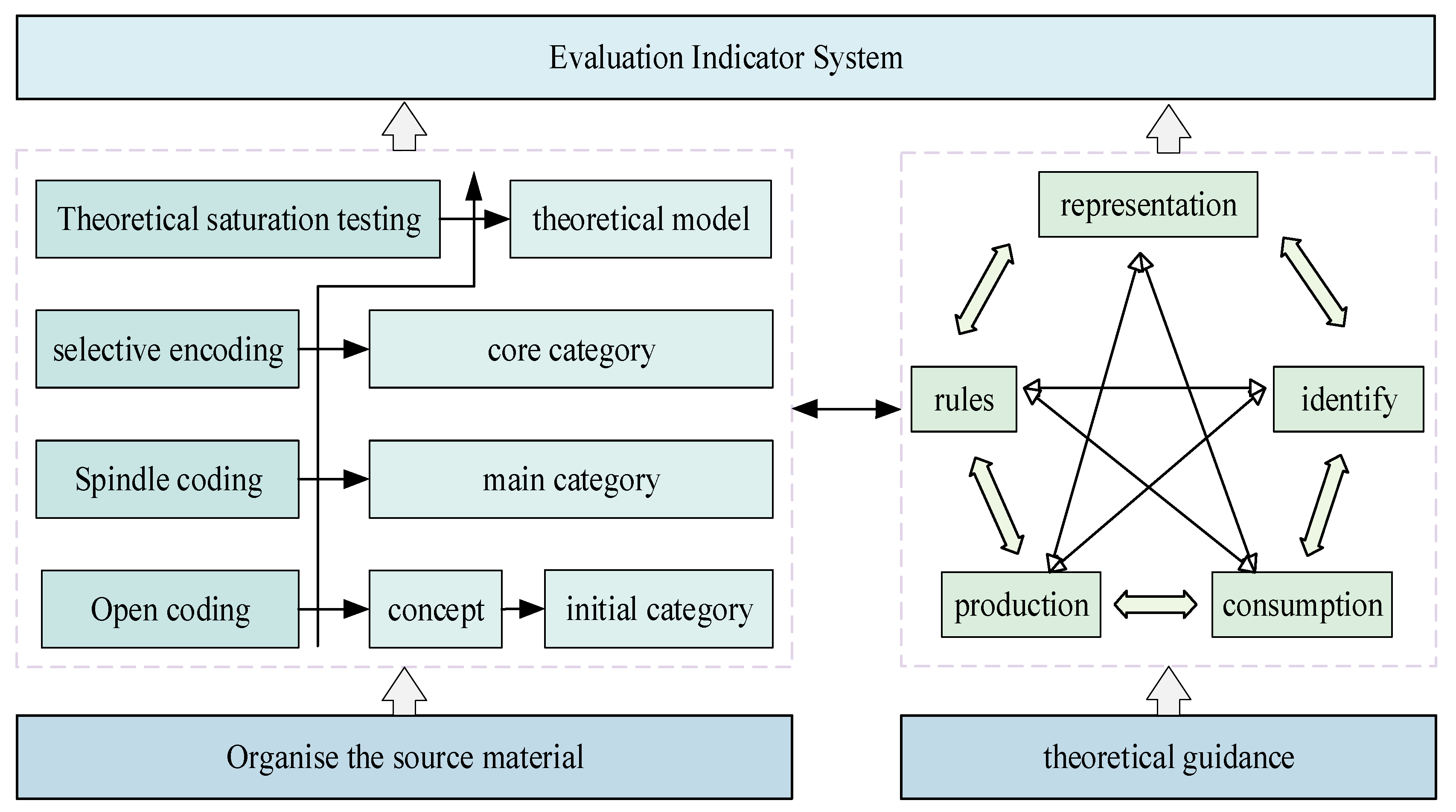
3.1. Construction of an Evaluation Indicator System Based on Dual-Directional Analysis of Grounded Theory and Cultural Cycle Theory
3.1.1. Open Coding
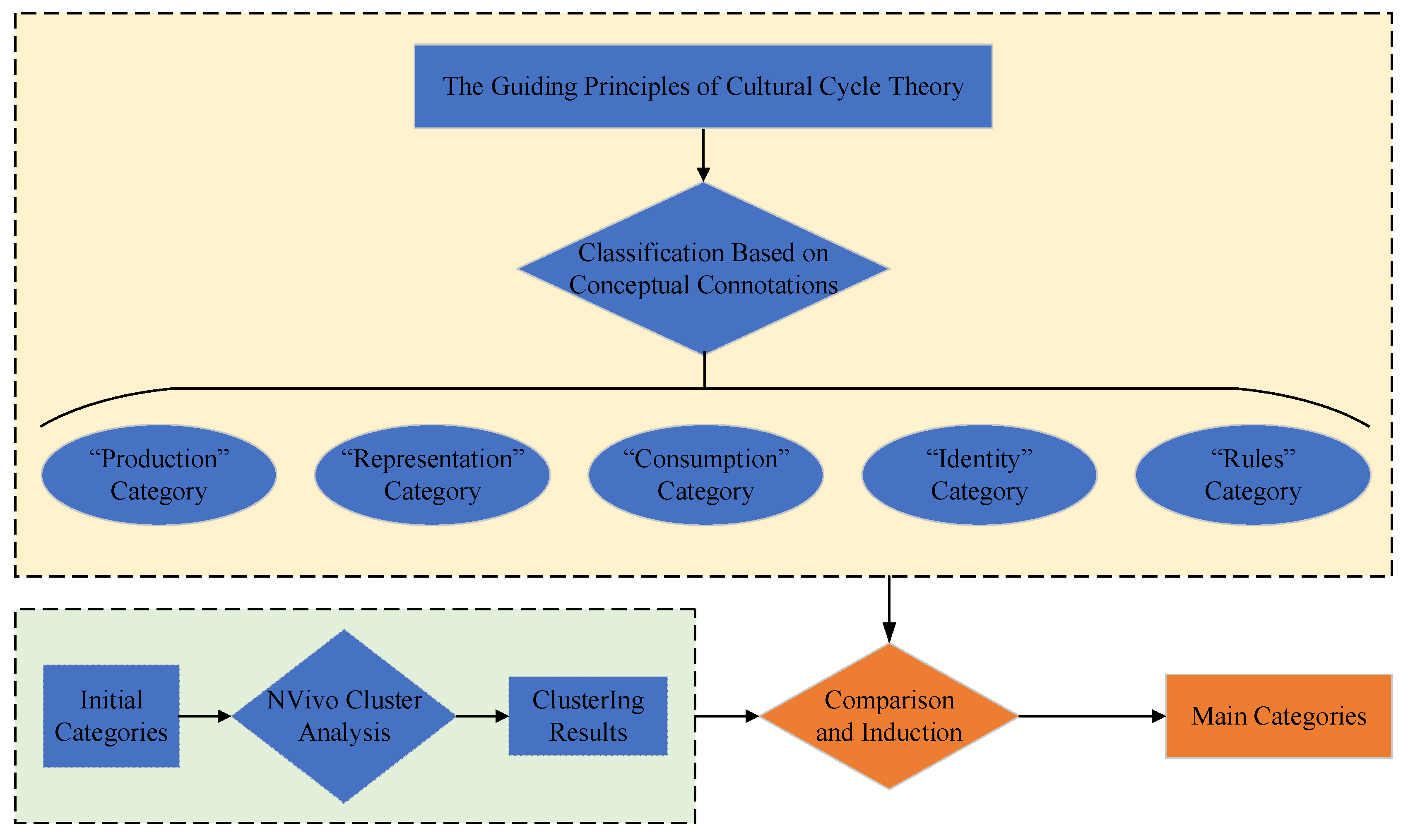
3.1.2. Spindle Coding and the Cultural Cycle Theory
3.1.3. Selective Coding
3.1.4. Theoretical Saturation Testing
3.1.5. Indicator System Construction
3.2. Indicator Weight Calculation Based on ANP
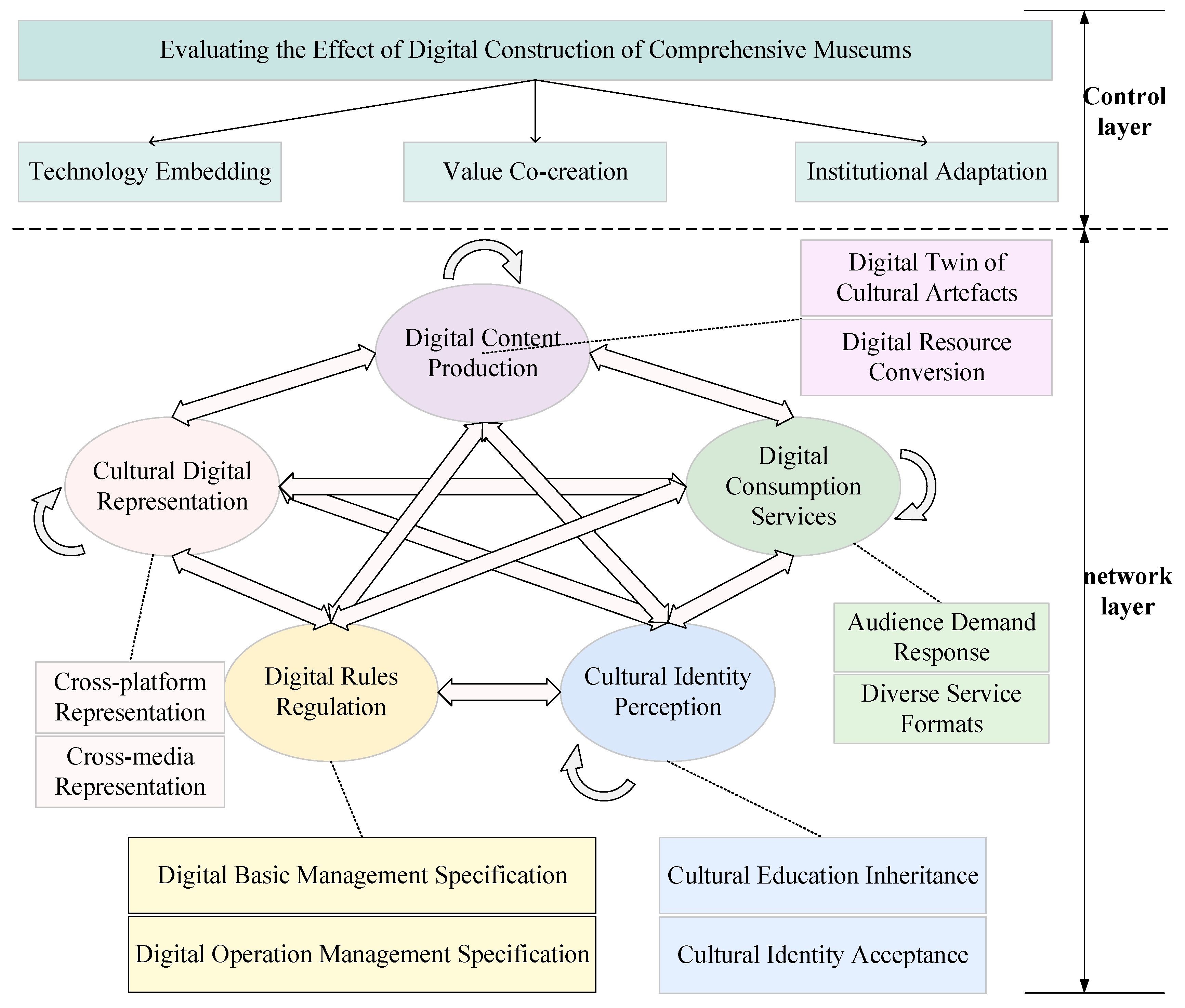
3.2.1. Construction of the ANP Network Structure
3.2.2. ANP Matrix Calculation
3.3. Comprehensive Evaluation Based on the Cloud Model
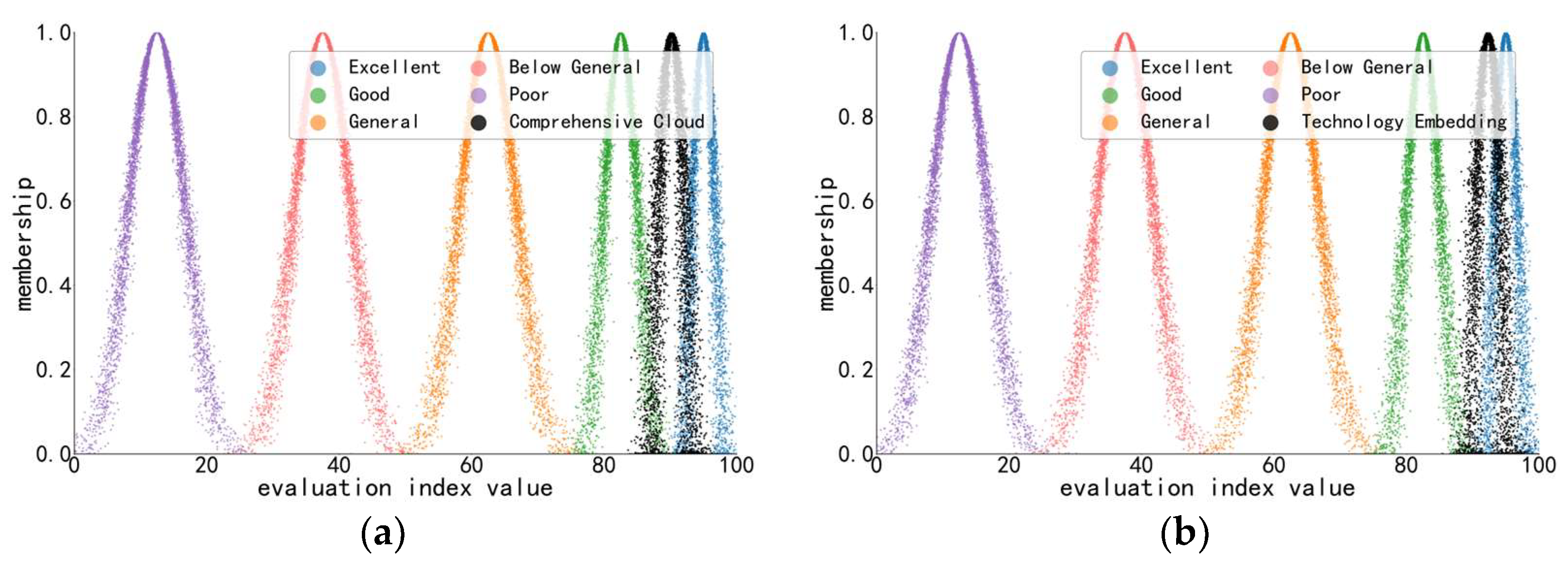
3.3.1. Determining the Evaluation Grades
3.3.2. Confirm the Evaluation Indicator Cloud
3.3.3. Establishing the Comprehensive Evaluation Cloud
4. Empirical Analysis: A Case Study of “Smart Jiangxi Museum”
4.1. Sample Selection
4.2. Data Sources
4.3. Data Analysis
4.3.1. Establish the Initial Categories
4.3.2. Establish the Main Categories
4.3.3. Establish Core Categories
4.3.4. Validating Theoretical Models Through Academic Journals
4.3.5. Establish an Effectiveness Evaluation Indicator System
4.4. Evaluation of Digital Construction Outcomes for Comprehensive Museums Based on the ANP-Cloud Model
4.4.1. Construction of the ANP Network Architecture
4.4.2. Determining Indicator Weights
4.4.3. Determining Indicator Cloud
4.4.4. Evaluation Results Analysis
5. Conclusions and Limitations
Author Contributions
Funding
Institutional Review Board Statement
Informed Consent Statement
Data Availability Statement
Conflicts of Interest
References
- Liang, Y. The Current State and Advancement in Museum Digitalization. People’s Trib. 2025, 6, 107–109. [Google Scholar]
- Li, Z.; Sun, P. The Application of Digital Technology in Museums. Sci. Educ. Mus. 2024, 10, 47–56. [Google Scholar] [CrossRef]
- Dou, W. Problems, Innovative Cases and Suggestions Faced by Museums in Digital Construction. Sci. Educ. Mus. 2023, 9, 46–53. [Google Scholar] [CrossRef]
- Song, M.; Zhang, S. Research on high-quality museum development in the context of fostering new-quality productive forces. Identif. Apprec. Cult. Relics 2024, 18, 98–101. [Google Scholar] [CrossRef]
- Li, G.; Ming, Z. Digital Empowerment for the Construction of Smart Museums. China Newsp. Ind. 2024, 38, 236–237. [Google Scholar]
- Goode, G.B. On the classification of museums. Science 1896, 3, 154–161. [Google Scholar] [CrossRef]
- Xu, W. On the Taxonomic System of Chinese Museums and the Positioning of Art Museums Therein. Orient. Collect. 2024, 1, 144–146. [Google Scholar]
- Li, Y.; Xia, L. Digital construction and sustainable economic development: A systematic inquiry. China CIO News 2021, 2021, 121–124. [Google Scholar]
- Rashida, K. Practical Application of Museum Research and Prospects for Digitization of Museum Collections. In Proceedings of the Conference on the Role and Importance of Science in the Modern World, New Delhi, India, 6 May 2025; Volume 2, pp. 18–23. [Google Scholar]
- Wang, M. Study on the Application of Digital Modeling Technology in Museum Cultural and Creative Design. Highlights Art Des. 2025, 9, 81–85. [Google Scholar] [CrossRef]
- Hu, W.; Han, H.; Wang, G.; Peng, T.; Yang, Z. Interactive design and implementation of a digital museum under the background of AR and blockchain technology. Appl. Sci. 2023, 13, 4714. [Google Scholar] [CrossRef]
- Glaser, B.G.; Strauss, A.L. Grounded Theory. In Strategien Qualitativer Forschung; Huber: Bern, Switzerland, 1998; Volume 4. [Google Scholar]
- Thornberg, R.; Dunne, C. Literature Review in Grounded Theory. SAGE Handb. Curr. Dev. Grounded Theory 2019, 2, 206–221. [Google Scholar]
- Nathaniel, A.K. When and how to use extant literature in classic grounded theory. Grounded Theory Rev. 2022, 21, 33–48. [Google Scholar] [CrossRef]
- Wang, G.; Zhang, L.; Guo, J. Driving factors and mechanisms of AMT application levels for equipment manufacturing enterprises: Based on programmatic grounded theory. Sustainability 2022, 14, 8415. [Google Scholar] [CrossRef]
- Clarke, A.; Healy, K.; Lynch, D.; Featherstone, G. The use of a constructivist grounded theory method-A good fit for social work research. Int. J. Qual. Methods 2023, 22, 16094069231186257. [Google Scholar] [CrossRef]
- Wu, S.; Li, M. Grounded Theory: History and Logic. Sociol. Stud. 2020, 35, 75–98. [Google Scholar]
- Johnson, R. What is cultural studies anyway? Soc. Text 1986, 16, 38–80. [Google Scholar] [CrossRef]
- Hall, S. Encoding/Decoding. In Media Studies: A Reader; Routledge: Abingdon, UK, 1996; pp. 41–49. [Google Scholar]
- Luan, K. The Interpretation of the Theoretical System of the Stuart Hall “the Circulation of Culture”. Hundred Sch. Arts 2017, 33 (Suppl. 1), 6–10. [Google Scholar]
- Hamedani, M.Y.G.; Markus, H.R. Understanding culture clashes and catalyzing change: A culture cycle approach. Front. Psychol. 2019, 10, 700. [Google Scholar] [CrossRef]
- Chen, S.; Sun, Y. Innovation of Traditional Culture: The Representation and Dissemination of Japanese Mythological Cultural Products. Fujian Trib. 2020, 4, 41–50. [Google Scholar]
- Zhang, D. A circuit-of-culture perspective on the national-cultural psyche through the recurrent meanings of traditional festivals. Theory Mon. 2018, 2018, 162–166. [Google Scholar]
- Pezzullo, P.C. Ecology and labour in the circuit of culture. Cultural Studies 2023, 37, 720–723. [Google Scholar] [CrossRef]
- Liu, Y. Analysis of Feminist in Dove Products Project with Cultural Circuit Theory. Educ. Reform Dev. 2025, 7, 313–316. [Google Scholar] [CrossRef]
- Huang, H.; Zhang, M.; Yu, K.; Gao, Y.; Liu, J. Construction of a complex network of green infrastructure in a smart city under spatial differentiation of landscape. Comput. Commun. 2020, 154, 380–389. [Google Scholar] [CrossRef]
- He, S.; Wu, C.; Zhang, R.; Wang, Z.; Ge, R. Study on the Construction of New Cultural Consumption Space in Historical and Cultural Neighborhoods in the Era of Consumption 4.0. Urban Dev. Stud. 2024, 31, 21–25. [Google Scholar]
- Guo, J.; Kuang, Y.; Wu, Q.; Cheng, X. Design of Cultural Creative Product in Jiangxi Museum based on Cultural Image. Packag. Eng. 2020, 41, 318–322. [Google Scholar]
- Kasana, S.; Chavan, M.; Sedera, D.; Cheng, Z.; Ganzin, M. Unlocking circular start-ups: A model of barriers. Bus. Strategy Environ. 2024, 33, 2546–2577. [Google Scholar] [CrossRef]
- Mendoza-Moheno, J.; Cruz-Coria, E.; González-Cruz, T.F. Socio-technical innovation in community-based tourism organizations: A proposal for local development. Technol. Forecast. Soc. Change 2021, 171, 120949. [Google Scholar] [CrossRef]
- Lozano, R.; Bautista-Puig, N.; Barreiro-Gen, M. Elucidating a holistic and panoptic framework for analysing circular economy. Bus. Strategy Environ. 2021, 30, 1644–1654. [Google Scholar] [CrossRef]
- Rowlands, T.; Waddell, N.; McKenna, B. Are we there yet? A technique to determine theoretical saturation. J. Comput. Inf. Syst. 2016, 56, 40–47. [Google Scholar] [CrossRef]
- Guo, P.; Zhou, Y.A. Grounded-theory-based Study on the Evaluation Index Extraction and Construction of China’s City Green Transition Policy. Manag. Rev. 2018, 30, 257–267. [Google Scholar] [CrossRef]
- Saaty, T.L. Decision-Making with Dependence and Feedback: The Analytic Network Process; RWS Publications: Pittsburgh, PA, USA, 1996; Volume 4922. [Google Scholar]
- Saaty, T.L. Multicriteria Decision-Making; RWS Publications: Pittsburgh, PA, USA, 1990. [Google Scholar]
- Saaty, T.L. Inner and outer dependence in the analytic hierarchy process: The supermatrix and superhierarchy. In Proceedings of the 2nd ISAHP, Pittsburgh, PA, USA, 11–14 August 1991; pp. 66–70. [Google Scholar]
- Li, D.; Liu, C. Study on the Universality of the Normal Cloud Model. Strateg. Study CAE 2004, 6, 28–34. [Google Scholar]
- Li, Y.; Deng, G. Research on crowdsourcing logistics service quality assessment based on cloud model and cloud similarity. Fuzzy Syst. Math. 2024, 38, 34–45. [Google Scholar] [CrossRef]
- Zhang, S.; Xu, C. Study on the Trust Evaluation Approach Based on Cloud Model. Chin. J. Comput. 2013, 36, 422–431. [Google Scholar] [CrossRef]
- Ye, R. Clarifying the collection base and telling the Jiangxi story: An overview of the Jiangxi Provincial Museum’s holdings and the exhibition system of its new building. Cult. Relics World 2020, 2020, 4–19. [Google Scholar]
- Lai, J.; Gong, Y. Digital transformation of museums: Exploration and practice at the Jiangxi Provincial Museum. Cult. Relics World 2023, 10, 12–16. [Google Scholar]
- Shao, Y. Research on the Digitization of the Brand Image of Jiangxi Provincial Museum. Master’s Thesis, Jiangxi Normal University, Nanchang, China, 2024. [Google Scholar] [CrossRef]
- Hu, W.; Hu, X. Reflections on the digital construction of Jiangxi’s converged-media museums. Old Dist. Constr. 2020, 24, 69–75. [Google Scholar]
- Zhong, Q. Digital Empowerment for a New Cultural-Tourism Life. Jiangxi Daily, 4 January 2023; p. 5. [Google Scholar] [CrossRef]

| Evaluation Grade | Grade Interval | Characteristic Parameters of the Cloud Model |
|---|---|---|
| Poor | [0.00, 25.00) | (12.50, 4.17, 0.50) |
| Below General | [25.00, 50.00) | (37.50, 4.17, 0.50) |
| General | [50.00, 75.00) | (62.50, 4.17, 0.50) |
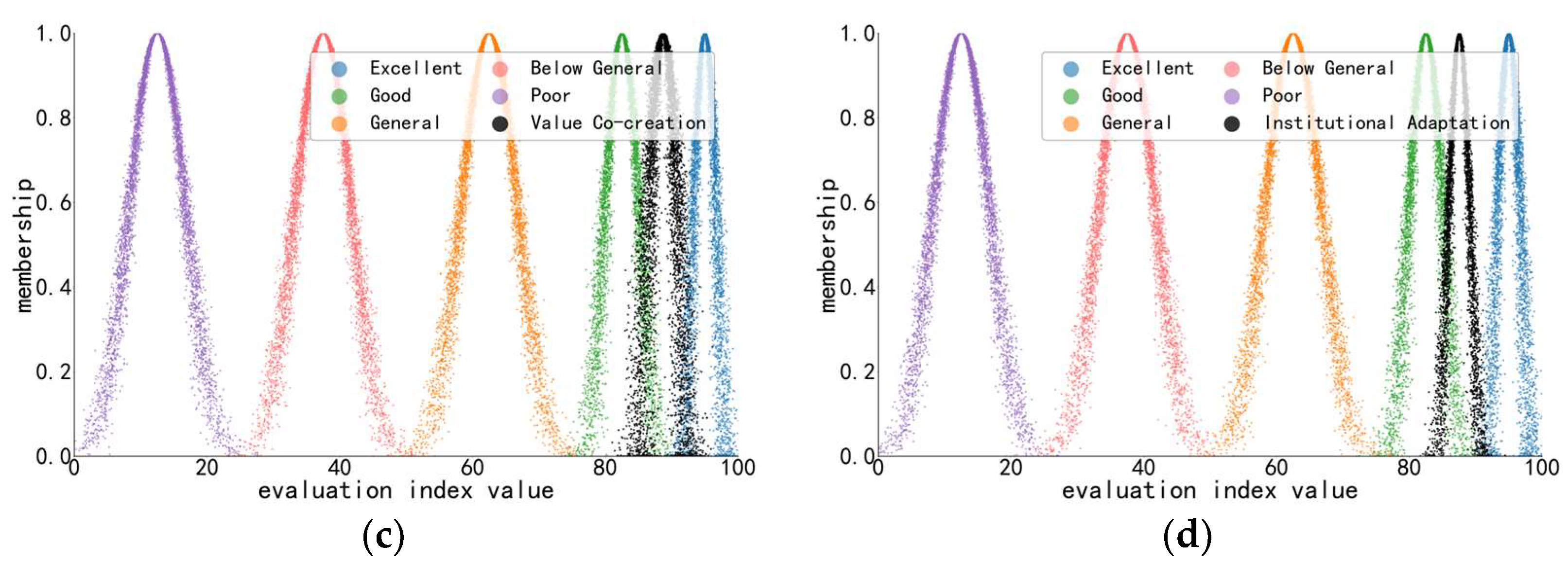
| Good | [75.00, 90.00) | (82.50, 2.50, 0.50) |
| Excellent | [90.00, 100.00] | (95.00, 1.67, 0.50) |
| No. | Data Name |
|---|---|
| 1 | Notice from the General Office of the Ministry of Culture and Tourism on the Release of 2022 Digital Innovation Initiatives in the Culture and Tourism Sector |
| 2 | Media Emphasis: Highlights of CCTV’s “News Live Room” program featuring the “Smart Jiangxi Museum” service system from our museum |
| 3 | Seventy Years of Glory: Tracing the Past, Embracing the Present|③ Innovative Breakthroughs in the Gan Treasure Box-A Dual Journey of Mutual Progress in the New Era |
| 4 | Digital Innovation Case Study|“Smart Jiangxi Museum”: Strengthening the Museum’s “Brain” to Energize Management and Services |
| 5 | Good News|“Smart Jiangxi Museum” Selected as One of the Top Ten Digital Innovation Practice Cases by the Ministry of Culture and Tourism |
| 6 | National Top Ten Cases! Development of the “Smart Jiangxi Museum” Comprehensive Management Service System |
| 7 | Team Practice|Nanchang Team: Focusing on Deep Interaction to Make Museum Culture More Accessible |
| 8 | Digital Innovation Case Study|Digital Technology Innovation Drives the Development of Smart Museums |
| 9 | Expert Interview Transcript |
| 10 | Relevant Academic Journals |
| Initial Categories | Initial Concepts | Original Text Data (Excerpt) |
|---|---|---|
| Digital Twin of Cultural Relics | 3D Scanning and Modeling | Utilizing high-precision 3D scanning and modeling techniques, three-dimensional and lifelike virtual models have been created for hundreds of cultural relics. |
| High-Definition Planar Scanning | High-definition flatbed scanning enables paintings, calligraphy, and rare ancient texts to be presented in their entirety for public viewing. | |
| Digital Resource Conversion | Exhibition Planning | Exhibitions are curated using digital research findings, delving deeply into the stories and cultural significance behind the artifacts. |
| Publication of Papers | Publish academic papers exploring the application of digital technologies in cultural heritage conservation, exhibition planning, and visitor services, focusing on the practice, theory, and case studies of museum digitalization. | |
| Cross-platform Representation | Official Website | The official website features a dedicated digital collection gallery, presenting 360-degree panoramic views of cultural relics. |
| WeChat Public Number | Regularly publishes short stories about cultural relics on the official account, accompanied by high-quality images of artifacts and engaging animations. | |
| Weibo/TikTok/Xiaohongshu | Regularly publish short videos and engaging educational content about our collections on Weibo, TikTok, and Xiaohongshu. | |
| Cross-media Representation | Touchscreen Equipment | Numerous interactive touchscreen devices are installed throughout the museum, allowing visitors to rotate artifacts 360 degrees with a simple tap. |
| VR/AR Equipment | Immersive scenes are created using VR and AR technology. Visitors wearing the equipment can ‘travel back in time’ to ancient Jiangxi and interact with historical figures. | |
| Holographic Projection Equipment | At the Jiangxi Provincial Museum, visitors are immersing themselves in the millennia-long cultural evolution of Jiangxi through digital 3D holographic projections. | |
| Artistic Devices | The Jiangxi Provincial Museum employs a comprehensive approach, integrating graphic displays, replicas, sculptures, and other artworks with supplementary exhibits to deliver a multifaceted, vivid, and contextual narrative. | |
| Audience Demand Response | Interactive Experience Equipment | Children desire more engaging interactive experiences, such as artifact jigsaw puzzles and educational quiz games. |
| Knowledge Acquisition Needs | Parents desire more detailed and accessible explanations of artifacts to facilitate knowledge transfer to their children. | |
| Convenient Visiting Needs | Visitors desire faster loading speeds and smoother viewing for online exhibitions, enabling effortless museum exploration anytime, anywhere. | |
| Diverse Service Formats | Online Service Functions | Online exhibition halls enable visitors to view 3D models of museum artifacts from home via mobile devices or computers, with 360-degree rotation capabilities. |
| Offline Service Optimization | Multiple guided tour modes enhance convenience and personalization, with scheduled commentary and innovative navigation catering to visitor needs. | |
| Cultural Education Inheritance | School Education Cooperation | Collaborating with schools to develop guided tours tailored for school curricula, incorporating technologies such as AR to enhance student comprehension. |
| Social Education Outreach | Hosting diverse thematic lectures and cultural training activities, such as research seminars on Han Dynasty culture and ceramic heritage, to engage public participation. | |
| Cultural Identity Acceptance | Audience’s Interest and Love of Culture | Given that over 90% of visitors expressed interest or strong interest in museum digitization, it is evident that attendees hold a supportive stance towards museum culture. |
| Audience’s Interactive Experience of History | Through interactive artifact displays, VR/AR applications, and other technologies, audiences can comprehensively and meticulously examine cultural relics, converse with virtual characters, and gain deeper insights into historical narratives. | |
| Digital Basic Management Specification | Personnel Management Rules | Staff information integration encompasses basic records, academic qualifications, employment history, and job transfer records, all of which are entered into a unified system. |
| Collection Management Rules | For digitalized collection management, a detailed archive is established for each item, recording prototype information, digital acquisition dates, and methods. | |
| Digital Operation Management Specification | Online Booking and Access Mechanism | Visitors can book appointments through the Jiangxi Provincial Museum’s official website or its WeChat public account, “Jiangxi Provincial Museum”. Upon accessing the booking system, select the visit date, time slot, and number of attendees. Complete the personal details form and submit the order to finalize the booking. |
| Specification for the Use of Digital Equipment | Visitors using equipment within the museum, such as audio guides, must adhere to the relevant rental and usage regulations. | |
| Data Privacy and Security Notices | To standardize data collection on audience behavior, our library has formulated the ‘Digital Service Data Collection Rules’. It is clearly stipulated that only anonymous data related to exhibition services (such as the length of stay of exhibits and the heat map of the guide route) should be collected, and sensitive data, including facial features and biometric information, should not be collected. |
| Main Categories | Initial Categories | Connotation |
|---|---|---|
| Digital Content Production | Digital Twin of Cultural Relics | Employing digital technology to create high-precision replicas and simulations of cultural artifacts, thereby generating virtual models corresponding to physical objects. |
| Digital Resource Conversion | Applications of digital technology in cultural heritage conservation, exhibition planning, and visitor services. | |
| Cultural Digital Representation | Cross-platform Representation | Museums publish information across various platforms from time to time. |
| Cross-media Representation | Displaying information across different devices. | |
| Digital Consumption Services | Audience Demand Response | Level of responsiveness to audience needs. |
| Diverse Service Formats | Includes both online and offline services. | |
| Cultural Identity Perception | Cultural Education Inheritance | Cultural heritage is perpetuated through educational means. |
| Cultural Identity Acceptance | Audience affirmation and acceptance of culture. | |
| Institutional Rules Regulation | Digital Basic Management Specification | Including personnel management and collection management. |
| Digital Operation Management Specification | Including online booking and access mechanisms, digital equipment usage specifications, and data privacy and security guidelines. |
| Sub-Objectives | Primary Indicators | Secondary Indicators |
|---|---|---|
| Technology Embedding | Digital Content Production (B1) | Digital Twin of Cultural Artifacts (C11) |
| Digital Resource Conversion (C12) | ||
| Cultural Digital Representation (B2) | Cross-platform Representation (C21) | |
| Cross-media Representation (C22) | ||
| Value Co-creation | Digital Consumption Services (B3) | Audience Demand Response (C31) |
| Diverse Service Formats (C32) | ||
| Cultural Identity Perception (B4) | Cultural Education Inheritance (C41) | |
| Cultural Identity Acceptance (C42) | ||
| Institutional Adaptation | Digital Rules Regulation (B5) | Digital Basic Management Specification (C51) |
| Digital Operation Management Specification (C52) |
| Sub-Objective | Primary Indicator | Secondary Indicator | Weight | Ranking |
|---|---|---|---|---|
| Technology Embedding (0.45) | Digital Content Production (0.23) | Digital Twin of Cultural Artifacts | 0.10 | 5 |
| Digital Resource Conversion | 0.13 | 4 | ||
| Cultural Digital Representation (0.22) | Cross-platform Representation | 0.17 | 1 | |
| Cross-media Representation | 0.05 | 9 | ||
| Value Co-creation (0.38) | Digital Consumption Services (0.23) | Audience Demand Response | 0.08 | 6 |
| Diverse Service Formats | 0.15 | 2 | ||
| Cultural Identity Perception (0.15) | Cultural Education Inheritance | 0.08 | 7 | |
| Cultural Identity Acceptance | 0.07 | 8 | ||
| Institutional Adaptation (0.17) | Institutional Rule Regulation (0.17) | Digital Basic Management Specification | 0.03 | 10 |
| Digital Operation Management Specification | 0.14 | 3 |
| Comprehensive Cloud Digital Characteristics | Sub-Objective Cloud Digital Characteristics | Primary Indicator Cloud Digital Characteristics | Secondary Indicator Cloud Digital Characteristics |
|---|---|---|---|
| (90.16, 1.89, 0.75) | (92.33, 1.80, 0.76) | (92.02, 1.60, 0.85) | (94.56, 1.32, 0.76) |
| (90.12, 1.76, 0.90) | |||
| (92.66, 2.03, 0.66) | (92.85, 2.04, 0.67) | ||
| (92.04, 1.90, 0.61) | |||
| (88.70, 2.11, 0.81) | (90.16, 1.95, 0.75) | (88.10, 2.93, 1.13) | |
| (91.35, 1.62, 0.63) | |||
| (86.39, 2.51, 0.97) | (87.16, 2.40, 1.03) | ||
| (85.49, 2.64, 0.89) | |||
| (87.53, 1.56, 0.32) | (87.53, 1.56, 0.32) | (90.41, 1.78, 0.64) | |
| (86.86, 1.55, 0.31) |
| Target Layer | Excellent | Good | General | Below General | Poor | Grade |
|---|---|---|---|---|---|---|
| Digitalization Outcomes | 0.60 | 0.56 | 0.39 | 0.19 | 0.00 | Excellent |
| Technology Embedding | 0.72 | 0.53 | 0.37 | 0.18 | 0.00 | Excellent |
| Value Co-creation | 0.57 | 0.60 | 0.39 | 0.19 | 0.00 | Good |
| Institutional adaptation | 0.54 | 0.64 | 0.40 | 0.20 | 0.00 | Good |
Disclaimer/Publisher’s Note: The statements, opinions and data contained in all publications are solely those of the individual author(s) and contributor(s) and not of MDPI and/or the editor(s). MDPI and/or the editor(s) disclaim responsibility for any injury to people or property resulting from any ideas, methods, instructions or products referred to in the content. |
© 2025 by the authors. Licensee MDPI, Basel, Switzerland. This article is an open access article distributed under the terms and conditions of the Creative Commons Attribution (CC BY) license (https://creativecommons.org/licenses/by/4.0/).
Share and Cite
Qi, L.; Tang, J.; Zhang, J.; Zhang, J. Research on Evaluating the Effects of Digital Construction in Comprehensive Museums: A Collaborative Evaluation Approach Based on Cultural Cycle Theory and Grounded Theory. Sustainability 2025, 17, 10452. https://doi.org/10.3390/su172310452
Qi L, Tang J, Zhang J, Zhang J. Research on Evaluating the Effects of Digital Construction in Comprehensive Museums: A Collaborative Evaluation Approach Based on Cultural Cycle Theory and Grounded Theory. Sustainability. 2025; 17(23):10452. https://doi.org/10.3390/su172310452
Chicago/Turabian StyleQi, Lin, Jinfeng Tang, Jiaxin Zhang, and Jian Zhang. 2025. "Research on Evaluating the Effects of Digital Construction in Comprehensive Museums: A Collaborative Evaluation Approach Based on Cultural Cycle Theory and Grounded Theory" Sustainability 17, no. 23: 10452. https://doi.org/10.3390/su172310452
APA StyleQi, L., Tang, J., Zhang, J., & Zhang, J. (2025). Research on Evaluating the Effects of Digital Construction in Comprehensive Museums: A Collaborative Evaluation Approach Based on Cultural Cycle Theory and Grounded Theory. Sustainability, 17(23), 10452. https://doi.org/10.3390/su172310452

