Article

Synergies in Sustainability: Assessing the Innovation Effects of Digital and Green Investments in EU Cohesion Policy


1
Department of Social, Political and Cognitive Sciences, University of Siena, 53100 Siena, Italy
2
Department of Management, Economics and Industrial Engineering, Politecnico di Milano, Via Lambruschini, 4/B, 20156 Milan, Italy
*
Author to whom correspondence should be addressed.
Sustainability 2025, 17(23), 10446; https://doi.org/10.3390/su172310446
Submission received: 21 October 2025 / Revised: 13 November 2025 / Accepted: 19 November 2025 / Published: 21 November 2025

Abstract

The European Union’s Cohesion Policy is a key instrument designed to reduce disparities among regions and promote sustainable, inclusive growth across Europe. In the context of the green and digital transitions, understanding how Cohesion Policy funds affect innovation is crucial to effective policy design. This study examines the impact of these funds on firm-level innovation in three domains: digital, green, and combined digital–green innovation. Using firm-level data and econometric models, our analysis uncovers a strong and statistically significant positive effect of Cohesion Policy funding on digital innovation. The impact on green innovation alone is positive but weaker and only marginally significant. Innovations that are both digital and green benefit from Cohesion Policy significantly, highlighting the potential of integrated innovation strategies.

1. Introduction

The pursuit of a twin transition, simultaneously fostering digitalization and the low-carbon economy, has become a cornerstone of contemporary industrial and environmental policy [1,2]. In the context of escalating climate pressures and rapid technological change, governments are increasingly called to promote growth models that are both competitive and sustainable [3,4]. The European Union (EU) has placed this ambition at the center of its long-term strategy, viewing the digital and green transitions as mutually reinforcing pathways toward climate neutrality and economic resilience [5,6]. The European Green Deal and the Digital Decade Policy Programme 2030 jointly frame this agenda, emphasizing the need to harness digital technologies to decarbonize production, enhance resource efficiency, and stimulate innovation. Similar priorities resonate globally—from the U.S. Inflation Reduction Act to Japan’s Green Growth Strategy—reflecting a broad recognition that environmental and digital transformations must proceed in parallel to sustain productivity and ensure industrial competitiveness.
At the firm level, the twin transition represents both a challenge and an opportunity. Firms are under growing pressure to decarbonize their operations while maintaining productivity and innovation performance [7,8]. Integrating digital technologies, such as automation, artificial intelligence, and advanced data analytics, into production processes can dramatically enhance energy efficiency, enable the real-time monitoring of emissions, and optimize resource use [9,10]. Simultaneously, investing in low-carbon technologies and green R&D allows firms to anticipate environmental regulation, diversify their innovation portfolio, and strengthen long-term competitiveness in increasingly sustainability-oriented markets [11,12,13]. The ability to combine these two dimensions is thus crucial to achieving sustainable business transformation, enabling firms to meet regulatory, market, and societal demands while enhancing technological capacity and value creation.
Nonetheless, the successful implementation of the twin transition requires not only technological diffusion but also a redirection of innovation dynamics toward sustainable and digitally enabled production systems. Indeed, without a structural shift in the direction of innovation and strong policy signals, economies risk remaining locked into carbon-intensive and inefficient technological trajectories [14,15]. Indeed, environmental innovations tend to face higher uncertainty, longer payback periods, and weaker market incentives than conventional technologies [16,17,18]. Similarly, digital technologies often exhibit strong network effects and knowledge complementarities that can amplify inequalities across regions and firms. Therefore, to realize the twin transition, innovation must be directed toward technologies that simultaneously enhance environmental performance and digital capability [19,20].
The literature identifies a variety of policy instruments capable of inducing directed technological change toward sustainable technologies. Broadly, these include price-based instruments (e.g., carbon pricing, emissions trading, or energy taxes) that increase the relative cost of pollution-intensive activities [21] and technology-push instruments (e.g., R&D subsidies, or innovation grants) that lower the cost of developing clean technologies [22,23]. Complementary demand-pull measures—such as green public procurement and environmental standards—help create markets for emerging technologies and reduce uncertainty about future demand [24,25]. A coherent policy mix design should thus ensure integration between digital and green domains, aligning incentives and avoiding fragmented approaches.
Within this framework, the European Union’s Cohesion Policy represents a particularly relevant instrument for fostering directed technical change. As one of the world’s largest place-based investment programs, it combines substantial financial resources with explicit territorial targeting, thereby addressing both innovation and sustainable development [26,27]. Through its thematic objectives—particularly those focusing on research and innovation, information and communication technologies, and the low-carbon economy—Cohesion Policy provides an integrated platform to channel public investment toward the technological directions underpinning the twin transition.
Against this backdrop, our paper investigates the impact of the EU Cohesion Policy on the twin transition in terms of digital and green innovation. In particular, we focus on the 2014–2020 programming period—the last fully completed cycle—where Cohesion Policy explicitly targeted the digital and green transitions through substantial funding for research, development, innovation, and the low-carbon economy [2,5]. This policy setting offers a unique quasi-experimental framework for assessing how EU investments in digitalization and the low-carbon economy translate into innovation outcomes at the firm level.
Using detailed microdata on firms benefiting from EU-funded projects, we assess the impact of investments in digitalization and low-carbon innovation on patent applications. Our empirical strategy unfolds in two steps. First, we disentangle the separate effects of digitalization and low-carbon projects by applying a Difference-in-Differences (DiD) approach to estimate the extensive margin of innovation—whether treated firms are more likely to start patenting—and a continuous panel two-way fixed effects model to capture the intensive margin—the scale of patenting among innovative firms. Second, we analyze the joint impact of receiving both types of funds to assess whether complementarities amplify innovation dynamics.
Overall, this paper contributes to the literature on the twin transition in several complementary ways. First, while many studies have examined the enabling conditions for the twin transition—such as regional scientific capabilities [28], digital infrastructures [29], and knowledge recombination in circular economy technologies [30]—this work focuses on the impact of EU Cohesion Policy as a driver of innovation. By evaluating how targeted public investments in digital and green domains affect firm-level patenting, it offers empirical insights into the effectiveness of place-based policy instruments in catalyzing technological change. Second, whereas much of the existing research adopts descriptive or correlational approaches [31,32], this study employs a robust counterfactual framework, combining event-study and continuous fixed effects models to identify causal effects of policy interventions. Third, in contrast to analyses centered on specific sectors such as electric mobility [33] or regional case studies [34], this paper investigates a cornerstone policy applied across multiple regions and industries, enhancing the generalizability and relevance of its findings. Finally, it complements prior works by focusing on patenting as a direct and codified measure of technological innovation, whereas other studies tend to emphasize socio-economic or environmental indicators—such as carbon emissions [35], income inequality [36], or regional competitiveness [37]. Taken together, these contributions offer a rigorous and policy-relevant perspective on how integrated digital and green investments can foster innovation within the broader framework of sustainable industrial transformation in the European context.
The remainder of the paper is structured as follows: Section 2 reviews the theoretical underpinnings and the empirical literature related to directed technical change and policy mixes for sustainability transitions. Section 3 introduces the data sources, methodological approach, and econometric models employed to investigate the effect of Cohesion Policy funds. Section 4 presents the empirical findings. Section 5 discusses our main results. Finally, the paper concludes by highlighting the main implications.

2. Literature Review

The concept of the twin transition, integrating the digital and green transformations, has gained significant attention in both scholarly and policy arenas as a defining framework for sustainable industrial modernization [38,39,40]. The twin transition recognizes that environmental sustainability and digital innovation are no longer distinct objectives but rather mutually reinforcing dimensions of long-term competitiveness and resilience. At the core of this agenda lies the recognition that achieving climate neutrality and productivity growth requires the parallel deployment of low-carbon technologies and advanced digital infrastructures capable of enabling, monitoring, and scaling green innovation [5,41].
The green transition entails profound shifts in how energy and materials are produced, consumed, and managed. It demands the decoupling of economic growth from resource use through clean technologies, renewable energy systems, and sustainable production processes [42]. Conversely, the digital transition relies on technologies associated with the Fourth Industrial Revolution—artificial intelligence (AI), the Internet of Things (IoT), big data, and cyber–physical systems—which enhance efficiency, flexibility, and innovation potential [43]. At the intersection of these two transformations, digital tools serve as key enablers of green innovation by facilitating energy monitoring, predictive maintenance, waste reduction, and the optimization of production chains [36,39]. Yet, their potential can only be fully realized when firms are equipped with the organizational and technological capabilities to integrate digital and environmental objectives into a coherent innovation strategy [44].
Empirical research increasingly highlights that firms capable of integrating these two dimensions experience enhanced innovative performance and greater resilience [45,46]. For instance, Montresor and Vezzani (2023) [39] show that digital technology adoption substantially increases the probability of engaging in eco-innovation, particularly when digital and environmental objectives are pursued jointly. Similarly, Bellucci et al. (2023) [46] demonstrate that firms with strong environmental patenting activity attract greater venture capital funding, signaling the market’s recognition of the long-term value of sustainable technological innovation. However, technologies that simultaneously address digital and sustainability goals remain a small fraction of total global patent filings, revealing the still nascent nature of integrated green–digital innovation [45].
A complementary body of literature emphasizes the spatial and organizational conditions enabling the twin transition. Digital and green capabilities are unevenly distributed across regions, and spatial disparities in infrastructure, human capital, and governance quality shape firms’ ability to integrate these technologies [32,37,47]. At the firm level, successful implementation depends not only on technological assets but also on strategic vision, leadership, and absorptive capacity [48]. These findings underscore that the twin transition is not merely a technological process but a systemic transformation requiring coordination across policy domains, regions, and sectors.
Despite the growing body of theoretical and descriptive contributions, robust causal evidence on the innovation effects of the twin transition remains limited. Most empirical studies analyze digitalization and environmental innovation separately, often using productivity, employment, or export performance as outcomes [49,50]. Very few have investigated innovation outputs—such as patents—which represent a direct measure of technological creativity and a key channel through which the twin transition translates into long-term competitiveness. This gap constrains our understanding of how integrated investments in digital and low-carbon technologies influence firms’ inventive trajectories.
By focusing on patent applications as a measure of innovation, our study contributes to this emerging literature in three main ways. First, it provides causal micro-level evidence on how digital and low-carbon economy investments affect firms’ innovative output. Second, it empirically tests the complementarity hypothesis between digitalization and green innovation, addressing the lack of systematic analyses at the firm level. Third, by grounding the analysis in the context of EU Cohesion Policy, we assess whether large-scale public investments can effectively foster the conditions for the twin transition. Therefore, our research advances the theoretical and empirical understanding of how digital and environmental transformations co-evolve within firms, offering novel insights for industrial and innovation policy in the era of sustainable technological change.

3. Data and Methods

3.1. Dataset Construction

Our empirical analysis builds on an original firm-level dataset that links information on EU Cohesion Policy investments with detailed firm-level indicators of economic performance and innovation. As illustrated in Figure 1, we combine three complementary data sources—PATSTAT, Orbis, and OpenCoesione—to obtain a comprehensive view of Italian firms’ financial characteristics, innovation outcomes, and policy exposure.
First, we rely on PATSTAT, the worldwide patent database maintained by the European Patent Office (EPO), to collect information on firms’ patent applications. These data provide a harmonized and internationally comparable measure of inventive activity, allowing us to identify both the intensity and timing of innovation at the firm level.
Second, we use Orbis Bureau van Dijk, which contains financial report data at the company level. This information is crucial to accounting for firm heterogeneity in size, sector, and financial structure, which may influence both innovation and responsiveness to public support.
We merge PATSTAT and Orbis exploiting harmonized company names and firm addresses as linking keys to identify Italian firms that appear in both databases [51,52]. The result of this matching procedure is a consolidated dataset of Italian firms for which we observe both patenting activity and detailed economic and financial data.
Third, we integrate this harmonized dataset with administrative information from OpenCoesione, the Italian open-data portal that tracks the implementation of EU Cohesion Policy projects, including those financed under the European Regional Development Fund (ERDF). OpenCoesione provides project-level information on beneficiaries, financial allocations, thematic objectives, and implementation details. Firms are matched to Cohesion Policy projects based on fiscal code, company name, and address, ensuring high-precision linkage between administrative and statistical data sources.
The three datasets are merged at the firm level using a combination of the company fiscal code and the official company name, ensuring precise matching across administrative and statistical sources. This integrated dataset enables us to track, for each firm, (i) whether and when it received ERDF funding, (ii) the thematic orientation of the funded projects, and (iii) the evolution of its patenting activity and financial performance before and after treatment.
To investigate the impact of EU Cohesion Policy on innovation outcomes, we exploit the rich project-level information available in OpenCoesione to identify firms that benefited from funding explicitly targeting the digital and green transitions—the two pillars of the European twin transition. We classify firms according to the thematic objectives (TOs) of the ERDF under which they received support and refine this classification through a detailed textual analysis of project descriptions.
We distinguish three groups of treated firms, corresponding to the main dimensions of the twin transition.
The first group includes firms receiving funds under Thematic Objective 1 (TO1)—Strengthening research, technological development, and innovation—and Thematic Objective 2 (TO2)—Enhancing access to and use and quality of information and communication technologies. Within these objectives, we identify projects that explicitly emphasize digitalization—such as the adoption of advanced ICT systems, automation tools, or digital R&D infrastructure. We detect these projects through a keyword-based text analysis of project titles and summaries, refined through manual verification. The keyword list is based on the European Patent Office’s (EPO) Fourth Industrial Revolution (4IR) taxonomy and includes terms related to artificial intelligence (AI), the Internet of Things (IoT), data analytics, cloud computing, and automation. All keywords were translated into Italian to preserve semantic precision in the classification of project descriptions.
The second group includes firms receiving funding under Thematic Objective 4 (TO4), supporting the shift towards a low-carbon economy in all sectors. Projects under this objective focus on the green transition, promoting energy efficiency, renewable energy adoption, emission reduction, and sustainable production processes. To refine this classification, we apply a similar keyword-based approach using the terminology developed by Jindra and Leusin (2022) [45] in their analysis of sustainable digital technologies. Project texts are screened for explicit references to low-carbon technologies, environmental innovation, and resource efficiency, and the resulting classifications are validated manually to ensure accuracy. This methodology aligns with the approach recently adopted by Marrocu et al. (2025) [53].
A third group comprises firms that simultaneously received funds targeting both digital (TO1–TO2) and green (TO4) objectives. These firms are classified as beneficiaries of the twin transition, representing the integrated policy approach that combines digital and environmental innovation. In this case, we assess whether the joint receipt of digitalization and low-carbon funding produces complementary or synergistic effects on patenting activity beyond those observed for the two dimensions separately. To enhance the credibility of our approach, we manually verified the relevance of the selected projects for both digital and green treated firms. Specifically, we ensured that the thematic focus of each project was consistent with the firm’s core business activities and its NACE sector classification. For digital innovation, we found that the majority of treated firms operate in ICT-related sectors or are engaged in advanced manufacturing processes where digital technologies play a central role. Similarly, green innovation projects predominantly involve firms in the manufacturing and energy sectors, where sustainability and environmental efficiency are key strategic priorities. In addition, we manually reviewed a sample of non-selected projects to confirm that they were not aligned with our classification criteria.
The control group includes firms that received ERDF funding under the same thematic objectives (TO1, TO2, and TO4) but whose project descriptions do not provide any explicit indication of digital or green content. This ensures comparability in terms of funding instrument, eligibility criteria, and selection procedures while isolating the specific contribution of digital and green components. The analyzed firms are observed over the time frame 2014–2020.
This multi-source integration and classification strategy allows us to construct a representative and comprehensive policy-relevant dataset that connects firm-level innovation outcomes—proxied by patent applications—with transition-oriented public investments. It provides a robust repository for identifying the heterogeneous effects of digital, green, and twin transition funding under the EU Cohesion Policy framework.

3.2. Empirical Strategy

We estimate both the extensive and intensive margins of the policy impact on firms’ innovative activity. Our dependent variable, Y i t , is defined as the logarithm of the cumulative number of patent applications filed by firm i up to year t. This measure follows the consolidated literature on innovation, where patents serve as a widely accepted proxy for inventive performance and technological output [54,55]. Using the cumulative number of patents captures the persistence and path dependence of innovation processes, reflecting firms’ accumulated inventive capacity over time [56]. The logarithmic transformation reduces skewness in the patent count distribution, mitigates the influence of outliers, and allows coefficients to be interpreted as approximate percentage changes in patenting activity.
To address potential omitted variable bias and account for heterogeneity in firms’ pre-treatment characteristics, we include a comprehensive vector of financial and structural controls, X i , t 1 . Firm size is proxied by total assets, given that larger firms typically possess greater absorptive capacity, R&D potential, and managerial resources, which can influence both the likelihood of receiving EU funds and the propensity to patent. The financial structure is captured through total debt, and the gearing ratio, indicators that reflect capital constraint, and leverage factors known to shape innovation trajectories by conditioning access to external financing and the internal allocation of resources. We further control for the return on equity (ROE), to consider firms’ profitability, and production value, which proxies market scale and competitive exposure, as firms operating in larger or more dynamic markets are more likely to innovate to sustain or expand their position. All control variables are lagged by one year to mitigate simultaneity concerns and ensure temporal precedence, such that firm characteristics are measured before potential changes in innovation outcomes. This temporal alignment reinforces the causal interpretation of our estimates by coherently sequencing firm attributes, policy treatment, and patenting responses. Table 1 shows descriptive statistics for our dependent, explanatory, and other control variables.
To estimate the policy’s impact on the probability of patenting—the extensive margin—we apply the panel event-study estimator proposed by Callaway and Sant’Anna [57]. This method is particularly suited to our context, as it accommodates staggered treatment adoption across multiple time periods and corrects for potential biases associated with traditional two-way fixed effects estimators, such as the negative weighting of treatment groups [58,59].
Formally, defining G i as the first year in which firm i is treated ( G i = g ) and G i , g = 1 { G i = g } , the group–time average treatment effect (ATT) is given by
A T T ( g , t ) = E G g E [ G g ] · Y t Y g 1 m g , t ( X ) ,
where Y t denotes the logarithm of cumulative patent applications in year t and m g , t ( X ) = E [ Y t Y g 1 | X , C = 1 ] captures the counterfactual change for never-treated firms ( C = 1 ), conditional on covariates X. Firms are classified as treated from the year in which their funded project is completed. This specification enables estimation of both dynamic treatment effects θ d y n a m i c ( e ) at relative event time e and an aggregated average treatment effect θ a g g r e g a t e across cohorts and periods:
θ d y n a m i c ( e ) = g G 1 { g + e T } · P ( G = g G + e T ) · A T T ( g , g + e ) ,
θ a g g r e g a t e = g G t = 2 T ω ( g , t ) · A T T ( g , t ) ,
where ω ( g , t ) are weights reflecting the relative size of each group–time cell.
In Equation (2), the coefficients θ dynamic ( e ) for values of e < 0 capture the dynamics of patenting activity prior to the receipt of Cohesion Policy funds. These pre-treatment coefficients allow us to test the validity of the parallel trends assumption, which is a key requirement for causal identification in event-study designs. Conversely, the coefficients θ dynamic ( e ) for e 0 measure the dynamic treatment effects of Cohesion Policy funding on firms’ patenting activity, thereby capturing the temporal evolution of the policy’s impact on innovation outcomes.
To ensure comparability between treated and control firms, we additionally implement a Propensity Score Matching (PSM) procedure based on the vector of lagged controls X i , t 1 , with exact matching at the two-digit NACE sector level. This procedure balances observables and mitigates concerns that treatment assignment may reflect pre-existing structural differences between firms rather than exogenous exposure to policy interventions.
Table 2 reports the mean values of key control variables for treated and control firms across the three groups of treated and control units. After matching, the differences between treated and control units are minimal and statistically insignificant across all variables, as indicated by p-values consistently above conventional thresholds. Importantly, the intensity of EU Cohesion Policy Funds received is also comparable between treated and control firms, even though the thematic objectives differ across groups. This supports the robustness of the matching procedure and the comparability of the samples.
To further evaluate the policy’s effect on the intensity of innovation, we estimate a Continuous Two-Way Fixed Effects (CTWFE) model of the form
Y i t = θ 1 + β F u n d s i t + ( X i , t 1 γ ) + ρ i + η t + ε i t ,
where F u n d s i t denotes the annual amount of EU Cohesion Policy funds received for digitalization or low-carbon projects, ρ i are firm fixed effects that capture unobserved time-invariant heterogeneity, and η t are time fixed effects controlling for macroeconomic shocks and policy cycles common to all firms. The coefficient β measures the marginal effect of additional funding on the cumulative number of patent applications. All these models are estimated over the period 2014–2020. We conduct the analysis using RStudio (R version 4.4.3).
Finally, we corroborate our study by applying machine learning methods. In particular, we compute Feature Importance and SHAP values based on XG Boost. We conduct the analysis using Python version 3.14.0.
By combining the event-study Difference-in-Differences framework for the extensive margin with the CTWFE estimator for the intensive margin, as well as machine learning methods, our empirical strategy provides a comprehensive assessment of how EU Cohesion Policy funds directed toward digitalization, low-carbon innovation, and their intersection influence firms’ inventive performance as measured through patent applications.

4. Results

4.1. Digital Innovation

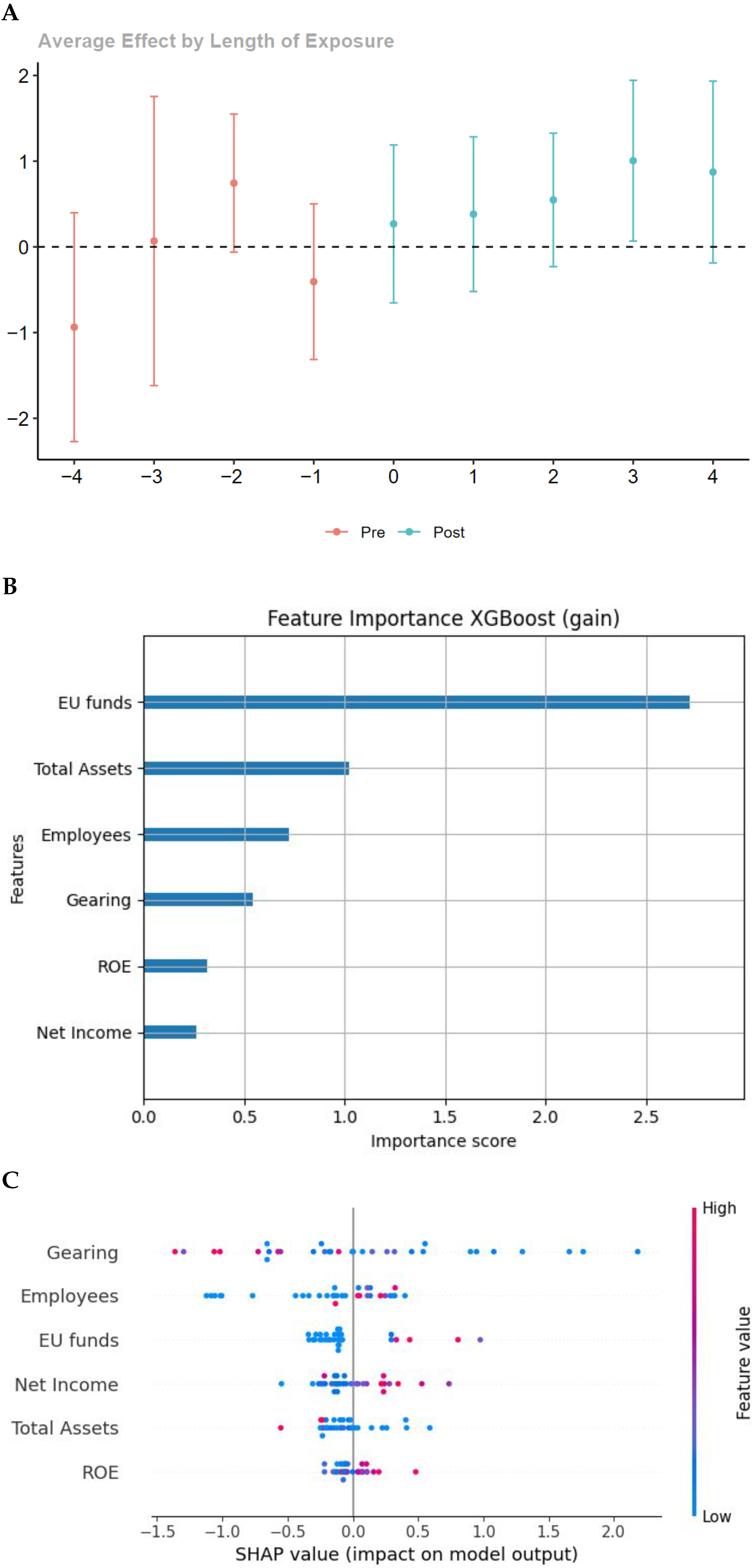
The empirical results provide strong and consistent evidence that EU Cohesion Policy investments aimed at digital innovation significantly stimulate firms’ inventive activity. Treated firms exhibit between 31.7% and 35.4% more patent applications than comparable non-treated firms (see Table 3), confirming that digital-oriented public support effectively catalyzes codified innovation outputs. The continuous two-way fixed effects (CTWFE) estimates further show that a 1% increase in funding intensity corresponds to a 5.1–5.8% increase in patent counts, underscoring the elasticity of innovation with respect to financial support. Moreover, as shown in Figure 2, the estimated coefficients θ dynamic ( e ) for e < 0 (light red lines) are consistently close to zero and statistically insignificant, supporting the validity of the parallel trends assumption prior to the receipt of digital Cohesion Policy funds.
To assess the robustness of our results, we winsorize the data to mitigate the influence of extreme values and outliers. Winsorization is performed by replacing observations below the 2.5th percentile with the 2.5th percentile value and those above the 97.5th percentile with the 97.5th percentile value. The results remain consistent, confirming that our findings are not driven by outlier observations. Furthermore, our results are robust to the inclusion of control variables.
Moreover, the convergence between econometric estimates and machine learning diagnostics (Feature Importance and SHAP analysis) provides robustness to these findings (see Figure 2). The high explanatory power of EU funds across methods confirms that digital policy support constitutes a dominant driver of inventive outcomes, mitigating concerns of model-specific results.
From a policy standpoint, these findings suggest that digital-oriented interventions within Cohesion Policy may succeed in addressing structural bottlenecks to innovation. They appear to enhance absorptive capacity and innovation readiness, key determinants of firms’ ability to translate external knowledge into innovation outputs [60]. This implies that the further strengthening of digital support instruments, such as smart manufacturing subsidies, R&D infrastructure investments, and digital upskilling programs, could accelerate patenting. In turn, such outcomes align with the EU’s objective of achieving technological convergence and reducing innovation disparities across territories.

4.2. Green Innovation

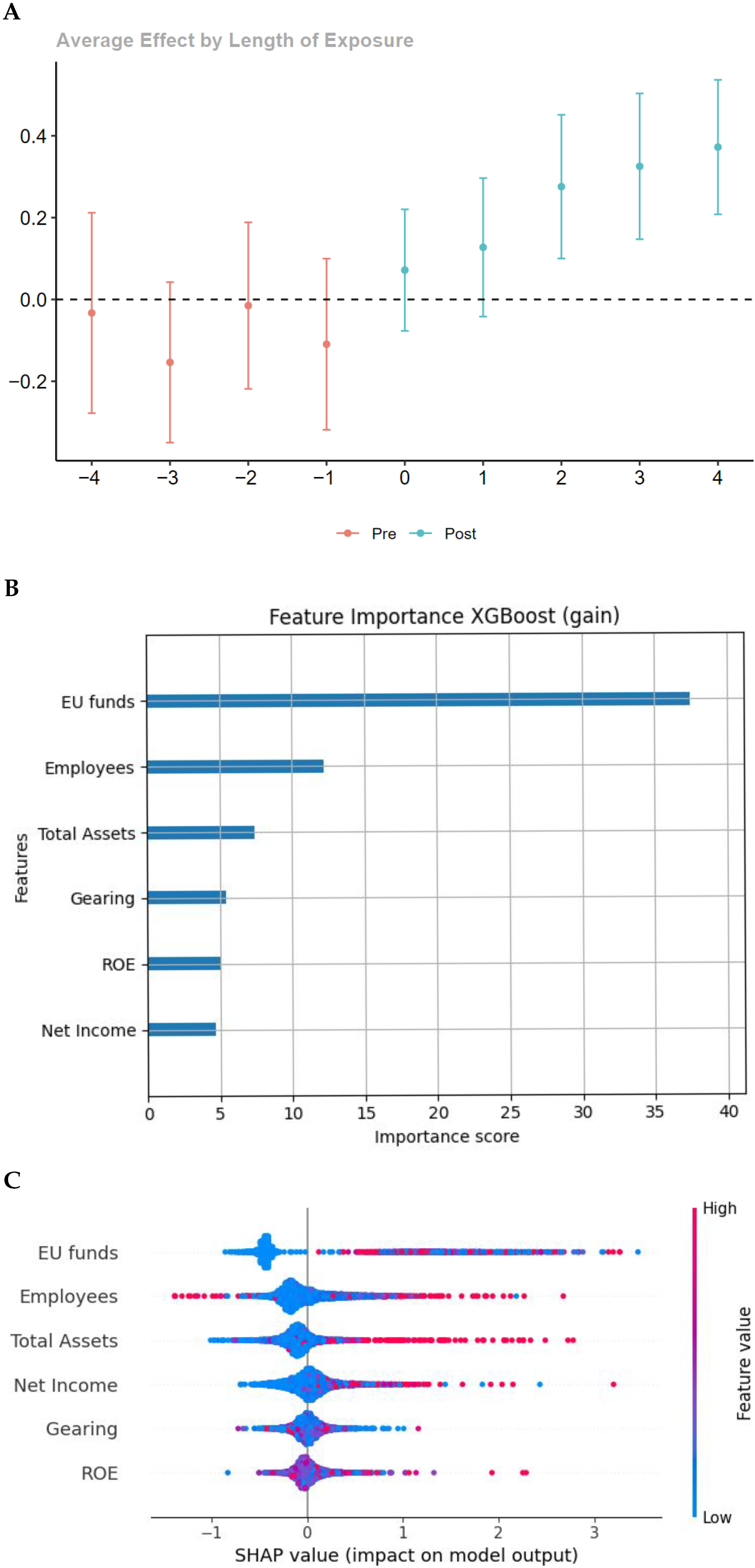
The results for green innovation present a more nuanced picture. Although the estimated coefficients are positive, their statistical significance is weaker and the elasticities considerably smaller (see Table 4). Firms benefiting from low-carbon economy support exhibit only modest increases in patenting, with effects that do not tend to be statistically significant across specifications. This limited responsiveness suggests that green-oriented funding alone is less effective in triggering codified innovation outputs, such as patents, compared with digital-oriented support. In addition, Figure 3 confirms that the pre-treatment coefficients θ dynamic ( e ) for e < 0 are not statistically different from zero, indicating that treated and control firms followed similar innovation trajectories before receiving green funding.
Our results are robust to winsorization of the data and to whether control variables are included or excluded.
Several factors help explain this outcome. First, as widely discussed in the environmental economics literature, green innovation often manifests in non-patentable forms, such as process optimization and energy efficiency measures [61,62]. These forms of innovation, while environmentally valuable, may not produce the types of technological novelties captured by patents.
Second, green R&D typically involves longer development cycles, higher technological uncertainty, and dependency on external regulatory drivers, such as carbon pricing or environmental standards [11,42]. In this context, the absence of strong demand-pull mechanisms—such as guaranteed markets for low-carbon solutions—limits firms’ incentives to pursue high-risk, patentable innovation.
The machine learning diagnostics corroborate this reading: the importance of green funds as predictors of patent growth is substantially lower than that of digital funds, and SHAP values reveal a more heterogeneous response across firms (see Figure 3). This suggests that environmental R&D performance depends on firm-specific capabilities and contextual conditions—such as industrial sector, technological maturity, and access to complementary digital assets.

4.3. Digital and Green Innovation

When digital and green innovation investments are combined, the results show a clear pattern of synergistic and persistent effects on patenting activity. Firms that simultaneously received digital and green funding exhibit a 40.3–46.8% increase in patent applications (see Table 5). The corresponding elasticities (0.045–0.041) are positive and statistically significant across specifications, and the event-study profiles indicate sustained effects over time rather than short-term spikes.
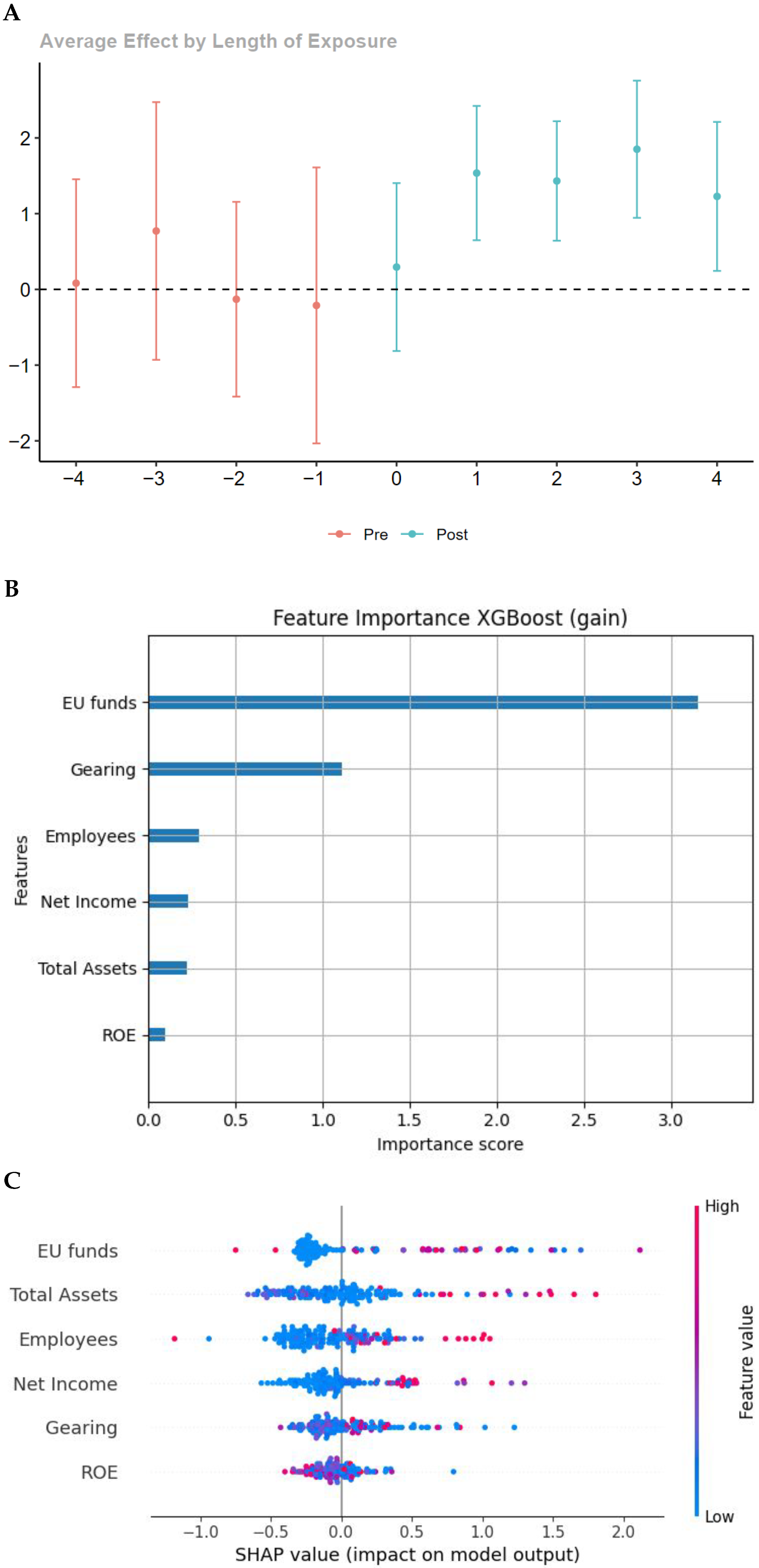
Furthermore, the dynamic treatment effects plotted in Figure 4 reveal no significant differences in patenting trends between treated and control firms before the intervention, as evidenced by the non-significant θ dynamic ( e ) estimates for e < 0 , thereby reinforcing the assumption of parallel pre-treatment trends in the case of twin transition funding.
Our results remain robust to data winsorization and to the inclusion or exclusion of control variables.
This piece of empirical evidence supports recent conceptualizations of the twin transition as a co-evolutionary process [38,44], whereby digitalization serves as a key enabler of environmental transformation, and sustainability imperatives drive demand for new digital applications. It also resonates with Jindra and Leusin (2022) [45], who found that firms investing in “digital sustainability technologies” occupy a growing share of global innovation frontiers, despite still representing a niche segment. This significant patenting response indicates that EU Cohesion Policy can play a catalytic role in scaling up this emerging class of twin innovations.
For policy makers, the implications are profound. The empirical results validate the strategic orientation of the EU’s twin transition agenda, demonstrating that integrated, cross-domain investments yield superior innovation returns compared with siloed interventions. Future programming periods of Cohesion Policy may thus institutionalize joint funding calls that explicitly target projects at the intersection of digital and green domains. Additionally, evaluation frameworks should be adapted to recognize the compound nature of twin innovations, which often involve systemic change across technologies, processes, and business models.

5. Discussion

The higher propensity to patent in response to digital investments may be attributed to the inherent characteristics of digital technologies and the sectoral dynamics in which they operate. Digital technologies, particularly those in ICT, are highly modular and conducive to recombinant innovation, allowing firms to reconfigure existing components into novel applications with relative ease. This combinatorial nature increases the likelihood of generating discrete, codifiable outputs that are well-suited for patent protection [63,64]. Moreover, sectoral heterogeneity in patenting behavior further reinforces this pattern. ICT-related industries consistently exhibit among the highest levels of patenting activity, not only due to their technological dynamism but also because firms in these sectors often use patents strategically—for example, to block competitors, signal technological capabilities, or facilitate licensing and market entry [65,66]. These factors suggest that the observed patent surge is plausibly driven by technological synergy, the structural and strategic features of digital technologies and their industrial context, rather than by institutional leniency in patent examination procedures.
Recent empirical studies consistently show that digital investments tend to raise patenting activity, particularly in digital technology domains. Chen and Wang (2025) [67] find that the 2009 revision of China’s Patent Law significantly increased digital patent output, with the effect being driven by enhanced R&D investment and personnel expansion. Bielig (2023) [68] documents a surge in digital technology patent filings at the European Patent Office, especially in computer and communication technologies, highlighting their strategic importance in innovation portfolios. Montresor and Vezzani (2023) [39], analyzing Italian firms, show that investments in Industry 4.0 technologies—such as AI, the IoT, and 3D printing—substantially increase the likelihood of eco-innovations, often codified through patents, and that bundling multiple digital technologies together amplifies this effect. Benassi et al. (2022) [43] further confirm that firms with larger stocks of 4IR patents, particularly in AI and wireless technologies, experience significant productivity gains. Their study also shows that early and persistent engagement in 4IR patenting enhances these benefits, suggesting that accumulated digital capabilities are key to translating investments into performance and innovation outcomes.
Patenting in green technologies faces structural limitations due to the “double externality” problem—where both environmental and knowledge spillovers reduce private incentives for innovation. Environmental externalities arise because the social benefits of pollution reduction exceed private returns, while knowledge externalities stem from the non-rival and non-excludable nature of innovation, making it difficult for firms to fully appropriate the value of their inventions [69]. This dual market failure implies that patent protection alone may be insufficient or even counterproductive for stimulating green innovation, especially when rapid diffusion is socially desirable but patents restrict access through temporary monopolies [69]. Moreover, the concept of directed technological change shows that without targeted policy interventions—such as subsidies for R&D and taxes on polluting technologies—innovation tends to favor carbon-intensive paths due to their initial productivity advantage [14]. Therefore, firms aiming to develop green innovation do not solely rely on patent applications.
Consistently, Ebrahim (2020) [70] highlights that while patent law offers mechanisms to incentivize clean technology development, such as Eco-Patent Commons and fast-track programs, these are underutilized and have shown limited effectiveness in promoting widespread diffusion. Perrons et al. (2021) [71] provide empirical data showing that clean energy patents are less frequently cited than their dirty counterparts, indicating lower integration into subsequent innovations and possibly reflecting a lower propensity to patent in the clean tech domain. Similarly, Hall and Helmers (2013) [72] provide a detailed analysis of the Eco-Patent Commons, a voluntary initiative where firms pledge environmentally beneficial patents for royalty-free use. Their findings show that the pledged patents represent a limited fraction of the firms’ overall portfolios—often less than 0.1%—and are typically narrower in scope, less cited, and less integrated into subsequent innovation compared with other patents in the same technological class. In addition, this result is also coherent with a vast portion of the literature claiming that innovation policies often require a considerable time lag before producing tangible effects and effective solutions. The process of developing, adopting, and diffusing new technologies—particularly in the green domain—is inherently gradual, as it depends on cumulative learning, technological adaptation, and institutional support mechanisms. Moreover, firms and research actors typically need time to adjust their strategies, reallocate resources, and internalize new policy incentives. Consequently, the full impact of innovation-oriented interventions may only become observable in the medium-to-long term [73,74,75].
Finally, we find that firms are more likely to patent green innovations when green funding is complemented by R&D support. Green subsidies alone are often insufficient to stimulate innovation, as they do not adequately reduce the costs or risks associated with technological development [14,69]. Policy synergies are rather necessary to foster green innovation. Consistent with this view, Scotti et al. (2025) [76] show that within the EU Emissions Trading System (EU ETS), the combination of ETS participation and EU Cohesion Policy or Horizon funding increases environmental patenting—particularly among energy firms—while simultaneously reducing carbon intensity. Our analysis extends this body of evidence by considering a larger sample of firms and employing a more precise identification of beneficiaries of green Cohesion Policy funds. Complementing these results on innovation outputs, Marrocu et al. (2025) [53] find—based on firm-level accounts—that twin transition projects combining digital and green investments generate the strongest and most persistent gains in value added and productivity. Our study adds to this body of performance-based evidence by demonstrating corresponding effects on patent-based measures of green inventive activity.

6. Conclusions

This paper has examined how the European Union’s Cohesion Policy, through its investment in research, innovation, and the low-carbon economy, contributes to the twin transition at the firm level. By combining administrative, financial, and innovation data, we have provided micro-level causal evidence on how digital, green, and integrated digital–green (twin) projects influence firms’ patenting activity—one of the most direct and internationally comparable indicators of inventive performance.
Our results reveal a heterogeneous pattern of policy impacts. Firms receiving support for digitalization projects exhibit a clear and statistically significant increase in patent applications, ranging between 31.7% and 35.4% relative to comparable control firms. In contrast, firms funded under low-carbon economy objectives show no statistically significant increase in patenting activity. Importantly, when firms receive funding for both digital and green projects, the impact on patenting becomes substantially stronger (between 40.3% and 46.8%), confirming the existence of complementary effects between digitalization and environmental innovation.
These findings advance the current debate on directed technical change and policy mix design for sustainability transitions. They demonstrate that the effectiveness of public investment depends not only on its scale but also on its directionality and integration across policy domains. Digitalization appears to act as a powerful enabler of green innovation, enhancing firms’ ability to monitor, optimize, and scale environmentally sustainable solutions. Conversely, isolated green investments—without complementary digital capabilities—may be insufficient to trigger measurable inventive activity. This suggests that public policies may be conceived as part of a coherent system of mutually reinforcing instruments, rather than as discrete funding streams operating in silos.

Policy Implications

Several policy implications emerge from our results.
First, the strong patenting response to combined digital–green funding highlights the importance of integrated policy design. Synergistic investments in digitalization and sustainability amplify innovation outcomes because digital capabilities enhance firms’ ability to absorb, process, and apply knowledge in green domains. Policymakers may, therefore, promote calls for proposals and selection criteria that explicitly foster cross-domain complementarities within both Cohesion Policy and the EU industrial strategy.
Second, the limited patent responsiveness of green-only projects suggests the need for a more balanced and coordinated policy mix. Supporting green innovation requires not only financial resources but also stable regulatory frameworks and complementary measures that reduce uncertainty and encourage firms to transform environmental efforts into patentable and commercially viable outcomes.
Finally, Cohesion Policy plays a strategic role in operationalizing the EU’s twin transition. By channeling resources toward digital and low-carbon priorities, it supports technological upgrading. Its place-based design ensures that the benefits of the twin transition are broadly shared across Europe’s diverse economic landscapes.
In conclusion, our evidence shows that integrated digital–green investments generate the strongest innovation effects. Maintaining and expanding coordinated funding approaches in the 2021–2027 programming period will be crucial to sustaining Europe’s competitiveness and accelerating progress toward sustainable development.

Author Contributions

Conceptualization, G.P. and F.S.; methodology, G.P. and F.S.; software, G.P. and F.S.; validation, G.P. and F.S.; formal analysis, G.P. and F.S.; investigation, G.P. and F.S.; data curation, G.P. and F.S.; writing—original draft preparation, G.P. and F.S.; writing—review and editing, G.P. and F.S.; visualization, G.P. and F.S. All authors have read and agreed to the published version of the manuscript.

Funding

This research study received no external funding.

Institutional Review Board Statement

Not applicable.

Informed Consent Statement

Not applicable.

Data Availability Statement

Dataset available upon request from the authors.

Conflicts of Interest

The authors declare no conflicts of interest.

References

  1. Bachtler, J.; Mendez, C.; Ferry, M. Towards a Green and Digital Transition: The New Cohesion Policy Strategies and Reform Debate; University of Strathclyde: Glasgow, UK, 2022. [Google Scholar]
  2. European Commission. 2022 Strategic Foresight Report: Twinning the Green and Digital Transitions in the New Geopolitical Context; Report; European Commission: Brussels, Belgium, 2022. [Google Scholar]
  3. Burinskienė, A.; Nalivaikė, J. Digital and sustainable (twin) transformations: A case of SMEs in the European Union. Sustainability 2024, 16, 1533. [Google Scholar] [CrossRef]
  4. Rodríguez-Pose, A.; Bartalucci, F. The green transition and its potential territorial discontents. Camb. J. Reg. Econ. Soc. 2024, 17, 339–358. [Google Scholar] [CrossRef]
  5. European Commission. Cohesion Policy: Over €1 Billion from REACT-EU to Support Recovery and the Green and Digital Transition in Italy. Press Release. 2022. Available online: https://ec.europa.eu/commission/presscorner/detail/en/ip_22_1467 (accessed on 16 April 2025).
  6. Monastiriotis, V.; Gamtkitsulashvili, T. Taking the Territorial Dimension of Industrial Policy Seriously: Industrial and Cohesion Policy in the EU; EU Industrial Policy Report 2024. (LUHNIP); Institute for European Analysis and Policy: Rome, Italy, 2024; pp. 104–115. [Google Scholar]
  7. Cui, L.; Mu, Y.; Shen, Z.; Wang, W. Energy transition, trade and green productivity in advanced economies. J. Clean. Prod. 2022, 361, 132288. [Google Scholar] [CrossRef]
  8. Zhang, C.; Zhu, H.; Li, X. Which productivity can promote clean energy transition—total factor productivity or green total factor productivity? J. Environ. Manag. 2024, 366, 121899. [Google Scholar] [CrossRef]
  9. Kharlamov, A.A.; Parry, G. The impact of servitization and digitization on productivity and profitability of the firm: A systematic approach. Prod. Plan. Control 2021, 32, 185–197. [Google Scholar] [CrossRef]
  10. Lastauskaite, A.; Krusinskas, R. Digitalization and productivity: Evidence from EU manufacturing sector. Eur. J. Econ. 2023, 3, 1–12. [Google Scholar] [CrossRef]
  11. Porter, M.E.; van der Linde, C. Toward a new conception of the environment-competitiveness relationship. J. Econ. Perspect. 1995, 9, 97–118. [Google Scholar] [CrossRef]
  12. Costantini, V.; Crespi, F.; Marin, G.; Paglialunga, E. Eco-innovation, sustainable supply chains and environmental performance in European industries. J. Clean. Prod. 2017, 155, 141–154. [Google Scholar] [CrossRef]
  13. Wang, X.; Zhong, X. Digital transformation and green innovation: Firm-level evidence from China. Front. Environ. Sci. 2024, 12, 1389255. [Google Scholar] [CrossRef]
  14. Acemoglu, D.; Aghion, P.; Bursztyn, L.; Hemous, D. The environment and directed technical change. Am. Econ. Rev. 2012, 102, 131–166. [Google Scholar] [CrossRef]
  15. Aghion, P.; Dechezleprêtre, A.; Hemous, D.; Martin, R.; Van Reenen, J. Carbon taxes, path dependency, and directed technical change: Evidence from the auto industry. J. Political Econ. 2016, 124, 1–51. [Google Scholar] [CrossRef]
  16. Popp, D. Induced innovation and energy prices. Am. Econ. Rev. 2002, 92, 160–180. [Google Scholar] [CrossRef]
  17. Grimaud, A.; Rouge, L. Environment, directed technical change and economic policy. Environ. Resour. Econ. 2008, 41, 439–463. [Google Scholar] [CrossRef]
  18. Borghesi, S.; Cainelli, G.; Mazzanti, M. Linking emission trading to environmental innovation: Evidence from the Italian manufacturing industry. Res. Policy 2015, 44, 669–683. [Google Scholar] [CrossRef]
  19. Acemoglu, D.; Akcigit, U.; Hanley, D.; Kerr, W. Transition to clean technology. J. Political Econ. 2016, 124, 52–104. [Google Scholar] [CrossRef]
  20. Greaker, M.; Heggedal, T.R.; Rosendahl, K.E. Environmental policy and the direction of technical change. Scand. J. Econ. 2018, 120, 1100–1138. [Google Scholar] [CrossRef]
  21. Flori, A.; Scotti, F. When the intensity of trading meets compliance requirements: An assessment for firms operating within the EU ETS. Energy Econ. 2025, 147, 108542. [Google Scholar] [CrossRef]
  22. Aghion, P.; Hepburn, C.; Teytelboym, A.; Zenghelis, D. Path dependence, innovation and the economics of climate change. In Handbook on Green Growth; Edward Elgar Publishing: Cheltenham, UK, 2019; pp. 67–83. [Google Scholar]
  23. Popp, D. Environmental policy and innovation: A decade of research. Int. Rev. Environ. Resour. Econ. 2019, 13, 265–337. [Google Scholar] [CrossRef]
  24. Johnstone, N.; Haščič, I.; Popp, D. Renewable energy policies and technological innovation: Evidence based on patent counts. Environ. Resour. Econ. 2010, 45, 133–155. [Google Scholar] [CrossRef]
  25. Costantini, V.; Crespi, F.; Palma, A. Characterizing the policy mix and its impact on eco-innovation: A patent analysis of energy-efficient technologies. Res. Policy 2017, 46, 799–819. [Google Scholar] [CrossRef]
  26. Becker, S.O.; Egger, P.H.; Von Ehrlich, M. Effects of EU regional policy: 1989–2013. Reg. Sci. Urban Econ. 2018, 69, 143–152. [Google Scholar] [CrossRef]
  27. Scotti, F.; Dell’Agostino, L.; Flori, A.; Pammolli, F. Premature exit from and delayed entrance into the less developed status: An empirical appraisal of the structural funds allocation criterion. J. Reg. Sci. 2024, 64, 5–59. [Google Scholar] [CrossRef]
  28. Damioli, G.; Bianchini, S.; Ghisetti, C. The emergence of a ‘twin transition’scientific knowledge base in the European regions. Reg. Stud. 2025, 59, 2355998. [Google Scholar] [CrossRef]
  29. Fazio, G.; Maioli, S.; Rujimora, N. The twin innovation transitions of European regions. Reg. Stud. 2025, 59, 2309176. [Google Scholar] [CrossRef]
  30. Fusillo, F.; Quatraro, F.; Santhià, C. Leveraging on circular economy technologies for recombinant dynamics: Do localised knowledge and digital complementarities matter? Reg. Stud. 2025, 59, 2329255. [Google Scholar] [CrossRef]
  31. Zhang, Y.J.; Du, M. Greening through digitalisation? Evidence from cities in China. Reg. Stud. 2025, 59, 2215824. [Google Scholar] [CrossRef]
  32. Cattani, L.; Montresor, S.; Vezzani, A. Firms’ eco-innovation and Industry 4.0 technologies in urban and rural areas. Reg. Stud. 2025, 59, 2243984. [Google Scholar] [CrossRef]
  33. Castellacci, F.; Santoalha, A. Does digitalisation affect the adoption of electric vehicles? New regional-level evidence from Google Trends data. Reg. Stud. 2025, 59, 2358829. [Google Scholar] [CrossRef]
  34. Brueck, C.; Losacker, S.; Liefner, I. China’s digital and green (twin) transition: Insights from national and regional innovation policies. Reg. Stud. 2025, 59, 2384411. [Google Scholar] [CrossRef]
  35. Bianchini, S.; Damioli, G.; Ghisetti, C. The environmental effects of the “twin” green and digital transition in European regions. Environ. Resour. Econ. 2023, 84, 877–918. [Google Scholar] [CrossRef]
  36. Santoalha, A.; Consoli, D.; Castellacci, F. Digital skills, relatedness and green diversification: A study of European regions. Res. Policy 2021, 50, 104340. [Google Scholar] [CrossRef]
  37. Faggian, A.; Marzucchi, A.; Montresor, S. Regions facing the ‘twin transition’: Combining regional green and digital innovations. Reg. Stud. 2025, 59, 2398555. [Google Scholar] [CrossRef]
  38. Diodato, D.; Huergo, E.; Moncada-Paternò-Castello, P.; Rentocchini, F.; Timmermans, B. Introduction to the special issue on “the twin (digital and green) transition: Handling the economic and social challenges”. Ind. Innov. 2023, 30, 755–765. [Google Scholar] [CrossRef]
  39. Montresor, S.; Vezzani, A. Digital technologies and eco-innovation. Evidence of the twin transition from Italian firms. Ind. Innov. 2023, 30, 766–800. [Google Scholar] [CrossRef]
  40. Kostarakos, I.; Marques, S.A.; Molica, F. Regional Resilience in the Era of Climate Change and Digitalization; European Commission: Seville, Spain, 2025. [Google Scholar]
  41. Muench, S.; Stoermer, E.; Jensen, K.; Asikainen, T.; Salvi, M.; Scapolo, F. Towards a Green and Digital Future; Publications Office of the European Union: Luxembourg, 2022. [Google Scholar]
  42. Barbieri, N.; Marzucchi, A.; Rizzo, U. Green technologies, interdependencies, and policy. J. Environ. Econ. Manag. 2023, 118, 102791. [Google Scholar] [CrossRef]
  43. Benassi, M.; Grinza, E.; Rentocchini, F.; Rondi, L. Patenting in 4IR technologies and firm performance. Ind. Corp. Change 2022, 31, 112–136. [Google Scholar] [CrossRef]
  44. Tabares, S.; Parida, V.; Chirumalla, K. Twin transition in industrial organizations: Conceptualization, implementation framework, and research agenda. Technol. Forecast. Soc. Change 2025, 213, 123995. [Google Scholar] [CrossRef]
  45. Jindra, B.; Leusin, M. The Development of Digital Sustainability Technologies by Top R&D Investors; Publications Office of the European Union: Luxembourg, 2022. [Google Scholar]
  46. Bellucci, A.; Fatica, S.; Georgakaki, A.; Gucciardi, G.; Letout, S.; Pasimeni, F. Venture capital financing and green patenting. Ind. Innov. 2023, 30, 947–983. [Google Scholar] [CrossRef]
  47. Kriesch, L.; Abbasiharofteh, M.; Losacker, S. The geography of digital and green (twin) firms in Germany. Reg. Stud. Reg. Sci. 2025, 12, 513–516. [Google Scholar] [CrossRef]
  48. Antonioli, D.; Ghisetti, C.; Mazzanti, M.; Nicolli, F.; Quatrosi, M. “Twin transition” and HRM practices: Empirical evidence from Italian firms. Ind. Innov. 2025, 1–20. [Google Scholar] [CrossRef]
  49. Cirillo, V.; Fanti, L.; Mina, A.; Ricci, A. New digital technologies and firm performance in the Italian economy. Ind. Innov. 2023, 30, 159–188. [Google Scholar] [CrossRef]
  50. Serafini, L.; Marrocu, E.; Paci, R. Smart strategies, smarter performance: The impact of S3 and industry 4.0 on firms’ outcomes. Ind. Corp. Change 2025, dtaf010. [Google Scholar] [CrossRef]
  51. Thoma, G.; Torrisi, S.; Gambardella, A.; Guellec, D.; Hall, B.H.; Harhoff, D. Harmonizing and Combining Large Datasets—An Application to Firm-Level Patent and Accounting Data; Technical Report; National Bureau of Economic Research: Cambridge, MA, USA, 2010. [Google Scholar]
  52. Tarasconi, G.; Menon, C. Matching Crunchbase with Patent Data; OECD Publishing: Paris, France, 2017. [Google Scholar]
  53. Marrocu, E.; Paci, R.; Serafini, L. Leveraging the Twin Transition: The Impact of Green and Digital Investment on Firms’ Performance. Working Paper CRENoS. 2025. Available online: https://crenos.unica.it/crenos/publications/leveraging-twin-transition-impact-green-and-digital-investment-firms%E2%80%99-performance (accessed on 16 April 2025).
  54. Griliches, Z. Patent Statistics as Economic Indicators: A Survey Part I; NBER: Cambridge, MA, USA, 1990. [Google Scholar]
  55. Meyer, C.B. Building Innovation Capacity. J. Appl. Behav. Sci. 2022, 58, 369–376. [Google Scholar] [CrossRef]
  56. Hausknost, D.; Haas, W. The politics of selection: Towards a transformative model of environmental innovation. Sustainability 2019, 11, 506. [Google Scholar] [CrossRef]
  57. Callaway, B.; Sant’Anna, P.H. Difference-in-differences with multiple time periods. J. Econom. 2021, 225, 200–230. [Google Scholar] [CrossRef]
  58. De Chaisemartin, C.; d’Haultfoeuille, X. Two-way fixed effects estimators with heterogeneous treatment effects. Am. Econ. Rev. 2020, 110, 2964–2996. [Google Scholar] [CrossRef]
  59. Goodman-Bacon, A. Difference-in-differences with variation in treatment timing. J. Econom. 2021, 225, 254–277. [Google Scholar] [CrossRef]
  60. Cohen, W.M.; Levinthal, D.A. Absorptive capacity: A new perspective on learning and innovation. Adm. Sci. Q. 1990, 35, 128–152. [Google Scholar] [CrossRef]
  61. Kemp, R.; Pontoglio, S. The innovation effects of environmental policy instruments—A typical case of the blind men and the elephant? Ecol. Econ. 2011, 72, 28–36. [Google Scholar] [CrossRef]
  62. Costantini, V.; Mazzanti, M. On the green and innovative side of trade competitiveness? The impact of environmental policies and innovation on EU exports. Res. Policy 2012, 41, 132–153. [Google Scholar] [CrossRef]
  63. Sears, J.; Hoetker, G. Technological overlap, technological capabilities, and resource recombination in technological acquisitions. Strateg. Manag. J. 2014, 35, 48–67. [Google Scholar] [CrossRef]
  64. Castaldi, C.; Frenken, K.; Los, B. Related variety, unrelated variety and technological breakthroughs: An analysis of US state-level patenting. In Evolutionary Economic Geography; Routledge: Abingdon, UK, 2017; pp. 63–77. [Google Scholar]
  65. Hall, B.H.; Ziedonis, R.H. The patent paradox revisited: An empirical study of patenting in the US semiconductor industry, 1979–1995. Rand J. Econ. 2001, 32, 101–128. [Google Scholar] [CrossRef]
  66. Neuhäusler, P. The use of patents and informal appropriation mechanisms—Differences between sectors and among companies. Technovation 2012, 32, 681–693. [Google Scholar] [CrossRef]
  67. Chen, L.; Wang, J. Intellectual Property Protection, R&D Investment and Digital Technology Innovation: An Empirical Study Based on the Revision of the Patent Law. Int. Rev. Econ. Financ. 2025, 103, 104320. [Google Scholar]
  68. Bielig, A. The propensity to patent digital technology: Mirroring digitalization processes in Germany with intellectual property in a European perspective. J. Knowl. Econ. 2023, 14, 2057–2080. [Google Scholar] [CrossRef] [PubMed]
  69. Hall, B.H.; Helmers, C. The Role of Patent Protection in (Clean/Green) Technology Transfer; Technical Report; National Bureau of Economic Research: Cambridge, MA, USA, 2010. [Google Scholar]
  70. Ebrahim, T.Y. Clean and sustainable technology innovation. Curr. Opin. Environ. Sustain. 2020, 45, 113–117. [Google Scholar] [CrossRef]
  71. Perrons, R.K.; Jaffe, A.B.; Le, T. Linking scientific research and energy innovation: A comparison of clean and dirty technologies. Energy Res. Soc. Sci. 2021, 78, 102122. [Google Scholar] [CrossRef]
  72. Hall, B.H.; Helmers, C. Innovation and diffusion of clean/green technology: Can patent commons help? J. Environ. Econ. Manag. 2013, 66, 33–51. [Google Scholar] [CrossRef]
  73. Courvisanos, J. Political aspects of innovation. Res. Policy 2009, 38, 1117–1124. [Google Scholar] [CrossRef]
  74. Weber, K.M.; Rohracher, H. Legitimizing research, technology and innovation policies for transformative change: Combining insights from innovation systems and multi-level perspective in a comprehensive ‘failures’ framework. Res. Policy 2012, 41, 1037–1047. [Google Scholar] [CrossRef]
  75. Prettner, K.; Werner, K. Why it pays off to pay us well: The impact of basic research on economic growth and welfare. Res. Policy 2016, 45, 1075–1090. [Google Scholar] [CrossRef]
  76. Scotti, F.; Flori, A.; Crescenzi, R.; Pammolli, F. Demand-pull and technology-push environmental innovation: A policy mix analysis on EU ETS and EU cohesion policy. Clim. Policy 2025, 25, 153–170. [Google Scholar] [CrossRef]
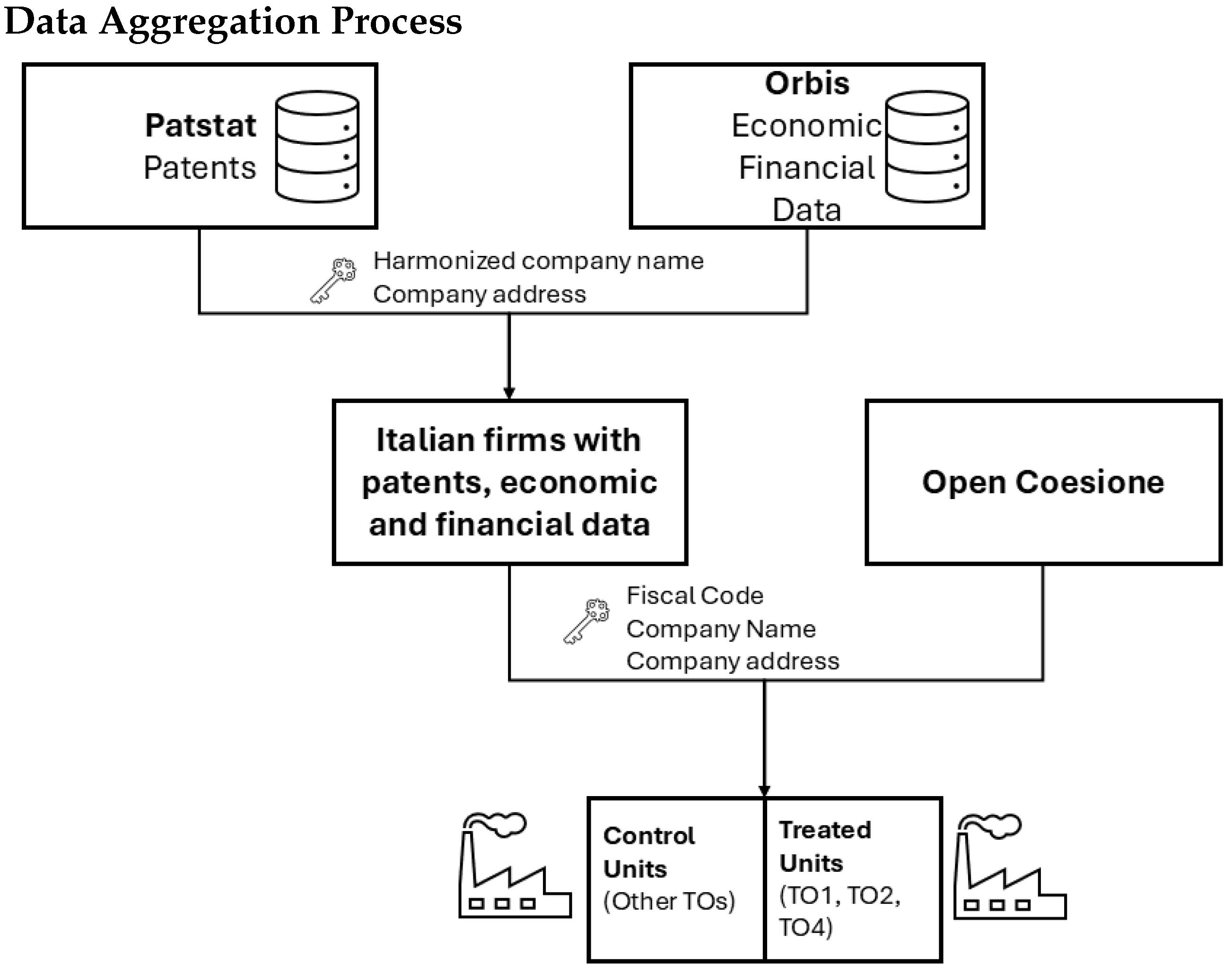
Figure 1. Data aggregation process.
Sustainability 17 10446 g001
Figure 2. (A) Dynamic impact of EU Cohesion Policy funds on digital innovation. (B) Feature Importance based on XG Boost. (C) SHAP value based on XG Boost. The analyzed firms received EU Cohesion Policy funds fostering digital innovation.
Sustainability 17 10446 g002
Figure 3. (A) Dynamic impact of EU Cohesion Policy funds on green innovation. (B) Feature Importance based on XG Boost. (C) SHAP value based on XG Boost. The analyzed firms received EU Cohesion Policy funds fostering green innovation.
Sustainability 17 10446 g003
Figure 4. (A) Dynamic impact of EU Cohesion Policy funds on digital and green innovation. (B) Feature Importance based on XG Boost. (C) SHAP value based on XG Boost. The analyzed firms received EU Cohesion Policy funds fostering digital and green innovation.
Sustainability 17 10446 g004
Table 1. Descriptive statistics.
Q1MeanMedianQ3Sd
Dependent Variable
Patents (Digital)06.69932567.975
Patents (Green)04.96221237.391
Patents (Mix)07.19252172.291
Explanatory Variable
EU Cohesion Policy Funds (Digital)0220,434.980110,862.1841,296,582.3852,159,714.600
EU Cohesion Policy Funds (Green)0163,821.162832,719932,719.2712,101,691.582
EU Cohesion Policy Funds (Mix)0229,193.803187,201.951364,819.0182,182,439.539
Other Control Variables
Total Assets1,090,79861,996,516.0003,268,8469,794,335.0001,681,537,561.000
Total Debt03,211,087.000113,747818,261.20051,959,496.000
Roe4.07018.85213.79031.22041.736
Gearing36.950169.02198.420226.045192.362
Production value1,020,192.00039,605,905.0002,994,8709,187,352.0001,022,896,721.000
Table 2. Comparison of control variables by treatment group.
Treated: Digital Innovation
VariableMean TreatedMean Controlsp-Value
Total Assets61,500,00062,500,0000.62
Total Debt3,200,0003,250,0000.69
Roe19.218.70.44
Gearing170.1165.30.50
Production Value39,000,00040,500,0000.16
EU Cohesion Policy Funds220,434.980225,000.0000.59
Treated: Green Innovation
VariableMean TreatedMean Controlsp-Value
Total Assets58,000,00060,000,0000.63
Total Debt3,100,0003,300,0000.71
Roe18.519.00.46
Gearing160.0175.00.52
Production Value37,000,00039,500,0000.18
EU Cohesion Policy Funds163,821.162168,000.0000.61
Treated: Mix Innovation
VariableMean TreatedMean Controlsp-Value
Total Assets64,000,00066,000,0000.60
Total Debt3,350,0003,450,0000.67
Roe19.118.60.42
Gearing172.0168.00.49
Production Value41,000,00043,000,0000.15
EU Cohesion Policy Funds229,193.803234,000.0000.58
Table 3. The impact of EU Cohesion Policy funds on digital innovation. Figures in brackets represent standard errors.
CSCTWFE
(1)(2)(3)(4)(5)(6)
Digital Innovation
EU Funds0.354 ***0.317 ***0.338 ***0.058 ***0.051 ***0.055 ***
(0.082)(0.078)(0.079)(0.013)(0.011)(0.011)
Firms’ controls
Winsorization
Note: The table displays the relationship between digital innovation and EU Cohesion Policy funds. Columns 1-2-3 display results for our panel event study (coefficient θ a g g r e g a t e , Equation (3)), where the main explanatory variable is a dummy variable indicating receipt of EU Cohesion Policy funds. Columns 4-5-6, by contrast, present results for CTWFE (coefficient β , Equation (4)), with the main explanatory variable being the total amount of EU Cohesion Policy funds obtained by the firm. Significance levels are indicated by *** (p < 0.01), ** (p < 0.05), and (* p < 0.1).
Table 4. The impact of EU Cohesion Policy funds on green innovation. Figures in brackets represent standard errors.
CSCTWFE
(1)(2)(3)(4)(5)(6)
Green Innovation
EU Funds0.551 *0.4080.4530.0360.0340.031
(0.294)(0.286)(0.291)(0.042)(0.038)(0.036)
Firms’ controls
Winsorization
Note: The table displays the relationship between green innovation and EU Cohesion Policy funds. Columns 1-2-3 display results for our panel event study (coefficient θ a g g r e g a t e , Equation (3)), where the main explanatory variable is a dummy variable indicating receipt of EU Cohesion Policy funds. Columns 4-5-6, by contrast, present results for CTWFE (coefficient β , Equation (4)), with the main explanatory variable being the total amount of EU Cohesion Policy funds obtained by the firm. Significance levels are indicated by *** (p < 0.01), ** (p < 0.05), and * (p < 0.1).
Table 5. The impact of EU Cohesion Policy funds on digital and green innovation. Figures in brackets represent standard errors.
CSCTWFE
(1)(2)(3)(4)(5)(6)
Digital and Green Innovation
EU Funds0.468 ***0.403 **0.421 **0.045 **0.041 **0.042 **
(0.194)(0.188)(0.191)(0.021)(0.019)(0.020)
Firms’ controls
Winsorization
Note: The table displays the relationship between digital and green innovation and EU Cohesion Policy funds. Columns 1-2-3 display results for our panel event study (coefficient θ a g g r e g a t e , Equation (3)), where the main explanatory variable is a dummy variable indicating receipt of EU Cohesion Policy funds. Columns 4-5-6, by contrast, present results for CTWFE (coefficient β , Equation (4)), with the main explanatory variable being the total amount of EU Cohesion Policy funds obtained by the firm. Significance levels are indicated as *** (p < 0.01), ** (p < 0.05), * (p < 0.1).
Disclaimer/Publisher’s Note: The statements, opinions and data contained in all publications are solely those of the individual author(s) and contributor(s) and not of MDPI and/or the editor(s). MDPI and/or the editor(s) disclaim responsibility for any injury to people or property resulting from any ideas, methods, instructions or products referred to in the content.