The Impact of Market-Oriented Carbon Regulation on the High-Quality Development of the Manufacturing Industry—Based on Double Machine Learning


Abstract
1. Introduction
2. Literature Review
3. Theoretical Mechanisms
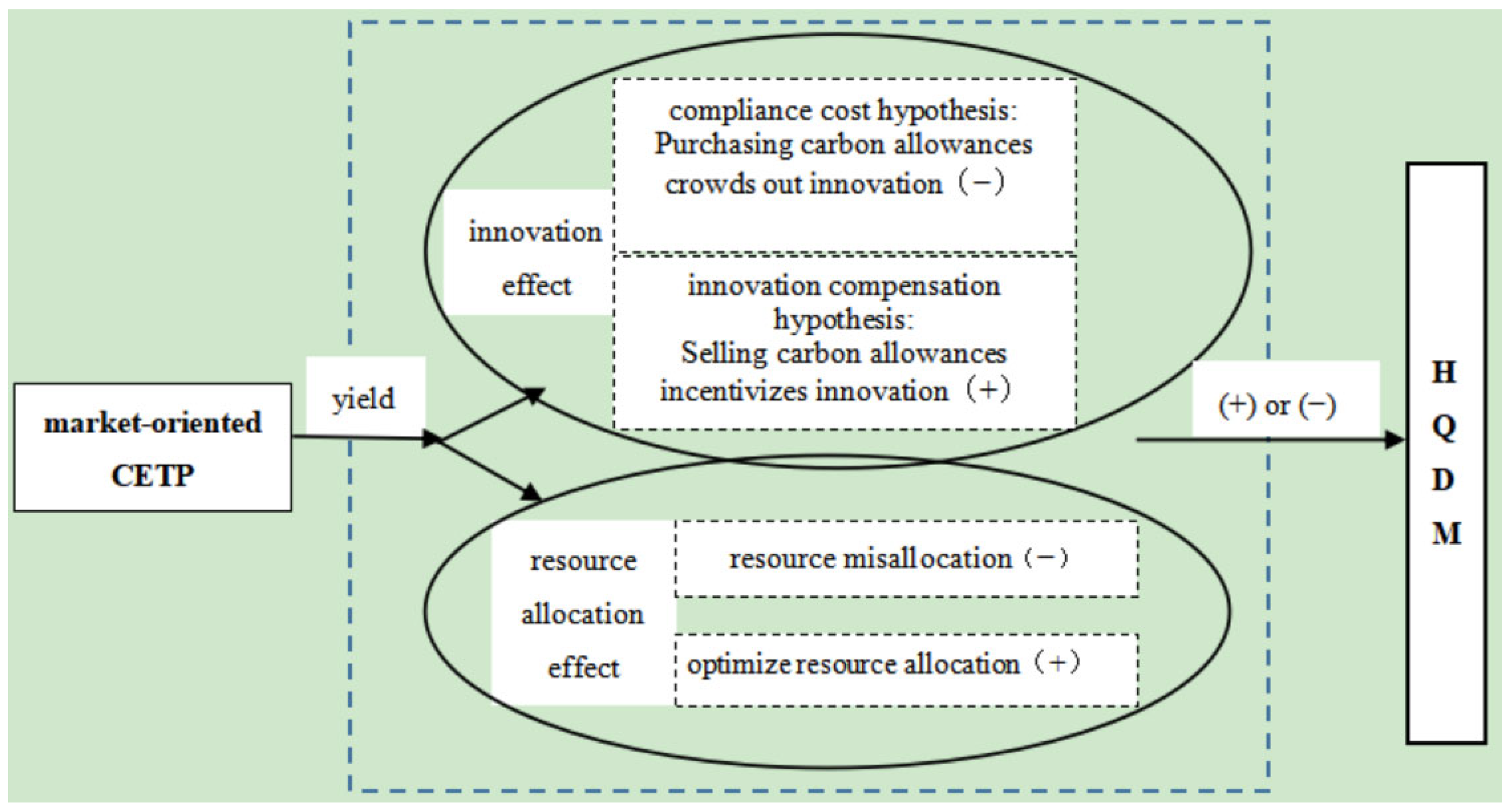
3.1. Innovation Effect
3.2. Resource Allocation Effect
4. Research Design
4.1. Policy Background, Variables, and Data
4.2. Research Methods
4.3. Variable Selection
- (1)
- Dependent Variable
- (2)
- Control Variables
5. Empirical Results
5.1. Baseline Results
5.2. Robustness Analysis
5.2.1. Sample Selection
- (1)
- Winsorization
- (2)
- Exclusion of Municipalities
5.2.2. Replacing the Estimation Method of the Dependent Variable
5.2.3. Resetting the DML Model
- (1)
- Adjusting the Sample Split Ratio
- (2)
- Replacing the Machine Learning Algorithm: Stacked Regression
- (3)
- Replacing the Machine Learning Model: Interaction Model
5.3. Further Analysis Based on Impact Mechanisms and Heterogeneity
5.3.1. Analysis of Impact Mechanisms
- (1)
- Innovation Effect
- (2)
- Resource Allocation Effect
5.3.2. Analysis of Heterogeneity
- (1)
- Location Conditions
- (2)
- Firm Ownership
- (3)
- Factor Intensity
6. Conclusions, Policy Implications, and Discussion
6.1. Conclusions
6.2. Policy Implications
- (1)
- Efforts should be made to accelerate the market-oriented transformation of carbon regulation. Given that the study findings of this paper indicate that the CETP significantly promotes the HQDM, it is necessary to make efforts to accelerate carbon regulation’s transformation from a purely “command-driven” model to a dual model with both “command-driven” and “market-oriented” characteristics, thereby enabling the market to fully exert its decisive role in carbon emission reduction, and lay a more solid institutional foundation for promoting sustainable development.
- (2)
- Carbon markets should be improved and perfected to achieve the optimal allocation of resources. Analysis of the impact mechanism reveals that the resource allocation effect of carbon markets has not yet emerged. This may be because the mechanisms of carbon markets in pilot regions are not yet well-established and have limited coverage, which in turn leads to insufficient liquidity in carbon markets and inadequate trading of carbon allowances. Thus, efforts should be made to further establish and improve carbon market trading mechanisms and supporting systems, and expand the carbon market’s coverage to include more industries and participants, while at the same time providing institutional support to promote the full flow of resources, thereby facilitating the optimal allocation of resources.
- (3)
- Differentiated policies for carbon emission rights trading should be formulated based on enterprise attributes and in light of local conditions. Heterogeneity analysis indicates that the impact of these policies is constrained by enterprise heterogeneity. The efficiency of carbon emission reduction is closely associated with the economic capacity required for low-carbon transformation and the technological characteristics of enterprises. Therefore, it is necessary to formulate differentiated carbon allowance standards for enterprises in different regions and with different attributes. For instance, for the central regions, efforts should be made to strike a balance between the carbon constraints brought by carbon trading policies and the local economic development level, with an appropriate increase in carbon allowances.
6.3. Discussion
Author Contributions
Funding
Institutional Review Board Statement
Informed Consent Statement
Data Availability Statement
Conflicts of Interest
References
- Hu, J.; Huang, N.; Shen, H.T. Can Market-Incentive Environmental Regulation Promote Corporate Innovation? A Natural Experiment Based on China’s Carbon Emissions Trading Mechanism. J. Financ. Res. 2020, 475, 171–189. [Google Scholar]
- Wang, B.B.; Qi, S.Z. The Effect of Market-Oriented and Command-and-Control Policy Tools on Emissions Reduction Innovation—An Empirical Analysis Based on China’s Industrial Patents Data. China Ind. Econ. 2016, 6, 91–108. [Google Scholar]
- Wu, Y.Y.; Qi, J.; Xian, Q.; Chen, J.D. The Carbon Emission Reduction Effect of China’s Carbon Market—From the Perspective of the Coordination between Market Mechanism and Administrative Intervention. China Ind. Econ. 2021, 8, 114–132. [Google Scholar]
- Hu, J.; Fang, Q.; Long, W.B. Carbon Emission Regulation, Corporate Emission Reduction Incentive and Total Factor Productivity: A Natural Experiment Based on China’s Carbon Emission Trading System. Econ. Res. J. 2023, 58, 77–94. [Google Scholar]
- Sun, X.H.; Zhang, J.N.; Li, J.X. Market-based Environmental Regulation and the Path of Transformation and Upgrading of Manufacturing Enterprises: Microscopic Evidence from Emissions Trading. J. Quant. Tech. Econ. 2024, 41, 90–109. [Google Scholar]
- Ren, S.G.; Zheng, J.J.; Liu, D.H.; Chen, X.H. Does Emissions Trading System Improve Firm’s Total Factor Productivity—Evidence from Chinese Listed Companies. China Ind. Econ. 2019, 5, 5–23. [Google Scholar]
- Gu, J.J.; Zhao, Y.L. China’s Overseas R&D Investment and Green High-quality Development in China’s Manufacturing. J. Quant. Tech. Econ. 2020, 37, 41–61. [Google Scholar]
- Liu, J.K.; Xiao, Y.Y. China’s Environmental Protection Tax and Green Innovation: Incentive Effect or Crowding-out Effect? Econ. Res. J. 2022, 57, 72–88. [Google Scholar]
- Gan, X.Q.; Xu, Q.F.; Yuan, Y.J. Green Transformation Policy of Regional Industries, Fiscal Pressure and Low-Carbon Development of Urban Manufacturing. Public Financ. Res. 2022, 9, 104–119. [Google Scholar]
- Gugler, K.; Szücs, F.; Wiedenhofer, T. Environmental Policies and directed technological change. J. Environ. Econ. Manag. 2024, 124, 102916. [Google Scholar] [CrossRef]
- Wang, H.F.; Bai, X.J.; Li, X. Environmental Regulation, Uncertainty and Short-term Investment Bias of Firms: A Comparative Analysis based on Heterogeneity of Environmental Regulation Tools. Financ. Trade Res. 2018, 29, 80–93. [Google Scholar]
- Zhang, A.M.; Li, X.B.; Jin, J.; Wu, W.H.; Yang, X.N. Environmental Regulation, Agency Cost and Corporate Performance—Empirical Evidence from Listed Companies in the Chemical Industry. Account. Res. 2021, 8, 83–93. [Google Scholar]
- Acemoglu, D.; Aghion, P.; Bursztyn, L. The Environment and Directed Technical Change. Am. Econ. Rev. 2012, 102, 131–166. [Google Scholar] [CrossRef] [PubMed]
- Broadstock, D.C.; Fouquet, R.; Kim, J.W. Carbon pricing and stock performance: Are carbon prices already more influential than energy prices? Energy Policy 2025, 206, 114775. [Google Scholar] [CrossRef]
- Liu, K.H.; Tong, J.D.; Shen, Y.R. Can Market-oriented Low-carbon Policies Promote Enterprise Exports—Evidence from Carbon Emission Trading Policies. J. Int. Trade 2023, 9, 88–105. [Google Scholar]
- Yu, D.F.; Jiang, Y.H.; Zhang, Z.W. The Innovation Spillover Effect of China’s Carbon Emissions Trading Pilot Policy: Evidence from Production Networks. J. Quant. Tech. Econ. 2023, 40, 28–49. [Google Scholar]
- Fan, Y.; Wu, J.; Xia, Y. How will a nationwide carbon market affect regional economies and efficiency of CO2 emission reduction in China? China Econ. Rev. 2016, 38, 151–166. [Google Scholar] [CrossRef]
- Xu, W.L.; Sun, L. Market-Incentive Environmental Regulation and Energy Consumption Structure Transformation. J. Quant. Tech. Econ. 2023, 40, 133–155. [Google Scholar]
- Iannucci, G.; Tampieri, A. The persistence of environmental and social strategies under emission permits. Energy Econ. 2024, 138, 107824. [Google Scholar] [CrossRef]
- Vakili, S.; Manias, P.; Armstrong, L.-M.; Turnock, S.; Teagle, D.A.H. Technical, economic, and environmental assessment of CO2 ship transport in carbon capture and storage. J. Environ. Manag. 2025, 373, 123919. [Google Scholar] [CrossRef]
- Marin, G.; Marino, M.; Pellegrin, C. The Impact of the European Emission Trading Scheme on Multiple Measures of Economic Performance. Environ. Resour. Econ. 2018, 71, 551–582. [Google Scholar] [CrossRef]
- Oladapo, B.I.; Olawumi, M.A.; Omigbodun, F.T. Renewable Energy Credits Transforming Market Dynamics. Sustainability 2024, 16, 8602. [Google Scholar] [CrossRef]
- Nong, D.; Nguyen, T.H.; Wang, C.; Van Khuc, Q. The environmental and economic impact of the emissions trading scheme (ETS) in Vietnam. Energy Policy 2020, 140, 111362. [Google Scholar] [CrossRef]
- Tran, T.M.; Siriwardana, M.; Meng, S.; Nong, D. Impact of an emissions trading scheme on Australian households: A computable general equilibrium analysis. J. Clean. Prod. 2019, 221, 439–456. [Google Scholar] [CrossRef]
- Dewaelheyns, N.; Schoubben, F.; Struyfs, K.; Van Hulle, C. The influence of carbon risk on firm value: Evidence from the European Union Emission Trading Scheme. J. Environ. Manag. 2023, 344, 118293. [Google Scholar] [CrossRef]
- Jia, Z.J.; Lin, B.Q.; Wen, S.Y. Carbon Trading Pilots and Total Factor Productivity—With Discussions on Porter Hypothesis, Technology Diffusion and Pollution Paradise. Econ. Perspect. 2023, 3, 66–86. [Google Scholar]
- Xiao, R.Q.; Chen, X.T.; Qian, L. Heterogeneous Environmental Regulation, Government Support and Enterprises’ Green Innovation Efficiency: From the Perspective of Two-stage Value Chain. Financ. Trade Res. 2022, 33, 79–93. [Google Scholar]
- Xu, Y.K.; Qi, Y. Re-evaluate the Impact of Environmental Regulation on Enterprise Productivity and Its Mechanism. Financ. Trade Econ. 2017, 38, 147–161. [Google Scholar]
- Yu, Y.Z.; Zhang, H.L.; Zhang, P.D. The Research of the Yardstick Phenomenon and Mechanisms of Asymmetric Environmental Regulation. Manag. World 2021, 37, 134–146. [Google Scholar]
- Yang, M.; Wang, E.Z.; Ye, C.S. Environmental Management System Certification and Chinese Manufacturing Enterprises’ Export. China Ind. Econ. 2022, 8, 155–173. [Google Scholar]
- Chen, H.; Guo, W.; Feng, X. The impact of low-carbon city pilot policy on the total factor productivity of listed enterprises in China. Resour. Conserv. Recycl. 2021, 169, 105457. [Google Scholar] [CrossRef]
- Wang, Z.J.; Wang, H. Low-Carbon City Pilot Policy and High Quality Development of Enterprises: From the Perspective of Economic Efficiency and Social Benefit. Econ. Manag. J. 2022, 44, 43–62. [Google Scholar]
- Chernozhukov, V.; Chetverikov, D.; Demirer, M. Double/debiased machine learning for treatment and structural parameters. Econom. J. 2018, 21, C1–C68. [Google Scholar] [CrossRef]
- Yang, J.; Chuang, H.; Kuan, C. Double machine learning with gradient boosting and its application to the Big N audit quality effect. J. Econom. 2020, 216, 268–283. [Google Scholar] [CrossRef]
- Zhang, T.; Li, J.C. Network Infrastructure, Inclusive Green Growth, and Regional Inequality: From Causal Inference Based on Double Machine Learning. J. Quant. Tech. Econ. 2023, 40, 113–135. [Google Scholar]
- Zhang, Y.; Li, H.; Ren, G. Quantifying the social impacts of the London Night Tube with a double/debiased machine learning based difference-in-differences approach. Transp. Res. Part A Policy Pract. 2022, 163, 288–303. [Google Scholar] [CrossRef]
- Bodory, H.; Huber, M.; Lafférs, L. Evaluating (weighted) dynamic treatment effects by double machine learning. Econom. J. 2022, 25, 628–648. [Google Scholar] [CrossRef]
- Farbmacher, H.; Huber, M.; Lafférs, L. Causal mediation analysis with double machine learning. Econom. J. 2022, 25, 277–300. [Google Scholar] [CrossRef]
- Wang, R.T.; Peng, F.P.; Li, W.; Wang, C.L. Does Terminating Rigid Payment Diminish Financing Cost of Companies? Manag. World 2022, 38, 42–56. [Google Scholar]
- Fan, X.; Liu, W. Total Factor Productivity Revisited: Based on the Perspective of Political Economy. Soc. Sci. China 2023, 2, 4–24+204. [Google Scholar]
- Bu, M.; Qiao, Z.; Liu, B. Voluntary environmental regulation and firm innovation in China. Econ. Model. 2019, 89, 10–18. [Google Scholar] [CrossRef]
- Clarkson, P.M.; Li, Y.; Pinnuck, M. The Valuation Relevance of Greenhouse Gas Emissions under the European Union Carbon Emissions Trading Scheme. Eur. Account. Rev. 2015, 24, 551–580. [Google Scholar] [CrossRef]
- Albrizio, S.; Kózluk, T.; Zipperer, V. Environmental policies and productivity growth: Evidence across industries and firms. J. Environ. Econ. Manag. 2017, 81, 209–226. [Google Scholar] [CrossRef]
- Robinson, P.M. Root-N-Consistent Semiparametric Regression. Econometrica 1988, 56, 931–954. [Google Scholar] [CrossRef]
- Niu, H.; Yan, C.L. Environmental Tax, Resource Allocation and High-quality Economic Development. J. World Econ. 2021, 44, 28–50. [Google Scholar]
- Huang, B.; Li, H.T.; Liu, J.Q.; Lei, J.H. Digital Technology Innovation and The High-quality Development of Chinese Enterprises: Evidence from Enterprise’s Digital Patents. Econ. Res. J. 2023, 58, 97–115. [Google Scholar]
- Wang, H.C.; Zhang, W.H.; Xia, Z.Y. Scale Preference in Industry and Firm’s TFP: Evidence from Five-year Plan Texts of Local Governments. Econ. Res. J. 2023, 58, 153–171. [Google Scholar]
- Zhao, T.; Zhang, Z.; Liang, S.K. Digital Economy, Entrepreneurship, and High-Quality Economic Development: Empirical Evidence from Urban China. Manag. World 2020, 36, 65–76. [Google Scholar]
- Chen, S.Y.; Chen, D.K. Air Pollution, Government Regulations and High-quality Economic Development. Econ. Res. J. 2018, 53, 20–34. [Google Scholar]
- Yu, Y.Z.; Liu, D.Y.; Gong, Y. Target of Local Economic Growth and Total Factor Productivity. Manag. World 2019, 35, 26–42. [Google Scholar]
- Zhou, L.; Tang, L. Environmental regulation and the growth of the total-factor carbon productivity of China’s industries: Evidence from the implementation of action plan of air pollution prevention and control. J. Environ. Manag. 2021, 296, 113078. [Google Scholar] [CrossRef] [PubMed]
- Fang, J.X. Ownership, Marketization Process and Capital Allocation Efficiency. Manag. World 2007, 1, 27–35. [Google Scholar]
- Qi, S.Z.; Lin, S.; Cui, J.B. Do Environmental Rights Trading Schemes Induce Green Innovation? Evidence from Listed Firms in China. Econ. Res. J. 2018, 53, 129–143. [Google Scholar]
- Shen, X.B.; Chen, Y.; Lin, B.Q. The Impacts of Technological Progress and Industrial Structure Distortion on China’s Energy Intensity. Econ. Res. J. 2021, 56, 157–173. [Google Scholar]


| Variable Type | Variable Symbol | Variable Name | Variable Definition | ||
|---|---|---|---|---|---|
| Dependent Variable | TFP | Total Factor Productivity | Total factor productivity estimated by the LP method | ||
| Explanatory Variable | Tctrade | Pilot Policy of Carbon Emission Rights Trading | Dummy variable | ||
| Control Variables | Enterprise-level | Enterprise Characteristics | Age | Listing Years | Current year—Listing year |
| Size | Firm Size | Total assets | |||
| Soe | Ownership | State-owned enterprise = 1; Non-state-owned enterprise = 0 | |||
| Export | Export Status | Exporting enterprise = 1; Non-exporting enterprise = 0 | |||
| Board | Board Size | Number of board directors | |||
| dep | Independent Director Ratio | Number of independent directors/Total number of directors | |||
| Toph | Ownership Concentration | Shareholding ratio of the largest shareholder | |||
| Enterprise Financial Status | Rate | Asset-Liability Ratio | Total liabilities/Total assets | ||
| Kl | Capital Intensity | Net fixed assets/ Number of employees | |||
| Flow | Enterprise Liquidity | Net cash flow from operating activities/Total assets | |||
| Profit | Return on Assets | Net profit/Total assets | |||
| Grow | Enterprise Growth | growth rate of net assets | |||
| Mva | Market Value | Total market value/Total assets | |||
| Inv | Enterprise Investment | Investment in fixed assets, intangible assets, and other long-term assets | |||
| City-level | Regional Development Status | Gdp | Economic Development Level | GDP/Total population | |
| Urb | Urbanization Level | Urbanization rate | |||
| Stru | Industrial Structure | Added value of the secondary industry/Added value of the tertiary industry | |||
| Pde | Population Density | Population per unit area | |||
| Wage | Income Level | Per capita wage | |||
| Road | Transportation Infrastructure | Highway mileage/ Total population | |||
| Int | Internet Penetration | Number of Internet users | |||
| Government Behavior | Gov | Government Expenditure | Fiscal expenditure/GDP | ||
| Fdi | Foreign Capital Utilization | utilized foreign direct investment/GDP | |||
| Fdp | Fiscal Decentralization | Budgetary fiscal revenue/Budgetary fiscal expenditure | |||
| RD | Government R&D Input | Per capita government fiscal expenditure on R&D | |||
| Exp | Education Input | Fiscal education expenditure/GDP | |||
| Nsoe | SOE Reform | Number of urban private and individual employees/ Total number of employees | |||
| Market Environment | Mkt | Marketization Level | Marketization Index of Chinese Provinces | ||
| Open | Degree of Opening-up | export trade volume/GDP | |||
| Fin | Financial Development Level | Balance of deposits and loans of financial institutions/GDP | |||
| Variable Type | Variable Symbol | Number of Observations | Mean | Standard Deviation | Min | Max | ||
|---|---|---|---|---|---|---|---|---|
| Dependent Variable | TFP | 7503 | 11.42 | 0.90 | 7.85 | 14.84 | ||
| Explanatory Variable | Tctrade | 7675 | 0.15 | 0.35 | 0 | 1 | ||
| Control Variables | Enterprise -level | Enterprise Characteristics | Age | 7675 | 25.79 | 2.95 | 20 | 32 |
| Size | 7675 | 126.76 | 343.09 | 1.26 | 9194.15 | |||
| Soe | 7675 | 0.71 | 0.45 | 0 | 1 | |||
| Export | 7675 | 0.03 | 0.17 | 0 | 1 | |||
| Board | 7675 | 9.17 | 1.86 | 0 | 18 | |||
| dep | 7675 | 0.363 | 0.058 | 0.00 | 0.80 | |||
| Toph | 7675 | 36.617 | 15.435 | 3.39 | 89.99 | |||
| Enterprise Financial Status | Rate | 7675 | 0.48 | 0.18 | −0.09 | 1.00 | ||
| Kl | 7675 | 1.90 | 2.58 | 0.17 | 80.47 | |||
| Flow | 7675 | 0.04 | 0.07 | −0.47 | 0.48 | |||
| Profit | 7675 | 0.03 | 0.05 | −0.53 | 0.40 | |||
| Grow | 7675 | 0.06 | 0.36 | −1.27 | 10.35 | |||
| Mva | 7675 | 203.88 | 579.54 | 4.58 | 25,564.3 | |||
| Inv | 7675 | 2.48 | 7.77 | 0 | 146.18 | |||
| City -level | Regional Development Status | Gdp | 7656 | 2.24 | 1.11 | 0.25 | 5.27 | |
| Urb | 7616 | 0.66 | 0.19 | 0.11 | 1.00 | |||
| Stru | 7669 | 1.09 | 0.78 | 0.19 | 32.12 | |||
| Pde | 7656 | 1131.60 | 1318.70 | 15.67 | 8854.08 | |||
| Wage | 7656 | 5.68 | 3.68 | 0.00 | 19.77 | |||
| Road | 7342 | 20.46 | 15.32 | 1.15 | 357.90 | |||
| Int | 7656 | 273.46 | 522.29 | 0.06 | 9114.00 | |||
| Government Behavior | Gov | 7675 | 0.14 | 0.05 | 0.04 | 0.57 | ||
| Fdi | 7249 | 0.03 | 0.03 | 0.00 | 0.39 | |||
| Fdp | 7656 | 0.69 | 0.21 | 0.03 | 1.54 | |||
| RD | 7656 | 0.15 | 0.11 | 0.00 | 0.69 | |||
| Exp | 7656 | 0.02 | 0.01 | 0.00 | 0.13 | |||
| Nsoe | 7628 | 0.39 | 0.17 | 0.018 | 0.99 | |||
| Market Environment | Mkt | 7675 | 9.20 | 19.53 | 2.47 | 422.00 | ||
| Open | 7468 | 4.09 | 8.26 | 0.03 | 80.17 | |||
| Fin | 7656 | 1.36 | 0.71 | 0.11 | 7.45 | |||
| Variable | TFP | |
|---|---|---|
| (1) | (2) | |
| Tctrade | 0.153 *** (0.033) | 0.097 *** (0.034) |
| Control Variable First-order Term | Yes | Yes |
| Control Variables Interaction and Quadratic Terms | No | Yes |
| Sample Size | 6771 | 6771 |
| Variable | TFP | |||||
|---|---|---|---|---|---|---|
| 1% Winsorization | 5% Winsorization | Exclusion of Municipalities | ||||
| (1) | (2) | (3) | (4) | (5) | (6) | |
| Tctrade | 0.153 *** (0.033) | 0.09 *** (0.035) | 0.148 *** (0.030) | 0.09 *** (0.034) | 0.155 *** (0.040) | 0.095 ** (0.042) |
| Control Variable First-order Term | Yes | Yes | Yes | Yes | Yes | Yes |
| Control Variables Interaction and Quadratic Terms | No | Yes | No | Yes | No | Yes |
| Sample Size | 6771 | 6771 | 6771 | 6771 | 5436 | 5436 |
| Variable | TFP | |||||||
|---|---|---|---|---|---|---|---|---|
| OP | GMM | OLS | FE | |||||
| (1) | (2) | (3) | (4) | (5) | (6) | (7) | (8) | |
| Tctrade | 0.112 ** (0.048) | 0.156 *** (0.055) | 0.117 ** (0.047) | 0.123 ** (0.054) | 0.140 *** (0.028) | 0.092 *** (0.033) | 0.125 *** (0.028) | 0.090 *** (0.033) |
| Control Variable First-order Term | Yes | Yes | Yes | Yes | Yes | Yes | Yes | Yes |
| Control Variables Interaction and Quadratic Terms | No | Yes | No | Yes | No | Yes | No | Yes |
| Sample Size | 6771 | 6771 | 6771 | 6771 | 6771 | 6771 | 6771 | 6771 |
| Variable | TFP | |||||
|---|---|---|---|---|---|---|
| Sample Split Ratio : (1 : 3) | Stacked Regression | Interaction Model | ||||
| (1) | (2) | (3) | (4) | (5) | (6) | |
| Tctrade | 0.148 *** (0.033) | 0.093 *** (0.034) | 0.099 * (0.056) | 0.061 * (0.036) | 0.091 *** (0.004) | 0.0761 *** (0.0069) |
| Control Variable First-order Term | Yes | Yes | Yes | Yes | Yes | Yes |
| Control Variables Interaction and Quadratic Terms | No | Yes | No | Yes | No | Yes |
| Sample Size | 6771 | 6771 | 6771 | 6771 | 6771 | 6771 |
| Variable | Inno | |
|---|---|---|
| (1) | (2) | |
| Tctrade | 0.009 * (0.005) | 0.019 *** (0.005) |
| Control Variable First-order Term | Yes | Yes |
| Control Variables Interaction and Quadratic Terms | No | Yes |
| Sample Size | 4142 | 4142 |
| Variable | Invest2021 | Invest2020 | Invest2019 | Invest2018 | ||||
|---|---|---|---|---|---|---|---|---|
| (1) | (2) | (3) | (4) | (5) | (6) | (7) | (8) | |
| Tctrade | −0.030 (0.029) | −0.007 (0.030) | −0.059 * (0.032) | −0.034 (0.029) | −0.049 (0.035) | −0.017 (0.037) | −0.059 (0.038) | −0.018 (0.035) |
| Control Variable First-order Term | Yes | Yes | Yes | Yes | Yes | Yes | Yes | Yes |
| Control Variables Interaction and Quadratic Terms | No | Yes | No | Yes | No | Yes | No | Yes |
| Sample Size | 6768 | 6768 | 6500 | 6500 | 6193 | 6193 | 5887 | 5887 |
| Variable | TFP | |||||
|---|---|---|---|---|---|---|
| Eastern Region | Central Region | Western Region | ||||
| (1) | (2) | (3) | (4) | (5) | (6) | |
| Tctrade | 0.160 *** (0.043) | 0.106 ** (0.043) | −0.041 (0.117) | −0.173 * (0.103) | −15.703 (1486.961) | 2.056 ** (0.856) |
| Control Variable First-order Term | Yes | Yes | Yes | Yes | Yes | Yes |
| Control Variables Interaction and Quadratic Terms | No | Yes | No | Yes | No | Yes |
| Sample Size | 4045 | 4045 | 1722 | 1722 | 1004 | 1004 |
| Variable | TFP | |||||
|---|---|---|---|---|---|---|
| 1% Winsorization | 5% Winsorization | Exclusion of Provincial Capital | ||||
| (1) | (2) | (3) | (4) | (5) | (6) | |
| Tctrade | −46.565 (1432.082) | 1.996 ** (0.802) | −400.216 (1399.706) | 1.437 ** (0.641) | −0.312 (1.443) | 0.370 *** (0.072) |
| Control Variable First-order Term | Yes | Yes | Yes | Yes | Yes | Yes |
| Control Variables Interaction and Quadratic Terms | No | Yes | No | Yes | No | Yes |
| Sample Size | 1004 | 1004 | 1004 | 1004 | 389 | 389 |
| Variable | TFP | |||
|---|---|---|---|---|
| SOEs | non-SOEs | |||
| (1) | (2) | (3) | (4) | |
| Tctrade | 0.073 ** (0.034) | 0.087 ** (0.037) | 0.085 * (0.046) | 0.071 (0.046) |
| Control Variable First-order Term | Yes | Yes | Yes | Yes |
| Control Variables Interaction and Quadratic Terms | No | Yes | No | Yes |
| Sample Size | 4842 | 4842 | 1929 | 1929 |
| Variable | TFP | |||||
|---|---|---|---|---|---|---|
| Technology-Intensive | Capital-Intensive | Labor-Intensive | ||||
| (1) | (2) | (3) | (4) | (5) | (6) | |
| Tctrade | 0.132 *** (0.046) | 0.169 *** (0.049) | 0.082 ** (0.041) | 0.054 (0.046) | −0.193 *** (0.070) | −0.118 ** (0.053) |
| Control Variable First-order Term | Yes | Yes | Yes | Yes | Yes | Yes |
| Control Variables Interaction and Quadratic Terms | No | Yes | No | Yes | No | Yes |
| Sample Size | 3725 | 3725 | 2248 | 2248 | 798 | 798 |
Disclaimer/Publisher’s Note: The statements, opinions and data contained in all publications are solely those of the individual author(s) and contributor(s) and not of MDPI and/or the editor(s). MDPI and/or the editor(s) disclaim responsibility for any injury to people or property resulting from any ideas, methods, instructions or products referred to in the content. |
© 2025 by the authors. Licensee MDPI, Basel, Switzerland. This article is an open access article distributed under the terms and conditions of the Creative Commons Attribution (CC BY) license (https://creativecommons.org/licenses/by/4.0/).
Share and Cite
Lin, C.; Wang, K.; Liu, H. The Impact of Market-Oriented Carbon Regulation on the High-Quality Development of the Manufacturing Industry—Based on Double Machine Learning. Sustainability 2025, 17, 10414. https://doi.org/10.3390/su172210414
Lin C, Wang K, Liu H. The Impact of Market-Oriented Carbon Regulation on the High-Quality Development of the Manufacturing Industry—Based on Double Machine Learning. Sustainability. 2025; 17(22):10414. https://doi.org/10.3390/su172210414
Chicago/Turabian StyleLin, Chunxin, Keqiang Wang, and Hongmei Liu. 2025. "The Impact of Market-Oriented Carbon Regulation on the High-Quality Development of the Manufacturing Industry—Based on Double Machine Learning" Sustainability 17, no. 22: 10414. https://doi.org/10.3390/su172210414
APA StyleLin, C., Wang, K., & Liu, H. (2025). The Impact of Market-Oriented Carbon Regulation on the High-Quality Development of the Manufacturing Industry—Based on Double Machine Learning. Sustainability, 17(22), 10414. https://doi.org/10.3390/su172210414