Investigating Spatial Variation Characteristics and Influencing Factors of Urban Green View Index Based on Street View Imagery—A Case Study of Luoyang, China


Abstract
1. Introduction
2. Materials and Methods
2.1. Study Area
2.2. Research Methodology
2.2.1. Selection of GVI Influencing Factors
2.2.2. GVI Calculation
Identification of Sample Points and Network
Street View Image Capture and Semantic Segmentation
Calculation of GVI
2.2.3. Urban Green Space Landscape Pattern
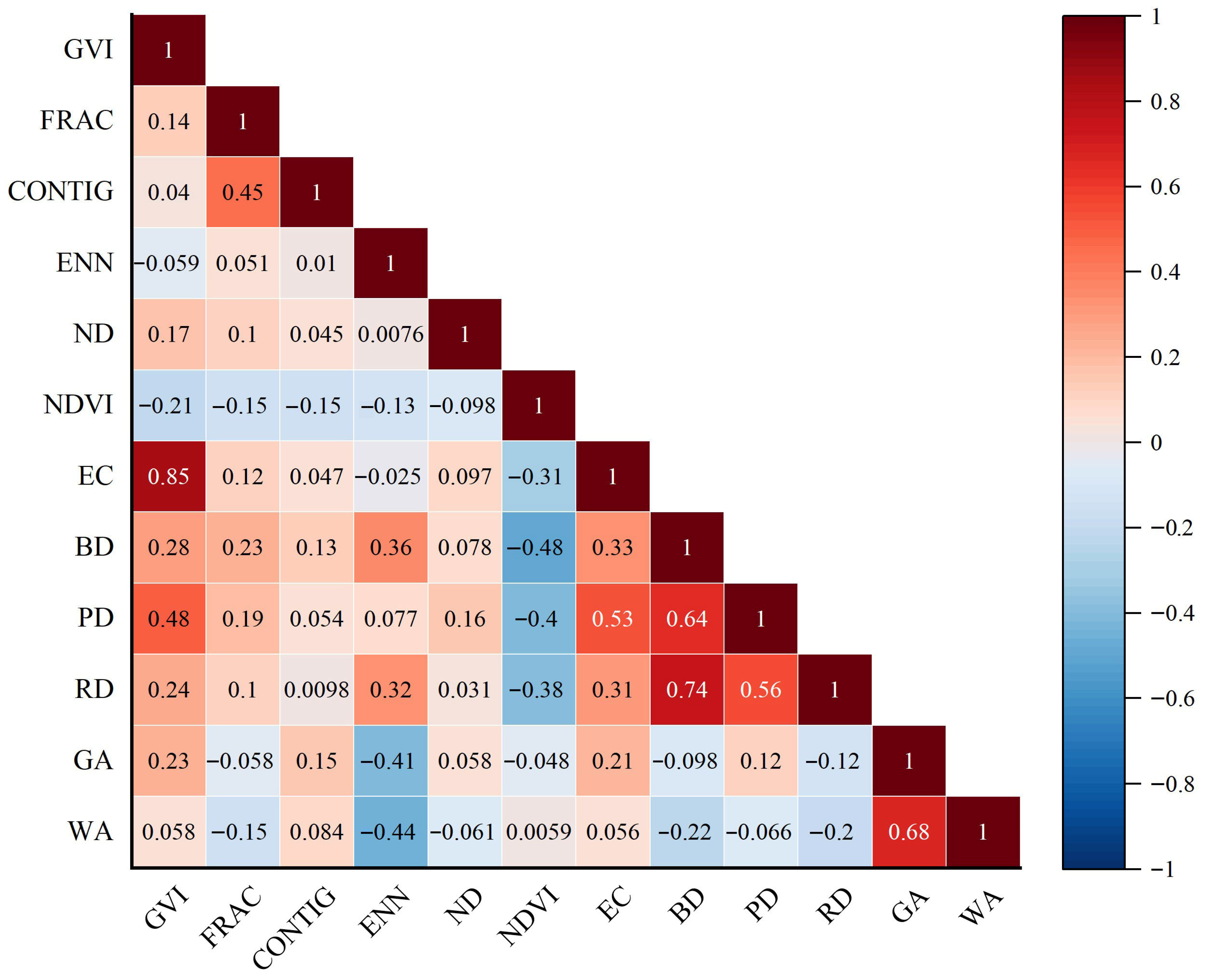
2.2.4. Spearman Correlation Coefficient
2.2.5. MGWR Multiscale Geographically Weighted Regression
2.3. Data Sources
3. Results
3.1. Spatial Distribution Characteristics of GVI
3.1.1. Spatial Pattern of GVI
3.1.2. Spatial Heterogeneity of GVI
3.2. Analysis of Influencing Factors
3.2.1. Multiple Regression Model
3.2.2. Overall Regression Effects
3.2.3. Spatial Scale Differences
4. Discussion
4.1. Analysis of Spatial Pattern Characteristics of GVI
4.2. Analysis of GVI Mechanisms
4.2.1. Landscape Pattern Factors
4.2.2. Vegetation Coverage Factors
4.2.3. Built Environment Factors
4.2.4. Accessibility Factors
4.3. Recommendations for Urban Planning and Management
- (1)
- Narrow the gap between central and peripheral areas by enhancing greening in fringe zones. Uneven green space distribution can lead to disparities in residents’ environmental experiences. Therefore, efforts should focus on enhancing street greening in peripheral areas, moderately increasing the number of street trees, pocket parks, and community green spaces. Encourage the use of idle or fragmented spaces for greening to promote a “balanced” supply of green spaces. This will help narrow the environmental gap between central and peripheral areas and mitigate potential environmental equity issues.
- (2)
- Optimize the coordination between the built environment and green space layout. Factors like EC, ND, and BD significantly influence GVI. Planning should control high-density development while ensuring harmony between building enclosures and greenery placement, preventing tall structures from excessively blocking green views. Street design can enhance green visibility within the street’s visual range through “layered” greening (combining trees, shrubs, and grasses), rooftop greening, and vertical greening, thereby strengthening visual continuity at the street scale.
- (3)
- Enhance spatial connectivity and accessibility of green spaces. Cities should leverage the radiating effects of core green areas like the “Sui-Tang Botanical Garden” and “Congzhengfang Park,” improve pedestrian and cycling systems, and design visual corridors along streets to integrate green spaces with daily travel routes. Simultaneously, strengthen greening along the Luo River waterfront and visual connectivity with street spaces to bridge the disconnect between waterfront landscapes and everyday street scenes, making waterfront green spaces an integral part of residents’ daily green experience.
4.4. Limitations and Outlook
5. Conclusions
- (1)
- The mean GVI value in the study area was 15.24%, indicating a generally low level with significant spatial variation. Green exposure differed markedly across streets and districts, exhibiting a spatial distribution pattern characterized by “extreme-core” features.
- (2)
- The intensity and distribution pattern of GVI were influenced by multiple factors, including landscape structure, vegetation cover, built environment, and accessibility. Among these, NDVI and enclosure exerted the most significant effects on GVI.
- (3)
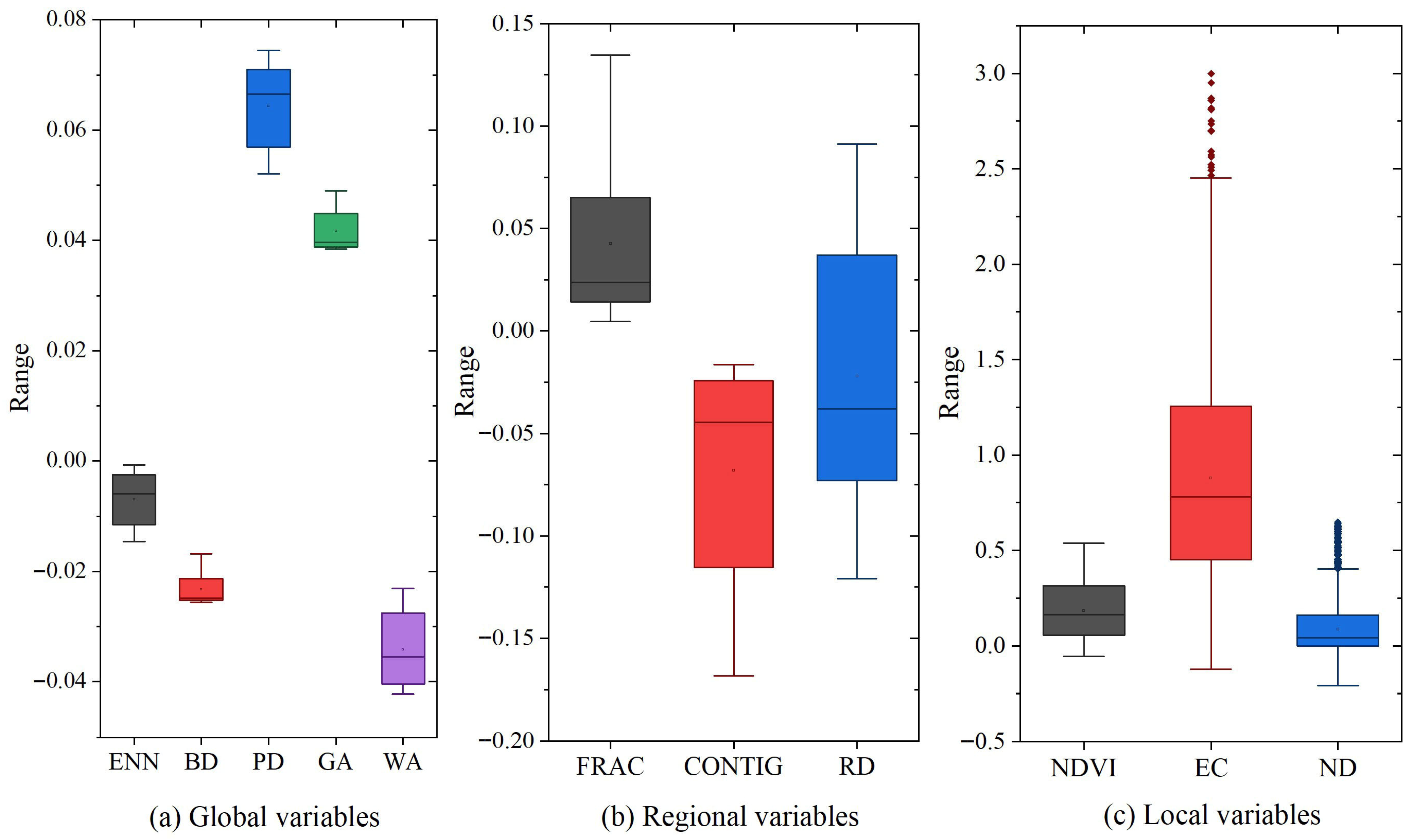
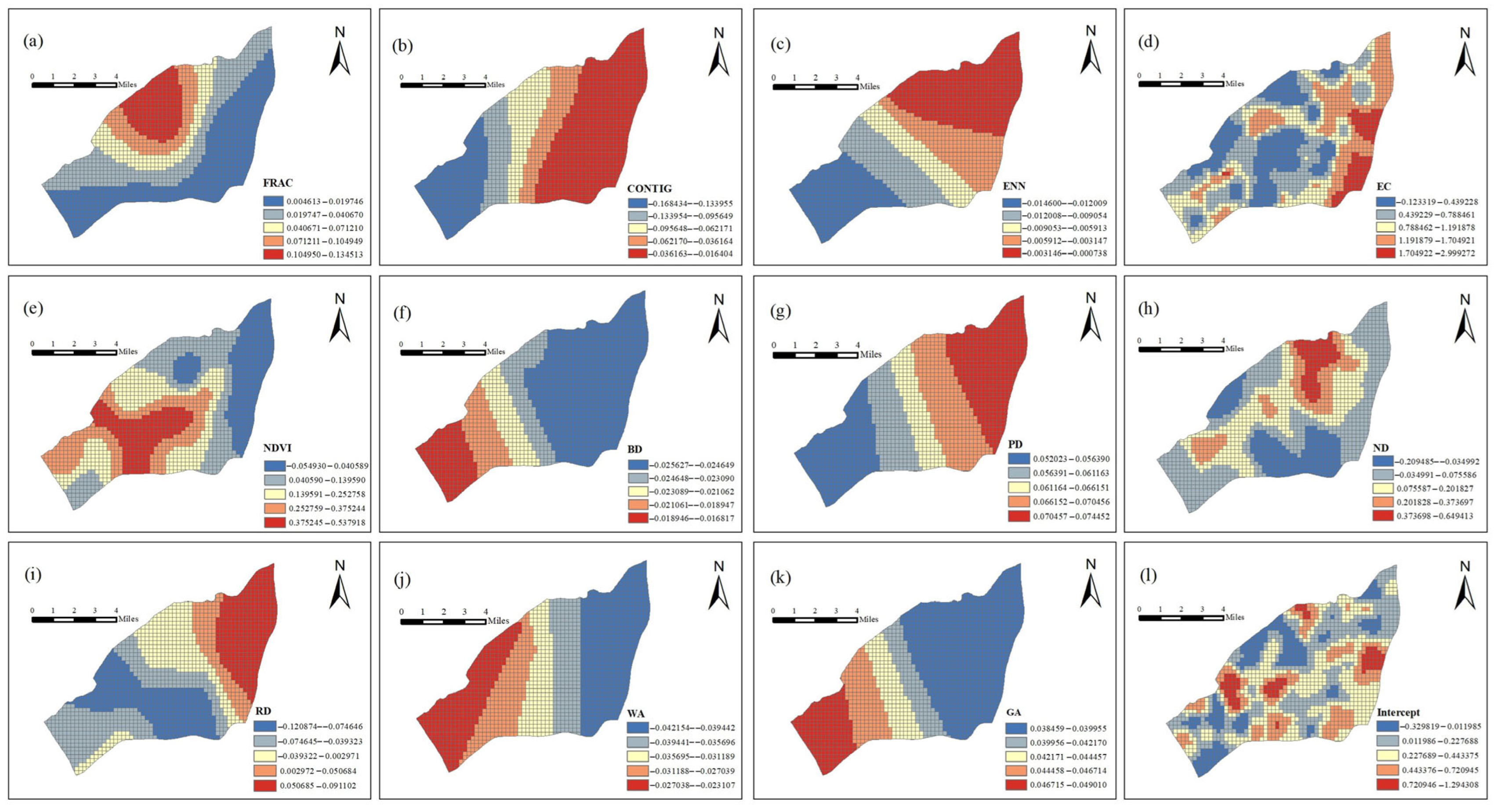
- The MGWR model reveals significant spatial differences in the influence scales of various factors. Among them, ENN, BD, PD, GA, and WA exert global effects on GVI, while factors such as FRAC, CONTIG, RD, NDVI, ND, and EC demonstrate regional dependence.
Author Contributions
Funding
Institutional Review Board Statement
Informed Consent Statement
Data Availability Statement
Conflicts of Interest
References
- Nourmohammadi, Z.; Lilasathapornkit, T.; Ashfaq, M.; Gu, Z.; Saberi, M. Mapping urban environmental performance with emerging data sources: A case of urban greenery and traffic noise in Sydney, Australia. Sustainability 2021, 13, 605. [Google Scholar] [CrossRef]
- Muluneh, M.G.; Worku, B.B. Contributions of urban green spaces for climate change mitigation and biodiversity conservation in Dessie city, Northeastern Ethiopia. Urban Clim. 2022, 46, 101294. [Google Scholar] [CrossRef]
- Du, H.; Zhou, F.; Cai, Y.; Li, C.; Xu, Y. Research on public health and well-being associated to the vegetation configuration of urban green space, a case study of Shanghai, China. Urban For. Urban Green. 2021, 59, 126990. [Google Scholar] [CrossRef]
- Aoki, Y. Relationship between perceived greenery and width of visual fields. J. Jpn. Inst. Landsc. Arch. 1987, 51, 1–10. [Google Scholar]
- Liu, O.Y.; Russo, A. Assessing the contribution of urban green spaces in green infrastructure strategy planning for urban ecosystem conditions and services. Sustain. Cities Soc. 2021, 68, 102772. [Google Scholar] [CrossRef]
- Falfán, I.; Muñoz-Robles, C.A.; Bonilla-Moheno, M.; MacGregor-Fors, I. Can you really see ‘green’? Assessing physical and self-reported measurements of urban greenery. Urban For. Urban Green. 2018, 36, 13–21. [Google Scholar] [CrossRef]
- Aikoh, T.; Homma, R.; Abe, Y. Comparing conventional manual measurement of the green view index with modern automatic methods using google street view and semantic segmentation. Urban For. Urban Green. 2023, 80, 127845. [Google Scholar] [CrossRef]
- Xia, Y.; Yabuki, N.; Fukuda, T. Development of a system for assessing the quality of urban street-level greenery using street view images and deep learning. Urban For. Urban Green. 2021, 59, 126995. [Google Scholar] [CrossRef]
- Yaping, C.; Bohong, Z.; Xiangping, Z. Multidimensional quantization of urban green space based on street view and remote sensing image: A case study of Chenzhou. Econ. Geogr. 2019, 39, 80–87. [Google Scholar]
- Helbich, M.; Poppe, R.; Oberski, D.; van Emmichoven, M.Z.; Schram, R. Can’t see the wood for the trees? An assessment of street view-and satellite-derived greenness measures in relation to mental health. Landsc. Urban Plan. 2021, 214, 104181. [Google Scholar] [CrossRef]
- Rui, J. Measuring streetscape perceptions from driveways and sidewalks to inform pedestrian-oriented street renewal in Düsseldorf. Cities 2023, 141, 104472. [Google Scholar] [CrossRef]
- Wang, J.; Liu, W.; Gou, A. Numerical characteristics and spatial distribution of panoramic Street Green View index based on SegNet semantic segmentation in Savannah. Urban For. Urban Green. 2022, 69, 127488. [Google Scholar] [CrossRef]
- Jin, B.; Geng, J.; Ke, S.; Pan, H. Analysis of spatial variation of street landscape greening and influencing factors: An example from Fuzhou city, China. Sci. Rep. 2023, 13, 21767. [Google Scholar] [CrossRef]
- Goel, R.; Garcia, L.M.; Goodman, A.; Johnson, R.; Aldred, R.; Murugesan, M.; Brage, S.; Bhalla, K.; Woodcock, J. Estimating city-level travel patterns using street imagery: A case study of using Google Street View in Britain. PLoS ONE 2018, 13, e0196521. [Google Scholar] [CrossRef]
- Kang, J.; Körner, M.; Wang, Y.; Taubenböck, H.; Zhu, X.X. Building instance classification using street view images. ISPRS J. Photogramm. Remote Sens. 2018, 145, 44–59. [Google Scholar] [CrossRef]
- Gonzalez, D.; Rueda-Plata, D.; Acevedo, A.B.; Duque, J.C.; Ramos-Pollán, R.; Betancourt, A.; García, S. Automatic detection of building typology using deep learning methods on street level images. Build. Environ. 2020, 177, 106805. [Google Scholar] [CrossRef]
- Yu, Q.; Wang, C.; McKenna, F.; Yu, S.X.; Taciroglu, E.; Cetiner, B.; Law, K.H. Rapid visual screening of soft-story buildings from street view images using deep learning classification. Earthq. Eng. Eng. Vib. 2020, 19, 827–838. [Google Scholar] [CrossRef]
- Dai, S.; Li, Y.; Stein, A.; Yang, S.; Jia, P. Street view imagery-based built environment auditing tools: A systematic review. Int. J. Geogr. Inf. Sci. 2024, 38, 1136–1157. [Google Scholar] [CrossRef]
- Tang, Z.; Ye, Y.; Jiang, Z.; Fu, C.; Huang, R.; Yao, D. A data-informed analytical approach to human-scale greenway planning: Integrating multi-sourced urban data with machine learning algorithms. Urban For. Urban Green. 2020, 56, 126871. [Google Scholar] [CrossRef]
- Wu, J.; Cheng, L.; Chu, S.; Xia, N.; Li, M. A green view index for urban transportation: How much greenery do we view while moving around in cities? Int. J. Sustain. Transp. 2020, 14, 972–989. [Google Scholar] [CrossRef]
- Ye, Y.; Richards, D.; Lu, Y.; Song, X.; Zhuang, Y.; Zeng, W.; Zhong, T. Measuring daily accessed street greenery: A human-scale approach for informing better urban planning practices. Landsc. Urban Plan. 2019, 191, 103434. [Google Scholar] [CrossRef]
- Wang, H.; Hu, Y.; Tang, L.; Zhuo, Q. Distribution of urban blue and green space in beijing and its influence factors. Sustainability 2020, 12, 2252. [Google Scholar] [CrossRef]
- He, H.; Lin, X.; Yang, Y.; Lu, Y. Association of street greenery and physical activity in older adults: A novel study using pedestrian-centered photographs. Urban For. Urban Green. 2020, 55, 126789. [Google Scholar] [CrossRef]
- Plascak, J.J.; Rundle, A.G.; Babel, R.A.; Llanos, A.A.; LaBelle, C.M.; Stroup, A.M.; Mooney, S.J. Drop-and-spin virtual neighborhood auditing: Assessing built environment for linkage to health studies. Am. J. Prev. Med. 2020, 58, 152–160. [Google Scholar] [CrossRef] [PubMed]
- Wang, R.; Helbich, M.; Yao, Y.; Zhang, J.; Liu, P.; Yuan, Y.; Liu, Y. Urban greenery and mental wellbeing in adults: Cross-sectional mediation analyses on multiple pathways across different greenery measures. Environ. Res. 2019, 176, 108535. [Google Scholar] [CrossRef] [PubMed]
- Hu, C.-B.; Zhang, F.; Gong, F.-Y.; Ratti, C.; Li, X. Classification and mapping of urban canyon geometry using Google Street View images and deep multitask learning. Build. Environ. 2020, 167, 106424. [Google Scholar] [CrossRef]
- Middel, A.; Lukasczyk, J.; Zakrzewski, S.; Arnold, M.; Maciejewski, R. Urban form and composition of street canyons: A human-centric big data and deep learning approach. Landsc. Urban Plan. 2019, 183, 122–132. [Google Scholar] [CrossRef]
- Ma, X.; Zeng, T.; Zhang, M.; Zeng, P.; Lin, B.; Lu, S. Street microclimate prediction based on Transformer model and street view image in high-density urban areas. Build. Environ. Res. 2025, 269, 112490. [Google Scholar] [CrossRef]
- Qin, K.; Xu, Y.; Kang, C.; Kwan, M.P. A graph convolutional network model for evaluating potential congestion spots based on local urban built environments. Trans. GIS 2020, 24, 1382–1401. [Google Scholar] [CrossRef]
- Zang, P.; Liu, X.; Zhao, Y.; Guo, H.; Lu, Y.; Xue, C.Q. Eye-level street greenery and walking behaviors of older adults. Int. J. Environ. Res. Public Health 2020, 17, 6130. [Google Scholar] [CrossRef]
- Steinmetz-Wood, M.; El-Geneidy, A.; Ross, N.A. Moving to policy-amenable options for built environment research: The role of micro-scale neighborhood environment in promoting walking. Health Place 2020, 66, 102462. [Google Scholar] [CrossRef]
- Deng, Y.; Liu, P.; Chen, M.; Wu, C. Exploring the effects of local environment on population distribution: Using imagery segmentation technology and street view. In Proceedings of the 2020 Asia-Pacific Conference on Image Processing, Electronics and Computers (IPEC), Dalian, China, 14–16 April 2020; IEEE: Piscataway, NJ, USA, 2020; pp. 310–315. [Google Scholar]
- Sytsma, V.A.; Connealy, N.; Piza, E.L. Environmental predictors of a drug offender crime script: A systematic social observation of Google Street View images and CCTV footage. Crime Delinq. 2021, 67, 27–57. [Google Scholar] [CrossRef]
- Min, W.; Mei, S.; Liu, L.; Wang, Y.; Jiang, S. Multi-task deep relative attribute learning for visual urban perception. IEEE Trans. Image Process. 2019, 29, 657–669. [Google Scholar] [CrossRef]
- Wu, C.; Peng, N.; Ma, X.; Li, S.; Rao, J. Assessing multiscale visual appearance characteristics of neighbourhoods using geographically weighted principal component analysis in Shenzhen, China. Comput. Environ. Urban Syst. 2020, 84, 101547. [Google Scholar] [CrossRef]
- Wang, Z.; Ito, K.; Biljecki, F. Assessing the equity and evolution of urban visual perceptual quality with time series street view imagery. Cities 2024, 145, 104704. [Google Scholar] [CrossRef]
- Li, J.; Li, J.; Shao, L.; Sun, S. Evaluation of spatial matching between urban green space and population: Dynamics analysis of winter population data in Xi’an. J. Urban Plan. Dev. 2021, 147, 05021012. [Google Scholar] [CrossRef]
- Sánchez, I.A.V.; Labib, S. Accessing eye-level greenness visibility from open-source street view images: A methodological development and implementation in multi-city and multi-country contexts. Sustain. Cities Soc. 2024, 103, 105262. [Google Scholar] [CrossRef]
- Zhou, H.; Tao, G.; Yan, X.; Sun, J. Influences of greening and structures on urban thermal environments: A case study in Xuzhou City, China. Urban For. Urban Green. 2021, 66, 127386. [Google Scholar] [CrossRef]
- Zhou, H.; Xu, C.; Pu, H.; Nie, Y.; Sun, J. Influence of urban surface compositions on outdoor thermal environmental parameters on an urban road: A combined two-aspect analysis. Sustain. Cities Soc. 2023, 90, 104376. [Google Scholar] [CrossRef]
- Huang, D.; Jiang, B.; Yuan, L. Analyzing the effects of nature exposure on perceived satisfaction with running routes: An activity path-based measure approach. Urban For. Urban Green. 2022, 68, 127480. [Google Scholar] [CrossRef]
- Chen, J.; Zhou, C.; Li, F. Quantifying the green view indicator for assessing urban greening quality: An analysis based on Internet-crawling street view data. Ecol. Indic. 2020, 113, 106192. [Google Scholar] [CrossRef]
- Apparicio, P.; Landry, S.; Lewnard, J. Disentangling the effects of urban form and socio-demographic context on street tree cover: A multi-level analysis from Montréal. Sustainability 2017, 157, 422–433. [Google Scholar]
- Gou, A.; Wang, X.; Wang, J.; Wang, C.; Tan, G. Spatial pattern and heterogeneity of green view index in mountainous cities: A case study of Yuzhong district, Chongqing, China. Sci. Rep. 2025, 15, 12576. [Google Scholar] [CrossRef]
- Miaoyi, L.; Zhonghao, Y.; Feng, X. Urban street greenery quality measurement, planning and design promotion strategies based on multi-source data: A case study of Fuzhou’s main urban area. Landsc. Archit. 2021, 28, 62–68. [Google Scholar]
- Yang, J.; Zhao, L.; Mcbride, J.; Gong, P. Can you see green? Assessing the visibility of urban forests in cities. Landsc. Urban Plan. 2009, 91, 97–104. [Google Scholar] [CrossRef]
- Guo, G.; Wu, Z.; Cao, Z.; Chen, Y.; Zheng, Z. Location of greenspace matters: A new approach to investigating the effect of the greenspace spatial pattern on urban heat environment. Landsc. Ecol. 2021, 36, 1533–1548. [Google Scholar] [CrossRef]
- Chen, C.; Wang, J.; Li, D.; Sun, X.; Zhang, J.; Yang, C.; Zhang, B. Unraveling nonlinear effects of environment features on green view index using multiple data sources and explainable machine learning. Sci. Rep. 2024, 14, 30189. [Google Scholar] [CrossRef] [PubMed]
- Hu, J.; Zhang, J.; Li, Y. Exploring the spatial and temporal driving mechanisms of landscape patterns on habitat quality in a city undergoing rapid urbanization based on GTWR and MGWR: The case of Nanjing, China. Ecol. Indic. 2022, 143, 109333. [Google Scholar] [CrossRef]
- O’Neill, R.V.; Krummel, J.R.; Gardner, R.H.; Sugihara, G.; Jackson, B.; DeAngelis, D.; Milne, B.; Turner, M.G.; Zygmunt, B.; Christensen, S. Indices of landscape pattern. Landsc. Ecol. 1988, 1, 153–162. [Google Scholar] [CrossRef]
- Zhang, W.; Zeng, H. Spatial differentiation characteristics and influencing factors of the green view index in urban areas based on street view images: A case study of Futian District, Shenzhen, China. Urban For. Urban Green. 2024, 93, 128219. [Google Scholar] [CrossRef]
- Ki, D.; Lee, S. Analyzing the effects of Green View Index of neighborhood streets on walking time using Google Street View and deep learning. Landsc. Urban Plan. 2021, 205, 103920. [Google Scholar] [CrossRef]
- Li, T.; Zheng, X.; Wu, J.; Zhang, Y.; Fu, X.; Deng, H. Spatial relationship between green view index and normalized differential vegetation index within the Sixth Ring Road of Beijing. Urban For. Urban Green. 2021, 62, 127153. [Google Scholar] [CrossRef]
- Yin, L.; Wang, Z. Measuring visual enclosure for street walkability: Using machine learning algorithms and Google Street View imagery. Appl. Geogr. 2016, 76, 147–153. [Google Scholar] [CrossRef]
- Wang, X.; Guan, C. Assessing green space exposure in high density urban areas: A deficiency-sufficiency framework for Shanghai. Ecol. Indic. 2025, 175, 113494. [Google Scholar] [CrossRef]
- Chan, T.-C.; Lee, P.-H.; Lee, Y.-T.; Tang, J.-H. Exploring the spatial association between the distribution of temperature and urban morphology with green view index. PLoS ONE 2024, 19, e0301921. [Google Scholar] [CrossRef]
- Clark, C. Urban population densities. J. R. Stat. Society. Ser. A 1951, 114, 490–496. [Google Scholar] [CrossRef]
- Guo, D.; Chen, S.S. Sustainability, Spatial Mismatching of Residents’ Visible Greening with Green Coverage under the Influence of Urban Morphology. Ecosyst. Health Sustain. 2025, 11, 0359. [Google Scholar] [CrossRef]
- Huang, Z.; Luo, S.; Cai, Y.; Lu, Z. Integrating Accessibility and Green View Index for Human-scale Street Greening Initiatives: A Case Study of Chengdu’s Third Ring Road. J. Resour. Ecol. 2024, 16, 356–367. [Google Scholar]
- Zhou, B.; Zhao, H.; Puig, X.; Xiao, T.; Fidler, S.; Barriuso, A.; Torralba, A. Semantic understanding of scenes through the ade20k dataset. Int. J. Comput. Vis. 2019, 127, 302–321. [Google Scholar] [CrossRef]
- Dong, R.; Zhang, Y.; Zhao, J. How green are the streets within the sixth ring road of Beijing? An analysis based on tencent street view pictures and the green view index. Int. J. Environ. Res. Public Health 2018, 15, 1367. [Google Scholar] [CrossRef]
- Gao, Y.; Zhao, J.; Han, L. Exploring the spatial heterogeneity of urban heat island effect and its relationship to block morphology with the geographically weighted regression model. Sustain. Cities Soc. 2022, 76, 103431. [Google Scholar] [CrossRef]
- Rouhana, F.; Zhu, J.; Bagtzoglou, A.C.; Burton, C.G. Analyzing structural inequalities in natural hazard-induced power outages: A spatial-statistical approach. Int. J. Disaster Risk Reduct. 2025, 117, 105184. [Google Scholar] [CrossRef]
- Rong, Y.; Li, K.; Guo, J.; Zheng, L.; Luo, Y.; Yan, Y.; Wang, C.; Zhao, C.; Shang, X.; Wang, Z. Multi-scale spatio-temporal analysis of soil conservation service based on MGWR model: A case of Beijing-Tianjin-Hebei, China. Ecol. Indic. 2022, 139, 108946. [Google Scholar] [CrossRef]
- Stancato, G. The Visual Greenery Field: Representing the Urban Green Visual Continuum with Street View Image Analysis. Sustainability 2024, 16, 9512. [Google Scholar] [CrossRef]
- Pickett, S.T.; Cadenasso, M.L. Landscape ecology: Spatial heterogeneity in ecological systems. Science 1995, 269, 331–334. [Google Scholar] [CrossRef] [PubMed]
- Li, X.; Zhang, C.; Li, W.; Kuzovkina, Y.A.; Weiner, D. Who lives in greener neighborhoods? The distribution of street greenery and its association with residents’ socioeconomic conditions in Hartford, Connecticut, USA. Urban For. Urban Green. 2015, 14, 751–759. [Google Scholar] [CrossRef]
- Huang, Y.; Lin, T.; Xue, X.; Zhang, G.; Liu, Y.; Zeng, Z.; Zhang, J.; Sui, J. Spatial patterns and inequity of urban green space supply in China. Ecol. Indic. 2021, 132, 108275. [Google Scholar] [CrossRef]
- Phillips, A.; Canters, F.; Khan, A.Z. Analyzing spatial inequalities in use and experience of urban green spaces. Urban For. Urban Green. 2022, 74, 127674. [Google Scholar] [CrossRef]
- Hao, X.; Long, Y. Street greenery: A new indicator for evaluating walkability. Shanghai Urban Plan. Rev. 2017, 1, 32–36. [Google Scholar]
- Xu, X.; Niu, L. Analysis of Influencing Factors of Green View Index Based on Street View Segmentation. Int. Arch. Photogramm. Remote Sens. Spat. Inf. Sci. 2024, 48, 517–524. [Google Scholar] [CrossRef]
- Huang, Z.; Duan, L.; Xu, Y.; Yang, S.; Lin, Z.; Yue, H.; Yang, J. Exploring the influence of urban green space and urban morphology on urban heat Islands using street view and satellite imagery. Sci. Rep. 2025, 15, 23759. [Google Scholar] [CrossRef] [PubMed]
- Zhu, J.; Qiu, L.; Su, Y.; Guo, Q.; Hu, T.; Bao, H.; Luo, J.; Wu, S.; Xu, Q.; Wang, Z. Disentangling the effects of the surrounding environment on street-side greenery: Evidence from Hangzhou. Ecol. Indic. 2022, 143, 109153. [Google Scholar] [CrossRef]
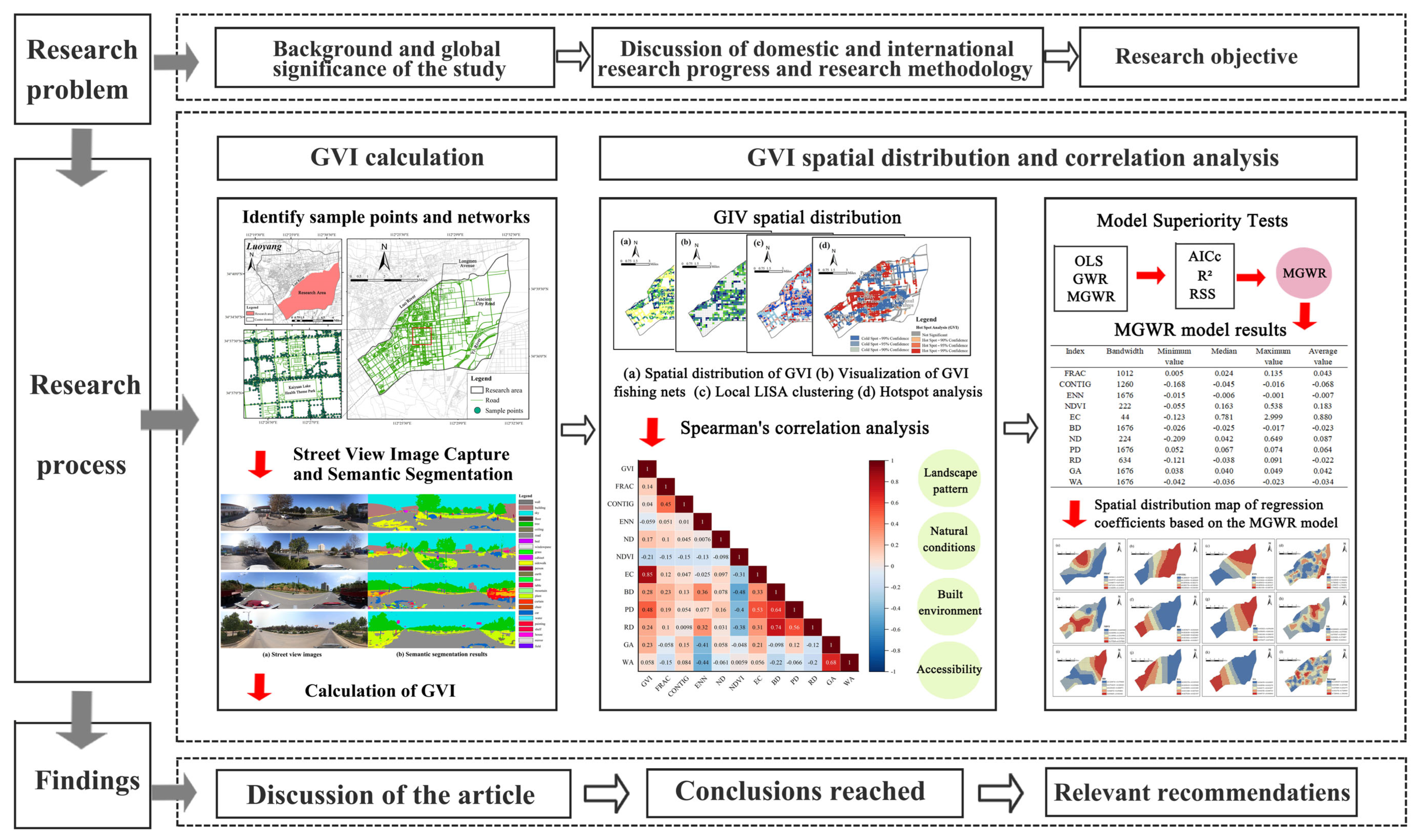



| Category | Typical Variable | Description | Formula | Reference Source |
|---|---|---|---|---|
| Landscape pattern factors | Fractal Dimension (FRAC) | Quantify the structural complexity and spatial diversity of landscapes through the degree of sinuosity and irregularity in patch shapes. | P: the plaque circumference; A: the plaque area. | O’Neill RV and Zhang [50,51] |
| Connectivity Index (CONTIG) | Measure the connectivity between pixels within the plaque. The higher the value, the stronger the connectivity between pixels of the same type, indicating a more complete landscape structure. | : the number of pixels within the patch; the actual connectivity value of the i-th pixel. : the maximum possible connectivity value for the i-th pixel. | ||
| Euclidean Nearest Neighbor Distance (ENN) | Measure the Euclidean distance between a given type of plaque and the most recent plaque of the same type. A higher value indicates more isolated plaques and a more dispersed spatial distribution. | : the Euclidean distance from the i-th patch to the nearest patch j of the same category; : the number of patches in that category. | ||
| Vegetation Cover Factors | Normalized Difference Vegetation Index (NDVI) | NDVI is a commonly used vegetation index in remote sensing that measures surface vegetation cover and growth conditions. | NIR: the reflectance in the near-infrared band (vegetation typically exhibits high reflectance in this band); RED: the reflectance in the red band (vegetation strongly absorbs light in this band). | King and Li [52,53] |
| Built Environment Factors | Enclosure (EC) | Describes the degree of visual enclosure of a street or space. A higher value indicates a greater proportion of non-sky pixels in the street view. | : the number of non-sky pixels in the street view image; : the total number of pixels in the street view image. | Yin [54] |
| Building density (BD) | The ratio of a building’s total floor area or building footprint to the unit area, used to reflect the compactness of a city’s built environment. | : the total floor area of buildings within the study unit, while : the total area of the study unit. | Wang and Chen [55,56] | |
| Road density (ND) | Total length of roads per unit area, reflecting the density of the transportation network and the accessibility of the city. | : the road length within the study unit, while : the total area of the study unit. | Gou [44] | |
| Population density (PD) | The number of residents per unit area serves as a key indicator for measuring the spatial distribution of urban populations and residential pressure. | : the total population within the research unit; : the total area of the study unit. | Clark CJJotRSSSA [57] | |
| Residential density (RD) | The number of residential buildings or residential floor area per unit area, used to reflect the compactness of residential space layout. | : the residential floor area within the research unit; : the total area of the study unit. | Guo a [58] | |
| Accessibility factors | Green Space Accessibility (GA) | The accessibility of residents or spatial units to the nearest green space is measured by a numerical value, where a lower number indicates a shorter distance to the green space and higher accessibility. | : the Euclidean distance or network distance from the research unit’s center of gravity or settlement to the i-th green space entrance, with the minimum value serving as the accessibility measure. | Ki and Huang [52,59] |
| Water Accessibility (WA) | The ease of access for residents or spatial units to the nearest rivers, lakes, or other bodies of water. A lower value indicates a shorter distance to the water body. | : the Euclidean distance or network distance from the research unit’s center of gravity or settlement to the i-th water body inlet, with the minimum value serving as the accessibility measure. |
| Data Type | Description | Source |
|---|---|---|
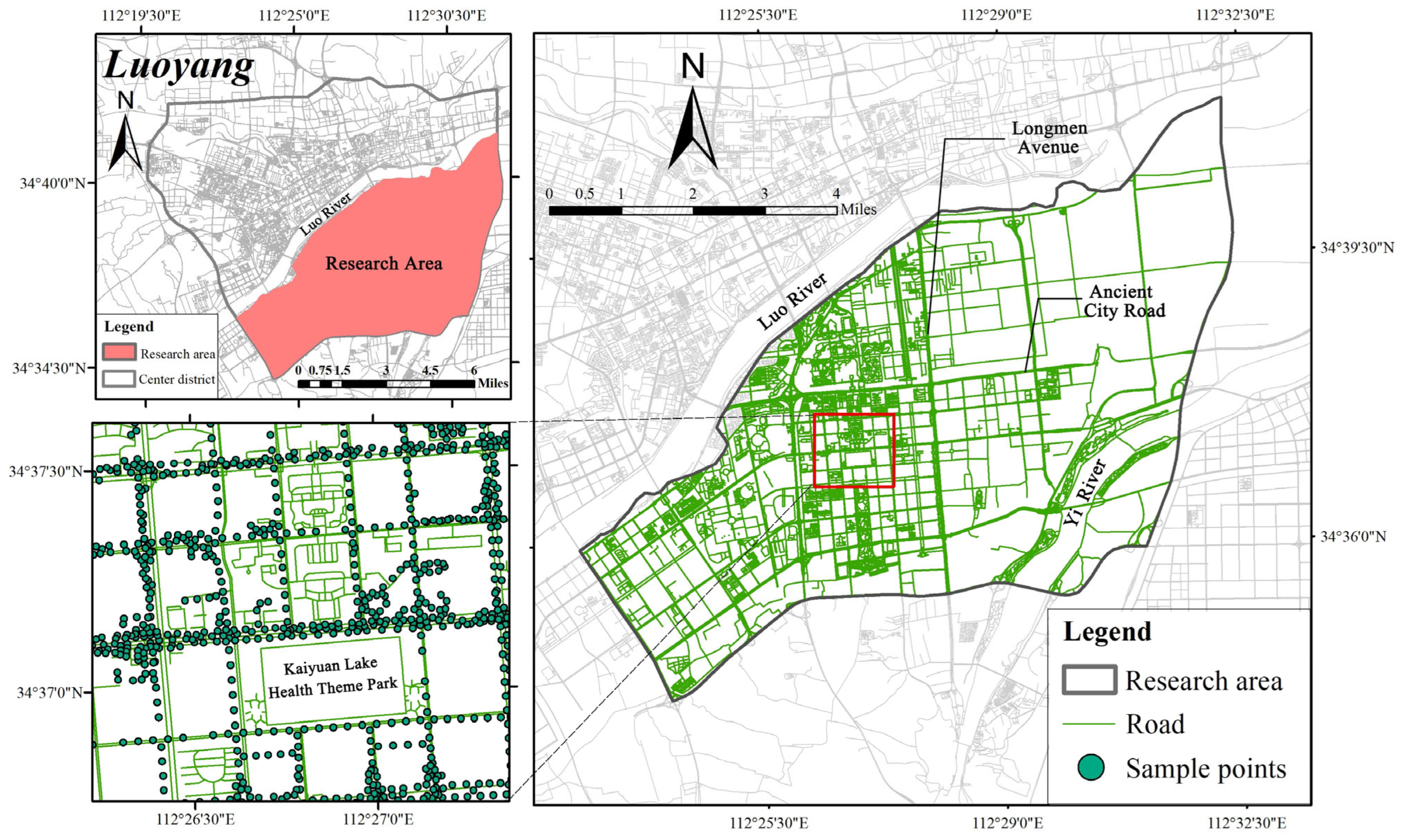
| Road Data | Vector data of the road network within the study area, used for street view sampling point placement and GVI positioning. | Open Street Map Platform: https://www.openstreetmap.org (accessed on 10 April 2025) |
| Street View imagery data | Extract street-level imagery to compute the Green View Index (GVI) for quantifying the visible greenery available to residents. | Baidu Maps Open Platform: https://lbsyun.baidu.com/ (accessed on 10 April 2025) |
| Urban Green Space Coverage Data | Distribution of green spaces including parks, protective green belts, and ancillary green areas, used for calculating green space accessibility and landscape pattern indices. | Wuhan University’s 2023 national land cover data at 1 m resolution(SinoLC-1): https://zenodo.org/records/8214467 (accessed on 1 May 2025) |
| NDVI data | Overall vegetation coverage level of the region, used for analyzing its relationship with GVI. | 2020 Sentinel-2 satellite imagery from the Google Earth Engine platform. |
| POI data | Park, commercial, and facility locations used to calculate density and accessibility. | Baidu Maps Open Platform: https://lbsyun.baidu.com/ (accessed on 1 May 2025) |
| Population Data | Population distribution at the community/street level, used for analyzing population density. | WorldPop Platform: https://hub.worldpop.org/project/categories?id=3 (accessed on 1 May 2025) |
| Regression Model | AICc | R2 | Adj. R2 | RSS |
|---|---|---|---|---|
| OLS | 4140.933 | 0.319 | 0.316 | 1141.959 |
| GWR | 4009.676 | 0.413 | 0.408 | 984.650 |
| MGWR | 3704.918 | 0.610 | 0.603 | 654.734 |
| Index | Bandwidth | Minimum Value | Median | Maximum Value | Average Value |
|---|---|---|---|---|---|
| FRAC | 1012 | 0.005 | 0.024 | 0.135 | 0.043 |
| CONTIG | 1260 | −0.168 | −0.045 | −0.016 | −0.068 |
| ENN | 1676 | −0.015 | −0.006 | −0.001 | −0.007 |
| NDVI | 222 | −0.055 | 0.163 | 0.538 | 0.183 |
| EC | 44 | −0.123 | 0.781 | 2.999 | 0.880 |
| BD | 1676 | −0.026 | −0.025 | −0.017 | −0.023 |
| ND | 224 | −0.209 | 0.042 | 0.649 | 0.087 |
| PD | 1676 | 0.052 | 0.067 | 0.074 | 0.064 |
| RD | 634 | −0.121 | −0.038 | 0.091 | −0.022 |
| GA | 1676 | 0.038 | 0.040 | 0.049 | 0.042 |
| WA | 1676 | −0.042 | −0.036 | −0.023 | −0.034 |
Disclaimer/Publisher’s Note: The statements, opinions and data contained in all publications are solely those of the individual author(s) and contributor(s) and not of MDPI and/or the editor(s). MDPI and/or the editor(s) disclaim responsibility for any injury to people or property resulting from any ideas, methods, instructions or products referred to in the content. |
© 2025 by the authors. Licensee MDPI, Basel, Switzerland. This article is an open access article distributed under the terms and conditions of the Creative Commons Attribution (CC BY) license (https://creativecommons.org/licenses/by/4.0/).
Share and Cite
Hu, J.; Du, Y.; Ma, Y.; Liu, D.; Chen, L. Investigating Spatial Variation Characteristics and Influencing Factors of Urban Green View Index Based on Street View Imagery—A Case Study of Luoyang, China. Sustainability 2025, 17, 10208. https://doi.org/10.3390/su172210208
Hu J, Du Y, Ma Y, Liu D, Chen L. Investigating Spatial Variation Characteristics and Influencing Factors of Urban Green View Index Based on Street View Imagery—A Case Study of Luoyang, China. Sustainability. 2025; 17(22):10208. https://doi.org/10.3390/su172210208
Chicago/Turabian StyleHu, Junhui, Yang Du, Yueshan Ma, Danfeng Liu, and Luyao Chen. 2025. "Investigating Spatial Variation Characteristics and Influencing Factors of Urban Green View Index Based on Street View Imagery—A Case Study of Luoyang, China" Sustainability 17, no. 22: 10208. https://doi.org/10.3390/su172210208
APA StyleHu, J., Du, Y., Ma, Y., Liu, D., & Chen, L. (2025). Investigating Spatial Variation Characteristics and Influencing Factors of Urban Green View Index Based on Street View Imagery—A Case Study of Luoyang, China. Sustainability, 17(22), 10208. https://doi.org/10.3390/su172210208