Environmentally Friendly Product Personality: The Role of Materials, Color, and Light in Car Interiors


Abstract
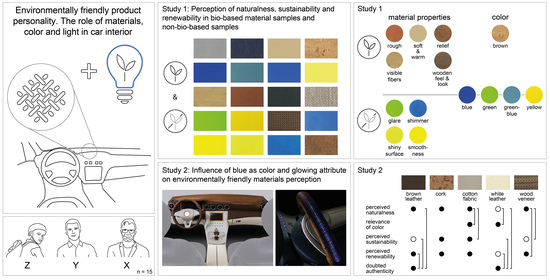
1. Introduction
2. Aims and Objectives
- What bio-based materials are perceived as “sustainable”, “natural”, and/or “renewable”?
- What contribution does blue as color and glowing attribute in the definition of EFDCs make?
3. Perception of Naturalness, Sustainability, and Renewability in Bio-Based Material Samples and Non-Material Samples
3.1. Materials and Methods
3.1.1. Material Selection and Sample Design
3.1.2. Participants
3.1.3. Laboratory Setup
3.1.4. Data Collection Procedure
3.1.5. Data Analysis
3.2. Results
Themes
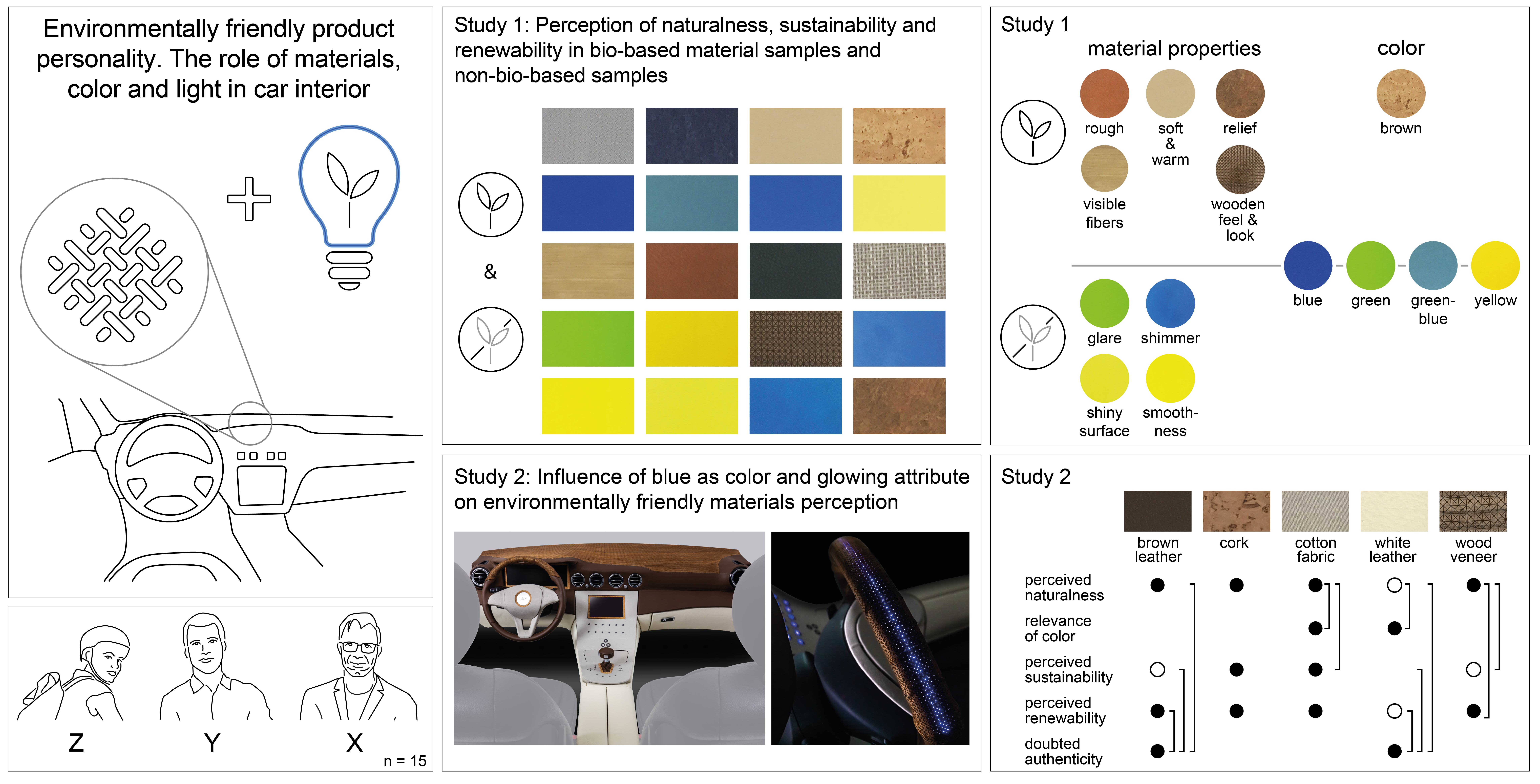
- Material properties supporting environmental friendliness perception
- Roughness
- Rough surfaces fostered the association of the subjects with environmental friendliness and naturalness.
Natural, even, feels natural.[Y1, bark, 10]
Felt or woodchip, tennis balls, insulation. Or is that cork? Cowhide.[Y5, bark, 10]
- Soft and warm surface
- The subjects described the feel of the surface of natural materials such as cotton fabric and cork as soft and warm. Materials with these properties were rated as very natural in general.
Very pleasant, because it’s soft.[Z5, cotton fabric, 3]
Warm, has a certain surface haptic.[X3, cork, 4]
- Texture
- Textured materials that feature a relief or a medium to low density were perceived by the subjects as occurring in nature and thus as environmentally friendly overall.
Completely natural, because it has a disordered structure.[Y1, natural-fiber composite, 20]
Natural, also because there are always darker/brighter parts in it.[X4, natural-fiber composite, 9]
- Visible fibers
- Visible fibers ensured that materials were perceived as more environmentally friendly.
I think it is natural, just from the fibers or wood scraps that are in it.[Z5, natural-fiber composite, 20]
A lot of small fibers pressed together to something.[Y2, bark, 10]
- Wooden feel and look
- Materials with a haptic or appearance reminiscent of wood were perceived by the subjects as environmentally friendly in the sense of being natural, sustainable, and renewable.
Looks like wood, feels like wood, very sustainable.[Z3, wood veneer, 15]
Very natural, looks like wood.[Y5, wood veneer, 15]
- Material properties reducing perception of environmental friendliness
- Glare
- Materials whose colors are very glaring were perceived by the subjects as less natural and consequently less environmentally friendly.
Too glaring, not very natural.[Z4, PMMA, acrylic glass, 8]
Artificially glaring.[X3, cast PVC foil, 13]
- Shimmer
- Shimmering or metallic surfaces were perceived as artificial and not environmentally friendly by the subjects.
Relatively less natural due to the shimmering effect.[Z3, cast PVC foil, 16]
Metallic, aesthetic, technological, not natural.[Z4, cast PVC foil, 19]
- Shiny surface
- Only one subject commented on shiny in connection with natural. Shiny surfaces were nevertheless included as a material property, as this seems to have a negative influence on the perception of environmental friendliness, even if not every subject explicitly verbalized it in the respective terms (natural, sustainable, renewable).
Color does occur in nature, but the shiny surface makes it look less natural.[Z3, cast PVC foil, 18]
- Smoothness
- Smooth surfaces were not associated with environmental friendliness by subjects for both bio-based material samples and non-material samples.
Not sustainable at all because it feels so rubbery and smooth.[Z3, cast PVC foil, 17]
What is this? It looks like fabric fibers with some kind of coating. [...] Is it sustainable? It looks artificial.[Y2, natural fiber composites, 12]
- Color
- The effect of the individual colors of the materials studied cannot be clearly categorized as for or against environmentally friendly perception as the previously mentioned properties. Different associations arose among the subjects, which are listed per color below.
- Blue
- The color blue led subjects to both associations that support environmentally friendly perceptions and those that reduce them.
Not natural, although it looks like blue sky.[X2, PMMA, acrylic glass, 5]
Quite natural like the sea.[Z5, PMMA, acrylic glass, 5]
- Green
- For non-material samples, the color green ensured that they appeared slightly more natural to the subjects. In the case of bio-based leather, on the other hand, the green appeared to have a negative impact on environmentally friendly perception.
It is like the yellow sample, but it seems more natural and less technological due to the color accordingly.[Y1, cast PVC foil, 13]
Whereas the color... green leather does not occur in nature.[Z3, leather, 11]
- Green-blue
- The green-blue of the viscose material was perceived as less natural by the subjects.
The color is moderately a natural color.[Y1, viscose fabric, 6]
The color appears unnatural.[Y5, viscose fabric, 6]
- Yellow
- Opinions of the subjects varied on yellow. The color shade also seems to have an influence, because samples 17 and 18 of cast PVC foils were considered either naturally occurring or non-occurring.
Not natural at all, because color does not occur in nature.[Z3, cast PCV foil, 17]
Yellow looks natural.[Y5, cast PVC foil, 18]
- Brown
- The majority of subjects perceived brown as conducive to the association with environmental friendliness. In rare exceptions, brown was rated as less natural.
Earth tone, looks very natural due to tone.[Y1, bark, 10]
The color is rather natural.[Z5, natural-fiber composites, 9]
- Doubts about authenticity
- Some bio-based material samples were questioned with regard to authenticity. Subjects often agreed that they looked natural but believed that this could be an intentional deception.
I think it is artificial leather.[Y3, leather, 11]
It pretends being natural.[X5, natural-fiber composites, 12]
- Renewable—ambiguous understanding of the term
- The term “renewable” was interpreted differently by the subjects. Although the experimenter explained its meaning to those subjects asking for clarification, the term was misinterpreted during the experiment. Instead of referring to renewable raw materials, the subjects often interpreted this term as the material quality of being reproducible.
This is certainly also renewable, the product can be manufactured again and again.[Y5, cast PVC foil, 18]
Renewable, so whether it can be recycled? In that sense?[Z3, cast PVC foil, 7]
3.3. Implications for Study 2
- Brown leather
- Cork
- Cotton fabric
- White leather
- Wood veneer
4. Influence of Blue as Color and Glowing Attribute on Environmentally Friendly Materials Perception
4.1. Materials and Methods
4.1.1. Demonstrator Design
4.1.2. Laboratory Setup
4.1.3. Data Collection Procedure
4.1.4. Data Analysis
4.2. Results
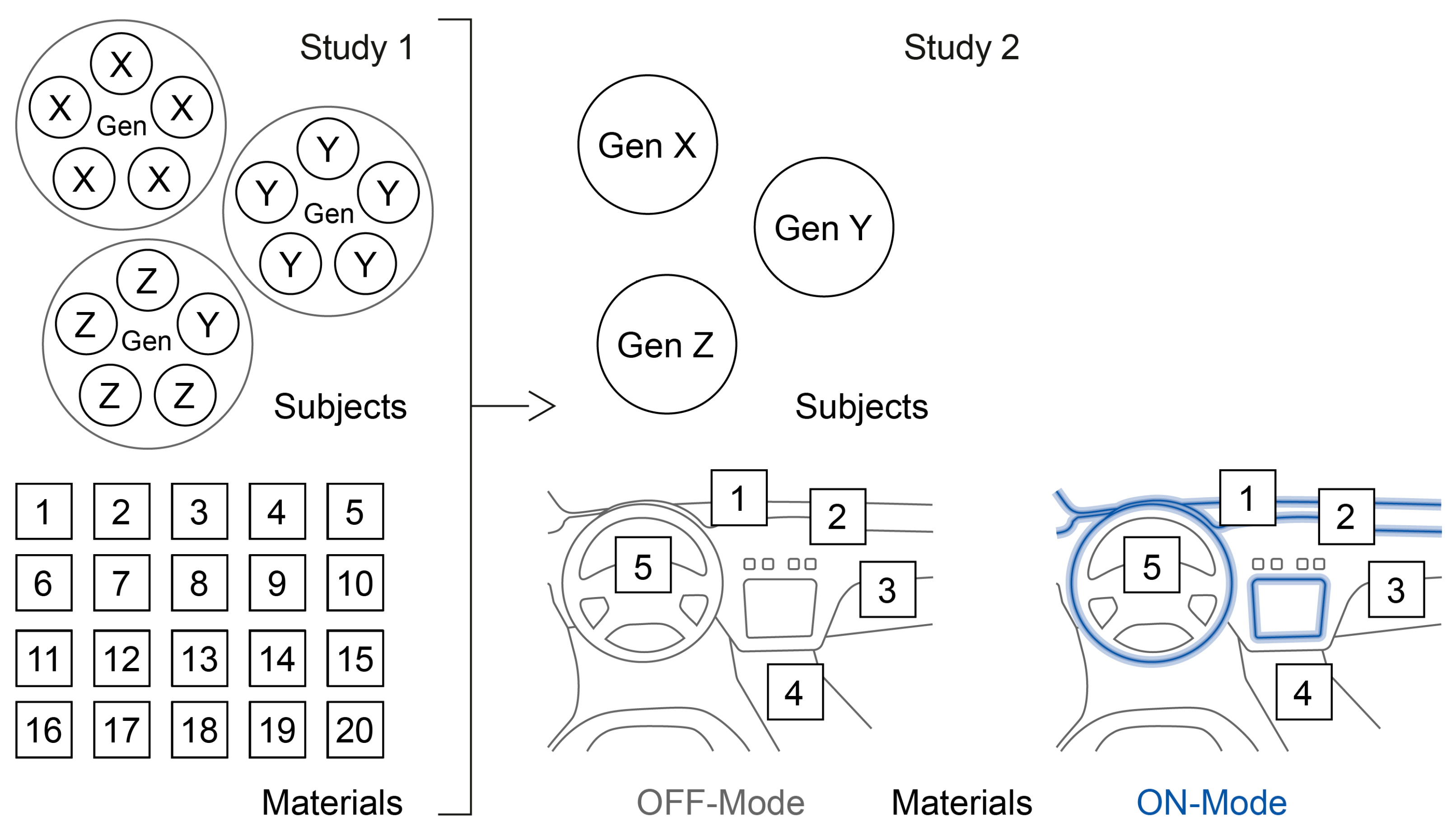
4.2.1. OFF-Mode
- Perceived naturalness of materials
- Wood veneer
- Due to the wooden appearance and haptics of the wood veneer, it was described as natural by some subjects.
It looks extremely natural because it has such a wooden look, or maybe it is wood.[Z4]
At the same time, it’s also very natural, as it has a bit of a wooden look.[Y3]
- Cotton fabric
- Overall, the cotton fabric was perceived as a natural material by most subjects across groups. This was supported in particular by its haptics.
Looks a bit like a natural material, as it has natural fiber.[X2]
It feels at least somehow good, natural.[Y5]
- Brown leather
- Despite some doubts about the authenticity of the brown leather, it was rated as natural by most of the subjects.
Even if it may be artificial leather, it looks very natural to me.[X3]
Since it seems to be real leather, it’s a natural fabric. It also looks very natural.[Y5]
- White leather
- The white leather was perceived as natural in OFF-Mode by noticeably fewer subjects than the brown leather.
Looks natural. But I can also be mistaken. Could also be an artificial leather. But for me at first glance, yes, it actually looks really high quality and also very natural.[Y5]
Natural, in any case. Very classic material.[Z2]
- Cork
- Of all the materials, cork was described as natural by most of the subjects.
Yes, it is a natural product, clearly, cork, occurs in nature. I also find it natural now.[Y5]
It looks very honest. Because it also somehow looks like a natural material.[Z4]
- Relevance of color
- The color of the material matters for the perception of naturalness and was particularly addressed by the subject in the case of cotton fabric and white leather.
- Cotton fabric
Well, I perceive it rather less natural because of the color tone.[Y3]
Natural. Yes, it’s the right shade.[Z3]
- White leather
This is natural. But I think this is more due to the color than the material.[Z5]
- Perceived renewability of materials
- Wood veneer
- The perception of the renewability of wood veneer was closely linked to the assumption that it was real wood and was accordingly positive.
Renewable. Completely. It grows again, is renewable.[X3]
And through this wooden look and things like that, I would also say it looks extremely
renewable.[Y3]
- Cotton fabric
- The opinion of the subjects on whether the cotton fabric is renewable was strongly related to the perception of naturalness. Only in a few cases there were doubts about the renewability.
It will certainly be renewable. Sure, I can recycle that and yes, it is very renewable.[X1]
Renewable. I think it’s a bit difficult to tell for this material.[Y3]
- Brown leather
- The brown leather was rated as renewable, but mostly on the condition that it was not artificial leather. Since only one subject addressed this topic verbally, there is only one quote placed here.
Renewable certainly, is a natural product, I strongly assume. Calfskin can certainly be renewed again.[Y5]
- Cork
- Since cork was identified as a bio-based material, the majority of subjects also considered it as renewable.
Renewable, yes, it is a natural product.[Y1]
If it really is cork, which I’m assuming now, it’s of course also quite good from the renewable and from the sustainability point of view.[Z5]
- Perceived sustainability of materials
- Wood veneer
- In the case of wood veneer, too, the assessment of sustainability was related to the perception of the material naturalness. A few subjects felt this differently due to the high processing of the material.
I don’t know what it’s made of, but it definitely has a lasting effect. Because it has such a natural character somehow.[Z3]
Sustainable, well, you can’t really recycle it. And I also think that they get such nice patterns in, you also need nice thin veneer. I don’t know, is it glued on or not? It’s probably glued on. I think it is rather moderately sustainable.[Y1]
- Cotton fabric
- If the cotton fabric was rated as natural, it also performed well with the subjects with regard to sustainability.
A natural product, I assume strongly. That can also be produced again in nature. That’s why I would classify it as very sustainable.[Y5]
Sustainable. That can probably be recycled pretty well.[X3]
- Brown leather
- Brown leather was perceived as sustainable, yet less than other materials. The reason for this was the question of whether leather production is sustainable or not.
Sustainable. Yes, I think so. Cows are slaughtered, that’s a by-product, there’s nothing wrong with that.[X1]
Whether it is sustainable depends on whether it is real leather or artificial leather. Both are rather questionable, which is why I would classify it as moderately sustainable.[Z2]
- White leather
- The effect described for brown leather also applies to white leather. The level of sustainability was made dependent on the leather production.
If it’s leather, it’s sustainable depending on how the animals are farmed.[X4]
Leather is not necessarily the sustainable material.[Y4]
- Cork
- Cork was found to be sustainable by the majority of the subjects. Few subjects mentioned the dependence of the sustainability on the way the cork was extracted.
If it is sustainable depends on how you win it. It looks sustainable to me.[X4]
I would say it is extremely sustainable. Looks like a natural product.[Y3]
- Doubted authenticity
- A very present topic was the authenticity of the materials. This issue involved the brown and white leather in particular, and it also had an impact on the evaluation of naturalness, renewability, and sustainability.
That’s relatively difficult now, because it can be anything. In the meantime, Mercedes and various manufacturers are so good at imitating leather that you can’t tell at first glance whether it’s real leather or a replica.[X3, brown leather]
This is artificial leather.[X1, white leather]
- Renewable—conceptual understanding
- Some subjects had comprehension problems with the term renewable.
Renewable... renewable...Should I interpret that now in terms of “I can easily renew it” or “it’s a renewable resource-based material”?[Y4, cotton fabric]
Renewable. I don’t know. Since it’s sewn together and pretty shape-retaining, I think it’s hard to replace a single piece. Or do you mean recycling? Or do you mean recycling the material?[Z3, brown leather]
4.2.2. ON-Mode
- Decrease of perceived naturalness of materials
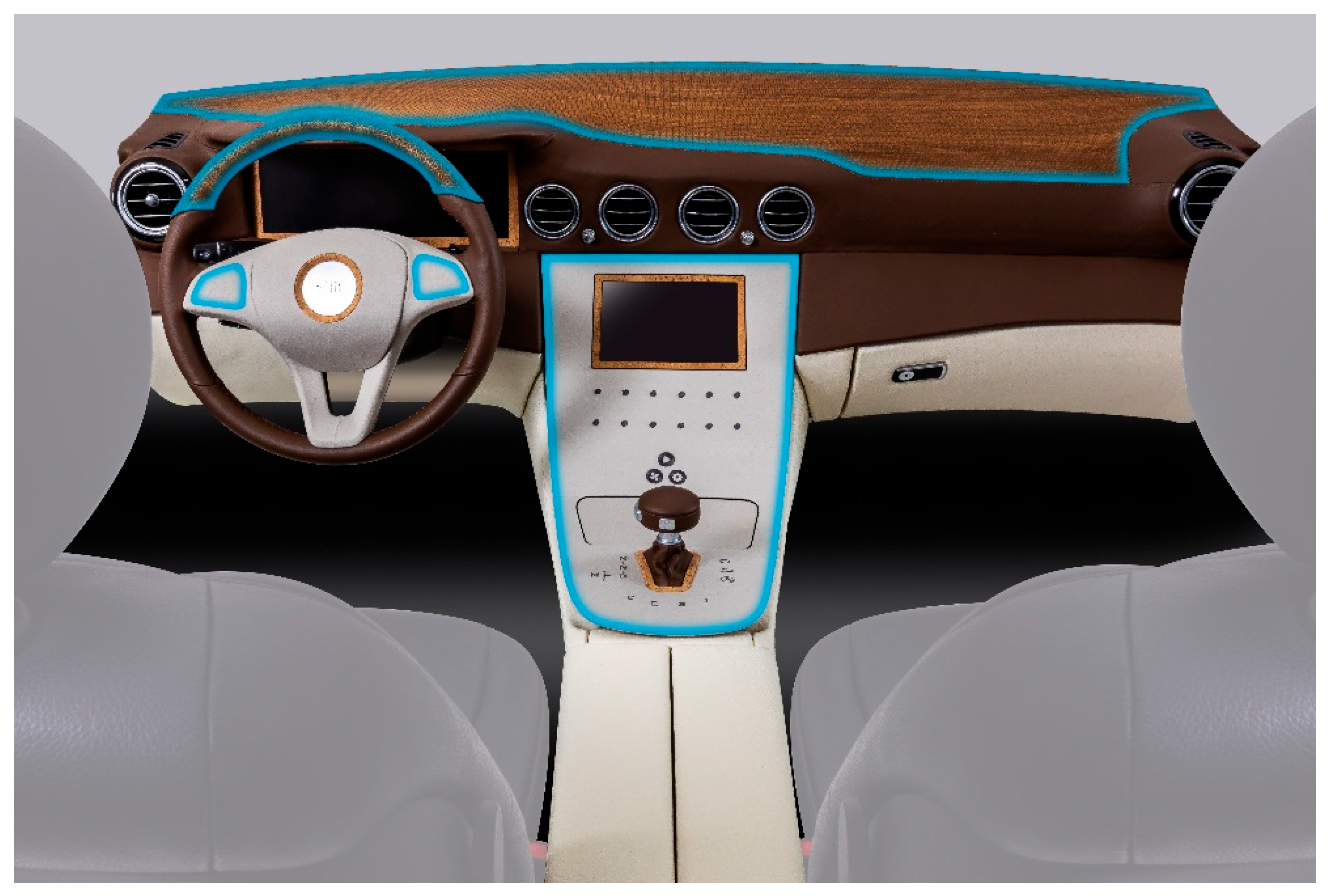
- The cotton fabric and wood veneer materials were perceived as significantly less natural in the ON-Mode than in the OFF-Mode by the subjects.
Well, I think it no longer looks natural, which is simply due to the lights.[Z5, cotton fabric]
Before, it seemed a bit more natural, and now, of course, it greatly reduces the effect.[Z1, wood veneer]
- Persistence of perceived naturalness of materials
- In a few cases, the naturalness of the materials white leather and cork was again addressed. The perceived naturalness of white leather and cork had not decreased. Moreover, the influence of the blue light did not change the naturalness of the cotton fabric and wood veneer for a few subjects.
It is still natural.[Z2, cotton fabric]
Depending on where you look, where the light shines through a bit more, it looks a bit less natural. Although on the other hand that blue: Water and sky are of course also natural, I would say it’s still very natural.[Y3, wood veneer]
- Disagreements about the effect of blue light on material perception
- The blue color of the light was especially criticized for the materials cotton fabric and wood veneer. Some subjects would have desired a warmer color instead.
I think visually it is not better now, Consequently, this shade of blue is a bit annoying.[Z5, cotton fabric]
I think the bright, cold tone of the blue disturbs the warm color of the wood.[Z4, wood veneer]
If these had been small white lights, then I could say: Yes, that is known in nature.[Y1, wood veneer]
- In contrast, numerous subjects found the effect that the blue light created with the wood veneer to be very positive.
I liked this earlier, but now I like it even more.[X3, wood veneer]
This has made it a bit higher in quality and a bit more innovative.[Y3, wood veneer]
The glow that it shines through like that, very cool.[Z2, wood veneer]
It looks cool. It somehow has a bit of a night sky look.[Z3, wood veneer]
- Renewable—conceptual understanding
- Although the subjects who had comprehension problems with the term “renewable” usually already expressed this in the OFF-Mode evaluation and did not repeat it in the ON-Mode, it also became clear in the ON-Mode that the term was not uniformly understood by some subjects.
Renewable. Yes of course, so the LEDs, you can certainly put them in new, it is a mass product, as is the fabric. Of course everything is renewable, the material is renewable and the fittings too.[Y5, cotton fabric]
Renewable. You can easily replace it. I just don’t know what kind of material it is. If it’s cork, it will of course be very high in terms of renewable raw material.[Z5, cork]
5. Discussion
6. Conclusions
Author Contributions
Funding
Institutional Review Board Statement
Informed Consent Statement
Data Availability Statement
Acknowledgments
Conflicts of Interest
Abbreviations
| BEV | Battery Electric Vehicle |
| EFDC | Environmentally Friendly Design Cue |
| EV | Electric Vehicles |
| HEV | Hybrid Electric Vehicle |
| LED | Light-Emitting Diode |
| LCA | Life Cycle Assessment |
| PMMA | Polymethylmethacrylate |
| PVC | Polyvinyl Chloride |
References
- Bangsa, A.B.; Schlegelmilch, B.B. Linking Sustainable Product Attributes and Consumer Decision-Making: Insights from a Systematic Review. J. Clean. Prod. 2020, 245, 118902. [Google Scholar] [CrossRef]
- Petersen, M.; Brockhaus, S. Dancing in The Dark: Challenges for Product Developers to Improve and Communicate Product Sustainability. J. Clean. Prod. 2017, 161, 345–354. [Google Scholar] [CrossRef]
- Kim, B.C.; Rhim, H.; Yang, H. Price Competition or Technology Improvement? An Investigation of Green Car Technology. Int. J. Prod. Res. 2021, 59, 2800–2816. [Google Scholar] [CrossRef]
- European Parliament. EU-Verkaufsverbot für Neue Benzin- und Dieselfahrzeuge ab 2035—Was Bedeutet Das? Available online: https://www.europarl.europa.eu/topics/de/article/20221019STO44572/verkaufsverbot-fur-neue-benzin-und-dieselfahrzeuge-ab-2035-was-bedeutet-das (accessed on 22 September 2025).
- Rossini, M.; Matt, D.; Russo Spena, P.; Luccarelli, M.; Ciarapica, F.E. Electric Vehicles Market Penetration Forecasts and Scenarios: A Review and Outlook. Int. J. Oper. Quant. Manag. 2014, 20, 153–192. [Google Scholar]
- Hekkert, P.; van Dijk, M. Designing from Context: Foundations and Applications of the VIP Approach. In Proceedings of the Design Thinking Research Symposium 5, Delft, The Netherlands, 18–20 December 2001. [Google Scholar]
- Karjalainen, T.M. Strategic Brand Identity and Symbolic Design Cues. In Proceedings of the 6th Asian Design Conference, Tsukuba, Japan, 14–17 October 2003. [Google Scholar]
- Luccarelli, M. Material Perception in Alternative Fuel Car Interiors. Increasing Marketability through Green Design Cues. In Proceedings of the 30th International Electric Vehicle Symposium, EVS30. Stuttgart, Germany, 9–11 October 2017. [Google Scholar]
- Kunkel, D. How to Host Car Clinic. Available online: https://www.wardsauto.com/dealers/how-to-host-car-clinic (accessed on 27 June 2025).
- Arnold, H.; Erner, M.; Möckel, P.; Schläffer, C. Tools for User-Driven Innovation at Deutsche Telekom Laboratories. In Applied Technology and Innovation Management: Insights and Experiences from an Industry-Leading Innovation Centre; Arnold, H., Erner, M., Möckel, P., Schläffer, C., Eds.; Springer: Berlin/Heidelberg, Germany, 2010; pp. 72–88. [Google Scholar] [CrossRef]
- Govers, P. Product Personality. Ph.D. Thesis, Delft University of Technology, Delft, The Netherlands, 15 June 2004. [Google Scholar]
- Govers, P.; Schoormans, J. Product Personality and Its Influence on Consumer Preference. J. Consum. Mark. 2005, 22, 189–197. [Google Scholar] [CrossRef]
- Janlert, L.-E.; Stolterman, E. The Character of Things. Des. Stud. 1997, 18, 297–314. [Google Scholar] [CrossRef]
- Landau, M.J.; Koerber, M.; Loehmann, S. Towards a Multisensory Representation of Electromobility Characteristics. In Proceedings of the 5th International Conference on Automotive User Interfaces and Interactive Vehicular Applications, Eindhoven, The Netherlands, 28–30 October 2013. [Google Scholar]
- Peters, A.; Agosti, R.; Popp, M.; Ryf, B. Electric Mobility: A Survey of Different Consumer Groups in Germany with Regard to Adoption. In Proceedings of the ECEEE 2011 Summer Study on Energy Efficiency: Energy Efficiency First: The Foundation of a Low-Carbon Society, Belambra Presqu’île de Giens, France, 6–11 June 2011. [Google Scholar]
- Turrentine, T.; Garas, D.; Lentz, A.; Woodjack, J. The UC Davis MINI E Consumer Study; Research Report UCDITS-RR-11-05; Institute of Transportation Studies, University of California: Davis, CA, USA, 2011. [Google Scholar]
- MacDonald, E.F.; She, J. Seven Cognitive Concepts for Successful Eco-Design. J. Clean. Prod. 2015, 92, 23–36. [Google Scholar] [CrossRef]
- Lee, J.; Jung, B.; Chu, W. Signaling Environmental Altruism Through Design: The Role of Green Cue Prominence in Hybrid Cars. Int. J. Des. 2015, 9, 79–91. [Google Scholar]
- Wehr, F.; Luccarelli, M. Using Personas in the Design Process. Towards the Development of Green Product Personality for In-Car User Interfaces. In Proceedings of the Design Society: International Conference on Engineering Design, Delft, The Netherlands, 5–8 August 2019. [Google Scholar]
- de Freitas Netto, S.V.; Sobral, M.F.F.; Ribeiro, A.R.B.; Soares, G.R.D.L. Concepts and Forms of Greenwashing: A Systematic Review. Environ. Sci. Eur. 2020, 32, 19. [Google Scholar] [CrossRef]
- Pedgley, O. Capturing and Analysing Own Design Activity. Des. Stud. 2007, 28, 463–483. [Google Scholar] [CrossRef]
- Sargeant, J. Qualitative Research Part II: Participants, Analysis, and Quality Assurance. J. Grad. Med. Educ. 2012, 4, 1–3. [Google Scholar] [CrossRef]
- Subedi, K.R. Determining the Sample in Qualitative Research. Sch. J. 2021, 4, 1–13. [Google Scholar] [CrossRef]
- Miles, M.B.; Huberman, A.M. Qualitative Data Analysis: An Expanded Sourcebook, 2nd ed.; Sage: Thousand Oaks, CA, USA, 1994. [Google Scholar]
- Guest, G.; Bunce, A.; Johnson, L. How Many Interviews Are Enough? An Experiment with Data Saturation and Variability. Field Methods 2006, 18, 59–82. [Google Scholar] [CrossRef]
- Overvliet, K.E.; Soto-Faraco, S. I Can’t Believe This Isn’t Wood! An Investigation in the Perception of Naturalness. Acta Psychol. 2011, 136, 95–111. [Google Scholar] [CrossRef] [PubMed]
- Fujisaki, W.; Goda, N.; Motoyoshi, I.; Komatsu, H.; Nishida, S. Audiovisual Integration in the Human Perception of Materials. J. Vis. 2014, 14, 12. [Google Scholar] [CrossRef] [PubMed]
- Van Someren, M.W.; Barnard, Y.F.; Sandberg, J.A. The Think Aloud Method: A Practical Guide to Modeling Cognitive Processes; Academic Press Ltd.: San Diego, CA, USA, 1994. [Google Scholar]
- Luccarelli, M.; Wehr, F. Future in-Car User Interfaces: Reducing Operation Complexity and Widening Feedback Features. Auto Des. 2021, 248, 66–69. [Google Scholar]
- Martín, R.; Iseringhausen, J.; Weinmann, M.; Hullin, M.B. Multimodal Perception of Material Properties. In Proceedings of the ACM SIGGRAPH Symposium on Applied Perception, Tübingen, Germany, 13–14 September 2015. [Google Scholar] [CrossRef]
- Djonov, E.; van Leeuwen, T. The Semiotics of Texture: From Tactile to Visual. Vis. Commun. 2011, 10, 541–564. [Google Scholar] [CrossRef]
- Population Structure and Aging. Available online: https://ec.europa.eu/eurostat/statistics-explained/index.php?title=Population_structure_and_ageing (accessed on 24 October 2025).
- Karana, E.; Barati, B.; Rognoli, V.; van der Laan, A.Z. Material Driven Design (MDD): A Method to Design for Material Experiences. Int. J. Des. 2015, 9, 35–54. [Google Scholar]
- Kuchenbecker, J.; Broschmann, D. Farbtafeln zur Prüfung des Farbensinnes/Farbensehens, 36th ed.; Thieme Verlag: Stuttgart, Germany, 2022. [Google Scholar]
- O’Connor, C.; Joffe, H. Intercoder Reliability in Qualitative Research: Debates and Practical Guidelines. Int. J. Qual. Methods 2020, 19, 1609406919899220. [Google Scholar] [CrossRef]
- Adafruit. NeoPixels. Available online: https://www.adafruit.com/product/1487 (accessed on 27 June 2025).
- LED Color SK6812. Technical Data Sheet. Available online: https://cdn-shop.adafruit.com/product-files/1138/SK6812+LED+datasheet+.pdf (accessed on 27 June 2025).



| No. | Sample | Material | Sample Characteristic | (a) Properties/ (b) Design Cue origin | Color | Visual Texture | Haptics | Relevance for EFDCs |
|---|---|---|---|---|---|---|---|---|
| 1 |  | wool fabric | material | (a) fine fabric, 100% new wool, zig-zag twill | grey/white | medium density | softness, warmth | bio-based |
| 2 |  | woven felt | material | (a) 100% wool | dark blue | fibers, medium density | rough- ness | bio-based |
| 3 |  | cotton fabric | material | (a) lightly sanded, satin weave | beige | homogeneity | softness, warmth | bio-based |
| 4 |  | cork | material | (a) thin, fine worked | light brown | wooden look, relief | softness, warmth, smooth- ness | bio-based |
| 5 |  | PMMA, acrylic glass | imitation | (b) Volkswagen | blue | shine | smooth- ness | color and reaction to light |
| 6 |  | Viscose fabric | material | (a) satin character, satin weave | green/blue | shimmer | smooth- ness | bio-based |
| 7 |  | cast PVC foil | imitation | (b) Volkswagen | blue | shine | smooth- ness | color and finish |
| 8 |  | PMMA, acrylic glass | imitation | (b) Porsche | acid green | glare | smooth- ness | color and reaction to light |
| 9 |  | natural-fiber composites | material | (a) Purcell, 100% cellulose | light beige | wooden look, medium density, shine | smooth- ness, warmth | bio-based |
| 10 |  | bark | material | (a) thin, calendered | brown | fibers, relief | rough- ness | bio-based |
| 11 |  | leather | material | (a) cow, olive leaf tanned, biologically dyed | dark green | relief | soft | bio-based |
| 12 |  | natural- fiber compo- sites | material | (a) flax fabric, bio-based polyamide matrix | grey | low density, fibers, shine | smooth- ness | bio-based |
| 13 |  | cast PVC foil | imitation | (b) Volkswagen | green | glare, shine | smooth- ness | color and finish |
| 14 |  | PMMA, acrylic glass | imitation | (b) MINI | yellow | glare, shine | smooth- ness | color and reaction to light |
| 15 |  | wood veneer | material | (a) beech, structured, flexible, laser cut | dark brown | wooden look, low density, relief, heterogeneity | wooden haptic | bio-based |
| 16 |  | cast PVC foil | imitation | (b) Smart | blue metallic | shimmer, shine | smooth- ness | color and finish |
| 17 |  | cast PVC foil | imitation | (b) Porsche | acid green | glare, shine | smooth- ness | color and finish |
| 18 |  | cast PVC foil | imitation | (b) MINI | yellow | glare, shine | smooth- ness | color and finish |
| 19 |  | cast PVC foil | imitation | (b) BMW | blue metallic | shimmer, shine | smooth- ness | color and finish |
| 20 |  | natural- fiber compo- sites | material | (a) tangled scrim, hemp, flax, sisal, epoxy resin | brown | fibers, medium density, relief, heterogeneity | bio-based |
| Theme | Subtheme | Key Facts |
|---|---|---|
| Material properties supporting environmental friendliness perception | Roughness Soft and warm surface Relief and medium to low density Visible fibers Wooden feel and look | Perception of heterogeneous surfaces, characterized by the properties mentioned in the subthemes, as environmentally friendly |
| Material properties reducing perception of environmental friendliness | Glare Shimmer Shiny surface Smoothness | Perception of homogeneous surfaces, characterized by the properties listed in the subthemes, as less environmentally friendly |
| Color | Blue Brown Green Green-Blue Yellow | Individual associations of brown mostly as environmentally friendly. No general categorization for or against environmental friendliness perception for other colors possible |
| Doubts regarding authenticity | - | Natural appearance perceived as intentional deception |
| Interpretation of the term renewable | - | Misinterpretation of renewable as reproducible |
| Material | Material Properties Supporting Perception of Environmental Friendliness | Car Interior Components |
| Brown leather (11) | Texture, color brown | Crash pad, steering wheel |
| Cork (4) | Texture, soft and warm surface, color brown | Applications around displays, gearshift lever, and logo on steering wheel |
| Cotton fabric (3) | Soft and warm surface | Center console |
| White leather (11) | Texture | Crash pad, center tunnel console |
| Wood veneer (15) | Wooden feel and look, texture, color brown | Crash pad, steering wheel |
| Color | Wavelength (nm) | Luminous Intensity (mcd) |
|---|---|---|
| Red | 620–625 | 700–1000 |
| Green | 522.5–525 | 1500–2200 |
| Blue | 467.5–470 | 700–1000 |
| Theme | Subtheme | Key Facts |
|---|---|---|
| Perceived naturalness of materials | Brown leather | Majority perception of the materials as natural; Slightly less frequent perception of the naturalness of white leather |
| Cork | ||
| Cotton fabric | ||
| White leather | ||
| Wood veneer | ||
| Relevance of color | Cotton fabric | Existing relevance of color for perception of naturalness |
| White leather | ||
| Perceived renewability of materials | Brown leather | Dependence of perception of renewability on authenticity |
| Cork | Link between perception of renewability and bio-baseness | |
| Cotton fabric | Link between perception of naturalness and perception of renewability | |
| Wood veneer | Link between authenticity and renewability | |
| Perceived sustainability of materials | Brown leather | Mixed perception of sustainability |
| Cork | Strong perception of renewability | |
| Cotton fabric | Link between perception of naturalness and perception of sustainability | |
| White leather | Mixed perception of sustainability | |
| Wood veneer | Link between perception of naturalness and perception of sustainability; Doubts due to high material processing | |
| Doubted authenticity | - | Dependence of the assumption of authenticity in brown and white leather on perceived naturalness, renewability, and sustainability |
| Renewable—conceptual understanding | - | No consistent comprehension of the term |
Disclaimer/Publisher’s Note: The statements, opinions and data contained in all publications are solely those of the individual author(s) and contributor(s) and not of MDPI and/or the editor(s). MDPI and/or the editor(s) disclaim responsibility for any injury to people or property resulting from any ideas, methods, instructions or products referred to in the content. |
© 2025 by the authors. Licensee MDPI, Basel, Switzerland. This article is an open access article distributed under the terms and conditions of the Creative Commons Attribution (CC BY) license (https://creativecommons.org/licenses/by/4.0/).
Share and Cite
Wehr, F.; Luccarelli, M. Environmentally Friendly Product Personality: The Role of Materials, Color, and Light in Car Interiors. Sustainability 2025, 17, 10129. https://doi.org/10.3390/su172210129
Wehr F, Luccarelli M. Environmentally Friendly Product Personality: The Role of Materials, Color, and Light in Car Interiors. Sustainability. 2025; 17(22):10129. https://doi.org/10.3390/su172210129
Chicago/Turabian StyleWehr, Franka, and Martin Luccarelli. 2025. "Environmentally Friendly Product Personality: The Role of Materials, Color, and Light in Car Interiors" Sustainability 17, no. 22: 10129. https://doi.org/10.3390/su172210129
APA StyleWehr, F., & Luccarelli, M. (2025). Environmentally Friendly Product Personality: The Role of Materials, Color, and Light in Car Interiors. Sustainability, 17(22), 10129. https://doi.org/10.3390/su172210129