Review

Unveiling the Synergistic Effects in Graphene-Based Composites as a New Strategy for High Performance and Sustainable Material Development: A Critical Review

by
Jie Xiao
1,†,
Xingxing Gao
1,†,
Jie Xu
2,*,
Juzhong Tan
3,
Xuesong Zhang
4 and
Hongchao Zhang
1,*
1
Key Laboratory of Fruit and Vegetable Processing of Ministry of Agriculture and Rural Affairs, Beijing Key Laboratory for Food Non-Thermal Processing, College of Food Science and Nutritional Engineering, China Agriculture University, Beijing 100083, China
2
Center for Nanotechnology and Nanotoxicology, Department of Environmental Health, Harvard T. H. Chan School of Public Health, Harvard University, Boston, MA 02115, USA
3
Department of Animal and Food Sciences, University of Delaware, Newark, DE 19716, USA
4
Engineering Laboratory for AgroBiomass Recycling & Valorizing, College of Engineering, China Agricultural University, Beijing 100083, China
*
Authors to whom correspondence should be addressed.
These authors contributed equally to this work.
Sustainability 2025, 17(22), 10058; https://doi.org/10.3390/su172210058
Submission received: 28 August 2025 / Revised: 26 October 2025 / Accepted: 5 November 2025 / Published: 11 November 2025
(This article belongs to the Section Sustainable Materials)

Abstract

Graphene-based materials have been the subject of extensive scientific investigations owing to their distinctive properties and versatile functionalities. However, their applications are hindered due to limited material performance, difficulties in recycling, and high costs during manufacturing. Considering this, studies have developed graphene or its derivatives by combining it with other components, while some of these composites revealed significantly improved performance with lesser consumption of raw materials; the underlying mechanisms remain inadequately elucidated. Therefore, the aspiration for novel applications of graphene-based materials could be significantly improved with the full utilization of the synergistic effects of these materials. In this review, we intend to discuss the synergistic activities and their inherent mechanisms between graphene or its derivatives and metals, metal oxides, polymers, and bioactive compounds, among others. The effectiveness of synergisms in enhancing the performance of graphene-based composites is corroborated by studies in a variety of application areas such as antimicrobial materials, cancer therapy, sensors, electronic devices, catalysts, and more. The content presented will be useful to guide the future development of graphene-based materials that are highly efficient and environmentally friendly.

1. Introduction

Graphene, a two-dimensional (2D) honeycomb lattice of sp2-bonded carbon atoms, and its derivatives (e.g., graphene oxide (GO), reduced GO (rGO), and functionalized variants) have emerged as quintessential model systems for probing interfacial phenomena in materials science [1]. Synthesized via oxidative exfoliation of graphite, GO exemplifies interfacial modification through covalent grafting of oxygen-containing functional groups (epoxy, carbonyl, carboxyl) onto its basal planes and edges, creating reactive sites for subsequent conjugation with polymers, metals, or biomolecules—a cornerstone of composite design [2,3,4]. Conversely, the reduction of GO to rGO partially restores the sp2-conjugated network, dynamically tuning electronic properties and wettability, thereby offering a versatile toolkit for tailoring interactions in hybrid systems [5]. Although pristine graphene derivatives possess exceptional intrinsic properties—such as an ultra-high specific surface area (2630 m2·g−1) and outstanding mechanical strength—their widespread commercialization remains constrained by several critical challenges. These include the high cost of scalable production of high-quality materials, difficulties in processing and integration into existing manufacturing systems, and the complex, often unpredictable relationship between their structural characteristics (e.g., number of layers, defect density) and the resulting performance in specific applications. For instance, irreversible aggregation due to van der Waals forces and π-π stacking compromises accessible surface areas, while inadequate adhesion in standalone graphene sheets restricts charge/energy transfer efficiency in applications like catalysis or antimicrobial surfaces [6,7,8]. Such limitations underscore the necessity of engineering strategies to harness graphene’s full potential.
Recent advances in graphene-based composites emphasize the deliberate integration of graphene with secondary components (metals, metal oxides, polymers) through interfacial bonding mechanisms—covalent coupling, π-π interactions, or electrostatic adsorption [9,10]. The exceptional performance of graphene-based composites originates from the intrinsic properties of graphene and its derivatives, possibly improved with the contributions from additive components to form composites. The essential properties of graphene-based composites include extremely high specific surface area, exceptional mechanical properties, outstanding electrical conductivity, and excellent thermal properties, among others [5,11]. For example, in antimicrobial systems, graphene–metal oxide hybrids leverage both the physical disruption of bacterial membranes (via graphene’s sharp edges) and interfacial electron transfer to metal centers for reactive oxygen species (ROS) generation. Similarly, in catalytic applications, the graphene support interface facilitates charge redistribution, optimizing adsorption energies of reactants and intermediates [12,13,14,15]. Such significantly enhanced functionalities may often be referred to as “synergistic effects”, a concept widely recognized in biological systems, which plays an equally pivotal role in materials science [16,17,18,19,20]. Strong synergism not only improves the material’s performance but also significantly reduces the usage of each individual material component while achieving the same target performance, which promotes sustainability in material manufacturing. Despite these advances, most studies focus on final composite performance rather than deconvoluting synergistic contributions. It is also extremely challenging to validate the interactions between graphene and additives dictating synergy and their quantitative correlations. A few studies have discussed the synergistic actions of graphene-based composites. For instance, studies hypothesized that graphene and its derivatives simultaneously exert physical actions by sharp edges and chemical actions by fast electron transfer at the graphene–additive interfaces [21,22]. Others inferred that graphene provides high surface area and charge mobility, while secondary components contribute specific reactivity or stability components (e.g., metal or metal oxide particles) [23].
Therefore, it is of importance to understand the current status of graphene-based composites with synergistic effects and their corresponding mechanisms to determine its enhanced performance in different applications [24].
Based on the statistical data of graphene-based materials obtained through the Web of Science (date of search: 15 August 2025), the number of publications searched with the keyword “graphene composites” increased rapidly from 2010 to 2024 (Figure 1A). It clearly showed that graphene-based composites have been extensively studied within scientific communities. However, systematic reviews of the existence of synergistic effects within graphene composites and mechanistic studies on synergy remain sparse.
Graphene-based composites possess diverse application domains, including antibacterial agents, antiviral therapeutics, cancer treatment, catalysis, surface coatings, energy storage, electrical conduction, mechanical reinforcement, biosensors, anticorrosion, membrane filtration, etc. [3,5,17]. In this review, we have systematically and comprehensively evaluated most of the above-mentioned applications. Unlike other reviews, a particular emphasis is placed on the synergistic effects exhibited by these materials, as illustrated in (Figure 1B). Furthermore, we aim to elucidate the fundamental synergistic mechanisms and propose standardized criteria to distinguish genuine synergy from coincidental enhancements. Our analysis is intended to inspire the rational design of next-generation composite materials with unprecedented multifunctionality and improved sustainability.

2. Synergistic Effects Observed in Graphene-Based Composites

2.1. Antimicrobial Graphene-Based Composites (AGCs)

Moderate levels of antimicrobial actions of graphene and its derivatives have been observed against a wide scope of microorganisms [2,25,26,27]. In recent years, more efforts have been made to develop more efficient engineered composites, i.e., AGCs for realistic applications [28]. The enhanced antimicrobial actions by AGCs relied on the properties of graphene nanosheets, which can cut, insert, or wrap the target microorganisms as well as interracially support the simultaneous attacks from functional additives on similar or different cellular components of microorganisms. As a result, the dual-action properties impart cumulative or intensified stresses on the microorganisms within a short period, causing cell lysis [29], with significantly reduced additive loading. Synergistic effects in AGCs across various application areas are summarized below.

2.1.1. AGCs Revealing Synergistic Effects for Clinic Application

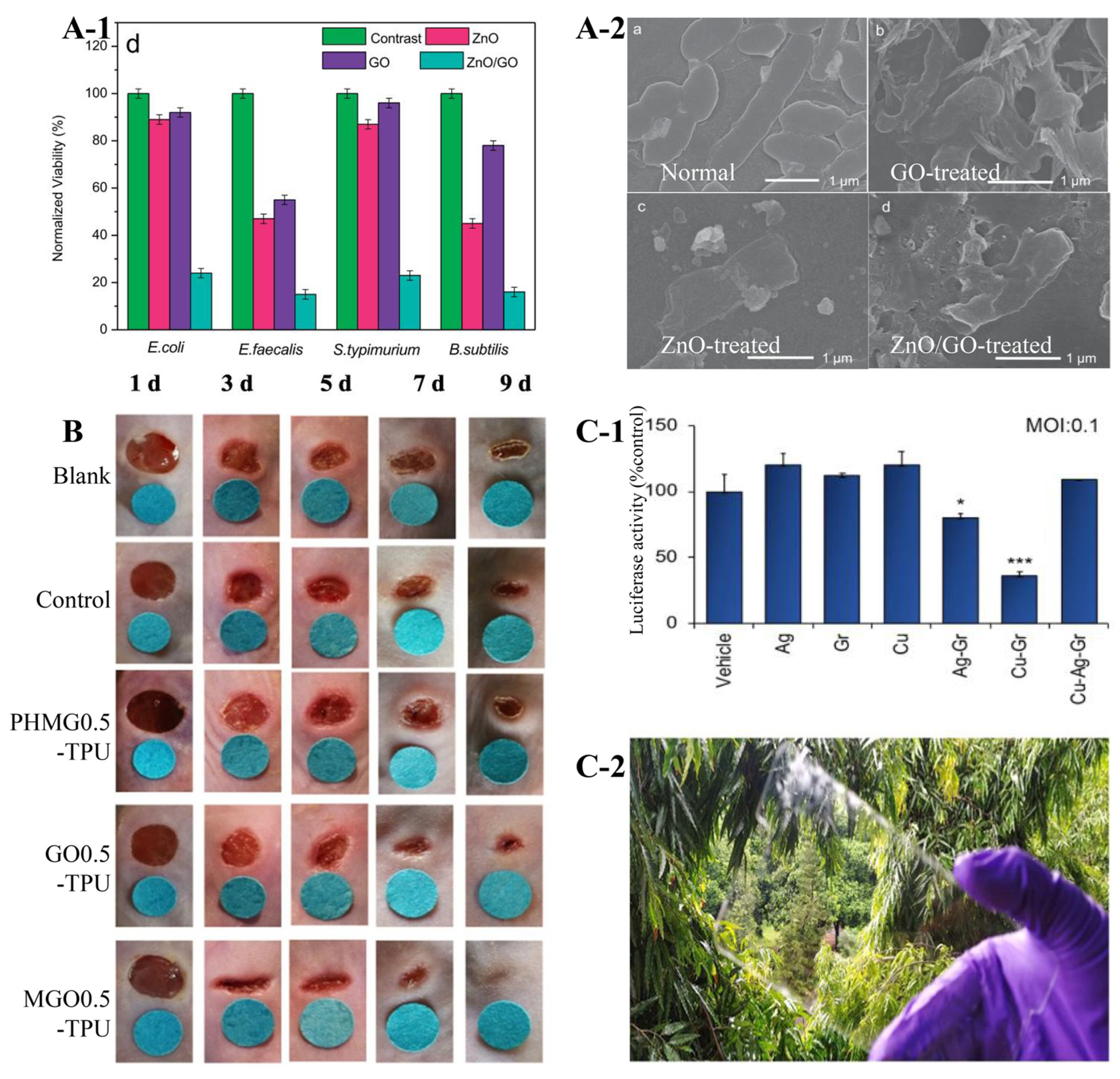
Bacterial infections on wounded skins or soft tissues present major clinical challenges, especially with the rising threat of multidrug-resistant pathogens due to the overuse of antibiotics [30,31]. In vitro studies have initially demonstrated that most AGCs with synergistic enhanced antimicrobial capabilities serve as proper antibiotic alternatives to control bacterial infections caused by organisms including Escherichia coli (E. coli), Staphylococcus aureus (S. aureus), and Proteus mirabilis (P. mirabilis) [32,33,34,35]. In Figure 2A-1, the results show that the spindle-shaped GO and ZnO composite led to an 80% reduction against E. coli and Salmonella typhimurium (S. typhimurium) compared to only 15% for ZnO or GO alone. However, such trends were not observed for other tested microorganisms. At the same concentration, it exhibited significantly stronger antimicrobial activity, making the composites a promising material for medical application [36]. It has been proposed that GO nanosheets may facilitate the entry of ZnO nanoparticles by disrupting bacterial walls (Figure 2A-2), while the liberated Zn2+ could bind to cell membranes and deactivate proteins and enzymes crucial for bacterial growth, chiefly targeting their thiol group (-SH) [36,37]. Thermally reduced graphene oxide (TRGO) combined with ZnO was also reported to exhibit superior bioactivity compared to ZnO and TRGO alone against biofilms of S. aureus, E. coli, and Pseudomonas aeruginosa, which could present in the wound. Beyond functional efficacy, systematic evaluation under wound healing conditions confirmed both biocompatibility and safety, positioning TRGO/ZnO nanocomposites as a new generation of clinically viable bioactive nanomaterials [38].
GO-AgNPs composites, synthesized by complexing Ag and GO, have also shown this synergistic inhibitory effect. GO-AgNPs exhibited a 73% inhibition rate against E. coli and 98.5% against S. aureus. In contrast, GO and AgNPs only displayed an 11% and 18% antibacterial effect, respectively, against E. coli, but this increased to 43% and 52% for S. aureus. This indicates that lower doses of GO-AgNP composites can achieve effective microbial inhibition, attributable to both enhanced bacterial surface adhesion and a higher rate of reactive oxygen species (ROS) production [41]. The inhibitory effects of AGCs on Gram-positive and Gram-negative bacteria are subjected to distinctive behaviors due to the significant variability in the structure of their cell walls. Graphene-based composites are less effective against Gram-negative bacteria, probably owing to their outer membrane composed of a glycerophospholipid and a lipooligosaccharide layer on their surface. The outer membrane protects Gram-negative bacteria from external damage, such as reactive oxygen species [42]. AGCs containing metals or metal oxides are also used as disinfection agents in surface coatings on medical devices to protect material surfaces against microbial adhesion and biofilm formation [43]. Remarkably, the developed rGO-nAg composites, using a simple complexation method, can eradicate nearly 100% S. aureus and P. mirabilis within 2 h–2.5 h, whereas rGO and nAg achieved complete inhibition by the end of 4 h [34]. The physical interaction of the sharp edges of rGO sheets [44,45], along with rGO’s entrapment of bacterial membranes, ensuring higher local silver ion concentrations, contributes to the increase in the permeation of Ag+ into the bacteria [34]. The composite achieved comparable effects within a shorter time frame, indicating that specific metal or metal oxide-based AGCs can exhibit synergistic effects. A deeper understanding of the physical and chemical interactions at the interface between AGCs and bacteria, however, is still necessary.
Antimicrobial hydrogels, known for their optimal water retention properties, have become a focal point for the development of wound dressings. Jian et al. developed an antibacterial hydrogel with controlled water loss by incorporating modified graphene oxide (MGO) into a thermoplastic polyurethane (TPU) matrix. The obtained material (MGO-TPU) inhibited 90.49% of bacteria on mouse tissues, whereas both TPU-GO (61.81% reduction) and TPU-polyhexamethylene guanidine hydrochloride (33.84% reduction) showed limited inhibition rates. Moreover, wounds treated with MGO-TPU healed notably quicker than those treated with other materials (Figure 2B) [39]. The results indicated potential synergies for enhancing wound healing capacity, although the authors did not explicitly state this. Similarly, polydopamine-coated bioactive glass (BGs@PDA) was integrated with reduced graphene oxide (rGO) to enable synergistic antibacterial therapy through silver nanoclusters (AgNCs) and near-infrared (NIR) photothermal activation. In co-culture experiments with both S. aureus and E. coli, the composite achieved nearly 100% bactericidal efficiency [46]. In vivo studies using mouse models have similarly reported wound healing effects with the treatment of Azithromycin @GO-polyethyleneimine-citraconic anhydride [43], GO/quaternary ammonium salt [44], Rose Bengal/GO/Polyvinyl alcohol (PVA) hydrogen [45], or graphene oxide/Ag/Collagen Coating [47].
Additionally, AGCs have displayed enhanced effectiveness in tackling bacterial infections caused by methicillin-resistant Staphylococcus aureus (MRSA) [31,44,48]. This improved effectiveness was observed in curcumin/GO [49] and gallic acid/GO [50]. It was reported that GO can be inserted into the bacterial membrane to deliver the poorly soluble curcumin to fight against MRSA due to its high loading surface area. While GO alone showed no bacterial inhibition at concentrations below 37.5 mg/mL, curcumin/GO showed efficacy against MRSA at a concentration of less than 0.002 mg/mL [49]. The authors indicated a synergistic activity of GO and curcumin based on the minimum inhibitory concentration (MIC) of curcumin in the literature, ranging from 125 mg/mL to 256 mg/mL, whereas no testing of curcumin alone was performed. When irradiated by near-infrared (NIR) light, AGCs quickly absorb optical energy and convert it to localized heat above 50 °C. NIR acts synergistically against microorganisms due to the additional membrane stresses or increased sensitivity of microbes to Au nanostar nanocomposite (AuNS) within the AGCs at elevated temperatures [50,51]. Enhanced by NIR, rGO/AuNS prepared using the seed-mediated growth method exhibited 90% MRSA eradication within 6 min, higher than rGO/AuNS without NIR (less than 16%) and NIR alone (almost none). Graphene sheets facilitated AuNS-mediated disruption of the bacterial cell membrane, increasing direct contact with the cells and, thus, antimicrobial efficacy [48]. The clinical application of metal-based antimicrobial agents may pose potential toxicity risks. There is a necessary need for more research on the biocompatibility and cell toxicity of developed AGCs.
Based on the observed antimicrobial effects and underlying mechanisms of various ACGs, it can be inferred that the unique spatial structure of graphene enables enhanced bacterial membrane adhesion, potentially through physical insertion into the lipid bilayer. This facilitates the delivery of antimicrobial agents. Furthermore, ACGs facilitate the transfer of reactive oxygen species (ROS), which assists in disrupting the bacterial cell membrane and thereby intensifies its antimicrobial efficacy. This multi-faceted mechanism supports its promising potential for clinical applications, such as wound dressings, antibacterial coatings, and targeted antimicrobial therapies. In addition, using AGCs for denture fabrication, restorative treatment, or implant coating in dental treatments has been summarized elsewhere [52].

2.1.2. AGCs Revealing Synergistic Effects for Water Purification

The presence of pathogens in water systems seriously threatens human health [53]. Employing polymer-based AGC films in water purification presents a promising tactic to eliminate pathogenic microorganisms while preserving water quality. The films operate via membrane filtration, where GO physically damages the bacterial membrane due to its high specific area with numerous functional groups, such as hydroxyl, carboxyl, and epoxy groups [54,55]. Assembly of pi-conjugated quaternary ammonium groups (piQA) with hydrothermally formed rGO hydrogel quickly kill most E. coli within 110 s, in contrast to the 10 min inactivation time of piQA alone, and significantly reduced processing time while enhancing antimicrobial efficiency. However, rGO led to a viability reduction of just under 30%. The high antibacterial performance of piQA-rGO may be influenced by the interactions between bacteria and the QA group, as well as the high local concentration of QA groups resulting from the rGO hydrogel’s surface area and porosity [56]. Another promising material, ε-poly-L-lysine (PLL), can be used to covalently functionalize hierarchically porous GO sponge for water treatment. This resulted in 61% retention of E. coli and 53% retention of B. subtilis, which is significantly higher than the 25% and 5% retention rates observed for the GO sponge without PLL, respectively. Moreover, the effective PLL concentration for synthesizing GO/PLL was less than half of the MIC value. The improved bacteria retention is likely due to a synergistic combination of physicochemical attachment and physical straining [57]. The demineralization of synthetic wastewater using AGC materials revealed the low photocatalytic performance of graphene oxide and its reduced form. However, the photothermal conversion efficacy of ZnO-GO [37] and Ni-rGO [58] under NIR irradiation was markedly enhanced compared to the usage of the individual material. The intense localized hyperthermia caused by excellent photocatalytic performance can substantially compromise cell membrane integrity and promote cellular glutathione oxidation, rendering bacteria vulnerable to ROS generated from the separation of photoinduced electrons or holes. Notably, the long-term removal efficacy and stability of AGCs for water purification still require validation to confirm the duration of their synergistic effect, particularly in the format of a film.

2.1.3. AGCs Revealing Synergistic Effects for Packaging Development

Microbial contamination presents a significant threat to food safety, leading to both economic losses and potential health risks. Developing packaging with AGCs is a possible way to decontaminate microorganisms as well as reduce unsustainable material consumption. Graphene sheets combined with food-grade polymers, such as poly (lactic acid) (PLA) and PVA have demonstrated synergistic antimicrobial effects. Additionally, they exhibit higher biocompatibility and better barrier properties when compared to graphene sheets and polymers used alone [59,60]. Starch/rGO, synthesized using a hydrothermal method, effectively functionalized with amylose and accommodates polyiodide to form starch/rGO/polyiodide nanocomposites. The resulting nanocomposite showed inhibition zones of 22.2 ± 2.2 mm and 20.2 ± 0.9 mm against E. coli and S. aureus, respectively, while starch/rGO alone did not exhibit any inhibition [60]. The authors presented the synthetic routes and antibacterial efficacy of the composites. The bactericidal mechanism was speculated but not experimentally validated. In addition, the synergistic effect of rGO, ZnO, and palladium nanoparticles (Pd NPs) demonstrated enhanced catalytic and antibacterial activities against a range of human pathogens, including P. aeruginosa and Klebsiella pneumoniae (K. pneumonia) [61]. Here, rGO sheets increased reactive surface area for Pd NPs and ZnO particles growth, intensifying their bactericidal power by disturbing cell wall permeability and generating several hydroxyl radicals, leading to cell death. Regrettably, comparisons between the antimicrobial capacities of AGCs, the individual components, and the polymers were not conducted in these studies. Moreover, real food systems are very complex, and when AGCs, including graphene and non-graphene components (like polyiodide), come into contact with food components, the production of the intended synergistic antimicrobial effect is not guaranteed [62]. Thus, further research is needed to investigate the antimicrobial capacity of AGCs on food products, as well as their impact on food quality when applied directly.

2.1.4. AGCs Revealing Synergistic Effects on Other Antimicrobial Applications

The potency of AGCs extends to miscellaneous applications, including the critical response to the global threat of COVID-19 which underscores the pressing demand for affordable and scalable antiviral materials. Das Jana et al. developed a PVA-based copper–graphene nanocomposite coating that showed strong antiviral activity (64% reduction) in a solid phase, while graphene or Cu alone showed negligible antiviral activity (Figure 2C-1). Graphene sheets can interact with the lipid bilayer membrane of the influenza virus envelope, clustering multiple viruses together on the graphene, which then positions the viruses in proximity to the Cu2O nanoparticles. Such nanoparticles could disrupt the HA protein, one of the major surface antigens. As depicted in Figure 2C-2, this nanocomposite is transparent and can be used as a cell phone screen protector. The author expected a wider application of this material on other surfaces, such as face masks, doorknobs, and medical instruments [40]. In addition to inhibiting the growth of viruses, AGCs are also highly effective as fungicides. Mancozeb and Cyproconazol, as broad-spectrum fungicides, physically loaded onto GO, can contribute to synergistic antifungal activity against the plant pathogenic fungus Fusarium graminearum. Mancozeb-GO (2.5–80%) and Cyproconazol-GO (34.62–89.13%) composites showed significantly higher efficacy in controlling the mycelial growth of Fusarium graminearum compared to GO (less than 10%), Mancozeb (9.87–67.4%), or Cyproconazol (28.91–70.04%) alone [63]. A similar synergistic antifungal effect was observed with Pyraclostrobin-GO composites [64], demonstrating their potential as ideal candidates for antibacterial surface coatings and plant fungicides. AGCs’ potent antiviral and antifungal characteristics position them ideally for use in antimicrobial surface coatings in medical facilities, protective equipment like face masks, and plant fungicides. However, further research is necessary to investigate the potential impact of the use of these materials on human health and ecosystems.
As demonstrated in Table 1, the material components of AGCs, their capacities as evidenced by key data, and the categories of working mechanisms reported by selective studies with significant synergistic effects aiming to be applied in antimicrobial area are summarized.
Table 1. Representative studies demonstrating significant synergistic antimicrobial effects in AGCs.
Graphene MaterialsSynergistic
Components
Target
Microorganisms
Synergistic Antimicrobial
Capacity
Synergistic
Mechanisms
ApplicationsReference
rGOPeptide (Cathelicidin-2)Escherichia coli (E. coli)The rGO-peptide complex resulted in 21.8 mm and 16.5 mm inhibition zones compared with 13.3 mm with rGO alone.Unique surface propertyClinic applicationJoshi et al., 2020 [25]
GOZnO nanoparticlesE. coli
Bacillus subtilis (B. subtilis)
ZnO/GO inactivated >80% of E. coli and 90% of B. subtilis, while it only inactivated 15% of E. coli and 50% of B. subtilis in the same condition with ZnO or GO alone.Cumulative effectClinic applicationZhong et al., 2018 [36]
GOPolyhexamethylene guanidine hydrochloride (PHMG)/thermoplastic polyurethane (TPU)E. coli
Staphylococcus aureus (S. aureus)
GO-PHMG/TPU inactivated 28.21% of E. coli and 30.88% of S. aureus even after 30 days, while PHMG/TPU inactivated 5.22% and 4.56% and GO/TPU inactivated 71.26% for E. coli and 76.96% for S. aureus.N/AClinic applicationJian et al., 2020 [39]
GOQuaternary ammonium salts (QAS)E. coli
S. aureus
GO-QAS at 200 μg/mL almost completely killed both E. coli and S. aureus, while GO and QAS caused approximately 87% and 92% cell death for S. aureus and 75% and 88% cell death for E. coli, respectively.Cumulative effectClinic applicationLiu et al., 2018 [44]
GOCurcuminMethicillin-resistant Staphylococcus aureus (MRSA)Curcumin/GO showed efficacy against MRSA at a concentration below 0.002 mg/mL, while MIC of GO is 37.5 mg/mL and MIC of curcumin alone against MRSA ranges from 125 to 256 mg/mL.Unique surface propertyClinic applicationBugli et al., 2018 [48]
rGOSilver nanoparticlesS. aureus
Proteus mirabilis
(P. mirabilis)
rGO-nAg killed almost 100% of S. aureus and P. mirabilis within 2–2.5 h compared to 4 h with rGO or nAg alone.Cumulative effectClinic applicationPrasad et al., 2017 [33]
GOAgNPs/polydopamine (PDA)/TiE. coli
S. aureus
PDA/GO/AgNPs-Ti resulted in 99.8% and 99.6% effectiveness against E. coli and S. aureus, which is significantly higher than that of pure Ti and PDA/GO-Ti (<20%)Cumulative effectClinic applicationXie et al., 2017 [47]
GOGold nanoclustersS. aureusGO and AuNCs resulted in 17% and <5% bacterial inactivation rates, compared with 34% for the GO-AuNP composite.Cumulative effectClinic applicationZheng et al., 2019 [65]
rGO (montmorillonite modified, MTT)Copper nanoparticlesE. coli
S. aureus
MMT-rGO-CuNPs resulted in a >99% reduction in E. coli and S. aureus, compared to individual treatments which achieved no more than a 97% killing rate.Unique surface propertyClinic applicationYan et al., 2019 [66]
GORed phosphorus (RP)E. coli
S. aureus
Ti-RP/GO resulted in >98% and >99.9% reduction under simulated sunlight and 808 nm for S. aureus and E. coli, compared with a 42% and 79% bacterial reduction caused by Ti-GO and Ti-RP alone.Cumulative effectClinic applicationZhang et al., 2020 [67]
Graphene quantum dots (GQD)AgNPsE. coli
S. aureus
GQD-AgNP resulted in >90% reduction for both S. aureus and E. coli under 450 nm, while GQD alone caused less than 30% and 40% reduction. Cumulative effectClinic applicationMei et al., 2020 [68]
GONi colloidal nanocrystal cluster (NCNC)E. coli
S. aureus
GO/NCNC resulted in 99.5% and 100% inhibition against S. aureus and E. coli, respectively, compared to 70–82% inhibition for individual components.Cumulative effectClinic applicationDu et al., 2022 [69]
GOPVA (polyvinyl alcohol)E. coli
S. aureus
GO/PVA led to over 97% and 99% reduction in S. aureus and E. coli, respectively, under dual-wavelength light, compared to around 80% and 50% reduction by GO/PVA.Cumulative effectClinic applicationLi et al., 2021 [45]
rGOpi-conjugated molecule containing five aromatic rings and two side-linked quaternary ammonium groups (piQA)E. coli
S. aureus
piQA-rGO rapidly removed most bacteria within 110 s compared to the inactivation time of piQA (10 min), while rGO resulted in just under a 30% loss of viability.Unique surface propertyWater purificationWang et al., 2019 [56]
GOε-poly-L-lysine (PLL)E. coli
B. subtilis
GO-PLL retained 61% of E. coli and 53% of B. subtilis, which is significantly higher than the retention rates of 25% and 5% for the GO sponge without PLL, respectively.Unique surface propertyWater purificationFilina et al., 2019 [57]
rGOAg-AgBr nanoparticlesE. coli K12Ag-AgBr/0.5% rGO resulted in 7 log reductions within 10 min, comparatively, Ag-AgBr and AgBr-rGO resulted in 7 and 5.5 log reductions in 40 min.Cumulative effectWater purificationXia et al., 2016 [70]
GOAgNP(silver nanoparticles)E. coli
S. Typhi
S. aureus
The diameter of the highest inhibition zone for S. typhi was measured as 11.75 ± 0.96 mm. S. aureus: this value was measured as 9.88 ± 0.25 mm; E coli: this value was measured as 10.00 ± 0.41 mm, while GOQD used as negative control did not show any antibacterial activityN/AWater purificationBüşra et al., 2024 [71]
rGOStarch/polyiodideE. coli
S. aureus
Starch/rGO/polyiodide nanocomposite resulted in inhibition zones of 22.2 ± 2.2 mm and 20.2 ± 0.9 mm for E. coli and S. aureus, respectively, whereas Starch/rGO alone did not exhibit any inhibition.N/AAntimicrobial food packagingNarayanan et al., 2021 [60]
rGOPd-ZnOP. aeruginosa
K. pneumonia
Pd-RGO-ZnO exhibited antibacterial activity against a panel of human pathogens, including P. aeruginosa and K. pneumonia.Unique surface propertyAntimicrobial food packagingRajeswari et al., 2020 [61]
GOCurcuminRespiratory syncytial virusCurcumin/GO resulted in 4 log reduction in viral titers, which was significantly higher than that caused by the individual components.Cumulative effectsOther antimicrobial applicationsYang et al., 2017 [72]
GOPolymeric N-halamine (PSPH)E. coli
S. aureus
GO-PSPH-Cl resulted in a 6.7 log reduction in S. aureus and an 8.1 log reduction in E. coli. Comparatively, GO and GO-PSPH resulted in <1.7 log and <2.7 log reduction of S. aureus and E. coli under the same condition.Cumulative effectsOther antimicrobial applicationsPan et al., 2017 [73]
Note: rGO: reduced graphene oxide; GO: graphene oxide; N/A: Not applicable.
Antimicrobial application of graphene materials is a most-relevant scope that can be compatible with the synergistic improvements. However, it is important to consider the microbial viabilities in more detail. For example, AGCs may induce bacteria to enter a viable but non-culturable (VBNC) state during the inactivation phase. These bacteria remain virulent and can regain the ability to reproduce under appropriate conditions through a process known as resuscitation [74], resulting in subsequent therapeutic recovery or food cross-contamination. Most current studies have not detected VBNC bacteria when treated with AGCs. Similarly, including MRSA, a large number of resistant strains require more professional experiments to validate the possible synergistic inactivation induced by AGCs. Novel approaches such as bacterial gene expression and physiological metabolism can be assessed when comparing the bactericidal process of individual components with AGCs.

2.2. Medicinal Graphene-Based Composites for Cancer Therapy

Graphene nanosheets possess high drug loading, controlled release, and photothermal conversion capabilities under NIR, providing great potential for the application of graphene-based composites in cancer therapy. Doxorubicin and small interfering RNA (siRNA) co-delivery, based on GO-polyallylamine prepared through chemical synthesis, presented remarkable tumor suppression (62.3%) against hepatitis C virus-related liver cancer cells [75]. Comparatively, doxorubicin/GO-polyallylamine only slightly inhibited tumor growth (85.3%) in the short term (10 days), while other groups showed no inhibition of tumor cells at all [75]. Note that, usually, cancer typically develops due to the malignant transformation of tissue cells in the body, which may differ from the transplanted tumor cells in this study. In another study, noncovalently poly (ethylene glycol) (PEG)ylated nano-rGO loaded with Arg-Gly-Asp-based peptides (RGD) enabled efficient photothermal heating of solutions under low-power 808 nm radiation to target and further photoablate U87MG cells (cancer cells). U87MG cells incubated with nano-rGO-RGD and irradiated with 15 W/cm2 NIR light for 8 min were destroyed. In contrast, cells treated with nano-rGO-RGD without irradiation, cells only irradiated with an 808 nm laser, and the control group all showed nearly 100% viability [76]. Hence, nano-rGO sheets could decrease the dosage required for both the photothermal agent (i.e., nano-rGO) and the drug, demonstrating environmentally friendly characteristics. Such synergistic effects were also observed in doxorubicin-loaded PEGylated nanographene oxide under 808 nm [77], nanosized rGO/PEGylation under 808 nm, rGO-polyethyleneimine-folic acid/doxorubicin [78], and indocyanine green-loaded polydopamine-rGO [79]. Notably, rGO has significantly higher drug loading efficiency for aromatic molecules compared to GO due to the reduction of oxygen-containing functional groups in GO during the rGO synthesis [78,80,81,82]. One of the benefits of using synergistic graphene complexes in cancer treatment is to lower the dosage of drugs needed for tumor suppression. Some of these graphene-based composites also have the capacity of targeted drug delivery. These findings make it favorable to develop a novel strategy with reduced negative health impacts, whereas the distribution, accumulation, and excretion of graphene-based composites in the body still need to be investigated.

2.3. Graphene-Based Catalysts

Global energy needs require novel catalysts with higher efficiency, lower costs, and better sustainability [83]. Highly efficient catalysts for the hydrogen evolution reaction (HER), oxygen evolution reaction (OER), and oxygen reduction reaction (ORR) are essential for achieving sustainable and efficient energy conversion/production or environmental purification [84]. As monolayers of sp2 carbon atoms combine into a hexagonal lattice, graphene shows strong catalytic activity, representing a promising sustainable material for energy utilization. This is primarily attributed to its excellent electron capture and transport capacity, large specific surface area, and unique interactions with catalyst particles via noncovalent interactions (such as ionic interactions and π-π interaction) [85] or covalent bonds (e.g., C−C bonds) [86]. However, such catalytic capacity can be seriously affected if graphene single layers aggregate with very small interlayer spacing [87,88]. In this context, graphene material hybrids with selective compounds showing synergies as enhanced catalysts can be summarized separately into three different categories, photocatalysis, electrocatalysis, and chemical catalysis, as follows.

2.3.1. Graphene-Based Catalysts Revealing Synergistic Effects Through Photocatalysis

The photoinduced generation of holes in the valence band (VB) and excited electrons in the conduction band (CB) create a strong driving force for catalytic oxidation and reduction reactions, such as HER, OER, and CRR [84]. Under the light, photosensitizers (polymers [89], transition metal [90,91], or their oxides [92]) undergo charge separation, leading to the production of electrons and holes. However, the conducting efficiency of polymers, transition metals (such as Fe or Co), or their oxides are usually insufficient [93,94], due to the high degree of recombination process in electron (e)–hole (h+) pairs [95]. The addition of graphene planes into the composite could serve effective electron acceptors and suppress the recombination of electron–hole pairs. This allows rapid charge transfer from other counterpart compounds to the graphene layers, and the conjugated structure of graphene further accelerates charge transfer between graphene layers, which simultaneously improves the conductivity of graphene-based composites [92,96,97]. Hybridization with graphene and similar derivatives can also improve the photocatalytic activity by enhancing light absorption on the 2D planar structure of graphene [92]. Similarly, the synergistically enhanced photocatalytic properties of these graphene-based composites were also found to be associated with improved adsorbent absorptivity (e.g., pollutants) by providing abundant surface reaction sites [98]. Such advantages of graphene-based composites have evoked a number of research efforts to develop high-performance hybrid photocatalysts. For example, Fe and Co co-doped graphene was prepared through the π-π interaction of perylene diimide (PDI) within the self-assembled interface of iron–cobalt dual single-atom anchoring on nitrogen-doped graphene (FexCoy-NG). The obtained composite showed excellent photocatalytic activity for bisphenol A (98.5% degradation), surpassing that of NG/PDI (less than 50% degradation), Fe-NG/PDI (less than 90% degradation), and Co-NG/PDI (less than 90% degradation) under visible light irradiation. The high degradation performance of this composite is mainly attributed to its larger specific surface area, which improves pollutant adsorption capacity and facilitates transfer of electrons in the photocatalytic reaction [91]. In addition, Li et al. synthesized a hydrogel composite photocatalyst of 3D-2D-3D BiOI/porous g-C3N4/graphene (BPG) via a two-step hydrothermal method [99]. BPG exhibited the highest photocatalytic activity for degrading methylene blue (MB) under visible-light irradiation (λ ≥ 420 nm). The reaction rate constant (k = 0.472 h−1) was 7.15 times higher than that of BiOI and 1.23 times higher than that of porous g-C3N4/graphene. The authors claimed that the synergistic effect in degradation can be ascribed to the shortened diffusion distance for photogenerated carrier transport and large contact area for rapid interfacial charge separation. Such improvements were also observed in the graphene–porphyrin metal–organic framework (MOF) composite [90], graphene-Fe/TiO2 composite [92], magnetically separable CoFe2O4-graphene [100], copper-centered MOF supported graphene oxide [96], and cotton fabric coated with graphene/titanium dioxide nanocomposite [101]. However, it is conceivable that these graphene-based composites exhibit variability in their catalytic performances due to diverse interfacial contacts between graphene and other constituent components. Such contacts are crucial for the transfer and separation of photogenerated charge carriers [102].

2.3.2. Graphene-Based Catalysts Revealing Synergistic Effects Through Electrocatalysis

During the electrocatalytic process, graphene sheets within the graphene-base materials provide a large surface area, expose active and defective sites, and promote fast and mass electron transport. For example, the edge sites and defective structures of rGO serve as active sites for ORR. The 2D structure of rGO provides a high surface area, facilitating the easy transfer of electrolyte/O2 to/from active sites on both sides. This characteristic led to the higher ORR and OER activity of CoFe2O4/rGO compared to CoFe2O4 or GO alone. The improved electrocatalytic action was evidenced by a notable rise in the current density for the OER of CoFe2O4/rGO (29.5 mA·cm−2), in contrast to CoFe2O4 (below 7.5 mA·cm−2) and rGO (below 15 mA·cm−2). In addition, the coupling between rGO and CoFe2O4 plays an important role in the OER process for the CoFe2O4/rGO nanohybrid. The catalytic activity of CoFe2O4/rGO for both ORR and OER is significantly higher than that of the mixture of rGO and CoFe2O4. This indicated that closer contact between CoFe2O4 and rGO promotes electronic conduction, ultimately enhancing electrocatalyst performance [103]. Similarly, high electrocatalytic OER activity was achieved by introducing graphene carbon dots (GCDs) to the finely tailored FeNi3 alloy. The dendrite-like FeNi3@GCDs were synthesized via a facile hydrothermal approach, with enlarged active areas, significantly enhanced electrical conductivity and a strong synergistic coupling effect. This led to an extraordinary OER performance with an overpotential of 238 mV (at a current density of 10 mA·cm−2) and a small Tafel slope of 48.7 mV·dec−1 [104]. It is important to note that the electrocatalytic performance of graphene-based composites is highly dependent on their stability. Therefore, preventing graphene aggregation is a vital consideration.

2.3.3. Graphene-Based Catalysts Revealing Synergistic Effects Through Chemical Catalysis

In chemical reaction processes, graphene nanosheets support or adsorb counterpart components through interfacial interactions to form new bonds, activating catalytic actions or preventing aggregation to increase active sites. Large surface areas and the oxygen groups of GO sheets facilitate the formation of Co-OH complexes through the direct interaction of Co species with nearby hydroxyl groups or through the dissociation of H2O with Co2+. The formation is proposed to accelerate the heterogeneous activation of peroxymonosulfate, which generates sulfate radicals to degrade pollutants [105]. The resulting catalyst exhibited synergistic catalytic performance in degrading Orange II in water (100% degradation) in 4 min, which is significantly higher compared to the treatments using bare Co3O4 (approximately 10% degradation) and GO (almost 5% degradation). In the Fenton-like oxidation of sulfonamides, which are widely used as antibiotics and are harmful to the environment and human health, the catalytic efficiency of goethite (Gt)-rGO (98.0% degraded) with an optimal rGO content of 6% was significantly higher than rGO (24.5% degraded) or Gt (44.0% degraded). The synergistic catalytic effects were attributed to the increased disorder of rGO layers and more exposed sites for H2O2 activation. Gt-rGO exhibited fast Fe (III)/Fe (II) cycling through Fe-C coordination, which generated -OH radicals by Fenton reaction for the degradation of sulfonamides. It should be noted that excessively high GO loading would reduce the exposure of Gt, hinder electron transfer, and decrease catalytic efficiency [106]. Graphene-based composites also exert a synergistic effect by physically adsorbing pollutants through π-π stacking interaction, which in turn further degrades pollutants by chemical oxidation. By this way, 4-nitrophenol (4-NP), a potential carcinogen, teratogen, and mutagen, was strongly absorbed and reduced by rGO surface alloyed with Au and Cu. The Au3-Cu1/rGO nanocatalyst synthesized by the deposition–precipitation method showed the highest kapp value of 96 × 10−3·s−1, which is nearly 9 times higher than that of Au (kapp = 11 × 10−3·s−1) and approximately 14 times higher than that of Cu (kapp = 7 × 10⁻³·s−1) due to the enhanced electronic communication and strong adsorption between 4-NP and Au-Cu/rGO, facilitating the direct reduction of 4-NP [23]. The authors innovatively studied the synergistic effect of Au-Cu nanoparticles and rGO based on density functional theory. They found that the adsorption energy of Au-Cu/rGO is much higher than that of pure rGO and Au-Cu, and the bond lengths in the Au-Cu/rGO system are changed. This, to some extent, explains the higher catalytic activity of Au-Cu/rGO compared to other catalysts.
It is worth mentioning that the formation of the interface and the contact angle between graphene and non-graphene components plays an important role in synergistic catalytic effects. Non-graphene components are activated by graphene through charge transfer and hole formation across the interface, which also ensures strong adhesion between the components. The contact angle, the ratio of interfacial area to surface area between graphene and non-graphene materials, is another factor that affects the dispersion of the active component. These factors need to be considered during material processing to obtain the anticipated synergistic effect. A detailed overview of the graphene-based catalysts has been outlined in Table 2.
Table 2. Representative studies demonstrating significant synergistic catalytic effects in graphene-based composites.
Graphene CompositesSynergistic
Components
ReactionSynergistic Catalytic CapacitySynergistic MechanismsApplicationsReference
Nitrogen-doped graphene (NG)FexCoy/perylene diimide (PDI)Degradation of Bisphenol A (BPA)Fe0.2Co0.8-NG/PDI degraded 100% of BPA, while NG/PDI, Co-NG/PDI, and Fe-NG/PDI degraded only 50%, 65%, and 90% of BPA, respectively.Cumulative effectPhotocatalysisLiu et al., 2023 [91]
GrapheneFe/TiO2Degradation of
methyl Orange
Graphene-0.5Fe/TiO2 composites have a 10-fold enhancement in photocatalytic activity compared to pure TiO2, surpassing GR-TiO2 (six times) and Fe-TiO2 (two times).Fast electron transferPhotocatalysisKhalid et al., 2012 [92]
N-doped reduced graphene oxide (NRG)SnS2/polyanilineDegradation of Cr (VI)The reaction rate constant (k) for photocatalytic reduction in Cr (VI) using polyaniline/SnS2/NRG2% is 3.8, which is higher than that of SnS2 (0.8), SnS2/NGR (1.9), and SnS2/polyaniline (2).Cumulative effectPhotocatalysisZhang et al., 2018 [107]
GrapheneCo-Fe2O4Degradation of methylene blue (MB)CoFe2O4-G degrades most of MB under visible-light irradiation at 25 °C, while pure CoFe2O4 hardly degrades MB.Cumulative effectPhotocatalysisFu et al., 2012 [100]
GrapheneTiO2Degradation of MBG-TiCl3 led to an 89.13% and 78.15% decrease in MB concentration when irradiated with UV and sunlight, respectively. In comparison, G reduced MB by 6.7% and 6.5%, while TiCl3 reduced MB by 34.5% and 14.2%.Cumulative effectPhotocatalysisKarimi et al., 2015 [101]
NGFe oxide/Fe hydroxideDegradation of antibiotics (Chloramphenicol sodium succinate, CAP)The Fe oxide/Fe hydroxide/N-rGO hybrid nanocomposites degraded around 62.5% of CAP under visible light irradiation during 150 min, in contrast to pure Fe oxide/Fe hydroxide (around 5%) or N-rGO layers (under 15%).Fast electron transferPhotocatalysisIvan et al., 2023 [108]
GOCopper-centered metal (MOF)Hydrogen evolution reaction (HER)
Oxygen evolution reaction (OER)
Oxygen reduction reaction (ORR)
The electroactive surface area of GO/Cu-MOF is 20 times higher than that of the bare electrode, while that of Cu-MOF is 4 times higher, with almost no increase in GO.Cumulative effectElectrocatalysisJahan et al., 2013 [96]
rGOIron–porphyrin metal–organic framework ((Fe-P) nMOF)ORRThe redox current of G-(Fe-P)nMOF increased nearly 10-fold compared to bare GC, while (Fe-P)nMOF increased 2-fold.Cumulative effectElectrocatalysisJahan et al., 2012 [90]
rGOCoFe2O4ORR
OER
The current density for the OER of CoFe2O4/rGO is significantly higher at 29.5 mA·cm2 compared to CoFe2O4 (below 7.5 mA·cm−2) and rGO (below 15 mA·cm−2).Fast electron transferElectrocatalysisBian et al., 2014 [103]
rGOBoron nitride nanosheets (BNNSs)Li2S conversionBNNSs/rGO exhibits the lowest onset potential (−0.41 V) compared with BNNSs + rGO (−0.32 V), rGO (−0.28 V) and BNNSs (−0.26 V) electrodes.Cumulative effectElectrocatalysisYang et al., 2023 [109]
GOCo3O4Degradation of Orange IIGO-Co3O4 degraded Orange II in water (100% degradation) in a very short time of 4 min, while bare Co3O4 (approximately 10% degradation) and GO (nearly 5% degradation) did not.Cumulative effectChemical catalysisShi et al., 2014 [105]
rGOAu-CuDegradation of 4-nitrophenol (4-NP)The Au3-Cu1/rGO nanocatalyst showed the highest kapp value of 96 × 10−3·s−1, which is nearly 9 times higher than that of Au/rGO (kapp = 11 × 10−3·s−1) and approximately 14 times higher than that of Cu/rGO (kapp = 7 × 10⁻³·s−1).Cumulative effectChemical catalysisRout et al., 2017 [23]
GrapheneC3N4Production of cyclohexanoneG-C3N4 (with ~1.2 wt% graphene) provides the highest yield (5.4%) for cyclohexanone, while graphene or C3N4 alone cannot produce any cyclohexanone.Fast electron transferChemical catalysisChen et al., 2016 [110]
Note: rGO: reduced graphene oxide; GO: graphene oxide.

2.4. Graphene-Based Composites with Improved Mechanic Properties

Graphene-based composites have been extensively investigated for applications requiring improved hardness, elasticity, and other mechanical properties, including those in vehicle manufacturing, aerospace, construction, and defense sectors [111]. Owing to their lightweight nature, corrosion resistance, facile processing, and electromagnetic interference shielding capability, graphene-based composites represent a highly promising sustainable material. A single layer of graphene is mechanically strong with a Young’s modulus of approximately 1 TPa and a strength of around 130 Gpa [112]. However, simply adding graphene to the material matrices did not improve the mechanical properties as expected. This result can mainly be ascribed to the agglomeration issue, which may have been associated with the point of failure during testing due to strong van der Waals forces and its high specific surface area, as well as the weak bonding between graphene and the matrix [113]. The latter rendered it incapable of performing effective stress transfer. Therefore, studies have found that the synthesis of hybrid composites based on graphene materials could be a feasible solution [114,115,116]. A more specific synergistic mechanism can be summarized based on the above literature as follows: First, the strong interfacial interactions between graphene-based composites and fillers (such as metals) through covalent bonds or non-covalent interactions (such as hydrogen bonds and van der Waals forces) help build an interconnected network. This prevents the stacking and face-to-face agglomeration of graphene sheets. Secondly, the architecture inhibits slipping under tensile stress through a “mechanically locked structure”, which contributes to the overall enhancement of the composite’s mechanical attributes. In this manner, the mechanical properties of hybrid composites can be further improved. For example, a synergistic effect arises from the scroll-like structure produced by combining carbon nanotubes (CNTs) with GO. The GO–CNT/poly (vinyl alcohol) composite films with retained ductility show superior mechanical properties compared to PVA composite films enhanced solely by GO or CNT. The tensile strength and Young’s modulus of the composites are increased by 148% and 132% compared to pure PVA, respectively. They are also significantly higher than the combined percent improvement of CNT/PVA and GO/PVA (yield strength: 6% + 29%; Young’s modulus: 3% + 13%) [114]. Such synergistic effects were also observed in a GO-Ag co-dispersing nanosystem [116] and polymer nanocomposites consisting of graphene oxide and carbon nanotubes [111,117,118,119,120]. Increased material hardness has also been realized through graphene incorporation. For instance, when graphene was integrated into a Cu matrix via pulse reverse electroplating, this improved hardness by 2.5 GPa and modulus by 137 GPa, which are 2 and 1.2 times higher than bulk Cu, respectively. This enhanced effect can also be observed in Cu-graphene nanocomposites [121]. Most other studies, however, hardly test the hardness of graphene alone. It is worth noting that the mixture ratio plays a key role in controlling the reinforcing ability of composite materials [122,123]. Furthermore, it is important to test the mechanical properties of these materials under extreme or simulated conditions, such as zero gravity in a space environment, to further evaluate their effectiveness.

2.5. Graphene-Based Conductive Composites
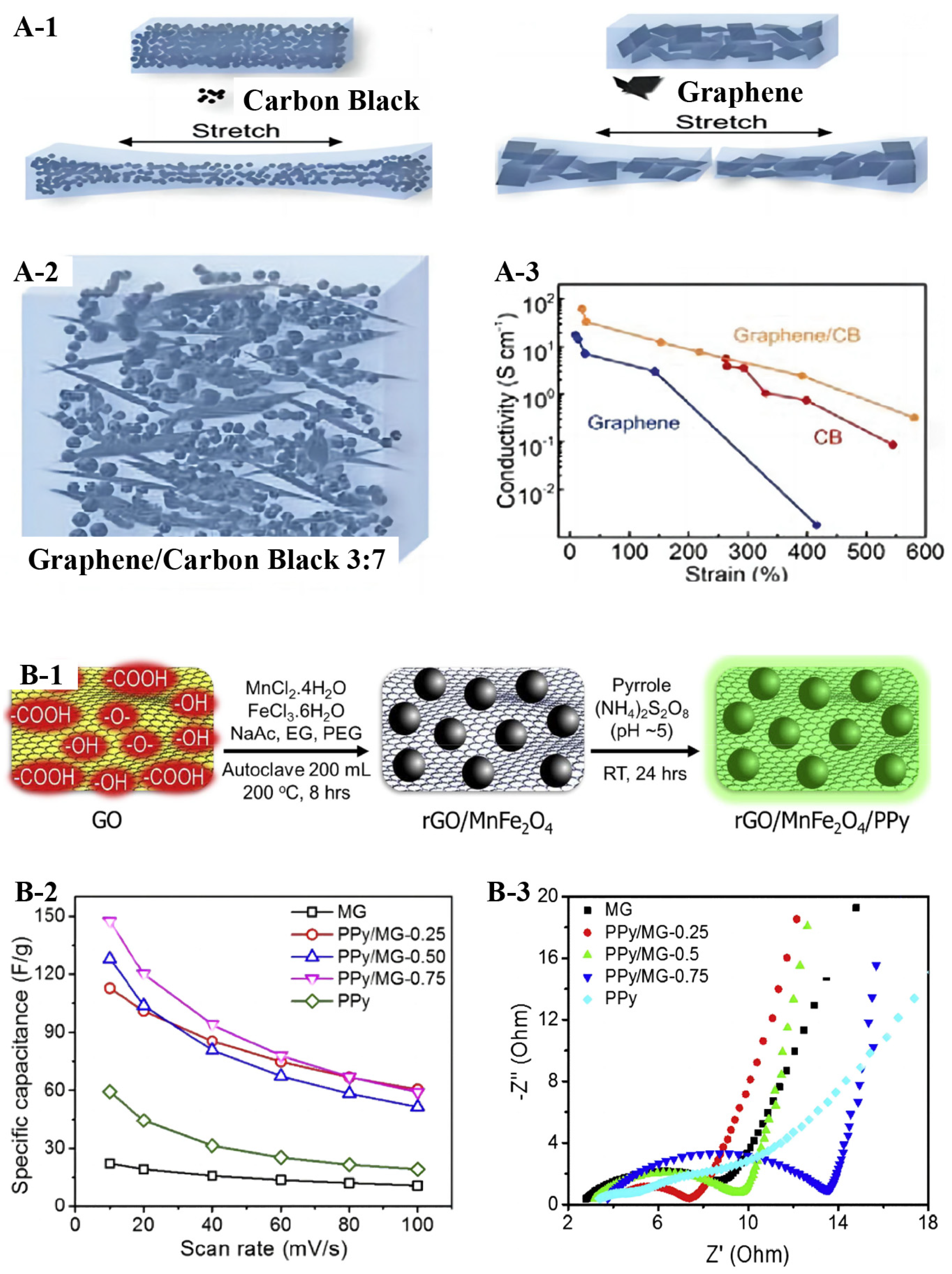
Today’s escalating demands for renewable energy resources propel research into efficient energy storage systems, such as batteries and supercapacitors. The surface modifiability, ductility, conductivity, and physical stability of graphene make it possible to use graphene-based composites as high-capacity renewable energy sources [124,125,126]. The main challenge is to ensure adequate electrolyte diffusion across the entire surface area of graphene, especially at high current densities [127]. To alleviate the restacking of graphene, it is available to combine with metal oxides [128], chalcogenides [129], and conducting polymers [130]. For example, embedding small carbon black nanoparticles within the narrow interstices between graphene nanosheets ensures high chemical stability and further accumulates more connected pathways of electron flow (Figure 3A-1,2), resulting in augmented initial conductivity of the composite at each ultimate strain (Figure 3A-3) [131].
Figure 3. Structural change for carbon black-TPU, graphene-TPU (A-1), and graphene/carbon black 3:7-TPU composites (A-2) before and after stretching and their initial conductivity versus ultimate strain (A-3) [131]; Copyright © 2022, Taylor & Francis. The formation of rGO/MnFe2O4 binary and rGO/MnFe2O4/PPy ternary hybrids (B-1). Calculated Cs of corresponding hybrids at different scan rates (B-2) and Nyquist plots of PPy, MG binary, and PPy/MG ternary hybrids showing and high-frequency regions (B-3). Reproduced with permission [124], Copyright © 2019, Elsevier.
Sustainability 17 10058 g003
In addition, the combination of graphene-supported manganese ferrite microspheres (MG) and a conductive polymer (polypyrrole, PPy) via co-precipitation method (Figure 3B-1) showed maximum capacitive performance (147.2 F/g at scan rate of 10 mV/s), while the individual capacitance of MG or PPy is 22.1 F/g and 59.3 F/g, respectively (Figure 3B-2) [124]. As observed in the low-frequency region of the Nyquist plot (characterized by straight-sloping lines (Figure 3B-3), the slope of the straight lines increases with a higher PPy ratio in the MG composite, indicating reduced diffusion resistance. This behavior demonstrates an improvement in the capacitive performance of the resulting hybrid material. Therefore, this synergistic effect is attributed to improved electron transfer and shortened diffusion paths, making MG/PPy a promising candidate for energy storage in supercapacitors. In another study, the synergistic coupling of titanium carbonitride nanocubes with GO using a deposition method showed an 800-fold fluorescence enhancement. This enhancement was attributed to integrated hotspots with enhanced electromagnetic fields compared to using only GO (30-fold) or titanium carbonitride nanocubes (400-fold) [132]. The high loading capacity of the conductive filler boosts the percolation pathway but can result in a porous final composite with somewhat diminished mechanical properties. Balancing high electrical conductivity and mechanical strength is therefore necessary in material development.
It is evident that combining graphene with selected functional materials can significantly enhance key properties such as initial electrical conductivity, capacitive performance, and loading capacity. These improvements demonstrate the distinct advantages and potential of graphene-based composites in conductive applications, further contributing to sustainable technological development.

2.6. Graphene-Based Sensors

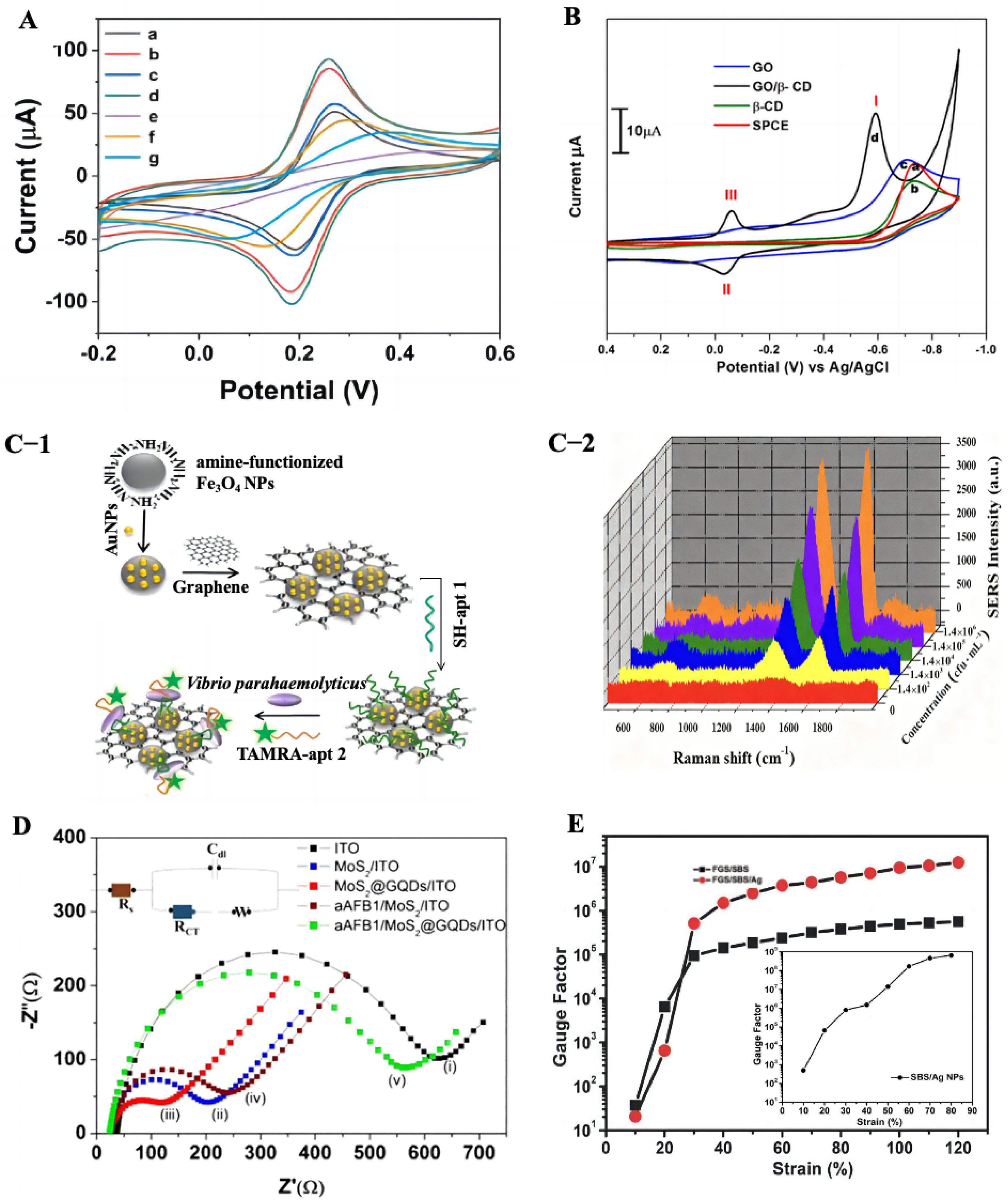
Graphene-based sensors, renowned for their acute sensitivity and specificity, have been extensively studied in recent years. A stable and accurate sensor for detecting zearalenone (ZEA), a non-steroidal estrogenic mycotoxin in food, was developed by reducing and modifying oxidized graphene nanoribbons (GNRs) and AuNPs on a glassy carbon electrode using an electrodeposition technique [133]. The as-prepared sensor showed a wide linear range (1–500 ng·mL−1) and a low detection limit (0.34 ng·mL−1) after incorporating molecularly imprinted polymer (MIP), known as one of the most efficient recognition elements for electrochemical sensors (Figure 4A). A similar synergistic effect was observed in the β-cyclodextrin-GO system. As shown in Figure 4B, neither GO nor β-CD alone enhanced the electrocatalytic activity of the bare screen-printed carbon electrode (SPCE) (reduction peaks remained around −0.73 V); however, when the β-CD/GO composite was introduced to the SPCE, the reduction peak current of nitrobenzene (NB) increased 2-fold, accompanied by a positive shift in the reduction potential. This enhanced electrocatalytic activity demonstrates the synergistic effect between β-CD and GO on the SPCE [134]. Furthermore, the reaction products exhibited an anodic peak (II) at 0.03 V and a cathodic peak (III) at 0.06 V, corresponding to the redox behavior between phenylhydroxylamine and nitrosobenzene, which contributes to the elimination of nitrobenzene contamination [135].
For microorganism detection, a biosensor assembled with graphene-based nanocomposites, metals, or conducting polymer, along with aptamer probes, can differentiate the target microorganisms directly from the complex environmental background. As is depicted in Figure 4C-1, a GO-wrapped Fe3O4-Au nanostructure aptamer sensor was developed for detecting Vibrio parahaemolyticus in spiked salmon samples [134]. This hybrid sensor employs dual aptamers acting as capture and sensing probes, eliciting a substantially amplified Surface-Enhanced Raman Scattering (SERS) response specifically toward Vibrio parahaemolyticus (Figure 4C-2). The synergistic electromagnetic enhancement by AuNPs combined with GO was due to the high adsorption and charge transfer effect on the graphene basal plane, leading to its high specificity and sensitivity with a detection limit of 14 CFU/mL. Similar observations for microorganism detection were also reported including polypyrrole/pyrrolepropylic acid/rGO-based immunosensors [136], ZnFe2O4/rGO [135], and MoS2@graphene quantum dots/ITO (Figure 4D) [137].
Strain sensors with high sensitivity, a broad sensing range, significant stretchability, and low voltage operation are pursued for applications in health monitoring and biomedicine. Zhou et al. developed a slit and shell-like strain sensor that exhibits extensive stretchability (680%), superior electrical conductivity (1521 S·cm−1), high sensitivity (≈107 at 120% strain), rapid response time (<30 ms), and excellent reproducibility over 2000 cycles [138]. This strain sensor was covered with frAGCented graphene sponges (FGS) and further embedded in poly (styrene-block-butadiene-block-styrene) (SBS) for increased stretchability and easy absorption of Ag ions. FGS/SBS/Ag possessed a low gauge factor versus strain (1–5 × 10⁵), while that of FGS/SBS and Ag/SBS reached 106–107 and 108–109, respectively (Figure 4E). The potential synergistic mechanism is described as follows: (1) variations in microcrack junctions in the silver oxide layer (cracking mechanism) and the overlapping area of neighboring FGS (disconnection mechanism) lead to enhanced sensitivity; and (2) the FGS tended to bridge the disconnected network of silver oxides under tensile strain.
Figure 4. Examples of graphene-based composites as sensors: CV measurements of a SERS aptamer-based sensor on GO-wrapped MIP/AuNPs/GCE for zearalenone determination CV measurements of bare GCE (a), rGNRs/GCE (b), AuNPs/GCE (c), AuNPs/rGNRs/GCE (d), MIP/AuNPs/rGNRs/GCE before template removal (e), MIP/AuNPs/rGNRs/GCE after elution (f), and MIP/AuNPs/rGNRs/GCE after adsorption of 150 ng·mL−1 ZEA solution (g) (A). Reproduced with permission [133], Copyright © 2023, Elsevier. CV (Cyclic voltammetry) response of bare SPCE (a), β-CD/SPCE (b), GO/SPCE (c), and GO/β-CD/SPCE (d) (B). Reproduced with permission [134], Copyright © 2017, Elsevier. Schematic of SERS aptasensor based on GO-wrapped Fe3O4@Au nanostructures (C-1), and the SERS response spectra of this aptasensor in the presence of different concentration of V. parahaemolyticus (C-2) [138], Copyright © 2017, Springer. EIS studies of (i) ITO, (ii) MoS2/ITO, (iii) MoS2@GQDs/ITO, (iv) aAFB1/MoS2/ITO, and (v) aAFB1/MoS2@GQDs/ITO electrodes (D). Reproduced with permission [137], Copyright @ 2020, Springer. Gauge factor versus strain for SBS/Ag, FGS/SBS, and FGS/SBS/Ag composite (E). Reproduced with permission [139], Copyright © 2017,Wiley.
Sustainability 17 10058 g004
Owing to the intrinsic superior properties of graphene, graphene-based composites have led to remarkable synergistic improvements in sensor performance. These enhancements, which include both elevated sensitivity and reinforced specificity, offer versatile opportunities for optimizing sensor functionality and diversifying material sources.

2.7. Graphene-Based Electromagnetic Interference (EMI) Shielding

With the advancement of next-generation electronic information technologies, electronic devices have brought considerable convenience while also generating electromagnetic waves that propagate in the form of radiation and heat. These emissions have raised concerns over potential health risks, environmental pollution, and the leakage of sensitive electromagnetic information. Consequently, the development of high-performance EMI shielding materials has become particularly critical to mitigate these challenges.
The incorporation of graphene and carbon nanotube fillers offers a promising strategy for optimizing the electrical, mechanical, thermal, and EMI shielding properties of nanocomposites. At the same filler loading, the composite with a graphene–MWCNT (multi-walled carbon nanotube) ratio of 1:3 achieved the highest electrical conductivity of 1.91 × 10⁻¹ S/cm at a hybrid filler loading of 10 phr. This remarkable enhancement in electrical conductivity directly contributed to an excellent EMI shielding effectiveness of −34 dB in the X-band (8.2–12.4 GHz). Additionally, it exhibited the highest tensile strength and tensile modulus, demonstrating overall significant synergistic effects between graphene and MWCNT [115].
Similarly, Erzhen Z et al. [140] reported a notable synergistic effect on graphene and CNTs. By incorporating only 20 wt% CNTs into the graphene film, the electrical conductivity was significantly enhanced from 1.78 × 10⁵ S/m to 2.74 × 10⁵ S/m, and the thermal conductivity increased markedly from 510 W·m−1·K−1 to 1154 W·m−1·K−1. Furthermore, the macroscopically assembled graphene–CNT hybrid film (with 20% loading) exhibited an improved EMI shielding effectiveness of ~60 dB, representing a substantial increase of approximately 10 dB compared to that of pure graphene film (~50 dB). The discovery of this synergistic behavior provides a promising strategy for designing advanced materials with superior electrical and thermal conductivity, as well as enhanced EMI shielding performance.

3. Synergistic Mechanisms in Graphene-Based Composites

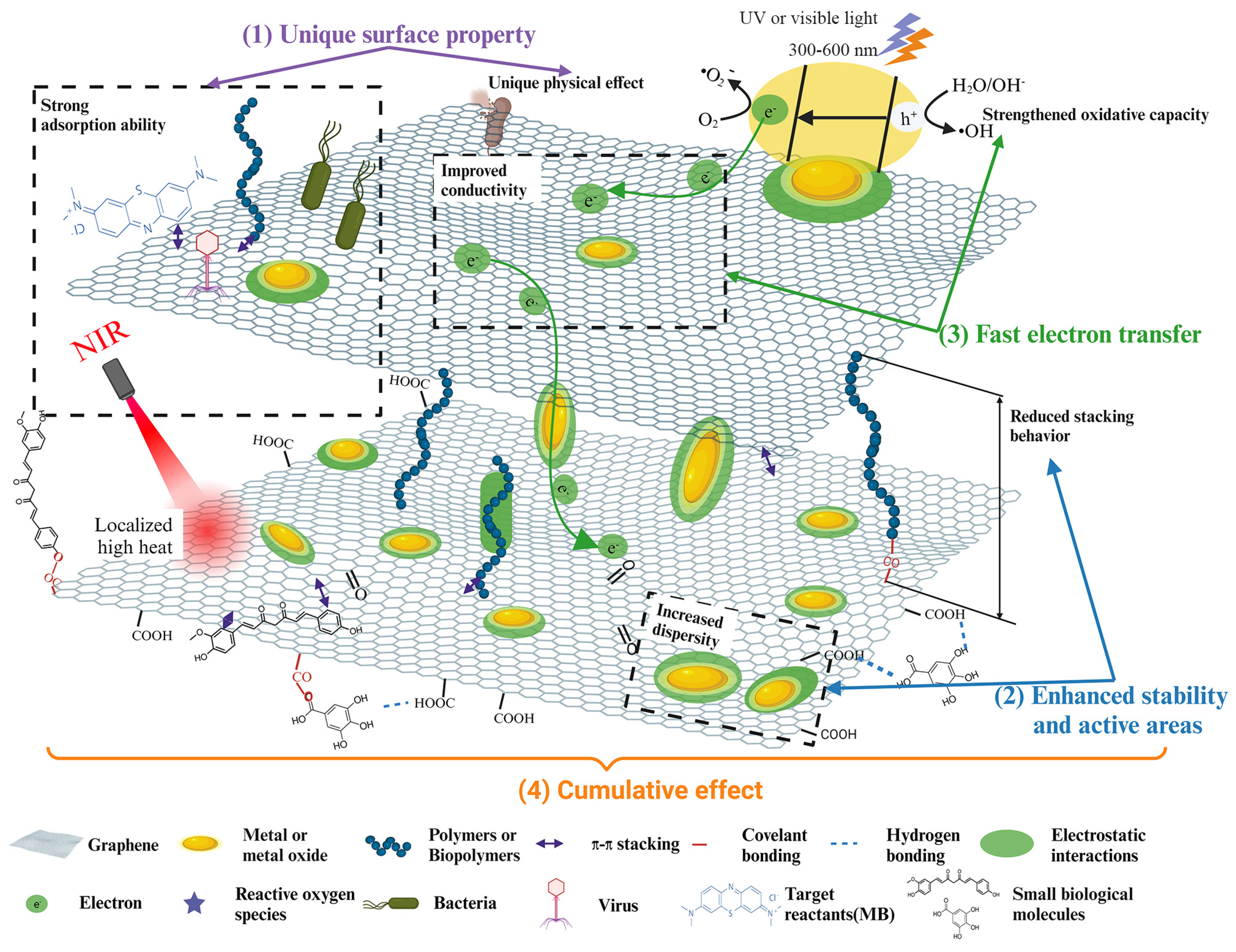
In the preceding sections, graphene-based composites have shown synergistic effects in various applications, supported by experimental evidence. Although these mechanisms derive from the innate properties of graphene derivatives or their interactions with the supplementary components, a systematic summation of the synergistic mechanisms is not comprehensive. Consequently, we proposed four possible common mechanisms that might be useful to explain synergistic effects on distinctive occasions.

3.1. Unique Surface Property

The nanostructure of graphene or graphene oxide provides an elevated surface-to-volume ratio as well as a large active surface area. On the one hand, this enables graphene sheets to gather other associated components (e.g., metals or metal oxides nanoparticles) locally, greatly increasing their concentration. On the other hand, target microorganisms or reactants can be adsorbed on the graphene surface more tenaciously, either through covalent bonds or noncovalent interactions, as opposed to when graphene or non-graphene components act individually. The sharp edges of the graphene surface sheet also directly penetrate microbial cells. These advancements could enhance the performance of graphene-based composites in antimicrobial activities, cancer therapy, catalysis, and sensing.

3.2. Enhanced Stability and Active Areas

Graphene sheets enable the uniform distribution of combined compounds on their surface structure. This can form co-supportive networks due to strong interfacial adhesion between graphene and the combined materials. This significantly diminishes the tendency of graphene sheets and other components (e.g., Ag), thereby increasing the reaction activities in binding areas. This synergistic mechanism may exist in graphene-based composites with bolstered antimicrobial capacity, enhanced catalytic action, and improved or advanced electronic devices.

3.3. Fast Electron Transfer

Fast electron transfer in graphene-based composites also plays a key role in generating synergistic effects. The graphene plane facilitates the electron transfer from noble metals or conducting polymers, resulting in improved conductivity and increased oxidative capacity, superior to that afforded by either graphene or non-graphene components alone. The outcomes of such actions improve conductivity, antimicrobial activities caused by oxidation, sensitivities in electronic devices and sensors, catalysis, etc.

3.4. Cumulative Effects

Often, the properties of graphene-based composites are enhanced by the simultaneous actions of two or more of the aforementioned mechanisms, known as the cumulative effects. This may significantly improve material performance due to fortification of multiple individual factors. A summary of synergistic mechanisms between graphene planes with different components is illustrated in Figure 5.

4. Conclusions, Challenges and Future Perspectives

Synergistic effects in graphene-based composites have been observed during antimicrobial treatments, cancer therapy, catalysts, mechanical properties, electronic devices, and sensor applications. Each combination of graphene and non-graphene components exhibits a specific synergistic extent and a niche application, with overall improvements shown over singular treatments and potential effectiveness toward sustainability. In this review, we elucidate the mechanisms of various graphene-based composites associated with their remarkable hybridization characteristics in specific applications. Moreover, we proposed four primary synergistic mechanisms, broadly categorized as follows: (1) synergistic effect induced by unique surface properties of graphene-based composites; (2) synergistic effect induced by enhanced stability and active areas of graphene-based composites; (3) synergistic effect induced by fast electron transfer; and (4) cumulative effects of the above mechanisms generated by graphene nanosheets and the counterpart materials. Therefore, more theoretical work and solid experimental research is crucial to demystify these mechanisms further.
Despite copious studies on graphene and related materials, the market for these revolutionary substances is still embryonic. Based on the endorsement of granted patents, the commercialization of graphene-based composites is expected to expand significantly, leading to increased revenue and production scale in the next 5–10 years [136]. Therefore, developments and applications of graphene-based composites will soar with the upgrading of massive graphene production systems and reduced costs.
Future work shall focus on tackling the major obstacles to the application of graphene-based materials in health-relevant fields, particularly biocompatibility. Generally, graphene-based composites with small and individual graphene sheets, inclusive of capping agents or with controlled-release mechanisms, are more readily internalized by macrophages, excreted, or efficiently degraded [55,135,141]. Therefore, some studies have commenced the tailoring of graphene-based composites with dispersion and separation properties to effectively increase the active sites of graphene sheets with higher performance. However, few have directly tackled the cytotoxicity of graphene nanosheets or metals within graphene-based composites in animal models. The advancement of prototypes with attenuated toxicity will pave the way for broader applications. Additionally, graphene variability in terms of layer count, defect densities, and sizes leads to performance inconsistencies in composites, posing a challenge for quantitative design and industrial-scale and high-quality production. These above-mentioned obstacles shall be properly handled in future studies.
Furthermore, as large-scale usage of graphene-based materials looms, their biodegradability, recycling options, and long-term impacts on human health and ecosystems necessitate consideration. Quantitative analysis is guaranteed for LCA and material consumption estimations when synergistic effects are employed during material design and fabrications. Regulatory frameworks must also adjust to accommodate a recommended graphene-based material dosage for deployment in biomedicines, chemical industries, foods, or water treatments, etc. [56].

Funding

This research received no external funding.

Institutional Review Board Statement

Not applicable.

Informed Consent Statement

Not applicable.

Data Availability Statement

Not applicable.

Acknowledgments

Authors acknowledge the support of the 2115 Talent Development Program of China Agricultural University.

Conflicts of Interest

The authors declare no conflict of interest.

References

  1. Ji, H.; Sun, H.; Qu, X. Antibacterial Applications of Graphene-Based Nanomaterials: Recent Achievements and Challenges. Adv. Drug Deliv. Rev. 2016, 105, 176–189. [Google Scholar] [CrossRef]
  2. Lukowiak, A.; Kedziora, A.; Strek, W. Antimicrobial Graphene Family Materials: Progress, Advances, Hopes and Fears. Adv. Colloid Interface Sci. 2016, 236, 101–112. [Google Scholar] [CrossRef] [PubMed]
  3. Lawal, A.T. Graphene-Based Nano Composites and Their Applications: A Review. Biosens. Biosens. Bioelectron. 2019, 141, 111384. [Google Scholar] [CrossRef]
  4. Jaleel, J.A.; Sruthi, S.; Pramod, K. Reinforcing Nanomedicine Using Graphene Family Nanomaterials. J. Control. Release 2017, 255, 218–230. [Google Scholar] [CrossRef] [PubMed]
  5. Tamang, S.; Rai, S.; Bhujel, R.; Bhattacharyya, N.K.; Swain, B.P.; Biswas, J. A concise review on GO, rGO and metal oxide/rGO composites: Fabrication and their supercapacitor and catalytic applications. J. Alloys Compd. 2023, 947, 169588. [Google Scholar] [CrossRef]
  6. Han, W.; Wu, Z.; Li, Y.; Wang, Y. Graphene Family Nanomaterials (GFNs)—Promising Materials for Antimicrobial Coating and Film: A Review. Chem. Eng. J. 2019, 358, 1022–1037. [Google Scholar] [CrossRef]
  7. Lin, Z.; Ye, X.; Han, J.; Chen, Q.; Fan, P.; Zhang, H.; Xie, D.; Zhu, H.; Zhong, M. Precise Control of the Number of Layers of Graphene by Picosecond Laser Thinning. Sci. Rep. 2015, 5, 11662. [Google Scholar] [CrossRef]
  8. Zhang, M.; Kong, W. Recent Progress in Graphene-Based and Ion-Intercalation Electrode Materials for Capacitive Deionization. J. Electroanal. Chem. 2020, 878, 114703. [Google Scholar] [CrossRef]
  9. Yan, L.; Zheng, Y.B.; Zhao, F.; Li, S.; Gao, X.; Xu, B.; Weiss, P.S.; Zhao, Y. Chemistry and Physics of a Single Atomic Layer: Strategies and Challenges for Functionalization of Graphene and Graphene-Based Materials. Chem. Soc. Rev. 2012, 41, 97–114. [Google Scholar] [CrossRef]
  10. Zeng, X.; Wang, G.; Liu, Y.; Zhang, X. Graphene-Based Antimicrobial Nanomaterials: Rational Design and Applications for Water Disinfection and Microbial Control. Environ. Sci. Nano 2017, 4, 2248–2266. [Google Scholar] [CrossRef]
  11. One-Step Synthesis of Pt-Decorated Graphene–Carbon Nanotubes for the Electrochemical Sensing of Dopamine, Uric Acid and Ascorbic Acid. Available online: https://ouci.dntb.gov.ua/en/works/4O8j8AOl/ (accessed on 24 September 2025).
  12. Li, X.; Zhi, L. Graphene hybridization for energy storage applications. Chem. Soc. Rev. 2018, 47, 3189–3216. [Google Scholar] [CrossRef]
  13. Liang, X.; Cheng, Q. Synergistic Reinforcing Effect from Graphene and Carbon Nanotubes. Compos. Commun. 2018, 10, 122–128. [Google Scholar] [CrossRef]
  14. Yang, Q.; Xu, Q.; Jiang, H.L. Metal-Organic Frameworks Meet Metal Nanoparticles: Synergistic Effect for Enhanced Catalysis. Chem. Soc. Rev. 2017, 46, 4774–4808. [Google Scholar] [CrossRef]
  15. Ying, Y.; Luo, X.; Qiao, J.; Huang, H. “More Is Different:” Synergistic Effect and Structural Engineering in Double-Atom Catalysts. Adv. Funct. Mater. 2021, 31, 2007423. [Google Scholar] [CrossRef]
  16. Wang, J.; Wang, Y.; Zhang, Y.; Uliana, A.; Zhu, J.; Liu, J.; Bruggen, B. Zeolitic Imidazolate Framework/Graphene Oxide Hybrid Nanosheets Functionalized Thin Film Nanocomposite Membrane for Enhanced Antimicrobial Performance. ACS Appl. Mater. Interfaces 2016, 8, 25508–25519. [Google Scholar] [CrossRef] [PubMed]
  17. Zheng, Y.; Zheng, S.; Xue, H.; Pang, H. Metal-Organic Frameworks/Graphene-Based Materials: Preparations and Applications. Adv. Funct. Mater. 2018, 28, 1804950. [Google Scholar] [CrossRef]
  18. Zhu, Y.; Murali, S.; Cai, W.; Li, X.; Suk, J.W.; Potts, J.R.; Ruoff, R.S. Graphene and Graphene Oxide: Synthesis, Properties, and Applications. Adv. Mater. 2010, 22, 3906–3924. [Google Scholar] [CrossRef]
  19. Su, C.; Loh, K.P. Carbocatalysts: Graphene Oxide and Its Derivatives. Acc. Chem. Res. 2013, 46, 2275–2285. [Google Scholar] [CrossRef]
  20. Sabath, L.D.; Abraham, E.P. Synergistic Action of Penicillins and Cephalosporins against Pseudomonas Pyocyanea. Nature 1964, 204, 1066–1069. [Google Scholar] [CrossRef]
  21. Hegab, H.M.; Elmekawy, A.; Zou, L.; Mulcahy, D.; Saint, C.P.; Ginic-Markovic, M. The Controversial Antibacterial Activity of Graphene-Based Materials. Carbon 2016, 105, 362–376. [Google Scholar] [CrossRef]
  22. Zou, X.; Zhang, L.; Wang, Z.; Luo, Y. Mechanisms of the Antimicrobial Activities of Graphene Materials. J. Am. Chem. Soc. 2016, 138, 2064–2077. [Google Scholar] [CrossRef] [PubMed]
  23. Rout, L.; Kumar, A.; Dhaka, R.S.; Reddy, G.N.; Giri, S.; Dash, P. Bimetallic Au-Cu Alloy Nanoparticles on Reduced Graphene Oxide Support: Synthesis, Catalytic Activity and Investigation of Synergistic Effect by DFT Analysis. Appl. Catal. A Gen. 2017, 538, 107–122. [Google Scholar] [CrossRef]
  24. Dreyer, D.R.; Park, S.; Bielawski, C.W.; Ruoff, R.S. The chemistry of graphene oxide. Chem. Soc. Rev. 2010, 39, 228–240. [Google Scholar] [CrossRef] [PubMed]
  25. Joshi, S.; Siddiqui, R.; Sharma, P.; Kumar, R.; Verma, G.; Saini, A. Green Synthesis of Peptide Functionalized Reduced Graphene Oxide (rGO) Nano Bioconjugate with Enhanced Antibacterial Activity. Sci. Rep. 2020, 10, 9441. [Google Scholar] [CrossRef] [PubMed]
  26. Krishnamoorthy, K.; Umasuthan, N.; Mohan, R.; Lee, J.; Kim, S.J. Antibacterial activity of graphene oxide nanosheets. Sci. Adv. Mater. 2012, 4, 1111–1117. [Google Scholar] [CrossRef]
  27. Liu, S.; Zeng, T.H.; Hofmann, M.; Burcombe, E.; Wei, J.; Jiang, R.; Kong, J.; Chen, Y. Antibacterial Activity of Graphite, Graphite Oxide, Graphene Oxide, and Reduced Graphene Oxide: Membrane and Oxidative Stress. ACS Nano 2011, 5, 6971–6980. [Google Scholar] [CrossRef]
  28. Yang, Y.; Li, M.; Zhou, B.; Jiang, X.; Zhang, D.; Luo, H. Graphene Oxide/Gallium Nanoderivative as a Multifunctional Modulator of Osteoblastogenesis and Osteoclastogenesis for the Synergistic Therapy of Implant-Related Bone Infection. Bioact. Mater. 2022, 25, 594–614. [Google Scholar] [CrossRef]
  29. Zhang, H.; Tikekar, R.V.; Ding, Q.; Gilbert, A.R.; Wimsatt, S.T. Inactivation of Foodborne Pathogens by the Synergistic Combinations of Food Processing Technologies and Food-Grade Compounds. Compr. Rev. Food Sci. Food Saf. 2020, 19, 2110–2138. [Google Scholar] [CrossRef]
  30. Bhaisare, M.L.; Wu, B.S.; Wu, M.C.; Khan, M.S.; Tseng, M.H.; Wu, H.F. MALDI MS Analysis, Disk Diffusion and Optical Density Measurements for the Antimicrobial Effect of Zinc Oxide Nanorods Integrated in Graphene Oxide Nanostructures. Biomater. Sci. 2016, 4, 183–194. [Google Scholar] [CrossRef]
  31. Ran, X.; Du, Y.; Wang, Z.; Wang, H.; Pu, F.; Ren, J.; Qu, X. Hyaluronic Acid-Templated Ag Nanoparticles/Graphene Oxide Composites for Synergistic Therapy of Bacteria Infection. ACS Appl. Mater. Interfaces 2017, 9, 19717–19724. [Google Scholar] [CrossRef]
  32. Deng, C.H.; Gong, J.L.; Zeng, G.M.; Niu, C.G.; Niu, Q.Y.; Zhang, W.; Liu, H.Y. Inactivation Performance and Mechanism of Escherichia Coli in Aqueous System Exposed to Iron Oxide Loaded Graphene Nanocomposites. J. Hazard. Mater. 2014, 276, 66–76. [Google Scholar] [CrossRef]
  33. Prasad, K.; Lekshmi, G.S.; Ostrikov, K.; Lussini, V.; Blinco, J.; Mohandas, M.; Vasilev, K.; Bottle, S.; Bazaka, K.; Ostrikov, K. Synergic Bactericidal Effects of Reduced Graphene Oxide and Silver Nanoparticles against Gram-Positive and Gram-Negative Bacteria. Sci. Rep. 2017, 7, 1591. [Google Scholar] [CrossRef]
  34. Kurapati, R.; Vaidyanathan, M.; Raichur, A.M. Synergistic Photothermal Antimicrobial Therapy Using Graphene Oxide/Polymer Composite Layer-by-Layer Thin Films. RSC Adv. 2016, 6, 39852–39860. [Google Scholar] [CrossRef]
  35. Li, P.; Sun, S.; Dong, A.; Hao, Y.; Shi, S.; Sun, Z.; Gao, G.; Chen, Y. Developing of a Novel Antibacterial Agent by Functionalization of Graphene Oxide with Guanidine Polymer with Enhanced Antibacterial Activity. Appl. Surf. Sci. 2015, 355, 446–452. [Google Scholar] [CrossRef]
  36. Zhong, L.; Liu, H.; Samal, M.; Yun, K. Synthesis of ZnO Nanoparticles-Decorated Spindle-Shaped Graphene Oxide for Application in Synergistic Antibacterial Activity. J. Photochem. Photobiol. B Biol. 2018, 183, 293–301. [Google Scholar] [CrossRef] [PubMed]
  37. Ghanem, A.F.; Badawy, A.A.; Mohram, M.E.; Rehim, M.H.A. Synergistic Effect of Zinc Oxide Nanorods on the Photocatalytic Performance and the Biological Activity of Graphene Nano Sheets. Heliyon 2020, 6, 03283. [Google Scholar] [CrossRef]
  38. Hassen, A.; Moawed, E.A.; Bahy, R.; El Basaty, A.B.; El-Sayed, S.; Ali, A.I.; Tayel, A. Synergistic effects of Thermally Reduced Graphene Oxide/Zinc Oxide Composite Material on Microbial Infection for Wound Healing Applications. Sci. Rep. 2024, 14, 22942. [Google Scholar] [CrossRef] [PubMed]
  39. Jian, Z.; Wang, H.; Liu, M.; Chen, S.; Wang, Z.; Qian, W.; Luo, G.; Xia, H. Polyurethane-Modified Graphene Oxide Composite Bilayer Wound Dressing with Long-Lasting Antibacterial Effect. Mater. Sci. Eng. 2020, 111, 110833. [Google Scholar] [CrossRef]
  40. Jana, I.D.; Kumbhakar, P.; Banerjee, S.; Gowda, C.C.; Kedia, N.; Kuila, S.K.; Banerjee, S.; Das, N.C.; Das, A.K.; Manna, I.; et al. Copper Nanoparticle-Graphene Composite-Based Transparent Surface Coating with Antiviral Activity against Influenza Virus. ACS Appl. Nano Mater. 2021, 4, 352–362. [Google Scholar] [CrossRef]
  41. Vi, T.T.T.; Kumar, S.R.; Pang, J.H.S.; Liu, Y.K.; Chen, D.W.; Lue, S.J. Synergistic Antibacterial Activity of Silver-Loaded Graphene Oxide towards Staphylococcus Aureus and Escherichia coli. Nanomaterials 2020, 10, 366. [Google Scholar] [CrossRef]
  42. Chautrand, T.; Souak, D.; Chevalier, S.; Duclairoir-Poc, C. Gram-Negative Bacterial Envelope Homeostasis under Oxidative and Nitrosative Stress. Microorganisms 2022, 10, 924. [Google Scholar] [CrossRef]
  43. Huo, S.; Gao, Y.; Fang, L.; Jiang, Z.; Xie, Q.; Meng, Q.; Fei, G.; Ding, S. Graphene Oxide with Acid-Activated Bacterial Membrane Anchoring for Improving Synergistic Antibacterial Performances. Appl. Surf. Sci. 2021, 551, 149444. [Google Scholar] [CrossRef]
  44. Liu, T.; Liu, Y.; Liu, M.; Wang, Y.; He, W.; Shi, G.; Hu, X.; Zhan, R.; Luo, G.; Xing, M.; et al. Synthesis of Graphene Oxide-Quaternary Ammonium Nanocomposite with Synergistic Antibacterial Activity to Promote Infected Wound Healing. Burn. Trauma 2018, 6, 1–23. [Google Scholar] [CrossRef]
  45. Li, Y.; Wang, J.; Yang, Y.; Shi, J.; Zhang, H.; Yao, X.; Chen, W.; Zhang, X. A Rose Bengal/Graphene Oxide/PVA Hybrid Hydrogel with Enhanced Mechanical Properties and Light-Triggered Antibacterial Activity for Wound Treatment. Mater. Sci. Eng. 2021, 118, 111447. [Google Scholar] [CrossRef]
  46. Song, F.; Ye, A.; Jiang, L.; Lu, Y.; Feng, Y.; Huang, R.; Du, S.; Dong, X.; Huang, T.; Li, P.; et al. Photothermal-Enhanced Silver Nanocluster Bioactive Glass Hydrogels for Synergistic Antimicrobial and Promote Wound Healing. Mater. Today Bio 2024, 30, 101439. [Google Scholar] [CrossRef] [PubMed]
  47. Xie, X.; Mao, C.; Liu, X.; Zhang, Y.; Cui, Z.; Yang, X.; Yeung, K.W.K.; Pan, H.; Chu, P.K.; Wu, S. Synergistic Bacteria Killing through Photodynamic and Physical Actions of Graphene Oxide/Ag/Collagen Coating. ACS Appl. Mater. Interfaces 2017, 9, 26417–26428. [Google Scholar] [CrossRef]
  48. Bugli, F.; Cacaci, M.; Palmieri, V.; Santo, R.; Torelli, R.; Ciasca, G.; Vito, M.; Vitali, A.; Conti, C.; Sanguinetti, M.; et al. Curcumin-Loaded Graphene Oxide Flakes as an Effective Antibacterial System against Methicillin-Resistant Staphylococcus Aureus. Interface Focus 2018, 8, 20170059. [Google Scholar] [CrossRef]
  49. Shamsi, S.; Elias, N.; Sarchio, S.N.E.; Yasin, F.M. Gallic Acid Loaded Graphene Oxide Based Nanoformulation (GAGO) as Potential Anti-Bacterial Agent against Staphylococcus Aureus. Mater. Today Proc. 2018, 5, 160–165. [Google Scholar] [CrossRef]
  50. Yang, F.; Feng, Y.; Fan, X.; Zhang, M.; Wang, C.; Zhao, W.; Zhao, C. Biocompatible Graphene-Based Nanoagent with NIR and Magnetism Dual-Responses for Effective Bacterial Killing and Removal. Colloids Surf. B Biointerfaces 2019, 173, 266–275. [Google Scholar] [CrossRef] [PubMed]
  51. Pan, W.Y.; Huang, C.C.; Lin, T.T.; Hu, H.Y.; Lin, W.C.; Li, M.J.; Sung, H.W. Synergistic Antibacterial Effects of Localized Heat and Oxidative Stress Caused by Hydroxyl Radicals Mediated by Graphene/Iron Oxide-Based Nanocomposites. Nanomed. Nanotechnol. Biol. Med. 2016, 12, 431–438. [Google Scholar] [CrossRef]
  52. Radhi, A.; Mohamad, D.; Rahman, F.S.A.; Abdullah, A.M.; Hasan, H. Mechanism and Factors Influence of Graphene-Based Nanomaterials Antimicrobial Activities and Application in Dentistry. J. Mater. Res. Technol. 2021, 11, 1290–1307. [Google Scholar] [CrossRef]
  53. Yuan, Z.; Tao, B.; He, Y.; Liu, J.; Lin, C.; Shen, X.; Ding, Y.; Yu, Y.; Mu, C.; Liu, P.; et al. Biocompatible MoS2/PDA-RGD Coating on Titanium Implant with Antibacterial Property via Intrinsic ROS-Independent Oxidative Stress and NIR Irradiation. Biomaterials 2019, 217, 119290. [Google Scholar] [CrossRef]
  54. Shao, W.; Liu, X.; Min, H.; Dong, G.; Feng, Q.; Zuo, S. Preparation, Characterization, and Antibacterial Activity of Silver Nanoparticle-Decorated Graphene Oxide Nanocomposite. ACS Appl. Mater. Interfaces 2015, 7, 6966–6973. [Google Scholar] [CrossRef] [PubMed]
  55. Seabra, A.B.; Paula, A.J.; Lima, R.; Alves, O.L.; Durán, N. Nanotoxicity of Graphene and Graphene Oxide. Chem. Res. Toxicol. 2014, 27, 159–168. [Google Scholar] [CrossRef] [PubMed]
  56. Wang, L.; He, J.; Zhu, L.; Wang, Y.; Feng, X.; Chang, B.; Karahan, H.E.; Chen, Y. Assembly of Pi-Functionalized Quaternary Ammonium Compounds with Graphene Hydrogel for Efficient Water Disinfection. J. Colloid Interface Sci. 2019, 535, 149–158. [Google Scholar] [CrossRef] [PubMed]
  57. Filina, A.; Yousefi, N.; Okshevsky, M.; Tufenkji, N. Antimicrobial Hierarchically Porous Graphene Oxide Sponges for Water Treatment. ACS Appl. Bio Mater. 2019, 2, 1578–1590. [Google Scholar] [CrossRef]
  58. Zhang, Z.; Sun, J.; Chen, X.; Wu, G.; Jin, Z.; Guo, D.; Liu, L. The Synergistic Effect of Enhanced Photocatalytic Activity and Photothermal Effect of Oxygen-Deficient Ni/Reduced Graphene Oxide Nanocomposite for Rapid Disinfection under near-Infrared Irradiation. J. Hazard. Mater. 2021, 419, 126462. [Google Scholar] [CrossRef]
  59. Usman, A.; Hussain, Z.; Riaz, A.; Khan, A.N. Enhanced Mechanical, Thermal and Antimicrobial Properties of Poly(Vinyl Alcohol)/Graphene Oxide/Starch/Silver Nanocomposites Films. Carbohydr. Polym. 2016, 153, 592–599. [Google Scholar] [CrossRef]
  60. Narayanan, K.B.; Park, G.T.; Han, S.S. Antibacterial Properties of Starch-Reduced Graphene Oxide—Polyiodide Nanocomposite. Food Chem. 2021, 342, 128385. [Google Scholar] [CrossRef]
  61. Rajeswari, R.; Prabu, H.G. Palladium Decorated Reduced Graphene Oxide/Zinc Oxide Nanocomposite for Enhanced Antimicrobial, Antioxidant and Cytotoxicity Activities. Process Biochem. 2020, 93, 36–47. [Google Scholar] [CrossRef]
  62. Zhao, X.; Chen, J.; Li, H.; Chen, Y.; Lian, R.; Wang, Y. Innovative packaging materials and methods for flavor regulation of prepared aquatic products: Mechanism, classification and future prospective. Food Innov. Adv. 2023, 2, 145–155. [Google Scholar] [CrossRef]
  63. Wang, X.; Peng, F.; Cheng, C.; Chen, L.; Shi, X.; Gao, X.; Li, J. Synergistic antifungal activity of graphene oxide and fungicides against fusarium head blight in vitro and in vivo. Nanomaterials 2021, 11, 2393. [Google Scholar] [CrossRef]
  64. Peng, F.; Wang, X.; Zhang, W.; Shi, X.; Cheng, C.; Hou, W.; Lin, X.; Xiao, X.; Li, J. Nanopesticide Formulation from Pyraclostrobin and Graphene Oxide as a Nanocarrier and Application in Controlling Plant Fungal Pathogens. Nanomaterials 2022, 12, 1112. [Google Scholar] [CrossRef] [PubMed]
  65. Zheng, K.; Li, K.; Chang, T.H.; Xie, J.; Chen, P.Y. Synergistic Antimicrobial Capability of Magnetically Oriented Graphene Oxide Conjugated with Gold Nanoclusters. Adv. Funct. Mater. 2019, 29, 1904603. [Google Scholar] [CrossRef]
  66. Yan, Y.; Li, C.; Wu, H.; Du, J.; Feng, J.; Zhang, J.; Huang, L.; Tan, S.; Shi, Q. Montmorillonite-Modified Reduced Graphene Oxide Stabilizes Copper Nanoparticles and Enhances Bacterial Adsorption and Antibacterial Activity. ACS Appl. Bio Mater. 2019, 2, 1842–1849. [Google Scholar] [CrossRef] [PubMed]
  67. Zhang, Q.; Liu, X.; Tan, L.; Cui, Z.; Li, Z.; Liang, Y.; Zhu, S.; Yeung, K.W.K.; Zheng, Y.; Wu, S. An UV to NIR-Driven Platform Based on Red Phosphorus/Graphene Oxide Film for Rapid Microbial Inactivation. Chem. Eng. J. 2020, 383, 123088. [Google Scholar] [CrossRef]
  68. Mei, L.; Cao, F.; Zhang, L.; Xu, J.; Xu, Z.; Yu, Y.; Zhang, X.; Shi, Y.; Li, X.; Cheng, K.; et al. Ag-Conjugated Graphene Quantum Dots with Blue Light-Enhanced Singlet Oxygen Generation for Ternary-Mode Highly-Efficient Antimicrobial Therapy. J. Mater. Chem. B 2020, 8, 1371–1382. [Google Scholar] [CrossRef]
  69. Du, T.; Huang, B.; Cao, J.; Li, C.; Jiao, J.; Xiao, Z.; Wei, L.; Ma, J.; Du, X.; Wang, S. Ni Nanocrystals Supported on Graphene Oxide: Antibacterial Agents for Synergistic Treatment of Bacterial Infections. ACS Omega 2022, 7, 18339–18349. [Google Scholar] [CrossRef]
  70. Xia, D.; An, T.; Li, G.; Wang, W.; Zhao, H.; Wong, P.K. Synergistic Photocatalytic Inactivation Mechanisms of Bacteria by Graphene Sheets Grafted Plasmonic AgAgX (X = Cl, Br, I) Composite Photocatalyst under Visible Light Irradiation. Water Res. 2016, 99, 149–161. [Google Scholar] [CrossRef]
  71. Oktay, B.; Erarslan, A.; Üstündağ, C.B.; Ahlatcıoğlu Özerol, E. Preparation and Characterization of Graphene Oxide Quantum Dots/Silver Nanoparticles and Investigation of Their Antibacterial Effects. Mater. Res. Express 2024, 11, 015603. [Google Scholar] [CrossRef]
  72. Yang, X.X.; Li, C.M.; Li, Y.F.; Wang, J.; Huang, C.Z. Synergistic Antiviral Effect of Curcumin Functionalized Graphene Oxide against Respiratory Syncytial Virus Infection. Nanoscale 2017, 9, 16086–16092. [Google Scholar] [CrossRef]
  73. Pan, N.; Liu, Y.; Fan, X.; Jiang, Z.; Ren, X.; Liang, J. Preparation and Characterization of Antibacterial Graphene Oxide Functionalized with Polymeric N-Halamine. J. Mater. Sci. 2017, 52, 1996–2006. [Google Scholar] [CrossRef]
  74. Yang, D.; Wang, Y.; Zhao, L.; Rao, L.; Liao, X. Extracellular pH Decline Introduced by High Pressure Carbon Dioxide Is a Main Factor Inducing Bacteria to Enter Viable but Non-Culturable State. Food Res. Int. 2022, 151, 110895. [Google Scholar] [CrossRef]
  75. Kim, S.; Lee, J.-S.; Lee, H. Combination Treatment of Hepatitis C Virus-Associated Hepatocellular Carcinoma by Simultaneously Blocking Genes in Multiple Organelles via Functionally Engineered Graphene Oxide. Chem. Eng. J 2023, 452, 139279. [Google Scholar] [CrossRef]
  76. Robinson, J.T.; Tabakman, S.M.; Liang, Y.; Wang, H.; Casalongue, H.S.; Vinh, D.; Dai, H. Ultrasmall Reduced Graphene Oxide with High Near-Infrared Absorbance for Photothermal Therapy. J. Am. Chem. Soc 2011, 133, 6825–6831. [Google Scholar] [CrossRef]
  77. Zhang, W.; Guo, Z.; Huang, D.; Liu, Z.; Guo, X.; Zhong, H. Synergistic Effect of Chemo-Photothermal Therapy Using PEGylated Graphene Oxide. Biomaterials 2011, 32, 8555–8561. [Google Scholar] [CrossRef] [PubMed]
  78. Wei, G.; Yan, M.; Dong, R.; Wang, D.; Zhou, X.; Chen, J.; Hao, J. Covalent Modification of Reduced Graphene Oxide by Means of Diazonium Chemistry and Use as a Drug-Delivery System. Chem. A Eur. J. 2012, 18, 14708–14716. [Google Scholar] [CrossRef] [PubMed]
  79. Hu, D.; Zhang, J.; Gao, G.; Sheng, Z.; Cui, H.; Cai, L. Indocyanine Green-Loaded Polydopamine-Reduced Graphene Oxide Nanocomposites with Amplifying Photoacoustic and Photothermal Effects for Cancer Theranostics. Theranostics 2016, 6, 1043–1052. [Google Scholar] [CrossRef] [PubMed]
  80. Gao, X.; Jang, J.; Nagase, S. Hydrazine and Thermal Reduction of Graphene Oxide: Reaction Mechanisms, Product Structures, and Reaction Design. J. Phys. Chem. 2010, 114, 832–842. [Google Scholar] [CrossRef]
  81. Zhou, Y.; Bao, Q.; Tang, L.A.L.; Zhong, Y.; Loh, K.P. Hydrothermal Dehydration for the “Green” Reduction of Exfoliated Graphene Oxide to Graphene and Demonstration of Tunable Optical Limiting Properties. Chem. Mater. 2009, 21, 2950–2956. [Google Scholar] [CrossRef]
  82. Zheng, X.T.; Li, C.M. Restoring Basal Planes of Graphene Oxides for Highly Efficient Loading and Delivery of β-Lapachone. Mol. Pharm. 2012, 9, 615–621. [Google Scholar] [CrossRef]
  83. Sun, S.; Zhang, G.; Gauquelin, N.; Chen, N.; Zhou, J.; Yang, S.; Chen, W.; Meng, X.; Geng, D.; Banis, M.N.; et al. Single-atom catalysis using Pt/graphene achieved through atomic layer deposition. Sci. Rep. 2013, 3, 1775. [Google Scholar] [CrossRef]
  84. Jin, X.; Gu, T.H.; Kwon, N.H.; Hwang, S.J. Synergetic Advantages of Atomically Coupled 2D Inorganic and Graphene Nanosheets as Versatile Building Blocks for Diverse Functional Nanohybrids. Adv. Mater. 2021, 33, 2005922. [Google Scholar] [CrossRef]
  85. Georgakilas, V.; Tiwari, J.N.; Kemp, K.C.; Perman, J.A.; Bourlinos, A.B.; Kim, K.S.; Zboril, R. Noncovalent Functionalization of Graphene and Graphene Oxide for Energy Materials, Biosensing, Catalytic, and Biomedical Applications. Chem. Rev. 2016, 116, 5464–5519. [Google Scholar] [CrossRef] [PubMed]
  86. Niyogi, S.; Bekyarova, E.; Itkis, M.E.; Zhang, H.; Shepperd, K.; Hicks, J.; Sprinkle, M.; Berger, C.; Lau, C.N.; Deheer, W.A.; et al. Spectroscopy of covalently functionalized graphene. Nano Lett. 2010, 10, 4061–4066. [Google Scholar] [CrossRef] [PubMed]
  87. MacHado, B.F.; Serp, P. Graphene-Based Materials for Catalysis. Catal. Sci. Technol. 2012, 2, 54–75. [Google Scholar] [CrossRef]
  88. Cui, H.; Guo, Y.; Zhou, Z. Three-Dimensional Graphene-Based Macrostructures for Electrocatalysis. Small 2021, 17, 2005255. [Google Scholar] [CrossRef]
  89. Wei, J.; Liang, B.; Cao, Q.; Mo, C.; Zheng, Y.; Ye, X. Vertically aligned PANI nanorod arrays grown on graphene oxide nanosheets for a high-performance NH3 gas sensor. RSC Adv. 2017, 7, 33510–33520. [Google Scholar] [CrossRef]
  90. Jahan, M.; Bao, Q.; Loh, K.P. Electrocatalytically Active Graphene-Porphyrin MOF Composite for Oxygen Reduction Reaction. J. Am. Chem. Soc. 2012, 134, 6707–6713. [Google Scholar] [CrossRef]
  91. Liu, J.; Peng, Q.; Yang, R.; Wang, B.; Zhang, X.; Wang, R.; Zhu, X.; Cheng, M.; Xu, H.; Li, H. Incorporating Fe, Co Co-Doped Graphene with PDI Supermolecular for Promoted Photocatalytic Activity: A Story of Electron Transfer. J. Colloid Interface Sci. 2023, 637, 94–103. [Google Scholar] [CrossRef]
  92. Khalid, N.R.; Hong, Z.; Ahmed, E.; Zhang, Y.; Chan, H.; Ahmad, M. Synergistic effects of Fe and Graphene on Photocatalytic Activity Enhancement of TiO2 under Visible Light. Appl. Surf. Sci. 2012, 258, 5827–5834. [Google Scholar] [CrossRef]
  93. Deng, Y.; Xiao, S.; Zheng, Y.; Rong, X.; Bai, M.; Tang, Y.; Ma, T.; Cheng, C.; Zhao, C. Emerging Electrocatalytic Activities in Transition Metal Selenides: Synthesis, Electronic Modulation, and Structure-Performance Correlations. Chem. Eng. J. 2023, 451, 138514. [Google Scholar] [CrossRef]
  94. Namsheer, K.; Rout, C.S. Conducting Polymers: A Comprehensive Review on Recent Advances in Synthesis, Properties and Applications. RSC Adv. 2021, 11, 5659–5697. [Google Scholar] [CrossRef]
  95. Pramanik, A.; Dhar, J.A.; Banerjee, R.; Davis, M.; Gates, K.; Nie, J.; Davis, D.; Han, F.X.; Ray, P.C. WO 3 Nanowire-Attached Reduced Graphene Oxide-Based 1D–2D Heterostructures for near-Infrared Light-Driven Synergistic Photocatalytic and Photothermal Inactivation of Multidrug-Resistant Superbugs. ACS Appl. Bio Mater. 2023, 6, 919–931. [Google Scholar] [CrossRef]
  96. Jahan, M.; Liu, Z.; Loh, K.P. A Graphene Oxide and Copper-Centered Metal Organic Framework Composite as a Tri-Functional Catalyst for HER, OER, and ORR. Adv. Funct. Mater. 2013, 23, 5363–5372. [Google Scholar] [CrossRef]
  97. Wang, W.; He, D.; Duan, J.; Wang, S.; Peng, H.; Wu, H.; Fu, M.; Wang, Y.; Zhang, X. Simple Synthesis Method of Reduced Graphene Oxide/Gold Nanoparticle and Its Application in Surface-Enhanced Raman Scattering. Chem. Phys. Lett. 2013, 582, 119–122. [Google Scholar] [CrossRef]
  98. Son, S.; Lee, J.M.; Kim, S.J.; Kim, H.; Jin, X.; Wang, K.K.; Kim, M.; Hwang, J.W.; Choi, W.; Kim, Y.R.; et al. Understanding the Relative Efficacies and Versatile Roles of 2D Conductive Nanosheets in Hybrid-Type Photocatalyst. Appl. Catal. B Environ. 2019, 257, 117875. [Google Scholar] [CrossRef]
  99. Li, J.; Yu, X.; Zhu, Y.; Fu, X.; Zhang, Y. 3D-2D-3D BiOI/Porous g-C3N4/Graphene Hydrogel Composite Photocatalyst with Synergy of Adsorption-Photocatalysis in Static and Flow Systems. J. Alloys Compd. 2021, 850, 156778. [Google Scholar] [CrossRef]
  100. Fu, Y.; Chen, H.; Sun, X.; Wang, X. Combination of Cobalt Ferrite and Graphene: High-Performance and Recyclable Visible-Light Photocatalysis. Appl. Catal. B Environ. 2012, 111–112, 280–287. [Google Scholar] [CrossRef]
  101. Karimi, L.; Yazdanshenas, M.E.; Khajavi, R.; Rashidi, A.; Mirjalili, M. Optimizing the Photocatalytic Properties and the Synergistic effects of Graphene and Nano Titanium Dioxide Immobilized on Cotton Fabric. Appl. Surf. Sci. 2015, 332, 665–673. [Google Scholar] [CrossRef]
  102. Wang, L.; Tan, H.; Zhang, L.; Cheng, B.; Yu, J. In-Situ Growth of Few-Layer Graphene on ZnO with Intimate Interfacial Contact for Enhanced Photocatalytic CO2 Reduction Activity. Chem. Eng. J. 2021, 411, 128501. [Google Scholar] [CrossRef]
  103. Bian, W.; Yang, Z.; Strasser, P.; Yang, R. A CoFe2O4/Graphene Nanohybrid as an Efficient Bi-Functional Electrocatalyst for Oxygen Reduction and Oxygen Evolution. J. Power Sources 2014, 250, 196–203. [Google Scholar] [CrossRef]
  104. Li, Z.; Xu, X.; Lu, X.; He, C.; Huang, J.; Sun, W.; Tian, L. Synergistic Coupling of FeNi3 Alloy with Graphene Carbon Dots for Advanced Oxygen Evolution Reaction Electrocatalysis. J. Colloid Interface Sci. 2022, 615, 273–281. [Google Scholar] [CrossRef]
  105. Shi, P.; Dai, X.; Zheng, H.; Li, D.; Yao, W.; Hu, C. Synergistic Catalysis of Co3O4 and Graphene Oxide on Co3O4/GO Catalysts for Degradation of Orange II in Water by Advanced Oxidation Technology Based on Sulfate Radicals. Chem. Eng. J. 2014, 240, 264–270. [Google Scholar] [CrossRef]
  106. Yu, H.; Liu, G.; Dong, B.; Jin, R.; Zhou, J. Synergistic catalytic Fenton-like degradation of sulfanilamide by biosynthesized goethite-reduced graphene oxide composite. J. Hazard. Mater. 2021, 415, 125704. [Google Scholar] [CrossRef] [PubMed]
  107. Zhang, F.; Zhang, Y.; Zhang, G.; Yang, Z.; Dionysiou, D.D.; Zhu, A. Exceptional Synergistic Enhancement of the Photocatalytic Activity of SnS2 by Coupling with Polyaniline and N-Doped Reduced Graphene Oxide. Appl. Catal. B Environ. 2018, 236, 53–63. [Google Scholar] [CrossRef]
  108. Ivan, R.; Popescu, C.; Antohe, V.A.; Antohe, S.; Negrila, C.; Logofatu, C.; Pino, A.P.; György, E. Iron Oxide/Hydroxide–Nitrogen Doped Graphene-like Visible-Light Active Photocatalytic Layers for Antibiotics Removal from Wastewater. Sci. Rep. 2023, 13, 2740. [Google Scholar] [CrossRef]
  109. Yang, J.; Cao, C.; Qiao, J.; Qiao, W.; Jiang, B.; Tang, C.; Xue, Y. Self-Assembled BNNSs/rGO Heterostructure as a Synergistic Adsorption and Catalysis Mediator Boosts the Electrochemical Kinetics of Lithium-Sulfur Batteries. Chem. Eng. J. 2023, 471, 144737. [Google Scholar] [CrossRef]
  110. Chen, K.; Chai, Z.; Li, C.; Shi, L.; Liu, M.; Xie, Q.; Zhang, Y.; Xu, D.; Manivannan, A.; Liu, Z. Catalyst-Free Growth of Three-Dimensional Graphene Flakes and Graphene/g-C3N4 Composite for Hydrocarbon Oxidation. ACS Nano 2016, 10, 3665–3673. [Google Scholar] [CrossRef]
  111. Chatterjee, S.; Nafezarefi, F.; Tai, N.H.; Schlagenhauf, L.; Nüesch, F.A.; Chu, B.T.T. Size and Synergy Effects of Nanofiller Hybrids Including Graphene Nanoplatelets and Carbon Nanotubes in Mechanical Properties of Epoxy Composites. Carbon 2012, 50, 5380–5386. [Google Scholar] [CrossRef]
  112. Cao, K.; Feng, S.; Han, Y.; Gao, L.; Ly, T.H.; Xu, Z.; Lu, Y. Elastic straining of free-standing monolayer graphene. Nat. Commun. 2020, 11, 284. [Google Scholar] [CrossRef]
  113. Papageorgiou, D.G.; Kinloch, I.A.; Young, R.J. Mechanical properties of graphene and graphene-based nanocomposites. Prog. Mater. Sci. 2017, 90, 75–127. [Google Scholar] [CrossRef]
  114. Li, Y.; Yang, T.; Yu, T.; Zheng, L.; Liao, K. Synergistic Effect of Hybrid Carbon Nantube-Graphene Oxide as a Nanofiller in Enhancing the Mechanical Properties of PVA Composites. J. Mater. Chem. 2011, 21, 10844–10851. [Google Scholar] [CrossRef]
  115. Bagotia, N.; Choudhary, V.; Sharma, D.K. Synergistic Effect of Graphene/Multiwalled Carbon Nanotube Hybrid Fillers on Mechanical, Electrical and EMI Shielding Properties of Polycarbonate/Ethylene Methyl Acrylate Nanocomposites. Compos. Part B Eng. 2019, 159, 378–388. [Google Scholar] [CrossRef]
  116. Shuai, C.; Guo, W.; Wu, P.; Yang, W.; Hu, S.; Xia, Y.; Feng, P. A Graphene Oxide-Ag Co-Dispersing Nanosystem: Dual Synergistic effects on Antibacterial Activities and Mechanical Properties of Polymer Scaffolds. Chem. Eng. J. 2018, 347, 322–333. [Google Scholar] [CrossRef]
  117. Nam, K.H.; Yu, J.; You, N.H.; Han, H.; Ku, B.C. Synergistic Toughening of Polymer Nanocomposites by Hydrogen-Bond Assisted Three-Dimensional Network of Functionalized Graphene Oxide and Carbon Nanotubes. Compos. Sci. Technol. 2017, 149, 228–234. [Google Scholar] [CrossRef]
  118. Li, W.; Dichiara, A.; Bai, J. Carbon Nanotube-Graphene Nanoplatelet Hybrids as High-Performance Multifunctional Reinforcements in Epoxy Composites. Compos. Sci. Technol. 2013, 74, 221–227. [Google Scholar] [CrossRef]
  119. Zhang, H.; Zhang, G.; Tang, M.; Zhou, L.; Li, J.; Fan, X.; Shi, X.; Qin, J. Synergistic Effect of Carbon Nanotube and Graphene Nanoplates on the Mechanical, Electrical and Electromagnetic Interference Shielding Properties of Polymer Composites and Polymer Composite Foams. Chem. Eng. J 2018, 353, 381–393. [Google Scholar] [CrossRef]
  120. Huang, G.; Wang, S.; Song, P.; Wu, C.; Chen, S.; Wang, X. Combination Effect of Carbon Nanotubes with Graphene on Intumescent Flame-Retardant Polypropylene Nanocomposites. Compos. Part A Appl. Sci. Manuf. 2014, 59, 18–25. [Google Scholar] [CrossRef]
  121. Wang, S.; Han, S.; Xin, G.; Lin, J.; Wei, R.; Lian, J.; Sun, K.; Zu, X.; Yu, Q. High-Quality Graphene Directly Grown on Cu Nanoparticles for Cu-Graphene Nanocomposites. Mater. Des. 2018, 139, 181–187. [Google Scholar] [CrossRef]
  122. Yang, S.-Y.; Lin, W.-N.; Huang, Y.-L.; Tien, H.-W.; Wang, J.-Y.; Ma, C.-C.M.; Li, S.-M.; Wang, Y.-S. Synergetic Effects of Graphene Platelets and Carbon Nanotubes on the Mechanical and Thermal Properties of Epoxy Composites. Carbon 2011, 49, 793–803. [Google Scholar] [CrossRef]
  123. Prasad, K.E.; Das, B.; Maitra, U.; Ramamurty, U.; Rao, C.N.R. Extraordinary Synergy in the Mechanical Properties of Polymer Matrix Composites Reinforced with 2 Nanocarbons. Proc. Natl. Acad. Sci. USA 2009, 106, 13186–13189. [Google Scholar] [CrossRef]
  124. Thu, T.V.; Nguyen, T.; Le, X.D.; Le, T.S.; Thuy, V.; Huy, T.Q.; Truong, Q.D. Graphene-MnFe2O4-Polypyrrole Ternary Hybrids with Synergistic Effect for Supercapacitor Electrode. Electrochim. Acta 2019, 314, 151–160. [Google Scholar] [CrossRef]
  125. Stankovich, S.; Dikin, D.A.; Dommett, G.H.B.; Kohlhaas, K.M.; Zimney, E.J.; Stach, E.A.; Piner, R.D.; Nguyen, S.B.T.; Ruoff, R.S. Graphene-based composite materials. Nature 2006, 442, 282–286. [Google Scholar] [CrossRef]
  126. Mohan, V.B.; Lau, K.; Hui, D.; Bhattacharyya, D. Graphene-Based Materials and Their Composites: A Review on Production, Applications and Product Limitations. Compos. Part B Eng. 2018, 142, 200–220. [Google Scholar] [CrossRef]
  127. Fan, X.; Yu, C.; Yang, J.; Ling, Z.; Hu, C.; Zhang, M.; Qiu, J. A Layered-Nanospace-Confinement Strategy for the Synthesis of Two-Dimensional Porous Carbon Nanosheets for High-Rate Performance Supercapacitors. Adv. Energy Mater. 2015, 5, 1401761. [Google Scholar] [CrossRef]
  128. Toupin, M.; Brousse, T.; Bélanger, D. Charge Storage Mechanism of MnO2 Electrode Used in Aqueous Electrochemical Capacitor. Chem. Mater. 2004, 16, 3184–3190. [Google Scholar] [CrossRef]
  129. Ratha, S.; Rout, C.S. Supercapacitor Electrodes Based on Layered Tungsten Disulfide-Reduced Graphene Oxide Hybrids Synthesized by a Facile Hydrothermal Method. ACS Appl. Mater. Interfaces 2013, 5, 11427–11433. [Google Scholar] [CrossRef]
  130. Snook, G.A.; Kao, P.; Best, A.S. Conducting-Polymer-Based Supercapacitor Devices and Electrodes. J. Power Sources 2011, 196, 1–12. [Google Scholar] [CrossRef]
  131. Wu, W.; Liu, H.Y.; Kang, Y.; Zhang, T.; Jiang, S.; Li, B.; Yin, J.; Zhu, J. Synergistic Combination of Carbon-Black and Graphene for 3D Printable Stretchable Conductors. Mater. Technol. 2022, 37, 1971–1980. [Google Scholar] [CrossRef]
  132. Bhaskar, S.; Ramamurthy, S.S. Synergistic Coupling of Titanium Carbonitride Nanocubes and Graphene Oxide for 800-Fold Fluorescence Enhancements on Smartphone Based Surface Plasmon-Coupled Emission Platform. Mater. Lett. 2021, 298, 130008. [Google Scholar] [CrossRef]
  133. Zhou, B.; Xie, H.; Zhou, S.; Sheng, X.; Chen, L.; Zhong, M. Construction of AuNPs/Reduced Graphene Nanoribbons Co-Modified Molecularly Imprinted Electrochemical Sensor for the Detection of Zearalenone. Food Chem. 2023, 423, 136294. [Google Scholar] [CrossRef]
  134. Velmurugan, M.; Karikalan, N.; Chen, S.M.; Dai, Z.C. Studies on the Influence of β-Cyclodextrin on Graphene Oxide and Its Synergistic Activity to the Electrochemical Detection of Nitrobenzene. J. Colloid Interface Sci. 2017, 490, 365–371. [Google Scholar] [CrossRef]
  135. Wu, S.; Duan, N.; Qiu, Y.; Li, J.; Wang, Z. Colorimetric Aptasensor for the Detection of Salmonella Enterica Serovar Typhimurium Using ZnFe2O4-Reduced Graphene Oxide Nanostructures as an Effective Peroxidase Mimetics. Int. J. Food Microbiol. 2017, 261, 42–48. [Google Scholar] [CrossRef]
  136. Wang, D.; Hu, W.; Xiong, Y.; Xu, Y.; Li, C.M. Multifunctionalized reduced graphene oxide-doped polypyrrole/pyrrolepropylic acid nanocomposite impedimetric immunosensor to ultra-sensitively detect small molecular aflatoxin B1. Biosens. Bioelectron 2015, 63, 185–189. [Google Scholar] [CrossRef]
  137. Bhardwaj, H.; Marquette, C.A.; Dutta, P.; Rajesh, G.S. Integrated Graphene Quantum Dot Decorated Functionalized Nanosheet Biosensor for Mycotoxin Detection. Anal. Bioanal. Chem. 2020, 412, 7029–7041. [Google Scholar] [CrossRef]
  138. Duan, N.; Shen, M.; Wu, S.; Zhao, C.; Ma, X.; Wang, Z. Graphene Oxide Wrapped Fe3O4@Au Nanostructures as Substrates for Aptamer-Based Detection of Vibrio Parahaemolyticus by Surface-Enhanced Raman Spectroscopy. Microchim. Acta 2017, 184, 2653–2660. [Google Scholar] [CrossRef]
  139. Zhao, S.; Guo, L.; Li, J.; Li, N.; Zhang, G.; Gao, Y.; Li, J.; Cao, D.; Wang, W.; Jin, Y.; et al. Binary Synergistic Sensitivity Strengthening of Bioinspired Hierarchical Architectures Based on Fragmentized Reduced Graphene Oxide Sponge and Silver Nanoparticles for Strain Sensors and Beyond. Small 2017, 13, 1700944. [Google Scholar] [CrossRef] [PubMed]
  140. Zhou, E.; Xi, J.; Guo, Y.; Liu, Y.; Xu, Z.; Peng, L.; Gao, W.; Ying, J.; Chen, Z.; Gao, C. Synergistic Effect of Graphene and Carbon Nanotube for High-Performance Electromagnetic Interference Shielding Films. Carbon 2018, 133, 316–322. [Google Scholar] [CrossRef]
  141. Zurutuza, A.; Marinelli, C. Challenges and Opportunities in Graphene Commercialization. Nat. Nanotechnol. 2014, 9, 730–734. [Google Scholar] [CrossRef]
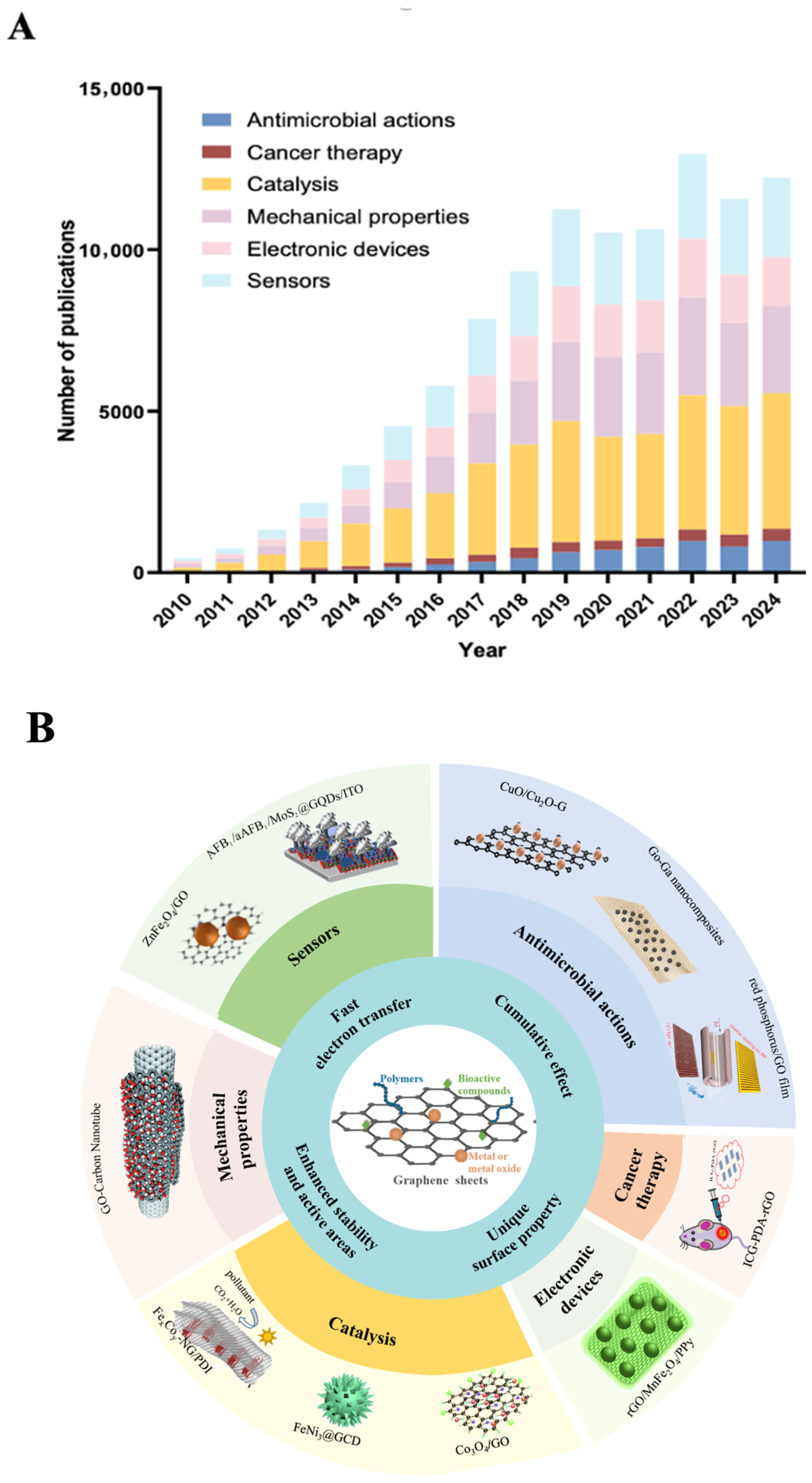
Figure 1. Publication statistics on graphene-based composites in different application areas from 2010 to 2023 (A); data obtained from Web of Science. Scheme of potential applications of graphene-based composites with improved performance based on the synergistic effects (B).
Sustainability 17 10058 g001
Figure 2. Examples of graphene-based composites in antimicrobial applications: Antibacterial efficacy of ZnO/GO compared ZnO or GO alone (A-1) and the morphology of the bacterial membrane treated with spindle-shaped GO, ZnO and ZnO/GO composites (A-2). Reproduced with permission [36], Copyright © 2018, Elsevier. Wound healing effect of MGO0.5-TPU (B). Reproduced with permission [39], Copyright © 2020, Elsevier. PVA/Cu/graphene nanocomposite antiviral activity (C-1) and transparency of dip-coated tempered mobile screen *: Significance is defined as p < 0.05; ***: Significance is defined as p < 0.001. (C-2). Reproduced with permission [40], Copyright © 2021, American Chemical Society.
Sustainability 17 10058 g002
Figure 5. Proposed synergistic mechanisms between graphene planes and different components for materials performance. Created with BioRender.com.
Sustainability 17 10058 g005
Disclaimer/Publisher’s Note: The statements, opinions and data contained in all publications are solely those of the individual author(s) and contributor(s) and not of MDPI and/or the editor(s). MDPI and/or the editor(s) disclaim responsibility for any injury to people or property resulting from any ideas, methods, instructions or products referred to in the content.