Article

Investigating the Effect of Talent Management Practices on Sustainable Competitive Advantage in Private-Sector Organizations

by
Razaz Waheeb Attar
1,*,
Amal Alanazi
2 and
Amal Hassan Alhazmi
1
1
Management Department, College of Business Administration, Princess Nourah bint Abdulrahman University, P.O. Box 84428, Riyadh 11671, Saudi Arabia
2
Applied College Administrative, Princess Nourah bint Abdulrahman University, P.O. Box 84428, Riyadh 11671, Saudi Arabia
*
Author to whom correspondence should be addressed.
Sustainability 2025, 17(21), 9909; https://doi.org/10.3390/su17219909
Submission received: 23 September 2025 / Revised: 18 October 2025 / Accepted: 27 October 2025 / Published: 6 November 2025

Abstract

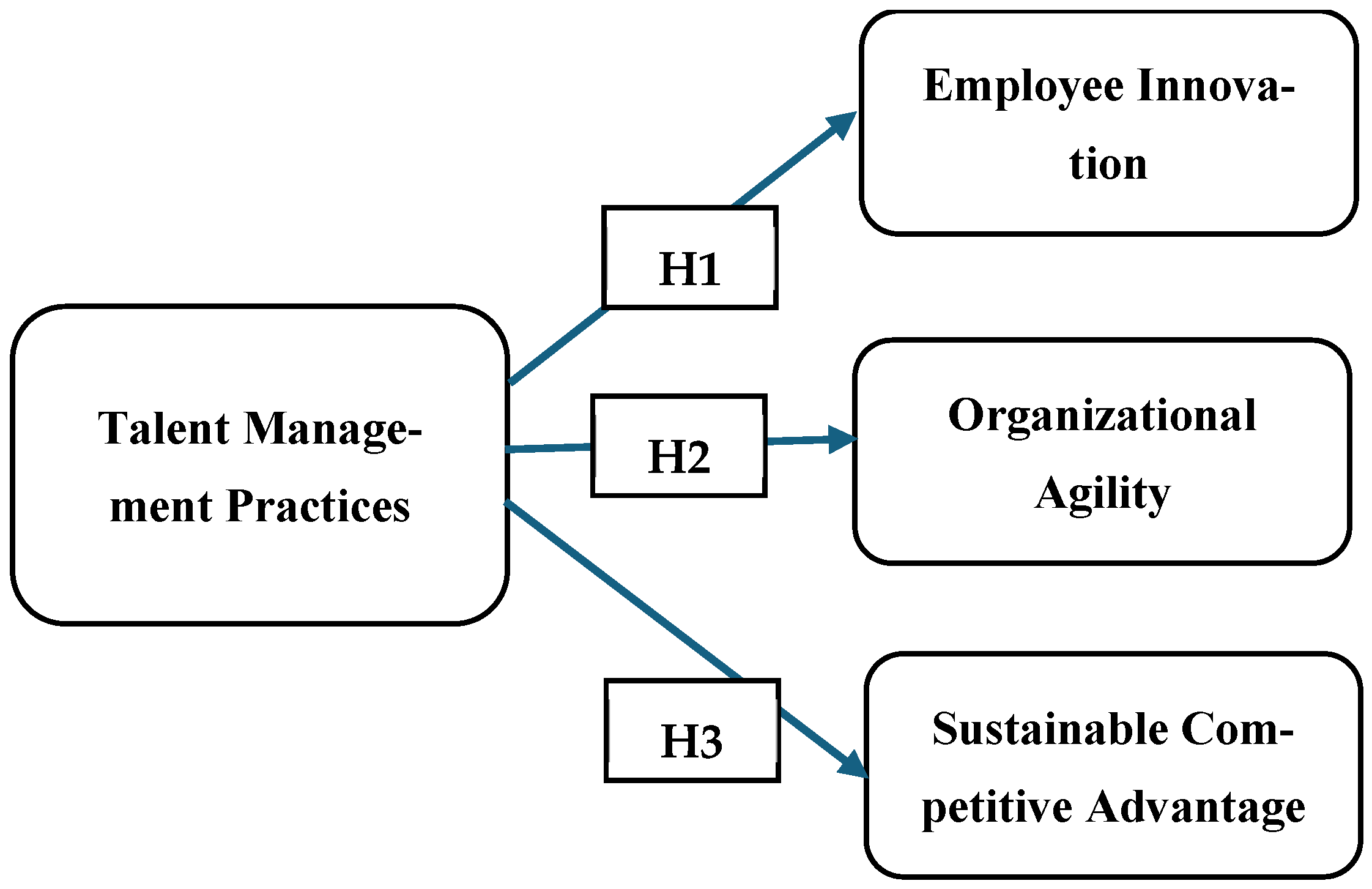
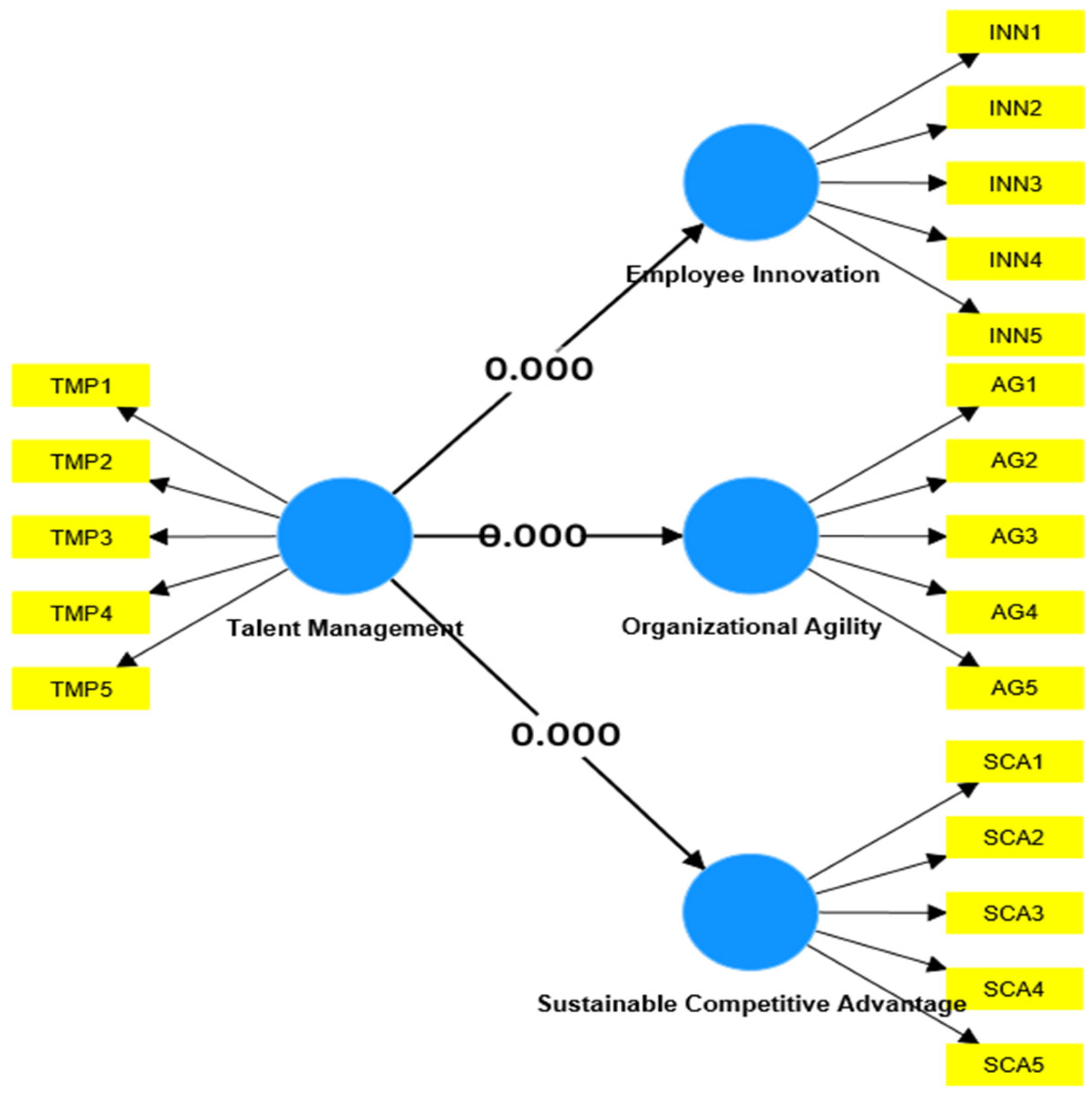
Talent management is an important strategic tool to improve sustainable organization performance and competitiveness in the contemporary business environment. Even though there are increasingly more studies around this topic in the world, studies in the context of Saudi Arabia, and more specifically in the private sector, are still scarce, forming the research gap that this study aims to fill. The study is designed to explore the effect of human resource practices on employee innovation, organization resilience, and sustainable competitive advantage in the Saudi private-sector organizations based on the Resource-Based Variability (RBV) theory as a theoretical perspective. Data were gathered from 366 structured questionnaires, and the hypotheses were tested by employing the relevant statistical tools. The results supported the first hypothesis (H1), showing that there is a positive influence of the practices of talent management on the innovation of the employees, and the second hypothesis (H2) showing the correlation between these practices and organizational resilience. The third hypothesis (H3) showed that talent management practices are significant in the attainment of a sustainable competitive advantage. The findings affirm that the adoption of sound approaches for the attraction, development, and retention of talent has a part in the consolidation of innovation, resilience, and the accomplishment of competitive advantage. The most important theoretical and applied implications of the study are discussed at the end, along with the limitations of the study and suggestions for future research.
Keywords: talent management; employee innovation; sustainable business innovation organizational agility; entrepreneurship; strategy talent management; employee innovation; sustainable business innovation organizational agility; entrepreneurship; strategy