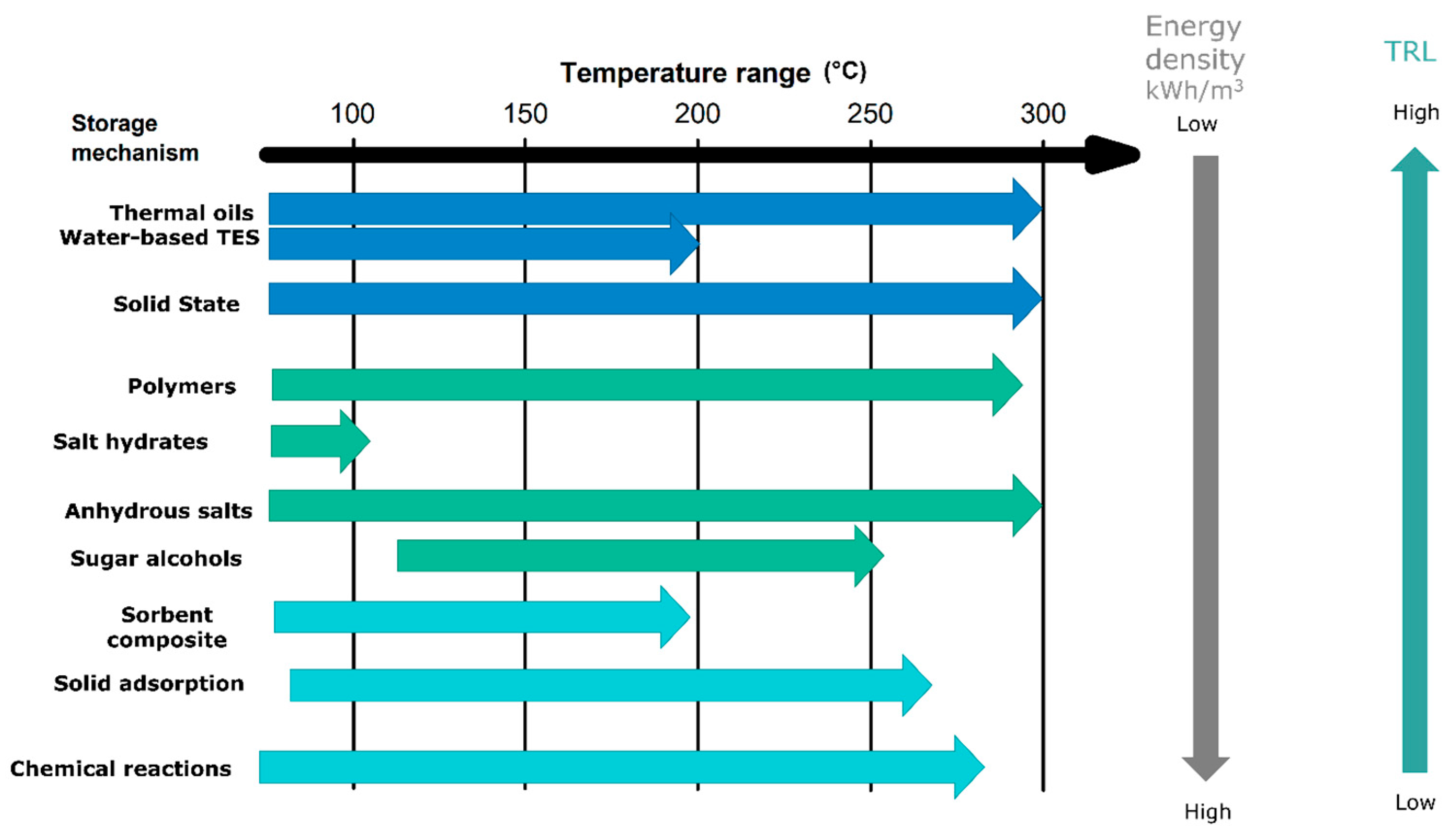
Thermal Energy Storage Technology Roadmap for Decarbonising Medium-Temperature Heat Processes—A Review
 , ,
, ,  , , ,
, , ,  and
and
Abstract
1. Introduction
- compensating for the intermittency of variable renewable energy sources and balancing out energy supply and energy consumption,
- stabilising processes by providing additional power on demand, e.g., in cases with needs for high ramping up in a short period,
- enabling waste heat recovery and, thus, energy efficiency,
- peak shaving,
- load shifting.
- The present review’s temperature range focuses on 100 to 300 °C and gives an up-to-date overview of materials in this range,
- KPI-based technology comparison of TES technologies in the temperature ranges from 100 to 300 °C,
- Extended material description and specifications of TES technologies (storage media) in the temperature range focus,
- Focus on industrial (not building) applications of TES technologies in a restricted temperature range,
- Description of currently deployed TES technologies and potential technologies to play a role in the future in the form of a roadmap,
- Application examples of the described technologies in the temperature range of interest.
2. Scope and Guidance
- Provide a catalogue of TES technologies that can support decarbonisation at 100 to 300 °C.
- Describe which are their important characteristics and current strengths, and limitations.
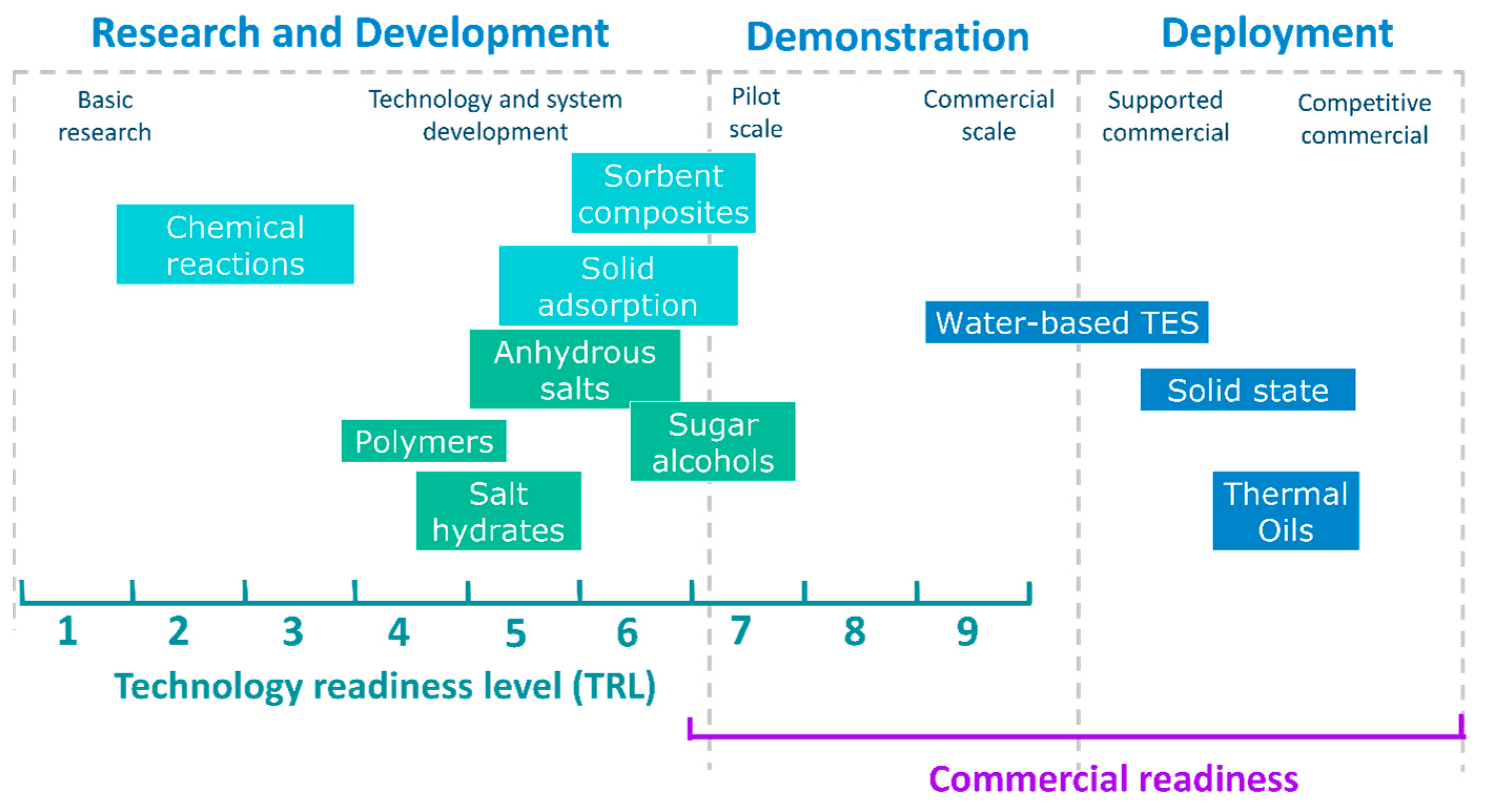
- Assess their maturity level, i.e., at which Technological Readiness Level (TRL) they currently are, and what challenges need to be addressed to advance them.
- (1)
- Storage media, where the basic understanding of the storage mechanism is described, where each potential storage medium is reviewed and assessed in the temperature range of interest,
- (2)
- System configuration, where the technology is classified by the system configuration,
- (3)
- KPIs, where a collection of KPIs for each technology is presented, and
- (4)
- Technology overview, where a final technology comparison is provided with advantages, disadvantages, and challenges.
3. Key Performance Indicators
- Technical performance indicators (KPItech) refer to the technical aspects of thermal energy storage technologies. The technical performances investigated through these KPIs cover the main systems of TES with the relative components.
- Environmental indicators (KPIenvi) are commonly used metrics for environmental data management, eco-efficiency measurement, environment target setting, and real-life monitoring. Such KPIs are used to measure, quantify, and evaluate the performance of a system/component/technology regarding the scope, targets, and objectives, which were designed to be achieved during its demonstration and application [14].
- Socio-economic performance indicators (KPIso-eco) are used to measure the social and economic development of the technology. In this context, the Technology Readiness Level (TRL) is the most widely accepted and used index, measuring the state of maturity of the technologies.

| Category | Name | Unit | Description | Ref. |
|---|---|---|---|---|
| Technical performance indicators | Energy storage density | [J/m3] | The energy storage capacity delivered by a TES system is divided by the system volume. | [15,16] |
| Power density | [kW/m3] | The maximum thermal power delivered by a component divided by the component volume. | [15,16] | |
| Limit operational temperature range (ΔTop) | [°C] | The operation temperature range is defined by the temperatures at which the system is designed to operate, also referred to as nominal conditions. This defines the minimum temperature (Tmin) and the maximum temperature (Tmax) at which the material will be maintained during the operation of the system. | [5] Steinmann | |
| Storage period | [h/d/y] | Targeted storage period. | [17] | |
| Partial discharge | [-] | Parameter to indicate if partial charge/discharge is possible (yes/no). | [18] | |
| Storage size range | [m3] Range | The storage volume is the space occupied by a storage system. | [18] | |
| Round-trip efficiency | [%] | The relationship between the energy delivered to charge the storage and the energy retrieved. It represents how effectively the technology retains and discharges thermal energy once stored. This parameter can be strongly dependent on the system’s working conditions (e.g., daily or seasonal). | [4] | |
| Durability | [Year] | It refers to the assumed maximum number of cycles during which the storage system can release at least 80% of the designed useful capacity. | [4] | |
| Environmental performance indicators | Safety risk | [-] | It includes any risk related to unsafe conditions that can cause system failure, operation or harm to humans, such as flammability, release of toxic gas, explosion, or thermal runaway. | - |
| Environmental risks | [-] | It includes any environmental risk related to environmental hazards, disposal, recycling, pollution, radiation, noise, land-use patterns, work environment, and climate change. | - | |
| Socio-economic performance indicators | Production cost (PC) | [€/kWh] | It refers to the costs incurred when manufacturing a good or providing a service. Production cost includes a variety of expenses, such as labour, raw materials, consumable manufacturing supplies, and general overhead. | [19,20] |
| The specific cost of the storage | [€/kWh] | It defines the overall cost of a certain TES normalised by the total amount of energy it can deliver during its expected lifetime. | [20] | |
| Operation and maintenance cost (O and M) | [€/kWh] | This indicator includes the operating site cost, and planned and unscheduled maintenance. | [20] | |
| TRL | [-] | Identification of the maturity level of a technology from the first level, characterised by the definition of raw principles of scientific research, to the last level of maturity, in which the technology is immediately replicable within an operational context. | [20] |
4. TES Technologies in Industrial Cases
4.1. Industrial Cases and TES Integration (100–300 °C)
4.2. TES Technologies Overview (100–300 °C):
- (1)
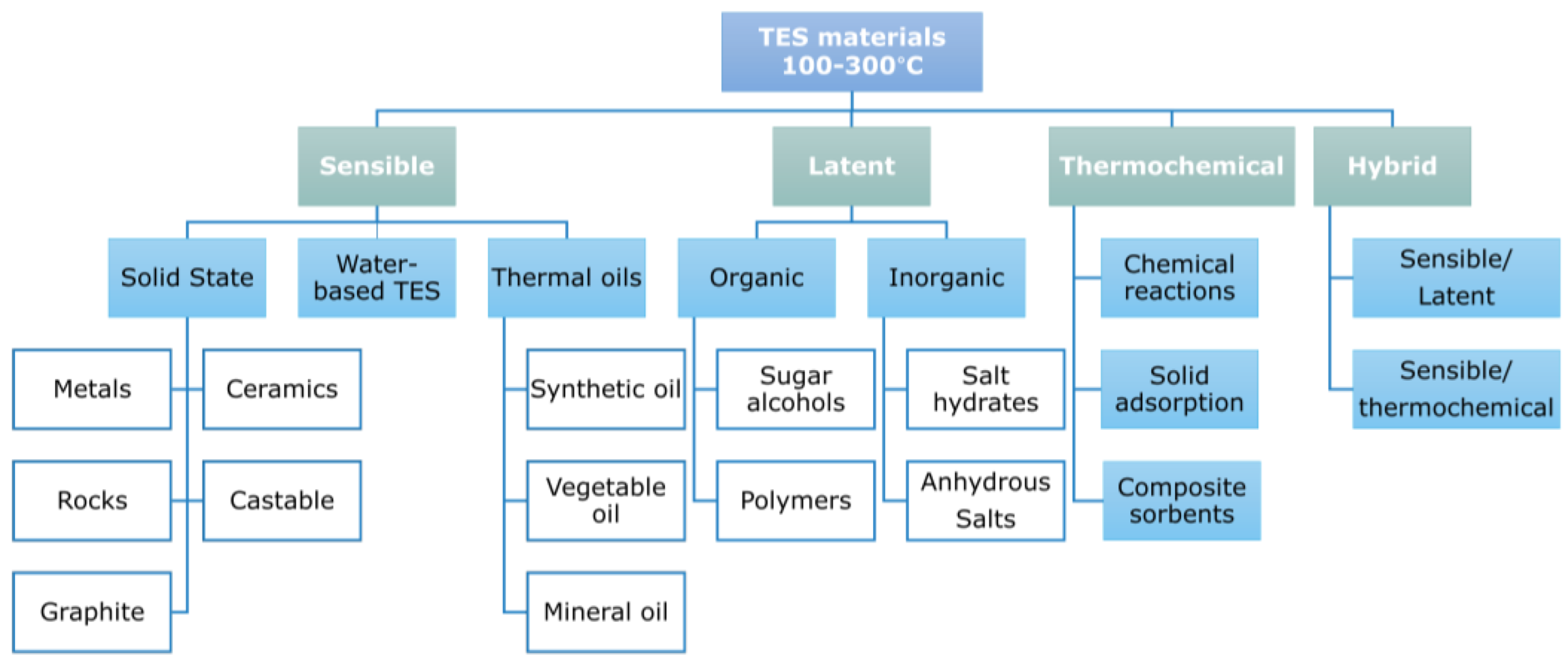
- Solid-state (SS) that groups metals, castables, ceramics, and rocks.
- (2)
- Water-based TES, which are mainly water-pressurised tanks.
- (3)
- Thermal oils that are considered synthetic, vegetable, and mineral oils.
| HTF | Advantages | Disadvantages | Temperature (°C) | Specific Heat (kJ/kg·K) | Cost ($/kg) | Thermal Conductivity (W/mK) |
|---|---|---|---|---|---|---|
| Molten metals |
|
| 142 to 600 | 0.24 to 4.16 | 2 to 1.3 | 12 to 46 (600 °C) |
| Mineral oils |
|
| −50 to 300 | 2 to 3 | 0.3 | 0.1 (300 °C) |
| Synthetic oils | −50 to 340 | 2 to 3.6 | 3 to 5 | 0.1 (300 °C) | ||
| Pressurised water |
|
| 350 °C | 2.1 | 0 | 0.08 (600 °C) |
| Water |
|
| 0 to 100 °C | 4.2 | 0 | 0.598 (20 °C) |
| Molten salts |
|
| 97 to 650 °C | 1.3 to 1.6 | 0.5 to 1.1 | 0.2 to 0.55 (200–500 °C) |
| Air |
|
| 1100 °C | 1.12 | 0 | 0.06 (600 °C) |
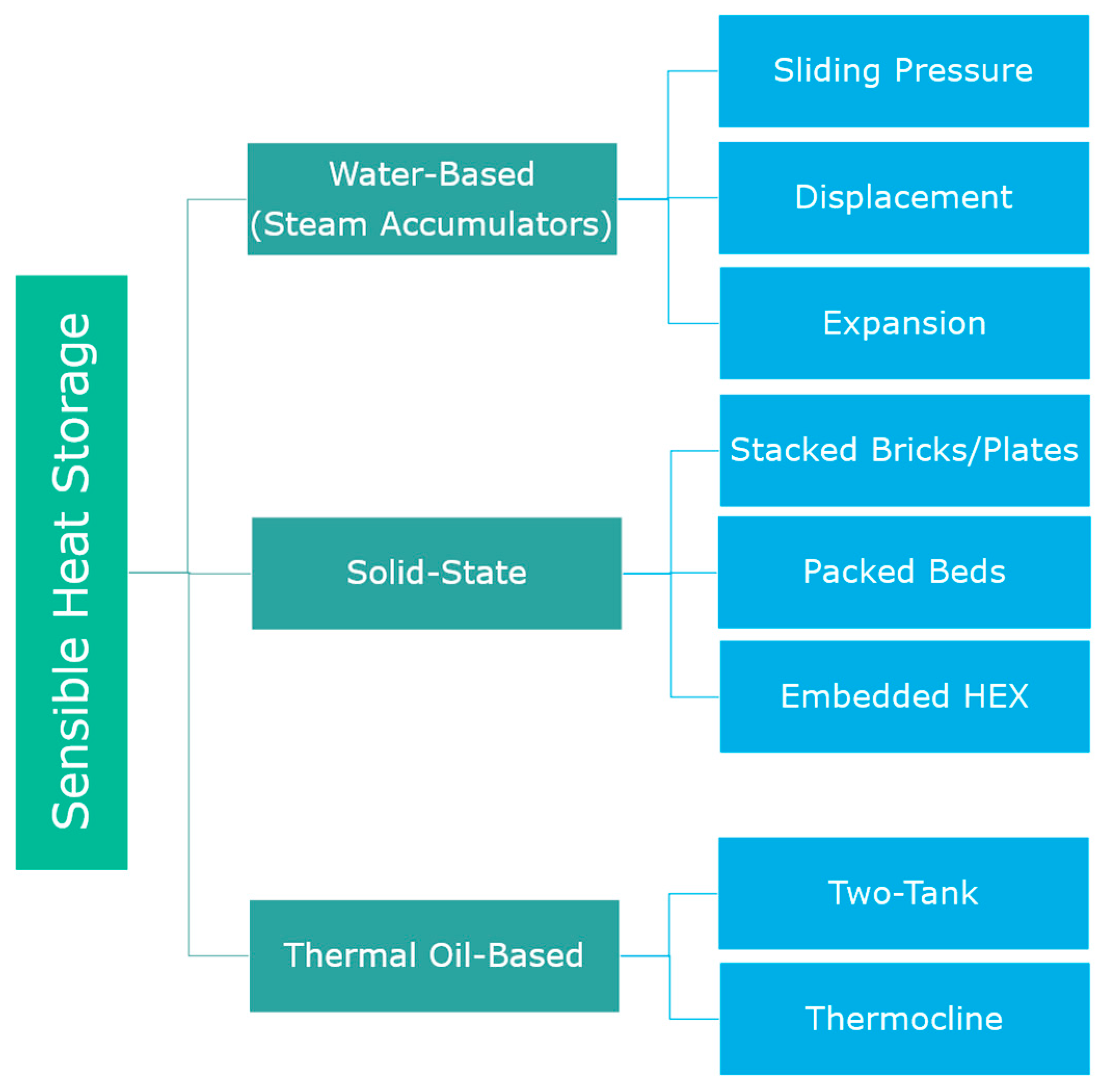
4.3. Sensible Heat Storage
4.3.1. Storage Media and System Configuration
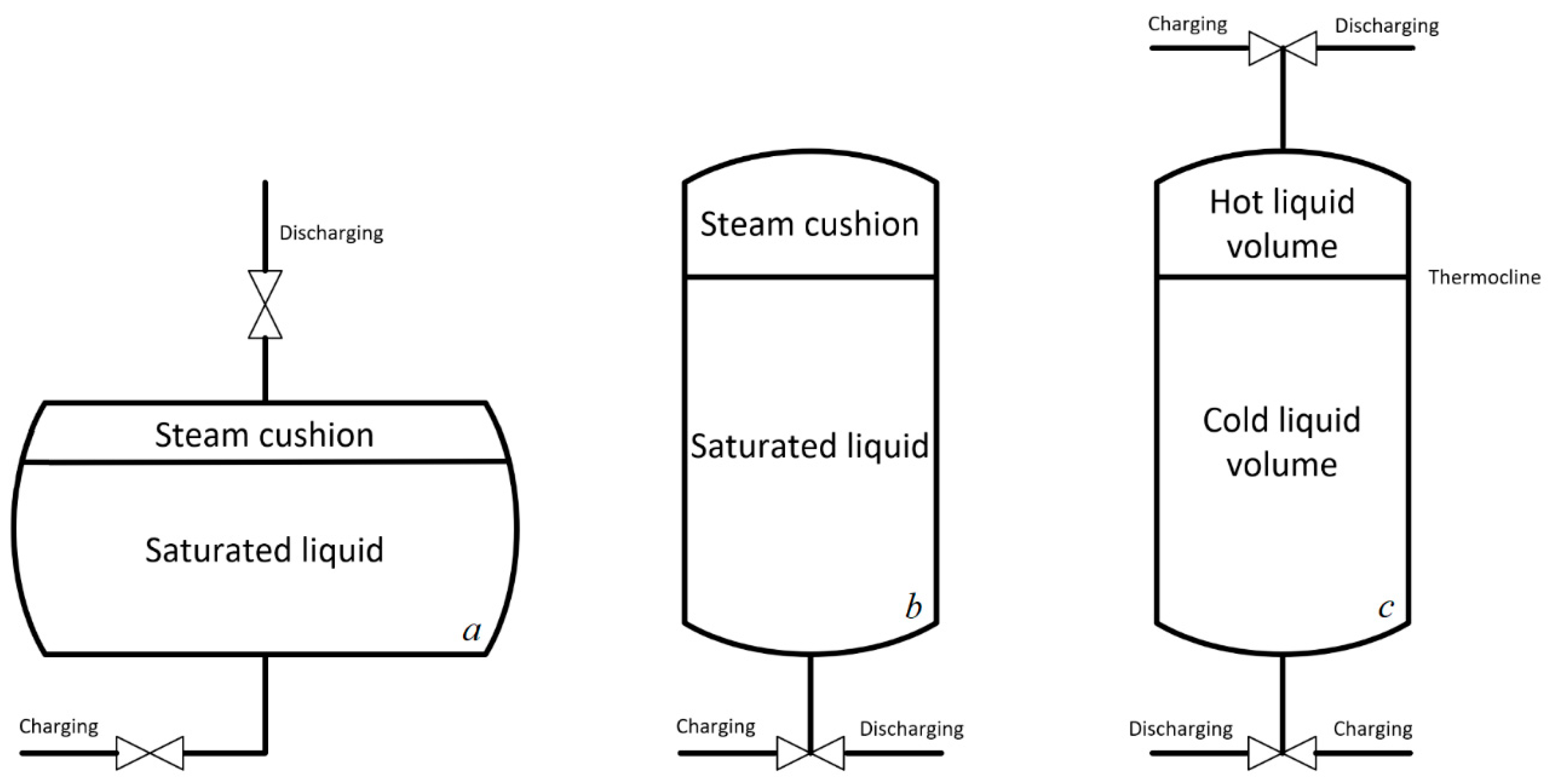
4.3.2. Water-Based Systems
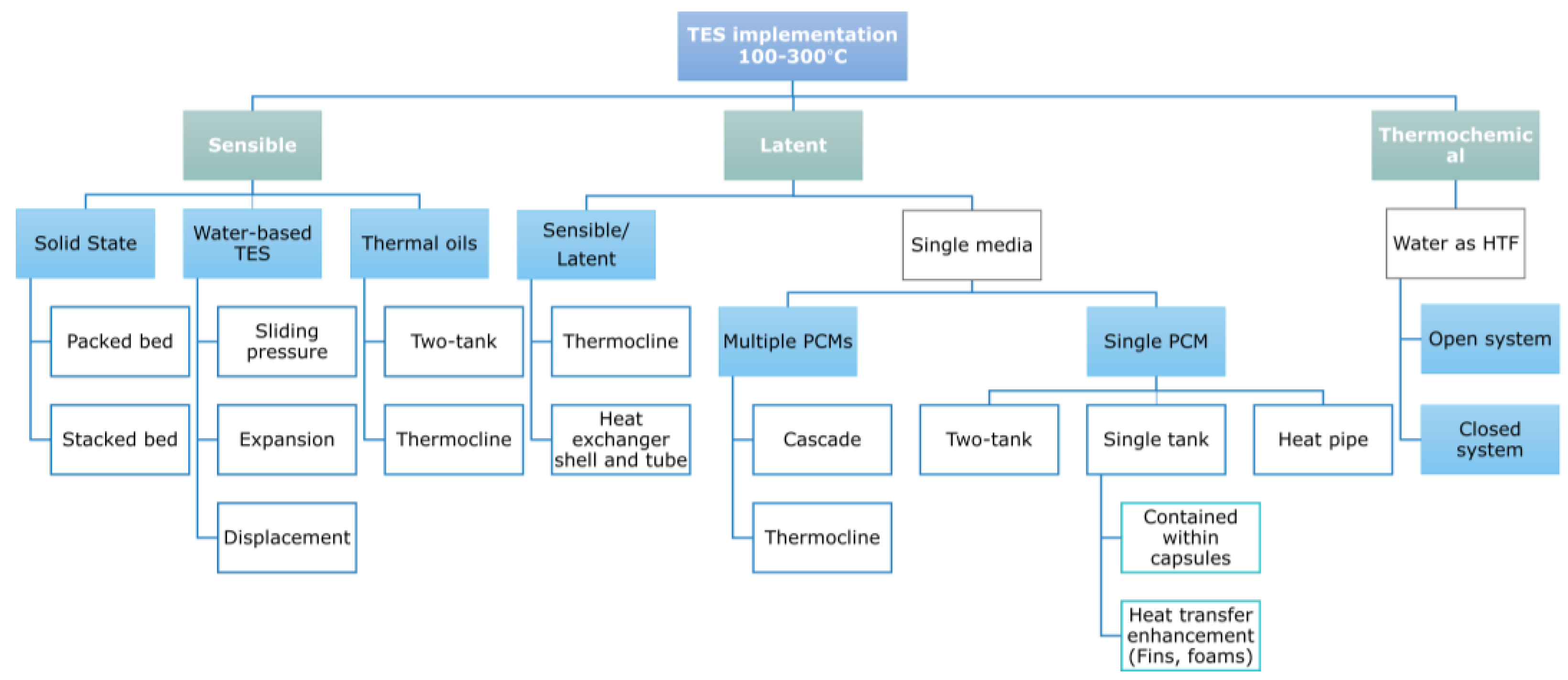
- Sliding pressure storage (Ruths Storage)
- Expansion storage
- Displacement storage
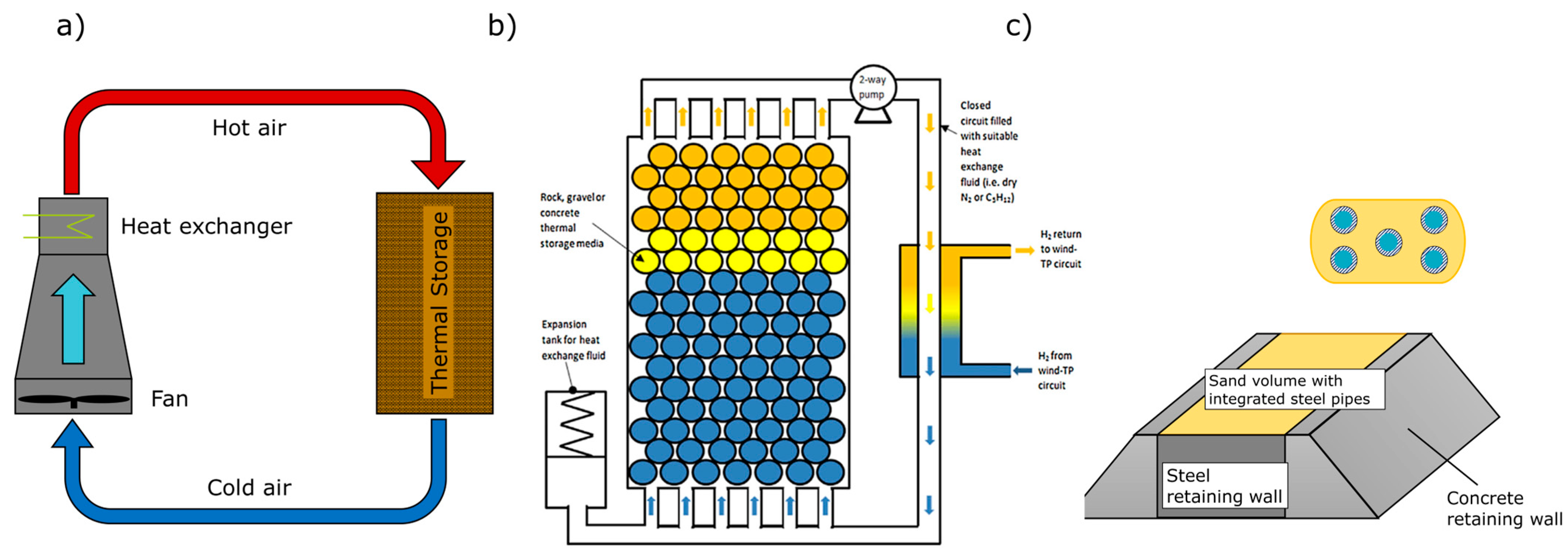
4.3.3. Solid-State TES (SSTES)
- Stacked Bricks/Plates
- Packed Beds
- Embedded HEX
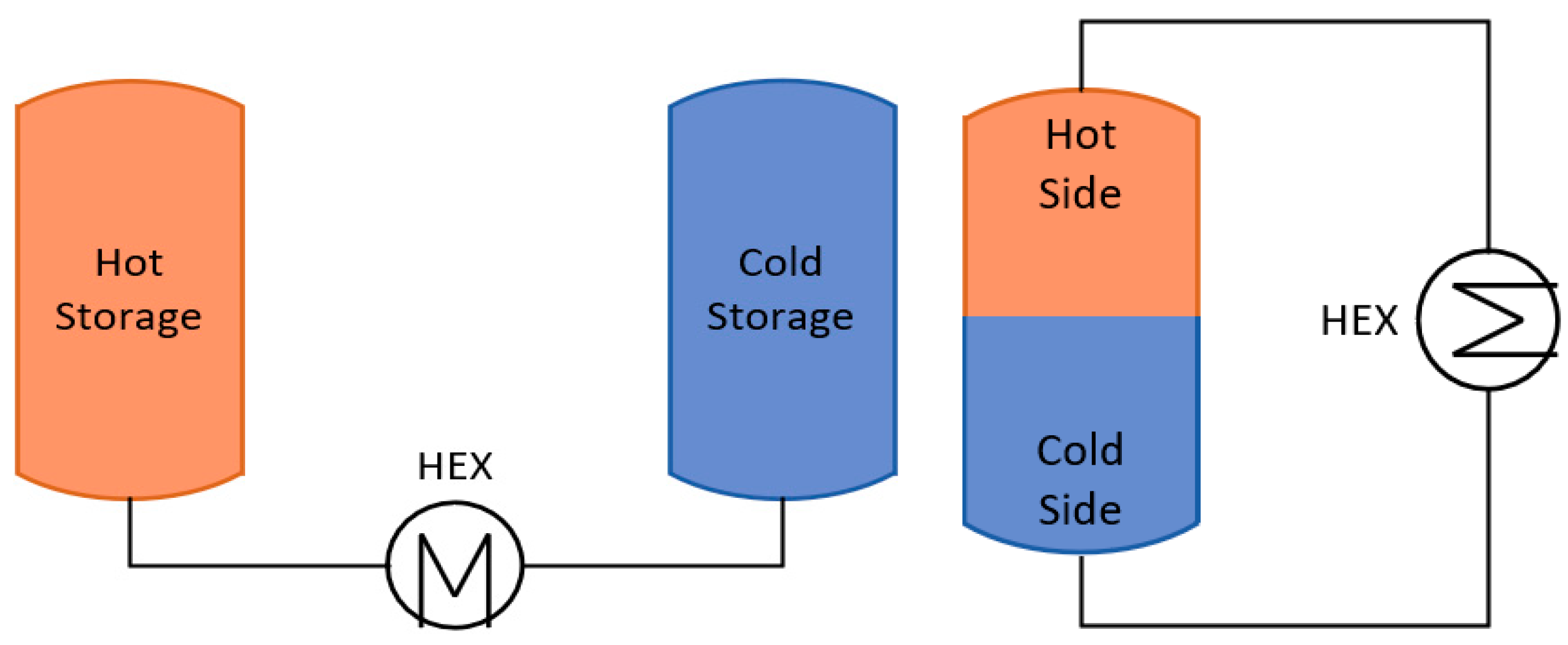
4.3.4. Thermal Oil-Based TES
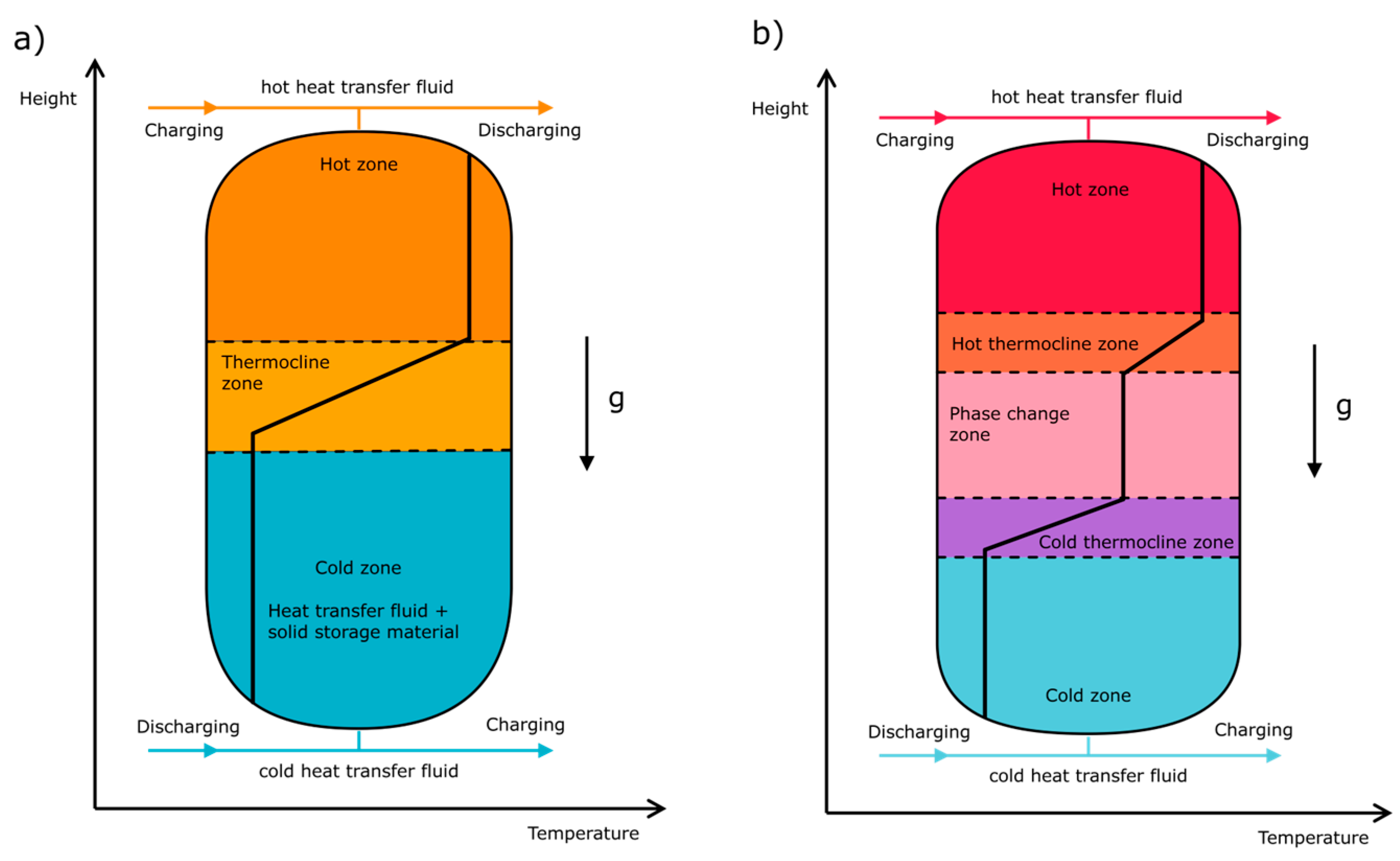
- Two-Tank System
- Thermocline System
4.3.5. KPIs Sensible Storage Technologies
4.3.6. Technology Overview
4.4. Latent Heat Storage
4.4.1. Storage Media
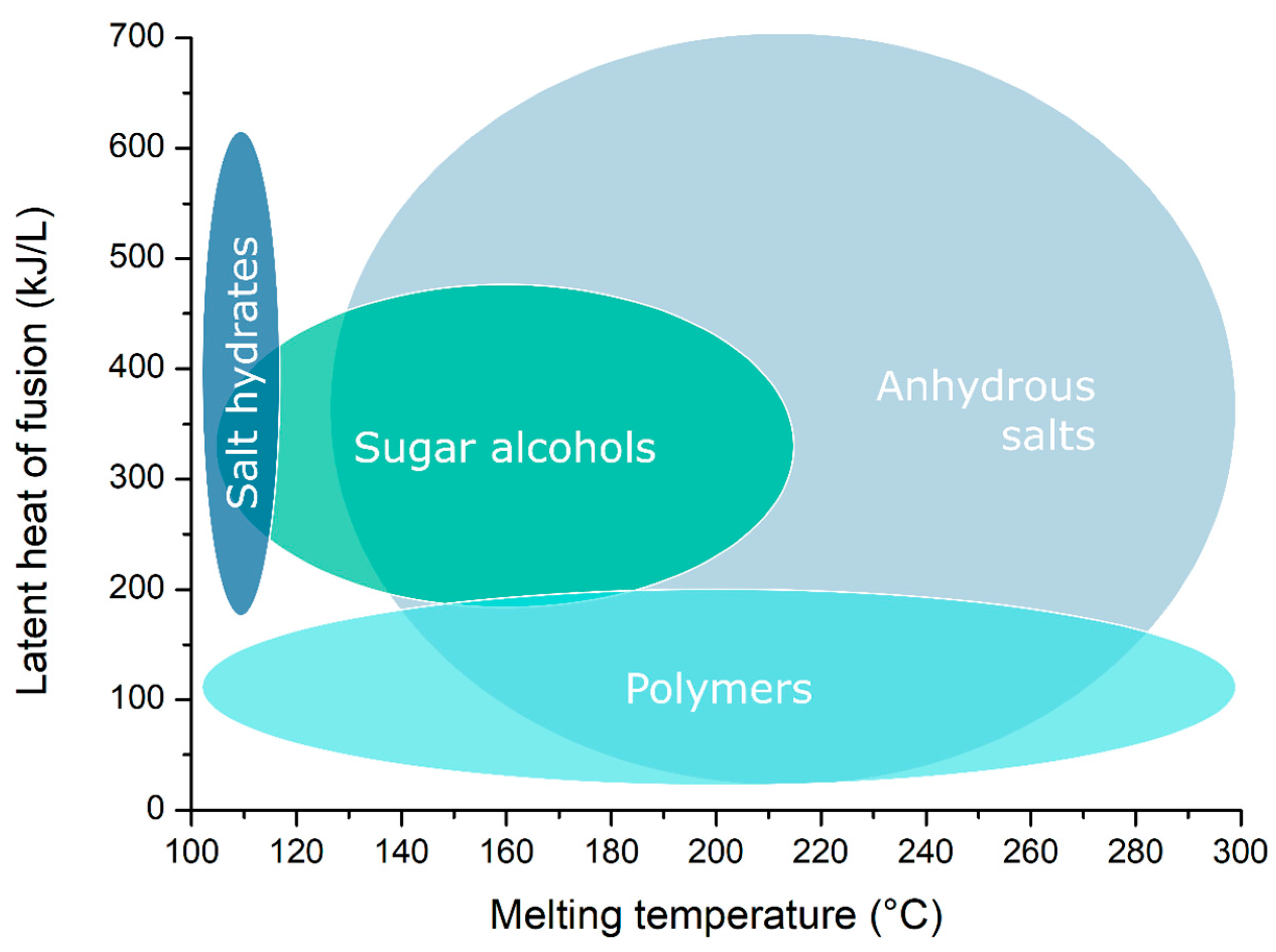
4.4.2. Salt Hydrates
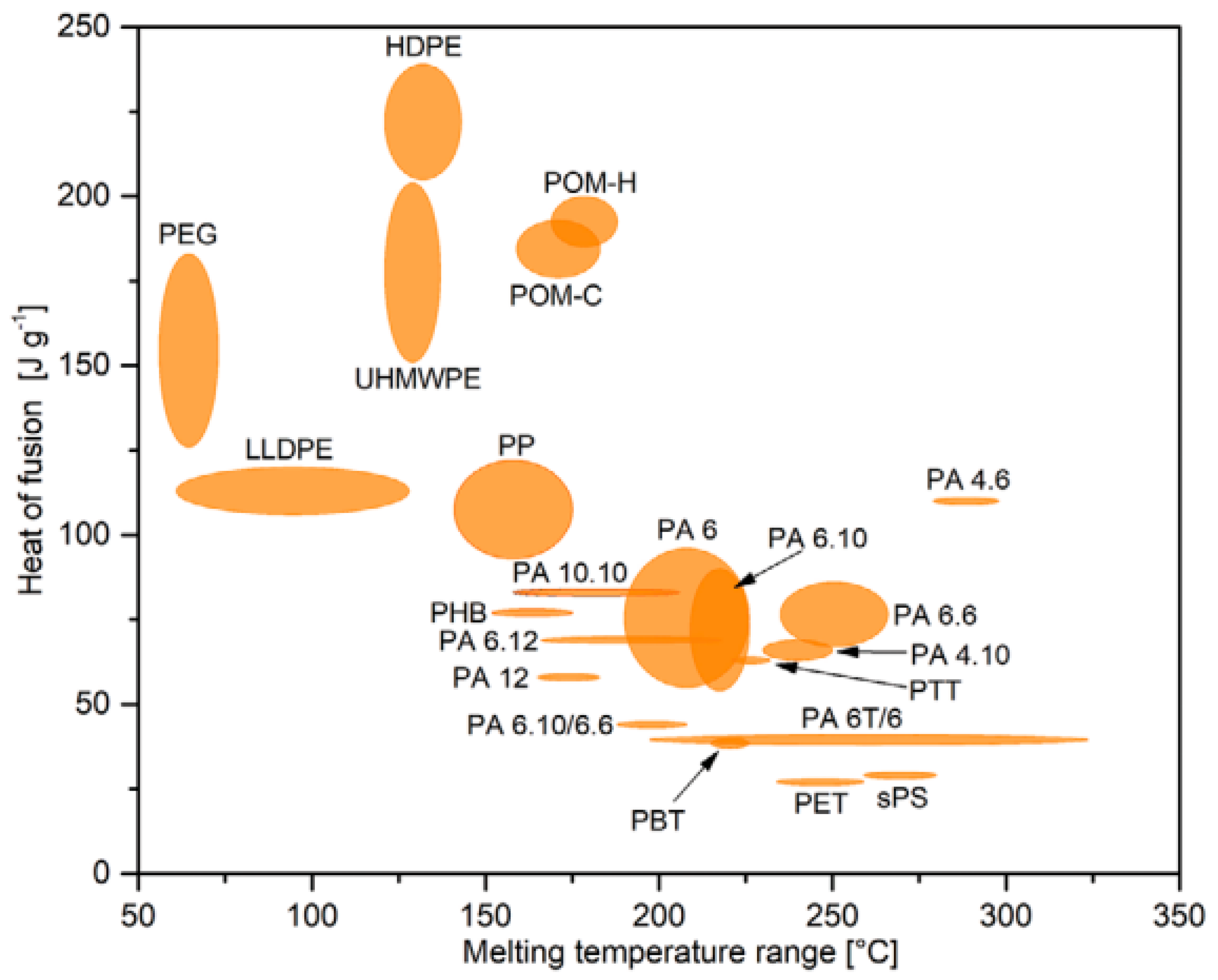
4.4.3. Polymers
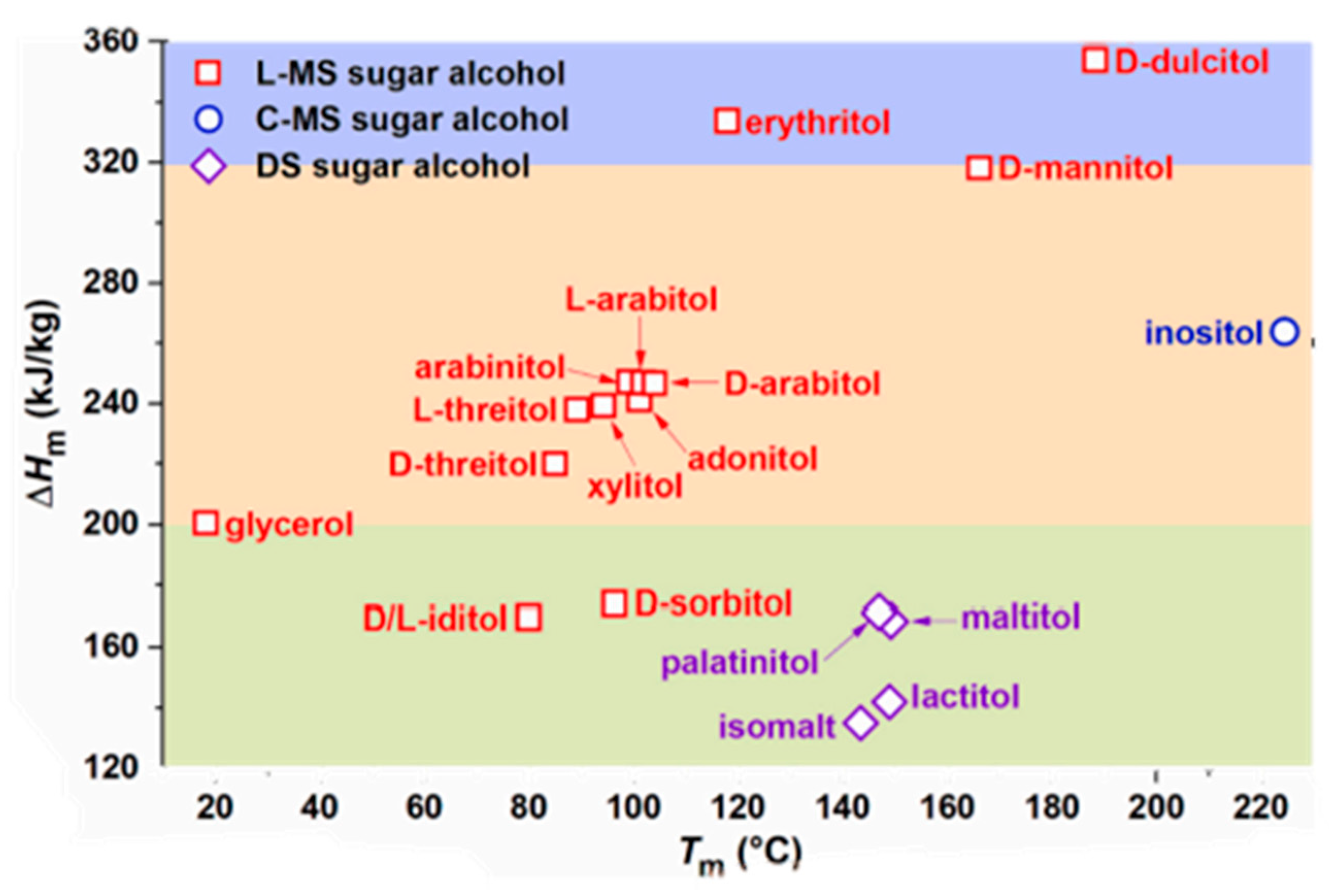
4.4.4. Sugar Alcohols
4.4.5. Anhydrous Salts
| Salt | T Melting (°C) | Heat of Fusion (J/g) | Thermal Conductivity (W·m−1·K−1) (Liquid) | Cp (J/kg k) (Liquid) | Volume Change (%) | Density (kg/m3) (Solid) | Price (€/m3) | Ref |
|---|---|---|---|---|---|---|---|---|
| Urea-NH4Cl (85-15) | 102 | 214 | 0.76 | 1.7 | - | 1348 | 174 | [49] |
| Urea-K2CO3 (15-85) | 102 | 206 | 0.78 | 2.20 | - | 1415 | 269 | [49] |
| Urea-KNO3 (77-23) | 109 | 109 | 0.81 | 1.90 | - | 1415 | 255 | [49] |
| Urea-NaCl (90-10) | 112 | 230 | 0.82 | 2.20 | - | 1372 | 180 | [49] |
| Urea-KCl (89-11) | 115 | 227 | 0.83 | 1.96 | - | 1370 | 255 | [49] |
| LiNO3–NaNO3–KNO3 | 123 | 140 | 0.79 | 1.44 | - | 2068 | 197 | [49] |
| KNO3-LiNO3 (67-33) | 133 | 170 | N/A | N/A | 14 | 2068 | 1979 | [102] |
| KNO3-NaNO2 (56-44) | 141 | 97 | 0.730 | 1.74 | - | 1994 | 504 | [49] |
| KNO3-NaNO2-NaNO3 (53-40-7) | 142 | 110 | 0.5 | 1.3 | 4 | 1.98 | 497 | [102] |
| KNO2-NaNO3 (48-52) | 149 | 124 | 0.58 | 1.05 | - | 2080 | 994 | [49] |
| LiNO3-NaNO2 (62-38) | 156 | 233 | 1.12 | 1.57 | - | 2296 | 3816 | [49] |
| LiNO3-KCl | 160 | 272 | 1.31 | 1.26 | - | 2196 | 3409 | [49] |
| LiNO3-NaNO3-KCl | 160 | 266 | 0.88 | 1.32 | - | 2297 | 2852 | [49] |
| LiOH-LiNO3 (19-81) | 183 | 352 | 0.69 | 2000 | N/A | 2124 | 5165 | [49] |
| LiNO3-NaNO3 (49-51) | 194 | 265 | 0.590 | 1720 | N/A | 2317 | 3084 | [49,103] |
| LiNO3-NaCl (87-13) | 208 | 369 | 0.630 | 1560 | N/A | 2350 | 5254 | [49] |
| LiNO3-KCl (87-13) | 208 | 369 | 0.630 | 1560 | N/A | 2350 | 5254 (£/m3) | [49] |
| KNO3-KOH (80-20) | 214 | 83 | 0.540 | 1350 | N/A | 1905 | 611 (£/m3) | [49] |
| LiOH/NaOH (20-80) | 215 | 290 | N/A | N/A | N/A | N/A | N/A | [103] |
| Na/K/NO3 (0.5/0.5) | 220 | 100.7 | 0.56 | 1.35 | N/A | 1920 | N/A | [104] |
| KNO3-NaNO3 (54-46) | 222 | 100 | 0.5 | 1.5 | 5 | 1.95 | [102] | |
| LiBr-LiNO3 (27-73) | 228 | 279 | 0.570 | 1380 | N/A | 2630 | 6134 (£/m3) | [49] |
| LiOH-NaNO3-NaOH (6-67-27) | 230 | 184 | 0.780 | 2000 | N/A | 2154 | 538 (£/m3) | [49] |
| Ca(NO3)2(45wt%)-NaNO3(55wt%) | 230 | 110 | - | - | - | - | - | [37] |
| (80)NaOH-(20)NaNO3 | 232 | 252 | N/A | N/A | N/A | N/A | N/A | [105] |
| (55)NaNO2-(45)NaNO3 | 233 | 163 | 0.59 | 1.310 | N/A | 2210 | 482 | [49] |
| ZnCl2/KCl (0.319/0.681) | 235 | 198 | 0.8 | N/A | N/A | 2480 | N/A | [104] |
| (73)NaOH-(27)NaNO2 | 237 | 252 | N/A | N/A | N/A | N/A | N/A | [103] |
| (27)NaOH-(73)NaNO3 | 237 | 294 | N/A | N/A | N/A | N/A | N/A | [105] |
| CaCl2-LiNO3 (13-87) | 238 | 317 | 0.690 | 1530 | N/A | 2362 | 5325 | [49] |
| LiCl-LiNO3 (9-91) | 244 | 342 | 0.640 | 1610 | N/A | 2351 | 6019 | [49] |
| (72)NaNO3-(28)NaOH | 247 | 237 | N/A | N/A | N/A | N/A | N/A | [105] |
| (86)NaNO3-(14)NaOH | 250 | 160 | 0.660 | 1.1990 | N/A | 2241 | 382 | [49] |
| LiNO3 | 254 | 360 | 0.650 | 1450 | N/A | 2380 | 6700 | [103] |
| (18.5)NaNO3-(81.5)NaOH | 257 | 292 | N/A | N/A | N/A | N/A | N/A | [10] |
| LiCl-LiOH | 262 | 485 | - | - | - | - | - | [37] |
| (41)NaNO3-(59)NaOH | 266 | 278 | N/A | N/A | N/A | N/A | N/A | [105] |
| NaNO2 | 270 | 180 | 0.53–0.67 | 1.65 | 16.5 | 1.81 | N/A | [105] |
| ZnCl2 | 280 | 75 | 0.5 | 0.74 | N/A | 2907 | N/A | [104] |
| NaNO3 | 306 | 172 | 0.5 | 1.82 | 10.7 | 2.26 | 0.41 | [104,105] |
| NaOH | 318 | 165 | 0.92 | 2.08 | N/A | 2100 | N/A | [104,105] |
| KNO3(94 wt%)-KCl(6 wt%) | 320 | 80 | - | - | - | - | - | [37] |
| KNO3 | 337 | 100 | 0.5 | 1.4 | 5 | 1.95 | [102] |
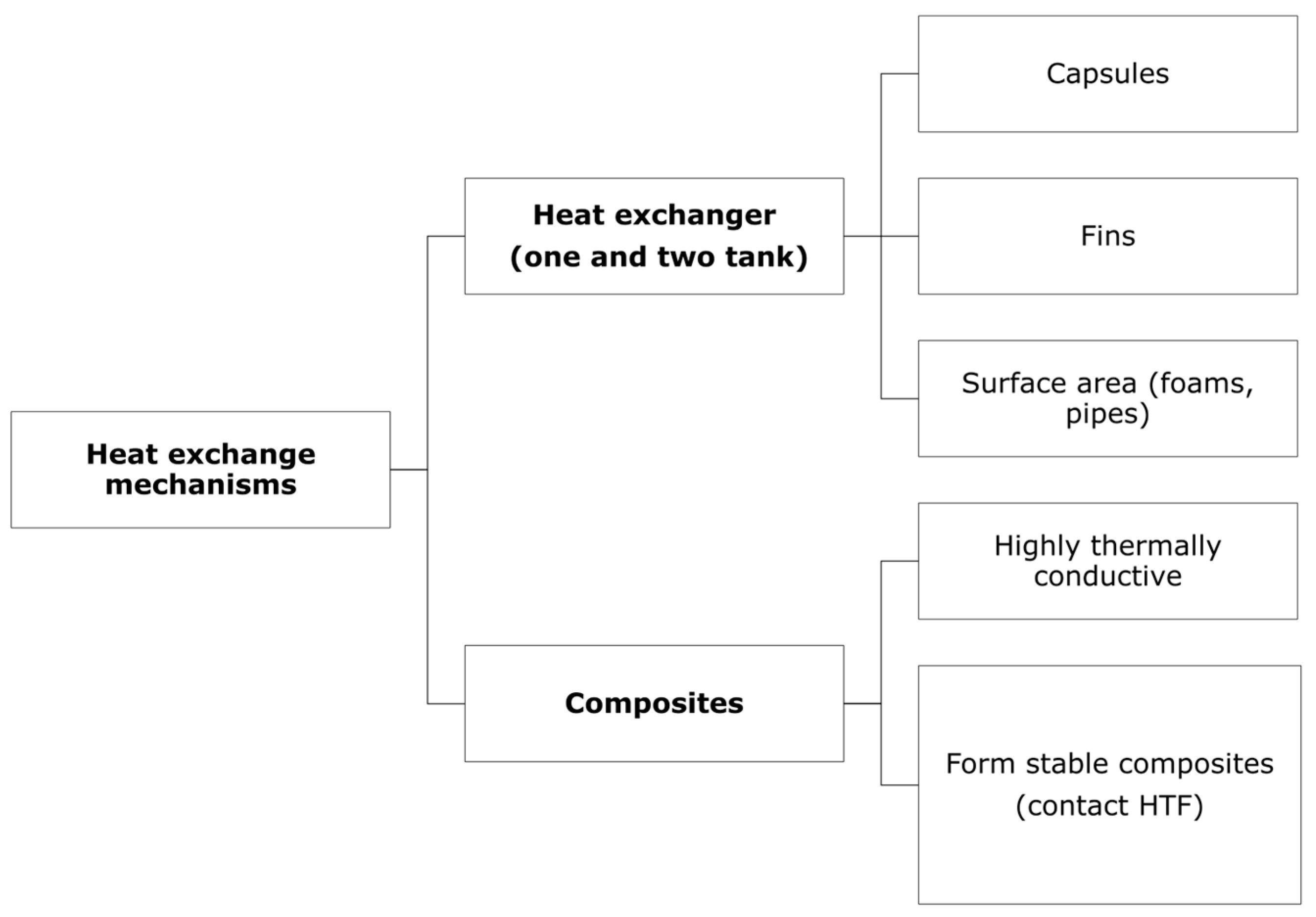
4.4.6. System Configuration
4.4.7. Storage Media Overview
4.4.8. KPI’s Latent Heat Storage Technologies
4.5. Thermochemical
4.5.1. Storage Media
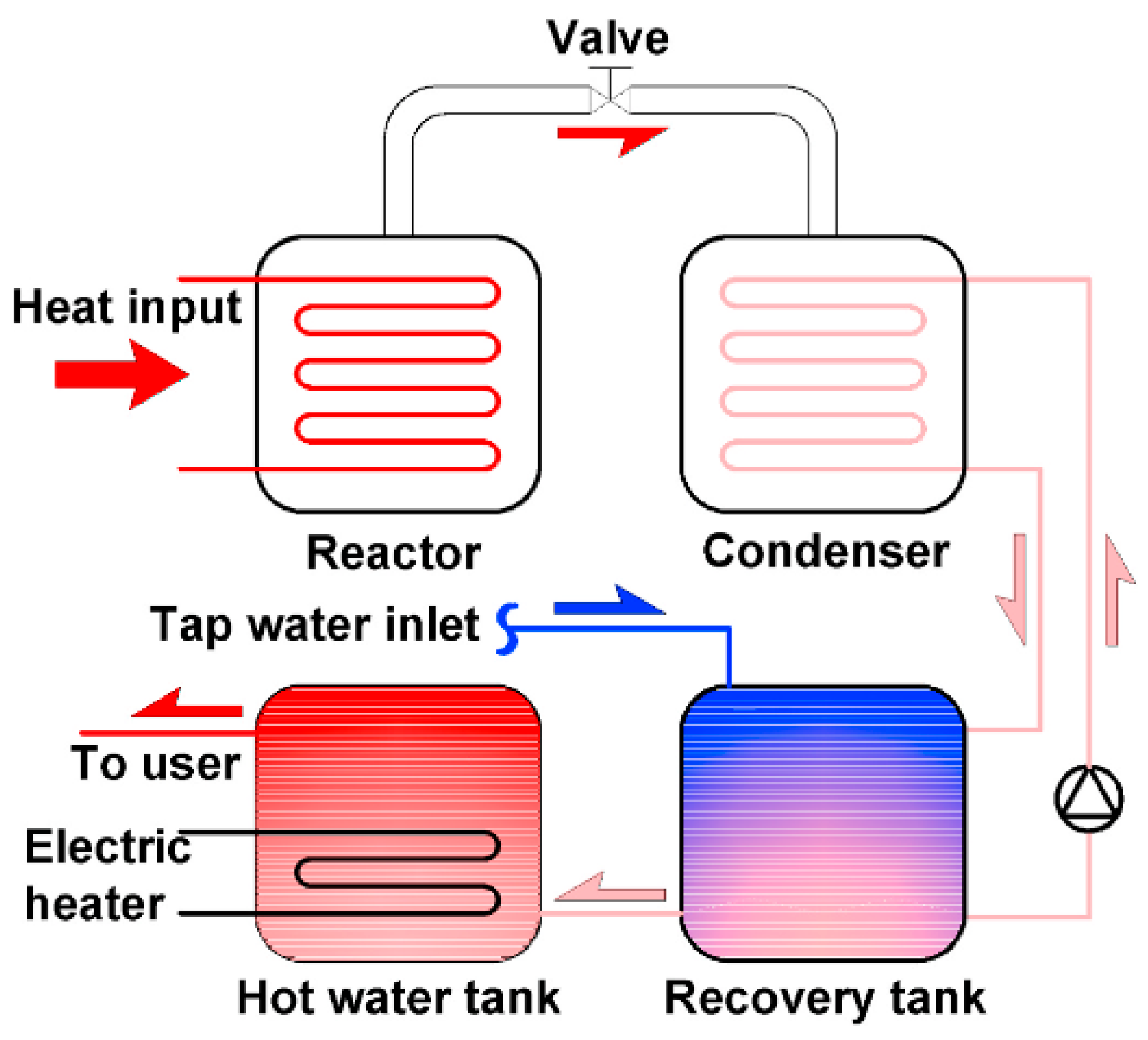
4.5.2. Sorption-Based Thermochemical
4.5.3. Reversible Chemical Reactions
4.5.4. System Configuration
4.5.5. KPIs Thermochemical Storage Technologies
4.5.6. Technology Overview
4.6. Hybrid Systems
4.6.1. Working Mechanism
4.6.2. Sensible and Latent
4.6.3. Thermochemical and Sensible
4.6.4. Technology Overview
4.7. Technology Comparison
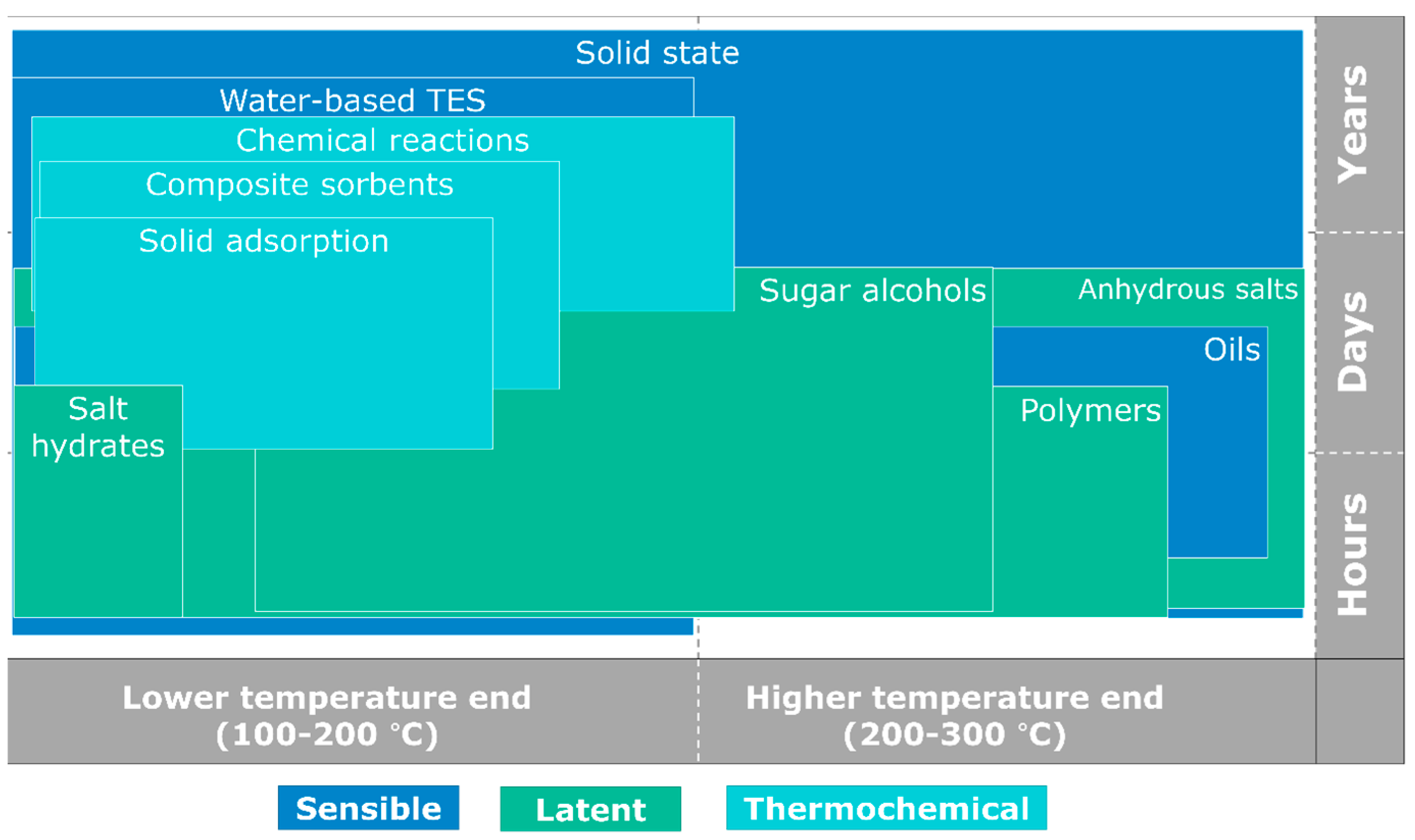
4.7.1. Storage Period and Technology Maturity for the Industrial Case
4.7.2. Cost of TES Technologies vs. Industrial Site Space
5. Conclusions and Outlook
- Sensible heat TES technology has undergone a long development, and the technology outlook shows that most of the technologies between 100 °C and 300 °C are commercially available and mature.
- Latent heat TES technology has been the focus in recent decades, mainly including the research on PCMs to improve their thermal performance (e.g., thermal conductivity), the design of heat exchangers to improve the heat transfer, and some applied research to facilitate latent heat TES commercialisation.
- Among thermochemical storage, sorption TES is the most mature technology; however, compared to the sensible and latent heat storage, it is still an emerging topic. The current study on the sorption TES system is focused on developing alternative working pairs (sorbent and sorbate materials) and optimising the system configurations and cycles. Only a limited number of studies have conducted practical research on these systems within the relevant temperature range. Further reversible reactions should be researched in this temperature range, and heat transformers stand up as a promising solution for waste heat recovery in the medium-temperature range.
- In general, latent and thermochemical storage show costs above the economic viability of thermal energy storage implementations as a function of the number of cycles, which is an investment cost of 0.25 €/kWh for seasonal energy storage (1 cycle a year) and 75 for daily storage (considering 300 cycles per year). Specially, TCS ranges from 8 to 100 per kWh, depending on the system selected. Open systems are less complex and inexpensive, and the manufacturing methodology for the TCS material. Meanwhile, PCM installations also depend on the implementation method (encapsulation, active, board plaster, etc.), and the cost of PCM ranges between 10 and 50 kWh. In both cases, the cost of the equipment is much higher than the cost of the storage material. Therefore, PCM and TCS systems are economically viable only for applications with a higher number of cycles.
Funding
Institutional Review Board Statement
Informed Consent Statement
Data Availability Statement
Conflicts of Interest
Abbreviations
| Melting temperature | |
| Solidification temperature | |
| Decomposition temperature | |
| Latent heat of fusion | |
| CSP | Concentrated Solar Power |
| DHW | Domestic Hot Water |
| DSC | Differential Scanning Calorimetry |
| EnAW | Energie Agentur der Wirtschaft |
| EOL | End of Life |
| FT-IR | Fourier-transform Infrared Spectroscopy |
| HD | High Density |
| HTF | Heat Transfer Fluid |
| KPIs | Key Performance Indicators |
| MOF | Metal–Organic Framework |
| OAD | Oxalic Acid Dehydrate |
| PBT | Polybutylene Terephthalate |
| PC | Production Cost |
| PCM | Phase Change Material |
| PE | Polyethylene |
| PEG | Polyethylene Glycol |
| PHB | Polyhydroxy Buyrate |
| POM | Polyoxymethylene |
| PP | Polypropylene |
| PTT | Polytrimethylene Terephthalate |
| PV | Photovoltaic |
| RES | Renewable Energy Sources |
| SS | Solid-State |
| TCS | Thermochemical Storage |
| TES | Thermal Energy Storage |
| TGA | Thermo Gravimetric Analyses |
| TRL | Technology Readiness Level |
References
- Bundesamt für Energie. Gesamtenergiestatistik; Bundesamt für Energie: Ittigen, Switzerland, 2024. [Google Scholar]
- Neusel, L.; Hirzel, S.; Rehfeldt, M. Still alive, but different in the future? Decarbonisation of industrial steam boilers from a multi-dimensional perspective. In Proceedings of the ECEEE Summer Study 2022, Hyères, France, 6–11 June 2022; pp. 1353–1364. [Google Scholar]
- de Boer, R.; Marina, A.; Zühlsdorf, B.; Arpagaus, C.; Bantle, M.; Wilk, V.; Elmegaard, B.; Corberán, J.; Benson, J. Strengthening Industrial Heat Pump Innovation: Decarbonizing Industrial Heat. Whitepaper 2020, 32. Available online: https://orbit.dtu.dk/en/publications/strengthening-industrial-heat-pump-innovation-decarbonizing-indus/ (accessed on 6 March 2024).
- International Renewable Energy Agency. Innovation Outlook: Thermal Energy Storage; International Renewable Energy Agency: Masdar City, United Arab Emirates, 2020. [Google Scholar]
- Steinmann, W.-D. Thermal Energy Storage for Medium and High Temperatures; Springer: Wiesbaden, Germany, 2022. [Google Scholar] [CrossRef]
- Sarbu, I.; Sebarchievici, C. A comprehensive review of thermal energy storage. Sustainability 2018, 10, 191. [Google Scholar] [CrossRef]
- Zhou, D.; Zhao, C.Y.; Tian, Y. Review on thermal energy storage with phase change materials (PCMs) in building applications. Appl. Energy 2012, 92, 593–605. [Google Scholar] [CrossRef]
- Sharma, A.; Tyagi, V.V.; Chen, C.R.; Buddhi, D. Review on thermal energy storage with phase change materials and applications. Renew. Sustain. Energy Rev. 2009, 13, 318–345. [Google Scholar] [CrossRef]
- Miró, L.; Gasia, J.; Cabeza, L.F. Thermal energy storage (TES) for industrial waste heat (IWH) recovery: A review. Appl. Energy 2016, 179, 284–301. [Google Scholar] [CrossRef]
- Agalit, H.; Zari, N.; Maaroufi, M. Suitability of industrial wastes for application as high temperature thermal energy storage (TES) materials in solar tower power plants—A comprehensive review. Sol. Energy 2020, 208, 1151–1165. [Google Scholar] [CrossRef]
- Gutierrez, A.; Miró, L.; Gil, A.; Rodríguez-Aseguinolaza, J.; Barreneche, C.; Calvet, N.; Py, X.; Fernández, A.I.; Grágeda, M.; Ushak, S.; et al. Industrial waste materials and by-products as thermal energy storage (TES) materials: A review. AIP Conf. Proc. 2016, 2016, 1734. [Google Scholar] [CrossRef]
- Achkari, O.; El Fadar, A. Latest developments on TES and CSP technologies—Energy and environmental issues, applications and research trends. Appl. Therm. Eng. 2020, 167, 114806. [Google Scholar] [CrossRef]
- Arpagaus, C.; Bless, F.; Uhlmann, M.; Schiffmann, J.; Bertsch, S.S. High temperature heat pumps: Market overview, state of the art, research status, refrigerants, and application potentials. Energy 2018, 152, 985–1010. [Google Scholar] [CrossRef]
- Kourkoumpas, D.S.; Benekos, G.; Nikolopoulos, N.; Karellas, S.; Grammelis, P.; Kakaras, E. A review of key environmental and energy performance indicators for the case of renewable energy systems when integrated with storage solutions. Appl. Energy 2018, 231, 380–398. [Google Scholar] [CrossRef]
- González-Gil, A.; Palacin, R.; Batty, P. Optimal energy management of urban rail systems: Key performance indicators. Energy Convers. Manag. 2015, 90, 282–291. [Google Scholar] [CrossRef]
- Romaní, J.; Gasia, J.; Solé, A.; Takasu, H.; Kato, Y.; Cabeza, L.F. Evaluation of energy density as performance indicator for thermal energy storage at material and system levels. Appl. Energy 2019, 235, 954–962. [Google Scholar] [CrossRef]
- Cabeza, L.F.; Galindo, E.; Prieto, C.; Barreneche, C.; Fernández, A.I. Key performance indicators in thermal energy storage: Survey and assessment. Renew. Energy 2015, 83, 820–827. [Google Scholar] [CrossRef]
- Del Pero, C.; Aste, N.; Paksoy, H.; Haghighat, F.; Grillo, S.; Leonforte, F. Energy storage key performance indicators for building application. Sustain. Cities Soc. 2018, 40, 54–65. [Google Scholar] [CrossRef]
- SWS Heating. Development and Validation of an Innovative Solar Compact Selective-Water-Sorbent-Based Heating System; SWS Heating: Solihull, UK, 2020. [Google Scholar]
- Gibb, D.; Seitz, A.; Johnson, M.; Romani, J.; Gasia, J.; Gabeza, L.F.; Gurtner, R.; Vandersickel, A. Applications of Thermal Energy Storage in the Energy Transition; Lehrstuhl für Energiesysteme: Garching, Germany, 2018; p. 154. [Google Scholar]
- Palacios, A.; Barreneche, C.; Navarro, M.E.; Ding, Y. Thermal energy storage technologies for concentrated solar power—A review from a materials perspective. Renew. Energy 2020, 156, 1244–1265. [Google Scholar] [CrossRef]
- Lorenzin, N.; Abánades, A. A review on the application of liquid metals as heat transfer fluid in Concentrated Solar Power technologies. Int. J. Hydrogen Energy 2016, 41, 6990–6995. [Google Scholar] [CrossRef]
- Vignarooban, K.; Xu, X.; Arvay, A.; Hsu, K.; Kannan, A.M. Heat transfer fluids for concentrating solar power systems—A review. Appl. Energy 2015, 146, 383–396. [Google Scholar] [CrossRef]
- Bespalko, S.; Miranda, A.M.; Halychyi, O. Overview of the existing heat storage technologies: Sensible heat. Acta Innov. 2018, 82–113. [Google Scholar] [CrossRef]
- Gajbhiye, P.; Kedare, S.; Bose, M. Experimental analysis of parameters influencing thermal stratification in single media single tank storage system with flow distributor. Therm. Sci. Eng. Prog. 2022, 30, 101243. [Google Scholar] [CrossRef]
- Danehkar, S.; Yousefi, H. A comprehensive overview on water-based energy storage systems for solar applications. Energy Rep. 2022, 8, 8777–8797. [Google Scholar] [CrossRef]
- Hofmann, R.; Dusek, S.; Gruber, S.; Drexler-Schmid, G. Design optimization of a hybrid steam-PCM thermal energy storage for industrial applications. Energies 2019, 12, 898. [Google Scholar] [CrossRef]
- González-Gómez, P.A.; Laporte-Azcué, M.; Fernández-Torrijos, M.; Santana, D. Hybrid storage solution steam-accumulator combined to concrete-block to save energy during startups of combined cycles. Energy Convers. Manag. 2022, 253, 115168. [Google Scholar] [CrossRef]
- Renergia. Renergia Jahresbericht; Renergia: Root, Switzerland, 2020; Volume 34. [Google Scholar]
- Nahhas, T.; Py, X.; Olives, R. Life Cycle Assessment of Air-Rock Packed Bed Storage System and Its Comparison with Other Available Storage Technologies for Concentrating Solar Power Plants. Waste Biomass Valorization 2020, 11, 2357–2365. [Google Scholar] [CrossRef]
- Gautam, A.; Saini, R.P. A review on sensible heat based packed bed solar thermal energy storage system for low temperature applications. Sol. Energy 2020, 207, 937–956. [Google Scholar] [CrossRef]
- Davenne, T.R.; Garvey, S.D.; Cardenas, B.; Simpson, M.C. The cold store for a pumped thermal energy storage system. J. Energy Storage 2017, 14, 295–310. [Google Scholar] [CrossRef][Green Version]
- Michels, H.; Pitz-Paal, R. Cascaded latent heat storage for parabolic trough solar power plants. Sol. Energy 2007, 81, 829–837. [Google Scholar] [CrossRef]
- Kundu, B.; Das, P.K. Performance and optimum dimensions of flat fins for tube-and-fin heat exchangers: A generalized analysis. Int. J. Heat Fluid Flow 2009, 30, 658–668. [Google Scholar] [CrossRef]
- Odenthal, C.; Steinmann, W.-D.; Zunft, S. Analysis of a horizontal flow closed loop thermal energy storage system in pilot scale for high temperature applications—Part II: Numerical investigation. Appl. Energy 2020, 263, 114576. [Google Scholar] [CrossRef]
- Zanganeh, G.; Pedretti, A.; Zavattoni, S.; Barbato, M.; Steinfeld, A. Packed-bed thermal storage for concentrated solar power - Pilot-scale demonstration and industrial-scale design. Sol. Energy 2012, 86, 3084–3098. [Google Scholar] [CrossRef]
- Bauer, T.; Laing, D.; Tamme, R. Overview of PCMs for Concentrated Solar Power in the Temperature Range 200 to 350 °C. Adv. Sci. Technol. 2010, 74, 272–277. [Google Scholar] [CrossRef]
- Li, G.; Hwang, Y.; Radermacher, R.; Chun, H.H. Review of cold storage materials for subzero applications. Energy 2013, 51, 1–17. [Google Scholar] [CrossRef]
- Purohit, B.K.; Sistla, V.S. Inorganic salt hydrate for thermal energy storage application: A review. Energy Storage 2021, 3, e212. [Google Scholar] [CrossRef]
- Casini, M. 5—Phase-change materials. In Smart buildings: Advanced Materials and Nanotechnology to Improve Energy-Efficiency and Environmental Performance; Casini, B., Ed.; Woodhead Publishing: Sawston, UK, 2016; pp. 179–218. [Google Scholar] [CrossRef]
- Xie, N.; Luo, J.; Li, Z.; Huang, Z.; Gao, X.; Fang, Y.; Zhang, Z. Salt hydrate/expanded vermiculite composite as a form-stable phase change material for building energy storage. Sol. Energy Mater. Sol. Cells 2019, 189, 33–42. [Google Scholar] [CrossRef]
- Song, Z.; Deng, Y.; Li, J.; Nian, H. Expanded graphite for thermal conductivity and reliability enhancement and supercooling decrease of MgCl2·6H2O phase change material. Mater. Res. Bull. 2018, 102, 203–208. [Google Scholar] [CrossRef]
- Xie, S.; Sun, J.; Wang, Z.; Liu, S.; Han, L.; Ma, G.; Jing, Y.; Jia, Y. A thermally stable phase change material with high latent heat based on an oxalic acid dihydrate/boric acid binary eutectic system. Sol. Energy Mater. Sol. Cells 2017, 168, 38–44. [Google Scholar] [CrossRef]
- Wei, D.; Han, S.; Shen, X. Solid–liquid phase equilibria of (n-octadecane with myristic, and palmitic acid) binary mixtures used as phase change materials (PCMs). J. Chem. Thermodyn. 2016, 101, 7–11. [Google Scholar] [CrossRef]
- Choi, J.C.; Kim, S.D. Heat transfer in a latent heat-storage system using MgCl2·6H2O at the melting point. Energy 1995, 20, 13–25. [Google Scholar] [CrossRef]
- Tang, W.; Wang, Z.; Mohseni, E.; Wang, S. A practical ranking system for evaluation of industry viable phase change materials for use in concrete. Constr. Build. Mater. 2018, 177, 272–286. [Google Scholar] [CrossRef]
- Soda, M.; Beyene, A. Multiphase ultra-low grade thermal energy storage for organic Rankine cycle. Int. J. Energy Res. 2016, 40, 51–60. [Google Scholar] [CrossRef]
- Li, Y.; Yan, D.; Guo, Y.; Wang, S.; Deng, T. Studies on magnesium chloride hexahydrate as phase change materials. Appl. Mech. Mater. 2011, 71–78, 2598–2601. [Google Scholar] [CrossRef]
- da Cunha, J.P.; Eames, P. Thermal energy storage for low and medium temperature applications using phase change materials—A review. Appl. Energy 2016, 177, 227–238. [Google Scholar] [CrossRef]
- Zalba, B.; Marín, J.M.; Cabeza, L.F.; Mehling, H. Review on thermal energy storage with phase change: Materials, heat transfer analysis and applications. Appl. Therm. Eng. 2003, 23, 251–283. [Google Scholar] [CrossRef]
- Hirschey, J.; Gluesenkamp, K.R.; Mallow, A.; Graham, S. Review of Inorganic Salt Hydrates with Phase Change Temperature in Range of 5 ° C to 60 ° C and Material Cost Comparison with Common Waxes. In Proceedings of the 5th International High Performance Buildings Conference, West Lafayette, IN, USA, 9–12 July 2018; pp. 1–10. [Google Scholar]
- Weingrill, H.M.; Resch-Fauster, K.; Zauner, C. Applicability of Polymeric Materials as Phase Change Materials. Macromol. Mater. Eng. 2018, 303, 1800355. [Google Scholar] [CrossRef]
- Tang, B.; Qiu, M.; Zhang, S. Thermal conductivity enhancement of PEG/SiO2 composite PCM by in situ Cu doping. Sol. Energy Mater. Sol. Cells 2012, 105, 242–248. [Google Scholar] [CrossRef]
- Tang, Y.; Lin, Y.; Jia, Y.; Fang, G. Improved thermal properties of stearyl alcohol/high density polyethylene/expanded graphite composite phase change materials for building thermal energy storage. Energy Build. 2017, 153, 41–49. [Google Scholar] [CrossRef]
- Yu, Q.; Jiang, Z.; Cong, L.; Lu, T.; Suleiman, B.; Leng, G.; Wu, Z.; Ding, Y.; Li, Y. A novel low-temperature fabrication approach of composite phase change materials for high temperature thermal energy storage. Appl. Energy 2019, 237, 367–377. [Google Scholar] [CrossRef]
- Hong, Y. Preparation of polyethylene-paraffin compound as a form-stable solid-liquid phase change material. Sol. Energy Mater. Sol. Cells 2000, 64, 37–44. [Google Scholar] [CrossRef]
- Alkan, C.; Sari, A.; Uzun, O. Poly(ethylene glycol)/acrylic polymer blends for latent heat thermal energy storage. AIChE J. 2006, 52, 3310–3314. [Google Scholar] [CrossRef]
- Fang, Y.; Kang, H.; Wang, W.; Liu, H.; Gao, X. Study on polyethylene glycol/epoxy resin composite as a form-stable phase change material. Energy Convers. Manag. 2010, 51, 2757–2761. [Google Scholar] [CrossRef]
- Jiang, Y.; Ding, E.; Li, G. Study on transition characteristics of PEG/CDA solid-solid phase change materials. Polymer 2001, 43, 117–122. [Google Scholar] [CrossRef]
- Sari, A.; Alkan, C.; Biçer, A. Synthesis and thermal properties of polystyrene-graft-PEG copolymers as new kinds of solid-solid phase change materials for thermal energy storage. Mater. Chem. Phys. 2012, 133, 87–94. [Google Scholar] [CrossRef]
- Pielichowski, K.; Flejtuch, K. Non-oxidative thermal degradation of poly(ethylene oxide): Kinetic and thermoanalytical study. J. Anal. Appl. Pyrolysis 2005, 73, 131–138. [Google Scholar] [CrossRef]
- Alkan, C.; Günther, E.; Hiebler, S.; Himpel, M. Complexing blends of polyacrylic acid-polyethylene glycol and poly(ethylene-co-acrylic acid)-polyethylene glycol as shape stabilized phase change materials. Energy Convers. Manag. 2012, 64, 364–370. [Google Scholar] [CrossRef]
- Chen, C.; Wang, L.; Huang, Y. Crosslinking of the electrospun polyethylene glycol/cellulose acetate composite fibers as shape-stabilized phase change materials. Mater. Lett. 2009, 63, 569–571. [Google Scholar] [CrossRef]
- Sundararajan, S.; Samui, A.B.; Kulkarni, P.S. Versatility of polyethylene glycol (PEG) in designing solid-solid phase change materials (PCMs) for thermal management and their application to innovative technologies. J. Mater. Chem. A Mater. 2017, 5, 18379–18396. [Google Scholar] [CrossRef]
- Sari, A.; Alkan, C.; Karaipekli, A.; Uzun, O. Poly(ethylene glycol)/poly(methyl methacrylate) Blends as Novel Form-Stable Phase-Change Materials for Thermal Energy Storage. J. Appl. Polym. Sci. 2009, 116, 929–933. [Google Scholar] [CrossRef]
- Pielichowski, K.; Flejtuch, K. Differential scanning calorimetry studies on poly(ethylene glycol) with different molecular weights for thermal energy storage materials. Polym. Adv. Technol. 2002, 13, 690–696. [Google Scholar] [CrossRef]
- Weingrill, H.M.; Resch-Fauster, K.; Lucyshyn, T.; Zauner, C. High-density polyethylene as phase-change material: Long-term stability and aging. Polym. Test. 2019, 76, 433–442. [Google Scholar] [CrossRef]
- Weingrill, H.M.; Resch-Fauster, K.; Lucyshyn, T.; Zauner, C. Thermally conductive high-density polyethylene as novel phase-change material: Application-relevant long-term stability. J. Appl. Polym. Sci. 2020, 137, 48269. [Google Scholar] [CrossRef]
- Yang, C.; Navarro, M.E.; Zhao, B.; Leng, G.; Xu, G.; Wang, L.; Jin, Y.; Ding, Y. Thermal conductivity enhancement of recycled high density polyethylene as a storage media for latent heat thermal energy storage. Sol. Energy Mater. Sol. Cells 2016, 152, 103–110. [Google Scholar] [CrossRef]
- Zauner, C.; Hengstberger, F.; Etzel, M.; Lager, D.; Hofmann, R.; Walter, H. Durability of a fin-Tube latent heat storage using high density polyethylene as PCM. In IOP Conference Series: Materials Science and Engineering; IOP Publishing: Bristol, UK, 2017. [Google Scholar] [CrossRef]
- Salyer, I.O.; Davison, J.E. Thermal-energy storage in crosslinked pellets of high-density polythylene for home heating and cooling via off-peak electric power utilization. J. Appl. Polym. Sci. 1983, 28, 2903–2924. [Google Scholar] [CrossRef]
- Sciacovelli, A.; Navarro, M.E.; Jin, Y.; Qiao, G.; Zheng, L.; Leng, G.; Wang, L.; Ding, Y. High density polyethylene (HDPE)—Graphite composite manufactured by extrusion: A novel way to fabricate phase change materials for thermal energy storage. Particuology 2018, 40, 131–140. [Google Scholar] [CrossRef]
- Thakare, K.A.; Vishwakarma, H.G.; Bhave, A.G. Experimental investigation of possible use of hdpe as thermal storage material in thermal storage type solar cookers. Int. J. Res. Eng. Technol. 2015, 4, 92–99. [Google Scholar] [CrossRef]
- del Barrio, E.P.; Godin, A.; Duquesne, M.; Daranlot, J.; Jolly, J.; Alshaer, W.; Kouadio, T.; Sommier, A. Characterization of different sugar alcohols as phase change materials for thermal energy storage applications. Sol. Energy Mater. Sol. Cells 2017, 159, 560–569. [Google Scholar] [CrossRef]
- Paul, A.; Shi, L.; Bielawski, C.W. A eutectic mixture of galactitol and mannitol as a phase change material for latent heat storage. Energy Convers. Manag. 2015, 103, 139–146. [Google Scholar] [CrossRef]
- Gil, A.; Barreneche, C.; Moreno, P.; Solé, C.; Fernández, A.I.; Cabeza, L.F. Thermal behaviour of d-mannitol when used as PCM: Comparison of results obtained by DSC and in a thermal energy storage unit at pilot plant scale. Appl. Energy 2013, 111, 1107–1113. [Google Scholar] [CrossRef]
- Kaizawa, A.; Maruoka, N.; Kawai, A.; Kamano, H.; Jozuka, T.; Senda, T.; Akiyama, T. Thermophysical and heat transfer properties of phase change material candidate for waste heat transportation system. Heat. Mass. Transf. 2008, 44, 763–769. [Google Scholar] [CrossRef]
- Solé, A.; Neumann, H.; Niedermaier, S.; Martorell, I.; Schossig, P.; Cabeza, L.F. Stability of sugar alcohols as PCM for thermal energy storage. Sol. Energy Mater. Sol. Cells 2014, 126, 125–134. [Google Scholar] [CrossRef]
- Wang, Y.; Wang, L.; Xie, N.; Lin, X.; Chen, H. Experimental study on the melting and solidification behavior of erythritol in a vertical shell-and-tube latent heat thermal storage unit. Int. J. Heat Mass Transf. 2016, 99, 770–781. [Google Scholar] [CrossRef]
- Agyenim, F.; Eames, P.; Smyth, M. Experimental study on the melting and solidification behaviour of a medium temperature phase change storage material (Erythritol) system augmented with fins to power a LiBr/H2O absorption cooling system. Renew. Energy 2011, 36, 108–117. [Google Scholar] [CrossRef]
- Gasia, J.; Martin, M.; Solé, A.; Barreneche, C.; Cabeza, L. Phase Change Material Selection for Thermal Processes Working under Partial Load Operating Conditions in the Temperature Range between 120 and 200 °C. Appl. Sci. 2017, 7, 722. [Google Scholar] [CrossRef]
- Kaizawa, A.; Kamano, H.; Kawai, A.; Jozuka, T.; Senda, T.; Maruoka, N.; Okinaka, N.; Akiyama, T. Technical Feasibility Study of Waste Heat Transportation System Using Phase Change Material from Industry to City. ISIJ Int. 2008, 48, 540–548. [Google Scholar] [CrossRef]
- Shukla, A.; Buddhi, D.; Sawhney, R.L. Thermal cycling test of few selected inorganic and organic phase change materials. Renew. Energy 2008, 33, 2606–2614. [Google Scholar] [CrossRef]
- Del Barrio, E.P.; Cadoret, R.; Daranlot, J.; Achchaq, F. New sugar alcohols mixtures for long-term thermal energy storage applications at temperatures between 70 °C and 100 °C. Sol. Energy Mater. Sol. Cells 2016, 155, 454–468. [Google Scholar] [CrossRef]
- Shao, X.; Yang, S.; Fan, L.; Yuan, Y. Sugar alcohol phase change materials for low-to-medium temperature thermal energy storage: A comprehensive review. J. Energy Storage 2023, 68, 107848. [Google Scholar] [CrossRef]
- Zumbé, A.; Lee, A.; Storey, D. Polyols in confectionery: The route to sugar-free, reduced sugar and reduced calorie confectionery. Br. J. Nutr. 2001, 85, S31–S45. [Google Scholar] [CrossRef]
- Gil, A.; Oró, E.; Castell, A.; Cabeza, L.F. Experimental analysis of the effectiveness of a high temperature thermal storage tank for solar cooling applications. Appl. Therm. Eng. 2013, 54, 521–527. [Google Scholar] [CrossRef]
- Barreneche, C.; Gil, A.; Sheth, F.; Ine, A.; Cabeza, L.F. Effect of D -mannitol polymorphism in its thermal energy storage capacity when it is used as PCM. Sol. Energy 2013, 94, 344–351. [Google Scholar] [CrossRef]
- Nomura, T.; Zhu, C.; Sagara, A.; Okinaka, N.; Akiyama, T. Estimation of thermal endurance of multicomponent sugar alcohols as phase change materials. Appl. Therm. Eng. 2015, 75, 481–486. [Google Scholar] [CrossRef]
- Siniti, M.; Jabrane, S.; Létoffé, J.M. Study of the respective binary phase diagrams of sorbitol with mannitol, maltitol and water. Thermochim. Acta 1999, 325, 171–180. [Google Scholar] [CrossRef]
- Lebrun, N.; Van Miltenburg, J.C.; Bustin, O.; Descamps, M. Calorimetric fragility of maltitol. Phase Transit. 2003, 76, 841–846. [Google Scholar] [CrossRef]
- Buddhi, D.; Sharma, S.D.; Sharma, A. Thermal performance evaluation of a latent heat storage unit for late evening cooking in a solar cooker having three reflectors. Energy Convers. Manag. 2003, 44, 809–817. [Google Scholar] [CrossRef]
- Lecuona, A.; Nogueira, J.I.; Ventas, R.; Rodríguez-Hidalgo, M.D.C.; Legrand, M. Solar cooker of the portable parabolic type incorporating heat storage based on PCM. Appl. Energy 2013, 111, 1136–1146. [Google Scholar] [CrossRef]
- Du, K.; Calautit, J.; Eames, P.; Wu, Y. A state-of-the-art review of the application of phase change materials (PCM) in Mobilized-Thermal Energy Storage (M-TES) for recovering low-temperature industrial waste heat (IWH) for distributed heat supply. Renew. Energy 2021, 168, 1040–1057. [Google Scholar] [CrossRef]
- Orozco, M.A.; Acurio, K.; Vásquez-Aza, F.; Martínez-Gómez, J.; Chico-Proano, A. Thermal Storage of Nitrate Salts as Phase Change Materials (PCMs). Materials 2021, 14, 7223. [Google Scholar] [CrossRef]
- Xiao, X.; Zhang, P.; Li, M. Experimental and numerical study of heat transfer performance of nitrate/expanded graphite composite PCM for solar energy storage. Energy Convers. Manag. 2015, 105, 272–284. [Google Scholar] [CrossRef]
- Zhong, L.; Zhang, X.; Luan, Y.; Wang, G.; Feng, Y.; Feng, D. Preparation and thermal properties of porous heterogeneous composite phase change materials based on molten salts/expanded graphite. Sol. Energy 2014, 107, 63–73. [Google Scholar] [CrossRef]
- Zhou, D.; Eames, P. Thermal characterisation of binary sodium/lithium nitrate salts for latent heat storage at medium temperatures. Sol. Energy Mater. Sol. Cells 2016, 157, 1019–1025. [Google Scholar] [CrossRef][Green Version]
- Bauer, T.; Laing, D.; Tamme, R. Characterization of sodium nitrate as phase change material. Int. J. Thermophys. 2012, 33, 91–104. [Google Scholar] [CrossRef]
- Freeman, E.S. The Kinetics of the Thermal Decomposition of Potassium Nitrate and of the Reaction between Potassium Nitrite and Oxygen1a. J. Am. Chem. Soc. 1957, 79, 838–842. [Google Scholar] [CrossRef]
- Lide, D. Aqueous Solubility of Inorganic Compounds at Various Temperatures. In CRC Handbook of Chemistry and Physics; [Online]; CRC Press: Boca Raton, FL, USA, 2005; pp. 1–6. [Google Scholar]
- Bauer, T.; Steinmann, W.-D.; Laing, D.; Tamme, R. Thermal Energy Storage Materials and Systems. Annu. Rev. Heat. Transf. 2012, 15, 131–177. [Google Scholar] [CrossRef]
- Nomura, T.; Okinaka, N.; Akiyama, T. Technology of Latent Heat Storage for High Temperature Application: A Review. ISIJ Int. 2010, 50, 1229–1239. [Google Scholar] [CrossRef]
- Agyenim, F.; Hewitt, N.; Eames, P.; Smyth, M. A review of materials, heat transfer and phase change problem formulation for latent heat thermal energy storage systems (LHTESS). Renew. Sustain. Energy Rev. 2010, 14, 615–628. [Google Scholar] [CrossRef]
- Kenisarin, M.M. High-temperature phase change materials for thermal energy storage. Renew. Sustain. Energy Rev. 2010, 14, 955–970. [Google Scholar] [CrossRef]
- International Renewable Energy Agency. IRENA-IEA-ETSAP Technology Brief 4: Thermal Storage; International Renewable Energy Agency: Masdar City, United Arab Emirates, 2012. [Google Scholar]
- Tamme, R.; Bauer, T.; Buschle, J.; Laing, D.; Müller-Steinhagen, H.; Steinmann, W.D. Latent heat storage above 120 °C for applications in the industrial process heat sector and solar power generation. Int. J. Energy Res. 2008, 32, 264–271. [Google Scholar] [CrossRef]
- Sari, A.; Karaipekli, A. Thermal conductivity and latent heat thermal energy storage characteristics of paraffin/expanded graphite composite as phase change material. Appl. Therm. Eng. 2007, 27, 1271–1277. [Google Scholar] [CrossRef]
- Cheng, W.L.; Zhang, R.M.; Xie, K.; Liu, N.; Wang, J. Heat conduction enhanced shape-stabilized paraffin/HDPE composite PCMs by graphite addition: Preparation and thermal properties. Sol. Energy Mater. Sol. Cells 2010, 94, 1636–1642. [Google Scholar] [CrossRef]
- Shamsi, H.; Boroushaki, M.; Geraei, H. Performance evaluation and optimization of encapsulated cascade PCM thermal storage. J. Energy Storage 2017, 11, 64–75. [Google Scholar] [CrossRef]
- Shao, X.F.; Yang, S.; Wang, C.; Yang, Y.J.; Wang, W.J.; Zeng, Y.; Fan, L.W. Screening of sugar alcohols and their binary eutectic mixtures as phase change materials for low-to-medium temperature thermal energy storage. (II): Isothermal melting and crystallization behaviors. Energy 2019, 180, 572–583. [Google Scholar] [CrossRef]
- Espagnet, A.R. Techno-Economic Assessment of Thermal Energy Storage Integration into Low Temperature District Heating Networks. Master’s Thesis, KTH School of Industrial Engineering and Management, Stockholm, Sweden, 2016; 94p. Available online: https://www.diva-portal.org/smash/get/diva2:956741/FULLTEXT01.pdf (accessed on 6 March 2024).
- Hameed, G.; Ghafoor, M.A.; Yousaf, M.; Imran, M.; Zaman, M.; Elkamel, A.; Haq, A.; Rizwan, M.; Wilberforce, T.; Abdelkareem, M.A.; et al. Low temperature phase change materials for thermal energy storage: Current status and computational perspectives. Sustain. Energy Technol. Assess. 2022, 50, 101808. [Google Scholar] [CrossRef]
- Chiu, J.N. Heat Transfer Aspects of Using Phase Change Material in Thermal Energy Storage Applications; KTH Royal Institute of Technology: Stockholm, Sweden, 2011. [Google Scholar]
- Chiu, J.N. A Review of Thermal Energy Storage Systems with Salt Hydrate Phase Change Materials for Comfort Cooling. Inorg. Mater. 2009, 15, 24–46. [Google Scholar]
- Chang, M.H.; Huang, C.M.; Liu, W.H.; Chen, W.C.; Cheng, J.Y.; Chen, W.; Wen, T.W.; Ouyang, S.; Shen, C.H.; Hsu, H.W. Design and Experimental Investigation of Calcium Looping Process for 3-kWth and 1.9-MWth Facilities. Chem. Eng. Technol. 2013, 36, 1525–1532. [Google Scholar] [CrossRef]
- Lele, A.F. State-of-Art of Thermochemical Heat Storage Systems. In A Thermochemical Heat Storage System for Households: Combined Investigations of Thermal Transfers Coupled to Chemical Reactions; Springer International Publishing: Cham, Switzerland, 2016. [Google Scholar] [CrossRef]
- Aydin, D.; Casey, S.P.; Riffat, S. The latest advancements on thermochemical heat storage systems. Renew. Sustain. Energy Rev. 2015, 41, 356–367. [Google Scholar] [CrossRef]
- Teng, L.; Xuan, Y.; Da, Y.; Liu, X.; Ding, Y. Modified Ca-Looping materials for directly capturing solar energy and high-temperature storage. Energy Storage Mater. 2020, 25, 836–845. [Google Scholar] [CrossRef]
- Chacartegui, R.; Valverde, J.M.; Barrios-Padura, A.; Lizana, J.; Ortiz, C. Identification of best available thermal energy storage compounds for low-to-moderate temperature storage applications in buildings. Mater. Construcción 2018, 68, e160. [Google Scholar] [CrossRef]
- Hauer, A. Evaluation of adsorbent materials for heat pump and thermal energy storage applications in open systems. Adsorption 2007, 13, 399–405. [Google Scholar] [CrossRef]
- Boukhanouf, R.; Riffat, S. Theoretical and experimental investigation of a two-bed adsorption system using a novel adsorber configuration. Int. J. Green Energy 2007, 4, 119–132. [Google Scholar] [CrossRef]
- Casey, S.P.; Aydin, D.; Elvins, J.; Riffat, S. Salt impregnated desiccant matrices for ‘open’ thermochemical energy conversion and storage—Improving energy density utilisation through hygrodynamic & thermodynamic reactor design. Energy Convers. Manag. 2017, 142, 426–440. [Google Scholar] [CrossRef]
- Farulla, G.A.; Cellura, M.; Guarino, F.; Ferraro, M. A review of thermochemical energy storage systems for power grid support. Appl. Sci. 2020, 10, 3142. [Google Scholar] [CrossRef]
- Kuznik, F.; Johannes, K.; Obrecht, C.; David, D. A review on recent developments in physisorption thermal energy storage for building applications. Renew. Sustain. Energy Rev. 2018, 94, 576–586. [Google Scholar] [CrossRef]
- Jänchen, J.; Ackermann, D.; Stach, H.; Brösicke, W. Studies of the water adsorption on Zeolites and modified mesoporous materials for seasonal storage of solar heat. Sol. Energy 2004, 76, 339–344. [Google Scholar] [CrossRef]
- Vasta, S.; Brancato, V.; La Rosa, D.; Palomba, V.; Restuccia, G.; Sapienza, A.; Frazzica, A. Adsorption Heat Storage: State-of-the-Art and Future Perspectives. Nanomaterials 2018, 8, 522. [Google Scholar] [CrossRef]
- Jarimi, H.; Aydin, D.; Yanan, Z.; Ozankaya, G.; Chen, X.; Riffat, S. Review on the recent progress of thermochemical materials and processes for solar thermal energy storage and industrial waste heat recovery. Int. J. Low-Carbon Technol. 2019, 14, 44–69. [Google Scholar] [CrossRef]
- Scapino, L.; Zondag, H.A.; Van Bael, J.; Diriken, J.; Rindt, C.C.M. Energy density and storage capacity cost comparison of conceptual solid and liquid sorption seasonal heat storage systems for low-temperature space heating. Renew. Sustain. Energy Rev. 2017, 76, 1314–1331. [Google Scholar] [CrossRef]
- Scapino, L.; Zondag, H.A.; Van Bael, J.; Diriken, J.; Rindt, C.C.M. Sorption heat storage for long-term low-temperature applications: A review on the advancements at material and prototype scale. Appl. Energy 2017, 190, 920–948. [Google Scholar] [CrossRef]
- Hauer, A. Adsorption systems for tes—Design and demonstration projects. In Thermal Energy Storage for Sustainable Energy Consumption; Paksoy, H.Ö., Ed.; Springer: Dordrecht, The Netherlands, 2007; pp. 409–427. [Google Scholar]
- Hauer, A.; Fischer, F. Open adsorption system for an energy efficient dishwasher. Chem. Ing. Tech. 2011, 83, 61–66. [Google Scholar] [CrossRef]
- Krönauer, A.; Lävemann, E.; Brückner, S.; Hauer, A. Mobile sorption heat storage in industrial waste heat recovery. Energy Procedia 2015, 73, 272–280. [Google Scholar] [CrossRef]
- Vodianitskaia, P.J.; Soares, J.J.; Melo, H.; Gurgel, J.M. Experimental chiller with silica gel: Adsorption kinetics analysis and performance evaluation. Energy Convers. Manag. 2017, 132, 172–179. [Google Scholar] [CrossRef]
- Mauran, S.; Lahmidi, H.; Goetz, V. Solar heating and cooling by a thermochemical process. First experiments of a prototype storing 60 kW h by a solid/gas reaction. Sol. Energy 2008, 82, 623–636. [Google Scholar] [CrossRef]
- de Boer, R.; Haije, W.G.; Veldhuis, J.B.J. Determination of structural, thermodynamic and phase properties in the Na2S–H2O system for application in a chemical heat pump. Thermochim. Acta 2002, 395, 3–19. [Google Scholar] [CrossRef]
- Darkwa, K. Thermochemical energy storage in inorganic oxides: An experimental evaluation. Appl. Therm. Eng. 1998, 18, 387–400. [Google Scholar] [CrossRef]
- Clark, R.J.; Mehrabadi, A.; Farid, M. State of the art on salt hydrate thermochemical energy storage systems for use in building applications. J. Energy Storage 2020, 27, 101145. [Google Scholar] [CrossRef]
- Gbenou, T.R.S.; Fopah-Lele, A.; Wang, K. Recent status and prospects on thermochemical heat storage processes and applications. Entropy 2021, 23, 953. [Google Scholar] [CrossRef]
- Abedin, A.; Rosen, M. A Critical Review of Thermochemical Energy Storage Systems. Open Renew. Energy J. 2011, 4, 42–46. [Google Scholar] [CrossRef]
- Okhrimenko, L.; Favergeon, L.; Johannes, K.; Kuznik, F.; Pijolat, M. Thermodynamic study of MgSO4–H2O system dehydration at low pressure in view of heat storage. Thermochim. Acta 2017, 656, 135–143. [Google Scholar] [CrossRef]
- Donkers, P.A.J.; Sögütoglu, L.C.; Huinink, H.P.; Fischer, H.R.; Adan, O.C.G. A review of salt hydrates for seasonal heat storage in domestic applications. Appl. Energy 2017, 199, 45–68. [Google Scholar] [CrossRef]
- N’Tsoukpoe, K.E.; Schmidt, T.; Rammelberg, H.U.; Watts, B.A.; Ruck, W.K.L. A systematic multi-step screening of numerous salt hydrates for low temperature thermochemical energy storage. Appl. Energy 2014, 124, 1–16. [Google Scholar] [CrossRef]
- Lahmidi, H.; Mauran, S.; Goetz, V. Definition, test and simulation of a thermochemical storage process adapted to solar thermal systems. Sol. Energy 2006, 80, 883–893. [Google Scholar] [CrossRef]
- Michel, B.; Mazet, N.; Neveu, P. Experimental investigation of an innovative thermochemical process operating with a hydrate salt and moist air for thermal storage of solar energy: Global performance. Appl. Energy 2014, 129, 177–186. [Google Scholar] [CrossRef]
- Marias, F.; Neveu, P.; Tanguy, G.; Papillon, P. Thermodynamic analysis and experimental study of solid/gas reactor operating in open mode. Energy 2014, 66, 757–765. [Google Scholar] [CrossRef]
- van Essen, V.M.; Cot Gores, J.; Bleijendaal, L.P.J.; Zondag, H.A.; Schuitema, R.; Bakker, M.; Van Helden, W.G.J. Characterization of Salt Hydrates for Compact Seasonal Thermochemical Storage. In Proceedings of the ASME 2009 3rd International Conference on Energy Sustainability, San Francisco, CA, USA, 19–23 July 2009; Volume 2, pp. 825–830. [Google Scholar] [CrossRef]
- Prasad, J.S.; Muthukumar, P.; Desai, F.; Basu, D.N.; Rahman, M.M. A critical review of high-temperature reversible thermochemical energy storage systems. Appl. Energy 2019, 254, 113733. [Google Scholar] [CrossRef]
- Stengler, J.; Linder, M. Thermal energy storage combined with a temperature boost: An underestimated feature of thermochemical systems. Appl. Energy 2020, 262, 114530. [Google Scholar] [CrossRef]
- Richter, M.; Habermann, E.M.; Siebecke, E.; Linder, M. A systematic screening of salt hydrates as materials for a thermochemical heat transformer. Thermochim. Acta 2018, 659, 136–150. [Google Scholar] [CrossRef]
- Ervin, G. Solar heat storage using chemical reactions. J. Solid. State Chem. 1977, 22, 51–61. [Google Scholar] [CrossRef]
- Desage, L.; McCabe, E.; Vieira, A.P.; Humphries, T.D.; Paskevicius, M.; Buckley, C.E. Thermochemical batteries using metal carbonates: A review of heat storage and extraction. J. Energy Storage 2023, 71, 107901. [Google Scholar] [CrossRef]
- Sergeev, D.; Bruno, F.; Bayon, A.; Müller, M.; Grigore, M.; Liu, M. Novel solid–solid phase-change cascade systems for high-temperature thermal energy storage. Sol. Energy 2018, 177, 274–283. [Google Scholar] [CrossRef]
- Ortiz, C. Thermochemical energy storage based on carbonates: A brief overview. Energies 2021, 14, 4336. [Google Scholar] [CrossRef]
- Wu, S.; Zhou, C.; Doroodchi, E.; Moghtaderi, B. Thermodynamic analysis of a novel hybrid thermochemical-compressed air energy storage system powered by wind, solar and/or off-peak electricity. Energy Convers. Manag. 2019, 180, 1268–1280. [Google Scholar] [CrossRef]
- Zhou, X.; Mahmood, M.; Chen, J.; Yang, T.; Xiao, G.; Ferrari, M.L. Validated model of thermochemical energy storage based on cobalt oxides. Appl. Therm. Eng. 2019, 159, 113965. [Google Scholar] [CrossRef]
- Farcot, L.; Le Pierrès, N.; Fourmigué, J.F. Experimental investigation of a moving-bed heat storage thermochemical reactor with SrBr2/H2O couple. J. Energy Storage 2019, 26, 101009. [Google Scholar] [CrossRef]
- N’Tsoukpoe, K.E.; Kuznik, F. A reality check on long-term thermochemical heat storage for household applications. Renew. Sustain. Energy Rev. 2021, 139, 110683. [Google Scholar] [CrossRef]
- Grekova, A.; Gordeeva, L.; Aristov, Y. Composite sorbents ‘li/Ca halogenides inside Multi-wall Carbon Nano-tubes’ for Thermal Energy Storage. Sol. Energy Mater. Sol. Cells 2016, 155, 176–183. [Google Scholar] [CrossRef]
- Zhao, Q.; Lin, J.; Huang, H.; Wu, Q.; Shen, Y.; Xiao, Y. Optimization of thermochemical energy storage systems based on hydrated salts: A review. Energy Build. 2021, 244, 111035. [Google Scholar] [CrossRef]
- Zhang, Y.; Wang, R. Sorption thermal energy storage: Concept, process, applications and perspectives. Energy Storage Mater. 2020, 27, 352–369. [Google Scholar] [CrossRef]
- Zauner, C.; Hengstberger, F.; Mörzinger, B.; Hofmann, R.; Walter, H. Experimental characterization and simulation of a hybrid sensible-latent heat storage. Appl. Energy 2017, 189, 506–519. [Google Scholar] [CrossRef]
- Frazzica, A.; Manzan, M.; Sapienza, A.; Freni, A.; Toniato, G.; Restuccia, G. Experimental testing of a hybrid sensible-latent heat storage system for domestic hot water applications. Appl. Energy 2016, 183, 1157–1167. [Google Scholar] [CrossRef]
- Dabiri, S.; Mehrpooya, M.; Nezhad, E.G. Latent and sensible heat analysis of PCM incorporated in a brick for cold and hot climatic conditions, utilizing computational fluid dynamics. Energy 2018, 159, 160–171. [Google Scholar] [CrossRef]
- Ahmed, N.; Elfeky, K.E.; Qaisrani, M.A.; Wang, Q.W. Numerical characterization of thermocline behaviour of combined sensible-latent heat storage tank using brick manganese rod structure impregnated with PCM capsules. Sol. Energy 2019, 180, 243–256. [Google Scholar] [CrossRef]
- Chirino, H.; Xu, B.; Xu, X. Parametric study of cascade latent heat thermal energy storage (CLHTES) system in Concentrated Solar Power (CSP) plants. J. Energy Inst. 2019, 92, 653–664. [Google Scholar] [CrossRef]
- Cabeza, L.F.; Solé, A.; Fontanet, X.; Barreneche, C.; Jové, A.; Gallas, M.; Prieto, C.; Fernández, A.I. Thermochemical energy storage by consecutive reactions for higher efficient concentrated solar power plants (CSP): Proof of concept. Appl. Energy 2017, 185, 836–845. [Google Scholar] [CrossRef]
- N’Tsoukpoe, K.E.; Mazet, N.; Neveu, P. The concept of cascade thermochemical storage based on multimaterial system for household applications. Energy Build. 2016, 129, 138–149. [Google Scholar] [CrossRef]
- N’Tsoukpoe, K.E.; Osterland, T.; Opel, O.; Ruck, W.K.L. Cascade thermochemical storage with internal condensation heat recovery for better energy and exergy efficiencies. Appl. Energy 2016, 181, 562–574. [Google Scholar] [CrossRef]
- Ströhle, S.; Haselbacher, A.; Jovanovic, Z.R.; Steinfeld, A. Upgrading sensible-heat storage with a thermochemical storage section operated at variable pressure: An effective way toward active control of the heat-transfer fluid outflow temperature. Appl. Energy 2017, 196, 51–61. [Google Scholar] [CrossRef]
- Fischer, L.; Mura, E.; O’Neill, P.; Von Arx, S.; Worlitschek, J.; Qiao, G.; Li, Q.; Ding, Y. Thermophysical properties of a phase change dispersion for cooling around 50 °C. Int. J. Refrig. 2020, 119, 410–419. [Google Scholar] [CrossRef]
- Amim, A.; Priyadarshi, G.; Babre, T.P.; Naik, B.K. Evaluation of thermal kinetics of microencapsulated PCM for low-temperature thermal energy storage application. Mater. Lett. X 2022, 14, 100143. [Google Scholar] [CrossRef]
- Niedermeier, K.; Marocco, L.; Flesch, J.; Mohan, G.; Coventry, J.; Wetzel, T. Performance of molten sodium vs. molten salts in a packed bed thermal energy storage. Appl. Therm. Eng. 2018, 141, 368–377. [Google Scholar] [CrossRef]
- Hegner, L.; Krimmel, S.; Ravotti, R.; Festini, D.; Worlitschek, J.; Stamatiou, A. Experimental feasibility study of a direct contact latent heat storage using an ester as a bio-based storage material. Energies 2021, 14, 511. [Google Scholar] [CrossRef]
- Ortega-Fernández, I.; Calvet, N.; Gil, A.; Rodríguez-Aseguinolaza, J.; Faik, A.; D’Aguanno, B. Thermophysical characterization of a by-product from the steel industry to be used as a sustainable and low-cost thermal energy storage material. Energy 2015, 89, 601–609. [Google Scholar] [CrossRef]
- Agrafiotis, C.; Becker, A.; Roeb, M.; Sattler, C. Hybrid Sensible/Thermochemical Storage of Solar Energy in Cascades of Redox-Oxide-Pair-Based Porous Ceramics. In Energy Sustainability; American Society of Mechanical Engineers: New York, NY, USA, 2015. [Google Scholar] [CrossRef]
- Agrafiotis, C.; Roeb, M.; Sattler, C. Hybrid Sensible/Thermochemical Solar Energy Storage Concepts Based on Porous Ceramic Structures and Redox Pair Oxides Chemistry. Energy Procedia 2015, 69, 706–715. [Google Scholar] [CrossRef]
- Geyer, P.; Buchholz, M.; Buchholz, R.; Provost, M. Hybrid thermo-chemical district networks—Principles and technology. Appl. Energy 2017, 186, 480–491. [Google Scholar] [CrossRef]
- Ding, Z.; Wu, W.; Leung, M. Advanced/hybrid thermal energy storage technology: Material, cycle, system and perspective. Renew. Sustain. Energy Rev. 2021, 145, 111088. [Google Scholar] [CrossRef]


| Publication | Focus | Material Information in the Temperature Range |
|---|---|---|
| Steinmann, 2022 [5] | A book providing an overview of medium- and high-temperature TES. Information is organised by technologies rather than the temperature range of the considered TES. | Mineral oil: 0–200 °C Molten salts: HTS: 180–450 °C/Solar Salt: 250–475 °C/Carbonate Salt: 375–700 °C/Liquid sodium: 100–850 °C Solid storage media: Concrete: 0–450 °C/Gravel packed bed: 0–900 °C/Ceramics: 0–1200 °C/CellFlux: 0–600 °C Dual media: Gravel thermal oil: 0–300 °C/Gravel + HTS: 175–475 °C/Gravel molten salt: 250–475 °C pressurised water: 0–175 °C Latent heat storage: NaNO3 + KNO3: 230–550 °C/NaNO3: 0–550 °C/LiF: 0–925 °C |
| Sarbu et al., 2018 [6] | TES in combination with buildings, focuses on reducing the energy demand of buildings by using solar energy. | Solid–liquid materials for sensible storage: 20–126 °C Solid-state sensible storage materials: 200–1200 °C Melting temperatures for latent heat materials: 29–125 °C Chemical reactions for thermal energy storage: 200–1195 °C PCM for cold storage: −30–100 °C |
| Zhou et al., 2012 [7] | Latent energy storage for building applications. | Melting temperatures of PCM: 19–30 °C |
| Sharma et al., 2009 [8] | Focus on latent heat storage systems with applications in buildings. | Temperature ranges for solid–liquid materials for sensible storage: 0–160 °C The freezing point of paraffin: 42–68 °C The melting temperature of paraffin: 6–76 °C Melting temperature of non-paraffin: 8–127 °C Melting temperature of fatty acids: 17–102 °C Melting temperature of salt hydrates: 14–117 °C The melting temperature of metallics: 30–125 °C The melting temperature of eutectics: 15–82 °C |
| Miró et al., 2016 [9] | Waste heat recovery with TES technologies. | Some TES material proposition from 90 to 250 °C |
| Agalit et al., 2020 [10] | Usage of industrial waste material as TES. | - |
| Gutierrez et al., 2016 [11] | Industrial waste or by-products revalorisation. | Potential application temperature of some industrial waste: 20–200 °C |
| Achkari et al., 2020 [12] | Combination of TES with concentrating solar power (CSP) technology to generate electrical power. | Phase change temperatures of some PCMs: 121–185 °C |
| Use Case | Typical Process (100–300 °C) | Suitable TES Technologies | Description |
|---|---|---|---|
| 1. Process Heating/Cooling | Steam generation for cooking, pasteurising, and cleaning (Food and Beverage, Pharma) | Latent TES (PCMs), Sensible TES (water tanks, thermal oils), Heat pumps + TES | TES supports batch or continuous operations, improves efficiency, and shifts energy demand to off-peak hours. |
| 2. Surplus Heat Recovery | Batch process waste heat reuse (e.g., polymerisation, drying) | Sensible TES (packed beds), Latent TES | Captures and reuses excess thermal energy between cycles or shifts uses across shifts. |
| Seasonal site or district heating from industrial waste heat (70–120 °C) | Sensible TES (hot water tanks), Thermochemical TES | Long-duration storage for heating or internal use; supports hybrid industrial and residential systems. | |
| 3. Backup Steam Supply | Steam backup when the primary system fails | Steam accumulators, PCM TES, Thermochemical TES | Ensures reliability and resilience without fossil-fuel standby boilers. |
| 4. Electrification/Demand Management | Electric steam systems using a variable renewable supply | Sensible TES with electric boilers, Latent TES with heat pumps, Thermochemical TES | Stores energy during low-price or surplus electricity periods and releases it as steam on demand. |
| KPI | Thermal Oils | Solid-State | Water-Based TES | ||||||
|---|---|---|---|---|---|---|---|---|---|
| Vegetable Oil | Synthetic Oil | Mineral Oil | Graphite | Castable | Ceramics | Rocks | Metals | ||
| Thermal Energy Storage Density (kWh/m3) | 50.1 (ΔT = 100 K) | 50 (ΔT = 100 K) | 56.4 (ΔT = 100 K) | 48.6 (ΔT = 100 K) | 69.8–83.6 (ΔT = 100 K) | 34.8–119.7 (ΔT = 100 K) | 45.8–201 (ΔT = 100 K) | 69–110 (ΔT = 100 K) | 58.3 (ΔT = 50 K) |
| Power Density (kW/m3) | - | - | - | - | - | - | - | - | - |
| Operational Temperature Range (°C) | 0–200 | 15–400 | −10–315 | Up to 3500 | Up to 1000 | Up to 2830 | Up to 800 | Up to 1200 | 0–220 |
| Storage Period (h/d/y) | h/d | h/d | h/d | h/d | h/d | h/d | h/d | h/d | h/d |
| Flexibility | Yes | Yes | Yes | Yes | Yes | Yes | Yes | Yes | Yes |
| Storage Size Range (m3) | - | - | - | 28 [35]–6300 [36] | - | - | - | - | Up to 5000 |
| Capacity (Wh/MWh) | Up to 25 kWh | Up to 25 kWh | Up to 30 kWh | - | - | Up to 25 MWh | Up to 25 MWh | Up to 30 MWh | Up to 300 MWh |
| Round Trip Efficiency (%) | - | - | - | - | - | - | - | - | - |
| Durability (Years) | 10–60 | 10–60 | 10–60 | 10–60 | 10–60 | 10–60 | 10–60 | 10–60 | 10–60 |
| Safety Risk | High | High | High | Low | Low | Low | Low | Low | Certified |
| Environmental Risk | Medium | Medium | Medium | Low | Low | Low | Low | Low | Low |
| Specific Cost (€/kWh) | 3.2–19.6 | 75 | 37.2 | 77–257 | 2–8.4 | 9.8–50 | 1.1–2.6 | 20–78 | Varies |
| Technology Readiness Level (TRL) | 9 | 9 | 9 | 9 | 7 | 9 | 7 | 7 | 9 |
| Technology | Application | Pros | Cons | Research Focus |
|---|---|---|---|---|
| Thermal Oil—Thermocline | Short–medium term |
|
| Focus on alternative oils (e.g., vegetable oils); limited operating temperature. |
| Thermal Oil—Two-Tank | Short–long term |
|
| Widely adopted, mature design |
| Solid Storage—Packed Bed | Limited cycle temp. differences |
|
| Material selection, long-term stability, and system design refinement |
| Solid Storage—Stacked | High temp. cycles, frequent use |
|
| Cost reduction, long-term stability, pilot testing (e.g., DLR CellFlux) |
| Water-Based—Displacement | Frequent cycles, low pressure |
|
| PCM integration and hybrid systems to improve capacity and stability |
| Water-Based—Expansion | High-pressure applications |
|
| Larger systems, mechanical integrity at higher pressures |
| Water-Based—Sliding Pressure | Combined systems with HX integration |
|
| HX-integrated designs; optimising discharge control |
| Compound | Melting Temperature (°C) | Heat of Fusion (kJ/kg) | Thermal Conductivity (W/m.K) | Density (kg/m3) | Cost (€/m3) | Ref. |
|---|---|---|---|---|---|---|
| Oxalic acid dehydrate (OCD) | 105 | 264 | 0.9 | 1653 | 339 | [49] |
| CaBr2 4H2O | 110 | 115 to 138 | - | 2194 to 1956 | - | [50] |
| Al2(SO4)3 16H2O | 112 | - | - | - | - | [50] |
| MgCl2 6H2O | 117 | 168 | 0.5 to 0.7 | 1440 to 1570 | 56 | [50] |
| MgNO3 2H2O | 130 | - | - | - | 131 | [50,51] |
| Sugar Alcohol | Phase | Tm [°C] | Tm-Ts [K] | TD [°C] | Hm [kJ/kg] | Cycling Stability | Price (€/kg) | Ref. |
|---|---|---|---|---|---|---|---|---|
| Erythritol | 117–119 | 51–69 | 160 | 339–344 | yes | 4.1–6.2 | [82,83,84] | |
| D-Mannitol | β δ | 150–167 | 30 | 280 | 192–316 | Phase-dependent | 1.4–1.5 [83] | [78,85,86,87,88] |
| Myo-inositol | 216–224 | ≈20 | 200–260 | Yes (20% decrease in Hm After 50 cycles) | - | [78,84,89] | ||
| Galactitol/Dulcitol | 180 187 | 57–79 | 293–295 | 250–400 | no | 1.31 [83] | [75,78,81] | |
| Maltitol | 149 | n.a | n.a | 173 | No, forms glass | 1.4 [83] | [90,91] | |
| Galactitol + Mannitol (30:70) | 154 | 49 to 86 | 313 | 282 | yes | - | [75] | |
| Inositol + Dulcitol + Mannitol (21:24:55) | 150 | n.a | n.a | 222 | Investigated by const. T-kinetics: low degeneration | - | [89] |
| Category | Sugar Alcohols | Salt Hydrates | Anhydrous Salts | Polymers |
|---|---|---|---|---|
| Main Materials | Erythritol, D-Mannitol, Inositol, Dulcitol | CaBr2∙4H2O, MgCl2∙6H2O, Al2(SO4)3∙16H2O, Mg(NO3)2∙2H2O | NaNO3, KNO3, eutectics | HDPE, PEG |
| Pros | Safe, tunable, high-energy density, eco-friendly | Low cost, high heat of fusion, higher conductivity than organics | Mature, tunable, high-density, moderate corrosion (below 500 °C) | Recyclable, non-toxic, stable, customisable latent heat (comparable to organics) |
| Cons | Supercooling, degradation, and poor crystallisation | Supercooling, corrosion, melting instability, sealed containment strategies, large volume change | Low conductivity, high cost of Li salts (which allows lower melting), matrix needed | Limited T range, ageing issues, and lower capacity than others in the same T range |
| Challenges and R&D | Reduce degradation; expand HTF options for high temperatures | Improve melting behaviour; research new containment strategies to reduce corrosion | Enhance conductivity; explore new salt mixtures | Develop high-T polymers; improve long-term stability |
| KPI | Units | Sugar Alcohol | Salt Hydrates | Anhydrous Salts | Polymers | |
|---|---|---|---|---|---|---|
| KPItech1 | Thermal energy storage density | kWh/m3 | 50–200 [111] | 72–133 [49] | 43–235 [49] | 45–80 [49,67] |
| KPItech2 | Power density | [kW/m3] | 10 kW-MW [4] | kW- 10 KW [4] | 10 kW-MW [4] | kW-10 kW [4] |
| KPItech3 | Limit operational temperature range | [°C] | 115–300 [83] | 105–180 [112] | 102–500 [49] | 50–350 [67] |
| KPItech4 | Storage period | [h/d/y] | h/m | h/m | h/m | h/m |
| KPItech5 | Flexibility | [-] | Y | Y | Y | Y |
| KPItech6 | Storage size range | [m3] Range | 3–7 for 1 GJ [112] | |||
| KPItech7 | Recharging energy or auxiliar energy | [kWh] Range | kWh to 100 kWh [4] | |||
| KPItech8 | Round trip efficiency | [%] | 75–90 [4,113] | |||
| KPItech10 | Durability | [Year] | 300–5000 cycles [4] or 10–30 years [113] | 7200 h [67] | ||
| KPIenvi1 | Safety risk | [-] | Low | Medium (corrosion) | Medium (vapours) | Low |
| KPIenvi2 | Environmental risks | [-] | Low | Low | Medium | Low |
| KPIso-eco1 | Production cost | [€/kWh] | 25–90 [4] (power production) | |||
| KPIso-eco2 | Specific cost of the storage | [€/kWh] | 13.6 (Erythritol) [49] | 1–4 [49] | 1–26 [49] | 9 (HDPE) [49] |
| KPIso-eco3 | Operation and maintenance cost | [€/kWh] | 3% of total cost [114,115] PCM cost 43% Tank cost 17% Installation cost 10% Control system and utility cost 24% | |||
| KPIso-eco5 | Investment cost | [€/kWh] | 10–50 [106] Viable: Daily storage: 75; short term: 225; Buffer storage: 750 [106] | |||
| KPIso-eco5 | TRL | [-] | 3–4 [4] | 4–6 [4] | 3–4 [4] | 3–4 [4] |
| Material | Adsorption Heat (kJ/kg) | Energy Density (GJ/m3) | Charging Temperatures (°C) | Density (kg/m3) | Specific Heat (kJ/kg.K) | Thermal Conductivity (W/mK) | Possible Refrigerants | Cost (€/ton) |
|---|---|---|---|---|---|---|---|---|
| Zeolites | 50–300 | 0.4–0.6 | 70–350 | 650–900 | 0.85–0.95 | 0.15–0.25 | Water | 0.51–44 |
| AIPOs/SAPOs | 250–300 | 0.61–0.86 | 60–100 | 800–900 | 0.85–0.95 | 0.15–0.25 | Water | - |
| MOFs | 20–200 | 1.6 | 60–150 | 1000–2000 | 0.8–1.2 | 0.10–0.15 | Water, methanol, ethanol | - |
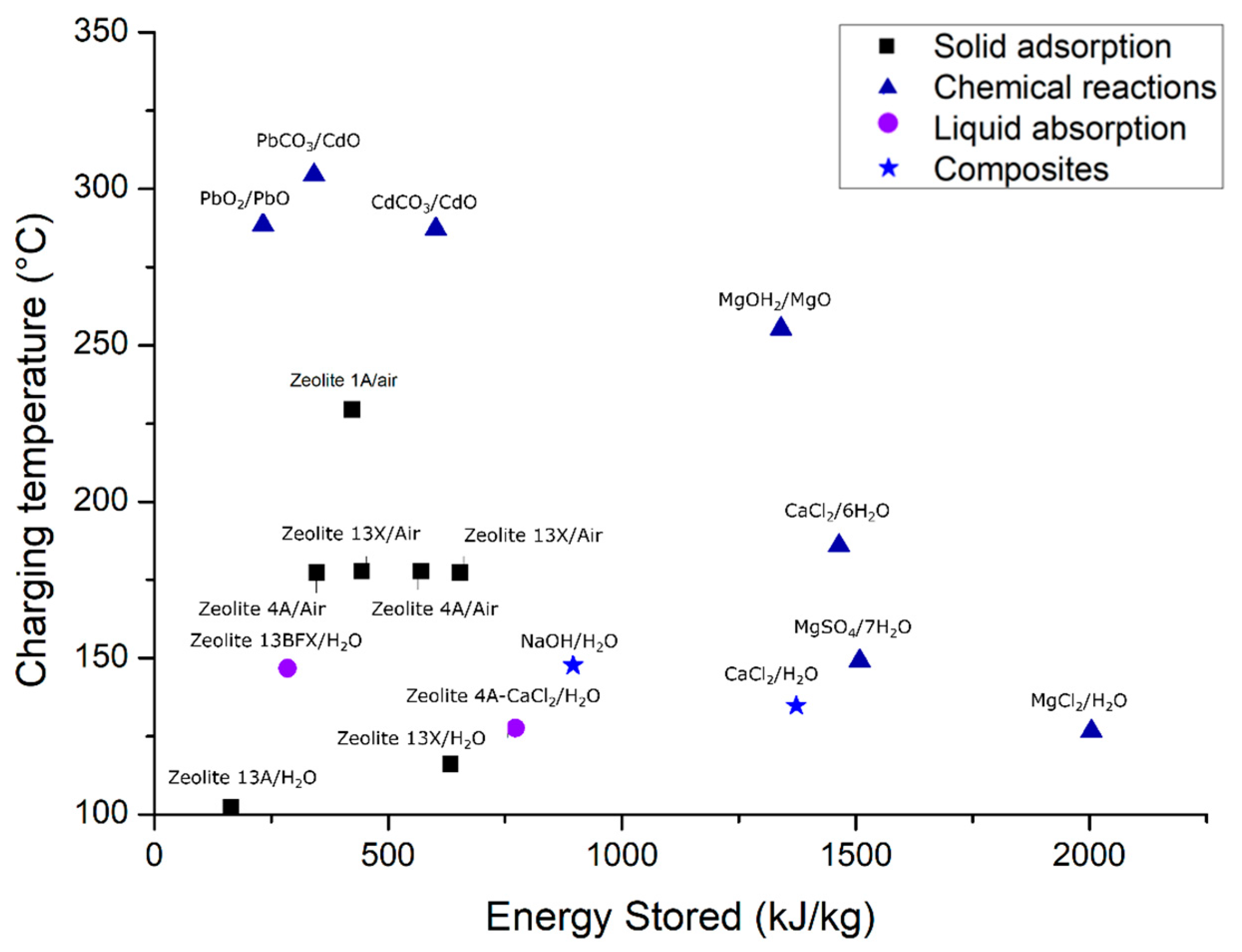
| Thermochemical Material | Heat of Reaction (kJ/kg) | Energy Density (GJ/m3) | Charging Temperatures (°C) | Density (kg/m3) | Cost (€/T) | Cost (€/GJ) |
|---|---|---|---|---|---|---|
| Hydrated salts | ||||||
| CaCl2·6H2O | 1082 | 1.85 | 95 | 1710 | 116 | 107 |
| MgCl2·6H2O | 2001 | 3.14 | 117 | 2001 | 154 | 77 |
| MgSO4·7H2O | 1671 | 2.81 | 122–150 | 1680 | 77 | 73 |
| SrBr2·5H2O | 814.4 | 2.02 | 70–174 | 2386 | 2400 | 2838 |
| Hydroxides, carbonates and oxides | ||||||
| MgCO3/MgO | 1755 | - | 300–320 | - | - | - |
| CdCO3/CdO | 601 | - | 287 | - | - | - |
| Mg(OH)2/MgO | 1340 | - | 255 | - | - | - |
| PbCO3/PbO | 240 | - | 288–300 | - | - | - |
| PbCO3/CdO | 341 | - | 300 | - | - | - |
| PbO2/PbO | 232 | - | 288–300 | - | - | - |
| Aspect | Open System | Closed System |
|---|---|---|
| System Type | Exchanges both mass and energy with the environment (e.g., uses moist air as a working fluid) | Exchanges only energy; sorbent and sorbate are stored separately (e.g., uses water and salt hydrate) |
| Working Principle | Heat is transferred to a transport medium (air), which drives the thermochemical process | External heat drives TCM dissociation, and energy is transferred via a closed-loop working fluid |
| Operation | Steam is sourced from ambient moist air | Requires an evaporator to supply steam during hydration |
| Advantages |
|
|
| Disadvantages |
|
|
| KPI | Units | Sorption-Based | Reversible Chemical Reactions | |
|---|---|---|---|---|
| KPItech1 | Thermal energy storage density | kWh/m3 | 250–400 [130,159] | 800–1200 [130,159] |
| KPItech2 | Power density | [kW/m3] | 120–310 [130] | 200–350 [130] |
| KPItech3 | Limit operational temperature range (ΔTop) | °C | 30–200 [139] | 30–300 [139] |
| KPItech4 | Storage period | [h/d/y] | h/d/y [130] | h/d/y [130] |
| KPItech5 | Flexibility | [-] | Yes | |
| KPItech6 | Storage size range | [m3] Range | Open: 2–88 L/Closed: 1–157 L [160] | |
| KPItech7 | Recharging energy or auxiliar energy? | [Wh] Range | 10–100 kWh [130] | |
| KPItech8 | Round trip efficiency | [%] | 50–65 [130] | 40 (open)–50 (closed) [130] |
| KPItech9 | Durability | [Year] | 15–25 [130] | <100 cycles [130] |
| KPIenvi1 | Safety risk | [-] | Low | Low |
| KPIenvi2 | Environmental risks | [-] | Low | Medium (open systems) |
| KPIso-eco2 | Specific cost of the storage | [€/kWh] | 15–150 €/kWh [130] | 80–160 €/kWh [130] |
| KPIso-eco2 | Investment cost | [€/kWh] | 8–100 [106] Viability Seasonal: 25 €/kWh; daily storage 75 €/kWh [106] | |
| KPIso-eco3 | Operation and maintenance cost | [€/kWh] | - | |
| KPIso-eco5 | TRL | [-] | 4–6 | 1–3 |
| Category | Representative Materials | Pros | Cons | Challenges |
|---|---|---|---|---|
| Solid Adsorption | Zeolite 13X–H2O, Silica Gel, Activated Carbon | Strong water affinity, high output (>55 °C), safe, cheap | Lowest energy density (<250 kWh/m), high charging temp. (160–250 °C) | Develop MOFs, enhance hydrophobicity, reduce cost and improve kinetics |
| Chemical Reactions | CaCl2, MgCl2, Na2S, SrBr2 with H2O | High energy density (up to 1200 kWh/m3), minimal losses | Irreversible cycles, material degradation | Enhance reaction reversibility, thermal conductivity, and lower material cost |
| Composite Sorbents | Zeolite + MgCl2/MgSO4 composites | Better stability, enhanced transfer, lower cost than pure TCMs | Lower energy density, still limited by reversibility | Improve compatibility, corrosion resistance, and optimise reactors |
| KPI | KPI | Thermocline | Hybrid Latent | |
|---|---|---|---|---|
| KPItech1 | Thermal energy storage density | kWh/m3 | Energy densities (kWh/m3): Delcotherm + Magnetite: 106.2 (180–300 °C) [175]; Caloria + gravel/sand: 37.4 (218–304 °C) [5]; Caloria + rock/sand: 51.1; NaNO3/KNO3 + quartzite: 53.4 (290–390 °C). | See Section 4.4 for detailed information on PCM storage media |
| KPItech2 | Power density | [kW/m3] | See Section 4.4 for detailed information on PCM storage media | |
| KPItech3 | Limit operational temperature range (ΔTop) | °C | Therminol VP1: 15–400 °C Steinmann [5] | |
| KPItech4 | Storage period | [h/d/y] | Buffer storage, short-term | |
| KPItech5 | Flexibility | [-] | Partial discharge possible | |
| KPItech6 | Storage size range | [m3] Range | −3500 m3 [5] | 28 m3 |
| KPItech7 | Capacity | [Wh] Range | See Section 4.4 for detailed information on PCM storage media | |
| KPItech8 | Round-trip efficiency | [%] | 77–83% (Solar One test facility) [5] | |
| KPItech10 | Durability | [Year] | 15–20 | 15–20 |
| KPIenvi1 | Safety risk | [-] | Safety risks are mainly due to the high flammability of thermal oils. | No safety risks |
| KPIenvi2 | Environmental risks | [-] | Impact depends on HTF: natural oils = low, synthetic/mineral oils = high; filling materials inert unless contaminated. | Low environmental impact (add reference to PCM material) |
| KPIso-eco2 | Specific cost of the storage | [€/kWh] | The cost of the storage envelope is highly dependent on the storage medium. The thermomechanical loads are difficult to predict. | |
| KPIso-eco5 | TRL | [-] | 9 [4] | 4 [4] |
| Hybrid Type | Key Advantages | Key Challenges | Research Focus | Technology Status |
|---|---|---|---|---|
| Sensible–Latent |
|
| Improve energy storage density, reduce charging temps, enhance conductivity, stabilise discharge temperature | Commercially deployed |
| Sensible–Thermochemical |
|
| Optimise configurations for heat recovery from thermochemical units | Developed at high temps; proposed for lower temps |
| Latent–Thermochemical |
|
| Combine PCM and TCS to recover condensation heat and reduce temperature lift in TCS systems | Assessed experimentally at the hybrid material level |
| KPI | Unit | Sensible Heat (Water/Thermal Oils/Solid State) | Latent Heat (Sugar Alcohols, Polymers, Anhydrous Salts, Salt Hydrates) | Thermochemical (Sorbents and Chemical Reactions) (TCS) |
|---|---|---|---|---|
| Energy Density | kWh/m3 | 35–200 | 50–235 | 250–1200 |
| Power Density | kW/m3 | kW–300 MW | 10 kW–MW | 180–350 |
| Temp. Range | °C | −10–400 | 105–300 | 30–300 |
| TRL | - | 7–9 | 4–7 | 3–6 |
| Storage Size | m3 | 0–5000 | 1–10 | 2–100 (L) |
| Safety Risk | - | Low–High (Oils) | Low–Medium | Low |
| Cost | €/kWh | 0.5–75 | 10–60 | 15–150 |
| Lifetime | Years | 10–60 | 10–30 | 10–30 |
| Storage Period | - | h/d | h/m/d | h/d/y |
| TES Technology | TRL | Main Identified Technical Challenges | Storage Period | Main Potential Applications |
|---|---|---|---|---|
| Sensible heat—Water-based TES | 9 | Limited to low-pressure operations; needs improved insulation and corrosion control for high temperatures; losses over time in large systems | Hours to days | Short-term storage for process steam and hot water |
| Sensible heat—Thermal oils | 7–9 | Degradation under thermal cycling, flammability, disposal concerns, and cost of synthetic oils | Hours to days | Steam-based process heating, integrated oil systems |
| Sensible heat—Solid media (castables, rocks) | 7–9 | Difficulties with heat transfer, mechanical stresses during cycling, and thermal expansion | Hours to days | Batch process heat, frequent cycling, and retrofits |
| Latent heat—Nitrate salts | 6–7 | Phase segregation, material corrosion, low conductivity, and heat exchanger design | Hours to days | Medium-temp. steam storage, food processing |
| Latent heat—Polymers | 4–6 | Need for tailored synthesis, long-term durability, and heat exchanger compatibility | Hours to days | Modular compact heating units in industry |
| Latent heat—Sugar alcohols/salt hydrates | 5–6 | Low thermal conductivity, chemical stability, subcooling, and cycling durability | Hours to days | Thermal buffering, backup systems |
| Thermochemical—Composite sorbents | 4–6 | Complex reactor integration, reversibility, thermal management, and cyclic degradation | Days to weeks | District heating integration, surplus recovery |
| Thermochemical—Salt-based reactions | 3–5 | Slow kinetics, irreversibility, segregation, thermal management, and corrosion | Weeks to months | Seasonal steam backup, industrial long-duration storage |
| TES Technology | Energy Density (kWh/m3) | Estimated Cost (€/kWh) | Lifetime (Years) | Notes |
|---|---|---|---|---|
| Water-based TES | 58.3 (∆T = 50 K) | 1–5 | 10–60 | Low-cost, safe, large footprint; excellent for daily/weekly cycles |
| Thermal Oils | 50–56 (∆T = 100 K) | 20–75 | 10–40 | Moderate temperature range, high flammability, and disposal concerns |
| Solid-state Sensible (e.g., Castables, Ceramics) | 70–120 | 5–30 | 15–50 | High thermal durability, limited thermal conductivity, and bulkier systems |
| Nitrate PCMs | 100–160 | 10–30 | 10–30 | Good thermal stability; high latent energy density |
| Sugar Alcohol PCMs | 150–220 | 15–50 | 10–20 | High energy density, but challenges with supercooling and cycling stability |
| Anhydrous Salt PCMs | 130–180 | 20–60 | 10–25 | High latent heat; may suffer from phase segregation and corrosiveness |
| Polymer-based TES | 80–120 | 30–80 | 10–20 | Lightweight, flexible, still emerging, and lower thermal conductivity |
| Composite Sorbents (THS) | >200 (effective) | 25–90 | 10–30 | High energy density and storage duration; still under optimisation |
| Chemical Reactions (THS) | >200 (effective) | 20–100 | 10–30 | High potential, still emerging; reversible reactions not yet fully mature |
Disclaimer/Publisher’s Note: The statements, opinions and data contained in all publications are solely those of the individual author(s) and contributor(s) and not of MDPI and/or the editor(s). MDPI and/or the editor(s) disclaim responsibility for any injury to people or property resulting from any ideas, methods, instructions or products referred to in the content. |
© 2025 by the authors. Licensee MDPI, Basel, Switzerland. This article is an open access article distributed under the terms and conditions of the Creative Commons Attribution (CC BY) license (https://creativecommons.org/licenses/by/4.0/).
Share and Cite
Palacios, A.; Krabben, Y.; Linder, E.; Thamm, A.-K.; Arpagaus, C.; Paranjape, S.; Bless, F.; Carbonell, D.; Schuetz, P.; Worlitschek, J.; et al. Thermal Energy Storage Technology Roadmap for Decarbonising Medium-Temperature Heat Processes—A Review. Sustainability 2025, 17, 9693. https://doi.org/10.3390/su17219693
Palacios A, Krabben Y, Linder E, Thamm A-K, Arpagaus C, Paranjape S, Bless F, Carbonell D, Schuetz P, Worlitschek J, et al. Thermal Energy Storage Technology Roadmap for Decarbonising Medium-Temperature Heat Processes—A Review. Sustainability. 2025; 17(21):9693. https://doi.org/10.3390/su17219693
Chicago/Turabian StylePalacios, Anabel, Yannick Krabben, Esther Linder, Ann-Katrin Thamm, Cordin Arpagaus, Sidharth Paranjape, Frédéric Bless, Daniel Carbonell, Philipp Schuetz, Jörg Worlitschek, and et al. 2025. "Thermal Energy Storage Technology Roadmap for Decarbonising Medium-Temperature Heat Processes—A Review" Sustainability 17, no. 21: 9693. https://doi.org/10.3390/su17219693
APA StylePalacios, A., Krabben, Y., Linder, E., Thamm, A.-K., Arpagaus, C., Paranjape, S., Bless, F., Carbonell, D., Schuetz, P., Worlitschek, J., & Stamatiou, A. (2025). Thermal Energy Storage Technology Roadmap for Decarbonising Medium-Temperature Heat Processes—A Review. Sustainability, 17(21), 9693. https://doi.org/10.3390/su17219693