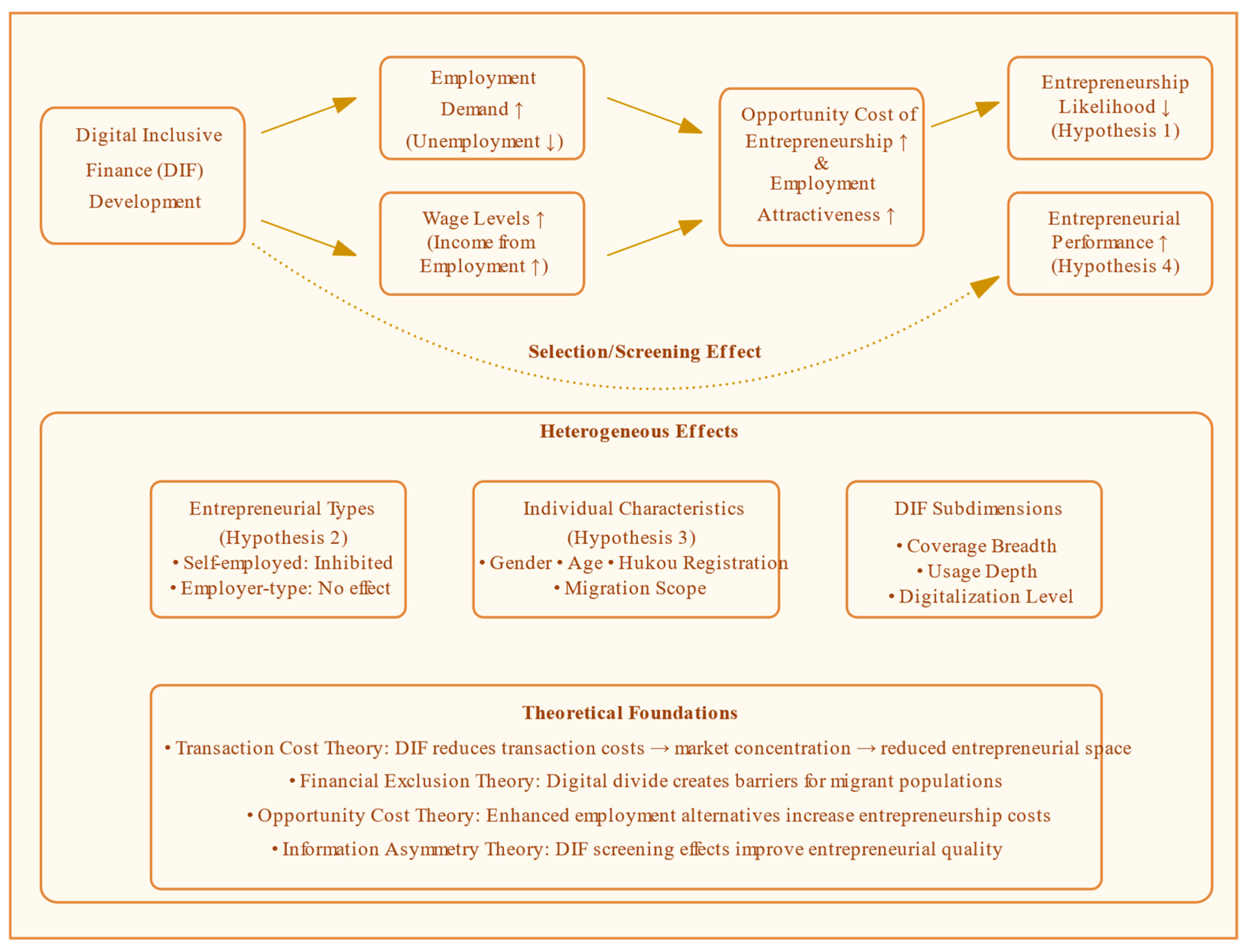
6.1. Mechanism Examination
Mechanism Analysis: City-Level Mediation Methodology and Validation. We examine employment demand expansion and wage enhancement mechanisms using city-level mediators in individual-level regressions. This approach raises ecological fallacy concerns requiring methodological justification.
Our city-level mediation strategy has three theoretical justifications. First, migrants make occupational choices within specific urban labor markets where aggregate employment conditions directly influence individual opportunity sets. Second, institutional constraints (hukou system, labor market segmentation) create relatively homogeneous conditions within cities, making city-level aggregates meaningful for individual decisions. Third, our comprehensive individual and household controls isolate city-level effects from personal characteristics. Critically, we ensure all mediation regressions employ robust standard errors clustered at the city level (169 cities) to address within-city correlation in both treatment and mediating variables. The consistency of these mechanisms with our heterogeneity analysis (
Table 8), which shows stronger effects for theoretically more vulnerable subgroups, helps mitigate concerns about spurious correlations and adds credibility to a causal interpretation, serving a similar diagnostic purpose to a falsification test. While these mechanisms are theoretically established, our contribution lies in empirically testing their relevance for China’s migrant population.
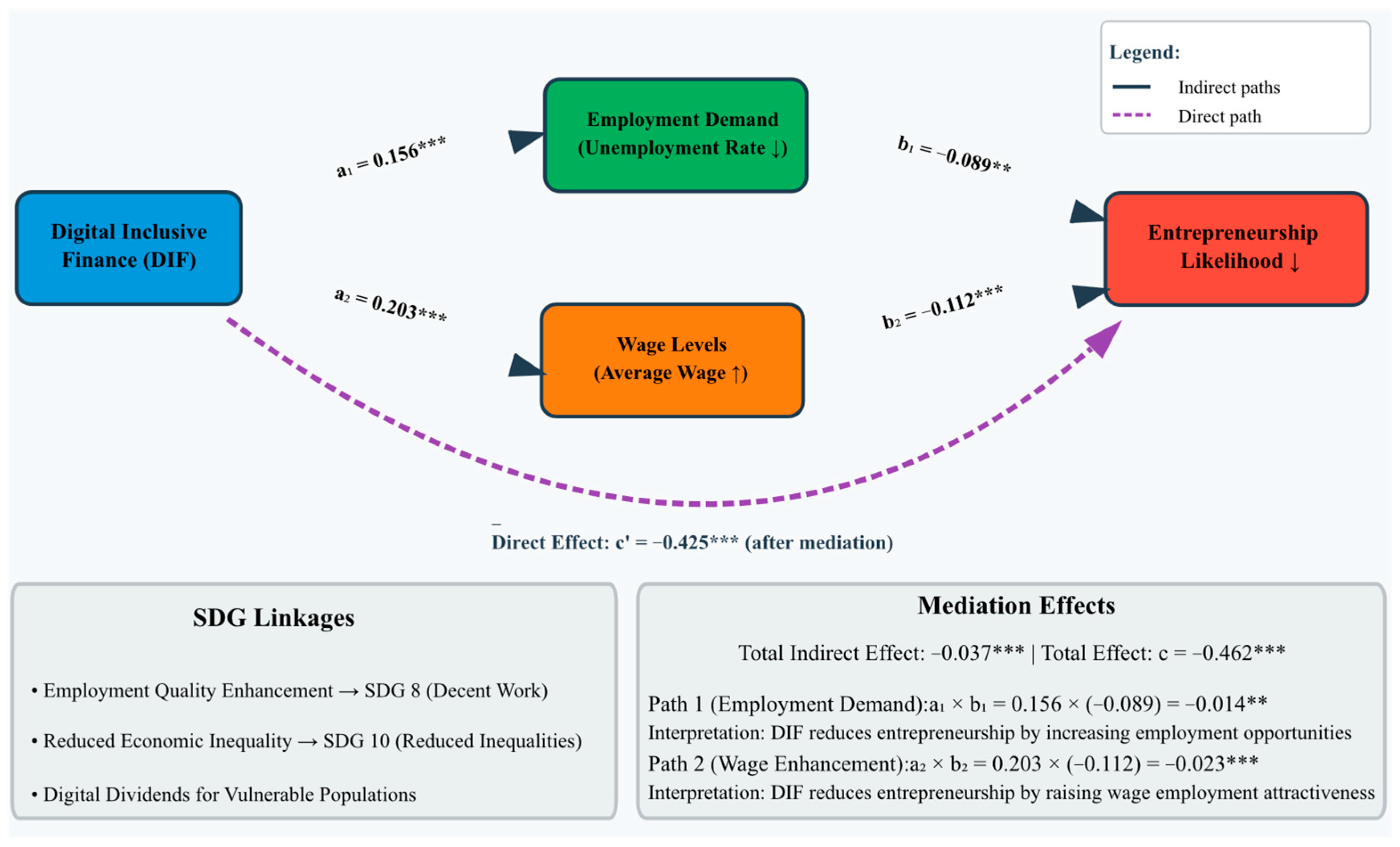
Figure 2 presents the mediation path analysis examining how DIF affects migrant entrepreneurship through two key mechanisms: employment demand and wage enhancement. The diagram illustrates the indirect pathways (a
1b
1 and a
2b
2) alongside the direct effect (c’), with path coefficients derived from our empirical analysis.
As shown in
Figure 2, our mediation analysis reveals two significant indirect pathways through which DIF influences migrant entrepreneurship decisions. The first pathway operates through employment demand (unemployment rate reduction): DIF development significantly increases local employment opportunities (a
1 = 0.156,
p < 0.001), which in turn reduces entrepreneurship likelihood (b
1 = −0.089,
p < 0.01), yielding an indirect effect of −0.014. The second pathway functions through wage enhancement: DIF significantly raises average wage levels (a
2 = 0.203,
p < 0.001), making wage employment more attractive relative to entrepreneurship (b
2 = −0.112,
p < 0.001), producing an indirect effect of −0.023.
The total indirect effect (−0.037) accounts for approximately 8.0% of the total DIF effect on entrepreneurship, while the direct effect (−0.425) remains significant, indicating partial mediation. These findings support our theoretical expectation that DIF reduces migrant entrepreneurship primarily by enhancing the attractiveness and availability of wage employment alternatives, thereby increasing the opportunity costs of entrepreneurial activities.
As a distinct form of employment, entrepreneurship is influenced by total employment demand (employment scale) in the labor market. Thus, employment demand could serve as an effective pathway through which DIF affects migrant entrepreneurship. Theoretically, from an employment demand perspective, DIF reduces financial service acquisition costs and barriers for enterprises—the main providers of employment opportunities—lowering their financing and investment costs. This facilitates business expansion, increases labor demand, and generates substantial employment opportunities [
13]. Additionally, DIF fosters the growth of the gig economy and creates new jobs, further increasing total employment demand. Specifically, DIF creates employment opportunities for migrants through several gig economy pathways: First, digital payment infrastructure enables migrants to participate in platform-based services without traditional banking relationships or permanent addresses that previously excluded them from formal employment—exemplified by ride-hailing platforms like Didi and food delivery services like Meituan that rely entirely on mobile payment systems. Second, DIF platforms reduce transaction costs and information asymmetries in matching migrant workers with short-term employment opportunities, particularly in urban service sectors where migrants concentrate, as demonstrated by platforms like 58.com that integrate job matching with instant payment capabilities. Third, mobile-based credit scoring systems within DIF ecosystems allow migrants to access working capital for small-scale service provision despite lacking traditional collateral or credit histories—for instance, delivery workers can obtain microloans through Alipay’s Huabei to purchase electric bikes and equipment. Fourth, the integration of social insurance and payment systems within super-apps like Alipay enables migrants to receive employment benefits and maintain job mobility across cities without losing access to financial services, addressing a key institutional barrier in China’s hukou system. These mechanisms specifically address institutional barriers that historically prevented migrants from accessing stable urban employment, thereby creating attractive alternatives to necessity-driven entrepreneurship.
However, this transition from self-employment to gig economy participation carries potential risks that warrant careful consideration. While DIF-enabled gig work offers flexibility and reduced entry barriers, it may also expose migrants to labor market vulnerabilities including income volatility, limited social protection, and algorithmic management practices that can result in exploitative working conditions. Unlike traditional self-employment where migrants retain control over their work processes, platform-based gig work often involves asymmetric power relationships that may undermine worker autonomy and bargaining power. These concerns align with reference [
10]’s analysis of how digital divides can exacerbate existing inequalities, particularly for vulnerable populations with limited digital literacy or alternative employment options.
These dynamics broaden migrant populations’ employment alternatives, indirectly crowding out entrepreneurship. In short, DIF enhances urban employment demand, providing migrant populations with broader employment opportunities as substitutes for entrepreneurship, thereby inhibiting entrepreneurial likelihood. Furthermore, as rational economic agents, migrant populations inevitably consider the total utility of different employment forms when making career choices. For migrant populations, migration costs—arising from shifts in living environments, social networks, and capital—must be factored into any employment decision. This compels migrant populations to prioritize employment options with higher income levels to maximize compensation for these costs while also balancing risks and stability. Entrepreneurship, as a risky venture, entails significant uncertainty, requiring individuals to assume substantial risks and responsibilities, alongside income instability [
26]. By contrast, the income-enhancing effects of wage employment facilitated by DIF are more easily discernible [
14]. DIF alleviates information constraints for migrant populations by leveraging functions such as financing, investment, and payment services, enabling access to timely, accurate, and diverse external information about economic trends and policy dynamics. This helps individuals enhance their professional knowledge and skills, thereby increasing income. If the income gains from DIF-driven general wage employment meet migrant populations’ expectations, combined with the inevitable high risks and instability of entrepreneurship, migrant populations are more inclined to choose wage-based employment with clearer perceived overall utility, ultimately having a negative effect on their entrepreneurial choices.
Using the mediating effect test proposed by Wen and Ye [
44], we examine the mechanism by which DIF influences migrant populations’ entrepreneurial choices using the following equations:
where
M denotes the mediating variable, with “urban unemployment rate” (Unemployment) serving as an indicator of employment demand—higher unemployment reflects lower total urban employment demand—and “average wage of urban employees” (Awage) measuring wage levels, where higher values indicate higher earnings. Other variables align with those defined in Equation (1). The mediating effect requires the simultaneous satisfaction of the following conditions: First, coefficient
δ2 in Equation (2) is statistically significant. Second, coefficient
λ3 in Equation (3) is statistically significant, and
λ2 is less than
β2 in Equation (1), indicating that DIF influences migrant populations’ entrepreneurial choices through the mediating variable.
Mediation Analysis Methodology. Before presenting our mediation results, we acknowledge methodological limitations in our approach. Our mediation analysis employs city-level mediators (unemployment rate and average wage) in individual-level regressions, which raises potential ecological fallacy concerns. While ideally mediation effects would be tested using bootstrap methods for robust significance testing, our analysis follows the traditional step-wise regression approach commonly employed in the development economics literature. The use of city-level mediators assumes that aggregate urban labor market conditions affect individual migrant entrepreneurship decisions, which is theoretically justified given that migrants make occupational choices within specific urban contexts and face similar institutional constraints within the same city. However, this approach may mask heterogeneity in individual responses to aggregate conditions, and our results should be interpreted with this limitation in mind.
Table 9 shows the regression results for mechanism testing. For the employment demand mechanism, column (2) reveals a negative correlation between the DIF level and the unemployment rate, indicating that DIF increases total urban employment demand and alleviates unemployment. Column (3) shows that
λ3 is significantly positive at the 5% level, while
λ2 is significantly negative at the 1% level. The marginal effect of DIF on migrant populations’ entrepreneurial choices decreases from −0.449 in column (1) to −0.4380, demonstrating a significant partial mediating effect of urban employment demand in DIF’s influence on migrant populations’ entrepreneurial choices. Following a similar approach, in column (4), the regression results for the employee wage pathway indicate a positive correlation between the DIF level and urban employees’ average wage, showing that DIF significantly enhances urban wage levels. The results in column (5) show that
λ3 is statistically significant and negative at the 1% level, and
λ2 is also statistically significant and negative at the 1% level. The marginal effect of DIF on migrant populations’ entrepreneurial choices decreases obviously from −0.449 in column (1) to −0.4025, confirming that the urban employee wage pathway passes the test. In summary, DIF reduces the likelihood of migrant populations pursuing entrepreneurship by increasing total urban employment demand and raising employees’ wages. These mediation effects, while statistically significant using traditional step-wise regression tests, should be interpreted cautiously given our use of city-level mediators in individual-level analysis and the absence of bootstrap significance testing, which represents a limitation of our current approach.
The employment demand mechanism operates through both traditional formal employment expansion and gig economy development. DIF platforms create new employment categories particularly accessible to migrants: delivery services, ride-sharing, domestic services, and micro-logistics, all enabled by integrated payment, credit, and identity verification systems. Unlike traditional employment requiring fixed addresses and established credit histories, these DIF-mediated opportunities allow migrants to participate in urban labor markets using mobile phones and basic identification, thereby expanding employment options beyond entrepreneurship. This dual-path employment expansion—formal jobs plus gig opportunities—helps explain the negative direct effect of DIF on necessity-driven entrepreneurship.
Specifically, the mediation tests show strong statistical support: in the employment demand pathway, DIF’s effect on unemployment rate (p = 0.000) and unemployment rate’s effect on entrepreneurship (p = 0.047) both achieve conventional significance levels. In the wage pathway, DIF’s effect on average wage (p = 0.000) and wage’s effect on entrepreneurship (p = 0.000) demonstrate robust statistical significance, confirming the reliability of both mediation channels.
Digital Finance Risks and Migrant Vulnerability Assessment
While our mechanism analysis reveals potential benefits from DIF-facilitated employment transitions, systematic risk assessment requires explicit consideration of potential negative consequences that warrant policy attention.
Digital Divide and Exclusion Risks. The digital divide documented in prior research [
10] poses particular challenges for migrant populations who may lack stable internet access, digital literacy, or technological resources necessary to capitalize on DIF opportunities. This technological exclusion could inadvertently worsen existing inequalities if DIF development proceeds without targeted inclusion measures. Migrants in peripheral urban areas or informal settlements may experience substantially different DIF accessibility compared to those in central districts, potentially creating new forms of spatial-digital stratification.
Platform Labor Market Vulnerabilities. The transition from self-employment to DIF-enabled gig work, while potentially offering income stability, may expose migrants to new forms of labor market precarity including algorithmic management, income volatility, and limited worker protections. Unlike traditional self-employment where migrants retain control over work processes, platform-based employment often involves asymmetric power relationships that may undermine worker autonomy and bargaining power. These concerns align with reference [
10]’s analysis of how digital technologies can systematically disadvantage marginalized populations.
Financial Risk and Over-indebtedness. DIF expansion may increase access to credit products without corresponding financial literacy support, potentially exposing vulnerable migrant populations to over-indebtedness risks. Mobile lending platforms’ convenience and reduced documentation requirements, while expanding access, may also facilitate imprudent borrowing decisions among populations with limited financial planning experience or irregular income streams.
These risk considerations underscore the importance of complementary policies addressing digital inclusion, platform worker protection, and financial education to ensure DIF development genuinely improves rather than merely transforms migrant economic vulnerability.
6.2. DIF’s Effect on the Entrepreneurial Performance of the Migrant Population
The preceding analysis focused on DIF’s effect on migrant populations’ entrepreneurial likelihood and its mechanisms. However, DIF might also influence the intensity or scale of their entrepreneurship. Drawing on Wang [
45] and Feng [
46], we use income and employee scale as proxy variables to estimate DIF’s effect on migrant populations’ entrepreneurial performance. To mitigate selection bias resulting from retaining only samples engaged in entrepreneurship, we apply Heckman’s [
47] correction for regression analysis with the following models:
where
lnincomeict represents the logarithm of entrepreneurial income; the definitions of other variables remain consistent with previous sections. The key variables influencing income include the DIF level, age, gender, education, political status, marital status, and health status.
Heckman Selection Correction: Substantial Identification Limitations. Our entrepreneurial performance analysis faces significant methodological constraints requiring cautious interpretation.
Our Heckman specification lacks valid exclusion restrictions, relying primarily on functional form identification through distributional assumptions. Household size and parental migration experience serve as potential quasi-instruments, hypothesized to affect entrepreneurship entry but not performance conditional on entry. This identifying assumption remains untestable and may not hold empirically.
Given these identification constraints, our performance results should be interpreted with considerable caution. While we find positive effects of DIF on both entrepreneurial income and employment scale, these estimates may reflect selection processes, functional form assumptions, or unmeasured factors rather than genuine performance improvements. The consistency across different specifications provides limited reassurance, but cannot overcome fundamental identification limitations.
We present these results as suggestive evidence requiring substantial future validation rather than reliable causal estimates. Future research with stronger exclusion restrictions, alternative selection correction methods, or experimental variation would be necessary to establish definitive conclusions about DIF’s performance effects among migrant entrepreneurs.
Ideally, the selection equation should include variables that affect entrepreneurship likelihood but do not directly influence entrepreneurial performance outcomes. In our specification, both equations include largely the same set of covariates, meaning identification relies primarily on functional form assumptions rather than exclusion restrictions. This approach, while common in the entrepreneurship literature when suitable instruments are unavailable, may result in weak identification and reduced precision of estimates. The lack of strong exclusion restrictions means our Heckman results should be interpreted as providing suggestive evidence of selection-corrected relationships rather than definitive causal estimates of DIF’s performance effects.
Table 10 presents the estimation results for DIF’s effect on migrant populations’ entrepreneurial performance. Columns (1) and (2), with income as the dependent variable, show that the coefficients of the DIF level are statistically significant and positive at the 1% level. This indicates that while DIF reduces the likelihood of migrant populations pursuing entrepreneurship, it increases the income levels of those who engage in entrepreneurship, exerting a positive effect on entrepreneurial performance. DIF can influence regional economic environments and structures through technological innovation and consumption upgrading, which to some extent increases entrepreneurial income and improves entrepreneurial performance [
20]. The IV regression results in column (2) validate the robustness of these findings. Columns (3) and (4), with the number of employees as the dependent variable, use a Tobit model for estimation since self-employment entrepreneurship has zero employees. The results reveal that DIF significantly increases the number of employees and enhances entrepreneurial performance. The IV regression results in column (4) further confirm the robustness of these outcomes. Hypothesis 4 is validated.
Model Assumptions and Limitations. Our entrepreneurial performance analysis employs Heckman selection correction and Tobit models, which assume normally distributed error terms. While these parametric approaches provide efficient estimates under correct specification, violations of normality assumptions could affect inference validity. Visual inspection of residuals and Shapiro–Wilk tests suggest reasonable adherence to normality, though some departure is observed in the tails of the distribution. To assess robustness to distributional assumptions, future research could employ non-parametric alternatives such as quantile regression for income analysis or bootstrap-based inference methods that do not rely on specific distributional assumptions. Additionally, our use of city-level aggregated variables in individual-level regressions may introduce ecological fallacy concerns that warrant consideration in interpreting results.
6.3. Theoretical Implications and International Perspectives
Our findings present important theoretical and policy implications that extend beyond the Chinese context, contributing to broader academic debates on digital finance and inclusive growth. This section critically situates our results within existing theoretical frameworks and discusses their relevance for international development policy.
Our findings provide evidence relevant to SDG 8.3, which calls for policies supporting “decent job creation and entrepreneurship.” While traditional interpretations assume digital financial inclusion primarily supports entrepreneurship, our results suggest DIF may contribute to SDG 8 by facilitating transition from precarious self-employment to stable wage employment, thereby advancing SDG 10’s goal of reducing inequalities for marginalized populations.
Theoretical Challenges and Contributions. Our findings pose significant challenges to conventional entrepreneurship theories. Traditional credit constraint models, rooted in the work of Evans and Jovanovic [
48], predict that enhanced financial accessibility should stimulate entrepreneurship by reducing capital barriers. However, our results reveal a more complex dynamic where digital financial inclusion operates through labor market channels that can override financial market effects. The negative relationship between DIF and migrant entrepreneurship suggests that labor market mechanisms—specifically increased employment opportunities and wage premiums—may dominate financial inclusion benefits for vulnerable populations. This finding contributes to entrepreneurship theory by highlighting the critical importance of opportunity cost considerations, particularly for marginalized groups facing higher entrepreneurial risks and limited social safety nets.
Reconceptualizing Digital Finance Mechanisms. Our important evidence supports a dual-pathway model of digital finance impacts in developing economies. While DIF reduces information asymmetries and transaction costs—consistent with theoretical predictions—it simultaneously creates employment alternatives that increase entrepreneurship’s opportunity cost. This mechanism is particularly pronounced for necessity-driven entrepreneurs, such as migrant populations engaging in survival-oriented self-employment. The dual effect suggests that digital finance may function as both an enabler and a disruptor of entrepreneurial activity, with the net effect depending on the relative strength of financial inclusion versus labor market substitution effects. This reconceptualization has important implications for understanding why digital finance impacts may vary significantly across different populations and developmental contexts.
International Comparative Context. Our findings contribute to a growing body of evidence suggesting heterogeneous impacts of digital financial services across different developing economy contexts. While mobile money services have been widely credited with promoting financial inclusion and economic activity in various developing countries, the entrepreneurial effects appear context-dependent. The institutional environment, development stage, and demographic characteristics of target populations likely mediate these relationships. Our evidence from China’s migrant population suggests that in contexts where digital finance significantly expands formal employment opportunities, the traditional positive relationship between financial access and entrepreneurship may not hold. This insight has important implications for international development programs that assume universal positive effects of digital financial inclusion.
Development Stage Considerations. The apparent contradiction between our findings and some international experiences may reflect China’s particular development stage and institutional context. In economies undergoing rapid structural transformation, digital finance may accelerate the transition from informal, necessity-driven entrepreneurship toward formal wage employment. This transition, while potentially reducing overall entrepreneurship rates, may represent economic progress if it shifts workers from precarious self-employment to more stable, higher-paying formal employment. Our finding that DIF improves entrepreneurial performance among those who remain entrepreneurs supports this interpretation, suggesting a quality-improving selection effect. This perspective aligns with dual economy models that predict declining self-employment rates as economies develop and formal sector opportunities expand.
Global Policy Implications. These findings have important implications for international development policy and global financial inclusion initiatives. The results suggest that digital finance policies should be designed with careful consideration of local labor market conditions and target population characteristics. For vulnerable populations like migrants, the primary benefit of digital financial inclusion may not be direct entrepreneurship promotion but rather improved access to formal employment opportunities and enhanced performance for those who do engage in business activities. This nuanced understanding calls for more targeted approaches to digital finance policy that recognize the heterogeneous needs and circumstances of different population groups. Furthermore, our findings highlight the importance of complementary policies—such as entrepreneurship training and business development services—that can help marginalized populations capitalize on opportunities created by digital financial inclusion while preserving their entrepreneurial options.
Risk Mitigation and Digital Inclusion Challenges. While our findings suggest potential benefits from DIF-facilitated employment transitions, they also highlight critical risks that policymakers must address. The digital divide referenced in our analysis [
10] poses particular challenges for migrant populations, who may lack the digital literacy, stable internet access, or technological resources necessary to fully capitalize on DIF opportunities. This technological exclusion could inadvertently worsen existing inequalities if DIF development proceeds without targeted inclusion measures. Furthermore, the shift from self-employment to platform-based gig work, while potentially offering higher income stability, may expose migrants to new forms of labor market precarity including algorithmic discrimination, unpredictable income streams, and limited worker protections. Effective DIF policy implementation requires complementary interventions addressing digital literacy training, platform worker protection, and maintaining entrepreneurial pathways for those who prefer self-employment.
Capability Approach and ESG Framework Considerations. While our analysis does not comprehensively integrate capability approach or environmental-social-governance (ESG) frameworks, these theoretical perspectives offer important lens for interpreting our findings. From a capability approach standpoint, our results suggest that DIF expansion may enhance certain capabilities (employment access, income stability) while potentially constraining others (entrepreneurial autonomy, self-determination). The transition from self-employment to platform-based work represents a complex trade-off between different forms of human development that warrants deeper theoretical exploration.
Similarly, our sustainability claims would benefit from more rigorous ESG framework integration, particularly regarding social governance indicators such as income distribution, worker protection, and digital inclusion metrics. The absence of comprehensive inequality measures (Gini coefficients, poverty indices) in our analysis represents a significant theoretical limitation that constrains definitive sustainability claims. Future research should incorporate explicit capability and ESG frameworks to provide more nuanced understanding of digital finance impacts on human development and sustainable growth.
6.3.1. Methodological Contributions and Limitations
Our empirical approach employs standard techniques in the entrepreneurship and development finance literature, including instrumental variable and mediation analysis methods. We do not claim methodological innovation; rather, our contribution lies in the systematic application of these established methods to examine DIF’s effects on a previously understudied population. The integration of city-level DIF data with individual-level migrant survey data, while methodologically standard, provides valuable robust findings for understanding digital finance impacts on vulnerable populations.
However, we acknowledge significant limitations. Our empirical strategy employs city-level clustered standard errors to address potential within-city correlation among individual observations, which is essential for valid statistical inference in multi-level data structures. Our cross-sectional design constrains causal inference despite IV techniques. The potential correlation between our instrumental variable (internet penetration) and unmeasured urban development factors represents a limitation to strong causal interpretation. Additionally, our mediation analysis using city-level mediators raises ecological fallacy concerns, and our reliance on traditional step-wise regression methods rather than bootstrap procedures for testing mediation significance represents a methodological limitation that could affect the robustness of our mechanism inferences. Future research employing longitudinal data or natural experiments could provide stronger causal identification.
Robustness of our findings. Although this study provides valuable insights into the relationship between Digital Inclusive Finance (DIF) and migrant entrepreneurship in China, several limitations warrant acknowledgment and indicate important directions for future research.
Methodological and Data Limitations. This analysis relies on cross-sectional data from the 2017 China Migrants Dynamic Survey matched with the 2016 DIF Index, which constrains our ability to establish definitive causal relationships or to capture dynamic entrepreneurial trajectories over time. While our instrumental variable approach and the use of lagged explanatory variables help mitigate endogeneity concerns, residual confounding from unobserved time-varying factors cannot be entirely ruled out. Future studies employing panel or longitudinal data could better disentangle causality and reveal temporal adjustment processes in the DIF–entrepreneurship relationship.
Measurement and Construct Limitations. The DIF Index, while comprehensive, is compiled at the prefecture level and derived primarily from Alipay transaction data, capturing only part of the broader digital finance landscape—especially in regions where alternative platforms, informal channels, or emerging fintech services play significant roles. Aggregation at this spatial scale may also mask within-city heterogeneity in individual access to and utilization of digital financial services. Moreover, our binary classification of entrepreneurship, though consistent with established literature, may overlook nuanced forms of entrepreneurial activity and hybrid employment arrangements increasingly prevalent in the digital economy.
Contextual and Generalizability Constraints. The findings are embedded within China’s distinctive institutional and developmental environment, characterized by the hukou household registration system, particular rural–urban migration flows, and a digital finance ecosystem dominated by super-apps such as Alipay and WeChat Pay. Moreover, our analytical scope focuses specifically on China’s “floating population”—rural-born individuals living in cities without local household registration for at least one month—which represents only one segment of the broader entrepreneurial landscape. This focus excludes multiple migrant categories: return migrants who move back to rural areas, urban-born entrepreneurs, short-term migrants with less than one month residency, undocumented migrants who may avoid official surveys, and circular migrants with highly fluid mobility patterns. The residency requirement inherent in our sample definition creates potential bias toward more settled migrant populations, who may have different risk preferences, capital access patterns, and entrepreneurial motivations compared to highly mobile or temporary migrants. This sample selection could systematically underrepresent the most vulnerable and opportunistic segments of China’s migrant population, all of whom may exhibit different relationships between digital finance access and entrepreneurial behavior. These contextual and scope specificities may limit direct generalization to other economies with different institutional frameworks, migration patterns, or stages of digital finance development. While our identified mechanisms—employment demand expansion and wage enhancement—may operate elsewhere, their relative importance and manifestation could vary considerably across contexts.
Temporal Limitations. Beyond these contextual constraints, the temporal scope of our dataset warrants explicit consideration. Our analysis draws on 2016 DIF Index data matched with 2017 CMDS microdata, whereas China’s digital finance ecosystem has since undergone major developments. Notable changes include the suspension of Ant Group’s IPO in 2020, the subsequent tightening of fintech regulations, the nationwide rollout of digital yuan (e-CNY) pilot programs, and the COVID-19 pandemic’s acceleration of cashless payment adoption. Such changes may have reshaped the accessibility, usage patterns, and mechanisms through which DIF influences migrant entrepreneurship. In particular, post-2020 regulatory adjustments could have altered the risk–return trade-offs integral to entrepreneurship; expanded DIF coverage may have shifted baseline access for migrant populations; and pandemic-driven digitalization has created new employment and consumption dynamics that our historical dataset cannot capture. Accordingly, caution is warranted in extrapolating our findings to the current market and policy environment. Future research should therefore validate these findings using post-2020 nationally representative data, enabling assessment of the temporal robustness of the identified mechanisms and the potential emergence of new dynamics in DIF’s impact on migrant entrepreneurship.
6.3.2. Empirical Contribution and Boundary Conditions
While our theoretical frameworks build incrementally on existing literature, our findings provide important evidence about boundary conditions under which digital finance theories operate. By demonstrating that digital financial inclusion can reduce entrepreneurship among institutionally disadvantaged populations, we challenge the universal assumption that financial inclusion necessarily promotes entrepreneurship. This represents significant empirical contribution despite limited theoretical innovation.
Testing established mechanisms (employment demand expansion, wage enhancement) among China’s migrant population—facing extreme institutional constraints—extends understanding of when and how these mechanisms function in practice. The scale of our context (376 million migrants) and counterintuitive findings have implications extending beyond China to other developing economies pursuing digital financial inclusion strategies.
Scope and Population Coverage Limitations. Our focus on registered migrants with minimum one-month residency creates important analytical boundaries that warrant explicit acknowledgment. This design excludes several migrant categories whose entrepreneurial behaviors may differ substantially: (1) return migrants who move back to rural areas after urban experience; (2) interactions between migrants and local urban populations that may influence entrepreneurial dynamics; (3) highly mobile circular migrants with fluid movement patterns; (4) short-term migrants who may rely more heavily on necessity-driven entrepreneurship; and (5) undocumented workers who avoid official surveys but represent significant populations in certain sectors.
Regional Heterogeneity Constraints. Our analysis aggregates results across diverse regional contexts (coastal vs. inland, tier-1 vs. lower-tier cities) that may mask important geographic variations in DIF–entrepreneurship relationships. Coastal regions with more developed digital infrastructure and diversified economies may exhibit different patterns compared to inland areas with limited alternative employment options. This aggregation approach, while necessary for statistical power, may obscure contextual factors that mediate DIF effects across China’s varied development landscape.
These scope limitations suggest our findings apply most directly to settled migrant populations in formal employment relationships, potentially underrepresenting entrepreneurial dynamics among the most vulnerable and mobile segments of China’s migrant workforce.
6.4. Research Extensions and Methodological Opportunities
Furthermore, while our instrumental variable approach addresses endogeneity concerns and provides robust causal identification, we acknowledge that additional sensitivity tests could further strengthen our findings. Future research could benefit from employing propensity score matching to account for selection on observables, and falsification tests using placebo outcomes to provide additional validation of our causal identification. These represent important methodological extensions that would build upon our baseline findings and enhance the robustness of conclusions about DIF’s effects on migrant entrepreneurship.
Longitudinal Research Extensions. Our cross-sectional analysis provides crucial baseline evidence establishing fundamental DIF–entrepreneurship relationships. Future longitudinal studies tracking individual entrepreneurial trajectories could strengthen causal identification while revealing dynamic adjustment processes.
Instrumental Variable Limitations. Beyond cross-sectional constraints, our instrumental variable approach faces specific methodological challenges. Internet penetration may correlate with unmeasured regional characteristics such as innovation ecosystems, entrepreneurial culture, and institutional arrangements that directly influence migrant entrepreneurship decisions, potentially violating the exclusion restriction assumption fundamental to causal identification. This represents a broader challenge in identifying truly exogenous variation in digital finance development, as most plausible instruments relate to technological or institutional factors that may have independent effects on entrepreneurship outcomes. While our DIF-specific mechanism focus and comprehensive control strategy provide theoretical support for our identification approach, definitive causal validation would benefit from natural experiments exploiting exogenous policy variations or alternative instrumental variables in future research.
Methodological Robustness Considerations. Our analysis reveals moderate correlations between key explanatory variables (DIF, GDP per capita, and traditional financial development), though multicollinearity diagnostics indicate acceptable VIF levels. Future research could benefit from alternative estimation approaches that do not assume linear relationships, such as machine learning methods or non-parametric techniques. Additionally, our performance analysis relies on parametric models (Heckman and Tobit) that assume normally distributed errors. While diagnostic tests suggest reasonable adherence to these assumptions, robustness checks using quantile regression, bootstrap inference, or other distribution-free methods would strengthen confidence in the entrepreneurial performance findings. More critically, our Heckman selection correction lacks explicit exclusion restrictions for robust identification, relying instead on functional form assumptions that may compromise the reliability of our selection-corrected performance estimates. Such methodological diversification would help assess whether our core findings persist across different analytical frameworks and distributional assumptions.
Heckman Selection Model Limitations. Our entrepreneurial performance analysis using Heckman selection correction faces fundamental identification challenges that warrant explicit acknowledgment. The absence of valid exclusion restrictions—variables that affect the selection into entrepreneurship but do not directly influence entrepreneurial performance—means our identification relies primarily on functional form assumptions and the nonlinearity of the probit selection equation. This functional form identification is generally considered weaker than identification through exclusion restrictions, as it depends on distributional assumptions that may not hold in practice. The risk of weak identification is particularly concerning in Heckman models, as it can lead to imprecise estimates and unreliable inference about selection-corrected effects. Future research would benefit from identifying suitable exclusion restrictions, such as regional variations in entrepreneurship support policies, historical migration patterns, or family business traditions that affect entrepreneurship entry but do not directly determine business performance outcomes. Alternatively, employing alternative selection correction methods less dependent on functional form assumptions, or acknowledging that selection-corrected results provide bounds rather than point estimates, would enhance the robustness of performance effect conclusions.
Mediation Analysis Limitations. Our mechanism analysis employs city-level mediators (unemployment rate and average wage) in individual-level regressions, raising ecological fallacy concerns that could affect the validity of our mediation inferences. The assumption that aggregate urban labor market conditions uniformly affect individual migrant decisions may not hold across all population subgroups or urban contexts. Additionally, our mediation analysis relies on traditional step-wise regression methods rather than bootstrap procedures, which would provide more robust significance testing for indirect effects. Future research would benefit from individual-level mediation data, bootstrap-based significance testing, and multilevel modeling approaches that explicitly account for the hierarchical structure of individual migrants nested within cities. These limitations may affect both the magnitude and statistical significance of our estimated indirect effects, potentially leading to over- or under-estimation of the true mediation relationships.
Selection Bias and Policy Coordination Challenges. Beyond the cross-sectional and instrumental variable limitations discussed above, our identification strategy faces additional challenges from migrant selection behavior and coordinated policy implementations that warrant explicit acknowledgment. Systematic migrant selection of destinations with favorable digital financial infrastructure could create reverse causality that our cross-sectional framework cannot eliminate. Moreover, local development strategies may coordinate DIF promotion with entrepreneurship support through comprehensive policy packages, generating correlated interventions that violate our identification assumptions. Future research would benefit significantly from difference-in-differences approaches exploiting exogenous variations in DIF rollout timing across regions, panel data tracking individual migration and entrepreneurship trajectories over time, or natural experiments providing quasi-random assignment to digital finance access. Such identification strategies would address the fundamental endogeneity concerns our current approach cannot fully resolve while building upon the baseline relationships we establish.
Unmeasured Heterogeneity. Despite controlling for a wide array of individual, household, and city-level factors, unobserved influences such as local entrepreneurial culture, informal institutional arrangements, variations in policy execution, social networks, and individual entrepreneurial capabilities may affect both DIF development and entrepreneurial behavior in ways our model cannot fully capture.
Future Research Directions. Addressing the above limitations will enhance both the robustness and the external validity of future work. Longitudinal data tracking individuals’ entrepreneurial trajectories could yield stronger causal identification and reveal dynamic responses to DIF expansion. Comparative studies across countries at varying stages of development could test how mechanisms identified here perform in diverse institutional settings. Richer measures of digital finance—covering multiple platforms, individual-level usage patterns, and qualitative dimensions of financial inclusion—would improve measurement precision. Finally, exploring heterogeneous impacts across specific digital financial services (e.g., payments, credit, insurance, investment) could provide more nuanced insights into the distinct pathways shaping entrepreneurial outcomes.
Additionally, future research could examine heterogeneous effects across educational levels and regional variations (such as eastern versus western China), which may reveal important nuances in how individual capabilities and regional development contexts mediate DIF’s entrepreneurship effects. Our current heterogeneity analysis, while covering gender, age, household registration, and migration range, could be extended to explore how different educational backgrounds and regional development disparities influence the DIF–entrepreneurship relationship. Expanding the analytical scope to include return migrants, urban-born entrepreneurs, circular migration patterns, short-term migrants, and undocumented workers would provide a more comprehensive understanding of digital finance impacts across China’s diverse demographic landscape. Particular attention should be paid to understanding how sample selection toward settled migrants may have influenced our findings, and whether the relationships we identify hold for more mobile and vulnerable migrant populations who face different institutional constraints and entrepreneurial opportunities. Such extensions would enhance both the theoretical robustness and practical relevance of findings for policy design targeting different population groups.


_Li.png)