


Abstract
Fruit production is a high environmental impact sector, requiring sustainable strategies that reduce greenhouse gas (GHG) emissions, improve resource efficiency, and maintain fruit quality. This study assessed the environmental performance of innovative substrates with biodegradable additives and organic binders in tunnel-grown raspberry production. The functional unit was 1 kg of marketable fruit, and the experiment was conducted in Karwia, Poland. GHG emissions were calculated for eight substrate variants following ISO 14040 and 14041 guidelines. The baseline was coconut fiber, while modified variants included the additions of sunflower husk biochar and/or a wood-industry isolate, representing sustainable strategies in soilless cultivation. Emissions ranged from 0.728 to 1.226 kg CO2 eq/kg of raspberries, with the control showing the highest values. All modified substrates (produced based on a mixture of biochar and isolate) reduced emissions, with the most efficient variant achieving nearly a 40% decrease. Water use efficiency was decisive, as consumption declined from 2744 m3/ha (control) to 1838 m3/ha in improved variants. Substrate air–water properties proved critical for both environmental and economic outcomes. The findings confirm that substrate modification constitutes an effective, sustainable strategy for raspberry production under high tunnels, supporting climate-smart horticulture and resource-efficient food systems.
1. Introduction
Fruit production is recognized as an agricultural sector with a relatively high environmental impact compared to cultivating arable crops [1] and other primary production sectors [2,3,4,5]. Furthermore, increasing environmental requirements, the need to improve production efficiency, and the imperative to minimize the carbon footprint drive the development and adoption of new, more sustainable production technologies [6]. The comparatively lower environmental burden of berry crop production can be attributed to their suitability for cultivating soils with limited productive potential [7,8].
Sustainable strategies in fruit production are increasingly important in the face of resource scarcity, climate change, and growing consumer expectations for high-quality and environmentally friendly products. A balanced approach that combines efficient water use, improved soil and substrate management, integrated pest control, and organic or biodegradable practices can strengthen both environmental and economic outcomes. In particular, integrating biodegradable substrate additives represents a promising pathway for lowering greenhouse gas emissions and enhancing resource efficiency in soilless cultivation systems. Recent studies indicate that such solutions reduce the overall carbon footprint of fruit production, improve nutrient cycling, and minimize input losses, making them a valuable element of future-oriented horticultural practices [9].
Using tunnel systems in raspberry cultivation enables fruit quality improvement and the extension of the harvesting season [8,10]. However, it also entails additional investment and environmental costs—particularly greenhouse gas (GHG) emissions associated with tunnel construction [11]. One of the key ecological factors is GHG emissions resulting from fertilization—mainly due to the production of nitrogen fertilizers and nitrous oxide (N2O) emissions [12,13,14]. A reliable and effective assessment of the environmental burden of fruit production, especially under protected cultivation systems, requires identifying the production processes and inputs and quantifying the emissions associated with those processes [15]. In this segment of agricultural production, six major categories of production-related inputs are typically distinguished: infrastructure establishment, irrigation, fertilization, pest control, soil/substrate management, and tree/shrub management [16]. Effective management of these processes is critical for enhancing production efficiency, reducing environmental costs, and ensuring the long-term economic viability of farms [17].
Raspberry production under tunnel systems, with relatively low additional economic inputs, contributes to the extension of the harvesting period, increased yield, and improved fruit quality. Bradish et al. [18] highlight that protected cultivation leads to higher marketable yields of raspberries while reducing the need for plant protection products due to the sheltering of fruit from moisture, frost, and wind. Although tunnel cultivation requires additional financial investment, it is often necessitated by variable climatic conditions, the demand for high-quality fruit, the need to extend the fruiting season, and the aim for earlier harvests—all of which are crucial for the economic efficiency of production and for enhancing competitiveness in the sector. Risk management related to weather variability and production decision-making is critical in modern agriculture and can be a decisive factor in the success of protected cultivation systems [19]. Hanson et al. [8] reported an improvement in raspberry fruit quality, including an increase in individual fruit mass under tunnel cultivation, which directly contributed to the volume of marketable yield. A key parameter influencing the postharvest shelf life of fruit is its moisture content at the time of harvest. Raspberry production systems using substrate cultivation under plastic tunnels offer several advantages: higher production efficiency, increased yield security, larger fruit size, improved harvesting efficiency, fewer issues with pests and diseases, and an extended harvesting window. The main disadvantages include higher investment and operational costs per unit area and the need for rigorous crop monitoring. In addition to proper cultivar selection in relation to climatic conditions and crop management strategies, root zone conditions are a critical factor affecting the profitability of this production system [20].
One of the increasingly popular approaches in tunnel-based raspberry production is containerized cultivation. This system allows for the optimization of both irrigation and fertilization, which contributes to reduced input costs, improved growing conditions (enabling responsive fertigation depending on current weather conditions), and lower water and fertilizer use per unit of cultivated area and per kilogram of yield. Using containers with controlled substrate also promotes better sanitary conditions in the root zone. The implementation of innovative management practices, such as precision irrigation and fertilization control, aligns with the principles of sustainable and climate-smart agriculture [21,22].
Improved fertilization and irrigation efficiency—e.g., through fertigation and optimized growing media—can significantly reduce the carbon footprint of the entire production system [23,24]. Additionally, incorporating biodegradable substrate additives, such as biochar or isolates derived from industrial waste, offers the dual benefit of lowering emissions associated with substrate production and improving the physical properties of the growing medium [25,26,27,28].
The global area of tunnel-based raspberry cultivation continues to expand, driven by increasing per capita demand for these fruits [8]. Over the past decades, research on raspberry production has focused on improving cultivation techniques and enabling year-round production [29,30,31], with ongoing development in substrate selection and fertigation methods [23]. In this context, identifying strategies to optimize this branch of agricultural production is both timely and necessary.
In this context, sustainable strategies in raspberry production involve implementing practices that simultaneously reduce the carbon footprint, improve resource efficiency, and maintain fruit quality. Such methods include using innovative substrates enriched with biodegradable additives, precision fertigation techniques, and optimized irrigation management. These approaches align with the broader principles of sustainable agriculture by integrating environmental, economic, and social goals into production systems.
The present study aimed to assess the environmental efficiency of innovative substrates incorporating biodegradable additives and an organic impregnation agent in tunnel-based raspberry production. The input data for the ecological efficiency evaluation were based on calculated life cycle carbon footprint values. The carbon footprint is a significant quality parameter for food products and is an essential input in the marketing and communication strategy of agri-food products. Innovative food products should be accompanied by transparent information regarding the environmental impact of their production technologies, particularly regarding climate change. Additionally, based on the chemical composition of the fruit, nutritional value parameters were evaluated to assess the effects of the production system on fruit quality.
The growing demand for high-quality berry fruits, including raspberries, combined with increasingly stringent environmental requirements (such as EU regulations on sustainable agriculture, e.g., the European Green Deal), necessitates implementing technologies to reduce greenhouse gas (GHG) emissions. In this context, developing and evaluating alternative solutions that enhance the environmental efficiency of production while maintaining or improving yield and fruit quality has become essential.
The research addresses the agricultural sector’s current needs and aligns with the global trend of transforming food systems toward climate neutrality. The study is innovative, combining life cycle assessment (LCA) of environmental performance with the application of biodegradable additives in substrates used for tunnel-based raspberry cultivation. The novelty of the research lies in its comprehensive analysis of how substrate modification influences GHG emissions throughout the product life cycle. The scientific contribution is empirical evidence demonstrating that substrate composition significantly affects environmental efficiency and resource use in soilless production systems. This finding provides an important reference point for further research on low-emission horticultural technologies. The proposed use of biodegradable substrate additives and the application of LCA methods for their evaluation represent an innovative approach to addressing the environmental challenges of modern horticulture. Moreover, the results may support agricultural technologies’ certification of compliance with sustainable development principles [32,33].
Traditional horticultural substrates, such as pure coconut coir, are widely used in tunnel-based raspberry cultivation due to their favorable water retention capacity and root-supportive structure. However, producing and transporting such substrates—particularly from tropical countries—generate significant environmental burdens [28]. Furthermore, pure coconut coir exhibits limited cation exchange capacity and is prone to rapid compaction, which can deteriorate the air-water balance in the root zone [34].
As a result, research on alternative and modified substrates has gained increasing importance in optimizing plant growth conditions, enhancing nutrient retention, and improving water use efficiency. In this study, we propose using substrates modified with biodegradable additives—specifically, biochar derived from sunflower husks and an isolate produced from wood industry waste. These additives not only improve the substrate’s physical properties but also reduce bulk density, increase porosity and total water-holding capacity, thereby creating more favorable conditions for root development and more efficient fertigation [24,26].
From an economic perspective, improved resource management in protected cultivation systems contributes to enhanced productivity while reducing the environmental footprint [35,36]. Using modified substrates increases water and nutrient use efficiency within the production system. The study demonstrated that incorporating biochar and wood-derived isolate into the substrate reduced GHG emissions per unit of yield by up to 30% and reduced water and electricity consumption for irrigation by more than 25%. At the same time, increased nutrient retention minimized fertilizer losses to the environment through nitrous oxide (N2O) emissions and leaching, which aligns with current trends in precision and sustainable agriculture [37,38,39].
It is also significant that the substrates currently used in soft fruit production are primarily made from coconut fiber. Coconut fiber is produced from waste; therefore, GHG emissions are usually below 400 g CO2 eq per fiber. Transporting this raw material from Asia contributes to the greenhouse effect [40]. From the perspective of environmental efficiency, however, transport of this product is a significant source of greenhouse gas emissions [41]. Therefore, searching for alternative, locally available raw materials for substrate production should be a strategic element of research and implementation in developing soft fruit production technologies.
The improved efficiency of tunnel-based raspberry production systems is not limited to environmental benefits. Equally important is the impact of the modified substrates on yield quantity and fruit quality. Enhanced air–water relations and improved nutrient availability in the root zone enabled plants to achieve higher marketable yields in fruit mass and sensory quality [20]. Moreover, the extension of the harvest period and improvements in postharvest quality parameters open opportunities for better market prices, thereby increasing the overall profitability of production.
Given the growing consumer expectations and forthcoming regulations regarding the certification of “low-emission agricultural technologies” [32], it is imperative to develop production solutions that simultaneously meet environmental, economic, and quality standards. The findings of this study address these challenges by offering practical and scalable solutions for raspberry producers, particularly in the context of the expanding area under protected cultivation.
The objective of the study was realized through a vegetation experiment conducted in Karwia, Pomeranian Voivodeship, Poland, on a commercial raspberry farm (54°49′44″ N; 18°12′36″ E). Greenhouse gas (GHG) emissions were calculated for eight experimental treatments, following the guidelines and requirements of ISO 14040 [42] and ISO 14041 standards [43].
2. Methods
The research objective was accomplished through a vegetation experiment conducted in the village of Karwia, Pomeranian Voivodeship, Poland, on a commercial raspberry farm (54°49′44″ N; 18°12′36″ E). Greenhouse gas (GHG) emissions were calculated for eight experimental treatments, based on the guidelines and recommendations of ISO standards 14040 and 14041.
The base material used for substrate preparation was coconut coir obtained from two producers. The reference substrate (Variant 0) was composed of unmodified coconut fiber. The experimental substrates consisted of coconut coir reinforced with biodegradable pelletized components, made from biochar derived from sunflower husks and/or bonded with an isolate—a by-product from fiberboard manufacturing. Each variant was cultivated in four replications.
Based on the above-mentioned materials, both the control (Variant 0) and experimental substrate variants were prepared. The substrates were formulated using coir from two sources: LERGO (designated as Code A) and CERES (designated as Code B) (Table 1).

Table 1.
List of components used for substrate formulation *.
All substrate components were homogenized using a ribbon mixer. The prepared mixtures were then placed into containers (pots) with a capacity of 7 dm3 (Table 2 and Table 3). Each container was filled with the same volume of substrate. The plants were transplanted on 12 April 2022.
Table 2.
Physical parameters of the substrates applied in the experiments.
Table 3.
Physical parameters of the tested substrate variants *.
When analyzing Table 2 and Table 3, the following explanations should be made regarding the values contained therein:
- Bulk density was determined using gravimetric analysis (ratio of the fresh mass of the solids to the volume of the substrate)
- Moisture content was determined using gravimetric analysis (oven-drying to measure weight loss)
- Angle of repose was determined using the fixed funnel method
- Coefficient of friction was determined using a direct shear test
- Porosity was determined using the water absorption test
- Compressibility was determined using confined compression
Life Cycle Assessment Methodology
The Life Cycle Assessment (LCA) method is becoming an increasingly common tool for analyzing the environmental impact of agricultural production systems [16]. Effective agricultural management, including precisely identifying production stages with the highest environmental impact, is crucial for achieving sustainable development goals [45]. LCA identifies key stages that generate the most significant environmental burden and enables the comparison of alternative technological solutions.
The following standards were applied to determine the environmental impact level of raspberry production under different technological conditions: ISO 14040: “Environmental management—Life cycle assessment—Principles and framework” and ISO 14044: “Environmental management—Life cycle assessment—Requirements and guidelines”. The analysis was carried out per the recommendations provided in the ILCD Handbook [46].
The study excluded post-harvest handling processes, logistics, the use of agricultural tools, and marketing. The production and transportation of seedlings and pots were also excluded from the system boundaries. The functional unit was defined as 1 kg of marketable product, and the system time boundary was set to one year. The global warming potential (GWP) was estimated based on the emission of greenhouse gases expressed in carbon dioxide equivalent (CO2-eq). The system boundaries are illustrated in Figure 1.
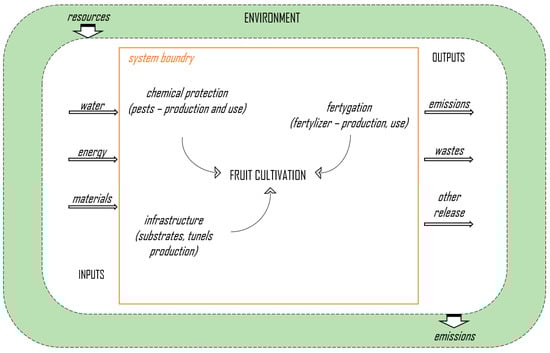
Figure 1.
System boundaries adopted for raspberry production.
The plants were cultivated using a hydroponic system. The hydroponic system was designed as a partially closed-loop setup to optimize water and nutrient use efficiency. A standard nutrient solution composition was applied, which is commonly used for fertigation in protected raspberry cultivation. The composition of the nutrient solution is presented in Table 4. The nutrient solution’s electrical conductivity (EC) ranged from 1.6 to 2.2 mS·cm−1. The experiment was conducted in three replications. Due to the controlled climate conditions and the uniformity of the substrate, replications were not arranged in a randomized block design.
Table 4.
Chemical composition of the solution used for fertigation.
The statistical analysis assessed differences in greenhouse gas emissions between experimental treatments using one-way ANOVA. Prior to conducting ANOVA, the normality of the data distribution was tested with the Shapiro–Wilk test, and the assumption was confirmed. When significant differences were detected, Tukey’s HSD test was applied to identify treatment groups that differed significantly.
3. Results and Discussion
In the life cycle assessment (LCA), the carbon footprint resulting from the production and application of mineral fertilizers used during the growth period of the test plants was calculated. For this purpose, emission factors expressed in carbon dioxide equivalent per kilogram of applied product were used, based on established values for individual fertilizers [47,48,49,50], along with the application rate per hectare.
Fertilizer production requires substantial energy inputs. Approximately 1.2% of global energy consumption is estimated to be allocated to fertilizer manufacturing processes, contributing around 1.2% of total global greenhouse gas (GHG) emissions [13]. Therefore, fertilizer production represents a critical component of the life cycle assessment of agricultural products, and the system boundaries should be sufficiently broad to account for its influence on the total GHG emissions of a product system.
Most of the total GHG emissions related to fertilization originate from the production of fertilizing agents. At the same time, the remaining portion is associated with emissions from their use—specifically, indirect emissions of nitrous oxide (N2O). Among all yield-forming nutrients, nitrogen has the highest associated GHG emissions. This is due to the high energy demand of nitrogen fertilizer production processes and nitrogen losses from soil or substrate in the form of nitrous oxide. Approximately 1% of the applied nitrogen is assumed to be converted to N2O [51].
According to the IPCC guidelines [52,53,54], it is generally accepted that 1% of the nitrogen applied via mineral fertilization is emitted as N2O—this is the so-called emission factor (EF) for direct soil emissions. Menegat et al. [12] estimated that field emissions account for 58.6% of the total GHG emissions related to synthetic nitrogen fertilizers’ production, application, and transport.
Agricultural GHG emissions represent 10–12% of total anthropogenic emissions, while N2O emissions from agriculture account for 84% of the global N2O emissions [14]. Agriculture is the dominant contributor to global N2O emissions among all anthropogenic sources. According to the definition proposed by the Intergovernmental Panel on Climate Change (IPCC) [54], the fertilizer-induced emission factor is expressed as the percentage of emission intensity relative to the total amount of nitrogen applied (Nt, kg N · ha−1). IPCC documents [53,54] indicate that N2O emissions should be calculated based on the amount of applied nitrogen per unit of cultivated area—i.e., using the emission factor (EF), which for direct soil emissions averages 1% of the applied nitrogen (Nt, kg N · ha−1). This means that the greater the nitrogen input, the higher the emission intensity.
In the present study, greenhouse gas (GHG) emissions expressed in CO2 equivalents related to the production and application of nitrogen fertilizers were estimated based on the composition and quantity of applied fertigation mixtures, as well as the amount of unused fertilizer solution (leachate) in the individual experimental setups. According to IPCC methodology [52], N2O emissions from leachates were calculated based on the total nitrogen content in the leachates and the emission factor for N2O from nitrogen discharged into aquatic systems (0.019 kg N2O-N/kg N).
The total nitrogen content in the leachates was estimated using crop nitrogen requirements (nitrogen content × yield) and the volume of unused fertigation solution. The amount of N2O-N emissions was then converted into CO2 equivalents by multiplying by the global warming potential (GWP) of N2O, which is 292 [55].
GHG emissions from agrochemicals were calculated using specific emission factors for active substances, their concentrations in the formulations, and the quantity of the product applied [56,57] (see Table 5). The highest GHG emissions were associated with products whose active substances are obtained via chemical synthesis and were also dependent on the applied dose of the active ingredient. Overall, the GHG emissions from pesticide production are relatively small compared to the emission potential of fertilizers, especially nitrogen-based ones [58,59].
Table 5.
Use of pesticides in raspberry production and GHG emission levels.
Audsley et al. [56] estimated the average energy input for pesticide production across various crops at approximately 94 kg CO2 equivalents per hectare of cultivated land. Appropriate crop protection management—including integrated pest management (IPM) and dose reduction—can minimize emissions while maintaining high production efficiency [60].
In the life cycle assessment, greenhouse gas emissions resulting from the combustion of fossil fuels used for agronomic operations were considered. Fuel consumption associated with specific agrotechnical practices related to tunnel construction, plant transplantation, and pesticide application is presented in Table 6.
Table 6.
Mineral fertilizer consumption and associated greenhouse gas (GHG) emissions.
Based on data from the EPA [61], the emission factor for diesel combustion in agricultural tractors was assumed to be 3.864 kg CO2 per dm3 of fuel. Due to the relatively low levels of nitrogen oxides and methane released during diesel combustion in agricultural tractors, these greenhouse gas sources were omitted per the recommendations in [61]. Electricity was used for tunnel construction and production processes (Table 7). The emission factor for electricity generation was assumed to be 0.9245 kg CO2 per kWh [62]. According to the methodology proposed by the FAO [63], nitrogen emissions to the atmosphere from using mineral fertilizers were estimated at 1% as direct emissions, and an additional 0.27% from nitrogen dispersed in the environment through runoff. Irrigation was carried out using groundwater pumped from a depth of 25 m. An electric pump with 36% pumping efficiency was used for water pumping. The assumed CO2 emissions to generate 1 kWh of electricity were 0.9245 kg.
Table 7.
Greenhouse gas emissions related to the use of energy for tunnel construction.
Water demand was calculated by continuously monitoring substrate moisture levels throughout the growing season. The operational lifespan of the tunnel structures was assumed to be 25 years. For the production of 1 tonne of steel, a carbon dioxide emission factor of 1.83 t CO2 was adopted. The construction of 10 tunnels per hectare requires 288 tons of steel (Table 8). The carbon footprint associated with polyethylene film production was estimated at 2.4 kg CO2 per kg of material. The tunnels were covered with a film of 150 g/m2 basis weight.
Table 8.
Greenhouse gas emissions from steel and plastic consumption.
The substrates used in the experiment were prepared by mixing individual components. The experimental substrates consisted of coconut coir, biochar derived from sunflower husks, and a wood-based insulation by-product generated during the production of the prefabricated wood components. The carbon footprint for coconut coir was assumed to be 367 g CO2-eq per kg of substrate [28,64]. Process energy required for biochar production and insulation hardening originated from electricity. CO2 emissions related to biochar production were estimated at 170 kg CO2-eq per ton of this substrate component, while emissions from insulation production were estimated at 25 kg CO2-eq per ton. The quantity of substrate used in each treatment variant was calculated based on bulk density values at 35% moisture content and converted to dry weight.
3.1. Analysis of GHG Emissions Related to Raspberry Production
Detailed data on greenhouse gas (GHG) emissions per 1 kg of raspberries are presented in Figure 2. The highest contribution to total GHG emissions originated from tunnel construction activities, ranging from 2.92 to 3.27 kg CO2-eq per kg of fruit, which accounted for 66.86–75.07% of the total emissions. The second most significant source was fertilization emissions, ranging from 0.73 to 1.27 kg CO2-eq per kg of fruit, representing on average 18.72–25.90% of the total emissions. Irrigation contributed 4.36–5.79% to the overall emissions, while emissions related to substrate production accounted for 0.96–1.40%. The lowest share—below 1%—was attributed to emissions from pesticide use and fuel combustion during crop cultivation.
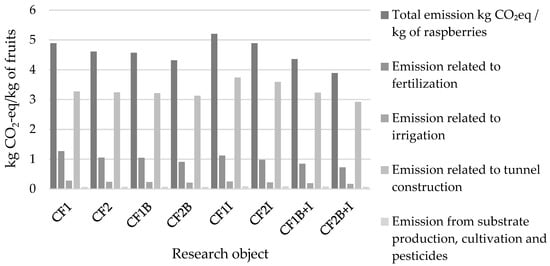
Figure 2.
GHG emission values per mass of the product produced.
Excluding emissions related to tunnel construction, fertilization activities accounted for the largest share of total greenhouse gas emissions across all treatment variants, as shown in Figure 3. These emissions represented approximately 76% of the overall total. Emissions associated with irrigation remained relatively stable, contributing around 17–18%. In the variants with more advanced substrate compositions (including additionally pelletized biochar and insulation material), an increased share of emissions was observed from substrate production and the combined emissions resulting from pesticide use and fuel combustion during cultivation.
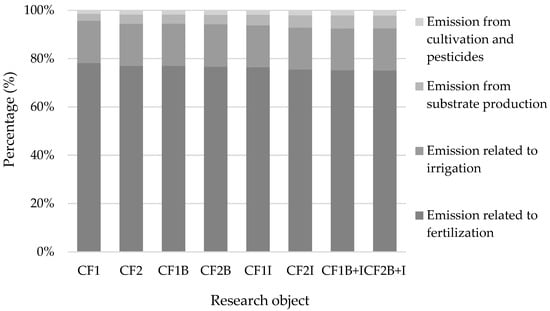
Figure 3.
Shares of individual components in total greenhouse gas emissions per manufactured product mass, excluding tunnel construction emissions.
Table 9 presents the total greenhouse gas emissions levels per unit mass of produced yield, depending on the experimental treatments. The use of different variants of coconut coir did not significantly affect the emissions expressed in CO2-eq per kilogram of raspberry yield. Statistical analysis indicated no significant differences in total emissions between substrates based on Lergo and Ceres coconut coir when supplemented with the same additives. However, within both substrate groups, a substantial increase in GHG emissions was observed in treatments containing a 10% addition of biochar and a 10% addition of insulation material compared to the control treatments.
Table 9.
Total CO2 emissions.
3.2. Emissions Related to Substrate Production
Substrate production generates emissions that constitute one of the components of the carbon footprint in the analyzed cultivation variants (Table 10). Substrates containing a 10% addition of either biochar or insulation material and those with a 20% addition of both components were characterized by higher bulk density. As a result, the consumption of substrates containing the tested additives increased by approximately 20% in treatments with a 10% addition of a single component and by around 35% in treatments with the combined addition of both elements. Including these additives increased GHG emissions from substrate production by 10% for the lower, and 20% for the higher, proportion of components in the substrate mass.
Table 10.
CO2 emissions related to substrate production.
The use of coconut coir sourced from different producers (Lergo and Ceres) contributed, in some cases, to statistically significant differences in GHG emissions associated with substrate production, expressed in CO2 equivalents per kilogram of raspberry yield (Table 10, Figure 4). These differences were observed in the control variants (without the addition of biochar and insulation) as well as in treatments containing both components. Introducing additives (biochar and/or insulation) had a variable impact on substrate-related GHG emissions depending on the type of coconut coir used. Coir sourced from different manufacturers (Lergo and Ceres) exhibited divergent responses to the same additives, suggesting that the properties of the base material can significantly influence the environmental effect of substrate composition modifications. For substrates based on Lergo coir, the addition of biochar alone did not result in a significant change in emissions compared to the control variant. In contrast, a substantial increase in emissions was observed following the addition of insulation or the combination of both components. In contrast, with Ceres coir, significant differences in emissions were found only after the application of individual elements (biochar or insulation). At the same time, the combined use of both did not produce a significant change compared to the base variant. It can therefore be concluded that the impact of substrate composition on greenhouse gas emissions in raspberry cultivation is influenced not only by the type of additives used (biochar, insulation) but also by the intrinsic properties of the coconut coir serving as the substrate base.
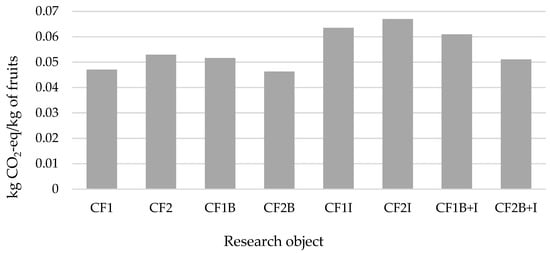
Figure 4.
GHG emission values from substrate production per mass of the product produced.
3.3. Emissions from Irrigation
From an environmental perspective, one of the key factors in tunnel-based fruit and vegetable production is the efficiency of irrigation and, consequently, fertigation. The use of containerized substrates can contribute to improving the environmental performance of the production system by reducing both water and fertilizer consumption. Employing substrates with higher total water-holding capacity—i.e., those capable of better water retention—enables a reduction in the volume of fertigation solution used and a decrease in energy inputs required for irrigation. Qiu et al. [23] demonstrated that in container-grown raspberry cultivation, using appropriately selected substrates allowed for a reduction in nutrient solution usage and improved its uptake efficiency, without compromising yield. They also highlighted the improved alignment of fertigation regimes with climatic conditions and the plant’s developmental stages. Similarly, Hanson et al. [8] found tunnel systems with container-based fertigation significantly reduced fertilizer and water use compared to open-field cultivation, increasing yield quality and quantity. Comparable findings were reported by Polish researchers Zhao et al. [65], who emphasized that substrates with high water retention can reduce water and fertilizer usage by 20–30% in greenhouse cultivation, while maintaining high crop productivity. Carlen et al. [20] further indicated that the properties of the root zone are critical for the profitability and efficiency of raspberry production in container systems, from agronomic and environmental perspectives. Boyacı et al. [66] also observed a significant reduction in water use in tomato cultivation systems fertilized with vermicompost.
In the present study, adding biochar significantly reduced CO2 emissions per unit mass of the produced yield, regardless of the type of coconut coir used as the base for substrate formulation (Table 11). The application of a 20% mixture of biochar and insulation material (in a 1:1 ratio) reduced energy consumption for irrigation by 22% in substrates based on Lergo coir (treatment CF1B + I) and by 33% in those based on Ceres coir (treatment CF2B + I). The incorporation of biochar at several to a dozen percent positively influenced the physical properties of the substrates [24]. Biochars exhibit a higher bulk density than commonly used coconut coir-based substrates, increasing water-holding capacity. This makes biochar a promising alternative to conventional substrate components. Using biochar as a substrate ingredient offers economic benefits over traditional materials due to its lower carbon footprint associated with production and transport. Moreover, numerous studies have demonstrated the beneficial effects of biochar amendments on plant growth under specific conditions [26,27,67].
Table 11.
CO2 emissions related to energy use for irrigation.
According to the results presented in Table 11 and Figure 5, the lowest greenhouse gas (GHG) emission per unit of yield (0.170 kg CO2-eq/kg of yield) was obtained using a substrate composed of Ceres coconut coir with a 10% addition of biochar and a 10% addition of insulation material (variant CF2B + I). In contrast, the highest emission value (0.283 kg CO2-eq/kg of the yield) was recorded for the substrate made from Lergo coconut coir without additives. A broader data analysis reveals that substrates based on Ceres coconut coir generally exhibited lower GHG emissions than those formulated with Lergo coir. Notably, the most significant reduction in greenhouse gas emissions per unit of yield was achieved in variants where biochar and insulation material were applied simultaneously—regardless of the type of coconut coir used as the substrate base. The obtained results indicate a possible synergistic effect of these two materials on the air-water properties of the substrate. Kader et al. [68] emphasize that biochar used with other organic materials as a substrate brings positive effects in the form of improving the physical and chemical properties of the substrate.
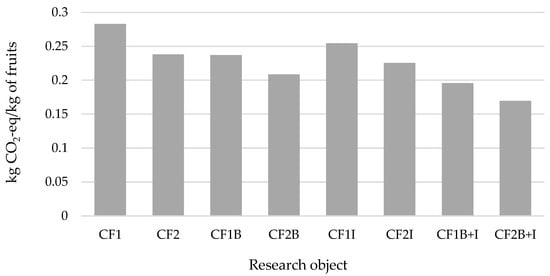
Figure 5.
GHG emission values from irrigation per mass of product produced.
3.4. Fertilization-Related Emissions
According to IFA Statistics, UNEP, and the World Bank [69,70], approximately 60% of the total energy consumption in European agriculture is attributed to the production, logistics, and application of fertilizers—primarily nitrogen-based. Therefore, fertilization efficiency holds strategic importance in reducing agriculture’s environmental impact [71].
Nitrogen fertilizer production is highly energy-intensive, accounting for around 90% of the total energy demand associated with fertilization. The production of 1 kg of nitrogen fertilizer requires roughly nine times more energy than phosphate fertilizers and eleven times more than potash fertilizers. The greenhouse gas emissions from nitrogen fertilizer production amount to approximately 8 kg CO2-eq per kilogram of nitrogen. This is primarily due to the production process of nitrogen fertilizers—especially ammonium nitrate, urea, and calcium ammonium nitrate—which relies on the Haber-Bosch process for ammonia synthesis. This process demands substantial energy (natural gas, steam, and electricity).
According to analyses by Kongshaug [13] and Wood & Cowie [50], producing 1 kg of nitrogen (in the form of nitrogen fertilizers) requires approximately 35–60 MJ of primary energy. In comparison, phosphate fertilizers require 5–8 MJ/kg P2O5, while potash fertilizers demand only 3–5 MJ/kg K2O. These ratios are also confirmed in FAO [72] and IFA (International Fertilizer Association) [69] publications, including reports on fertilizer emissions and energy consumption.
Similarly, Ilari et al. [37] demonstrated that the highest short-term global warming potential in the fruit production sector is associated with the production and application of synthetic fertilizers.
In the study, emissions associated with fertilization represented the second most significant component of the total carbon footprint across all analyzed cultivation variants—second only to emissions from tunnel construction. This highlights the crucial role of the adopted fertigation strategy in shaping greenhouse gas (GHG) emission levels. Fertilization-related emissions consist of three main components: emissions from fertilizer production, indirect emissions from nitrous oxide (N2O), and emissions from nitrogen leaching.
Figure 6 illustrates the variation in GHG emissions from fertilization depending on the experimental treatment. In all variants, the dominant source was indirect nitrous oxide emissions, which contributed the most to the overall fertilization-related GHG emissions. Emissions from fertilizer production constituted the second-largest component, while emissions from nitrogen leaching consistently accounted for the smallest share, regardless of the treatment applied.
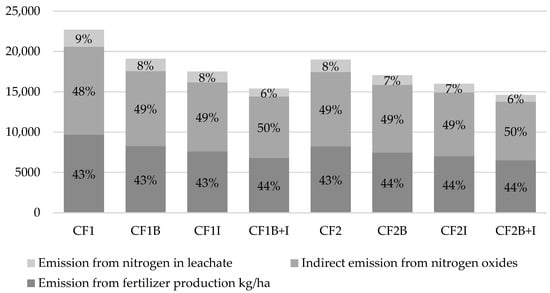
Figure 6.
GHG emissions from fertilizer application in tunnel raspberry cultivation as affected by experimental treatments.
It is worth noting that introducing biochar and isolate as substrate additives consistently led to a reduction in total fertilization-related emissions. This effect was particularly evident in the case of nitrogen leaching emissions, whose share decreased noticeably following the use of these components.
According to the data presented in Table 12, the lowest GHG emissions from fertilization per unit of yield (0.728 kg CO2-eq/kg of yield) were recorded in the treatment using Ceres coconut fiber substrate with the addition of 10% biochar and 10% wood industry isolate. The highest emissions (1.266 kg CO2-eq/kg of yield) were observed in the substrate made of Lergo coconut fiber without any additives. Overall, substrates based on Ceres coconut fiber exhibited lower GHG emissions from fertilization compared to those made with Lergo coconut fiber. Notably, the most significant reduction in greenhouse gas emissions per unit of yield was achieved in treatments where biochar and isolate were applied simultaneously.
Table 12.
CO2 emissions associated with fertilization.
The amount of greenhouse gas (GHG) emissions per functional unit is the most reliable indicator of the environmental impact of agricultural production. The results of the study indicate that the total GHG emissions in the tunnel cultivation of raspberries ranged from 3.648 to 4.815 kg CO2-eq per kilogram of fruit. The best environmental performance was recorded in the treatment where a substrate composed of coconut fiber, biochar, and wood industry isolate was applied. The highest carbon footprint was observed in treatments using a mixture of coconut fiber and isolate.
The level of GHG emissions in individual treatments was primarily determined by the yield volume and water use efficiency, influencing fertilizer use efficiency—fertilizers being the main source of greenhouse gas emissions from primary production. Applying 10% (by weight) biochar increased the efficiency of water and mineral fertilizer use by approximately 10–15%, while adding the wood isolate further improved water efficiency by 4–6%. In the case of the substrate composed of coconut fiber, biochar, and isolate, an overall increase in efficiency ranging from 22% to 30% was observed, depending on the specific substrate variant.
Improving water efficiency is of key importance for plant production under cover. A 30% increase in fertilization and water use efficiency is a highly favorable outcome for optimizing the plant production process. Implementing the developed substrates in commercial cultivation can support the integration of sustainable agriculture principles.
Nearby, guidelines will be developed for certification standards related to technologies that reduce greenhouse gas emissions in agriculture. On 30 November 2022, the European Commission adopted a proposal for the first EU-wide voluntary framework for the reliable certification of carbon dioxide removal from the atmosphere. Certification schemes are expected to support the implementation of innovative carbon removal technologies and sustainable solutions for reducing carbon emissions in the agricultural sector.
The developed solution addresses the needs of future-oriented crop cultivation technologies and offers effective competition to traditional horticultural substrates composed entirely of coconut fiber. A crucial area for future research is the reduction in greenhouse gas emissions associated with constructing growing tunnels.
The study demonstrates that substrate modifications based on biodegradable additives represent a technological innovation and a practical component of sustainable strategies for raspberry production. By reducing greenhouse gas emissions and improving water and nutrient use efficiency, these solutions contribute to implementing climate-smart and resource-efficient agricultural systems.
4. Conclusions
The research topic addresses key challenges of contemporary agriculture, particularly the necessity to reduce the environmental impact of primary production and the drive toward achieving the goals of the European Green Deal. The application of life cycle assessment (LCA) methods in the analysis of raspberry cultivation technologies under cover enables the precise identification of greenhouse gas emission sources and the indication of practical pathways for their reduction. Using innovative, biodegradable substrate additives (biochar and wood industry isolate) has proven effective both from environmental and production standpoints.
In light of increasing environmental requirements and the need to mitigate greenhouse gas emissions, a strategic approach to agricultural production management is gaining paramount importance. Effective farm management based on environmental data and life cycle analysis allows for optimizing resource use and emission reduction, while facilitating the adaptation of practices to new certification requirements and climate policies. Integrating innovative cultivation technologies with a systems approach and precise planning throughout the production cycle enables the development of competitive and sustainable farming models. Such an approach constitutes the foundation of modern agriculture that responds to future challenges.
The research yields the following conclusions:
- Modifying the composition of the substrate in raspberry cultivation under cover can bring about positive environmental effects in the form of reduced greenhouse gas emissions associated with the production of dessert raspberries. The study demonstrated a nearly 40% reduction in greenhouse gas emissions compared to the control treatment.
- The factors that had the most significant influence on the level of greenhouse gas emissions were water and nutrient use efficiency.
- The air–water properties of the substrate are critically important for both the environmental and economic efficiency of soilless plant production under cover.
- The best environmental and production outcomes were achieved with a substrate mixture composed of coconut fiber, biochar, and a wood industry isolate.
- The parameter that has had the most significant impact on greenhouse gas emissions is the construction and operation of tunnels. Optimizing raspberry production technology in the context of environmental costs should also focus on changes to tunnel design, the use of alternative building materials, and extending tunnel operating life.
A limitation of this study is the one-year research period, which does not allow for assessing the long-term stability of biodegradable additives (e.g., biochar), nutrient release patterns, or changes in substrate physical properties across multiple growth cycles. Moreover, although tunnel construction was identified as the dominant emission source, potential mitigation options for tunnel infrastructure were not analyzed in depth. Another limitation of this study is the lack of a detailed economic analysis, including production costs of improved substrates, input–output ratios, and profitability compared to conventional substrates.
The study carries specific theoretical and practical implications. From a theoretical perspective, it enriches knowledge regarding the impact of substrate composition on the carbon footprint of raspberry production in soilless systems. It highlights the potential of LCA as a tool for optimizing agricultural technologies. From a practical perspective, the developed substrate variants can be implemented by growers to reduce production costs and meet future certification requirements for low-emission agriculture. The obtained results may serve as a reference point for developing national standards for the certification of cultivation technologies in the context of greenhouse gas emission reduction in the horticultural sector.
Author Contributions
Conceptualization, M.N., M.K. (Maciej Kuboń) and M.K. (Monika Komorowska); methodology, M.N. and M.K. (Monika Komorowska); software, J.T., A.W. and M.O.; validation, M.K. (Monika Komorowska), M.N. and M.K. (Maciej Kuboń); formal analysis, M.K. (Monika Komorowska) and M.N.; investigation, M.K. (Monika Komorowska) and M.N.; resources, M.N. and M.K. (Maciej Kuboń); data curation, J.T., A.W. and M.O.; writing—original draft preparation, M.K. (Monika Komorowska) and M.N.; writing—review and editing, M.K. (Monika Komorowska), J.T., A.W. and M.O.; visualization, M.K. (Monika Komorowska) and M.N.; supervision, M.N. and M.K. (Maciej Kuboń); project administration, M.N.; funding acquisition, J.T. All authors have read and agreed to the published version of the manuscript.
Funding
This work was funded by the AGH University of Krakow through resources allocated for the development of the research capacity of the Faculty of Management, as part of the “Excellence Initiative—Research University” program.
Data Availability Statement
The data presented in this study are available on request from the corresponding author. The data for this article were obtained as part of the project “Innovative technology for the production of berries, using the example of raspberries with increased bioactive compound content and increased commercial value,” implemented under the ARMA’s “COOPERATION M16” program. Aid grant agreement No. 00024.DDD.6509.00014.2019.07.
Conflicts of Interest
The authors declare no conflicts of interest.
References
- Granatstein, D.; Kupferman, E. Sustainable Horticulture in Fruit Production. Acta Hortic. 2006, 767, 295–308. [Google Scholar] [CrossRef]
- Carlsson-Kanyama, A.; Ekström, M.P.; Shanahan, H. Food and Life Cycle Energy Inputs: Consequences of Diet and Ways to Increase Efficiency. Ecol. Econ. 2003, 44, 293–307. [Google Scholar] [CrossRef]
- Cuadra, M.; Björklund, J. Assessment of Economic and Ecological Carrying Capacity of Agricultural Crops in Nicaragua. Ecol. Indic. 2007, 7, 133–149. [Google Scholar] [CrossRef]
- Frey, S.; Barrett, J. Our Health, Our Environment: The Ecological Footprint of What We Eat. In Proceedings of the International Ecological Footprint Conference, Cardiff, UK, 8–10 May 2007. [Google Scholar]
- Garnett, T. Fruit and Vegetables & UK Greenhouse Gas Emissions: Exploring the Relationship. In Food and Climate Research Network; University of Surrey: Guildford, UK, 2006. [Google Scholar]
- Rashidov, N.; Chowaniak, M.; Niemiec, M.; Mamurovich, G.S.; Gufronovich, M.J.; Gródek-Szostak, Z.; Szeląg-Sikora, A.; Sikora, J.; Kuboń, M.; Komorowska, M. Assessment of the Multiannual Impact of the Grape Training System on GHG Emissions in North Tajikistan. Energies 2021, 14, 6160. [Google Scholar] [CrossRef]
- Gerbens-Leenes, P.W.; Nonhebel, S.; Ivens, W.P.M.F. A Method to Determine Land Requirements Relating to Food Consumption Patterns. Agric. Ecosyst. Environ. 2002, 90, 47–58. [Google Scholar] [CrossRef]
- Hanson, E.; Von Weihe, M.; Schilder, A.C.; Chanon, A.M.; Scheerens, J.C. High Tunnel and Open Field Production of Floricane- and Primocane-Fruiting Raspberry Cultivars. Hort. Technol. 2011, 21, 412–418. [Google Scholar] [CrossRef]
- Clark, M.; Springmann, M.; Rayner, M.; Scarborough, P.; Hill, J.; Tilman, D.; Harrington, R. Estimating the Environmental Impacts of 57,000 Food Products. Proc. Natl. Acad. Sci. USA 2022, 119, e2120584119. [Google Scholar] [CrossRef]
- Bradish, C.M.; Perkins, P.; Fernandez, G.E.; Ma, G. Comparison of Health-Beneficial Secondary Metabolites in Red Raspberry Grown under Field and High Tunnel Production Systems. In Proceedings of the 2012 ASHS Annual Conference, Miami, FL, USA, 31 July–3 August 2012. [Google Scholar]
- Wróblewska, W.; Pawlak, J.; Paszko, D. Economic Aspects in the Raspberry Production on the Example of Farms from Poland, Serbia, and Ukraine. J. Hortic. Res. 2019, 27, 71–80. [Google Scholar] [CrossRef]
- Menegat, S.; Ledo, A.; Tirado, R. Greenhouse Gas Emissions from Global Production and Use of Nitrogen Synthetic Fertilizers in Agriculture. Sci. Rep. 2022, 12, 14490. [Google Scholar] [CrossRef]
- Kongshaug, G. Energy Consumption and Greenhouse Gas Emissions in Fertilizer Production. In Proceedings of the IFA Technical Conference, Marrakech, Morocco, 28 September–1 October 1998; pp. 1–18. [Google Scholar]
- IPCC. Climate Change 2014: Synthesis Report. Contribution of Working Groups I, II, and III to the Fifth Assessment Report of the Intergovernmental Panel on Climate Change; Pachauri, R.K., Meyer, L.A., Eds.; IPCC: Geneva, Switzerland, 2014; Available online: https://www.ipcc.ch/report/ar5/syr/ (accessed on 28 June 2025).
- Komorowska, M.; Niemiec, M.; Sikora, J.; Suder, M.; Gródek-Szostak, Z.; Atilgan, A.; Ovcharuk, O.; Lach, Ł.; Kusa, R.; Duda, J. Strategies for Managing Corn Residue Crop in the Context of Greenhouse Gas Emissions. Environ. Sci. Pollut. Res. 2024, 31, 60189–60205. [Google Scholar] [CrossRef]
- Cerutti, A.; Beccaro, G.L.; Bosco, S.; De Luca, A.I.; Falcone, G.; Fiore, A.; Iofrida, N.; Giudice, A.L.; Strano, A. Life Cycle Assessment in the Fruit Sector. In Life Cycle Assessment in the Agri-Food Sector; Notarnicola, B., Salomone, R., Petti, L., Renzulli, P., Roma, R., Cerutti, A., Eds.; Springer: Cham, Switzerland, 2015; pp. 333–388. [Google Scholar] [CrossRef]
- Rose, D.C.; Keating, C.; Morris, C. Understanding how to influence farmers’ decision-making behaviour: A social science review. Agric. Syst. 2016, 149, 165–176. [Google Scholar] [CrossRef]
- Bradish, C.M.; Yousef, G.G.; Ma, G.; Perkins-Veazie, P.; Fernandez, G.F. Anthocyanin, Carotenoid, Tocopherol, and Ellagitannin Content of Red Raspberry Cultivars Grown Under Field or High Tunnel Cultivation in the Southeastern United States. J. Amer. Soc. Hort. Sci. 2015, 140, 163–171. [Google Scholar] [CrossRef]
- Klerkx, L.; Rose, D. Dealing with the game-changing technologies of Agriculture 4.0: How do we manage diversity and responsibility in food system transition pathways? Glob. Food Secur. 2020, 24, 100347. [Google Scholar] [CrossRef]
- Carlen, C.; Ançay, A.; Christ, B. Optimization of the Root Environment for Raspberry Production on Substrate. Acta Hortic. 2020, 1277, 283–286. [Google Scholar] [CrossRef]
- Campbell, B.M.; Thornton, P.; Zougmoré, R.; van Asten, P.; Lipper, L. Sustainable intensification: What is its role in climate smart agriculture? Curr. Opin. Environ. Sustain. 2014, 8, 39–43. [Google Scholar] [CrossRef]
- Pretty, J.; Benton, T.G.; Bharucha, Z.P.; Dicks, L.V.; Flora, C.B.; Godfray, H.C.J.; Goulson, D.; Hartley, S.; Lampkin, N.; Morris, C.; et al. Global assessment of agricultural system redesign for sustainable intensification. Nat. Sustain. 2018, 1, 441–446. [Google Scholar] [CrossRef]
- Qiu, C.; Gaudreau, L.; Nemati, R.; Gosselin, A.; Desjardins, Y. Primocane Red Raspberry Response to Fertigation EC, Types of Substrate and Propagation Methods. Eur. J. Hortic. Sci. 2017, 82, 72–80. [Google Scholar] [CrossRef]
- Huang, L.; Gu, M. Effects of Biochar on Container Substrate Properties and Growth of Plants—A Review. Horticulturae 2019, 5, 14. [Google Scholar] [CrossRef]
- Sikora, J.; Niemiec, M.; Tabak, M.; Gródek-Szostak, Z.; Szeląg-Sikora, A.; Kuboń, M.; Komorowska, M. Assessment of the Efficiency of Nitrogen Slow-Release Fertilizers in Integrated Production of Carrot Depending on Fertilization Strategy. Sustainability 2020, 12, 1982. [Google Scholar] [CrossRef]
- Tian, Y.; Sun, X.; Li, S.; Wang, H.; Wang, L.; Cao, J.; Zhang, L. Biochar Made from Green Waste as Peat Substitute in Growth Media for Calathea rotundifolia cv. Fasciata. Sci. Hortic. 2012, 143, 15–18. [Google Scholar] [CrossRef]
- Méndez, A.; Cárdenas-Aguiar, E.; Paz-Ferreiro, J.; Plaza, C.; Gascó, G. The Effect of Sewage Sludge Biochar on Peat-Based Growing Media. Biol. Agric. Hortic. 2016, 33, 40–51. [Google Scholar] [CrossRef]
- Grasselly, D.; Hamm, F.; Quaranta, G.; Vitrou, J. Carbon Footprint of Coconut Fibre (Coir) Substrates. Infos-Ctifl 2009, 249, 55–59. [Google Scholar]
- Heuvel, J.E.V.; Proctor, J.T.; Sullivan, J.A. Trellising System and Cane Density Affect Yield and Fruit Quality of Red Raspberry. Hort. Sci. 2000, 35, 1215–1219. [Google Scholar] [CrossRef]
- Dale, A.; Pirgozliev, S.; King, E.M.; Sample, A. Scheduling Primocane-Fruiting Raspberries (Rubus idaeus L.) for Year-Round Production in Greenhouses by Chilling and Summer-Pruning of Canes. J. Hortic. Sci. Biotechnol. 2005, 80, 346–350. [Google Scholar] [CrossRef]
- Sønsteby, A.; Myrheim, U.; Heiberg, N.; Heide, O.M. Production of High Yielding Red Raspberry Long Canes in a Northern Climate. Sci. Hortic. 2009, 121, 289–297. [Google Scholar] [CrossRef]
- European Commission. Communication from the Commission to the European Parliament, the Council, the European Economic and Social Committee and the Committee of the Regions; EU Policy Framework on Biobased, Biodegradable and Compostable Plastics; COM(2022) 682 Final; European Commission: Brussels, Belgium, 2022. [Google Scholar]
- Niemiec, M.; Komorowska, M.; Atilgan, A.; Abduvasikov, A. Labelling the Carbon Footprint as a Strategic Element of Environmental Assessment of Agricultural Systems. Agric. Eng. 2024, 28, 235–250. [Google Scholar] [CrossRef]
- Sangaré, M.; Nemati, M.R.; Fortin, J.P. Beneficial Effect of Coconut Fiber and Peat on the Physical Quality of Nursery Substrates. Acta Hortic. 2013, 1013, 175–180. [Google Scholar] [CrossRef]
- Antle, J.M.; Valdivia, R.O. Modelling the supply of ecosystem services from agriculture: A minimum-data approach. Aust. J. Agric. Resour. Econ. 2006, 50, 1–15. [Google Scholar] [CrossRef]
- Hutsol, T.; Kutyrev, A.; Kiktev, N.; Biliuk, M. Robotic Technologies in Horticulture: Analysis and Implementation Prospects. Agric. Eng. 2023, 27, 113–133. [Google Scholar] [CrossRef]
- Ilari, A.; Toscano, G.; Boakye-Yiadom, K.A.; Duca, D.; Pedretti, E.F. Life Cycle Assessment of Protected Strawberry Productions in Central Italy. Sustainability 2021, 13, 4879. [Google Scholar] [CrossRef]
- Pan, S.Y.; He, K.H.; Lin, K.T.; Fan, C.; Chang-Tang, C. Addressing Nitrogenous Gases from Croplands Toward Low-Emission Agriculture. npj Clim. Atmos. Sci. 2022, 5, 43. [Google Scholar] [CrossRef]
- Mohammadzadeh, P.; Shahgholi, G.; Szymanek, M.; Tanaś, W. Analysis of Energy Indicators of Dry Farming Wheat Production in Northwest of Iran. Agric. Eng. 2024, 28, 37–49. [Google Scholar] [CrossRef]
- De Beus, N.; Carus, M.; Barth, M. Carbon footprint and sustainability of different natural fibres for biocomposites and insulation material-study providing data for the automotive and insulation industry. Carbon Footpr. Nat. Fibres 2019, 56. Available online: https://eiha.org/media/2019/03/19-03-13-Study-Natural-Fibre-Sustainability-Carbon-Footprint.pdf (accessed on 28 June 2025).
- Soto-Barrera, V.C.; Begambre-González, F.; Vellojín-Muñoz, K.E.; Fernandez-Hoyos, D.F.; Torres-Bejarano, F.M. Life Cycle Assessment of Biocomposite Production in Development Stage from Coconut Fiber Utilization. Sustainability 2025, 17, 8338. [Google Scholar] [CrossRef]
- ISO 14040:2006; Environmental Management—Life Cycle Assessment—Principles and Framework. International Organization for Standardization: Geneva, Switzerland, 2006.
- ISO 14041:1998; Environmental Management—Life Cycle Assessment—Goal and Scope Definition and Inventory Analysis. International Organization for Standardization: Geneva, Switzerland, 1998.
- PN-EN 13041:2002; Soil Improvers and Growing Media–Determination of Physical Properties–Dry Bulk Density, Air Capacity, Water Capacity, Shrinkage and Total Porosity. Polish Committee for Standardization: Warsaw, Poland, 2002.
- Notarnicola, B.; Tassielli, G.; Renzulli, P.A.; Monforti-Ferrario, F.; Sala, S. Environmental impacts of food consumption in Europe. J. Clean. Prod. 2017, 140, 753–765. [Google Scholar] [CrossRef]
- European Commission-Joint Research Centre-Institute for Environment and Sustainability. International Reference Life Cycle Data System (ILCD) Handbook—General Guide for Life Cycle Assessment—Detailed Guidance; EUR 24708 EN; Publications Office of the European Union: Luxembourg, 2010; Available online: https://eplca.jrc.ec.europa.eu/uploads/ILCD-Handbook-General-guide-for-LCA-DETAILED-GUIDANCE-12March2010-ISBN-fin-v1.0-EN.pdf (accessed on 28 June 2025).
- IPCC. Summary of the Revised 1996 IPCC Guidelines for National Greenhouse Gas Inventories. In The Additions and Revisions to the Reference Manual of the IPCC Guidelines Were Accepted by the IPCC at Its Twelfth Session (Mexico City, 11–13 September 1996); IPCC: Geneva, Switzerland, 1996. [Google Scholar]
- Houghton, J.T.; Meira Filho, L.G.; Lim, B.; Treanton, K.; Mamaty, I.; Bonduki, Y.; Griggs, D.J.; Callender, B.A. Revised 1996 IPCC Guidelines for National Greenhouse Gas Inventories; IPCC: Geneva, Switzerland, 1996. [Google Scholar]
- Garg, A.; Kazunari, K.; Pulles, T. IPCC Guidelines for National Greenhouse Gas Inventories. 2020. Available online: https://www.ipcc-nggip.iges.or.jp/public/2006gl/pdf/2_Volume2/V2_1_Ch1_Introduction.pdf (accessed on 26 March 2020).
- Wood, S.; Cowie, A. Review of Greenhouse Gas Emission Factors for Fertiliser Production; Research and Development Division, State Forests of New South Wales; Cooperative Research Centre for Greenhouse Accounting: Sydney, Australia, 2004. [Google Scholar]
- Novoa, R.; Tejeda, H. Evaluation of the N2O emissions from N in plant residues as affected by environmental and management factors. Nutr. Cycl. Agroecosyst. 2006, 75, 29–46. [Google Scholar] [CrossRef]
- IPCC. 2019 Refinement to the 2006 IPCC Guidelines for National Greenhouse Gas Inventories; Intergovernmental Panel on Climate Change: Geneva, Switzerland, 2019; Available online: https://www.ipcc.ch/report/2019-refinement-to-the-2006-ipcc-guidelines-for-national-greenhouse-gas-inventories/ (accessed on 27 June 2025).
- IPCC. IPCC Guidelines for National Greenhouse Gas Inventories, Volume 4: Agriculture, Forestry and Other Land Use; Intergovernmental Panel on Climate Change: Geneva, Switzerland, 2006. [Google Scholar]
- IPCC. The Intergovernmental Panel on Climate Change (IPCC) Will Participate in the 21st Conference of the Parties (COP 21) to the United Nations Framework Convention on Climate Change (UNFCCC) in Paris, Starting on Monday, 30 November, 2015; IPCC: Geneva, Switzerland, 2015. [Google Scholar]
- Forster, P.; Ramaswamy, V.; Artaxo, P.; Berntsen, T.; Betts, R.; Fahey, D.W.; Haywood, J.; Lean, J.; Lowe, D.C.; Myhre, G.; et al. Changes in Atmospheric Constituents and in Radiative Forcing. In Climate Change 2007: The Physical Science Basis. Contribution of Working Group I to the Fourth Assessment Report of the Intergovernmental Panel on Climate Change; Solomon, S., Qin, D., Manning, M., Chen, Z., Marquis, M., Averyt, K.B., Tignor, M., Miller, H.L., Eds.; Cambridge University Press: Cambridge, UK; New York, NY, USA, 2007; Available online: https://www.ipcc.ch/site/assets/uploads/2018/02/ar4-wg1-chapter2-1.pdf (accessed on 27 June 2025).
- Audsley, E.; Stacey, K.; Parsons, D.J.; Williams, A.G. Estimation of the Greenhouse Gas Emissions from Agricultural Pesticide Manufacture and Use; Cranfield University: Cranfield, UK, 2009. [Google Scholar] [CrossRef]
- Cech, R.; Leisch, F.; Zaller, J.G. Pesticide Use and Associated Greenhouse Gas Emissions in Sugar Beet, Apples, and Viticulture in Austria from 2000 to 2019. Agriculture 2022, 12, 879. [Google Scholar] [CrossRef]
- Lal, R. Soil Carbon Sequestration Impacts on Global Climate Change and Food Security. Science 2004, 304, 1623–1627. [Google Scholar] [CrossRef]
- Audsley, E. Harmonisation of Environmental Life Cycle Assessment for Agriculture; Final Report, Concerted Action AIR3-CT94-2028; European Commission, DG VI Agriculture: Luxembourg, 1997; 139p. [Google Scholar]
- Pretty, J.; Bharucha, Z.P. Integrated Pest Management for sustainable intensification of agriculture in Asia and Africa. Insects 2015, 6, 152–182. [Google Scholar] [CrossRef]
- United States Environmental Protection Agency (EPA). Greenhouse Gas Inventory Guidance: Direct Emissions from Mobile Combustion Sources; EPA: Washington, DC, USA, 2016; p. 27.
- Wang, D.; Ye, W.; Wu, G.; Li, R.; Guan, Y.; Zhang, W.; Wang, J.; Shan, Y.; Hubacek, K. Greenhouse Gas Emissions from Municipal Wastewater Treatment Facilities in China from 2006 to 2019. Sci. Data 2022, 9, 317. [Google Scholar] [CrossRef] [PubMed]
- FAO. Livestock Environmental Assessment and Performance Partnership. In Global Database of GHG Emissions Related to Feedcrops: Methodology; Version 1; FAO: Rome, Italy, 2017. [Google Scholar]
- Smebye, A.B.; Sparrevik, M.; Schmidt, H.P.; Cornelissen, G. Life-Cycle Assessment of Biochar Production Systems in Tropical Rural Areas: Comparing Flame Curtain Kilns to Other Production Methods. Biomass Bioenergy 2017, 101, 35–43. [Google Scholar] [CrossRef]
- Zhao, Q.; Feng, J.; Guo, S.; Yang, S.; Jing, R.; Zhang, X.; Zhou, X.; Li, D. Water-Fertilizer Regulation Improves Yield, Quality, and Water-Fertilizer Use Efficiency of Greenhouse Lettuce by Altering the Bacterial Community in Nutrient Solutions. J. Agric. Food Res. 2025, 21, 101976. [Google Scholar] [CrossRef]
- Boyacı, S.; Kocięcka, J.; Atilgan, A.; Niemiec, M.; Liberacki, D.; Rolbiecki, R. Determination of the Effects of Different Irrigation Levels and Vermicompost Doses on Water Consumption and Yield of Greenhouse-Grown Tomato. Water 2024, 16, 1095. [Google Scholar] [CrossRef]
- Nieto, A.; Gascó, G.; Paz-Ferreiro, J.; Fernández, J.; Plaza, C.; Méndez, A. The Effect of Pruning Waste and Biochar Addition on Brown Peat Based Growing Media Properties. Sci. Hortic. 2016, 199, 142–148. [Google Scholar] [CrossRef]
- Kader, S.; Gratchev, I.; Michael, R.N. Recycled waste substrates: A systematic review. Sci. Total Environ. 2024, 953, 176029. [Google Scholar] [CrossRef] [PubMed]
- International Fertilizer Association (IFA). Energy Efficiency and CO2 Emissions in Ammonia Production 2008–2009: Summary Report; International Fertilizer Association: Paris, France, 2009. [Google Scholar]
- World Resources Institute (WRI). World Resources 2000–2001: People and Ecosystems—The Fraying Web of Life; World Resources Institute: Washington, DC, USA, 2000; Available online: http://pdf.wri.org/world_resources_2000-2001_people_and_ecosystems.pdf (accessed on 28 June 2025).
- Niemiec, M.; Cupiał, M.; Szeląg-Sikora, A. Ocena Efektywności Nawożenia Selera Korzeniowego Nawozami o Spowolnionym Działaniu. Agric. Agric. Sci. Procedia 2015, 7, 177–183. [Google Scholar] [CrossRef]
- FAO. FAOSTAT: Emission Totals; FAO: Rome, Italy; Available online: https://www.fao.org/faostat/en/#data/GT (accessed on 29 October 2022).
Disclaimer/Publisher’s Note: The statements, opinions and data contained in all publications are solely those of the individual author(s) and contributor(s) and not of MDPI and/or the editor(s). MDPI and/or the editor(s) disclaim responsibility for any injury to people or property resulting from any ideas, methods, instructions or products referred to in the content. |
© 2025 by the authors. Licensee MDPI, Basel, Switzerland. This article is an open access article distributed under the terms and conditions of the Creative Commons Attribution (CC BY) license (https://creativecommons.org/licenses/by/4.0/).