Article

Exploring the Mechanism of How the Market-Based Allocation of Data Elements Affects the Supply Chain Resilience of Manufacturing Enterprises: A Perspective on Data as a Production Factor

1
School of Law, Southeast University, Nanjing 211189, China
2
Local Legislation Research Base of Jiangsu Province, Southeast University, Nanjing 211189, China
*
Author to whom correspondence should be addressed.
Sustainability 2025, 17(17), 7950; https://doi.org/10.3390/su17177950
Submission received: 31 July 2025 / Revised: 18 August 2025 / Accepted: 1 September 2025 / Published: 3 September 2025

Abstract

The escalating frequency of natural disasters and political conflicts has heightened focus on industrial supply chain resilience and security, making corporate supply chain resilience enhancement a critical global concern. Data, as a novel production factor, presents an effective pathway to fortify supply chain resilience. This paper investigates data factor marketisation by constructing a theoretical framework linking it with manufacturing enterprise supply chain resilience. Using China’s Big Data Comprehensive Experimental Zone establishment as a quasi-natural experiment, we analyzed data from Chinese A-share listed manufacturing firms spanning 2003–2023 to empirically validate our theoretical analysis. Our findings reveal that data factor marketisation significantly enhances manufacturing enterprise supply chain resilience, as confirmed using rigorous robustness checks. Mechanism analysis demonstrates that data factor marketisation improves resilience by reducing information asymmetries, boosting management efficiency, mitigating supply chain reliance, and enhancing supply chain financing. Heterogeneity analysis indicates stronger positive impacts in non-state-owned enterprises, smaller firms, companies with advanced data capabilities, non-digital-intensive businesses, enterprises with substantial supply chain funding needs, and those in regions with strong rule of law. Further analysis shows that improved employment, financing, innovation, and communication environments amplify the positive relationship between data factor marketisation and supply chain resilience. This study provides crucial insights for policy makers seeking to leverage data marketisation for industrial resilience enhancement and offers strategic guidance for enterprises navigating an increasingly uncertain global supply chain environment.

1. Introduction

In recent years, with the escalation of geopolitical conflicts, the spread of the global pandemic, and the frequent occurrence of extreme climate events, traditional supply chain management models have struggled to adapt to the current complex and volatile external environment [1,2,3]. Supply chain resilience has become a core issue of widespread concern in the international community and academia. Since China proposed the construction of a new development pattern with the domestic cycle as the mainstay and the domestic and international dual cycles promoting each other, The Communist Party of China further stated, at its 20th National Congress, that “efforts should be made to enhance the resilience and security level of the industrial chain and supply chain.” The 2024 China Economic Work Conference emphasized the need to “enhance the autonomous and controllable capabilities of the industrial chain and supply chain” and continuously improve the competitiveness of the manufacturing industry. At the meso-level of industry, building a safe, stable, autonomous, and controllable industrial chain and supply chain is a key direction for industrial structure upgrading and an important focus for promoting the high-quality development of the manufacturing industry [4]. At the micro-level of enterprise, integrating the concept of digital transformation into the supply chain management process reshapes enterprise supply chain management capabilities and achieves enterprise resilient development [5]. As a core capability to cope with external shocks and maintain operational stability, enterprise supply chain resilience takes into account both the resistance to risk shocks and the pursuit of economic benefits, which is not only a key proposition for achieving the high-quality development of the manufacturing industry, but also a core force for promoting sustainable economic development [6]. Against this background, an in-depth discussion of the influencing factors around enterprise supply chain resilience has an important theoretical and practical necessity.
Concurrently, with the accelerating digital transformation of the global economy, the extent of data resource control and its translation into productive capacity are now pivotal in determining a nation’s or region’s ability to leap ahead and secure a competitive edge globally [7,8]. Since the 19th CPC Central Committee’s Fourth Plenum initially identified data as a factor of production eligible for distribution, leveraging data value from a factor of production perspective has become the cornerstone of China’s data strategy. As a new wave of technological and industrial revolution deepens, data factors are increasingly integrated with the real economy, driving the continuous restructuring of traditional industry supply chains and the emergence of novel business models [9]. Consequently, given the growing importance of data factors, supply chain resilience, and security, investigating the empowering effect of data factors on these aspects holds significant theoretical and practical value for furthering supply side structural reforms, developing and bolstering the real economy. The integration of artificial intelligence (AI) technologies represents a critical dimension of data factor marketisation, serving both as an enabler and beneficiary of enhanced data circulation and accessibility. AI applications, including machine learning algorithms, predictive analytics, and automated decision-making systems, require substantial high-quality data inputs to function effectively, making data marketisation essential for their deployment and optimization [10]. Conversely, AI technologies enhance the value extraction from data factors by enabling sophisticated pattern recognition, real-time processing, and predictive capabilities that transform raw data into actionable insights for supply chain management. In the context of Big Data Comprehensive Pilot Zones, AI applications facilitate intelligent demand forecasting, automated supplier selection, risk prediction, and dynamic inventory optimization, thereby directly contributing to supply chain resilience enhancement. The synergistic relationship between AI deployment and data factor marketisation creates a virtuous cycle where improved data accessibility enables more sophisticated AI applications, which in turn generate higher-value data insights and drive further demand for data circulation. This technological convergence is particularly relevant for manufacturing enterprises, where AI-powered supply chain management systems can leverage marketized data factors to achieve superior operational efficiency, risk mitigation, and adaptive capacity in volatile business environments.
Accordingly, this paper treats China’s inaugural digital economy pilot policy—the National Big Data Comprehensive Pilot Zone—as a quasi-natural experiment, examining the impact of data elements on manufacturing firms’ supply chain resilience. The Big Data Pilot Zone, functioning as a digital open-sharing platform, continuously aggregates multi-channel digital supply chain information. This infuses enterprises with substantial data, expanding their supply chain management resource endowment, facilitating the construction of a resilient supply chain architecture through in-depth data analysis and the extraction of forward-looking insights. Furthermore, leveraging the Pilot Zone’s data integration, analytics, and application capabilities, companies can effectively enhance their supply chain digitalisation levels, developing and internalizing data resources to bolster supply chain resilience. The ‘Notice of the State Council on Issuing the Action Outline for Promoting the Development of Big Data’ advocates for “data flow leading technology, material, capital and talent flows” and “coordinating the layout and construction of national big data centres to strengthen the in-depth integration of data resources.” Empirical evidence suggests that establishing Big Data Pilot Zones significantly drives improvements in enterprise supply chain management. For instance, in Guizhou Province during 2023, the adoption rate of digital supply chains among large-scale industrial enterprises reached 72.5%, with supply chain collaboration efficiency increasing by 35% since the Pilot Zone’s establishment. In 2024, manufacturing firms in the Beijing-Tianjin-Hebei region experienced a 40% reduction in average response times to supply chain risk warnings and an approximately 25% decrease in supply chain disruption losses compared to other regions. Consequently, the employment of the Big Data Pilot Zone establishment as a quasi-natural experiment offers reliable conclusions.
In recent years, academics have increasingly recognized the role of data as a resilience-enhancing asset within supply chain management. The prevailing view is that data facilitates the continuous accrual of supply chain information, and its potential should be fully exploited to mitigate supply chain vulnerabilities [11,12,13,14]. However, there is a dearth of research that systematically investigates the link between data and the resilience of manufacturing firms’ supply chains, particularly examining the mechanisms related to information asymmetry, enhanced managerial efficiency, and access to finance. Accordingly, this study theoretically examines the impact of data marketisation on firms’ supply chain resilience and its underlying mechanisms. It leverages the establishment of national Big Data Pilot Zones as a quasi-natural experiment, using data from listed manufacturing companies for empirical analysis. This paper makes the following marginal contributions: (1) In terms of perspective, unlike the existing literature, which primarily focuses on the impact of data marketisation on firm productivity and innovation, this study analyses the impact of data marketisation on the ability of manufacturing firms’ supply chains to withstand and recover from disruptions. Furthermore, departing from traditional studies that rely on unidimensional performance indicators, we develop a comprehensive framework for evaluating supply chain resilience. This framework incorporates predictive capability, resistance capability, recovery capability, organizational capability, and government support, providing a fresh theoretical perspective and measurement instrument for studying enterprise resilience in the digital age. (2) Regarding the mechanisms, the framework incorporates elements such as reduced information asymmetry, improved management efficiency, lessened supply chain dependency, and enhanced access to funding. This framework provides insight into how data marketisation affects enterprise supply chain resilience through a supply chain-wide perspective. The degree of variance between supply and demand fluctuations measures information asymmetry, the ratio of management expenses quantifies management efficiency, the concentration of the supply chain reflects supply chain dependency, and supply chain financing levels measure funding access. This study finds that data marketisation enhances supply chain resilience through optimizing information flow, improving coordination efficiency, diversifying supply risk, and bolstering the financing landscape, offering empirical evidence of how the digital transformation reconfigures supply chain management models. (3) From a policy perspective, this study systematically analyses the heterogeneous impact of data marketisation on enterprise supply chain resilience. It takes into account factors such as enterprise ownership, size, data application capabilities, and industry digitalisation levels, alongside contextual factors such as the rule of law and the supply chain capital employed. This study explores the supply chain resilience performance of different enterprise types in the context of data marketisation. The findings reveal that the benefits of data marketisation are more pronounced for non-state-owned enterprises, smaller businesses, and those with strong data application capabilities. This study also identifies that employment, financing, innovation, and communication environments moderate the policy effects. These findings provide policy makers with a scientifically grounded basis for implementing tailored data marketisation strategies, contributing to more precise and effective policy interventions.

2. Literature Review

The burgeoning digital economy has fundamentally reshaped the landscape of business operations, elevating data to a strategic asset and a distinct factor of production. This section provides a comprehensive review of the literature pertinent to data as a factor, the concept of supply chain resilience, and the intricate relationship between them, particularly in the context of digital transformation and technological advancements.

2.1. Data as a Factor of Production and Its Marketization

The traditional economic framework identifies land, labour, and capital as the primary factors of production. However, in the contemporary digital era, data has increasingly been recognized as a fourth, equally fundamental, factor. This recognition stems from data’s pervasive role in driving innovation, enhancing efficiency, and creating new value across industries. The concept of “data factor marketization” refers to the process by which data, as a productive input, becomes subject to market mechanisms, allowing for its efficient allocation, pricing, and exchange. This involves developing data trading platforms, establishing data governance frameworks, and fostering a legal and regulatory environment that supports data flow and utilization. The ultimate goal of data marketization is to unlock the economic value embedded in vast datasets, transforming raw information into actionable insights and tradable assets.
The theoretical underpinnings of data as a factor of production can be traced to information economics, which emphasizes the unique characteristics of information goods, such as non-rivalry and non-excludability, and the challenges associated with their pricing and exchange. From a resource-based view, data, particularly when combined with analytical capabilities, can be seen as a strategic resource that confers competitive advantage [15,16,17]. When data becomes marketized, it implies a more formalized and efficient mechanism for firms to acquire, process, and leverage this critical resource, thereby enhancing their capabilities. The establishment of initiatives like China’s National Big Data Comprehensive Pilot Zones exemplifies governmental efforts to facilitate this marketization process, creating an institutional environment conducive to data sharing, integration, and value creation. These zones are designed to experiment with policies and infrastructure that promote the development of data markets, allowing for the observation of their impact on economic agents, including manufacturing firms.
The literature extensively discusses the broader concept of “digital transformation,” which is intrinsically linked to the effective utilization of data. Digital transformation involves the adoption of cutting-edge technologies and the strategic integration of physical and information flows into overall supply chain processes, aiming to make systems autonomous and enhance resilience, transparency, and efficiency [18]. Many studies have shown that digital transformation has a significant impact on supply chain resilience. This impact is usually achieved through intermediary effects such as supply chain process integration, specifically covering the integration of information flow, logistics, and capital flow [19]. For instance, Yuan, Tan, and Liu (2023) empirically demonstrate that digital transformation significantly impacts supply chain resilience, with information flow integration playing a crucial mediating role [19]. Similarly, Li, Tian, and Zhang (2025) conducted research to explore how digitalization can help build supply chain resilience and robustness [20]. Their research focused on the intermediary role of supply chain collaboration and the regulatory role of formal contracts. Their findings suggest that digitalization directly enhances supply chain resilience, highlighting its role as a technical factor in managing disruptions. Yin (2022), drawing on resource orchestration theory, further dissects digital transformation into breadth and depth, investigating how different configurations of digital transformation, R&D spending, and firm size contribute to high supply chain resilience, revealing complex causal relationships [21]. Wang, Chen, Xie, and Liu (2025) also delve into digital empowerment, which is a facet of digital transformation, and its role in enhancing manufacturing supply chain resilience, finding that it operates primarily by boosting innovation vitality within enterprises [22]. Li, Tian, and Zhang (2025) extend this by examining how digital transformation, by alleviating the corporate digital divide, enhances supply chain collaboration, and, consequently, resilience, particularly in addressing supply–demand imbalances [20].
A more granular perspective on data utilization comes from research on “big data analytics” (BDA) and “artificial intelligence” (AI). BDA involves sophisticated methods and techniques to extract valuable insights from large, complex datasets, thereby enhancing decision-making and optimizing supply chain operations [23]. Singh (2025) empirically examines the impact of data analytics, collaboration, and flexibility on supply chain resilience performance, finding that advanced data analytics capabilities significantly enhance collaboration and flexibility, leading to superior resilience [24]. Some scholars differentiate between big data-assisted decision-making technology (ADT) and big data intelligent decision-making technology (IDT), demonstrating that both improve supply chain resilience, with varying effectiveness depending on environmental dynamism and management support [25]. Modgil, Singh, and Hannibal (2022) provide critical insights into how AI technologies enable supply chain learning and adaptation during crisis situations like COVID-19, demonstrating that AI-powered systems can rapidly process disruption data to identify patterns and optimize response strategies [26]. Belhadi et al. (2022) develop a comprehensive AI-based framework for building supply chain resilience, showing how machine learning algorithms can enhance decision-making processes by analyzing complex supply chain data and predicting potential vulnerabilities [27]. Okpara, Moneme, Onuaja, and Ikegbunam (2024) highlight the significance of BDA in procurement processes and supply chain management, showing its positive influence on supply chain visibility, flexibility, and ultimately, resilience [28]. Kim and Han (2024) specifically investigate the effect of big data analysis capabilities on the supply chain resilience and performance of exporting manufacturing SMEs, confirming its positive impact through logistics flexibility and supply chain resilience [29]. These studies collectively establish that the capability to analyze and utilize data is crucial, and data factor marketization is the enabling environment that provides the raw material for such capabilities.
Furthermore, advanced technologies like AI, edge computing, and blockchain are increasingly integrated into supply chain management, all of which are fundamentally data-driven. Modgil et al. (2022) examine how various AI technologies, including machine learning and predictive analytics, impact supply chain resilience during pandemic disruptions, revealing that AI-enabled systems significantly improve supply chain adaptability and recovery capabilities through enhanced data processing and real-time decision-making [30].Anozie et al. (2024) explore how edge computing enhances supply chain resilience in retail marketing by processing data in real-time, reducing delays, and improving responsiveness [31]. Rashid et al. (2024) investigate the power of cloud adoption and AI in optimizing resilience and sustainable manufacturing supply chains, finding that AI improves adaptability, strengthening resilience [32]. Liu, Costa, and Wu (2024) present a data-driven framework for optimizing production efficiency and resilience in global supply chains, demonstrating significant improvements in resource utilization and resilience through data-driven insights [33]. Suali, Srai, and Tsolakis (2024) examine the role of digital platforms, which are inherently data-intensive, in e-commerce food supply chain resilience under exogenous disruptions, highlighting how platform-induced disintermediation allows for bidirectional flows of data and information [34]. Ali, Sharabati, Alqurashi, and Al-Haddad (2024) explore the combined influence of AI technology, supply chain collaboration, and information sharing on supply chain resilience, emphasizing that AI paves the way for timely information and insight generation, which facilitates information sharing [35]. These advancements underscore that the marketization of data provides the raw material that these sophisticated technologies process, analyze, and leverage to build more resilient supply chains. Without accessible and tradable data, the full potential of these technologies cannot be realized.
Big Data Comprehensive Pilot Zones (Big Data CPZ) constitute a distinctive institutional innovation that systematically facilitates data element marketization through multifaceted mechanisms. These zones function as strategic policy instruments that establish comprehensive infrastructural foundations for data commodification: they deploy advanced digital infrastructure including data centres and cloud computing platforms that enable scalable data aggregation and processing capabilities essential for market transactions. Concurrently, Big Data CPZ serve as institutional laboratories for testing data governance frameworks, particularly the “five rights separation” model emphasized by Zhao et al. (2025), which provides crucial legal clarity for data rights confirmation and valuation methodologies [36]. The zones further cultivate innovation ecosystems that generate endogenous demand for data services, creating what Wang and Feng (2024) identify as enhanced regional innovation capabilities through improved data accessibility—a phenomenon that demonstrates the market-driven feedback loops between data availability and economic value creation [37].
The institutional design of Big Data CPZ incorporates targeted policy incentives that systematically reduce transaction costs and barriers to data market participation. Empirical evidence from Zhao et al. (2023) and Zhu et al. (2023) demonstrates that government subsidies and regulatory frameworks effectively incentivize digital transformation, thereby expanding the pool of market participants and enhancing data market liquidity [38,39]. However, the realization of efficient data element marketization within these zones confronts persistent institutional and behavioural challenges, including information asymmetries, trust deficits among private enterprises regarding data sharing, and the nascent state of comprehensive data governance frameworks. These constraints underscore the complexity of transforming data from a proprietary resource into a tradable market commodity. Nevertheless, Big Data CPZ represent a pioneering institutional arrangement that provides controlled environments for empirically testing theoretical propositions about data marketization, offering valuable insights into the mechanisms through which policy interventions can facilitate the emergence of functional data markets.

2.2. Research on Supply Chain Resilience

Supply chain resilience (SCR) has emerged as a paramount concept in contemporary supply chain management, particularly in response to the increasing frequency and severity of global disruptions. It refers to the capacity of a supply chain to prepare for, respond to, and recover from disruptions, maintaining continuity of operations and achieving desired performance levels. Brandon-Jones et al. (2014) define SCR as the ability of a supply chain to return to its original state or move to a new, more desirable state after a disruption, emphasizing both recovery and adaptation [15]. This definition highlights a dynamic capability, where firms not only absorb shocks, but also learn and evolve to become more robust in the face of future uncertainties. The COVID-19 pandemic, for instance, served as a stark reminder of the necessity for sustainable solutions and the ability to streamline supply chains with technology-driven infrastructures to overcome challenges like demand forecasting under uncertainty and vulnerability [18,40].
The literature identifies several key antecedents and enablers of supply chain resilience. One of the most consistently highlighted factors is information sharing and visibility. A transparent flow of information across the supply chain network allows for firms to detect disruptions early, assess their potential impact, and coordinate effective responses. Brandon-Jones et al. (2014) empirically demonstrate that supply chain connectivity and information-sharing resources lead to a supply chain visibility capability, which in turn enhances resilience and robustness [15]. Similarly, Mandal et al. (2016) found that visibility positively influences SCR, along with collaboration, flexibility, and velocity [41]. More recent studies continue to underscore the critical role of information sharing, particularly in mitigating the negative effects of uncertainty on SCR [16]. Ali et al. (2024) further elaborate on this, showing that information sharing mediates the collective impact of AI technology and supply chain collaboration on SCR, emphasizing that clear communication and knowledge exchange are fundamentally important [35]. This suggests that merely having data is insufficient; the ability to share and leverage it effectively across the network is paramount.
Flexibility and adaptability are also central to SCR. A flexible supply chain can quickly reconfigure its processes, resources, and networks in response to changing conditions or disruptions. Mandal et al. (2016) confirm the positive influence of flexibility on SCR [41]. Singh (2024) extends this by examining multi-layer supply chain flexibility (MSCF), demonstrating its notable influence on SCR, particularly in environments characterized by high levels of environmental dynamism and supply chain risks [24]. This multi-layer perspective suggests that flexibility needs to be embedded across various operational and strategic dimensions of the supply chain to be truly effective. Kähkönen et al. (2021) link this to dynamic capabilities, finding that a firm’s reconfiguring ability has a strong influence on supply chain resilience, especially when responding to upstream and downstream disruptions triggered by events like COVID-19 [42]. This emphasizes the proactive nature of resilience, where firms develop capabilities to sense and seize opportunities or neutralize threats.
The role of technology adoption in enhancing SCR has gained significant attention, especially with the advent of Industry 4.0 technologies. Digitalization, big data analytics (BDA), artificial intelligence (AI), the Internet of Things (IoT), and blockchain technology are increasingly recognized as critical tools. Tiwari et al. (2024) emphasize that digitizing operations and facilities is essential for enhancing resilience, transparency, and efficiency, citing technologies like ERP, real-time data analytics, IoT, and blockchain [18]. Singh (2025) explicitly links data analytics capabilities to superior SCR performance [43]. Liu et al. (2023) differentiate between big data-assisted decision-making technology (ADT) and big data intelligent decision-making technology (IDT), finding that both improve SCR, with their effects varying based on environmental dynamism and management/government support [44]. This nuanced view suggests that the type and application of big data technology matter.
Blockchain technology, with its promise of immutable and transparent logs, is highlighted for solidifying trust, enhancing traceability, and mitigating threats, thereby contributing to overall SCR [18,45,46]. Pandey et al. (2023) identify internal integration as a crucial causal factor enabled by blockchain technology for SCR and sustainability, followed by standardized data management and smart ordering [47]. AI, on the other hand, is seen as a powerful tool for optimizing resilience and sustainable manufacturing through enhanced adaptability and integration [48,49,50]. AI-driven tools can revolutionize demand forecasting and inventory optimization, enabling predictive supply chain management and proactive decision-making [49,51]. Hirsch et al. (2024) specifically identify supply chain integration, automation, monitoring, analytical, information-sharing, planning, predictive, and decision-making capabilities of AI and information systems as enhancers of SCR in the FMCG industry [52].
Beyond technological enablers, risk management and proactive strategies are fundamental. Coşkun and Erturgut (2023) find that most dimensions of uncertainty negatively affect SCR, but information-sharing can moderate this relationship, emphasizing the need for proactive strategies [16]. Pertheban et al. (2023) demonstrate that proactive resilience strategies significantly influence organizational performance, mediated by ambidextrous capabilities, highlighting the importance of foresight and adaptive capacity [53]. Singh and Kushwah (2025) further evaluate the effectiveness of various risk-mitigation measures, concluding that proactive and diversified approaches, including predictive analytics and real-time monitoring, lead to greater resilience and quicker recovery [54].
Beyond the characteristics and drivers of supply chain resilience, its robust measurement is fundamental to relevant research. Current academic approaches to measuring supply chain resilience in enterprises largely derive from the concept of supply chain resilience itself. Existing research can be broadly categorized into two approaches. The first involves qualitative analysis, primarily analyzing the essence of supply chain resilience from capability [55], process [56], and outcome [57] perspectives, thus yielding varied measurement indicators. This method typically remains at the theoretical level of indicator system construction. The second employs quantitative analysis, with some researchers utilizing single metrics to indirectly assess enterprise resilience [35,58,59].
In summary, supply chain resilience is a multi-faceted construct built upon a foundation of robust information flow, strong collaborative relationships, inherent flexibility, and the strategic adoption of advanced digital technologies. While the benefits of these individual enablers are well-documented, the emerging challenge lies in understanding how the broader phenomenon of data factor marketization, which underpins many of these technological and informational advancements, collectively impacts and strengthens SCR, particularly in a unique institutional context like China.

3. Theoretical Background and Research Hypothesis

3.1. Institutional Context

In recent years, China has placed considerable emphasis on market-oriented reforms for data factors, promoting the circulation and use of data resources through government data opening and sharing and the construction of data factor regulations. Among these, the National Big Data Comprehensive Pilot Zones (referred to as Big Data Pilot Zones) serve as pilot projects for institutional innovation at the national level, becoming a significant driving force for the marketisation of data factors. Compared to single data exchanges or public data opening policies, the Big Data Pilot Zones possess more comprehensive institutional arrangements in data infrastructure construction, data opening and sharing, and data trading mechanisms, enabling a more comprehensive reflection of data factor marketisation development.
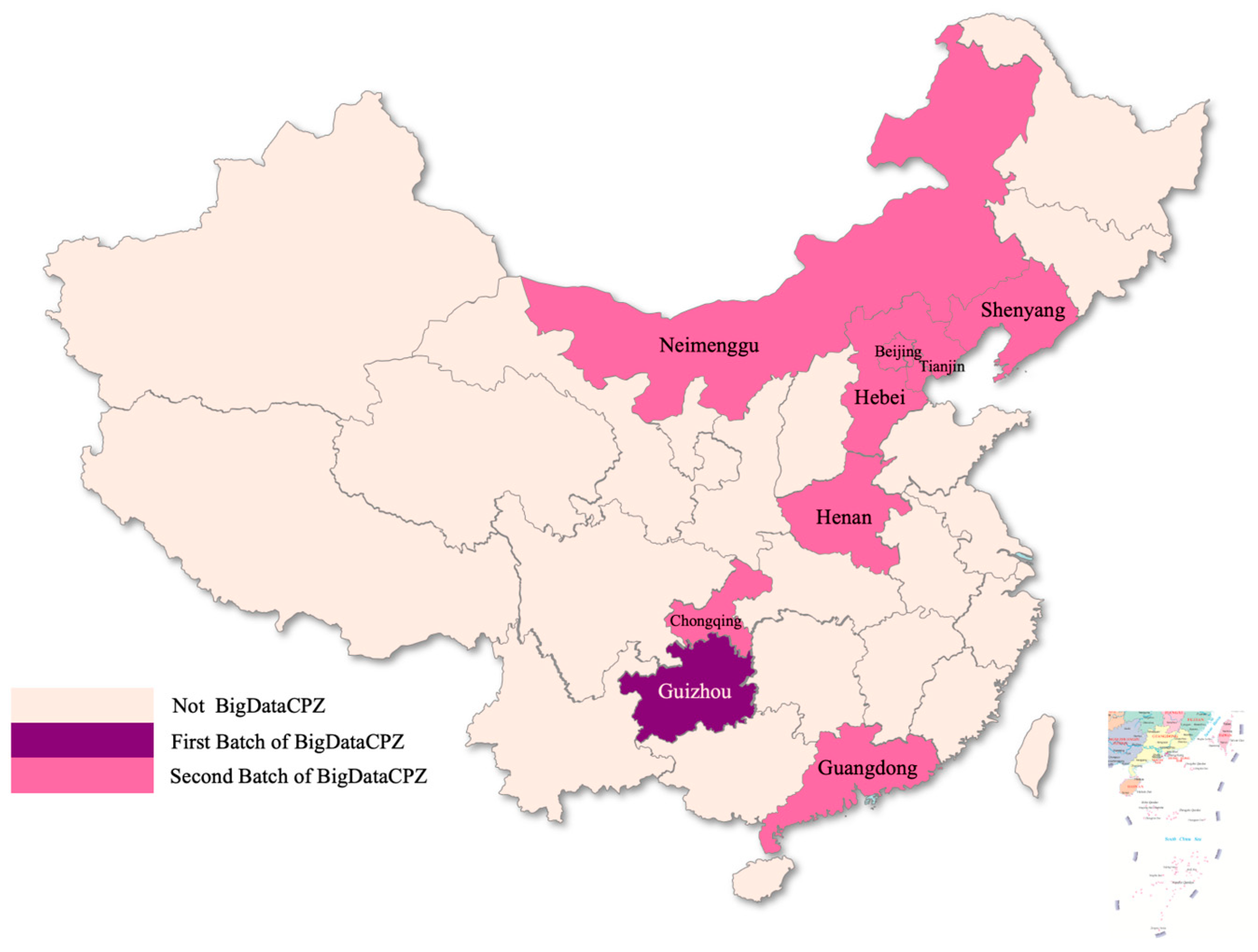
Guizhou launched China’s first Big Data Comprehensive Pilot Zone in 2015, followed by four regional zones in Shanghai, Henan, Chongqing, and Shenyang in 2016, plus two trans-regional zones in the Beijing-Tianjin-Hebei and Pearl River Delta regions and Inner Mongolia’s infrastructure development zone. The distribution of these eight national-level zones is shown in Figure 1, effectively covering the Southwest, East China, Central China, Northeast, and South China regions. During implementation, these zones focussed on data integration, sharing, and opening, promoting market-oriented reform of data factors and eliminating systemic obstacles to data circulation. They provided manufacturing enterprises with richer data resources through government-led and enterprise-participating mechanisms, optimized data sharing processes, and established regional data trading platforms that offer fair data access channels for enterprises of different scales.
The selection of Big Data CPZ as our empirical proxy for data factor marketisation is theoretically justified for several critical reasons. First, unlike fragmented data policies, pilot zones provide systematic institutional frameworks that address all of the key dimensions of data marketisation, from infrastructure to trading mechanisms. Second, they represent the most significant and measurable policy shock in China’s data marketisation process, creating clear temporal and geographical variations essential for causal identification. Third, pilot zone designation triggers coordinated policy interventions that directly influence enterprises’ data access and utilization capabilities. These concrete implementations demonstrate how Big Data CPZ serves as the most direct and observable embodiment of data factor marketisation policies, making it the ideal empirical setting for examining the causal effects on enterprise supply chain resilience.

3.2. Research Hypothesis

3.2.1. The Impact of Data Factor Marketisation on Supply Chain Resilience

A crucial aspect of bolstering a firm’s supply chain resilience lies in establishing, maintaining, and enhancing the interconnections among its constituent entities [60]. Drawing upon stakeholder theory [61,62], organizations are subject to scrutiny from various stakeholders, encompassing suppliers, customers, investors, and governing bodies, whose attitudes and actions exert a direct influence on the firm’s operational performance and prospective growth. Firstly, data factor marketisation augments a firm’s digital proficiency and transparency, thereby substantially elevating its position within supply chain relationships. Enterprises possessing sophisticated data application capabilities can attain prominence and sway in the market, facilitating the garnering of trust and collaboration from suppliers and customers [63]. Concurrently, investors and suppliers are increasingly attentive to a firm’s sustainable development capacity and digital transformation maturity, exhibiting a greater inclination to collaborate with organizations demonstrating robust data application skills and high information transparency [64]. Consequently, firms with advanced data factor marketisation attract a broader array of collaborating suppliers, diminish supplier concentration, and enhance corporate supply chain resilience.
Secondly, predicated on resource dependence theory [65,66], a firm’s competitive edge emanates from its possession of valuable, scarce, and inimitable resources. In the digital economic climate, data has ascended to the status of a novel strategic asset, with its value-generating potential becoming increasingly pronounced. Data factor marketisation empowers firms to procure, integrate, and leverage data assets more effectively, not only augmenting operational efficiency, but also conveying a salient signal to the market regarding the firm’s core competencies. This signalling mechanism aids investors and partners in mitigating the expenses associated with information acquisition and analysis, lessening information asymmetry [67], enabling firms to secure amplified financial backing and collaborative opportunities, thereby lessening reliance on particular clients or vendors and fortifying supply chain diversification and flexibility [68]. Furthermore, dynamic capabilities theory underscores that a firm’s competitive advantage in a fluid environment arises from its aptitude to perceive opportunities, capitalize upon them, and reconfigure resources [69]. Data factor marketisation furnishes firms with more comprehensive environmental awareness instruments and decision-support systems, enabling them to identify and address supply chain vulnerabilities with greater alacrity, and amplify supply chain adaptability and resilience.
Based on the aforementioned analysis, this paper puts forward the following hypothesis:
H1: 
Marketization of data elements can improve enterprise supply chain resilience.

3.2.2. Mechanisms of Data Factor Marketisation on Firms’ Supply Chain Resilience

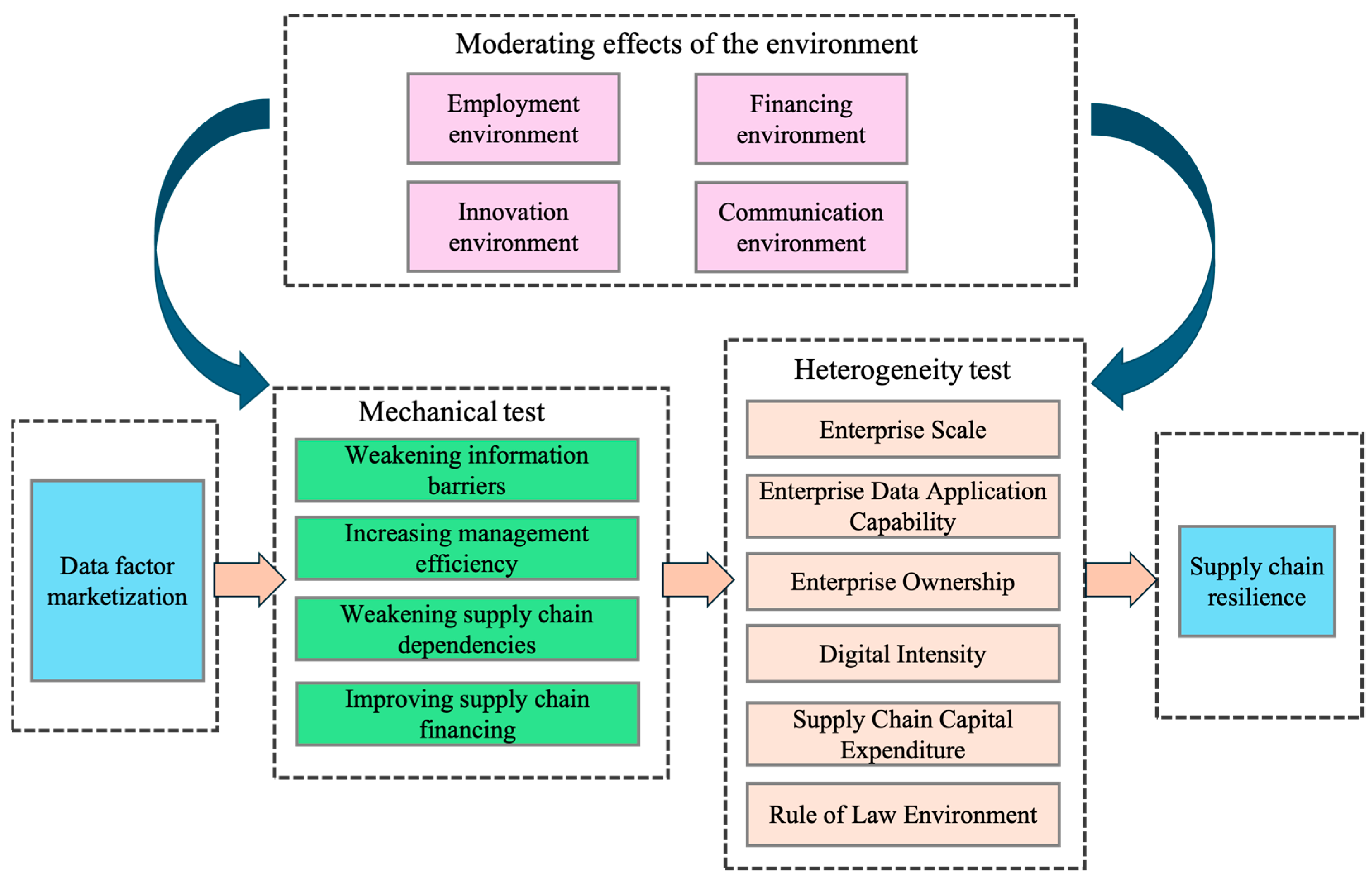
In order to explore the mechanisms of data factor marketisation on the resilience of corporate supply chains, this paper analyses four dimensions, discussed below.
First, data factor marketisation helps to weaken information barriers and improve information transparency, thereby enhancing supply chain resilience. As a new type of production factor, data factor is embodied as the comprehensive information processing capability that is ultimately formed by enterprises in the process of acquiring key information and development opportunities through digital transformation and data accumulation. The theory of information economics suggests that good information transparency can reduce transaction costs, obtain more accurate market information, and reduce dependence on specific information sources, thus enhancing supply chain resilience [70]. And the enterprise supply chain involves not only the physical flow of products, but also the efficient integration of information flow and capital flow. A good data factor market can enhance the ability of enterprises to obtain information on the supply chain, prompting them to attract high-quality partners and suppliers and then establish more stable information-sharing relationships, as well as obtain support in times of crisis, such as priority access to suppliers’ inventory information or changes in customer demand, so as to be able to resume operations more quickly in the face of risk, thus enhancing the overall supply chain resilience of the enterprise [71]. From the viewpoint of data acquisition, a good data factor market can create value for enterprises through information transparency and reduce the risk of supply chain information asymmetry; from the viewpoint of data processing, efficient data analysis can give enterprises an ‘information advantage’, protect enterprises to reduce decision-making delays when unfavourable events occur, and enhance their supply chain stability and supply chain resilience during a crisis. From the viewpoint of data processing, efficient data analysis can give enterprises an “information advantage,” protect them from adverse events, reduce decision-making delays, enhance their supply chain stability during crises, and improve their supply chain resilience. However, while the theoretical benefits of reducing information asymmetries are compelling, practical challenges exist. The quality and trustworthiness of marketized data are paramount; inaccurate or manipulated data can lead to erroneous decisions and undermine resilience. Furthermore, despite frameworks like “five rights separation” [36], the inherent complexity of data ownership and privacy concerns can still impede full data sharing, especially for highly sensitive proprietary information. Some firms might also lack the internal capabilities necessary to effectively process and utilize the vast amounts of data made available through marketization, as highlighted by Birkel and Wehrle (2024) regarding SMEs’ challenges in digital transformation [72]. Nevertheless, the overarching trend suggests that increased data accessibility and transparency, driven by data element marketization, fundamentally improves a manufacturing enterprise’s ability to sense and respond to disruptions, thereby bolstering its supply chain resilience.
Secondly, good marketisation of data elements can help improve the efficiency of enterprise management, reduce operating costs, and thus enhance the resilience of the supply chain. “Slow decision-making and low efficiency” has always been an important bottleneck restricting the development of Chinese enterprises. Among them, managers’ cognitive limitations and information processing ability are important factors affecting management efficiency. Before managers make operational decisions, they need to collect information from all aspects of the enterprise in order to reduce the uncertainty of decision-making and complete scientific decision-making [73]. Supply chain management requires efficient decision support to ensure the coordination and responsiveness of each link, and a good data element market will deliver more comprehensive information to management and improve the quality of corporate decision-making, which helps it to respond quickly when facing a crisis, thus positively affecting supply chain resilience. Resilience is not only reflected in the ability to respond to shocks, but also includes the ability to prevent potential risks [74]. Efficient management can enable enterprises to flexibly adjust resource allocation in the supply chain and quickly respond to market changes or supply disruptions, thus maintaining operational stability and enhancing the overall supply chain resilience. A good data element market can achieve more accurate demand forecasts and more scientific resource allocation for enterprises, and therefore can operate and manage with higher efficiency, thus enhancing the effectiveness of management [75]. This improved management efficiency provides stronger support for enterprises in dealing with supply chain risks. Firms with good data resources signal management sophistication upstream and downstream in the supply chain, which helps to increase potential partners’ confidence in their management capabilities [76]. In addition, the marketisation of good data elements can improve decision-making efficiency and alleviate the problem of decision-making difficulties caused by insufficient information, which can give enterprises a stronger ability to cope with the supply chain management challenges brought about by external environmental shocks and enhance supply chain resilience. However, some studies also point to potential challenges or nuances. While digital transformation generally improves performance, its impact can vary depending on organizational culture, leadership, and employee attitudes [77,78,79]. Bilal et al. (2024) identify competitive pressure, leadership role, organizational culture, and IT readiness as key antecedents influencing digital transformation and firm performance [80]. This suggests that simply having access to marketized data is not sufficient; firms must also possess the internal capabilities, leadership commitment, and a data-driven culture to effectively leverage it for management efficiency.
Third, a better data factor market environment helps to weaken firms’ supply chain dependence and diversify their sources of supply, which in turn improves supply chain resilience. A good data factor market indicates that firms excel in data collection, processing, and application, have strong supplier identification capabilities, and have management that are more aware of diversified supply and more willing to build a diversified supply network for the firm. Supply chain resilience emphasizes the ability to maintain supply stability in an uncertain environment [15]. Management with strong data analysis capabilities can develop more effective supplier management strategies, enhance the diversity of supply sources, optimize the supplier structure, as well as achieve diversified sourcing channels to ensure that the enterprise can quickly adjust and substitute when facing the risk of a single supplier, thus enhancing overall supply chain resilience. Being in a region with a better development environment for data elements, the government’s attitude towards data elements will also prompt management to adhere to a risk diversification orientation, avoiding the risks associated with over-reliance on a single supplier, thus enabling enterprises to demonstrate greater supply chain resilience. Modern portfolio theory suggests that diversification reduces systemic risk, and supplier diversification can similarly reduce supply chain risk [81]. And efficient data analysis capabilities can help enterprises identify more potential suppliers, optimize the supplier evaluation process, improve the scientific nature of supplier selection, and achieve a balance between the enterprise’s supply security and supply efficiency, thus enhancing supply chain resilience. However, mitigating supply chain reliance through data marketization is not without its complexities. While data can identify alternatives, the actual process of onboarding new suppliers, establishing relationships, and ensuring quality control remains a significant operational challenge. Butollo et al. (2024) caution against simplified perspectives on globalized versus intraregional production, noting that increased regionalization is only one of several strategies and is often driven by state policies for strategically important products, not production networks as a whole [82]. This suggests that while data provides the intelligence, strategic decisions and operational capabilities are still paramount. Moreover, the sheer volume of data available through marketization can be overwhelming, requiring sophisticated data analytics capabilities to extract meaningful insights and avoid “analysis paralysis.”
Fourth, a good market allocation of data elements can help improve the level of supply chain financing so that enterprises can obtain more financial support and then enhance the resilience of the supply chain. “Financing is difficult and expensive” has always been an important bottleneck restricting the development of Chinese enterprises [83]. Among them, enterprise credit assessment and risk identification are important factors affecting the financing constraints, and before financial institutions make lending decisions, they need to collect information on various aspects of enterprises to reduce information asymmetry and complete risk assessment [84]. Supply chain management requires stable financial support to ensure the liquidity and efficiency of each link, and a good data factor market will send positive signals to financial institutions to improve the credit assessment of enterprises, which will help them to obtain financing support when they are facing financial pressures, thus positively affecting supply chain resilience. A good data factor market configuration usually means that firms have strong capabilities in data management, information transparency, and digital governance, and are able to provide financial institutions with more reliable credit information, and are therefore able to access finance on more favourable terms, thus enhancing the availability of finance. This stability of funding provides businesses with stronger support in dealing with supply chain disruptions or other risks. Firms with good marketability of data elements send signals of good creditworthiness upstream and downstream of the supply chain, which helps to increase the confidence of potential partners in their financial stability. However, challenges remain in fully realizing the potential of data element marketization for supply chain financing. Data privacy and security concerns are paramount, as financial data is highly sensitive. Ensuring the integrity and confidentiality of marketized data is crucial to building trust among financial institutions and enterprises. Moreover, the valuation of data as an asset for collateral purposes is still an evolving field, requiring robust methodologies and legal frameworks. While the concept is promising, the practical implementation of data-backed financing requires significant regulatory clarity and technological maturity. Despite these hurdles, the marketization of data elements, especially when supported by the policy infrastructure of Big Data CPZ, holds substantial promise for revolutionizing supply chain financing by making capital more accessible, efficient, and responsive to the dynamic needs of manufacturing enterprises, thereby significantly bolstering their financial resilience.
Based on the above analyses, this paper proposes the following hypotheses:
H2: 
Data factor marketization improves firms’ supply chain resilience by weakening information barriers, increasing management efficiency, weakening supply chain dependencies, and improving supply chain financing.
Based on the above discussion and analysis, the collated research framework for this study is shown in Figure 2.

4. Research Design

4.1. Model Setting

This paper chooses the establishment of China’s Big Data Pilot Zone as a policy shock, and uses it as a proxy variable for data factor marketisation, and evaluates the results of the theoretical analysis of data factor marketisation and enterprise supply chain resilience by assessing the policy effects of the Big Data Pilot Zone. This paper constructs a double difference model for the benchmark regression test, and the specific model settings are as follows:
S C R i t = α + β B i g d a t a C P Z i t + X i t + Z r t + ζ r + δ i + μ t + ε i t r
where the explanatory variable S C R i t , denotes the supply chain resilience index of enterprise i in year t B i g d a t a C P Z i t is a double difference variable for Big Data Pilot Zones, which is the interaction term of the group dummy variable and the time dummy variable, and is used to identify whether or not the city that enterprise i belongs to is included in the comprehensive Big Data Pilot Zone in year t. The samples of enterprises that have become comprehensive Big Data Pilot Zones are set as the treatment group, and, for the samples in the treatment group, a value of 1 is assigned to the year of policy implementation and the following years, while a value of 0 is assigned to other samples; the samples of enterprises whose cities are not part of the comprehensive Big Data Pilot Zones are set as the control group, and a value of 0 is assigned to the sample of enterprises whose cities are not part of the comprehensive Big Data Pilot Zones. α is a constant term that reflects the baseline level of supply chain resilience for manufacturing enterprises when the influence of other independent variables is not considered. The coefficient of β of B i g d a t a C P Z i t is a key focus of the present study, and if the coefficient is significantly positive, then it suggests that the marketisation of data factors can indeed significantly enhance supply chain resilience. X i t is a firm-related control variable. Z r t is a city-related control variable. In addition, this paper controls for firm-fixed effects δ i , year-fixed effects μ t , and city-fixed effects ζ r . ε i t r is a random perturbation term.
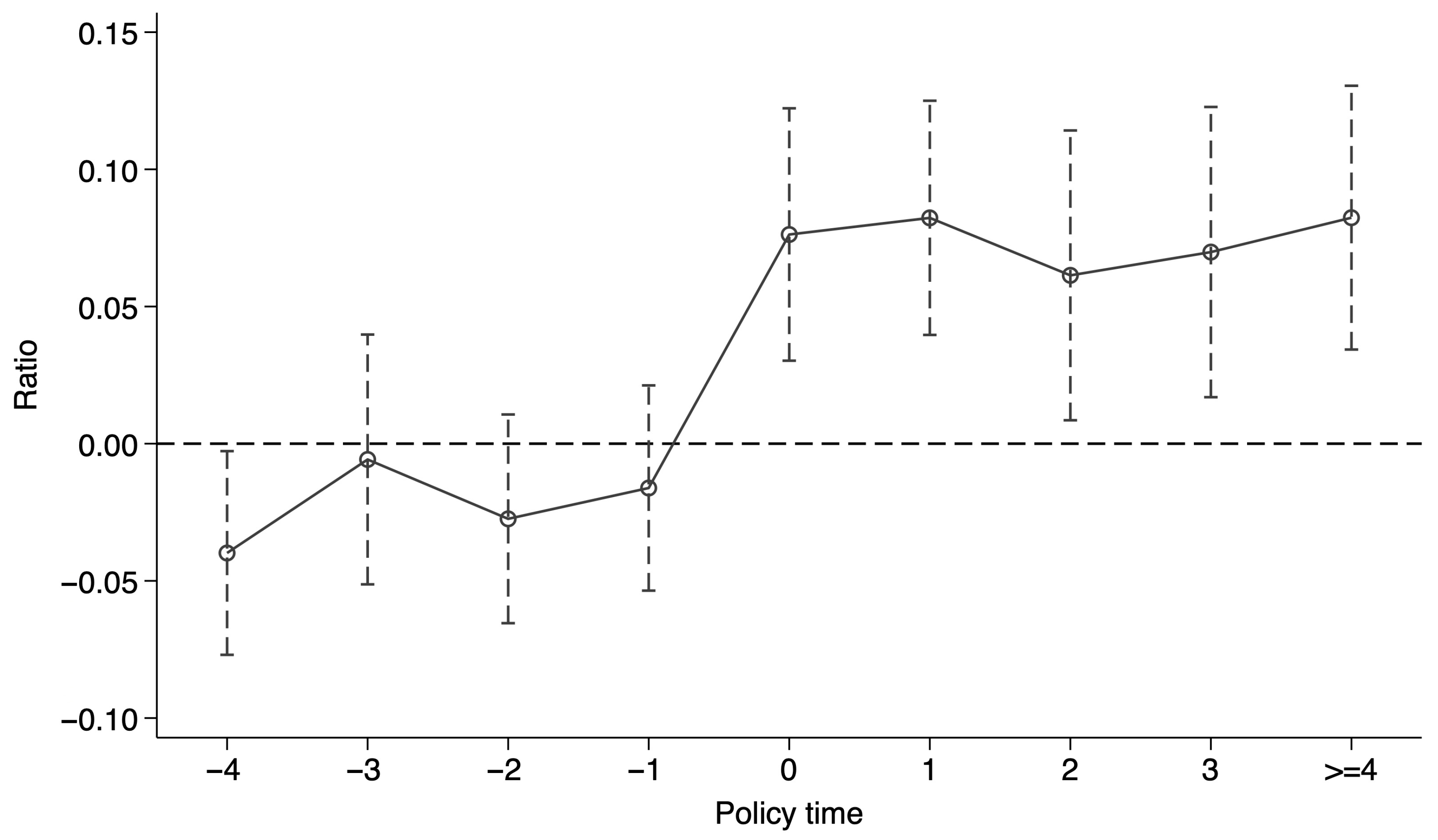
A necessary prerequisite for using the double-difference method for regression analysis and obtaining unbiased estimation results is that the supply chain resilience of manufacturing firms in pilot and non-pilot regions before the implementation of the Big Data Comprehensive Pilot Zone policy satisfies the parallel trend assumption. This paper draws on existing research [85] and uses the event study method to test for parallel trends. The specific model is set up as follows:
S C R i t = α + n = 4 β n Y e a r n × T r a e t r + X i t + Z r t + ζ r + δ i + μ t + ε i t r
where Y e a r n is a time dummy variable representing the number of years the sample is away from the establishment of the Big Data Pilot Zone, and n takes the value of 0 in the year of establishment. In order to facilitate the relevant operations, we use the negative number n to represent the n year before the establishment and use the positive number n to represent the n year after the establishment.

4.2. Variable Selection

4.2.1. Dependent Variable

This study focuses specifically on the industrial supply chains of manufacturing enterprises, which encompass the integrated network of suppliers, manufacturers, distributors, and customers involved in the production and delivery of manufactured goods. Industrial supply chains in manufacturing are characterized by complex interdependencies, multi-tier supplier relationships, and vulnerability to various disruptions, including natural disasters, geopolitical tensions, and market volatility. In this context, supply chain resilience is defined as the manufacturing enterprise’s comprehensive capability to anticipate, absorb, adapt to, and recover from supply chain disruptions while maintaining operational continuity and competitive performance. According to Martin’s theory of resilience in the field of economics, supply chain resilience can be understood as not only the ability to resist external risk shocks, but also the ability to quickly adapt and recover in an uncertain environment [86]. Building on this foundation, supply chain resilience in manufacturing specifically refers to the supply chain’s ability to cope with risks—that is, the capacity to maintain chain stability when suffering from unfavourable external shocks, while dynamically adjusting network structures and operation modes to orderly recover to pre-shock states and further develop and evolve to achieve chain upgrading.
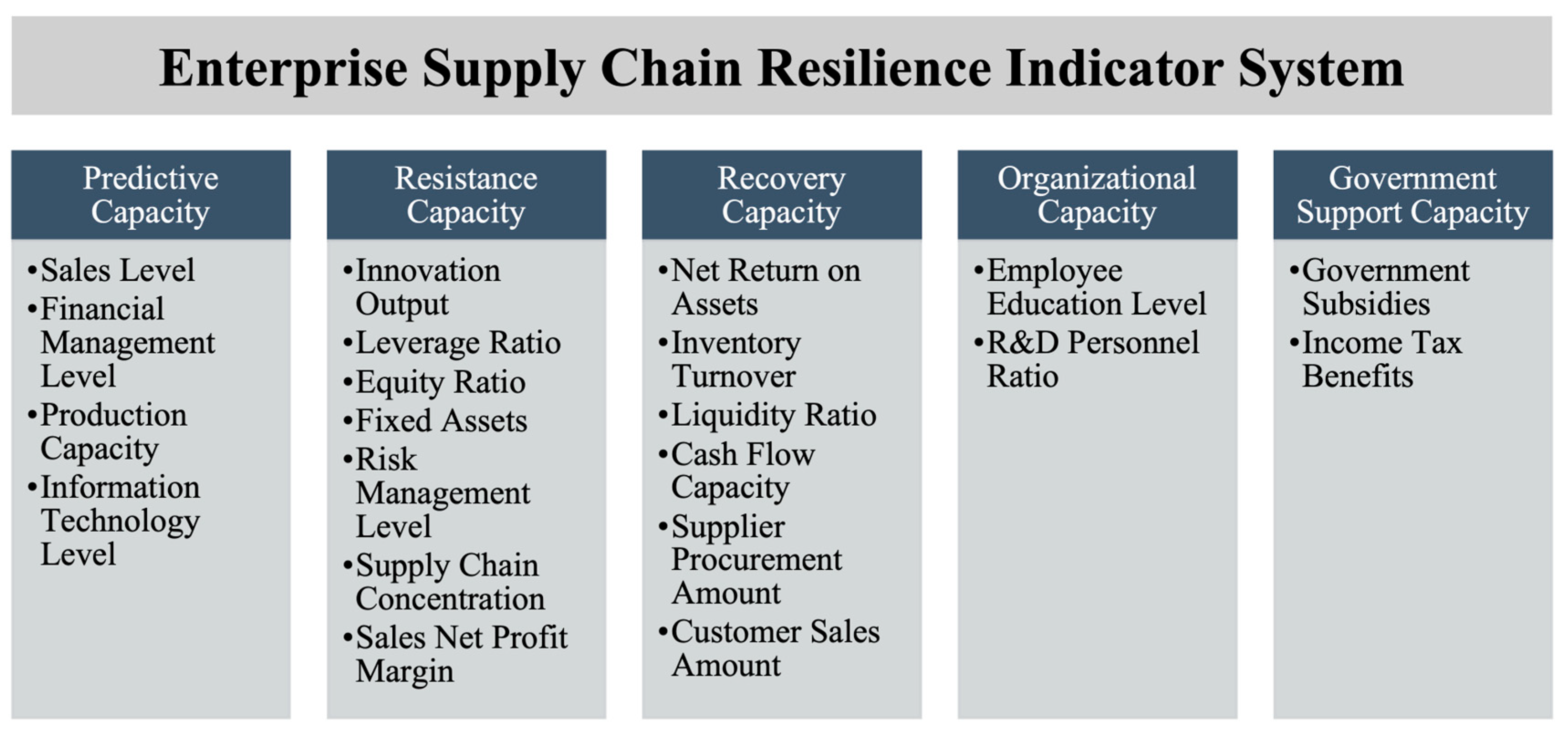
At this stage, academics have not reached a consensus on the measurement of supply chain resilience. Some scholars measure it from four aspects of risk aversion and supply chain structure [87]. Some scholars also decompose supply chain resilience into multiple dimensional indicators, such as supply chain prediction ability, recovery ability, and resilience ability, and then measure them [58,88,89,90]. To address this measurement challenge and provide a comprehensive assessment framework, this paper constructs a supply chain resilience evaluation index system for manufacturing enterprises from five theoretically grounded dimensions: prediction ability, resilience ability, recovery ability, organizational ability, and government support power, as shown in Figure 3. This five-dimensional framework is specifically designed to capture the multifaceted nature of supply chain resilience in manufacturing contexts:
(1)
Prediction ability reflects the enterprise’s capacity for risk anticipation, early warning systems, and proactive supply chain planning;
(2)
Resilience ability measures the supply chain’s inherent robustness and capacity to withstand external shocks without significant disruption;
(3)
Recovery ability captures the speed, effectiveness, and completeness of post-disruption restoration to normal operations;
(4)
Organizational ability represents the human capital, management capabilities, and institutional knowledge supporting supply chain operations;
(5)
Government support acknowledges the institutional environment’s role in enabling supply chain stability through policy support and regulatory frameworks.
At the same time, considering that there may be correlations between indicators that lead to data overlap at the information level, this paper uses the CRITIC-TOPSIS model to measure supply chain resilience in order to alleviate the measurement bias caused by the conflict of correlations [91]. The indicator system constructed in this paper and the calculation method are shown in Table 1.
Adaptive capacity is the foundation of supply chain resilience and measures the solidity and responsiveness of an enterprise’s supply chain when it is hit by external shocks, mainly including solidity and supply chain visibility. Solidity refers to the ability of the supply chain system to maintain stable operations in a dynamically changing environment through the three-in-one safeguard mechanism of adaptive adjustment of operation status, maintenance of structural soundness, and liquidity management when the enterprise faces a crisis; therefore, this paper selects the level of sales, efficiency of capital management, production capacity, and the level of informationization to measure the adaptive capacity.
Resilience refers to the stability of the supply chain in the face of external shocks. Strong intangible assets, such as brands and patented technologies, can improve a firm’s market position and competitive advantage. In addition, the comprehensive ability of the enterprise in terms of sales, management, and capital is also an important manifestation of resistance capacity. Therefore, this paper selects innovation output, equity multiplier, equity ratio, fixed assets, risk-taking level, supply chain concentration, and net sales profit margin to measure resistance capacity.
Supply chain resilience refers to the ability of a supply chain to recover after an impact [92]. On the one hand, a stable financial situation allows for companies to quickly adjust funds to deal with emergencies. On the other hand, only if companies have strong supply chain management capabilities can they ensure that production continues without being affected by interruptions in raw material supply. Therefore, this paper selects indicators such as return on net assets, inventory turnover, current ratio, self-hematopoietic capacity, supplier procurement, and customer sales to measure supply chain resilience.
Organizational capabilities refer to the quality and capabilities of personnel in the supply chain. This is not only an important resource for enterprises to gain competitive advantages in response to market competition, but also a key factor for enterprises to maintain the stability of supply chain partnerships. Therefore, this paper selects the proportion of personnel with bachelor’s degrees or above and the proportion of R&D personnel to measure organizational capabilities [93].
Government support refers to the impact of policies and regulations on the supply chain in the external environment. Taking into account the two aspects of support and supervision, and based on the availability of data, this paper selects government subsidies and income tax payable to measure government support. Government subsidies can most directly reflect the government’s support for enterprises, while income tax payable represents the government’s supervision of the market.

4.2.2. Independent Variable

The core explanatory variable of this study is data factor marketisation, B i g d a t a C P Z . Its specific setting consists of T r e a t and P o s t , where T r e a t represents the dummy variable of whether the city where the manufacturing enterprise is located belongs to the eight Big Data Pilot Zones, taking the value of 1 if it does and 0 otherwise, and P o s t is the dummy variable of whether the sample enterprise is in the pre- or post-implementation of the Big Data Pilot Zone policy in the year t, and takes the value of 1 if it is in the year 2016 or later and 0 otherwise.

4.2.3. Control Variables

The control variables selected for this study are divided into two levels: firm and city. Among them, the selection of variables at the enterprise level and its rationale are shown in Table 2.
The measurement of each variable is shown in Table 3.

4.3. Data Sources and Description

Considering the availability of data, the sample interval of this paper is set as 2003–2023. The sample data selected in this paper are mainly divided into two types of data: enterprise characteristics and city characteristics. The basic information and financial data of Chinese A-share listed companies in the manufacturing industry are obtained from the CSMAR database. Chinese A-share listed companies represent the main board stocks traded on the Shanghai and Shenzhen Stock Exchanges and are subject to strict regulatory disclosure requirements, ensuring data reliability and comparability for our empirical analysis. The data related to city characteristics are mainly from the China Statistical Yearbook of past years, the State Information Centre, the National Bureau of Statistics, and other authoritative departments. Since the price index and the industry classification of listed companies are not exactly the same, in order to improve the accuracy and completeness of the sample matching, this paper unifies the industry classification standards in accordance with the National Economy Industry Classification and Code (GB/4754 I 2017) [108]. On this basis, this paper matches the above data and, with reference to practices in the existing literature [109], treats the initial samples as follows: (1) excludes ST, *ST, PT, and insolvent samples; (2) excludes the samples with missing relevant variables; and (3) applies a bilateral 1 percent shrinkage to the continuous-type variables.

4.4. Descriptive Statistics

Table 4 demonstrates the descriptive statistics of the main research variables in this study. The coefficient of whether the city where the enterprise is located belongs to one of the eight comprehensive Big Data Pilot Zones has a maximum of 1, a minimum of 0, and a mean of 0.2317, which indicates that enterprises in comprehensive Big Data Pilot Zones are still a minority, given the large volume of all listed Chinese enterprises. Moreover, in addition, under the comprehensive index calculation method of enterprise supply chain resilience constructed in this study, the maximum value of SCR, a variable representing enterprise supply chain resilience, is 2.6668, the minimum value is 0.7717, and the standard deviation is 0.2706. This indicates that there is still a significant gap in supply chain resilience among listed enterprises in the manufacturing industry.

4.5. Description of Characteristic Facts

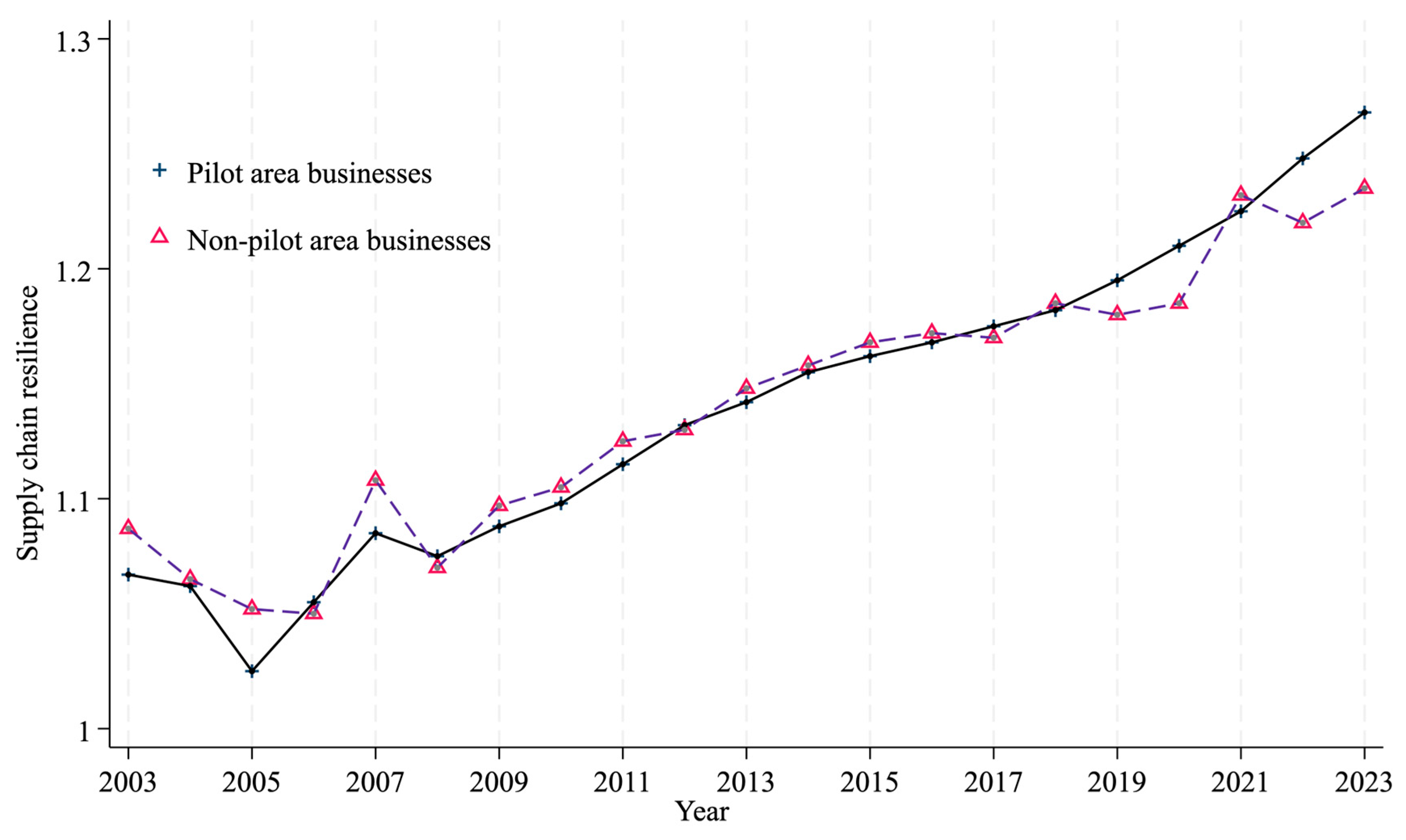
In this paper, based on whether the location of the enterprise belongs to the city of the National Big Data Comprehensive Pilot Area, the sample is divided into two groups, pilot area and non-pilot area, and a year-by-year mean value graph is drawn to visualize the evolutionary trajectory of supply chain resilience. As shown in Figure 4, the supply chain toughness of manufacturing enterprises in both pilot and non-pilot regions shows a dynamic trend throughout the sample period. Before 2016, the supply chain toughness of enterprises in pilot regions was lower than that of non-pilot regions in most years, and the trend of change between the two was basically the same. However, after 2016, the supply chain resilience of enterprises in the pilot regions significantly increased and surpassed that of the non-pilot regions, creating an obvious policy differentiation effect. This characteristic fact suggests that the deep implementation of the data factor market allocation policy has a significant impact on the evolutionary trajectory of enterprise supply chain resilience. This not only highlights the key role of data factor policies in supply chain structure optimization, but also further suggests that it is necessary to analyze the supply chain effects of market-based allocation of data factors from a dynamic evolutionary perspective. At the same time, the fact provides preliminary empirical support for the theoretical inference of this paper on data factor-enabled supply chain resilience enhancement.
At the same time, the fact provides preliminary empirical support for the theoretical inference of this paper on data factor-enabled supply chain resilience enhancement. Notably, in 2021, the supply chain resilience of non-pilot regions briefly exceeds that of pilot regions. This temporary reversal can be attributed to the heterogeneous impact of the COVID-19 pandemic and the differentiated recovery patterns across regions. Pilot regions, which typically have higher industrial concentration and more complex supply chain networks, may have experienced more severe disruptions during the pandemic, leading to a temporary decline in resilience metrics. Additionally, non-pilot regions may have benefited from supply chain diversification strategies and alternative sourcing arrangements during this period. However, by 2022–2023, pilot regions resumed their leading position, suggesting that the long-term benefits of big data policies continue to enhance supply chain resilience despite short-term fluctuations.

5. Results of Empirical Analyses

5.1. Benchmark Regression Results

Table 5 reports the results of the assessment of the impact of data factor marketisation on the supply chain resilience of manufacturing firms. The model in column (2) controls for firm-fixed effects and year-fixed effects, while columns (3) and (4) progressively incorporate inter-firm-level control variables and city-level control variables. The regression results show that the regression coefficients of the core explanatory variable Big Data CPZ are all significantly positive, indicating that data factor marketisation has a significant role in promoting supply chain resilience in manufacturing firms. The model in column (5) controls for city-fixed effects, and the results show that the regression coefficients of Big Data CPZ are still significantly positive at the 1% level. The above results indicate that by gradually incorporating different levels of fixed effects and control variables in the baseline regression model, the enhancing effect of data factor marketisation on corporate supply chain resilience has not changed. From the perspective of economic significance, the regression coefficient value of Big Data CPZ is 0.1966 in column (5), for example, implying that, all other things being equal, the supply chain resilience of manufacturing firms in the reform pilot region is improved on average by 0.1966, compared to that of the region that has not carried out reform of Big Data CPZ. To sum up, the marketisation of data factors significantly improves manufacturing firms’ supply chain toughness.

5.2. Parallel Trend Test

When applying the multiple-time-point double-difference model, the core assumption is that the trends of change in the treatment group and the control group should remain consistent before the policy is implemented, i.e., “the parallel trend assumption is satisfied.” This section uses the parallel trend test model Equation (2) constructed in Section 4.1 model setting to perform a parallel trend test. This article regards the four years before the establishment of the Big Data Pilot Zone as the reference period and uniformly classifies the period of 4 years or more established as the fourth period. Figure 5 presents the regression coefficients of the core explanatory variables Y e a r n × T r a e t r and their 95% confidence intervals. It can be seen from the figure that, in most years before the implementation of the policy in the Big Data Pilot Zone, the regression coefficient was not significant. This means that there is no significant difference in the temporal development trend of supply chain resilience of manufacturing enterprises in pilot and non-pilot areas during this period. This situation verified the study’s parallel trend assumption. Further analysis shows that in the period when the Big Data Pilot Zone was established and in many subsequent years, the regression coefficient shows significant positive values. This shows that the Big Data Pilot Zone has a long-term and dynamic impact on improving the resilience of manufacturing companies’ supply chains.

5.3. Robustness Check

5.3.1. PSM—DID

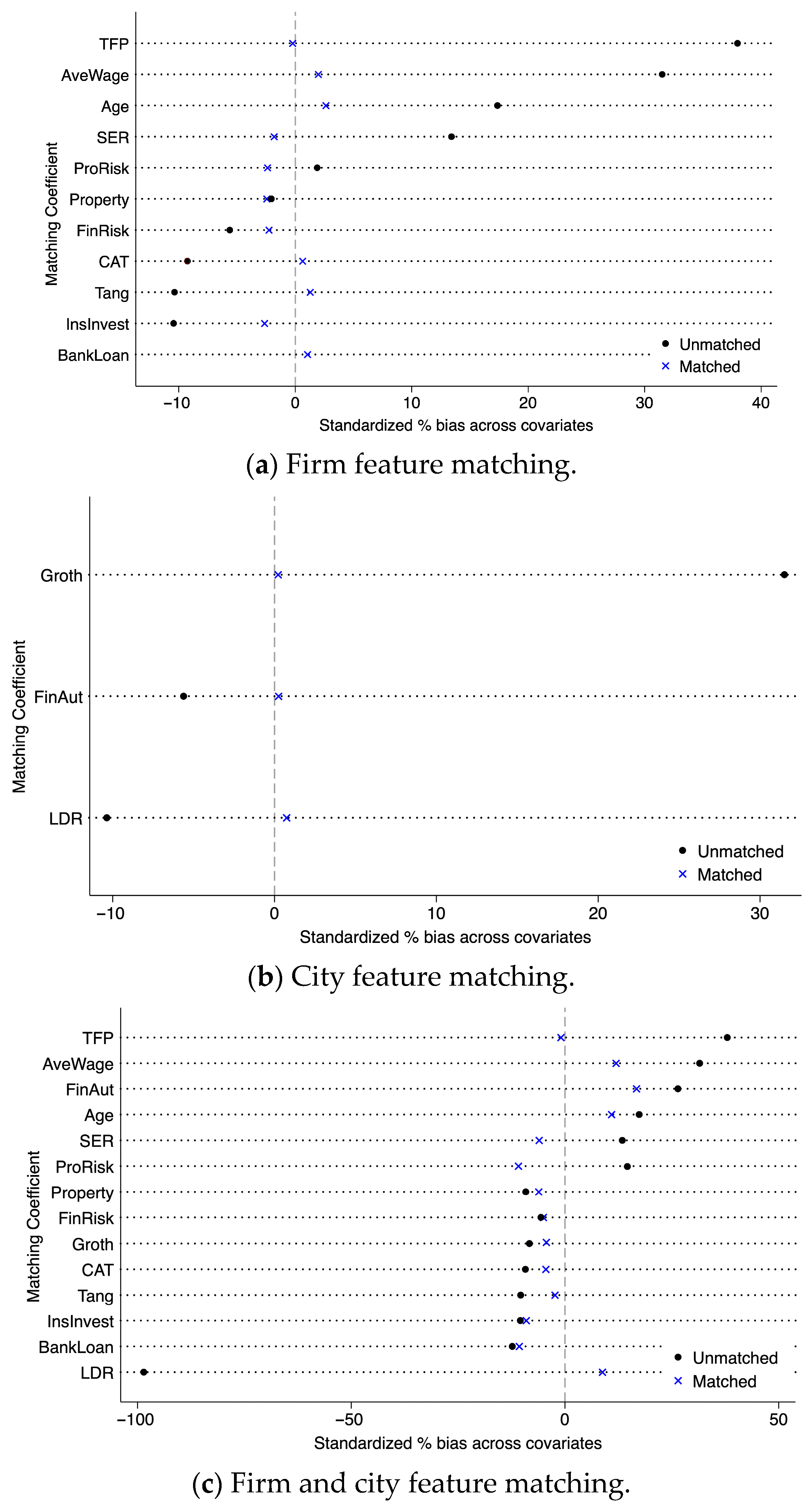
To further mitigate the endogeneity problem caused by sample selection error, this study uses propensity score matching to carry out a robustness test. This study uses the nearest-neighbour matching method with the control variables as covariates. Three matching methods, namely enterprise characteristics matching, city characteristics matching, and dual-matching of enterprise characteristics and city characteristics, are adopted to carry out the robustness test of PSM-DID. The balance test of the three matching methods is shown in Figure 6. As can be seen from the figure, the %bias of all covariates is less than 10%, regardless of the matching method. All covariates are smaller than the %bias before matching, except for the covariate Property in the matching of firm characteristics. This shows that the data matching has good balance. The regression results in Table 6 show that the data for Big Data CPZ remains significantly positive at the 1% level after controlling for possible in-production problems in all three matching methods. This suggests that, after PSM matching, data factor marketisation presents a positive facilitating effect on the supply chain resilience of manufacturing firms in all cases, and Hypothesis 1 is further validated.

5.3.2. Placebo Test

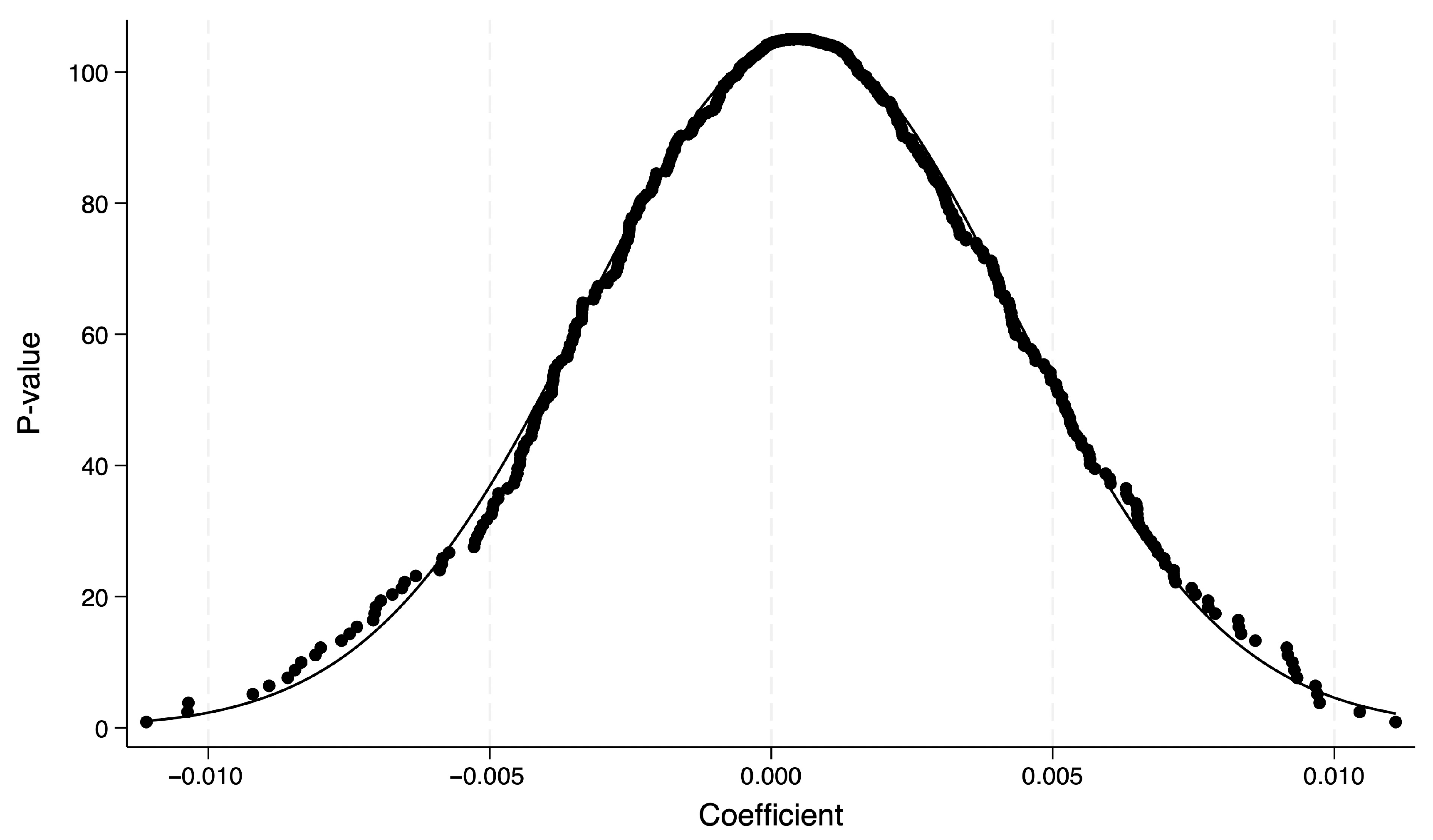
Considering that the impact of the Big Data Comprehensive Pilot Zone policy on the supply chain resilience of manufacturing firms may come from other unobservable factors, a placebo test was conducted by randomly upsetting the independent variable Big Data CPZ and then regressing it again after repeating this experimental procedure 1000 times. Figure 7 demonstrates the distribution of the regression coefficients of the Big Data Comprehensive Pilot Zone Policy Pilot on the supply chain resilience of manufacturing firms obtained after 1000 re-regressions. The pseudo-regression coefficient between the resilience of the enterprise supply chain and the pilot in the Big Data Comprehensive Pilot Zone basically fluctuates around the zero value, showing the characteristics of a normal distribution, and most of them are not significant below the significance level of 10%. This suggests that the regression results of data factor marketisation on enterprise supply chain resilience have not been obtained by chance, and that the conclusions in the benchmark regression above have good robustness.

5.3.3. Excluding the Influence of Market Factors

The establishment of Big Data Pilot Zones is often closely related to the degree of regional marketisation, and regions with higher levels of marketisation may be more likely to qualify for the pilot zones, while the degree of marketisation itself also affects the supply chain resilience of firms [110]. In order to ensure the robustness of the benchmark regression results in this paper and to avoid omitted variable bias, it is necessary to exclude the potential interference of regional marketisation factors on the research findings.
In addressing this methodological challenge, we extensively searched for appropriate proxy variables to measure regional marketization levels in the Chinese context. After a comprehensive evaluation of the available alternatives, we selected the marketization index as our primary measure. This indicator measures the level of marketization in a region. The marketization index compiled by Fan Gang et al. comprehensively reflects the relationship between the government and market, the development of the non-state-owned economy, the degree of product market development, the degree of factor market development, and the degree of financial marketization, as well as the development of market intermediary organizations and the rule of law environment. It possesses strong comprehensiveness and representativeness; therefore, this paper uses the China Marketization Index constructed by Fan Gang et al. to measure the degree of marketization. The larger the value of this indicator, the higher the degree of marketization. This index represents the most authoritative and widely accepted measure of regional marketization in China, having been extensively validated in academic research and policy analysis [111,112]. While we considered alternative proxies for market development, none possessed the comprehensive coverage, temporal consistency, and institutional relevance of the Fan Gang index for our research context.
In order to verify whether the results are robust, this paper uses the marketization index (MI) as a substitute variable for the degree of regional marketization. After incorporating the MI into the regression model, the results are as shown in column (1) of Table 7. The results show that, after controlling for factors related to regional marketization, the construction of Big Data Pilot Zones has a significantly positive effect on promoting the resilience of enterprise supply chains, and the size of the regression coefficient is basically consistent with the significance level and the benchmark regression results. This result can show that the positive impact of market-based data element allocation on the resilience of enterprise supply chains is not driven by differences in regional marketization degree.

5.3.4. Excluding Competing Policies

China has enacted a number of pilot policies on digital technology development and digital transformation, which may interact with the Big Data Pilot Zone policy to potentially bias the findings of this paper. Specifically, the ‘Notice on Carrying Out National Smart City Pilot Work’ and the ‘Interim Management Measures for National Smart City Pilots’, officially issued on 5 December 2012, the ‘Broadband China Strategy and Implementation Plan’ issued by the State Council in 2013, and the ‘Promoting the Development of Digital Technology and Digital Transformation in China’, issued in 2015, could potentially bias the findings of this paper. ‘The Action Programme for Promoting the Development of Big Data‘, issued in 2015, and the ‘Guiding Opinions on Actively Promoting Supply Chain Innovation and Application’, issued in 2017, may have an impact on the resilience of corporate supply chains. To ensure the accuracy and robustness of the research findings, it is necessary to exclude the interference of these competing policies.
Several methodological approaches exist to address potential bias from competing policies, including event study methodology, synthetic control methods, and triple-difference estimation. However, this study employs policy dummy variables as the primary approach for controlling competing policy effects. This methodological choice is justified on several grounds. First, the dummy variable approach maintains consistency with our baseline difference-in-differences specification, preserving the quasi-experimental identification strategy while incorporating additional controls. Second, given the overlapping nature of policy implementation in China’s institutional environment, dummy variables provide a parsimonious method to account for multiple concurrent interventions without introducing excessive model complexity. Third, this approach ensures the interpretability of coefficients and facilitates direct comparison with baseline results, which are essential for robustness assessment. While alternative methods offer certain analytical advantages, the dummy variable specification optimally balances methodological rigour with empirical tractability in the context of our research design.
The impact of relevant pilot policies on the regression results is controlled by introducing policy dummy variables. The regression results are shown in columns (2)–(5) of Table 7. The regression results show that after the four competitive policies are added to the benchmark model to control for each of them, the regression results of the core explanatory variable Big Data CPZ are still significantly positive, indicating that the relevant competitive policies do not have a significant impact on the results of the study, which further strengthens the robustness of the benchmark regression results of this study.

5.3.5. Adjustment Sample Time

Enterprise supply chain resilience is vulnerable to major external shock events, of which the 2008 global financial crisis and the 2020 New Crown epidemic are two important events that have had a profound impact on global supply chains in recent years. The 2008 financial crisis led to a contraction in global trade and supply chain disruptions, and enterprises were forced to revisit and adjust their supply chain strategies [2]. The 2020 New Crown epidemic further exposed supply chain vulnerabilities and pushed companies to accelerate digital transformation to enhance supply chain resilience [113]. These two major events may have interfered with the results of the benchmark regression in this study, affecting the accuracy of the identification of the market-based allocation effect of data elements. To ensure the robustness of this study’s findings, it is necessary to test the consistency of the core findings across time by changing the sampled time windows.
This paper sets four different sample time windows for robustness testing, each with its own specific considerations: first, the 2010–2023 sample window, which excludes the direct impact of the 2008 financial crisis, covers the complete cycle before and after the epidemic, and tests the stability of policy effects in the post-crisis era; second, the 2003–2020 sample window, which covers the period before and after the financial crisis, but excludes the impact of the epidemic, to test the performance of the policy effects when the financial crisis is included; third, the 2010–2020 sample window, which excludes the two major external shocks of the financial crisis and the epidemic at the same time, and builds a relatively stable economic environment, to test the “pure” impact of the policy effects; and fourth, the 2008–2022 sample window, which covers the financial crisis outbreak to the recovery from the epidemic to test the stability of the policy effects in the post-crisis era. Fourth, the sample window of 2008–2022, covering the period from the outbreak of the financial crisis to the recovery period after the epidemic, to test the robustness of the policy effects over the full cycle including major external shocks. The regression results are shown in Table 8. From the regression results, it can be seen that the size of the regression coefficients remains significantly positive after changing the sample time, although there is a slight fluctuation in the size of the regression coefficients, which further validates the robustness of the results of this study.

6. Mechanical Testing

6.1. Information Barrier Weakening Mechanism

The core of supply chain resilience lies in an enterprise’s ability to quickly identify, accurately warn, and effectively respond to supply chain risks, and the realization of these abilities largely relies on the full flow and effective integration of information in all links of the supply chain [114]. The existence of information barriers prevents companies from grasping key information such as upstream and downstream suppliers, customer needs, and market changes in a timely manner, which makes it difficult for companies to accurately assess supply chain risks and formulate effective response strategies, which in turn weakens the resilience of the supply chain. The essence of market-oriented allocation of data elements is to break down data islands to promote data flow and sharing among different entities. The most direct effect is to reduce information acquisition costs, improve information transmission efficiency, and reduce information asymmetry, which weakens market information barriers. Choosing to weaken information barriers is a key mechanism to connect the market-oriented allocation of data elements and the resilience of enterprise supply chains. The deviation between supply and demand fluctuations is used to measure the speed at which an enterprise’s production side matches the demand side, and its level reflects the degree of information friction faced by an enterprise at the market and supply chain levels [115,116]. This study uses supply–demand volatility deviation (Sdvd) as a substitute variable for market information barriers. Sdvd is measured as the coefficient of variation in the quarterly revenue growth rate over the past three years, calculated as the standard deviation divided by the mean of revenue growth rates. The mechanism test results can be seen in Table 9. The data in column (2) shows that the regression coefficient of the Big Data Comprehensive Experimental Area is significantly negative, which indicates that the marketization of data elements can weaken market information barriers. The data in column (3) shows that the regression coefficient of market information barriers is significantly negative, and the regression coefficient of the Big Data Comprehensive Test Area is significantly positive, but its absolute value decreases compared with the data in column (1). The above results show that the marketization of data elements has a positive impact on supply chain resilience by weakening market information barriers.

6.2. Management Efficiency Enhancement Mechanism

The construction and maintenance of supply chain resilience requires enterprises to have efficient internal management capabilities, which can quickly deploy resources, optimize process configuration, and coordinate the responses of various departments to cope with the unexpected risks and uncertainty impacts of the supply chain [117]. Inefficient management will lead to a slow response, waste of resources, and poor decision-making when facing a supply chain crisis, which will seriously weaken the supply chain’s anti-risk ability and recovery ability. The market-based allocation of data elements can provide enterprises with highly accurate and high-value massive information, empowering the optimization of production processes, automation of quality control, refinement of inventory management, and scientific decision-making in a data-driven manner, thus significantly improving the management efficiency of enterprises and reducing internal control costs. The improvement of management efficiency enables enterprises to respond more agilely to supply chain changes, allocate supply chain resources more accurately, and prevent and resolve supply chain risks more effectively [118]. Therefore, management efficiency improvement is chosen as an important mechanism to connect the market-based allocation of data elements and the resilience of the enterprise supply chain. The improvement of management efficiency is mainly reflected in the reduction in management and control costs, which means that enterprises can use the data generated during operations to optimize management processes, improve resource allocation efficiency, and reduce unnecessary management expenses. In this paper, the proportion of management expenses to operating income (ManCost1) and the proportion of management expenses to total assets (ManCost2) are used as substitute variables for enterprise management control costs. ManCost1 is calculated as management expenses divided by operating income, while ManCost2 is measured as management expenses divided by total assets, both representing the relative burden of management control activities. The lower the management control costs, the higher the management efficiency. The results of the mechanism test are as shown in Table 10. The regression results in columns (2) and (3) show that the regression coefficients of variables in the Big Data Comprehensive Test Area are significantly negative, which indicates that the marketization of data elements can effectively improve the management efficiency of enterprises. Column (4) shows that the regression coefficient of enterprise control costs is significantly negative, while the regression coefficient of the Big Data Comprehensive Test Area is significantly positive, but the absolute value is lower than the benchmark regression. The above results show that the marketization of data elements actively affects the resilience of supply chains by improving enterprise management efficiency, thereby improving the overall risk resistance of the supply chain.

6.3. Weakening the Supply Chain Dependence Mechanism

From the perspective of industrial economics, supply chain dependence is essentially the result of suboptimal choices made by firms under the constraints of incomplete information and search costs. According to transaction cost theory, when facing high supplier search costs, firms tend to establish long-term relationships with a few known suppliers, creating a pattern of supply chain concentration. Although this centralisation reduces short-term transaction costs, it significantly increases systemic risk exposure and weakens supply chain shock resistance [119]. The market-based allocation of data elements can significantly reduce the supplier search cost and information acquisition cost of enterprises, expand the searchable set of potential suppliers, and improve the matching efficiency of supply and demand through the construction of a unified information sharing platform. This process essentially reconfigures the information structure of the traditional supply chain through economies of scale and network effects of data elements, enabling enterprises to obtain more diversified supplier choices at lower costs and break the original supply chain dependence pattern. From the perspective of risk dispersion, supply chain diversification can effectively reduce the concentration risk, and when a supply chain node has a problem, enterprises can quickly start alternative solutions to maintain supply chain continuity. In this paper, supply chain concentration is used to measure the enterprise’s supply chain dependence (SupplyDep). SupplyDep is measured using the Herfindahl–Hirschman Index (HHI) of supplier concentration, calculated as the sum of squared market shares of the top five suppliers relative to total procurement value. The mechanism test results are shown in Table 11. The data in column (2) shows that the regression coefficient of the Big Data Comprehensive Experimental Area is obviously negative, which indicates that the marketization of data elements can effectively reduce the dependence of enterprises on the supply chain. The situation in column (3) shows that the regression coefficient of supply chain dependence is significantly negative, while the regression coefficient of the Big Data Comprehensive Test Area is significantly positive, and the absolute value of the coefficient is lower than the benchmark regression. These results show that the marketization of data elements achieves the purpose of reducing supply chain dependence by reducing search costs and matching costs, and, at the same time, enhances the buffering ability of enterprises to respond to supply chain shocks, which in turn has a positive impact on the resilience of the enterprise’s supply chain.

6.4. Improvement of Supply Chain Financing Level Mechanism

Supply chain financing is an important financial guarantee mechanism for enterprises to maintain the stability and resilience of the supply chain. The core of supply chain financing lies in the use of real trade relations and information flow between upstream and downstream enterprises in the supply chain, as well as the effective allocation of funds through commercial credit and accounts payable [94]. By building a transparent information sharing mechanism, market-based allocation of data elements can significantly alleviate information asymmetry problems in supply chain finance and enhance trust and willingness to cooperate among supply chain partners. This paper uses accounts’ payable indicators to measure an enterprise’s commercial credit financing level, which is the enterprise’s supply chain financing (SCF). SCF is measured as the ratio of accounts payable to total assets, reflecting the extent to which enterprises utilize supplier credit as a financing source within their supply chain operations. The mechanism’s test results are as shown in Table 12. Column (2) shows that the regression coefficient of the Big Data Comprehensive Test Area is significantly positive, which indicates that the marketization of data elements can significantly improve the supply chain financing level of enterprises. Column (3) shows that the regression coefficient of supply chain financing is significantly positive and that the regression coefficient of the Big Data Comprehensive Experimental Area is also significantly positive, but also that its absolute value decreases compared with the benchmark regression. Taken together, the marketization of data elements has a positive impact on the resilience of enterprises’ supply chains by improving an enterprise’s ability to obtain supply chain financing, ultimately improving the overall resilience of the supply chain.

7. Heterogeneity Analysis

7.1. Heterogeneity of Enterprise Property Rights

The nature of the property rights of enterprises determines their fundamental differences in resource allocation, decision-making mechanisms, and market behaviours, which in turn affects their modes of constructing supply chain resilience and the degree of response to the marketisation of data elements. State-owned enterprises (SOEs) may have a certain advantage in public data access and can more easily obtain data resources from government departments and public organizations, and, at the same time, due to their natural connection with the government, tend to be able to obtain more policy support and resource protection when responding to supply chain risks [120]. In contrast, non-state-owned enterprises mainly rely on market-based means to obtain data, such as data trading, cooperation and sharing, Internet platform data, etc., and the construction of their supply chain resilience relies more on market mechanisms and their own capabilities. Compared to state-owned enterprises, non-state-owned enterprises are more sensitive to the marketization of data elements and rely more on market-oriented data resources. Therefore, in the process of market-oriented allocation of data elements, they may achieve greater supply chain resilience-improvement effects. This paper speculates that the marketization of data elements has a more significant effect on promoting the resilience of non-state-owned enterprises’ supply chains. In order to verify the above inference, this paper divides the sample into two groups, non-state-owned enterprises and state-owned enterprises, based on the nature of the actual controllers of the enterprise, and conducts a regression analysis, respectively. The results in columns (1) and (2) of Table 13 show that the marketization of data elements has a positive impact on the supply chain resilience of both types of enterprises, and the regression coefficient of state-owned enterprises is significantly positive at the 10% level. The increase in the resilience of supply chains of non-state-owned enterprises is relatively greater. This shows that non-state-owned enterprises can make more full use of the information advantages and efficiency improvements brought by the market-oriented allocation of data elements, thereby obtaining greater benefits in the construction of supply chain resilience.

7.2. Heterogeneity of Enterprise Sizes

Small enterprises are relatively weak in their ability to obtain resources such as capital, talent, technology, etc., and often face significant resource constraints and information asymmetry problems in supply chain management and risk response, and their supply chain resilience building capacity is relatively insufficient. Compared to large manufacturing enterprises, small enterprises rely more on external data resources and information services to make up for their own capacity deficiencies in supply chain management, and are more sensitive to the information flow and efficiency improvement brought by the marketisation of data elements [121]. The market-based allocation of data elements can provide low-cost and high-quality data services for small enterprises, help them overcome the disadvantage of insufficient information acquisition ability, and improve supply chain visibility and risk early warning ability. This paper speculates that, compared to large manufacturing enterprises, data factor marketisation will bring more significant supply chain resilience-enhancement effects for small manufacturing enterprises, helping them to narrow the gap with large enterprises in supply chain management capabilities. To test the above inference, this paper divides the sample into two groups of small and large firms based on the mean value of the number of employees in the firms. We use employee count as the classification criterion because it is a widely accepted measure of firm size in organizational research and directly reflects operational capacity and resource availability, which are fundamental determinants of supply chain management capabilities and resilience-building capacities [122]. The results in columns (3) and (4) of Table 13 show that the regression coefficients of the Big Data Pilot Zone are significantly positive and have larger values in the group of small firms, whereas the coefficients are relatively small in the group of large firms, although they are also significantly positive, indicating that the marketisation of data factors has a more pronounced effect on the supply chain resilience promotion of small manufacturing firms.

7.3. Heterogeneity of Enterprise Data Application Capabilities

Enterprises with stronger data application capabilities usually have a well-developed data infrastructure and a mature digital supply chain management model, and have obvious advantages in mining and utilizing the value of data elements. Facing opportunities around the market allocation of data elements, such enterprises can quickly integrate external data resources at lower integration costs, optimize supply chain forecasting, monitoring, and response strategies, and improve supply chain visibility and agility, thus enhancing supply chain resilience more effectively [123]. In contrast, enterprises with weaker data application capabilities have significant barriers to utilizing the market-based dividends of data elements due to the lack of corresponding technical foundation and application experience, making it difficult to give full play to the facilitating effect of data elements on supply chain resilience. Therefore, this paper speculates that, compared to manufacturing enterprises with weaker data application capabilities, enterprises with stronger data application capabilities can obtain more significant supply chain resilience-enhancement effects. This paper uses textual analysis to verify the above inferences and measures a company’s data application capabilities by counting the frequency of big data application-related keywords in the annual reports of listed companies. We divided the samples into two groups based on the mean: high data application ability and low data application ability. The regression results in columns (1) and (2) of Table 14 show that, among the groups with high big data application capabilities, the regression coefficient in the Big Data Test Area is significantly positive and large, while in the groups with low data application capabilities, the regression coefficient is not significant. It can be seen that the marketization of data elements in promoting supply chain resilience is more obvious among manufacturing companies with strong data application capabilities.

7.4. Heterogeneity in the Degree of Digital Intensity

The digital-intensive manufacturing industry itself is highly dependent on data technology. With strong information-processing capabilities, data-integration capabilities, and intelligent supply chain management capabilities, its digital infrastructure is relatively complete, and the degree of supply chain digitisation is high. According to the principle of diminishing marginal utility, for these enterprises that already have a strong digital foundation, the marginal contribution of additional data resources brought about by the marketized allocation of data elements is relatively limited, and there is relatively little room for further improvement in their supply chain resilience. In contrast, non-digital-intensive manufacturing industries, with relatively weak digital foundations and a lower degree of digitalisation of supply chain management, are more sensitive to the impacts of accelerated information flow and lower data access costs brought about by the marketisation of data factors [124]. The market-based allocation of data elements can provide these enterprises with much-needed digital tools and data resources to help them rapidly improve supply chain visibility, forecasting ability, and response speed, thus obtaining more significant supply chain resilience-enhancement effects. Therefore, this paper speculates that data factor marketisation promotes supply chain resilience of non-digital-intensive manufacturing industries more significantly. In order to verify the relevant inferences, this paper regards the 01 digital product manufacturing industry as a digital-intensive manufacturing industry in accordance with the ‘Statistical Classification of Digital Economy and Its Core Industries (2021)’. This digitally intensive manufacturing industry includes six medium industries, namely computer manufacturing, communication equipment and radar equipment manufacturing, digital media equipment manufacturing, smart equipment manufacturing, electronic components and electronic specialty materials manufacturing, and other digital product manufacturing. Combined with the two-digit manufacturing industry classifications used in this article, we classify computer, communications, and other electronic equipment manufacturing and print and record media reproduction as digitally intensive manufacturing, while the rest of the industries are classified as non-digitally intensive manufacturing. The regression results in column (3) and column (4) of Table 14 show that the impact of data factor marketisation on supply chain resilience of non-digital-intensive manufacturing firms is significantly positive, while the impact on supply chain resilience of digital-intensive manufacturing firms is relatively small and insignificant. This suggests that data factor marketisation has a stronger influence in promoting the supply chain resilience of non-digital intensive firms, but is not yet sufficient to significantly change the supply chain resilience gap between them and digital-intensive firms.

7.5. Heterogeneity of Supply Chain Capital Occupation

The supply chain often appears from the downstream customer to the enterprise fund occupation; if the proportion of enterprise funds occupied is too high, it will increase the pressure of accounts receivable, leading to supply chain tension and cash flow management difficulties, seriously affecting the ability of the enterprise to cope with the impact of external risks and the level of supply chain resilience [125]. For enterprises with a higher degree of supply chain capital occupation, they face greater financial constraints and liquidity risks, and their supply chain resilience is relatively more fragile, so they have a stronger demand and higher sensitivity to the effects of information transparency enhancement, financing channel expansion, and risk early warning ability enhancement brought about by the marketisation of data elements. The market-based allocation of data elements can alleviate the information asymmetry problem by enhancing the transparency of supply chain information and strengthen the trust relationship between supply chain partners, thus helping to improve the efficiency of an account’s receivable recovery and the supply chain financing environment. In addition, data factor marketisation can also improve the risk identification and early warning ability of enterprises and help enterprises with high capital occupation to better manage supply chain risks and maintain supply chain stability. Therefore, this paper speculates that data factor marketisation has a more significant effect on the supply chain resilience of enterprises with a higher degree of supply chain capital appropriation. In this paper, the ratio of accounts receivable to operating revenue is used to measure the degree of capital appropriation of enterprises by downstream customers, and then the sample is regressed in groups using its median as a criterion.
It can be seen from the results in columns (1) and (2) of Table 15 that, in the Big Data Comprehensive Test Area, the regression coefficient of the high supply chain fund utilization group shows a significant positive correlation at a significance level of 1%. However, in the low supply chain fund utilization group, the regression coefficient of the Big Data Comprehensive Test Area is positive, but it is no longer significant. The possible reasons for the above results are that the marketisation of data elements can enhance the commercial credit financing ability and information transparency of enterprises, and, in the case of high supply chain capital consumption, these effects can more effectively alleviate the pressure of capital shortage faced by enterprises and reduce the risk of supply chain disruption. In addition, the full flow of data elements can help to transform higher receivable pressure into more transparent risk signals, and, when enterprises improve the quality of information disclosure through data element marketisation, the degree of external trust in the enterprise will be significantly increased, thus enhancing the risk-resistant ability of the enterprise supply chain. Therefore, for firms with high supply chain capital usage, the promotion effect of data factor marketisation on supply chain resilience is more significant.

7.6. Heterogeneity of Rule of Law Environments

The level of economic development and the imperfection of the legal system between regions in China leads to a pattern of differentiation in the level of the rule of law between regions, and this difference in the rule of law environment directly affects the effectiveness of the implementation of the market-based allocation of data factors and the willingness of enterprises to participate. Regions with a relatively perfect rule of law environment usually have a more sound legal framework for data protection, a more standardized market trading order, and a more perfect intellectual property protection system, which provides a strong institutional guarantee for the safe flow and efficient allocation of data factors, and enterprises are more willing to participate in data sharing and trading activities. However, regions with relatively lagging rule of law environments may have problems, such as data security risks, higher compliance costs, and imperfect transaction dispute resolution mechanisms, all of which will reduce the incentives for enterprises to participate in the marketisation of data elements and weaken the facilitating effect of data element marketisation on supply chain resilience [126,127]. In addition, the differences in the rule of law environment will also affect the degree of trust and the efficiency of enterprises’ use of external data resources, which in turn affects the actual effect of data factor marketisation. This paper speculates that the marketization of data elements has a more significant effect on promoting the resilience of enterprise supply chains in areas with improved legal environments. In order to verify this inference, this paper uses the indicator “Development of Market Intermediary Organizations and Legal System Environment” in the ‘China Province Marketization Index Report’ to measure the regional legal environment. The higher the value, the better the legal environment in the region. Based on this, the legal environment is divided into two groups: high and low for group regression. The results in columns (3) and (4) of Table 15 show that, in the high-rule of law environment group, the regression coefficient of the Big Data Comprehensive Test Area is significantly positive and significant at the 5% level, while in the low-rule of law environment group, the regression coefficient of the Big Data Comprehensive Test Area is not significant. This shows that, in areas with a relatively complete legal environment, the marketization of data elements has a more obvious effect on improving supply chain resilience. This may be because, in areas with better legal environment, enterprises can obtain more legal protection and institutional support, the flow and transactions of data elements are safer and more efficient, and it is easier for enterprises to gain competitive advantages through the marketization of data elements, improve risk control capabilities, and thereby enhance the resilience of supply chains.

8. Further Analysis

According to the analysis of the theoretical framework above, the regional resource environment is an important external factor affecting the construction of enterprise supply chain resilience and the effect of market-based allocation of data elements. Specifically, the employment environment determines the ability of enterprises to acquire and cultivate data analysis talents, which directly affects the mining and utilization efficiency of the value of data elements; the financing environment affects the ability of enterprises to secure funds for supply chain digital investment and risk response; the innovation environment affects the ability of enterprises to use data elements to carry out supply chain innovation and technological upgrades; and the communication environment determines the efficiency and quality of data transmission and is the infrastructure guarantee for the market-based allocation of data elements. The degree of perfection of these resource-environment factors may strengthen the enhancing effect of data factor marketisation on the supply chain resilience of manufacturing enterprises, forming a synergistic effect between policy effect and environmental endowment. Based on this, this section constructs a model containing the moderating effect of resource environment for further discussion.
S C R i t = α + β B i g d a t a C P Z i t × E n v r t + κ B i g d a t a C P Z i t + θ E n v r t + X i t + Z r t + ζ r + δ i + μ t + ε i t r
where E n v r t is a proxy variable for the resource environment, which, in a later section, denotes the hiring environment, the financing environment, the innovation environment, and the communication environment, respectively. The regression coefficients, β , of the double-difference term and the interaction term B i g d a t a C P Z i t × E n v r t of the proxy variable for the resource variables for the Big Data Integrated Pilot Zone are the focus of this section.

8.1. Employment Environment

Labour is the most essential element in business production operations and supply chain management. Although digital technologies such as big data and artificial intelligence can automate supply chain management to a certain extent, it is still difficult to completely replace most skill-based positions, especially key positions such as data analysis, supply chain coordination, and risk management. Therefore, local labour supply capacity remains a key consideration for enterprises to build supply chain resilience. A good hiring environment can effectively reduce the recruitment costs of enterprises, including the friction costs arising from the search and screening of job applicants during the recruitment process, and provide a guarantee for enterprises to quickly form a high-quality supply chain management team [128]. Using this logic, the application of data elements improves the possibility of cross-region talent matching, which helps to alleviate the recruitment pressure of enterprises, but labour mobility is still faced with migration cost constraints such as living habits, which undoubtedly increases the difficulty of cross-region recruiting for enterprises and affects their supply chain layout decisions. This paper speculates that adequate labour supply can provide enterprises with more talent options, especially data analysis and supply chain management talents, reduce the cost and risk of enterprises in the process of human resource allocation, and improve the ability of enterprises to optimize their supply chains by using data elements, thus further enhancing the facilitating effect of data element marketization on supply chain resilience. The total population reflects the regional labour supply base, and this paper uses the logarithm of the total urban population to measure the hiring environment, which is cross-multiplied with the double-difference term so as to conduct a regression analysis. The results in column (1) of Table 16 show that the regression coefficient of the interaction term is significantly positive. This suggests that the more favourable the regional hiring environment, the more pronounced the contribution of data factor marketisation to the supply chain resilience of manufacturing firms is, proving the above inference.

8.2. Financing Environment

Funding constraints have been the core bottleneck restricting the digital transformation and resilience-building of enterprise supply chains. Enterprises need to invest a large amount of capital in the process of building resilient supply chains, including the construction of supply chain digital infrastructure, upgrading of data collection and analysis systems, construction of a diversified supplier network, and the allocation of resources for emergency reserves. The advantages and disadvantages of the regional financing environment directly determine the convenience and cost level of enterprises in obtaining these construction funds. In regions with rich financing channels and perfect financial services, it is easier for enterprises to obtain sufficient external financial support at a lower cost to provide financial security for supply chain resilience investment [129]. Although the market-based allocation of data elements can help enterprises broaden financing channels and reduce financing costs caused by information asymmetry by improving information transparency, enterprises still need sufficient initial capital to invest in data infrastructure and supply chain digital transformation. In addition, the core of supply chain resilience lies in the ability of enterprises to respond and recover quickly in the face of unexpected risks, which often requires enterprises to have sufficient financial buffers and liquidity support. This paper speculates that a superior financing environment can provide enterprises with more sources of capital and lower financing costs, enabling them to make full use of the opportunities brought by data factor marketisation to invest in supply chain resilience, and, at the same time, enhancing their financial response capacity in the face of supply chain shocks, thus amplifying the promotional effect of data factor marketisation on supply chain resilience. This paper adopts the logarithm of total loans of urban financial institutions as a measure of the regional financing environment, which can better reflect the fund supply capacity of the local financial market and the convenience of enterprise financing. The regression results in column (2) of Table 16 show that the regression coefficient of the interaction term between data factor marketisation and financing environment is significantly positive, indicating that the better the financing environment, the more significant the promotion effect of data factor marketisation on the supply chain resilience of manufacturing firms, which verifies the above reasoning.

8.3. Innovation Environment

The realization of supply chain resilience relies on the continuous technological innovation and digital capability enhancement of enterprises, which includes core technological capabilities such as supply chain visualization, predictive analysis, and intelligent scheduling, and also involves rapid technological response and solution innovation capabilities in the face of unexpected situations. As an important external driving force for technological progress, the regional innovation environment provides enterprises with abundant technological resources and knowledge spillover effects through the collaborative innovation system of industry–university–research institutes. In regions with a sound innovation ecology, enterprises can not only access cutting-edge supply chain management technologies and data analysis tools more conveniently, but also rapidly improve their digital capabilities through technical cooperation with universities, research institutes, and other enterprises [130]. Data elements in supply chain applications often involve complex data mining, machine learning, and artificial intelligence algorithms, and there are high technical thresholds and implementation difficulties in the application of these technologies. At the same time, there are significant differences in the database, technology accumulation, and innovation capabilities of different enterprises, and this technological heterogeneity directly affects the extent to which enterprises benefit from the marketisation of data elements. This paper speculates that a superior innovation environment can help enterprises lower the technological threshold of data factor application through technology diffusion, knowledge sharing, and collaborative innovation, enhance the ability of enterprises to use data technology for supply chain innovation, and enable more enterprises to effectively use data factor resources to build intelligent and resilient supply chain systems so as to enhance the overall effect of data factor marketisation. In this paper, the logarithm of urban science expenditure is selected as a proxy variable for regional innovation environment, which reflects the strength of local government’s investment in science and technology innovation and the level of regional innovation support. The regression results in column (3) of Table 16 show that the coefficient of the interaction term between data factor marketisation and the innovation environment is significantly positive, confirming that the more superior the innovation environment, the stronger the promotion effect of data factor marketisation on the resilience of firms’ supply chains, which supports the theoretical expectation of this paper.

8.4. Communication Environment

Modern supply chain management is highly dependent on real-time information transmission and cross-geographical coordination capabilities, and the quality of communication infrastructure directly determines the level of digitisation and risk response efficiency of enterprise supply chain. A high-quality communication environment not only provides a stable network guarantee for daily supply chain data exchange, remote monitoring, and collaborative management, but also is the key infrastructure for enterprises to achieve rapid information transmission, emergency dispatching, and activation of alternative solutions when facing supply chain emergencies [131]. With the development of emerging communication technologies such as 5G, cloud computing, and IoT, the digitisation of the supply chain is increasing, and enterprises are increasingly dependent on high-quality communication networks. In areas with developed communication infrastructure, enterprises can obtain high-speed and stable network services at lower costs to support the real-time collection, transmission, and processing of large-scale data, laying a solid foundation for the digital management of the entire supply chain process. The core of market allocation of data elements lies in opening up data circulation channels and improving data transmission efficiency, which cannot be separated from reliable communication network support. The advantages and disadvantages of the communication environment directly affect the convenience of enterprises’ access to and use of external data resources, as well as the operational efficiency of their internal supply chain data systems. In areas with extensive network coverage, fast transmission speeds, and high service quality, it is easier for enterprises to realize real-time connectivity and collaborative response of various links in the supply chain and give full play to the value of data elements in enhancing supply chain transparency, forecasting accuracy, and decision-making timeliness. This paper speculates that a well-developed communication environment can significantly improve the speed and quality of data flow, reduce delays and distortions in the information transmission process, and enable enterprises to make fuller use of the information advantages brought about by the marketisation of data elements to build an agile and responsive supply chain system, thus strengthening the positive impact of the marketisation of data elements on the resilience of the supply chain. This paper adopts the logarithm of total urban telecom service revenue as a measure of the communications environment, which can comprehensively reflect the market size, infrastructure level, and degree of commercialisation of regional communications services. The regression results in Column (4) of Table 16 show that the interaction effect between communication environment and data factor marketisation is significantly positive, confirming that the more complete the communication infrastructure, the more prominent the effect of data factor marketisation on the supply chain resilience of enterprises, which is in line with theoretical expectations.

9. Conclusions and Policy Implications

9.1. Conclusions

As the issue of supply chain resilience and security has been raised to an unprecedented level, how to improve resilience capacity and security level has become the main problem faced by the government. In this paper, against the background of the explosive growth of data factors and the construction of China’s digital power, we take the marketisation of data factors as the entry point of the study, and construct a theoretical analysis framework that includes the marketisation of data factors and the resilience of the supply chains of manufacturing enterprises. This study takes the establishment of a comprehensive pilot zone for big data as a quasi-natural experiment and uses the data of China’s A-share listed manufacturing companies from 2003 to 2023 as a research sample to empirically test the theoretical analysis framework. This study finds that data factor marketisation significantly improves firms’ supply chain resilience, a result that still holds after a series of robustness tests. Meanwhile, data factor marketisation improves firms’ supply chain resilience by weakening information barriers, improving firms’ management efficiency, and weakening supply chain dependence, as well as improving firms’ supply chain financing. Meanwhile, the enabling effect of data factor on firms’ supply chain enhancement is more pronounced among non-state-owned firms, small-scale firms, firms with high data application capabilities, non-digital-intensive firms, firms with a higher share of supply chain capital, and firms with a more favourable local rule of law environment. Further research suggests that better employment, financing, innovation, and communication environments can further strengthen the supply chain resilience-enhancing effects of data factor marketisation.
To facilitate the comprehension and practical application of our findings, we present a structural summary of the key research results in Table 17.

9.2. Policy Recommendations

Based on the above empirical analyses and conclusions, this paper puts forward several policy recommendations below.
First of all, it is recommended that governments consider accelerating the improvement of the institutional framework and infrastructure construction for the market-oriented allocation of data elements. In view of the significant effect of the marketization of data elements on improving the resilience of manufacturing enterprises’ supply chains, policy-makers may consider regarding the market-oriented allocation of data elements as an important strategic measure to enhance the resilience of industrial chains and supply chains. Governments are encouraged to provide all-round support in policy formulation, capital investment, and organizational guarantees, and coordinate the construction of data infrastructure and data standard formulation through the establishment of a cross-department coordination mechanism. Key tasks such as data security are recommended to ensure the safe and efficient circulation of data elements. Secondly, it is suggested that governments accelerate the establishment of a unified and standardized data element trading platform and formulate standardized data product classification systems, pricing mechanisms, and transaction rules. In particular, policy-makers may consider vigorously promoting the standardization of supply chain-related data, thereby reducing the cost of enterprises acquiring and using data and, at the same time, improving the legal framework for data security and privacy protection. It is recommended to clarify data classification and grading standards and establish a data security assessment and certification system to provide legal protection for enterprises to participate in data sharing with confidence. Finally, drawing on the successful experience of the Big Data Comprehensive Pilot Zone, governments are encouraged to appropriately expand the scope of market-oriented pilot projects of data elements and focus on manufacturing clusters and establish an experience exchange mechanism between pilot areas to avoid duplicate construction and waste of resources.
Second, enterprises are encouraged to take the initiative to improve their data application capabilities and make full use of data factor marketisation opportunities to enhance supply chain resilience. Based on the heterogeneity effect found in this paper, it is recommended that different types of enterprises adopt differentiated strategies. For non-state-owned enterprises and small- and medium-sized enterprises (SMEs), as they benefit more significantly from the marketisation of data elements, they may consider actively investing in digital infrastructure, establishing a sound data management system, and focusing on improving their supply chain data collection, processing, and analysis capabilities. Such enterprises are encouraged to obtain high-quality external data resources at lower costs by establishing enterprise data sharing alliances and procuring specialized data services. For enterprises with strong data application capabilities, it is suggested that they give full play to their technological advantages, deeply explore the value of data elements, and form a competitive advantage in supply chain prediction, risk early warning, intelligent scheduling, etc. At the same time, they may consider exporting digital solutions to the industry to maximize the value of data. For traditional manufacturing enterprises, especially non-digital-intensive enterprises, in view of their significant room for improvement in the marketisation of data elements, it is recommended that digital transformation be taken as the strategic focus of the enterprise, starting from basic data collection and gradually building an intelligent supply chain management system. Meanwhile, for enterprises with a high degree of supply chain capital utilization, they are encouraged to focus on using data elements to enhance the level of supply chain financial services, strengthen the trust relationship between upstream and downstream enterprises through data sharing, and improve accounts’ receivable management and cash flow.
Third, it is recommended that local governments focus on optimizing the regional resource environment to create good conditions for the marketisation of data elements to play their role. According to the moderating effect found in this paper, regional environmental endowment directly affects the policy effect of data factor marketisation. In terms of talent environment, local governments may consider strengthening the cultivation of composite talents such as data analysis and supply chain management, encouraging universities to set up relevant cross-disciplines, promoting the cooperation between industry, universities, and research institutes to cultivate applied talents, and, at the same time, setting up incentive mechanisms for the flow of talents and guiding the flow of excellent talents to the manufacturing agglomeration area. In terms of the financing environment, it is suggested that the financing service system for small- and medium-sized enterprises be improved, a special supply chain financial service platform be established, financial institutions be encouraged to develop innovative credit products based on supply chain data, and special attention be paid to the liquidity support needs of enterprises with high degree of supply chain capital occupation. In terms of the innovation environment, policy-makers may consider increasing investment in science and technology innovation in manufacturing cluster areas, constructing supply chain technology innovation centres and data application laboratories, and promoting the establishment of industrial technology innovation alliances so as to facilitate the collaborative research of supply chain digital technology. In terms of the communication environment, it is recommended that the construction of new infrastructure, such as 5G network and industrial internet, be accelerated, focusing on guaranteeing the quality of network coverage in manufacturing parks and logistics hubs and providing technical support for real-time transmission and sharing of supply chain data. In addition, regions with better rule of law environments are encouraged to further leverage their institutional strengths to improve their data governance systems and provide replicable and scalable experiences for other regions.

9.3. Limitations and Potential Future Study Areas

Although this research has made some progress in theoretical construction and empirical analysis, there are still the following limitations which need to be further improved and expanded upon in subsequent research. Firstly, the sample selection problem: this study only selects manufacturing enterprises listed on China A shares as the research sample, and such selection may have sample selection bias. On the one hand, listed companies are generally relatively large in scale and strong in strength, and their digital foundation and resource acquisition capabilities are relatively good, which may overestimate the policy effect of marketization of data elements. On the other hand, a large number of small- and medium-sized manufacturing companies and non-listed companies are not included in the scope of the study, and these companies may be more sensitive to the policy of marketization of data elements, and their effect on improving supply chain resilience may be more significant. This study only focuses on manufacturing and does not cover other industries such as services and agriculture, which limits the universal applicability of the research conclusions.
Second, indicator construction. In terms of supply chain resilience measurement, although this study has constructed a comprehensive indicator system that includes five dimensions—prediction ability, resilience, recovery ability, organizational ability, and government support—supply chain resilience, as a complex multidimensional concept, may not be able to be fully captured by the existing indicator system.
The third point is the lack of a global perspective. This research is mainly based on China’s institutional background and development practice, and lacks comparative analysis with other countries and regions. Different countries have significant differences in data governance systems, digital economic development levels, and supply chain management models. These differences may affect the mechanisms and effects of the marketization of data elements on supply chain resilience.
In view of the limitations of these studies, future research can be further expanded in the following aspects: First, the scope of research samples and industry coverage must be expanded. Future research should consider including data from non-listed companies, especially data from small- and medium-sized enterprises and obtain more comprehensive sample information through questionnaires and on-site interviews so that the marketization of data elements can be more accurately evaluated. The differentiated impact of supply chain resilience of enterprises of different sizes. The scope of research should also be extended to other industries, such as the service industry and agriculture, to explore the differences in the mechanisms and effects of the marketization of data elements among different industries and provide theoretical support for formulating industry differentiation policies. Second, we must improve the supply chain resilience indicator system and measurement methods. Future research can combine the latest developments in supply chain management theory to build a more comprehensive and accurate supply chain resilience assessment system, especially to strengthen the measurement of key elements such as supply chain network structure and cross-organizational collaboration. We can try to use new technological means, such as big data and artificial intelligence, to extract resilience indicators from the actual supply chain operation data of enterprises to improve accuracy and real-time measurements. Third, we must carry out international comparative research and expand our global perspective. Future research should strengthen the comparative analysis of the marketization practices of data elements in different countries, explore the heterogeneous characteristics of the impact of data elements on supply chain resilience in different institutional environments, and provide international experience for optimizing and improving China’s marketization policies of data elements.

Author Contributions

Software, H.Y.; Formal analysis, H.Y.; Data curation, H.Y.; Writing—original draft, H.Y.; Writing—review & editing, H.Y.; Project administration, H.Y.; Funding acquisition, H.Y. and X.D. All authors have read and agreed to the published version of the manuscript.

Funding

This paper is funded by the National Social Science Fund of China (20&ZD189).

Institutional Review Board Statement

Not applicable.

Informed Consent Statement

Not applicable.

Data Availability Statement

Data are available from the authors upon request.

Conflicts of Interest

The authors declare that they have no known competing financial interests or personal relationships that could have appeared to influence the work reported in this paper.

References

  1. Jenkins, J.C.; Schock, K. Global Structures and Political Processes in the Study of Domestic Political Conflict. Annu. Rev. Sociol. 1992, 18, 161–185. [Google Scholar] [CrossRef]
  2. Jüttner, U.; Maklan, S. Supply Chain Resilience in the Global Financial Crisis: An Empirical Study. Supply Chain. Manag. Int. J. 2011, 16, 246–259. [Google Scholar] [CrossRef]
  3. Panahi, R.; Ng, A.K.Y.; Afenyo, M.K.; Haeri, F. A Novel Approach in Probabilistic Quantification of Risks within the Context of Maritime Supply Chain: The Case of Extreme Weather Events in the Arctic. Accid. Anal. Prev. 2020, 144, 105673. [Google Scholar] [CrossRef]
  4. You, J.; Zhang, W. How Heterogeneous Technological Progress Promotes Industrial Structure Upgrading and Industrial Carbon Efficiency? Evidence from China’s Industries. Energy 2022, 247, 123386. [Google Scholar] [CrossRef]
  5. Li, P.; Chen, Y.; Guo, X. Digital Transformation and Supply Chain Resilience. Int. Rev. Econ. Financ. 2025, 99, 104033. [Google Scholar] [CrossRef]
  6. Cai, Y.-J.; Choi, T.-M. A United Nations’ Sustainable Development Goals Perspective for Sustainable Textile and Apparel Supply Chain Management. Transp. Res. Part E Logist. Transp. Rev. 2020, 141, 102010. [Google Scholar] [CrossRef]
  7. Sun, Q.; Miao, C.; Duan, Q.; Ashouri, H.; Sorooshian, S.; Hsu, K. A Review of Global Precipitation Data Sets: Data Sources, Estimation, and Intercomparisons. Rev. Geophys. 2018, 56, 79–107. [Google Scholar] [CrossRef]
  8. Levitin, A.V.; Redman, T.C. Data as a Resource: Properties, Implications, and Prescriptions. MIT Sloan Manag. Rev. 1998, 40, 89–102. [Google Scholar]
  9. Huang, L.; Dou, Y.; Liu, Y.; Wang, J.; Chen, G.; Zhang, X.; Wang, R. Toward a Research Framework to Conceptualize Data as a Factor of Production: The Data Marketplace Perspective. Fundam. Res. 2021, 1, 586–594. [Google Scholar] [CrossRef]
  10. Tatarczak, A. Mapping the Landscape of Artificial Intelligence in Supply Chain Management: A Bibliometric Analysis. Mod. Manag. Rev. 2024, 29, 43–57. [Google Scholar] [CrossRef]
  11. Mageto, J. Big Data Analytics in Sustainable Supply Chain Management: A Focus on Manufacturing Supply Chains. Sustainability 2021, 13, 7101. [Google Scholar] [CrossRef]
  12. Helmuth, C.A.; Craighead, C.W.; Connelly, B.L.; Collier, D.Y.; Hanna, J.B. Supply Chain Management Research: Key Elements of Study Design and Statistical Testing. J. Oper. Manag. 2015, 36, 178–186. [Google Scholar] [CrossRef]
  13. Richey, R.G.; Morgan, T.R.; Lindsey-Hall, K.; Adams, F.G. A Global Exploration of Big Data in the Supply Chain. Int. J. Phys. Distrib. Logist. Manag. 2016, 46, 710–739. [Google Scholar] [CrossRef]
  14. Kache, F.; Seuring, S. Challenges and Opportunities of Digital Information at the Intersection of Big Data Analytics and Supply Chain Management. Int. J. Oper. Prod. Manag. 2017, 37, 10–36. Available online: https://www.emerald.com/ijopm/article/37/1/10/147574/Challenges-and-opportunities-of-digital (accessed on 28 July 2025). [CrossRef]
  15. Brandon-Jones, E.; Squire, B.; Autry, C.W.; Petersen, K.J. A Contingent Resource-Based Perspective of Supply Chain Resilience and Robustness. J. Supply Chain. Manag. 2014, 50, 55–73. [Google Scholar] [CrossRef]
  16. Coşkun, A.E.; Erturgut, R. How Do Uncertainties Affect Supply-Chain Resilience? The Moderating Role of Information Sharing for Sustainable Supply-Chain Management. Sustainability 2023, 16, 131. [Google Scholar] [CrossRef]
  17. Nagariya, R.; Mukherjee, S.; Baral, M.M.; Chittipaka, V. Analyzing Blockchain-Based Supply Chain Resilience Strategies: Resource-Based Perspective. Int. J. Product. Perform. Manag. 2023, 73, 1088–1116. [Google Scholar] [CrossRef]
  18. Tiwari, M.K.; Bidanda, B.; Geunes, J.; Fernandes, K.; Dolgui, A. Supply Chain Digitisation and Management. Int. J. Prod. Res. 2024, 62, 2918–2926. [Google Scholar] [CrossRef]
  19. Yuan, Y.; Tan, H.; Liu, L. The Effects of Digital Transformation on Supply Chain Resilience: A Moderated and Mediated Model. J. Enterp. Inf. Manag. 2023, 37, 488–510. [Google Scholar] [CrossRef]
  20. Li, Q.; Tian, W.; Zhang, H. Digital Transformation for Sustainability in Industry 4.0: Alleviating the Corporate Digital Divide and Enhancing Supply Chain Collaboration. Systems 2025, 13, 123. [Google Scholar] [CrossRef]
  21. Yin, W. Identifying the Pathways through Digital Transformation to Achieve Supply Chain Resilience: An fsQCA Approach. Environ. Sci. Pollut. Res. 2022, 30, 10867–10879. [Google Scholar] [CrossRef]
  22. Wang, H.; Chen, Y.; Xie, J.; Liu, C. Research on Digital Empowerment, Innovation Vitality and Manufacturing Supply Chain Resilience Mechanism. PLoS ONE 2025, 20, e0316183. [Google Scholar] [CrossRef]
  23. Hasan, R.; Kamal, M.M.; Daowd, A.; Eldabi, T.; Koliousis, I.; Papadopoulos, T. Critical Analysis of the Impact of Big Data Analytics on Supply Chain Operations. Prod. Plan. Control 2022, 35, 46–70. [Google Scholar] [CrossRef]
  24. Singh, R.K. Strengthening Resilience in Supply Chains: The Role of Multi-Layer Flexibility, Supply Chain Risks and Environmental Dynamism. Int. J. Logist. Manag. 2024, 35, 1807–1826. [Google Scholar] [CrossRef]
  25. Liu, Y.; Yang, C.; Huang, K.; Gui, W.; Hu, S. A Systematic Procurement Supply Chain Optimization Technique Based on Industrial Internet of Things and Application. IEEE Internet Things J. 2023, 10, 7272–7292. [Google Scholar] [CrossRef]
  26. Modgil, S.; Singh, R.K.; Hannibal, C. Artificial Intelligence for Supply Chain Resilience: Learning from COVID-19. Int. J. Logist. Manag. 2022, 33, 1246–1268. [Google Scholar] [CrossRef]
  27. Belhadi, A.; Kamble, S.; Fosso Wamba, S.; Queiroz, M.M. Building Supply-Chain Resilience: An Artificial Intelligence-Based Technique and Decision-Making Framework. Int. J. Prod. Res. 2022, 60, 4487–4507. [Google Scholar] [CrossRef]
  28. Okpara, I.I.; Moneme, P.C.; Onuaja, O.A.; Ikegbunam, K.E. The Significance of Big Data Analytics in the Procurement Process and Supply Chain Management in the Nigerian Manufacturing Industry. Int. J. Res. Innov. Soc. Sci. 2024, 8, 2850–2872. [Google Scholar] [CrossRef]
  29. Kim, C.-B.; Han, Y.-E. A Study on the Effect of Big Data Analysis Capabilities on the Supply Chain Resilience and Performance of Exporting Manufacturing SMEs-Focused on the Machinery and Equipment Industry. Korean Logist. Res. Assoc. 2024, 34, 89–104. [Google Scholar] [CrossRef]
  30. Modgil, S.; Gupta, S.; Stekelorum, R.; Laguir, I. AI Technologies and Their Impact on Supply Chain Resilience during COVID-19. Int. J. Phys. Distrib. Logist. Manag. 2022, 52, 130–149. [Google Scholar] [CrossRef]
  31. Anozie, U.C.; DADA, S.A.; Okonkwo, F.C.; Egunlae, O.O.; Animasahun, B.O.; Mazino, O. The Convergence of Edge Computing and Supply Chain Resilience in Retail Marketing. Int. J. Sci. Res. Arch. 2024, 12, 2769–2779. [Google Scholar] [CrossRef]
  32. Rashid, A.; Rasheed, R.; Ngah, A.H.; Amirah, N.A. Unleashing the Power of Cloud Adoption and Artificial Intelligence in Optimizing Resilience and Sustainable Manufacturing Supply Chain in the USA. J. Manuf. Technol. Manag. 2024, 35, 1329–1353. [Google Scholar] [CrossRef]
  33. Liu, Z.; Costa, C.; Wu, Y. Data-Driven Optimization of Production Efficiency and Resilience in Global Supply Chains. World J. Innov. Mod. Technol. 2024, 7, 47–57. [Google Scholar] [CrossRef]
  34. Suali, A.S.; Srai, J.S.; Tsolakis, N. The Role of Digital Platforms in E-Commerce Food Supply Chain Resilience under Exogenous Disruptions. Supply Chain. Manag. Int. J. 2024, 29, 573–601. [Google Scholar] [CrossRef]
  35. Ali, A.A.A.; Sharabati, A.-A.A.; Alqurashi, D.R.; Shkeer, A.S.; Allahham, M. The Impact of Artificial Intelligence and Supply Chain Collaboration on Supply Chain Resilience: Mediating the Effects of Information Sharing. Uncertain Supply Chain. Manag. 2024, 12, 1801–1812. [Google Scholar] [CrossRef]
  36. Zhao, J.; Liu, H.; Zhang, S.; Shu, K.; Fang, Q.; Zhang, W.; Tan, C.; Zhang, X.; Wang, Y.; Qi, Y. A “Five Rights Separation” Framework for Data Rights Confirmation in Data Element Circulation. Humanit. Soc. Sci. Commun. 2025, 12, 205. [Google Scholar] [CrossRef]
  37. Wang, J.; Feng, L. Improving the Regional Science and Technology Innovation Ability under the Background of Data Element Marketization: Insights from the Yunnan Province. Sustainability 2024, 16, 7113. [Google Scholar] [CrossRef]
  38. Zhao, X.; Zhao, L.; Sun, X.; Xing, Y. The Incentive Effect of Government Subsidies on the Digital Transformation of Manufacturing Enterprises. Int. J. Emerg. Mark. 2024, 19, 3892–3912. [Google Scholar] [CrossRef]
  39. Zhu, J.; Baker, J.S.; Song, Z.; Yue, X.-G.; Li, W. Government Regulatory Policies for Digital Transformation in Small and Medium-Sized Manufacturing Enterprises: An Evolutionary Game Analysis. Humanit. Soc. Sci. Commun. 2023, 10, 751. [Google Scholar] [CrossRef]
  40. Shen, Z.M.; Sun, Y. Strengthening Supply Chain Resilience during COVID-19: A Case Study of JD.Com. J. Oper. Manag. 2021, 69, 359–383. [Google Scholar] [CrossRef]
  41. Mandal, S.; Sarathy, R.; Korasiga, V.R.; Bhattacharya, S.; Dastidar, S.G. Achieving Supply Chain Resilience: The Contribution of Logistics and Supply Chain Capabilities. Int. J. Disaster Resil. Built Environ. 2016, 7, 544–562. [Google Scholar] [CrossRef]
  42. Kähkönen, A.-K.; Evangelista, P.; Hallikas, J.; Immonen, M.; Lintukangas, K. COVID-19 as a Trigger for Dynamic Capability Development and Supply Chain Resilience Improvement. Int. J. Prod. Res. 2021, 61, 2696–2715. [Google Scholar] [CrossRef]
  43. Singh, R.K. Measuring Supply Chain Resilience Performance: Role of Data Analytics, Collaboration and Flexibility. Meas. Bus. Excell. 2025, 29, 121–136. [Google Scholar] [CrossRef]
  44. Liu, H.; Lu, F.; Shi, B.; Hu, Y.; Li, M. Big Data and Supply Chain Resilience: Role of Decision-Making Technology. Manag. Decis. 2023, 61, 2792–2808. [Google Scholar] [CrossRef]
  45. Liu, Y.; Fang, W.; Feng, T.; Xi, M. Blockchain Technology Adoption and Supply Chain Resilience: Exploring the Role of Transformational Supply Chain Leadership. Supply Chain. Manag. Int. J. 2024, 29, 371–387. [Google Scholar] [CrossRef]
  46. Thakur, A. Market Trends and Analysis of Blockchain Technology in Supply Chain. Front. Blockchain 2023, 6, 1142599. [Google Scholar] [CrossRef]
  47. Pandey, A.K.; Daultani, Y.; Pratap, S. Blockchain Technology Enabled Critical Success Factors for Supply Chain Resilience and Sustainability. Bus. Strategy Environ. 2023, 33, 1533–1554. [Google Scholar] [CrossRef]
  48. Ahmad, K.; Rozhok, A.; Revetria, R. Supply Chain Resilience in SMEs: Integration of Generative AI in Decision-Making Framework. In Proceedings of the 2024 International Conference on Machine Intelligence and Smart Innovation (ICMISI), Alexandria, Egypt, 12–14 May 2024; IEEE: New York, NY, USA; pp. 295–299. [Google Scholar]
  49. Nweje, U.; Taiwo, M. Leveraging Artificial Intelligence for Predictive Supply Chain Management, Focus on How AI- Driven Tools Are Revolutionizing Demand Forecasting and Inventory Optimization. Int. J. Sci. Res. Arch. 2025, 14, 230–250. [Google Scholar] [CrossRef]
  50. K., S.S. Enhancing Supply Chain Resilience Through Artificial Intelligence: A Strategic Framework for Executives. Emerg. Sci. J. 2024, 8, 1462–1473. [Google Scholar] [CrossRef]
  51. Olaleye, I.A.; Mokogwu, C.; Olufemi-Phillips, A.Q.; Adewale, T.T. Transforming Supply Chain Resilience: Frameworks and Advancements in Predictive Analytics and Data-Driven Strategies. Open Access Res. J. Multidiscip. Stud. 2024, 8, 85–93. [Google Scholar] [CrossRef]
  52. Hirsch, K.; Niemann, W.; Swart, B. Artificial Intelligence and Information Systems Capabilities for Supply Chain Resilience: A Study in the South African Fast-Moving Consumer Goods Industry. J. Transp. Supply Chain. Manag. 2024, 18, a1025. [Google Scholar] [CrossRef]
  53. Pertheban, T.R.; Thurasamy, R.; Marimuthu, A.; Venkatachalam, K.R.; Annamalah, S.; Paraman, P.; Hoo, W.C. The Impact of Proactive Resilience Strategies on Organizational Performance: Role of Ambidextrous and Dynamic Capabilities of SMEs in Manufacturing Sector. Sustainability 2023, 15, 12665. [Google Scholar] [CrossRef]
  54. Singh, P.; Kushwah, R. Effectiveness of Risk Mitigation Strategies in Global Supply Chains. Int. J. Multidiscip. Res. 2025, 7, 1–9. [Google Scholar] [CrossRef]
  55. Lee, A.V.; Vargo, J.; Seville, E. Developing a Tool to Measure and Compare Organizations’ Resilience. Nat. Hazards Rev. 2013, 14, 29–41. [Google Scholar] [CrossRef]
  56. Patriarca, R.; Di Gravio, G.; Costantino, F.; Falegnami, A.; Bilotta, F. An Analytic Framework to Assess Organizational Resilience. Saf. Health Work. 2018, 9, 265–276. [Google Scholar] [CrossRef]
  57. Gittell, J.H.; Cameron, K.; Lim, S.; Rivas, V. Relationships, Layoffs, and Organizational Resilience. J. Appl. Behav. Sci. 2006, 42, 300–329. [Google Scholar] [CrossRef]
  58. Alquraish, M. Digital Transformation, Supply Chain Resilience, and Sustainability: A Comprehensive Review with Implications for Saudi Arabian Manufacturing. Sustainability 2025, 17, 4495. [Google Scholar] [CrossRef]
  59. Bani-Melhem, A.J.; Aboelmaged, M.; Alkhatib, S.F. Driving Service Performance: The Interplay of Innovation and Resilience in Food Retail Supply Chain. Bus. Process Manag. J. 2025. [Google Scholar] [CrossRef]
  60. Ponomarov, S.Y.; Holcomb, M.C. Understanding the Concept of Supply Chain Resilience. Int. J. Logist. Manag. 2009, 20, 124–143. [Google Scholar] [CrossRef]
  61. Mahajan, R.; Lim, W.M.; Sareen, M.; Kumar, S.; Panwar, R. Stakeholder Theory. J. Bus. Res. 2023, 166, 114104. [Google Scholar] [CrossRef]
  62. Parmar, B.L.; Freeman, R.E.; Harrison, J.S.; Wicks, A.C.; Purnell, L.; de Colle, S. Stakeholder Theory: The State of the Art. Acad. Manag. Ann. 2010, 4, 403–445. [Google Scholar] [CrossRef]
  63. Addo-Tenkorang, R.; Helo, P.T. Big Data Applications in Operations/Supply-Chain Management: A Literature Review. Comput. Ind. Eng. 2016, 101, 528–543. [Google Scholar] [CrossRef]
  64. Teece, D.J.; Pisano, G.; Shuen, A. Dynamic Capabilities and Strategic Management. Strat. Mgmt. J. 1997, 18, 509–533. [Google Scholar] [CrossRef]
  65. Jiang, H.; Luo, Y.; Xia, J.; Hitt, M.; Shen, J. Resource Dependence Theory in International Business: Progress and Prospects. Glob. Strategy J. 2023, 13, 3–57. [Google Scholar] [CrossRef]
  66. Hillman, A.J.; Withers, M.C.; Collins, B.J. Resource Dependence Theory: A Review. J. Manag. 2009, 35, 1404–1427. [Google Scholar] [CrossRef]
  67. Lambert, R.A.; Leuz, C.; Verrecchia, R.E. Information Asymmetry, Information Precision, and the Cost of Capital*. Rev. Financ. 2012, 16, 1–29. [Google Scholar] [CrossRef]
  68. Sheffi, Y.; Rice, J.B., Jr. A Supply Chain View of the Resilient Enterprise. MIT Sloan Manag. Rev. 2005, 47, 40–48. [Google Scholar]
  69. Teece, D.J. Dynamic Capabilities as (Workable) Management Systems Theory. J. Manag. Organ. 2018, 24, 359–368. [Google Scholar] [CrossRef]
  70. Hirshleifer, J. Where Are We in the Theory of Information? Am. Econ. Rev. 1973, 63, 31–39. [Google Scholar]
  71. McCreadie, M.; Rice, R.E. Trends in Analyzing Access to Information. Part I: Cross-Disciplinary Conceptualizations of Access. Inf. Process. Manag. 1999, 35, 45–76. [Google Scholar] [CrossRef]
  72. Birkel, H.; Wehrle, M. Small- and Medium-Sized Companies Tackling the Digital Transformation of Supply Chain Processes: Insights From a Multiple Case Study in the German Manufacturing Industry. IEEE Trans. Eng. Manag. 2024, 71, 13711–13726. [Google Scholar] [CrossRef]
  73. Lei, L.; Shu, S.Q. Does Audit Regulation Improve Corporate Decision Making? Evidence from the Disclosure of Tax-related Key Audit Matters. Bus. Fin Acc. 2024, 51, 2055–2092. [Google Scholar] [CrossRef]
  74. Atieh Ali, A.A.; Sharabati, A.-A.A.; Allahham, M.; Nasereddin, A.Y. The Relationship between Supply Chain Resilience and Digital Supply Chain and the Impact on Sustainability: Supply Chain Dynamism as a Moderator. Sustainability 2024, 16, 3082. [Google Scholar] [CrossRef]
  75. Figge, F.; Hahn, T. Value Drivers of Corporate Eco-Efficiency: Management Accounting Information for the Efficient Use of Environmental Resources. Manag. Account. Res. 2013, 24, 387–400. [Google Scholar] [CrossRef]
  76. Mollenkopf, D.A.; Peinkofer, S.T.; Chu, Y. Supply Chain Transparency: Consumer Reactions to Incongruent Signals. J. Ops Manag. 2022, 68, 306–327. [Google Scholar] [CrossRef]
  77. Asif, M.; Yang, L.; Hashim, M. The Role of Digital Transformation, Corporate Culture, and Leadership in Enhancing Corporate Sustainable Performance in the Manufacturing Sector of China. Sustainability 2024, 16, 2651. [Google Scholar] [CrossRef]
  78. Ahmed, S.; Abd Aziz, N.; Haque, R.; Bin, S.; Senathirajah, A.R.; Qazi, S.Z. Digital Transformation in Malaysian Manufacturing: A Study of Change Sensing and Seizing Capabilities. Cogent Bus. Manag. 2024, 11, 2392046. [Google Scholar] [CrossRef]
  79. Li, Y.; Hua, Z. Environmental Protection Tax Law and Corporate ESG Performance. Financ. Res. Lett. 2024, 64, 105423. [Google Scholar] [CrossRef]
  80. Bilal, M.; Xicang, Z.; Jiying, W.; Sohu, J.M.; Akhta, S. Navigating the Manufacturing Revolution: Identifying the Digital Transformation Antecedents. Manag. Decis. 2024, 62, 1775–1805. [Google Scholar] [CrossRef]
  81. Shefrin, H.; Statman, M. Behavioral Portfolio Theory. J. Financ. Quant. Anal. 2000, 35, 127–151. [Google Scholar] [CrossRef]
  82. Butollo, F.; Staritz, C.; Maile, F.; Wuttke, T. The End of Globalized Production? Supply-Chain Resilience, Technological Sovereignty, and Enduring Global Interdependencies in the Post-Pandemic Era. Crit. Sociol. 2025, 51, 779–798. [Google Scholar] [CrossRef]
  83. Lu, Y.; Li, L.; Zhan, H.; Zhan, M. Fintech, Information Heterogeneity, and the Regional Distribution Effects of Corporate Financing Constraints. Econ. Model. 2024, 137, 106777. [Google Scholar] [CrossRef]
  84. Zheng, C.; Deng, F.; Zhuo, C.; Sun, W. Green Credit Policy, Institution Supply and Enterprise Green Innovation. J. Econ. Anal. 2022, 1, 3. [Google Scholar] [CrossRef]
  85. Zhao, J.; Cheng, X.; Guo, J. How Do Aspirations Work? Financial Performance Shortfalls and Firms’ Green Innovation. Bus. Strat. Env. 2025, 34, 724–748. [Google Scholar] [CrossRef]
  86. Martin, R.; Sunley, P. On the Notion of Regional Economic Resilience: Conceptualization and Explanation. J. Econ. Geogr. 2015, 15, 1–42. [Google Scholar] [CrossRef]
  87. Leoni, L.; Ardolino, M.; El Baz, J.; Gueli, G.; Bacchetti, A. The Mediating Role of Knowledge Management Processes in the Effective Use of Artificial Intelligence in Manufacturing Firms. Int. J. Oper. Prod. Manag. 2022, 42, 411–437. [Google Scholar] [CrossRef]
  88. Boone, T.; Fahimnia, B.; Ganeshan, R.; Herold, D.M.; Sanders, N.R. Generative AI: Opportunities, Challenges, and Research Directions for Supply Chain Resilience. Transp. Res. Part E Logist. Transp. Rev. 2025, 199, 104135. [Google Scholar] [CrossRef]
  89. Ghobakhloo, M.; Iranmanesh, M.; Foroughi, B.; Tseng, M.-L.; Nikbin, D.; Khanfar, A.A.A. Industry 4.0 Digital Transformation and Opportunities for Supply Chain Resilience: A Comprehensive Review and a Strategic Roadmap. Prod. Plan. Control. 2025, 36, 61–91. [Google Scholar] [CrossRef]
  90. Yao, Z.; Li, H.; Yao, P. The Impact of ESG Performance on Supply Chain Resilience Companies. J. Cap. Univ. Econ. Bus. 2025, 27, 95–112. (In Chinese) [Google Scholar] [CrossRef]
  91. Du, X.; Wang, Y.; Chen, F. Evaluation of Coal-Resource-Based Cities Transformation Based on CRITIC-TOPSIS Model. Sustain. Cities Soc. 2024, 103, 105271. [Google Scholar] [CrossRef]
  92. Paul, S.K.; Chowdhury, P.; Moktadir, M.A.; Lau, K.H. Supply Chain Recovery Challenges in the Wake of COVID-19 Pandemic. J. Bus. Res. 2021, 136, 316–329. [Google Scholar] [CrossRef]
  93. Wang, J. Gender Theory and Female Homicide Victimization: A Cross-National Analysis 2000–2019. Acad. Manag. Ann. 2025, 29, 83–93. [Google Scholar] [CrossRef]
  94. Li, Y.; Zhang, Y.; Geng, L. Digital Finance, Financing Constraints and Supply Chain Resilience. Int. Rev. Econ. Financ. 2024, 96, 103545. [Google Scholar]
  95. Power, D. Supply Chain Management Integration and Implementation: A Literature Review. Supply Chain. Manag. Int. J. 2005, 10, 252–263. [Google Scholar] [CrossRef]
  96. Marginson, S. Limitations of Human Capital Theory. Stud. High. Educ. 2019, 44, 287–301. [Google Scholar] [CrossRef]
  97. Cuypers, I.R.P.; Hennart, J.-F.; Silverman, B.S.; Ertug, G. Transaction Cost Theory: Past Progress, Current Challenges, and Suggestions for the Future. Acad. Manag. Ann. 2021, 15, 111–150. [Google Scholar] [CrossRef]
  98. Minetti, R.; Murro, P.; Rotondi, Z.; Zhu, S.C. Financial Constraints, Firms’ Supply Chains, and Internationalization. J. Eur. Econ. Assoc. 2019, 17, 327–375. [Google Scholar] [CrossRef]
  99. John, S.P.; De Villiers, R. Factors Affecting the Success of Marketing in Higher Education: A Relationship Marketing Perspective. J. Mark. High. Educ. 2024, 34, 875–894. [Google Scholar] [CrossRef]
  100. Zhang, C.; Zhu, H.; Li, X. Which Productivity Can Promote Clean Energy Transition—Total Factor Productivity or Green Total Factor Productivity? J. Environ. Manag. 2024, 366, 121899. [Google Scholar] [CrossRef]
  101. Yang, B.; Guo, C.; Fan, Y. Institutional Investor Networks and ESG Performance: Evidence from China. Emerg. Mark. Financ. Trade 2024, 60, 113–137. [Google Scholar] [CrossRef]
  102. Zhou, L.; Li, Y. Commercial Credit Supply in the Digital Economy Era: Impact Mechanisms and Differences in Property Rights. Int. Rev. Financ. Anal. 2025, 99, 103931. [Google Scholar] [CrossRef]
  103. Crawford, J.; Jabbour, M. The Relationship between Enterprise Risk Management and Managerial Judgement in Decision-making: A Systematic Literature Review. Int. J. Manag. Rev. 2024, 26, 110–136. [Google Scholar] [CrossRef]
  104. Mahmood, S.; Misra, P.; Sun, H.; Luqman, A.; Papa, A. Sustainable Infrastructure, Energy Projects, and Economic Growth: Mediating Role of Sustainable Supply Chain Management. Ann. Oper. Res. 2024. [Google Scholar] [CrossRef]
  105. Agrawal, D.R.; Brueckner, J.K.; Brülhart, M. Fiscal Federalism in the Twenty-First Century. Annu. Rev. Econ. 2024, 16, 429–454. [Google Scholar] [CrossRef]
  106. Zaman, S.I.; Khan, S.A.; Kusi-Sarpong, S. Investigating the Relationship between Supply Chain Finance and Supply Chain Collaborative Factors. Benchmarking Int. J. 2024, 31, 1941–1975. [Google Scholar] [CrossRef]
  107. Shah, W.U.H.; Lu, Y.; Liu, J.; Rehman, A.; Yasmeen, R. The Impact of Climate Change and Production Technology Heterogeneity on China’s Agricultural Total Factor Productivity and Production Efficiency. Sci. Total Environ. 2024, 907, 168027. [Google Scholar] [CrossRef] [PubMed]
  108. GB/T 4754-2017; Industrial Classification for National Economic Activities. General Administration of Quality Supervision, Inspection and Quarantine of the People’s Republic of China: Beijing, China, 2017.
  109. Yuan, H.; Yuan, H. Investigating the Nexus Between Environmental Information Disclosure and Green Development Efficiency: The Intermediary Role of Green Technology Innovation—A PSM-DID Analysis. J. Knowl. Econ. 2023, 15, 11653–11683. [Google Scholar] [CrossRef]
  110. Berndt, C.; Boeckler, M. Geographies of Marketization: Studying Markets in Postneoliberal Times. Prog. Hum. Geogr. 2023, 47, 124–140. [Google Scholar] [CrossRef]
  111. Gang, F.; Ma, G.; Wang, X. 14. Marketisation in China from 1997 to 2014: Achievements and Contribution to Growth. In China’s 40 Years of Reform and Development: 1978–2018; ANU Press: Canberra, Australia, 2018; pp. 257–269. [Google Scholar]
  112. Fan, G.; Ma, G.; Wang, X. Institutional Reform and Economic Growth of China: 40-Year Progress toward Marketization. Acta Oeconomica 2019, 69, 7–20. [Google Scholar] [CrossRef]
  113. van Hoek, R. Research Opportunities for a More Resilient Post-COVID-19 Supply Chain–Closing the Gap between Research Findings and Industry Practice. Int. J. Oper. Prod. Manag. 2020, 40, 341–355. [Google Scholar] [CrossRef]
  114. Zhou, H.; Benton, W.C. Supply Chain Practice and Information Sharing. J. Ops. Manag. 2007, 25, 1348–1365. [Google Scholar] [CrossRef]
  115. Forni, M.; Gambetti, L.; Granese, A.; Sala, L.; Soccorsi, S. An American Macroeconomic Picture: Supply and Demand Shocks in the Frequency Domain. Am. Econ. J. Macroecon. 2025, 17, 311–341. [Google Scholar] [CrossRef]
  116. Yuan, H.; Luan, H.; Wang, X. The Impact of ESG Rating Events on Corporate Green Technology Innovation under Sustainable Development: Perspectives Based on Informal Environmental Regulation of Social Systems. Sustainability 2024, 16, 8308. [Google Scholar] [CrossRef]
  117. Heikkilä, J. From Supply to Demand Chain Management: Efficiency and Customer Satisfaction. J. Ops. Manag. 2002, 20, 747–767. [Google Scholar] [CrossRef]
  118. Habib, A.M.; Yang, G.; Cui, Y. Do Competitive Strategies Affect Working Capital Management Efficiency? Bus. Process Manag. J. 2024, 30, 1716–1736. [Google Scholar] [CrossRef]
  119. Gebhardt, M.; Spieske, A.; Birkel, H. The Future of the Circular Economy and Its Effect on Supply Chain Dependencies: Empirical Evidence from a Delphi Study. Transp. Res. Part E Logist. Transp. Rev. 2022, 157, 102570. [Google Scholar] [CrossRef]
  120. Harrison, A.; Immergluck, D.; Walker, J. Single-Family Rental (SFR) Investor Types, Property Conditions, and Implications for Urban Neighbourhoods: Evidence from Memphis, Tennessee. Hous. Stud. 2025, 40, 466–486. [Google Scholar] [CrossRef]
  121. Wu, K.; Zheng, K. Tax Incentives, Supply Chain Spillovers, and Enterprise Technological Innovation. Int. Rev. Financ. Anal. 2025, 99, 103930. [Google Scholar] [CrossRef]
  122. Sullivan, D.; Marvel, M. How Entrepreneurs’ Knowledge and Network Ties Relate to the Number of Employees in New SMEs. J. Small Bus. Manag. 2011, 49, 185–206. [Google Scholar] [CrossRef]
  123. Pathak, S.; Krishnaswamy, V.; Sharma, M. A Dynamic Capability Perspective on the Impact of Big Data Analytics and Enterprise Architecture on Innovation: An Empirical Study. J. Enterp. Inf. Manag. 2025, 38, 532–563. [Google Scholar] [CrossRef]
  124. Gao, J.; Ren, Y.; Zhan, X. Does Digital Finance Alter the Leverage Decision of Firms? Evidence from China. Int. Rev. Financ. Anal. 2025, 104, 104251. [Google Scholar] [CrossRef]
  125. Huynh, N.; Le, Q.N. From Chain to Capital: Supply Chain Risks and Working Capital Management. Econ. Lett. 2025, 247, 112100. [Google Scholar] [CrossRef]
  126. Atta, N.; Sharifi, A. A Review of the Knowledge Structure and Trends in Research on the Interlinkages between the Rule of Law and Environmental Sustainability. Sustain. Dev. 2025, 33, 2216–2249. [Google Scholar] [CrossRef]
  127. Zhang, Y. From Courts to Markets: On the Effect of Judicial Efficiency on Financial Markets Development. Appl. Econ. Lett. 2024, 32, 1202–1206. [Google Scholar] [CrossRef]
  128. Ulate, M.; Vasquez, J.P.; Zarate, R.D. Labor Market Effects of Global Supply Chain Disruptions. J. Monet. Econ. 2025, 149, 103724. [Google Scholar] [CrossRef]
  129. Balakrishnan, K.; Core, J.E.; Verdi, R.S. The Relation Between Reporting Quality and Financing and Investment: Evidence from Changes in Financing Capacity. J. Account. Res. 2014, 52, 1–36. [Google Scholar] [CrossRef]
  130. Wang, S.; Fan, J.; Zhao, D.; Wang, S. Regional Innovation Environment and Innovation Efficiency: The Chinese Case. Technol. Anal. Strateg. Manag. 2016, 28, 396–410. [Google Scholar] [CrossRef]
  131. Yang, W.; Aghasian, E.; Garg, S.; Herbert, D.; Disiuta, L.; Kang, B. A Survey on Blockchain-Based Internet Service Architecture: Requirements, Challenges, Trends, and Future. IEEE Access 2019, 7, 75845–75872. [Google Scholar] [CrossRef]
Figure 1. Distribution map of the eight comprehensive data pilot zones.
Sustainability 17 07950 g001
Figure 2. Research framework.
Sustainability 17 07950 g002
Figure 3. Measurement dimensions of supply chain resilience.
Sustainability 17 07950 g003
Figure 4. Characteristic fact sheet.
Sustainability 17 07950 g004
Figure 5. Parallel trend test.
Sustainability 17 07950 g005
Figure 6. Equilibrium test for PSM.
Sustainability 17 07950 g006
Figure 7. Placebo test.
Sustainability 17 07950 g007
Table 1. Supply chain resilience evaluation indicator system for manufacturing enterprises.
Primary IndicatorsSecondary IndicatorsCalculationsIndicator CharacteristicsWeighting
Predictive CapacitySales LevelOperating Revenue+0.0518
Financial Management LevelOperating Revenue/Accounts Receivable+0.3190
Production CapacityNumber of Employees+0.0356
Information Technology LevelDegree of Digital Transformation+0.0226
Resistance CapacityInnovation OutputNumber of Patents Independently Obtained in Current Year+0.0596
Leverage RatioTotal Liabilities/Total Equity0.0001
Equity RatioTotal Liabilities/Total Equity0.0001
Fixed AssetsFixed Assets Value—Cumulative Depreciation+0.0517
Risk Management LevelThree-Year Rolling Standard Deviation of Industry Average Adjusted Total Asset Net Profit Margin+0.0001
Supply Chain ConcentrationAverage Ratio of Procurement and Sales with Top Five Suppliers and Customers+0.0039
Sales Net Profit MarginNet Profit/Operating Revenue+0.0001
Recovery CapacityNet Return on AssetsNet Profit/Shareholders’ Equity+0.0001
Inventory TurnoverCost of Sales/Inventory+0.0154
Liquidity RatioCurrent Assets/Current Liabilities+0.0137
Cash Flow CapacityEnterprise Cash Generation Capability+0.0473
Supplier Procurement AmountAmount of Procurement from Suppliers by Listed Companies in Current Period+0.1643
Customer Sales AmountNumber of Sales to Customers by Listed Companies in Current Period+0.1405
Organizational CapacityEmployee Education LevelProportion of Employees with Bachelor’s Degree or Above in Total Workforce+0.0112
R&D Personnel RatioProportion of R&D Personnel in Total Workforce+0.0157
Government Support CapacityGovernment SubsidiesAmount of Various Government Subsidies+0.0470
Income Tax BenefitsIncome Tax Amount+0.0001
Table 2. Selection of control variables and reasons for selection.
Variable DimensionVariableReasons for Selecting Control Variables
Firm levelYears of enterprise establishment (Age)Based on organizational learning theory, the age of an enterprise represents the degree of experience accumulation and institutionalization. Older firms have accumulated rich crisis management experience through historical supply chain disruptions and have established more stable supplier networks and improved risk management systems, but they may also suffer from organisational inertia that affects their ability to innovate [94]. Controlling for firm age helps to isolate the net effect of marketisation of data elements.
Current asset turnover (CAT)Operational efficiency reflects firms’ resource allocation capabilities and supply chain management. Firms with high turnover have stronger inventory management capabilities and responsiveness, can adjust production plans and reallocate resources more quickly, and show greater adaptability in the event of supply disruptions [95]. Controlling for this variable excludes the effect of the firm’s underlying operational capacity.
Average wage (AveWage)Based on human capital theory, the level of pay represents the quality of employee skills. Higher pay is associated with higher-skilled employees with stronger problem identification, innovative thinking, and cross-functional coordination skills, which are critical in the event of a supply chain disruption [96]. High-quality human capital directly affects the effectiveness of risk management and the resilience of an organization’s supply chain.
Tangible asset ratio (Tang)Based on transaction cost theory, asset structure reflects operational flexibility. Firms with high tangible asset ratios face greater sunk costs, which may limit the flexibility of supply chain strategic adjustments, but also provide production security and economies of scale [97]. Asset structure affects a firm’s ability to adapt its supply chain in times of technological change or market changes.
Bank Loan (Bank Loan)The level of financial leverage directly affects a firm’s financial resilience and investment capacity. Moderate debt provides financial support for supply chain resilience investment, but too high leverage may lead to increased financial risk, limiting the enterprise’s ability to invest in emergency response to supply chain disruptions, thus making it difficult for the enterprise to bear the cost of supply chain resilience construction [98].
Sales Expense Ratio (SER)Based on relationship marketing theory, sales investment reflects market development capability and customer relationship management level. Strong market capability helps companies to find alternative sales channels in case of supply chain disruption, and sales expense investment accompanies market information acquisition and customer demand understanding, providing information advantage and demand buffer [99].
Total Factor Productivity (TFP)TFP integrates the technical efficiency and management level of the firm. High-TFP enterprises have more advanced production technology and effective management system, can better use digital tools for supply chain monitoring and early warning, and establish standardized risk management process and rapid decision-making mechanisms, which serve as an important foundation for building supply chain resilience [100].
Institutional investor shareholding ratio (InsInvest)Based on agency theory, institutional investors have professional risk assessment capabilities and long-term investment perspectives, and their supervision promotes the establishment of a perfect risk management system for enterprises and promotes supply chain resilience investment. The network effect of institutional investors provides enterprises with additional information sources and resource support, which helps to obtain external help in times of crisis [101].
Property (Property)The ownership structure of an enterprise affects its ability to access resources and governance mechanisms. State-owned enterprises enjoy better government support and access to resources, but face policy constraints and efficiency problems; private enterprises have weaker access to resources, but have higher market sensitivity and decision-making efficiency, affecting the flexibility of supply chain management [102].
Profitability risk (ProRisk) and financial risk (FRisk)Based on risk management theory, the level of enterprise risk is directly related to the ability to withstand supply chain shocks. Earnings volatility reflects operational stability, and high-risk firms face greater operational uncertainty and may lack the resources to invest in supply chain resilience; financial risk reflects cash flow stability and affects a firm’s ability to recover in the event of disruption [103].
City levelEconomic growth rate (Growth)Based on the theory of regional economics, regional economic development provides external environmental support for the resilience of enterprise supply chains. Fast-growing regions have better infrastructure, rich factor supply, and an active market environment, which provide favourable conditions for enterprises to build diversified supply networks, and, at the same time, provide more investment opportunities and policy support [104].
Fiscal Autonomy (FinAut)Based on the theory of fiscal federalism, the fiscal capacity of local governments affects infrastructure investment and industrial support policies. Governments with strong financial autonomy are able to formulate industrial policies more flexibly, invest in infrastructure such as transport and communications, provide better external conditions for business supply chain operations, and are more capable of providing emergency support in times of economic crisis [105].
Deposit-to-loan ratio (LDR)Based on financial development theory, the level of financial development reflects the degree of ease of external financing for enterprises. Banks in regions with high deposit-to-lending ratios are more active in supporting the real economy, and enterprises are more likely to obtain liquidity support and supply chain resilience investment funds, while promoting the development of supply chain finance, providing financing facilities for small- and medium-sized suppliers, and maintaining the stability of the supply chain [106].
Table 3. Variable definitions.
VariablesSymbolDefinition
Dependent VariableSCRSupply chain resilience index for manufacturing firms comprising a composite indicator
Independent VariableBig Data CPZWhether the company was included in Big Data CPZ during the year
Control variableAgeln (Years since establishment + 1)
CATOperating revenue/Average current assets
AveWageln (Cash paid to employees/Number of employees)
TangTangible assets/Total assets
BankLoan(Short-term borrowings + Non-current liabilities due within one year + Long-term borrowings)/Total assets
SERSelling expenses/Operating revenue
TFPTotal factor productivity estimated by LP method [107]
InsInvestProportion of shares held by institutional investors
PropertyDummy variable: SOE = 1, Non-SOE = 0
ProRiskThree-year volatility of EBIT to total assets ratio
FRiskThree-year volatility of cash flow to total assets ratio
GrowthRegional GDP growth rate
FinAutLocal fiscal general budget revenue/Local fiscal general budget expenditure
LDRYear-end loan balance/Year-end deposit balance of financial institutions
Table 4. Descriptive statistics.
Variables(1)(2)(3)(4)(5)
NMeansdMinMax
SCR13,9101.16670.27060.77172.6668
Big Data CPZ13,9100.23170.421901
Age13,9102.99710.29951.79183.6109
CAT13,9101.36080.84380.26785.2057
AveWage13,91011.53620.53639.605012.8986
Tang13,9100.93560.06490.62431.0000
BankLoan13,9100.16100.13780.00000.5401
SER13,9100.07710.09400.00180.4795
TFP13,91010.33910.84287.705012.3141
InsInvest13,91047.001522.47960.478789.9657
Property13,9100.42310.49410.00001.0000
ProRisk13,9100.02770.03110.00130.1863
FinRisk13,9100.04090.03140.00310.1739
Groth13,9100.09200.0614−0.07720.3449
FinAut13,9100.70440.21280.20171.0888
LDR13,9100.75630.19420.39431.2227
Table 5. Benchmark regression results.
Variables(1)(2)(3)(4)(5)
SCRSCRSCRSCRSCR
Big Data CPZ0.2734 ***
(0.0046)
0.2076 ***
(0.0056)
0.2052 ***
(0.0049)
0.2003 ***
(0.0050)
0.1966 ***
(0.0050)
Age −0.031 *
(0.0171)
−0.0317 *
(0.0171)
−0.0390 **
(0.0172)
CAT −0.0627 ***
(0.0024)
−0.0627 ***
(0.0024)
−0.0615 ***
(0.0024)
AveWage −0.0422 ***
(0.0042)
−0.0423 ***
(0.0042)
−0.0406 ***
(0.0042)
Tang 0.0602 **
(0.0239)
0.0609 **
(0.0240)
0.0614 **
(0.0240)
BankLoan −0.1571 ***
(0.013)
−0.1576 ***
(0.0130)
−0.1589 ***
(0.0131)
SER −0.0329
(0.0319)
−0.0333
(0.0319)
−0.0239
(0.0321)
TFP 0.1666 ***
(0.0024)
0.1666 ***
(0.0024)
0.1665 ***
(0.0025)
InsInvest 0.0002
(0.0001)
0.0002
(0.0001)
0.0001
(0.0001)
Property −0.0119 *
(0.0064)
−0.0121 *
(0.0064)
−0.0145 **
(0.0064)
ProRisk 0.6299 ***
(0.0399)
0.6295 ***
(0.0399)
0.6167 ***
(0.0401)
FinRisk −0.0437
(0.0399)
0.6295 ***
(0.0399)
0.6167 ***
(0.0401)
Groth 0.0263
(0.0239)
0.0308
(0.0241)
FinAut −0.0116
(0.0167)
−0.0113
(0.0187)
LDR 0.0176
(0.0139)
0.0298 **
(0.0146)
Cons1.1382 ***
(0.0022)
1.1518 ***
(0.0017)
0.0593
(0.0719)
0.0536
(0.0738)
0.0469
(0.0746)
N1391013910139101391013910
R-squared0.14180.74670.80870.80870.8108
CityNoNoNoNoYes
IndNoYesYesYesYes
YearNoYesYesYesYes
***, **, and * denote significance at 1%, 5%, and 10%, respectively.
Table 6. Results for PSM-DID.
Variabless(1)(2)(3)
SCRSCRSCR
Big Data CPZ0.2008 ***
(0.0136)
0.1979 ***
(0.0101)
0.2015 ***
(0.0137)
Constant−0.0307
(0.2678)
−0.0330
(0.2688)
−0.0366
(0.3225)
Cons752975217529
R-squared11,65312,76411,653
CityYesYesYes
IndYesYesYes
YearYesYesYes
*** denote significance at 1%.
Table 7. Exclusion of market factors and other policy interferences.
Variables(1)(2)(3)(4)(5)
SCRSCRSCRSCRSCR
Big Data CPZ0.1931 ***0.1931 ***0.1937 ***0.1928 ***0.1908 ***
(0.0138)(0.0136)(0.0136)(0.0135)(0.0129)
MI0.0059
(0.0089)
SmartCity −0.0028
(0.0175)
Broadband −0.0166
(0.0132)
OpenDataCity 0.0023
(0.0094)
DataExchange 0.0051
(0.0117)
Age−0.0732−0.0724−0.0790−0.0711−0.0714
(0.0763)(0.0757)(0.0760)(0.0758)(0.0759)
CAT−0.0839 ***−0.0841 ***−0.0841 ***−0.0841 ***−0.0840 ***
(0.0098)(0.0098)(0.0098)(0.0098)(0.0099)
AveWage−0.0413 **−0.0412 **−0.0410 **−0.0411 **−0.0412 **
(0.0159)(0.0159)(0.0158)(0.0159)(0.0159)
Tang0.02600.02620.02430.02610.0259
(0.0758)(0.0757)(0.0759)(0.0757)(0.0757)
BankLoan−0.1152 ***−0.1145 ***−0.1114 ***−0.1151 ***−0.1159 ***
(0.0359)(0.0362)(0.0363)(0.0362)(0.0371)
SER0.00810.00260.00040.00380.0042
(0.1254)(0.1261)(0.1255)(0.1256)(0.1262)
TFP0.1851 ***0.1852 ***0.1852 ***0.1851 ***0.1852 ***
(0.0089)(0.0089)(0.0089)(0.0089)(0.0089)
InsInvest0.00010.00010.00010.00000.0000
(0.0004)(0.0004)(0.0004)(0.0004)(0.0004)
Property−0.0230−0.0232−0.0242−0.0232−0.0230
(0.0217)(0.0218)(0.0218)(0.0217)(0.0218)
ProRisk0.6047 ***0.6062 ***0.6083 ***0.6049 ***0.6066 ***
(0.1192)(0.1186)(0.1185)(0.1189)(0.1189)
FinRisk−0.1818−0.1815−0.1856−0.1807−0.1808
(0.1140)(0.1142)(0.1139)(0.1148)(0.1145)
Groth0.04720.04870.05090.04820.0477
(0.0423)(0.0425)(0.0417)(0.0423)(0.0425)
FinAut0.00030.0005−0.00210.00150.0006
(0.0612)(0.0611)(0.0614)(0.0601)(0.0607)
LDR0.06530.06880.06500.06840.0701
(0.0465)(0.0492)(0.0510)(0.0495)(0.0491)
Constant−0.0777−0.02750.0022−0.0341−0.0336
(0.2802)(0.2731)(0.2724)(0.2673)(0.2683)
Observations13,91013,91013,91013,91013,910
R-squared0.77830.77830.77850.77830.7783
CityYesYesYesYesYes
IndYesYesYesYesYes
YearYesYesYesYesYes
***, and ** denote significance at 1%, 5%, respectively.
Table 8. Adjustment time window.
Variables(1)(2)(3)(4)
2010–20232003–20202010–20202008–2022
SCRSCRSCRSCR
Big Data CPZ0.1978 ***0.1891 ***0.1926 ***0.1961 ***
(0.0134)(0.0136)(0.0135)(0.0136)
Age−0.0835−0.0672−0.0991−0.0868
(0.0639)(0.1076)(0.0998)(0.0750)
CAT−0.0839 ***−0.0904 ***−0.0921 ***−0.0854 ***
(0.0097)(0.0113)(0.0112)(0.0099)
AveWage−0.0409 **−0.0440 ***−0.0426 **−0.0429 **
(0.0160)(0.0166)(0.0173)(0.0172)
Tang0.02200.02290.01300.0111
(0.0834)(0.0881)(0.0972)(0.0817)
BankLoan−0.1195 ***−0.0725 *−0.0711 *−0.1078 ***
(0.0371)(0.0424)(0.0415)(0.0394)
SER−0.0193−0.0114−0.0442−0.0003
(0.1278)(0.1425)(0.1376)(0.1266)
TFP0.1846 ***0.1831 ***0.1814 ***0.1877 ***
(0.0096)(0.0099)(0.0108)(0.0092)
InsInvest0.0000−0.0001−0.0002−0.0001
(0.0005)(0.0005)(0.0005)(0.0004)
Property−0.0222−0.0469 **−0.0511 **−0.0370
(0.0250)(0.0197)(0.0249)(0.0226)
ProRisk0.5237 ***0.5914 ***0.4748 ***0.6004 ***
(0.1317)(0.1346)(0.1657)(0.1225)
FinRisk−0.1818−0.2072 **−0.2192 **−0.2068 *
(0.1119)(0.0992)(0.1028)(0.1179)
Groth0.03560.04570.03080.0176
(0.0435)(0.0445)(0.0453)(0.0432)
FinAut0.0153−0.0544−0.0303−0.0066
(0.0616)(0.0622)(0.0657)(0.0588)
LDR0.05610.08360.06000.0740
(0.0502)(0.0664)(0.0722)(0.0538)
Constant0.01660.06050.17960.0380
(0.2966)(0.3178)(0.3299)(0.3053)
Observations13,19710,65010,31810,766
R-squared0.78640.78930.80030.7847
CityYesYesYesYes
IndYesYesYesYes
YearYesYesYesYes
***, **, and * denote significance at 1%, 5%, and 10%, respectively.
Table 9. Weakening information barriers mechanism test.
Variables(1)(2)(3)
SCRSdvdSCR
Big Data CPZ0.1966 ***
(0.005)
−0.0933 ***
(0.0137)
0.1952 ***
(0.0049)
Sdvd 0.0931 ***
(0.0137)
Cons0.0469
(0.0746)
1.1518 ***
(0.0017)
0.0593
(0.0719)
N13,91013,91013,910
R-squared0.81080.74670.8087
CityYesYesYes
IndYesYesYes
YearYesYesYes
*** denote significance at 1%.
Table 10. Testing of mechanisms to improve management efficiency.
Variables(1)(2)(3)(4)(5)
SCRManCost1ManCost2SCRSCR
Big Data CPZ0.1966 ***
(0.005)
−0.097 ***
(0.0355)
−0.837 ***
(0.099)
0.1949 ***
(0.0044)
0.1321 ***
(0.0027)
ManCost1 −0.0931 ***
(0.0137)
ManCost2 −0.6254 ***
(0.1165)
Cons0.0469
(0.0746)
1.1518 ***
(0.0017)
0.4602 ***
(0.1353)
0.0593
(0.0719)
0.0610
(0.0424)
N13,91013,91013,91013,91013,910
R-squared0.81080.74670.77840.80870.8796
CityYesYesYesYesYes
IndYesYesYesYesYes
YearYesYesYesYesYes
*** denote significance at 1%.
Table 11. Weakening the supply chain dependency mechanism test.
Variables(1)(2)(3)
SCRSupplyDepSCR
Big Data CPZ0.1966 ***
(0.005)
−0.0371 **
(0.0161)
0.1849 ***
(0.009)
SupplyDep 0.0252 **
(0.0127)
Cons0.0469
(0.0746)
0.0662
(0.0491)
0.061
(0.0424)
N13,91013,91013,910
R-squared0.81080.77830.7784
CityYesYesYes
IndYesYesYes
YearYesYesYes
***, and ** denote significance at 1%, and 5%, respectively.
Table 12. Testing of mechanisms to improve supply chain financing.
Variables(1)(2)(3)
SCRSCFSCR
Big Data CPZ0.1966 ***
(0.005)
−0.0147 ***
(0.0047)
0.1850 ***
(0.0089)
SCF −0.0047 **
(0.0020)
Cons0.0469
(0.0746)
−0.0189
(0.2647)
−0.0473
(0.2692)
N13,91013,91013,910
R-squared0.81080.88960.8969
CityYesYesYes
IndYesYesYes
YearYesYesYes
***, and ** denote significance at 1%, and 5%, respectively.
Table 13. Tests for heterogeneity in firm ownership and firm size.
Variables(1)(2)(3)(4)
State-Owned EnterpriseNonstate-Owned EnterpriseLarge-Scale EnterprisesSmall-Scale Enterprises
SCRSCRSCRSCR
Big Data CPZ0.1191 *
(0.0693)
0.2361 ***
(0.0082)
0.1862 ***
(0.0088)
0.2338 **
(0.1131)
Cons0.1790 ***
(0.0520)
−0.3478
(0.2384)
−0.0145
(0.2689)
−0.0645 **
(0.0289)
N5785812569806930
R-squared0.79760.79950.76340.7784
CityYesYesYesYes
IndYesYesYesYes
YearYesYesYesYes
***, **, and * denote significance at 1%, 5%, and 10%, respectively.
Table 14. Test of heterogeneity in firms’ data application capabilities and digital intensity.
Variables(1)(2)(3)(4)
High Data Adoption Capability FirmsLow Data Adoption Capability FirmsDigitally Intensive FirmsNon-Digitally Intensive Firms
SCRSCRSCRSCR
Big Data CPZ0.4291 *** (0.1286)0.1045
(1.0351)
0.1815
(0.1144)
0.2848 ***
(0.0091)
Cons0.1361
(0.3302)
0.0718
(0.2907)
0.0687 (0.0490)−0.0011 (0.0038)
N6852605858688042
R-squared0.79290.78470.75740.7783
CityYesYesYesYes
IndYesYesYesYes
YearYesYesYesYes
*** denote significance at 1%.
Table 15. Test of heterogeneity in the level of supply chain capital appropriation and the rule of law environment.
Variables(1)(2)(3)(4)
High Supply Chain Capital UtilizationLow Supply Chain Capital UtilizationHigh Rule of Law EnvironmentLow Rule of Law Environment
SCRSCRSCRSCR
Big Data CPZ0.6054 ***
(0.1183)
0.0810
(0.0608)
0.4083 **
(0.1609)
0.1625
(1.0418)
Cons−0.1834
(0.1145)
−0.0440
(0.2681)
0.0246
(0.0749)
−0.0433 **
(0.0209)
N6885702569466964
R-squared0.77850.77830.80870.8108
CityYesYesYesYes
IndYesYesYesYes
YearYesYesYesYes
***, and ** denote significance at 1%, and 5%, respectively.
Table 16. Results of further analyses.
Variables(1)(2)(3)(4)
Employment EnvironmentFinancing EnvironmentInnovation EnvironmentCommunication Environment
SCRSCRSCRSCR
Big Data CPZ × Env0.0633 ***
(0.0145)
0.0024 **
(0.0012)
0.0232 *
(0.0129)
0.0266 **
(0.0124)
Big Data CPZ0.1373
(0.0891)
0.0451 **
(0.0203)
0.0625
(0.0784)
0.1319
(0.1332)
Env−0.0199
(0.0251)
0.0089
(0.0258)
−0.0062
(0.0083)
0.0087
(0.0094)
Cons0.0500
(0.3640)
−0.1906
(0.5499)
0.0259
(0.2648)
−0.2324
(0.3099)
N13,91013,91013,91013,910
R-squared0.78190.77830.77840.7831
CityYesYesYesYes
IndYesYesYesYes
YearYesYesYesYes
***, **, and * denote significance at 1%, 5%, and 10%, respectively.
Table 17. Summary of key research findings.
Research DimensionKey Finding
Main EffectData factor marketisation significantly improves supply chain resilience
Mechanism AnalysisInformation asymmetry reductionSignificant positive effect on supply chain resilience
Management efficiency improvementSignificant positive effect on supply chain resilience
Supply chain dependence mitigationSignificant positive effect on supply chain resilience
Supply chain financing enhancementSignificant positive effect on supply chain resilience
Heterogeneity EffectsNon-state-owned vs. state-owned firmsMore pronounced positive effects in non-state-owned firms
Small vs. large firmsMore pronounced positive effects in small firms
High vs. low data capability firmsMore pronounced positive effects in high-capability firms
Non-digital vs. digital-intensive firmsMore pronounced positive effects in non-digital-intensive firms
High vs. low supply chain capital firmsMore pronounced positive effects in high supply chain capital firms
Strong vs. weak rule of law environmentMore pronounced positive effects in strong rule of law regions
Moderating EffectsEmployment environmentPositive amplification effect on data factor marketisation impact
Financing environmentPositive amplification effect on data factor marketisation impact
Innovation environmentPositive amplification effect on data factor marketisation impact
Communication environmentPositive amplification effect on data factor marketisation impact
Disclaimer/Publisher’s Note: The statements, opinions and data contained in all publications are solely those of the individual author(s) and contributor(s) and not of MDPI and/or the editor(s). MDPI and/or the editor(s) disclaim responsibility for any injury to people or property resulting from any ideas, methods, instructions or products referred to in the content.