Article

Life Cycle Assessment of Spring Frost Protection Methods: High and Contrasted Environmental Consequences in Vineyard Management


by
Vincent Baillet
*,
Ronan Symoneaux
and
Christel Renaud-Gentié
GRAPPE, Ecole Supérieure des Agricultures (ESA), USC 1422 INRAE, 49007 Angers, France
*
Author to whom correspondence should be addressed.
Sustainability 2025, 17(17), 7835; https://doi.org/10.3390/su17177835
Submission received: 25 June 2025 / Revised: 19 July 2025 / Accepted: 22 August 2025 / Published: 31 August 2025

Abstract

Due to climate change, the risk of spring frosts has increased and may rise further in the near future. This is pushing winegrowers to adopt active spring frost protection methods (ASFPMs) in their vineyard management practices. This study analyzes the potential contribution of the most commonly used ASFPMs to the environmental impacts of grape production in the Loire Valley region, using the Life Cycle Assessment (LCA) approach, while considering local mesoclimatic conditions. The environmental offsets of ASFPMs are modeled by comparing the viticulture stage impact with and without ASFPM technologies. Furthermore, the present paper proposes an original approach to integrate potential yield loss, simulating frost damage. This sensitivity analysis identifies the yield loss threshold at which the different ASFPMs are environmentally compensated under various mesoclimatic conditions. We show that the environmental contribution of instant ASFPMs varies most significantly based on the number of frost hours, but generally remains the highest across most environmental indicators compared to other impacts of viticulture, e.g., ranging from 35 to 92% for the climate change indicator. Wind machines contribute the least to the viticulture stage, regardless of frost hour occurrence. However, even permanent solutions have a significant impact on at least one environmental indicator, regardless of frost hour occurrence. Additionally, the environmental offset analysis outlines that the yield loss thresholds for ASFPM impact compensation are high, even for the most effective solutions in a frost-prone context. Future research should include passive spring frost protection methods and other types of vineyard management in LCA of the viticulture stage.

1. Introduction

Human activity has increased the probability of compound extreme events since the 1950s, based on evidence from observed changes [1]. Several extreme weather events are expected to become more frequent due to climate change and to strongly impact global agriculture activity. Among extreme events, multiple studies have shown an increasing risk of frost damage in viticulture due to earlier budburst dates in various European regions [2,3,4]. Over the past decade, spring frost events have become more frequent in the Loire Valley region, particularly in exposed areas such as the bottom of the valley, resulting in an increasing vulnerability due to global warming [5]. Various grape varieties of the region, such as Chenin Blanc, show a low resistance to frost and present an early bud development. Concerning the future, not all studies agree on the trajectory of spring frost risk in viticulture. Recent findings suggest that, for France, there may be no significant change in spring frost risk during the second half of the 21st century compared to current conditions [6]. However, some authors project an increased risk of frost damage in the near future under different climate scenarios, particularly in the Loire Valley [7], as well as in other French regions such as Champagne [8]. The evolution of spring frost risk under climate change depends heavily on the model used to simulate budburst and remains highly uncertain due to the limited precision of current grapevine budburst and dehardening models [9]. Viticultural practices are expected to adapt in response to climate change [10] and to growing social demand for environmentally friendly agricultural management [11].
Spring frost events have led to the development of several practices to protect perennial crops, involving different management strategies. Two major categories of methods have emerged: active and passive spring frost protection methods. Passive spring frost protection methods involve preventive and agronomic actions, such as late pruning or maintaining bare soil or short vegetation on soil during frost events. In contrast, active spring frost protection methods (ASFPMs) require direct intervention during frost events, often involving high resource consumption and significant human labor [12,13]. Among ASFPMs, different strategies can be employed, such as heating, air mixing, dynamic heat transfer, and other innovative solutions [12]. Among the existing technologies of ASFPMs, five are the most commonly used in France—wind machines, sprinklers, candles, heating cables, and heaters [14]—and one emerging method among others is tested: the winter cover. All these solutions involve the consumption of fossil and/or mineral resources, energy, and water, while also emitting pollutants and generating waste [13]. As a result, the application of ASFPMs leads to several potential environmental impacts, from their direct field emissions or end-of-life treatments. However, frost damage can strongly impact the yield if no ASFPMs are applied. Consequently, yield loss could lead to higher potential environmental impacts, due to the higher ratio between resources and energy use and the pollutants emitted for a given amount of grapes produced.
Life Cycle Assessment (LCA) is the international reference in terms of environmental assessment methodology, providing a comprehensive set of environmental impact categories for a given system [15]. Moreover, LCA has been applied to various agricultural systems, with an increase in LCA case studies between 1998 and 2015 [16]. In the wine sector, most LCA studies highlight the main sources of environmental impact, particularly the viticulture stage, due to fuel, fertilizer, and pesticide consumption, as well as the production of glass bottles for packaging [17,18]. Mechanical operations have been identified as particularly relevant for climate change indicators [19]. Vineyard management in temperate climates with oceanic influence requires a high number of field operations due to its perennial nature, the need to manage soil under the vines, and its high sensitivity to fungal diseases [20,21]. In a complete pathway of technical operations (PTO), which is defined as the sequence of all annual technical operations required to manage a vineyard at plot scale, fuel consumption primarily contributes to the following environmental indicators: global warming, photochemical ozone formation, acidification, and fossil resource demand. Fuel consumption, particularly fuel combustion, is a key factor in differentiating viticulture systems, such as organic and conventional farming [22]. Fossil fuel consumption plays a significant role in various environmental impact categories throughout the global wine production chain [23]. Fertilizers can also play an important role in the global warming and eutrophication potential impacts of the viticulture stage according to their natures and applied quantities [21,24]. Additionally, the production and direct emissions of pesticides often contribute the most in the ecotoxicity impacts when included in LCA studies [25,26].
In LCA studies of viticulture, ASFPMs are not included in scientific and technical papers as they can be qualified as exceptional practices. Their integration is challenging because their use is directly dependent on mesoclimatic conditions and difficult to compare due to the diversity of technologies involved [27]. One LCA study on annual apple production incorporated wind machine use [28] and highlighted its significant contribution in the overall fuel consumption of the annual production. In another environmental assessment approach, the INDIGO method introduced an indicator that qualitatively assesses ASFPM use in wine-growing activity [29]. In a recent LCA study, Baillet et al. [30] compared the potential environmental impacts of ASFPM use, presenting their hotspots and ranking their performances for seven environmental indicators in the function of frost event occurrence in two French regions with different plantation densities and mesoclimates. Concerning the evaluated environmental impacts of the study, the wind machines and sprinklers had the best performances among the other ASFPMs, except concerning the water consumption indicator for the latter. On the contrary, antifrost candles and fuel-fired heaters showed the lowest performances and high variability depending on frost event occurrences. However, the interrogation of the environmental share of these practices into the overall grape production remains. Given the scientific literature on key environmental hotspots in LCA studies of viticulture, investigating the potential environmental impact of ASFPM use into a PTO appears to be particularly relevant and necessary in regions prone to high spring frost risk.
The central research question of this study is: How does the application of different types of ASFPM affect the environmental impacts of the grape production? A related sub-question is whether protecting vineyards against spring frost leads to better environmental performance when potential damage to the annual yield is taken into account. To explore this, the present paper proposes a case study assessing the potential environmental share of ASFPMs into a complete PTO in viticulture, using the LCA methodology. Finally, the environmental impacts of PTO with and without ASFPM are compared through a sensitivity analysis of yield loss to identify potential environmental compensation of ASFPM use under a production year affected by frost events.

2. Materials and Methods

A representative PTO from the Loire Valley, along with several ASFPM technologies applied in the region, is coupled to assess the environmental contributions of the ASFPMs. First, the data collection is presented, defining the evaluated PTO and ASFPM systems. Then, the subsystems are introduced, describing the modeled LCA contributions and presenting the corresponding life cycle inventory for both systems. Next, the emissions models, LCA software, and associated databases are outlined. Finally, the overall assessment approach in this study is detailed, explaining the structure of the environmental analysis.

2.1. PTO Case Study

The PTO data were collected through interviews with the winegrower in the Anjou protected denomination, located in the Loire Valley region. The vintage was characterized by a climate of warm temperatures, which led to an early harvest with low cryptogamic pressure [19,31]. This PTO case study from the Loire Valley region includes the productive and unproductive phases. The unproductive phases encompass the vineyard establishment, trellis installation, the three unproductive years at the plantation of the vineyard, and its removal at its end of life. The productive phase consists of all practices and operations conducted from October to September on a vineyard plot of 2.3 hectares, representing an average productive year. The grape variety was Chenin Blanc for the production of dry Anjou Blanc Protected Denomination of Origin (PDO) wine. Concerning the unproductive phase data, the winegrower described his practices for the vineyard installation and end of life based on similar plots to the studied one. For the plot characteristics, the soil contained 15% clay and the average slope was around 5%. The planting density was 4700 plants per hectare and the plot was not artificially drained. However, heavy soil operations were realized at the plantation stage and end of life of the plot, involving the use of a bulldozer and an excavator. In total, 75 tons of cow fresh manure was used as a soil improver before the plantation of the vines. The trellis was composed of treated pine posts at each row extremity, and galvanized steel posts every 7 m linked with 4 galvanized steel wires per row. During the three unproductive years, the soil was chemically weeded and tilled with nine pesticide applications, including antifungal treatments, and implying nine active substances. Concerning the tillage management, seven mechanical and eight manual operations were conducted. During the productive year, the soil was covered at 70% by natural grass and chemically weeded at 30%. Mineral fertilizers were applied twice in 5 productive years while an organic fertilizer and a calcium improver were applied once in 5 productive years. Additionally, six phytosanitary treatments, including one herbicide, four fungicides, and one insecticide, were applied involving twelve active substances. Finally, thirteen other mechanical and five manual operations were conducted. The plot’s yield in 2011 was 3360 kg of grapes per hectare. The inventory input flows of the PTO case study can be retrieved in Table S1 of the Supplementary Materials.

2.2. ASFPMs of Loire Valley

The ASFPM data were obtained through fifteen interviews realized in 2023 in the Loire Valley, involving twelve winegrowers, a manufacturer of winter cover, and two winegrower advisors specialized in climate change adaptation. The ASFPM practices were based on the frost event experience of interviewees and were not attached to a specific year of application. The LCA methodology has been applied to ASFPMs following the context-specific framework of Baillet et al. [27]. Application scenarios have been developed to establish the necessary conditions for applying the ASFPMs based on interviews with ASFPM users. To provide a contextual framework for ASFPM application in the Loire Valley vineyard, mesoclimatic scenarios have been elaborated based on hourly weather data collected between 2013 and 2023 from the INRAE weather station of Montreuil-Bellay, located in the Loire Valley region. Hourly weather data include the temperature, windspeed, and relative humidity. The ASFPM application is set between early April to late May, representing the average frost risk period in the Loire Valley region. The life cycle inventories of the modeled ASFPMs from the Loire Valley region can be retrieved in the national French governmental platform of data [14]. Five technologies of ASFPMs have been identified as the most used practices in France:
-
Wind machines—these infrastructures mix air from higher altitude with the colder air near the ground during spring frost events. Rather than significantly raising temperatures, they slow the natural cooling process of the surface layer [32]. Wind machines are available in both mobile (MWM) and fixed (FWM) models, with the former serving as a semi-permanent solution and the latter offering long-term frost protection. These machines can be powered by thermal engines (FWM1, FWM3, FWM4, MW2), electric motors (MW1), gas engines (FWM2), or even connected directly to a tractor’s power take-off. Wind machines are often used alongside antifrost candles or small heaters filled with combustibles to enhance protection (FWM1, FWM2, MWM1, MWM2). In some cases, a burner is placed in front of the machine to preheat the air before it is circulated downward by the propellers (FWM4). However, trials have shown inconsistent results in terms of temperature gain from this additional heating method [33]. These systems can be manually controlled or equipped with automatic activation.
-
Sprinklers (S), while originally designed for irrigation, are also used to coat vine buds with water before temperatures drop below freezing. As the water freezes, it releases latent heat, helping to maintain the bud temperature at 0 °C or above. Additionally, the resulting ice layer provides insulation, preventing severe frost damage, generally occurring from −4 to −1 °C depending on the phenological stage of the bud. While sprinklers can be automated, their effectiveness depends on precise mesoclimatic conditions and a continuous water supply, making automated activation potentially risky. This method requires a permanent underground piping system along with a semi-permanent overground irrigation setup.
-
Antifrost candles (ACs), lit at the last moment, are used to warm the air around vine buds. A large number of candles are required for effective protection, with approximatively 350 candles per hectare in the Loire Valley, depending on frost severity. This method requires continuous monitoring during use but offers a quick and flexible solution, as no prior installation is needed before spring frost events.
-
Heating cables (HCs) correspond to electric (HC1) or radiative (HC2) cables attached to the vine wires close to the bud zone that generate heat through electrical conductivity, warming the surrounding area within a 5 to 10 cm radius. They must be connected to a control unit powered either by a generator or the national electric grid. This solution can be semi-permanent, requiring full installation and removal before and after the spring frost period, or partially permanent, where an underground system remains in place and is connected to the national grid.
-
Heaters are metal containers designed to burn fuel (H1), wood (H2), or peat (H3), generating warmth to protect vine buds from frost. Each heater lasts for approximately 25 uses before needing to be replaced, with around 180 heaters needed per hectare in the Loire Valley. Heaters must be installed before frost events and require continuous monitoring during their application to ensure effectiveness.
Additionally, an emerging method has been included to this study:
-
Winter cover (WC) is a protective layer that covers one or two rows of vines and is secured to adjacent rows with elastics. Together, these layers form a cover over the entire plot, helping to retain daytime warmth and prevent frost damage. The plastic layer reflects the radiative heat from the soil toward the vines. If windspeed exceeds 12 m/s, the winter protection needs to be folded around the vine trellis wires to prevent damage to the elastic, cover, and trellis system. Such windspeed combined with temperatures below 0 °C usually occurs only during advective frost. Therefore, this semi-permanent system is primarily designed to protect vines against radiative frost.
The analyzed ASFPMs of this study can be retrieved in Table 1, which presents each studied technology with different common alternatives, such as different types of energy resources.

2.3. PTO Subsystems

Concerning the PTO, fifteen subsystems are modeled within the LCA framework. In the subsystem labeling, “NP” refers to the “non-productive phases”, which include inventory data amortized over a 30-year period representing the vine’s lifespan. “P” represents the “productive phases”, corresponding to data from one grape production year. For occasional operations, the inventory data are amortized based on their frequency of occurrence. Manual operations account for worker transportation between the farm and the vineyard, as well as any tools used. Mechanical operations without inputs include the use of machinery, implements, and fuel, along with their associated manufacturing processes, depending on the nature and duration of the operation. The operations involving inputs, such as treatments, chemical weeding, and fertilization, include the manufacturing and transport of those inputs:
-
Soil used by the vineyard: Covers the planted surface area and adjacent zones utilized for tractor movement.
-
NP trellis infrastructure and installation: Includes all materials installed in the vineyard, along with the associated manual and mechanical operations required for installation.
-
NP other operations: Encompasses all mechanical and manual operations conducted in the young vineyard, including mechanical and chemical soil management, pruning, other manual operations, phytosanitary treatments (including both active pesticide ingredients and machinery operations), and fertilization (including both fertilizers and machinery operations).
-
NP pesticide emissions: Includes the on-field emissions of pesticide active ingredients.
-
NP nutrient emissions: Encompasses on-field emissions of phosphorus and nitrogen.
-
NP heavy metal emissions: Covers on-field emissions of cadmium, chromium, copper, nickel, lead, zinc, and mercury resulting from fertilizer applications and atmospheric deposition.
-
Other occasional operations: Includes mechanical and manual operations occurring less than once per year, such as soil decompaction.
-
Fertilizing operations: Covers the production of fertilizers and soil improvers used, along with the associated operation for their on-field application.
-
P nutrient emissions: Includes the same elements and applies the same models as described in the subsystem “NP nutrient emissions”.
-
P heavy metal emissions: Encompasses the same elements as the subsystem “NP heavy metal emissions”.
-
P mechanical soil management: Covers all machinery operations for soil tillage and mechanical weeding.
-
P manual operations: Includes worker transportation from the farm to the vineyard plots.
-
P other mechanical operations.
-
P phytosanitary treatment operations: Encompasses the manufacturing and transport of pesticides, along with the associated operations for their on-field application.
-
P pesticide emissions: Covers the same elements as the subsystem “NP pesticide emissions”.
-
P harvest mechanical operations: Includes harvester, tractors, and trailer operations.

2.4. ASFPM Subsystems

The ASFPM’s LCA are modeled such as the following subsystems:
-
Application: Encompasses direct emissions from water and energy consumption, as well as their production processes, including extraction, treatment, refining, and fuel combustion associated with equipment use.
-
Equipment manufacturing: Covers the production and disposal of all equipment used for ASFPMs, including paraffin for antifrost candles.
-
Transport: Accounts for the transportation of materials.
-
Implementation and removal: Includes all operations and resources required for installing and removing the ASFPM in the field, along with the transportation of human labor from the farm to the vine plot.
-
Fold and unfold: Specific to the winter cover system, this refers to folding and unfolding the cover when wind speed exceeds a critical threshold, risking damage to the cover and vine plants. It only covers the transportation of human labor from the farm to the vine plot.
The system boundaries extend from resource extraction to the end-of-life treatment of the ASFPMs. The functional unit (FU) is initially defined as “using the ASFPM for one hour to protect one hectare of vine crop”. The LCA is adjusted to include context-specific factors, such as winegrowers’ application strategies and mesoclimatic conditions during the spring. After these adjustments, the FU becomes the following “to protect 1 hectare of vine crop during one hour of frost”. One hour of frost is defined as an hour when the average temperature drops below 0 degrees during the spring period, as specified by Poling [34]. Frost severity is not taken into account in the modeling; therefore, average fuel consumption values are used, including peat, wood, paraffin, fuel oil, gas, and diesel. For the winter cover system, the FU is defined as “protecting 1 hectare of vine crop with 1 fold and unfold operation”. This approach follows the framework established by Baillet, Symoneaux and Renaud-Gentié [27], which details the integration of these context-specific factors and the corresponding FU adjustments.

2.5. Life Cycle Inventory (LCI) Direct Emission Models

-
Phosphorus emissions are estimated based on fertilizer application and soil content using the SALCA-P model [35].
-
Nitrogen emissions are calculated with the IPCC method [36] for N2O, Brentrup [37] for NH3, and Nemecek & Schnetzer [38] for NO3.
-
On-field pesticide active ingredients emissions are calculated with the Pest-LCI model [39]. This model accounts for the type of sprayer, the development stage of the vine canopy, and the width of the non-treated zone.
-
On-field heavy metal emissions of cadmium, chromium, copper, nickel, lead, zinc, and mercury resulting from fertilizer applications and atmospheric deposition are calculated with the SALCA heavy metals method [40].
-
On-field CO2 emissions from lime, dolomite, and urea applications are calculated based on the emission factors of the IPCC chapter 11 volume 4 [36].
-
On-field combustion emissions are calculated with the Ecoinvent model from Nemecek and Kägi [41].
The main on-field inputs and outputs of the LCI models can be retrieved in the Supplementary Materials in Table S1.

2.6. LCA Software and Databases

The software SIMAPRO version 9.6 has been used to assess the ASFPMs and the other technical operations of the viticulture PTO. PTO modeling has been applied following the framework of Renaud Gentié et al. [42]. The databases Ecoinvent 3.10 (Cut-off) and Agribalyse 3.1.1 have been used in the LCAs of the case study. Three characterization methods have been applied to assess the PTO and ASFPM environmental indicators, including Impact World + v1.29, Environmental Footprint (EF) 3.1, and ReCiPe (Hierarchist perspective) 2016 v1.1. The midpoint indicators have been identified as the best suited for a deep analysis of ASFPMs’ environmental share in the global environmental impact of the viticulture stage. The results presented and discussed in the article are all indicators of Impact World + v1.29. The corresponding charts of the other characterization methods can be retrieved in the Supplementary Materials.

2.7. Global Environmental Assessment Approach

The global environmental assessment approach of the paper is presented in Table 2. First, we analyze the environmental shares of the PTO subsystems without active frost protection to identify hotspots in each assessed environmental indicator. Environmental impacts are expressed per ha over a year of production. Next, we examine the overall environmental impact of the PTO including ASFPMs to assess the ASFPM contribution in the LCA of the global viticulture stage. Different levels of frost occurrence are analyzed by evaluating the LCA of various PTO–ASFPM combinations to determine the variations in environmental scores under different climatic scenarios. The environmental impacts of these combinations are also expressed per ha over a year of production. We then compare the environmental impact of the PTO with and without the inclusion of ASFPMs, incorporating simulated yield loss and expressing the environmental impacts per kg of grapes produced. This analysis helps to identify potential environmental compensation based on annual yield loss, assuming 100% efficiency of ASFPMs. The potential environmental offset is calculated for each ASFPM technology under varying spring frost hour occurrences, expressing the compensation in % yield loss equivalent of PTO environmental results.
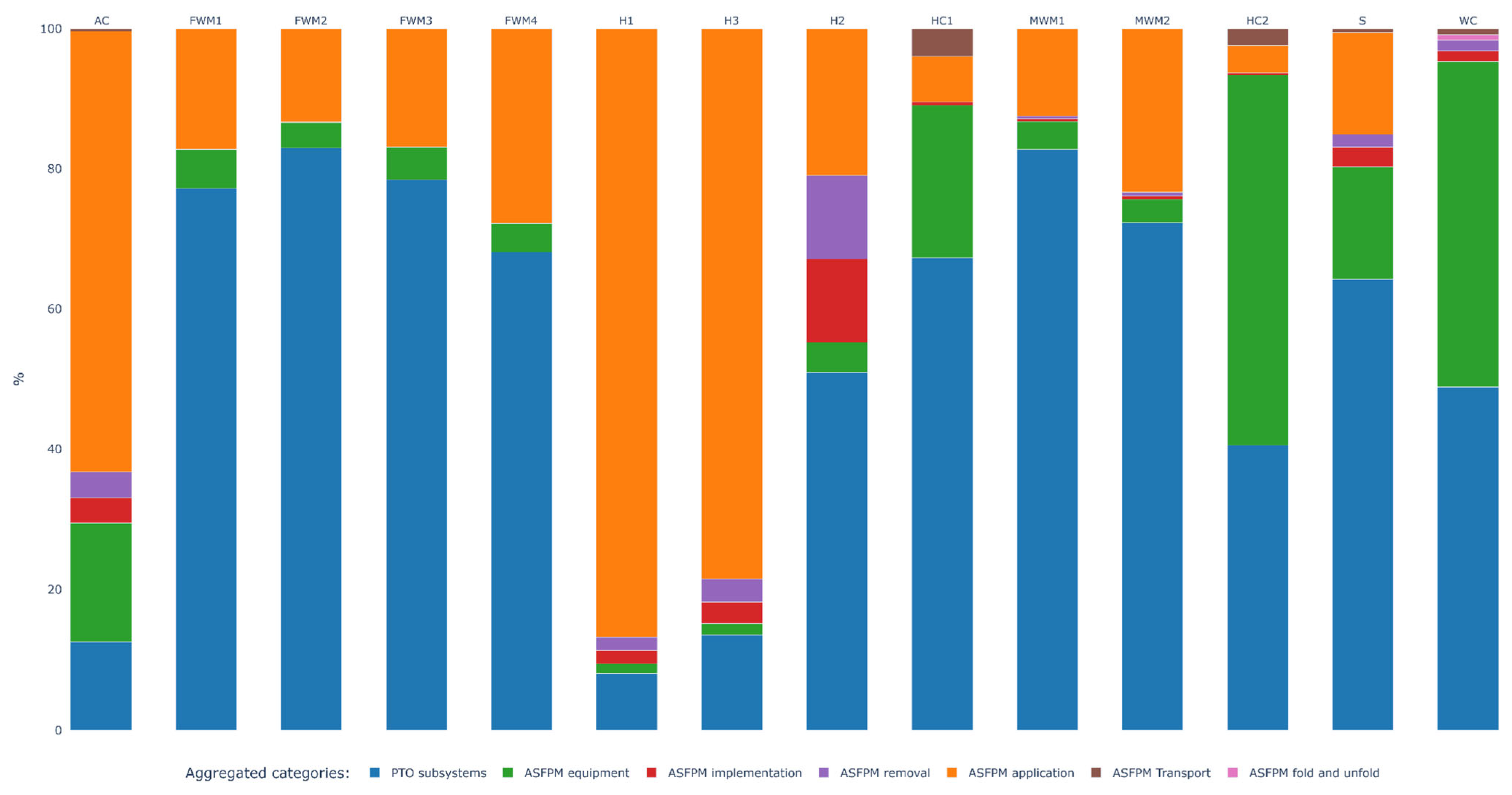
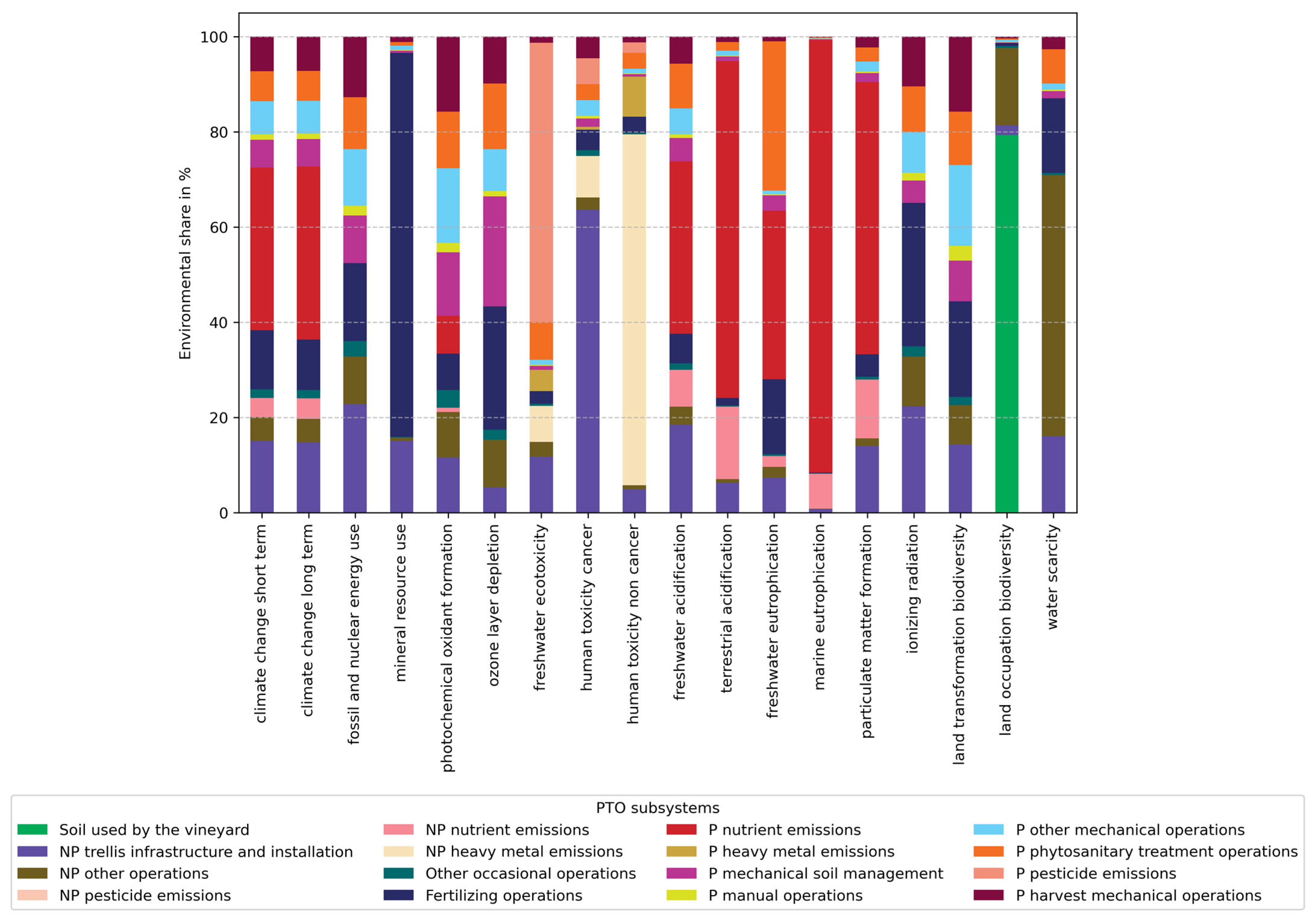
Figure 1. Environmental share overview of all subsystems from a complete pathway of technical operations (PTO) without active spring frost protection methods (ASFPMs) using the Impact World + characterization method. The functional unit is defined as managing 1 ha of vineyard over one year of production. The non-productive (NP) and productive (P) years are considered. The following PTO subsystems are included: soil used by the vineyard—surface area occupied by the vineyard; NP trellis infrastructure and installation—manufacture, transport of human labor, and installation of the trellis infrastructure; NP other operations—operations during the unproductive stage including machinery manufacture, transport of human labor, and diesel combustion; NP pesticide emissions—emissions of active substances from pesticide application during the unproductive stage; NP nutrient emissions—emission of nutrient from fertilizing operations and soil storage during the unproductive stage; NP heavy metal emissions—heavy metal emissions from pesticide and fertilizing operations during the unproductive stage; other occasional operations—including mechanical and manual operations occurring less than once per year; fertilizing operations—accounting for machinery manufacture, transport of human labor and diesel consumption; P nutrient emissions—emission of nutrient from fertilizing operations and soil storage during the productive stage; P heavy metal emissions—heavy metal emissions from pesticide and fertilizing operations during the productive stage; P mechanical soil management—accounting for diesel consumption, transport of human labor, and machinery manufacture; P manual operations—accounting for the transport and equipment of human labor; P other mechanical operations—diesel consumption, transport of human labor, and machinery manufacture; P phytosanitary treatment operations—diesel consumption, transport of human labor, and machinery manufacture; P pesticide emissions—emissions of active substances from pesticide application during the productive stage; P harvest mechanical operations—diesel consumption, transport of human labor, and machinery manufacture during harvesting.
Sustainability 17 07835 g001
Figure 2. Environmental share of active spring frost protection method (ASFPM) technologies in a complete pathway of technical operations (PTO) for the climate change short-term indicator using the Impact World + characterization method. The functional unit is defined as managing 1 ha of vineyard over one year of production under 11 h of spring frost. AC: antifrost candles, petrol as raw material. FWM1: wind machine, fixed, diesel fuel, with small heaters. FWM2: wind machine, fixed, gas fuel, with small heaters. FWM3: wind machine, fixed, diesel fuel, without small heaters. FWM4: wind machine, fixed, diesel fuel, with burner. H1: heater, fuel as energy resource. H2: heater, use wood as energy resource. H3: heater, use peat as energy resource. MWM1: wind machine, mobile, diesel fuel, with small heater and generator. MWM2: wind machine, mobile, diesel fuel, with small heater. HC1: heating cable, copper cable. HC2: heating cable, radiative cable with diode. S: sprinkler, 35 m3 of direct water consumption. WC: winter cover, non-woven polypropylene cover.
Sustainability 17 07835 g002
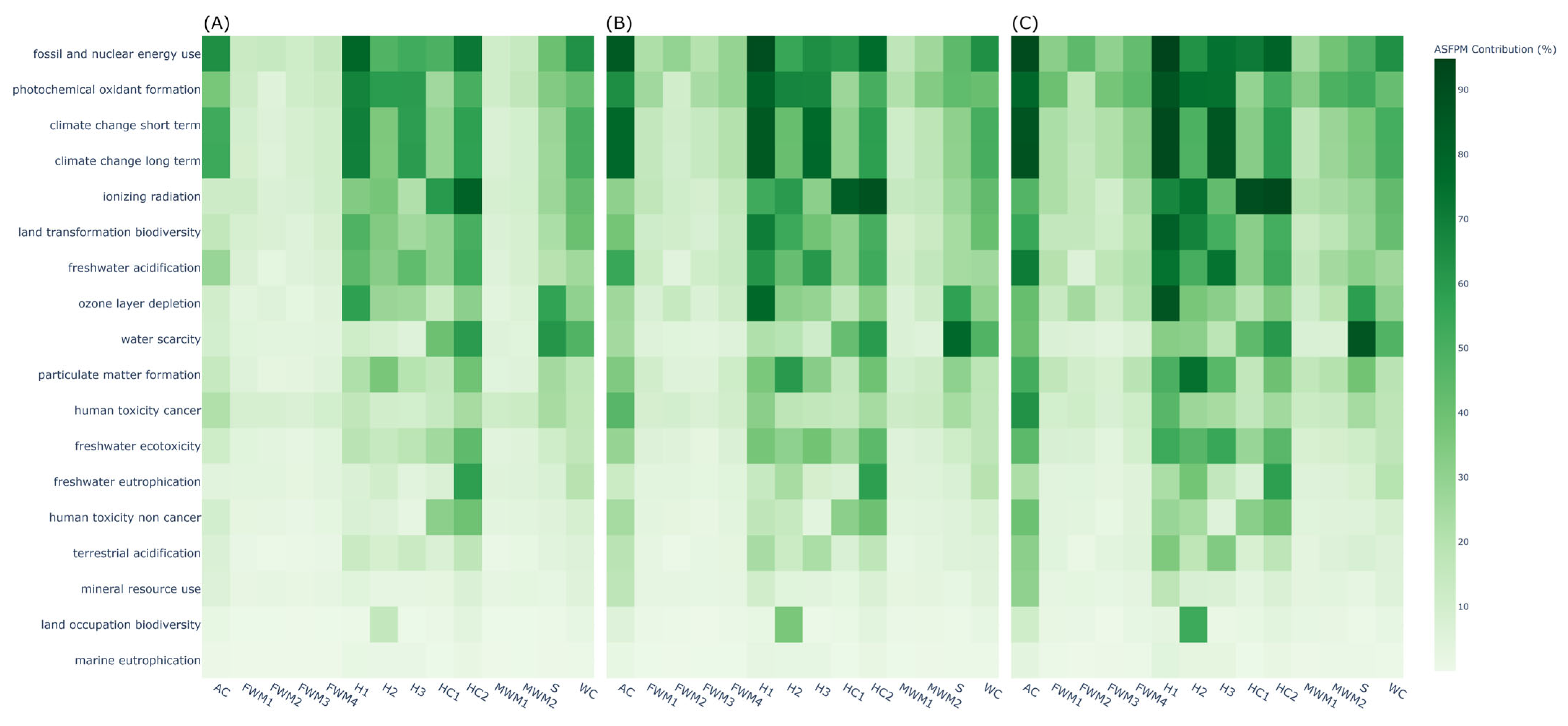
Figure 3. Global environmental share of active spring frost protection methods (ASFPMs) within a complete pathway of technical operations (PTO) using the Impact World + characterization method. The functional unit of the three charts is defined as managing 1 ha of vineyard over one year of production under (A) 1 h of spring frost (B) 5 h of spring frost, and (C) 11 h of spring frost. The environmental indicators are ranked in descending order based on their total contribution across all ASFPMs. AC: antifrost candles, petrol as raw material. FWM1: wind machine, fixed, diesel fuel, with small heaters. FWM2: wind machine, fixed, gas fuel, with small heaters. FWM3: wind machine, fixed, diesel fuel, without small heaters. FWM4: wind machine, fixed, diesel fuel, with burner. H1: heater, fuel as energy resource. H2: heater, use wood as energy resource. H3: heater, use peat as energy resource. MWM1: wind machine, mobile, diesel fuel, with small heater and generator. MWM2: wind machine, mobile, diesel fuel, with small heater. HC1: heating cable, copper cable. HC2: heating cable, radiative cable with diode. S: sprinkler, 35 m3 of direct water consumption. WC: winter cover, non-woven polypropylene cover.
Sustainability 17 07835 g003
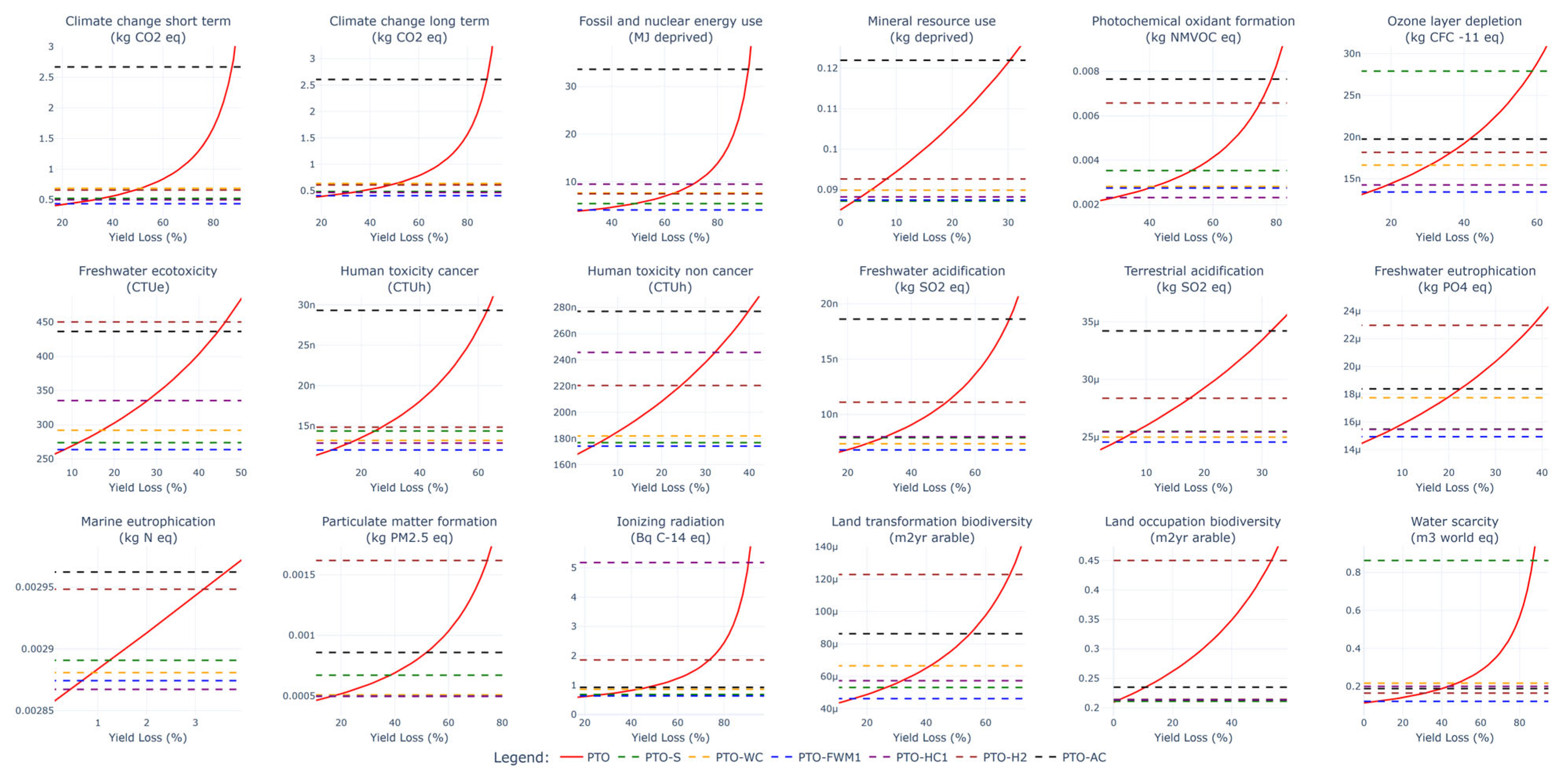
Figure 4. Environmental impacts of a complete pathway of technical operations (PTO) expressed per kg of grapes produced in function of yield loss (%) using the Impact World + characterization method. The red solid line “PTO” represents the complete PTO without active spring frost protection method (ASFPM), under varying levels of yield loss. The colored dash lines represent PTO that includes ASFPM application under 11 h of spring frost. These scenarios assume 100% protection efficiency, and therefore no yield loss. All LCA results for PTO with ASFPMs are expressed per kg of grapes produced, assuming no yield loss. The green dash line “PTO-S” corresponds to PTO with sprinkler, the orange dashed line “PTO-WC” to PTO with winter cover, the blue dashed line “PTO-FWM1” to PTO with fixed wind machine with heaters, the purple dashed line “PTO-HC1” to PTO with heating cables, the brown dashed line “PTO-H2” to PTO with wood-burning heaters, and the black dashed line “PTO-AC” to PTO with antifrost candles.
Sustainability 17 07835 g004
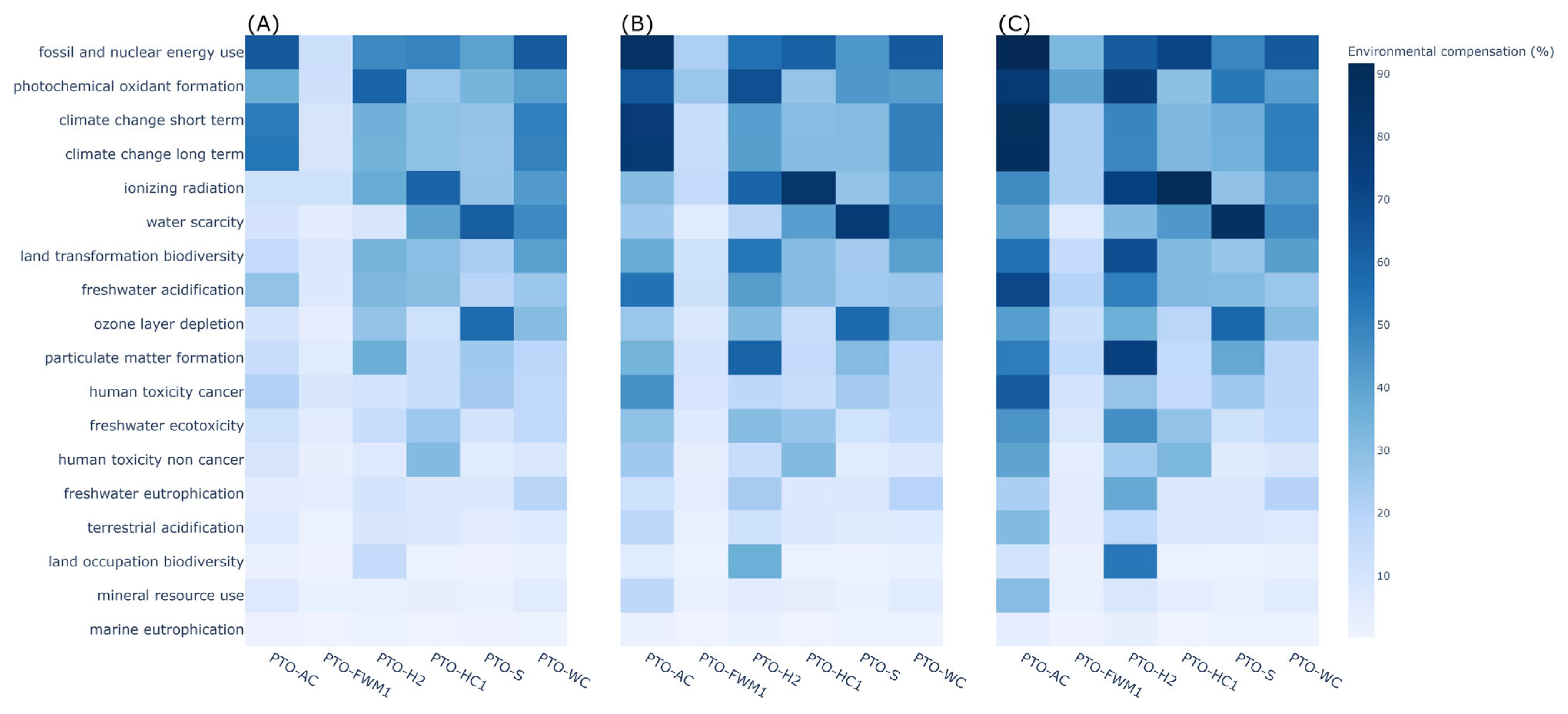
Figure 5. Environmental compensation of pathway of technical operations (PTO) using active spring frost protection methods (ASFPMs) assessed with the Impact World + characterization method. The environmental compensation is evaluated by comparing a complete PTO with ASFPMs (assumed to prevent yield loss entirely) to a PTO without ASFPM application, where various levels of yield loss are simulated. The functional unit for the PTO-ASFPMs is expressed in kg of grapes produced over one year of production under (A) 1 h of spring frost, (B) 5 h of spring frost, and (C) 11 h of spring frost. The heatmap results are expressed in % of yield loss relative to the PTO without ASFPM application. “PTO-S” corresponds to PTO with sprinkler, “PTO-WC” to PTO with winter cover, “PTO-FWM1” to PTO with fixed wind machine with heaters, “PTO-HC1” to PTO with heating cables, “PTO-H2” to PTO with wood-burning heaters, and “PTO-AC” to PTO with antifrost candles.
Sustainability 17 07835 g005

3. Results

3.1. Environmental Shares of the PTO Without ASFPM

The overall environmental shares of the PTO subsystems without ASFPM application are presented in Figure 1. The subsystem “P nutrient emissions” shows the highest impact across the following indicators: climate change (both short and long term), mainly driven by N2O emissions, accounting for 34%; terrestrial and freshwater acidification, mainly due to ammonia emissions, representing 36% and 70%, respectively; freshwater and marine eutrophication, caused by nitrate and phosphate emissions, contributing 35% and 91%, respectively; and particulate matter formation, mainly due to ammonia emissions, accounting for 57%. The “soil used by the vineyard” subsystem is the main contributor to the indicator of land occupation biodiversity, due to the direct occupied land of the vine plot. The “fertilizing operation” subsystem shows the strongest impact on mineral resource use, accounting for 81%, as well as ozone layer depletion, representing 26%, and ionizing radiation, contributing 30%, mainly due to the production of mineral fertilizers. The subsystem “NP trellis infrastructure and installation” has a high contribution for the human toxicity cancer indicator, accounting for 64%, and the fossil and nuclear energy use indicator, representing 24 %, mainly due to the production of steel trellis posts. The subsystem “NP other operations” contributes the most to the water scarcity indicator, accounting for 55%, due to the water use during irrigation in the nursery stage. Diesel consumption from the mechanical operations of PTO subsystems, particularly due to combustion, contributes the most to the photochemical oxidant formation and fossil nuclear energy use indicators, accounting for 60% and 39%, respectively. Additionally, it has a significant impact on climate change (short and long term), accounting for 23%. The subsystem “P pesticide emission” shows the highest impact on freshwater ecotoxicity, accounting for 59%. The subsystem “NP heavy metal emission” contributes the most to the human toxicity non-cancer indicator, accounting for 74%, primary due to the high input of mercury in soil. These results are consistent with the EF3.1 method shown in Figure S1, except for the resource use of minerals and metals indicator, where most of its impact is sourced from the subsystem “NP trellis infrastructure and installation”. These results are also in line with ReCiPe 2016 (H), as Figure S2 shows similar trends to the different viticulture’s subsystems.

3.2. Environmental Shares of ASFPM into the PTO

Following the overall environmental shares of the PTO subsystems, the assessed ASFPMs are incorporated into the PTO at varying frost hour frequencies, reflecting different levels of usage intensity.
The climate change short-term impact of a PTO including ASFPM application is presented in Figure 2 to highlight the environmental share of ASFPMs within a year of production. The FU is defined as managing 1 hectare of vine crop during a production year, with 11 h of spring frost. The environmental contribution of ASFPMs ranges from 17% to 92% of the PTO’s climate change impact, depending on the ASFPM technology used. The “ASFPM application” subsystem has the highest share in the climate change indicator for all ASFPMs, except for the electric cables HC1, radiative cables HC2, and the winter cover WC, which generate most of their climate change impact from the manufacturing and waste treatment of ASFPM equipment. The contributions of the ASFPM’s subsystems are not discussed further in this study, as the focus is on the overall environmental share of ASFPMs within the complete viticulture stage. However, additional insights into the contributions of ASFPM subsystems under varying spring frost hours can be retrieved in Baillet et al. [30] for various potential environmental indicators.
The environmental shares of ASFPMs within the PTO across all potential environmental indicators are presented in Figure 3. The FU is defined as managing 1 hectare of vineyard, with 1, 5, or 11 spring frost hours, as shown in Figure 3A–C, respectively. In Figure 3, the environmental indicators are ranked in ascending order based on the total contribution of all ASFPMs for each indicator.
The marine eutrophication indicator is the least impacted by ASFPMs, with a minimum contribution of around 0.05% from FWM2 under 1 h of frost, and a maximum contribution of around 3.6% from AC under 11 h of frost. The environmental share of ASFPMs for the land occupation biodiversity indicator is also low, except for H2, which contributes to 15%, 36%, and 53% under 1, 5, and 11 h of frost, respectively.
The mineral resource use indicator is mainly impacted by the use of AC and H1 when frost occurrence exceeds 5 h. However, under a low number of frost hours, HC2 contributes the most to this indicator, accounting for 7% regardless of frost occurrence. When 11 h of frost occurs, the environmental shares of AC and H1 in the mineral resource use indicator are 30% and 17%, respectively. All other ASFPMs contribute less than 10% to this indicator, regardless of frost occurrence.
Regarding the terrestrial acidification indicator, AC, H1, and H3 show relatively high contributions when frost hour occurrences are high, each accounting for more than 30%. HC2 contributes a significant 17% to this indicator, regardless of frost hour occurrence. For the remaining ASFPMs, the environmental share is relatively low, except for H2 under 11 frost hours, where it accounts for 17%.
Concerning freshwater eutrophication, HC2 shows a constant high contribution of 58%, regardless of frost occurrence. This is due to its equipment manufacturing, and particularly to the light-emitting-diode manufacture. When frost hour occurrence increases, the contributions of H1, H2, and AC in this indicator increase up to 23%, 37%, and 23%, respectively.
Regarding the ecotoxicity indicator, HC2 contributes 44%, regardless of frost hour occurrence. When frost hour occurrence is high, H1, H2, H3, and AC show a high contribution of 53%, 46%, 55%, and 45% to this indicator, respectively.
Concerning the human toxicity cancer indicator, AC and H1 present a contribution of 63% and 46%, respectively, under 11 h of frost. Under high frost hour occurrences, H2 and AC show the highest contributions to the particulate matter formation indicator, accounting for 74% and 52%, respectively. S has a very high contribution to the water scarcity indicator, accounting for 87% under high frost hour occurrences. HC2 and WC constantly contribute 60% and 48%, respectively, to this indicator, regardless of frost hour occurrence.
For the ozone layer depletion indicator, H1 and S contribute over 50%, regardless of frost hour occurrence.
Concerning freshwater acidification and land transformation biodiversity, AC, H1, H2, H3, and HC2 each contribute more than 50% when 11 frost hours occur.
For the ionizing radiation indicator, HC1 and HC2 show the highest contribution, exceeding 90% when 11 frost hours occur.
In both the climate change long and short-term indicator, AC, H1, H3, HC2, and WC contribute more than 50%, regardless of frost hour occurrence. When 11 frost hours occur, AC, H1, and H3 show very high contributions, exceeding 85% in both climate change indicators. These indicators present a similar pattern among the ASFPM technologies within the PTO.
For the photochemical oxidant formation indicator, fixed wind machines using diesel as a fuel resource, along with an additional burner, have a significant environmental share of 33%, when the frost hour occurrence is high. All types of heaters and candle show the strongest environmental share for this indicator, accounting for more than 74% under high frost hour occurrences. Additionally, HC2 and HC1 maintain stable, high environmental shares of 50% and 28%, respectively, regardless of frost hour occurrence. FWM2 shows the lowest contribution, ranging from 5% to 17%, depending on the number of frost hours.
Concerning the fossil and nuclear energy use indicator, wind machines contribute between 25 to 44% when 11 frost hours occur, depending on the types of wind machines. Additionally, H1 and AC remain the highest contributors to this indicator, accounting for 92% and 95%, respectively, when 11 frost hours occur. FWM3 shows the lowest environmental share, contributing between 11% and 29%, depending on the frost hour occurrences.
Similar results can be retrieved in Figures S3 and S4, presenting the EF3.1 and ReCiPe environmental indicators, respectively. The absolute values of the potential environmental impacts of PTO with different types of ASFPM can be retrieved in Table S2, based on the following FU: managing 1 hectare of vine crops under 1, 5, and 11 h of spring frost. The absolute value of the global environmental impact of PTO without ASFPM is presented in the first rows of the table. The climate change long-term indicator is omitted, as it shows similar results to the climate change short-term indicator. Additionally, the human toxicity indicators are not presented due to high uncertainties in the LCA of ASFPM use, as outlined in Table S3 of the Supplementary Materials.

3.3. Uncertainties Analysis of PTO with ASFPM Application

The uncertainty analysis of the PTO-ASFPMs can be retrieved in Table S3 of the Supplementary Materials. The FU of this analysis is defined as managing 1 hectare of vines over one year of production, under 11 spring frost hours. The uncertainty analysis was performed using Monte-Carlo simulation based on 1000 runs.
Among all impact categories, the highest uncertainties are observed for water scarcity, human toxicity, ionizing radiation, and land transformation biodiversity. These indicators have the highest coefficients of variation (CVs) making comparisons between PTO–ASFPM scenarios challenging. The average CV values for these indicators are as follows:
-
Water scarcity: 4371 m3 world eq.
-
Human toxicity (non-cancer): 3501 CTUh.
-
Homan toxicity (cancer): 535 CTUh.
-
Ionizing radiation: 72 Bq C-14 eq.
-
Land transformation biodiversity: 60 m2yr arable.
In contrast, marine eutrophication, land occupation biodiversity, climate change, and terrestrial acidification show the lowest uncertainties with CVs as follows:
-
Marine eutrophication: 0.48 kg N eq.
-
Land occupation biodiversity: 2.15 m2yr arable.
-
Climate change: 3.81 kg CO2 eq.
-
Terrestrial acidification: 4.27 kg SO2 eq.
The other environmental impacts can be compared across the PTO–ASFPM scenarios, revealing significant differences between ASFPM applications. Nevertheless, the environmental impacts of mineral resources, freshwater ecotoxicity, and ionizing radiation indicators between the PTO-FWM and PTO-MWM types are not significant, due to their CV relative to the differences in their indicator scores.
Although the toxicity and water scarcity indicators exhibit high uncertainty, they remain important to assess in viticulture due to their relatively high potential contribution compared to other human activities, as well as their relevance to the relationship between winegrowers and the public. The same reasons apply, to a lesser extent, to indicators such as climate change, eutrophication, particulate matter, and acidification. Regarding the environmental impacts of ASFPMs, their notable and increasing contributions to fossil and energy use, photochemical oxidant formation, and ionizing radiation further emphasize the importance of including these indicators in the assessment.

3.4. Environmental Offset of ASFPM Use into a PTO with Potential Yield Loss

Following the contribution analysis of all ASFPMs within a complete PTO, this section compares PTO with ASFPMs to PTO without them, where the latter includes yield losses due to frost events.
Figure 4 presents the environmental impacts of a PTO with and without the application of six different ASFPMs. One representative technology from each ASFPM category is examined in detail, based on the most commonly used ASFPMs in the region [43]: the wind machine (FWM1), the winter cover (WC), the antifrost candles (AC), the heaters (H2), the sprinkler (S), and the heating cables (HC1). The FU is modified to express the potential environmental impacts per kg of grapes produced within the year under 11 spring frost hours. The six ASFPMs are assumed to be 100% efficient in protecting the vineyard from spring frost events, meaning no yield loss is attributed to PTO using ASFPMs. The context-specific LCA framework differentiates antifrost technologies based on their operational strategies and the user’s expertise. Although ASFPMs are rarely 100% effective during frost episodes, this maximalist and egalitarian assumption was nevertheless retained for this study due to a lack of references on ASFPM effectiveness. Indeed, quantifying their effectiveness in identical topographical and climatic conditions is extremely challenging. In contrast, for PTO without ASFPM, a simulated yield loss ranging from 0 to 100% is applied. Figure 4 identifies the yield loss percentage at which the potential environmental impact of each ASFPM technology is offset by its protective effects within one year of production. Figures S5 and S6 in the Supplementary Materials present the environmental impacts using the EF3.1 and ReCiPe methods, respectively, for the same systems.
Figure 5 is a synthetic heatmap presenting the yield loss percentage at which the potential environmental impacts of applying each ASFPM are compensated. In other words, it indicates the yield loss percentage at which the environmental impacts of PTO with ASFPMs (represented by dotted lines in Figure 4) intersects with the environmental impact of PTO without ASFPM (represented by the solid red line in the same figure). It shows three heatmaps, corresponding to 1 (Figure 5A), 5 (Figure 5B), and 11 (Figure 5C) frost hours occurring between the start of April and the end of May. At 11 h of frost, PTO-AC achieves environmental compensation at a yield loss exceeding 50% for the following environmental indicators: fossil and nuclear energy use freshwater ecotoxicity, human toxicity cancer, photochemical oxidant formation, climate change short term, land transformation biodiversity, freshwater acidification, and particulate matter formation. For PTO-H2, the following environmental indicators are offset at a yield loss exceeding 50%: land occupation biodiversity, particulate matter formation, freshwater acidification, ionizing radiation, climate change short term, photochemical oxidant formation, and fossil nuclear energy use. PTO-HC1 shows environmental compensation at over 50% yield loss for the following indicators: fossil and nuclear energy use, and ionizing radiation. For PTO-S, environmental offset above 50% yield loss is observed for the indicators of photochemical oxidant formation, water scarcity, and ozone layer depletion. PTO-WC demonstrates environmental compensation exceeding 50% yield loss for fossil and nuclear energy use, climate change short and long term, regardless of frost hour occurrence. Concerning PTO-FWM1, all indicators are offset by less than 30% yield loss, except for the photochemical oxidant formation and fossil and energy use indicators which are offset by over 30% when 11 frost hours occur. The marine eutrophication indicator is offset by less than 5% yield loss for all PTO with ASFPMs, regardless of frost hour occurrence. Conversely, fossil and nuclear energy use is the hardest indicator to offset for PTO-AC and PTO-WC. The ionizing radiation indicator is also difficult to compensate for PTO-HC1, and PTO-H2, especially when frost hour occurrence is high. Additionally, the water scarcity indicator is the most critical indicator for PTO-S, showing a compensation level exceeding 85% when 11 frost hours occur. Figures S7 and S8 of the Supplementary Materials present the corresponding synthetic heatmaps based on the EF3.1 and ReCiPe characterization methods, respectively.

4. Discussion

ASFPM applications significantly contribute to the overall environmental impact of the viticulture stage, encompassing both productive and unproductive phases of grape production. In the viticulture stage and the context of the studied case, nutrient emissions and diesel consumption have a major impact on various environmental indicators, including climate change, acidification, eutrophication, and particulate matter formation. These findings are consistent with those of Rouault et al. [22] and Arcese et al. [23]. Ecotoxicity indicators are primarily driven by phytosanitary emissions during the productive stage, in line with previous studies [25,26]. Phytosanitary emissions are highly sensitive to the number of treatments applied and the active substance used, while diesel consumption largely depends on the number of mechanical operations carried out. Additionally, water scarcity indicator is most impacted by the nursery stage due to the high irrigation demands, as EU regulation does not allow irrigation of vines in productive stage in the Loire Valley region. The establishment phase, particularly the manufacturing of trellises and poles, shows a high contribution to various LCA indicators, which aligns with the findings of a recent study assessing the overall environmental score of vineyard management in Germany [18].
Depending on the ASFPM type and the frost hour occurrences, the ASFPM contributions fluctuate significantly across various environmental indicators. For example, in the fossil and nuclear energy use indicator, antifrost candles’ contribution ranges from 61% for 1 h of spring frost to 91% for 11 h. Additionally, when spring frost lasts 11 h, the contribution of different ASFPMs to the viticulture stage varies widely, from 25% for a mobile wind machine to 95% for fuel-burning heaters. These variations highlight the importance of informing winegrowers’ decision for selection of the most suitable ASFPM, while considering the mesoclimatic context and thus its application frequency. Moreover, instant ASFPMs show greater contributions and variation across most environmental indicators within the viticulture stage compared to permanent ASFPMs. These findings align with the comparative LCA of ASFPMs from Baillet et al. [30]. The absolute values in Table 2 further emphasize the differences between PTO–ASFPM systems. Under 11 frost hours, PTOs combined with instant solutions show an additional order of magnitude than other PTO–ASFPM systems, particularly in indicators such as climate change, fossil and nuclear energy use, ozone layer depletion, freshwater acidification, freshwater eutrophication, particulate matter formation, and water scarcity. All PTOs combined with a permanent antifrost solution show a high order of magnitude for at least one environmental indicator, except those using wind machine technology. ASFPMs that show significant differences in environmental contributions under varying climatic conditions are highly sensitive to energy and resource consumption during their on-field operation.
The sensitivity analysis of PTO with and without ASFPM, considering theoretical yield loss, provides original and valuable insights into the potential environmental compensation of ASFPM application. Under 11 frost hours, several PTO–ASFPM combinations show a very high environmental offset, making ASFPM application impact difficult to compensate. This is particularly evident for instant solutions, such as antifrost candles and wood-burning heaters, under high frost hour occurrences, even with optimal operational strategies. Conversely, PTO combined with winter cover shows stable environmental compensation across several indicators, regardless of frost occurrence. PTO using heating cables, however, shows higher impacts in certain indicators, such as fossil and nuclear energy use, ionizing radiation and most of the toxicity indicators, compared to winter cover, while showing lower scores in other indicators, independent of frost occurrence. These findings highlight the significant environmental impacts of ASFPMs within PTOs, demonstrating how resource-intensive practices can substantially affect the overall environmental performance of the viticulture stage. Additionally, the results indicate that all environmental indicators are significantly affected by at least one type of ASFPM, except for marine eutrophication, though the intensity of the impact varies depending on frost occurrence.
Comparing ASFPM environmental contributions within a complete PTO to other studies is challenging due to limited published research in this field. However, the LCA study by Milà i Canals [28] also includes ASFPM application in its environmental assessment of apple production, using a mass-based functional unit over a full production year. This study incorporates two ASFPMs, wind machines and sprinklers, applied from mid-August to mid-November in two different locations in New Zealand. The results show significantly higher energy consumption in ASFPM-applied systems, particularly for sprinklers, than the other apple production systems. Moreover, ASFPMs play a key role in the photochemical oxidant formation, ecotoxicity, and global warming indicators, as these impacts are primarily driven by the high energy consumption required for their mechanization operations. Although wind machines and sprinklers, as evaluated in Milà i Canals [28], are among the least impactful ASFPMs in terms of climate change, mineral resource use, fossil and energy use, human toxicity (cancer), acidification, and land use indicators according to Baillet et al. [30], both studies highlight the importance of including ASFPMs in the environmental assessment of agricultural systems. Additionally, the significant environmental contributions of ASFPMs within the PTO in this study align with the findings of Viveros Santos et al. [44], which mentions the high carbon footprint of wood-burning spring frost protection methods in vineyards.
However, assuming 100% efficiency for all ASFPM types may underestimate the environmental impact of PTO–ASFPM systems, potentially favoring less efficient methods by minimizing their impacts per kg of grapes compared to the most efficient ones. Yet, no common framework exists to assess ASFPM effectiveness, making comparisons difficult, as their performance depends on various external mesoclimatic factors [45]. Additionally, this assumption underestimates the thresholds of the potential environmental offset by assuming a 100% yield saving. Furthermore, this study considers optimal strategies for ASFPM use; however, inefficient use of these systems can not only fail to prevent frost damage but can also lead to significant financial and environmental costs. Additionally, grape yield is influenced by various external factors such as pest and disease frequency, drought, precipitation, and more. Identifying the portion of yield saved due to frost protection practices is thus both challenging and uncertain. Nevertheless, expressing the impact per saved bud could offer additional insights for comparing ASFPM practices within similar external conditions (mesoclimate, plot structure, topography, vegetal material). Moreover, measuring the temperature differential around the buds during frost events, with and without the use of ASFPM, could serve as a valuable complementary indicator alongside the LCA results, or potentially be integrated directly into the FU.
In this study, ASFPM LCAs account for frost duration but not frost intensity [14,27]. However, including intensity parameters could influence the potential environmental impacts, as some ASFPMs may be less effective against severe frost events [45] and others may consume more energy and resources at lower temperatures. For instance, sprinklers provide better protection against intense frost than heating-based ASFPMs [46]. Even within a single ASFPM type, such as wind machines, efficiency varies depending on the air mass mixing altitude and whether it occurs vertically or horizontally [47]. Several external factors affect ASFPM performance, complicating comparisons due to a lack of standardized evaluation protocol. Still, various studies agree that passive spring frost protection methods are the most effective and cost-efficient [12,48].
Since most passive protection methods are agronomic and preventive field operations, such as late pruning, mowing, maintaining bare ground, selecting optimal plantation sites, or choosing resilient plant varieties, their environmental impact is predictably lower than the ASFPM ones. However, assessing a complete PTO that integrates these practices alongside ASFPMs would provide a more comprehensive evaluation. Moreover, evaluating additional PTO types with the assessed ASFPMs could provide valuable insights, enhancing confidence in the environmental contributions of ASFPMs during the viticulture stage. Additionally, considering the indirect consequences of ASFPM application, such as the increased frequency of phytosanitary treatments due to sprinkler use, could significantly impact various environmental indicators in an LCA of PTO systems. Incorporating these parameters would offer valuable insights for a holistic assessment of PTOs under mesoclimatic pressures, as winegrowers face increasing challenges that require adaptations and changes in their practices.
In this study, the frost risk period begins at the start of April and ends on the last day of May, covering two full months of potential ASFPM application. However, considering global warming scenarios coupled with phenological models, the length of the frost risk period is expected to increase at varying intensities, depending on grape variety and previous winter conditions [4]. A comparison of the environmental impacts between historical and future PTO–ASFPM systems would provide valuable insights. Prospective LCAs could integrate relevant background and contextual data for future PTO–ASFPM systems, following the recommendations of Arvidsson et al. [49], while considering future mesoclimatic conditions as in the LCA framework of Viveros Santos et al. [44]. This approach would help to identify potential impacts of the future viticulture stage under future climatic and market scenarios, allowing a comparison of global environmental changes with the current attributional LCA of PTO–ASFPM systems. Additionally, adapting the framework of Baillet et al. [27] to include prospective LCAs would enable the integration of potential emerging technologies into environmental comparisons. Regarding the environmental performance of the actual assessed ASFPMs, this would be particularly relevant to identify potential innovative sustainable practices. Nevertheless, adapting this framework may be challenging, as spring frost phenomena occur at a very localized scale, which may not be accurately represented by current climatic models. Additionally, while using hourly climatic data is relevant for assessing the absolute values of LCA impacts, it is not easily applicable for climate projections and would require additional adjustments.
To address the potential sustainability issues of ASFPMs within a PTO to decision-makers, integrating additional indicators into the LCA would be valuable, such as a planet boundaries concept [50,51], endpoint indicators [52], and single score [53]. These concepts involve aggregation, weighting, and normalization transformations that could simplify the handling of LCA results for non-LCA practitioners. Additionally, economic concerns remain a key constraint in decision-making. Incorporating economic and organizational indicators would provide valuable insights by identifying trade-offs and synergies among environmental, feasibility, and economic dimensions. Notably, following the potential offset analysis presented in this paper, economic compensation linked to yield loss variation could be explored. This may offer additional further valuable insights, highlighting potential synergies or trade-offs between economic viability and environmental sustainability.

5. Conclusions

This case study highlights the environmental contributions of using ASPFMs within a complete PTO in viticulture across different spring frost contexts. The study presents a full LCA of the PTO, including the environmental contribution of ASFPM over a full grape production year. The main environmental shares of both PTO and ASFPMs are analyzed and compared under different mesoclimatic conditions. Then, the environmental impacts of PTO with and without ASFPM are compared under different mesoclimatic conditions, with a simulated yield loss range, to assess the potential environmental compensation of ASFPM use.
The findings indicate that ASFPMs significantly contribute to the overall environmental footprint of the PTOs, even in a low-frost-risk context, highlighting their importance in integrating them in LCA of agricultural systems. The environmental contributions vary greatly depending on the type of ASFPM used within the PTO and the mesoclimatic context. Instant ASFPMs, such as antifrost candles and heaters, exhibit considerably higher environmental impacts compared to permanent solutions, such as wind machines and sprinklers. In many cases, instant ASFPMs emerge as the primary contributors to the environmental impacts across various environmental indicators, including fossil and nuclear energy, climate change, and acidification. These impacts escalate with increasing frost hours, thereby significantly amplifying the overall environmental performance of the PTO. While permanent ASFPMs show lower impacts, they still contribute substantially, especially in a frost-prone context, and should be included in comprehensive LCAs of PTO in viticulture. Among all ASFPMs, wind machines show the lowest environmental impacts and demonstrate the greatest potential for environmental compensation across most environmental indicators. However, the environmental compensation threshold of ASFPMs, although considered as exceptional practices, are significantly high, particularly in frost-prone contexts.
This study contributes to better understanding the global environmental performance of the wine sector in areas exposed to extreme climatic events, where energy- and resource-intensive measures are often required. Future research should explore prospective LCA approaches for exploring potential sustainable and innovative practices in frost-prone contexts. Additionally, including additional factors to link ASFPM efficiency and frost intensities should enable a more refined LCA assessment between PTO–ASFPM systems. Including future climate change scenarios would also be valuable in assessing the long-term sustainability of the wine industry in regions of increasing frost risk. Finally, translating LCA outcomes into more accessible environmental indicators, while integrating economic and organizational indicators, could significantly improve decision-making support in viticulture practices.

Supplementary Materials

The following supporting information can be downloaded at https://www.mdpi.com/article/10.3390/su17177835/s1. The Supplementary Materials include details about the absolute values of the LCA results, the life cycle inventory of the pathway of technical operation, and all the LCA figures using two additional characterization methods, EF3.1 and ReCiPe 2016 (H). The following figures and tables can be found in the document: Figure S1: Environmental share overview of all subsystems from a complete pathway of technical operations (PTO) without active spring frost protection methods (ASFPMs) using the EF3.1 characterization method. Figure S2: Environmental share overview of all subsystems from a complete pathway of technical operations (PTO) without active spring frost protection methods (ASFPMs) using the ReCiPe 2016 (H) characterization method. Figure S3: Global environmental share of active spring frost protection methods (ASFPMs) within a complete pathway of technical operations (PTO) using the EF3.1 characterization method. Figure S4: Global environmental share of active spring frost protection methods (ASFPMs) within a complete pathway of technical operations (PTO) using the ReCiPe 2016 (H) characterization method. Figure S5: Environmental impacts of a complete pathway of technical operations (PTO) expressed per kg of grapes produced in function of yield loss (%) using the EF3.1 characterization method. Figure S6: Environmental impacts of a complete pathway of technical operations (PTO) expressed per kg of grapes produced in function of yield loss (%) using the ReCiPe 2016 (H) characterization method. Figure S7: Environmental compensation of pathway of technical operations (PTO) using active spring frost protection methods (ASFPMs) assessed with the EF3.1 characterization method. Figure S8: Environmental compensation of pathway of technical operations (PTO) using active spring frost protection methods (ASFPMs) assessed with the ReCiPe 2016 (H) characterization method. Table S1: Inventory inputs and outputs of the PTO case study from the Loire Valley region. Table S2: Summary environmental score of PTO with and without ASFPM application. Table S3: Monte-Carlo uncertainty analysis of PTO systems (with and without ASFPM) with the Impact World + characterization factors (95% confidence interval).

Author Contributions

V.B.: conceptualization, data and inventory acquisition, formal assessment, writing—original draft, review, and editing; R.S.: writing—review and editing, super-vision and funding acquisition; C.R.-G.: conceptualization, data and inventory acquisition, writing—original draft, writing—review and editing, supervision, and funding acquisition. All authors have read and agreed to the published version of the manuscript.

Funding

This study is part of a Ph.D. thesis funded by the Pays de la Loire region, Angers, France.

Data Availability Statement

All data are available on an open resource depositary (https://entrepot.recherche.data.gouv.fr/dataset.xhtml?persistentId=doi:10.57745/RLG4DS (accessed on 12 January 2025)) and in the Supplementary Materials resources. The authors can provide additional entry data upon request concerning the direct emission models for grape production.

Acknowledgments

The authors thank the interviewees for sharing their knowledge about frost protection systems and production management. The authors thank the anonymous reviewers and editor for their time and contribution to the improvement of the paper.

Conflicts of Interest

The authors declare no conflicts of interest. All co-authors have reviewed and approved the contents of this manuscript. There are no financial or non-financial competing interest to disclose regarding this study. The authors certify that this submission is original work and is not under consideration by any other publication.

References

  1. Katherine, C.; Dipak, D.; Gerhard, K.; Aditi, M.; Peter, W.T.; Christopher, T.; José, R.; Paulina, A.; Ko, B.; Gabriel, B.; et al. IPCC, 2023: Climate Change 2023: Synthesis Report, Summary for Policymakers. Contribution of Working Groups I, II and III to the Sixth Assessment Report of the Intergovernmental Panel on Climate Change; Intergovernmental Panel on Climate Change (IPCC): Geneva, Switzerland, 2023; pp. 1–34. [Google Scholar]
  2. Leolini, L.; Moriondo, M.; Fila, G.; Costafreda-Aumedes, S.; Ferrise, R.; Bindi, M. Late spring frost impacts on future grapevine distribution in Europe. Field Crops Res. 2018, 222, 197–208. [Google Scholar] [CrossRef]
  3. Kartschall, T.; Wodinski, M.; Von Bloh, W.; Oesterle, H.; Rachimow, C.; Hoppmann, D. Changes in phenology and frost risks of Vitis vinifera (cv Riesling). Meteorol. Z. 2015, 24, 189–200. [Google Scholar] [CrossRef]
  4. Mosedale, J.R.; Wilson, R.J.; Maclean, I.M.D. Climate Change and Crop Exposure to Adverse Weather: Changes to Frost Risk and Grapevine Flowering Conditions. PLoS ONE 2015, 10, e0141218. [Google Scholar] [CrossRef]
  5. Neethling, E.; Petitjean, T.; Quénol, H.; Barbeau, G. Assessing local climate vulnerability and winegrowers’ adaptive processes in the context of climate change. Mitig. Adapt. Strateg. Glob. Change 2017, 22, 777–803. [Google Scholar] [CrossRef]
  6. Zito, S.; Pergaud, J.; Richard, Y.; Castel, T.; Le Roux, R.; García de Cortázar-Atauri, I.; Quenol, H.; Bois, B. Projected impacts of climate change on viticulture over French wine regions using downscaled CMIP6 multi-model data. OENO One 2023, 57, 431–446. [Google Scholar] [CrossRef]
  7. Petitjean, T.; Tissot, C.; Thibault, J.; Rouan, M.; Quenol, H.; Bonnardot, V. Évaluation spatio-temporelle de l’exposition au gel en régions viticoles traditionnelle (Pays de Loire) et émergente (Bretagne). In Proceedings of the 35ème Colloque de L’Association Internationale de Climatologie, Toulouse, France, 6–9 July 2022. [Google Scholar]
  8. Sgubin, G.; Swingedouw, D.; Dayon, G.; García de Cortázar-Atauri, I.; Ollat, N.; Pagé, C.; van Leeuwen, C. The risk of tardive frost damage in French vineyards in a changing climate. Agric. For. Meteorol. 2018, 250–251, 226–242. [Google Scholar] [CrossRef]
  9. Gavrilescu, C.; Zito, S.; Richard, Y.; Castel, T.; Morvan, G.; Bois, B. Frost risk projections in a changing climate are highly sensitive in time and space to frost modelling approaches. In Proceedings of the 14th International Terroir Congress & 2nd ClimWine Symposium, Bordeaux, France, 3–8 July 2022; pp. 1–7. [Google Scholar]
  10. Fraga, H.; Malheiro, A.C.; Moutinho-Pereira, J.; Santos, J.A. An overview of climate change impacts on European viticulture. Food Energy Secur. 2012, 1, 94–110. [Google Scholar] [CrossRef]
  11. Droulia, F.; Charalampopoulos, I. Future Climate Change Impacts on European Viticulture: A Review on Recent Scientific Advances. Atmosphere 2021, 12, 495. [Google Scholar] [CrossRef]
  12. Rochard, J.; Monamy, C.; Pauthier, B.; Rocque, A. Stratégie et équipements de prévention vis-à-vis du gel de printemps et de la grêle. Perspectives en lien avec les changements climatiques, projet ADVICLIM. BIO Web Conf. 2019, 12, 01012. [Google Scholar] [CrossRef]
  13. Liu, J.; Sherif, S.M. Combating Spring Frost With Ethylene. Front. Plant Sci. 2019, 10, 1408. [Google Scholar] [CrossRef] [PubMed]
  14. Baillet, V.; Payen, A.; Naviaux, P.; Pauthier, B.; Chassaing, T.; Renaud-Gentié, C. Life Cycle Inventories and Unit Processes of Active Spring Frost Protection Methods Applied in Loire Valley and Champagne Regions. 2024. Available online: https://entrepot.recherche.data.gouv.fr/dataset.xhtml?persistentId=doi:10.57745/RLG4DS (accessed on 12 January 2025).
  15. Jolliet, O.; Saadé, M.; Crettaz, P.; Shaked, S. Analyse du Cycle de Vie: Comprendre et Réaliser un Écobilan; PPUR Presses Polytechniques: Lausanne, Switzerland, 2010; Volume 23, p. 348. [Google Scholar]
  16. Alhashim, R.; Deepa, R.; Anandhi, A. Environmental Impact Assessment of Agricultural Production Using LCA: A Review. Climate 2021, 9, 164. [Google Scholar] [CrossRef]
  17. Ferrara, C.; De Feo, G. Life Cycle Assessment Application to the Wine Sector: A Critical Review. Sustainability 2018, 10, 395. [Google Scholar] [CrossRef]
  18. Foerster, F.C.; Döring, J.; Koch, M.; Kauer, R.; Stoll, M.; Wohlfahrt, Y.; Wagner, M. Comparative life cycle assessment of integrated and organic viticulture based on a long-term field trial in Germany. Sustain. Prod. Consum. 2024, 52, 487–497. [Google Scholar] [CrossRef]
  19. Renaud-Gentié, C.; Dieu, V.; Thiollet-Scholtus, M.; van der Werf, H.M.G.; Perrin, A.; Mérot, A. L’Analyse du Cycle de Vie pour réduire l’impact environnemental de la viticulture biologique. BIO Web Conf. 2019, 15, 01031. [Google Scholar] [CrossRef][Green Version]
  20. Beauchet, S.; Rouault, A.; Renouf, M.A.; Thiollet-Scholtus, M.; Jourjon, F.; Renaud-Gentié, C. Inter-annual variability in the environmental performance of viticultural technical management routes–a case study in the Middle Loire Valley (France). Int. J. Life Cycle Assess. 2019, 24, 253–265. [Google Scholar] [CrossRef]
  21. Neto, B.; Dias, A.C.; Machado, M. Life cycle assessment of the supply chain of a Portuguese wine: From viticulture to distribution. Int. J. Life Cycle Assess. 2012, 18, 590–602. [Google Scholar] [CrossRef]
  22. Rouault, A.; Beauchet, S.; Renaud-Gentie, C.; Jourjon, F. Life Cycle Assessment of viticultural technical management routes (TMRs): Comparison between an organic and an integrated management route. OENO One 2016, 50, 13. [Google Scholar] [CrossRef]
  23. Arcese, G.; Lucchetti, M.C.; Martucci, O. Analysis of sustainability based on Life Cycle Assessment: An empirical study of wine production. J. Environ. Sci. Eng. 2012, 1, 682–689. [Google Scholar]
  24. Renaud-Gentié, C.; Grémy-Gros, C.; Julien, S.; Giudicelli, A. Participatory ecodesign of crop management based on Life Cycle Assessment: An approach to inform the strategy of a Protected Denomination of Origin. A case study in viticulture. Ital. J. Agron. 2024, 18, 2217. [Google Scholar] [CrossRef]
  25. Agraso-Otero, A.; Cancela, J.J.; Vilanova, M.; Ugarte Andreva, J.; Rebolledo-Leiva, R.; González-García, S. Assessing the Environmental Sustainability of Organic Wine Grape Production with Qualified Designation of Origin in La Rioja, Spain. Agriculture 2025, 15, 536. [Google Scholar] [CrossRef]
  26. Renaud-Gentié, C.; Dijkman, T.J.; Anders, B.; Morten, B. Modeling pesticides emissions for Grapevine Life Cycle Assessment: Adaptation of Pest-LCI model to viticulture. In Proceedings of the 9th International Conference on LCA of Food, San Francisco, CA, USA, 8–11 October 2014. [Google Scholar]
  27. Baillet, V.; Symoneaux, R.; Renaud-Gentié, C. Life cycle assessment of active spring frost protection methods in viticulture: A framework to compare different technologies. Clean. Environ. Syst. 2024, 14, 100209. [Google Scholar] [CrossRef]
  28. Milà i Canals, L.; Burnip, G.M.; Cowell, S.J. Evaluation of the environmental impacts of apple production using Life Cycle Assessment (LCA): Case study in New Zealand. Agric. Ecosyst. Environ. 2006, 114, 226–238. [Google Scholar] [CrossRef]
  29. Thiollet-Scholtus, M.; Bockstaller, C. Using indicators to assess the environmental impacts of wine growing activity: The INDIGO® method. Eur. J. Agron. 2015, 62, 13–25. [Google Scholar] [CrossRef]
  30. Baillet, V.; Pauthier, B.; Payen, A.; Naviaux, P.; Symoneaux, R.; Chassaing, T.; Renaud-Gentié, C. Life cycle assessment of active spring frost protection methods in viticulture in the Loire Valley and Champagne French regions. OENO One 2025, 59, 18. [Google Scholar] [CrossRef]
  31. Renaud-Gentié, C. Eco-Efficiency of Vineyard Technical Management Routes: Interests and Adaptations of Life Cycle Assessment to Account for Specificities of Quality Viticulture. Ph.D. Thesis, Université d’Angers, Angers, France, 2015. [Google Scholar]
  32. Le Cap, C. Numerical Simulations and Field Measurements of Frost Events in a Vineyard Equipped with Wind Machines: Application to the Quincy Vineyard. Ph.D. Thesis, Université de Rennes, Rennes, France, 2023. [Google Scholar]
  33. Evans, R.G. The art of protecting grapevines from low temperature injury. In Proceedings of the ASEV 50th Anniversary Annual Meeting, Seattle, WA, USA, 19–23 June 2000; pp. 60–72. [Google Scholar]
  34. Poling, E.B. Spring Cold Injury to Winegrapes and Protection Strategies and Methods. HortScience 2008, 43, 1652–1662. [Google Scholar] [CrossRef]
  35. Prasuhn, V. Erfassung der PO4-Austräge für die Ökobilanzierung SALCA Phosphor; Agroscope-Reckenholz-Tänikon Research Station ART: Zürich, Switzerland, 2006; 20p. [Google Scholar]
  36. IPCC. Guidelines for National Greenhouse Gas Inventories. Chapter 11: N2O Emissions from Managed Soils, and CO2 Emissions from Lime and Urea Application; IPCC: Paris, France, 2006; Volume 4. [Google Scholar]
  37. Brentrup, F.; Küsters, J.; Lammel, J.; Kuhlmann, H. Methods to estimate on-field nitrogen emissions from crop production as an input to LCA studies in the agricultural sector. Int. J. Life Cycle Assess. 2000, 5, 349. [Google Scholar] [CrossRef]
  38. Nemecek, T.; Schnetzer, J. Methods of Assessment of Direct Field Emissions for LCIs of Agricultural Production Systems, Data v3.0 (2012); Agroscope Reckenholz-Tanïkon Research Station ART: Zurick, Switzerland, 2011; p. 25. [Google Scholar]
  39. Nemecek, T.; Antón, A.; Basset-Mens, C.; Gentil-Sergent, C.; Renaud-Gentié, C.; Melero, C.; Naviaux, P.; Peña, N.; Roux, P.; Fantke, P. Operationalising emission and toxicity modelling of pesticides in LCA: The OLCA-Pest project contribution. Int. J. Life Cycle Assess. 2022, 27, 527–542. [Google Scholar] [CrossRef]
  40. Freiermuth, R. Modell zur Berechnung der Schwermetallflüsse in der Landwirtschaftlichen Ökobilanz–SALCA-Schwermetall; Forschungsanstalt Agroscope Reckenholz-Tänikon (ART): Zürich, Switzerland, 2006; 28p. [Google Scholar]
  41. Nemecek, T.; Kägi, T. Life Cycle Inventories of Swiss and European Agricultural Production Systems; Agroscope Reckenholz-Taenikon Research Station ART: Zurich and Dübendorf, Switzerland, 2007; pp. 1–360. [Google Scholar]
  42. Renaud-Gentié, C.; Burgos, S.; Benoît, M. Choosing the most representative technical management routes within diverse management practices: Application to vineyards in the Loire Valley for environmental and quality assessment. Eur. J. Agron. 2014, 56, 19–36. [Google Scholar] [CrossRef]
  43. TechniLoire. Equipements de Protection Face au Gel; InterLoire: Tours, France, 2023; 25p. [Google Scholar]
  44. Viveros Santos, I.; Renaud-Gentié, C.; Roux, P.; Levasseur, A.; Bulle, C.; Deschênes, L.; Boulay, A.-M. Prospective life cycle assessment of viticulture under climate change scenarios, application on two case studies in France. Sci. Total Environ. 2023, 880, 163288. [Google Scholar] [CrossRef]
  45. Drepper, B.; Bamps, B.; Gobin, A.; Van Orshoven, J. Strategies for managing spring frost risks in orchards: Effectiveness and conditionality—A systematic review. Environ. Evid. 2022, 11, 29. [Google Scholar] [CrossRef]
  46. Lakatos, L.; Brotodjojo, R.R.R. Frost Protection Case Study in Orchards. IOP Conf. Ser. Earth Environ. Sci. 2022, 1018, 012024. [Google Scholar] [CrossRef]
  47. Battany, M.C. Vineyard frost protection with upward-blowing wind machines. Agric. For. Meteorol. 2012, 157, 39–48. [Google Scholar] [CrossRef]
  48. De Melo-Abreu, J.P.; Villalobos, F.J.; Mateos, L. Frost Protection. In Principles of Agronomy for Sustainable Agriculture; Villalobos, F.J., Fereres, E., Eds.; Springer International Publishing: Cham, Switzerland, 2016; pp. 443–457. [Google Scholar]
  49. Arvidsson, R.; Tillman, A.M.; Sandén, B.A.; Janssen, M.; Nordelöf, A.; Kushnir, D.; Molander, S. Environmental assessment of emerging technologies: Recommendations for prospective LCA. J. Ind. Ecol. 2018, 22, 1286–1294. [Google Scholar] [CrossRef]
  50. Sala, S.; Benini, L.; Crenna, E.; Secchi, M. Global Environmental IMPACTS and Planetary Boundaries in LCA; European Commission: Luxembourg, 2016.
  51. Ryberg, M.W.; Owsianiak, M.; Richardson, K.; Hauschild, M.Z. Challenges in implementing a Planetary Boundaries based Life-Cycle Impact Assessment methodology. J. Clean. Prod. 2016, 139, 450–459. [Google Scholar] [CrossRef]
  52. Bare, J.C.; Hofstetter, P.; Pennington, D.W.; de Haes, H.A.U. Midpoints versus endpoints: The sacrifices and benefits. Int. J. Life Cycle Assess. 2000, 5, 319–326. [Google Scholar] [CrossRef]
  53. Kägi, T.; Dinkel, F.; Frischknecht, R.; Humbert, S.; Lindberg, J.; De Mester, S.; Ponsioen, T.; Sala, S.; Schenker, U.W. Session “Midpoint, endpoint or single score for decision-making?”—SETAC Europe 25th Annual Meeting, May 5th, 2015. Int. J. Life Cycle Assess. 2016, 21, 129–132. [Google Scholar] [CrossRef]

Table 1. Labeling of all analyzed active spring frost protection methods (ASFPMs) in the French Loire Valley region.
LabelType of ASFPMHighlighted Detail
PTOPathway of technical operationsAll technical operations applied during the annual production
ACAntifrost candlesPetrol as a raw material
FWM1Wind machineFixed machine, diesel fuel, with small heaters
FWM2Wind machineFixed, gas fuel, with small heaters
FWM3Wind machineFixed, diesel fuel, without small heaters
FWM4Wind machineFixed, diesel fuel, with burner
H1HeaterUse fuel as an energy resource
H2HeaterUse wood as an energy resource
H3HeaterUse peat as an energy resource
HC1Heating cableElectric heating with copper cable
HC2Heating cableRadiative cable with light-emitting diode
MWM1Wind machineMobile, diesel fuel, with a small heater and generator
MWM2Wind machineMobile, diesel fuel, with a small heater
SSprinkler35 m3 of direct water consumption
WCWinter coverNon-woven polypropylene cover
Table 2. Global environmental assessment approach of the present study. PTO: pathway of technical operation; ASFPM: active spring frost protection method.
System AssessedContextFunctional UnitChart
PTO without ASFPMNRTo conduct 1 ha of vineyard over one year of productionBarplot of environmental share of all PTO subsystems (Figure 1)
ASFPM within a PTO11 h frost/yearBarplot of environmental share of ASFPM subsystems (climate change short-term indicator) (Figure 2)
ASFPM within a PTO11 h frost/yearHeatmaps of environmental share o for all indicators (Figure 3A–C)
5 h frost/year
1 h frost/year
PTO with ASFPM11 h frost/yearTo produce 1 kg of grapesEnvironmental impacts per kg of grapes produced (Figure 4)
PTO without ASFPMyield loss range from 0 to 100%Environmental impacts per kg of grapes produced depending on yield loss in % (Figure 4)
PTO with ASFPM11 h frost/yearHeatmaps of the environmental compensation for all indicators (Figure 5A–C)
5 h frost/year
1 h frost/year
Disclaimer/Publisher’s Note: The statements, opinions and data contained in all publications are solely those of the individual author(s) and contributor(s) and not of MDPI and/or the editor(s). MDPI and/or the editor(s) disclaim responsibility for any injury to people or property resulting from any ideas, methods, instructions or products referred to in the content.