Formulation of Green Metro Train Service Plan Considering Passenger Travel Costs, Operational Costs, and Carbon Emissions


Abstract
1. Introduction
- (1)
- Investigating energy conservation and emission reduction from a transportation organization perspective, we propose a novel green metro train service plan model that optimizes service frequency, route strategies, and train formation configurations.
- (2)
- An Improved Adaptive Large-scale Neighborhood Search (IALNS) algorithm is proposed to solve the train service plan problem, which represents an innovation in algorithm design and application.
- (3)
- The proposed methodology maximizes rolling stock turnover efficiency while fulfilling passenger demand, concurrently reducing operator costs and carbon emissions, thereby fostering sustainable metro operations through green innovation.
2. Train Service Plan Model
2.1. Assumptions
2.2. Mathematical Notation
2.3. Objective Function
- Minimizing Total Passenger Travel Costs
- 2.
- Minimizing Total Enterprise Operating Costs
- 3.
- Minimizing Carbon Emissions
- 4.
- Multi-Objective Function Integration and Optimization
2.4. Constraints
- Minimum Departure Frequency and Maximum Capacity Constraints
- 2.
- Maximum Load Factor Constraint
- 3.
- Available Rolling Stock Constraint
- 4.
- Train Frequency Range Constraint
3. Algorithm Design
3.1. Construction of the Initial Solution
3.2. Adaptive Large Neighborhood Search
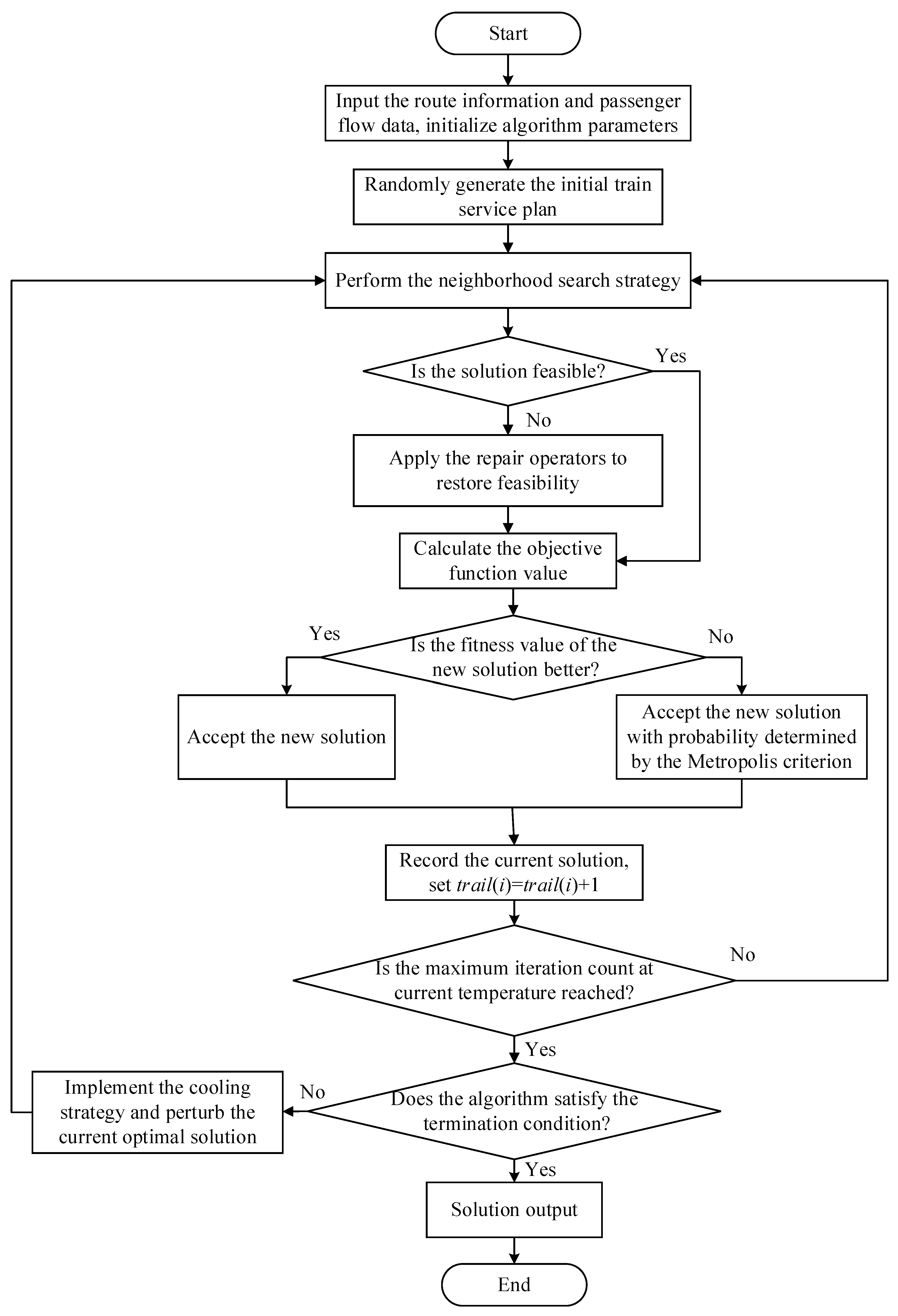
3.3. Algorithm Solution Procedure
4. Computation Case and Results Analysis
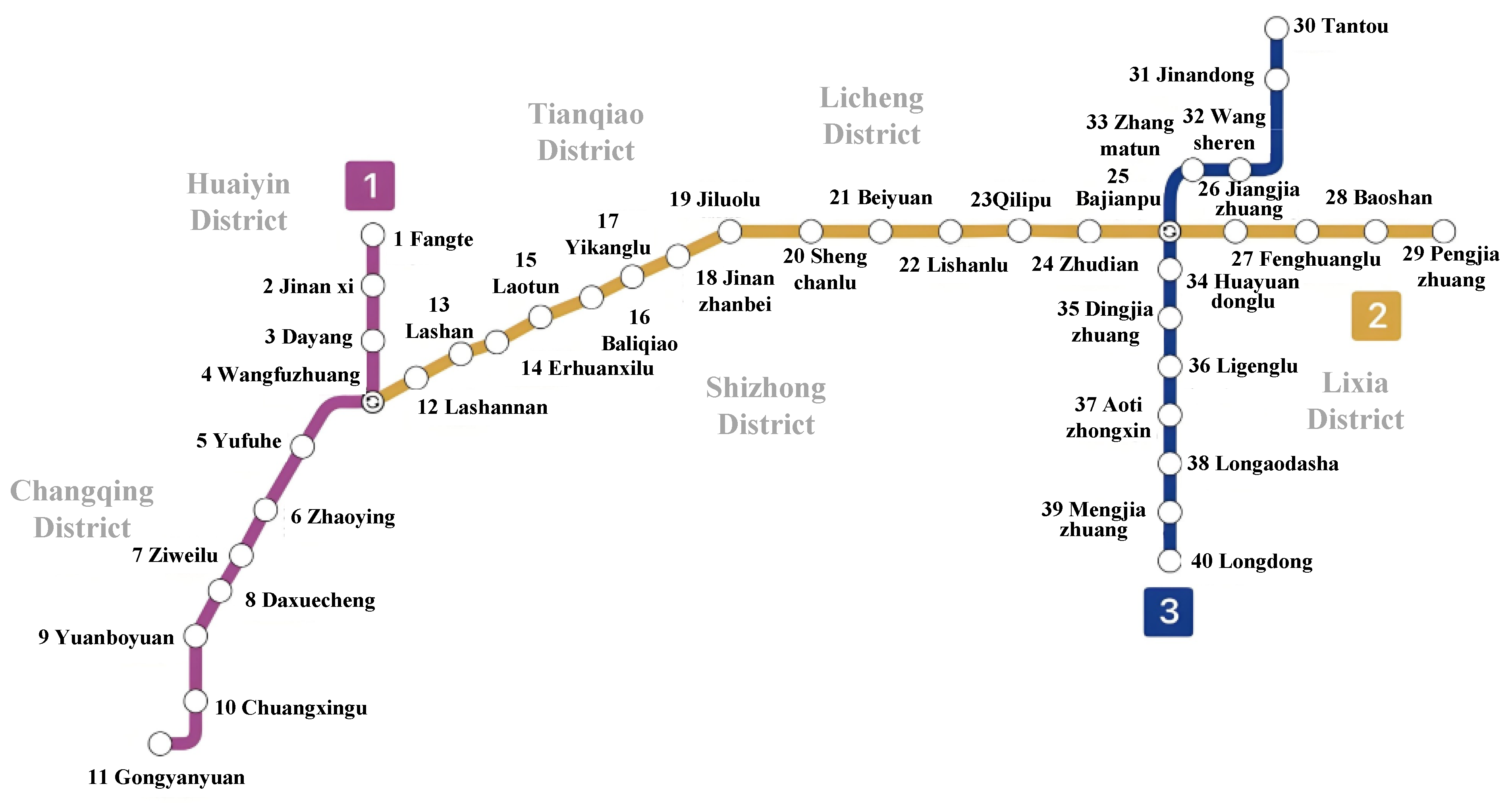
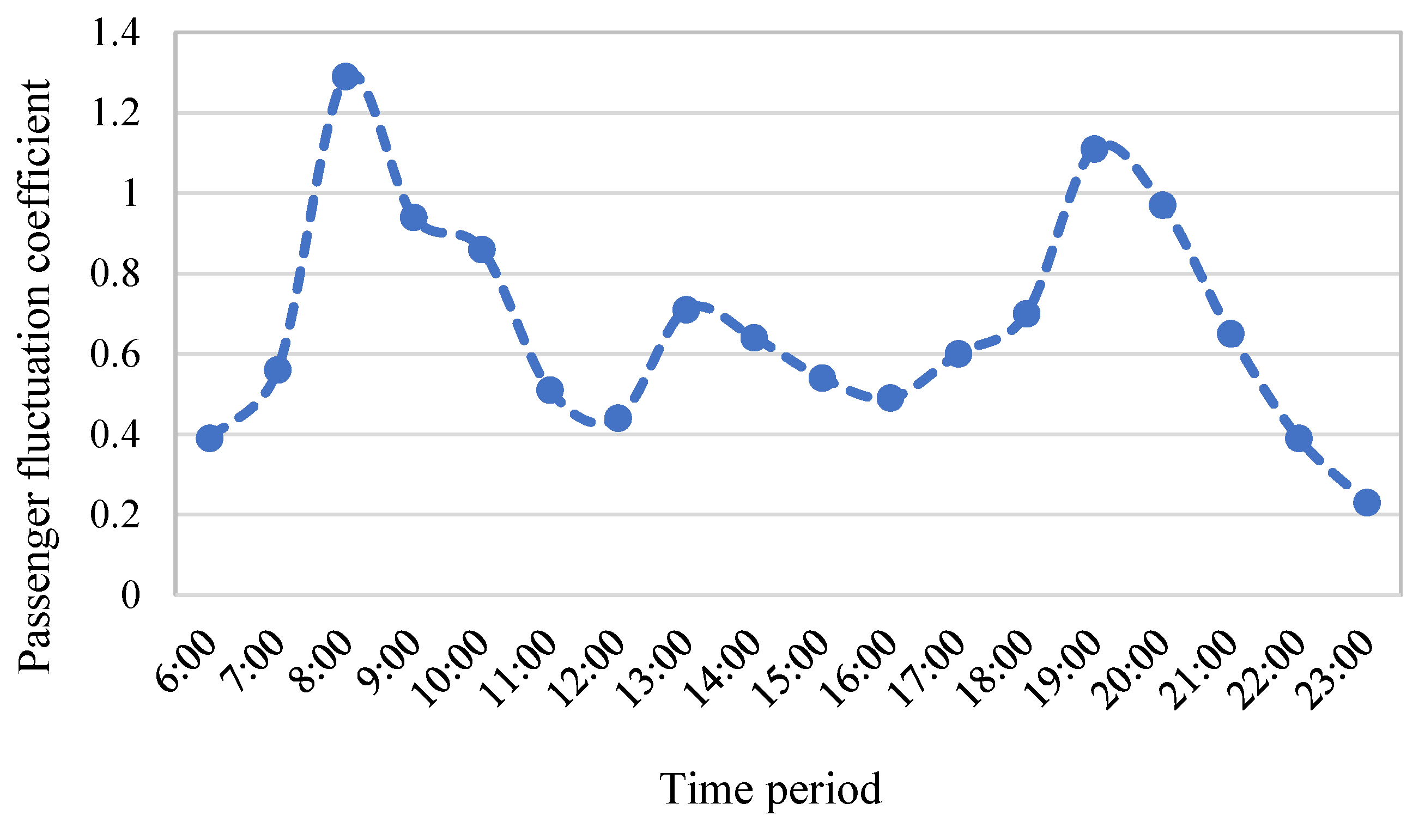
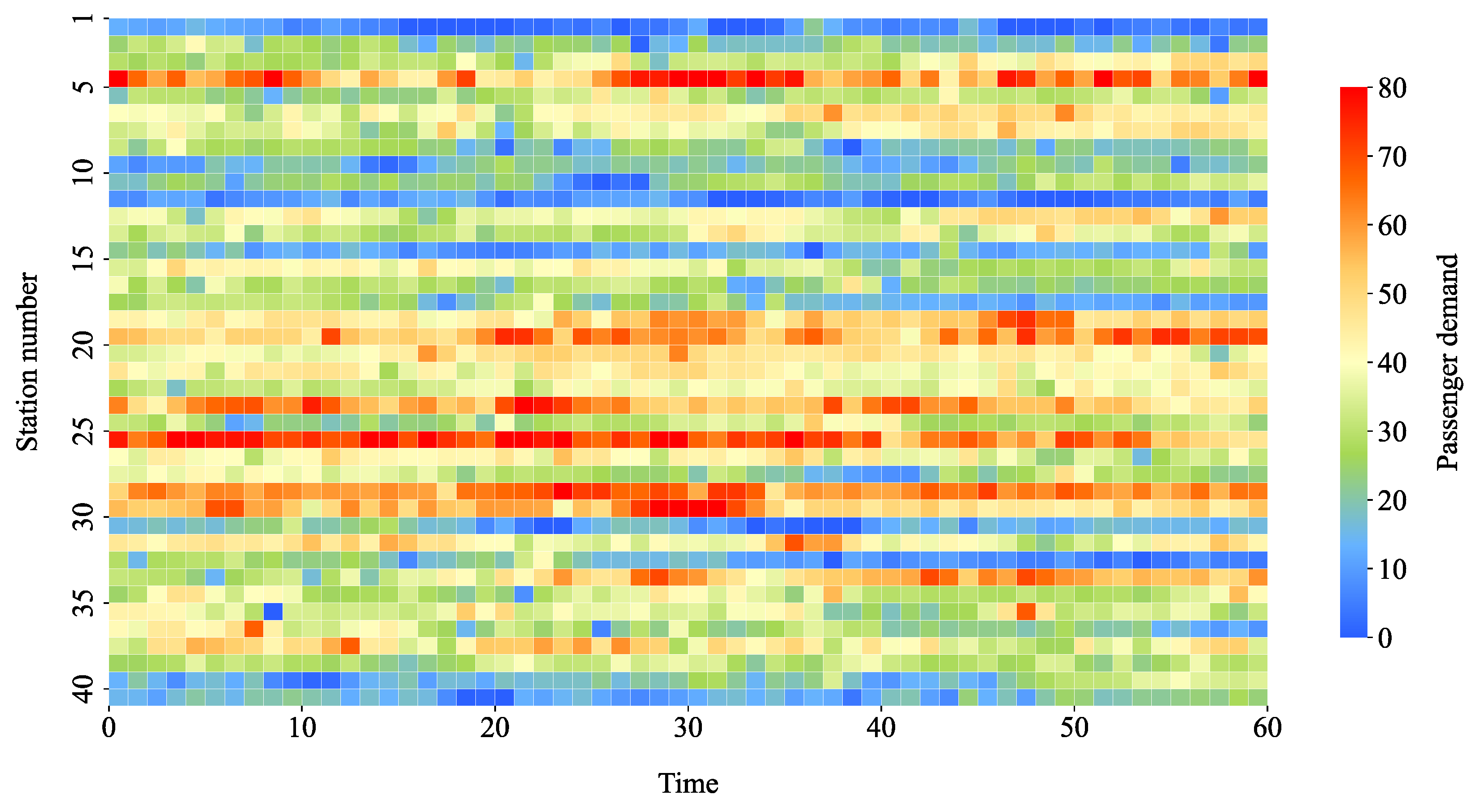
4.1. Basic Parameter Settings
4.2. Analysis of Solution Results
4.2.1. Comparative Analysis of Models
4.2.2. Comparative Analysis of Algorithms
5. Conclusions
Author Contributions
Funding
Institutional Review Board Statement
Informed Consent Statement
Data Availability Statement
Acknowledgments
Conflicts of Interest
References
- Zhou, Q.; Liang, X.; Huang, J.S.; Wang, H.P.; Mao, B.H. Carbon Emission Efficiency and Influencing Factors Analysis of Urban Rail Transits. J. Transp. Syst. Eng. Inf. Technol. 2023, 23, 30–38. [Google Scholar] [CrossRef]
- Kathryn, G.L.; Nelson, J.D.; McLelland, B.C.; Hastings, A. Japan and the UK: Emission Predictions of Electric and Hydrogen Trains to 2050. Transp. Res. Interdiscip. Perspect. 2021, 10, 100344. [Google Scholar] [CrossRef]
- Zhu, Z.; Lu, C.T. Life Cycle Assessment of Shared Electric Bicycle on Greenhouse Gas Emissions in China. Sci. Total Environ. 2023, 860, 160546. [Google Scholar] [CrossRef] [PubMed]
- Huang, Y.W.; Chen, X.; Yan, Y.B.; Yuan, M.Z.; Lv, S.F.; Luo, H.F. Full Life-Cycle Carbon Emission Intensity of Subway: A Case Study of Guangzhou Metro Line 21. Rail. Transp. Econ. 2025, 47, 24–36+76. [Google Scholar] [CrossRef]
- Zhao, P.J.; Zeng, L.G.; Li, P.L.; Lu, H.Y.; Hu, H.Y.; Li, C.M.; Zheng, M.Y.; Li, H.T.; Yu, Z.; Yuan, D.Y.; et al. China’s Transportation Sector Carbon Dioxide Emissions Efficiency and Its Influencing Factors Based on the EBM DEA Model with Undesirable Outputs and Spatial Durbin Model. Energy 2022, 238, 121934. [Google Scholar] [CrossRef]
- Roy, M.; Ghoddusi, H.; Jessika, E.T. Evaluating Low-Carbon Transportation Technologies When Demand Responds to Price. Environ. Sci. Technol. 2022, 56, 2096–2106. [Google Scholar] [CrossRef]
- Shi, H.T.; Chai, J.; Lu, Q.Y.; Zheng, J.L.; Wang, S.Y. The Impact of China’s Low-Carbon Transition on Economy, Society and Energy in 2030 Based on CO2 Emissions Drivers. Energy 2022, 239, 122336. [Google Scholar] [CrossRef]
- Pu, J.; Cai, C.; Guo, R.; Su, J.C.; Lin, R.M.; Liu, J.; Peng, K.M.; Huang, C.G.; Huang, X.F. Carbon Emissions of Urban Rail Transit in Chinese Cities: A Comprehensive Analysis. Sci. Total Environ. 2024, 921, 171092. [Google Scholar] [CrossRef]
- Nieuwenhuijsen, M.J. Urban and Transport Planning Pathways to Carbon Neutral, Liveable and Healthy Cities: A Review of the Current Evidence. Environ. Int. 2020, 140, 105661. [Google Scholar] [CrossRef]
- He, Y.J.; Liu, X.R.; Sun, E.; Wu, D.F. Balancing Economic Growth and Environmental Conservation Through the Optimization of Rail Transit Routes for Sustainable Development. Sci. Rep. 2024, 14, 31926. [Google Scholar] [CrossRef]
- Da Fonseca-Soares, D.; Eliziario, S.A.; Galvinicio, J.D.; Ramos-Ridao, A.F. Life-Cycle Greenhouse Gas (GHG) Emissions Calculation for Urban Rail Transit Systems: The Case of Pernambuco Metro. Appl. Sci. 2023, 13, 8965. [Google Scholar] [CrossRef]
- Wang, T.; Xiao, G.N.; Li, Q.J.; Biancardo, S.A. The Impact of the 21st-Century Maritime Silk Road on Sulfur Dioxide Emissions in Chinese Ports: Based on the Difference-in-Difference Model. Front. Mar. Sci. 2025, 12, 1608803. [Google Scholar] [CrossRef]
- Pan, H.C.; Lu, J.B.; Hu, H.; Liu, Z.G.; Sha, Y. Collaborative Optimization of Urban Rail Timetable and Flow Control under Mixed Passenger and Freight Transportation. J. Transp. Syst. Eng. Inf. Technol. 2023, 23, 187–196. [Google Scholar] [CrossRef]
- Ma, Y.Y.; Meng, X.L.; Jia, B.T.; Ren, Y.Y.; Qin, Y.S. An Energy-Saving Optimization Method of High-Speed Trains Based on Time Deviation Penalty during Train Operation. J. Transp. Inf. Saf. 2021, 39, 84–91. [Google Scholar]
- Liu, J.; Peng, Q.Y.; Yin, Y. Multimodal Transportation Route Planning under Low Carbon Emissions Background. J. Transp. Syst. Eng. Inf. Technol. 2018, 18, 243–249. [Google Scholar] [CrossRef]
- Lin, B.L.; Liu, C.; Wang, H.J.; Lin, R.X. Modeling the Railway Network Design Problem: A Novel Approach to Considering Carbon Emissions Reduction. Transport. Res. D Tr. E. 2017, 56, 95–109. [Google Scholar] [CrossRef]
- Wen, L.; Song, Q.Q. Simulation Study on Carbon Emission of China’s Freight System under the Target of Carbon Peaking. Sci. Total. Environ. 2022, 812, 152600. [Google Scholar] [CrossRef]
- Winkler, L.; Pearce, D.; Nelson, J.; Babacan, O. The Effect of Sustainable Mobility Transition Policies on Cumulative Urban Transport Emissions and Energy Demand. Nat. Commun. 2023, 14, 2357. [Google Scholar] [CrossRef]
- Jia, C.; Wang, X.D.; Qian, C.Y.; Cao, Z.N.; Zhao, L.; Lin, L.Z. Quantitative Study on the Environmental Impact of Beijing’s Urban Rail Transit Based on Carbon Emission Reduction. Sci. Rep. 2025, 15, 2380. [Google Scholar] [CrossRef]
- Yang, J.H.; Liu, P.X.; Zhong, F.L.; Han, N. Subway Opening Enables Urban Green Development: Evidence from Difference-in-Differences and Double Dual Machine Learning Methods. J. Environ. Manage. 2025, 375, 124177. [Google Scholar] [CrossRef]
- Lin, L.; Meng, X.L.; Song, K.W.; Feng, L.P.; Han, Z.; Xia, X.M. Train Planning for Through Operation Between Intercity and High-Speed Railways: Enhancing Sustainability Through Integrated Transport Solutions. Sustainability 2025, 17, 1089. [Google Scholar] [CrossRef]
- Schöbel, A. An Eigenmodel for Iterative Line Planning, Timetabling and Vehicle Scheduling in Public Transportation. Transp. Res. C Emerg. Technol. 2017, 74, 348–365. [Google Scholar] [CrossRef]
- Zhang, Y.X.; Peng, Q.Y.; Lu, G.Y.; Zhong, Q.W.; Zan, X.; Zhou, X.S. Integrated Line Planning and Train Timetabling Through Price-Based Cross-Resolution Feedback Mechanism. Transp. Res. B Methodol. 2022, 155, 240–277. [Google Scholar] [CrossRef]
- Xu, D.J.; Mao, B.H.; Chen, S.K.; Gong, L.; Zeng, J.W. Optimization of Operation Scheme for Full-Length and Short-Turn Routings Considering Operation Proportion. J. Traffic Transp. Eng. 2021, 21, 173–186. [Google Scholar] [CrossRef]
- Shi, J.G.; Yang, J.; Zhou, F.; Xu, R.H. Integrate Optimization Model of Operation Schedule for Metro Express/Local Train. J. Traffic Transp. Eng. 2018, 18, 130–138. [Google Scholar] [CrossRef]
- Chen, Z.Y.; Ouyang, H.; Xu, G.M.; Su, H.J. Multi-Period Frequency Optimization of Urban Rail Lines Based on Travel Reliability. J. Railw. Sci. Eng. 2022, 19, 3526–3535. [Google Scholar] [CrossRef]
- Yang, A.A.; Sun, J.Y.; Wang, B.; Chen, S.K.; Ming, W. Optimization of Virtual-Coupling-Orientated Train Operation Plan Based on Full-Length and Short-Turn Routing. J. Beijing Jiaotong Univ. 2022, 46, 9–14. [Google Scholar]
- Ding, X.Q.; Guan, S.T.; Sun, D.J.; Jia, L.M. Short Turning Pattern for Relieving Metro Congestion During Peak Hours: The Substance Coherence of Shanghai, China. Eur. Transp. Res. Rev. 2018, 10, 28. [Google Scholar] [CrossRef]
- Li, Z.Y.; Zhao, J.; Peng, Q.Y. Train Service Design in an Urban Rail Transit Line Incorporating Multiple Service Routes and Multiple Train Compositions. Transp. Res. C Emerg. Technol. 2021, 123, 102959. [Google Scholar] [CrossRef]
- Lin, L.; Meng, X.L.; Cheng, X.Q.; Ma, Y.Y.; Xu, S.C. Train Service Plan Design under the Condition of Multimodal Rail Transit Systems Integration and Interconnection. J. Adv. Transport. 2023, 2023, 8275191. [Google Scholar] [CrossRef]
- Dai, Y.Z.; Zhan, S.G. Analysis of Full-Length and Short-Turn Routing of Urban Rail Transit Considering Carbon Emission. J. Railw. Sci. Eng. 2022, 19, 3546–3556. [Google Scholar] [CrossRef]
- Huang, K.; Liao, F.X.; Gao, Z.Y. An Integrated Model of Energy-Efficient Timetabling of the Urban Rail Transit System with Multiple Interconnected Lines. Transp. Res. C Emerg. Technol. 2021, 129, 103171. [Google Scholar] [CrossRef]
- Lin, L.; Meng, X.L.; Cheng, X.Q.; Han, Z.; Fu, Y.X. A Method for Developing Service Plan of Urban Rail Train Considering Carbon Emissions Impacts. J. Transp. Inf. Saf. 2023, 41, 176–184. [Google Scholar]
- Claessens, M.T.; Vandijk, N.M.; Zwaneveld, P.J. Cost Optimal Allocation of Rail Passenger Lines. Eur. J. Oper. Res. 1998, 110, 474–489. [Google Scholar] [CrossRef]
- Canca, D.; Delossantos, A.; Laporte, G.; Mesa, J.A. An Adaptive Neighborhood Search Metaheuristic for the Integrated Railway Rapid Transit Network Design and Line Planning Problem. Comput. Oper. Res. 2017, 78, 1–14. [Google Scholar] [CrossRef]
- Peng, Q.Y.; Liu, S.Y.; Jiang, S.; Feng, T.; Chen, Y.; Zhao, Y.X. Collaborative Optimization of Suburban Railway and Metro Train Operation Plans under Interconnection Operational Mode. J. Transp. Syst. Eng. Inf. Technol. 2025, 25, 36–47. [Google Scholar] [CrossRef]
- Binder, S.; Maknoon, Y.; Bierlaire, M. Exogenous Priority Rules for the Capacitated Passenger Assignment Problem. Transp. Res. B Methodol. 2017, 105, 19–42. [Google Scholar] [CrossRef]
- Li, W.Q.; Ni, S.Q.; Yang, Y.H.; Wen, D. Research on Passenger Flow Assignment Method of High-Speed Railway Based on Line Plan. J. China Railw. Soc. 2021, 43, 1–8. [Google Scholar] [CrossRef]



| Indicator | Year | YoY Change | |
|---|---|---|---|
| 2023 | 2024 | ||
| Total Electricity Consumption (MWh) | 2,529,406.09 | 2,702,252.06 | 6.83% |
| Electricity Consumption per Vehicle-kilometer (kWh/veh·km) | 3.56 | 3.54 | −0.42% |
| Electricity Consumption per Passenger-kilometer (kWh/pax·km) | 0.104 | 0.102 | −1.34% |
| Total CO2 Emissions (tCO2) | 13,572,793.10 | 14,500,284.57 | 6.83% |
| CO2 Emissions per 10,000 Vehicle-kilometers (tCO2/10,000 veh·km) | 19.10 | 19.02 | −0.42% |
| CO2 Emissions per 10,000 Passenger-kilometers (tCO2/10,000 pax·km) | 0.556 | 0.549 | −1.34% |
| Notations | Description | Role |
|---|---|---|
| Total travel costs for passengers | Sub-objective | |
| Operating costs for enterprise | Sub-objective | |
| Carbon emissions from metro trains | Sub-objective | |
| Total travel time for passengers from station i to station j via travel path k during time period h | Intermediate variable | |
| Waiting time for passengers from station i to station j via travel path k during time period h | Intermediate variable | |
| Onboard travel time for passengers from station i to station j via travel path k during time period h | Intermediate variable | |
| Onboard dwell waiting time incurred by passengers traveling from station i to station j via travel path k during time period h at intermediate stations | Intermediate variable | |
| Transfer time for passengers from station i to station j via travel path k during time period h | Intermediate variable | |
| The crowding-induced disutility cost for passengers traveling from station i to station j via travel path k during period h | Intermediate variable | |
| Total power consumption over the study period | Intermediate variable | |
| Traction power consumption of metro trains | Intermediate variable | |
| Power consumption of the lighting system in metro trains | Intermediate variable | |
| Power consumption of the signaling system in metro trains | Intermediate variable | |
| Power consumption of the air conditioning system in metro trains | Intermediate variable | |
| Service frequency of trains with m formations on train route e during period h | Decision variable | |
| It takes a value of 1 if routing e services station i and aligns directionally with passenger path choice k, otherwise 0 | 0–1 variable | |
| It takes the value 1 if station j is directly accessible from station i on passenger path choice k without intermediate stops, otherwise 0 | 0–1 variable | |
| It takes the value 1 if passengers traveling from station i to station j via path choice k incurs exactly one transfer along the entire path, otherwise 0 | 0–1 variable | |
| It takes the value 1 if routing services both transfer station and transfer station while aligning directionally with passenger path choice , otherwise 0 | 0–1 variable | |
| Set of research periods. Each research period h has a fixed duration of one hour | Set | |
| Set of feasible passenger travel paths. k is an arbitrary route in the set | Set | |
| Set of stations | Set | |
| Set of train routes, where and are arbitrary routes in the set | Set | |
| Short-formation train | Symbol | |
| Long-formation train | Symbol | |
| Passenger flow from station i to station j via path k during time period h | Parameter | |
| Monetary conversion coefficient for value of time | Parameter | |
| Distance from station i to station j traversing path k | Parameter | |
| Average running speed via path k from station i to station j during time period h | Parameter | |
| Average per-stop dwell time during period h, comprising boarding/alighting time and start–stop additional time | Parameter | |
| Transfer walking time | Parameter | |
| Rated passenger capacity of an m-formation train | Parameter | |
| Operating cost per vehicle-kilometer | Parameter | |
| Total number of vehicles in an m-formation train | Parameter | |
| The operating mileage of trains on route e | Parameter | |
| Share of fossil fuel-fired power generation | Parameter | |
| Adhesive traction force of an m-formation train | Parameter | |
| Adhesive mass of an m-formation train | Parameter | |
| Adhesion coefficient | Parameter | |
| Average operating speed of trains on route e | Parameter | |
| Specific basic resistance | Parameter | |
| Number of lighting fixtures per carriage | Parameter | |
| Internal surface area of the carriage | Parameter | |
| Indoor–outdoor temperature difference of the carriage | Parameter | |
| Minimum service frequency | Parameter | |
| The maximum capacity of lines and stations | Parameter | |
| Cross-sectional passenger volume in section n during period h | Parameter | |
| The total number of sections | Parameter | |
| Maximum load factor | Parameter | |
| The number of available vehicles per unit time period | Parameter |
| Section | Distance (m) | Section | Distance (m) |
|---|---|---|---|
| Fangte–Jinanxi | 1545 | Beiyuan–Lishanlu | 814 |
| Jinanxi–Dayang | 1994 | Lishanlu–Qilipu | 2377 |
| Dayang–Wangfuzhuang | 3953 | Qilipu–Zhudian | 1500 |
| Wangfuzhuang–Yufuhe | 2961 | Zhudian–Bajianpu | 2174 |
| Yufuhe–Zhaoying | 3136 | Bajianpu–Jiangjiazhuang | 2086 |
| Zhaoying–Ziweilu | 3424 | Jiangjiazhuang–Fenghuanglu | 1682 |
| Ziweilu–Daxuecheng | 1903 | Fenghuanglu–Baoshan | 3771 |
| Daxuecheng–Yuanboyuan | 1841 | Baoshan–Pengjiazhuang | 3755 |
| Yuanboyuan–Chuangxingu | 3003 | Tantou–Jinandong | 2524 |
| Chuangxingu–Gongyanyuan | 1975 | Jinandong–Wangsheren | 3145 |
| Wangfuzhuang–Lashannan | 1836 | Wangsheren–Zhangmatun | 2112 |
| Lashannan–Lashan | 3703 | Zhangmatun–Bajianpu | 2228 |
| Lashan–Erhuanxilu | 2055 | Bajianpu–Huayuandonglu | 1532 |
| Erhuanxilu–Laotun | 2040 | Huayuandonglu–Dingjiazhuang | 1619 |
| Laotun–Baliqiao | 836 | Dingjiazhuang–Ligenglu | 1050 |
| Baliqiao–Yikanglu | 987 | Ligenglu–Aotizhongxin | 888 |
| Yikanglu–Jinanzhanbei | 1175 | Aotizhongxin–Longaodasha | 1151 |
| Jinanzhanbei–Jiluolu | 1310 | Longaodasha–Mengjiazhuang | 2002 |
| Jiluolu–Shengchanlu | 1985 | Mengjiazhuang–Longdong | 1713 |
| Shengchanlu–Beiyuan | 1604 |
| Station | Dwell Time (s) | Station | Dwell Time (s) | Station | Dwell Time (s) |
|---|---|---|---|---|---|
| Fangte | 200 | Laotun | 80 | Pengjiazhuang | 110 |
| Jinanxi | 100 | Baliqiao | 85 | Tantou | 115 |
| Dayang | 80 | Yikanglu | 80 | Jinandong | 100 |
| Wangfuzhuang | 95 | Jinanzhanbei | 95 | Wangsheren | 85 |
| Yufuhe | 80 | Jiluolu | 100 | Zhangmatun | 85 |
| Zhaoying | 80 | Shengchanlu | 90 | Huayuandonglu | 95 |
| Ziweilu | 90 | Beiyuan | 90 | Dingjiazhuang | 90 |
| Daxuecheng | 85 | Lishanlu | 90 | Ligenglu | 90 |
| Yuanboyuan | 80 | Qilipu | 95 | Aotizhongxin | 95 |
| Chuangxingu | 80 | Zhudian | 85 | Longaodasha | 85 |
| Gongyanyuan | 110 | Bajianpu | 105 | Mengjiazhuang | 80 |
| Lashannan | 85 | Jiangjiazhuang | 80 | Longdong | 110 |
| Lashan | 80 | Fenghuanglu | 85 | ||
| Erhuanxilu | 90 | Baoshan | 90 |
| Parameter | Value | Measurement Unit |
|---|---|---|
| 25 | CNY/h | |
| 17 | h | |
| 4 | Vehicle | |
| 6 | Vehicle | |
| 4.8 | min | |
| 60 | CNY/(Vehicle·km) | |
| 80 | % | |
| 146.2 | t | |
| 222.2 | t | |
| 10 | Count | |
| 322 | m2 | |
| 10 | °C | |
| 6 | Train pairs/hour | |
| 40 | Train pairs/hour | |
| 120 | % | |
| 210 | Vehicle |
| Model | Line 1 | Line 2 | Line 3 |
|---|---|---|---|
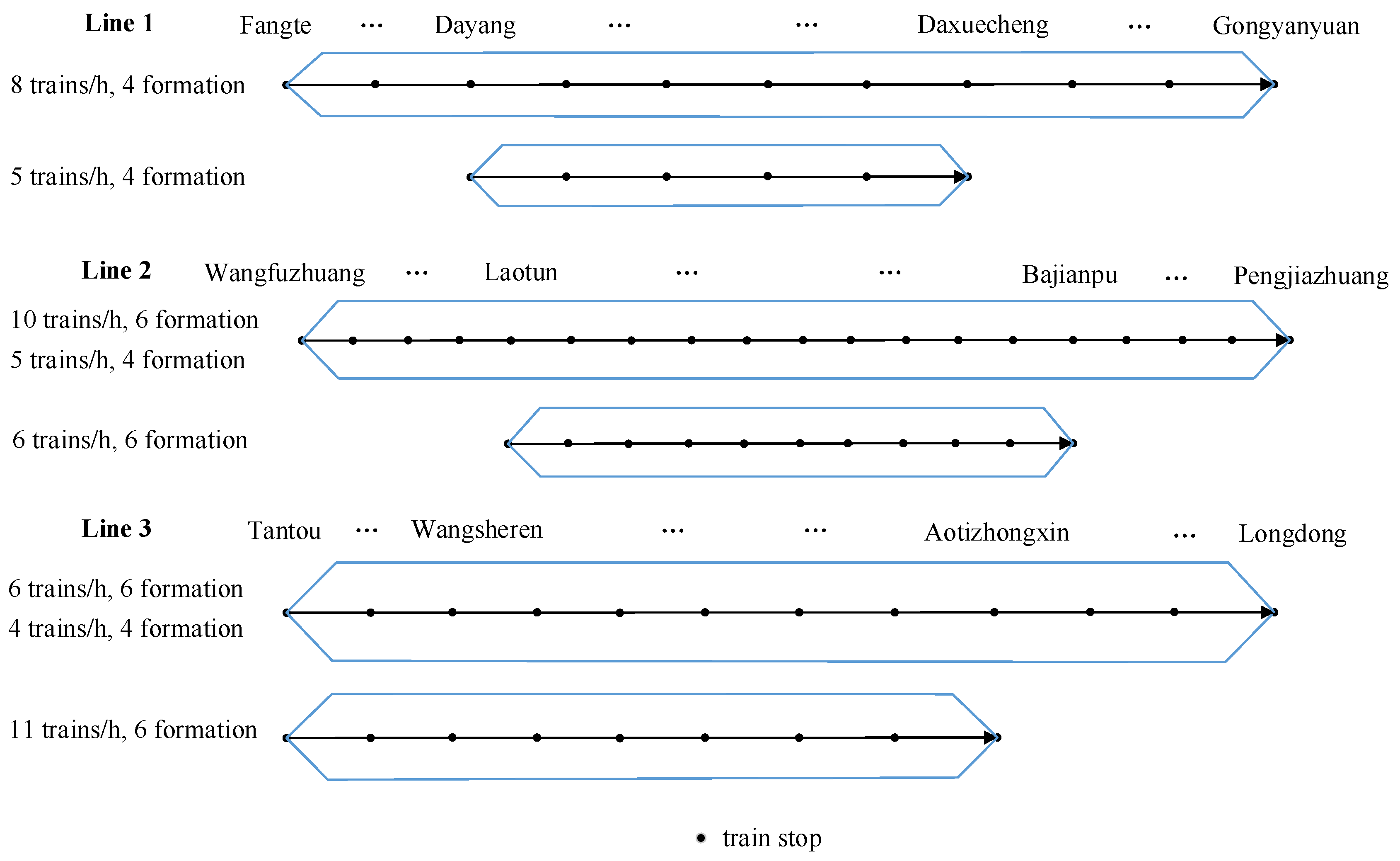
| This model | Long routing: 8 trains/h, 4 formation Short routing: 5 trains/h, 4 formation | Long routing: 10 trains/h, 6 formation + 5 trains/h, 4 formation Short routing: 6 trains/h, 6 formation | Long routing: 6 trains/h, 6 formation + 4 trains/h, 4 formation Short routing: 11 trains/h, 6 formation |
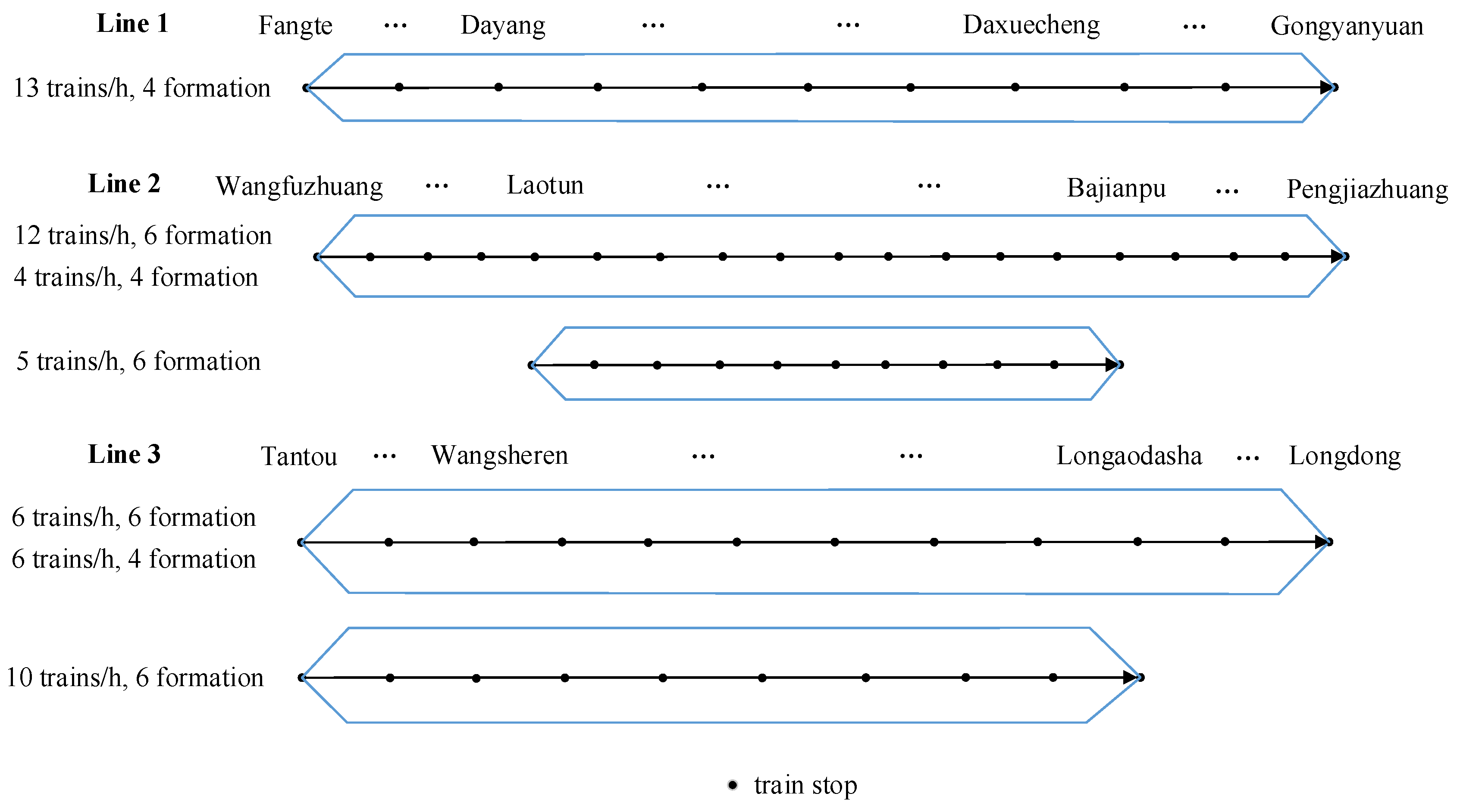
| Long routing model | 13 trains/h, 4 formation | 16 trains/h, 6 formation 5 trains/h, 4 formation | 12 trains/h, 6 formation 12 trains/h, 4 formation |
| Long-formation model | 9 trains/h, 6 formation | Long routing: 14 trains/h, 6 formation Short routing: 6 trains/h, 6 formation | Long routing: 9 trains/h, 6 formation Short routing: 11 trains/h, 6 formation |
| Short-formation model | 13 trains/h, 4 formation | Long routing: 21 trains/h, 4 formation Short routing: 8 trains/h, 4 formation | Long routing: 13 trains/h, 4 formation Short routing: 17 trains/h, 4 formation |
| The currently implemented timetable | 13 trains/h, 4 formation | 20 trains/h, 6 formation | 20 trains/h, 6 formation |
Disclaimer/Publisher’s Note: The statements, opinions and data contained in all publications are solely those of the individual author(s) and contributor(s) and not of MDPI and/or the editor(s). MDPI and/or the editor(s) disclaim responsibility for any injury to people or property resulting from any ideas, methods, instructions or products referred to in the content. |
© 2025 by the authors. Licensee MDPI, Basel, Switzerland. This article is an open access article distributed under the terms and conditions of the Creative Commons Attribution (CC BY) license (https://creativecommons.org/licenses/by/4.0/).
Share and Cite
Lin, L.; Meng, X.; Song, K.; Han, Z.; Xia, X.; Yang, W. Formulation of Green Metro Train Service Plan Considering Passenger Travel Costs, Operational Costs, and Carbon Emissions. Sustainability 2025, 17, 7776. https://doi.org/10.3390/su17177776
Lin L, Meng X, Song K, Han Z, Xia X, Yang W. Formulation of Green Metro Train Service Plan Considering Passenger Travel Costs, Operational Costs, and Carbon Emissions. Sustainability. 2025; 17(17):7776. https://doi.org/10.3390/su17177776
Chicago/Turabian StyleLin, Li, Xuelei Meng, Kewei Song, Zheng Han, Ximan Xia, and Wenwen Yang. 2025. "Formulation of Green Metro Train Service Plan Considering Passenger Travel Costs, Operational Costs, and Carbon Emissions" Sustainability 17, no. 17: 7776. https://doi.org/10.3390/su17177776
APA StyleLin, L., Meng, X., Song, K., Han, Z., Xia, X., & Yang, W. (2025). Formulation of Green Metro Train Service Plan Considering Passenger Travel Costs, Operational Costs, and Carbon Emissions. Sustainability, 17(17), 7776. https://doi.org/10.3390/su17177776