Article

Evolution of Industrial Structure and Economic Growth in Hebei Province, China

1
School of Economics and Finance, Xi’an Jiaotong University, Xi’an 710049, China
2
Earth and Environmental Studies, Montclair State University, Montclair, NJ 07043, USA
3
School of Tourism Data, Guilin Tourism University, Guilin 541004, China
*
Author to whom correspondence should be addressed.
Sustainability 2025, 17(17), 7756; https://doi.org/10.3390/su17177756
Submission received: 13 July 2025 / Revised: 21 August 2025 / Accepted: 25 August 2025 / Published: 28 August 2025
(This article belongs to the Section Economic and Business Aspects of Sustainability)

Abstract

Over the past several decades, old industrialized regions worldwide have faced immense pressure to adapt to global economic shifts. Using one of China’s major industrial provinces, Hebei, as a representative case study, this study examines how the evolution of one of China’s old industrial provinces, Hebei’s industrial structure has influenced its economic growth from 1990 to 2023. Drawing on theories of structural transformation and endogenous growth, we argue that the reallocation of resources from lower-productivity sectors (e.g., agriculture) to higher-productivity sectors (manufacturing and services) can act as an engine of growth. We employ a shift-share analysis (SSA) to decompose Hebei’s economic growth into components attributable to national trends, industrial structure, and regional competitive performance. The results reveal a globally relevant pattern of stagnation: while Hebei’s growth largely benefited from nationwide economic expansion (national effect), its heavy industrial structure initially posed a drag on growth (negative structural effect) and its regional competitive advantage in steel and energy sectors has eroded over time (weakening competitive effect). Our regression analysis further shows that growth was overwhelmingly dependent on capital accumulation while the contribution of labor was statistically insignificant, pointing to a low-productivity trap common in such regions. By integrating these methods, this study provides a robust diagnostic framework for identifying the root causes of economic distress in legacy industrial regions both within and outside China. These findings underscore the importance of structural upgrading for sustainable growth and offer critical lessons for policymakers globally, highlighting the necessity of moving beyond extensive, capital-driven growth toward an intensive model focused on industrial diversification, innovation, and human capital to ensure the sustainable revitalization of post-industrial economies.

1. Introduction

Economic development is invariably accompanied by profound changes in the composition of economic activity across sectors. Classic development theorists such as Colin Clark and Simon Kuznets observed that as economies grow, labor and output shift from agriculture to industry and then to services [1,2]. These structural transformations are not merely consequences of growth but can be drivers of productivity improvement. When labor and capital move from low-productivity sectors to higher-productivity sectors, aggregate economic growth accelerates. This insight, articulated in theories like Lewis’s dual-sector model [3], suggests that changing the industrial structure of an economy can be a powerful mechanism for endogenous growth by increasing overall efficiency and fostering technological progress.
In the context of China’s economic rise, structural change has been especially rapid and pronounced. Over the last four decades, China transitioned from an agrarian economy to a global industrial powerhouse and is now increasingly oriented toward services and innovation-driven industries. This structural evolution has been a key component of China’s growth miracle [4,5]. However, the patterns and impacts of structural change can vary significantly across regions within China, given differences in resource endowments, policy environments, and initial industrial bases. Hebei Province offers a compelling case study in this regard. Its developmental trajectory mirrors that of many legacy industrial regions globally, such as the Ruhr Valley in Germany or the “Rust Belt” in the United States, which have also struggled with the transition from heavy industry to a more diversified, sustainable economy. Therefore, a central goal of this study is to use Hebei not merely as a standalone case, but as a representative lens through which to analyze the common mechanisms of structural inertia and competitive decline that challenge post-industrial regions worldwide.
Located in North China and forming part of the Jing-Jin-Ji urban agglomeration (encompassing Beijing and Tianjin), Hebei has long been characterized by a heavy industrial base—notably steel, mining, and energy production [6]. This industrial emphasis contributed to rapid GDP growth in earlier decades but also led to structural imbalances and sustainability challenges. By 2015, Hebei’s economy was still heavily reliant on the secondary sector (resource mining-based industry, such as steel refining), with high value-added services underdeveloped relative to the national average. The dominance of heavy industry resulted in resource bottlenecks and environmental pressures (e.g., surging raw material and energy costs) that threatened to undermine long-term growth [7,8]. Recognizing these issues, policymakers initiated supply-side structural reforms around 2015 to reduce excess industrial capacity and promote higher-value industries. Since 2020, in line with China’s national goal of “high-quality development”, Hebei has accelerated efforts to optimize its industrial structure by nurturing strategic emerging industries and expanding the service economy.
Despite the clear policy importance of regional structural transformation, existing research has seldom integrated production factor reallocation into analyses of provincial growth in China. Many studies have examined China’s national structural change [9,10,11] or used cross-province growth regressions to assess the role of industrial structure [12,13,14,15]. However, studies on a single province like Hebei with a panel of data on output, capital, and labor by sector remain limited. Moreover, conventional growth accounting often attributes growth to factor accumulation and productivity without explicitly accounting for the contribution of sectoral shifts. This study addresses that gap by using a shift-share analysis to explicitly decompose Hebei’s economic growth into components related to national growth, industrial structure, and regional competitiveness.
The shift-share approach, originally developed in regional science [16,17], is well suited to assess how much of Hebei’s growth differential arises from its industrial mix versus its intrinsic performance. By applying this method to three decades of data, we can answer questions such as: How much did Hebei’s industrial structure change contribute to its economic growth since the early 1990s? Was growth primarily driven by nationwide trends or by Hebei-specific advantages? Is the province’s future growth more likely to come from further market-oriented reforms and factor reallocation, or from technological progress and productivity gains within sectors? These questions relate to the broader development debate on whether growth in middle-income regions will be sustained by moving up the value chain (structural upgrading) versus deepening factor accumulation [18,19]. From a global perspective, these questions are not unique to Hebei; they are at the heart of the global debate on how industrial regions can avoid the “middle-income trap” [18].
To ground our analysis, we embed it in the relevant literature on regional economic development, structural transformation, and endogenous growth theory. We draw on seminal works [2,3] and modern analyses [5] to build an analytical framework linking industrial structure with growth outcomes. This framework posits that a rationalized industrial structure—one that aligns with comparative advantage and adapts to technological change—enables more efficient allocation of capital and labor, thereby fostering higher total factor productivity. Conversely, an imbalanced structure (e.g., over-reliance on resource-intensive heavy industry) may yield short-term output gains but eventually leads to diminishing returns and macroeconomic vulnerabilities.
Methodologically, the paper combines descriptive analysis and an econometric exploration with panel data. First, we conduct a shift-share decomposition of Hebei’s growth performance from 1993 to 2023. This technique provides a clear breakdown of growth sources for Hebei during this study time, highlighting the periods when Hebei’s industrial structure either boosted or hindered its growth relative to national benchmarks. Second, we consider a panel data regression approach using the compiled dataset (which includes annual series of sectoral GDP, capital stock, and employment) from 2008 to 2019 due to data availability. We apply a fixed-effects model to statistically test the relationships suggested by the shift-share results. Although the primary focus of the study is on the shift-share findings, the panel regression discussion provides an avenue for robustness and deeper insight by controlling for unobserved heterogeneity and capturing dynamic effects.
In the following sections, we first review the theoretical and empirical literature on structural change and growth (Section 2), establishing the expected linkages and justifying our analytical approach. Section 3 describes the data and methodology, including the shift-share model and the rationale for its use in this long-term regional analysis, as well as the proposed panel regression model specification. Section 4 presents the empirical results. Section 5 provides a discussion of the findings in light of theory and draws out implications for policy and future research. Finally, Section 6 concludes the paper.
By combining rigorous empirical analysis with a strong theoretical foundation, this study aims to answer the following research questions: How have the national growth effect, industry mix effect, and regional competitive effect shaped Hebei’s economic growth over the past three decades? To what extent have capital and labor inputs contributed to sectoral output growth in Hebei? What are the key barriers preventing Hebei from achieving a successful structural transformation away from heavy industry?
To address these questions, we test the following hypotheses:
H1: 
Hebei’s economic growth has been predominantly driven by the national growth effect, but its specialized industrial structure has exerted a persistent negative drag (a negative Industry Mix Effect).
H2: 
The province’s regional competitiveness has deteriorated over time, particularly following the post-2008 period, reflecting the limits of its extensive growth model.
H3: 
Sectoral output in Hebei is significantly dependent on capital accumulation, while the contribution of labor is muted, indicating low marginal labor productivity.
Answering these questions and testing these hypotheses will contribute to the understanding of how Hebei, a strategic corridor economy supporting the Beijing–Tianjin urban core, can transition toward more sustainable growth trajectories through structural transformation.

2. Literature Review and Theoretical Framework

2.1. Structural Transformation and Economic Growth

The relationship between industrial structure and economic growth has been a central theme in development economics for decades. Kuznets [2] famously documented that modern economic growth is characterized by “sweeping structural changes” in which the shares of agriculture, industry, and services in GDP and employment are radically altered. In his comparative analysis of countries over long periods, Kuznets noted a common pattern: as income per capita rises, the relative weight of agriculture declines while industry and later services expand, in both capital and labor investments. This reallocation of resources is both a cause and effect of economic growth [20]. Clark [1] earlier observed similar regularities, highlighting that higher-income economies tend to have smaller agricultural sectors and larger service sectors—a reflection of demand shifts and productivity differentials among sectors. These empirical regularities gave rise to the notion that structural transformation is an integral part of the growth process, especially in developing economies transitioning from agrarian to industrial bases [21].
A key theoretical insight into why structural change matters for growth was provided by Lewis [3]. In Lewis’s two-sector model, an economy consists of a traditional agricultural sector with surplus labor and a modern industrial sector with higher productivity. Growth is driven by the transfer of labor from the low-productivity agricultural sector to the high-productivity industrial sector, which raises overall output per worker. This model formalized the idea that reallocating factors to more productive uses yields a structural bonus to growth beyond the gains from capital accumulation or within-sector technological progress. In essence, if production factors move to sectors where they produce more value-added, aggregate productivity increases even without new technology. More generally, a cross-country study by McMillan et al. [5] found that structural change (movement of labor between sectors) contributed positively to productivity growth in many Asian and African economies in the 1990s and 2000s. These findings underscore that the direction and productivity differential of labor reallocations are crucial: economies grow faster when resources flow into sectors that have higher productivity and/or faster productivity growth.
Another strand of literature, pioneered by Hollis Chenery and colleagues, systematically analyzed patterns of structural change across countries at different development levels. Chenery and Syrquin [22] identified typical trajectories, noting for instance that in low-income countries agriculture dominates employment and GDP, but as industrialization takes off, manufacturing’s share rises sharply. They also pointed out that the impact of structural shifts on growth can differ by development stage: in early industrialization, shifting resources to manufacturing (which often has higher capital intensity and scope for technological catch-up) provides a large boost to growth, whereas in later stages, the service sector’s expansion (primarily high-skill services) becomes important for sustaining growth. Chenery et al. [23] further argued that fast-growing developing countries tend to follow “patterns of development” involving not just capital deepening but also qualitative changes in the economy’s structure—for example, diversifying exports and upgrading technologies. Their comparative studies emphasized that structural transformation is more than an outcome of growth; it is part of a dynamic process that can either facilitate or impede growth depending on whether a country’s evolving industrial structure matches its factor endowments and the global technological context.
Recent surveys of this literature [24] reinforce a few key points. First, large productivity gaps between sectors (common in developing economies) imply that reallocation can significantly raise aggregate productivity—a potential source of “unconditional convergence” at the sectoral level as poorer economies shift into manufacturing [25]. Second, drivers of structural change include not only supply-side factors (differential productivity growth by sector as in Baumol’s hypothesis [26]) but also demand-side forces (Engel’s law for food, rising services demand with income [27]) and trade/globalization (which can accelerate industrialization or de-industrialization). Third, structural change is closely linked to urbanization, human capital accumulation, and institutional changes, making it a multifaceted component of development. In summary, the literature establishes that structural transformation—the reallocation of economic activity across agriculture, industry, and services—is both a hallmark of development and a mechanism that can influence an economy’s growth trajectory. It provides the broad context for analyzing Hebei, which has been moving from an agricultural towards an industrial and now service-oriented economy, supporting the development of the Jing-Jin-Ji urban agglomeration [28].
Such structural transformation experiences are not unique to Hebei or even China, though. Globally, industrial regions have faced similar trajectories. For instance, the Ruhr area in Germany and the Rust Belt in the United States experienced comparable periods of industrial expansion, followed by stagnation and the urgent necessity for economic restructuring. Thus, Hebei’s experience can offer valuable lessons on the role of structural realignment, industrial diversification, and the critical importance of transitioning toward innovation-driven growth.

2.2. Regional Development and Endogenous Growth Perspectives

From a regional economics perspective, understanding how industrial structure affects growth requires recognizing the spatial dimension of structural change. Theories of regional development [29,30,31] often emphasize the role of leading sectors and growth poles—regions specializing in fast-growing industries tend to pull ahead, creating divergence, unless diffusion mechanisms spread growth to lagging regions. In China, coastal provinces that developed strong manufacturing export sectors in the 1980s–2000s grew much faster than inland provinces that remained focused on agriculture or resource extraction [32]. Hebei’s experience, as a supporting province with heavy industry in the Jing-Jin-Ji urban agglomeration, reflects these dynamics: its growth has been influenced by its proximity to the vibrant Beijing-Tianjin core and by national industrial policies that at times favored heavy industry (e.g., steel) in the 2000s. The new economic geography literature suggests that industrial concentration can yield increasing returns through agglomeration economies, thereby boosting regional growth [33]. However, over-concentration in certain industries can also expose regions to shocks (commodity price swings, trade policy changes) and environmental stresses, which may ultimately reduce competitiveness.
Endogenous growth theory offers further insight by highlighting mechanisms like innovation, human capital, and knowledge spillovers that link structural composition with long-run growth. In models by Romer [34] and Aghion et al. [35], sustained growth arises from technological innovation—often concentrated in certain high-tech industries. Regions or countries that develop new industries (e.g., electronics, biotechnology, digital services) can generate increasing returns to scale due to knowledge spillovers and the non-rival nature of technological improvements [36]. This implies that an economy’s ability to shift into innovation-intensive sectors is critical for avoiding the slowdown predicted by exogenous growth models once capital deepening faces diminishing returns. Lucas [37] similarly argued that human capital accumulation (skills and education) produces external effects that prevent marginal returns from declining, thereby fueling long-term growth. In a regional context, this means that provinces like Hebei must not only reallocate labor and capital to existing higher productivity uses, but also upgrade qualitatively by building technological capabilities and a skilled workforce to support emerging industries. Indeed, Hebei’s recent emphasis on developing strategic new industries (such as advanced manufacturing, green energy, and high-tech services) reflects an understanding that future growth will depend on innovation and efficiency gains—hallmarks of intensive growth—rather than just the extensive expansion of traditional industries.
The concept of intensive vs. extensive growth is relevant here. Extensive growth relies on increasing inputs (labor, capital, natural resources), which Hebei pursued in the early decades (e.g., massive investment in steel plants, exploitation of coal and minerals). However, extensive growth can hit limits as factor costs rise and environmental or resource constraints bind. Intensive growth, by contrast, relies on raising productivity through better technology, reallocation, and improved efficiency in resource use. The transition from one to the other often coincides with structural change—for instance, moving from basic manufacturing to higher-value manufacturing and services often brings higher total factor productivity. Endogenous growth theory suggests that policies fostering R&D, education, and efficient allocation of resources will yield self-sustaining growth. In Hebei’s case, addressing its diminishing returns in heavy industry will require innovation and a reorientation towards sectors with greater knowledge content. This aligns with China’s broader policy direction to shift from the old model of growth (high-volume, low-margin, resource-intensive) to a new model emphasizing quality and innovation.
The theoretical framework that guides this study combines insights from structural transformation literature and endogenous growth theory. We hypothesize that Hebei’s economic growth has been significantly shaped by structural factors—namely, how resources have moved between agriculture, industry, and services—and that its future growth potential hinges on completing the shift to a more diversified and innovation-driven industrial structure. A key hypothesis is that Hebei’s heavy-industry-centric structure in past decades, while contributing to high GDP growth rates in favorable times, also led to vulnerabilities such as low aggregate productivity growth (once heavy industry matured) and exposure to policy changes (like capacity cuts for pollution control). Our empirical analysis will show evidence of these patterns: for example, a negative structural effect on growth during periods when Hebei’s industrial mix was misaligned with the fastest-growing sectors nationally, and a declining competitive effect as factor costs rose and environmental regulations tightened. Conversely, as Hebei’s structure becomes more balanced and more technology-intensive, we expect to see improvements in both the structural and competitive components of growth. The next section outlines the methodology used to empirically assess these components.

3. Materials and Methods

3.1. Data Sources and Variables

Hebei province, surrounding China’s political and economic centers of Beijing and Tianjin, is more than just a geographic entity. Hebei is a classic example of a “heavy-industry heartland”, with an economy historically built upon coal and steel production. This legacy has created a development trajectory fraught with the tensions of path dependency, severe environmental degradation, and the pressures of aligning with a national agenda that has pivoted decisively towards high-quality, innovation-driven growth. The province’s unique position makes it a focal point for major national strategies, including environmental regulation and regional integration, adding a distinct layer of complexity to its developmental challenges.
This study utilizes an extensive panel of annual data for Hebei Province spanning 1990 to 2023. The dataset was primarily compiled from the National Bureau of Statistics of China and Hebei’s provincial statistical yearbooks. It includes key macroeconomic and sectoral indicators needed to analyze structural change and growth. The main variables are:
Gross Domestic Product (GDP) by sector: We have the inflation-adjusted value added (output) of the primary (agriculture), secondary (industry and construction), and tertiary (services) sectors in Hebei for each year from 1992–2023.
Capital stock by sector: the capital stock is calculated as follows (in constant prices):
C a p i t a l S t o c k i , t = F i x e d A s s e t I n v e s t m e n t t × SectorGDP i , t j = 1 3 SectorGDP j , t FixedAssetInvestmentPriceIndex t 100
where i = Industry category (1 = Primary industry, 2 = Secondary industry, 3 = Tertiary industry), t = Year, S e c t o r G D P i , t = the value added of industry i in year t , F i x e d A s s e t I n v e s t m e n t t is the total fixed investment amount in year t , and FixedAssetInvestmentPriceIndex t is the price index of year t for the fixed assest investment, to keep the prices comparable across the years from 1992–2023.
Employment by sector: We have the number of employed people in primary, secondary, and tertiary sectors from both the state-owned enterprise and private sector for each year from 2008 to 2019. These figures show the reallocation of labor across sectors.
To ensure consistency, all monetary values were in constant prices (real terms). The data were cleaned by checking for anomalies or obvious errors.

3.2. Shift-Share Analysis Methodology

To analyze the contribution of industrial structure to Hebei’s economic growth, we employ the shift-share analysis (SSA) framework. Shift-share analysis is a classical tool in regional economics used to dissect the growth of a regional variable (such as output or employment) into components attributable to broader trends and those due to the region’s unique characteristics [38]. The approach is well-suited to our research question as it provides a clear attribution of growth between “structural” and “competitive” factors for Hebei, benchmarked against the national economy.
The shift-share technique was introduced by Daniel Creamer in the 1940s [39] and formalized by Dunn [17] in the context of regional economic analysis. It was designed to answer how much of a region’s growth (say in employment or output) over a period was due to national economic growth versus the region’s industry mix versus its local competitive performance. In our case, the region is Hebei Province, and the variable of interest is typically the value-added (GDP) or productivity in Hebei’s economy. By comparing Hebei’s growth to that of a larger reference region (here, the national Chinese economy), we can isolate whether Hebei grew faster or slower because it specialized in certain industries or because its economy was more or less competitive than average.
In the traditional (comparative-static) shift-share model, the change in a region’s total output (or employment) Δ Y between an initial year t 0 and a final year t 1 is decomposed into three additive components:
National Growth Effect (NGE)—This is the portion of the region’s growth that can be attributed to the general growth of the national economy. It answers: How much would Hebei’s output have grown if all its industries had grown at the overall national GDP growth rate? Formally, N G E = Y H e b e i , t 0 × g n a t , where g n a t is the growth rate of national GDP over the period. This component captures the external macroeconomic environment—a rising tide that lifts (or lowers) all boats. It reflects the fact that in a booming national economy, even lagging regions tend to grow somewhat, and in a national recession, even strong regions face headwinds.
Industry Mix Effect (IME)—Often called the structural effect, this component measures the advantage or disadvantage a region experiences due to its particular industry composition. It asks: how did Hebei’s growth differ because of the industries it specializes in, relative to the national average industry structure? For example, if high-tech services grew faster than the overall economy nationally, a region with a larger share of high-tech services would, ceteris paribus, tend to grow faster (positive IME). Conversely, a region heavily invested in a stagnating sector would have a negative IME. The formula is I M E = i Y i , H e b e i , t 0 × g n a t , i g n a t , summing over industries i . Here g n a t , i is the national growth rate of industry i . Essentially, IME calculates how much growth Hebei should have had given its starting industry mix, if each industry grew at the national rate for that industry, and then subtracts the pure national effect. A positive structural effect indicates Hebei’s industry mix was weighted towards faster-growing sectors than the national economy, whereas a negative value means Hebei was concentrated in slower-growing or declining sectors.
Regional Competitive Effect (RCE)—Also known as the local share effect or differential effect, this component captures the growth attributable to regional-specific factors—essentially, how Hebei’s industries performed relative to their counterparts nationwide. It is computed as R C E = i Y i , H e b e i , t 0 × g H e b e i , i g n a t , i , where g H e b e i , i is the growth rate of industry i in Hebei. If an industry in Hebei grew faster than the same industry nationally, Hebei gains a positive competitive effect from that industry (indicating some regional advantage, e.g., better firms, policy support, natural endowments, etc.). If it grew slower, the effect is negative, indicating a competitive disadvantage. Summing across all industries gives the net competitive effect for the region. This component reflects any local deviations from national industry trends and is often interpreted as a proxy for regional competitiveness or policy impact.
By construction, N G E + I M E + R C E = Δ Y H e b e i over the period. The methodology provides a straightforward but powerful disaggregation. An analogy sometimes used: imagine Hebei’s growth as being driven by (a) the national wind (NGE), (b) how its sails are set (industry composition, IME), and (c) the efficiency/strength of its own ship (its local performance, RCE).
We apply the shift-share analysis in a dynamic form year by year to track how these components evolve, rather than only a single initial-to-final decomposition. Specifically, for each year from 1993 to 2023, we treat the previous year as the base and decompose the annual growth in Hebei’s GDP into the three effects for that specific year. This year-on-year approach allows for a granular analysis of how the growth components fluctuate annually in response to economic shocks and policy shifts. This yields a time series of the national effect, structural effect, and competitive effect, which can be accumulated or analyzed over sub-periods.
It is important to note some assumptions and limitations of the shift-share method. It assumes a consistent industry classification and that national and regional data are comparable (we ensure this by using the same sector definitions for Hebei and China). It is essentially an accounting exercise: it does not by itself explain why Hebei’s industries grew faster or slower, just that they did. As Lahr and Ferreira [40] remark, shift-share analysis is “merely a practicable accounting identity” and was never meant to be a full causal model. Its strength lies in clarity and simplicity—it offers valuable insights using standard data and is not overly technical, making it a popular starting point for regional analysis. Indeed, despite critiques over the years, SSA remains widely used by regional economists and planners because it can quickly flag whether a region’s growth shortfall (or surplus) is due to unfavorable structure or weak competitiveness. We keep this interpretive nature in mind: when we find a negative structural effect, it suggests a need to adjust industrial structure, but further analysis (like regression or case studies) would be needed to pinpoint how to do so. In addition, we acknowledge that more advanced formulations of SSA exist in the literature, such as extended models that incorporate homothetic structures or dynamic variants designed to better isolate short-term competitive shifts. However, for the primary objective of this study—to provide a clear, long-term decomposition of the structural and competitive effects shaping Hebei’s three-decade trajectory, the classic formulation offers unparalleled descriptive clarity and transparency. This classic approach allows us to transparently attribute growth to its core components without the added complexity that can obscure these fundamental trends.
We chose the static shift-share model for our analysis rather than the “dynamic” variant because our interest is in the cumulative effects over long periods and the overall contribution of structural change to growth. A static model (comparing two points or computing period-by-period effects relative to a fixed base) is appropriate for evaluating the net impact of past changes and policy shifts. In contrast, other dynamic variants would often recalculate the base each period, and hence emphasize short-term competitive shifts. Our approach therefore strikes a balance: we apply the classic static formula in a dynamic, year-by-year manner. This allows us to track annual fluctuations while still interpreting trends over multi-year periods corresponding to major policy regimes (e.g., pre-WTO 1990s, post-WTO boom ~2001–2007, post-Global Financial Crisis (GFC) rebalancing 2010s).
The reference region is the national economy of China (data for the same period, 1993–2023 from the National Bureau of Statistics are used). We take national GDP growth as the benchmark for NGE, and national sectoral growth rates for IME and RCE computations. This is logical given Hebei is a province within China and subject to the same national policies and market conditions to a large extent. It also fits the research questions: for instance, one of our questions is whether Hebei’s growth has depended more on nationwide forces or on unique local factors—the shift-share breakdown directly informs this by size of NGE vs. RCE. We acknowledge that China itself had structural changes during 1993–2023 (e.g., the national economy’s industry mix changed), but the shift-share method accounts for that by using each year’s national sector growth rates.
Restricted by data availability, this study only uses the coarse sector categorization: the primary (mainly agriculture), secondary (heavy or light industries), and tertiary (service sector). One consideration is that China’s sector definitions changed after 2003 (with a reclassification of tertiary industry). We made sure to use a consistent definition or at least align the data so that the comparisons remain valid. Minor discrepancies may arise from statistical revisions, but these are unlikely to affect the qualitative insights.

3.3. Panel Regression Model

3.3.1. Data for Panel Regression

The variables for the panel regression model cover the period from 2008 to 2019 due to data availability. The dependent variable is sectoral GDP (Y), while the independent variables are sectoral capital stock (K) and sectoral employment (L). All monetary values are in constant 2008 prices to remove the effects of inflation. The units are 100 million RMB for GDP and Capital, and 10,000 people for Employment. A summary of the descriptive statistics for the variables used in the regression (after log-transformation) is provided in Table 1. As expected, there is significant variation in all variables both across the three sectors and overtime.
Other conceptually relevant inputs, such as sectoral materials/energy consumption, human capital quality indices, or R&D intensity, are not available as consistent annual series for Hebei at the sector level over 2008–2019. In line with the Cobb–Douglas core, we therefore retain capital and labor as regressors and rely on sector fixed effects to account for time-invariant sectoral attributes.

3.3.2. Model Specification and Justification

While shift-share analysis provides a powerful decomposition of growth of Hebei’s economic growth, it does not directly test hypotheses of the contributions of capital and labor in Hebei’s economic development. Therefore, we consider an econometric approach to complement the shift-share results, leveraging the panel structure of our dataset (sector-by-year). Specifically, we explore a panel data regression model to quantify the impact of structural variables (sectoral capital and labor inputs) on economic output. This econometric check is designed to validate, however, not replace, the narrative suggested by shift–share.
We have three cross-sectional units (indexed by i = 1, 2, 3 for primary, secondary, tertiary sectors) observed over T   =   12 years (2008–2019) because of the lack of employment data prior to 2008, and the disruption of the COVID-19 after 2019. This yields a panel of N   × T   =   36 observations. Although N = 3 is small, a panel framework is still applicable; effectively, we allow sector-specific intercepts while maintaining common slopes for capital and labor across sectors, which is standard with small N.
The sectoral output (value added) for each sector i in year t , denoted Y i t is used as our dependent variable. We include the main factor input Capital input ( K i t ), and Labor input ( L i t ), as our primary independent variables. The model follows a sector-level Cobb–Douglas production function, Y i t = A i f K i t , L i t , which, after log-transformation, takes the following form:
ln Y i t = α i + β ln K i t + γ ln L i t + ε i t ,
where i indexes the sector (Primary, Secondary, Tertiary), t indexes the year (2008–2019), Y is sectoral GDP, K is capital stock, and L is employment. The term α i = log A i represents the sector-specific, time-invariant fixed effect, which captures heterogeneity in total factor productivity (TFP) across the three sectors that is constant over time. The coefficients β and γ are the output elasticities of capital and labor, respectively, and are assumed to be homogeneous across sectors. Our specification is intentionally parsimonious: capital and labor are the core Cobb–Douglas inputs, while sector fixed effects absorb time-invariant productivity differences (e.g., average materials intensity or organizational efficiency). With ( N   =   3 and T   =   12 ), adding multiple additional regressors would erode degrees of freedom and exacerbate multicollinearity, especially because many candidate inputs at this aggregation level move closely with capital, yielding unstable estimates. The chosen design therefore favors a stable, interpretable baseline in a short panel [41].
With N = 3 sectors, given these are broad sectors, treating α i as fixed (i.e., correlated with regressors) is reasonable. One drawback of the fixed setting is that the effect of α i (the total factor productivity) is not directly estimated, as they are removed by the de-meaning process within each sector. Still, selecting the Fixed Effects (FE) model over a Random Effects (RE) model has strong theoretical justification. The primary assumption of an RE model is that the unobserved specific effect ( α i ) is uncorrelated with the regressors. This assumption is highly unlikely to be held in our context. For instance, inherently more productive sector (with a higher α i ) is likely to attract more capital investment, leading to a correlation between α i and K i t . The Hausman test is typically used to formally test this assumption, but its power is low with a small N . Given the strong economic rationale for correlation, the FE model is the more consistent and robust choice, as it explicitly allows for such correlation. The FE model effectively controls for all time-invariant heterogeneity, ensuring that the estimated coefficients for capital and labor are not biased by omitted, time-constant sectoral characteristics [41].
Before estimating the model, we considered the issue of stationarity. While panel unit-root and cointegration tests are common in panel studies with long time series, their power is known to be low in panels with a short time dimension, such as ours (T = 12). Applying such tests could yield unreliable results [41]. However, the use of a fixed-effects model with time-invariant fixed effects ( α i ) is already robust to certain forms of non-stationarity. Furthermore, since the primary goal of our regression is to provide a complementary, quantitative explanation for the relationships observed in the shift-share analysis rather than to establish long-run causal or forecasting relationships, we proceed with the fixed-effects estimation, acknowledging the potential for underlying time-series properties as a limitation to be explored in future research with more extensive data.

3.4. Analytical Workflow

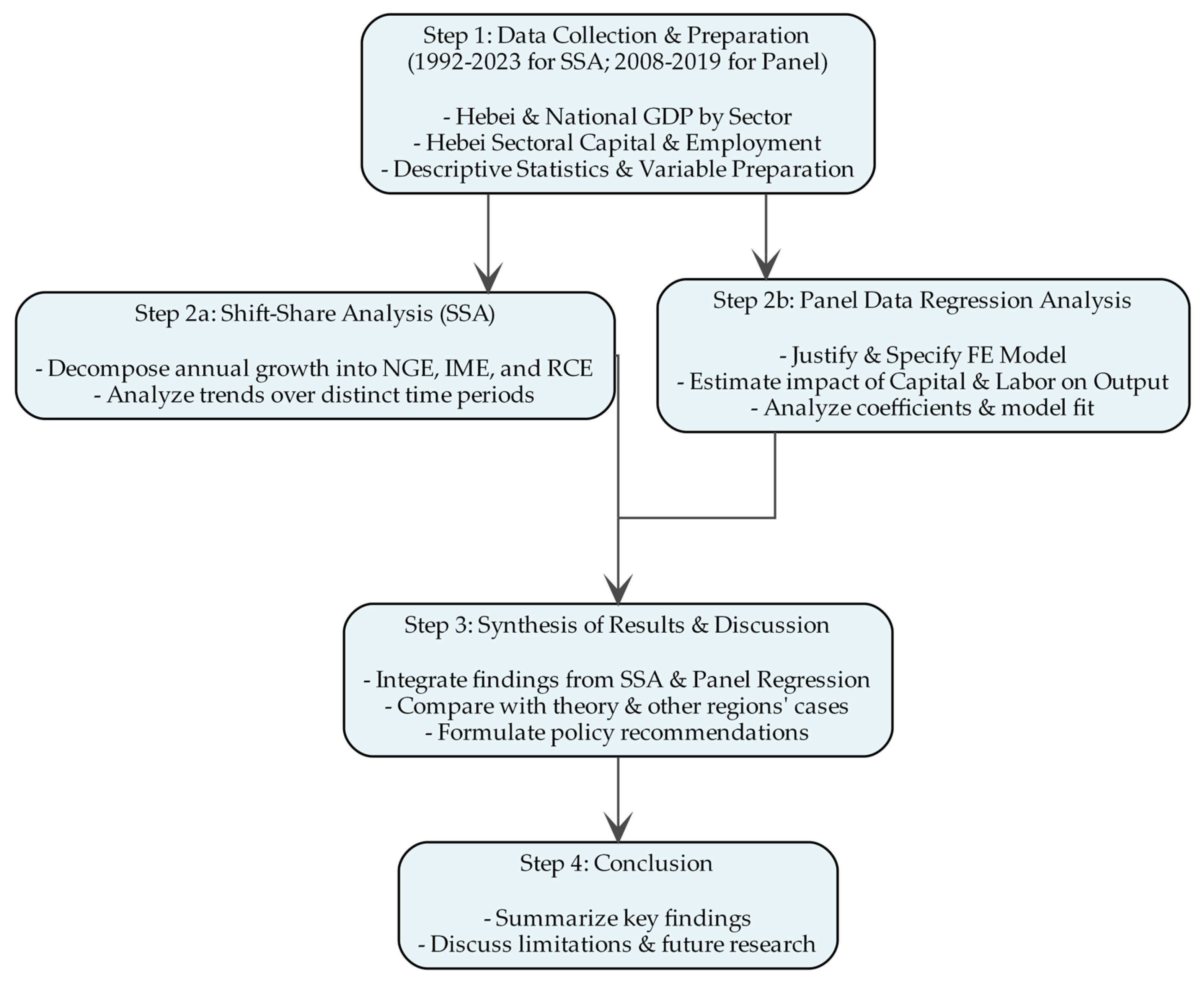
To provide a clear overview of our research process, the analytical workflow of this study is summarized in Figure 1 below. The process begins with data collection and preparation, followed by two parallel streams of empirical analysis—the shift-share decomposition and the panel regression—which are then synthesized in the discussion to derive policy implications.

4. Results

4.1. Evolution of Hebei’s Industrial Structure and Factor Allocation

Before delving into the shift-share decomposition, we first describe the major trends in Hebei’s industrial structure from 1992 through 2023, as revealed by the data. This provides context for interpreting the shift-share results.
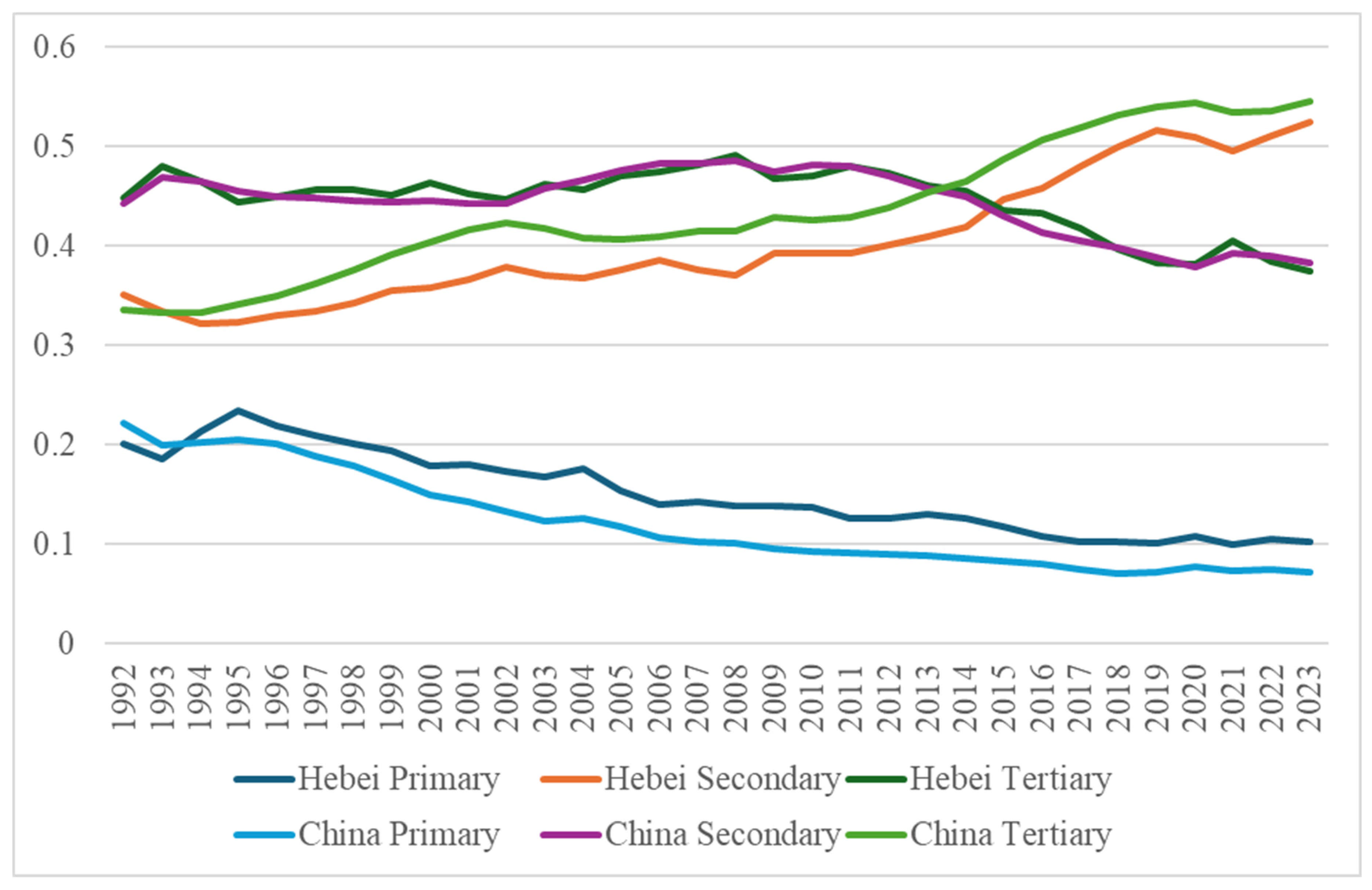
Figure 2 illustrates the changing composition of Hebei’s GDP among the primary, secondary, and tertiary sectors. An analysis of Hebei’s economic data from 1992 to 2023 reveals a story not of successful rebalancing, but of a deepening structural imbalance, especially comparing that to the national industrial structural change. Throughout the entire thirty-year period, the province’s economy was dominated by the secondary sector (industry and construction). Instead of peaking and declining, this sector’s share of provincial GDP demonstrated a remarkable and persistent increase (Figure 2), growing from 35.1% in 1992 to a commanding 52.4% by 2023. This trend reflects Hebei’s entrenched legacy as a heartland of heavy industry, which continued to expand its relative importance long after the initial boom following China’s WTO accession.
The trajectory of the other sectors underscores this lack of diversification. The primary sector’s (agriculture) contribution to GDP saw a steady and expected decline, which agrees with the national trend, falling from 20.1% in 1992 to just 10.2% by 2023. More telling is the path of the tertiary sector (services). Its share of the economy grew through the 1990s and 2000s, peaking at 47.1% in 2012. However, from that point on, the goal of creating a service-led economy faltered. The tertiary sector’s share stagnated and then entered a period of relative decline, falling to just 37.4% by 2023. The critical inflection point anticipated around 2015, when national policies began to favor services, did not materialize in Hebei’s economic structure. The province did not pivot; instead, it doubled down on its industrial base, leading to a structure that was more, not less, concentrated in the secondary sector by the end of the period.
The allocation of production factors mirrors this structural story. Capital investment was overwhelmingly channeled into the secondary sector for over two decades. The marginal productivity of this capital deteriorated over time, with the capital-output ratio for Hebei’s industrial sector worsening significantly after the mid-2000s. This indicates that each additional unit of investment was generating progressively less output—a classic sign of diminishing returns in an over-invested sector that became more acute as the province’s reliance on it grew.
The reallocation of labor was slower and more complex. While agriculture’s share of GDP fell sharply, it continued to employ a disproportionately large share of the labor force, implying persistently low and even declining relative labor productivity. The secondary sector absorbed labor during its boom years but began shedding workers as automation increased and capacity was cut. The tertiary sector became the primary engine of job creation, though its employment share grew more slowly than its output share, suggesting a rise in labor productivity within services. This slow pace of labor transition from low-productivity agriculture to higher-productivity non-agricultural sectors highlights a key challenge in Hebei’s development: structural change in output did not translate immediately into efficient labor reallocation.

4.2. Shift-Share Decomposition Results

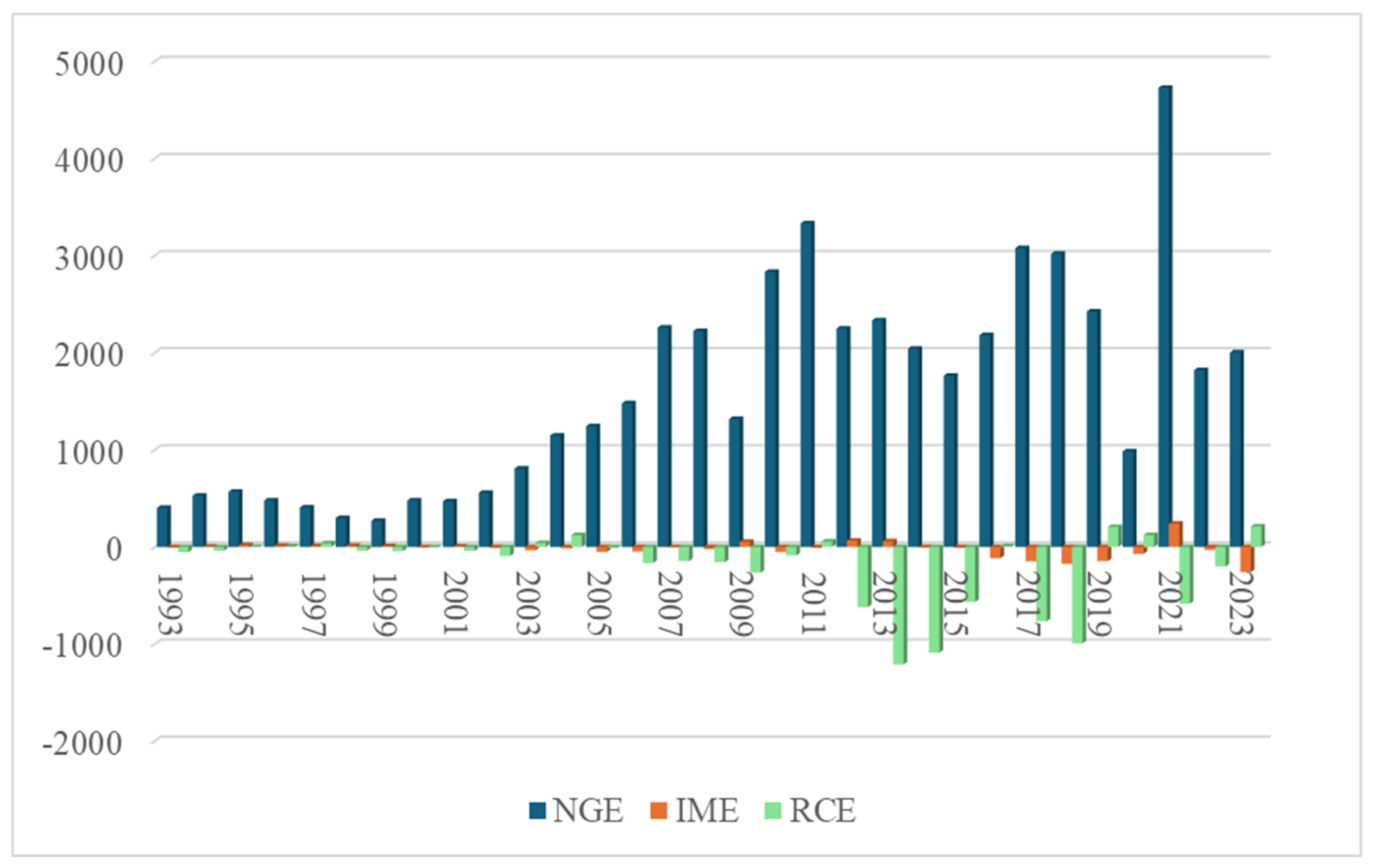
The shift-share analysis, conducted annually from 1993 to 2023, decomposes Hebei’s economic growth into the National Growth Effect (NGE), the Industry Mix Effect (IME), and the Regional Competitive Effect (RCE). The results are depicted in Figure 3, which reveal a dynamic story of how these forces shaped Hebei’s trajectory through distinct economic eras.
To better understand the long-term trends, the annual results are aggregated by averaging the contributions of each component over the distinct economic eras discussed below. The aggregated results are presented in Table 2.
Early Reform and Growth (1993–2000): In this period, the National Growth Effect (NGE) was the primary engine of Hebei’s expansion. Contrary to expectations of a structural drag, the Industry Mix Effect (IME) was small but frequently positive, suggesting Hebei’s industrial composition provided a slight advantage in the mid-to-late 1990s. The most notable finding for this era is the Regional Competitive Effect (RCE), which was highly volatile and often negative (e.g., −52.9 in 1993), averaged −16.0 per year. This indicates that even in the early reform period, Hebei’s industries struggled to consistently outperform their national counterparts, challenging the notion of a sustained early competitive advantage.
WTO Accession and Investment Boom (2001–2008): Following China’s entry into the WTO, the NGE became immense, supercharging Hebei’s growth. During this boom, the IME turned decisively negative, averaging −18.9 annually (e.g., −33.8 in 2003, −49.4 in 2005), revealing that as the national economy diversified, Hebei’s heavy-industry focus was already becoming a structural liability. However, this was masked by a highly erratic but occasionally strong (e.g., +121.0 in 2004) but still average negative RCE of −21.5 per year (Table 2). This volatility suggests a “boom and bust” pattern in competitiveness; while Hebei’s industries could ramp up production aggressively to meet demand, they also suffered periods of significant underperformance relative to the nation (e.g., RCE of −164.4 in 2006 and continued to be negative for the next few years).
Post-Financial Crisis and Deepening Imbalances (2009–2015): The global financial crisis marked a turning point. While the NGE remained substantial due to China’s massive stimulus package, the other components reveal deep-seated problems. The IME temporarily turned positive and large (e.g., +64.8 in 2012), as the stimulus-fueled construction and infrastructure boom momentarily made Hebei’s industrial structure an advantage. However, this was completely overshadowed by a catastrophic decline in the RCE. The competitive effect plummeted to extreme negative values, averaging −539.41 per year (e.g., −619.3 in 2012, −1209.8 in 2013), indicating a severe erosion of competitiveness. Rising costs, overcapacity, and environmental pressures meant Hebei’s industries were now dramatically underperforming their national peers. This period represents the true unraveling of Hebei’s extensive growth model.
Failed Rebalancing and Continued Drag (2016–Present): In this most recent period, the NGE moderated as China’s overall growth slowed. The IME became severely and consistently negative (e.g., −173.7 in 2018), averaging −58.6 annually (Table 2), confirming that Hebei’s failure to rebalance its economy has created a powerful and worsening structural drag. The RCE, while no longer in freefall (now average −249.0 in this period), still remained extremely volatile. It posted some positive years, suggesting that the worst of the competitive decline may be over, but these were punctuated by massive negative shocks (e.g., −992.7 in 2018, −583.2 in 2021). This ongoing volatility indicates that the province has not yet forged a new, stable foundation for competitive advantage and remains highly vulnerable to economic shocks.

4.3. Panel Regression Analysis Results

To supplement the shift-share findings, we estimated the panel data regression model outlined in Section 3.3. The model relates Hebei’s sectoral output to capital and labor inputs, controlling for sector fixed effects and time effects. Despite the limited degrees of freedom (3 sectors), the estimation yields insights consistent with the above qualitative analysis. Results are reported in Table 3.
The regression results show that capital has a positive and highly statistically significant effect on sectoral GDP. The coefficient for log(Capital) is 0.554, indicating that a 1% increase in the log-transformed capital is associated with a 0.554% increase in the log-transformed output, holding labor input constant. This finding provides robust quantitative evidence for the capital-intensive nature of Hebei’s growth. The model explains a very high proportion of the variance in sectoral GDP, with an adjusted R-squared of 0.912, suggesting the inputs of capital and labor, along with sector-specific fixed effects, are primary determinants of output in Hebei during the period from 2008 to 2019.
In striking contrast, the coefficient for log(Employment) is 0.069 and is not statistically significant from zero (the 95% confidence interval includes zero). This implies that, within the model’s framework, simply increasing the quantity of labor, after controlling for capital and inherent sectoral differences, did not translate into a measurable increase in output. This counterintuitive result does not suggest labor is unimportant, but rather points toward a critical issue of low labor productivity and potential mismatches in human capital.
This interpretation is consistent with a parsimonious Cobb–Douglas specification in which capital and labor capture the principal elasticities of production, while persistent sectoral productivity differences are absorbed by fixed effects rather than proliferating additional regressors in a short panel.

5. Discussion

Based on the empirical findings presented above, in this section, we synthesize the results to construct a coherent narrative of Hebei’s development and how it is situated within a broader global regional development context. We then discuss the resulting policy implications.

5.1. A Universal Challenge: Structural Drag and Waning Competitiveness in Legacy Industrial Regions

The shift-share analysis provides a clear and critical narrative of Hebei’s growth challenges. The persistently negative Industry Mix Effect (IME) confirms that for the better part of two decades, Hebei’s economic structure was a liability, compared to the national trend. More critically, this structural drag has worsened in the most recent period. The failure to shift the economy towards high value added service industries, combined with a doubling-down on the secondary sector, means the province is swimming against the structural tide of the national economy with increasing difficulty (or too reliant on its past success in the secondary industry to be willing to catch up [42]). This finding empirically validates the core premise of structural transformation theory: a region’s growth potential is fundamentally linked to its industrial composition. Hebei’s experience serves as a classic case of path dependency [43], where historical specialization created a structural inertia that has so far proven insurmountable. This deepening structural misalignment is the primary factor explaining why Hebei’s growth continues to face significant headwinds. This phenomenon is a textbook example of the challenges faced by old industrial areas worldwide. These regions often become “locked-in” to their economic specializations, making them vulnerable when national or global economic winds shift, as their accumulated capital, labor skills, and institutional focus are all geared toward industries in decline.
Simultaneously, the deterioration of the Regional Competitive Effect (RCE) from positive to negative reveals a second critical challenge: Hebei was not only specialized in the less productive sectors, but its firms in those sectors were also losing their edge. The initial competitive advantage, driven by low-cost factors and resource abundance, was eroded by rising labor and energy costs, and increasingly stringent environmental regulations, as China enters the era of ecological civilization [44]. This decline in competitiveness suggests that the province’s growth model, based on extensive expansion, had reached its limits. Without sufficient innovation and productivity gains within its key industries, Hebei could no longer outperform its national peers. The recent stabilization of the RCE around zero since 2019 is a tentative but positive sign (Figure 3), suggesting that the painful process of closing inefficient capacity and upgrading technology may have staunched the competitive bleeding, though a new engine of competitiveness has yet to be fully ignited.

5.2. Capital-Driven Growth and the Puzzle of Labor Productivity

The panel regression results (Table 3) add a crucial layer of explanation to this narrative, though due to data availability, we can only perform the panel regression for the latter half of the shift-share analysis period. The large, highly significant coefficient on capital (0.554) provides quantitative evidence of the investment-heavy, extensive growth model that characterized Hebei’s economy [45]. Growth was primarily achieved by accumulating capital, confirming the descriptive evidence of massive investment in the secondary sector. This reliance on capital accumulation is the hallmark of early-stage industrialization, but it becomes unsustainable as a primary growth driver when returns diminish, a phenomenon clearly reflected in Hebei’s waning RCE especially during the decade of the 2010s (Figure 3).
The most striking finding from the regression is the statistically insignificant coefficient for employment. This suggests that, within the model’s framework and timeframe, simply increasing the quantity of labor did not translate into a significant increase in output once capital inputs and sector-specific characteristics were controlled for. This does not mean labor is unimportant for Hebei’s economic development; rather, it points to a more complex issue of labor productivity. The result may imply that the marginal productivity of labor was low, or that the skills of the workforce were not well-matched to the needs of a modernizing economy. This aligns with the shift-share findings during this period: if Hebei’s industries were becoming less competitive (negative RCE), it is plausible that low labor productivity was a contributing factor. While due to the lack of data, we are not able to empirically test this hypothesis, the implication here is still strong. It underscores that the challenge is not merely reallocating workers but enhancing the human capital and productivity of the workforce itself. The province appears to be caught in a low-productivity trap, where adding more labor without upgrading skills or technology yields little economic benefit—a typical case of diminished return of labor input [46].

5.3. Synthesis, Broader Implications, and Policy Directions

Synthesizing the two analyses provides a powerful, unified story. The shift-share analysis shows what happened: a worsening structural drag and a loss of competitiveness hampered Hebei’s growth. The panel regression helps explain why: growth was overwhelmingly dependent on capital accumulation, which faced diminishing returns (as implied by the negative RCE), while the contribution of labor was statistically insignificant, pointing to underlying productivity issues. Hebei’s journey is a microcosm of the challenges facing many industrial regions globally as they navigate economic transition, and it holds urgent lessons for avoiding the middle-income trap. From the manufacturing hubs of North America to the coal regions of Eastern Europe, the struggle to transition away from a resource-intensive, capital-driven growth model is a defining feature of our time. The findings from Hebei therefore offer urgent, generalizable lessons for policymakers worldwide grappling with regional decline and the imperative to foster more resilient and sustainable economic futures.
This integrated understanding leads to clear and actionable policy implications. First, it is necessary for Hebei province to acknowledge the failed Transition and urgently re-strategize. Hebei must recognize that the structural adjustment policies of the past decade have not achieved their primary objectives. The evidence presented here confirms that continued reliance on the old industrial structure is untenable. Policy must be radically reoriented to focus not just on growing the service sector, but on cultivating high-productivity services (e.g., finance, logistics, information technology) and advanced manufacturing. This involves a genuine shift from a “heavy” to a “smart” industrial base, leveraging technology to modernize existing industries (e.g., specialty steel, new materials) while aggressively fostering new growth poles in strategic emerging sectors [47]. This transition mirrors successful strategies adopted in other international contexts, such as the Ruhr region’s shift toward advanced manufacturing and green technologies [48,49], demonstrating a broader relevance of innovation-led structural realignment.
Second, now it is high time for Hebei to move from capital accumulation to innovation-driven competitiveness. The declining and consistent negative RCE and the dominance of capital in the growth equation show that the old model is exhausted. Future competitiveness must be built on innovation, efficiency, and technology instead of relying on the once prosperous old industries like coal and steel. This requires creating a robust ecosystem for R&D by strengthening university-industry linkages, offering targeted incentives for corporate R&D, and attracting venture capital. Improving management practices and embracing digitalization can boost total factor productivity. This is likely the only sustainable path to reviving a positive Regional Competitive Effect for Hebei in the coming years. International experiences reinforce this point, notably how regions adjacent to major metropolitan areas, such as suburban regions around Paris, Tokyo, and Seoul, have effectively utilized proximity to urban cores to significantly enhance labor productivity and regional competitiveness [50,51].
Third, it is urgent to prioritize human capital and labor productivity in Hebei province, taking advantage of the proximity to Beijing and Tianjin, two of the cities in China that boast of one of the largest pools of high-quality talents. The insignificant labor coefficient is a call to action. Economic policy must pivot from focusing on employment quantity to enhancing labor quality. This necessitates significant investment in education, vocational training, and lifelong learning programs to equip the workforce with the skills needed for the industries of the future. Additionally, Hebei should implement targeted policies and incentives designed specifically to attract top-tier talent from neighboring Beijing and Tianjin. This could involve offering attractive residential packages, streamlined administrative processes, advanced infrastructure, and competitive employment opportunities to attract skilled professionals and innovators into Hebei’s growing sectors. Considering the living cost in Beijing and Tianjin and the convenience brought by the highly developed high-speed rail system in China, such programs might provide a long-last effect to attract neighboring talents. Addressing the labor productivity puzzle is paramount; policies should aim to create a flexible, skilled, and adaptable workforce that can command higher wages and drive innovation, unlocking a new and more inclusive source of growth.
At the end of the day, Hebei’s journey illustrates that structural transformation is not an automatic process but a contested and challenging one that requires proactive and strategic policy intervention. The path forward requires a decisive break from the past, moving beyond an extensive growth model dependent on capital and low-cost factors, toward an intensive model driven by structural upgrading, innovation, and a highly productive workforce.

5.4. Hebei in a Global and National Context: Common Challenges, Divergent Paths

Hebei’s challenges are not unique. They are a powerful illustration of the difficulties facing legacy industrial regions globally and within China. The mechanisms identified in our analysis—deep-seated path dependency, a structural drag from an outdated industrial mix, and waning competitiveness from an exhausted growth model—are the same forces at play in other historical industrial heartlands. For instance, the Ruhr Valley in Germany successfully transitioned from a coal and steel heartland by investing heavily in higher education (establishing numerous universities and research institutes), environmental remediation, and cultural tourism, transforming industrial relics into public parks and event spaces [48]. Similarly, post-industrial cities in the U.S. “Rust Belt”, such as Pittsburgh, have revived their economies by leveraging university-led research in robotics and healthcare to build new high-tech industrial clusters [52]. These international cases highlight the critical role of long-term investment in innovation, human capital, and quality of life as drivers of successful transformation.
Within China, Hebei’s situation can be contrasted with other old industrial provinces like Liaoning in the Northeast. While both provinces suffer from the legacy of state-owned heavy industry, Liaoning has made more concerted, albeit slow, efforts to cultivate advanced manufacturing, particularly in robotics and aerospace, leveraging its existing industrial skill base [53]. Or Shanxi, another coal-dependent province, has aggressively pursued a transition towards new energy and tourism [54]. Compared to these cases, Hebei’s path dependency appears more pronounced as our analysis reveals, partly due to its specific role as a provider of raw materials and heavy industrial goods to the neighboring megacities of Beijing and Tianjin [28,55], which may have created disincentives for a more radical and independent restructuring, a position that requires strategic and balanced developing plans for Hebei in the near future and long run. These international and national cases underscore a critical lesson: successful transformation is not automatic but requires decisive, long-term policy interventions focused on innovation, human capital, and diversification, a lesson from which Hebei has yet to fully profit.

6. Conclusions

This study situates Hebei’s provincial development within the broader literature on structural transformation and regional growth. Our investigation confirms that the evolution of industrial structure in Hebei has had a profound and increasingly problematic impact on its long-term economic growth, in line with theoretical expectations from development economics.
We found that Hebei’s growth was heavily fueled by factor accumulation and a boom in its secondary industry, consistent with China’s national industrialization drive and Hebei’s local resource abundance [47]. However, this growth pattern led to severe structural imbalances—an oversized and inefficient heavy industrial sector and an underdeveloped service sector, which have imposed binding constraints on sustainable development. Using a shift-share decomposition, we demonstrated that Hebei’s industrial structure has become a powerful and worsening drag on its growth, particularly as the national economy shifted toward services and innovation. The catastrophic decline in the province’s regional competitive advantage post-2008 further reveals an economy struggling with the limits of its extensive, resource-driven growth model. These findings echo the experiences documented by Kuznets [2] and Chenery [22]: failure to adapt economic structures to new realities can lead to stagnation and loss of dynamism.
Our analysis shows that policy efforts of Hebei since 2015 have largely failed to alter this trajectory. Rather than rebalancing, Hebei’s economy has become even more concentrated in the secondary sector, and its competitive position remains highly volatile. The promise of a high-quality, service-led growth model has not materialized. This reality challenges the tenets of endogenous growth theory, suggesting that without the prerequisite institutional and policy shifts to foster genuine innovation and efficient resource reallocation, an economy can become trapped in a low-productivity equilibrium. It is important to note that these challenges are not exclusive to Hebei but are emblematic of regional economic struggles encountered globally by former industrial powerhouses. Similar lessons can be applied to regions that have experienced industrial stagnation in advanced and developing countries alike.
Incorporating a panel data regression of sector-level output on capital and labor further reinforced our conclusions. The panel model revealed that capital investment was the primary driver of output, while the contribution of labor was statistically insignificant, pointing to low marginal productivity. This quantifies the core problem: Hebei’s growth model was dependent on capital deepening in industries where returns were diminishing, while it failed to effectively leverage its human resources. The imperative for structural change is not merely theoretical; it is an urgent economic necessity demonstrated by the data. International examples from regions like the Ruhr valley in Germany, Pittsburgh in the United States, and Sheffield in the UK provide additional evidence of the necessity and effectiveness of policies emphasizing human capital, innovation, and industrial upgrading, underscoring the broader relevance of Hebei’s experience.
The policy implications emerging from our study are stark. First, there must be an acknowledgment that the transition has so far failed. Hebei must radically re-strategize to foster high-productivity services and advanced manufacturing, breaking from its path dependency on heavy industry. Second, enhancing regional competitiveness is vital but cannot be achieved through capital accumulation alone. It requires a systemic focus on innovation, efficiency, and human capital development through investments in education, R&D, and modern infrastructure. Third, Hebei’s experience underscores the immense difficulty of structural adjustment in the face of entrenched interests and economic inertia. Proactive, decisive, and consistent policy intervention is required to overcome these barriers.
While this study has revealed critical insights into Hebei’s developmental challenges, the analysis is subject to several limitations that open avenues for future research. First, our application of the classic shift-share model, chosen for its descriptive clarity, remains an accounting decomposition and does not establish causality. While it effectively identifies what happened (e.g., the worsening structural drag), it cannot fully explain the deeper economic reasons why this occurred. This limitation underscores that while our chosen method is ideal for diagnostic purposes, it is not a tool for establishing causality. Future studies could employ econometric methods like spatial panel models to more rigorously test the causal impact of structural changes. Second, our panel regression was constrained by data availability, particularly the short time series ( T = 12 ) and the small number of sectors ( N = 3 ). While robust for its purpose as a complementary analysis, a more disaggregated sectoral dataset over a longer period (per data availability) would allow for more advanced econometric testing, including post-estimation diagnostics for heteroscedasticity and cross-sectional dependence, and an exploration of heterogeneous effects of capital and labor across different sub-sectors. Finally, our analysis is primarily quantitative; future research could benefit from qualitative case studies of specific firms and policy initiatives within Hebei to provide a deeper, micro-level understanding of the barriers and enablers of structural transformation.
From a broader perspective, this case study contributes to the literature by providing a globally relevant cautionary tale of failed structural transformation at the regional level. The experience of Hebei provides a clear, data-driven illustration of the mechanisms, namely, worsening structural drag, eroding competitiveness, and diminishing returns to capital, that can trap any legacy industrial region in a state of stagnation. It demonstrates how a combination of shift-share analysis and panel regression can be used to serve as a robust and transferable template for diagnosing the root causes of economic distress in other industrial regions globally, thereby informing evidence-based policy aimed at fostering successful structural transformation.

Author Contributions

Conceptualization, J.H. and D.Y.; methodology, J.H. and D.Y.; software, D.Y.; validation, J.H., D.Y. and H.S.; formal analysis, J.H. and D.Y.; investigation, J.H. and D.Y.; resources, J.H. and H.S.; data curation, J.H. and H.S.; writing—original draft preparation, J.H. and D.Y.; writing—review and editing, D.Y.; visualization, J.H. and D.Y.; supervision, D.Y.; project administration, J.H. and D.Y.; funding acquisition, J.H. All authors have read and agreed to the published version of the manuscript.

Funding

This research received no external funding.

Institutional Review Board Statement

Not applicable.

Informed Consent Statement

Not applicable.

Data Availability Statement

Data will be made available upon request.

Acknowledgments

During the preparation of this manuscript/study, the authors used ChatGPT 4.5 for the purposes of grammar and wording checks. The authors have reviewed and edited the output and take full responsibility for the content of this publication.

Conflicts of Interest

The authors declare no conflicts of interest.

References

  1. Clark, C. The Conditions of Economic Progress; Macmillan and Company, Ltd.: London, UK, 1940. [Google Scholar]
  2. Kuznets, S. Modern Economic Growth: Rate, Structure, and Spread; Yale University Press: New Haven, CT, USA, 1967. [Google Scholar]
  3. Lewis, W.A. Economic Development with Unlimited Supplies of Labour. Manch. Sch. 1954, 22, 139–191. [Google Scholar] [CrossRef]
  4. Lin, J.Y. Demystifying the Chinese Economy; Cambridge University Press: Cambridge, UK, 2011. [Google Scholar]
  5. McMillan, M.; Rodrik, D.; Verduzco-Gallo, Í. Globalization, Structural Change, and Productivity Growth, with an Update on Africa. World Dev. 2014, 63, 11–32. [Google Scholar] [CrossRef]
  6. Yu, D.L. Understanding regional development mechanisms in Greater Beijing Area, China, 1995–2001, from a spatial–temporal perspective. GeoJournal 2014, 79, 195–207. [Google Scholar] [CrossRef]
  7. Tian, L.; Xu, G.; Fan, C.; Zhang, Y.; Gu, C.; Zhang, Y. Analyzing Mega City-Regions through Integrating Urbanization and Eco-Environment Systems: A Case Study of the Beijing-Tianjin-Hebei Region. Int. J. Environ. Res. Public Health 2019, 16, 114. [Google Scholar] [CrossRef] [PubMed]
  8. Liu, Y.; Bian, J.; Li, X.; Liu, S.; Lageson, D.; Yin, Y. The optimization of regional industrial structure under the water-energy constraint: A case study on Hebei Province in China. Energy Policy 2020, 143, 111558. [Google Scholar] [CrossRef]
  9. Cheng, C. China’s Economic Development: Growth And Structural Change; Taylor & Francis: Abingdon, UK, 2019. [Google Scholar]
  10. Wagner, H. Challenges to China’s Policy: Structural Change. Comp. Econ. Stud. 2013, 55, 721–736. [Google Scholar] [CrossRef]
  11. Tang, H.; Yun, W.; Liu, W.; Sang, L. Structural changes in the development of China’s farmland consolidation in 1998–2017: Changing ideas and future framework. Land Use Pol. 2019, 89, 104212. [Google Scholar] [CrossRef]
  12. Chen, Z.; Hu, L.; Lin, R.; Chen, Z. The industrial structure upgrading and regional economic growth: An empirical analysis from China’s provincial panel data. In Proceedings of the 2021 2nd International Conference on Big Data Economy and Information Management (BDEIM), Sanya, China, 3–5 December 2021; pp. 181–184. [Google Scholar]
  13. Li, A. Empirical Study on the Relationship Between Industrial Structure and Economic Growth; Atlantis Press: Dordrecht, The Netherlands, 2019; pp. 841–844. [Google Scholar]
  14. Dekle, R.; Vandenbroucke, G. A quantitative analysis of China’s structural transformation. J. Econ. Dyn. Control 2012, 36, 119–135. [Google Scholar] [CrossRef]
  15. Lee, K. Economic Reform, Structural Changes, and Regional Economic Growth in China: Cross-Province Regressions. Asian Econ. J. 1996, 10, 225–237. [Google Scholar] [CrossRef]
  16. United States National Resources Planning Board. Industrial Location and National Resources: December, 1942. National Resources Planning Board; U.S. Government Printing Office: Washington, DC, USA, 1943.
  17. Dunn, E.S. A Statistical and Analytical Technique for Regional Analysis. Pap. Reg. Sci. 1960, 6, 97–112. [Google Scholar] [CrossRef]
  18. Aiyar, M.S.; Duval, M.R.A.; Puy, M.D.; Wu, M.Y.; Zhang, M.L. Growth Slowdowns and the Middle-Income Trap; International Monetary Fund: Washington, DC, USA, 2013. [Google Scholar]
  19. Song, L.; Fang, C.; Johnston, L. China’s Path Towards New Growth: Drivers of Human Capital, Innovation and Technological Change. In China’s New Sources of Economic Growth; Song, L., Fang, C., Johnston, L., Garnaut, R., Eds.; Human Capital, Innovation and Technological Change; ANU Press: Canberra, Australia, 2017; Volume 2, pp. 1–20. [Google Scholar]
  20. Sen, K. Structural Transformation around the World: Patterns and Drivers. Asian Dev. Rev. 2019, 36, 1–31. [Google Scholar] [CrossRef]
  21. Brandt, L.; Hsieh, C.-T.; Zhu, X. Growth and Structural Transformation in China. In China’s Great Economic Transformation; Brandt, L., Rawski, T.G., Eds.; Cambridge University Press: Cambridge, UK, 2008; pp. 683–728. [Google Scholar]
  22. Chenery, H.B.; Syrquin, M. Patterns of Development, 1950-1970; World Bank: London, UK, 1977. [Google Scholar]
  23. Chenery, H.B.; Robinson, S.; Syrquin, M.; Bank, W. Industrialization and Growth: A Comparative Study; World Bank: Washington DC, USA, 1986. [Google Scholar]
  24. Herrendorf, B.; Rogerson, R.; Valentinyi, Á. Chapter 6—Growth and Structural Transformation. In Handbook of Economic Growth; Aghion, P., Durlauf, S.N., Eds.; Elsevier: Amsterdam, The Netherlands, 2014; Volume 2, pp. 855–941. [Google Scholar]
  25. Rodrik, D. Unconditional Convergence in Manufacturing. Q. J. Econ. 2012, 128, 165–204. [Google Scholar] [CrossRef]
  26. Baumol, W.J. Macroeconomics of Unbalanced Growth: The Anatomy of Urban Crisis. Am. Econ. Rev. 1967, 57, 415–426. [Google Scholar]
  27. Engel, E. Die Lebenskosten Belgischer Arbeiter-Familien Früher und Jetzt; C. Heinrich: Dresden, Germany, 1895. [Google Scholar]
  28. Fang, C.; Yu, D. China’s Urban Agglomerations; Springer Nature: Singapore, 2020. [Google Scholar]
  29. Perroux, F. Note sur la notion de” pôle de croissance”. Économie Appliquée 1955, 8, 307–320. [Google Scholar] [CrossRef]
  30. Myrdal, G. Economic Theory and Under-Developed Regions; G. Duckworth: Richmond, UK, 1957. [Google Scholar]
  31. Lefebvre, H. The Production of Space; Basil Blackwell Ltd.: Cambridge, MA, USA, 1991; p. 464. [Google Scholar]
  32. Yu, D.L.; Wei, Y.H.D. Analyzing regional inequality in post-Mao China in a GIS environment. Eurasian Geogr. Econ. 2003, 44, 514–534. [Google Scholar] [CrossRef]
  33. Krugman, P. Geography and Trade; MIT Press: Cambridge, MA, USA, 1991. [Google Scholar]
  34. Romer, P.M. Endogenous Technological Change. J. Political Econ. 1990, 98, S71–S102. [Google Scholar] [CrossRef]
  35. Aghion, P.; Howitt, P.; Brant-Collett, M.; García-Peñalosa, C. Endogenous Growth Theory; MIT press: Cambridge, MA, USA, 1998. [Google Scholar]
  36. Romer, P.M. Increasing Returns and Long-Run Growth. J. Political Econ. 1986, 94, 1002–1037. [Google Scholar] [CrossRef]
  37. Lucas, R.E. On the mechanics of economic development. J. Monet. Econ. 1988, 22, 3–42. [Google Scholar] [CrossRef]
  38. Herzog, H.W., Jr.; Olsen, R.J. Shift-share analysis revisited: The allocation effect and the stability of regional structure. J. Reg. Sci. 1977, 17, 441–454. [Google Scholar] [CrossRef]
  39. Creamer, D. Chapter 4: Shifts of manufacturing industries. In Industrial Location and National Resources; Government Printing Office: Washington, DC, USA, 1943; pp. 85–104. [Google Scholar]
  40. Lahr, M.L.; Ferreira, J.P. A Reconnaissance Through the History of Shift-Share Analysis. In Handbook of Regional Science; Fischer, M.M., Nijkamp, P., Eds.; Springer: Berlin/Heidelberg, Germany, 2021; pp. 1–16. [Google Scholar]
  41. Hsiao, C. Analysis of Panel Data; Cambridge University Press: Cambridge, UK, 2014. [Google Scholar]
  42. Gu, R.; Li, C.; Li, D.; Yang, Y.; Gu, S. The Impact of Rationalization and Upgrading of Industrial Structure on Carbon Emissions in the Beijing-Tianjin-Hebei Urban Agglomeration. Int. J. Environ. Res. Public Health 2022, 19, 7997. [Google Scholar] [CrossRef]
  43. Barnes, W.; Gartland, M.; Stack, M. Old habits die hard: Path dependency and behavioral lock-in. J. Econ. Issues 2004, 38, 371–377. [Google Scholar] [CrossRef]
  44. Jiang, B.; Bai, Y.; Wong, C.P.; Xu, X.; Alatalo, J.M. China’s ecological civilization program–Implementing ecological redline policy. Land Use Pol. 2019, 81, 111–114. [Google Scholar] [CrossRef]
  45. Yu, D.L. Spatially varying development mechanisms in the Greater Beijing Area: A geographically weighted regression investigation. Ann. Reg. Sci. 2006, 40, 173–190. [Google Scholar] [CrossRef]
  46. Andres Faiña, J.; Lopez-Rodriguez, J.; Montes-Solla, P.; Romero, I.; Varela-Candamio, L. Regional Development and Structural Change: The Productivity Paradox of Spanish Peripheral Regions. In Regional Upgrading in Southern Europe: Spatial Disparities and Human Capital; Fonseca, M., Fratesi, U., Eds.; Springer International Publishing: Cham, Switzerland, 2017; pp. 101–128. [Google Scholar]
  47. Hou, J.; Yu, D.; Song, H.; Zhang, Z. Urbanization in Resource-Based County-Level Cities in China: A Case Study of New Urbanization in Wuan City, Hebei Province. Sustainability 2025, 17, 6335. [Google Scholar] [CrossRef]
  48. Kunzmann, K. The Ruhr in Germany: A laboratory for regional governance. In The Changing Institutional Landscape of Planning; Routledge: Abingdon, UK, 2017; pp. 133–157. [Google Scholar]
  49. Shaw, R. The International Building Exhibition (IBA) Emscher Park, Germany: A Model for Sustainable Restructuring? Eur. Plan. Stud. 2002, 10, 77–97. [Google Scholar] [CrossRef]
  50. Ghahremani, H.; Bajestani, S.A.; McCarthy, L.; Jalalianhosseini, M. Transformation of Urban Spaces within Cities in the Context of Globalization and Urban Competitiveness. J. Urban Plan. Dev. 2021, 147, 05021026. [Google Scholar] [CrossRef]
  51. Sassen, S. The Global City: New York, London, Tokyo; Princeton University Press: Princeton, NJ, USA, 2013. [Google Scholar]
  52. Andes, S.; Horowitz, M.; Helwig, R.; Katz, B. Capturing the Next Economy: Pittsburgh’s Rise as a Global Innovation City; The Anne T. and Robert M. Bass Initiative on Innovation and Placemaking; Brookings: Washington, DC, USA, 2017. [Google Scholar]
  53. Andreoni, A.; Frattini, F.; Prodi, G. Getting robots in ‘our own hands’: Structural drivers, spatial dynamics and multi-scalar industrial policy in China. Compet. Change 2024, 24, 1–23. [Google Scholar] [CrossRef]
  54. Cao, X. Challenges and potential improvements in the policy and regulatory framework for sustainable tourism planning in China: The case of Shanxi Province. J. Sustain. Tour. 2015, 23, 455–476. [Google Scholar] [CrossRef]
  55. Li, W.; Yi, P.; Yu, H.; Lin, W.; Wu, X. Assessment on sustainable development of three major urban agglomerations in China based on sustainability-differentiation-combined weighting method. Sustain. Dev. 2023, 31, 2678–2693. [Google Scholar] [CrossRef]
Figure 1. Analytical workflow of the current study.
Sustainability 17 07756 g001
Figure 2. Percentage change in Hebei province’s and China’s industrial structures.
Sustainability 17 07756 g002
Figure 3. Shift share analysis of Hebei against China, 1993–2023.
Sustainability 17 07756 g003
Table 1. Descriptive Statistics for Panel Regression Variables (Log-Transformed).
VariableObsMeanStd. Dev.MinMax
ln(GDP)368.810.677.589.80
ln(Capital)3610.040.678.6211.05
ln(Employment)365.032.570.927.87
Table 2. Average Annual Contribution to Growth by Effect (Selected Periods).
PeriodAvg. Annual NGEAvg. Annual IMEAvg. Annual RCE
1993–2000428.56.2−16.0
2001–20081273.4−21.5−55.4
2009–20152266.915.1−539.4
2016–20232529.5−58.6−249.0
Note: Values represent the average annual contribution to GDP growth in 100 million RMB.
Table 3. Panel Regression Results: Determinants of Sectoral GDP.
Dependent variable: log(GDP)
Coefficient (95% Confidence Interval)
log(Capital)0.554 *** (0.496, 0.611)
log(Employment)0.069 (−0.046, 0.184)
Observations36
R20.922
Adjusted R20.912
F Statistic182.810 *** (df = 2; 31)
Note: * p < 0.1; ** p < 0.05; *** p < 0.01. Lower and upper boundaries of 95% confidence interval in parentheses. The model includes sector-level fixed effects. Notes: Log–log Cobb–Douglas with sector fixed effects; the coefficients are common across sectors. Parsimonious specification is used to avoid over-parameterization in a short panel.
Disclaimer/Publisher’s Note: The statements, opinions and data contained in all publications are solely those of the individual author(s) and contributor(s) and not of MDPI and/or the editor(s). MDPI and/or the editor(s) disclaim responsibility for any injury to people or property resulting from any ideas, methods, instructions or products referred to in the content.