Evaluation of the Public Welfare of China’s Nature Reserves



Abstract
1. Introduction
2. Materials and Methods
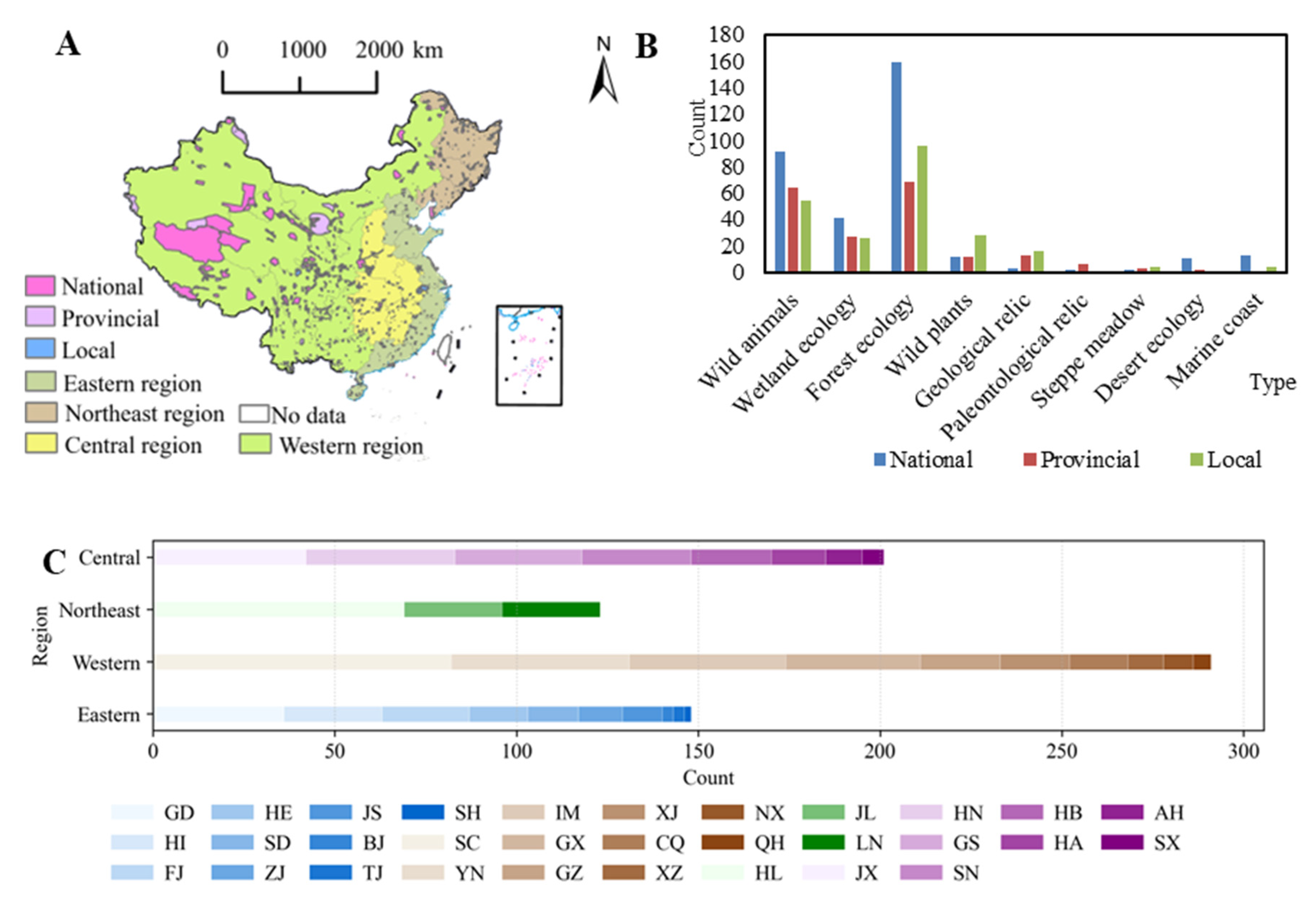
2.1. Study Area
2.2. Experimental and Technical Design
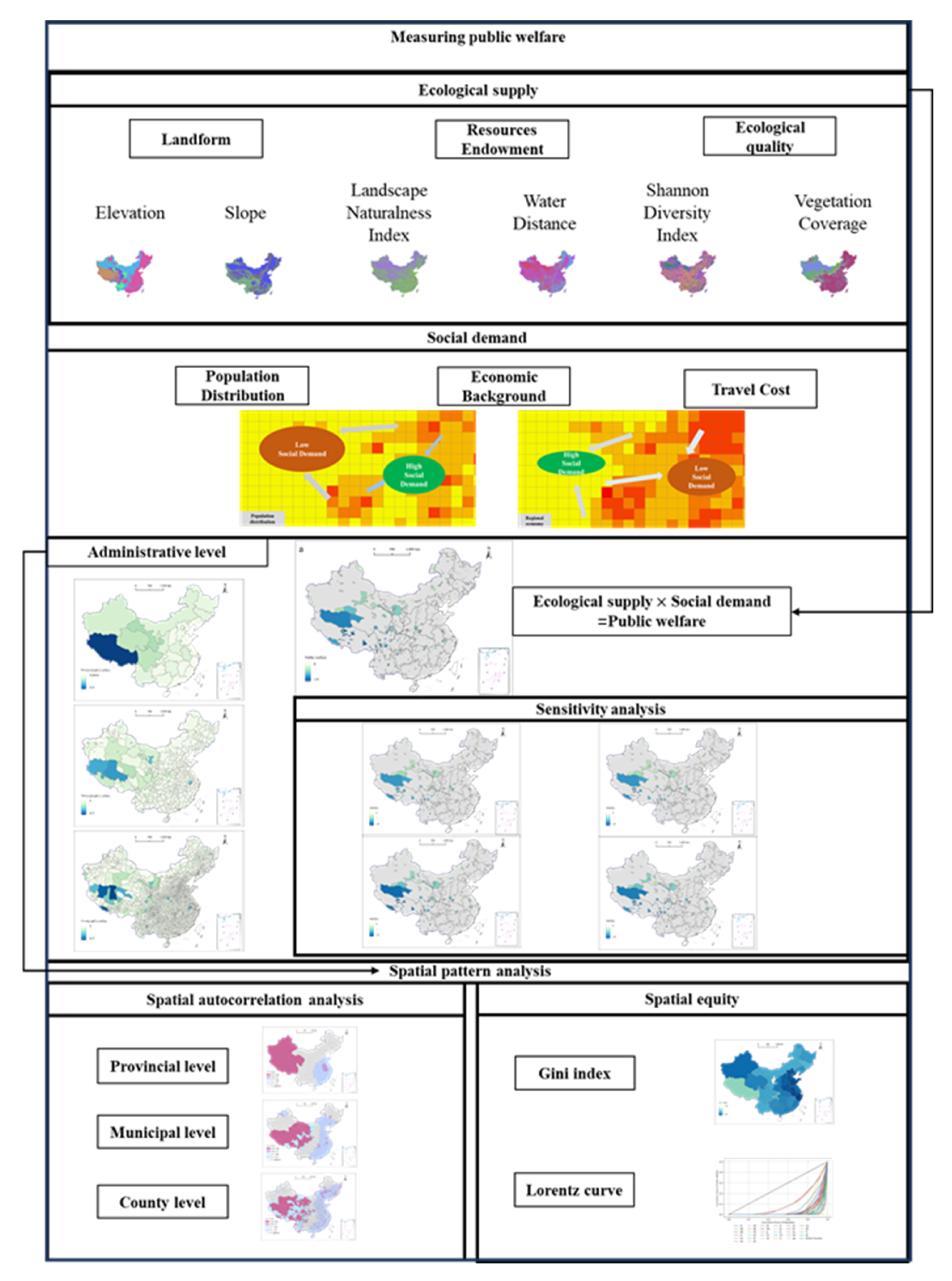
2.2.1. Measuring Public Welfare
2.2.2. Spatial Pattern Analysis
2.3. Indicators and Research Methods
2.3.1. Calculation of Public Welfare
2.3.2. Space Pattern Analysis
2.3.3. Data Sources and Processing
3. Results
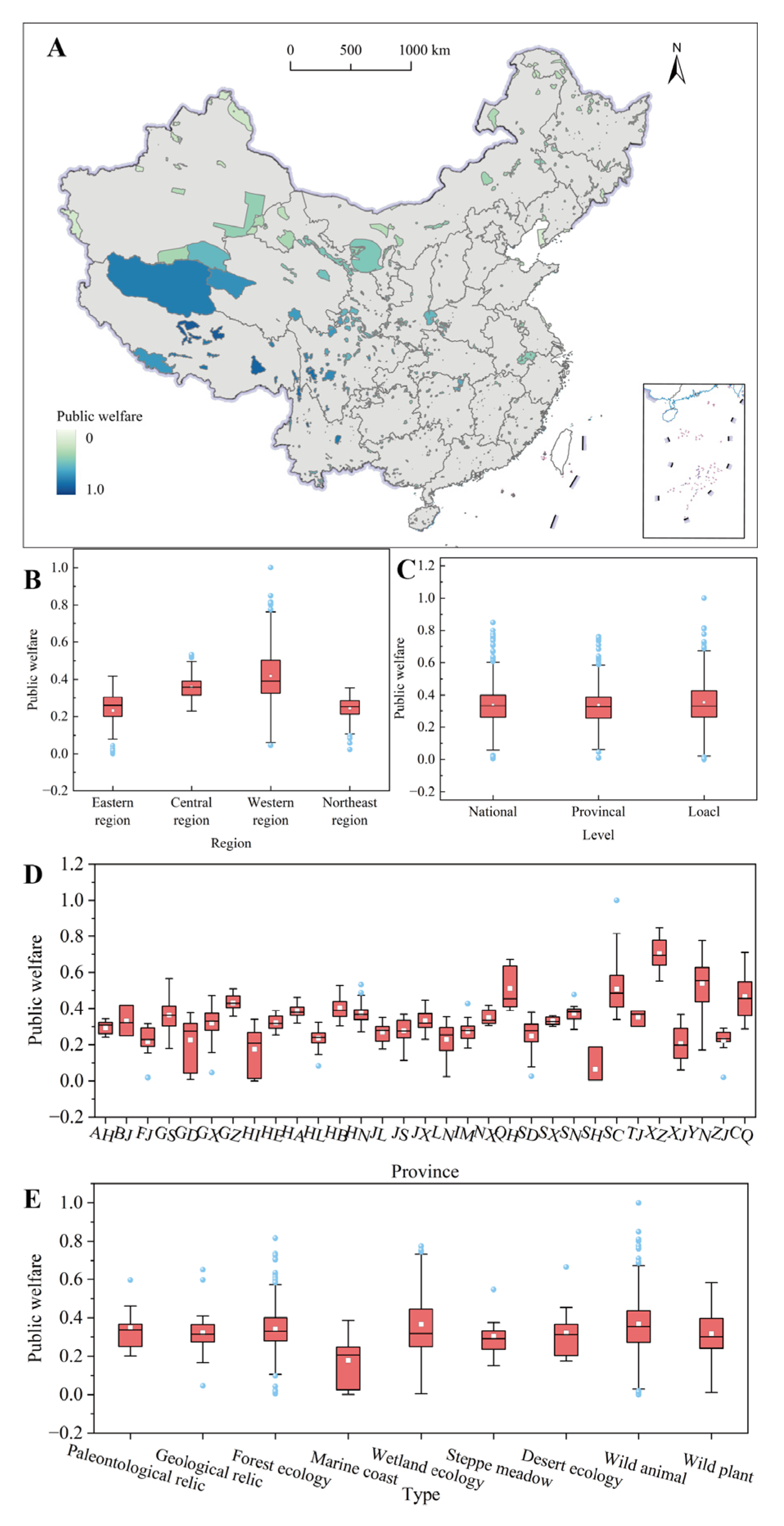
3.1. Nature Reserve’s Public Welfare
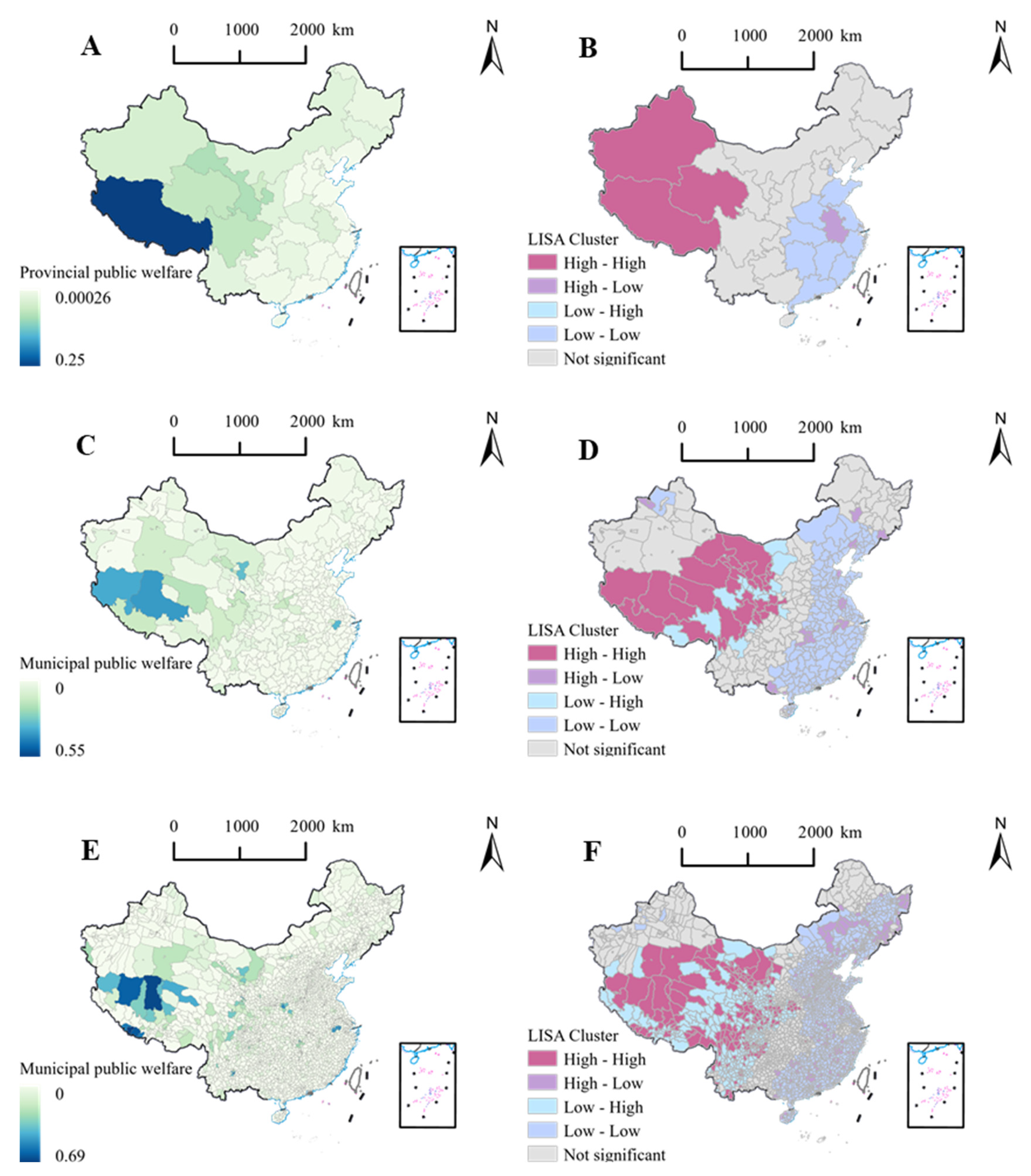
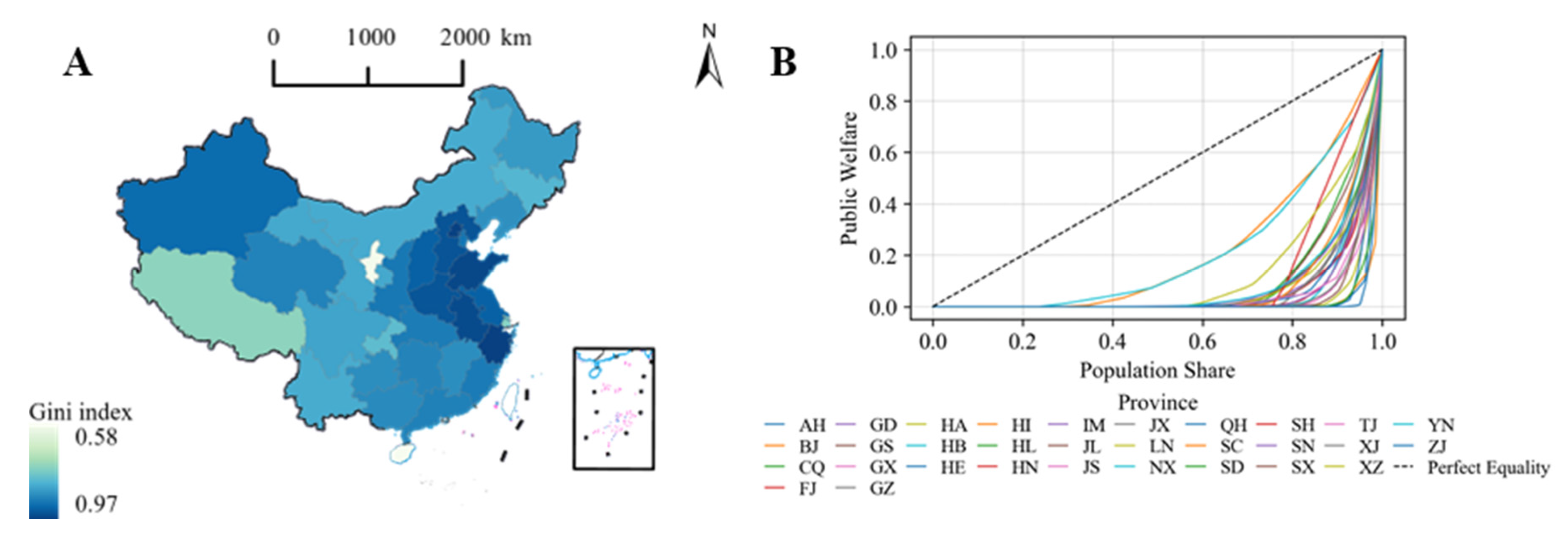
3.2. Spatial Pattern of Public Welfare
4. Discussion
4.1. Theoretical Contribution
4.2. Practical Implication
4.3. Limitations and Suggestions for Future Research
5. Conclusions
Author Contributions
Funding
Institutional Review Board Statement
Informed Consent Statement
Data Availability Statement
Acknowledgments
Conflicts of Interest
References
- Maxwell, S.L.; Cazalis, V.; Dudley, N.; Hoffmann, M.; Rodrigues, A.S.L.; Stolton, S.; Visconti, P.; Woodley, S.; Kingston, N.; Lewis, E.; et al. Area-based conservation in the twenty-first century. Nature 2020, 586, 217–227. (In English) [Google Scholar] [CrossRef] [Scilit]
- Wauchope, H.S.; Jones, J.P.G.; Geldmann, J.; Simmons, B.I.; Amano, T.; Blanco, D.E.; Fuller, R.A.; Johnston, A.; Langendoen, T.; Mundkur, T.; et al. Protected areas have a mixed impact on waterbirds, but management helps. Nature 2022, 605, 103–107. [Google Scholar] [CrossRef] [Scilit] [PubMed]
- Gao, J.X.; Wang, Y.; Zou, C.X.; Xu, D.L.; Lin, N.F.; Wang, L.X.; Zhang, K. China’s ecological conservation redline: A solution for future nature conservation. Ambio 2020, 49, 1519–1529. (In English) [Google Scholar] [CrossRef] [Scilit]
- Coetzee, B.W.T. Evaluating the ecological performance of protected areas. Biodivers. Conserv. 2017, 26, 231–236. (In English) [Google Scholar] [CrossRef] [Scilit]
- Sasanifar, S.; Alijanpour, A.; Shafiei, A.B.; Rad, J.E.; Molaei, M.; Alvarez-Alvarez, P. Assessing the Effects of Conservation Measures on Soil Erosion in Arasbaran Forests Using RUSLE. Forests 2023, 14, 1942. (In English) [Google Scholar] [CrossRef] [Scilit]
- Lameck, A.S.; Rotich, B.; Ahmed, A.; Kipkulei, H.; Mnyawi, S.R.; Czimber, K. Land use/land cover changes due to gold mining in the Singida region, central Tanzania: Environmental and socio-economic implications. Environ. Monit. Assess. 2025, 197, 464. [Google Scholar] [CrossRef] [Scilit]
- Cheng, A.T.; Sims, K.R.E.; Yi, Y. Economic development and conservation impacts of China’s nature reserves. J. Environ. Econ. Manag. 2023, 121, 102848. [Google Scholar] [CrossRef] [Scilit]
- Correia, R.A.; Jepson, P.; Malhado, A.C.M.; Ladle, R.J. Culturomic assessment of Brazilian protected areas: Exploring a novel index of protected area visibility. Ecol. Indic. 2018, 85, 165–171. [Google Scholar] [CrossRef] [Scilit]
- Timmers, R.; van Kuijk, M.; Verweij, P.A.; Ghazoul, J.; Hautier, Y.; Laurance, W.F.; Arriaga-Weiss, S.L.; Askins, R.A.; Battisti, C.; Berg, Å.; et al. Conservation of birds in fragmented landscapes requires protected areas. Front. Ecol. Environ. 2022, 20, 361–369. (In English) [Google Scholar] [CrossRef] [Scilit]
- Liburd, J.; Menke, B.; Tomej, K. Activating socio-cultural values for sustainable tourism development in natural protected areas. J. Sustain. Tour. 2024, 32, 1182–1200. (In English) [Google Scholar] [CrossRef] [Scilit]
- Zorondo-Rodríguez, F.; Rodríguez-Gómez, G.B.; Fuenzalida, L.F.; Burgos-Ayala, A.; Mendoza, K.; Díaz, M.J.; Cornejo, M.; Llanos-Ascencio, J.L.; Campos, F.; Zamorano, J.; et al. How do Protected Areas Contribute to Human Well-Being? Multiple Mechanisms Perceived by Stakeholders in Chile. Hum. Ecol. 2024, 52, 425–444. (In English) [Google Scholar] [CrossRef] [Scilit]
- Ghoddousi, A.; Loos, J.; Kuemmerle, T. An Outcome-Oriented, Social-Ecological Framework for Assessing Protected Area Effectiveness. Bioscience 2022, 72, 201–212. (In English) [Google Scholar] [CrossRef] [Scilit]
- Liu, Y.X.; Fu, B.J.; Wang, S.; Rhodes, J.R.; Li, Y.; Zhao, W.W.; Li, C.J.; Zhou, S.; Wang, C.X. Global assessment of nature?s contributions to people. Sci. Bull. 2023, 68, 424–435. (In English) [Google Scholar] [CrossRef] [Scilit] [PubMed]
- Pu, X.T.; Ding, W.G.; Ye, W.F.; Nan, X.J.; Lu, R.Q. Ecosystem service research in protected areas: A systematic review of the literature on current practices and future prospects. Ecol. Indic. 2023, 154, 16. (In English) [Google Scholar] [CrossRef] [Scilit]
- Simonson, W.D.; Miller, E.; Jones, A.; García-Rangel, S.; Thornton, H.; McOwen, C. Enhancing climate change resilience of ecological restoration-A framework for action. Perspect. Ecol. Conserv. 2021, 19, 300–310. (In English) [Google Scholar] [CrossRef] [Scilit]
- Majewski, L. Economic impact analysis of nature tourism in protected areas: Towards an adaptation to international standards in German protected areas. J. Outdoor Recreat. Tour. -Res. Plan. Manag. 2024, 45, 14. (In English) [Google Scholar] [CrossRef] [Scilit]
- Forje, G.W.; Tchamba, M.N. Ecotourism governance and protected areas sustainability in Cameroon: The case of Campo Ma’an National Park. Curr. Res. Environ. Sustain. 2022, 4, 100172. [Google Scholar] [CrossRef] [Scilit]
- National Information Center. Available online: http://www.sic.gov.cn/sic/index_pc.html (accessed on 17 August 2025).
- Hou, Y.Z.; Zhao, W.W.; Hua, T.; Pereira, P. Mapping and assessment of recreation services in Qinghai-Tibet Plateau. Sci. Total Environ. 2022, 838, 11. (In English) [Google Scholar] [CrossRef] [Scilit]
- Zeng, Y.X.; Wang, L.E.; Zhong, L.S. Measuring and reducing the ecological risk of community tourism for ecosystem conservation. Ecol. Indic. 2024, 166, 14. (In English) [Google Scholar] [CrossRef] [Scilit]
- Sun, S.; Sun, Q.; Zhang, F.; Ma, J. A Spatial Accessibility Study of Public Hospitals: A Multi-Mode Gravity-Based Two-Step Floating Catchment Area Method. Appl. Sci. 2024, 14, 7713. [Google Scholar] [CrossRef] [Scilit]
- Gong, X.; Huang, B. Public welfare evaluation index system of national parks:A case study of the Qinghai-Tibet Plateau National Park Cluster. Biodivers. Sci. 2023, 31, 20230360222. [Google Scholar] [CrossRef] [Scilit]
- Martinez-Harms, M.J.; Bryan, B.A.; Wood, S.A.; Fisher, D.M.; Law, E.; Rhodes, J.R.; Dobbs, C.; Biggs, D.; Wilson, K.A. Inequality in access to cultural ecosystem services from protected areas in the Chilean biodiversity hotspot. Sci. Total Environ. 2018, 636, 1128–1138. (In English) [Google Scholar] [CrossRef] [Scilit]
- Xiong, C.; Xu, H.; Tian, Y. Assessment of ecosystem service value in China from the perspective of spatial heterogeneity. Ecol. Indic. 2024, 159, 111707. [Google Scholar] [CrossRef] [Scilit]
- Caglayan, I.; Yesil, A.; Cieszewski, C.; Gul, F.K.; Kabak, O. Mapping of recreation suitability in the Belgrad Forest Stands. Appl. Geogr. 2020, 116, 102153. [Google Scholar] [CrossRef] [Scilit]
- Asilioglu, F.; Cay, R.D. A dual spatial analysis method based on recreation opportunity spectrum and analytical hierarchy process for outdoor recreation site suitability. J. Outdoor Recreat. Tour.-Res. Plan. Manag. 2023, 44, 100703. [Google Scholar] [CrossRef] [Scilit]
- Furian, M.; Tannheimer, M.; Burtscher, M. Effects of Acute Exposure and Acclimatization to High-Altitude on Oxygen Saturation and Related Cardiorespiratory Fitness in Health and Disease. J. Clin. Med. 2022, 11, 6699. (In English) [Google Scholar] [CrossRef] [Scilit] [PubMed]
- Pan, X.; Yang, Z.; Han, F.; Lu, Y.; Liu, Q. Evaluating Potential Areas for Mountain Wellness Tourism: A Case Study of Ili, Xinjiang Province. Sustainability 2019, 11, 5668. [Google Scholar] [CrossRef] [Scilit]
- Acharya, A.; Mondal, B.K.; Bhadra, T.; Abdelrahman, K.; Mishra, P.K.; Tiwari, A.; Das, R. Geospatial Analysis of Geo-Ecotourism Site Suitability Using AHP and GIS for Sustainable and Resilient Tourism Planning in West Bengal, India. Sustainability 2022, 14, 2422. (In English) [Google Scholar] [CrossRef] [Scilit]
- Feng, Z.; Zhang, J.; Hou, W.; Zhai, L. Dynamic changes of hemeroby degree based on the land cover classification: A case study in Beijing. Chin. J. Ecol. 2017, 36, 508–516. [Google Scholar]
- Roy, M.; Medhekar, A. Tourism-Led growth hypothesis: A global perspective bibliographic analysis. Asia Pac. J. Tour. Res. 2025, 30. early access (In English) [Google Scholar] [CrossRef] [Scilit]
- Zhang, B.; Feng, Q.L.; Meng, H.J.; Zhang, M. Foreign tourists exploring China: A multidimensional evaluationbased tourism optimization model. In Proceedings of the 2025 International Conference on Remote Sensing, Mapping, and Image Processing-RSMIP, Sanya, China, 17–19 January 2025; Spie-Int Soc Optical Engineering, in Proceedings of SPIE: Bellingham, WA, USA, 2025; Volume 13650. [Google Scholar]
- Chung, J.; Kim, J.; Sung, K. Analysis of Heat Mitigation Capacity in a Coastal City using InVEST Urban Cooling Model. Sustain. Cities Soc. 2024, 113, 10. (In English) [Google Scholar] [CrossRef] [Scilit]
- Sun, F.; Wang, D.; Niu, Y. Competition patterns of high-speed rail versus highways and aviation. Geogr. Res. 2017, 36, 171–187. [Google Scholar]
- Sedgwick, P. STATISTICAL QUESTION Spearman’s rank correlation coefficient. BMJ-Br. Med. J. 2014, 349, 3. (In English) [Google Scholar] [CrossRef] [Scilit]
- Tiefelsdorf, M. The saddlepoint approximation of Moran’s I’s and local Moran’s Ii’s reference distributions and their numerical evaluation. Geogr. Anal. 2002, 34, 187–206. (In English) [Google Scholar] [CrossRef] [Scilit]
- Morganti, E.; Dablanc, L.; Fortin, F. Final deliveries for online shopping: The deployment of pickup point networks in urban and suburban areas. Res. Transp. Bus. Manag. 2014, 11, 23–31. [Google Scholar] [CrossRef] [Scilit]
- Rahman, M.M. Is co-management a double-edged sword in the protected areas of Sundarbans mangrove? Biol. Philos. 2022, 37, 22. (In English) [Google Scholar] [CrossRef] [Scilit]
- Chen, J.; Shi, H.; Wang, X.; Zhang, Y.; Zhang, Z. Effectiveness of China’s Protected Areas in Mitigating Human Activity Pressure. Int. J. Environ. Res. Public Health 2022, 19, 9335. [Google Scholar] [CrossRef] [Scilit]
- Li, Q.; Quan, H.; Wang, L.-E. Beneficiaries of free admission to scenic areas: A cost-benefit analysis of scenic areas for public welfare from the perspective of stakeholders. Tour. Manag. Perspect. 2020, 35, 100696. [Google Scholar] [CrossRef] [Scilit]
- Wu, J.; Wu, G.; Zheng, T.; Zhang, X.; Zhou, K. Value capturecapture mechanisms, transaction costs, and heritage conservation: A case study of Sanjiangyuan National Park, China. Land Use Policy 2020, 90, 104246. [Google Scholar] [CrossRef] [Scilit]
- Hong, Y.-Z.; Chang, H.-H. Ecoforestry program and farmers’ life satisfaction—Empirical evidence of forest farms in China. J. Environ. Manag. 2025, 380, 125000. [Google Scholar] [CrossRef] [Scilit]
- Wang, X.; Wang, R.; Lyu, X.; Wu, H. Using public perceptions to inform urban protected area buffer zone planning. Environ. Manag. 2024, 74, 300–316. [Google Scholar] [CrossRef] [Scilit]
- Zheng, B.; Li, M.; Yu, B.; Gao, L. The Future of Community-Based Ecotourism (CBET) in China’s Protected Areas: A Consistent Optimal Scenario for Multiple Stakeholders. Forests 2021, 12, 1753. [Google Scholar] [CrossRef] [Scilit]
- Wang, X.; Yang, C.; Qiao, H.; Hu, J. More than two-fifths of the protected land in a global biodiversity hotspot in southwest China is under intense human pressure. Sci. Total Environ. 2024, 906, 167283. [Google Scholar] [CrossRef] [Scilit]
- Koltko-Rivera, M.E. Rediscovering the later version of Maslow’s hierarchy of needs: Self-transcendence and opportunities for theory, research, and unification. Rev. Gen. Psychol. 2006, 10, 302–317. [Google Scholar] [CrossRef] [Scilit]
- Zhang, Z.; Wang, F.; Deng, L. Identifying node-corridor-network of tourist flow and influencing factors using GPS big data: A case study in Gansu and Qinghai provinces, China. Int. J. Appl. Earth Obs. Geoinf. 2024, 135, 104271. [Google Scholar] [CrossRef] [Scilit]
- Diniz, M.F.; Dallmeier, F.; Gregory, T.; Martinez, V.; Saldivar-Bellassai, S.; Benitez-Stanley, M.A.; Sanchez-Cuervo, A.M. Balancing multi-species connectivity and socio-economic factors to connect protected areas in the Paraguayan Atlantic Forest. Landsc. Urban Plan. 2022, 222, 11. (In English) [Google Scholar] [CrossRef] [Scilit]
- Hu, Y.; Zhong, L.; Qi, W. Identification and analysis of conservation gap of national nature reserves in China. Ecol. Indic. 2024, 158, 111525. [Google Scholar] [CrossRef] [Scilit]
- Deng, Y.; Mao, Z.; Huang, J.; Yan, F.; Han, S.; Li, A. Spatial Patterns of Natural Protected Areas and Construction of Protected Area Groups in Guangdong Province. Int. J. Environ. Res. Public Health 2022, 19, 14874. [Google Scholar] [CrossRef] [Scilit] [PubMed]
- Fu, L.; Kong, S.; Zong, C.; Ma, J. The Difference of Spatial Distribution of Wetland Nature Reserves and Wetland Parks in China. Wetl. Sci. 2015, 13, 356–363. [Google Scholar]
- Jones, N.; Graziano, M.; Dimitrakopoulos, P.G. Social impacts of European Protected Areas and policy recommendations. Environ. Sci. Policy 2020, 112, 134–140. (In English) [Google Scholar] [CrossRef] [Scilit] [PubMed]
- Baldi, G.; Schauman, S.; Texeira, M.; Marinaro, S.; Martin, O.A.; Gandini, P.; Jobbágy, E.G. Nature representation in South American protected areas: Country contrasts and conservation priorities. PeerJ 2019, 7, 23. (In English) [Google Scholar] [CrossRef] [Scilit] [PubMed]




| Primary Category | Secondary Category | Indicator Layer | Definition |
|---|---|---|---|
| Ecological supply | Landform | Elevation [25,26] | Lower elevation areas exhibit higher oxygen content, rendering them more suitable for public activities and recreational tourism. In nature reserves, low-altitude regions can accommodate a greater number of visitors, thereby enhancing human health and well-being. Ecosystem services in these areas, such as improved air quality and recreational opportunities, can be extended to a larger population, particularly low-income groups, thereby generating inclusive ecological benefits [27]. |
| Slope [26,28] | Regions characterized by gentler slopes offer greater accessibility, suitability for tourism development, and enhanced comfort for visitors. Within nature reserves, such areas can be extensively developed into trails or tourist attractions, mitigating constraints related to transportation and travel costs and enabling broader public participation [29]. | ||
| Resource endowment | Landscape Naturalness Index [30] | Highly natural landscapes provide more comprehensive ecosystem services and possess higher ecological value. These landscapes are more effective in delivering ecological products and services, including air purification and water provision. Such highly natural environments afford the public more direct ecological benefits, such as access to clean air and protection of water resources [29]. | |
| Water distance [19] | The natural landscape around the water is relatively high quality, has high scenic value, and is attractive to the public. | ||
| Ecological quality | Vegetation coverage [26] | Vegetation cover directly augments carbon sequestration and ecological supply capacity. Abundant vegetation not only sequesters carbon dioxide but also enhances air quality and biodiversity, exerting a positive influence on human health [19]. | |
| Shannon Diversity Index [19] | The Shannon Diversity Index reflects the richness of the natural environment. Nature reserves with higher biodiversity are more likely to attract scientific research and ecotourism activities. For the public, regions with elevated ecological diversity provide greater access to natural resources and health benefits, while offering more low-cost ecotourism opportunities [22]. | ||
| Social demand | Population distribution | Nature reserves that encompass more densely populated areas can deliver abundant ecological services to a larger population, thereby maximizing the utilization of ecological resources [29]. | |
| Economic base | The measurement of the local economic base enables the determination of whether a nature reserve provides greater ecological welfare to low-income groups. The greater the coverage of low-income groups by a nature reserve, the higher its public welfare value [31]. | ||
| Travel costs | Elevated transportation costs may impede access to nature reserves for low-income groups. Reducing these costs, for instance through the provision of public transportation and subsidies, can enhance participation by low-income groups, ensuring the broader distribution of nature reserve benefits and promoting both ecological conservation and social equity [32]. | ||
| Score | Land Use Type |
|---|---|
| 1 | Urban land; Rural settlements; Other construction land |
| 2 | Paddy fields; Dry fields; Grassland with low coverage; Rivers and canals; Reservoirs; Ponds; Tidal flats; Beach; Marshes; Bare soil; Bare rocky soil |
| 3 | Shrubland; Sparse woodland; Other woodland; Grassland with medium coverage; Lakes; Sandy soil; Gobi, Saline soil; Sea |
| 4 | Wooded land; Grassland with high coverage |
| 5 | Glacier and snow |
Disclaimer/Publisher’s Note: The statements, opinions and data contained in all publications are solely those of the individual author(s) and contributor(s) and not of MDPI and/or the editor(s). MDPI and/or the editor(s) disclaim responsibility for any injury to people or property resulting from any ideas, methods, instructions or products referred to in the content. |
© 2025 by the authors. Licensee MDPI, Basel, Switzerland. This article is an open access article distributed under the terms and conditions of the Creative Commons Attribution (CC BY) license (https://creativecommons.org/licenses/by/4.0/).
Share and Cite
Zhang, B.; Zhong, L.; Zeng, Y. Evaluation of the Public Welfare of China’s Nature Reserves. Sustainability 2025, 17, 7729. https://doi.org/10.3390/su17177729
Zhang B, Zhong L, Zeng Y. Evaluation of the Public Welfare of China’s Nature Reserves. Sustainability. 2025; 17(17):7729. https://doi.org/10.3390/su17177729
Chicago/Turabian StyleZhang, Bin, Linsheng Zhong, and Yuxi Zeng. 2025. "Evaluation of the Public Welfare of China’s Nature Reserves" Sustainability 17, no. 17: 7729. https://doi.org/10.3390/su17177729
APA StyleZhang, B., Zhong, L., & Zeng, Y. (2025). Evaluation of the Public Welfare of China’s Nature Reserves. Sustainability, 17(17), 7729. https://doi.org/10.3390/su17177729