Article

Exploring Industry 4.0 Technologies Implementation to Enhance Circularity in Spanish Manufacturing Enterprises


by
Juan-José Ortega-Gras
1,2,*,
María-Victoria Bueno-Delgado
2,
José-Francisco Puche-Forte
1,2,
Josefina Garrido-Lova
1 and
Rafael Martínez-Fernández
3
1
Technological Centre of Furniture and Wood of the Region of Murcia (CETEM), 30510 Yecla, Spain
2
Department of Information and Communication Technologies, Universidad Politécnica de Cartagena, Antiguo Cuartel de Antigones, 30202 Cartagena, Spain
3
Development Agency of the Region of Murcia (INFO), Murcia Government, Av. de la Fama, 3, 30003 Murcia, Spain
*
Author to whom correspondence should be addressed.
Sustainability 2025, 17(17), 7648; https://doi.org/10.3390/su17177648
Submission received: 27 June 2025 / Revised: 15 August 2025 / Accepted: 18 August 2025 / Published: 25 August 2025
(This article belongs to the Special Issue Achieving Sustainability: Role of Technology and Innovation)

Abstract

Industry 4.0 (I4.0) is reshaping manufacturing by integrating advanced digital technologies and is increasingly seen as an enabler of the circular economy (CE). However, most research treats digitalisation and circularity separately, with limited empirical insight regarding their combined implementation. This study investigates I4.0 adoption to support sustainability and CE across industries, focusing on how enterprise size influences adoption patterns. Based on survey data from 69 enterprises, the research examines which technologies are applied, at what stages of the product life cycle, and what barriers and drivers influence uptake. Findings reveal a modest but growing adoption led by the Internet of Things (IoT), big data, and integrated systems. While larger firms implement more advanced tools (e.g., robotics and simulation), smaller enterprises favour accessible solutions (e.g., IoT and cloud computing). A positive link is observed between digital adoption and CE practices, though barriers remain significant. Five main categories of perceived obstacles are identified: political/institutional, financial, social/market-related, technological/infrastructural, and legal/regulatory. Attitudinal resistance, particularly in micro and small enterprises, emerges as an additional challenge. Based on these insights, and to support the twin transition, the paper proposes targeted policies, including expanded funding, streamlined procedures, enhanced training, and tools for circular performance monitoring.

1. Introduction

The Industry 4.0 (I4.0) revolution, characterised by the implementation of Key Enabling Technologies (KETs) throughout industrial processes, has the potential to revolutionise traditional manufacturing processes, leading to significant improvements in productivity, flexibility and sustainability [1]. KETs encompass a range of cutting-edge technologies, recognised as foundational elements of the I4.0 transformation [2,3,4].
Manufacturing enterprises play a central role in the digital transformation by integrating I4.0 technologies, including existing technologies such as the Internet of Things (IoT), artificial intelligence (AI), additive manufacturing, big data analytics, and advanced robotics into their production systems. This digitalisation enables real-time monitoring and optimisation of operations [5], delivering benefits across all enterprise sizes, including cost reduction, improved product and process quality, greater efficiency and flexibility, increased output, and enhanced market competitiveness [6].
In addition, digitalisation in manufacturing can act as a key enabler of industrial sustainability, particularly through the deployment of KETs aimed at reducing environmental impacts and improving resource efficiency [7,8]. For example, AI-driven processes can substantially reduce energy consumption, while additive manufacturing may minimise material waste by enabling high-precision production and the use of recycled inputs [9]. This intersection of digital and sustainable innovation is encapsulated in the concept of the twin transition, the concurrent advancement of digitalisation and sustainability within the industrial sector [10,11], which is a central pillar of the European Union’s industrial strategy [12]. This dual transformation leverages digital technologies to boost operational efficiency, reduce environmental footprints, foster growth that is both sustainable and technologically advanced [13,14], and, above all, facilitate Circular Economy (CE) practices [15,16]. In line with this, recent studies indicate that digitalisation could enable a reduction of up to 35% in CO2 emissions, particularly through its potential to drive behavioural change and systemic transformation [17,18,19].
Despite growing interest, several barriers continue to hinder the widespread adoption of KETs, particularly among small and medium-sized enterprises (SMEs). High initial investment costs, skill shortages and integration challenges are among the most cited obstacles [20,21,22], compounded by regulatory frameworks that often lag behind technological innovation, creating uncertainty for long-term planning [23]. A review of 20 studies categorised these barriers into six main types: financial, cultural, competence-related, legal, technical, and implementation challenges [24].
Furthermore, there is limited knowledge about the actual adoption levels of I4.0 for sustainability purposes in SMEs, as most studies treat I4.0 and CE separately [25,26,27,28] with a predominant focus on large enterprises [29,30]. As highlighted in several studies, the literature remains in an early stage of development, lacking both quantitative assessments of I4.0 implementation for sustainability purposes [31,32] and qualitative insights into how organisations align digitalisation with sustainability objectives [33,34]. Core questions related to the drivers, mechanisms, and contextual factors enabling a successful twin transition remain insufficiently addressed [15,35].
Against this backdrop, the present study seeks to help close this gap by assessing the level of implementation of I4.0 technologies aimed at improving sustainability and advancing the circular economy among manufacturing enterprises. The research focuses on identifying which I4.0 technologies are being adopted for environmental or circular benefits and mapping their application across different stages of the production process. It also analyses the main barriers and drivers associated with the twin digital and circular transition, with particular attention to how these factors differ according to company size.
This study also explores potential correlations between enterprise size and the adoption of I4.0 technologies for sustainability purposes. The goal is to provide a comprehensive picture of the current state of the twin transition and to offer evidence-based recommendations to help strengthen and accelerate the digital and circular transformation of the manufacturing sector. In doing so, this study directly responds to the research directions outlined by Prof. Dr. Manjula S. Salimath in the special issue [36]. In addressing “what is the role of technology and innovation in developing or attaining sustainability?”, it maps I4.0 adoption patterns, their applications across production stages, and their alignment with CE strategies. It answers, “how do digitisation and digital technology impact sustainability efforts?” by evidencing cases where I4.0 enhances resource efficiency, minimises waste and optimises processes. Finally, it tackles “what are the key sustainable technologies that are likely to drive future trends?” by identifying which I4.0 tools are most frequently implemented across different enterprise sizes.
This contribution focuses specifically on micro (<10 employees), small (10–49 employees), medium (50–249 employees), and large (>250 employees) sized enterprises. It analyses the degree of implementation of I4.0 technologies in support of CE in the Region of Murcia, located in Southeast Spain. This region, with a population of 1,571,933 [37], has a diverse industrial and business fabric and is one of Spain’s leading areas for producing fruit, vegetables, and flowers, with exports distributed across Europe. The industrial landscape of the Region of Murcia, as mapped in its Smart Specialisation Strategy (RIS4) [38], shows clear leadership in sectors linked to the agri-food value chain, including key activities such as agriculture, livestock, fisheries, and food processing. Complementary sectors such as water cycle management (including treatment, purification, and distribution), environmental services, logistics, and transport also stand out.
In addition to these established sectors, the region hosts several emerging industries, including tourism, health, habitat, and the footwear and fashion sectors. Furthermore, the presence of large enterprises in strategic fields such as energy, marine and maritime industries, and chemicals contributes to a robust and dynamic industrial ecosystem with strong driving capacity.
This paper is structured as follows: Section 2 provides an overview of the current landscape of digitalisation and sustainability in the Spanish manufacturing sector with a particular focus on SMEs. Section 3 describes the research methodology, including the survey design and analytical approach. Section 4 presents the main statistical findings, covering the demographic profile of respondents, adoption patterns of I4.0 technologies, applications across industrial processes, and the perceived drivers and barriers to implementation. Section 5 offers a detailed discussion of the results and their implications for enterprise transformation. Finally, Section 6 summarises the key insights and provides practical recommendations to support the twin digital and circular transition in enterprises.

2. Background

Throughout this section, the term “manufacturing enterprises” is generally used to refer to all enterprises in the sector, regardless of size. However, given that much of the available literature and most empirical evidence focus specifically on SMEs, there are instances where the discussion refers directly to this group. In these cases, the arguments or data may be most applicable to SMEs, though they can often provide relevant insights for both micro and large manufacturing enterprises, depending on the context and the specific barriers or opportunities being addressed.
The transition toward more sustainable and circular production systems has gained significant attention in recent years, driven by the dual challenges of resource scarcity and environmental degradation. I4.0 technologies have emerged as potential enablers of the CE, offering new opportunities for waste reduction, resource efficiency, and enhanced industrial symbiosis. While most of the literature and empirical studies to date have focused primarily on SMEs, the opportunities and challenges associated with digitalisation and circularity are relevant for micro, small, medium, and large manufacturing enterprises alike. In this study, we consider manufacturing enterprises of all sizes within the Region of Murcia. It is important to note, however, that SMEs make up most of the regional industrial landscape, as well as the sample analysed in this research.

2.1. Twin Transition: Integrating I4.0 and CE

The twin transition refers to the simultaneous progression of digital transformation and environmental sustainability across economic sectors [39]. The term, used within the European context, highlights the strategic alignment of these two megatrends—digitalisation and sustainability—with the aim of ensuring that advancements in one domain reinforce and accelerate those in the other [40]. This integrated approach is expected to generate economic, environmental, and social benefits, including opportunities to convert waste into value streams [41].
Although the number of studies exploring the relationship between CE and I4.0 technologies remains limited [32], emerging research confirms a positive influence of I4.0 tools on circularity and sustainability, particularly within the manufacturing sector. For example, survey-based and case study research in [42] demonstrates how digital technologies can reduce material and energy consumption, as well as minimise waste and emissions. Complementing this, a systematic literature review [43] has identified over twenty distinct applications of I4.0 that contribute to environmentally sustainable outcomes, including enhanced supply chain traceability and real-time process optimisation. These positive effects have been recognised as key enablers of sustainability across a range of regional contexts [15], with evidence also suggesting that digitalisation in one region can foster sustainable development in neighbouring areas, thereby transcending geographical boundaries [44].
Nevertheless, despite these promising insights, the existing literature tends to focus on conceptual analyses rather than practical implementation. Much of the current research addresses general frameworks of I4.0 and CE integration [39,45,46], often overlooking the concrete challenges encountered by enterprises in operationalising these concepts. In particular, the application of digital technologies at the shop-floor level and their alignment with specific CE strategies along the value chain remain underexplored. A few notable exceptions attempt to bridge this gap, e.g., by proposing integrated frameworks that align digital technologies with CE strategies and organisational enablers [47], identifying key organisational practices that support twin transitions [48], or exploring through case studies how the interaction between information and operational technologies influences digital CE adoption [49].
This gap is particularly relevant in the European manufacturing landscape, where the twin transition is becoming increasingly central to policy and industrial agendas [28]. While the academic discourse around the twin transition is expanding, many studies point to a scarcity of assessment tools and readiness models tailored to the SMEs context [50]. Existing reviews emphasise a wide array of barriers—technological, organisational, financial, and regulatory—that hinder companies’ progress toward circular and digital maturity, alongside a smaller set of enablers that can support successful implementation [51].
This study offers empirical insights into how manufacturing enterprises in the Region of Murcia are navigating the twin transition, both in adopting CE practices and in leveraging I4.0 technologies. This exploratory, data-driven approach is grounded in a regional diagnostic survey and aims to elucidate current practices, perceived barriers and drivers, and patterns of digital and circular uptake. To further situate our findings, Section 2.2 first reviews the broader status of digitalisation and circularity among Spanish enterprises at the national level, while Section 2.3 focuses on opportunities and challenges to be faced.

2.2. Status of SMEs Regarding Digitalisation and Circularity

To situate our regional survey within the broader national context, we examine existing data on the twin transition in Spanish SMEs. Two complementary large-scale sources, the European Commission’s Flash Eurobarometer 486 on digitalisation and sustainability in SMEs [52] and Telefónica’s 2023 report on the Digital Society in Spain [53], provide a snapshot of current adoption levels and highlight persistent gaps. These studies reveal a heterogeneous landscape in which many enterprises have begun deploying I4.0 tools (such as cloud computing and IoT), yet only a minority have fully integrated circular practices like material reuse or lifecycle assessment.

2.2.1. Digitalisation Status

The Flash Eurobarometer 486, based on interviews with 16,365 participants from SMEs across the European Union (EU) 27 and 12 non-EU countries, indicates that, while many Spanish SMEs have begun the process of digital transformation, the extent of adoption varies significantly across enterprises. KETs such as cloud computing, big data analytics, and AI are gaining traction. Notably, the report highlights that approximately 40% of Spanish SMEs have adopted cloud computing solutions, which support data storage, sharing, and collaborative workflows, thereby improving operational efficiency. Furthermore, around 25% of SMEs are utilising big data analytics to extract insights from their operational data, contributing to more informed decision-making and optimised performance.
Findings from Telefónica’s report corroborate these trends, showing a consistent increase in the adoption of I4.0 technologies among Spanish SMEs over recent years. Additional insights are provided by the Digital Economy and Society Index (DESI 2024) [54], a benchmarking tool developed by the European Commission to assess the digital performance and competitiveness of EU Member States. According to DESI 2024 indicators, Spanish SMEs exhibit a level of digital intensity that surpasses the European average, particularly in the adoption of cloud computing, e-commerce, and Customer Relationship Management (CRM) systems.
Nevertheless, Telefónica’s report also underscores persistent disparities between large enterprises and SMEs. While larger enterprises typically possess greater financial and human resources to invest in advanced technologies, SMEs often face structural challenges, including limited funding, a shortage of digital skills, and constrained internal capabilities. These limitations hinder the widespread adoption of I4.0 technologies and the development of comprehensive digital strategies, thereby widening the gap between SMEs and their larger counterparts.

2.2.2. Circularity Status

The advancement of CE practices across the EU remains modest, despite substantial policy efforts and increased strategic attention. According to Eurostat, the EU’s circular material use rate, an indicator of the share of material resources recovered and reused, stood at 11.8% in 2023, reflecting a slow but steady progression towards more circular models. In comparison, Spain’s circularity rate reached only 8.5%, placing it below the EU average and highlighting the need for intensified efforts at the national level [55].
Nonetheless, since the launch of the Spanish National Circular Economy Strategy in 2020 [56], the country has made notable progress. Comparative assessments at the EU level indicate that Spain is now among the leading countries in the CE transition [57]. However, significant disparities persist between the macro-level improvements, reflected in national material flow data, and the micro-level performance associated with product lifecycle indicators and firm-level adoption of circular practices. Within this context, waste management continues to be a central challenge for CE development, both at the European level and particularly in Spain.
Against this background, the CE transition within Spanish SMEs remains at a nascent stage, particularly when compared to their progress in digitalisation. While sustainability is increasingly recognised as a strategic priority, its practical implementation, especially through CE principles, has yet to achieve widespread traction in the SME sector.
According to the Flash Eurobarometer 486, only 30% of Spanish SMEs have adopted energy efficiency measures, and even fewer have implemented comprehensive sustainability strategies. This limited uptake can be attributed to a combination of structural and cultural barriers, including a lack of awareness, insufficient financial and technical resources, limited access to qualified personnel, and the perceived high cost of green technologies. Additionally, the absence of strong consumer demand for sustainable products further discourages SMEs from prioritising circularity in their business models [58].
Although reports such as Telefónica 2023 indicate growing awareness among SMEs regarding sustainability, most remain in the early stages of CE adoption. Typical initiatives, such as recycling programmes, material waste reduction and the incorporation of renewable energy, are being explored; however, these efforts are far from systemic and often lack strategic integration.
A critical indicator of this disconnect is the widespread unfamiliarity with the CE concept itself: recent surveys suggest that 54% of Spanish SMEs do not know what the CE is [59], and among those that do, only 15% have implemented specific circular initiatives [60]. This gap highlights the urgent need for knowledge transfer and capacity-building programmes tailored to SMEs.
In practice, circular design strategies, such as product recyclability, modularity, or differentiated recovery, are still rare among Spanish SMEs. Only around 25% of enterprises incorporate such considerations into their product development processes, a figure closely tied to firm size. Larger enterprises are significantly more likely to allocate resources to circular innovation, while smaller ones often lack the internal capabilities to do so [58].
Furthermore, the predominant environmental approach among SMEs remains focused on basic environmental management practices. These include achieving environmental certifications and reducing resource consumption, particularly energy, where cost savings can be realised in the short term. However, more advanced circular strategies, such as the use of ecological or biodegradable materials, are uncommon. The short-term economic mindset that prevails among many SMEs often leads them to view environmental efforts primarily as a compliance issue or a cost-saving mechanism, rather than a strategic investment in long-term resilience and competitiveness [59].

2.3. Opportunities and Challenges

The convergence of digitalisation and circularity presents both promising avenues and formidable obstacles for Spanish SMEs striving to enhance their sustainability and competitiveness. On one hand, the European Green Deal and the EU Digital Strategy establish a supportive policy landscape and funding mechanisms, such as Horizon Europe and the European Regional Development Fund (ERDF), that can catalyse investments by SMEs in I4.0 technologies and circular innovation [61,62].
At the national level, the Spanish government has implemented some initiatives aimed at facilitating the twin transition for SMEs. The Digital Spain’s Strategic Roadmap promotes the digital transformation of the industrial sector through direct funding, technical assistance, and knowledge transfer programmes [63]. Simultaneously, the Spanish Circular Economy Strategy outlines policy measures and incentives to support the adoption of circular business models, including financial support and regulatory frameworks [55].
While some progress has been made among Spanish SMEs, the transition remains at an early stage. The persistent disparity in the adoption of digital technologies and CE practices between large enterprises and SMEs underscores the need for continued institutional support and the development of tailored policy instruments [64].
The next sections present the empirical findings from the Region of Murcia survey, which shed light on how local SMEs are navigating these challenges and where targeted interventions might accelerate the twin transition.

3. Materials and Methods

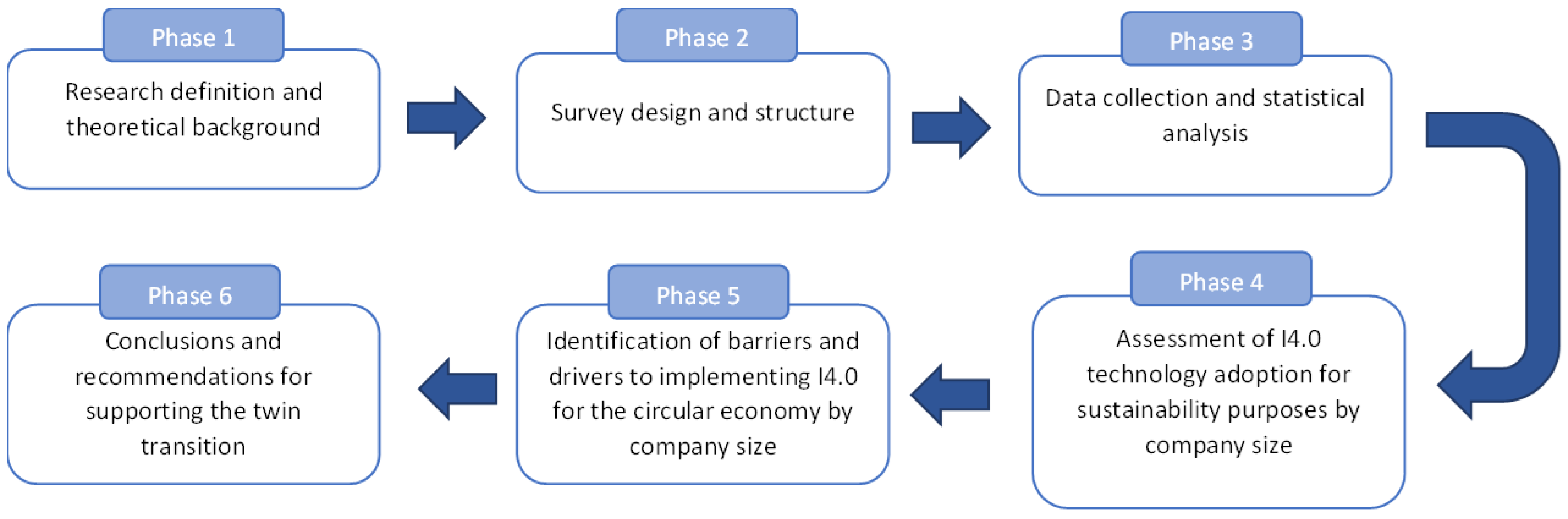
This section details the methodology implemented in this research, summarised in Figure 1.
In phase 1, the research objectives and theoretical framework were defined through an initial review of the literature and relevant policy documents on I4.0 and the CE. This preliminary exploration confirmed the study’s relevance, especially given the limited empirical evidence on how manufacturing enterprises—particularly at the regional level—engage with the twin digital and green transition. The conceptual framing highlighted the need to understand not only adoption rates but also the barriers and enabling factors shaping this process.
In phase 2, a structured survey was designed. The questionnaire comprised 19 items, organised into thematic blocks covering company characteristics (sector and size), awareness and strategic importance of CE, and adoption of I4.0 technologies for sustainability purposes, among other topics.
In phase 3, data collection and statistical analysis were implemented. The Development Agency of the Region of Murcia (Instituto de Fomento de la Región de Murcia, INFO) [65] was responsible for disseminating the survey and collecting responses from manufacturing enterprises in the Region of Murcia. INFO is a public body responsible for promoting regional economic development, innovation, and business competitiveness. Descriptive statistics, conducted by the authors, were complemented by inferential techniques to explore possible correlations between company size and different patterns, such as technology adoption or CE awareness.
In phase 4, the analysis of the adoption of I4.0 technologies for CE purposes by enterprise size was conducted. Technologies were grouped by type and mapped across different value chain stages. Particular attention was given to differentiating between basic digital tools and more advanced technologies, as well as identifying specific use cases supporting CE strategies.
In phase 5, the analysis focused on identifying barriers and drivers for I4.0 adoption in the context of CE. Results were disaggregated by enterprise size to capture variations in challenges and motivations.
Finally, in phase 6, the main insights were synthesised into a set of strategic recommendations. In addition, further avenues for academic research are proposed.

3.1. Survey Design and Structure

The survey (Document S1) comprised 19 questions spanning multiple thematic blocks. These included company profile (sector and size), awareness and importance of circular economy, current practices in industrial symbiosis, implementation of circular strategies across the value chain (design, production, use, and end-of-life), adoption of I4.0 technologies for sustainability, perceived barriers to circular economy adoption and awareness of supporting resources (e.g., government funding programmes and technology centres). The questionnaire mainly used fixed-choice questions (yes/no, multiple-choice, Likert scales) with optional open text fields.
To ensure a shared understanding of key concepts, the survey began with an introductory explanation of the CE to guide respondents. Specifically, CE was described as “a production and consumption model in which the value of products, materials, and resources is preserved in the economy for as long as possible, while waste generation is minimised. This allows us to move away from the traditional ‘take, make, dispose’ model.” In the specific section addressing CE practices across the value chain, a more detailed explanation was provided, outlining CE as a model based on the principles of rethinking, redesigning, reducing, reusing, repairing, refurbishing, remanufacturing, recycling, and recovering. Respondents were also presented with examples of CE strategies applied at each stage of the product lifecycle, including design, production, internal logistics, distribution and sales, use, and end-of-life product management.
Regarding I4.0, the questionnaire did not include a general definition but specified the technologies under consideration directly within the relevant item. Question 12 asked respondents whether their company had implemented any of the following technologies to support sustainability efforts: IoT, big data, cloud computing, simulation, virtual and/or augmented reality (VR/AR), AI, 3D printing, integrated systems, robotics, or others.

3.2. Data Collection and Statistical Analysis

The survey was disseminated online over a three-month period in 2023, targeting micro, small, medium, and large-sized enterprises in the regional manufacturing ecosystem. Invitations were distributed via INFO’s official networks, email lists, and social media channels to encourage broad participation. Of the 98 questionnaires submitted, 69 were retained after excluding responses that were incomplete (key items unanswered). The validated sample therefore comprises 69 firms. No demographic information was available for the discarded cases, so we could not perform a formal non-response bias test. Nevertheless, the high effective response rate (70.4%) and the broad sectoral coverage of the retained sample mitigate the risk of severe bias. Item-level missingness within the 69 valid questionnaires was <5% per variable. Analyses used listwise deletion; a pairwise-deletion sensitivity check yielded identical significance levels.
The final validated sample was n = 69 manufacturing enterprises, which is considered sufficient and broadly representative of the regional enterprise population in terms of size distribution and industry sectors. By employee count, the sample includes 34 microenterprises (0–9 employees), 22 small enterprises (10–49 employees), and 13 medium/large enterprises (≥50 employees). The “medium” (50–249) and “large” (>250) categories were aggregated due to small individual subgroup sizes (n < 10). Geographically, all firms are based in the Region of Murcia and represent diverse manufacturing industries, such as food and beverage, chemicals, and metal-mechanical production (as identified by their Spanish National Classification of Economic Activities (CNAE) sector codes [66]).
Survey responses were processed and analysed using Python 3.10 with the pandas library. Descriptive statistics (counts and percentages) were used to summarise adoption rates of each I4.0 technology, both overall and by company size. Cross-tabulations were constructed to compare micro, small, medium, and large enterprises.
Key outcome variables include whether a firm adopted each I4.0 technology (e.g., IoT, big data, robotics), the number of technologies adopted, the stages of the value chain where they were applied and the perceived barriers to adoption. Barriers were categorised into five predefined groups: political/administrative, economic/financial, social/market, technological/infrastructural, and legal. An additional category (no barrier) captured responses indicating a lack of interest or perceived need. Open-text comments describing the purpose of technology use were qualitatively analysed and grouped into common themes such as energy monitoring, process optimisation, product design, supply chain traceability and safety improvement.
Given the nature of the variables, non-parametric techniques were employed. The outcome variables analysed were predominantly categorical (e.g., technology adopted = yes/no; barrier type) or ordinal (enterprise-size classes; counts of adopted technologies or barriers). Consequently, non-parametric techniques were preferred. A chi-square (χ2) test of independence was selected to examine associations between categorical variables because it (i) imposes no assumptions of normality or homoscedasticity, (ii) tolerates unequal group sizes, and (iii) provides cell-level insight through standardised Pearson residuals, which pinpoint the specific size–technology combinations that deviate from independence. Expected frequencies were verified; where any cell contained < 5 observations, adjacent categories were merged to satisfy test assumptions. To explore monotonic relationships between ordinal variables, we used Spearman’s rank correlation coefficient (ρ) rather than Pearson’s r, as Spearman’s method is distribution-free, resilient to outliers, and appropriate for skewed count data. All tests were two-tailed with a significance threshold of α = 0.05.
For inferential analysis, χ2 tests were conducted to assess whether differences in technology adoption rates or perceived barriers across company size categories were statistically significant (significance level p < 0.05). Contingency tables were constructed for technology adoption (yes/no) by company size, and standardised residuals were computed to identify specific deviations from expected values. Similar tests were applied to the distribution of barrier categories by firm size.
Additionally, we explored pairwise correlations using Spearman’s rho (ρ) to uncover potential monotonic relationships between key variables. Enterprise size (treated as an ordinal variable) was tested against the number of technologies adopted and the number of barriers identified. We also analysed the correlation between technology adoption and barrier awareness. These non-parametric correlations provided further insight into the strength and direction of associations, especially where assumptions of normality or linearity could not be met. All statistical results are reported with corresponding coefficients and p-values, and key findings are illustrated with bar charts and heatmaps. In the heatmaps, each cell’s colour intensity is proportional to the observed frequency, with darker shades indicating higher adoption counts. This visual approach enables readers to compare patterns across rows (company size) and columns (technology). To complement the heatmaps, we compute standardised residuals (z-scores) for every cell of the contingency table. A residual >+2 (or <–2) signals that the observed frequency is substantially higher (or lower) than would be expected if adoption were independent of company size, providing an intuitive measure of which combinations drive the overall χ2 value.

4. Results

Statistical note: findings based on associations that do not reach the conventional 5% significance level (p ≥ 0.05) are reported as trends and interpreted with caution. No policy implications or causal claims are made.

4.1. Demographic Profile of the Respondents

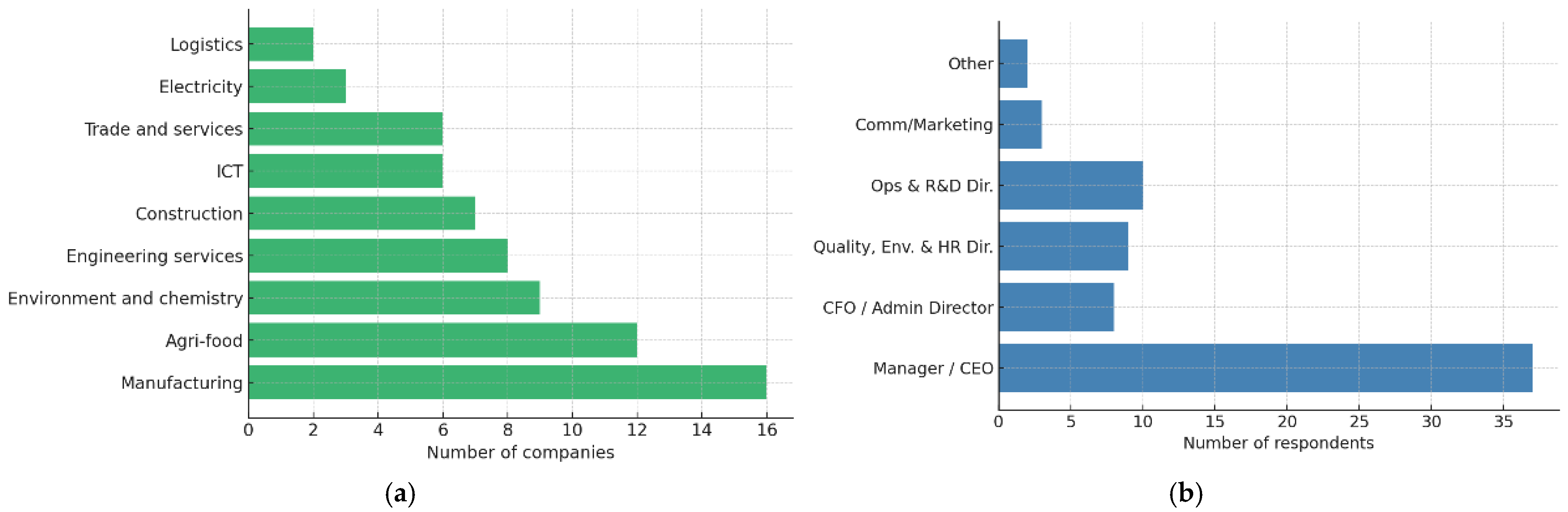
Table 1 summarises the demographic characteristics of the 69 valid responses. The sample reflects the business landscape of the Region of Murcia, encompassing a variety of manufacturing sub-sectors and organisational profiles. As shown, most of those surveyed are small and microenterprises, in line with regional and national patterns. A key strength of the sample is the high presence of decision-makers: over 53% of respondents hold senior positions (e.g., CEO and General Manager), reinforcing the strategic relevance and reliability of the information collected. While the CEO/owner category is well represented (n = 37), the remaining roles have markedly smaller counts (≤10 each). Because of this imbalance, we did not conduct a formal role-specific statistical test; potential interpretation effects related respondent roles are therefore noted as a study limitation (see Section 5).
To enhance visual comprehension, Figure 2a shows the sector distribution of respondents, highlighting the prominence of the manufacturing and agri-food sectors. Figure 2b summarises the positions of the respondents.

4.2. Circular Economy Awareness and Strategic Relevance

Table 2 presents enterprises’ familiarity with the concept of the CE and the importance they attach to integrating CE principles into their business models. Respondents rated, on a scale from 0 to 10, both their level of knowledge of CE and the perceived relevance of adopting a CE-oriented business model.
Medium and large enterprises report the highest average scores for both knowledge (8.00) and importance (8.62), indicating stronger engagement with CE frameworks. In contrast, small enterprises record lower levels of knowledge (6.05), yet slightly higher importance (7.55), whereas microenterprises, despite showing a moderate level of knowledge (7.06), place marginally less emphasis on developing circular business models (7.41).

4.3. Adoption of Industry 4.0 Technologies by SMEs

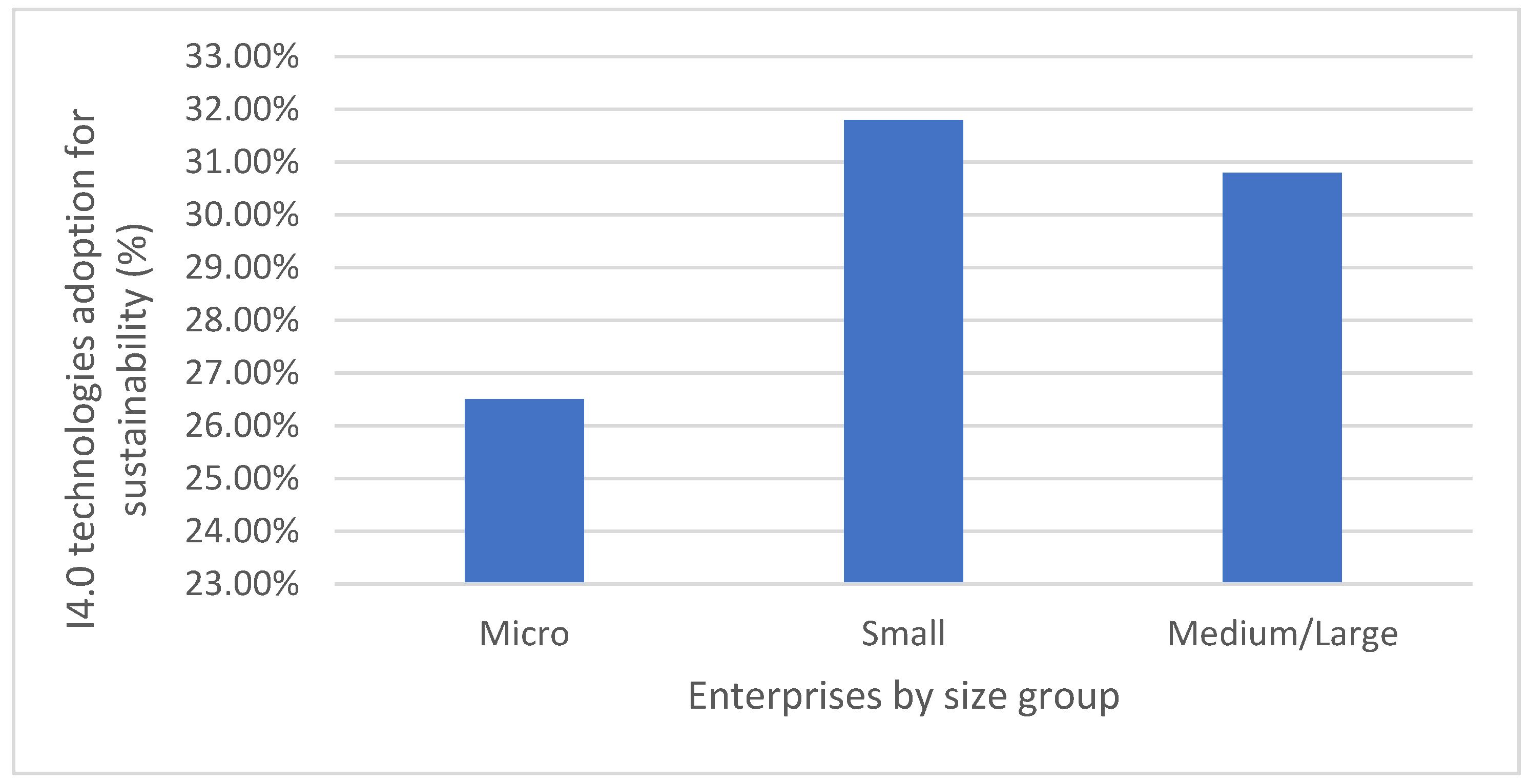
Out of the 69 enterprises surveyed, only 28.9% reported implementing at least one of the nine I4.0 technologies considered in the context of improving sustainability or circularity. Specifically, 73.5% of microenterprises, 68.2% of small enterprises, and 69.2% of medium/large enterprises indicated no adoption of I4.0 technologies. Conversely, active implementation was reported by just 26.5% of microenterprises, 31.8% of small enterprises, and 30.8% of medium/large enterprises (Figure 3).
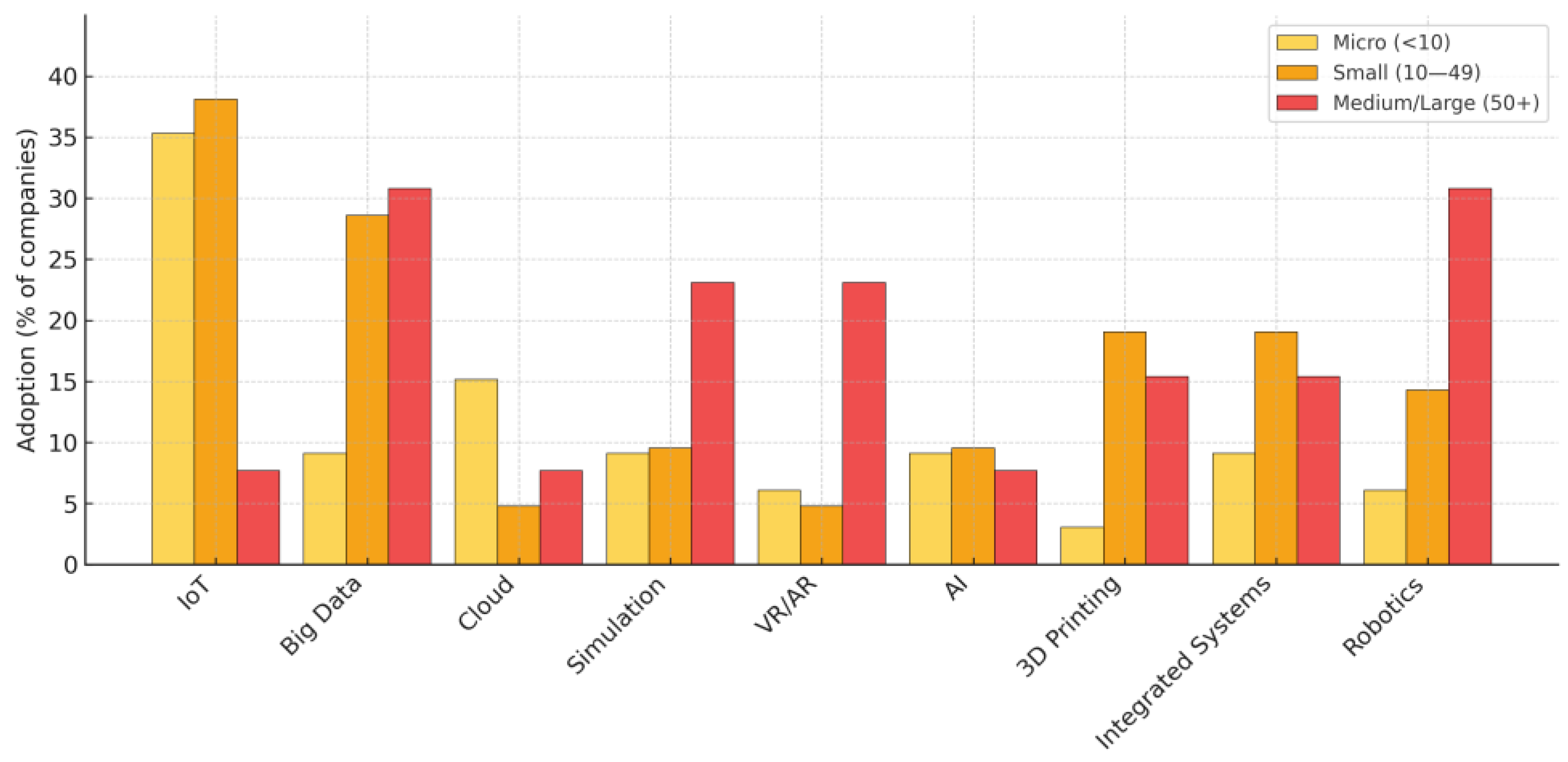
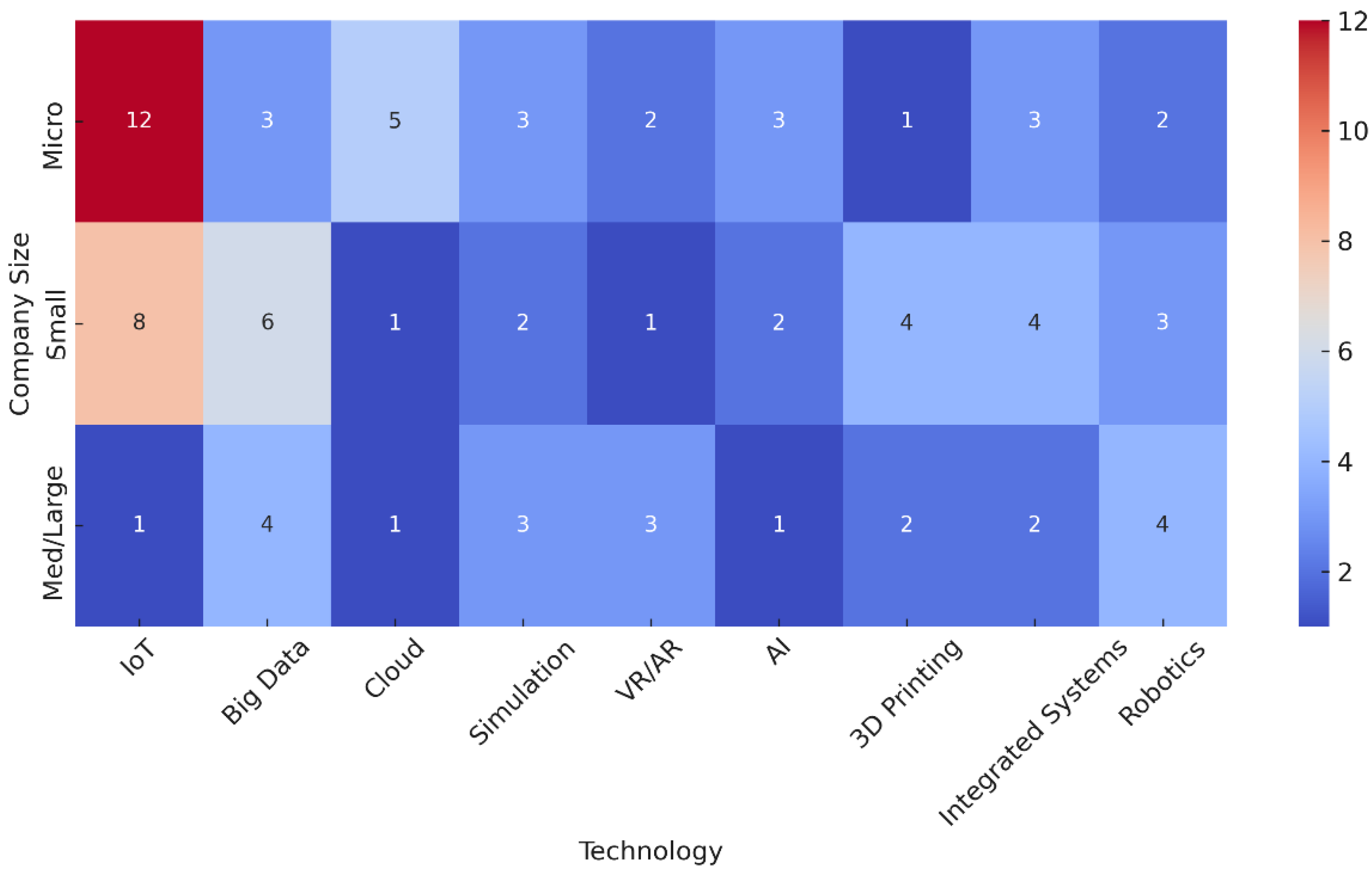
The degree of adoption, however, varies by technology. Table 3 summarises the number and percentage of enterprises that have adopted each technology, both overall and by company size. As shown, IoT is the most widely adopted technology in this context, used by 30.4% of the sample. IoT adoption is relatively high among micro and small enterprises (around one-third of each group), whereas only 7.7% of the medium/large enterprises reported using IoT.
Big data analytics is the second-most adopted technology overall (18.8% of respondents). Notably, big data shows a clear size-dependent uptake: over 30.8% of medium/large enterprises have implemented big data capabilities (e.g., for large-scale data processing or analytics), compared to 27.3% of small enterprises and just 8.8% of microenterprises.
Most other technologies are less commonly adopted across the board. For example, cloud computing solutions for sustainability (such as cloud-based data storage or software) are used by 10.1% of respondents overall. Interestingly, microenterprises lead in cloud adoption (14.7%). Some rely on cloud services to access advanced tools without substantial information technology (IT) infrastructure, whereas only 7.7% of medium/large enterprises reported using cloud for sustainability purposes (Table 3).
Technologies related to simulation and virtualization show a moderate level of uptake. Process simulation and digital twins are implemented by about 11.6% of respondents. Medium/large enterprises are more likely (23.1%) to use simulation models (e.g., to optimise production processes or model circular systems) than micro or small enterprises (8.8% each). A similar pattern is evident for VR/AR tools: 23.1% of medium/large enterprises have begun using VR/AR (for example, in product design or training), compared to just 5.9% of smaller firms.
In contrast, adoption of AI (including machine learning algorithms for sustainability, predictive maintenance, etc.) is uniformly low, at around 8.7% of respondents in each size group (six enterprises in total).
Another niche technology is 3D printing—only 10.1% of firms use additive manufacturing in their sustainability or circular initiatives. Interestingly, small and medium/large enterprises report higher usage of 3D printing (15.4–18.2%) than microenterprises (2.9%). Some small manufacturers (18.2%) have adopted 3D printing for prototyping new sustainable products or producing spare parts on demand, whereas almost none of the microenterprises have this capacity, likely due to the investment required.
Two other technologies show moderate uptake. Integrated information systems (e.g., Enterprise Resource Planning (ERP) systems or other IT integrations used to improve traceability or resource efficiency) are used by 13.0% of respondents overall. Small enterprises lead in this area: 18.2% have integrated digital systems for sustainability (such as linking production data to management systems to track environmental performance), compared to 8.8% of micro and 15.4% of medium/large enterprises. Industrial robotics for sustainable operations are reported by 13.0% of respondents. As expected, robotics adoption is skewed toward larger enterprises: nearly one-third (30.8%) of medium/large enterprises use robotics in processes that improve sustainability (for example, automated handling to reduce waste or improve safety), whereas only 5.9% of microenterprises have any robotics.
Figure 4 and Figure 5 illustrate these adoption patterns by enterprise size. It is evident that microenterprises (yellow bars) have embraced certain low-cost digital solutions (IoT and cloud) nearly on par with larger firms but lag in more complex technologies such as big data analytics and robotics. Small enterprises (orange bars) show a balanced adoption in some areas (e.g., IoT, big data, 3D printing, and integrated systems), often outperforming microenterprises and sometimes approaching larger enterprises. The medium/large group (red bars) leads in the adoption of high-end technologies (big data, simulation, VR, robotics) but lags in IoT and cloud, potentially because many medium-sized firms in the sample are still developing their digital capabilities and are more focused on process-specific tools.
Figure 5 presents the observed frequencies of adoption for each I4.0 technology across enterprise size categories, providing a clear visual summary of these patterns through a colour-coded representation of adoption intensity.
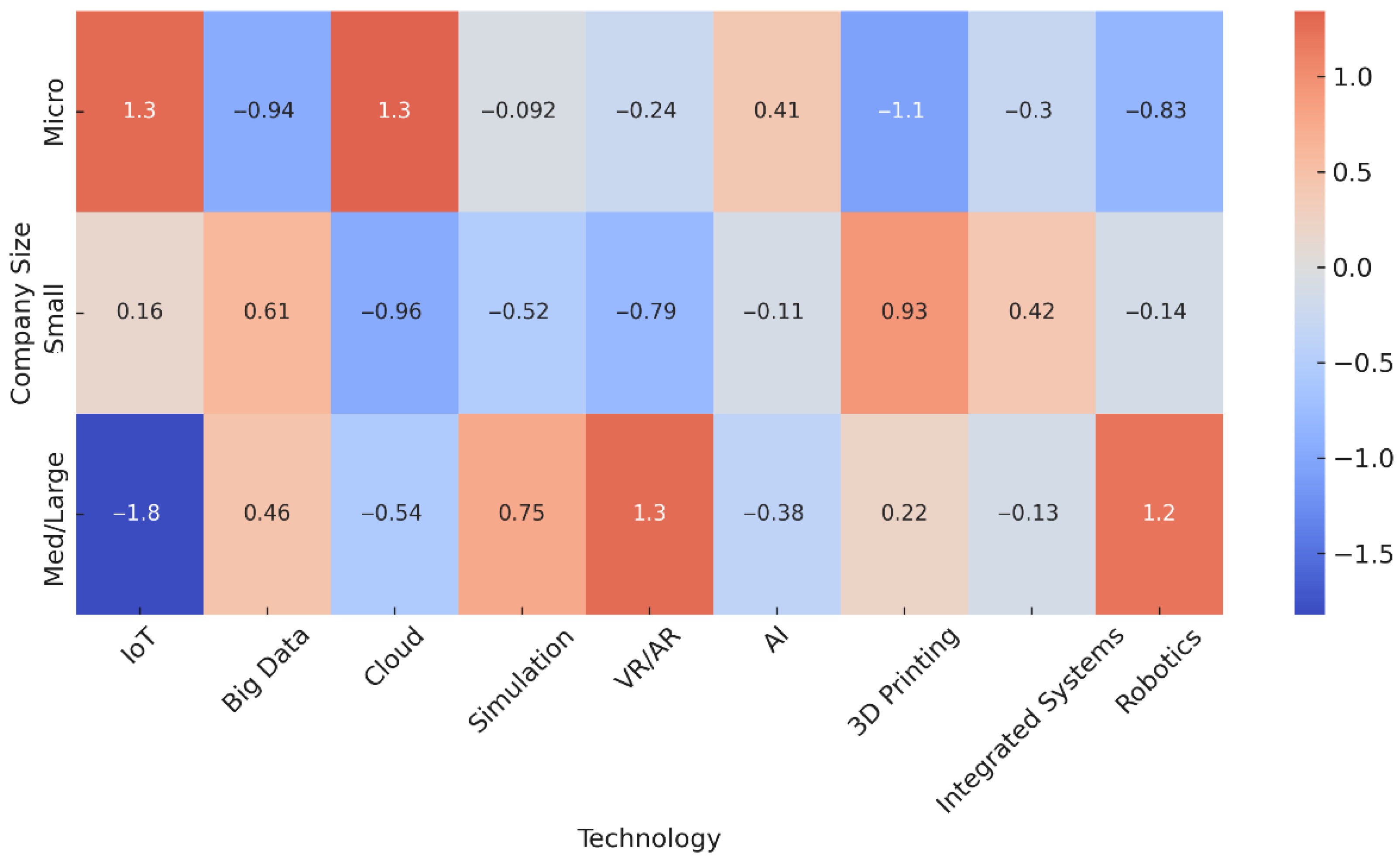
To further explore differences in technology adoption by company size, a chi-square test of independence was conducted, as reported in Figure 6. This figure translates the colours in Figure 5 into standardised residuals. Cells beyond ±2 (highlighted by dashed lines) identify the technology–size pairs that depart most from independence; all other cells should be interpreted as random variation.
In greater detail, the test yielded a chi-square statistic of χ2 = 17.44 with 16 degrees of freedom and a p-value of 0.36 (>0.05), indicating no significant overall association between company size and the adoption of I4.0 technologies. To gain deeper insight, standardised residuals were examined to identify specific deviations from expected frequencies under the null hypothesis of independence. Although none of the residuals exceeded the ±2 threshold typically considered statistically significant, some patterns emerged: microenterprises adopted big data and 3D printing less frequently than expected, while medium/large firms showed slightly higher-than-expected adoption of robotics.
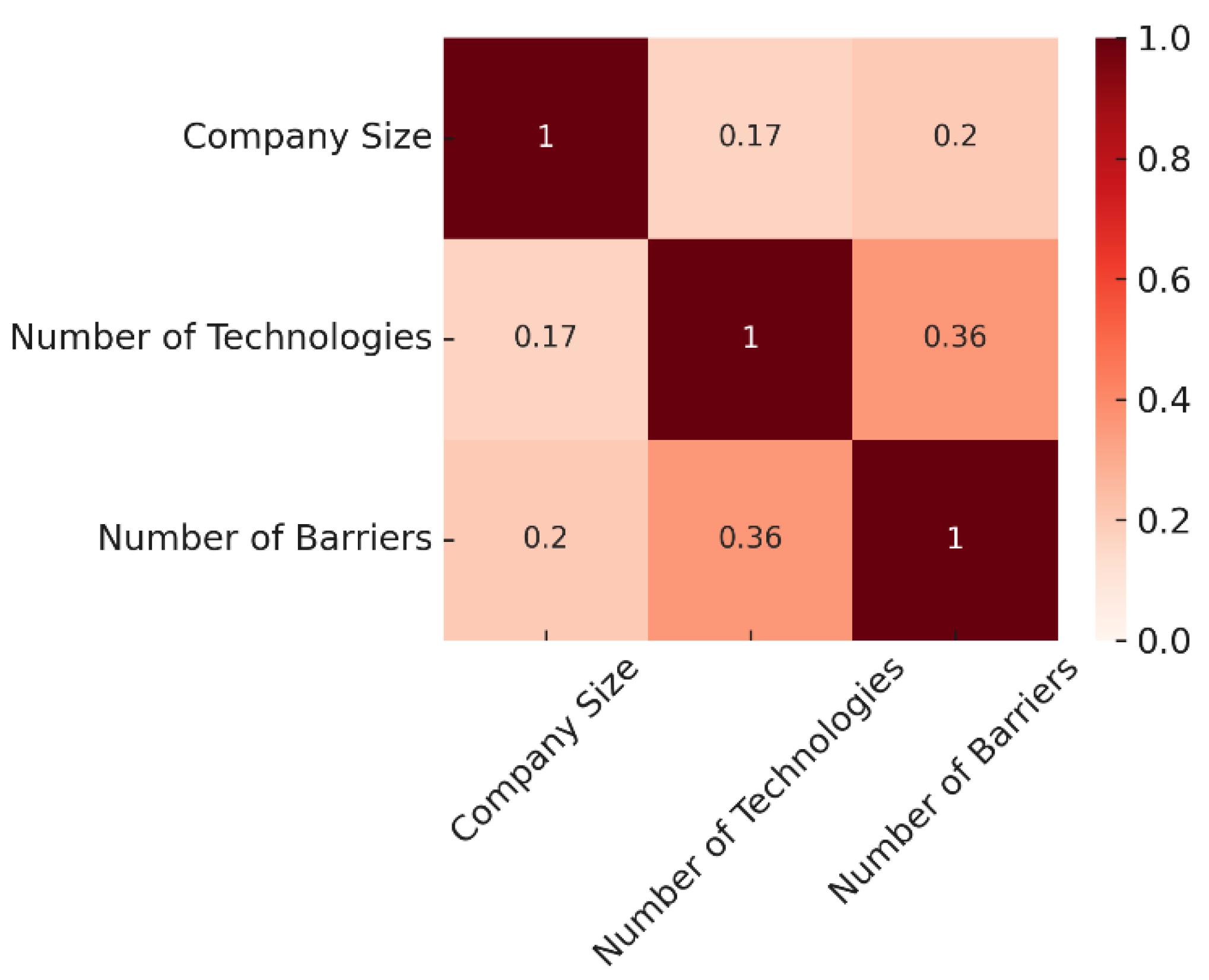
To further explore potential associations, Spearman’s rank correlation coefficients were calculated between company size, the number of technologies adopted, and the number of perceived barriers (Figure 7). The results showed a weak and non-significant correlation between company size and the number of technologies adopted (ρ = 0.168, p = 0.121), as well as between company size and the number of perceived barriers (ρ = 0.197, p = 0.069). These findings suggest that company size alone may not be a strong determinant of either the level of technological engagement or the extent of the challenges perceived during implementation. Conversely, a moderate and statistically significant positive correlation was observed between the number of technologies adopted and the number of perceived barriers (ρ = 0.364, p = 0.001), indicating that enterprises adopting more technologies tend to report a greater number of barriers. This relationship is consistent with the notion that more intensive adoption efforts may expose companies to a broader range of operational, technical, or organisational challenges. Importantly, this association is evident within each size category (micro, small, and medium/large), indicating that it cannot be explained solely by firm-size differences.

4.4. Application of Technologies: Value Chain Stages and Purposes

To clarify how digital technologies contribute to sustainability, the survey asked participants to indicate both the value chain stage and the specific purpose for which each adopted technology was used. The respondents’ open-ended explanations reveal distinctive patterns in the application of I4.0 technologies. However, because these insights derive from a limited set of anecdotal comments, they should not be considered broadly generalisable.
  • IoT: Respondents primarily deploy IoT for real-time monitoring and control in the production stage. Several micro and small enterprises reported using sensor networks to measure environmental parameters such as energy consumption and temperature on the factory floor, aiming to improve energy efficiency and reduce waste. For example, one respondent noted IoT-based “energy and temperature measurement” in their operations to monitor resource usage. Additionally, IoT is used to connect shop-floor data with enterprise systems—e.g., linking machines to an ERP system or a cloud platform for data collection. One medium enterprise described IoT enabling “connection to Systems, Applications, and Products in Data Processing (SAP), ERP, Product Lifecycle Management (PLM), etc.”, integrating production data with business management software to facilitate better decision-making. Overall, it appears that the purpose of IoT adoption is largely operational efficiency and resource monitoring, aligning with both cost-reduction and environmental management objectives in production.
  • Big data analytics: The respondents employing big data tools are mainly analysing large datasets for process optimisation and strategic insights. Many of these applications occur at the production or enterprise management level. For example, one medium-sized enterprise updated its ERP system to capture and analyse big data from production (“data collection in operative plants that are integrated into the ERP”), highlighting a focus on data-driven process control. Others use big data for performance dashboards and decision support, as indicated by a respondent who implemented “management dashboards to control processes and outcomes”. In terms of value chain stage, big data is applied both in operations (production monitoring) and at the organisational level (enterprise analytics), with the key purpose being to uncover inefficiencies, track sustainability metrics (e.g., waste, energy trends), and guide continuous improvement. Notably, a few larger enterprises also integrate big data with supply chain and customer data, but most examples were internally focused. Overall, the main driver for big data adoption appears to be improving process efficiency and decision-making quality in support of sustainability goals (such as optimising resource use or improving product quality to reduce defects).
  • Cloud computing: Respondents using cloud services do so to enable data sharing and the scalability of their sustainability initiatives. Several small and micro enterprises reported moving data or applications to the cloud “for data management”. For example, one microenterprise described using “cloud services with some enterprises”, indicating cloud-based collaboration or data exchange with partner companies (possibly to facilitate industrial symbiosis or supply chain transparency). Generally, cloud computing is employed as an IT infrastructure enabler—hosting databases of environmental metrics, sharing information on platforms, or using Software-as-a-Service (SaaS) tools for tracking carbon footprint—rather than a direct process technology. The value chain stage appears to be cross-cutting, supporting multiple stages by providing accessible data storage and analysis. The purpose is to reduce IT infrastructure costs, improve the accessibility of sustainability data, and sometimes to foster collaboration—a driver especially for smaller enterprises that lack in-house IT.
  • Simulation and digital twins: The respondents adopting simulation models or digital twin technology apply them in process design and optimisation stages. For instance, one medium enterprise implemented digital twin simulations for its wastewater treatment process (“modelling depuration treatments”), indicating use in the end-of-pipe environmental management stage (to optimise how waste is treated). Others mentioned “digital twins” in the development and simulation of production scenarios via data models. These tools are used to experiment with process changes in a virtual environment, allowing companies to predict the impact on resource efficiency or emissions before making real-world changes. Overall, simulation appears to be used as a design and planning tool within production or product development. The purpose is to enable innovation and risk reduction—companies can drive sustainability by virtually testing new circular processes (e.g., recycling loops, new materials, or product designs) and optimising for efficiency, which is a key facilitator for adoption in the relatively few firms using this approach.
  • VR/AR: The use of VR/AR among respondents is still nascent, but where implemented, it is linked to product design and prototyping, as well as training. One small manufacturer reported “3D modelling” using virtual reality, which likely assists in designing eco-friendly products or components in a virtual space. Another respondent referred to developing a “digital twin” under VR, blurring the line between simulation and VR—possibly using VR to visualise and interact with a digital model of their process or product. A few enterprises simply noted they are “starting to develop” VR/AR solutions, suggesting that the main barrier is the early stage of adoption. Hence, the value chain stage for VR/AR seems to be primarily design/research and development (R&D) (helping to design products or processes with sustainability in mind, such as visualising how a product can be disassembled or recycled), and secondarily operations training (e.g., AR for guiding workers in sustainable procedures; though this was not explicitly mentioned by respondents, it is a known use case). The main purpose is innovation in design and improved understanding of complex systems, which can drive sustainability by enabling better designs and skilled workers.
  • AI: Although only a few respondents use AI, their applications highlight its potential in monitoring and predictive analytics. One medium enterprise described employing AI to develop a real-time monitoring and alert system (“monitoring tools and real-time triggering systems”), which likely uses machine learning to detect anomalies in energy usage or emissions and alert managers. This application lies in the production/operations stage, aimed at predictive maintenance or predictive environmental control (preventing spills, optimising machine efficiency). Another respondent indicated they are just beginning to develop AI capabilities (“starting to develop although the road trip is long”), implying interest in future use for optimisation. At the time the questionnaire was launched, the purpose driving AI adoption appeared to be advanced automation of decision-making—using algorithms to identify patterns humans might miss, thereby improving efficiency or compliance (a driver particularly in more complex operations).
  • 3D Printing/Additive manufacturing: The few enterprises that reported having with 3D printing capabilities used them in product development and production of specialised parts. For example, one small enterprise noted they “We have it, and we use it” 3D printing, without elaboration, which can be interpreted as using it for prototyping new product designs with sustainable materials or for manufacturing spare parts/tools in-house to reduce waste and transportation. Another respondent simply answered “Yes” to 3D printing, suggesting they have integrated it in some capacity. The value chain stage appears to be typically product design and production. As a circular economy strategy, 3D printing can enable lightweight designs (material savings) and local production (reducing transport). The purpose mentioned implicitly by respondents is convenience and innovation—they have the printers and use them as needed, implying a driver of flexibility in manufacturing and the ability to rapidly test sustainable product concepts. Cost reduction in prototype outsourcing and material efficiency appear to be likely secondary drivers.
  • Integrated systems: Several respondents highlighted the use of integrated information systems to support sustainability efforts, often referring to traceability and process integration. For instance, one respondent wrote “traceability, processes” under this category, indicating that they have integrated systems to ensure traceability of materials or products across the supply chain (value chain stage: logistics and distribution, as well as production). This could mean linking barcodes or Radio Frequency Identification (RFID) tracking from production through customer delivery to monitor product life cycles or returns. Another respondent humorously referred to “the concept of common sense” when describing integrated systems—perhaps suggesting that integrating systems is seen as an obvious necessity (or that they interpreted “integrated systems” loosely). In any case, enterprises that adopted integrated digital systems appear to have done so to break down data silos and connect processes with the goal of obtaining end-to-end visibility of resource flows (e.g., tracking waste, recycling, or product performance in use) and to streamline processes (a driver being operational coherence and meeting regulatory/customer demands for documentation, such as carbon footprint reporting).
  • Robotics: The use cases for industrial robotics in the surveyed enterprises appear to be tied to operations and logistics, with sustainability or safety benefits. One medium-sized enterprise reported using robots “for storing boxes and pallets”, i.e., in the warehouse for handling them. This application (value chain stage: logistics/internal material handling) likely yields efficiency gains (faster, optimised storage and retrieval) and reduces accidental damage (hence waste) and energy use through optimised movements. Another respondent described robotic installations in production to protect workers: robots were introduced “to avoid one worker being under constant vapour and heat” at a pasteuriser’s output. This points to a health and safety motive—using automation to remove operators from hazardous, high-temperature environments—which is both a social driver (worker well-being) and can improve process control (consistent operation, and less downtime). In general, production automation via robotics (welding, assembly and packaging) could yield quality improvements and resource efficiency (as robots can minimise material waste). The main purpose driving robotics adoption, as gleaned from responses, includes efficiency (throughput increase), quality consistency, and safety/environmental control (e.g., preventing accidents and thereby avoiding environmental incidents).

4.5. Implementation of I4.0 Technologies for Sustainability Across the Product Life Cycle

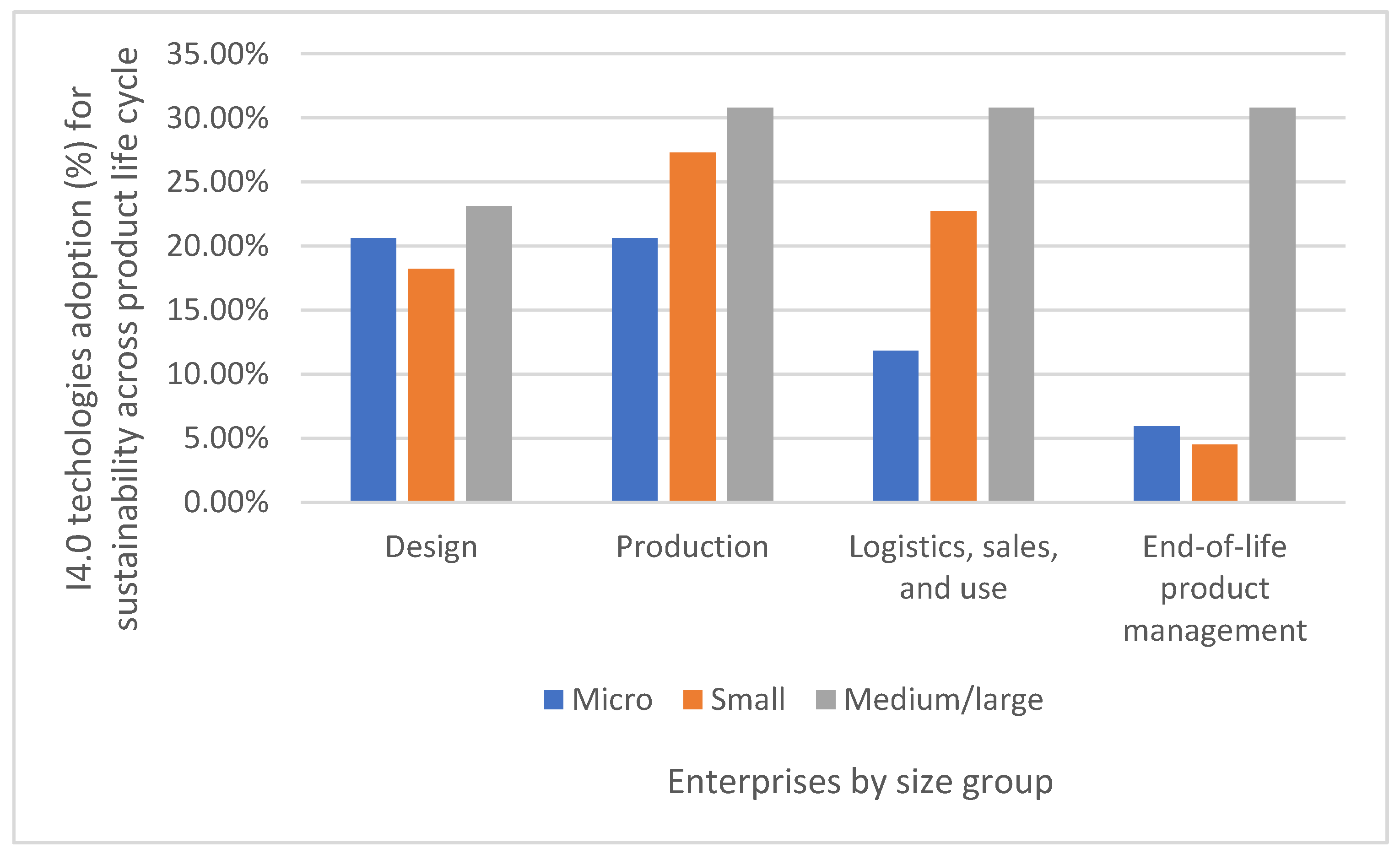
Figure 8 presents the percentage of enterprises implementing I4.0 technologies for sustainability purposes at different stages of the product life cycle (design, production, logistics/sales/use, and end-of-life product management), disaggregated by enterprise size. Implementation varies across both stages and enterprise type.
The production phase stands out with the highest uptake across all groups, particularly among medium/large enterprises (30.8%), followed by small (27.3%) and microenterprises (20.6%).
In contrast, the end-of-life management stage shows the widest gap by size: 30.8% of medium/large enterprises report adoption, compared with only 5.9% of microenterprises and 4.5% of small enterprises.
Adoption in the design stage is relatively low but more consistent across company sizes, with slightly higher values among medium/large enterprises (23.1%).
The logistics, sales, and use stage exhibits a progressive increase in adoption along the size spectrum, from 11.8% in microenterprises to 30.8% in medium/large enterprises.
Overall, medium and large enterprises demonstrate broader implementation across all life cycle stages, particularly in advanced or circularity-oriented phases, whereas micro and small enterprises remain focused on more conventional digitalisation efforts, primarily within production.
To assess whether the adoption of I4.0 technologies for sustainability purposes varies significantly across product life cycle stages depending on enterprise size, a chi-square test of independence was conducted. The test yielded a chi-square value of χ2 = 7.42 with 14 degrees of freedom and a p-value of 0.917, indicating no statistically significant association between company size and the implementation stage.
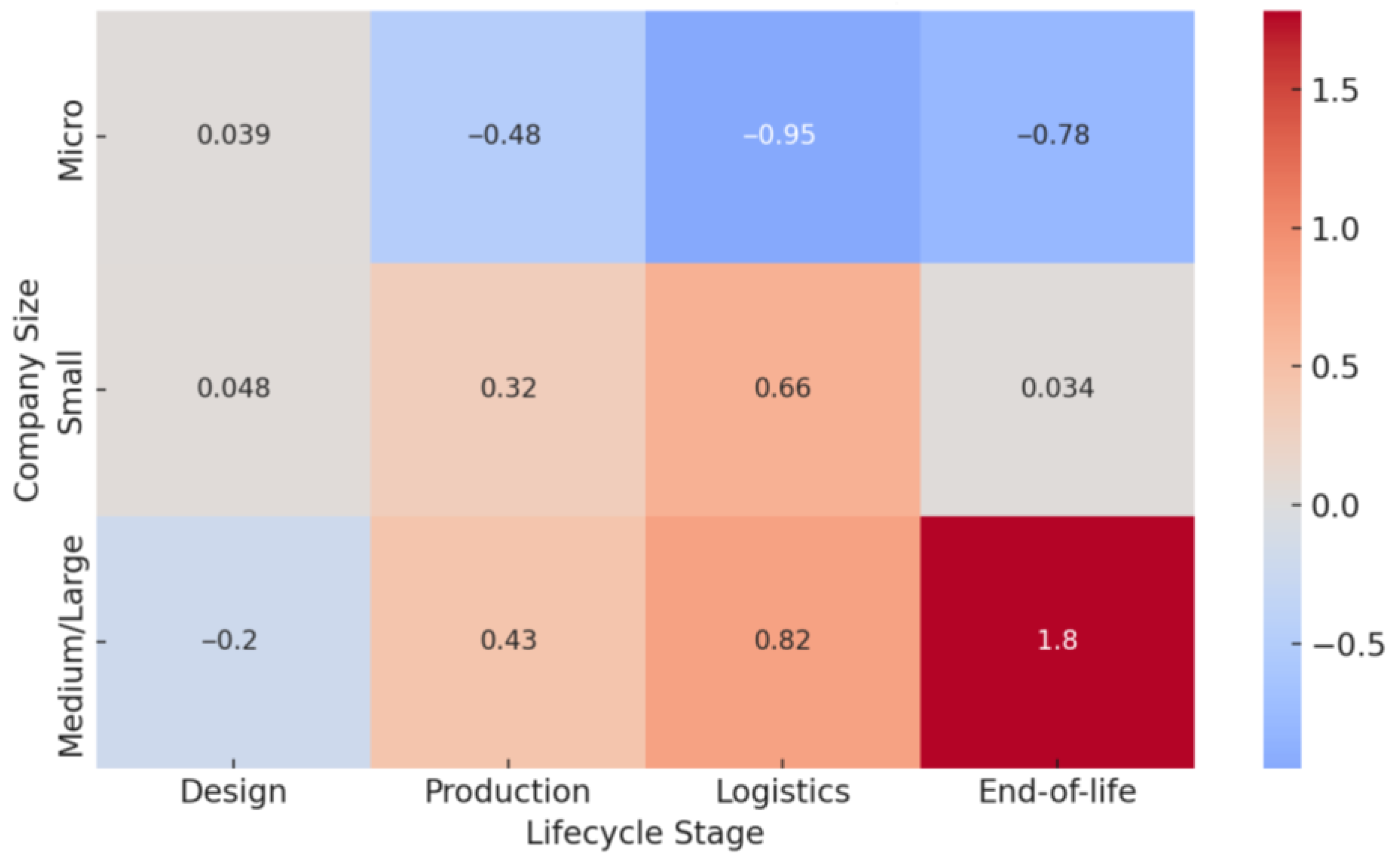
To investigate these further, standardised residuals were calculated for each size group and stage (Figure 9). While none of the residuals exceeded the ±2 threshold for statistical significance, some deviations are noteworthy. Medium and large enterprises showed higher-than-expected implementation of I4.0 technologies, particularly in logistics/sales/use (residual = +0.82) and end-of-life product management (residual = +1.80). In contrast, microenterprises reported lower-than-expected use in these same stages (residuals = –0.95 and –0.78, respectively), suggesting limited penetration of advanced technologies in later-cycle or circularity-oriented activities.
Although not statistically significant, these patterns are consistent with the descriptive data and may reflect a general tendency for larger firms to integrate digital tools more comprehensively across extended life cycle phases.
In summary, while medium and large enterprises exhibit broader adoption of I4.0 technologies across all life cycle stages—particularly beyond production—micro and small enterprises remain largely focused on basic digitalisation efforts, with limited penetration in more complex or circular-oriented stages such as end-of-life management.

4.6. Barriers and Drivers for Technology Adoption

Despite the clear benefits and use cases identified, enterprises also face barriers in adopting I4.0 technologies for sustainability purposes. To better understand these limitations, the survey asked respondents to identify perceived barriers to implementing a circular economy model—an approach that inherently involves the uptake of advanced technologies and practices. Table 4 summarises the results, showing the percentage of enterprises by size that selected each barrier. Respondents could select multiple categories.
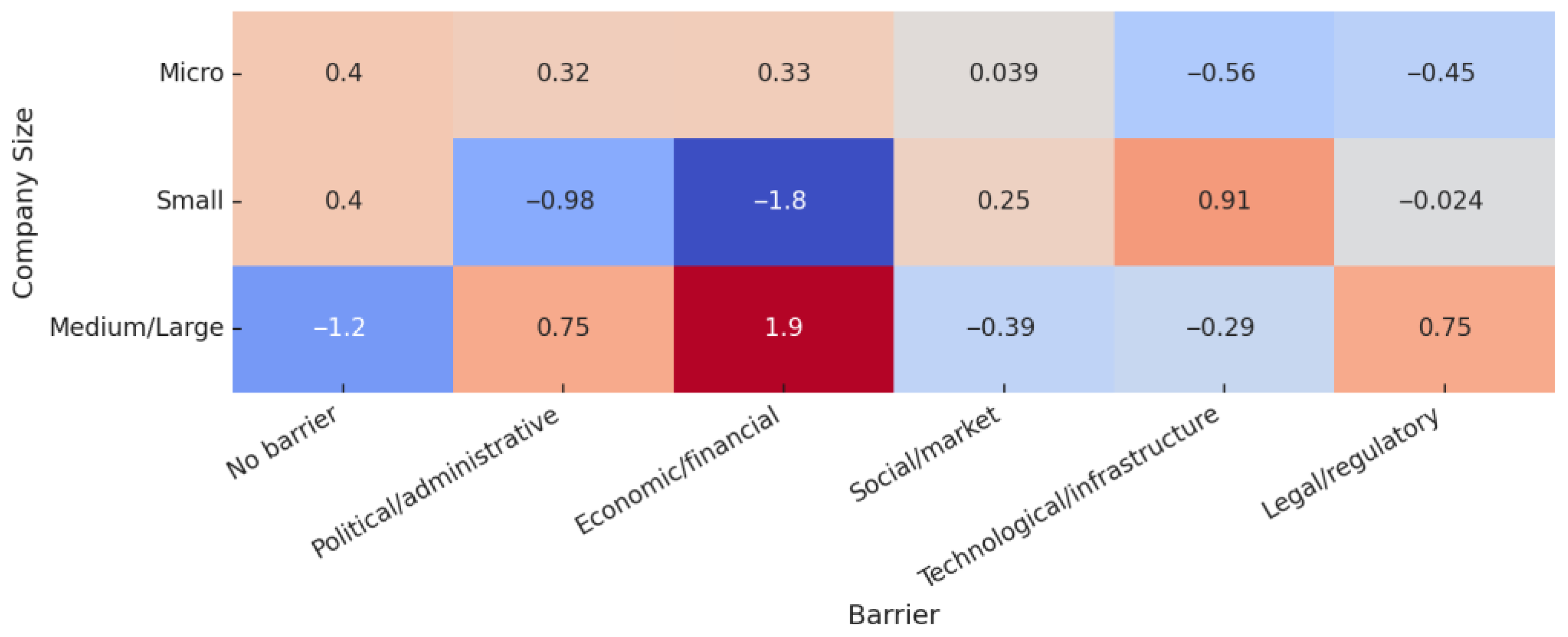
Figure 10 illustrates the standardised residuals for all barrier categories by company size. Although only the economic/financial barrier showed a statistically significant deviation, the residuals help to visualise how different types of enterprises diverge from expected response patterns.
Overall, the most frequently cited barriers were political/administrative and economic/financial. About 40.6% of all respondents highlighted political or administrative issues, such as lack of government incentives, difficulties accessing public funding, or insufficient support programmes, as limiting their ability to adopt sustainability and digitalisation strategies. Nearly as many (37.7%) pointed to economic or financial barriers, particularly the cost of implementing circular or digital technologies and the uncertainty surrounding return on investment.
Importantly, the salience of these barriers varies by enterprise size. Economic and financial barriers were mentioned by a significantly larger proportion of medium/large firms (69.2%), compared to 41.2% of microenterprises and only 13.6% of small firms. A chi-square test confirmed that the distribution of investment-related barriers differs by enterprise size (χ2 = 11.10, p = 0.004). Larger enterprises reported this barrier more often than smaller ones; the underlying reasons require further investigation.
Political/administrative barriers were cited by 53.8% of medium/large enterprises and 44.1% of microenterprises, but only 27.3% of small ones, making them the most frequently cited barrier overall (40.6%). This category includes issues like insufficient public incentives or the absence of clear guidelines, reflecting a need for stronger institutional drivers to facilitate adoption. Although the differences by size were not statistically significant (p ≈ 0.25), this barrier remains the most frequently selected overall. Respondents referred to the absence of clear guidelines, administrative complexity, and a perceived lack of leadership or direction at the policy level.
Legal and regulatory barriers, such as compliance requirements or restrictive environment rules, were selected by 27.5% of respondents overall, most notably 38.5% of medium/large enterprises. Some respondents remarked on challenges related to waste management regulations or product certification
Surprisingly, technological and infrastructure barriers, directly related to the core theme of I4.0, were among the least cited barriers (18.8% overall). Slightly more small enterprises (27.3%) identified this barrier compared to micro (14.7%) and medium/large (15.4%). Reported issues included a lack of internal digital skills, poor IT infrastructure, and the absence of proven or fit-for-purpose technological solutions for their specific needs.
Social or market barriers (e.g., low consumer awareness, cultural resistance within firms, or difficulty collaborating with partners) were the second least cited category (20.3% overall). A fifth of respondents (with a slight tilt toward small enterprises at 22.7%) feel that the market context, such as clients unwilling to pay for greener products or difficulty finding collaborative partners for symbiosis, is holding back their sustainability tech adoption. Microenterprises (20.6%) and large enterprises (15.4%) cited social barriers to a similar small extent.
Finally, 23.2% of all respondents selected the option “no barriers—the company is not interested”, indicating limited engagement with CE initiatives. This was most prevalent among micro and small enterprises (26.5% and 27.3%, respectively) and far less common among medium/large enterprises (7.7%), only 1 in 13. Notably, enterprises reporting no interest also had much lower technology adoption levels, averaging just ~0.8 technologies adopted compared to ~1.4 among those who reported at least one barrier. This suggests that lack of interest may coincide with a broader disengagement from digital and circular innovation processes.
Drivers and enablers for technology adoption can be inferred as the converse of these barriers and from the qualitative responses on technology purpose. From the opinions collected, a few key drivers emerge, but note that these insights derive from a limited set of anecdotal comments, so they should not be considered broadly generalisable.
  • Cost reduction and efficiency gains: Many respondents explicitly or implicitly indicated that they adopt technologies like IoT, big data, and robotics to save costs (energy, materials, and labour) and to improve efficiency. For example, the widespread use of IoT for energy monitoring is driven by the need to cut energy bills and improve resource efficiency. Likewise, big data and AI are pursued to optimise processes and reduce waste. This economic motive is a primary driver, especially for medium enterprises—indeed, those that have adopted technologies often justified it in terms of operational savings or productivity. Conversely, where cost savings are not evident or capital cost is too high, adoption falters (hence financial barriers). Thus, demonstrating a clear return on investment (ROI) is a critical driver: in enterprises where management perceived a strong business case (short payback period or quality improvement leading to higher sales), technologies were implemented despite hurdles. One medium enterprise, for instance, justified its big data investment by improvements in process control (reducing defects and saving raw materials). We found that larger enterprises tend to calculate these returns and act on them, whereas smaller ones may need external incentives to make the math work.
  • Regulatory compliance and market requirements: Although regulatory barriers exist, regulation can also act as a driver when it forces or incentivises action. In our sample, some enterprises adopted traceability systems, cleaner production processes, or emission monitoring in response to regulations or customer demands. For example, Extended Producer Responsibility (EPR) schemes and supply chain requirements push companies to digitalise tracking of materials (using integrated systems, IoT) to ensure compliance and transparency. One common theme was traceability: enterprises implemented integrated Information and Communication Technologies (ICT) systems to trace products and waste, which not only helps in internal efficiency but also meets client expectations for sustainability reporting. Medium/large enterprises (38.5% citing legal barriers) are also the ones proactively addressing regulations by investing in technologies—so in a sense, regulation is a driver for those who have resources, even as it is perceived as a barrier by others. Future tightening of environmental regulations (and the availability of green labels or certifications) is likely to drive more small and medium enterprises to adopt digital solutions, turning a current obstacle into a catalyst.
  • External support and knowledge: The presence of enabling support structures is a notable driver. More than half of the respondents (52.2%) were aware of the regional Technology Centres, and this awareness was much higher among medium/large enterprises (76.9%) and small ones (59.1%) than micros (38.2%). These technology centres (which provide R&D support, testing, and training) are likely facilitators for adoption—enterprises that know about and collaborate with them can more easily implement new technologies. Similarly, knowledge of funding programmes correlates with adoption: for instance, 76.9% of medium/large enterprises know about energy efficiency grants, compared to only 14.7% of microenterprises. This aligns with the finding that medium/large respondents more frequently invest in energy-saving technologies (IoT and efficient machinery)—they are taking advantage of available grants or at least aware of them. The survey’s data on awareness of the INFO’s I4.0 catalogue and other resources (Table 5) indicates that smaller enterprises suffer an information gap. Those small enterprises that did adopt technologies often cited having received some guidance or co-funding. Therefore, education, technical assistance, and financial incentives are key drivers when present. Indeed, companies that had participated in prior programmes or were networked with industry clusters showed higher readiness in our sample. This suggests that expanding outreach (to reduce the 23.2% “not interested” cohort) and connecting SMEs with support schemes will directly increase technology uptake.
  • Strategic vision and organisational culture: A less tangible but crucial driver is the company’s internal commitment to sustainability. Respondents that consider circular economy and digitalisation as strategic priorities (often driven by leadership or a dedicated innovation team) tend to proactively adopt I4.0 solutions. For example, one microenterprise that implemented four different circular practices and multiple technologies described these efforts as part of a strategic model, with clear top management support. In contrast, respondents without such a vision largely stagnated (as seen with those citing a lack of interest). Thus, having a forward-looking organisational culture and skilled personnel is a driver. Some respondents alluded to this: one noted that adopting new technologies required “training staff in CE”, which they had pursued as an enabling action. Enterprises that invested in employee training and brought in new expertise (either hiring or via partnerships) found it easier to implement technologies. This underlines the role of human capital and change management as drivers: even when technology is available and funding is accessible, adoption requires people who can integrate the technology into daily operations. SMEs with younger, tech-savvy management or those that had prior positive experiences with innovation clearly stood out in our dataset.
  • Market competitiveness and client pressure: Finally, a driver mentioned indirectly by a few enterprises is the desire to enhance competitiveness or brand value through digital sustainability. For instance, implementing IoT and data analytics gave some companies the ability to market themselves as efficient and innovative, possibly opening new business-to-business (B2B) opportunities. A few respondents referenced customer requirements as a reason for adopting traceability systems (e.g., a multinational client demanded proof of sustainable sourcing, pushing the SME supplier to digitalise its tracking). While only 20.3% cited “social/market” barriers, this also means roughly that fraction sees market pull as insufficient—conversely, where market pull exists (specific client or niche market expectations), it becomes a positive driver. One example is enterprises in the agri-food industry in Murcia adopting IoT and blockchain for traceability because large retailers now require detailed provenance information for sustainable products. Such external pressures are likely to increase, becoming a stronger driver in the near future.

5. Discussion

The demographic composition of the sample strengthens the reliability of the findings, as most responses come from strategic decision-makers. The predominance of micro and small enterprises aligns with regional economic structures, enabling representative conclusions for policy and strategic development, especially in the context of RIS4Mur.
In terms of CE awareness, larger enterprises appear more familiar with the concept and more committed to integrating it into their strategies. This may stem from greater access to training, funding, or regulatory exposure. However, smaller enterprises, despite recognising CE’s relevance, may lack the capacity to implement related practices, highlighting a need for tailored support mechanisms. The findings confirm a generally low level of I4.0 technology adoption across enterprises of all sizes, indicating that digital transformation for sustainability purposes is still in its early stages among enterprises in the Region of Murcia. While larger enterprises show a slightly higher engagement with certain technologies, the absence of a statistically significant association between company size and overall adoption levels (χ2 = 17.44, p = 0.36) suggests that the barriers to implementation are widespread and not limited to a particular segment.
This relatively uniform low adoption may stem from structural challenges common to many enterprises, such as limited financial resources, lack of skilled personnel, and difficulties aligning advanced digital tools with existing business models. Despite regional and national strategies promoting digitalisation and CE transition, actual implementation remains fragmented. These results highlight a gap between strategic and operational execution. However, disaggregated analysis by type of technology reveals important differences. IoT emerges as the most widely adopted solution, particularly among micro and small enterprises. This trend likely reflects the relative affordability, modularity and accessibility of IoT tools, which enable even the smallest companies to monitor and optimise resource use without major infrastructure overhauls. Interestingly, medium and large enterprises report lower IoT adoption rates, potentially due to a focus on more complex or specialised technologies.
Big data analytics, in contrast, shows a clear size dependence, with larger enterprises significantly more likely to implement it. This aligns with the idea that data-driven solutions require not only technological infrastructure but also organisational maturity and access to sufficient volumes of data, resources typically more available in medium or large companies. Although the difference was not statistically significant, the trend (χ2 test, p ≈ 0.10) underscores the digital divide in data capabilities.
Cloud computing adoption presents an unexpected pattern, with microenterprises slightly leading. This may reflect a practical workaround: smaller enterprises use cloud-based platforms to access digital functionalities without investing in costly on-premises systems. Although not statistically significant (p > 0.4), this result challenges the common assumption that digital sophistication is tied to enterprise size and suggests that microenterprises can be agile adopters when tools are cost-effective and easy to implement.
The adoption of more complex and capital-intensive technologies—such as simulation, robotics, and VR/AR—remains concentrated among medium/large enterprises. For example, robotics is used by nearly one-third of enterprises in this group but by only 5.9% of microenterprises, likely due to investment requirements and scale advantages. Interestingly, the size difference for robotics adoption approached statistical significance (χ2 test, p = 0.07), reinforcing the interpretation that technological complexity correlates with enterprise capacity.
One of the most insightful findings relates to a moderate and statistically significant positive correlation between the number of technologies adopted and the number of perceived barriers (Spearman ρ = 0.364, p = 0.001). This suggests that enterprises further along the digitalisation path are more aware of implementation challenges, possibly because they have encountered them directly. Rather than indicating resistance, this relationship may reflect increased digital maturity and a more critical understanding of the practical hurdles faced during implementation.
Two non-mutually exclusive mechanisms may explain this pattern. First, enterprises that have already deployed several I4.0 tools gain problem awareness through direct experience; as shown in [67], “digital frontrunners” identify more barriers because they encounter them in practice. Second, adopting multiple technologies increases coordination, integration, and change management demands, thereby raising the perceived barrier load [68]. In line with complexity theory, each additional technology expands the number of interfaces and stakeholders that must be managed, amplifying regulatory, financial, and skills-related constraints. Future longitudinal studies could disentangle these effects by tracking the same firms over time.
An analysis of the application of I4.0 technologies across the value chain reveals that their impact extends from product design (VR and 3D printing) to production (IoT sensors, AI, simulation, and robotics), logistics and supply chain management (integrated systems and robotics), and even end-of-life management (where simulation is used to model treatment operations and integrated systems help track products for recycling). The purposes for which these technologies are applied align with classic sustainability drivers: monitoring and reducing energy and resource use (IoT and AI), optimising processes to cut waste (big data and simulation), improving product circularity by design (VR/AR and 3D printing), ensuring compliance and traceability (integrated systems), and improving safety and efficiency (robotics). Notably, many enterprises leverage these technologies in combination with other technologies or organisational innovations. For example, a respondent integrating IoT data into an ERP system is simultaneously addressing a technological and managerial aspect of the circular transition. This interplay suggests that digital technologies act as enablers for circular strategies at multiple points in the value chain; when enterprises have a specific sustainability goal (e.g., energy savings and regulatory compliance), they tend to adopt the technology that directly serves that goal.
This broad deployment across the value chain illustrates the potential of I4.0 technologies to function as key enablers of circular strategies. However, when these patterns are examined in relation to the product life cycle stages and enterprise size, a more comprehensive picture emerges, highlighting both the opportunities and limitations of digital adoption in practice. The results of the heatmap of standardised residuals from a chi-square test of independence indicate that medium and large enterprises tend to implement technologies at the end-of-life stage more often than expected, while microenterprises tend to do so less often. However, none of these deviations exceed the ±2 threshold, so they are not significantly significant. These findings underscore the differentiated implementation of such technologies across life cycle stages and the influence of organisational scale on the capacity to integrate digital tools in support of circular strategies. The predominance of implementation in the production phase across all enterprise sizes suggests that this stage remains the primary focus of digitalisation efforts, likely due to its immediate operational and cost-efficiency gains. However, as we move beyond production, especially into stages such as end-of-life management, the gap between large and small enterprises widens significantly, pointing to deeper structural barriers among smaller enterprises.
This disparity highlights a key issue: while larger enterprises appear to be diversifying their technological applications towards more strategic and circular strategies, such as eco-design, smart logistics, and reverse logistics, micro and small enterprises remain concentrated in basic, process-focused digital uses. This limited scope may reflect resource constraints, lack of technical capabilities, or insufficient institutional support to engage in more complex sustainability-driven transformations.
Moreover, the gradual increase in adoption rates across stages like logistics and use, in parallel with enterprise size, suggests that the integration of technologies such as connected products or customer analytics remains strongly linked to digital maturity and organisational readiness. These capabilities are typically more developed in medium and large enterprises, which have already consolidated foundational digital infrastructures. In this context, the analysis reinforces the idea that I4.0 technologies are not uniformly transformative but rather dependent on enterprises’ internal capacities and strategic orientations.
This perspective is further supported by the identification of key barriers and enablers influencing technology adoption, particularly in relation to enterprises’ size and institutional environment.
Interviews and comments (based on a limited set of anecdotal comments) suggest that larger enterprises often contemplate more capital-intensive projects (e.g., advanced robotics, comprehensive system overhauls); hence budget approvals and ROI considerations become a primary concern. Smaller enterprises, conversely, may limit themselves to lower-cost initiatives (or not attempt them at all), so they less frequently identify cost as a barrier—in fact, some small businesses might be unaware of what the investments would entail, focusing instead on other hurdles.
Smaller enterprises may be less familiar with policy instruments or may not pursue them enough to feel frustrated by bureaucracy; micro and large enterprises, on the other hand, expressed frustration with, for example, the complexity of obtaining grants or the lack of tailored support. This suggests a need for stronger institutional drivers to facilitate adoption across sizes.
While regulation can also drive innovation (by forcing change), in this sample it is seen more as a barrier—likely because many enterprises try to comply with complex rules and hesitate to adopt new technologies without clear regulatory frameworks. In other words, for many enterprises that have interest, it seems that technology per se is not the main barrier—rather, cost and institutional factors are more significant. Still, those who selected this category commonly pointed to a lack of internal technical knowledge, insufficient digital infrastructure, or immature technologies as limitations. For example, one respondent commented that suitable technology solutions for their specific circular process were not readily available or proven (an infrastructural gap). This suggests a need for better technology transfer and support, especially targeting small enterprises that are keen but under-equipped. Furthermore, there is a weak negative correlation between perceiving technological barriers and the number of technologies adopted (Spearman ρ = −0.14, p = 0.26), which—though not significant—suggests that enterprises struggling with technology-related constraints tend to adopt fewer solutions. This observation aligns with the fact that the lack of interest or awareness is itself a major barrier: many micro and small enterprises are not yet actively seeking digital solutions for sustainability because they have not prioritised these goals. Enterprises that indicated “no barriers—not interested” reported significantly lower adoption (mean = 0.8 technologies), compared to those who identified at least one barrier (mean = 1.4 technologies) with the difference being statistically significant (t-test, p = 0.04). In such cases, the drivers must first come from raising awareness and demonstrating the business case for a circular economy practices.
Finally, the analysis reveals that the balance of barriers and drivers plays a crucial role in determining each enterprise’s progress in the twin transition. While resource limitations and policy gaps are holding back many smaller manufacturing enterprises—over a quarter of which have not yet engaged in any digital sustainability efforts—those that have moved forward are primarily motivated by efficiency gains, compliance requirements, and external support. Statistical analysis highlights some size-related distinctions: larger enterprises are more concerned about financing but are also better equipped to access support, whereas smaller enterprises need more fundamental awareness-raising and technical capacity building. Although no significant differences were found in the number of adopted technologies by enterprise size, larger enterprises tend to adopt more complex tools (e.g., robotics, simulation), while micro and small enterprises favour simpler, low-cost solutions (e.g., IoT, cloud). These findings suggest that policies should be tailored by enterprise size—training, advisory services, and affordable off-the-shelf digital tools may be more effective for micro and small enterprises, while medium and large ones might benefit more from co-funding and infrastructure partnerships. Overall, the data portray a sector in early-stage transformation: a core group of manufacturing enterprises in Murcia is actively deploying digital technologies to improve environmental and operational performance, yet many others still perceive or face significant barriers. Strengthening key drivers—such as targeted funding, clearer cost–benefit cases, simplified regulations, and greater knowledge exchange—will be essential to broaden adoption of I4.0 technologies for sustainability. With the right support, even the smallest enterprises can begin their digital circular transition, for instance, through IoT-based monitoring for quick wins in energy and waste reduction.
To translate these “quick wins” into scalable and sustained actions, it is crucial to define concrete implementation pathways. Regional agencies, such as INFO, could adapt existing financial instruments to support technology adoption projects specifically aimed at circular outcomes, including not only funding for equipment but also advisory services for integration and use. Technology Centres, meanwhile, can develop sector-specific demonstration projects and hands-on training modules to guide SMEs in the practical use of digital tools such as IoT, ERP systems, or simulation software to support circular strategies. These measures should be complemented by targeted awareness campaigns using local case studies and the promotion of collaboration spaces (e.g., industrial clusters or regional networks) that enable companies to share knowledge, data infrastructure and solutions, especially when internal capacity is limited. Additionally, universities, such as the Technical University of Cartagena, can support this process by co-developing evaluation tools, providing tailored training for SMEs, and collaborating on pilot projects that demonstrate the practical application of Industry 4.0 technologies for circular strategies.

6. Conclusions

This study has offered a comprehensive overview of Industry 4.0 (I4.0) technology adoption for sustainability among manufacturing enterprises in the Region of Murcia, Spain. By integrating quantitative survey data and qualitative insights, we have analysed not only which digital tools are being deployed but also how they are implemented, by whom, and in what contexts—highlighting associated motivations and barriers.
The results reveal an emerging yet still modest pattern of I4.0 adoption. IoT stands out as the most widely used technology, followed by big data and integrated systems. While medium and larger enterprises are more likely to implement advanced technologies such as robotics, simulation, or AI, even microenterprises are actively adopting accessible solutions—especially IoT and cloud computing—for applications such as energy monitoring and basic data management. Nevertheless, overall technological deployment remains limited, and integration across all stages of the product life cycle is still rare.
A key finding is the positive relationship between the number of technologies adopted and engagement with Circular Economy (CE) strategies. Enterprises applying I4.0 technologies in multiple life cycle stages (e.g., production and end-of-life) are also more likely to implement sustainability certifications, life cycle assessment (LCA) methods, and circularity indicators. This suggests that digital and circular innovation tend to progress together, particularly among more proactive and strategically oriented enterprises.
Notable size-related differences were also observed. Micro and small enterprises often face gaps in awareness, training, and technical capacity, which limit their ability to undertake more complex or multi-stage digital transitions. In contrast, medium and large enterprises, although more digitally mature, frequently cite financial and regulatory barriers as the main obstacles to further progress. These findings highlight the need for differentiated policies that respond to the specific constraints of enterprises depending on their size and level of readiness.
The analysis of perceived barriers revealed five core categories:
  • Political/institutional, such as low visibility of public programmes or insufficient government support;
  • Economic-financial, including high investment costs and uncertainty about return, especially critical for high-tech upgrades in large enterprises;
  • Social/market-related, encompassing weak demand, cultural resistance to change, or limited collaboration networks;
  • Technological/infrastructural, especially for smaller enterprises lacking digital capabilities or access to appropriate solutions;
  • Legal/regulatory, such as complex compliance requirements or unclear frameworks.
Additionally, 23% of respondents indicated no interest in implementing circular models, revealing a passive yet significant barrier rooted in low awareness or perceived irrelevance. This attitude was more prevalent among micro and small enterprises, which also reported lower levels of technology adoption and sustainability actions.
Based on these insights, the twin transition requires a holistic and tailored approach. Key recommendations include the following:
  • Expanding targeted funding schemes (e.g., grants and green loans) to support sustainable digital investments;
  • Simplifying administrative and regulatory processes while improving visibility of available support instruments;
  • Strengthening technical assistance, advisory services, and workforce training, especially for micro and small enterprises;
  • Encouraging collaborative platforms, peer learning, and industrial clustering to foster knowledge exchange between more and less digitally advanced enterprises;
  • Promoting the use of measurement and communication tools (e.g., circularity key performance indicators (KPIs), LCA, and eco-labels) to enhance transparency and market uptake.
In conclusion, although the adoption of I4.0 technologies for sustainability remains at an early stage among manufacturing enterprises in the Region of Murcia, a subset of enterprises is already demonstrating how digital tools can effectively support circular practices. Bridging the gap between pioneers and the broader enterprise landscape will require coordinated intervention that combine financial incentives, institutional support, and technical capacity-building. This study offers both a diagnostic and a strategic roadmap for accelerating I4.0 and CE integration in regional manufacturing ecosystems.
Beyond its regional scope, these findings carry significant policy, industry, and society implications. To promote sustainable growth within a CE system, a certain degree of institutional planning is necessary [69]. In this way, for policymakers, the results provide a basis for designing targeted funding schemes, regulatory simplifications, and technical assistance programmes tailored to enterprise size and readiness levels. For industry actors, particularly managers as key enablers for CE development [70], the evidence highlights the strategic importance of adopting I4.0 technologies, not only to enhance operational efficiency but also as key enablers of circular and sustainable practices—thereby strengthening long-term competitiveness and innovation capacity. Managers would need to act differently according to firm size, as recent evidence shows that digital technologies, when combined with green and social innovation, can shape distinct sustainability pathways depending on company size and technology adoption patterns [71]. For society, advancing the twin transition can foster environmental preservation, resource efficiency, and the creation of quality employment in emerging green industries while directly contributing to climate neutrality targets and building a more robust circular economy. These benefits are consistent with the evidence from those international business cases where CE integration has proven to reduce environmental impacts while unlocking new growth opportunities, job creation, and social equity [72]. They also align with broader critical perspectives on sustainable consumption and growth, which advocate questioning the implicit assumptions of ceaseless economic expansion [73].
While offering valuable insights into the integration of I4.0 technologies and CE strategies in manufacturing enterprises in the Region of Murcia, certain considerations remain. The analysis is based on a cross-sectional survey conducted in a single Spanish region and relies on self-reported data. Future research could expand the geographical scope, adopt longitudinal designs to track changes over time, and incorporate qualitative approaches such as case studies or interviews to explore organisational dynamics in greater depth. Additionally, exploring sector-specific adoption patterns and the role of supply chain integration in accelerating the twin transition would further enrich the understanding of how digital and circular strategies interact in diverse industrial contexts.

Supplementary Materials

The following supporting information can be downloaded at: https://www.mdpi.com/article/10.3390/su17177648/s1, Document S1: Survey on Circularity in Murcia.

Author Contributions

Conceptualization, J.-J.O.-G. and M.-V.B.-D.; methodology, J.-J.O.-G., M.-V.B.-D., and J.G.-L.; software, M.-V.B.-D.; validation, J.G.-L., J.-F.P.-F., and R.M.-F.; formal analysis, J.-J.O.-G. and M.-V.B.-D.; investigation, J.-J.O.-G.; resources, J.G.-L., J.-F.P.-F., and R.M.-F.; data curation, J.-J.O.-G. and M.-V.B.-D.; writing—original draft preparation, J.-J.O.-G. and M.-V.B.-D.; writing—review and editing, all authors; visualization, J.-J.O.-G.; supervision, M.-V.B.-D. and J.G.-L.; project administration, J.G.-L. and R.M.-F.; funding acquisition, M.-V.B.-D., J.G.-L., J.-F.P.-F. and R.M.-F. All authors have read and agreed to the published version of the manuscript.

Funding

This research was funded by MICIU/AEI/10.13039/501100011033 and by ERDF/EU, grant number PID2023-148104OB-C42.

Institutional Review Board Statement

Not Applicable.

Informed Consent Statement

Not Applicable.

Data Availability Statement

Restrictions apply to the availability of these data. Data were obtained from INFO (https://www.institutofomentomurcia.es, accessed on 26 June 2025) and may be requested from the authors with prior authorization from INFO.

Acknowledgments

INFO: for its collaboration in the design, dissemination, and data provision of the survey, as well as the participating enterprises for their valuable time and insights. During the preparation of this manuscript, the authors used ChatGPT (OpenAI, GPT-4.5, 2025) for the purposes of language refinement and improvement of clarity in some sections. The authors have reviewed and edited the output and take full responsibility for the content of this publication.

Conflicts of Interest

The authors declare no conflicts of interest.

Abbreviations

The following abbreviations are used in this manuscript:
CETEMTechnological Centre of Furniture and Wood of the Region of Murcia
INFODevelopment Agency of the Region of Murcia
IoTInternet of Things
I4.0Industry 4.0
KETsKey Enabling Technologies
AIArtificial Intelligence
SMEsSmall and Medium-sized Enterprises
CECircular Economy
RIS4Smart Specialisation Strategy
EUEuropean Union
DESI 2024Digital Economy and Society Index
CRMCustomer Relationship Management
ERDFEuropean Regional Development Fund
VRVirtual Reality
ARAugmented Reality
CNAESpanish National Classification of Economic Activities
χ2Chi-square
ΡSpearman’s rho
ITInformation Technology
ERPEnterprise Resource Planning
SAPSystems, Applications, and Products in Data Processing
PLMProduct Lifecycle Management
SaaSSoftware-as-a-Service
R&DResearch and Development
RFIDRadio Frequency IDentification
ROIReturn on Investment
EPRExtended Producer Responsibility
ICTInformation and Communication Technologies
B2BBusiness to Business
LCALife Cycle Assessment
KPIsKey Performance Indicators

References

  1. Liao, Y.; Deschamps, F.; Loures, E.d.F.R.; Ramos, L.F.P. Past, present and future of Industry 4.0—A systematic literature review and research agenda proposal. Int. J. Prod. Res. 2017, 55, 3609–3629. [Google Scholar] [CrossRef]
  2. Martinelli, A.; Mina, A.; Moggi, M. The enabling technologies of industry 4.0: Examining the seeds of the fourth industrial revolution. Ind. Corp. Change 2021, 30, 162–188. [Google Scholar] [CrossRef]
  3. Mabkhot, M.M.; Ferreira, P.; Maffei, A.; Podržaj, P.; Mądziel, M.; Antonelli, D.; Lanzetta, M.; Barata, J.; Boffa, E.; Finžgar, M.; et al. Mapping Industry 4.0 Enabling Technologies into United Nations Sustainability Development Goals. Sustainability 2021, 13, 2560. [Google Scholar] [CrossRef]
  4. Mubarok, K. Redefining Industry 4.0 and its Enabling Technologies. In Proceedings of the International Conference on Science and Technology, Surabaya, Indonesia, 17–18 October 2019; Volume 1569. [Google Scholar] [CrossRef]
  5. Xu, L.D.; Xu, E.L.; Li, L. Industry 4.0: State of the art and future trends. Int. J. Prod. Res. 2018, 56, 2941–2962. [Google Scholar] [CrossRef]
  6. Masood, T.; Sonntag, P. Industry 4.0: Adoption challenges and benefits for SMEs. Comput. Ind. 2020, 121, 103261. [Google Scholar] [CrossRef]
  7. Rajput, S.; Singh, S.P. Connecting circular economy and industry 4.0. Int. J. Inf. Manag. 2019, 49, 98–113. [Google Scholar] [CrossRef]
  8. Bonilla, S.H.; Silva, H.R.O.; Terra da Silva, M.; Franco Gonçalves, R.; Sacomano, J.B. Industry 4.0 and Sustainability Implications: A Scenario-Based Analysis of the Impacts and Challenges. Sustainability 2018, 10, 3740. [Google Scholar] [CrossRef]
  9. Morrar, R.; Arman, H.; Mousa, S. The fourth industrial revolution (Industry 4.0): A social innovation perspective. Technol. Innov. Manag. Rev. 2017, 7, 12–20. [Google Scholar] [CrossRef]
  10. Schallmo, D.; Jehle, D. Twin Transition: Theoretical background, empirical insights, and integrated approach. Int. J. Innov. Manag. 2025, 29, 2540002. [Google Scholar] [CrossRef]
  11. Müller, M.; Lang, S.; Stöber, L.F. Twin Transition—Hidden Links between the Green and Digital Transition. J. Innov. Econ. Manag. 2024, 45, 57–94. [Google Scholar] [CrossRef]
  12. European Commission. Communication from the Commission to the European Parliament and the Council 2022 Strategic Foresight Report Twinning the Green and Digital Transitions in the New Geopolitical Context; COM/2022/289 Final; European Commission: Brussels, Belgium, 2022; Available online: https://eur-lex.europa.eu/legal-content/EN/TXT/?uri=CELEX:52022DC0289 (accessed on 10 June 2025).
  13. Ortega-Gras, J.-J.; Bueno-Delgado, M.-V.; Cañavate-Cruzado, G.; Garrido-Lova, J. Twin Transition through the Implementation of Industry 4.0 Technologies: Desk-Research Analysis and Practical Use Cases in Europe. Sustainability 2021, 13, 13601. [Google Scholar] [CrossRef]
  14. Montresor, S.; Vezzani, A. Digital technologies and eco-innovation. Evidence of the twin transition from Italian firms. Ind. Innov. 2023, 30, 766–800. [Google Scholar] [CrossRef]
  15. Faggian, A.; Marzucchi, A.; Montresor, S. Regions facing the ‘twin transition’: Combining regional green and digital innovations. Reg. Stud. 2025, 59, 2398555. [Google Scholar] [CrossRef]
  16. Moldovan, L. Towards Twin Transition for a more competitive European industry. Acta Marisiensis. Ser. Technol. 2024, 21, 55–60. [Google Scholar] [CrossRef]
  17. Falk, J.; Gaffney, O. Exponential Roadmap. Scaling 36 Solutions to Halve Emissions by 2030; Future Earth: Stockholm, Sweden, 2020; Available online: https://exponentialroadmap.org/wp-content/uploads/2020/03/ExponentialRoadmap_1.5.1_216x279_08_AW_Download_Singles_Small.pdf (accessed on 10 June 2025).
  18. Mikulska, A.; Trojanowska, A.; Bazan-Próchniewicz, I.; Płońska, M.; Józefaciuk, A.; Speczik, M.; Meresiński, P.; Czyżewski, A.B.; Wolff, K.; Przybylik, M. No Decarbonisation without Digitalisation. Sustainability Needs Digital Technology; PKN Orlen S.A.: Warsaw, Poland, 2021; Available online: https://www.orlen.pl/en/sustainability/transition-projects/Digital-transformation (accessed on 24 May 2025).
  19. Wang, C.; Zhang, R.; Ibrahim, H.; Liu, P. Can the Digital Economy Enable Carbon Emission Reduction: Analysis of Mechanisms and China’s Experience. Sustainability 2023, 15, 10368. [Google Scholar] [CrossRef]
  20. Horváth, D.; Szabó, R.Z. Driving forces and barriers of Industry 4.0: Do multinational and small and medium-sized companies have equal opportunities? Technol. Forecast. Soc. Change 2019, 146, 119–132. [Google Scholar] [CrossRef]
  21. Muñoz Puche, A.; Jiménez-Zarco, A.; Izquierdo-Yusta, A. The Impact of Circular Ecological Transition Factor in the Industry 5.0 Era: Evidence From Furniture Sector Enterprises in Spain. In Sustainability, Circular Economy, and Transformation in Organizations; Özşahin, M., Simovic, V., Ertürk, A., Eds.; IGI Global Scientific Publishing: Hershey, PA, USA, 2025; pp. 135–185. [Google Scholar] [CrossRef]
  22. Moeuf, A.; Pellerin, R.; Lamouri, S.; Tamayo-Giraldo, S.; Barbaray, R. The industrial management of SMEs in the era of Industry 4.0. Int. J. Prod. Res. 2017, 56, 1118–1136. [Google Scholar] [CrossRef]
  23. Kiel, D.; Arnold, C.; Collisi, M.; Voigt, K.-I. The impact of the Industrial Internet of Things on established business models. In Proceedings of the International Association for Management of Technology Conference, Orlando, FL, USA, 15–19 May 2016; Volume 2, pp. 673–695. [Google Scholar]
  24. Orzes, G.; Rauch, E.; Bednar, S.; Poklemba, R. Industry 4.0 Implementation Barriers in Small and Medium Sized Enterprises: A Focus Group Study. In Proceedings of the IEEE International Conference on Industrial Engineering and Engineering Management (IEEM), Bangkok, Thailand, 16–19 December 2018; pp. 1348–1352. [Google Scholar] [CrossRef]
  25. Guerrero, A.; Robles, D.; Fraile, S. Assessment of the Degree of Implementation of Industry 4.0 Technologies: Case Study of Murcia Region in Southeast Spain. Eng. Econ. 2021, 32, 422–432. [Google Scholar] [CrossRef]
  26. Barreiro-Gen, M.; Lozano, R. How circular is the circular economy? Analysing the implementation of circular economy in organisations. Bus. Strategy Environ. 2020, 29, 3484–3494. [Google Scholar] [CrossRef]
  27. Jamwal, A.; Agrawal, R.; Sharma, M.; Giallanza, A. Industry 4.0 Technologies for Manufacturing Sustainability: A Systematic Review and Future Research Directions. Appl. Sci. 2021, 11, 5725. [Google Scholar] [CrossRef]
  28. Abilakimova, A.; Bauters, M.; Ogunyemi, A.A. Systematic literature review of digital and green transformation of manufacturing SMEs in Europe. Prod. Manuf. Res. 2024, 13, 2443166. [Google Scholar] [CrossRef]
  29. Radziwon, A.; Bilberg, A.; Bogers, M.; Madsen, E.S. The Smart Factory: Exploring Adaptive and Flexible Manufacturing Solutions. Procedia Eng. 2014, 69, 1184–1190. [Google Scholar] [CrossRef]
  30. Villa, A.; Taurino, T. SME Innovation and Development in the Context of Industry 4.0. Procedia Manuf. 2019, 39, 1415–1420. [Google Scholar] [CrossRef]
  31. Aiello, F.; Cozzucoli, P.C.; Mannarino, L.; Pupo, V. Bayesian insights on digitalization and environmental sustainability practices. Towards the twin transition in the EU. Bus. Strategy Environ. 2024, 34, 417–432. [Google Scholar] [CrossRef]
  32. Wiegand, T.; Wynn, M. Circularity and Digitalisation in German Textile Manufacturing: Towards a Blueprint for Strategy Development and Implementation. Processes 2024, 12, 2697. [Google Scholar] [CrossRef]
  33. Mishra, P. Mapping the Evolution of Industry 4.0 and Sustainability Research: A Comprehensive Bibliometric Study. Sustain. Oper. Comput. 2024, 5, 227–238. [Google Scholar] [CrossRef]
  34. Wang, X.; Wang, K.; Xu, B.; Jin, W. Digitalisation and technological innovation: Panaceas for sustainability? Int. J. Prod. Res. 2025, 63, 6071–6088. [Google Scholar] [CrossRef]
  35. Bianchini, S.; Damioli, G.; Ghisetti, C. The environmental effects of the “twin” green and digital transition in European regions. Environ. Resour. Econ. 2023, 84, 877–918. [Google Scholar] [CrossRef]
  36. Special_Issues/92ZUO4421I. Available online: https://www.mdpi.com/journal/sustainability/special_issues/92ZUO4421I (accessed on 13 August 2025).
  37. Portal Estadístico de la Región de Murcia. Población 2024. Available online: https://econet.carm.es/mapa-poblacion (accessed on 24 May 2025).
  38. Estrategia de Investigación e Innovación para la Especialización Inteligente y Sostenible de la Región de Murcia 2021–2027. Available online: https://www.ris4regiondemurcia.es/wp-content/uploads/2022/12/ESTRATEGIA-RIS4.pdf (accessed on 24 May 2025).
  39. Siedschlag, I.; Mohan, G.; Yan, W. Twin transitions across enterprises: Do digital technologies and sustainability go together? J. Clean. Prod. 2024, 481, 144025. [Google Scholar] [CrossRef]
  40. Baumgartner, M.; Kopp, T.; Niever, M. Twin Transition—A literature analysis of the relationship between two megatrends and the role of artificial intelligence. Int. J. Innov. Manag. 2025, 29, 2540011. [Google Scholar] [CrossRef]
  41. Youssef, A.B. How Can Industry 4.0 Contribute to Combatting Climate Change? Rev. D’économie Ind. 2020, 169, 161–193. [Google Scholar] [CrossRef]
  42. Laskurain-Iturbe, I.; Arana-Landín, G.; Landeta-Manzano, B.; Uriarte-Gallastegi, N. Exploring the influence of industry 4.0 technologies on the circular economy. J. Clean. Prod. 2021, 321, 128944. [Google Scholar] [CrossRef]
  43. Javaid, M.; Haleem, A.; Singh, R.P.; Suman, R.; Gonzalez, E.S. Understanding the adoption of Industry 4.0 technologies in improving environmental sustainability. Sustain. Oper. Comput. 2022, 3, 203–217. [Google Scholar] [CrossRef]
  44. Wang, X.; Qin, C.; Liu, Y.; Tanasescu, C.; Bao, J. Emerging enablers of green low-carbon development: Do digital economy and open innovation matter? Energy Econ. 2023, 127, 107065. [Google Scholar] [CrossRef]
  45. Bühler, L.; Schuster, T.; Pflaum, A. Twin Transformation—The case of smart circular economy in manufacturing industries: Insights from an umbrella review. Int. J. Innov. Manag. 2025, 29, 2540007. [Google Scholar] [CrossRef]
  46. Radavičius, T.; Tvaronavičienė, M. Digitalisation, knowledge management and technology transfer impact on organisations’ circularity capabilities. Insights Reg. Dev. 2022, 4, 76–95. [Google Scholar] [CrossRef]
  47. Dolci, V.; Bigliardi, B.; Petroni, A.; Pini, B.; Filippelli, S.; Tagliente, L. Integrating Industry 4.0 and Circular Economy: A Conceptual Framework for Sustainable Manufacturing. Procedia Comput. Sci. 2024, 232, 1711–1720. [Google Scholar] [CrossRef]
  48. Tabares, S.; Parida, V.; Chirumalla, K. Twin transition in industrial organizations: Conceptualization, implementation framework, and research agenda. Technol. Forecast. Soc. Change 2025, 213, 123995. [Google Scholar] [CrossRef]
  49. Stegmann, L.; Weeger, A.; Buchwald, A. Twin transformation in production industries: The IT/OT interplay as an enabler to resolve the alignment problem. Int. J. Innov. Manag. 2025, 29, 2540008. [Google Scholar] [CrossRef]
  50. Perossa, D.; Acerbi, F.; Rocca, R.; Fumagalli, L.; Taisch, M. Twin Transition cosmetic roadmapping tool for supporting cosmetics manufacturing. Clean. Environ. Syst. 2023, 11, 100145. [Google Scholar] [CrossRef]
  51. Spaltini, M.; Terzi, S.; Taisch, M. Development and implementation of a roadmapping methodology to foster twin transition at manufacturing plant level. Comput. Ind. 2024, 154, 104025. [Google Scholar] [CrossRef]
  52. European Commission: Directorate-General for Communication & Kantar. SMEs, Start-Ups, Scale-Ups and Entrepreneurship: Desk Research Report. Publications Office, 2020. Available online: https://data.europa.eu/doi/10.2775/413656 (accessed on 24 May 2025).
  53. Canfranc, P.R.; García, J.P.V.; Quirós, C.T.; Soria, J.B. Sociedad Digital en España 2023, 1st ed.; Penguin Random House Group: Barcelona, Spain, 2023; Available online: https://www.fundaciontelefonica.com/cultura-digital/publicaciones/sociedad-digital-en-espana-2023/780/ (accessed on 24 May 2025).
  54. Directorate-General for Communications Networks, Content and Technology. DESI Dashboard for the Digital Decade (2023 onwards). Available online: https://digital-decade-desi.digital-strategy.ec.europa.eu/datasets/desi/charts (accessed on 24 May 2025).
  55. Eurostat. Circular Material Use Rate. Available online: https://ec.europa.eu/eurostat/databrowser/product/page/ENV_AC_CUR (accessed on 15 April 2025).
  56. Spanish General Sub-Directorate for the Circular Economy. España Circular 2030: Estrategia Española de Economía Circular; Spanish Ministry for Ecological Transition and Demographic Challenge: Madrid, Spain, 2020; Available online: https://www.miteco.gob.es/content/dam/miteco/es/calidad-y-evaluacion-ambiental/temas/economia-circular/espanacircular2030_def1_tcm30-509532_mod_tcm30-509532.pdf (accessed on 15 April 2025).
  57. Morato, J.; Jiménez, L.M. Informe COTEC 2023: Situación y Evolución de la Economía Circular en España; Fundación Cotec para la Innovación: Madrid, Spain, 2023; Available online: https://cotec.es/informes/la-economia-circular-2023/ (accessed on 15 April 2025).
  58. Ormazabal, M.; Prieto-Sandoval, V.; Puga-Leal, R.; Jaca, C. Circular Economy in Spanish SMEs: Challenges and opportunities. J. Clean. Prod. 2018, 185, 157–167. [Google Scholar] [CrossRef]
  59. Cámara de Comercio and MAPFRE. Informe Sobre Economía Circular y Pymes en España; Cámara de Comercio and MAPFRE: Madrid, Spain, 2021; Available online: https://empresasostenible.camara.es/sites/default/files/2022-07/informe-economia-circular-pymes-marzo-2021_0.pdf (accessed on 15 April 2025).
  60. Acelera Pyme. Red.es, Ministerio para la Transformación Digital y de la Función Pública. Available online: https://www.acelerapyme.gob.es/en/news/pill/transforming-future-circular-economy-and-small-businesses (accessed on 15 April 2025).
  61. European Commission. Communication from the Commission to the European Parliament, the European Council, the Council, the European Economic and Social Committee and the Committee of the Regions-The European Green Deal; COM(2019) 640 Final; European Commission: Brussels, Belgium, 2019; Available online: https://eur-lex.europa.eu/legal-content/EN/TXT/?qid=1588580774040&uri=CELEX%3A52019DC0640 (accessed on 15 April 2025).
  62. European Commission. Communication from the Commission to the European Parliament, the Council, the European Economic and Social Committee of the Regions—Shaping Europe’s Digital Future; COM(2020) 67 Final; European Commission: Brussels, Belgium, 2020; Available online: https://eur-lex.europa.eu/legal-content/EN/TXT/?uri=CELEX%3A52020DC0067 (accessed on 15 April 2025).
  63. Ministerio para la Transformación Digital y la Función Pública. Estadísticas e Informes. Década Digital 2030 de España. Available online: https://avance.digital.gob.es/gl-es/Paginas/estadisticas-informes.aspx (accessed on 15 April 2025).
  64. Gobierno de España. Plan de Digitalización de Pymes 2021–2025; Gobierno de España: Madrid, Spain, 2021; Available online: https://espanadigital.gob.es/sites/espanadigital/files/2022-06/210127_plan_digitalizacion_pymes.pdf (accessed on 15 April 2025).
  65. Instituto de Fomento de la Región de Murcia, INFO. La Comunidad Analiza las Potencialidades de la Economía Circular para las Empresas Regionales. Available online: https://www.institutofomentomurcia.es/-/la-comunidad-analiza-las-potencialidades-de-la-economia-circular-para-las-empresas-regionales (accessed on 24 May 2025).
  66. Spanish National Classification of Economic Activities, CNAE. Available online: https://www.ine.es/daco/daco42/clasificaciones/cnae09/notasex_cnae_09.pdf (accessed on 24 May 2025).
  67. Müller, J.; Islam, N.; Kazantsev, N.; Romanello, R.; Oliveira, G.; Das, D.; Hamzeh, R. Barriers and Enablers for Industry 4.0 in SMEs: A Combined Integration Framework. IEEE Trans. Eng. Manag. 2024, 1–13. [Google Scholar] [CrossRef]
  68. Herold, D.M.; Marzantowicz, Ł. Supply chain responses to global disruptions and its ripple effects: An institutional complexity perspective. Oper. Manag. Res. 2023, 16, 2213–2224. [Google Scholar] [CrossRef]
  69. Lin, B.C.-A. Sustainable Growth: A Circular Economy Perspective. J. Econ. Issues 2020, 54, 465–471. [Google Scholar] [CrossRef]
  70. Khan, S.; Singh, R.; Alnahas, J.; Abbate, S.; Centobelli, P. Navigating the Smart Circular Economy: A Framework for Manufacturing Firms. J. Clean. Prod. 2024, 480, 144007. [Google Scholar] [CrossRef]
  71. Torrent-Sellens, J.; Enache-Zegheru, M.; Ficapal-Cusí, P. Promoting the European Sustainable Firm: How Economic, Social, and Green Innovation and the AI-Based Technologies Create Pathways of Social and Environmental Sustainability. Bus. Strategy Environ. 2025, 1–27. [Google Scholar] [CrossRef]
  72. Bato, V. The Future of International Business: Integrating the Circular Economy for Sustainable Success. EE3S Web Conf. 2024, 585, 11004. [Google Scholar] [CrossRef]
  73. Salimath, M.S.; Chandna, V. Sustainable Consumption and Growth: Examining Complementary Perspectives. Manag. Decis. 2018, 59, 1228–1248. [Google Scholar] [CrossRef]
Figure 1. Methodological flow.
Sustainability 17 07648 g001
Figure 2. (a) Sector distribution of surveyed enterprises; (b) position of respondents (n = 69).
Sustainability 17 07648 g002
Figure 3. Percentage of enterprises that have implemented I4.0 technologies with sustainable purposes.
Sustainability 17 07648 g003
Figure 4. Adoption of I4.0 technology by enterprise size (percentage of respondents in each size category that have adopted each technology).
Sustainability 17 07648 g004
Figure 5. Heatmap of adoption frequency of I4.0 technology by enterprise size. Darker shades denote higher counts; clearer cells correspond to lower observations.
Sustainability 17 07648 g005
Figure 6. Standardised residuals from the χ2 test of adoption by size. Residuals outside ±2 indicate higher- or lower-than-expected counts at ≈5% significance.
Sustainability 17 07648 g006
Figure 7. Spearman correlations between variables. Note: Spearman’s ρ = 0.364 (p = 0.001).
Sustainability 17 07648 g007
Figure 8. Adoption of I4.0 technologies in the product life cycle, broken down by enterprise size.
Sustainability 17 07648 g008
Figure 9. Standardised residuals from the χ2 test of I4.0 technology adoption by company size and product life cycle stage; cells beyond ±2 denote categories where a size group differs markedly from the overall trend.
Sustainability 17 07648 g009
Figure 10. Standardised residuals from the χ2 test of reported barriers by company size; cells beyond ±2 denote categories where a size group differs markedly from the overall trend.
Sustainability 17 07648 g010
Table 1. Enterprise size, respondent position, and sector (n = 69).
CategorySubcategoryCountPercentage
Enterprise SizeMicro (<10 employees)3449.3%
Small (10–49 employees)2231.9%
Medium and Large (>50 employees)1318.8%
Respondent RoleManager/CEO3753.6%
CFO/Administrative director811.6%
Quality, Environment and HR director913.0%
Operations and R&D director1014.5%
Communication/Marketing34.3%
Other (e.g., Assistant, Sales, Purchasing)22.9%
Sector of ActivityManufacturing (general)1623.2%
Agri-food1217.4%
Environment and chemistry913.0%
Engineering services811.6%
Construction710.1%
ICT68.7%
Trade and services68.7%
Electricity34.3%
Logistics22.9%
Table 2. Awareness and importance of CE by company size.
Micro (n = 34)Small (n = 22)Medium/Large (n = 13)
CE knowledge level7.066.058.00
Importance of CE-based business model development7.417.558.62
Table 3. Level of adoption of the nine Industry 4.0 technologies considered for sustainability, by enterprise size (number of respondents adopting, with row percentages of that size group in parentheses).
TechnologiesMicro (n = 34)Small (n = 22)Med/Large (n = 13)Total (n = 69)
Internet of Things12 (35.3%)8 (36.4%)1 (7.7%)21 (30.4%)
Big Data analytics3 (8.8%)6 (27.3%)4 (30.8%)13 (18.8%)
Cloud computing5 (14.7%)1 (4.5%)1 (7.7%)7 (10.1%)
Simulation/Digital twins3 (8.8%)2 (9.1%)3 (23.1%)8 (11.6%)
Virtual and Augmented Reality2 (5.9%)1 (4.5%)3 (23.1%)6 (8.7%)
Artificial Intelligence3 (8.8%)2 (9.1%)1 (7.7%)6 (8.7%)
3D Printing1 (2.9%)4 (18.2%)2 (15.4%)7 (10.1%)
Integrated systems3 (8.8%)4 (18.2%)2 (15.4%)9 (13.0%)
Robotics2 (5.9%)3 (13.6%)4 (30.8%)9 (13.0%)
Table 4. Perceived barrier to implementing circular economy (and by extension, advanced technologies for sustainability), by enterprise size (multiple responses allowed; figures indicate number of respondents selecting each barrier, with percentage of that size group in parentheses).
BarrierMicro (n = 34)Small (n = 22)Med/Large (n = 13)Total (n = 69)
No barrier (no interest)9 (26.5%)6 (27.3%)1 (7.7%)16 (23.2%)
Political/administrative (lack of initiatives or support)15 (44.1%)6 (27.3%)7 (53.8%)28 (40.6%)
Economic/financial (cost, limited financing)14 (41.2%)3 (13.6%)9 (69.2%)26 (37.7%)
Social/market (low demand, cultural resistance)7 (20.6%)5 (22.7%)2 (15.4%)14 (20.3%)
Technological/infrastructure (lack of tech know-how or facilities)5 (14.7%)6 (27.3%)2 (15.4%)13 (18.8%)
Legal/regulatory (regulations, liability)8 (23.5%)6 (27.3%)5 (38.5%)19 (27.5%)
Table 5. Awareness of different supporting structures and programmes.
Micro (n = 34)Small (n = 22)Med/Large (n = 13)Total (n = 69)
Technology Centres13 (38.2%)13 (59.1%)10 (76.9%)36 (52.2%)
Regional funding programme on energy efficiency5 (14.7%)8 (36.4%)10 (76.9%)23 (33.3%)
Regional funding programme for the calculation of carbon and water footprints6 (17.6%)8 (36.4%)6 (46.2%)20 (29.0%)
INFO’s I4.0 catalogue5 (14.7%)9 (40.9%)4 (30.8%)18 (26.1%)
National Strategic Programme for Circular Economy4 (11.8%)4 (18.2%)7 (53.8%)15 (21.7%)
Disclaimer/Publisher’s Note: The statements, opinions and data contained in all publications are solely those of the individual author(s) and contributor(s) and not of MDPI and/or the editor(s). MDPI and/or the editor(s) disclaim responsibility for any injury to people or property resulting from any ideas, methods, instructions or products referred to in the content.