Article

Does Financial Power Lead Farmers to Focus More on the Behavioral Factors of Business Relationships with Input Suppliers?


by
Michał Gazdecki
1,* and
Kamila Grześkowiak
2
1
Department of Economics and Economy Policy in Agribusiness, Faculty of Economics, Poznań University of Life Sciences, Wojska Polskiego 28, 60-637 Poznań, Poland
2
Department of Anthropology and Ethnology, Adam Mickiewicz University, Collegium Historicum Novum, Uniwersytetu Poznańskiego 7, 61-614 Poznań, Poland
*
Author to whom correspondence should be addressed.
Sustainability 2025, 17(17), 7634; https://doi.org/10.3390/su17177634
Submission received: 3 June 2025 / Revised: 11 August 2025 / Accepted: 20 August 2025 / Published: 24 August 2025
(This article belongs to the Special Issue Smart Supply Chain Innovation and Management)

Abstract

Developments in agriculture is reshaping the agribusiness landscape, altering farms’ bargaining power and strategic positioning within supply chains. These dynamics raise important questions about how financial strength influences farmers’ preferences for different components of business relationships with input suppliers. The primary objective of this study is to examine the relationship between a farm’s financial power and the importance it assigns to the behavioral dimension in such relationships. To address this objective, we employ a two-stage research design. In the first stage, qualitative interviews with farmers were conducted to identify the key attributes contributing to relationship value, encompassing economic, strategic, and behavioral dimensions. In the second stage, a quantitative survey was administered to 249 farmers, supplemented with financial data from the Farm Accountancy Data Network (FADN). The Maximum Difference Scaling (MaxDiff) method was applied to assess the relative importance of these attributes, followed by statistical analysis linking the observed preferences to a composite indicator of financial power. The results indicate that financially stronger farms place greater emphasis on economic factors while attaching less importance to behavioral aspects. Among less financially powerful farms, two distinct patterns emerge: one characterized by opportunistic, price-oriented behavior, and another reflecting a relational orientation that values trust, communication, and long-term cooperation alongside economic conditions. These findings contribute to a better understanding of business relationships in agribusiness by explaining how financial power shapes the trade-off between economic and behavioral components.

1. Introduction

The perception of the benefits derived from maintaining business relationships has evolved. Initially, they were viewed primarily in economic and financial terms. However, its understanding has gradually expanded to include non-economic components [1].
In economic research, as early as the 1990s, relationships were measured by the financial value of products and/or services exchanged between businesses [2]. This approach persisted in later studies [3,4]. Among the economic factors determining a business relationship’s value are cost reduction, profit generation, time savings in processes [5], increased sales, and the stability of profits or business growth [6].
When considering the non-economic components of relationship value, researchers have primarily highlighted stability, predictability, and the parties’ interdependence [1]. Studies in this area have explored several key dimensions. Social factors include building interpersonal ties, exchanging information, and the learning effect [5,6,7]. Psychological factors, including trust, knowledge transfer, a sense of security, and commitment [6,7,8,9]. Strategic factors include gaining a competitive advantage, investment, and long-term planning. Technological and technical factors, including product development and process improvements [8,10,11,12].
The value of a relationship can be viewed in terms of the benefits and costs experienced by the parties involved [13]. It can also be regarded as an economic and social dimension, which shapes perceptions of value and the motivation to maintain and develop the relationship [14]. Two perspectives can be identified within the conceptualization of relationships: an objective approach, based on economic and financial parameters, and a subjective approach, which analyses perceived benefits and costs. The model of business relationship value comprising three dimensions: economic, strategic, and behavioral was proposed by [5,15].
Viewing the value of a business relationship as a perceived construct raises the question of how a company’s financial performance is associated with how it values its relationships with business partners. Research suggests, for instance, that financial power can affect a company’s focus on behavioral factors in business relationships, but the effects are complex [16]. Interpersonal factors such as personal communication, credibility, and trust positively influence interfirm relationships, ultimately enhancing financial performance [17,18].
In agribusiness, the value of business relationships extends beyond financial transactions to include trust, cooperation, and other behavioral dimensions. These elements are not equally distributed, as power asymmetries between farmers and larger supply chain actors shape the nature and quality of interactions. Financially stronger farms are better positioned to negotiate favorable terms, change suppliers, and leverage relationships for strategic advantage. In contrast, financially weaker farms often experience dependency, limited bargaining power, and lock-in effects, even though they may place a high value on stability and community ties. Both farmers and suppliers operate within the constraints of market structures and transaction costs.
Such disparities influence how farmers perceive and prioritize economic versus behavioral aspects of their relationships. Understanding the role of financial power in shaping these perceptions is essential for advancing relationship value theory and for designing interventions that promote balanced, sustainable partnerships in the agri-food sector. This study addresses this gap by examining the relationship between farmers’ financial strength and the importance they assign to behavioral factors in interactions with input suppliers.
Our study aims to identify the components that shape the perceived value of business relationships with suppliers, focusing on the economic, behavioral, and strategic dimensions, and examining how each dimension contributes to overall relationship value. The primary objective is to determine the relationship between a farm’s financial power and the importance it assigns to the behavioral dimension in its relationships with input suppliers.
Many scholars highlight the weaker market position of farms compared to other actors in the agribusiness and food supply chain [18,19]. However, capital and land concentration at the farm level has also been observed [20,21], which impacts their market and financial performance. Financial power may lead farms to place greater emphasis on the behavioral aspects of relationships with input suppliers, as farmers may seek additional services, knowledge transfer, and strategic cooperation. Our study contribute to the existing literature in two key ways: first, by improving our understanding of how the value of business relationships is created, and second, by expanding our knowledge of the early stages of the food system.

2. Literature Review

2.1. Value of the Business Relationship

Authors increasingly refer to new ways of understanding value in the analysis of the effects of economic integration. They include the value chain and competition between enterprises in the analysis. Value as an economic concept is undergoing significant changes; new approaches and value categories are emerging, such as added value, market value, replacement value, net value, and many others [22].
Establishing and maintaining relationships result from the benefits they provide to the entities in the relationship [22]. In his summary of the research devoted to the effects of relationships, [1] notes that the way of perceiving these effects has changed over the years. Initially, they were treated mainly in economic and financial categories. However, understanding the benefits of relationships gradually was supplemented with non-economic components. As early as the 1990s in the economics, the relationship was measured by the financial value of products and/or services that flowed between companies [2] also in later works, one can find examples of understanding the value of relationships in the economic sense [3,4]. The economic components determining the value of relationships include cost reduction, profit, reduction of process time input [5], increased sales, profit stability, or business development [6]. Considering the business relationship’s non-economic effects, focus was mainly on issues related to stability, predictability, and interdependence of entities [1]. The studies representing this research trend analyzed, for example: social factors e.g., creating interpersonal bonds, information exchange, learning effect [5,6,7]; psychological factors e.g., trust, knowledge transfer, sense of security, commitment [6,7,8,9]; strategic factors e.g., creating competitive advantage, investments, long-term planning [8,10,11,12]; technological and technical factors e.g., product development, process improvement [5,6,10].
According to Leszczyński [1], further development of research on business relationship effects led to a distinction between the effects arising from the company’s perspective and the effects for the people involved in these relationships. Based on that, we can assume that in the case of companies, more attention is paid to economic factors; while describing the effects of relationships on the people involved, emphasis is on psychological and social aspects. The next stage in the research on relationship effects can be considered works that examine the impact of the relationship with the supplier on the relationships with other customers. The consequences of these considerations were attempts to understand the connections between the effects of relationships and the behavior of companies in business networks. Leszczyński [1] bases his considerations on relational effects on the functions a business relationship should fulfil. The following functions can be distinguished [1,23,24,25,26]:
Direct:
  • financial—impact on profit, revenue, costs;
  • quantitative—increasing sales or purchase volumes;
  • qualitative—processes of co-creating the value of products and services;
  • protective—e.g., securing supplies and ensuring certainty of receipt.
Indirect:
  • innovative—e.g., participation in innovative projects;
  • informational—obtaining information about the market, informing about new technologies;
  • promotional—sharing positive opinions about the supplier or recipient with other entities;
  • access—facilitating access to new sales markets or new suppliers;
  • motivational—the fact of cooperation with a given supplier or recipient (e.g., signing a contract) can have a motivating effect on the company’s employees.
In addition to many positive consequences, being in a relationship is also associated with negative effects. These are relational costs and relational dependency [1]. Incurring costs is associated with being in any relationship. These costs are higher at establishing a relationship and during its initial period. However, cost reduction happens due to the adjustment processes. That is reflected in how relationship costs are presented, as proposed by Gadde and Snehota [27], who distinguish between the costs of maintaining the relationship and adaptation. Leszczyński [1] notes that relational costs arise mainly due to adjustment processes. Enterprises gradually adjust their resources and processes in such a way as to minimize the costs resulting from one-off interactions. Mutual adjustments create the second type of negative consequences of relationships, i.e., relational dependency. Through adaptation to cooperation with a given business partner and increasing involvement in this cooperation, the possibility of cooperating with other entities simultaneously is limited. Increasing commitment to a relationship can gradually lead to dependency, which means that a given entity cannot function without cooperation with a previously selected business partner. The extent of relational dependency can be determined based on [28]:
  • the significance of the transaction with a given entity;
  • the importance of the relationship with this entity;
  • the possibility of transferring the transaction to another entity;
  • the number of entities can replace the previous supplier or recipient.

2.2. Dimensions of Business Relationships

Many scholars have analyzed the factors influencing the value of business relationships, with a significant number focusing on various behavioral dimensions. Among these, trust is one of the most frequently examined elements. Due to its complex nature, trust is often conceptualized as a latent construct [9], and is typically measured indirectly by a series of questions addressed to both parties in a business relationship.
For instance, the well-known RELPERF scale evaluates trust based on three specific questions [13]. The role of trust may vary depending on the stage of the relationship. Kusari et al. [29] found that in the early stages of business relationships, the interaction between monitoring and benevolence-based trust positively affects business performance. However, in later stages, continued monitoring in conjunction with benevolence trust may result in decreased performance.
Palmatier et al. [4] examined interorganizational relationship performance through four theoretical perspectives: (1) commitment-trust theory, (2) dependence theory, (3) transaction cost economics, and (4) relational norms. They emphasized the interaction between trust and commitment, arguing that customer trust, supported by mutual dependence and strong relational norms, leads to higher levels of commitment. Customers tend to trust sellers who engage in exchanges, follow strong relational norms, and transparent communication.
Other components of the behavioral dimension relate to relational exchange. These include, for example, information sharing and learning processes, which can significantly enhance the value of business relationships for both parties involved. As Håkansson and co-authors [30] emphasized, organizational learning is a key mechanism through which firms can build and sustain competitiveness. Consequently, companies often engage in collaborations with universities or other “knowledge producers.” Another strategy for acquiring knowledge is through participation in business networks. For instance, suppliers are more likely to learn within a business relationship when they are simultaneously connected to several of the buyer’s other supplier relationships [30]. Keskin [31] highlighted a positive relationship between learning orientation and firm innovativeness, which in turn contributes to improved long-term performance.
Interdependence among firms and mechanisms of cooperation are also important elements of relational exchange. Wilson and Nielson [32] proposed that global cooperation is founded on four dimensions: information sharing, organizational flexibility, joint working, and inter-firm harmony. The strategic benefits and trust that emerge as externalities from such cooperation indirectly support the continuity of business relationships. In this context, Ta et al. [33] contribute by demonstrating that trustworthiness is a critical factor that encourages firms to maintain relationships even after negative events such as contract breaches.
Finally, some scholars aim to better understand the factors contributing to the development of business relationships. Particular attention is given to satisfaction, which is often considered a direct consequence of trust and commitment [34]. Several studies suggest that satisfaction from relationship is positively correlated with the quality and frequency of communication [35] and the presence of personal bonds between partners [36]. The concept of satisfaction is also reflected in the RELPERF scale, where it is measured by two indicators: satisfaction with the partner company’s actions and willingness to cooperate in the future [13].
Another important research area concerns the consequences of relationship satisfaction. Satisfaction is often positioned as an antecedent to outcomes such as specific investments, opportunism, and formalization. Specific investments are a key concept in transaction cost analysis (TCA) models [37,38]. They refer to dedicated activities and resources committed jointly by organizations, which are highly specific and hold limited value outside the focal relationship. Higher levels of satisfaction are expected to lead to greater willingness to engage in such specific investments [39].
Opportunistic behaviour, defined by Williamson [40] as “self-interest seeking with guile,” involves deviation from agreements, exploitation of circumstances, and disregard for mutual obligations. According to Ping [41], declining satisfaction with a business relationship increases the likelihood of such negative behaviors. On the other hand, a positive association has been identified between relationship satisfaction and formalization. Companies that are satisfied with their partners are more willing to engage in the necessary communication and mutual adjustments that support the development of contracts and written procedures [39,42].
As presented so far, numerous factors have been identified to explain the value of business relationships, although most of them are primarily associated with behavioral components. In the paper considered by Möller and Halinen [43] as one of the most influential works by members of the IMP Group, Wilson and Jantrania [5] offered a comprehensive perspective on the concept of relationship value. Based on an extensive literature review, they explored the concept of value across various academic disciplines, including finance, economics, and marketing. They proposed a three-dimensional model of relationship value, encompassing the following components: (1) economic—such as investment quality, concurrent engineering, and cost reduction; (2) strategic—including strategic goals, time to market, strategic alignment, and core competencies; (3) behavioral—involving social bonds, trust, and organizational culture.
The three-dimensional perspective was adopted as the theoretical framework for our qualitative interviews.

2.3. The Nature of the Business Relationship with a Supplier in Agribusiness

The development of the agribusiness sector is closely linked to the gradual transformation of agriculture, particularly its integration into a broader system of industrial activities related to the supply of inputs, processing, and trade [44,45]. This integration blurs the boundaries between agricultural and non-agricultural sectors, contributing to the emergence of agribusiness as a distinct field. As these changes progress, collaboration among actors within the agribusiness system becomes increasingly important. Consequently, a network-based perspective offers a valuable framework for analyzing relationships and interactions among agribusiness entities. However, numerous scholars emphasize that this approach remains relatively underexplored in research examining the functioning of farms and other agribusiness organizations [20,46].
Input providers and buyers have been recognized in the literature as vertical network partners [47], where vertical is defined as “the stronger party is likely to be able to dominate and influence the conclusion of the contract and, thereby, determine the processes and outcomes of the relationship” [47]. Authors have defined vertical as a collaboration between actors with similar power in business and informal relations [8,47]. Asymmetrical relationships in the agri-food supply chain appear as complex interplay of financial power, market structure, social networks, and governance models that shapes business relations. Furthermore, financial power remains the most consistent predictor of farmers’ ability to navigate or resist asymmetry [20,45,47,48,49,50].
Empirical studies on agri-food supplier relationships reveal that financial power not only shapes the economic outcomes of these relationships but also significantly influences non-economic dimensions, including trust and autonomy. The findings presented by Lambrecht et al. [47], Suvanto and Lähdesmäki [48], and Pascucci and Gardebroek [49] illustrate how farmers’ access to resources determines their ability to avoid dependency and participate in decision-making networks. These observations coincide with the broader shift in the conceptualization of relationship value—from an exclusively economic calculation to a more comprehensive approach that encompasses psychological, social, and strategic factors [1,5,6,7,8,9,10].
Financial strength emerges as a precondition not only for capturing direct benefits (e.g., cost reduction, profit stability, or supply security) but also for accessing indirect, relational functions such as innovation, information, or promotional advantages [1,21,22,23,51]. Farmers with limited financial power often experience the adverse effects of asymmetrical relationships, including relational dependency and constrained bargaining power, as documented in Lambrecht’s “love-hate” characterization of supplier ties [47].
The authors cited one of the research participants from the poultry sector: “for example in case you can’t pay for your feed, the supplier will lend you the money for a month, but I’m sure that they will reduce the quality of the feed delivered” [47]. The relations are inconsistent, but necessary to receive advice and input. Simultaneously, they are bound by contracts with limited negotiation power [45]. These cases echo Leszczyński’s distinction between relational costs and dependency effects [1], whereby initial and ongoing adaptations to a dominant partner can limit flexibility, restrict market alternatives, and entrench vulnerable positions.
Meanwhile, farms with greater autonomy leverage their economic position to forge relationships that are not only financially beneficial but also conducive to innovation and strategic growth. The psychological dimension, such as the sense of ownership and commitment described by Suvanto and Lähdesmäki [48], further underscores how financial power amplifies or constrains the broader experience of relationship value beyond transactional terms.
As Lambrecht et al. underlined in their conclusions: “the farmers who are more involved in networking often possess greater knowledge and power. This “extra power” enables them to gain greater influence in their relationships and to establish contacts that are important for innovation” [47]. Zhang et al. [52] offer an important complement: the adoption of smart supply chain systems and participation in rural industrial integration enhance resilience by improving information flows, enabling real-time coordination, and reducing the risks of dependency. Rather than viewing financial power alone as the enabler of indirect benefits, we can now see that financial strength must be translated into investments to capture relational value fully. In this context, financial power is a gateway to leveraging technology to gain innovation benefits and strengthen trust-based networks. Hence effectively transforming economic resources into strategic ones.
We argue in this paper that understanding the value of business relationships in agribusiness requires moving beyond the lens of financial exchange. The relational functions framework discussed by Leszczyński [1] allows for a structured interpretation of how financial power translates into both tangible outcomes and embedded capabilities within business networks. Suvanto and Lähdesmäki [48] add another layer to the discussion. Researchers highlighted how farmers’ commitment to business relationships in the agri-food supply chain is influenced by psychological ownership. It is notably present in asymmetric relationships where one party has more power. Authors defined psychological ownership similarly to Pierce and co-authors [53] as the situation where individuals experience “the target of ownership as ‘theirs’” and a phenomenon that strengthens “their experienced level of commitment” [48]. Those with more financial resources have greater psychological ownership and more freedom in their supplier relationships. Meanwhile, farms with a weaker position often develop commitments with suppliers, feeling trapped due to a lack of alternatives.
These findings suggest that financial power determines the ability to negotiate favorable economic terms and affects how farmers engage with the non-economic dimensions of relationships, such as strategic cooperation, trust, and mutual learning. Pascucci and Gardebroek [49] study revealed that membership and delivery decisions are interrelated but influenced by different motivations, including economic returns, social norms, and governance structures. Depending on the localization, the financial stability of farms, and their social structure, farmers are more or less likely to join co-ops to strengthen their negotiating position and gain better market access.
Such trends are confirmed in a study by Reynolds and others [50], who found that equal power distribution, personal bonds, and effective communication were the most significant predictors of sustainable business relationships. Their findings show that when power is perceived as balanced—often the result of financial independence—relationships are more stable, longer-lasting, and valuable beyond economic terms.
Across the agri-food supply chain research, Reynolds and co-authors [50] show that the larger supply chain actors (processors, retailers, input and output enterprises) dominate decision-making, leaving farmers with limited bargaining power. Financially better-established farms have more options (e.g., switching suppliers, investing in innovation) and are less dependent on asymmetric relationships. Farms with less financial power rely on co-ops [49], vertical coordination [45], or supplier-driven innovation [47], often at the expense of their autonomy. However, psychological ownership [47] and social networks [49] show that non-economic factors significantly influence farmers’ decisions. Farmers in all researched regions prioritize trust, stability, and community ties, even when they clash with financial optimization.
Such an expanded understanding of relationship value is particularly relevant in the agri-food sector, where asymmetrical power dynamics between farms and larger supply chain actors—such as processors, retailers, and input suppliers—complicate how relationship value is perceived and managed. Therefore, examining the relationship between financial power and the evaluation of business relationships offers a meaningful extension of existing theories on relationship value.
As illustrated in the literature, economic resources influence access to qualitative relational benefits, such as trust-building, co-creation, and knowledge exchange [30,31,32,33], while also shaping the relational risks (e.g., dependency, lock-in effects) inherent in long-term partnerships [1,27,28]. This integrated perspective helps explain why farms with stronger economic standing can reframe supplier relationships from sites of dependency to enablers of strategic and psychological value, thereby deepening our understanding of value creation in asymmetric agribusiness contexts.
Based on the above considerations, we propose the following research hypothesis: farmers with greater financial power are more likely to pay attention to the behavioral aspects of their business relationships with input suppliers.

3. Materials and Methods

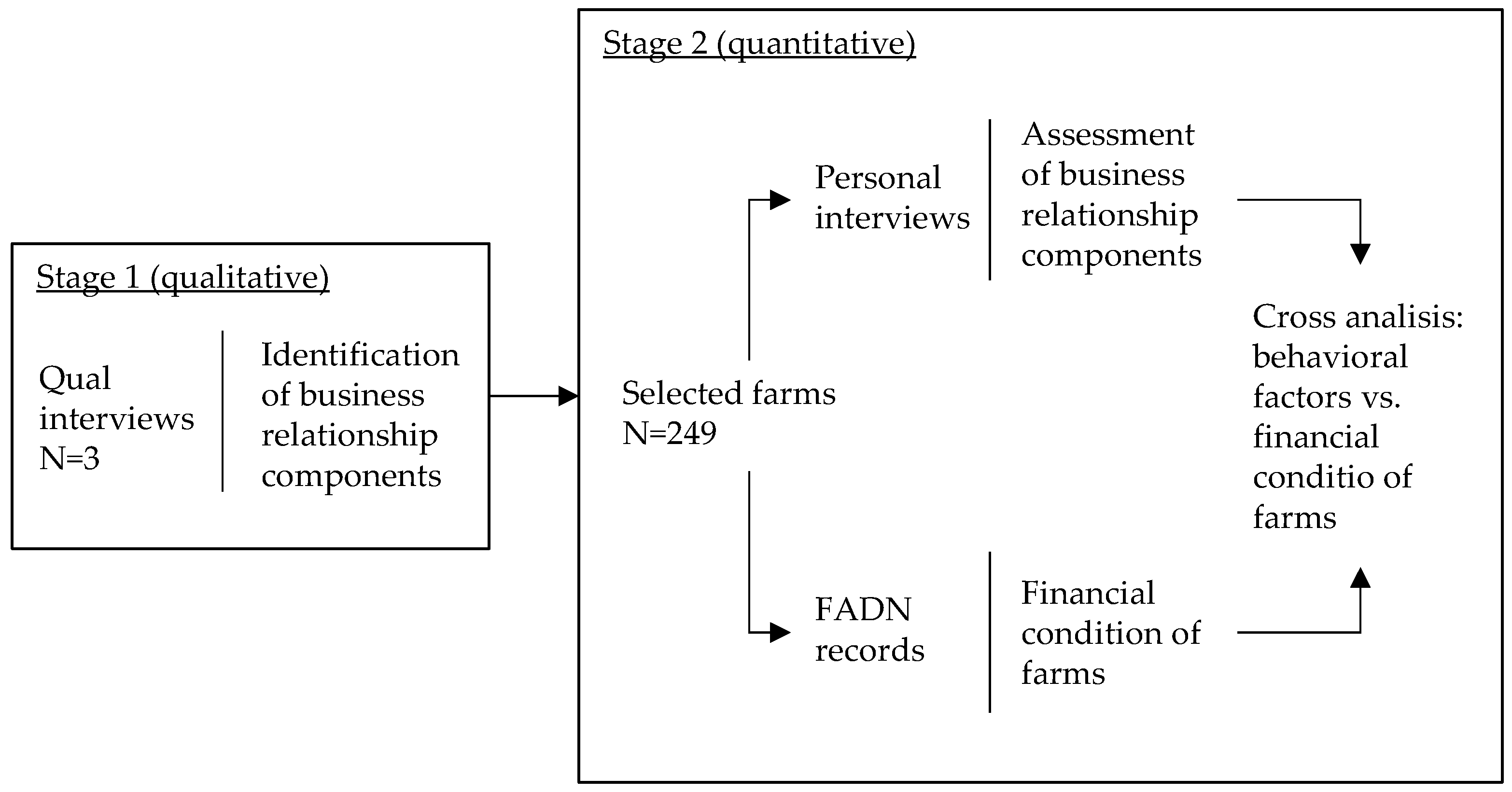
To achieve the study objective, we conducted field research among farmers. Our study employed triangulation of research methods, incorporating data from qualitative and quantitative data sets. The research process followed a two-stage approach (Figure 1):
  • stage 1 qualitative—focuses on the identification of components contributing to the value of relationships with suppliers across three dimensions: economic, behavioral, and strategic;
  • stage 2 quantitative—aims to determine the importance of business relationship components and assess whether, and to what extent, the financial condition of the examined entities is related to the perceived importance of the behavioral dimension of relationships.
First, we conducted qualitative interviews to identify the factors contributing to the value of a business relationship with an input supplier. Grounded in anthropological methodologies, the research explored how farmers perceive and construct their relationships with input providers. The data presented in this paper were collected through three semi-structured interviews with farmers. The farmers included in the study were purposefully selected. The sample reflects variation in farm size, encompassing mixed crop and livestock operations ranging from small-scale to large-scale farms. Drawing from anthropological traditions that emphasize the importance of emic perspectives [54,55], the interviews aimed to capture both practical and interpretive dimensions of the relational behavior of agribusiness relationships. Semi-structured interviews were chosen for their capacity to balance consistency in thematic coverage with flexibility, allowing respondents to articulate their views in their terms [56]. For this paper, we coded the names of research participants—when analyzing materials and citing the responses, we refer to them as: Respondent 1 (R1), Respondent 2 (R2), and Respondent 3 (R3). Interviews with farmers were conducted in January and February 2024. The interview guide was structured into five parts. Part A. Introduction aimed to inform respondents about the research objectives and to outline all relevant GDPR regulations. Part B consisted of six questions designed to describe the farm profile. Respondents were asked about their length of professional experience, the scale of production (e.g., number of hectares, livestock numbers), and the farm’s ownership profile. Part C focused on farmers’ practices regarding the procurement of production inputs. This section included 17 questions intended to explore the number of input suppliers, the duration of cooperation with them, and the reasons for maintaining these relationships. Respondents were also invited to share examples of both positive and negative experiences in their supplier relationships. Part D, the core section of the interview, included 33 questions aimed at examining the dimensions of business relationships with suppliers. Particular attention was given to the economic, strategic, and behavioral dimensions. This part began with open-ended questions to capture respondents’ spontaneous views on each dimension, followed by more targeted questions addressing specific components of business relationship within each category. Part E, the final section, served to summarize the interview. Respondents were asked whether they had any additional comments or reflections on their relationships with suppliers. The total duration of the interviews ranged from 52 to 75 min. None of the farmers’ sensitive data is included in this paper.
In the second, quantitative stage, we combined data from two sources: (1) personal interviews with farmers (N = 249) and (2) financial records of the investigated farms from the Farm Accountancy Data Network (FADN) [57]. At this stage, farmers participating in the FADN system from the Kujawsko-Pomorskie region in north-central Poland were selected. This region was purposefully chosen for the study. It provides a representative cross-section of the diversity of Polish farms, particularly in terms of open-field and animal production. Both of types are predominant in the national agricultural structure. Since fruit and vegetable production is less common in this region, these types of farms were not included in the analysis. Additionally, the region is characterized by a well-developed network of agricultural input suppliers. This feature was particularly important, as the study focuses on the relationships between farmers and their input suppliers. Upon completion of the interviews, we retrieved individual financial records from the FADN database for each farm included in the study. This approach allowed us to merge data on farmers’ behaviors and attitudes towards cooperation with input suppliers with financial characteristics of their farms.
To determine the relative importance of business relationship components and evaluate their contribution to overall relationship value, we employed the Maximum Difference Scaling (MaxDiff) method. MaxDiff is a measurement and scaling technique originally developed by Louviere and colleagues [58]. In a MaxDiff exercise, the respondent is first presented with a description of the concept under study and then shown a series of sets containing different attributes. For each set, the respondent is asked to indicate which attribute they consider the most important (best) and the least important (worst) [59,60].
Studies addressing farmers’ backward linkages with input suppliers remain scarce [61]. A review of the existing literature suggests that the financial component is incorporated in such analyses in two main ways. First, the financial aspect is considered directly. A significant stream of research focuses on bargaining power and negotiations between farmers and input suppliers. For example, Kuijpers and Swinnen [62] included financial factors by emphasizing production efficiency as a key driver of ongoing relationships with supplier. As financial indicators, they used variables such as technology costs, farmers’ opportunity costs, productivity levels, and price gains. In their analysis of how dairy farmers’ financial standing affects their relationships with feed suppliers, Malak-Rawlikowska and Milczarek-Andrzejewska [61] found that larger producers possess greater bargaining power. Consequently, they observed a positive relationship between the level of discounts obtained and production capacity, measured by both volume and value of output. Second, the financial dimension is included indirectly, typically treated as a contextual factor or in combination with other variables. For instance, Batt [63], in his model of long-term farmer–supplier relationships, primarily focused on classical relational factors such as trust and satisfaction. However, financial aspects were embedded within these constructs. For example, trust was partly operationalized through questions such as whether a supplier is “financially strong” or “able to offer credit” [63].
As our intention was to explore the link between financial standing and behavioral components of business relationships, we turned to the literature on farm finance. The financial performance of a farm can be evaluated using a variety of indicators and methodological approaches [64,65,66]. Some researchers apply conventional financial indicators used in the agricultural sector, such as gross farm income, net value added, farm net income, and standard output [67]. Others employ productivity measures such as land, asset, and labor productivity [68].
The financial performance of a farm can be assessed using various indicators and different methods [64,65,66]. In our study, we aimed to capture financial power as a measure of farm independence, therefore we adopt the approach proposed by Ryś-Jurek [69], which is well-suited to Polish conditions and was developed based on the same financial data source, i.e., the Farm Accountancy Data Network (FADN). Potential financial power refers to the farm’s ability to maintain a satisfactory financial condition both in the present and in the future. It is calculated based on farm income and retained depreciation, adjusted by subtracting the value of products allocated for household consumption. Actual financial power reflects the farm’s capacity to independently finance its operations and to generate savings from operating activities and the sale of fixed assets, reduced by investment expenditures. Meanwhile, internal financial strength indicates the farm’s ability to carry out both operational and investment activities without reliance on external financial support.
  • Potential financial power (PFP).
PFP = FFI − FC + D
where:
PFP—potential financial power
FFI—family farm income: remuneration to fixed factors of production of the family (work, land, and capital) and remuneration to the entrepreneur’s risks (loss/profit) in the accounting year (FADN variable SE420).
FC—farmhouse consumption: value of agricultural (crop and animal) products consumed by the holder’s family. It is considered in the amount of agricultural output (FADN variable SE260).
D—depreciation: depreciation of capital assets estimated at replacement value. Entry in the accounts of depreciation of capital assets over the accounting year. It is determined based on the replacement value. Concerns plantations of permanent crops, farm buildings and fixed equipment, land improvements, machinery and equipment, and forest plantations. There is no depreciation of land and circulating capital (FADN variable SE360).
  • Actual financial power (AFP).
AFP = CF,
where:
AFP—actual financial power
CF—cash flow presenting the holding’s capacity for saving and self-financing, calculated as net receipts of agricultural activity and other receipts + balance farm subsidies and taxes + balance subsidies and taxes on investments + balance of operations on capital + balance of operations on debts and loans (FADN variable SE530).
  • Internal financial power (IFP)
IFP = CF − TSO − TSI,
where
IFP—internal financial power
CF—cash flow (FADN variable SE530)
TSO—total subsidies to operational activity (FADN variable SE605)
TSI—total subsidies on investments (FADN variable SE406)
We could answer the research question by cross-referencing this with a financial condition indicator.

4. Exploring the Components of Supplier-Farm Relationships: Evidence from the Qualitative Stage

Qualitative methods, particularly in-depth interviews, not only support analysis based on qualitative data through contextualizing them but can also unveil variables and complexities that quantitative evaluations might miss. Hence, we offer insights based on methodological triangulation to enrich the analysis by drawing a picture of the nuanced interplay between financial power and the perceived value of relationships.

4.1. Respondents’ Profile

Our research participants, Respondent 1 (R1), Respondent 2 (R2), and Respondent 3 (R3), represent different levels of financial power and production complexity. All three have mixed production and run farms with the support of their family members, but their investment capacity and cash flow differ significantly. Selected information about the respondents’ profiles is presented in Table 1.
R1 owns 30 hectares and leases an additional 27 hectares. The farm’s production profile includes arable crop cultivation and dairy cattle husbandry. He has sustained long-term relationships with the same business partners for several decades, including membership in a local dairy cooperative. He works with 10 input providers and 3 buyers. Despite these enduring connections, he emphasized the transactional nature of his dealings with input suppliers. Speed of response, particularly in livestock care, crop disease outbreaks, and product availability, has been described as paramount. His decision to collaborate with 10 different suppliers is grounded in pragmatism, ensuring consistent access to necessary inputs. Annual spending varies depending on price fluctuations and product availability. This case reflects a flexible and dynamic approach in which loyalty is subordinate to economic efficiency and responsiveness to urgent operational needs. Moreover, when asked whether he would change the supplier if the consultant left for competition, he would stay with the advisor only if he could offer similar prices.
Nevertheless, such a situation has not happened yet, and supplier cooperation continues. As a cooperative member, he is not interested in looking for a dairy buyer. He values and is proud of cooperative membership. His town has a collection point for grain, peas, and potatoes. Often, they negotiate a price acceptable to both parties. He prefers to sell harvest a bit cheaper, but considering intangible assets like proximity. The local grain collection point is his primary recipient. He believes his relationship with providers and buyers is helping him to negotiate the best conditions and prices. His approach remains transactional and reactive, often based on price, availability, and urgency.
R2 has 50 ha, producing arable crops like beets, rapeseed, wheat, corn, and rye. Animal production consists of swine and dairy cattle. The farm is family-owned; he inherited it from his father. After taking over in 2011, he modernized his production, broadened the production profile, and chose new providers and buyers. He cooperates with 4 suppliers—sometimes buying small quantities locally during the season, and with 4–5 buyers. He prefers to buy from one supplier to get a better discount. Moreover, he emphasized that working with one specific company for a long time builds greater financial trust and ensures the stability of the supply chain.
For him, fewer suppliers mean more convenience in bookkeeping. The relationships with suppliers give him security as the cooperation is permanent, and all the issues can be resolved easily. His relationship with suppliers is slightly different from that with buyers, as their contact is more frequent—they are the advisors who support optimizing crops and animal breeding. R2 is also pragmatic yet loyal. Repeated, reliable cooperation builds his trust. Economic decisions are embedded in a broader efficiency-trust-convenience logic. Relational depth reduces transactional risk, making long-term cooperation more valuable than short-term. The product’s (input and output) price isn’t the sole factor; he values reliability, delivery timing, and service over chasing the lowest cost and price. He highlighted that, based on the needs, he sells where it is closer, faster, and with a better final profit. Optimizing time is his priority, and since he has several trusted buyers, he can choose what is best at a given moment. When selling products, the price is essential, but so is collection: “Some companies have worse equipment, not enough people, and you might waste time driving and waiting, which increases stress (R2 quote).
R3 leads the most complex production. He owns 150 ha and leases an additional 150 ha. He also has a mixed production profile, growing arable crops like winter wheat, corn, rapeseed, triticale, and barley. He runs an animal production. Since 2009, he has been a decision-maker and considers the farm his own. He cooperates with 3 suppliers and one livestock buyer. He has several of the same crop buyers depending on his crops each year, and perceives a salesperson as an advisor:
“He runs a farm himself and knows exactly what it’s all about. He has vast knowledge, comes to the field, and can call and let you know not to spray at a given moment because the crops will be wasted.”
(R3 quote)
He underlined that all business partners he works with are straightforward “they don’t lie, […] They communicate like people” (R3). He believes that relationships based on honesty and trust are essential in business. Ultimately, his efforts focus on yield and profit, and the relationship with the advisor helps to achieve it. R3 has relatively short cooperation with current input providers, lasting 2–3 years. When asked why, he explained that the distribution company he worked with before had advisors whose sole focus was sales targets. They offered unnecessary products or pushed certain brands. Currently, his advisors offer him products that are of good quality, not necessarily from well-known brands. Moreover, he knows that they sell only what is necessary for his production, which generates additional savings for him.
Regarding price, he primarily buys everything to help him achieve maximum production and ensure that the livestock is healthy and well-bred. He explained that if he didn’t buy vitamins, supplements, crop protection, or fertilizers, the pigs wouldn’t grow, and the crops wouldn’t be good. From a financial perspective, it wouldn’t be viable. Good treatments and good advice increase his profitability.
While discussing the reason for changing providers, he disclosed that his current advisor worked with another distributor. However, when he was moved to operate in a different region, he switched employers, and some clients went with him. He can’t imagine working with anyone who could be as helpful and specialized. If the advisor moved to another distributor, he would move with him again to ensure optimal production.
Across all three respondents, price is not the most essential factor in isolation. Instead, a relational and functional understanding of price emerges, evaluated not only in monetary terms but also in its association with value, timeliness, yield outcomes, and trust.
R1 sees price as secondary to convenience and relationship flexibility. Despite higher prices at the local collection point, he purchases there for the proximity and the possibility of “reaching an agreement.” That suggests that negotiability and logistics play a key role in decision-making—price is context-dependent and relationally embedded.
R2 similarly de-emphasizes the nominal price. Instead of comparing prices across various distributors and channels, he relies on his long-term supplier and “good price” for value. He is reluctant to switch his leading suppliers for a cheaper dealer, reflecting his worry regarding the costs of risk and unpredictability. That indicates that delivery and after-sales service add value and carry more weight than price alone.
R3 offers the most complex interpretation. He justifies a higher price when it leads to better yield and overall profitability. His understanding of price ties to output-oriented thinking—he buys what will make the farm viable, whether proper crop spraying or animal supplementation. He focuses on value-for-money and agronomic efficiency, not purely on low cost.

4.2. Components and Dimensions of Business Relationships with Suppliers

All respondents highlight economic value; however, this value arises through product pricing, service quality, and relational mechanisms, not discounts alone. Nevertheless, scale and complexity influence more strategic relationships. R3 has the largest and most complex operation. That is reflected in a highly relational and strategic approach to providers. He underscored the advisor’s ability to choose well-priced, high-quality generics as central to his profit optimization. The advisor’s advocacy during a payment delay is another economic benefit—relational capital substitutes for formal flexibility, reducing his risk exposure. His scale requires coordination and precision, so trust, communication, and expert advice are central.
R1 and R2 underlined their understanding that the relationship with providers is asymmetric. They pinpointed their minor negotiation power. R2 gains additional benefits through post-harvest diagnostics and targeted agronomic advice provided by the advisor. As it enhances the value of the crop, he sees the transfer of knowledge as an economic value. He mentioned receiving small incentives like baseball caps. Nevertheless, he does not expect to receive expensive gadgets, because he runs a “small farm”.
As for R1, he implements other practices to advance his financial power by cooperating with other farmers and collectively buying inputs. This way, he can receive a better price and generate savings. He believes he benefits economically from long-term arrangements, informal economies, and being “known” by the supplier. Those factors enhance his financial position. Relational flexibility is considered economically significant. Longer cooperation means that the suppliers know the farmer and better understand the farmer’s situation. If necessary, there is always a way to find a solution acceptable to both parties.
Behavioral values like mutual trust and knowledge transfer are necessary for all respondents in business relations. However, for R3, this dimension is more interconnected with the ability to innovate and generate higher profit. He values his business partners because those relationships improve his farm’s overall performance. Large, complex farms require integrated, trust-based partnerships with input providers, blending economic logic with agronomic optimization. His approach is based on shared agronomic knowledge, not tenure alone.
R1 and R2 are opportunistic and relational. Their key cooperation drivers are similar. Those farmers seek stability and reliability, as well as the best prices. R1 cooperates with more business partners than the rest of the research participants. From his perspective, this ensures more flexibility and opportunities for a better price. His financial power is weaker, and he tries to balance it out. R2 focuses on consistency in business relations to reduce transaction costs.
Based on the qualitative interviews, we identified several components contributing to the value of relationships within 3 dimensions: behavioral, strategic, and economic. We coded and grouped those factors and established 12 items:
1. Prices and financial terms; 2. Quality of offered products and services; 3. Openness to negotiation; 4. Durability and reliability of cooperation; 5. Trust and sincerity in relationships; 6. Partnership and good cooperation; 7. Consulting and knowledge sharing; 8. Flexibility and operational efficiency; 9. Communication and information exchange; 10. Security and stability; 11. Local/Polish company; 12. Facilitation of farm modernization and investment.

5. Behavioral Components vs. Financial Strength of Farm: Evidence from the Quantitative Analysis

For the quantitative part of the study, A description of the respondents is presented in Table 2. The farm profiles reflect the structural characteristics of Polish agriculture. Following data cleaning, eight interviews were excluded, resulting in a final sample of 241 interviews used for the analysis.
The components influencing the value of supplier relationships identified with qualitative intravenous are clustered in three main dimensions: behavioral, economic, and strategic. The table presents all items and their allocation to these dimensions. The relative importance of the components was assessed using the Maximum Difference Scaling (MaxDiff) method.
Table 3 includes two columns: the first column shows the expected value of each dimension, calculated under the assumption that all factors contribute equally. With 12 factors total, each would account for approximately 8.33% of the total importance. The second column presents the actual contribution of each component, as derived from the MaxDiff results. By comparing the actual and expected values, we can identify the true significance of each dimension in shaping supplier relationships.
Economic dimension plays a pivotal role in supplier-farmer relationships, with product pricing emerging as a primary consideration when assessing supplier relationships. Both the strategic and behavioral dimensions are less important to respondents in the context of supplier relationships. The components that enhance the perceived security of cooperation, i.e., the durability and reliability of the relationship, trust, and overall stability, were emphasized more (Table 4).
We conducted correlation tests across dimensions and individual components to better understand respondents’ preferences (Table 5 and Table 6). The results indicate a negative correlation between the economic and behavioral dimensions and between the economic and strategic dimensions. However, a weak but positive relationship was observed between the strategic and behavioral dimensions. The component “prices and financial terms”, which was identified as the most critical contributor to the perceived value of business relationships, shows a significant negative correlation with all other factors. The components related to the durability and reliability of cooperation (component 3), trust and sincerity in relationships (component 4), partnership and good cooperation (component 7), and communication and information exchange (component 12) had the strongest negative correlations.
We assessed the financial power of farms using three indicators: potential, actual, and internal relative financial power. Based on these three dimensions, a cluster analysis was conducted to identify distinct groups of farms according to their financial strength. We applied k-means clustering and identified three clusters. To determine the optimal number of clusters, we conducted a comparative analysis using ANOVA statistics for solutions ranging from two to seven clusters. For each solution, we examined the F-statistic, which reflects the ratio of between-group variance to within-group variance (Table 7). The three-cluster solution showed the highest F-value for internal financial strength (F = 219.77), as well as substantial values for the other two dimensions (F = 44.32 for potential financial strength and F = 112.50 for actual financial strength). Although increasing the number of clusters (particularly in the five-cluster solution) resulted in a slight improvement in variance for certain variables, the gains were marginal and inconsistent across dimensions. Furthermore, adding more than three clusters led to a notable decline in the F-value for potential financial strength, indicating a reduction in explanatory power. Consequently, the three-cluster solution was selected as the most suitable, offering a balance between model simplicity and the effectiveness of group separation across all three financial strength variables.
Cluster 1, the smallest group, comprises farms with the highest financial power. These are also the largest units in terms of size and scale. Financial power and turnover indicators (annual and cumulative) are substantially higher than in other groups. They rely less on external sources, as the relatively high internal and actual power suggests. Cluster 2 includes farms with relatively high income. Potential power is relatively high, but actual and internal power levels are significantly lower. Internal power is even negative on average, which suggests dependency on external financial resources or subsidies. Cluster 3, the largest group, comprises the smallest farms. Despite their size, they are less dependent on subsidies, indicating a stronger internal financial position in a relative sense (Table 8).
In terms of building relationships with suppliers, we may notice that Cluster 1 appears primarily driven by economic considerations, as shown by the highest importance score for the economic dimension (0.75). At the same time, behavioral and strategic factors play marginal roles. Cluster 2 places a slightly higher importance on behavioral (0.21) and strategic (0.07) dimensions. Cluster 3 is still mainly driven by economic factors; however, it presents the highest importance to behavioral factors (0.26) compared to other clusters.
From the supplier’s perspective, larger farms with a higher scale of production possess greater purchasing power and may therefore be perceived as more attractive clients. This factor can encourage suppliers to expand their service offerings and provide more favorable terms to such clients. Consequently, larger clients may receive a higher level of service. Such conditions could lead them to place greater emphasis on economic conditions. This may help explain why Cluster 3, consisting of smaller, focuses more on behavioral factors. Such farmers may value behavioral aspects more because they either receive them to a lesser extent in the market or experience them at a lower quality. Farmers in Cluster 2 assign a similar level of importance to economic factors as those in Cluster 1. However, their negative internal financial power may drive them to pay particular attention to both economic and strategic dimensions.
The stronger emphasis on behavioral factors among smaller farms may also be explained through the lens of psychological ownership theory. Lower financial power can shift the focus of farmers toward relational components of supplier relationships, as these can compensate a limited ability to make influence through economic means. Psychological ownership theory posits that when individuals develop a sense of possession and responsibility toward a target (such as a relationship, organization, or resource) they integrate it into their identity or invest personal effort in it [53,70]. As farmers exhibit a strong identification with their farms [71,72,73], they may devote considerable personal effort to them. In such cases, when resource-based power is constrained, actors may attempt to strengthen their perceived control by investing in relationships that enhance stability and predictability [74].
For smaller farmers, establishing strong behavioral bonds with suppliers can serve as both a psychological safeguard and a means of fostering mutual commitment. This is consistent with findings in the business relationship literature, which indicate that non-economic factors can mitigate power asymmetries and promote long-term cooperation [75,76].
The results indicate a relationship between the financial strength of entities and their perception of business relationship value. Entities with the highest financial power tend to prioritize economic aspects, such as price and financial conditions, while attributing relatively low importance to behavioral dimensions of cooperation. In contrast, entities with lower financial power (cluster 2 and 3) can be grouped into two distinct profiles. Cluster 2 displays a more opportunistic approach, making decisions primarily based on economic criteria. Cluster 3 values economic conditions but also actively seeks behavioral components, including trust, effective communication, and long-term collaboration.

6. Discussion

In-depth interviews provide valuable insights into the role of behavioral factors in business relationships. More importantly, qualitative data highlight what suppliers offer to support customers, strengthen relationships, and build trust. Establishing long-term customer relationships is crucial for business success. Companies employ various strategies to enhance customer loyalty and adapt to a changing business environment, including service quality, customer experience, and relationship management [34]. Based on empirical data, this article explores the role of behavioral factors, such as trust, as elements of economic activity linked with financial power.
Respondents who participated in qualitative research highlighted several significant dimensions when discussing their experiences with input providers: pragmatism, knowledge transfer, trust, partnership, and the importance of interpersonal communication. Respondents primarily emphasize behavioral components in the qualitative part of the study, considering economic factors less valuable. Similarly to the findings of Lambrecht et al. [47] concerning farmers in Flanders, participants in our study emphasize the role of trust-building in strengthening business relationships. Nonetheless, Polish respondents characterize these relationships differently, perceiving themselves as actors possessing a degree of economic power that shapes the dynamics of cooperation. All study participants describe the relationships as solid and professional. While economic values, such as price, cost savings, and return on investment, were acknowledged as important, they were closely interlinked with behavioral and strategic dimensions of the relationship.
Moreover, the conclusions drawn from the qualitative research both resonate with and extend the findings of Suvanto and Lähdesmäki [48], who emphasize that farmers’ psychological ownership—the perceived sense of control, familiarity, and attachment to business partners—plays a significant role in shaping relational dynamics. In their study, financial strength enabled certain farmers to exercise greater autonomy and strategic choice, whereas resource-constrained actors exhibited a form of commitment driven more by necessity than agency [48]. Our findings appear to echo this duality. R3, who manages a large and complex operation with considerable financial resources, demonstrates a strong sense of psychological ownership, which is evident in his strategic loyalty to an agronomically competent advisor whose expertise is directly linked to farm profitability. In contrast, R1 and R2 reflect a more pragmatic and adaptive form of relational commitment, where loyalty is shaped not by brand or long-standing ties but by availability, trust, informal arrangements, and service responsiveness. These behaviors closely align with what Suvanto and Lähdesmäki [48] describe as relational entrenchment, in which trust and continuity reduce perceived risk and compensate for limited financial leverage or market alternatives.
While Ulaga and Eggert [13] argue that relational and service-related benefits (such as service support, personal interaction, and supplier know-how), rather than cost advantages, drive value-based differentiation in business relatively easily, findings reveal how these dimensions manifest differently within asymmetric agribusiness contexts. In our qualitative study, respondents emphasized the importance of supplier expertise and field-level advisory services, which support identifying know-how as a key differentiator [13]. However, in contrast to corporate buyers, who can often switch suppliers with relative ease, our respondents face significant constraints in their bargaining position. For example, R1 mitigates these limitations by pragmatically diversifying both input suppliers and participating in collective purchasing arrangements to enhance negotiating power and secure better prices. Comparable strategies for navigating asymmetrical relationships through collective action are also evident in the research delivered by Pascucci and co-authors [49], who examine how cooperative membership in Italy bolsters the bargaining capacities of smaller farms.
That introduces a key contrast: whereas Ulaga and Eggert [13] conceptualize relational value as a means for suppliers to secure privileged access to buyers, our findings indicate that, in the context of agribusiness, relational capital serves as a compensatory mechanism for farmers facing structural asymmetries and operational risks. Moreover, although Ulaga and Eggert [13] emphasize that relationship longevity does not necessarily translate into key supplier status, our findings provide a more context-specific perspective. For instance, respondent R3 demonstrates strong loyalty to his supplier despite their relatively short relationship duration, attributing this to the advisor’s expertise and direct contribution to farm profitability. Thus, our study highlights how behavioral components function as important differentiators and proxies for leverage in resource-constrained agricultural business relationships.
Our qualitative findings align with existing research, whereas the quantitative results offer a contrasting perspective. The dominance of economic components in supplier relationships, as indicated in the quantitative phase, suggests the presence of opportunistic behavior among farmers. However, we also observed long-term supplier relationships, seemingly contradicting the logic of opportunistic behavior. Differences in the emphasis placed on behavioral and economic factors between the qualitative and quantitative stages of the study require further investigation. Several possible explanations could account for this variation. First, social desirability bias may play a role [77]. Respondents might declare that they primarily value behavioral aspects, such as trust and service quality, while they focus more on price and financial conditions. Although plausible, this explanation alone does not seem sufficient to fully account for the results. A stronger orientation toward economic factors could also suggest opportunistic behavior among farmers when selecting input suppliers. However, the qualitative stage revealed that farmers tend to maintain long-term relationships with their suppliers. Similar findings were reported by [78], who observed that even when there is an imbalance in bargaining power, placing farmers in a potential “hold-up” situation, both parties often prefer to uphold their agreements rather than breach them to capture short-term gains.
One possible explanation is that the limited number of available farmers and suppliers makes switching partners difficult. For both sides, maintaining an existing relationship may be less costly (or at least perceived as less costly) than seeking a new partner. Additionally, suppliers might provide a level of service that farmers find acceptable, and over time, the quality of service offered by suppliers in the market may converge. In such circumstances, economic factors may become the primary criterion for maintaining the farm’s financial stability.
Results of the quantitative stage are consistent with the study by Malak-Rawlikowska and Milczarek-Andrzejewska [61], who identified price and input quality as the most important elements of supplier relationships. At the same time, however, Malak-Rawlikowska & Milczarek-Andrzejewska emphasized that trust and the overall quality of the relationship are essential prerequisites for securing favorable price terms and high-quality inputs. Similarly, Batt and Rexha [79], in their research on small-scale potato growers, identified mutual trust as a key relational factor while acknowledging the continuing importance of prices and other financial conditions. That suggests a trade-off between the relationship relational (e.g., trust-based) and transactional (e.g., price-related) elements.
As Gajdić and co-authors [80] highlighted, buyer–supplier relationships in food systems are often discussed in terms of collaboration, trust, and performance logic. Our study contributes to the performance-oriented stream of literature, with particular emphasis on financial and economic indicators. While previous studies suggest that greater power or stronger performance may lead to an unequal distribution of investments or risk-sharing in farm–buyer cooperation [81,82] less is known about how a farm’s financial strength influences its relationships with suppliers. Our findings indicate that farms with lower financial power tend to place greater emphasis on the behavioral components of business relationshps.

7. Conclusions

In this study, we aim to explore how farmers assess the contribution of various components that shape the value of their relationships with input suppliers. Specifically, we investigate whether a farm’s financial power influences the importance assigned to behavioral aspects of business relationships. While the qualitative results highlight the high value placed on behavioral factors like trust and long-term relationships, the quantitative findings demonstrate that farmers primarily seek favorable financial terms. That suggests that economic conditions may serve as necessary foundations for supplier relationships, while behavioral components enhance the relationship’s overall value and may become decisive once financial expectations are fulfilled.
The results indicate a relationship between the financial strength of farms and their perception of relationship value. Farms with the highest financial power tend to prioritize economic aspects, such as price and payment conditions, and place lower emphasis on behavioral elements of cooperation—tthis means that our research hypothesis has to be rejected. Even the behavioral factors, such as knowledge transfer, are discussed within financial frames. In contrast, farms with lower financial power can be divided into two distinct profiles: (1) those with an opportunistic orientation, making decisions primarily based on financial terms; and (2) those with a relational orientation, who value favorable economic conditions but also actively seek behavioral attributes such as trust, effective communication, and long-term collaboration.

8. Research and Practical Applications

The study results have both research and practical relevance. By demonstrating how financial power moderates the importance assigned to each dimension of business relationship value (economic, strategic, and behavioral) the study offers new insights into the role of resource asymmetry in shaping relationship preferences. The findings contribute to the literature on resource dependence and psychological ownership by showing that lower financial power can lead to a stronger emphasis on non-economic, behavioral components as compensatory mechanisms in asymmetric relationships. Furthermore, the study suggests that a balanced integration of economic and behavioral dimensions can enhance the sustainability of supply chain relationships, supporting the stable development of market actors in asymmetric settings.
From a practical perspective, agribusiness suppliers can use these insights to tailor their service offers to the financial profiles of farms. For sustainable, long-term operations, agribusiness firms should combine competitive financial terms with trust-building, stability, and effective communication, strengthening resilience to market shocks. Smaller farms that place higher value on behavioral factors can be encouraged to join horizontal integration initiatives, which improve bargaining power, reduce costs, and help maintain trusted supplier relationships.

9. Limitations and Directions of Further Research

This study has some limitations that should be taken into account when interpreting the results. The regional scope restricts the applicability of the findings. The analysis was conducted within a specific geographical context, and the observed patterns in relationship value perceptions may differ in regions with alternative market structures, regulatory environments, and cultural norms. Future research should therefore extend the analysis to other regions and countries to test the robustness of the findings across diverse agribusiness settings. Furthermore, the study focuses primarily on crop farming, which limits the applicability of the conclusions to other agricultural sectors, e.g., horticultural production.
The research also revealed differences in the relative importance placed on behavioral and economic factors between the qualitative and quantitative stages, which warrant further examination. As several factors may account for these differences (already presented in the discussion), future studies should investigate them more thoroughly employing mixed-method approaches that combine behavioral experiments with transactional data, while also considering the influence of market structure.

Author Contributions

Conceptualization, M.G. and K.G.; methodology, M.G.; validation, M.G. and K.G.; formal analysis, M.G. and K.G.; investigation, M.G. and K.G.; resources, M.G. and K.G.; data curation, M.G. and K.G.; writing—original draft preparation, M.G. and K.G.; writing—review and editing, M.G. and K.G.; visualization, M.G. and K.G.; supervision, M.G.; project administration, M.G.; funding acquisition, M.G. All authors have read and agreed to the published version of the manuscript.

Funding

The publication was financed by the Polish Minister of Science and Higher Education as part of the Strategy of the Poznan University of Life Sciences for 2024-2026 in the field of improving scientific research and development work in priority research areas.

Institutional Review Board Statement

The study was conducted in accordance with the Declaration of Helsinki, and approved by the Ethics Committee of Rektorska Komisja ds. Etyki Badań Naukowych Prowadzonych z Udziałem Ludzi (12/2024, 21/06/2024).

Informed Consent Statement

Informed consent was obtained from all subjects involved in the study.

Conflicts of Interest

The authors declare no conflicts of interest.

Abbreviation

The following abbreviations are used in this manuscript:
FADNFarm Accountancy Data Network

References

  1. Leszczyński, G. Adaptacja w Relacjach Business-to-Business. Uwarunkowania i Efekty; Wydawnictwo Uniwersytetu Ekonomicznego w Poznaniu: Poznań, Poland, 2014; ISBN 978-83-7417-820-4. [Google Scholar]
  2. Wind, J. Getting a Read on Market-Defined ‘Value. ’ J. Revenue Pricing Manag. 1990, 1, 5–14. [Google Scholar]
  3. McEvily, B.; Zaheer, A. Does Trust Still Matter? Research on the Role of Trust in Inter-Organizational Exchange. In Handbook of Trust Research; Business 2010 and before; Edward Elgar Publishing Limited: Northampton, UK, 2006; ISBN 978-1-84720-281-9. [Google Scholar]
  4. Palmatier, R.W.; Dant, R.P.; Grewal, D. A Comparative Longitudinal Analysis of Theoretical Perspectives of Interorganizational Relationship Performance. J. Mark. 2007, 71, 172–194. [Google Scholar] [CrossRef]
  5. Wilson, D.T.; Jantrania, S. Understanding the Value of a Relationship. Asia Aust. Mark. J. 1994, 2, 55–66. [Google Scholar] [CrossRef]
  6. Sweeney, J.C.; Webb, D. Relationship Benefits: An Exploration of Buyer-Supplier Dyads. J. Relatsh. Mark. 2002, 1, 77–91. [Google Scholar] [CrossRef]
  7. Ford, D.; McDowell, R. Managing Business Relationships by Analyzing the Effects and Value of Different Actions. Ind. Mark. Manag. 1999, 28, 429–442. [Google Scholar] [CrossRef]
  8. Qian, C.; Dion, P.A.; Wagner, R.; Seuring, S. Efficacy of Supply Chain Relationships—Differences in Performance Appraisals between Buyers and Suppliers. Oper. Manag. Res. 2023, 16, 1302–1320. [Google Scholar] [CrossRef]
  9. Zieliński, M. Zaufanie w Relacjach Business-to-Business. Perspektywa Dynamiczna; Wydawnictwo Uniwersytetu Ekonomicznego w Poznaniu: Poznań, Poland, 2020; ISBN 978-83-7417-996-6. [Google Scholar]
  10. Biggemann, S.; Buttle, F. Intrinsic Value of Business-to-Business Relationships: An Empirical Taxonomy. J. Bus. Res. 2012, 65, 1132–1138. [Google Scholar] [CrossRef]
  11. Day, G.S. Managing Market Relationships. J. Acad. Mark. Sci. 2000, 28, 24–30. [Google Scholar] [CrossRef]
  12. Grace, D.; Weaven, S. An Empirical Analysis of Franchisee Value-in-Use, Investment Risk and Relational Satisfaction. J. Retail. 2011, 87, 366–380. [Google Scholar] [CrossRef]
  13. Ulaga, W.; Eggert, A. Value-Based Differentiation in Business Relationships: Gaining and Sustaining Key Supplier Status. J. Mark. 2006, 70, 119–136. [Google Scholar] [CrossRef]
  14. Mandjak, T.; Henseler, J.; Simon, J.; Szalkai, Z. Typology of Business Relationships Using Buyers’ and Suppliers’ Perceptions. IMP J. 2012, 6, 109–134. [Google Scholar]
  15. Morgan, R.M.; Hunt, S.D. The Commitment-Trust Theory of Relationship Marketing. J. Mark. 1994, 58, 20–38. [Google Scholar] [CrossRef]
  16. Fu, S.; Li, Z.; Wang, B.; Han, Z.; Huo, B. Cooperative Behavior between Companies and Contract Farmers in Chinese Agricultural Supply Chains: Relational Antecedents and Consequences. Ind. Manag. Data Syst. 2018, 118, 1033–1051. [Google Scholar] [CrossRef]
  17. Barnes, B.R.; Leonidou, L.C.; Siu, N.Y.M.; Leonidou, C.N. Interpersonal Factors as Drivers of Quality and Performance in Western–Hong Kong Interorganizational Business Relationships. J. Int. Mark. 2015, 23, 23–49. [Google Scholar] [CrossRef]
  18. Busch, G.; Spiller, A. Farmer Share and Fair Distribution in Food Chains from a Consumer’s Perspective. J. Econ. Psychol. 2016, 55, 149–158. [Google Scholar] [CrossRef]
  19. Fałkowski, J.; Malak-Rawlikowska, A.; Milczarek-Andrzejewska, D. Farmers’ Self-Reported Bargaining Power and Price Heterogeneity: Evidence from the Dairy Supply Chain. BFJ 2017, 119, 1672–1686. [Google Scholar] [CrossRef]
  20. Gazdecki, M. Factors of Business Relationships Change in Agribusiness Input Distribution Channel: The Case of Polish Market. IMP J. 2018, 12, 567–582. [Google Scholar] [CrossRef]
  21. Gazdecki, M.; Leszczyński, G.; Zieliński, M. Food Sector as an Interactive Business World: A Framework for Research on Innovations. Energies 2021, 14, 3312. [Google Scholar] [CrossRef]
  22. Lindgreen, A.; Wynstra, F. Value in Business Markets: What Do We Know? Where Are We Going? Ind. Mark. Manag. 2005, 34, 732–748. [Google Scholar] [CrossRef]
  23. Forsström, B. Value Co-Creation in Industrial Seller Partnerships—Creating and Exploiting Interdependencies. Ph.D. Thesis, Åbo Akademisförlag—Åbo Akademi University Press, Turku, Finland, 2005. [Google Scholar]
  24. Gadde, L.-E.; Hakansson, H. Business Relationships and Resource Combining. IMP J. 2008, 1, 31–45. [Google Scholar]
  25. Walter, A.; Ritter, T.; Gemünden, H.G. Value Creation in Buyer–Seller Relationships: Theoretical Considerations and Empirical Results from a Supplier’s Perspective. Ind. Mark. Manag. 2001, 30, 365–377. [Google Scholar] [CrossRef]
  26. Walter, A.; Ritter, T. The Influence of Adaptations, Trust, and Commitment on Value-creating Functions of Customer Relationships. J. Bus. Ind. Mark. 2003, 18, 353–365. [Google Scholar] [CrossRef]
  27. Gadde, L.-E.; Snehota, I. Making the Most of Supplier Relationships. Ind. Mark. Manag. 2000, 29, 305–316. [Google Scholar] [CrossRef]
  28. Jarratt, D.; Morrison, M. Dependence and the Application of Power and Control in Major Business Relationships: A Study of Manufacturing and Service Firms in the Business-to-business Sector. J. Strateg. Mark. 2003, 11, 235–253. [Google Scholar] [CrossRef]
  29. Kusari, S.; Hoeffler, S.; Iacobucci, D. Trusting and Monitoring Business Partners throughout the Relationship Life Cycle. Journal of Business-to-Business Marketing 2013, 20, 119–138. [Google Scholar] [CrossRef]
  30. Håkansson, H.; Havila, V.; Pedersen, A.-C. Learning in Networks. Ind. Mark. Manag. 1999, 28, 443–452. [Google Scholar] [CrossRef]
  31. Keskin, H. Market Orientation, Learning Orientation, and Innovation Capabilities in SMEs: An Extended Model. Eur. J. Innov. Manag. 2006, 9, 396–417. [Google Scholar] [CrossRef]
  32. Wilson, E.J.; Nielson, C.C. Cooperation and Continuity in Strategic Business Relationships. J. Bus. Bus. Mark. 2001, 8, 1–24. [Google Scholar] [CrossRef]
  33. Ta, H.; Esper, T.L.; Ford, K.; Garcia-Dastuge, S. Trustworthiness Change and Relationship Continuity after Contract Breach in Financial Supply Chains. J. Supply Chain. Manag. 2018, 54, 42–61. [Google Scholar] [CrossRef]
  34. Richard, J.E.; Zhang, A. Corporate Image, Loyalty, and Commitment in the Consumer Travel Industry. J. Mark. Manag. 2012, 28, 568–593. [Google Scholar] [CrossRef]
  35. Johnston, M.W.; Marshall, G.W. Contemporary Selling: Building Relationships, Creating Value, 5th ed.; Routledge: New York, NY, USA, 2016; ISBN 978-1-315-66834-5. [Google Scholar]
  36. Geiger, S.; Turley, D. Personal Selling as Knowledge-Based Activity: Communities of Practice in Sales. Ir. J. Manag. 2005, 26, 61–70. [Google Scholar]
  37. Anderson, E. The Salesperson as Outside Agent or Employee: A Transaction Cost Analysis. Mark. Sci. 1985, 4, 234–254. [Google Scholar] [CrossRef]
  38. Weiss, A.M.; Anderson, E. Converting from Independent to Employee Salesforces: The Role of Perceived Switching Costs. J. Mark. Res. 1992, 29, 101–115. [Google Scholar] [CrossRef]
  39. Mysen, T.; Svensson, G.; Payan, J.M. Causes and Outcomes of Satisfaction in Business Relationships. Mark. Intell. Plan. 2011, 29, 123–140. [Google Scholar] [CrossRef]
  40. Williamson, O.E. The Economic Institutions of Capitalism: Firms, Markets, Relational Contracting; Free Press: New York, NY, USA, 1985; ISBN 978-0-02-934820-8. [Google Scholar]
  41. Ping, R. Salesperson–Employer Relationships: Salesperson Responses to Relationship Problems and Their Antecedents. J. Pers. Sell. Sales Manag. 2007, 27, 39–57. [Google Scholar] [CrossRef]
  42. Atkin, T.S.; Rinehart, L.M. The Effect of Negotiation Practices on the Relationship between Suppliers and Customers. Negot. J. 2006, 22, 47–65. [Google Scholar] [CrossRef]
  43. Möller, K.; Halinen, A. IMP Thinking and IMM: Co-Creating Value for Business Marketing. Ind. Mark. Manag. 2018, 69, 18–31. [Google Scholar] [CrossRef]
  44. Bonanno, A.; Russo, C.; Menapace, L. Market Power and Bargaining in Agrifood Markets: A Review of Emerging Topics and Tools. Agribusiness 2018, 34, 6–23. [Google Scholar] [CrossRef]
  45. Saitone, T.L.; Sexton, R.J. Agri-Food Supply Chain: Evolution and Performance with Conflicting Consumer and Societal Demands. Eur. Rev. Agric. Econ. 2017, 44, 634–657. [Google Scholar] [CrossRef]
  46. Hingley, M.; Lindgreen, A. Living with Power Imbalance in the Food Supply Chain. In Delivering Performance in Food Supply Chains; Mena, C., Stevens, G., Eds.; Woodhead Publishing: Sawston, UK, 2010; p. 576. ISBN 978-1-84569-471-5. [Google Scholar]
  47. Lambrecht, E.; Kühne, B.; Gellynck, X. Asymmetric Relationships in Networked Agricultural Innovation Processes. Br. Food J. 2015, 117, 1810–1825. [Google Scholar] [CrossRef]
  48. Suvanto, H.; Lähdesmäki, M. Managing Asymmetrical Supply Chain Relationships: Psychological Ownership and Commitment in the Agri-Food Sector. Supply Chain Manag. Int. J. 2023, 28, 15–27. [Google Scholar] [CrossRef]
  49. Pascucci, S.; Gardebroek, C.; Dries, L. Some like to Join, Others to Deliver: An Econometric Analysis of Farmers’ Relationships with Agricultural Co-Operatives. Eur. Rev. Agric. Econ. 2012, 39, 51–74. [Google Scholar] [CrossRef]
  50. Reynolds, N.; Fischer, C.; Hartmann, M. Determinants of Sustainable Business Relationships in Selected German Agri-food Chains. Br. Food J. 2009, 111, 776–793. [Google Scholar] [CrossRef]
  51. Black, G.S. Trust and Commitment: Reciprocal and Multidimensional Concepts in Distribution Relationships. SAM Adv. Manag. J. 2008, 73, 46–55. [Google Scholar]
  52. Zhang, D.; Jiang, D.; He, B. Empowering Agricultural Economic Resilience with Smart Supply Chain: Theoretical Mechanism and Action Path. Sustainability 2025, 17, 2930. [Google Scholar] [CrossRef]
  53. Pierce, J.L.; Kostova, T.; Dirks, K.T. Toward a Theory of Psychological Ownership in Organizations. Acad. Manag. Rev. 2001, 26, 298–310. [Google Scholar] [CrossRef]
  54. Bernard, H.R. Research Methods in Anthropology: Qualitative and Quantitative Approaches, 6th ed.; Rowman & Littlefield: Lanham, MD, USA, 2017. [Google Scholar]
  55. Spradley, J.P. The Ethnographic Interview; Holt, Rinehart and Winston: New York, NY, USA, 1979; ISBN 978-0-03-044496-8. [Google Scholar]
  56. Longhurst, R. Semi-Structured Interviews and Focus Groups. Available online: https://www.researchgate.net/publication/268036642_Semi-structured_Interviews_and_Focus_Groups (accessed on 19 May 2025).
  57. Directorate-General for Agriculture and Rural Development. European Commission|Agri-Food Data Portal. Available online: https://agridata.ec.europa.eu/extensions/FarmEconomyFocus/FADNDatabase.html (accessed on 1 June 2025).
  58. Louviere, J.; Woodworth, G. Best-Worst Scaling: A Model for Largest Difference Judgments; Working paper; University of Alberta: Edmonton, AB, Canada, 1990. [Google Scholar]
  59. Cohen, S.; Maximum Difference Scaling: Improved Measures of Importance and Preference for Segmentation. Technical Papers Library. 2003. Available online: www.sawtoothsoftware.com (accessed on 14 April 2025).
  60. Furlan, R.; Turner, G. Maximum Difference Scaling: Exploring the Impact of Design Elements on Results. Int. J. Mark. Res. 2014, 56, 367–385. [Google Scholar] [CrossRef]
  61. Malak-Rawlikowska, A.; Milczarek-Andrzejewska, D. Relacje rolników z dostawcami środków produkcji—Na przykładzie sektora mleczarskiego w Polsce. Wieś I Rol. 2016, 2, 159–172. [Google Scholar] [CrossRef]
  62. Kuijpers, R.; Swinnen, J. Value Chains and Technology Transfer to Agriculture in Developing and Emerging Economies. Am. J. Agric. Econ. 2016, 98, 1403–1418. [Google Scholar] [CrossRef]
  63. Batt, P. Modelling Buyer-Seller Relationships in Agribusiness in South East Asia. In Proceedings of the 16th Annual IMP Conference, Bath, UK, 1 September 2000. [Google Scholar]
  64. Mishra, A.; Wilson, C.; Williams, R. Factors Affecting Financial Performance of New and Beginning Farmers. Agric. Financ. Rev. 2009, 69, 160–179. [Google Scholar] [CrossRef]
  65. Wolf, C.A.; Karszes, J. Financial Risk and Resiliency on US Dairy Farms: Measures, Thresholds, and Management Implications. J. Dairy Sci. 2023, 106, 3301–3311. [Google Scholar] [CrossRef] [PubMed]
  66. Spicka, J.; Hlavsa, T.; Soukupova, K.; Stolbova, M. Approaches to Estimation the Farm-Level Economic Viability and Sustainability in Agriculture: A Literature Review. Agric. Econ. (Zemědělská Ekon.) 2019, 65, 289–297. [Google Scholar] [CrossRef]
  67. Dono, G.; Buttinelli, R.; Cortignani, R. Financial Performance of Connected Agribusiness Activities in Italian Agriculture. BAE 2022, 11, 147–169. [Google Scholar] [CrossRef]
  68. Stępień, S.; Smędzik-Ambroży, K.; Svobodová, E.; Zdráhal, I.; Tošović-Stevanović, A. Economic and Financial Condition of Farms in Poland and Czechia During the COVID-19 Pandemic. Zagadnienia Ekon. Rolnej 2024, 378, 30–49. [Google Scholar] [CrossRef]
  69. Ryś-Jurek, R. Siła Finansowa Oraz Jej Uwarunkowania Produkcyjno-Ekonomiczne w Gospodarstwach Rolnych Unii Europejskiej; Wydawnictwo Uniwersytetu Przyrodniczego w Poznaniu: Poznań, Poland, 2019; ISBN 978-83-7160-910-7. [Google Scholar]
  70. Pierce, J.L.; Jussila, I. Psychological Ownership and the Organizational Context: Theory, Research Evidence, and Application; Edward Elgar Publishing: Northampton, MA, USA, 2011; pp. xiii, 319; ISBN 978-0-85793-444-4. [Google Scholar]
  71. Cullen, P.; Ryan, M.; O’Donoghue, C.; Hynes, S.; Huallacháin, D.Ó.; Sheridan, H. Impact of Farmer Self-Identity and Attitudes on Participation in Agri-Environment Schemes. Land Use Policy 2020, 95, 104660. [Google Scholar] [CrossRef]
  72. McGuire, J.M.; Morton, L.W.; Arbuckle, J.G.; Cast, A.D. Farmer Identities and Responses to the Social–Biophysical Environment. J. Rural. Stud. 2015, 39, 145–155. [Google Scholar] [CrossRef]
  73. Rise, J.; Sheeran, P.; Hukkelberg, S. The Role of Self-Identity in the Theory of Planned Behavior: A Meta-Analysis. J. Appl. Soc. Psychol. 2010, 40, 1085–1105. [Google Scholar] [CrossRef]
  74. Avey, J.B.; Avolio, B.J.; Crossley, C.D.; Luthans, F. Psychological Ownership: Theoretical Extensions, Measurement and Relation to Work Outcomes. J. Organ. Behav. 2009, 30, 173–191. [Google Scholar] [CrossRef]
  75. Khoja, F.; Adams, J.; Kauffman, R. The inside Story of Relationship Development: Power Asymmetry in a Buyer Supplier Relationship. IJISM 2011, 6, 73. [Google Scholar] [CrossRef]
  76. Brito, R.P.; Miguel, P.L.S. Power, Governance, and Value in Collaboration: Differences between Buyer and Supplier Perspectives. J. Supply Chain Manag. 2017, 53, 61–87. [Google Scholar] [CrossRef]
  77. Crowne, D.P.; Marlowe, D. A New Scale of Social Desirability Independent of Psychopathology. J. Consult. Psychol. 1960, 24, 349–354. [Google Scholar] [CrossRef] [PubMed]
  78. Malak-Rawlikowska, A. Are Farmers Trapped in Hold-Up Relationships with Their Contractors in the Supply Chain? The Case of Dairy Farmers and Feed Suppliers. Wieś I Rol. 2018, 181, 67–89. [Google Scholar] [CrossRef] [PubMed]
  79. Batt, P.J.; Rexha, N. Building Trust in Agribusiness Supply Chains. J. Int. Food Agribus. Mark. 2000, 11, 1–17. [Google Scholar] [CrossRef]
  80. Gajdić, D.; Kotzab, H.; Petljak, K. Collaboration, Trust and Performance in Agri-Food Supply Chains: A Bibliometric Analysis. BFJ 2023, 125, 752–778. [Google Scholar] [CrossRef]
  81. Glavee-Geo, R.; Engelseth, P.; Buvik, A. Power Imbalance and the Dark Side of the Captive Agri-Food Supplier–Buyer Relationship. J. Bus. Ethics 2022, 178, 609–628. [Google Scholar] [CrossRef]
  82. Touboulic, A.; Chicksand, D.; Walker, H.W. Power in large buyer–small supplier relationships in sustainable supply chains. Piccola Impresa Small Bus. 2012, 2, 13–28. [Google Scholar] [CrossRef]
Figure 1. Study design. Source: authors’ elaboration.
Sustainability 17 07634 g001
Table 1. Selected information about the profiles of respondents participating in stage 1 of the study.
CharacteristicRespondent 1Respondent 2Respondent 3
Farm size (hectares)583301600
Production profilePlant production: field cropsMixed production: field crops; livestock: cattle, sheep, swineMixed production: field crops; livestock: dairy cows
Farm operation modelAn individual farm, where the respondent is both the primary decision-maker and the main labour providerA large family farm, where the respondent is the main decision-maker and all family members are engaged in farm workA large-scale company-owned farm integrated into an international corporate structure.
Number of suppliers4850
Source: authors own research.
Table 2. Selected information about the profiles of respondents participating in stage 2 of the study, N = 249, according to FADN classification.
CharacteristicNumber Percent
Economic Size
Classes (ES6)
2000–<8000 EUR..
8000–<25,000 EUR4016.1%
25,000–<50,000 EUR6124.5%
50,000–<100,000 EUR7128.5%
100,000–<500,000 EUR *7630.5%
≥500,000 EUR *10.4%
Types of Farming (TF8)Field crops6626.5%
Milk5020.1%
Other grazing livestock3413.7%
Granivores2911.6%
Mixed7028.1%
Total Utilized Agricultural Area Categories≤20 ha8132.5%
20.01–50 ha9437.8%
50.01–100 ha5823.3%
≥100 ha166.4%
Source: authors own research. * For the further analyses, farms allocated to the categories 100,000–<500,000 EUR and ≥500,000 EUR were grouped together.
Table 3. Expected and actual importance of supplier relationship dimensions.
DimensionExpected ImportanceActual Importance
Economical25%66.8%
Behavioral50%23.0%
Strategic25%9.8%
Total100%100%
Source: authors own research.
Table 4. Expected and actual importance of supplier relationship factors.
DimensionComponentExpected ImportanceActual Importance
Economical1. Prices and financial terms8.3%50.2%
2. Quality of offered products and services8.3%11.4%
3. Openness to negotiation8.3%5.2%
Behavioral4. Durability and reliability of cooperation8.3%8.3%
5. Trust and sincerity in relationships8.3%5.6%
6. Partnership and good cooperation8.3%4.4%
7. Consulting and knowledge sharing8.3%1.9%
8. Flexibility and operational efficiency8.3%1.6%
9. Communication and information exchange8.3%1.2%
Strategic10. Security and stability8.3%5.2%
11. Local/Polish company8.3%2.7%
12. Facilitation of farm modernization and investment8.3%1.9%
Source: authors own research.
Table 5. Correlation matrix of dimensions contributing to the value of business relationships. Values in brackets denote p-values.
EconomicBehavioralStrategic
Economic1
Behavioral−0.952 *
(0.000)
1
Strategic−0.547 *
(0.000)
0.266 *
(0.000)
1
Source: authors own research. * correlation statistically significant at p < 0.05; N = 241
Table 6. Correlation matrix of components contributing to the value of business relationships. Values in brackets denote p-values.
Component of the Relationship
123456789101112
1. Prices and financial terms1.000
2. Quality of offered products and services−0.365 *
(0.000)
1
3. Openness to negotiation−0.133 *
(0.039)
0.183 *
(0.004)
1
4. Durability and reliability of cooperation−0.837 *
(0.000)
0.258 *
(0.000)
−0.035
(0.590)
1
5. Trust and sincerity in relationships−0.780 *
(0.000)
0.122
(0.058)
0.010
(0.877)
0.792 *
(0.000)
1
6. Partnership and good cooperation−0.846 *
(0.000)
0.297 *
(0.000)
0.030
(0.647)
0.823 *
(0.000)
0.738 *
(0.000)
1
7. Consulting and knowledge sharing−0.638 *
(0.000)
0.227 *
(0.000)
0.043
(0.504)
0.539 *
(0.000)
0.659 *
(0.000)
0.583 *
(0.000)
1
8. Flexibility and operational efficiency−0.741 *
(0.000)
0.247 *
(0.000)
0.292 *
(0.000)
0.660 *
(0.000)
0.648 *
(0.000)
0.741 *
(0.000)
0.451 *
(0.000)
1
9. Communication and information exchange−0.790 *
(0.000)
0.380 *
(0.000)
0.354 *
(0.000)
0.617 *
(0.000)
0.696 *
(0.000)
0.704 *
(0.000)
0.764 *
(0.000)
0.655 *
(0.000)
1
10. Security and stability−0.674 *
(0.000)
0.249 *
(0.000)
−0.142 *
(0.027)
0.731 *
(0.000)
0.700 *
(0.000)
0.567 *
(0.000)
0.420 *
(0.000)
0.485 *
(0.000)
0.441 *
(0.000)
1
11. Local/Polish company−0.609 *
(0.000)
0.378 *
(0.000)
0.189 *
(0.003)
0.415 *
(0.000)
0.480 *
(0.000)
0.462 *
(0.000)
0.459 *
(0.000)
0.451 *
(0.000)
0.598 *
(0.000)
0.389 *
(0.000)
1
12. Facilitation of farm modernization and investment−0.408 *
(0.000)
0.347 *
(0.000)
−0.111
(0.845)
0.242 *
(0.000)
0.321 *
(0.000)
0.364 *
(0.000)
0.524 *
(0.000)
0.245 *
(0.000)
0.429 *
(0.000)
0.210 *
(0.001)
0.313 *
(0.000)
1
* Correlation statistically significant at p < 0.05; N = 241.
Table 7. Number of clusters vs. F-statistics for financial power variables used in segmentation.
No of ClustersVariable
Potential PowerActual PowerInternal Power
231.71 180.57 141.88
344.32 112.50 219.77
431.76 127.97 217.52
531.73 153.68 190.79
625.33 157.85 163.28
728.50 137.45 207.73
Source: authors own research.
Table 8. Profiles of identified clusters according to the average values of selected indicators.
DimensionCluster
123
No of units2887126
Farm income (PLN2,571,942.47662,764.98538,936.67
Standard Output (EUR)232,926.8992,240.5058,135.33
Potential power—absolute (PLN)2,971,760.62847,127.89663,221.40
Potential power—relative0.580.520.67
Actual power—absolute (PLN)2,017,736.81335,031.03524,483.88
Actual power—relative0.430.220.56
Internal power—the absolute (PLN)1,260,122.36−17,933.83289,676.94
Internal power—relative0.28−0.040.28
Land area (ha)94.8846.2727.02
Average Annual Turnover (PLN)1,497,632.83486,671.79252,882.79
Cumulative Turnover (PLN)5,990,531.321,946,687.161,011,531.17
Importance of behavioral dimension0.180.210.26
Importance of economic dimension0.750.740.66
Importance of strategic dimension0.050.070.10
Source: authors own research.
Disclaimer/Publisher’s Note: The statements, opinions and data contained in all publications are solely those of the individual author(s) and contributor(s) and not of MDPI and/or the editor(s). MDPI and/or the editor(s) disclaim responsibility for any injury to people or property resulting from any ideas, methods, instructions or products referred to in the content.