Article

Industrial Robots and Green Productivity: Evidence from Global Panel Data on High-Quality Economic Development


1
Department of International Trade, Kyonggi University, Suwon-si 15442, Gyeonggi-do, Republic of Korea
2
Department of International Commerce and Business, Konkuk University, Seoul 05029, Republic of Korea
3
Department of International Trade, Konkuk University, Seoul 05029, Republic of Korea
*
Author to whom correspondence should be addressed.
Sustainability 2025, 17(16), 7257; https://doi.org/10.3390/su17167257
Submission received: 22 May 2025 / Revised: 21 July 2025 / Accepted: 28 July 2025 / Published: 11 August 2025

Abstract

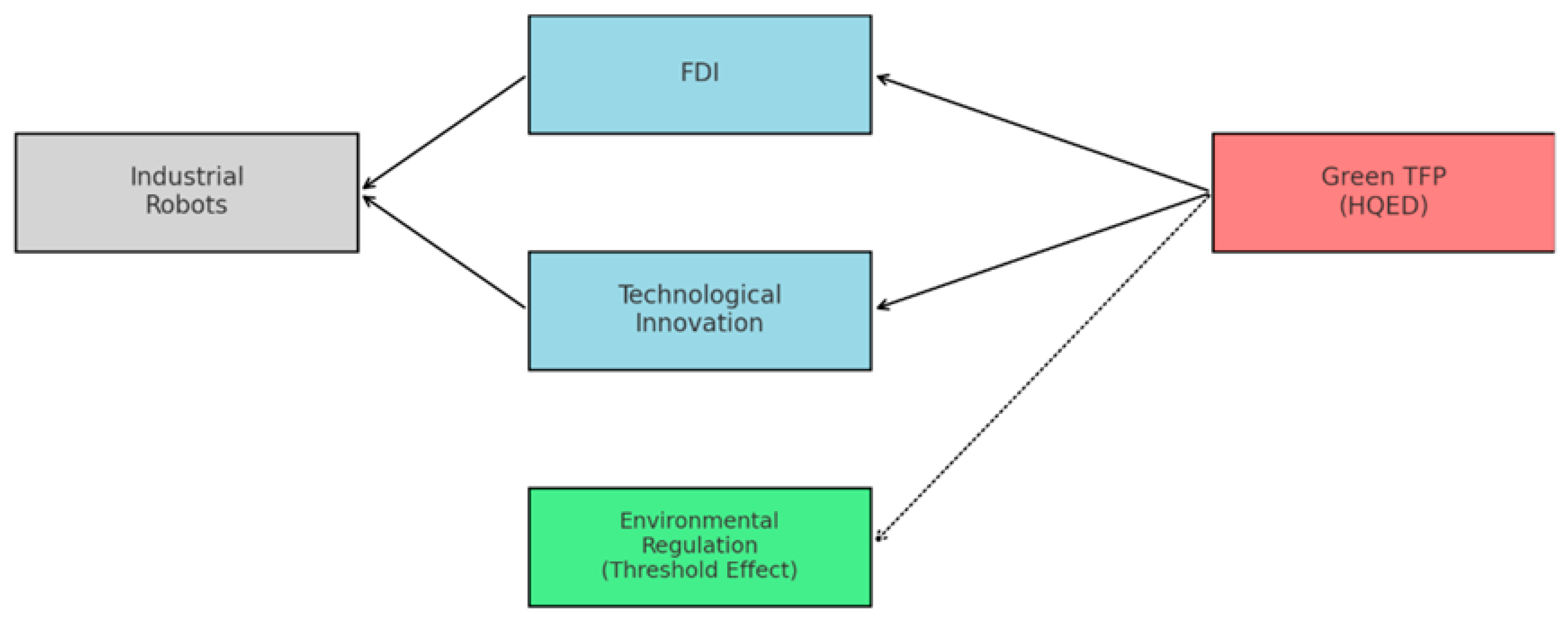
Amid escalating concerns over air pollution and demographic shifts, industrial robots have emerged as a key solution to enhancing energy efficiency, reducing emissions, and fostering economic growth. However, existing research often overlooks their role in shaping green total factor productivity (GTFP), a critical measure of environmentally sustainable economic performance. This study investigates the relationship between industrial robot applications (IRAs) and high-quality economic development (HQED) by integrating theoretical modeling and empirical analysis. Using panel data from 32 countries (16 developed and 16 developing) over the period of 1993–2019, classified according to the 2023 International Monetary Fund (IMF) standards, this study employs fixed-effects models, system generalized method of moments (SYS-GMM), and threshold regression models to assess IRA-induced impacts on HQED. The findings reveal that IRAs significantly contribute to HQED, with a stronger effect observed in developing economies. Moreover, a threshold effect exists, wherein environmental regulations (ERs) mediate the effectiveness of IRAs in improving GTFP. Additionally, IRAs drive HQED through foreign direct investment (FDI) and technological innovation (TI). These results provide empirical evidence and policy insights for leveraging industrial automation to promote sustainable economic growth across different national contexts.
Keywords: industrial robot applications; green total factor productivity; high-quality economic development; environmental regulations; FDI & technological innovation industrial robot applications; green total factor productivity; high-quality economic development; environmental regulations; FDI & technological innovation