Article

Higher Status, More Actions but Less Sacrifice: The SES Paradox in Pro-Environmental Behaviors

1
School of Humanities and Social Science, Xi’an Jiaotong University, Xi’an 710049, China
2
Teaching Department of Ideological and Political Theory Courses, Xiamen Institute of Technology, Xiamen 361021, China
*
Author to whom correspondence should be addressed.
Sustainability 2025, 17(15), 6948; https://doi.org/10.3390/su17156948
Submission received: 1 July 2025 / Revised: 25 July 2025 / Accepted: 26 July 2025 / Published: 31 July 2025
(This article belongs to the Special Issue Urban Resident Participation and Sustainable Urban Environments)

Abstract

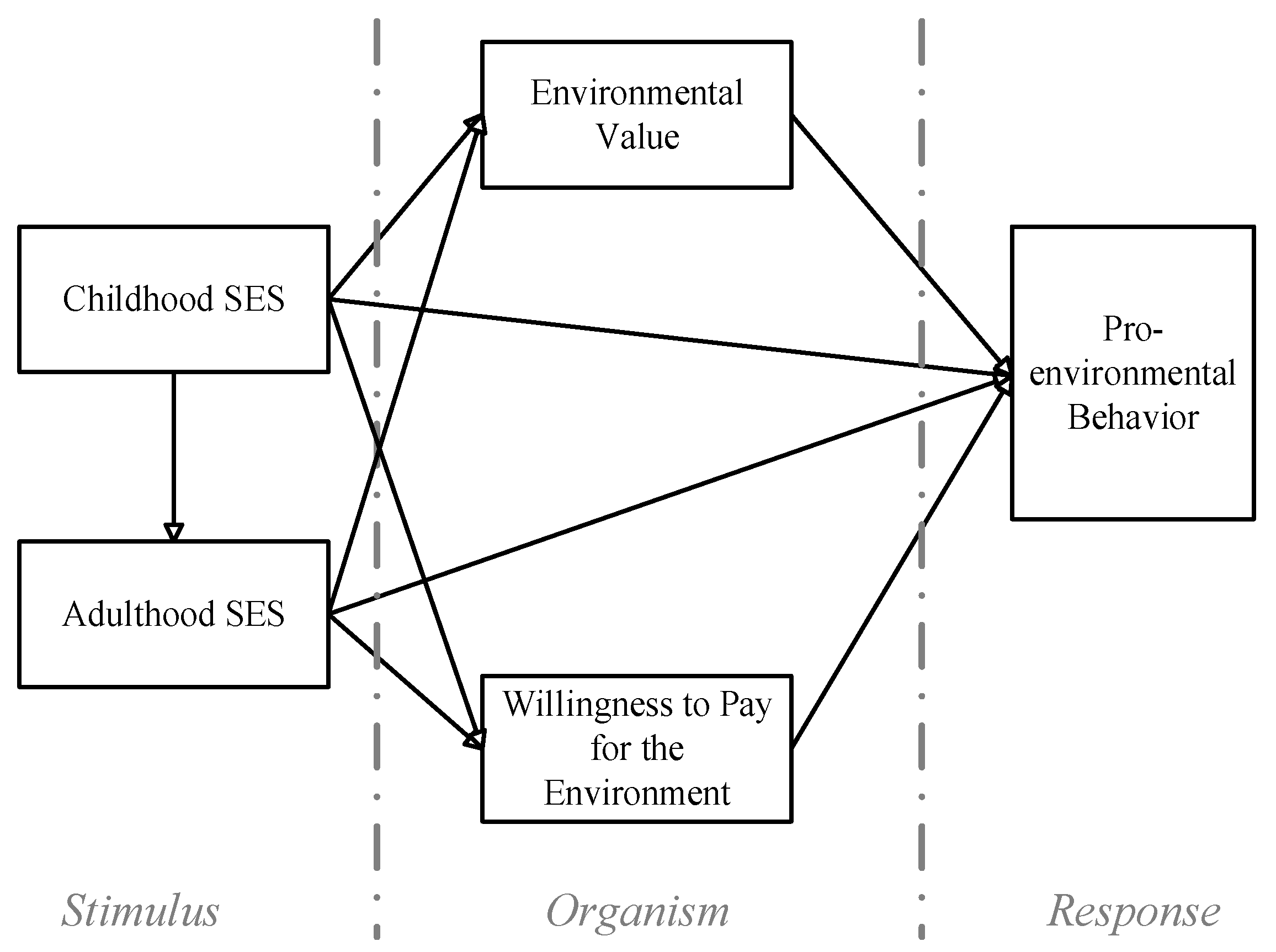
Identifying predictors of pro-environmental behaviors (PEBs) can not only figure out who concerns about the environment most but also inform possible pathways that advance or inhabit such prosocial actions. Most past studies and theories focus on factors that reside within personal characteristics or sociopsychological mechanisms rather than taking a holistic view that integrates these two elements into a framework. This study investigates how socioeconomic status (SES) correlates with PEBs, integrating both structural and psychological mechanisms. Drawing on the Stimulus–Organism–Response (SOR) theoretical framework, this paper examines the paradox whereby individuals with higher SES exhibit more frequent environmental actions yet demonstrate lower willingness to pay (WTP)—a form of economic sacrifice. Using nationally representative data from the 2021 Chinese General Social Survey (CGSS), our structural equation modeling reveals that adulthood SES positively correlates with environmental values and behaviors but negatively correlates with WTP. This challenges the traditional linear assumption that greater willingness necessarily leads to greater action. Additionally, while childhood SES predicts adult SES, it shows no direct effect on environmental engagement. These findings highlight multidimensional pathways by which SES shape environmental actions, necessitating differentiated policy approaches to build a sustainable world.
Keywords: PEBs; environmental value; willingness to pay; socioeconomic status; SOR model; sustainability PEBs; environmental value; willingness to pay; socioeconomic status; SOR model; sustainability