


A Comparison of the Cost-Effectiveness of Alternative Fuels for Shipping in Two GHG Pricing Mechanisms: Case Study of a 24,000 DWT Bulk Carrier


Abstract
1. Introduction
2. Data and Methods
2.1. Research Procedures
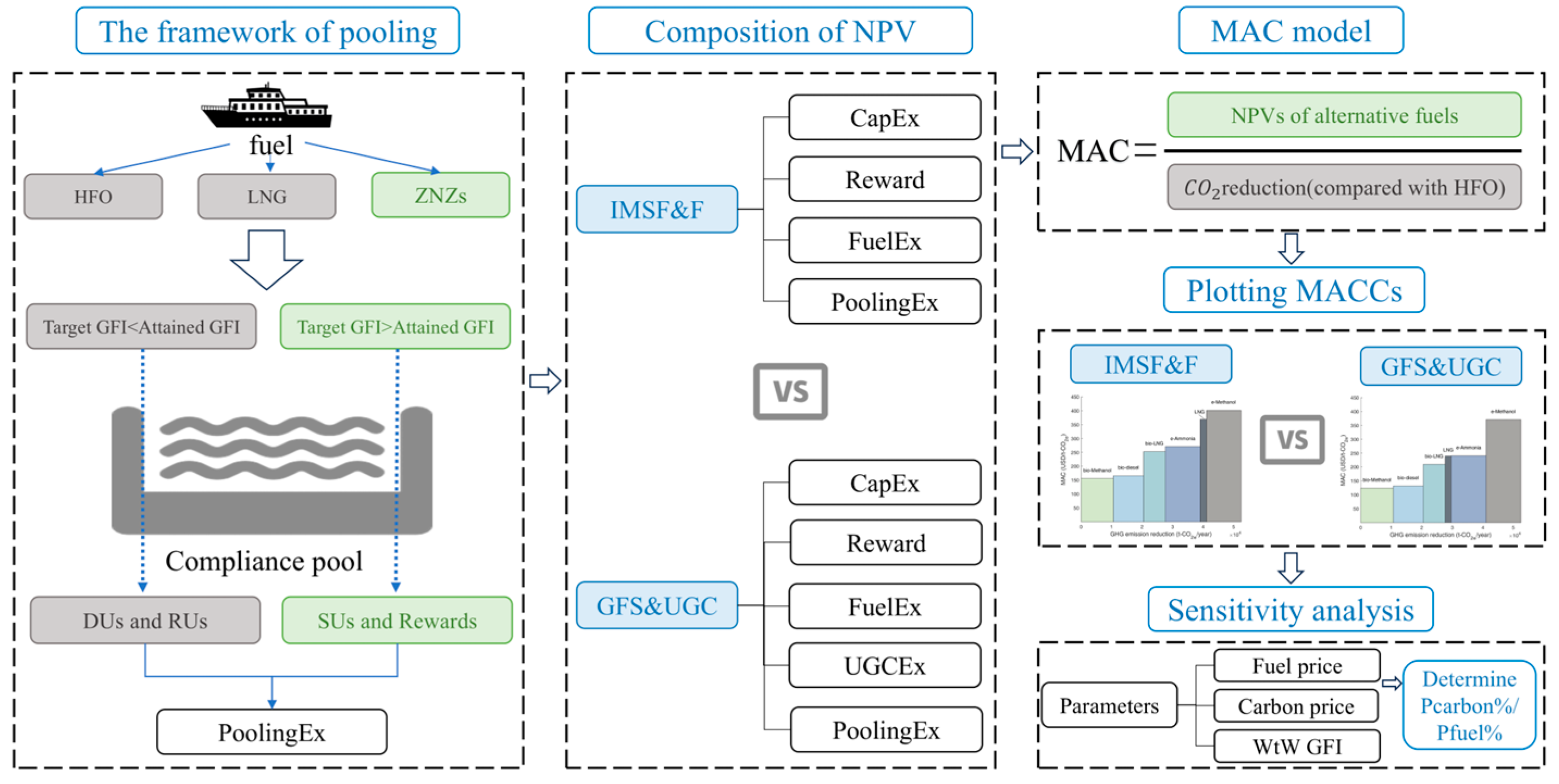
- Calculate and compare the net present values of alternative fuels under the two GHG pricing mechanisms;
- Develop an MAC model and calculate the MACs of alternative fuels under both mechanisms;
- Rank the alternative fuels in ascending order of MAC and plot MACCs for each mechanism to compare their cost-effectiveness;
- Perform sensitivity analysis to evaluate the impacts of fuel prices, carbon prices, and GFIWtW on the cost-effectiveness of alternative fuels.
2.2. Net Present Value
2.3. The MAC Model
2.4. Sensitivity Analysis
3. Results
3.1. NPVi,t
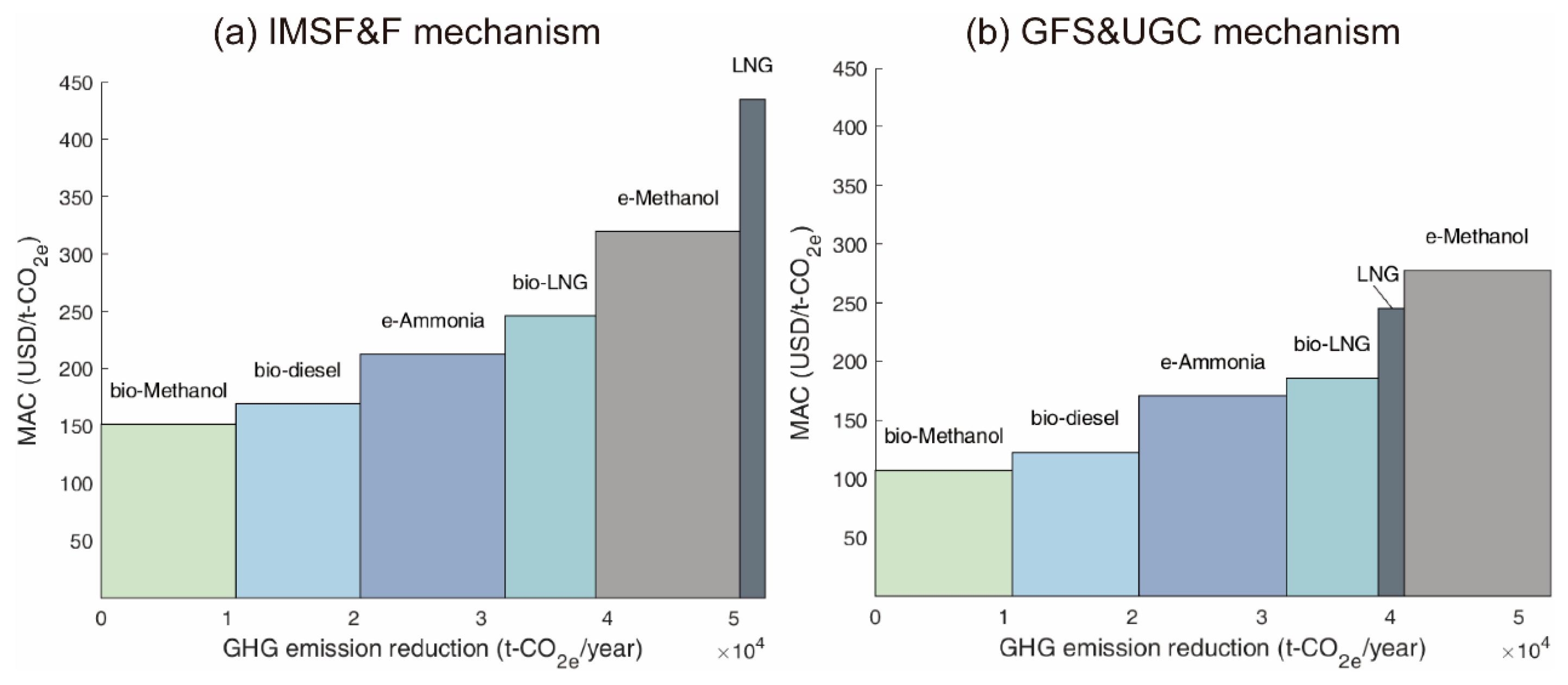
3.2. Results of MAC Model
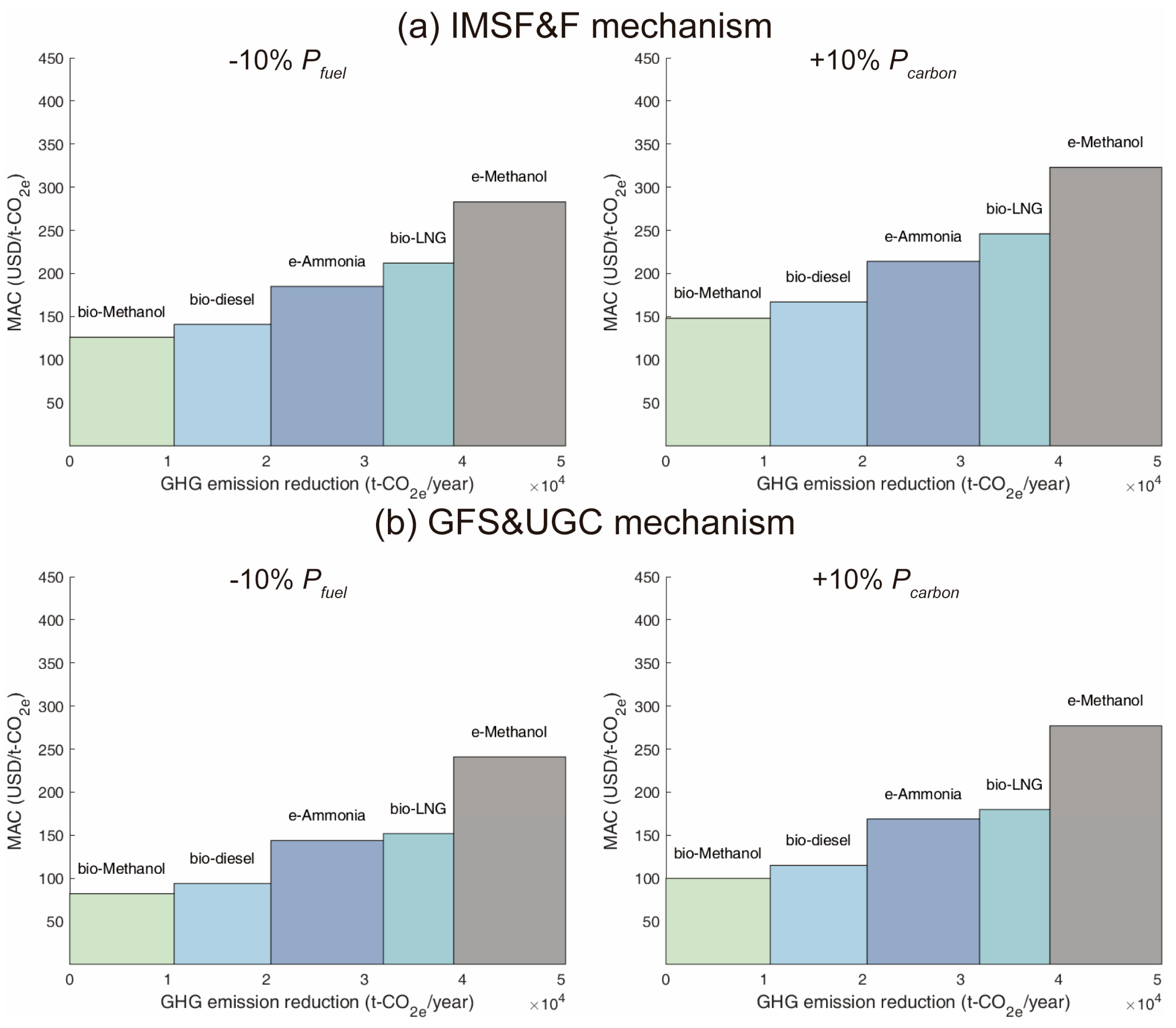
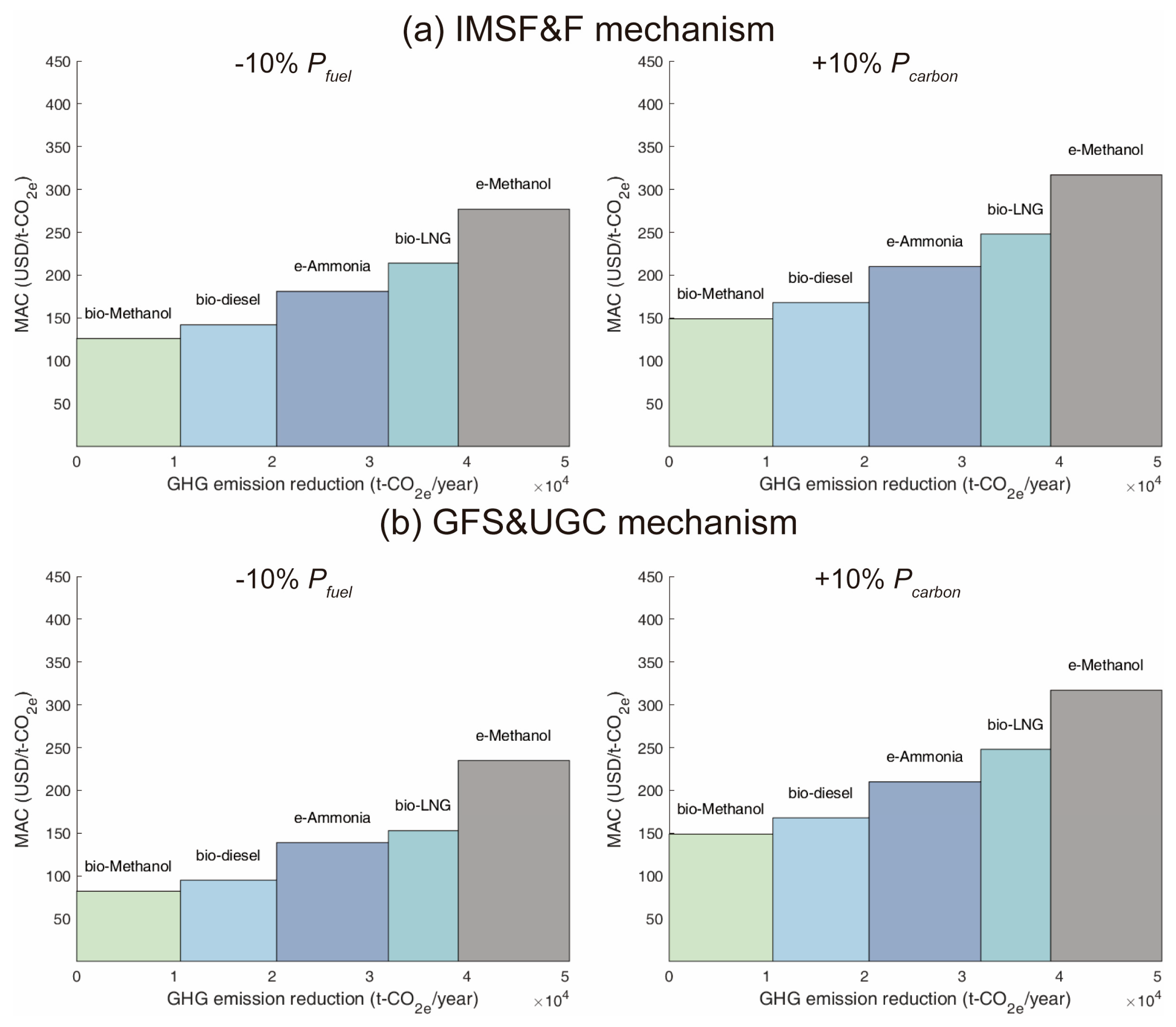
4. Sensitivity Analysis
5. Conclusions
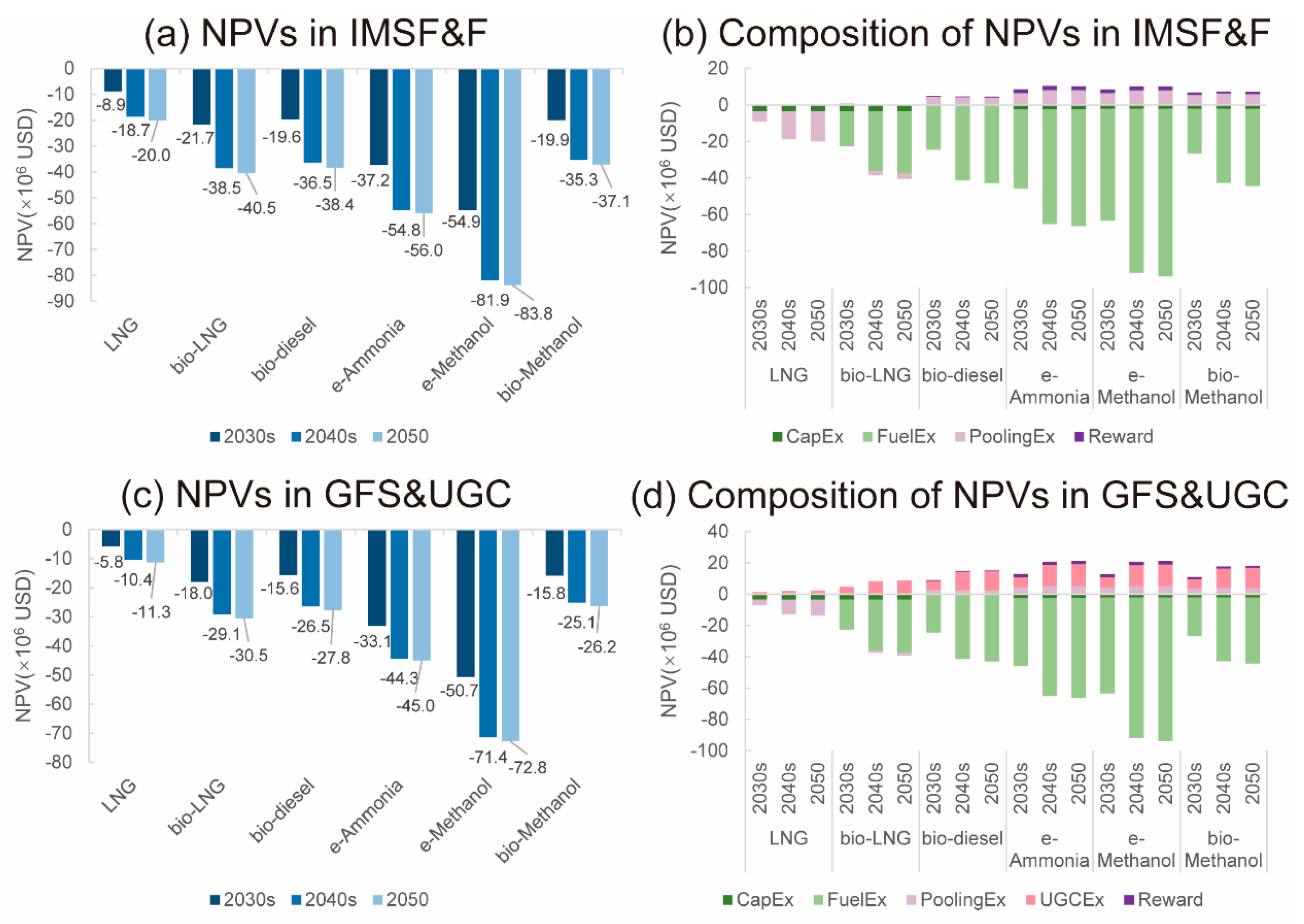
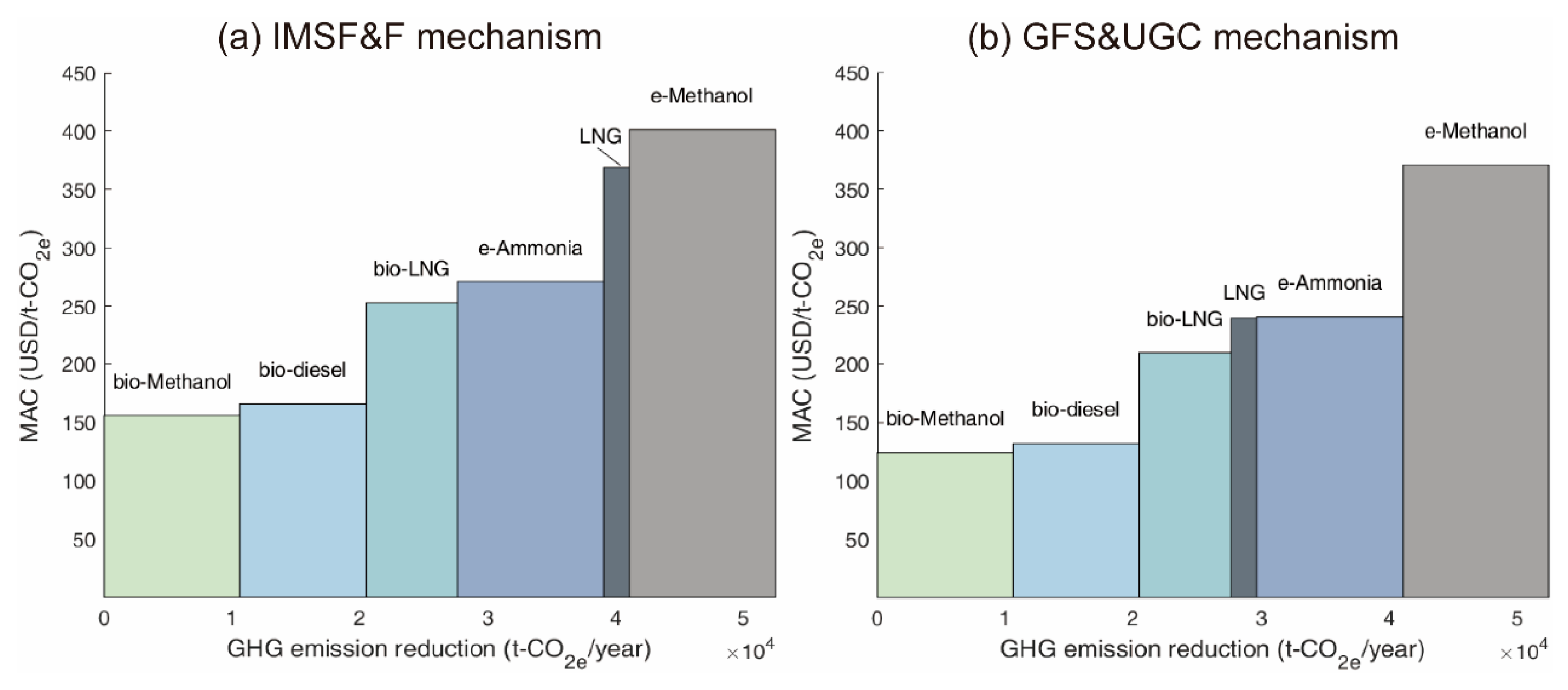
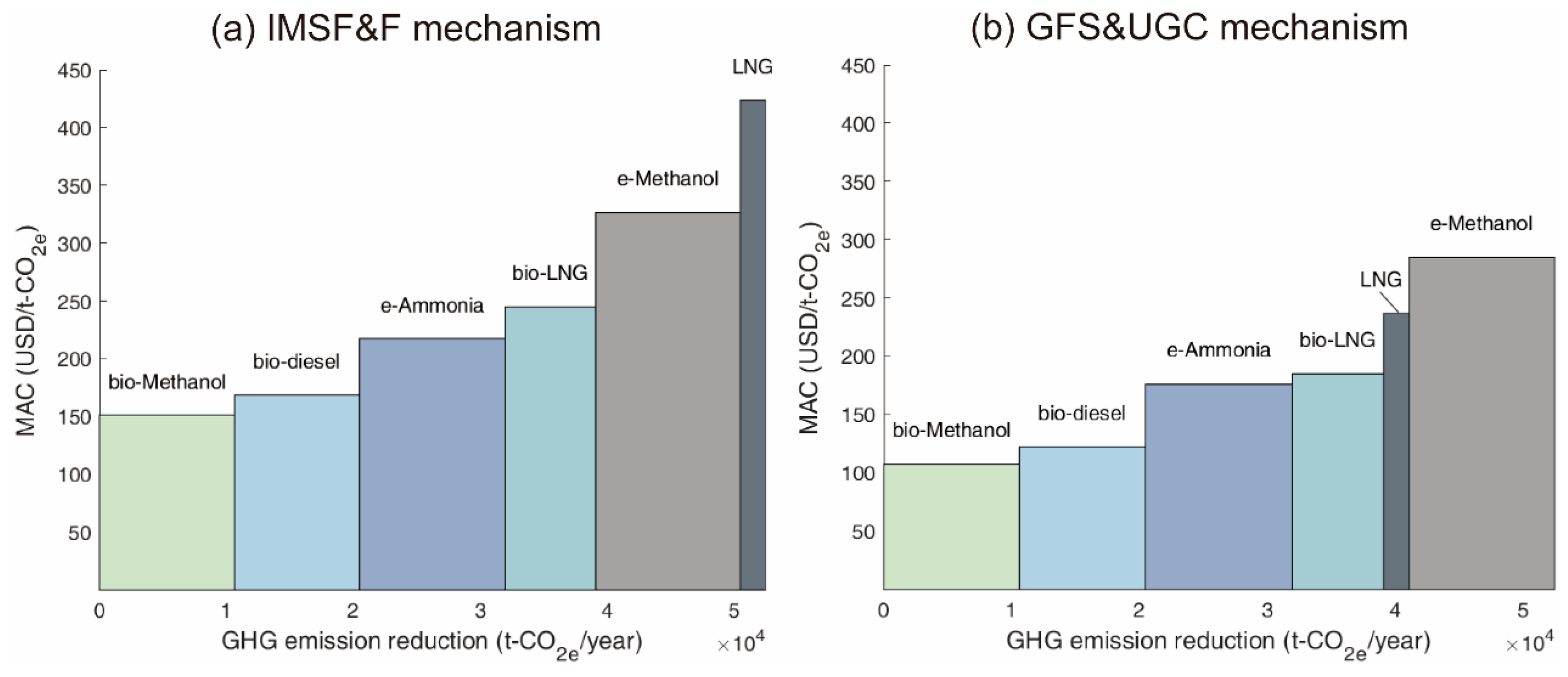
- Compared to the IMSF&F mechanism, implementing the GFS&UGC mechanism yields higher NPVs and lower MACs, thereby reducing shipowners’ economic losses. Consequently, introducing a universal GHG contribution component into the latest IMO GHG pricing mechanism can promote a just and equitable transition to sustainable shipping fuels;
- NPVs were all negative under both mechanisms and the investments of ZNZ-powered ships were not expected to be recouped by 2050 unless carbon prices rise dramatically to increase revenues;
- Bio-Methanol and bio-diesel were the most cost-competitive ZNZs in the long term and the poor cost-effectiveness of e-Methanol could be attributed to its extremely high price. Bio-LNG performed better in cost-effectiveness than e-Ammonia in the 2030s while the case reversed in the 2040s and 2050. PoolingEx and UGCEx could significantly reduce the economic viability of LNG over the period;
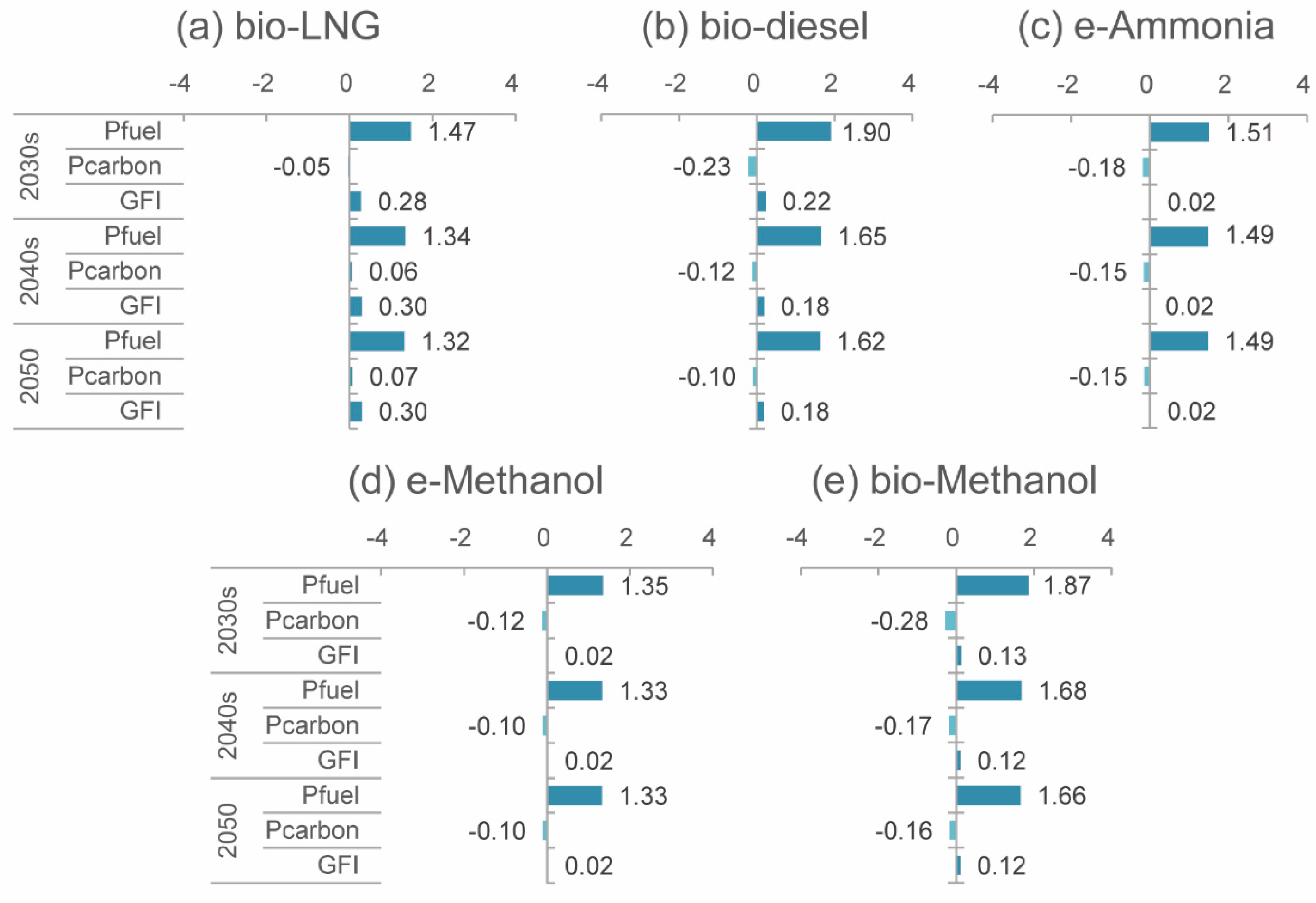
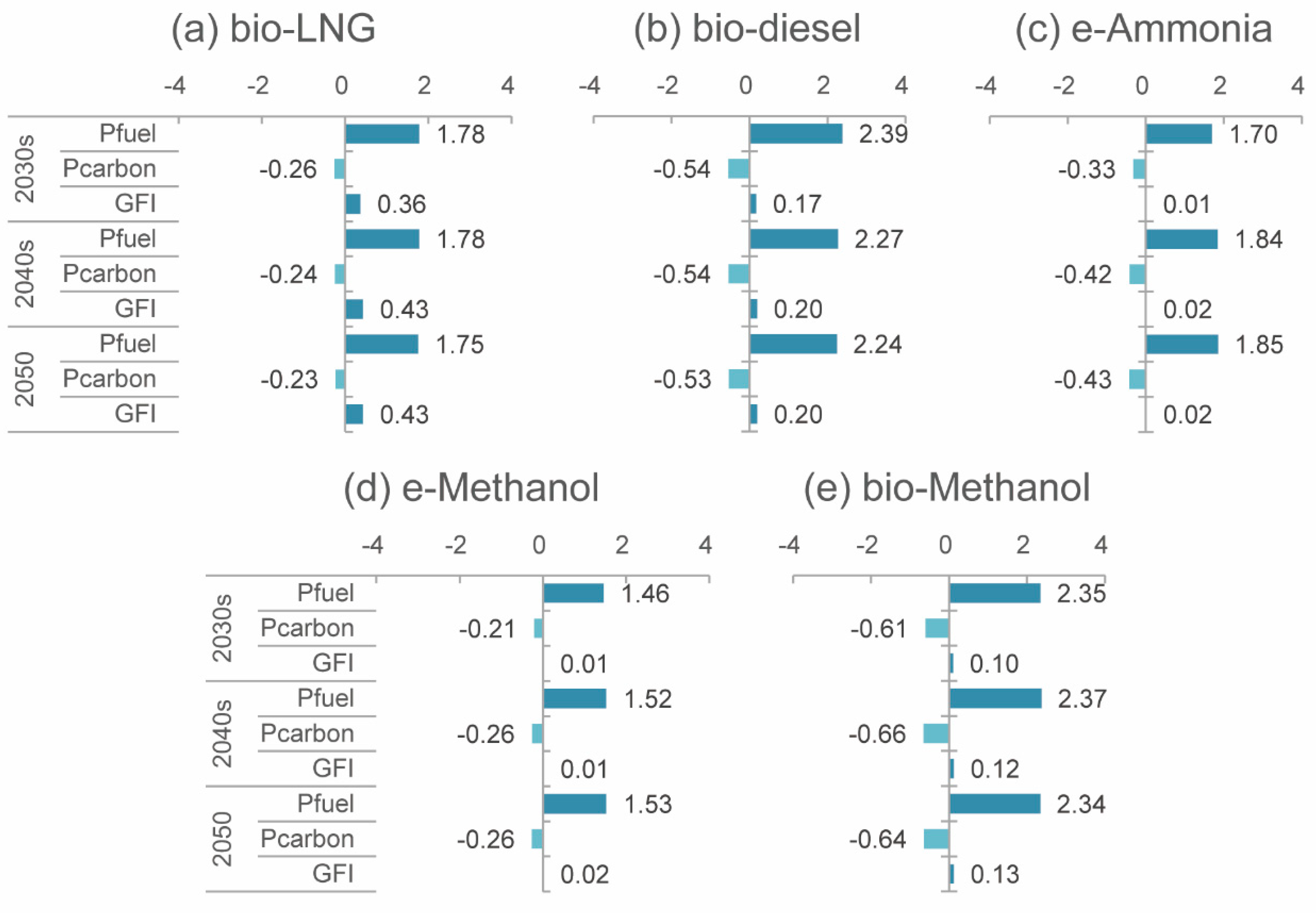
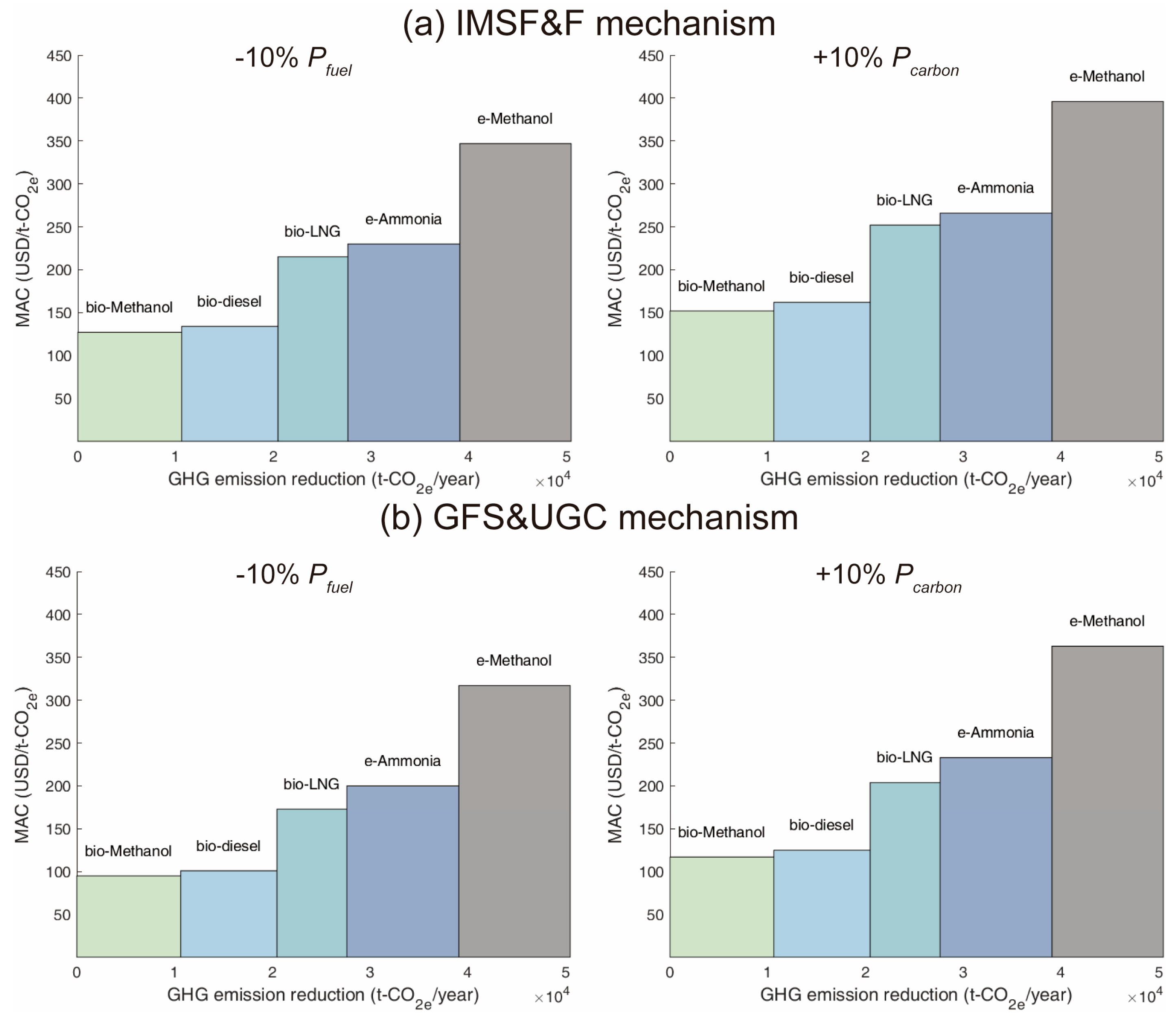
- MACs were more sensitive to fuel price compared to carbon price and GFIWtW under the price scope of this study, especially under the GFS&UGC mechanism;
- The ratios of Pcarbon%/Pfuel% in equivalent sensitivity scenarios were determined to assess the relative importance of carbon price and fuel price.
Author Contributions
Funding
Institutional Review Board Statement
Informed Consent Statement
Data Availability Statement
Conflicts of Interest
References
- Xu, L.; Shen, C.; Chen, J. The impact of the Maritime Silk Road Initiative on the carbon intensity of the participating countries. Marit. Econ. Logist. 2024, 27, 331–349. [Google Scholar] [CrossRef] [Scilit]
- IMO. Report of Fuel Oil Consumption Data Submitted to the IMO Ship Fuel Oil Consumption Database in GISIS; IMO: London, UK, 2023. [Google Scholar]
- IMO. 2023 IMO Strategy on Reduction of GHG Emissions from Ships; IMO: London, UK, 2023. [Google Scholar]
- DNV. Report of the Comprehensive Impact Assessment of the Basket of Candidate GHG Reduction Mid-Term Measures—Full Report on Task 2 (Impacts on the Fleet); DNV: Høvik, Norway, 2024. [Google Scholar]
- IMO. Fourth-IMO-GHG-Study-2020-Full-Report-and-Annexes_Compressed; IMO: London, UK, 2020. [Google Scholar]
- Zhang, C.; Zhu, J.; Guo, H.; Xue, S.; Wang, X.; Wang, Z.; Chen, T.; Yang, L.; Zeng, X.; Su, P. Technical Requirements for 2023 IMO GHG Strategy. Sustainability 2024, 16, 2766. [Google Scholar] [CrossRef] [Scilit]
- Schinas, O.; Butler, M. Feasibility and commercial considerations of LNG-fueled ships. Ocean Eng. 2016, 122, 84–96. [Google Scholar] [CrossRef] [Scilit]
- ABS. LNG as Marine Fuel; ABS: Houston, TX, USA, 2022. [Google Scholar]
- ICCT. The Climate Implications of Using LNG as a Marine Fuel; ICCT: Washington, DC, USA, 2020. [Google Scholar]
- Parris, D.; Spinthiropoulos, K.; Ragazou, K.; Giovou, A.; Tsanaktsidis, C. Methanol, a Plugin Marine Fuel for Green House Gas Reduction—A Review. Energies 2024, 17, 605. [Google Scholar] [CrossRef] [Scilit]
- IRENA. Innovation Outlook: Renewable Methanol; IRENA: Abu Dhabi, United Arab Emirates, 2021. [Google Scholar]
- Perčić, M.; Vladimir, N.; Fan, A. Techno-economic assessment of alternative marine fuels for inland shipping in Croatia. Renew. Sustain. Energy Rev. 2021, 148, 111363. [Google Scholar] [CrossRef] [Scilit]
- Seo, Y.; An, J.; Park, E.; Kim, J.; Cho, M.; Han, S.; Lee, J. Technical–Economic Analysis for Ammonia Ocean Transportation Using an Ammonia-Fueled Carrier. Sustainability 2024, 16, 827. [Google Scholar] [CrossRef] [Scilit]
- Schwarzkopf, D.A.; Petrik, R.; Hahn, J.; Ntziachristos, L.; Matthias, V.; Quante, M. Future Ship Emission Scenarios with a Focus on Ammonia Fuel. Atmosphere 2023, 14, 879. [Google Scholar] [CrossRef] [Scilit]
- Kim, K.; Roh, G.; Kim, W.; Chun, K. A Preliminary Study on an Alternative Ship Propulsion System Fueled by Ammonia: Environmental and Economic Assessments. J. Mar. Sci. Eng. 2020, 8, 183. [Google Scholar] [CrossRef] [Scilit]
- Ahmed, S.; Li, T.; Zhou, X.Y.; Yi, P.; Chen, R. Quantifying the environmental footprints of biofuels for sustainable passenger ship operations. Renew. Sustain. Energy Rev. 2025, 207, 114919. [Google Scholar] [CrossRef] [Scilit]
- Sevim, C.; Zincir, B. Biodiesel and Renewable Diesel as a Drop-in Fuel for Decarbonized Maritime Transportation. In Potential and Challenges of Low Carbon Fuels for Sustainable Transport; Agarwal, A.K., Valera, H., Eds.; Springer: Singapore, 2022; pp. 319–345. [Google Scholar]
- Mohd Noor, C.W.; Noor, M.M.; Mamat, R. Biodiesel as alternative fuel for marine diesel engine applications: A review. Renew. Sustain. Energy Rev. 2018, 94, 127–142. [Google Scholar] [CrossRef] [Scilit]
- Kanchiralla, F.M.; Brynolf, S.; Mjelde, A. Role of biofuels, electro-fuels, and blue fuels for shipping: Environmental and economic life cycle considerations. Energy Environ. Sci. 2024, 17, 6393–6418. [Google Scholar] [CrossRef] [Scilit]
- Lindstad, E.; Lagemann, B.; Rialland, A.; Gamlem, G.M.; Valland, A. Reduction of maritime GHG emissions and the potential role of E-fuels. Transp. Res. Part D Transp. Environ. 2021, 101, 103075. [Google Scholar] [CrossRef] [Scilit]
- Shi, K.; Guan, B.; Zhuang, Z.; Chen, J.; Chen, Y.; Ma, Z.; Zhu, C.; Hu, X.; Zhao, S.; Dang, H.; et al. Perspectives and Outlook of E-fuels: Production, Cost Effectiveness, and Applications. Energy Fuels 2024, 38, 7665–7692. [Google Scholar] [CrossRef] [Scilit]
- Xing, H.; Stuart, C.; Spence, S.; Chen, H. Alternative fuel options for low carbon maritime transportation: Pathways to 2050. J. Clean. Prod. 2021, 297, 126651. [Google Scholar] [CrossRef] [Scilit]
- IRENA. A Pathway to Decarbonize the Shipping Sector; IRENA: Abu Dhabi, United Arab Emirates, 2021. [Google Scholar]
- Lagemann, B.; Lagouvardou, S.; Lindstad, E.; Fagerholt, K.; Psaraftis, H.N.; Erikstad, S.O. Optimal ship lifetime fuel and power system selection under uncertainty. Transp. Res. Part D Transp. Environ. 2023, 119, 103748. [Google Scholar] [CrossRef] [Scilit]
- Kanchiralla, F.M.; Brynolf, S.; Olsson, T.; Ellis, J.; Hansson, J.; Grahn, M. How do variations in ship operation impact the techno-economic feasibility and environmental performance of fossil-free fuels? A life cycle study. Appl. Energy 2023, 350, 121773. [Google Scholar] [CrossRef] [Scilit]
- Wang, Y.; Iris, Ç. Transition to near-zero emission shipping fleet powered by alternative fuels under uncertainty. Transp. Res. Part D Transp. Environ. 2025, 142, 104689. [Google Scholar] [CrossRef] [Scilit]
- Balcombe, P.; Brierley, J.; Lewis, C.; Skatvedt, L.; Speirs, J.; Hawkes, A.; Staffell, I. How to decarbonise international shipping: Options for fuels, technologies and policies. Energy Convers. Manag. 2019, 182, 72–88. [Google Scholar] [CrossRef] [Scilit]
- Iris, Ç.; Lam, J.S.L. A review of energy efficiency in ports: Operational strategies, technologies and energy management systems. Renew. Sustain. Energy Rev. 2019, 112, 170–182. [Google Scholar] [CrossRef] [Scilit]
- Zou, Y.; Xiao, G.; Li, Q.; Biancardo, S.A. Intelligent Maritime Shipping: A Bibliometric Analysis of Internet Technologies and Automated Port Infrastructure Applications. J. Mar. Sci. Eng. 2025, 13, 979. [Google Scholar] [CrossRef] [Scilit]
- Chen, X.; Wu, S.; Shi, C.; Huang, Y.; Yang, Y.; Ke, R.; Zhao, J. Sensing Data Supported Traffic Flow Prediction via Denoising Schemes and ANN: A Comparison. IEEE Sens. J. 2020, 20, 14317–14328. [Google Scholar] [CrossRef] [Scilit]
- IMO. Draft Amendments to MARPOL Annex VI Regulations for the Prevention of Air Pollution from Ships (Revised MARPOL Annex VI); IMO: London, UK, 2025. [Google Scholar]
- IMO. Updates on the International Maritime Sustainable Fuels and Fund (IMSF&F) Mechanism and Revised Draft Amendments to MARPOL Annex VI Using the Structure of the “IMO Net-Zero Framework”; IMO: London, UK, 2024. [Google Scholar]
- IMO. Proposal on a Combination of a GHG Fuel Standard and a Universal GHG Contribution; IMO: London, UK, 2024. [Google Scholar]
- Lagouvardou, S.; Lagemann, B.; Psaraftis, H.N.; Lindstad, E.; Erikstad, S.O. Marginal abatement cost of alternative marine fuels and the role of market-based measures. Nat. Energy 2023, 8, 1209–1220. [Google Scholar] [CrossRef] [Scilit]
- IMO. Report of the Comprehensive Impact Assessment of the Basket of Candidate GHG Reduction Mid-Term Measures—Full Report on Task 3 (Impacts on States); IMO: London, UK, 2024. [Google Scholar]
- Caprace, J.-D.; Marques, C.H.; Assis, L.F.; Lucchesi, A.; Pereda, P.C. Sustainable Shipping: Modeling Technological Pathways Toward Net-Zero Emissions in Maritime Transport (Part I). Sustainability 2025, 17, 3733. [Google Scholar] [CrossRef] [Scilit]
- Tu, H.; Liu, Z.; Zhang, Y. Study on Cost-Effective Performance of Alternative Fuels and Energy Efficiency Measures for Shipping Decarbonization. J. Mar. Sci. Eng. 2024, 12, 743. [Google Scholar] [CrossRef] [Scilit]
- Karvounis, P.; Theotokatos, G.; Boulougouris, E. Environmental-economic sustainability of hydrogen and ammonia fuels for short sea shipping operations. Int. J. Hydrogen Energy 2024, 57, 1070–1080. [Google Scholar] [CrossRef] [Scilit]
- Longva, T.; Eide, M.S.; Endresen, Ø.; Sekkesæter, Ø.; Helgesen, H.; Rivedal, N.H. Marginal abatement cost curves for CO2 emission reduction from shipping to 2050. Marit. Transp. Res. 2024, 6, 100112. [Google Scholar] [CrossRef] [Scilit]
- Martin, J.; Dimanchev, E.; Neumann, A. Carbon abatement costs for renewable fuels in hard-to-abate transport sectors. Adv. Appl. Energy 2023, 12, 100156. [Google Scholar] [CrossRef] [Scilit]
- Korberg, A.D.; Brynolf, S.; Grahn, M.; Skov, I.R. Techno-economic assessment of advanced fuels and propulsion systems in future fossil-free ships. Renew. Sustain. Energy Rev. 2021, 142, 110861. [Google Scholar] [CrossRef] [Scilit]
- EMSA. Potential of Synthetic Fuels for Shipping; EMSA: Lisbon, Portugal, 2024. [Google Scholar]
- Lee, H.; Lee, J.; Roh, G.; Lee, S.; Choung, C.; Kang, H. Comparative Life Cycle Assessments and Economic Analyses of Alternative Marine Fuels: Insights for Practical Strategies. Sustainability 2024, 16, 2114. [Google Scholar] [CrossRef] [Scilit]
- IMarEST. Marginal Abatement Costs and Cost Effectiveness of Energy-Efficiency Measures; IMarEST: London, UK, 2011. [Google Scholar]
- Koizumi, T. Biofuels and food security. Renew. Sustain. Energy Rev. 2015, 52, 829–841. [Google Scholar] [CrossRef] [Scilit]
- ClassNK. Pathway to Zero-Emission in International Shipping; ClassNK: Tokyo, Japan, 2023. [Google Scholar]
- Zhao, Y.; Liu, F.; Zhang, Y.; Wang, Z.; Song, Z.; Zan, G.; Wang, Z.; Guo, H.; Zhang, H.; Zhu, J.; et al. Economic Assessment of Maritime Fuel Transformation for GHG Reduction in the International Shipping Sector. Sustainability 2024, 16, 10605. [Google Scholar] [CrossRef] [Scilit]
- Wu, Y.; Guo, H.; Qi, J.; Wang, S.; Zhen, L. Ship refueling optimization for dual-fuel ships considering carbon intensity indicator rating limit and uncertain fuel prices. Multimodal Transp. 2024, 3, 100138. [Google Scholar] [CrossRef] [Scilit]
- DNV GL. Comparison of Alternative Marine Fuels; DNV GL: Høvik, Norway, 2019. [Google Scholar]
- EMSA. Update on Potential of Biofuels in Shipping; EMSA: Lisbon, Portugal, 2022. [Google Scholar]
- NABU. Methanol as a Marine Fuel; NABU: Berlin, Germany, 2023. [Google Scholar]
- Gore, K.; Rigot-Müller, P.; Coughlan, J. Cost assessment of alternative fuels for maritime transportation in Ireland. Transp. Res. Part D Transp. Environ. 2022, 110, 103416. [Google Scholar] [CrossRef] [Scilit]
- Jesus, B.; Ferreira, I.A.; Carreira, A.; Ove Erikstad, S.; Godina, R. Economic framework for green shipping corridors: Evaluating cost-effective transition from fossil fuels towards hydrogen. Int. J. Hydrogen Energy 2024, 83, 1429–1447. [Google Scholar] [CrossRef] [Scilit]
- Kesicki, F. What are the key drivers of MAC curves? A partial-equilibrium modelling approach for the UK. Energy Policy 2013, 58, 142–151. [Google Scholar] [CrossRef] [Scilit]

| Type | DWT | Energy Consumption (GJ) [42] | CapExa (×106 USD) | |||
|---|---|---|---|---|---|---|
| HFO, bio-diesel | LNG, bio-LNG | e-Methanol, bio-Methanol | e-Ammonia | |||
| Short-sea bulk carrier | 24,000 | 128640 | 0 | 3.36 | 2.16 | 2.40 |
| Fuel Type | Fuel Price (USD/GJ) | ||
|---|---|---|---|
| 2030s | 2040s | 2050 | |
| HFO | 10.5 | 9.5 | 8.5 |
| LNG | 10.3 | 10.2 | 10.1 |
| bio-LNG | 26.5 | 30.2 | 34.3 |
| bio-diesel | 30.9 | 35.1 | 39.6 |
| e-Ammonia | 46.5 | 39.1 | 31.2 |
| e-Methanol | 61.2 | 53.5 | 45.0 |
| bio-Methanol | 30.8 | 34.2 | 38.6 |
| Parameter | Mechanism | Unit | 2030s | 2040s | 2050 |
|---|---|---|---|---|---|
| Z a [6] | Both | % | 54.3 | 85.3 | 100 |
| PReward,t [4] | Both | USD/t-CO2e b | 102.9 | 30.5 | 0 |
| GFIReward [31] | Both | g-CO2e/MJ | 19 | 9 c | 0 c |
| PPool,t d [4] | IMSF&F | USD/t-CO2e | 139 | 229 | 324 |
| GFS&UGC | USD/t-CO2e | 91 | 133 | 223 | |
| PUGC,t [4] | GFS&UGC | USD/t-CO2e | 60 | 120 | 120 |
| Fuel Type | Fuel Category | GFIWtW (g-CO2e/MJ) | αi (%) |
|---|---|---|---|
| HFO | Fossil fuel | 91.6 [46] | Baseline |
| LNG | Fossil fuel | 76.1 [46] | 17.0% |
| bio-LNG | ZNZs | 36.0 [47] | 60.7% |
| bio-diesel | ZNZs | 15.0 [47] | 83.6% |
| e-Ammonia | ZNZs | 2.6 [46] | 97.2% |
| e-Methanol | ZNZs | 3.0 [47] | 96.7% |
| bio-Methanol | ZNZs | 9.0 [47] | 90.2% |
| Fuel Type | 2030s | 2040s | 2050 | |||
|---|---|---|---|---|---|---|
| IMSF&F | GFS&UGC | IMSF&F | GFS&UGC | IMSF&F | GFS&UGC | |
| LNG | 369 | 240 | 424 | 237 | 435 | 245 |
| bio-LNG | 253 | 210 | 245 | 185 | 246 | 186 |
| bio-diesel | 166 | 132 | 169 | 122 | 169 | 123 |
| e-Ammonia | 271 | 241 | 217 | 176 | 213 | 171 |
| e-Methanol | 401 | 371 | 327 | 285 | 320 | 278 |
| bio-Methanol | 156 | 124 | 151 | 107 | 152 | 107 |
| Objects | Parameters | Units | LNG | bio-LNG | bio-diesel | e-Ammonia | e-Methanol | bio-Methanol | Ref. |
|---|---|---|---|---|---|---|---|---|---|
| Fleet | Fuel price | USD/GJ | Null | 28.9 | Null | Null | Null | 22.6 | [26] |
| GFIWtW | g-CO2/MJ | Null | 4.0 | Null | Null | Null | 8.0 | ||
| NPV | ×109 USD | 4.44 a | |||||||
| Fuel price | EUR/ton | 222.7 | Null | Null | 1069 | Null | Null | [52] | |
| GFIWtW | g-CO2/MJ | 114.4 | Null | Null | 0 | Null | Null | ||
| NPV | ×109 EUR | 6.166 b | Null | Null | Null | Null | Null | ||
| Fuel price | USD/GJ | 8.8 | 25.0 | 30.4 | 29.1 | 37.2 | 26.5 | [39] | |
| GFIWtW | t-CO2/t-fuel | 2.75 | 0 | 0 | 0 | 0 | 0 | ||
| MAC | USD/t-CO2e | 193.3 c | |||||||
| Fuel price | EUR/GJ | Null | 21.6 | Null | 33.8 | 40.4 | 21.9 | [19] | |
| MAC | EUR/t-CO2e | 1080 | Null | Null | 290 | 310 | 250 | ||
| Individual vessel | Fuel price | USD/GJ | 15.8 | 28.9 | 30.8 | Null | 69.6 | 22.8 | [34] |
| GFIWtW | g-CO2e/MJ | 84.8 | 15.5 | 61.1 | Null | 1.0 | 32.2 | ||
| MAC | USD/t-CO2e | −51.08 | 89.82 | 206.59 | Null | 628.43 | 24.62 | ||
| Fuel price | USD/ton | 425 | 1416 | Null | 740 | 1174 | 612 | [37] | |
| GFIWtW | g-CO2e/MJ | 77.5 | 20.1 | Null | 0 | 4.5 | 11.0 | ||
| MAC | USD/t-CO2e | 45 | 303 | Null | 352 | 584 | 284 | ||
| Fuel price | EUR/GJ | Null | Null | Null | 32.14 | 37.18 | Null | [25] | |
| MAC | EUR/t-CO2e | Null | Null | Null | 256 | 265 | Null | ||
| Fuel price | USD/ton | 692 | Null | Null | Null | Null | Null | [53] | |
| GFIWtW | t-CO2/t-fuel | 2.75 | Null | Null | Null | Null | Null | ||
| Total cost | ×109 USD | 3.4415 a | Null | Null | Null | Null | Null | ||
| Fuel price | EUR/GJ | Null | Null | 26.4 | Null | 33.0 | 19.2 | [41] | |
| Total cost d | ×109 EUR | Null | Null | 0.19 | Null | 0.25 | 0.15 | ||
| Fuel price | USD/GJ | 8.5 | Null | 37.6 | 42.8 | 56.1 | 30.1 | [43] | |
| GFIWtW | g-CO2/MJ | 205.0 | Null | 62.2 | 26.4 | 25.6 | 49.7 | ||
| Total cost | ×109 USD | 0.285 | Null | 0.529 | 0.622 | 0.748 | 0.456 | ||
| NPV | ×109 USD | 0.169 | Null | 0.304 | 0.373 | 0.443 | 0.273 | ||
| Fuel Type | 2030s | 2040s | 2050 | |||||||||
|---|---|---|---|---|---|---|---|---|---|---|---|---|
| IMSF&F | GFS&UGC | IMSF&F | GFS&UGC | IMSF&F | GFS&UGC | |||||||
| −10% Pfuel | +10% Pcarbon | −10% Pfuel | +10% Pcarbon | −10% Pfuel | +10% Pcarbon | −10% Pfuel | +10% Pcarbon | −10% Pfuel | +10% Pcarbon | −10% Pfuel | +10% Pcarbon | |
| bio-LNG | −38 | −1 | −37 | −6 | −33 | +1 | −33 | −5 | −32 | +2 | −33 | −5 |
| bio-diesel | −32 | −4 | −31 | −7 | −28 | −2 | −28 | −7 | −27 | −1 | −28 | −7 |
| e-Ammonia | −41 | −5 | −41 | −8 | −32 | −3 | −32 | −7 | −32 | −3 | −32 | −8 |
| e-Methanol | −54 | −5 | −54 | −8 | −44 | −4 | −44 | −8 | −43 | −3 | −43 | −7 |
| bio-Methanol | −29 | −4 | −29 | −7 | −25 | −3 | −25 | −7 | −26 | −3 | −25 | −7 |
| Fuel Type | Mechanism | Pcarbon%/Pfuel% | ||
|---|---|---|---|---|
| 2030s | 2040s | 2050 | ||
| bio-LNG | IMSF&F | 29.4 | 22.3 | 18.9 |
| GFS&UGC | 6.9 | 7.4 | 7.6 | |
| bio-diesel | IMSF&F | 8.3 | 13.8 | 16.2 |
| GFS&UGC | 4.4 | 4.2 | 4.2 | |
| e-Ammonia | IMSF&F | 8.4 | 10.0 | 10.0 |
| GFS&UGC | 5.2 | 4.4 | 4.3 | |
| e-Methanol | IMSF&F | 11.3 | 13.3 | 13.3 |
| GFS&UGC | 7.0 | 5.9 | 5.9 | |
| bio-Methanol | IMSF&F | 6.7 | 9.9 | 10.4 |
| GFS&UGC | 3.9 | 3.6 | 3.7 | |
Disclaimer/Publisher’s Note: The statements, opinions and data contained in all publications are solely those of the individual author(s) and contributor(s) and not of MDPI and/or the editor(s). MDPI and/or the editor(s) disclaim responsibility for any injury to people or property resulting from any ideas, methods, instructions or products referred to in the content. |
© 2025 by the authors. Licensee MDPI, Basel, Switzerland. This article is an open access article distributed under the terms and conditions of the Creative Commons Attribution (CC BY) license (https://creativecommons.org/licenses/by/4.0/).
Share and Cite
Zou, J.; Su, P.; Zhang, C. A Comparison of the Cost-Effectiveness of Alternative Fuels for Shipping in Two GHG Pricing Mechanisms: Case Study of a 24,000 DWT Bulk Carrier. Sustainability 2025, 17, 6001. https://doi.org/10.3390/su17136001
Zou J, Su P, Zhang C. A Comparison of the Cost-Effectiveness of Alternative Fuels for Shipping in Two GHG Pricing Mechanisms: Case Study of a 24,000 DWT Bulk Carrier. Sustainability. 2025; 17(13):6001. https://doi.org/10.3390/su17136001
Chicago/Turabian StyleZou, Jinyu, Penghao Su, and Chunchang Zhang. 2025. "A Comparison of the Cost-Effectiveness of Alternative Fuels for Shipping in Two GHG Pricing Mechanisms: Case Study of a 24,000 DWT Bulk Carrier" Sustainability 17, no. 13: 6001. https://doi.org/10.3390/su17136001
APA StyleZou, J., Su, P., & Zhang, C. (2025). A Comparison of the Cost-Effectiveness of Alternative Fuels for Shipping in Two GHG Pricing Mechanisms: Case Study of a 24,000 DWT Bulk Carrier. Sustainability, 17(13), 6001. https://doi.org/10.3390/su17136001

