Review

Principles for Incorporating Recycled Materials into Airport Pavement Construction for More Sustainable Airport Pavements


School of Science, Technology and Engineering, University of the Sunshine Coast, Sippy Downs, QLD 4556, Australia
*
Author to whom correspondence should be addressed.
Sustainability 2024, 16(17), 7586; https://doi.org/10.3390/su16177586
Submission received: 25 June 2024 / Revised: 5 August 2024 / Accepted: 30 August 2024 / Published: 2 September 2024
(This article belongs to the Special Issue Construction and Demolition Waste Management for a Sustainable Future)

Abstract

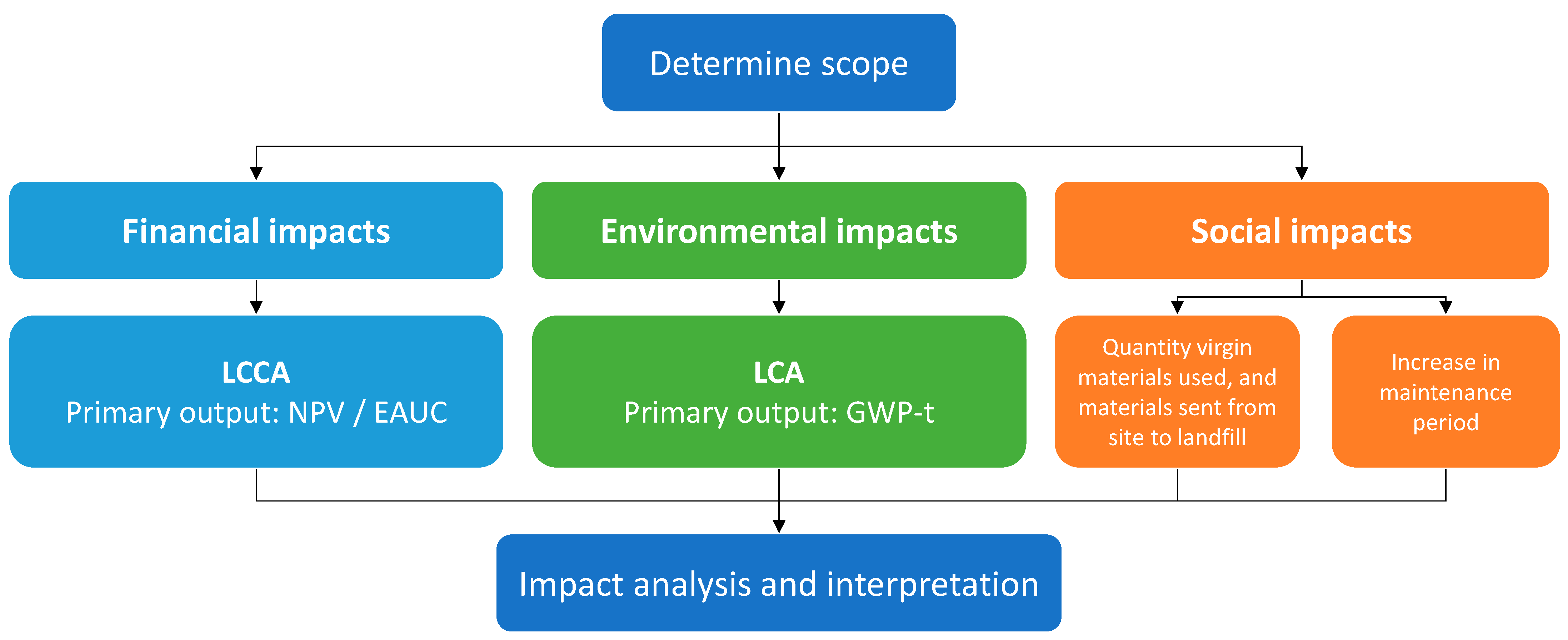
Current international waste policy promotes the reduction and re-use of waste materials, and in some cases, specifically calls for the use of recycled materials in pavements. Consequently, there is a need to understand the performance of recycled materials in airport pavements, as well as the overall sustainability benefit. This paper reviews several recycled materials and their applications to asphalt concrete, cement concrete, and bound and unbound granular materials in the context of airport pavements. Additionally, it reviews sustainability quantification methods, as well as implementation challenges for using recycled materials in airport pavements. For comparing pavements with and without recycled materials, a triple bottom line approach is appropriate. The triple bottom line approach should use life cycle cost assessment and life cycle assessment for the financial and environmental impacts, respectively, as best-practice, with frameworks and guidelines already established. For social impacts, it is recommended to quantify the reduction in virgin material use which relates to intergenerational equity by ensuring access to materials by future generations. Because there are still implementation challenges for the airport pavement industry, principles are developed that aim to promote uptake of recycled materials. These principles include sorting and processing, minimising haulage distances, and ensuring performance of pavement layers through performance testing and performance-related specifications.
Keywords: airport; pavement; life cycle assessment; life cycle cost analysis; sustainability; recycled materials airport; pavement; life cycle assessment; life cycle cost analysis; sustainability; recycled materials