1. Introduction
Natural disasters and public health crises have occurred intermittently throughout the course of human history, e.g., the SARS outbreak in 2003, the Indian Ocean tsunami in 2004, Hurricane Katrina in 2005, the earthquake in Haiti in 2010, the COVID-19 pandemic in 2020, and the massive rainfall in Henan, China, in 2021. Each major natural disaster or public health crisis has had a significant impact on the economy and the safety of human lives. Sufficient emergency material reserves are crucial for the mitigation of the threat of disasters [
1].
The issue of emergency material reserves for sudden events has been extensively researched. Emergency materials refer to various resources needed in response to sudden events. After the onset of a sudden event, a substantial quantity of resources is typically needed within a short timeframe. Shortages in emergency materials can markedly impact the efficiency of rescue operations [
2]. For example, the insufficient reserves of basic living materials such as tents, food, and water after an earthquake can have a huge impact on affected populations. Owing to the unpredictability of disasters and inadequate prediction of demand, some studies have focused on the location and quantity of material reserves before disasters [
3,
4,
5,
6], aiming to pre-position resources in emergency response plans. However, these studies have considered only single physical reserve methods. In fact, emergency material reserves should include various types of reserves, such as physical, capacity, and agreement reserves. Evaluating emergency material reserves can help to ensure the sustainable operation of material reserve systems.
Owing to the continuous development of emergency material reserves, three main types of reserves—physical reserves, capacity reserves, and agreement reserves—have emerged as mainstream practices [
7,
8]. Physical reserves are the most stable among these reserves but have high storage costs and generate a considerate amount of waste. By contrast, capacity reserves offer benefits such as lower costs, zero material waste, and effective reduction of inventory pressure compared with physical reserves [
9]. However, capacity reserve may be limited for new types of disasters [
10]. As for agreement reserves, governments can leverage mechanisms such as rapid response from enterprises, continuous replenishment, and information sharing to manage emergency materials [
7]. However, this approach may increase the risk of supply chain disruptions [
11]. Lücker [
8] has considered reducing interruption risks through strategies combining physical reserves, capacity reserves, and a combination of both. In recent years, some researchers have proposed that emergency reserves should consist of a combination of multiple reserve methods [
12,
13].
As research into emergency systems deepens, an increasing number of countries have developed such systems to address various sudden events [
14]. Establishing a useful emergency response framework necessitates the assessment of enterprises. Sheu [
15] proposed an emergency logistics response system based on the evaluation of suppliers and carriers. However, this model only considers post-disaster scheduling, overlooking the critical pre-disaster preparation phase. Pre-disaster preparations encompass complex tasks such as warehouse site selection, material allocation, inventory distribution, and expired material retrieval. Facility location [
16] and inventory allocation models have been proposed [
17]. Optimal warehouse locations and rational inventory allocations facilitate bolstering preparatory efforts during the pre-disaster phase. Once warehouse locations are determined, considering material management within an emergency response framework facilitates the prompt development of rational emergency material allocation schemes [
18]. Moreover, appropriate inventory levels should account for material obsolescence. Building upon classical inventory models, Bacel et al. [
19] addressed the issue of emergency material expiration and devised optimal inventory strategies. Although material allocation falls beyond the scope of material reserve research, it should be integrated into the emergency system. Given the high uncertainty of sudden events, coordinating facility locations and decisions related to transportation and fleet sizes becomes crucial across multiple periods [
20]. With predefined facility scales, efficient emergency logistics path optimization algorithms can enhance the response capability of emergency systems [
21].
Considerable progress in qualitative studies on the modes and mechanisms of emergency material reserves and quantitative studies on optimizing emergency material reserve site selection, layout, logistics, and response has been achieved [
10]. These findings provide a firm foundation for the current study. An effective SEMRS should encompass three types of reserves, namely, physical, capacity, and agreement reserves, and cover the entire process of emergency material production from raw material supply by suppliers to finished product output. This system involves multiple stakeholders, including local governments and private enterprises (comprising raw material suppliers and product manufacturers) [
22]. However, research on the evaluation systems of SEMRS is limited. The selection of evaluation indicators is either derived from literature or proposed by authors, and thus consensus and a comprehensive evaluation system covering multiple reserve methods are lacking. Given its fundamental role in emergency management, thoroughly understanding the entire process and stakeholders of emergency material reserves and comprehensively exploring the influencing factors of SEMRSs are crucial for the development of more stable and sustainable systems [
23]. Therefore, this study aims to address the following questions: what factors should be included in the evaluation indicator system of SEMRS, which factors are key influencing factors, do these key factors have causal relationships, and how to construct stable and sustainable SEMRS. Delving into these questions will offer valuable insights for the development of refined and sustainable government SEMRSs, thereby ensuring their sustainable operation.
The study focuses on SEMRSs, utilizing the Delphi method to identify factors for the evaluation system of SEMRSs. This process involves iterative rounds of expert questionnaires to attain expert consensus. The study offers several contributions: (1) From the perspective of systems methodology, we selected the three dimensions of “Wuli,” Shili,” and “Renli” to establish an evaluation framework that simultaneously assesses three types of reserve modes (physical, capacity, and agreement reserves) and achieves expert consensus. This approach addresses the limitations of previous studies that primarily focused on only one or two types of reserve methods [
10,
13]. (2) Given that SEMRS involves multiple stakeholders and various reserve methods, there are complex interactions and feedback mechanisms present. Consequently, some traditional methods—such as the Analytic Hierarchy Process (AHP) [
24], Decision-Making Trial and Evaluation Laboratory and Interpretive Structural Modeling (D-ISM) [
25], the Weighted Average Method, and the Entropy Weight Method—are not suitable for addressing such problems. Therefore, we employed a structured approach, namely, the Decision-Making Trial and Evaluation Laboratory (DEMATEL)-based Analytic Network Process (D-ANP). This approach allows for precise prioritization of indicators and the identification of causal relationships among them, thereby identifying key influencing factors and their interrelationships. (3) Analyzing the identified key factors and their causal relationships provides new recommendations for improving SEMRS. This study elucidates the operational mechanisms of emergency management systems, bolstering the resilience of emergency material supply and ensuring the long-term sustainability of emergency management systems.
The structural layout of this study is as follows:
Section 2 critically reviews the pertinent literature on the influencing factors of SEMRS.
Section 3 delineates the procedural steps of the Delphi method and the D-ANP approach.
Section 4 defines the formal research framework of this study and applies the D-ANP methodology for evaluation.
Section 5 offers managerial insights gleaned from the study’s findings. Finally,
Section 6 provides a comprehensive summary of the study.
2. Related Works
In the evaluation of SEMRSs, reserve modes, such as physical [
26], capacity [
27,
28,
29], and agreement reserves [
30], are analyzed separately. The interaction between two types of reserve modes has been explored [
7,
8], but research that simultaneously considers all three reserve modes to construct a comprehensive evaluation system is lacking. Given the intricate nature of evaluating emergency material reserves, we introduce the “Wuli-Shili-Renli” (WSR) system approach, aiming to bolster the systematicity of evaluation frameworks. Zhao and Gu [
31] proposed the WSR method in the 1990s, analyzing the research object from the perspectives of physics, systems, and human rationale to derive the material objectives of a research object. This method emphasizes the dynamic unity of systems as a combination of the material world, system composition, and human practices [
32]. In addition, the WSR method considers natural, social, and certain systems in human society and the natural world as hybrid systems. To understand and shape this system, “Wuli” must eliminate subjective factors, reflecting objective laws; “Renli” necessarily requires eliminating material factors, embodying social laws; “Shili” must reflect the operation laws of a certain “system of interaction between social systems and natural systems”; and the specific practical methods and processes of the WSR methodology should change according to the field of practice and surveyed objects [
33]. SEMRSs, as hybrid systems containing natural and social systems, are similarly applicable to the WSR methodology. The methodology has been applied to sustainable domains, such as the sustainable development assessment of new energy industries [
34]; this is a complex issue [
35]. Therefore, this study applies the WSR methodology to the study of the sustainable operation of SEMRSs, which are complex systems. Multiple reserve modes (physical, capacity, and agreement reserves) and multiple stakeholders (local governments and enterprises) are needed in the evaluation of SEMRSs. To systematically, comprehensively, and hierarchically study the complex problem of SEMRSs, we introduced factors influencing SEMRS from the perspectives of “Wuli,” “Shili,” and “Renli.”
2.1. Wuli (Usually Refers to Objective Things and Laws in the Material World, and in This Article Refers to Factors Related to the Material World) Factors Influencing SEMRS
The SEMRS encompasses three processes: supply, production, and storage, all of which involve physical elements. Factors such as the attributes of suppliers (quantity and scale), production-related elements (production processing time and response time of production equipment), and warehouse equipment attributes are considered. From the perspective of material suppliers, supplier stability must be prioritized in the selection of suppliers that support normal operations. This approach reduces the risk of supply interruptions and ensures the sustainable output of emergency materials [
36]. Additionally, factors such as supplier scale, pricing, and delivery time are incorporated into the supplier evaluation system [
37,
38]. The risk of interruption increases when a system relies on a single supplier during emergencies; hence, adopting a multi-sourcing strategy (i.e., selecting two or more suppliers) helps to mitigate and alleviate the impact of supply interruptions in humanitarian supply chains [
39]. Research on the selection of emergency material suppliers can be applied to real-world problems requiring short response times, providing rapid results at lower decision costs and thus becoming one of the mainstream trends in emergency response research [
40].
With regard to physical reserve methods, pre-disaster emergency preparations mainly focus on stockpiling emergency rescue materials and are typically covered by a single supplier in each affected area [
41]. Consequently, ensuring sufficient emergency materials in disaster areas poses a challenge when issues about material reserve warehouses arise [
42,
43]. Determining appropriate regional warehouse coverage rates can effectively address these issues. However, evaluation criteria solely based on supplier attributes are generic and cannot effectively or comprehensively describe emergency decisions [
44].
Analysis of capacity and agreement reserves indicates that advance contracting between local governments or relief organizations and suppliers is an effective approach for addressing various uncertain emergency situations [
45]. Establishing an effective and rational evaluation system should consider factors related to collaboration among local governments, suppliers, and reserve merchants. In the capacity reserve method, when local governments sign contracts with enterprises, factors such as the production processing time and production equipment holding costs of enterprises are typically considered because of issues regarding subsidies provided by local governments to enterprises [
46].
The advent of contemporary information and communication technologies and the availability of vast and complex datasets, that is, big data, have enabled the adoption of advanced techniques for revealing patterns, trends, and correlations, thereby enhancing situational awareness and decision-making capabilities during emergencies. Data-driven emergency response and management have been successfully applied to many recent events, including large-scale natural disasters [
47]. Improved levels of informatization facilitate rapid decision-making during emergencies, and the introduction of digital technology not only enhances warehouse mechanization but also effectively reduces warehouse management costs [
48].
2.2. Shili (Shili Covers the Laws Related to the Organization and Functioning of Society, Which in This Paper Refers to Factors Related to Aspects of Policy, Management Costs and Government Policy) Factors Influencing SEMRS
Situational elements in SEMRSs are primarily reflected in policies and aspects related to management costs, fees, and subsidies. Governments often play a crucial role in a country’s emergency management and response by implementing policies and measures [
49]. Public policy refers to initiatives and measures taken by government decision-makers and administrative agencies to address challenges in the public domain, aiming to alleviate these challenges and bring about the best overall outcomes for society [
50]. When responding to sudden public safety incidents, local governments, as the main agents of governance, should implement appropriate emergency policies, establish real-time and transparent information platforms, and coordinate suppliers, voluntary departments, administrative departments, and medical institutions to ensure effective collaboration among stakeholders [
51]. Evaluation criteria for assessing the arrangement of reserve and supply contracts among local governments, suppliers, and non-profit organizations should include factors such as government subsidies [
7,
52], penalty severity for default [
37,
52], emergency response time [
46], and inventory carrying costs [
7,
18,
23]. Additionally, optimal solutions for the issue as to which party, suppliers, or local governments should store rescue materials in contracts have been explored, and indicators, such as government subsidies, production equipment holding costs, inventory holding costs, labor costs, production processing time, and material scrap recycling fees, have been considered in the formulation of contract frameworks that promote cooperation between rescue organizations and the private sector [
30,
46]. When local governments sign contracts with suppliers, concerning the issue of maintaining material inventory levels and production capacity by suppliers and private enterprises leading to increased costs, local governments provide some subsidies to private enterprises. This is a process of bilateral bargaining, and an evolutionary game model between governments and suppliers shows that unreasonable government subsidies may increase suppliers’ motives for default [
7].
2.3. Renli (Renli Usually Refers to Human-Related Factors, Highlighting the Importance of Human Behaviour and Decision-Making in Emergency Stockpile Systems) Factors Influencing SEMRS
Emergency material reserves involve various subjective human factors, which are primarily reflected in the leadership roles of individuals and encompass their skills, reliability, and related attributes. Numerous studies have focused on measuring and evaluating emergency management capabilities. For instance, one study identified 19 factors relevant to assessing emergency response performance, including metrics related to response time and infrastructure efficacy [
53], emphasizing the importance of response time in averting disaster escalation and advocating for the enhancement of staff emergency management awareness through educational initiatives and drills [
54]. Another study constructed an evaluation index system for emergency management capabilities, covering aspects such as information dissemination, risk prediction, and employee proficiency [
55]. Moreover, from a sustainability perspective, researchers have explored the management of expired materials and recycling, proposing an option contract framework for emergency material reserves [
56]. Additionally, a public emergency preparedness capability index system based on four indicators was established, identifying 10 influential factors, such as education level and age [
57]. Overarching strategies for improving emergency management capabilities include the formulation of emergency management policies, the establishment of disaster management digital platforms, and the implementation of emergency training programs [
51,
58]. Evaluating emergency management capabilities in the context of rural public health emergencies highlighted the considerable impact of emergency funding and local government interventions on crisis management [
59,
60]. Adequate emergency funding is deemed fundamental to effective emergency management, and judicious decision-making concerning emergency funds is pivotal to the true capabilities of local governments. Therefore, these studies collectively underscore the multifaceted nature of emergency management capabilities and the importance of addressing various factors in the enhancement of overall preparedness and response effectiveness.
Based on the above literature review, the decision structure of this study is summarized in
Table 1.
3. Methodology
Identifying the key influencing factors of SEMRs is a typical multi-attribute decision-making problem. Multiple-criteria decision-making (MCDM) methods are often used to deal with problems in management that are characterized by several non-commensurable and conflicting (competing) criteria, and there may be no solution that satisfies all criteria simultaneously. For addressing this issue, the typical approach involves determining the relative weights of criteria. The commonly used methods for obtaining weights include Analytic Hierarchy Process (AHP), Analytic Network Process (ANP), and entropy weighting. However, these conventional methods are often beset with certain limitations.
The Analytic Hierarchy Process (AHP) [
65] and the Analytic Network Process (ANP) [
66] are proposed by Saaty. In multi-criteria decision-making, the AHP simplifies the problem by assuming criteria independence and unidirectional hierarchy relationships [
67]. In contrast to AHP, ANP considers the dependence of high level criteria on low level ones [
68], thus serving as an extension and enhancement of the AHP [
69]. However, ANP and AHP are limited because of human cognitive constraints [
70] and typical drawbacks associated with the one-to-nine scale, particularly in high order matrices. Thus, achieving consistency in pairwise comparisons remains challenging [
71].
Due to the involvement of multiple stakeholders and various reserve methods in SEMRS, intricate interactive relationships and feedback mechanisms exist. Therefore, in this study, we opt to utilize D-ANP rather than D-ISM. D-ANP not only incorporates causal relationship analysis but also quantifies the interdependencies and feedback weights among factors through network process analysis. This is particularly crucial for SEMRS, as the D-ANP method allows for a more comprehensive assessment of these complex interrelations. It provides weight vectors to support decision analysis and priority ranking, facilitating the identification of key influencing factors to enhance system resilience and sustainability. In contrast, although D-ISM effectively demonstrates causal relationships and hierarchical structures of factors [
72], its limitation lies in its inability to fully quantify the interdependencies among factors, which is a significant constraint in multi-criteria decision-making scenarios.
SEMRS evaluation is a typical multi-criteria decision-making problem. Therefore, the first issue to address is determining the competing criteria within the evaluation framework. This study employed the Delphi method to foster consensus among experts through iterative rounds of interviews, thus formalizing the decision structure. Subsequently, the D-ANP method was employed to ascertain the weights and causal relationships among each criterion layer, facilitating the identification of pivotal influencing factors and their interrelations.
3.1. Delphi Method
The Delphi technique, which was introduced by the RAND Corporation in the 1950s [
73], was originally aimed at predicting the likelihood of enemy attacks during the Cold War era [
74]. However, it has since found widespread application across diverse fields, serving to delineate research frameworks, address complex issues, and establish prioritization schemes [
75,
76,
77]. Characterized by highly structured group interactions [
78], the Delphi method facilitates the attainment of consensus or convergence of opinions through iterative rounds of questionnaires and controlled feedback mechanisms [
79,
80]. Notably, it operates according to written responses from participants, eliminating the need for physical gatherings [
81]. In practice, experts from various domains often offer disparate viewpoints on a given subject [
82]. Yet, through successive rounds of inquiry, participants gradually comprehend one another’s perspectives and refine their own viewpoints to achieve consensus [
83]. The maintenance of anonymity among participants throughout this process mitigates group conformity pressure and direct confrontations among experts [
84], thereby fostering the emergence of robust consensus outcomes [
64]. Widely acknowledged for its efficacy, the Delphi method has been effectively deployed as a decision-making tool for expert groups across numerous contexts [
85].
The multi-round questionnaire process of this study is outlined as follows:
First Round: The initial decision structure is designed on the basis of the literature review. The initial decision structure is then formulated into a semi-open questionnaire and distributed to experts. Their suggestions on the constructs and criteria within a decision structure are collected.
Second Round: After the suggestions from various experts are considered, the decision structure is refined. Changes are made to the constructs, and adjustments are applied to the criteria according to the feedback received. A second-round questionnaire is designed, accompanied by a response document addressing all suggestions made by the experts in the first round. Detailed explanations are provided for the acceptance or rejection of each suggestion from the first round.
Third Round: Further refinement of the decision structure is carried out, including adjustments to the number and classification of criteria. Consensus among the experts is gradually reached, and a third-round questionnaire is distributed, along with a response document addressing the suggestions provided in the second round.
The results collected from the third-round questionnaire indicate that consensus has been reached among the experts, thereby confirming the final decision structure of the study.
3.2. DEMATEL-BASED ANP
The D-ANP, proposed by Yang et al. [
86], combines DEMATEL and ANP. DEMATEL is an effective method for analyzing causal relationships [
69], enabling the quantitative representation of criteria and consideration of structural models, and ultimately generating a total impact matrix [
87]. D-ANP directly utilizes the total impact matrix generated by DEMATEL as the unweighted supermatrix for ANP, thereby circumventing the cumbersome pairwise comparisons involved in the ANP [
88]. The steps of the D-ANP are as follows:
Step 1: Build the direct influence matrix.
The degree of influence between each pair of criteria obtained through the questionnaire is represented by Zij, where Zij denotes the influence of criterion i on criterion j. Zij takes three possible values: 0 indicates no influence, 1 indicates some influence, and 2 indicates significant influence. Here, n represents the number of criteria, and all elements on the diagonal of matrix Z are set to 0.
Step 2: Generate the normalized direct influence matrix.
Step 3: Generate the total influence matrix.
Step 4: Obtain the relative weight of each criterion by the limiting supermatrix.
The total influence matrix
T is regarded as an unweighted supermatrix [
89], which is then normalized to derive the weighted supermatrix
W. Subsequently,
W undergoes multiple rounds of self-multiplications until convergence, resulting in the ultimate supermatrix
W* and enabling the determination of the global weights for all elements.
Step 5: Identify key influencing factors and determine the causal relationship between factors.
Importance and causality can be derived from
T, where the summation of each row yields
D, and the summation of each column yields
R. The importance of a criterion is determined by the sum of its row total
D and column total
R in
T, represented as D + R. Causality is assessed through the difference between
D and
R. A positive D-R value indicates that the criterion tends to influence other criteria (a cause), whereas a negative D-R value suggests that the criterion tends to be influenced by other criteria (a result). Identifying key factors involves considering importance rankings (D + R) obtained from the total influence matrix T and the rankings derived from the ultimate supermatrix
W* [
82]. The final ranking of criterion importance is established by arranging the sum of the two D+R values in ascending order.
5. Management Implications
Emergency management, which encompasses the entire process of pre-event prevention and warning, mid-event emergency response, and post-event recovery and reconstruction [
90], highlights the crucial role of emergency material reserve systems in all stages. How to enhance the sustainable operational capability of emergency material reserve systems, in conjunction with practical considerations and the identified key factors, have prompted us to propose the following recommendations:
First, governments should increase financial investment in emergency preparedness as a strategic approach to strengthening pre-event emergency capabilities [
91]. This approach includes enhancing risk response capacities and providing subsequent financial resources for emergency response and recovery. For instance, the enactment of the Emergency Response Fund Act in Australia in 2019, establishing a
$4 billion emergency fund, exemplifies proactive measures to supplement disaster response, recovery, and preparedness efforts. However, sole reliance on government fiscal funds may prove insufficient, as observed in the constrained budget system of the U.S. federal government’s disaster relief fund amidst the ongoing COVID-19 pandemic [
92]. Therefore, our second recommendation advocates for the establishment and improvement of social fundraising systems by local governments, in addition to national emergency fund reserves, to alleviate post-disaster financial pressures and ensure the sustainable operation of emergency material reserve systems.
Furthermore, enhancing the emergency fund guarantee system is imperative. Emergency management, covering pre-event prevention and warning, mid-event emergency response, and post-event recovery and reconstruction necessitates that the role of finance extends beyond mere emergency support during response or recovery. It should also aim to meet the new requirements for national risk prevention and emergency management modernization through the establishment of a modern emergency financial system. Therefore, further consideration from the perspective of risk governance is needed for the construction of a modernized emergency fund guaranteeing a system covering all stages of prevention, warning, response, and recovery.
Holding sufficient emergency funds is crucial, and making effective and rational decisions regarding these funds is even more important [
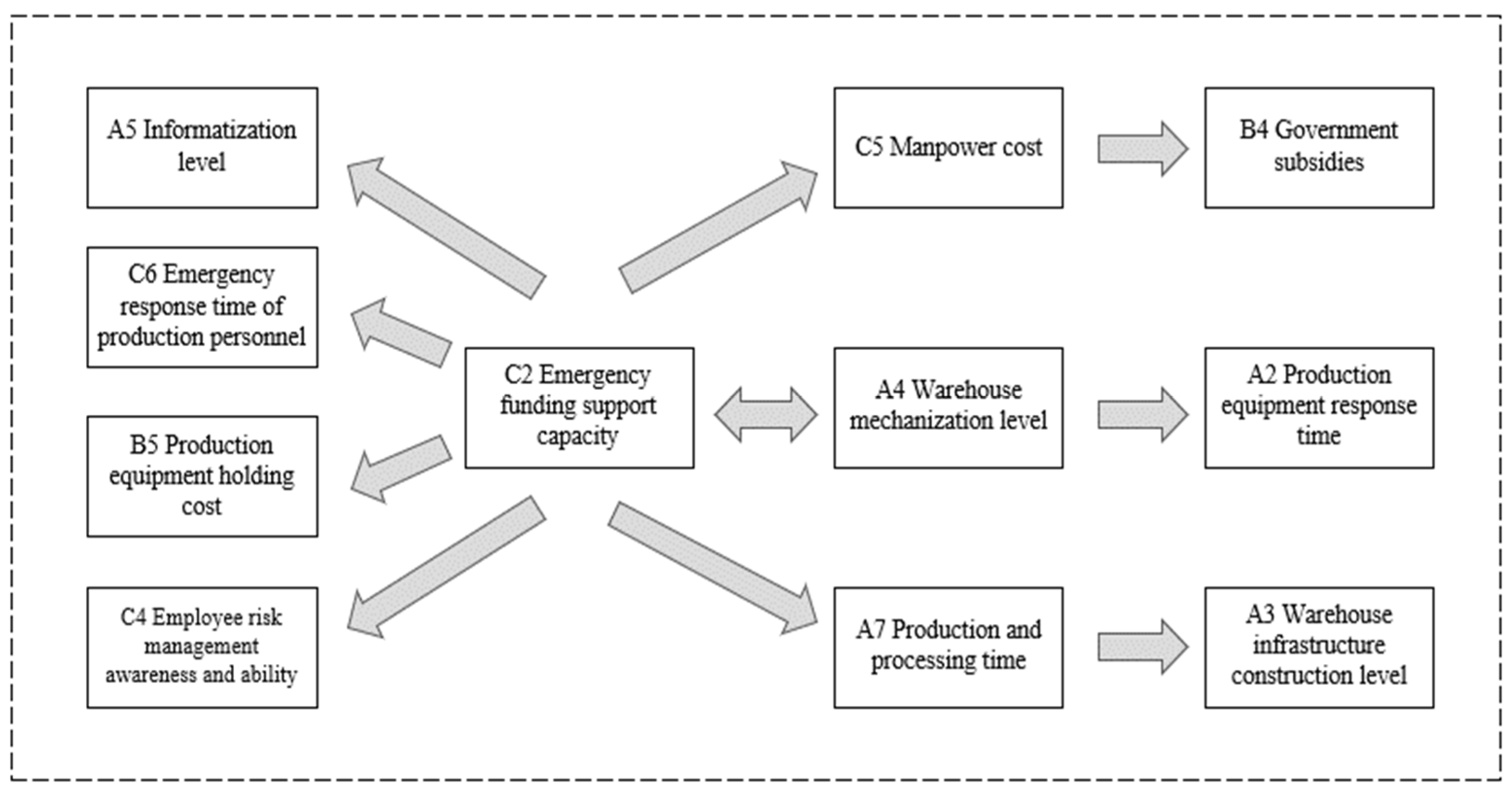
60]. How to maximize the effectiveness of emergency funds, through the analysis of causal relationships between key factors, can be achieved through the following approaches. For capacity reserve methods, we believe that the construction of SEMRSs should be facilitated through increased funding, enhancement of warehouse mechanization levels, improvement of warehouse infrastructure construction levels, and an increase in the number of production equipment holdings. This would reduce response times for production equipment, decrease production processing times, and promptly meet the demand for emergency materials through emergency production in the event of insufficient physical reserves, thereby reducing emergency response times and enhancing emergency response capabilities. For physical and protocol reserve methods, which do not require emergency production, establishing a digital management platform or considering the utilization of emerging technologies such as the Internet of Things and artificial intelligence can facilitate intelligent monitoring and management of warehouse equipment, enhance information transmission capabilities among various departments within the reserve system, minimize human errors and resource wastage, strengthen situational awareness and decision-making capabilities during emergencies, and improve the sustained output capability of materials within the reserve. Furthermore, local governments should establish a sound emergency fund budget decision-making system, execution system, budget information feedback system, and monitoring and evaluation system. Continuous improvement of the internal operation mechanism of the system enhances the sustainable operational capability of the reserve system. In this regard, we propose the development of a fourth type of reserve method—capital reserve—with physical, capacity, and protocol reserve methods.
6. Results and Discussions
In contrast to prior investigations, our study innovatively integrates the WSR methodology into the examination of SEMRSs, thereby advancing comprehension of such systems. The WSR method, originally proposed by Gu and Zhao [
31], is esteemed for its emphasis on coherence and effectiveness in complex decision-making scenarios [
34]. By adopting the hierarchical structure of WSR, we augment the depth and precision of SEMRS evaluations.
Our comprehensive evaluation framework incorporates numerous pertinent indicators from prior studies, aligning our research with previous assessments of material reserves’ reliability [
19], capacity reserves [
13], emergency production [
93], and emergency logistics [
77]. Nevertheless, compared to antecedent research, our study introduces fresh considerations in constructing the indicator system. This system encompasses various stakeholders, including local governments and enterprises, and integrates diverse types of reserves, such as physical stockpiles, production capacity, and contractual reserves. Additionally, it encompasses a more comprehensive and refined set of influencing factors. The proposed evaluation framework has garnered unanimous expert endorsement.
To ensure the validity of our findings, we employed a dual validation approach. First, to ascertain the reliability and managerial relevance of our results, we consulted three experts who had previously reached consensus during the assessment system development process. These experts unanimously confirmed the credibility and practical applicability of our findings. Subsequently, we conducted an AHP pairwise comparison questionnaire survey with the same group of experts to determine the overall weights of the criteria. According to the “14th Five-Year” Emergency Material Security Planning Outline (“14th Five-Year” Emergency Material Security Planning Outline.
https://www.gov.cn/zhengce/zhengceku/2023-02/03/content_5739875.htm, accessed on 1 June 2024), the national emergency material stockpile model is currently formed primarily by physical stockpiling, supplemented by agreement reserves and capacity reserves, and further supported by government and social reserves. Therefore, the experts agreed that the proportion of physical reserves should be x = 0.4, and the proportions of capacity reserves and agreement reserves should be y = 0.3 and z = 0.3, respectively. We then calculated the overall weight of each criterion through AHP and found that the weight rankings obtained were largely consistent with those derived from the D-ANP method (as shown in
Table A8). This consistency demonstrates the reliability of the D-ANP method in evaluating SEMRS.
Emergency funding support capacity emerged as a critical influencing factor in this study, signifying a significant finding. Through the analysis of indicators in the evaluation framework, our study comprehensively addresses various issues such as supplier default [
94,
95], emergency fund reserve [
7,
46,
59], material disposal and recycling [
19,
46,
56], emergency response [
96,
97,
98], and warehouse location selection [
99,
100], aligning with the focal points of previous research. However, previous studies have not pinpointed the core issues affecting emergency material reserves. By identifying key factors, we found that emergency fund reserves should be prioritized due to their critical importance in guaranteeing emergency fund capability, consistent with our management implications recommendations.
7. Conclusions
This study establishes a multi-mode, multi-stakeholder, and full-process evaluation index system for SEMRSs, identifying key factors influencing SEMRSs and further analyzing the causal relationships among these key factors and exploring mechanisms influencing the key factors of emergency material reserves. By addressing these aspects, the study effectively addresses questions regarding which factors are key influencers and the nature of the causal relationships among these key factors.
With respect to our findings, relevant suggestions for improving SEMRS are proposed. Specifically, the formal research structure is determined through expert questionnaires. The combination of DEMATEL and ANP is utilized to address the typical multi-attribute decision-making problem of SEMRS evaluation. The importance and causality of each influencing factor are determined, and key factors and causal relationships are identified accordingly. The results indicate that both suppliers and governments play important roles in the continuous supply of emergency materials. Eleven factors, namely, production equipment response time, warehouse infrastructure construction level, warehouse mechanization level, informatization level, production processing time, government subsidies, production equipment holding costs, emergency fund guarantee capacity, employee risk management awareness and ability, labor costs, and production staff emergency response time are identified as key factors affecting the SEMRS. Moreover, the emergency fund guarantee capacity, as the source affecting various factors, needs special attention.
Based on the key factors and their causal relationships, this study emphasizes the core factor of emergency financial support capacity. This factor serves as the source influencing various other factors, emphasizing not only its quantitative significance but also its crucial role within the identified causal relationships. By analyzing these relationships, we identify several key strategies for the effective and rational use of emergency funds. These strategies include increasing investment in warehousing construction, enhancing the level of warehousing mechanization to reduce production equipment response time, improving warehousing infrastructure, and increasing employee training to enhance their risk management awareness and capacities. These are critical paths that ensure that emergency funds play an effective and pivotal role. Besides, the study suggests that due to the high cost and severe waste of physical reserves, local governments and all relevant organizations should focus on improving the emergency fund guarantee capacity. While accelerating the improvement of the mechanisms for the coordinated operation of physical, capacity, and agreement reserves, further exploration of capital reserves is needed. It is recommended to actively sign emergency production supply contracts with suppliers in advance, improve SEMRSs implemented by local governments and coordinated by government–enterprise collaboration, enhance the regional emergency material supply capacity, and minimize storage costs and material waste during disasters. Furthermore, efforts should be made to improve the level of informatization within a system, refine reserve system operation mechanisms, develop a more comprehensive and sustainable material reserve system, and ensure the fulfillment of various emergency material demands during disasters.
This study presents several limitations that warrant acknowledgment. First, there is a lack of consensus within the academic community regarding the optimal number of experts to be included in Delphi method studies, necessitating further investigation. Second, while expert consensus was achieved in establishing the formal decision structure, as evidenced by the outcomes of multiple rounds of questionnaires, this study does not extensively delve into the extent of such consensus. Last, the D-ANP method, functioning as an additive model, operates under the assumption that the sum of all criteria weights equals 1. However, in reality, many variables may not always exhibit complete independence from one another. Hence, future research endeavors may benefit from exploring non-additive D-ANP methods as viable alternatives to address this issue. In addition, according to the results of this study, capital reserve should also be considered significant in emergency reserve. Future studies that simultaneously consider the four types of stockpiles—physical, capacity, agreement, and capital reserve—may enable a more comprehensive evaluation of SEMRSs.