Urban Morphology Influencing the Urban Heat Island in the High-Density City of Xi’an Based on the Local Climate Zone


Abstract
1. Introduction
2. Materials and Methods
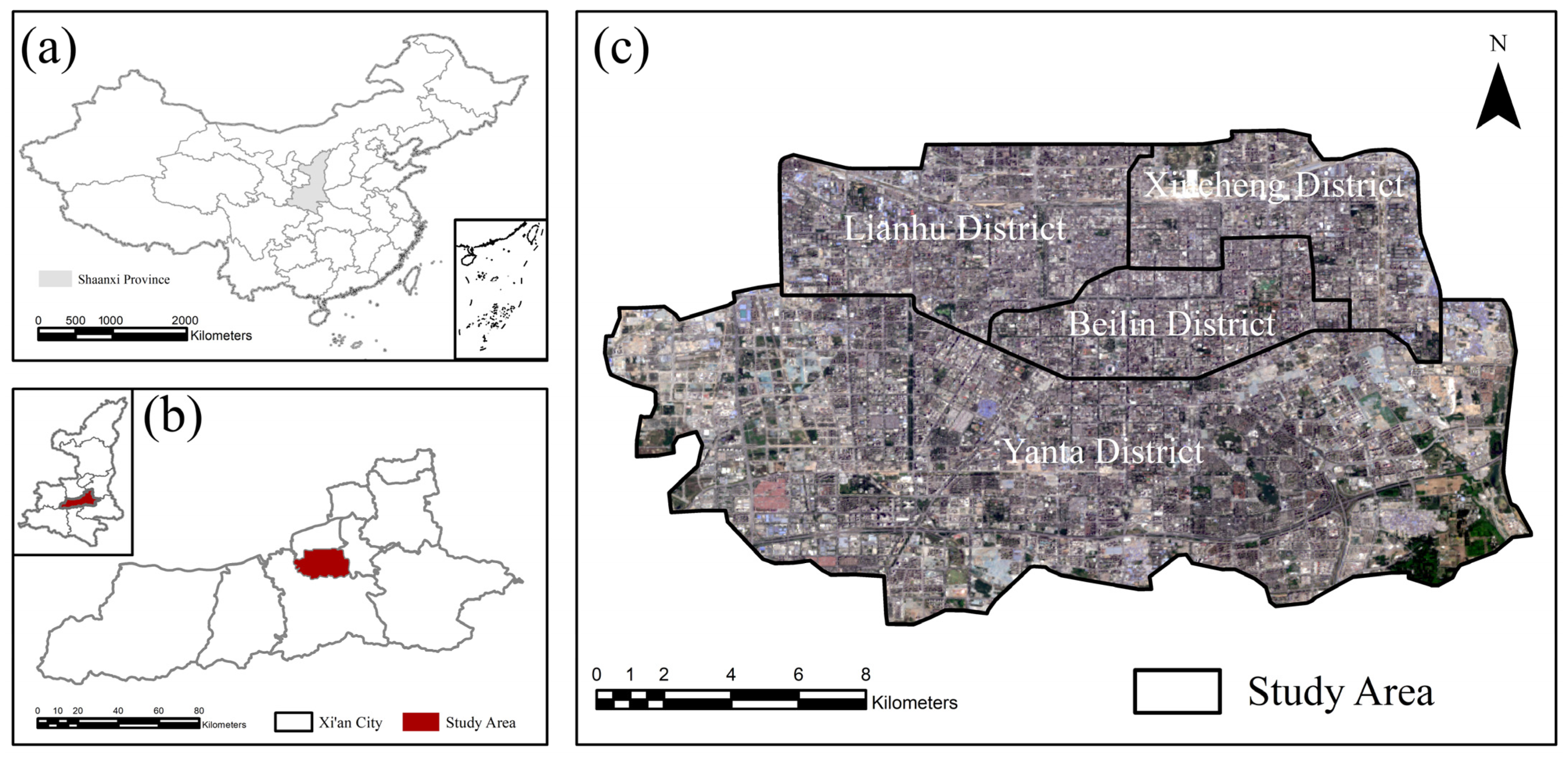
2.1. Study Area
2.2. Date Sources
2.3. Land Surface Temperature Retrieval
- —Surface radiance, calculated using the NDVI threshold method;
- —Surface temperature expressed by thermodynamic temperature;
- —Thermal radiant intensity of the blackbody at e temperature derived from Planck’s law;
- —Atmospheric transmittance in the thermal infrared band;
- —The upward/downward radiance of the atmosphere.
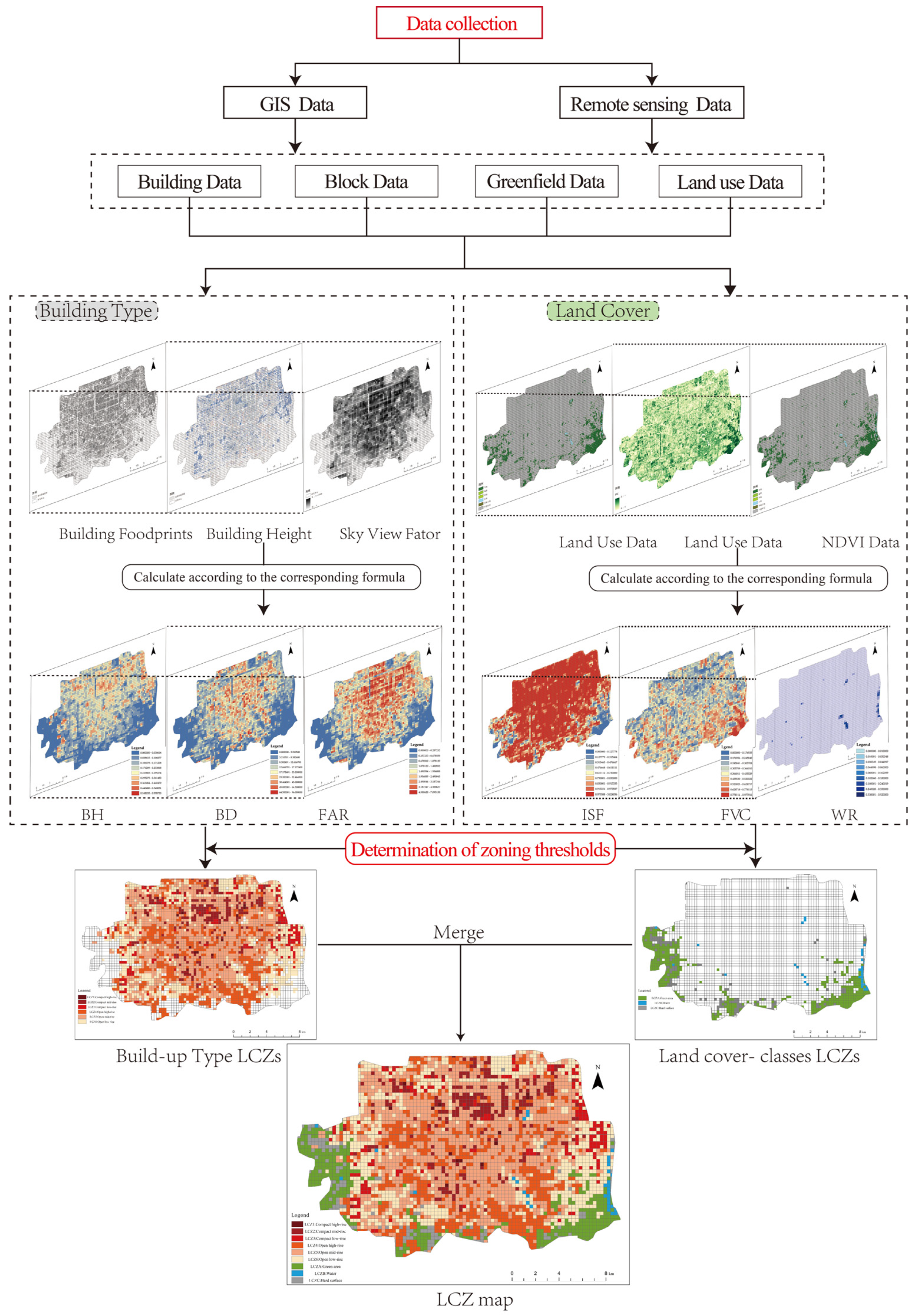
2.4. Delimitation of Local Climate Zone
2.4.1. Defining Grid Units
2.4.2. Determine Morphology Factors for Each Grid
2.4.3. LCZ Mapping
2.5. Data Analysis and Modelling
3. Results
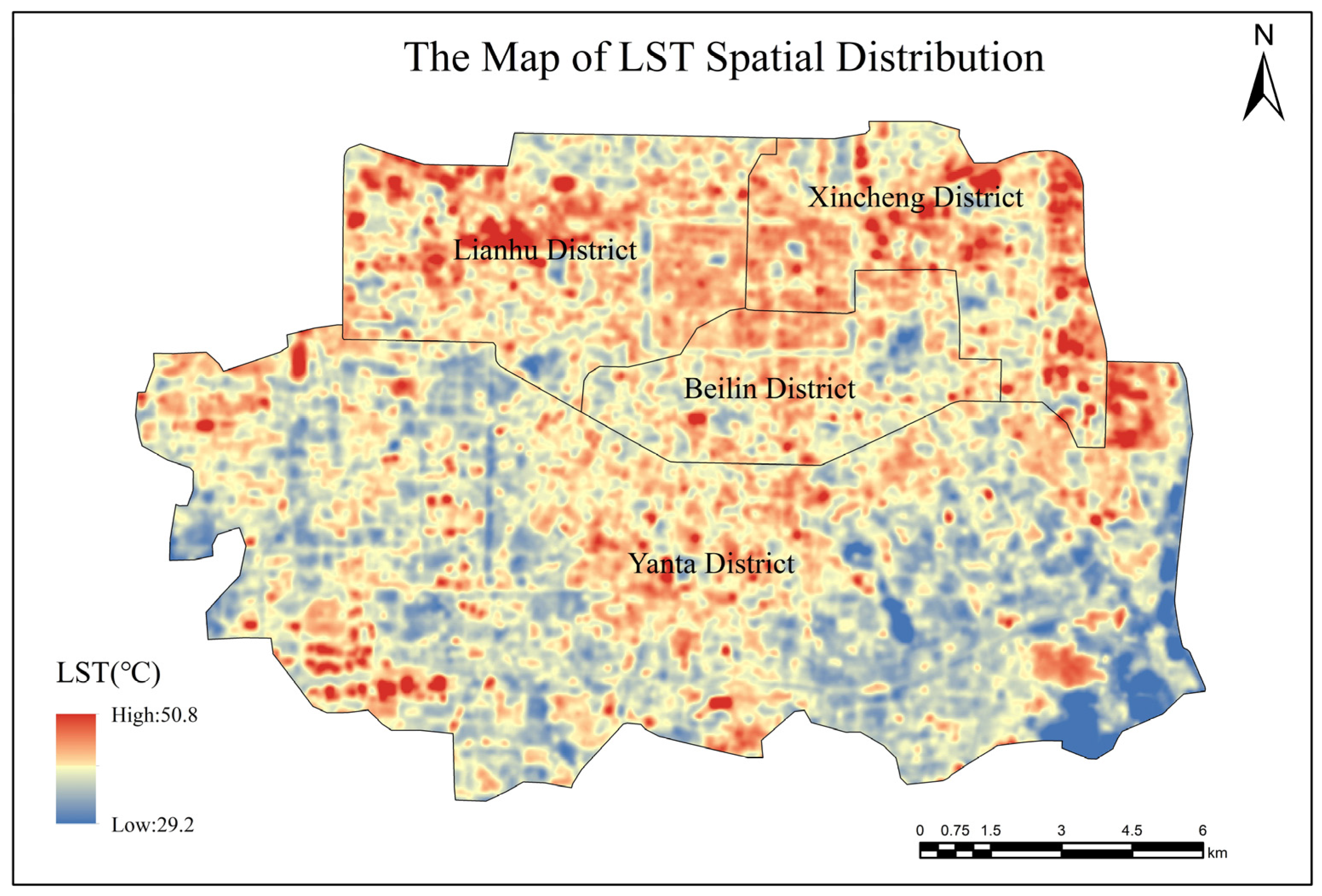
3.1. Characteristics of LST
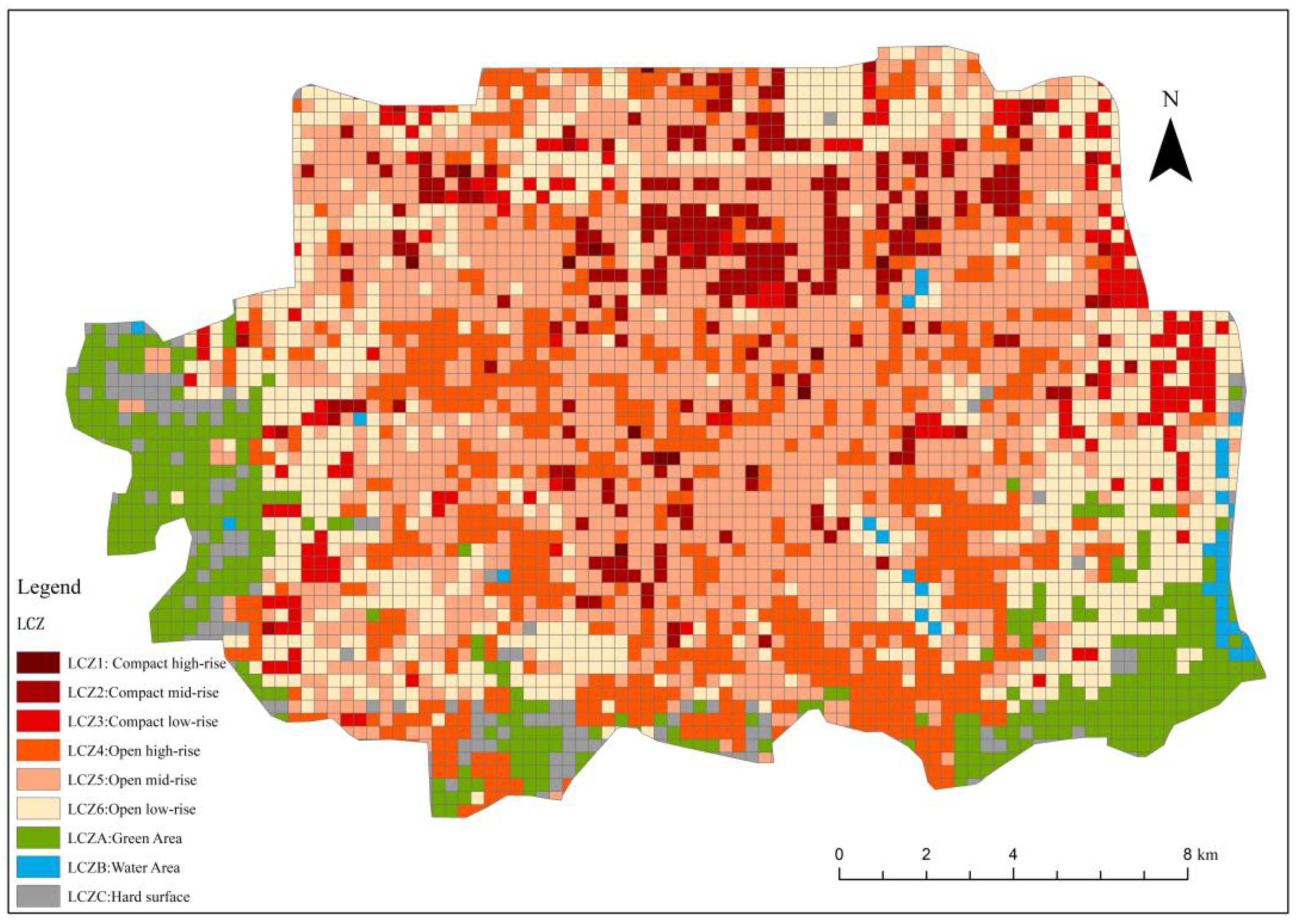
3.2. LCZ Map
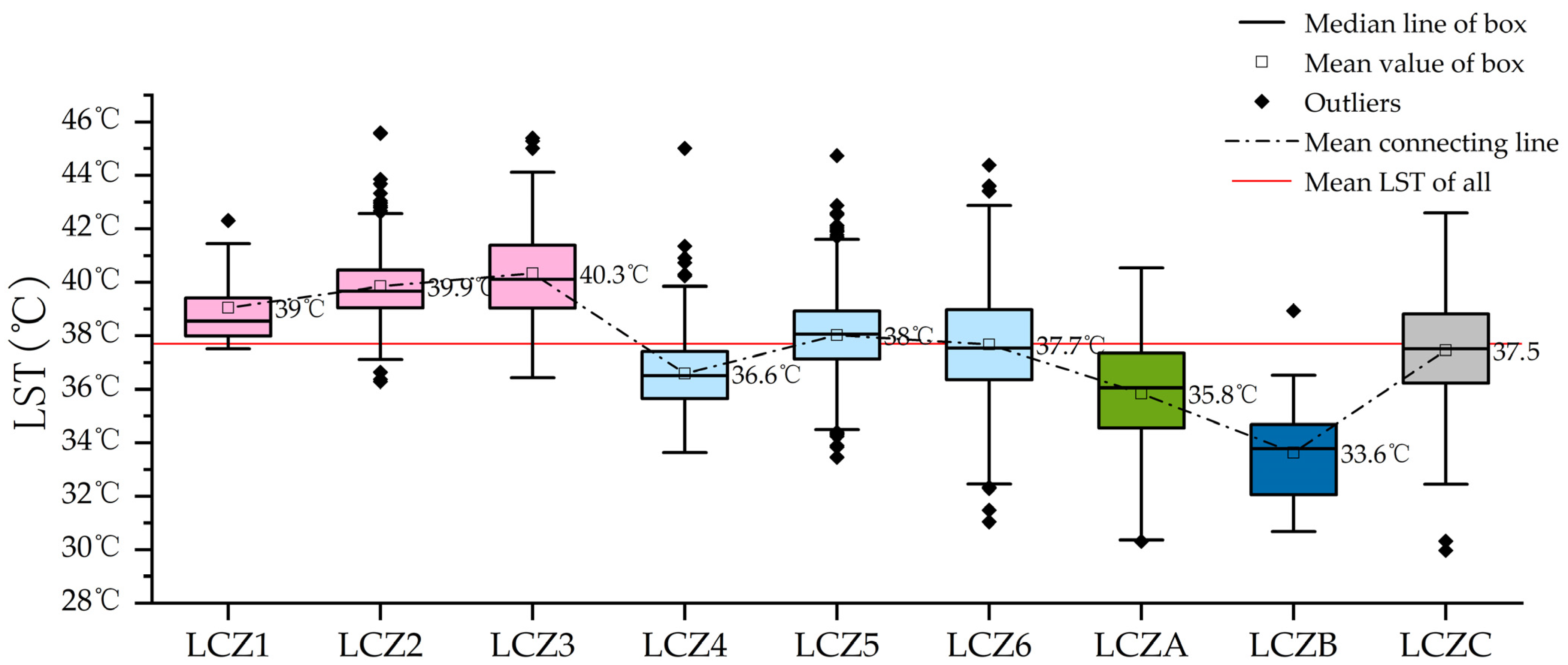
3.3. LST Differences in LCZs
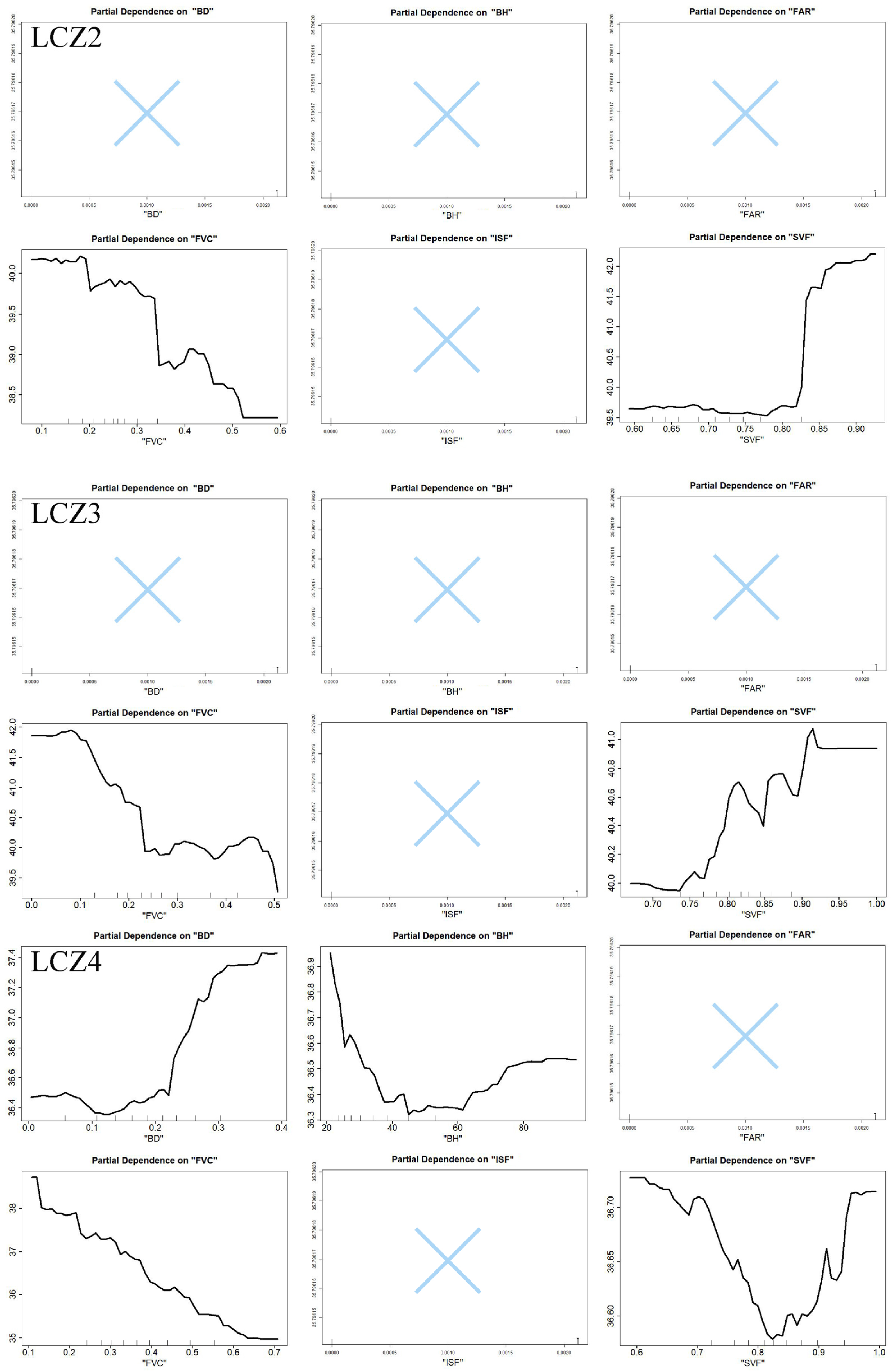
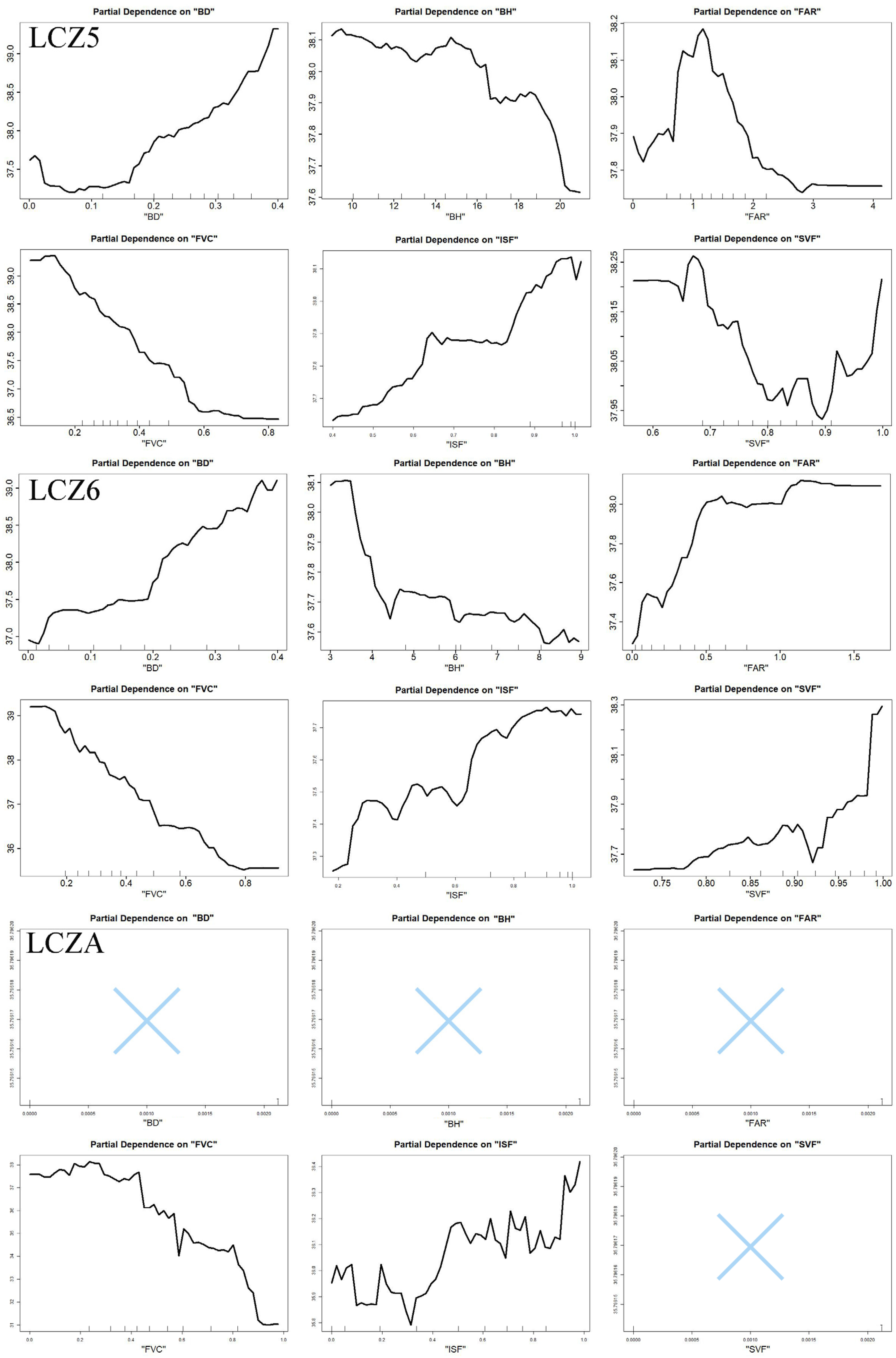
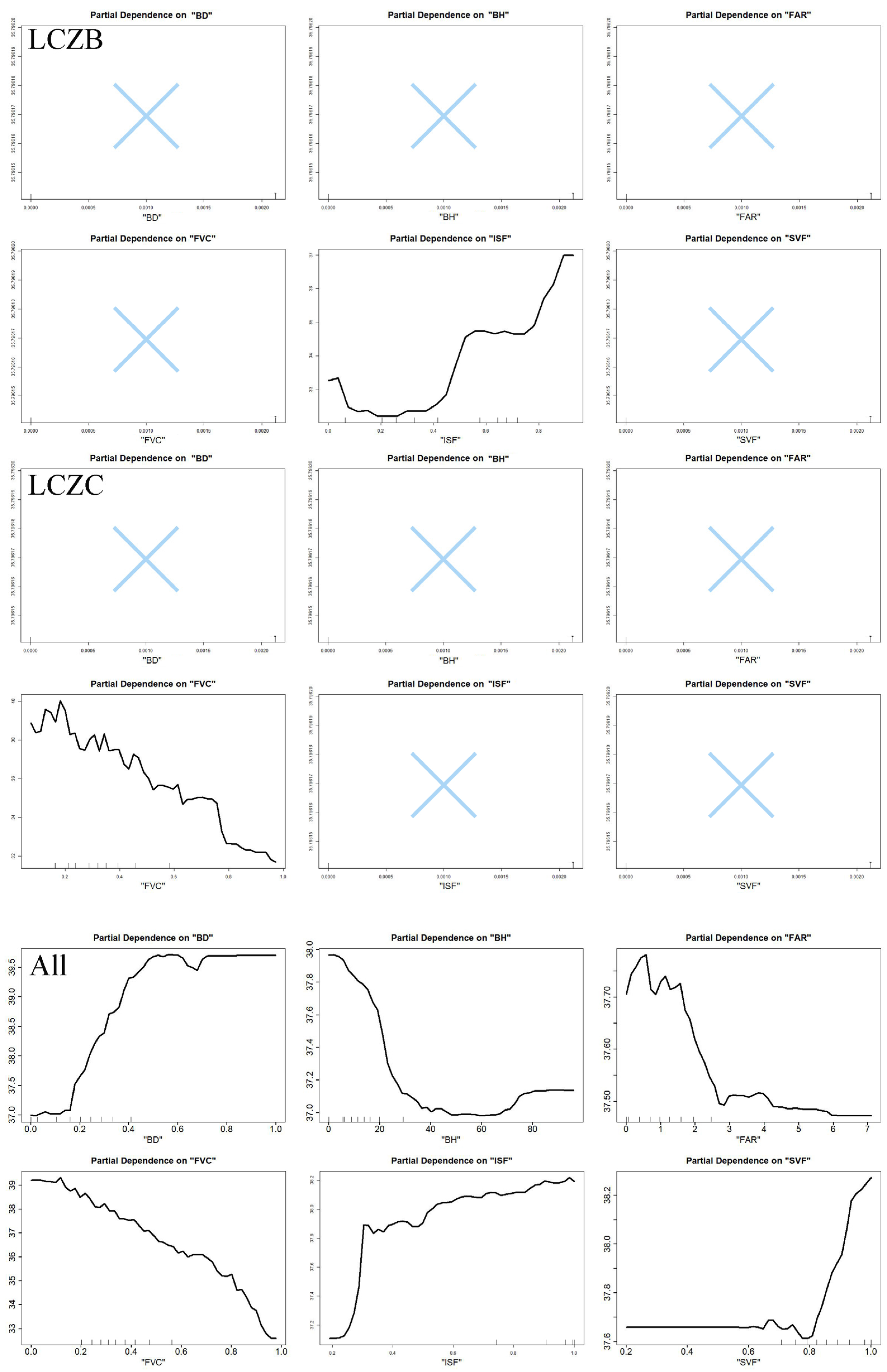
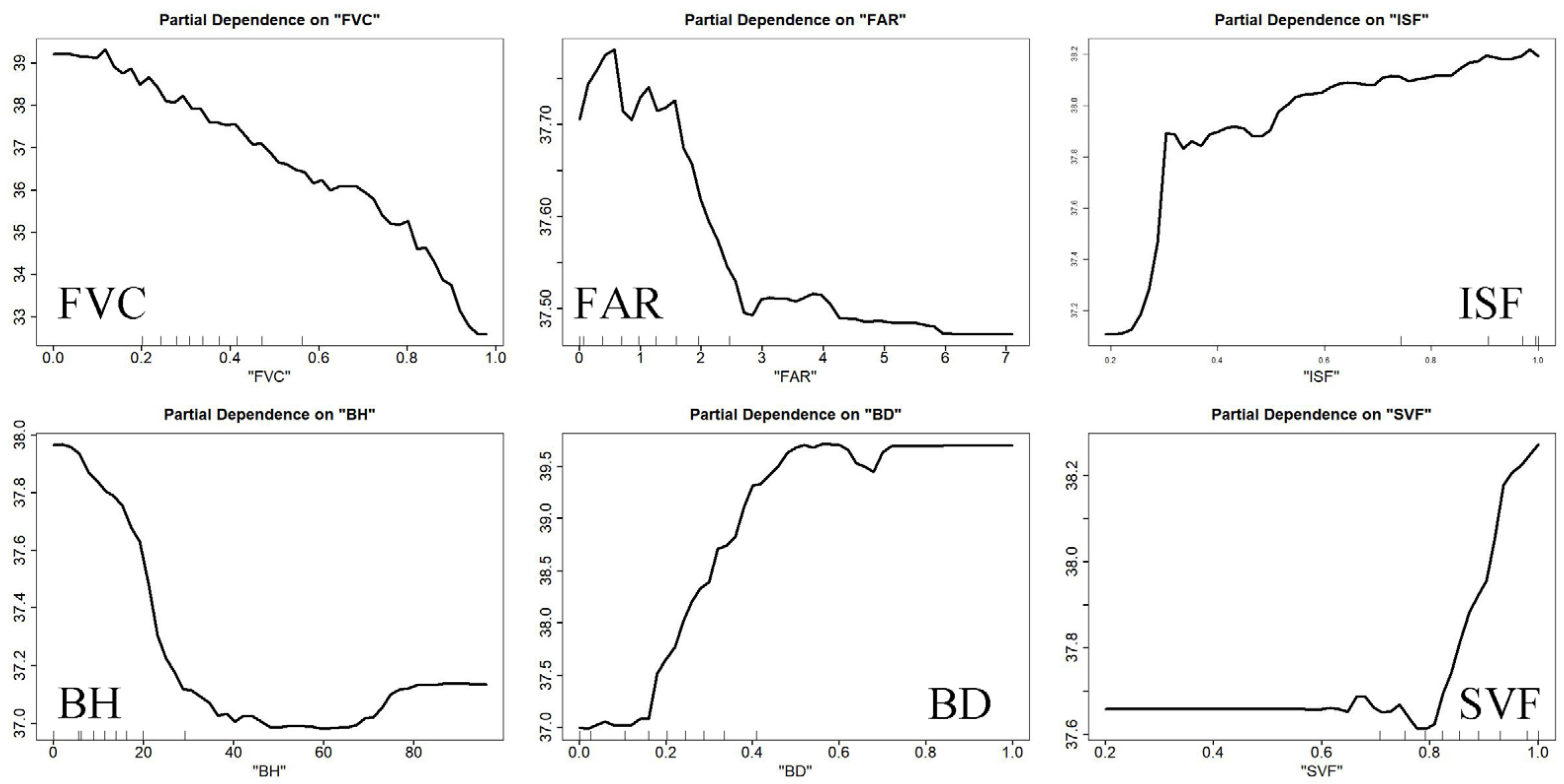
3.4. Nonlinear Analysis Results of Various Influence Factors and LST
4. Discussion
4.1. The Characteristics of LST among LCZ Types
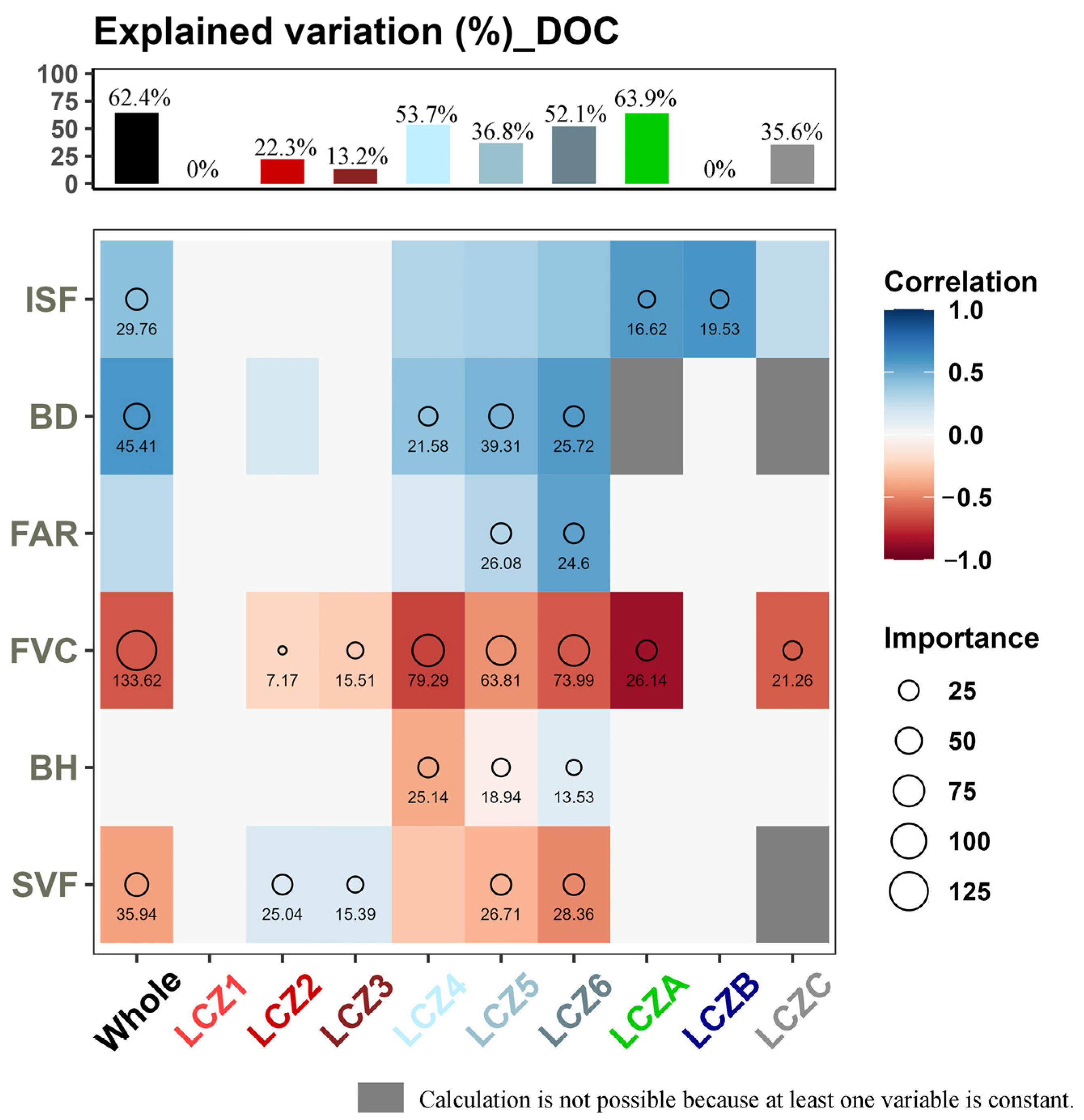
4.2. Discussion on the Relationship between Urban Spatial Form Factors and LST Based on LCZ
4.3. Optimization Strategies
5. Conclusions
Author Contributions
Funding
Institutional Review Board Statement
Informed Consent Statement
Data Availability Statement
Acknowledgments
Conflicts of Interest
Abbreviations
| LST | Land Surface Temperature |
| UHI | Urban Heat Island |
| UHII | Urban Heat Island Intensity |
| LCZ | Local Climate Zone |
| BD | Building Density |
| FAR | Floor Area Ratio |
| SVF | Sky View Factor |
| ISF | Impervious Surface Fraction |
| WR | Water Ratio |
| FVC | Fractional Vegetation Coverage |
| BH | Average Building Height |
| RTE | Radiative Transfer Equation |
References
- Arnfield, A.J. Two decades of urban climate research: A review of turbulence, exchanges of energy and water, and the urban heat island. Int. J. Climatol. A J. R. Meteorol. Soc. 2003, 23, 1–26. [Google Scholar] [CrossRef] [Scilit]
- Laurent, J.G.C.; Williams, A.; Oulhote, Y.; Zanobetti, A.; Allen, J.G.; Spengler, J.D. Reduced cognitive function during a heat wave among residents of non-air-conditioned buildings: An observational study of young adults in the summer of 2016. PLoS Med. 2018, 15, e1002605. [Google Scholar]
- Vicedo-Cabrera, A.M.; Scovronick, N.; Sera, F.; Royé, D.; Schneider, R.; Tobias, A.; Astrom, C.; Guo, Y.; Honda, Y.; Hondula, D. The burden of heat-related mortality attributable to recent human-induced climate change. Nat. Clim. Change 2021, 11, 492–500. [Google Scholar] [CrossRef] [Scilit]
- Santamouris, M. Recent progress on urban overheating and heat island research. Integrated assessment of the energy, environmental, vulnerability and health impact. Synergies with the global climate change. Energy Build. 2020, 207, 109482. [Google Scholar] [CrossRef] [Scilit]
- Nasehi, S.; Yavari, A.; Salehi, E.; Emmanuel, R. Role of local climate zone and space syntax on land surface temperature (case study: Tehran). Urban Clim. 2022, 45, 101245. [Google Scholar] [CrossRef] [Scilit]
- Abdullah, S.; Barua, D. modeling land surface temperature with a mono-window algorithm to estimate urban heat Island intensity in an expanding Urban Area. Environ. Process. 2022, 9, 14. [Google Scholar] [CrossRef] [Scilit]
- Ali, S.A.; Parvin, F.; Ahmad, A. Retrieval of land surface temperature from Landsat 8 OLI and TIRS: A comparative analysis between radiative transfer equation-based method and split-window algorithm. Remote Sens. Earth Syst. Sci. 2023, 6, 1–21. [Google Scholar] [CrossRef] [Scilit]
- Dejun, Z.; Shiqi, Y.; Liang, S.; Xiaoran, L.; Shihao, T.; Hao, Z.; Qinyu, Y.; Xinyu, Z. Retrieval of land surface temperature from FY3D MERSI-II based on re-fitting Split Window Algorithm. Eur. J. Remote Sens. 2022, 55, 1–18. [Google Scholar] [CrossRef] [Scilit]
- Yu, X.; Guo, X.; Wu, Z. Land surface temperature retrieval from Landsat 8 TIRS—Comparison between radiative transfer equation-based method, split window algorithm and single channel method. Remote Sens. 2014, 6, 9829–9852. [Google Scholar] [CrossRef] [Scilit]
- Nasar-u-Minallah, M.; Haase, D.; Qureshi, S.; Zia, S.; Fatima, M. Ecological monitoring of urban thermal field variance index and determining the surface urban heat island effects in Lahore, Pakistan. Environ. Monit. Assess. 2023, 195, 1212. [Google Scholar] [CrossRef] [Scilit]
- Kim, S.W.; Brown, R.D. Urban heat island (UHI) variations within a city boundary: A systematic literature review. Renew. Sustain. Energy Rev. 2021, 148, 111256. [Google Scholar] [CrossRef] [Scilit]
- Guo, G.H.; Zhou, X.Q.; Wu, Z.F.; Xiao, R.B.; Chen, Y.B. Characterizing the impact of urban morphology heterogeneity on land surface temperature in Guangzhou, China. Environ. Model. Softw. 2016, 84, 427–439. [Google Scholar] [CrossRef] [Scilit]
- Dirksen, M.; Ronda, R.; Theeuwes, N.; Pagani, G. Sky view factor calculations and its application in urban heat island studies. Urban Clim. 2019, 30, 100498. [Google Scholar] [CrossRef] [Scilit]
- Qi, Y.; Li, H.; Pang, Z.; Gao, W.; Liu, C. A case study of the relationship between vegetation coverage and urban heat island in a coastal city by applying digital twins. Front. Plant Sci. 2022, 13, 861768. [Google Scholar] [CrossRef] [Scilit]
- Zhang, P.; Ghosh, D.; Park, S. Spatial measures and methods in sustainable urban morphology: A systematic review. Landsc. Urban Plan. 2023, 237, 104776. [Google Scholar] [CrossRef] [Scilit]
- Duckworth, F.S.; Sandberg, J.S. The effect of cities upon horizontal and vertical temperature gradients. Bull. Am. Meteorol. Soc. 1954, 35, 198–207. [Google Scholar] [CrossRef] [Scilit]
- Stewart, I.D.; Oke, T.R.; Krayenhoff, E.S. Evaluation of the ‘local climate zone’scheme using temperature observations and model simulations. Int. J. Climatol. 2014, 34, 1062–1080. [Google Scholar] [CrossRef] [Scilit]
- Stewart, I.D.; Oke, T.R. Local Climate Zones for Urban Temperature Studies. Bull. Am. Meteorol. Soc. 2012, 93, 1879–1900. [Google Scholar] [CrossRef] [Scilit]
- Zhao, Z.Q.; Sharifi, A.; Dong, X.; Shen, L.D.; He, B.J. Spatial Variability and Temporal Heterogeneity of Surface Urban Heat Island Patterns and the Suitability of Local Climate Zones for Land Surface Temperature Characterization. Remote Sens. 2021, 13, 4338. [Google Scholar] [CrossRef] [Scilit]
- Xu, Y.N.; Zhang, C.X.; Hou, W. Modeling of Daytime and Nighttime Surface Urban Heat Island Distribution Combined with LCZ in Beijing, China. Land 2022, 11, 2050. [Google Scholar] [CrossRef] [Scilit]
- Wang, Z.; Ishida, Y.; Mochida, A. Effective Factors for Reducing Land Surface Temperature in Each Local Climate Zone Built Type in Tokyo and Shanghai. Remote Sens. 2023, 15, 3840. [Google Scholar] [CrossRef] [Scilit]
- Zhang, Q.; Xu, D.; Zhou, D.; Yang, Y.J.; Rogora, A. Associations between urban thermal environment and physical indicators based on meteorological data in Foshan City. Sustain. Cities Soc. 2020, 60, 10. [Google Scholar] [CrossRef] [Scilit]
- Estoque, R.C.; Murayama, Y.; Myint, S.W. Effects of landscape composition and pattern on land surface temperature: An urban heat island study in the megacities of Southeast Asia. Sci. Total Environ. 2017, 577, 349–359. [Google Scholar] [CrossRef] [Scilit] [PubMed]
- Gao, Y.J.; Zhao, J.Y.; Han, L. Exploring the spatial heterogeneity of urban heat island effect and its relationship to block morphology with the geographically weighted regression model. Sustain. Cities Soc. 2022, 76, 13. [Google Scholar] [CrossRef] [Scilit]
- Rigatti, S.J. Random Forest. J. Insur. Med. 2017, 47, 31–39. [Google Scholar] [CrossRef] [Scilit] [PubMed]
- Ming, Y.J.; Liu, Y.; Gu, J.P.; Wang, J.Z.; Liu, X. Nonlinear effects of urban and industrial forms on surface urban heat island: Evidence from 162 Chinese prefecture-level cities. Sustain. Cities Soc. 2023, 89, 14. [Google Scholar] [CrossRef] [Scilit]
- Gao, Y.J.; Zhao, J.Y.; Han, L. Quantifying the nonlinear relationship between block morphology and the surrounding thermal environment using random forest method. Sustain. Cities Soc. 2023, 91, 16. [Google Scholar] [CrossRef] [Scilit]
- Yang, C.; Kui, T.; Zhou, W.; Fan, J.; Pan, L.; Wu, W.; Liu, M. Impact of refined 2D/3D urban morphology on hourly air temperature across different spatial scales in a snow climate city. Urban Clim. 2023, 47, 101404. [Google Scholar] [CrossRef] [Scilit]
- Oke, T.R. Canyon geometry and the nocturnal urban heat island: Comparison of scale model and field observations. J. Climatol. 1981, 1, 237–254. [Google Scholar] [CrossRef] [Scilit]
- Geletič, J.; Lehnert, M. GIS-based delineation of local climate zones: The case of medium-sized Central European cities. Morav. Geogr. Rep. 2016, 24, 2–12. [Google Scholar] [CrossRef] [Scilit]
- Geletic, J.; Lehnert, M.; Dobrovolny, P. Land Surface Temperature Differences within Local Climate Zones, Based on Two Central European Cities. Remote Sens. 2016, 8, 788. [Google Scholar] [CrossRef] [Scilit]
- Shi, Y.; Xiang, Y.; Zhang, Y. Urban design factors influencing surface urban heat island in the high-density city of Guangzhou based on the local climate zone. Sensors 2019, 19, 3459. [Google Scholar] [CrossRef] [Scilit]
- Yuan, B.; Zhou, L.; Hu, F.; Zhang, Q. Diurnal dynamics of heat exposure in Xi’an: A perspective from local climate zone. Build. Environ. 2022, 222, 109400. [Google Scholar] [CrossRef] [Scilit]
- Li, F.; Chen, W.; Zeng, Y.; Zhao, Q.; Wu, B. Improving estimates of grassland fractional vegetation cover based on a pixel dichotomy model: A case study in Inner Mongolia, China. Remote Sens. 2014, 6, 4705–4722. [Google Scholar] [CrossRef] [Scilit]
- O’Malley, C.; Kikumoto, H. An investigation into heat storage by adopting local climate zones and nocturnal-diurnal urban heat island differences in the Tokyo Prefecture. Sustain. Cities Soc. 2022, 83, 103959. [Google Scholar] [CrossRef] [Scilit]
- Cui, S.Y.; Wang, X.H.; Yang, X.; Hu, L.F.; Jiang, Z.Q.; Feng, Z.H. Mapping Local Climate Zones in the Urban Environment: The Optimal Combination of Data Source and Classifier. Sensors 2022, 22, 6407. [Google Scholar] [CrossRef] [Scilit] [PubMed]
- Zhao, C.H.; Jensen, J.L.R.; Weng, Q.H.; Currit, N.; Weaver, R. Use of Local Climate Zones to investigate surface urban heat islands in Texas. GIScience Remote Sens. 2020, 57, 1083–1101. [Google Scholar] [CrossRef] [Scilit]
- Du, P.J.; Chen, J.K.; Bai, X.Y.; Han, W.Q. Understanding the seasonal variations of land surface temperature in Nanjing urban area based on local climate zone. Urban Clim. 2020, 33, 100657. [Google Scholar] [CrossRef] [Scilit]
- Fang, T.Y.; Mu, K.; Liu, Y.; Zhang, M.; Han, B.; Yang, L.; Khaletski, V. Investigations of Surface Urban Heat Island Effect Based on Local Climate Zone Method: A Case of Xi’an. E3S Web Conf. 2019, 136, 05011. [Google Scholar] [CrossRef] [Scilit]
- Shi, L.F.; Ling, F.; Foody, G.M.; Yang, Z.; Liu, X.X.; Du, Y. Seasonal SUHI Analysis Using Local Climate Zone Classification: A Case Study of Wuhan, China. Int. J. Environ. Res. Public Health 2021, 18, 7242. [Google Scholar] [CrossRef] [Scilit]
- Zhang, L.P.; Zhou, L.; Yuan, B.; Hu, F.N.; Zhang, Q.; Wei, W.; Sun, D.Q. Spatiotemporal Evolution Characteristics of Urban Land Surface Temperature Based on Local Climate Zones in Xi’an Metropolitan, China. Chin. Geogr. Sci. 2023, 33, 1001–1016. [Google Scholar] [CrossRef] [Scilit]
- Yang, X.Y.; Li, Y.G.; Luo, Z.W.; Chan, P.W. The urban cool island phenomenon in a high-rise high-density city and its mechanisms. Int. J. Climatol. 2017, 37, 890–904. [Google Scholar] [CrossRef] [Scilit]
- Cai, M.; Ren, C.; Xu, Y.; Lau, K.K.L.; Wang, R. Investigating the relationship between local climate zone and land surface temperature using an improved WUDAPT methodology—A case study of Yangtze River Delta, China. Urban Clim. 2018, 24, 485–502. [Google Scholar] [CrossRef] [Scilit]
- Yang, X.S.; Yao, L.Y.; Jin, T.; Peng, L.L.H.; Jiang, Z.D.; Hu, Z.Y.; Ye, Y.H. Assessing the thermal behavior of different local climate zones in the Nanjing metropolis, China. Build. Environ. 2018, 137, 171–184. [Google Scholar] [CrossRef] [Scilit]
- Liu, Y.; Li, Q.; Yang, L.; Mu, K.K.; Zhang, M.Y.; Liu, J.P. Urban heat island effects of various urban morphologies under regional climate conditions. Sci. Total Environ. 2020, 743, 140589. [Google Scholar] [CrossRef] [Scilit] [PubMed]
- He, B.J.; Ding, L.; Prasad, D. Relationships among local-scale urban morphology, urban ventilation, urban heat island and outdoor thermal comfort under sea breeze influence. Sustain. Cities Soc. 2020, 60, 102289. [Google Scholar] [CrossRef] [Scilit]
- Zhou, L.; Yuan, B.; Hu, F.; Wei, C.; Dang, X.; Sun, D. Understanding the effects of 2D/3D urban morphology on land surface temperature based on local climate zones. Build. Environ. 2022, 208, 108578. [Google Scholar] [CrossRef] [Scilit]
- Ferreira, L.S.; Duarte, D.H.S. Exploring the relationship between urban form, land surface temperature and vegetation indices in a subtropical megacity. Urban Clim. 2019, 27, 105–123. [Google Scholar] [CrossRef] [Scilit]
- Lin, Z.; Xu, H.; Yao, X.; Yang, C.; Yang, L. Exploring the relationship between thermal environmental factors and land surface temperature of a “furnace city” based on local climate zones. Build. Environ. 2023, 243, 110732. [Google Scholar] [CrossRef] [Scilit]
- Moss, J.L.; Doick, K.J.; Smith, S.; Shahrestani, M. Influence of evaporative cooling by urban forests on cooling demand in cities. Urban For. Urban Green. 2019, 37, 65–73. [Google Scholar] [CrossRef] [Scilit]
- Zhang, Y.; Odeh, I.O.; Ramadan, E. Assessment of land surface temperature in relation to landscape metrics and fractional vegetation cover in an urban/peri-urban region using Landsat data. Int. J. Remote Sens. 2013, 34, 168–189. [Google Scholar] [CrossRef] [Scilit]
- Zheng, B.; Myint, S.W.; Fan, C. Spatial configuration of anthropogenic land cover impacts on urban warming. Landsc. Urban Plan. 2014, 130, 104–111. [Google Scholar] [CrossRef] [Scilit]
- Alavipanah, S.; Wegmann, M.; Qureshi, S.; Weng, Q.; Koellner, T. The role of vegetation in mitigating urban land surface temperatures: A case study of Munich, Germany during the warm season. Sustainability 2015, 7, 4689–4706. [Google Scholar] [CrossRef] [Scilit]
- Akbari, H.; Pomerantz, M.; Taha, H. Cool surfaces and shade trees to reduce energy use and improve air quality in urban areas. Sol. Energy 2001, 70, 295–310. [Google Scholar] [CrossRef] [Scilit]
- Voogt, J.A.; Oke, T.R. Thermal remote sensing of urban climates. Remote Sens. Environ. 2003, 86, 370–384. [Google Scholar] [CrossRef] [Scilit]
- Wang, Q.; Wang, X.N.; Zhou, Y.; Liu, D.Y.; Wang, H.T. The dominant factors and influence of urban characteristics on land surface temperature using random forest algorithm. Sustain. Cities Soc. 2022, 79, 18. [Google Scholar] [CrossRef] [Scilit]
- Chen, Y.-C.; Lin, T.-P.; Lin, C.-T. A simple approach for the development of urban climatic maps based on the urban characteristics in Tainan, Taiwan. Int. J. Biometeorol. 2017, 61, 1029–1041. [Google Scholar] [CrossRef] [Scilit] [PubMed]
- Goward, S.N. Thermal behavior of urban landscapes and the urban heat island. Phys. Geogr. 1981, 2, 19–33. [Google Scholar] [CrossRef] [Scilit]
- Lin, P.Y.; Lau, S.S.Y.; Qin, H.; Gou, Z.H. Effects of urban planning indicators on urban heat island: A case study of pocket parks in high-rise high-density environment. Landsc. Urban Plan. 2017, 168, 48–60. [Google Scholar] [CrossRef] [Scilit]
- Bansal, P.; Quan, S.J. Examining temporally varying nonlinear effects of urban form on urban heat island using explainable machine learning: A case of Seoul. Build. Environ. 2024, 247, 20. [Google Scholar] [CrossRef] [Scilit]
- Huang, H.C.; Yun, Y.X.; Xu, J.G.; Huang, R.; Fu, J.; Huang, K.D. Scale Response of Summer Urban Heat Island to Building Plot Ratio and Its Warning Parameter. Teh. Vjesn. 2017, 24, 877–886. [Google Scholar] [CrossRef] [Scilit]
- Wang, M.; Xu, H. The impact of building height on urban thermal environment in summer: A case study of Chinese megacities. PLoS ONE 2021, 16, e0247786. [Google Scholar] [CrossRef] [Scilit] [PubMed]
- Giridharan, R.; Lau, S.S.Y.; Ganesan, S.; Givoni, B. Lowering the outdoor temperature in high-rise high-density residential developments of coastal Hong Kong: The vegetation influence. Build. Environ. 2008, 43, 1583–1595. [Google Scholar] [CrossRef] [Scilit]
- Kim, J.; Lee, D.-K.; Brown, R.D.; Kim, S.; Kim, J.-H.; Sung, S. The effect of extremely low sky view factor on land surface temperatures in urban residential areas. Sustain. Cities Soc. 2022, 80, 103799. [Google Scholar] [CrossRef] [Scilit]
- Chen, L.; Ng, E.; An, X.P.; Ren, C.; Lee, M.; Wang, U.; He, Z.J. Sky view factor analysis of street canyons and its implications for daytime intra-urban air temperature differentials in high-rise, high-density urban areas of Hong Kong: A GIS-based simulation approach. Int. J. Climatol. 2012, 32, 121–136. [Google Scholar] [CrossRef] [Scilit]
- Zhou, S.Y.; Zheng, H.; Liu, X.; Gao, Q.; Xie, J. Identifying the Effects of Vegetation on Urban Surface Temperatures Based on Urban-Rural Local Climate Zones in a Subtropical Metropolis. Remote Sens. 2023, 15, 4743. [Google Scholar] [CrossRef] [Scilit]
- Luo, P.Y.; Yu, B.J.; Li, P.F.; Liang, P.P.; Zhang, Q.Y.; Yang, L.C. Understanding the relationship between 2D/3D variables and land surface temperature in plain and mountainous cities: Relative importance and interaction effects. Build. Environ. 2023, 245, 110959. [Google Scholar] [CrossRef] [Scilit]






| Date | Use | Date Sources | Date Types |
|---|---|---|---|
| Landsat 8 remote sensing image data | Used to retrieve land surface temperature, calculate fractional vegetation coverage, and extract impervious surface | https://earthexplorer.usgs.gov/ (accessed on 1 October 2023) | Raster data with a 30 m resolution |
| Building footprint outline data | Used to calculate building density, floor area ratio, and sky view factor | https://www.openstreetmap.org/ (accessed on 1 October 2023) | Vector data |
| Building height data | Used to calculate average building height, floor area ratio, and sky view factor |
| Spatial Morphology Factors | Definition | Calculation Method | Date Sources |
|---|---|---|---|
| BH | Average building height in the study area | Where is the building height and n is the number of buildings | OpenStreetMap |
| BD | The ratio of the building base area to the total area of the area in the study | Where is the building base area and Ssite is the total site area of the area in the study | OpenStreetMap |
| FAR | The ratio of the total amount of floor area that buildings have to the total area of the area in the study | , where BSi is the building base area, BFi is the average number of floors in buildings, and Ssite is the total site area of the area in the study | OpenStreetMap |
| SVF | Used to describe the degree to which the sky in the study area is obscured by surrounding obstacles | Where γi is the maximum building height angle within the sector corresponding to the azimuth angle in the study area and n is the number of calculated azimuth angle in the study area | OpenStreetMap |
| ISF | The ratio of the area covered by various impermeable building materials to the total area of the underlying surface in the study area | Where Si is the area paved with hard materials and Ssite is the total site area of the area in the study | Land use map in 2021 |
| WR | The ratio of the water area to the total area of the area in the study | Where WSi is the water area and Ssite is the total site area of the area in the study | Land use map in 2021 |
| FVC | Percentage of vertical projected area of vegetation in the study area | Where NDVIsoil is the NDVI value of the pixel covered by pure bare soil and NDVIveg is the NDVI value of pure vegetation coverage pixels. After repeated comparisons, the NDVI value with a cumulative frequency of 2% and 98% was taken to be NDVIsoil and NDVIveg, respectively [34] | Landsat 8-OLI remote sensing image date |
| Local Climate Zone | Figure | Definition | ||
|---|---|---|---|---|
| Building-classes | Compact class | LCZ1 Compact high-rise | 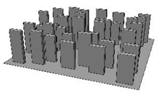 | High-rise buildings (10 stories or more) are closely mixed, and trees, green spaces, etc., are scarce. The surface is mainly covered with hard paving such as concrete. A large number of building materials such as concrete, steel, stone, and glass are used |
| LCZ2 Compact mid-rise |  | Mid-rise buildings (3–9 stories) are closely mixed, with few trees, green spaces, etc. The surface cover is mainly hard paving such as concrete. A large number of building materials such as concrete, stone, and tiles are used | ||
| LCZ3 Compact low-rise | 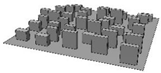 | Low-rise buildings (1–3 stories) are closely mixed, with few trees, green spaces, etc. The surface cover is mainly hard paving such as concrete. A large number of building materials such as concrete, stone, and tiles are used | ||
| Open class | LCZ4 Open high-rise |  | High-rise buildings (10 stories or more) are open and scattered, with abundant permeable underwater surfaces (low plants, sparse trees), and building materials are mainly concrete, steel, stone, glass, etc. | |
| LCZ5 Open mid-rise | 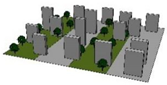 | Mid-rise buildings (3–9 stories) are open and scattered, with abundant permeable underwater cushions (low plants, sparse trees), and the building materials are mainly concrete, steel, stone, glass, etc. | ||
| LCZ6 Open low-rise | 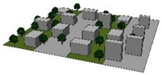 | Low-rise buildings (1–3 stories) are open and scattered, with abundant permeable underwater surfaces (low plants, sparse trees), and building materials are mainly concrete, stone, wood, etc. | ||
| Land cover-classes | LCZA Green area | 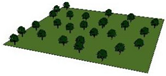 | A landscape with a large number of vegetation or herbaceous plants, and the area is often divided into natural grasslands, agriculture, or natural parks | |
| LCZB Water area | 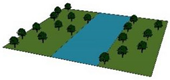 | Lakes, seas, and other large areas of water landscape, or small areas of rivers, reservoirs, reservoirs, etc. | ||
| LCZC Hard surface area |  | The surface cover is mainly stone or paved, basically no vegetation cover, and the area is often desert or urban roads | ||
| Local Climate Zone | BD | BH | SVF | ISF | FVC | FAR | WR | |
|---|---|---|---|---|---|---|---|---|
| Building classes | LCZ1 | 0.4–0.8 | 27–36 m | 0.5–0.8 | 0.8–1 | 0.1–0.3 | 2–5 | <0.1 |
| LCZ2 | 0.4–0.8 | 9–27 m | 0.6–0.9 | 0.8–1 | 0–0.6 | 1–4 | <0.1 | |
| LCZ3 | 0.4–0.8 | 0–9 m | 0.7–1.0 | 0.5–0.8 | 0–0.5 | 0–2 | <0.1 | |
| LCZ4 | 0–0.4 | 27–36 m | 0.5–0.9 | 0.2–1 | 0.1–0.7 | 0–6 | <0.1 | |
| LCZ5 | 0–0.4 | 9–27 m | 0.6–1.0 | 0.2–1 | 0.1–0.8 | 0–4 | <0.1 | |
| LCZ6 | 0–0.4 | 0–9 m | 0.7–1.0 | 0–1 | 0.1–0.9 | 0–2 | 0–0.4 | |
| Land cover classes | LCZA | <0.1 | 0 m | >0.9 | 0–0.5 | 0.1–1 | <0.1 | <0.1 |
| LCZB | <0.1 | 0–6 m | >0.9 | 0.0.5 | 0.1–0.7 | <0.1 | 0–0.6 | |
| LCZC | <0.1 | 0 m | >0.9 | 0.1–1 | 0–0.8 | <0.1 | <0.1 | |
Disclaimer/Publisher’s Note: The statements, opinions and data contained in all publications are solely those of the individual author(s) and contributor(s) and not of MDPI and/or the editor(s). MDPI and/or the editor(s) disclaim responsibility for any injury to people or property resulting from any ideas, methods, instructions or products referred to in the content. |
© 2024 by the authors. Licensee MDPI, Basel, Switzerland. This article is an open access article distributed under the terms and conditions of the Creative Commons Attribution (CC BY) license (https://creativecommons.org/licenses/by/4.0/).
Share and Cite
Wang, C.; Zhang, H.; Ma, Z.; Yang, H.; Jia, W. Urban Morphology Influencing the Urban Heat Island in the High-Density City of Xi’an Based on the Local Climate Zone. Sustainability 2024, 16, 3946. https://doi.org/10.3390/su16103946
Wang C, Zhang H, Ma Z, Yang H, Jia W. Urban Morphology Influencing the Urban Heat Island in the High-Density City of Xi’an Based on the Local Climate Zone. Sustainability. 2024; 16(10):3946. https://doi.org/10.3390/su16103946
Chicago/Turabian StyleWang, Chongqing, He Zhang, Zhongxu Ma, Huan Yang, and Wenxiao Jia. 2024. "Urban Morphology Influencing the Urban Heat Island in the High-Density City of Xi’an Based on the Local Climate Zone" Sustainability 16, no. 10: 3946. https://doi.org/10.3390/su16103946
APA StyleWang, C., Zhang, H., Ma, Z., Yang, H., & Jia, W. (2024). Urban Morphology Influencing the Urban Heat Island in the High-Density City of Xi’an Based on the Local Climate Zone. Sustainability, 16(10), 3946. https://doi.org/10.3390/su16103946