Article

CnSR: Exploring Consumer Social Responsibility Using Machine Learning-Based Topic Modeling with Natural Language Processing

Division of Consumer Science, White Lodging-J.W. Marriott, Jr. School of Hospitality and Tourism Management, Purdue University, West Lafayette, IN 47907, USA
*
Author to whom correspondence should be addressed.
Sustainability 2024, 16(1), 197; https://doi.org/10.3390/su16010197
Submission received: 16 October 2023 / Revised: 7 December 2023 / Accepted: 19 December 2023 / Published: 25 December 2023
(This article belongs to the Special Issue Shaping Sustainable Consumption Behavior)

Abstract

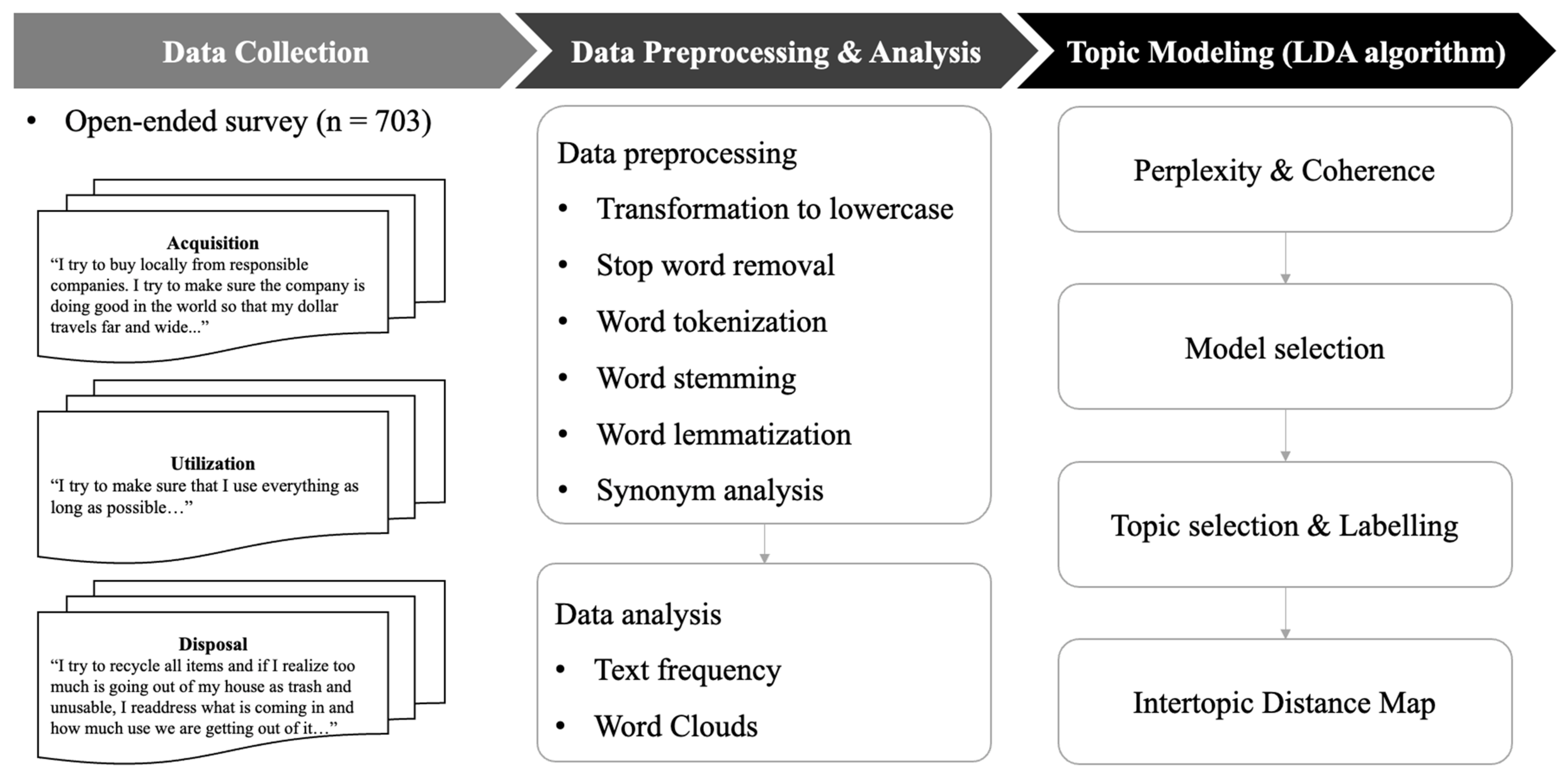
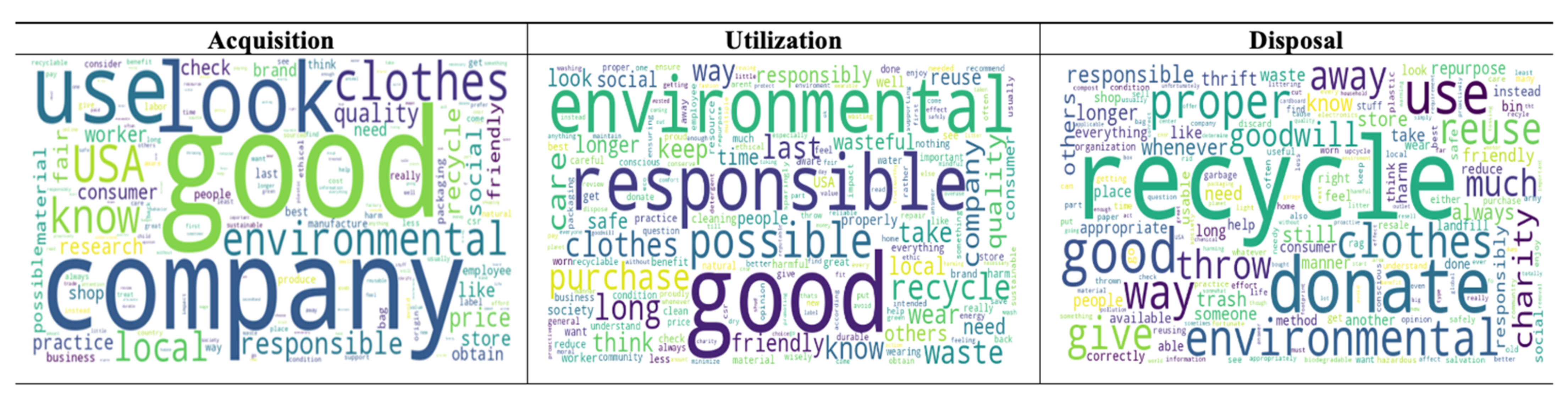
This study delves into Consumer Social Responsibility (CnSR) within the fashion industry, with the goal of understanding consumers’ sustainable and responsible behavior across three major consumption stages: acquisition, utilization, and disposal. While “corporate” social responsibility (CSR) has been extensively studied in the literature, CnSR that sheds light on “individual consumers” has received less attention and is understudied. Using topic modeling, an unsupervised machine learning (ML) technique that uses natural language processing (NLP) in Python, this study analyzed textual data consisting of open-ended responses from 703 U.S. consumers. The analysis unveiled key aspects of CnSR in each of the consumption processes. The acquisition stage highlighted various ethical and sustainable considerations in purchasing and decision making. During the utilization phase, topics concerning sustainable and responsible product usage, environmentally conscious practices, and emotional sentiments emerged. The disposal stage identified a range of environmentally and socially responsible disposal practices. This study provides a solid and rich definition of CnSR from the perspective of individual consumers, paving the avenue for future research on sustainable consumption behaviors and inspiring the fashion industry to create goods and services that are in line with CnSR.
Keywords: consumer social responsibility; fashion; sustainable consumption; machine learning; natural language processing; latent Dirichlet allocation; topic modeling; textual data; Python consumer social responsibility; fashion; sustainable consumption; machine learning; natural language processing; latent Dirichlet allocation; topic modeling; textual data; Python