Sustaining English Language Education with Social Networking Sites (SNSs): A Systematic Review

Abstract
1. Introduction
1.1. English Language Education
1.2. Social Networking Sites (SNSs) in Education
2. Aim of Current Systematic Review
3. Methods
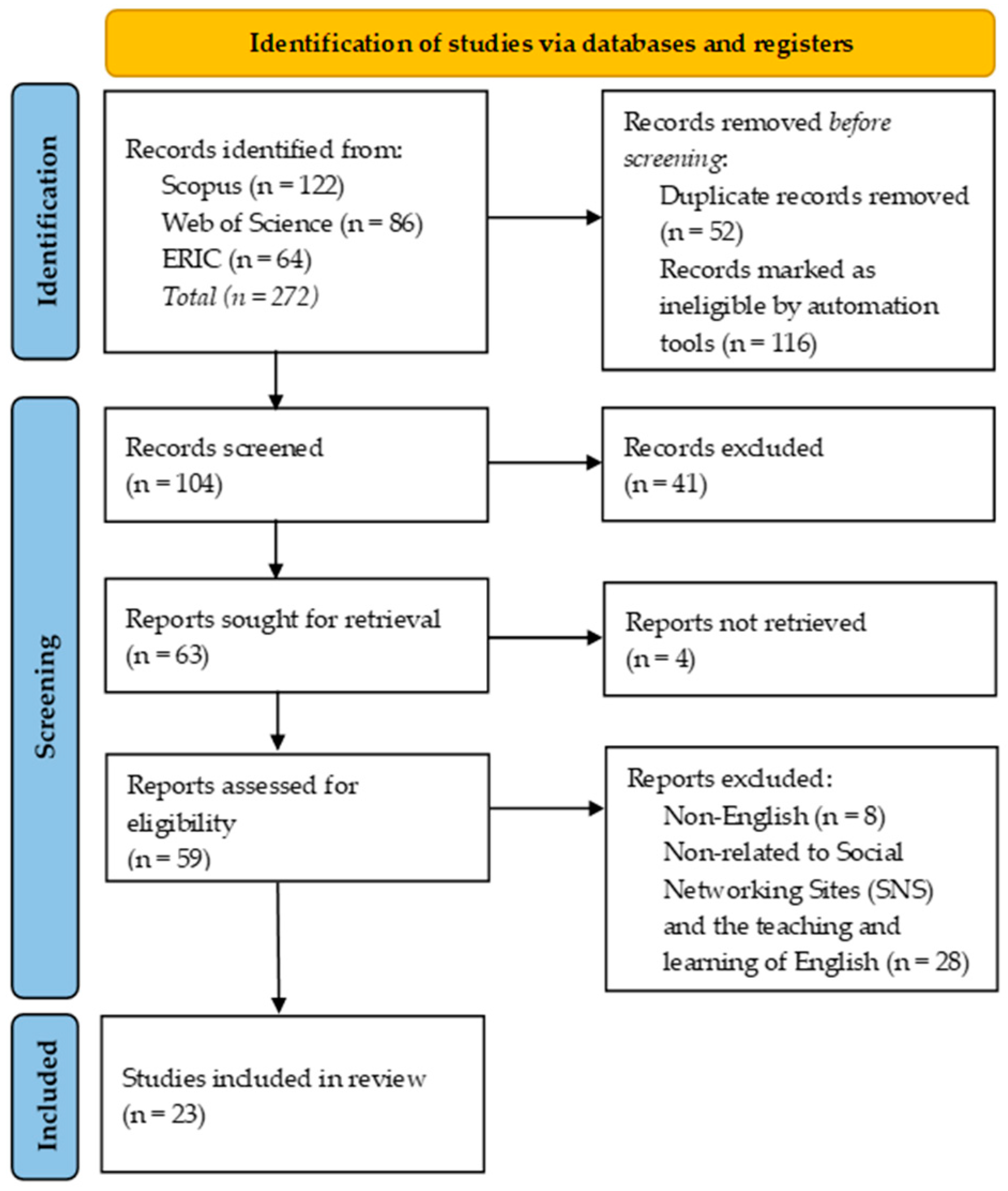
3.1. Phase 1: Identification
3.2. Phase 2: Screening
3.3. Phase 3: Included
4. Results
4.1. RQ1: What Are the Most Frequently Used Social Networking Sites (SNSs) in the English Education Field?
4.2. RQ2: What Are the Potential Benefits of Using Social Networking Sites (SNSs) in the English Education Field?
4.2.1. Enhancing English Language Competency
4.2.2. Improving English Learning Attributes
4.3. RQ3: What Are the Challenges of Using Social Networking Sites (SNSs) in the English Education Field?
5. Discussion
5.1. RQ1: What Are the Most Frequently Used Social Networking Sites (SNSs) in the English Education Field?
5.2. RQ2: What Are the Potential Benefits of Using Social Networking Sites (SNSs) in the English Education Field?
5.2.1. Enhancing English Language Competency
5.2.2. Improving English Learning Attributes
5.3. RQ3: What Are the Challenges of Using Social Networking Sites (SNSs) in the English Education Field?
6. Limitations and Recommendations
7. Conclusions
Author Contributions
Funding
Institutional Review Board Statement
Informed Consent Statement
Data Availability Statement
Conflicts of Interest
References
- Appel, G.; Grewal, L.; Hadi, R.; Stephen, A.T. The future of social media in marketing. J. Acad. Mark. Sci. 2020, 48, 79–95. [Google Scholar] [CrossRef] [Scilit] [PubMed]
- Cavus, N.; Sani, A.S.; Haruna, Y.; Lawan, A.A. Efficacy of Social Networking Sites for sustainable education in the era of COVID-19: A systematic review. Sustainability 2021, 13, 808. [Google Scholar] [CrossRef] [Scilit]
- Zainuddin, F.N.; Yunus, M.M. Sustaining formal and informal English language learning through Social Networking Sites (SNS): A systematic review (2018–2022). Sustainability 2022, 14, 10852. [Google Scholar] [CrossRef] [Scilit]
- Rosa, W. Goal 4: Ensure inclusive and equitable quality education and promote lifelong learning opportunities for all. In A New Era in Global Health: Nursing and the United Nations 2030 Agenda for Sustainable Development; Springer Publishing: New York, NY, USA, 2017; Available online: https://sdgs.un.org/goals/goal4 (accessed on 20 March 2022).
- Rao, P.S. The role of English as a global language. Res. J. Engl. (RJOE) 2019, 4, 65–79. [Google Scholar]
- Tajeddin, Z.; Atai, M.R.; Pashmforoosh, R. Beliefs about English as an International Language (EIL): Voices from Persian-speaking English teachers. Pedagog. Int. J. 2019, 15, 1–19. [Google Scholar] [CrossRef] [Scilit]
- McKay, S.L. English as an international language: What it is and what it means for pedagogy. RELC J. 2018, 49, 9–23. [Google Scholar] [CrossRef] [Scilit]
- Vodopija-Krstanović, I.; Marinac, M. English as an international language and English language teaching: The theory vs. practice divide. Iran. J. Lang. Teach. Res. 2019, 7, 19–38. [Google Scholar]
- Ilyosovna, N.A. The importance of English language. Int. J. Orange Technol. 2020, 2, 22–24. [Google Scholar]
- Ghazali, K. National Identity and Minority Languages. Available online: https://www.un.org/en/chronicle/article/national-identity-and-minority-languages (accessed on 22 March 2022).
- Mukhtar, N.H.; Nasir, N.A.M.; Zainal, N.; Yunus, M.M. QLETZ: Noun-you-know online module for vocabulary learning. Int. J. Sci. Technol. Res. 2019, 8, 2777–2781. [Google Scholar]
- Ministry of Education. Malaysia Education Blueprint 2013–2025; Putrajaya: Kementerian Pendidikan Malaysia. 2013. Available online: https://www.moe.gov.my/menumedia/media-cetak/penerbitan/dasar/1207-malaysia-education-blueprint-2013-2025/file (accessed on 22 March 2022).
- Krishnan, P.D.; Yunus, M.M. Blended CEFR in enhancing vocabulary among low proficiency students. Arab. World Engl. J. Spec. Issue CALL 2019, 5, 141–153. [Google Scholar] [CrossRef] [Scilit]
- Lim, T.M.; Yunus, M.M. Teachers’ perception towards the use of Quizizz in the teaching and learning of English: A systematic review. Sustainability 2021, 13, 6436. [Google Scholar] [CrossRef] [Scilit]
- Curriculum Development Division. Standard Document of Primary School Curriculum: Basic Core Module of English Language for National Schools; Curriculum Development Division: Putrajaya, Malaysia, 2021. [Google Scholar]
- John, E.; Yunus, M.M. A systematic review of social media integration to teach speaking. Sustainability 2021, 13, 9047. [Google Scholar] [CrossRef] [Scilit]
- Robbins, S.P.; Singer, J.B. From the editor—The medium is the message: Integrating social media and social work education. J. Soc. Work Educ. 2014, 50, 387–390. [Google Scholar] [CrossRef] [Scilit]
- Chisenga, J.; Kedemi, R.; Sam, J. The use of social media in agricultural research workflows in Ghana and Kenya. Agric. Inf. Worldw. 2014, 6, 48–57. [Google Scholar]
- Ariantini, K.P.; Suwastini, N.K.A.; Adnyani, N.L.P.S.; Dantes, G.R.; Jayantini, I.G.A.S.R. Integrating social media into English language learning: How and to what benefits according to recent studies. NOBEL J. Lit. Lang. Teach. 2021, 12, 91–111. [Google Scholar] [CrossRef] [Scilit]
- Citrawati, N.K.; Suwastini, N.K.A.; Jayanti, I.G.A.S.R.; Artini, N.N.; Dantes, G.R. Telegram as Social Networking Service (SNS) for enhancing students’ English: A systematic review. J. Engl. Lang. Teach. Linguist. (JELTL) 2021, 6, 239–260. [Google Scholar] [CrossRef] [Scilit]
- Alshenqeeti, H. Technology in the language classroom: How social media is changing the way EFL is taught. Arab World Engl. J. 2018, 4, 55–68. [Google Scholar] [CrossRef] [Scilit]
- Azad, M.; Alipour, M.; Talebi, P. The effect of using social networks on developing EFL learners’ pragmatic competence through speaking accuracy and fluency. Lang. Educ. Stud. 2018, 4, 15–24. [Google Scholar]
- Ismail, S.; Ahmad, M.; Zaim, M.; Mukhaiyar, M.; Gistituati, N. Student perspective in using social media as a tool in English language learning. J. Engl. Acad. 2019, 6, 58–68. [Google Scholar]
- Chua, C.N.; Yunus, M.M.; Suliman, A. ICT: An effective platform to promote writing skills among Chinese primary school pupils. Arab World Engl. J. 2019, 10, 223–237. [Google Scholar]
- Alizadeh, I. Evaluating the educational usability of Telegram as an SNS in ESAP programs from medical students’ perspective. Educ. Inf. Technol. 2018, 23, 2569–2585. [Google Scholar] [CrossRef] [Scilit]
- Elsayed, W. The negative effects of social media on the social identity of adolescents from the perspective of social work. Heliyon 2021, 7, e06327. [Google Scholar] [CrossRef] [Scilit]
- Akram, W.; Kumar, R. A study on positive and negative effects of social media on society. Int. J. Comput. Sci. Eng. 2017, 5, 351–354. [Google Scholar] [CrossRef] [Scilit]
- Hamid, S.; Ijab, M.T.; Sulaiman, H.; Anwar, R.M.; Norman, A.A. Social media for environmental sustainability awareness in higher education. Int. J. Sustain. High. Educ. 2017, 18, 474–491. [Google Scholar] [CrossRef] [Scilit]
- Sivagnanam, S.; Yunus, M.M. Utilizing social media in vocabulary enhancement among primary ESL learners. Univers. J. Educ. Res. 2020, 8, 490–498. [Google Scholar] [CrossRef] [Scilit]
- Yunus, M.M.; Zakaria, S.; Suliman, A. The potential use of social media on Malaysian primary students to improve writing. Int. J. Educ. Pract. 2019, 7, 450–458. [Google Scholar] [CrossRef] [Scilit]
- Page, M.J.; McKenzie, J.E.; Bossuyt, P.M.; Boutron, I.; Hoffmann, T.C.; Mulrow, C.D.; Shamseer, L.; Tetzlaff, J.M.; Akl, E.A.; Brennan, S.E.; et al. The PRISMA 2020 statement: An updated guideline for reporting systematic reviews. BMJ 2021, 372, 1–9. [Google Scholar]
- Baas, J.; Schotten, M.; Plume, A.; Côté, G.; Karimi, R. Scopus as a curated, high-quality bibliometric data source for academic research in quantitative science studies. Quant. Sci. Stud. 2020, 1, 377–386. [Google Scholar] [CrossRef] [Scilit]
- Li, K.; Rollins, J.; Yan, E. Web of Science use in published research and review papers 1997–2017: A selective, dynamic, cross-domain, content-based analysis. Scientometrics 2018, 115, 1–20. [Google Scholar] [CrossRef] [Scilit]
- Sirivedin, P.; Soopunyo, W.; Srisuantang, S.; Wongsothorn, A. Effects of Facebook usage on English learning behavior of Thai English teachers. Kasetsart J. Soc. Sci. 2018, 39, 183–189. [Google Scholar] [CrossRef] [Scilit]
- Wang, H.; Chen, C.W. Learning English from YouTubers: English L2 learners’ self-regulated language learning on YouTube. Innov. Lang. Learn. Teach. 2019, 14, 333–346. [Google Scholar] [CrossRef] [Scilit]
- Peñalver, E.A.; Urbieta, A.S. Tweets of a feather flock together: An analysis of the impact of twitter in a class of translation. Int. J. Virtual Pers. Learn. Environ. 2018, 8, 10–23. [Google Scholar] [CrossRef] [Scilit]
- Ngai, P.B. Online social networking and transnational-competence development among international students from Japan. J. Int. Stud. 2019, 9, 432–459. [Google Scholar] [CrossRef] [Scilit]
- Giang, B.T.K.; Tuan, V.V. The utilization of the internet resources for enhancing the self-study of Vietnamese students in improving their English competence. Turk. Online J. Des. Art Commun. (TOJDAC) 2018, 186–197. [Google Scholar] [CrossRef] [Scilit] [PubMed]
- Won, E.S.; Kim, J.R. The effectiveness of self-directed English learning through SNS: Adopting Facebook based on gamification. Int. J. Mob. Blended Learn. 2018, 10, 1–10. [Google Scholar] [CrossRef] [Scilit]
- Elsakova, R.; Kuzmina, N.; Kochkina, D. Smart technology integration in the system of bachelors’ language training. Int. J. Emerg. Technol. Learn. (iJET) 2019, 14, 25–39. [Google Scholar] [CrossRef] [Scilit]
- Rahman, F.; Abbas, A.; Hasyim, M. Facebook group as media of learning writing in ESP context: A case study at Hasanuddin University. Asian EFL J. Res. Artic. 2019, 26, 153–167. [Google Scholar]
- Maulina Geelan, D.; Basri, M.; Nuni, N. Constructing WhatsApp-based Speaking Instructional Material (WABSIM) for EFL teaching and learning: A need analysis. Asian EFL J. Res. Artic. 2021, 28, 89–110. [Google Scholar]
- Habibi, A.; Mukminin, A.; Riyanto, Y.; Prasojo, L.D.; Sulistiyo, U.; Sofwan, M.; Saudagar, F. Building an online community: Student teachers’ perceptions on the advantages of using social networking services in a teacher education program. Turk. Online J. Distance Educ. (TOJDE) 2018, 19, 46–61. [Google Scholar] [CrossRef] [Scilit]
- Herlina, R. Tutorial YouTube: English learning media under the frame work of students’ need analysis in EFL class. Academic J. Perspect. Lang. Educ. Lit. 2019, 7, 1–10. [Google Scholar]
- Ghorbani, N.; Ebadi, S. Exploring learners’ grammatical development in mobile assisted language learning. Cogent Educ. 2020, 7, 1704599. [Google Scholar] [CrossRef] [Scilit]
- Okumura, S. Design and implementation of a telecollaboration project for primary school students to trigger intercultural understanding. Intercult. Educ. 2020, 31, 377–389. [Google Scholar] [CrossRef] [Scilit]
- Salazar, M.A.; Pérez, T.M.A.; González, O.G.E.M.A.; Katherine, D.; Gonzalo, M.A.R.M. Analysis of closed Facebook communities to enhance vocabulary development in English as a foreign language through Flipped Classroom method. Int. J. Educ. Inf. Technol. 2019, 13, 130–135. [Google Scholar]
- Sari, A.B.P.; Dardjito, H.; Azizah, D.M. EFL Students’ improvement through the reflective YouTube video project. Int. J. Instr. 2020, 13, 393–408. [Google Scholar] [CrossRef] [Scilit]
- Jarrah, M.A.; Alzubi, A.A.F. Arab postgraduates’ readiness towards and effectiveness of utilizing Web 2.0 in language learning. Int. J. Instr. 2021, 14, 673–690. [Google Scholar] [CrossRef] [Scilit]
- Imamyartha, D.; Wahjuningsih, E.; A’yunin, A.; Santihastuti, A.; Mitasari Fauzie, D.L.T.A.; Andika, E.C.H. EFL learners’ engagement and learning motivation in team-based mobile language learning through WhatsApp. Teach. Engl. Technol. 2022, 22, 82–103. [Google Scholar]
- Roohani, A.; Vincheh, M.H. Effect of game-based, social media, and classroom-based instruction on the learning of phrasal verbs. Comput. Assist. Lang. Learn. 2021, 1–25. [Google Scholar] [CrossRef] [Scilit]
- Raja, P.; Setiyadi, A.B.; Riyantika, F. The correlation between perceptions on the use of online digital interactive media and reading comprehension ability. Int. J. Engl. Lang. Lit. Stud. 2021, 10, 292–319. [Google Scholar] [CrossRef] [Scilit]
- Solmaz, O. Pre-service language teachers’ use of social networking sites for language learning: A quantitative investigation. Eurasian J. Appl. Linguist. 2019, 5, 423–439. [Google Scholar] [CrossRef] [Scilit]
- Alobaid, A. Smart multimedia learning of ICT: Role and impact on language learners’ writing fluency— YouTube online English learning resources as an example. Smart Learn. Environ. 2020, 7, 1–30. [Google Scholar] [CrossRef] [Scilit]
- Chik, A. Humorous interaction, language learning, and social media. World Engl. 2019, 39, 1–14. [Google Scholar] [CrossRef] [Scilit]
- Vanek, J.; King, K.; Bigelow, M. Social presence and identity: Facebook in an English language classroom. J. Lang. Identity Educ. 2018, 17, 236–254. [Google Scholar] [CrossRef] [Scilit]


| Database | Search String |
|---|---|
| Scopus | TITLE-ABS-KEY ((“Social Networking Site *” OR “SNS” OR “social network *” OR “social media *” OR “Facebook” OR “YouTube” OR “Twitter” OR “Telegram” OR “WhatsApp” OR “TikTok” OR “Instagram”) AND (“English teaching *” OR “English learning *” OR “teaching and learning of English”)) |
| Web of Science (WoS) | TS = ((“Social Networking Site *” OR “SNS” OR “social network *” OR “social media *” OR “Facebook” OR “YouTube” OR “Twitter” OR “Telegram” OR “WhatsApp” OR “TikTok” OR “Instagram”) AND (“English teaching *” OR “English learning *” OR “teaching and learning of English”)) |
| Educational Resources Information Centre (ERIC) | SNS AND English |
| Criterion | Inclusion | Exclusion |
|---|---|---|
| Type of article | Journal articles | Review articles, books, book chapters, conference proceedings |
| Publication Year | 2018–2022 (5 years timespan) | <2018 |
| Language | English | Non-English |
| Content | Related to social networking sites (SNSs) and the teaching and learning of English | Non-related to social networking sites (SNSs) and the teaching and learning of English |
| References | Social Networking Sites (SNSs) | ||||||
|---|---|---|---|---|---|---|---|
| YouTube | Telegram | Edmodo | Generic | ||||
| [34] | ✓ | ||||||
| [35] | ✓ | ||||||
| [36] | ✓ | ||||||
| [37] | ✓ | ||||||
| [38] | ✓ | ||||||
| [39] | ✓ | ||||||
| [40] | ✓ | ||||||
| [41] | ✓ | ||||||
| [42] | ✓ | ||||||
| [43] | ✓ | ✓ | |||||
| [44] | ✓ | ||||||
| [45] | ✓ | ||||||
| [46] | ✓ | ||||||
| [47] | ✓ | ||||||
| [48] | ✓ | ||||||
| [49] | ✓ | ✓ | ✓ | ||||
| [50] | ✓ | ||||||
| [51] | ✓ | ||||||
| [52] | ✓ | ||||||
| [53] | ✓ | ||||||
| [54] | ✓ | ||||||
| [55] | ✓ | ||||||
| [56] | ✓ | ||||||
| Social Networking Sites (SNSs) | Number of Research Articles |
|---|---|
| 6 | |
| YouTube | 5 |
| 2 | |
| Telegram | 2 |
| 3 | |
| Edmodo | 1 |
| Generic | 7 |
| References | English Language Skills | |||||
|---|---|---|---|---|---|---|
| Speaking/ Communication | Reading | Writing | Grammar | Vocabulary | Generic | |
| [34] | ✓ | |||||
| [35] | ✓ | |||||
| [36] | ✓ | |||||
| [37] | ✓ | |||||
| [38] | ✓ | |||||
| [39] | ✓ | |||||
| [40] | ✓ | |||||
| [41] | ✓ | |||||
| [42] | ✓ | |||||
| [43] | ✓ | |||||
| [44] | ✓ | |||||
| [45] | ✓ | |||||
| [46] | ✓ | |||||
| [47] | ✓ | |||||
| [48] | ✓ | |||||
| [49] | ✓ | |||||
| [50] | ✓ | |||||
| [51] | ✓ | |||||
| [52] | ✓ | |||||
| [53] | ✓ | |||||
| [54] | ✓ | |||||
| [55] | ✓ | |||||
| [56] | ✓ | |||||
| English Language Skills | Number of Research Articles |
|---|---|
| Speaking/Communication | 3 |
| Reading | 1 |
| Writing | 3 |
| Grammar | 2 |
| Vocabulary | 1 |
| Generic | 13 |
| References | English Learning Attributes | |||||
|---|---|---|---|---|---|---|
| Motivation | Confidence | Engagement | Collaboration | Value | Not Mentioned | |
| [34] | ✓ | ✓ | ||||
| [35] | ✓ | ✓ | ||||
| [36] | ✓ | ✓ | ||||
| [37] | ✓ | ✓ | ✓ | |||
| [38] | ✓ | |||||
| [39] | ✓ | |||||
| [40] | ✓ | ✓ | ✓ | |||
| [41] | ✓ | |||||
| [42] | ✓ | ✓ | ||||
| [43] | ✓ | ✓ | ✓ | ✓ | ||
| [44] | ✓ | |||||
| [45] | ✓ | |||||
| [46] | ✓ | ✓ | ✓ | |||
| [47] | ✓ | |||||
| [48] | ✓ | ✓ | ✓ | |||
| [49] | ✓ | |||||
| [50] | ✓ | ✓ | ✓ | |||
| [51] | ✓ | ✓ | ||||
| [52] | ✓ | |||||
| [53] | ✓ | |||||
| [54] | ✓ | |||||
| [55] | ✓ | |||||
| [56] | ✓ | |||||
| English Learning Attributes | Number of Research Articles |
|---|---|
| Motivation | 11 |
| Confidence | 3 |
| Engagement | 10 |
| Collaboration | 9 |
| Value | 6 |
| Not mentioned | 2 |
| Challenges | References |
|---|---|
| Nonverbal communicative competence | [37] |
| Confidence level | [37] |
| Insufficient support | [38,39] |
| Distraction | [38,50,51,52] |
| Time constraint Technical issues | [40,46] [40,50,51,52] |
| Not mentioned | [34,35,36,41,42,43,44,45,47,48,49,53,54,55,56] |
Disclaimer/Publisher’s Note: The statements, opinions and data contained in all publications are solely those of the individual author(s) and contributor(s) and not of MDPI and/or the editor(s). MDPI and/or the editor(s) disclaim responsibility for any injury to people or property resulting from any ideas, methods, instructions or products referred to in the content. |
© 2023 by the authors. Licensee MDPI, Basel, Switzerland. This article is an open access article distributed under the terms and conditions of the Creative Commons Attribution (CC BY) license (https://creativecommons.org/licenses/by/4.0/).
Share and Cite
Tan, S.Y.; Md Yunus, M. Sustaining English Language Education with Social Networking Sites (SNSs): A Systematic Review. Sustainability 2023, 15, 5710. https://doi.org/10.3390/su15075710
Tan SY, Md Yunus M. Sustaining English Language Education with Social Networking Sites (SNSs): A Systematic Review. Sustainability. 2023; 15(7):5710. https://doi.org/10.3390/su15075710
Chicago/Turabian StyleTan, Siok Yong, and Melor Md Yunus. 2023. "Sustaining English Language Education with Social Networking Sites (SNSs): A Systematic Review" Sustainability 15, no. 7: 5710. https://doi.org/10.3390/su15075710
APA StyleTan, S. Y., & Md Yunus, M. (2023). Sustaining English Language Education with Social Networking Sites (SNSs): A Systematic Review. Sustainability, 15(7), 5710. https://doi.org/10.3390/su15075710