Innovative Business Models for a Sustainable Circular Bioeconomy in the French Agrifood Domain


Abstract
1. Introduction
2. Methodology
- The type of business model;
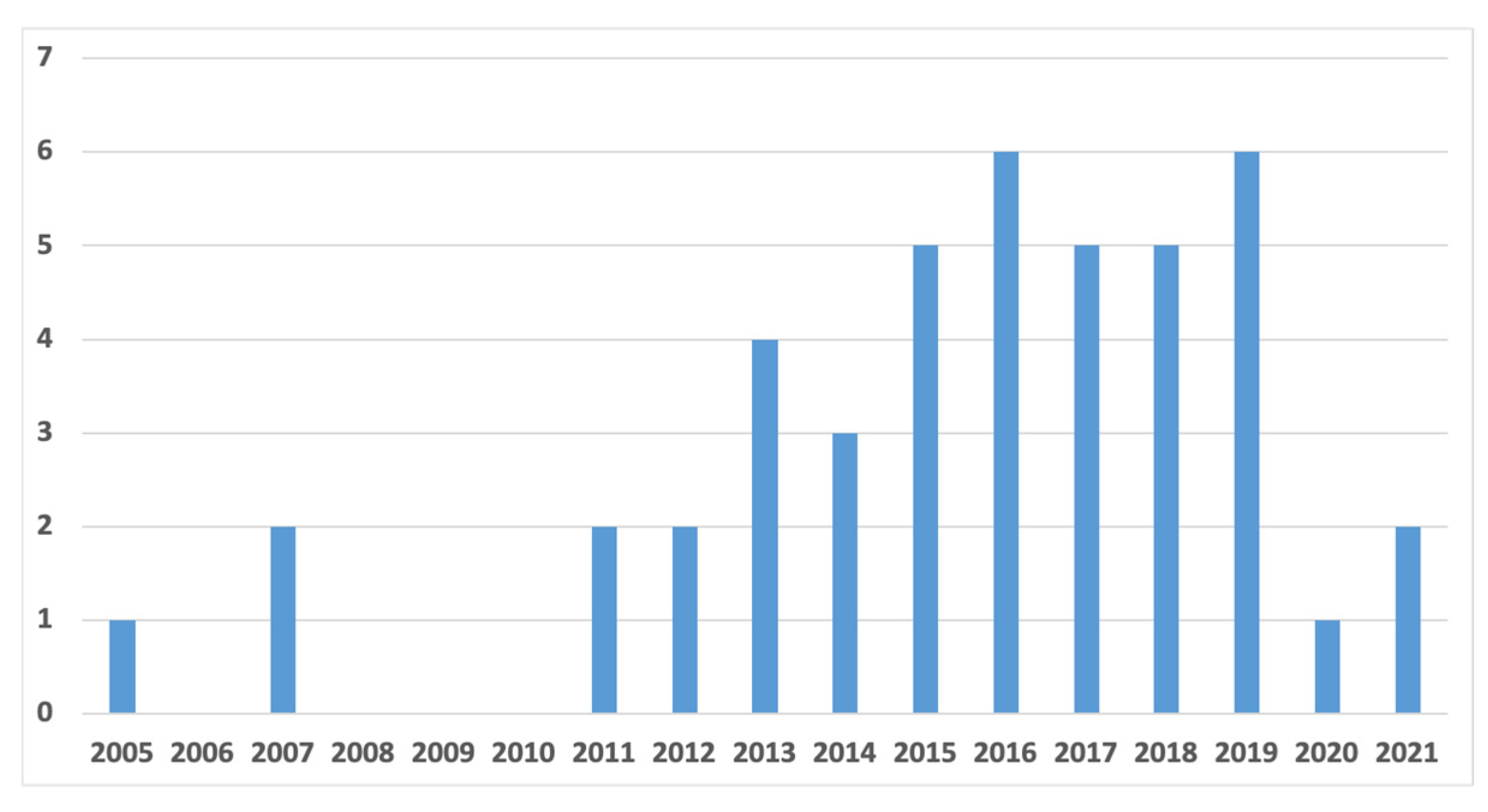
- The business drivers and the date when it started its circular economy activities;
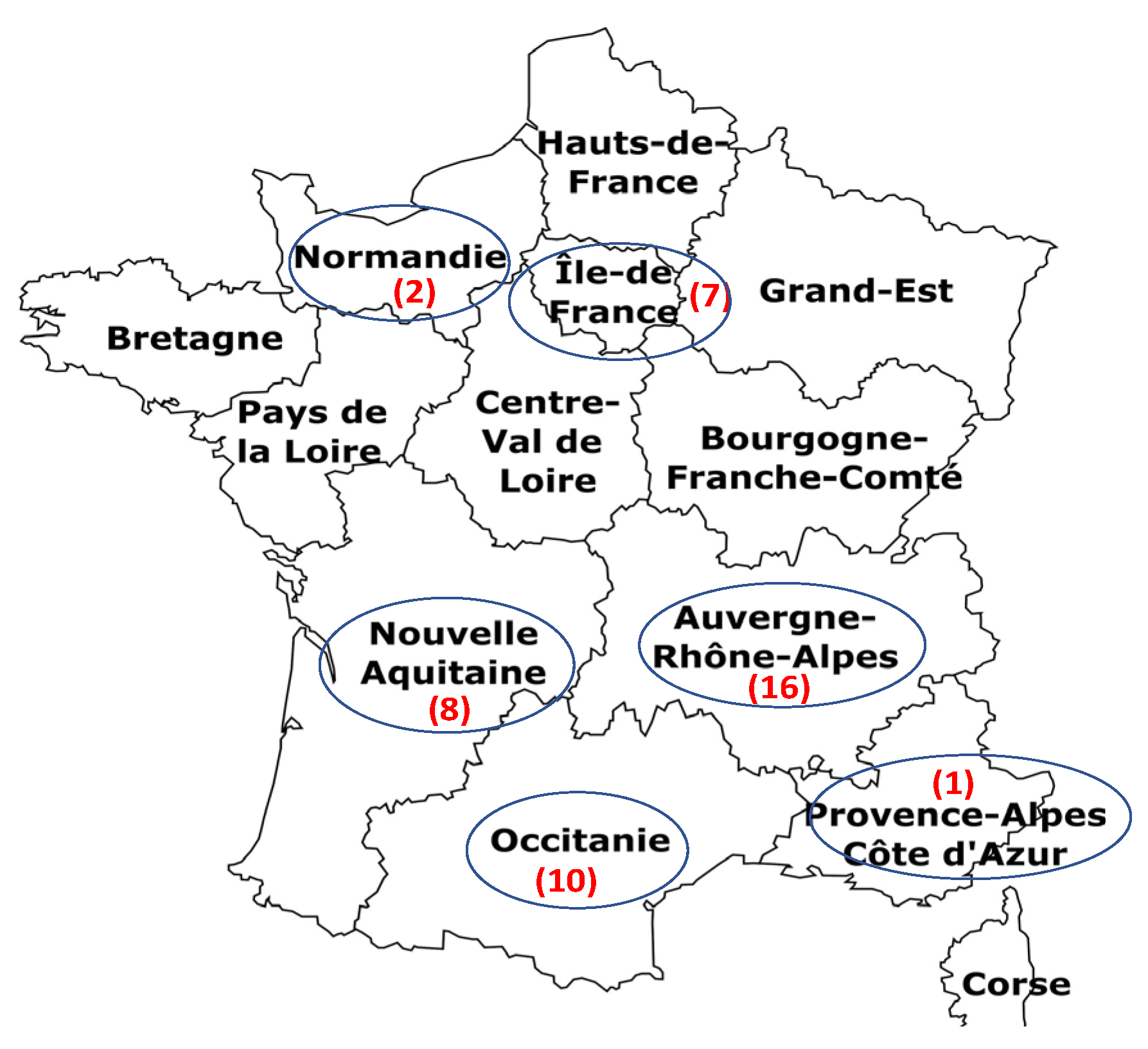
- The geographical location (region);
- The business model elements, including the type of resources used, the key partners or clients, the activities and valorization pathways leading to the main value proposition;
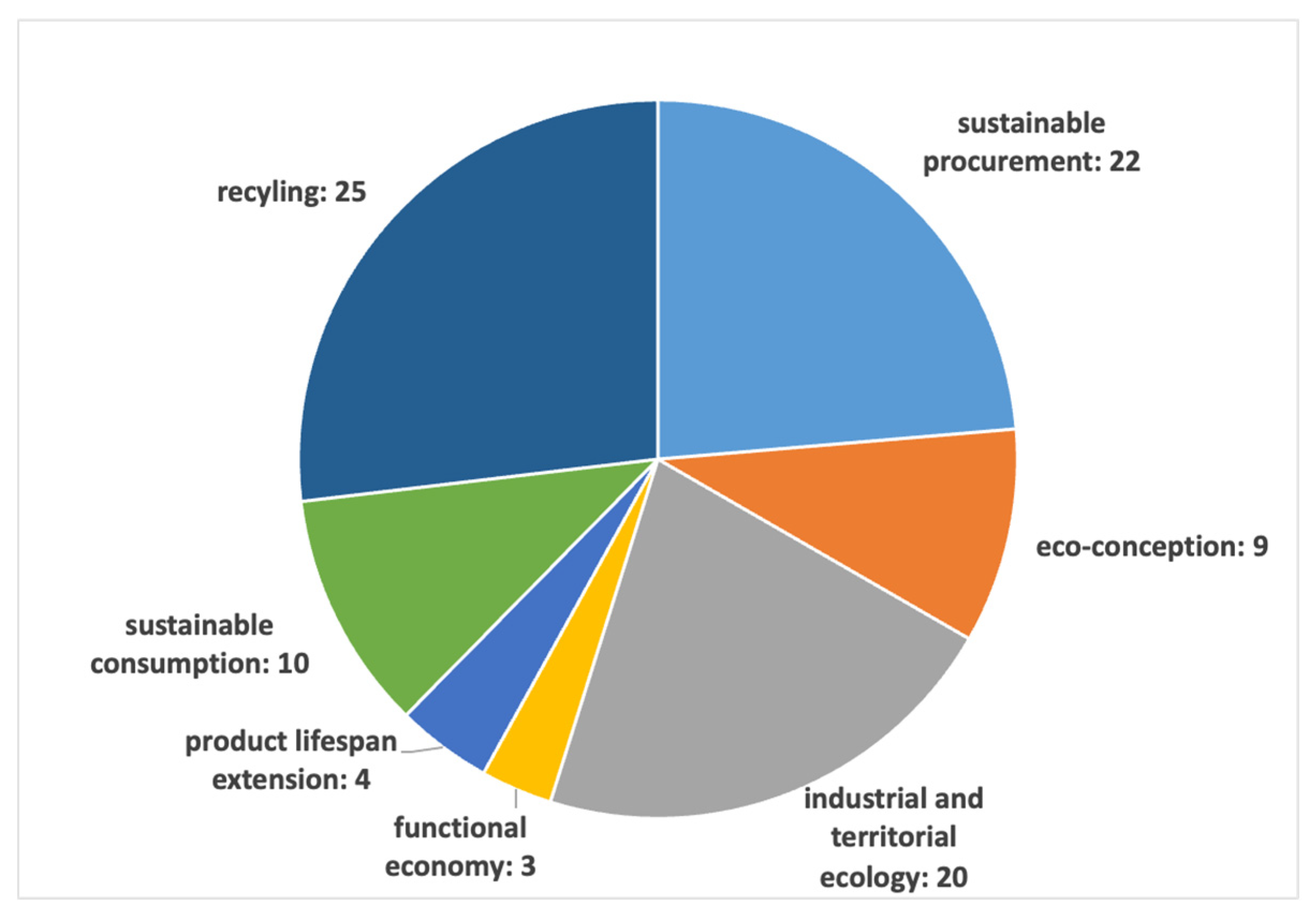
- The circular economy principles applied according to the ADEME pillars and as indicated by the business itself;
- The enablers and barriers (as indicated online by the business itself);
- The sustainability benefits (as indicated online by the business itself).
3. Results
3.1. Business Model Types, Origin and Drivers
3.2. The Playing Fields
3.3. Resources, Activities and Value Propositions
3.4. Actors and Their Interactions
3.5. Enablers and Barriers
3.6. Sustainability Outcomes
4. Discussion
4.1. The Game Concept
4.2. Circular Bioeconomy Business Models Impacted by Drivers
4.3. Enablers and Barriers
4.4. The Emergence of New Local Small-Scale Circular Bioeconomy Business Models
5. Conclusions
Author Contributions
Funding
Institutional Review Board Statement
Informed Consent Statement
Data Availability Statement
Conflicts of Interest
Appendix A

| No | Type and Size of Initiative | Driver and Starting Date (Time) | Region (Playing Field) | Type of Resource (Pieces) | Key Partners/Clients (Players) | Activities and Value Propositions (Moves) | CE Principles Applied (Moves) | Enablers and Barriers (Rules) | Sustainability Benefits (Outcomes) | Source |
|---|---|---|---|---|---|---|---|---|---|---|
| 1 | Farm, micro | sensible to environmental questions, since 2019 | Occitanie | organic waste, manure | nearby village, super-markets | worm farm; organic vermicompost | responsible consumption, recycling, sustainable procurement | valorizes more than 200 kg local waste per week | www.compost-vers.fr (accessed on 10 February 2023) | |
| 2 | Beer brewery, micro | ‘Bread is no waste’, since 2015 | Auvergne -Rhône-Alpes | old unsold bread | bakery | beer based on old bread | product lifespan extension | (-) fluctuation in quantities; logistics needed for collection | valorizes 35 kg hard bread into 1300 L beer | https://www.brasseriedelaloire.fr/ (accessed on 10 February 2023) |
| 3 | Enterprise, small | since 2012 | Auvergne -Rhône-Alpes | coffee grounds from distributors | large service company for waste collection and valorization | recycling of coffee grounds, valorization into logs for heating | recycling | valorizes 16 tons of coffee grounds per year | www.arabica-e-chocolat.com/engagements/ (accessed on 10 February 2023) | |
| 4 | Distillery, small | diversification needed, since 2014 | Occitanie | wine waste and by-products | research, public partners (ADEME, region) | portfolio of various new products for international sales | functional economy, industrial and territorial ecology, sustainable procurement | (-) need for new skills (language), technologies fiscal constraints | create new biorefinery model optimizing all resources | https://www.economiecirculaire.org/initiative/h/bioraffinerie-vers-un-modele-d-economie-circulaire.html (accessed on 10 February 2023) |
| 5 | Power company, small | since 2014 | Provence Alpes-Côte d’Azur | biomass | local industries, municipalities | local biomass conversion into electricity and heat | industrial and territorial ecology | economic and ecological value via new biomass conversion technology, 20 new jobs | https://www.minigreenpower.com/ (accessed on 10 February 2023) | |
| 6 | Cooperative medium-sized | the proximity of actors has enabled the symbiosis project, since 2007 | Nouvelle Aquitaine | tomatoes | large oil company | water heat from oil production used to heat greenhouses | industrial and territorial ecology, sustainable procurement | (+) proximity and long-term partnership (25 years); (-) reglementary, administrative barriers | ecological production of 6000 t/year oftomatoes (without fossil energies and pesticides), 150 jobs created | http://tomdaqui.com/ (accessed on 10 February 2023) |
| 7 | Company, medium-sized | importance of not throwing used oils away, since 2016 | Auvergne -Rhône-Alpes | oil | partnership with a waste collecting company and strategic consultancy | collect used oils and convert them into biofuels | responsible consumption, recycling, sustainable procurement, eco-conception | (+) media communication, users | awareness creation for environmental problem; 100% of the collected oil is revalorized | https://www.labaraqueahuile.fr/ (accessed on 10 February 2023) |
| 8 | Association, micro | offer local solution for organic waste collection and treatment, since 2015 | Auvergne -Rhône-Alpes | organic waste | waste depositories, public partners | consulting, organic waste collection and treatment (composting) | recycling, sustainable procurement | (+) proximity for waste collection and partners; (-) financing | treatment of 2 K tons of biowaste per year, | http://compostond.fr/ (accessed on 10 February 2023) |
| 9 | Association, micro | bring chain actors together to enhance reuse of bottles, since 2018 | Occitanie | beverage chain (beer, wine, fruit bottles) | multiple from the beverage chain and public | collect, clean and reuse returnable drink bottles | product lifespan extension, responsible consumption, functional economy, sustainable procurement | reduction in glass waste by 1400 tons/year and of CO2 emissions by 390 tons/year | https://www.consignup.org | |
| 10 | Bakery, micro | cereals normally used for animal feed, but not for human food, 2018 | Nouvelle Aquitaine | cereal grains from beer brewing | beer brewer | cookies based on cereal grains from brewery | responsible consumption, recycling, industrial and territorial economy | (+) proximity, openness and engagement of actors; (-) time needed | higher added-value creation | https://www.economiecirculaire.org/articles/h/patisserie-anti-gaspillage-solidaire.html (accessed on 10 February 2023) |
| 11 | Enterprise, micro | since 2018 | Nouvelle Aquitaine | unsold fruit and vegetables | super-markets | collect and convert unsold fruit and vegetables into soups, juices and jams | responsible consumption, recycling, eco-conception | support of local communities, knowledge of retailers; (-) time needed | valorizes 7180 kgs within 9 months, 950 soups et 2650 jams | https://www.recita.org/initiative/h/cyfruileg-les-fruits-et-legumes-invendus-en-jus-soupes-et-confitures.html (accessed on 10 February 2023) |
| 12 | Shops, small | since 2013 | Île-de-France | various agri-food products | consumers | in bulk sales of food products | responsible consumption | consumers can reduce environmental impact by buying without packaging | http://daybyday-shop.com/ (accessed on 10 February 2023) | |
| 13 | Enterprise, small | since 2015 | Auvergne -Rhône-Alpes | various co-products from food industry (breweries, bakeries, milk etc.) | valorization of co-products for animal feed | sustainable procurement | production of 60,000 tons of flour for animal feed per year | http://www.flash-infos.com/actu/information-economique-rhone-alpes/alimentation-animale-bonda-simplante-a-pont-de-vaux/ (accessed on 10 February 2023) | ||
| 14 | Cooperative large | since 2013 | Auvergne -Rhône-Alpes | corn raid | public partners | corn raid used converted into energy via biomass heater | sustainable procurement | reduction of 2600 tons of CO2/year; reduction in energy costs | www.limagrain.com (accessed on 10 February 2023) | |
| 15 | Company, small | against food waste, since 2012 | Île-de-France | various unsold food products | retailers, distributors, communities hospitals | redistribution of surplus or unsold products to disadvantaged citizens via associations | responsible consumption, recycling, sustainable procurement | economic and environmental (lost food), social | http://www.eqosphere.com (accessed on 10 February 2023) | |
| 16 | Company, medium-sized | since 2017 | Auvergne -Rhône-Alpes | byproducts from red fruits | industrial partner | red fruit by-products valorized into high added value ingredients for animal feed | industrial and territorial ecology | geographical proximity of partners (confidence); (-) some products do not fulfil quality requirements | valorizes 150 tons per year | https://ravifruit.com/fr (accessed on 10 February 2023) |
| 17 | Association, micro | since 2019 | Nouvelle Aquitaine | food waste | restaurant owners, gardeners | collection of food waste with bicycles, valorization into compost | responsible consumption, recycling, sustainable procurement | local environmental initiative | https://lescarriolesvertes.org/ (accessed on 10 February 2023) | |
| 18 | Enterprise, medium-sized | find solution for coproducts from fish processing, since 2016 | Occitanie | fish co-products (tuna) | leather industry | valorization of fish coproducts into leather (e.g., for shoes) | recycling, sustainable procurement | (+) participation in trade fairs for promotion; (-) time for R&D | extra revenues, waste avoidance | https://www.groupebarba.com/fr/accueil/ (accessed on 10 February 2023) |
| 19 | Restaurant, micro | avoid food waste, since 2018 | Île-de-France | various food products, fruits and vegetables | retailers | propose dishes with 80% of products otherwise thrown away (expiration date) | recycling | (+) loyalty of consumers; (-) decrease in collected food | reduction in food waste by 400 kg per week, 2–3 jobs created | https://www.lebocalpierrefitte.fr/ (accessed on 10 February 2023) |
| 20 | Association, micro | develop and promote biobased construction, since 2015 | Auvergne -Rhône-Alpes | different chains: wood, hemp, sheep’s wool | farmers, house builders, regional trade chamber | valorization of bioresources for insulation in the construction sector | sustainable procurement | provides eco-friendly materials | https://www.eclaira.org/initiative/h/le-developpement-de-la-construction-biosourcee-en-auvergne.html (accessed on 10 February 2023) | |
| 21 | EU project with Association, small | treatment of sludge and wastewater from fish farming, 2016–2020 | Occitanie | fish farming | 20 European research partners | valorization of fish farming waste (sludge) with worms into compost | industrial and territorial ecology, recycling, eco-conception | (+) increasing awareness of the problem, collective management of waste, financial support | conversion of 40% of sludge into worm compost (worms are ideal to digest organic matter) | http://lombritek.com/lk/ (accessed on 10 February 2023) |
| 22 | Industrial ecology park, small | sustainable economic development, since 2007 | Auvergne -Rhône-Alpes | agricultural by-products | various enterprises, research institutes and public partners | biomass conversion into biochar, biogas food additives; joint R&D, training | industrial and territorial ecology | in total, 90% of biomass goes back to the soil, 400 tons of biowaste valorized/year | http://www.parc-naturopole.fr/ (accessed on 10 February 2023) | |
| 23 | Enterprise, medium-sized | fight against food waste, create jobs for sustainability and quality goals, 2016 | Auvergne -Rhône-Alpes | urban biowaste | diverse private and public partners | innovative solution for valorizing locally urban biowaste into compost | industrial and territorial ecology, recycling | (+) public laws for energy transition and waste separation | contribute to local circular economy, 150 tons of biowaste collected and valorized/year | https://alchimistes.co/ (accessed on 10 February 2023) |
| 24 | Start-up enterprise, micro | desire to develop an ecological and responsible project, since 2018 | Occitanie | sheep wool | public partners and support | valorize sheep wool for insulated/cool bags | product lifespan extension, responsible consumption, recycling, sustainable procurement, eco-conception | complementary skills, made in France, (-) need to know support options, limited production capacity, recruitment in rural area | local valorization of eco-resources instead of plastic bags | https://lemoutongivre.com/ (accessed on 10 February 2023) |
| 25 | Start-up, micro | fight against food waste, since 2021 | Nouvelle Aquitaine | unsold bread | bakeries, restaurants, super-markets etc. | revalorize unsold bread into new flour via new technology; promotional activities | product lifespan extension, responsible consumption, recycling, sustainable procurement, eco-conception | (-) not everybody is sensitive for the waste topic | eco-responsible waste treatment service, 150 professionals equipped with the new technology in 3 years | http://www.expliceat.fr/crumbler/ (accessed on 10 February 2023) |
| 26 | Enterprise, medium-sized | fight against food waste, since 2005 | Île-de-France | biowaste and used oils from cooking | professionals from the agrifood chain and restaurants | collection and valorization of biowaste into pet food, bioenergy and fertilizers | recycling | creation of 200 jobs in France and 1600 in the world | https://refood.fr/ (accessed on 10 February 2023) | |
| 27 | Industrial ecology park, micro | rethink the way of functioning of industrial parks, territorial development, since 2011 | Nouvelle Aquitaine | mussel shells, coffee ground, wood fiber, | local enterprises, research | green roofs made from agrifood by-products | industrial and territorial ecology, recycling, eco-conception | (+) scientific and private company support, public financing | 100% local bioresources, reduction in environmental impact | http://reseau-biotop.com/1/ (accessed on 10 February 2023) |
| 28 | Public- private partnership project, small | eco-development project, since 2017 | Auvergne -Rhône-Alpes | livestock effluents | Biogas company | livestock effluents converted into biogas via anaerobic digesters | industrial and territorial ecology, sustainable procurement | (+) territorial embeddedness, ppp, (-) financing, acceptability | locally valorize biomass, energy autonomy, support existent food chains, innovative governance model | https://www.pays-salers.fr/ (accessed on 10 February 2023) |
| 29 | Enterprise, medium-sized | initiator was a restaurant owner, since 2013 | Île-de-France | urban food waste | restaurants | service (support and training); collection and valorization of food waste; compost, biogas | sustainable consumption, recycling | complementary skills, knowledge of clients’ needs, public regulation, (-) financing | establishment of 500 collection points, waste from 150,000 meals per day | https://www.moulinot.fr/ (accessed on 10 February 2023) |
| 30 | Community-oriented enterprise, micro | 100% valorization of organic resources, since 2014 | Occitanie | organic waste | multi-actor | waste collection and valorization into biogas and fertilizers | industrial and territorial ecology, recycling, sustainable procurement | land-use control, collaboration, financing capacity | industrial ecology with synergies | https://www.cler-verts.fr/ (accessed on 10 February 2023) |
| 31 | Start-up enterprise, micro | create new portfolio of eco-responsible leather, since 2021 | Nouvelle Aquitaine | fish skins | fisheries, leather industry | valorize fish skins (tannin extracts) into eco-leather (shoes, gloves, furniture…) | industrial and territorial ecology, eco-conception, sustainable procurement | availability and quality of by-products, curiosity of the public towards products, (-) marketing and financing | adding value to fish by-products, territorial business development | http://www.femer.fr/ (accessed on 10 February 2023) |
| 32 | Private-private partnership project, medium-sized | industrial fish waste considered without value, since 2017 | Occitanie | byproducts from the sea | large waste collection company | fish waste and by-products valorized into biofertilizers | industrial and territorial ecology, recycling | well-established logistics, central positioning of the firm | valorizes 500 tons of by-products per year | https://www.veolia.fr/medias/actualites/veolia-stef-sassocient-valoriser-coproduits-mer (accessed on 10 February 2023) |
| 33 | Association, micro | create new local and circular food waste valorization chain, since 2019 | Auvergne -Rhône-Alpes | local food waste | individual households | bicycle collection and valorization of food waste into biofertilizers | recycling | public support and training, (-) difficult to get access to land for composter, transition from free-of-charge to payable service | development of a local circular economy | https://rovalterre.org/ (accessed on 10 February 2023) |
| 34 | Enterprise, micro | important losses (about 30%) in the fruit and vegetable sector, since 2013 | Occitanie | fruit and vegetable losses from organic production | multi-actor | valorization of ugly or overripe fruits and vegetables into juices, compotes, soups | sustainable procurement, sustainable consumption | direct local juice production by producers without intermediary, (-) farmers without marketing skills | valorizes 1000 tons per year; 5 jobs created | https://si-bio.fr/fr (accessed on 10 February 2023) |
| 35 | Start-up enterprise, micro | desire to do something for the environment, since 2020 | Île-de-France | brewers’ grains | breweries, bakeries | valorization of brewers’ grains into edible tableware | sustainable consumption, sustainable procurement, eco-conception | laws pushing professionals to change, (-) the COVID-19 pandemic | replaces throw-away tableware | http://somalte.com/ (accessed on 10 February 2023) |
| 36 | Enterprise, small | since 2017 | Auvergne -Rhône-Alpes | whey/lactoserum | multi-actor: enterprise consists of farmers and milk producers | valorization of whey into heat, electricity and fertilizers via anaerobic digestion | industrial and territorial ecology | geographical proximity, quality, network | heat for own use (greenhouse and fodder drying), reduction in transportation, CO2 reduction | https://www.eclaira.org/initiative/h/synergie-industrielle-fromagerie-de-la-drome-agritexia-valorisation-du-petit-lait-de-fromagerie-en-energie.html (accessed on 10 February 2023) |
| 37 | Biogas unit, micro | importance of local circular economy, since 2015 | Auvergne -Rhône-Alpes | livestock manure, agrifood waste | multi-actor | valorization of livestock manure and local agrifood waste into electricity, heat | recycling | valorizes 18,500 tons of agricultural and 17,500 tons of food waste per year | https://www.methelec.com/ (accessed on 10 February 2023) | |
| 38 | Enterprise, micro | environmental challenge to collect and valorize the high volumes of this by-product, since 2016 | Auvergne -Rhône-Alpes | whey/lactoserum (liquid co- product from milk production) | multi-actor between inter-professional and milk producers | collection and valorization of whey into milk powder and creme for the food industry | industrial and territorial ecology | common interest given by AOP zone, activity for 5 years stabilizing, (-) investment costs, market price dependence | avoid environmental problem via spreading, can be used for agro-industrial use | https://www.eclaira.org/initiative/h/une-initiative-collective-de-gestion-du-lactoserum-en-production-fermiere.html (accessed on 10 February 2023) |
| 39 | Enterprise, small | aim to valorize waste in situ, since 2017 | Auvergne -Rhône-Alpes | urban food waste | multi-actor: cafeterias, enterprises, residents, public | collection and valorization of urban food waste into compost | functional economy, industrial and territorial ecology, recycling | (+) proximity, (-) insufficient space in city, investment costs, time needed for composting | local waste usage, creation of new jobs, CO2 reduction | https://www.upcycle.org/ (accessed on 10 February 2023) |
| 40 | Enterprise, large multi-national | valorization of residues for quality and biodiversity protection, 2011 | Occitanie | plant residues | valorization of medical plant residues into heat for own use | industrial and territorial ecology, recycling, sustainable procurement | valorizes 1000 tons of residues, reduction in CO2 and in own costs for gas | https://www.pierre-fabre.com/fr/article/la-chaudiere-biomasse-de-lusinetarnaise-pierre-fabre-dermo-cosmetique-primee (accessed on 10 February 2023) | ||
| 41 | Association, micro | landfill of biowaste not acceptable any more, need for quality organic fertilizers, 2019 | Normandie | biowaste from agriculture | farmers, farmers associations, technical support centers, public | training, support for professionals, sensitization of citizens, biowaste valorization into compost | recycling | create local jobs | https://neci.normandie.fr/initiatives/valorisation-des-biodechets-des-professionnels (accessed on 10 February 2023) | |
| 42 | Enterprise, small | pioneer in the domain, since 2016 | Nouvelle Aquitaine | agrifood losses, waste and industrial food by-products | industrial and research | valorization of biowaste via insects into animal feed (proteins, oils), biofuels and fertilizers | industrial and territorial ecology, recycling, eco-conception, sustainable procurement | trend for waste valorization and agro-ecology, (-) regulation is a limiting factor, financing, process upscaling | offer new waste-based products, 13,000 tons of waste valorized per year | https://www.compagniedesinsectes.com/ (accessed on 10 February 2023) |
| 43 | Association, micro | incentive for individuals to replant traditional apple trees, since 2019 | Normandie | apple waste and by-products | tourism office for sales, local bakeries, public | valorization of apple waste and by-products into dried flour as alternative for gluten-allergic consumers | industrial and territorial ecology | gastronomic heritage and promotion of a key local product, waste valorization, job creation | https://actu.fr/normandie/epaignes_27218/lassociation-3-pommes-depaignes-se-lance-dans-fabrication-farine_24043864.html (accessed on 10 February 2023) | |
| 44 | Social enterprise, micro | social and environmental driver, since 2018 | Île-de-France | food surpluses from restaurants | restaurants | collection of food surpluses from restaurants and redistribution | industrial and territorial ecology, sustainable procurement, sustainable consumption | (-) competition of food surplus resources | waste reduction, contribution to food aid | https://www.excellents-excedents.fr/ (accessed on 10 February 2023) |
References
- EC—European Commission. Innovating for Sustainable Growth: A Bioeconomy for Europe. 2012. Available online: https://data.europa.eu/doi/10.2777/6462 (accessed on 10 January 2023).
- FAO—Food and Agricultural Organization of the United Nations. How Sustainability Is Addressed in Official Bioeconomy Strategies at International, National and Regional Levels; UN FAO: Rome, Italy, 2016. [Google Scholar]
- OECD—Organization for Economic Co-operation and Development. Meeting Policy Challenges for a Sustainable Bioeconomy; OECD: Paris, France, 2018. [Google Scholar]
- Sanz-Hernández, A.; Esteban, E.; Garrido, P. Transition to a bioeconomy: Perspectives from social sciences. J. Clean. Prod. 2019, 224, 107–119. [Google Scholar] [CrossRef]
- Bugge, M.; Hansen, T.; Klitkou, A. What is the Bioeconomy? A Review of the Literature. Sustainability 2016, 8, 691. [Google Scholar] [CrossRef]
- Priefer, C.; Jörissen, J.; Frör, O. Pathways to shape the bioeconomy. Resources 2017, 6, 10. [Google Scholar] [CrossRef]
- Hausknost, D.; Schriefl, E.; Lauk, C.; Kalt, G. A transition to which bioeconomy? An exploration of diverging techno-political choices. Sustainability 2017, 9, 669. [Google Scholar] [CrossRef]
- McCormick, K.; Kautto, N. The bioeconomy in Europe: An overview. Sustainability 2013, 5, 2589–2608. [Google Scholar] [CrossRef]
- Pfau, S.F.; Hagens, J.E.; Dankbaar, B.; Smits, A.J. Visions of sustainability in bioeconomy research. Sustainability 2014, 6, 1222–1249. [Google Scholar] [CrossRef]
- Hetemäki, L.; Hanewinkel, M.; Muys, B.; Ollikainen, M.; Palahí, M.; Trasobares, A.; Potoćnik, J. Leading the Way to a European Circular Bioeconomy Strategy; European Forest Institute: Joensuu, Finland, 2017; Volume 5, p. 52. [Google Scholar] [CrossRef]
- Axelos, M.; Bamière, L.; Colin, F.; Dourmad, J.-Y.; Duru, M.; Gillot, S.; Kurek, B.; Mathias, J.-D.; Méry, J.; O’Donohue, M.; et al. Réflexion Prospective Interdisciplinaire Bioéconomie—Rapport de Synthèse; INRAE: Paris, France, 2020; p. 70. Available online: https://hal.inrae.fr/hal–02866076 (accessed on 15 December 2022).
- EMF—Ellen MacArthur Foundation. Towards the Circular Economy. Economic and Business Rationale for an Accelerated Transition. 2013. Available online: https://www.ellenmacarthurfoundation.org/assets/downloads/publications/Ellen-MacArthur-Foundation-Towards-the-Circular-Economy-vol.1.pdf (accessed on 10 January 2023).
- EC—European Commission. A Sustainable Bioeconomy for Europe. Strengthening the Connection between Economy, Society and the Environment: Updated Bioeconomy Strategy. 2018. Available online: https://data.europa.eu/doi/10.2777/478385 (accessed on 10 January 2023).
- ECEEE—European Council for an Energy Efficient Economy. 2022. Available online: https://www.eceee.org/all-news/news/biomass-availability-gap-looms-large-over-eus-green-bioeconomy/ (accessed on 17 January 2023).
- D’Amato, D.; Droste, N.; Allen, B. Green, circular, bioeconomy: A comparative analysis of sustainability avenues. J. Clean. Prod. 2017, 168, 716–734. [Google Scholar] [CrossRef]
- Tan, E.C.; Lamers, P. Circular Bioeconomy Concepts. A Perspective. Front. Sustain. 2021, 2, 701509. [Google Scholar] [CrossRef]
- French Ministry of Agriculture, Food and Forestry. Une Stratégie Bioéconomie Pour la France. Enjeux et Visions. 2018. Available online: https://agriculture.gouv.fr/une-strategie-bioeconomie-pour-la-france-plan-daction-2018-2020 (accessed on 15 December 2022).
- Donner, M.I.M. Understanding Place Brands as Collective and Territorial Development Processes. Ph.D. Thesis, Wageningen University, Wageningen, The Netherlands, 2016; p. 178. [Google Scholar] [CrossRef]
- EMF—Ellen MacArthur Foundation. France’s Antiwaste and Circular Economy Law: Eliminating Waste and Promoting Social Inclusion. 2021. Available online: https://ellenmacarthurfoundation.org/circular-examples/frances-anti-waste-and-circular-economy-law (accessed on 8 January 2023).
- Niang, A.; Torre, A.; Bourdin, S. How do local actors coordinate to implement a successful biogas project? Environ. Sci. Policy 2022, 136, 337–347. [Google Scholar] [CrossRef]
- Veyssière, S.; Laperche, B.; Blanquart, C. Territorial development process based on the circular economy: A systematic literature review. Eur. Plan. Stud. 2021, 30, 1–20. [Google Scholar] [CrossRef]
- Pieroni, M.P.; McAloone, T.; Pigosso, D.A. Business model innovation for circular economy and sustainability: A review of approaches. J. Clean. Prod. 2019, 241, 118271. [Google Scholar] [CrossRef]
- Geissdoerfer, M.; Pieroni, M.P.; Pigosso, D.C.; Soufani, K. Circular business models: A review. J. Clean. Prod. 2020, 277, 123741. [Google Scholar] [CrossRef]
- Nußholz, J.L. Circular business models: Defining a concept and framing an emerging research field. Sustainability 2017, 9, 1810. [Google Scholar] [CrossRef]
- Salvador, R.; Barros, M.V.; da Luz, L.M.; Piekarski, C.M.; de Francisco, A.C. Circular business models: Current aspects that influence implementation and unaddressed subjects. J. Clean. Prod. 2020, 250, 119555. [Google Scholar] [CrossRef]
- Micheaux, H.; Aggeri, F. Innovation Environnementale et création de Valeur: Emergence et Conditions de Développement de BM Circulaires Dans la Filière DEEE, AIMS Conference, Lyon, France, September 2016. Available online: https://hal-mines-paristech.archives-ouvertes.fr/hal-01368036/document (accessed on 18 January 2021).
- Reim, W.; Parida, V.; Sjödin, D.R. Circular business models for the bio-economy: A review and new directions for future research. Sustainability 2019, 11, 2558. [Google Scholar] [CrossRef]
- Salvador, R.; Puglieri, F.N.; Halog, A.; de Andrade, F.G.; Piekarski, C.M.; Antonio, C. Key aspects for designing business models for a circular bioeconomy. J. Clean. Prod. 2021, 278, 124341. [Google Scholar] [CrossRef]
- Bröring, S.; Vanacker, A. Designing Business Models for the Bioeconomy: What are the Major Challenges? EFB Bioeconomy J. 2022, 2, 100032. [Google Scholar] [CrossRef]
- Donner, M.; Radić, I.; Erraach, Y.; El Hadad-Gauthier, F. Implementation of circular business models for olive oil waste and by-product valorization. Resources 2022, 11, 68. [Google Scholar] [CrossRef]
- Hansen, E. Responding to the Bioeconomy: Business Model Innovation in the Forest Sector. In Environmental Impacts of Traditional and Innovative Forest-Based Bioproducts. Environmental Footprints and Eco-Design of Products and Processes; Kutnar, A., Muthu, S., Eds.; Springer: Singapore, 2016. [Google Scholar] [CrossRef]
- Gatto, F.; Re, I. Circular bioeconomy business models to overcome the valley of death. A systematic statistical analysis of studies and projects in emerging bio-based technologies and trends linked to the SME instrument support. Sustainability 2021, 13, 1899. [Google Scholar] [CrossRef]
- Donner, M.; Verniquet, A.; Broeze, J.; Kayser, K.; De Vries, H. Critical success and risk factors for circular business models valorizing agricultural waste and by-products. Resour. Conserv. Recycl. 2021, 165, 105236. [Google Scholar] [CrossRef]
- Salvador, R.; Barros, M.V.; Donner, M.; Brito, P.; Halog, A.; Antonio, C. How to advance regional circular bioeconomy systems? Identifying barriers, challenges, drivers, and opportunities. Sustain. Prod. Consum. 2022, 32, 248–269. [Google Scholar] [CrossRef]
- Adamseged, M.E.; Grundmann, P. Understanding business environments and success factors for emerging bioeconomy enterprises through a comprehensive analytical framework. Sustainability 2020, 12, 9018. [Google Scholar] [CrossRef]
- Bigliardi, B.; Filippelli, S. Investigating circular business model innovation through keywords analysis. Sustainability 2021, 13, 5036. [Google Scholar] [CrossRef]
- Antikainen, M.; Valkokari, K. A framework for sustainable circular business model innovation. Technol. Innov. Manag. Rev. 2016, 6, 5–12. [Google Scholar] [CrossRef]
- Bocken, N.; Strupeit, L.; Whalen, K.; Nußholz, J. A review and evaluation of circular business model innovation tools. Sustainability 2019, 11, 2210. [Google Scholar] [CrossRef]
- Donner, M.; De Vries, H. How to innovate business models for a circular bio-economy? Bus. Strategy Environ. 2021, 30, 1–16. [Google Scholar] [CrossRef]
- Bocken, N.M.; Weissbrod, I.; Antikainen, M. Business model experimentation for the circular economy: Definition and approaches. Circ. Econ. Sustain. 2021, 1, 49–81. [Google Scholar] [CrossRef]
- Achillas, C.; Bochtis, D. Toward a Green, Closed-Loop, Circular Bioeconomy: Boosting the Performance Efficiency of Circular Business Models. Sustainability 2020, 12, 10142. [Google Scholar] [CrossRef]
- D’Adamo, I. The analytic hierarchy process as an innovative way to enable stakeholder engagement for sustainability reporting in the food industry. Environ. Dev. Sustain. 2022, 1–18. [Google Scholar] [CrossRef]
- Morone, P.; Imbert, E. Food waste and social acceptance of a circular bioeconomy: The role of stakeholders. Curr. Opin. Green Sustain. Chem. 2020, 23, 55–60. [Google Scholar] [CrossRef]
- Freudenreich, B.; Lüdeke-Freund, F.; Schaltegger, S. A stakeholder theory perspective on business models: Value creation for sustainability. J. Bus. Ethics 2020, 166, 3–18. [Google Scholar] [CrossRef]
- Philp, J.; Winickoff, D.E. Clusters in industrial biotechnology and bioeconomy: The roles of the public sector. Trends Biotechnol. 2017, 35, 682–686. [Google Scholar] [CrossRef] [PubMed]
- Stadler, T.; Chauvet, J.M. New innovative ecosystems in France to develop the Bioeconomy. New Biotechnol. 2018, 40, 113–118. [Google Scholar] [CrossRef] [PubMed]
- Ayrapetyan, D.; Befort, N.; Hermans, F. The role of sustainability in the emergence and evolution of bioeconomy clusters: An application of a multiscalar framework. J. Clean. Prod. 2022, 376, 134306. [Google Scholar] [CrossRef]
- Krippendorff, K. Content Analysis: An Introduction to Its Methodology; Sage: Thousand Oaks, CA, USA, 2004. [Google Scholar]
- Elo, S.; Kyngäs, H. The qualitative content analysis process. J. Adv. Nurs. 2008, 62, 107–115. [Google Scholar] [CrossRef]
- Assarroudi, A.; Heshmati Nabavi, F.; Armat, M.R.; Ebadi, A.; Vaismoradi, M. Directed qualitative content analysis: The description and elaboration of its underpinning methods and data analysis process. J. Res. Nurs. 2018, 23, 42–55. [Google Scholar] [CrossRef]
- De Vries, H.; Donner, M.; Axelos, M. A New Conceptual ‘Cylinder’ Framework for Sustainable Bioeconomy Systems and Their Actors. J. Agric. Environ. Ethics 2021, 34, 11. [Google Scholar] [CrossRef]
- De Vries, H.; Donner, M.; Axelos, M. Sustainable food systems science based on physics’ principles. Trends Food Sci. Technol. 2022, 123, 382–392. [Google Scholar] [CrossRef]
- FAO—Food and Agriculture Organization of the United Nations. Global Food Losses and Food Waste. Extent, Causes and Prevention; UN FAO: Rome, Italy, 2011. [Google Scholar]
- Callois, J.M. Le Renouveau Des Territoires Par la Bioéconomie: Les Ressources Du Vivant au Cœur D’une Nouvelle Economie; Éditions Quae: Paris, France, 2022. [Google Scholar]
- Noel, J.; Gatien-Tournat, A.; Fortunel, F.; Margetic, C. Dynamiques territoriales et jeux d’acteurs dans l’approvisionnement bio-local de la restauration collective ligérienne: L’exemple de Manger bio en Vendée et du Bio d’ici en Sarthe. Pour 2015, 3, 251–257. Available online: https://www.cairn.info/revue-pour-2015-3-page-251.htm&wt.src=pdf (accessed on 4 February 2023). [CrossRef]


| Enablers | Barriers | |
|---|---|---|
| Organizational and spatial |
|
|
| Environmental, social and cultural |
|
|
| Technical and logistic |
|
|
| Economic-financial and marketing |
|
|
| Institutional and legal |
|
|
| Sustainability Dimension | Example | Case |
|---|---|---|
| Economic | higher added-value creation | 10 |
| extra revenues | 18 | |
| territorial business development | 31 | |
| Environmental | reduction in glass waste by 1400 tons/year and of CO2 emissions by 390 tons/year | 9 |
| reduction in 2600 tons of CO2/year; reduction in energy costs | 14 | |
| approximately 7180 kg unsold fruits valorized into 950 soups et 2650 jams within 9 months | 11 | |
| in total, 90% of biomass goes back to the soil, 400 tons of bio-waste valorized per year | 22 | |
| Social | creation of 20 new jobs created | 5 |
| protection of gastronomic heritage and promotion of a key local product | 43 | |
| contribution to food aid | 44 | |
| Multiple | ecological production of 6000 t/year of tomatoes without fossil energies and pesticides, 150 jobs created | 6 |
| economic and environmental (by valorizing lost food), social by redistributing surplus or unsold food products to citizens in disadvantaged situations | 15 | |
| locally valorized biomass, energy autonomy, supported existent agri-food chains, innovative governance model | 28 |
Disclaimer/Publisher’s Note: The statements, opinions and data contained in all publications are solely those of the individual author(s) and contributor(s) and not of MDPI and/or the editor(s). MDPI and/or the editor(s) disclaim responsibility for any injury to people or property resulting from any ideas, methods, instructions or products referred to in the content. |
© 2023 by the authors. Licensee MDPI, Basel, Switzerland. This article is an open access article distributed under the terms and conditions of the Creative Commons Attribution (CC BY) license (https://creativecommons.org/licenses/by/4.0/).
Share and Cite
Donner, M.; de Vries, H. Innovative Business Models for a Sustainable Circular Bioeconomy in the French Agrifood Domain. Sustainability 2023, 15, 5499. https://doi.org/10.3390/su15065499
Donner M, de Vries H. Innovative Business Models for a Sustainable Circular Bioeconomy in the French Agrifood Domain. Sustainability. 2023; 15(6):5499. https://doi.org/10.3390/su15065499
Chicago/Turabian StyleDonner, Mechthild, and Hugo de Vries. 2023. "Innovative Business Models for a Sustainable Circular Bioeconomy in the French Agrifood Domain" Sustainability 15, no. 6: 5499. https://doi.org/10.3390/su15065499
APA StyleDonner, M., & de Vries, H. (2023). Innovative Business Models for a Sustainable Circular Bioeconomy in the French Agrifood Domain. Sustainability, 15(6), 5499. https://doi.org/10.3390/su15065499