Article

The Credit Accessibility and Adoption of New Agricultural Inputs Nexus: Assessing the Role of Financial Institutions in Sudan


1
College of Economics and Management, Nanjing Agricultural University, Nanjing 210095, China
2
Department of Agricultural Economics & Agribusiness, Faculty of Natural Resources & Environmental Studies, Kordofan University, EI Obeid 51111, Sudan
3
College of Economics, Sichuan Agricultural University, Chengdu 611130, China
4
College of Public Administration, Nanjing Agricultural University, Nanjing 210095, China
*
Author to whom correspondence should be addressed.
Sustainability 2023, 15(2), 1297; https://doi.org/10.3390/su15021297
Submission received: 19 October 2022 / Revised: 1 January 2023 / Accepted: 4 January 2023 / Published: 10 January 2023

Abstract

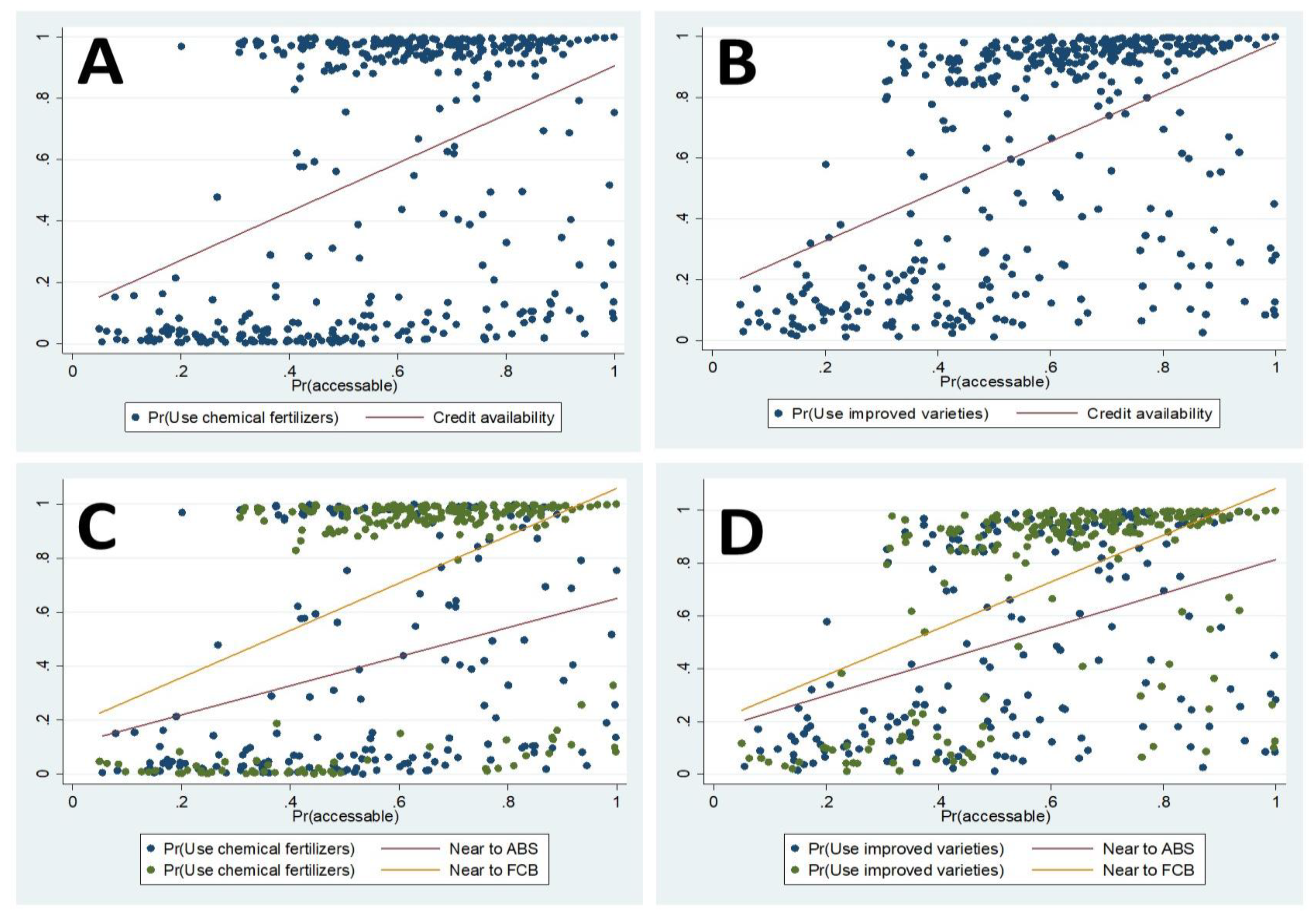
Many studies have shown that credit is crucial for the adoption of new agricultural inputs and technologies in developing countries. Hence, the issue about how financial institutions select farmer applicants to give loans to is very important. We used primary data from 401 rural households to show what kinds of farmers can get credit from banks in Sudan. The probit model is used to examine the factors that determine both farmers’ access to credit and the adoption of new inputs, and to show the nexus of credit accessibility and the adoption of new input through other factors. The main findings show that farming experience, the number of close friends, hire labor, cultivated land, irrigation, and extension services, are the factors that significantly determine farmers’ credit accessibility from banks. Some of these determinants, such as cultivated land and irrigation, also influence the adoption of new inputs. There exists a strong correlation between credit accessibility from banks and the possibility of using new input. In addition, an IV probit model shows that farmers’ use of chemical fertilizers and improved varieties directly influences the loan decision from banks. This means farmers’ credit demand induced by the chance of using new input actually has been satisfied by the banks in Sudan. The comparison results show that, for the subsample, for the Farmer’s Commercial Bank (FCB) the nexus between credit accessibility and the adoption of new inputs is stronger than that of the Agricultural Bank of Sudan (ABS). Therefore, this study recommended that the Sudan government should choose FCB as the lender of subsidized credit to increase the banks’ contribution to the development of plant production.
Keywords: agricultural credit; technology adoption; banks; probit model; Sudan agricultural credit; technology adoption; banks; probit model; Sudan