Review

Heat Stress and Histopathological Changes of Vital Organs: A Novel Approach to Assess Climate Resilience in Farm Animals

by
Ebenezer Binuni Rebez
1,
Veerasamy Sejian
1,*,
Mullakkalparambil Velayudhan Silpa
2 and
Frank R. Dunshea
3,4
1
Rajiv Gandhi Institute of Veterinary Education and Research, Kurumbapet, Pondicherry 605009, India
2
Institute of Animal Breeding and Genetics, Justus Liebig University Giessen, Ludwigstr. 21b, 35390 Giessen, Germany
3
School of Agriculture and Food, Faculty of Veterinary and Agricultural Sciences, The University of Melbourne, Melbourne, VIC 3010, Australia
4
Faculty of Biological Sciences, University of Leeds, Leeds LS2 9JT, UK
*
Author to whom correspondence should be addressed.
Sustainability 2023, 15(2), 1242; https://doi.org/10.3390/su15021242
Submission received: 3 December 2022 / Revised: 29 December 2022 / Accepted: 5 January 2023 / Published: 9 January 2023
(This article belongs to the Section Sustainable Agriculture)

Abstract

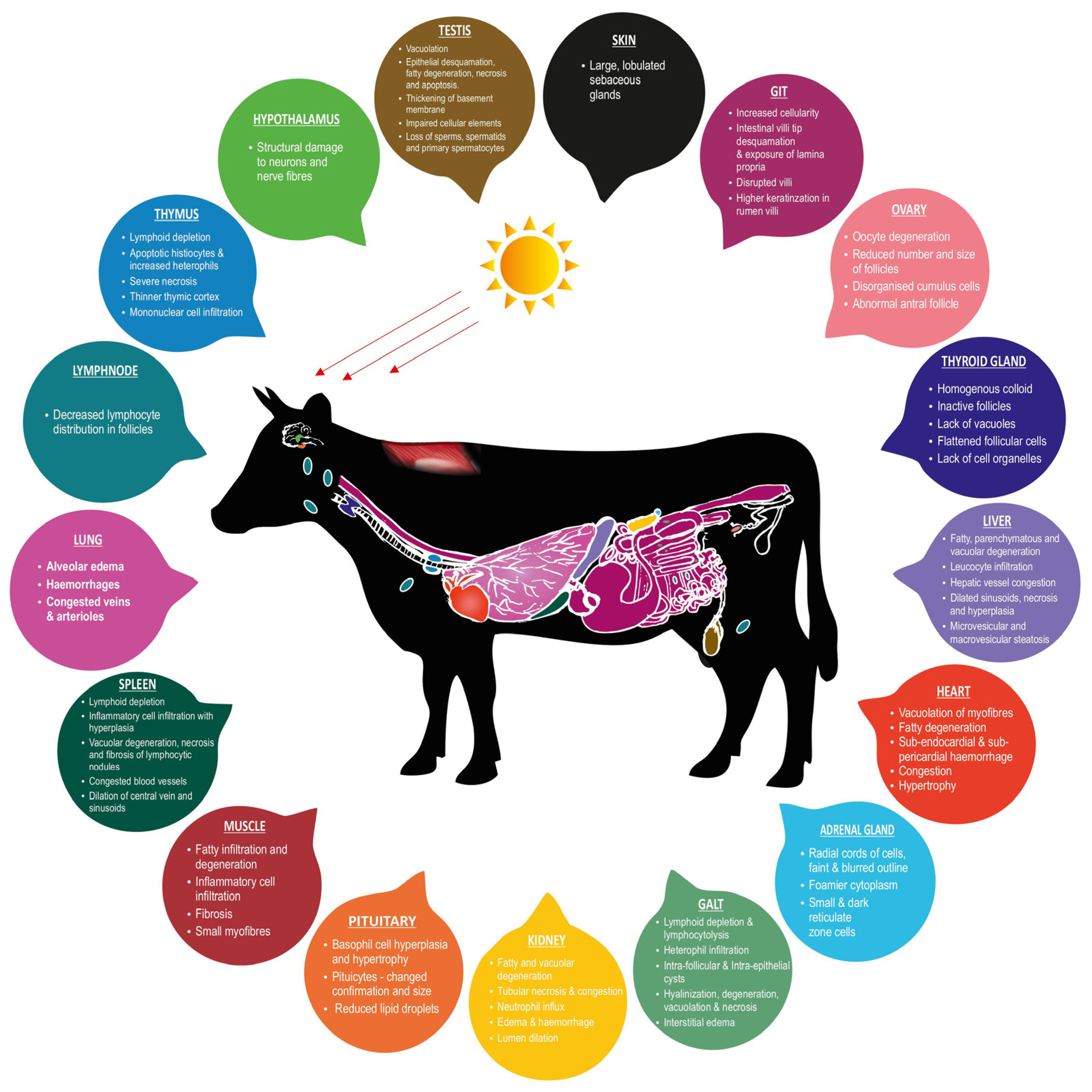
Heat stress causes functional and metabolic alterations in different cells and tissues. There are several pathomorphological changes and biomarkers associated with head load in adaptive and productive organs of livestock. Heat stress-induced histopathological alterations in livestock were categorized as degenerative changes (fatty degeneration, steatosis, hydropic degeneration), necrosis (pyknosis, fibrosis), circulatory disturbances (hyperemia, edema, hemorrhage, congestion, thrombosis, ischemia), growth disturbances (hyperplasia, atrophy) and focal/diffuse inflammation (vascular changes, exudation). Upon immunohistochemical analysis, the biomarkers identified in growth-related organs were HSP70, HSP60, GABA, GABAAR, GABABR, HSP90, GnRH, LH, FSH, m6A, Nrf2, and C/EBPβ. The biomarkers in the reproductive organs were HSP70, Bax, Bcl-2, GABA, GABAAR, GABABR, Caspase-3, HSP90, HSPB9, HSPB10, HSF1, HSP40, T, E2, Cyt-C, CAT, BCL2L1, and VEGF. The identified biomarkers in the immune organs were CD3+ T cells, CD4+ T cells, CD8+ T cells, HSP70, and Bcl-2. All these biomarkers could serve as reliable variables in heat stress assessment in livestock. Further, HSP70, HSP90, HSP60, NPY, HSP27, Bcl-2, NF-κB, AQP2, Insulin, CD3+ T cells, CD4+ T cells, CD172a, EGF, AQP1, AQP3, AQP4, AQP5, CRYAB, GHR, 5-HT, CCK, and GLP-1 are heat stress-related biomarkers in adaptive organs that help in assessing the climate resilience of a livestock species and improving understanding about adaptive mechanisms. Among these biomarkers, HSP70 was established to be the ideal cellular biomarker for scaling heat response in livestock. Thus, examining heat-stressed organ histopathology and identifying cellular markers by immunohistochemistry may lay the foundation for screening climate-resilient livestock breeds in the challenging climatic scenario. Further, such an approach could help in developing concepts to combat the detrimental consequences of heat stress to ensure sustainability in livestock production.
Keywords: heat stress; histopathology; HSP70; immunohistochemistry; livestock heat stress; histopathology; HSP70; immunohistochemistry; livestock